This post may contain affiliate links. If you make a purchase through these links, we may earn a commission at no additional cost to you.
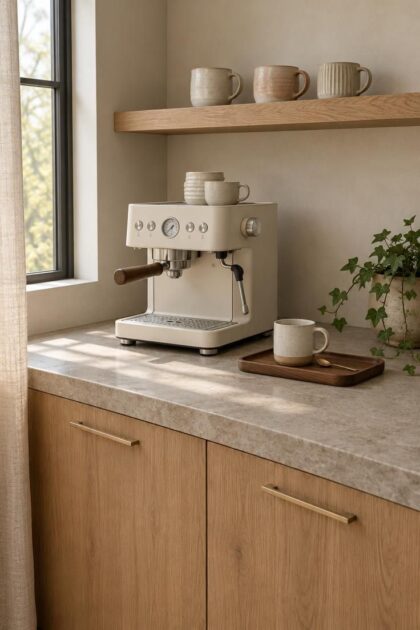
A coffee bar rarely looks cluttered because the household owns too many mugs.
It looks cluttered because the setup was arranged around how the equipment looks rather than around how a drink actually gets made.
The machine becomes a display object, the bags and tools pile up beside it, and the counter turns into a shelf instead of a work surface.
Treating the station as a compact ordering problem changes everything, from what sits out to where each item lives.
Why Layout Is the Real Clutter Problem, Not the Appliance Count
The strongest signal from recent industry reporting is that the home coffee bar has shifted from a machine purchase into an organized ritual space.
The National Kitchen and Bath Association’s 2026 Kitchen Trends Report found that 85 percent of surveyed kitchen and bath professionals expect dedicated beverage areas to be a popular kitchen feature over the next three years, according to reporting summarized in the research brief.
That figure comes from 634 industry respondents, so it describes professional expectation rather than installed reality, but the direction is clear: households are planning space for coffee rather than simply buying another brewer.
Clutter usually enters that space through a missing surface or a badly ordered sequence, not through excess equipment.
A three-cup pour-over setup with a reserved landing tray reads calmer than a single drip machine wedged against a toaster and a stack of mail.
The fix begins with a mental shift: the counter is a work surface first and a display surface second, which determines what earns a permanent place on top.
When a coffee bar layout is planned around sequence, the visible items are the ones in active use, and everything else has a home within arm’s reach.
The Workflow That Should Shape the Counter Sequence
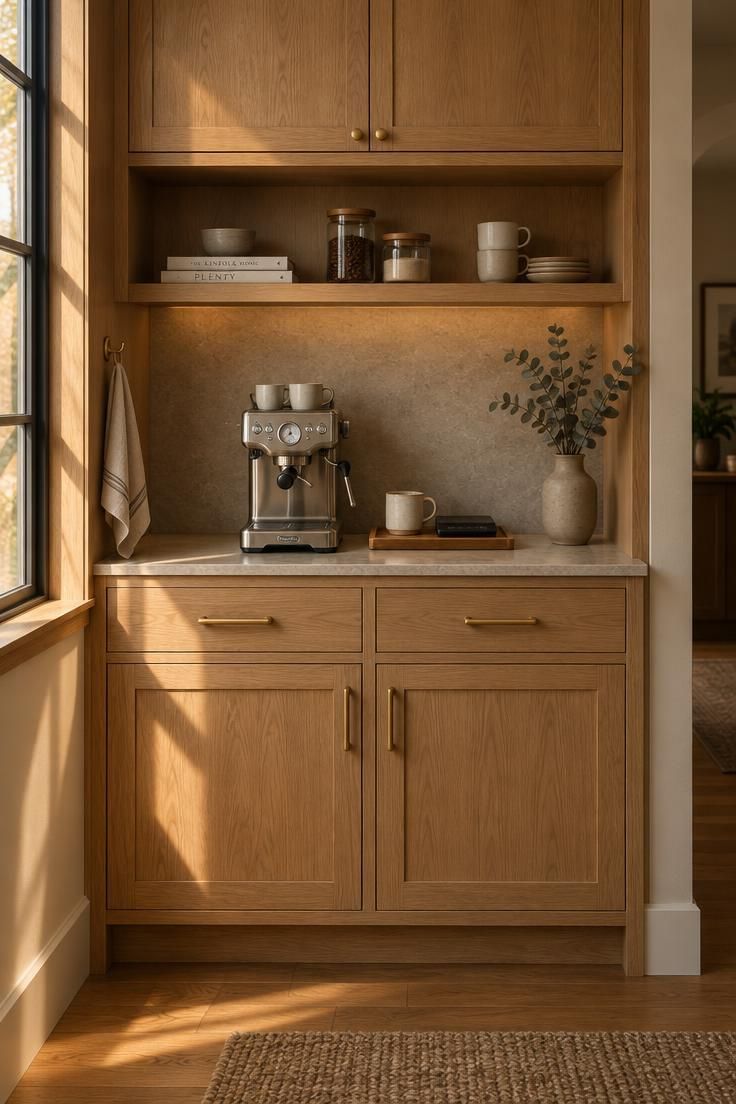
A residential coffee routine follows a rough order: store, grind, brew, finish, serve, clean.
Espresso adds two more stopping points, since tamping and milk handling each want their own patch of counter.
Clutter appears when one of those stops has nowhere assigned to it.
Cups migrate onto the only open patch, the grinder sits too far from the machine, or the milk pitcher ends up balanced on the drip tray.
The practical test is simple and costs nothing.
Set out the items needed for one typical morning drink on the bare counter, then walk through the routine the way it actually happens.
Count the cross-body reaches and the turns.
Each one marks a spot where the sequence broke down and where something will eventually pile up.
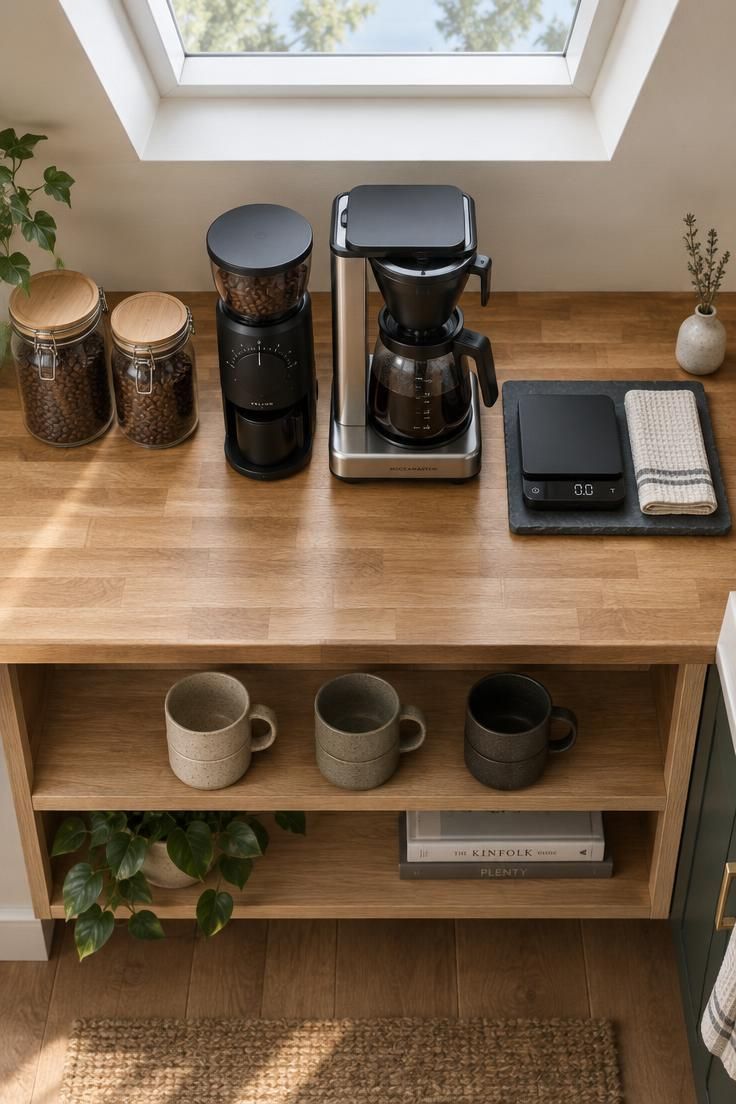
Many households discover that their daily drink needs two mugs, a scale, and a spoon within a single comfortable arc, while the pour-over kettle and the cold brew jar are really weekly items that belong in a cabinet.
That distinction between daily and occasional does more for visual calm than any storage purchase.
Landing Space Is the Difference Between Styled and Staged
The footprint listed for a coffee machine rarely matches the space the routine actually consumes.
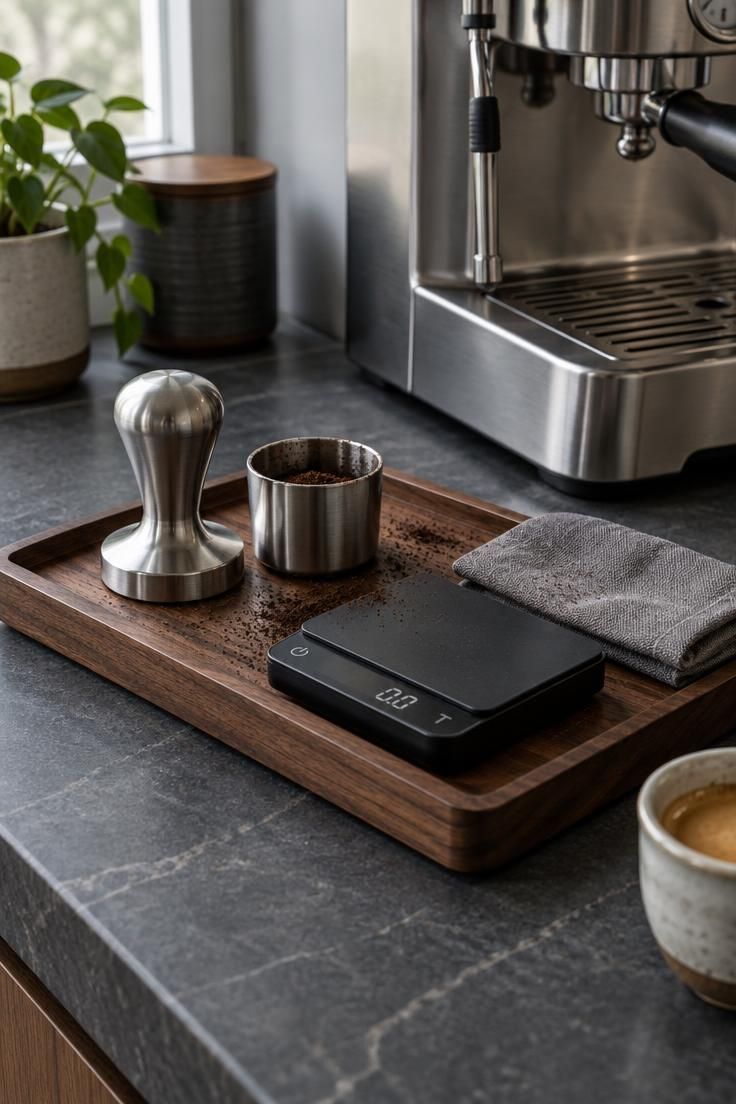
A scale, a portafilter, a milk pitcher, a carafe, or a spoon all want somewhere to sit during the two minutes they are in hand.
A drip brewer needs room for the carafe plus a mug and a filter canister.
An espresso setup needs space for a distribution tool, a tamper, a scale, and a small rinse cup or knock box.
Treating coffee station landing space as a permanently reserved zone, rather than leftover counter, is the single change that keeps most setups from sliding into disorder.
A shallow tray or a small mat defines that zone visually, so a family member instinctively returns the tamper to its place instead of leaving it near the sink.
The tray also catches stray grounds, which keeps the surrounding surface easier to wipe down.
Choose the tray size after measuring the largest item that will sit on it during a normal morning, not after choosing the machine.
Storage Drawers That Keep the Counter and the Visual Field Clear
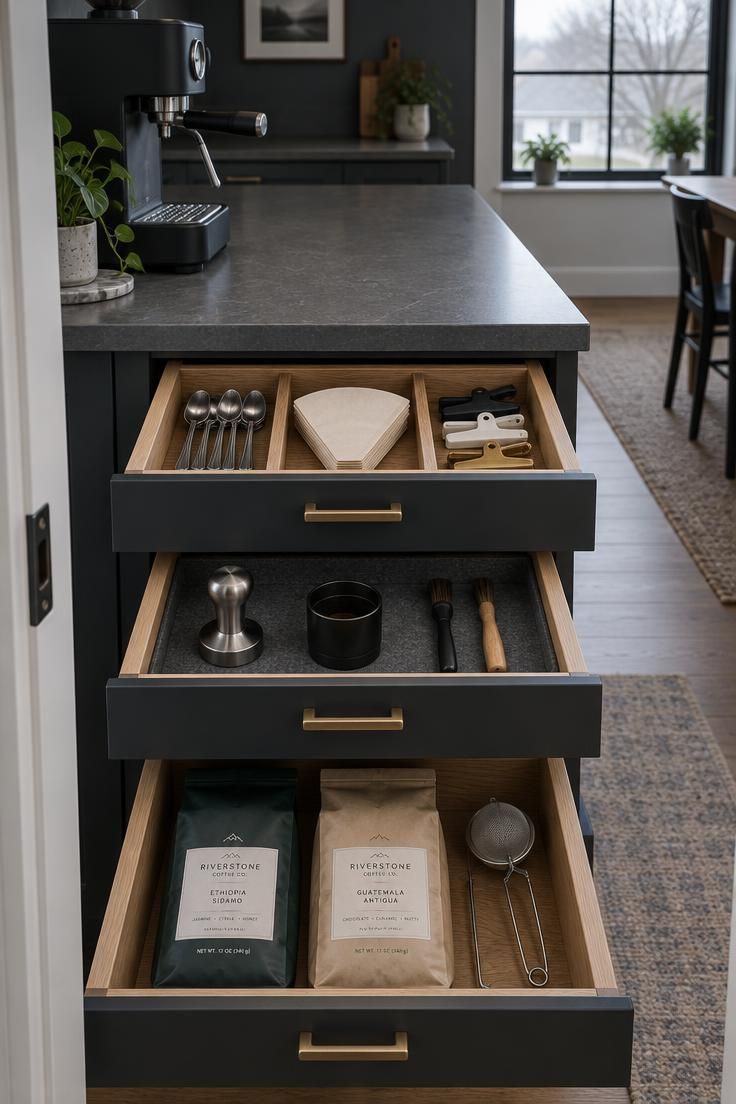
Drawers outperform lower cabinet doors for coffee accessories because everything arrives in a single pull.
A useful three-tier logic places small tools and filters in the top drawer, tamping tools and scales in the middle, and backup beans, tea, and less-used items in the lower drawer.
Coffee bar storage drawers done this way turn a shallow depth into an advantage, since a shallow drawer directly beneath the machine keeps tampers, dosing cups, and cleaning brushes within easy reach.
Open shelving offers a different tradeoff.
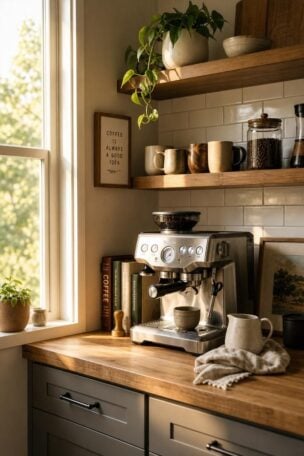
It reads like a small cafe, but it collects dust and stray grounds and it asks for a decision about every object that stays visible.
Closed storage absorbs that decision and produces a calmer surface.
One threshold helps with the sorting: an item used less than once a day does not need a permanent spot on the counter.
Applying that rule usually empties half the surface in a single pass.
Appliance Garages and the Concealment Tradeoff
An appliance garage hides the machine behind a door that lifts, rolls, or slides, which keeps a compact counter looking composed between uses.
Depth is where these units succeed or fail.
The interior has to accommodate the machine while leaving clearance for the water reservoir, the cord, and the space steam and heat need.
The practical rule from the research is straightforward: do not close the door while a machine is producing noticeable heat or steam.
Visual options vary.
A tambour panel rolls up into a small housing, a bi-fold door folds flat against the adjacent cabinet, and a pocket door slides out of sight altogether.
The most usable arrangements keep the landing tray inside the garage, so the machine is ready the moment the door opens and the tools do not have to be unpacked from a cabinet each time.
That single detail separates a garage that gets used from one that becomes a hiding place for neglected equipment.
Where the Coffee Bar Lives Determines How Cluttered It Feels
Location is a morning traffic question before it is a styling question.
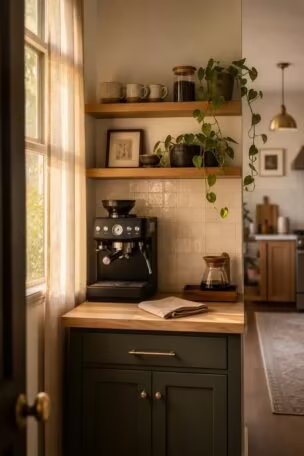
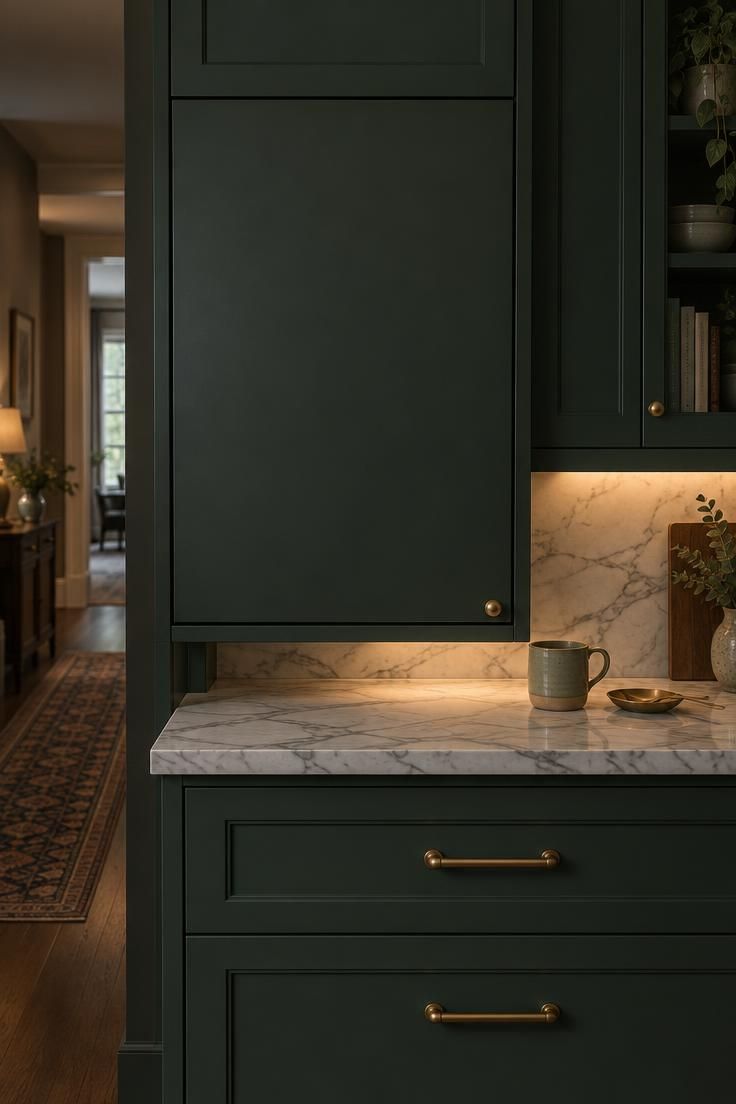
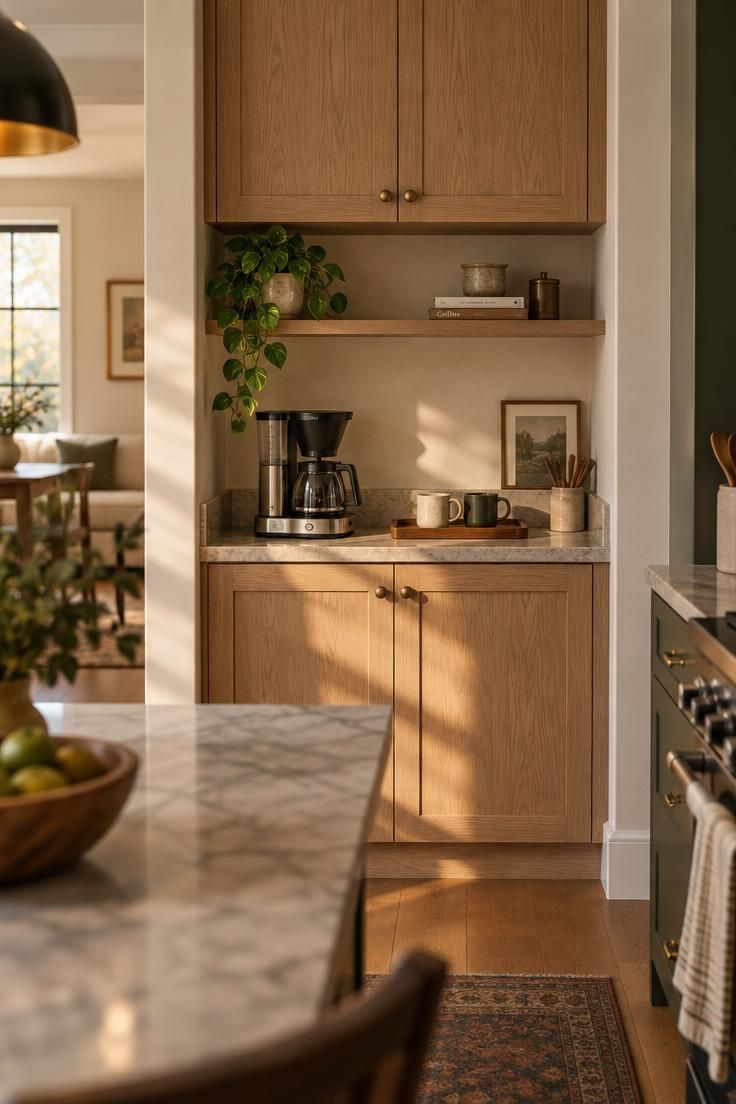
Common placements include a run of kitchen cabinetry, a pantry or butler’s pantry, a breakfast area, a dining room sideboard, a hallway or transition space, or a recessed niche in a wall.
Each of these supports a different coffee bar workflow.
A pantry alcove keeps the station out of the cooking zone, a sideboard in the dining room turns the morning routine into a small sit-down moment, and a hallway niche keeps the equipment close to where the household actually walks.
Congestion is the caution worth repeating.
Placing the station directly in the main cooking-prep zone, or beside the primary sink or a narrow kitchen entrance, creates friction when several people share the kitchen in the morning.
A household of one can often ignore that advice without consequence.
A household of four getting ready at the same hour usually cannot.
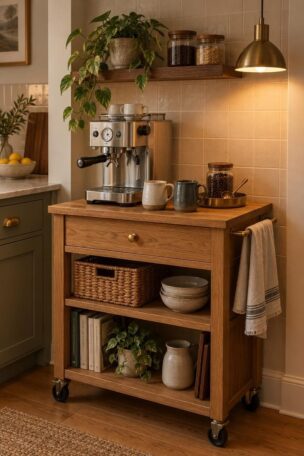
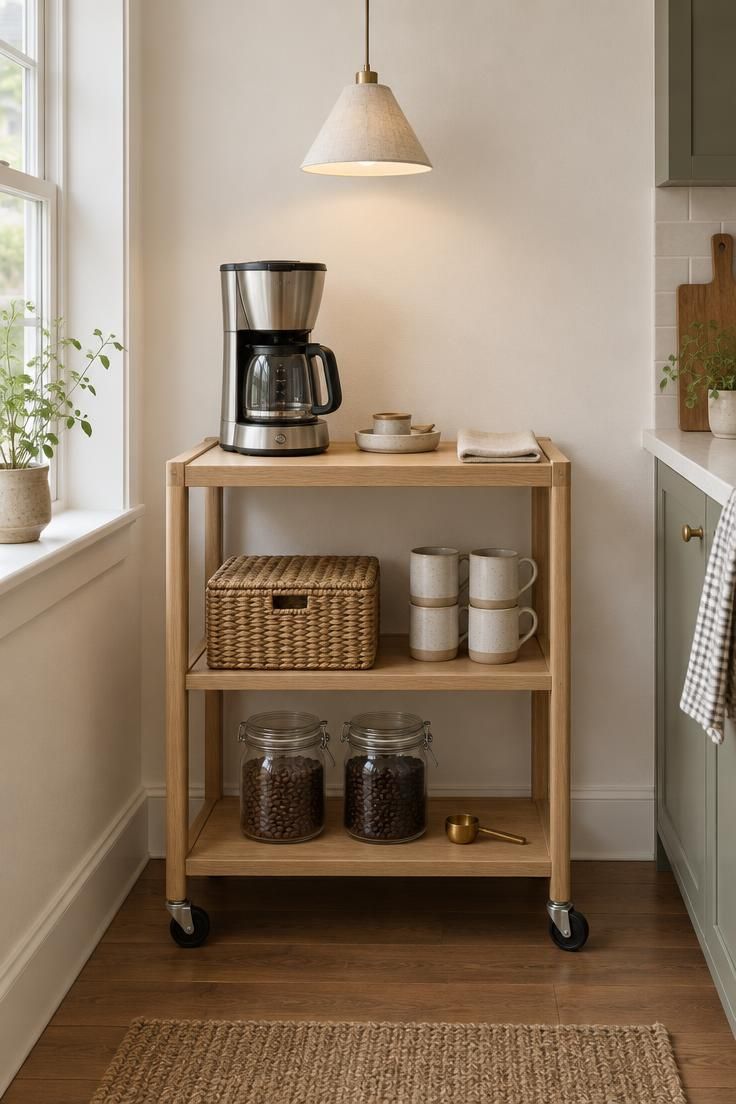
For smaller homes and rentals, a rolling cart or a narrow console delivers the same sequence without a permanent footprint, and it can be pushed against a wall or into a closet when the space is needed for something else.
Water and Power Access Shape the Practical Layout
A reservoir-fed coffee setup asks for one thing above all: clear access to the tank.
If the machine sits under a low cabinet or inside a garage, refilling means pulling the whole unit forward, which quickly discourages daily use and pushes the machine back onto the open counter.
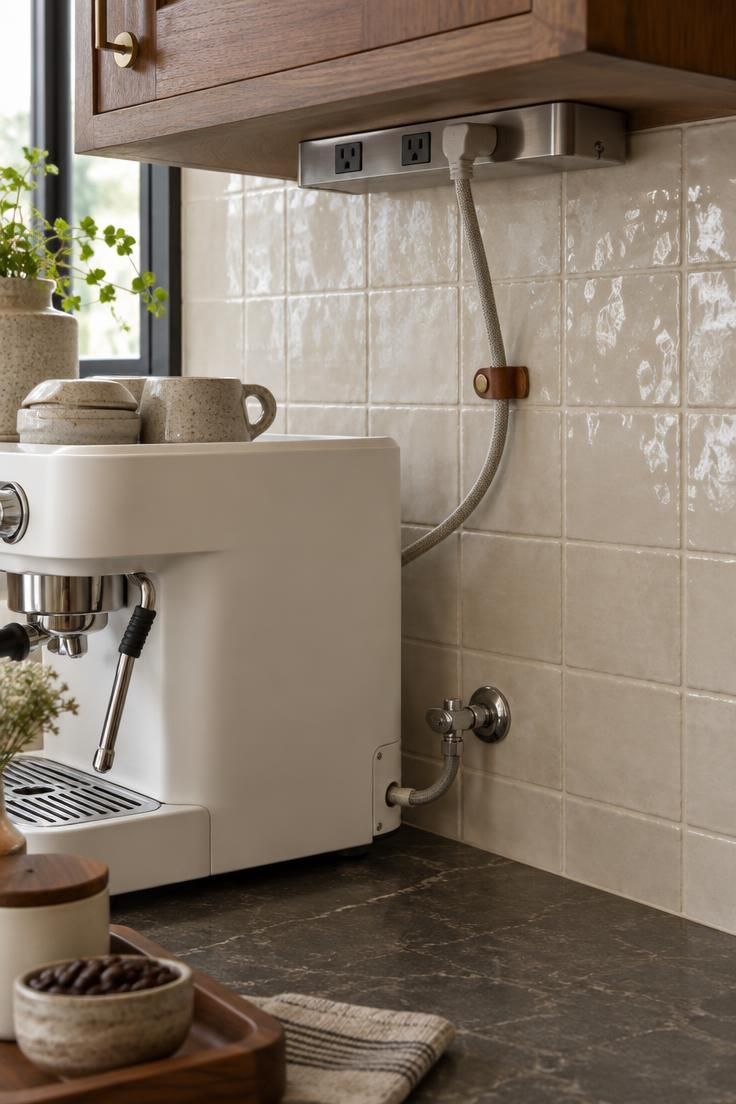
A plumbed machine trades that chore for a water line that has to be planned before the cabinetry goes in, which is a decision for a licensed plumber rather than a weekend project.
A small prep sink can help with espresso cleanup and rinsing, but the research suggests placing it to the side of the main brewing surface rather than directly in front of it, so the working area stays open during a pour.
Power follows the same planning logic.
Coffee machines, grinders, and the occasional kettle may each want an outlet, and the placement is far easier to resolve before the backsplash and counter are installed than after.
An electrician determines circuit capacity and any protection requirements, so the layout conversation stays at the level of outlet count and location rather than wiring detail.
How Far Should You Go With a Small or Rental-Friendly Setup?
A built-in coffee bar is a commitment, and plenty of homes and rentals call for something that can move.
A rolling cart, a narrow console, or a low dresser topped with stone or butcher block can deliver the same sequence and the same concealment when the ordering logic stays the same.
The cart approach works best when it has a dedicated landing tray on top, a drawer or lidded bin for tools, and a closed basket or lidded box for bulk supplies.
Taller carts sometimes carry a small upper shelf, which can hold mugs or a stack of filters without adding visual noise at counter height.
The advantage of freestanding pieces is not only portability.
They can be resized or replaced as the household’s routine shifts, whether that means moving from drip to espresso or gaining a second daily coffee drinker.
A built-in cannot be pushed into a corner when the kitchen needs the space back, and a cart can.
Current Style Direction: Warm, Quiet, and Less Themed
The leading residential direction leans toward warm and residential rather than glossy or commercial.
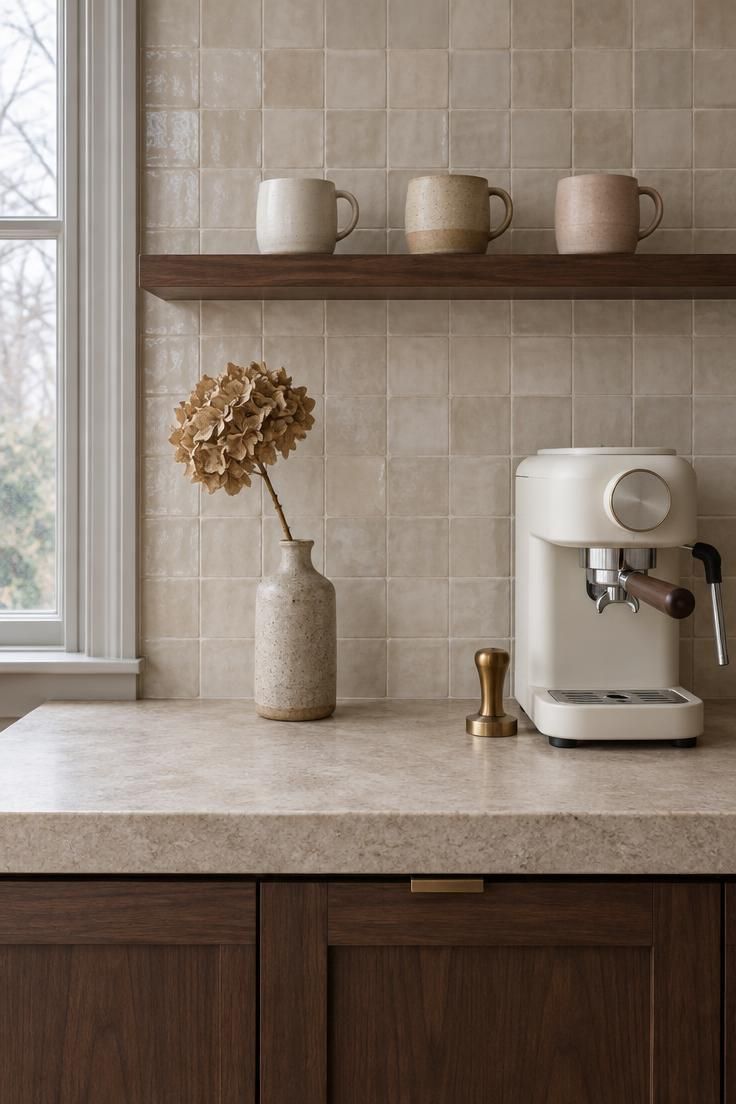
White oak and walnut, honed stone, handmade-look tile, brushed brass or aged bronze, and natural fibers show up across recent reporting, while highly rustic farmhouse decor and coffee-themed typography appear to be fading.
The style question is really a layout question in disguise.
Warm, quiet materials let a compact station feel composed, and a loud backsplash or a word-art sign competes with the machine for attention.
Each object on the counter then has to justify itself against a busier visual field, which usually means fewer objects stay out.
Historical coffee service offers a useful reference point.
Ottoman and European traditions expressed coffee culture through ritual and material rather than through heavy theme, and the modern home station can borrow that restraint without recreating any specific period.
A honed stone counter, a soft ivory backsplash, and three ceramic mugs on a walnut shelf carry more of that history than a printed sign ever will.
Why the Data Is Useful but Not a Prescription
The trend data behind coffee bars comes from several directions, and each source measures something slightly different.
The National Kitchen and Bath Association survey captures what kitchen and bath professionals expect to see specified in the coming years.
Houzz’s 2026 Kitchen Trends Study, which surveyed 1,780 U.S. homeowners who were renovating, found that 24 percent included a beverage station such as a coffee or espresso bar.
The American Institute of Architects’ Home Design Trends Survey reported a net increase in coffee bar popularity among surveyed residential architects.
Each of those sources leans toward design-conscious households and working professionals, so the numbers describe where renovated kitchens are heading rather than what most homes currently contain.
National Coffee Association data tells a different story about daily habits.
A Fall 2025 survey found that 82 percent of past-day coffee drinkers had their coffee at home, with drip brewers at 38 percent, single-cup machines at 23 percent, cold brew at 17 percent, and espresso at 11 percent.
That distribution matters for layout planning.
Most home setups are built around a drip or single-cup machine, which needs a shorter workflow and less landing space than a full espresso station.
Reading the surveys together suggests that more households are making room for a coffee routine, and that the room they make usually benefits from better organization more than from additional features.
Conclusion
A good coffee bar layout should let someone make a typical daily drink without walking more than a step or two between storage, grinder, brewer, and cup.
Check landing space before choosing appliances, since the reserved work zone determines how the counter actually functions.
Reserve drawers for the tools used every morning, keep the number of open surfaces low, and place the station away from the busiest prep zone if more than one person shares the kitchen.
Pick the spot where coffee already happens in the household, clear the counter down to the machine, and set out a single tray for the tools of one drink.
That tray is the first thing to try, and it usually shows within a week where the rest of the layout needs to change.