This post may contain affiliate links. If you make a purchase through these links, we may earn a commission at no additional cost to you.
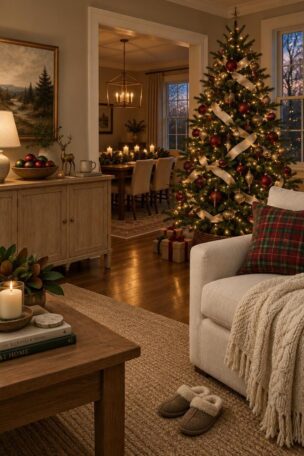
Winter home decor works through texture, tone, and light rather than a full seasonal overhaul.
The cold-season look starts with nubby textiles placed against smooth surfaces, bare branches and evergreen sprigs in simple vessels, and low warm light sources that create soft pools of glow.
Each idea here can stand alone as a small vignette or serve as an easy swap when the weather turns.
The focus stays on what to place and why it reads as winter, from full-room compositions to small detail arrangements.
Layered Throw Blankets on a Deep-Seated Sofa
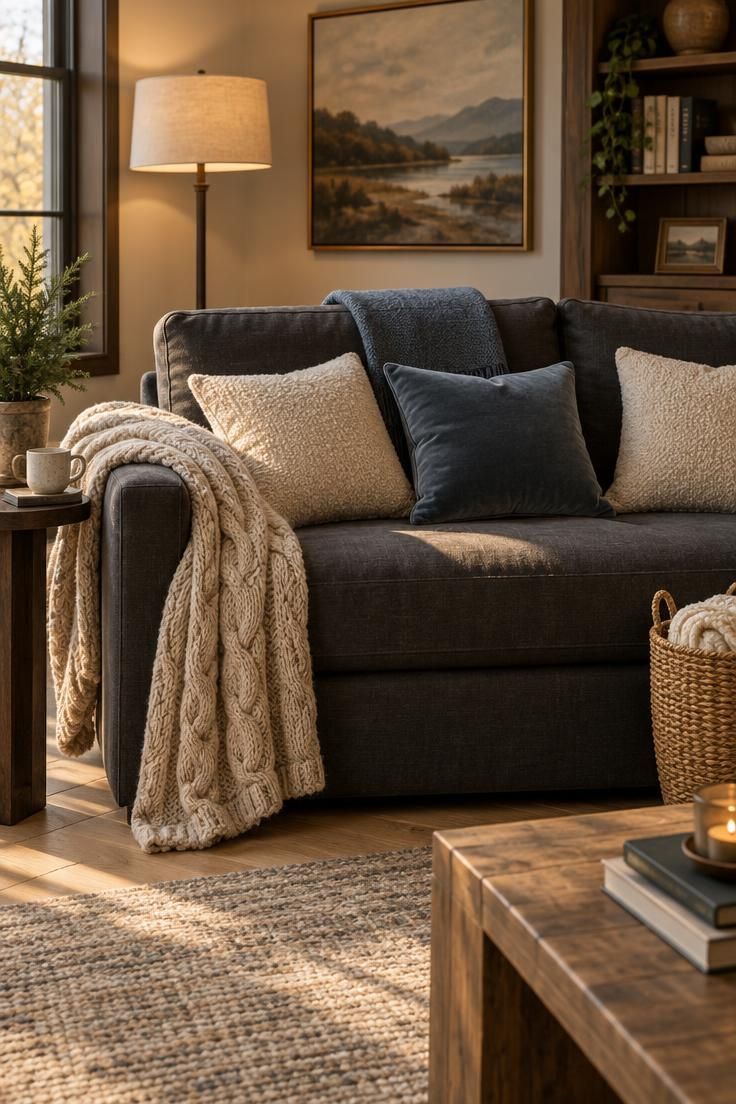
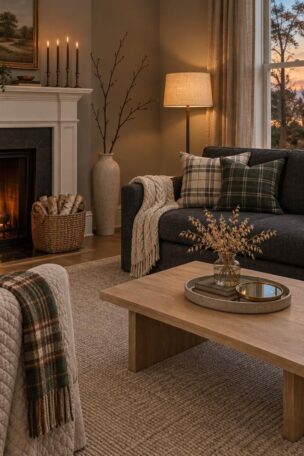
Throws do more visual work than any other single layer on a sofa, and placing them with intent keeps them from looking tossed.
A wide sofa arm holds a long drape well, while a seat crease anchors a tighter fold that stays put.
Mixing one high-pile knit with one smooth woven fabric gives the eye two distinct surfaces to read across the same piece of furniture.
Palette choice follows the room.
Against cool wall colors, lean warmer with an oatmeal or camel throw that softens the surrounding gray or blue.
In a room that is already beige, a charcoal or forest-green layer adds definition without breaking the calm.
Two to three layered throw blankets per seating area tend to look considered.
Beyond that, the pile starts to read as clutter, and the sofa loses its silhouette.
Roll the surplus blanket into a basket so it stays visible but contained.
Style Blueprint:
- Deep-seated sofa in charcoal linen
- One chunky knit throw in oatmeal
- One smooth woven throw in slate blue or forest green
- Seagrass basket for a rolled spare throw
- Bouclé and velvet cushions in mixed sizes
Evergreen and Bare-Branch Asymmetry in a Stoneware Vase
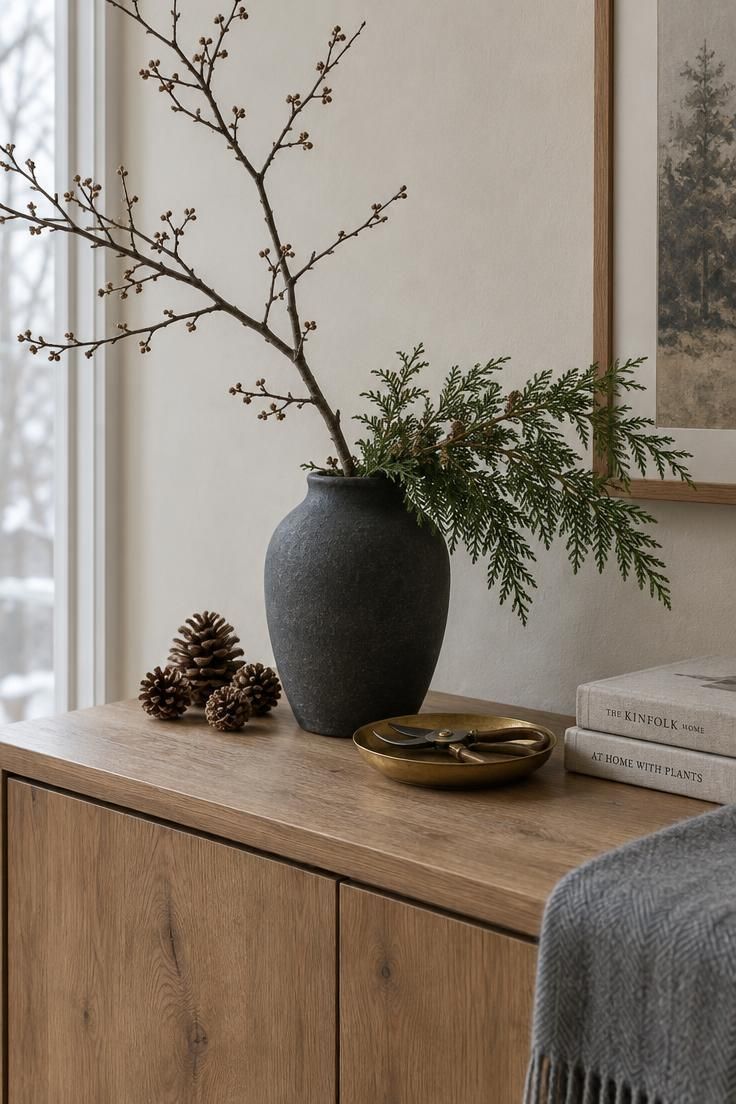
Branches placed off center read as contemporary, while a symmetrical bunch tends to look dated.
A single tall stem in a narrow or matte vessel gives the eye one strong vertical line, and a short evergreen sprig near its base keeps the arrangement from feeling sparse.
Stepped stem heights create a natural line that mirrors how branches grow outdoors.
Fresh greenery sheds as it dries, so evergreen arrangements belong on surfaces that are easy to wipe.
A sideboard or dining table with a smooth finish is a low-maintenance spot, and a quick sweep every few days keeps the area tidy.
Small or narrow rooms benefit from a reduced version of the same idea.
On a slim console, one tall branch plus one short evergreen sprig fills the surface without crowding it.
The vase does most of the styling work when the silhouette is clean.
Mixing fresh and dried elements in one vessel asks for a little editing over time.
Remove the evergreen once it starts to brown, and keep the bare branch as the constant element through the coldest weeks.
Style Blueprint:
- Matte stoneware vase in charcoal or mushroom
- One tall bare branch plus one evergreen sprig
- Pinecones as loose surface accents
- Small brass dish to hold snips
Winter Mantel Styling with Mixed Heights and a Leaner Mirror
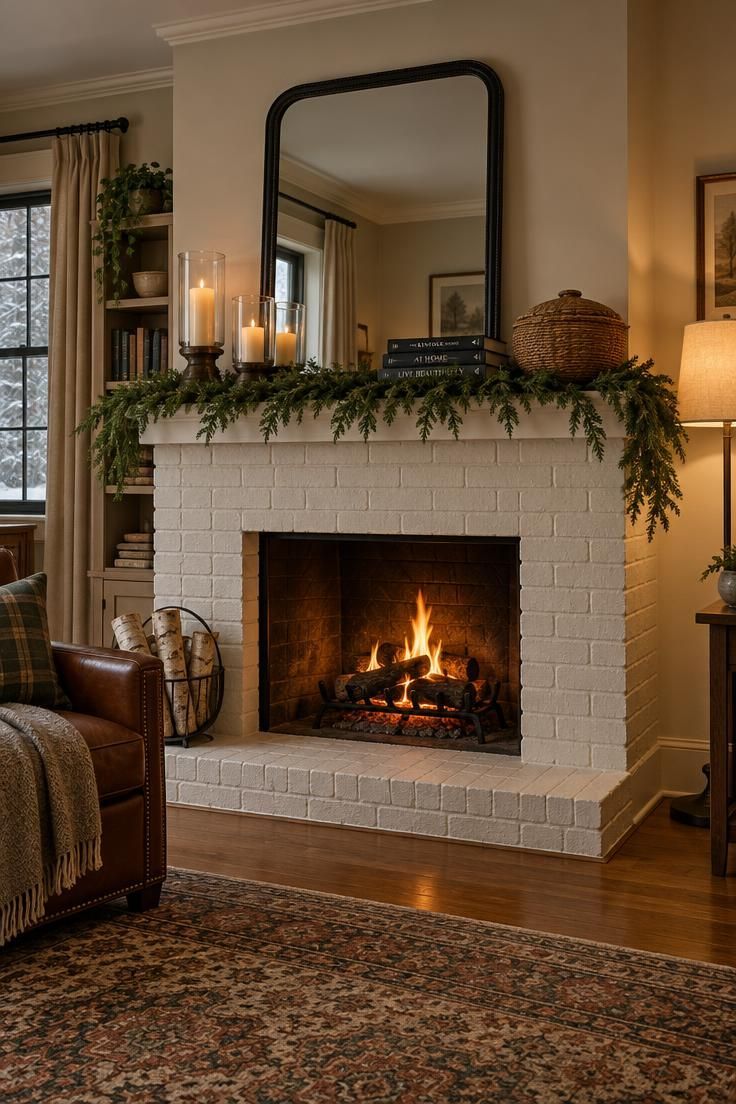
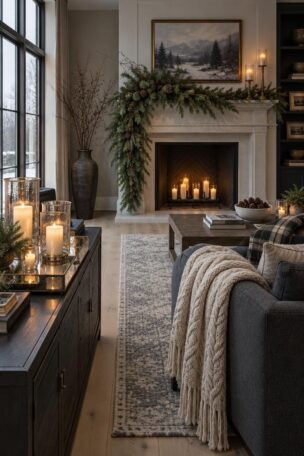
A mantel reads as composed when three heights are in play: the tall mirror behind, the long low garland across the front, and smaller objects filling the gaps.
Winter mantel styling lives or dies on that layering, and the mirror gives the arrangement a vertical anchor so the garland does not float.
Too many small objects turn the ledge into a shelf of clutter.
One large anchor, whether the mirror or a bundle of branches, lets everything else support it rather than compete.
Clustering the small pieces in odd numbers keeps the rhythm relaxed.
A rental without a working fireplace can still borrow the idea.
A freestanding shelf or a deep windowsill takes the same three-height treatment, with a leaned frame in place of the mirror and a low garland along the front edge.
Weight distribution matters as much as height.
Keep one end noticeably heavier with a basket or a stack of books, and let the other end breathe.
The uneven balance keeps the arrangement from resembling a row of items lined up along the ledge.
Style Blueprint:
- Tall leaner mirror with a slim dark frame
- Low cedar or fir garland along the front edge
- Glass hurricane holders at two heights
- Round woven basket as the heavy end
- Small stack of dark books
Design Pro-Tip: Cluster the small objects in odd numbers and keep one end heavier than the other so the composition moves instead of marching in a straight line.
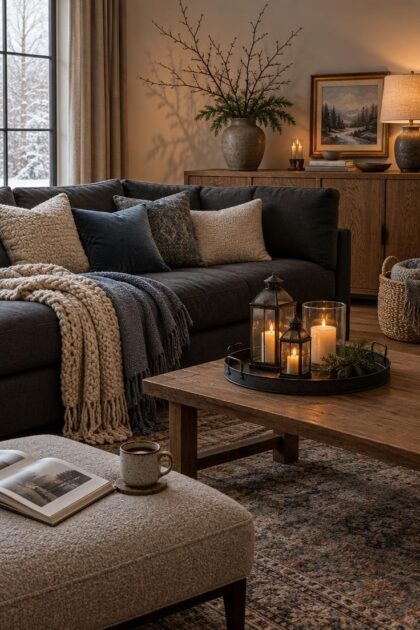
Candle and Lantern Groupings on a Low Coffee Table
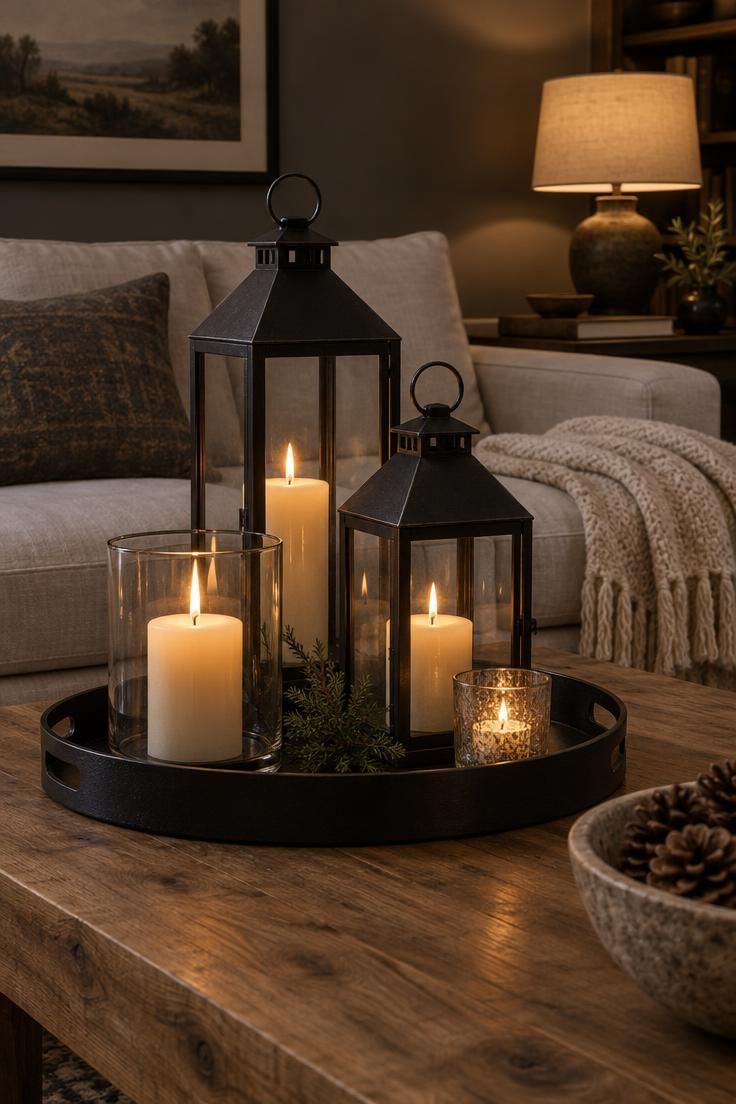
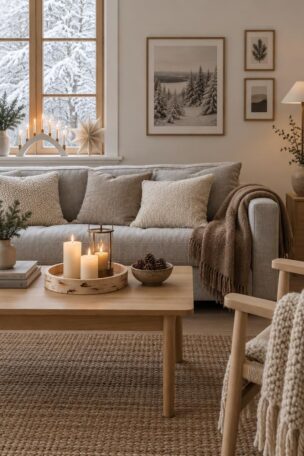
Candle and lantern groupings turn a coffee table into a small winter vignette when the pieces share a material or finish.
Keeping to all glass or all black metal makes the cluster feel intentional, while staggered heights give it the rhythm that a flat row lacks.
A tray corrals the whole group and lets it move off the table when space is needed.
The visual payoff comes from contrast between the warm flames and the low surrounding light.
Grouping the tallest piece at the back and stepping the rest forward creates a triangular silhouette that reads clearly from the sofa.
Safety deserves a quick word here: an open flame near a knit throw or a dry garland calls for keeping textiles and greenery clear of the glass, and battery-operated candles offer the same glow in a room where children or pets are in the mix.
A low table or an ottoman both work as the base.
Clear the surface of everything except the tray so the grouping stays the single focal point of the table.
Style Blueprint:
- Round brass or black metal tray
- Two lanterns in one finish family
- Clear glass hurricane with a cream pillar candle
- Small glass votive for the front edge
Design Pro-Tip: Place the tallest candle or lantern at the back and stagger the rest forward so the group reads as a triangle from the sofa view.
Small-Space Winter Styling on a Deep Windowsill
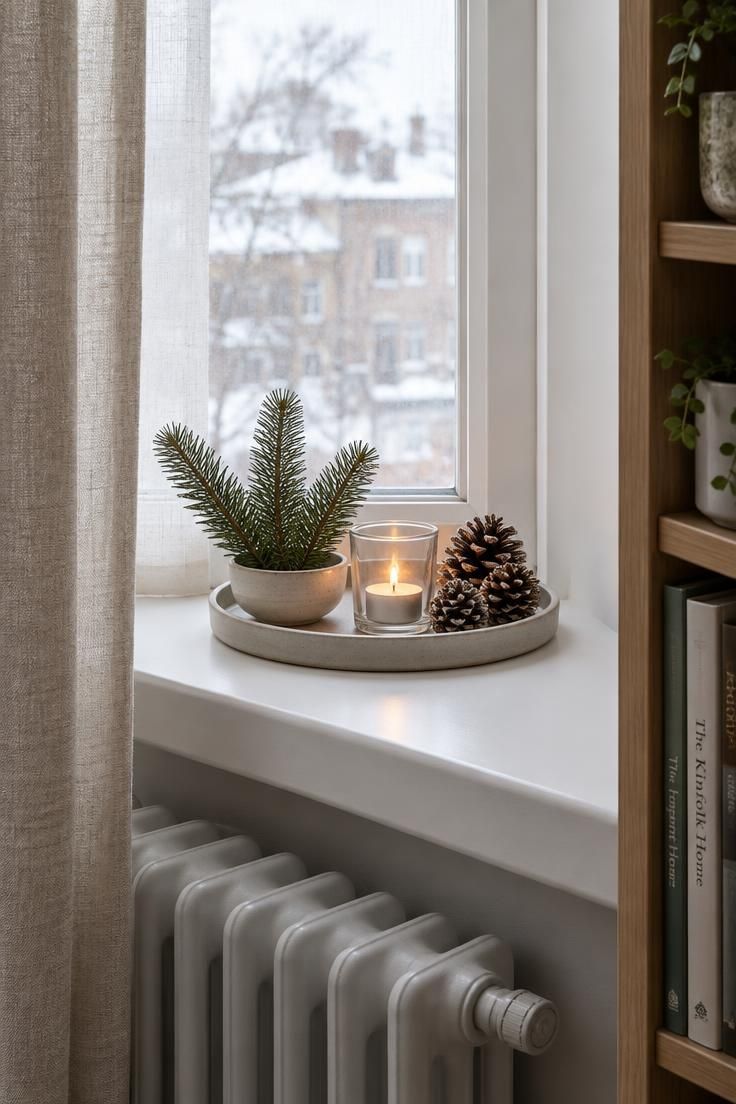
Apartments and narrow rooms rarely have space for floor arrangements, so a deep sill works well as display space for winter home decor.
A low dish of evergreen sprigs, one small candle in a glass holder, and a couple of pinecones sit comfortably in the frame of a window without blocking the light.
Small spaces reward repetition.
Sticking to one material or tone, all clear glass or all matte ceramics, keeps the eye from jumping between unrelated objects.
The vignette reads as one idea rather than a collection of small things.
Daylight direction shapes the choice of finish.
A bright window rewards translucent glass that catches and softens the light, while a shaded corner settles well with matte ceramics that hold their color under low light.
Defining the edge of the vignette matters more here than in larger rooms.
A tray or saucer keeps the grouping from creeping along the sill and gives the display a clear boundary.
Style Blueprint:
- Small ceramic dish or saucer as the base
- Three evergreen sprigs
- Clear glass votive holder
- Two pinecones at the edge
Design Pro-Tip: Use a tray or saucer to define the vignette’s edge so a small arrangement doesn’t spread across the whole windowsill.
Frosted Glass and Silver-Tone Accents on Open Shelving
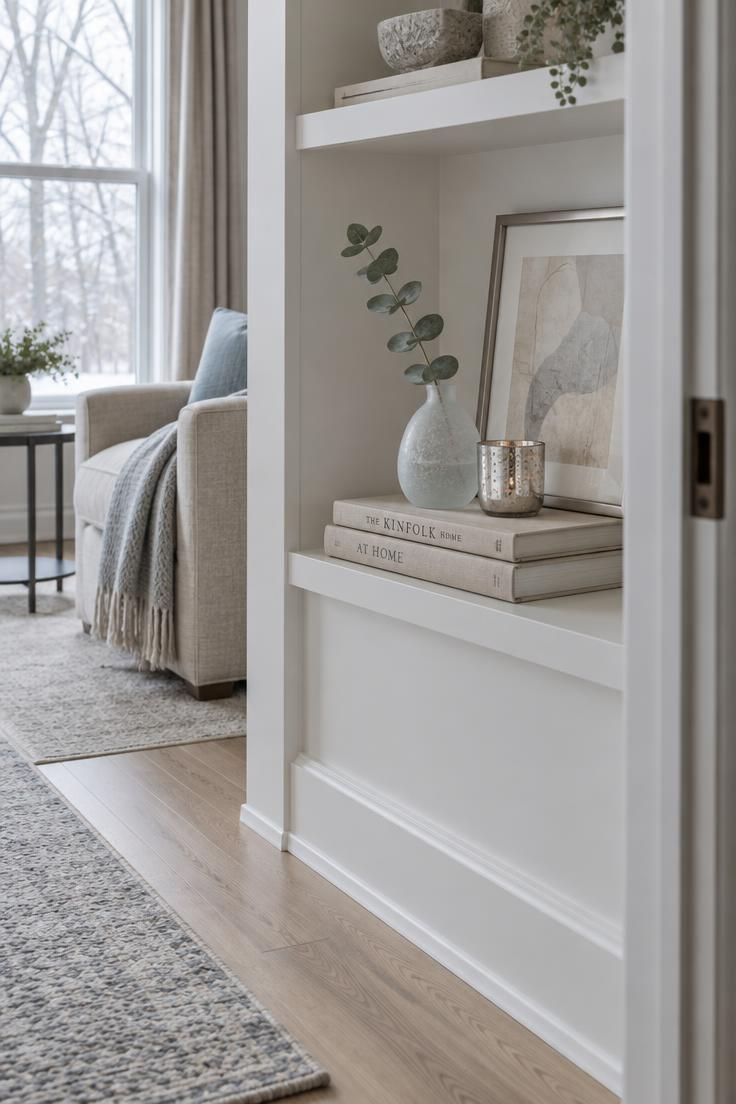
Cool accents give a winter room a counterpoint to all the warm textiles.
Frosted glass, mercury glass, and a single metal finish calm a scheme that might otherwise tip too far into beige.
Keeping the metallics in one family, brushed silver or aged pewter, prevents the cool surface from looking like a mix of leftovers.
A single styled shelf does more than a scattered collection across a whole bookcase.
Concentrating the small-space winter styling on one ledge lets the objects read as a group, and the empty shelf space around them keeps the cool palette from feeling sparse.
One natural element balances the cool materials.
A gray-green eucalyptus sprig or a single dried stem adds an organic line that softens the glass and metal without warming the palette too much.
Style Blueprint:
- Frosted glass bud vase
- Mercury-glass candleholder
- Brushed nickel or pewter frame
- Two pale books stacked flat
- One eucalyptus stem
Winter Table Centerpiece with Low Greenery and Warm Wood
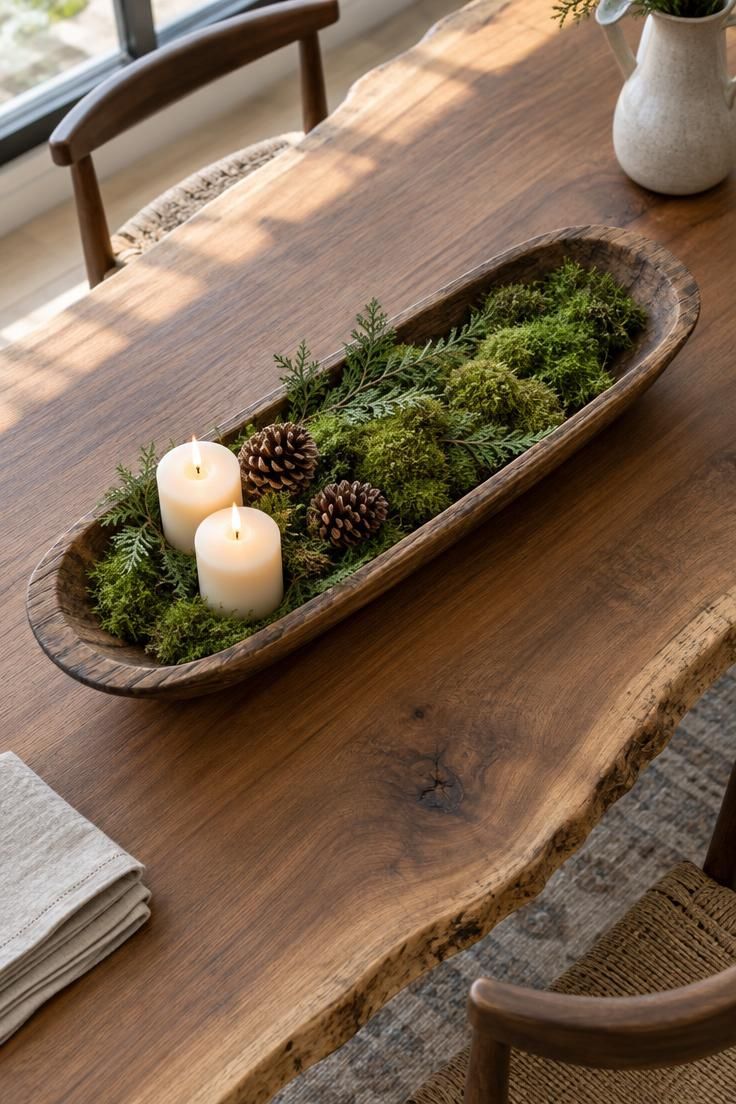
A long low bowl keeps sightlines open across a dining table, which matters more in smaller dining areas where a tall arrangement would block the view between seats.
A dough bowl filled with moss, evergreen sprigs, and a few pinecones reads as winter without any holiday-specific motif.
Grouping the candles at one end instead of centering them lets the centerpiece work at different states of dress.
A fully set table looks balanced with the candles at the end, and a partly cleared table still reads as styled.
Dried and preserved materials keep their look through the season with little attention, while fresh greenery will shed and need occasional sweeping.
A mix of the two lets the arrangement change gradually and still hold its shape.
Style Blueprint:
- Long wooden dough bowl
- Preserved moss as the base layer
- Small cedar or fir sprigs
- Two pinecones
- Two short ivory pillar candles
Design Pro-Tip: Group the candles at one end of the bowl rather than centering them so the arrangement works whether the table is fully set or partly cleared.
Warm Wood and Natural Baskets on a Winter Console
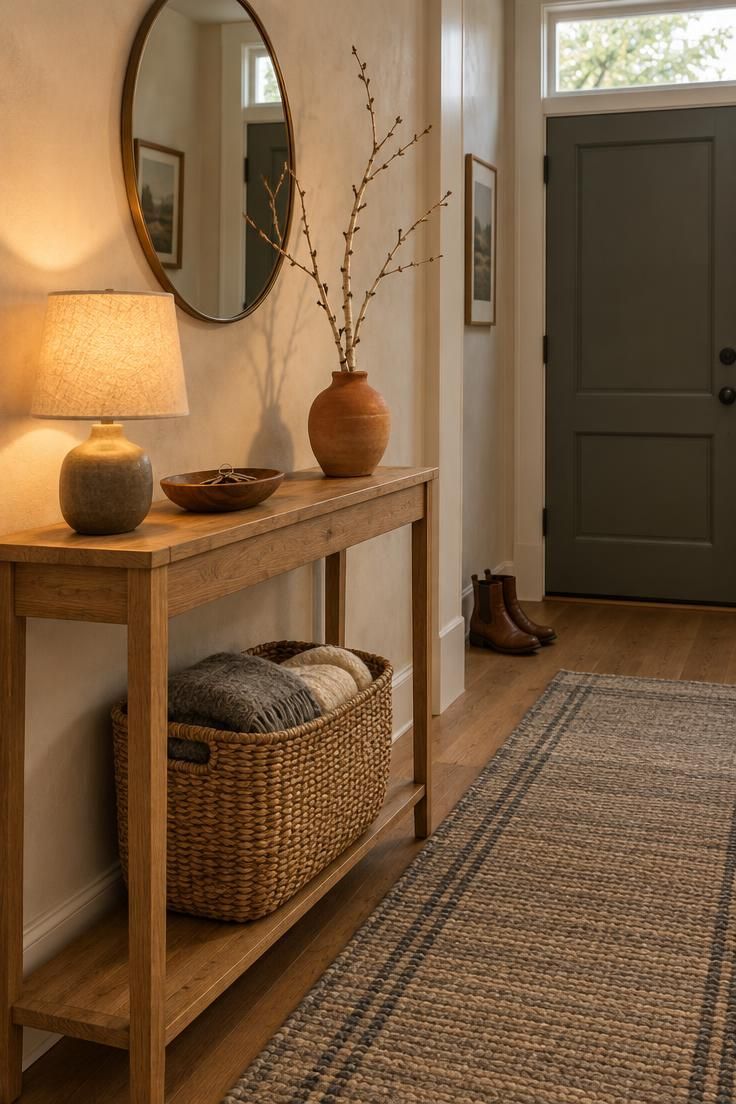
Warm wood and woven textures offset the cool daylight that pours through entry windows in winter.
A slim oak console with a basket below and a small wooden bowl on top gives the hall a natural-material palette that reads seasonal without leaning on holiday motifs.
A basket dedicated to scarves and gloves keeps the console from becoming a drop zone.
The lower shelf holds the excess, and the top stays clear enough for keys and one branch in a vase.
Texture contrast carries the look in low light, where color differences fade.
Pairing one smooth wooden object with one rough woven one makes the material change visible even on a gray afternoon.
Style Blueprint:
- Slim oak console
- Woven abaca basket for throws
- Small acacia wood bowl
- Terracotta bud vase with a birch branch
Design Pro-Tip: Pair one smooth wooden object with one rough woven one so the texture difference still reads in low winter light.
String Lights Inside a Glass Cloche on a Bedside Table
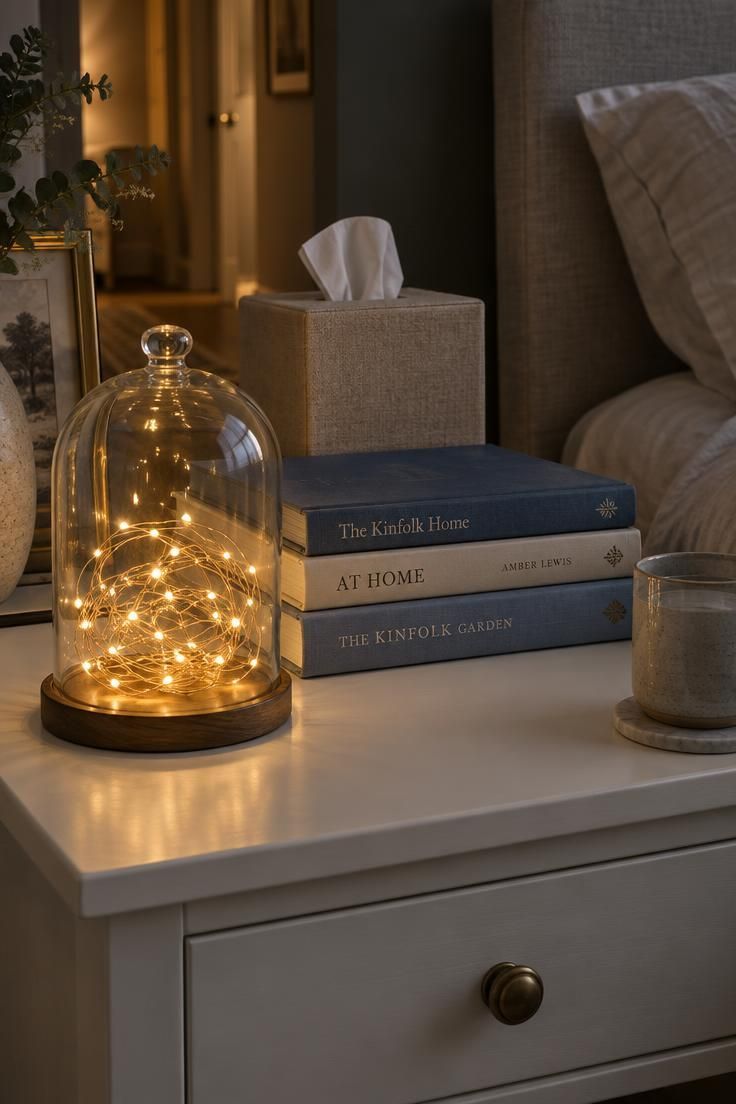
String lights can bring a soft point of glow to a bedroom without the visual tangle of loose strands.
Contained inside a clear glass cloche or a large hurricane jar, the bundle reads as a decorative object during the day and a warm pool of light at night.
The cloche takes up less room than a floor lantern and sits comfortably on a narrow bedside table.
Keeping the cord behind the book stack and the switch facing the bed turns the piece into something easy to live with.
Battery-operated strands suit this use well since they avoid a cord crossing the table surface.
The glow stays low and local, which keeps the rest of the bedroom in soft shadow.
Style Blueprint:
- Clear glass cloche or large hurricane jar
- Battery-operated warm white string lights
- Short stack of muted hardcover books
- Natural linen tissue box cover
Winter Bedding Layers with a Quilted Coverlet and Textured Throw
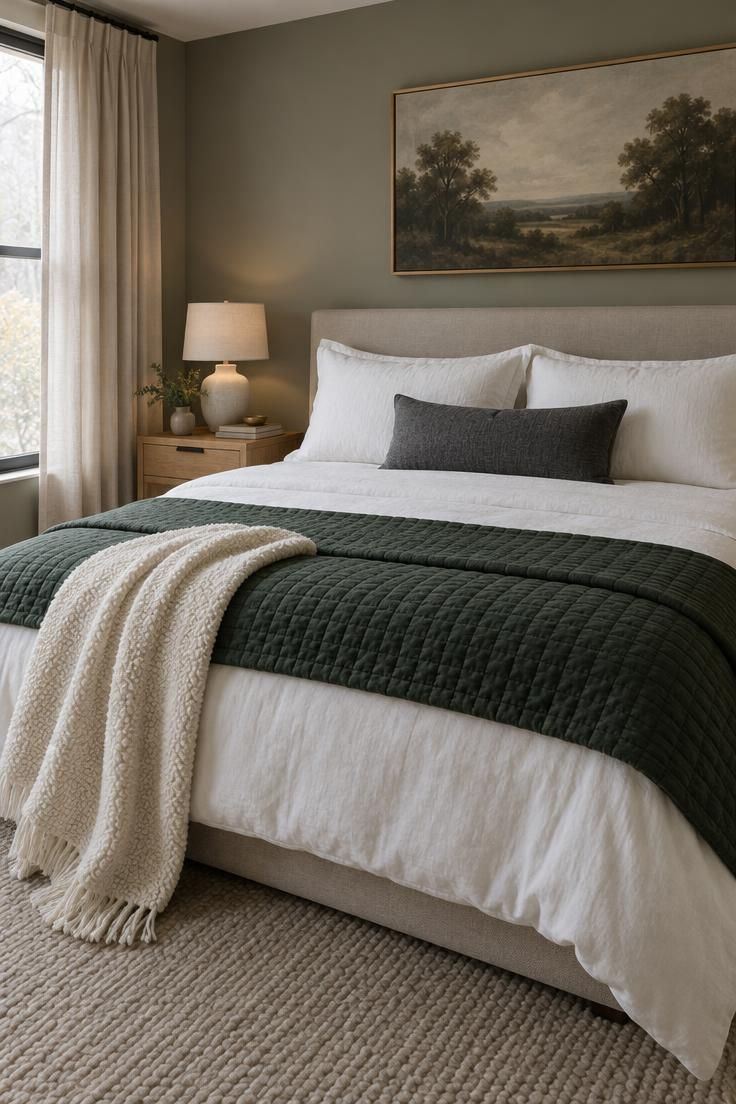
A bed can read as cold-season without a full bedding replacement.
Layering a quilted or matelassé coverlet over a smooth duvet, then adding a nubby throw across one corner, builds visible depth along the edge of the bed where the layers stack.
Color choice follows the size of the room.
In a large, cool-toned bedroom, a deep quilt in forest green or navy gives the bed a strong anchor.
In a smaller room, tonal layers with varied weaves keep the bed from feeling heavy.
The folded edge is where the winter read happens.
Folding the quilt in thirds and letting it sit slightly askew keeps the bed from looking staged while still showing the texture.
A throw is easier to swap than a full bedding set when the season ends.
Keeping the duvet and shams neutral lets the top layers carry the seasonal shift.
Style Blueprint:
- White linen duvet
- Forest green or navy quilted coverlet
- Cream bouclé throw
- Charcoal lumbar cushion
- Two smooth white shams
Design Pro-Tip: Fold the quilt in thirds and place it slightly askew rather than perfectly square for a less staged look.
Entryway Bench with Winter Woven Texture and a Dried Wreath
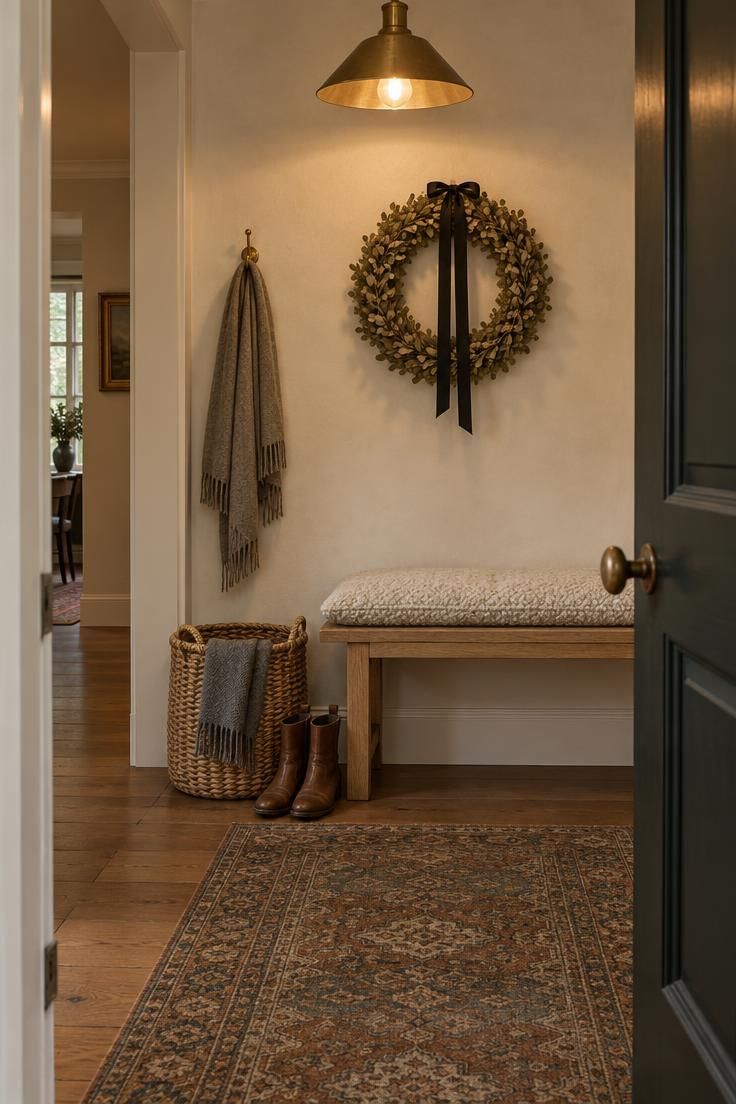
An entryway bench does functional and decorative work at once.
A chunky woven cushion gives the bench a place to sit while pulling on boots, a basket below holds shoes or a spare throw, and a dried boxwood wreath on the wall above carries the seasonal note without asking for floor space.
Homes without a mudroom can still borrow this setup.
The bench creates a spot to sit and put on boots, which makes the arrangement useful through the whole cold season.
When floor space is tight, a row of wall hooks plus a small floor basket carries much of the same function.
The bench is nice to have, but the hooks and basket handle the daily drop and hang.
A second basket kept on the bench for hats and gloves lets the visual arrangement manage clutter instead of hiding it.
Style Blueprint:
- White oak bench
- Chunky oatmeal wool cushion
- Seagrass basket for shoes or a throw
- Dried boxwood wreath with a black ribbon
- Small basket for hats and gloves
Design Pro-Tip: Keep a second basket on the bench for hats and gloves so the arrangement also manages the daily clutter.
Frosted Pine Sprigs Tucked Behind a Framed Winter Print
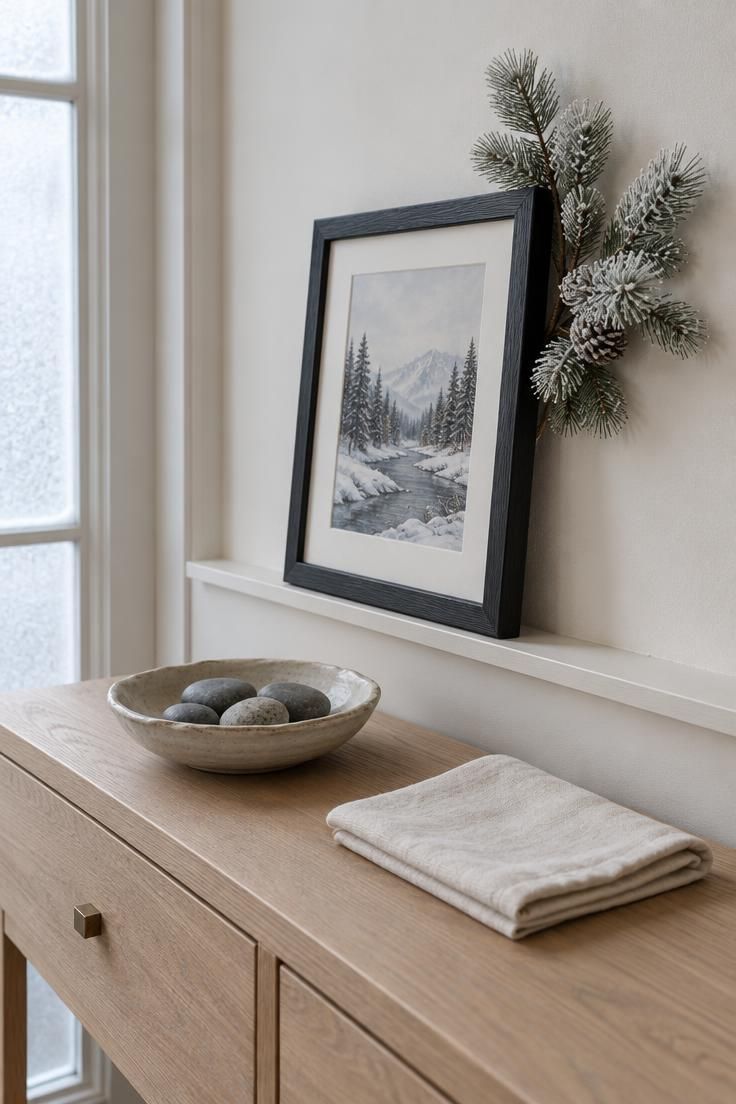
A narrow entryway ledge can feel bare without becoming cluttered.
Leaning a small framed print against the wall gives the surface a quiet focal point, while pine sprigs tucked behind the frame’s corner add a seasonal note that does not compete with the artwork.
This idea works best with a print that has a soft winter palette, such as a pale landscape or a simple botanical study.
The pine should feel like a collected branch from a cold walk, not a bundled craft-store piece, and a light coating of matte finish on the needles can create that frosted look without painting.
The ceramic dish beside the frame holds a few smooth stones and a folded cloth.
These objects echo the print’s gray tones and keep the grouping from feeling too symmetrical.
For a small entryway, the key is to use one leaning element rather than hanging multiple frames.
The layered pine becomes an accent that can be easily replaced with dried seed heads or a sprig of cedar as the weeks change.
Style Blueprint:
- Small black-framed winter landscape print
- Bundle of frosted pine sprigs behind one upper corner
- Shallow hand-thrown ceramic dish with gray river stones
- Folded ivory linen cloth anchored beneath the dish
Winter Book Stack with a Small Brass Bell on a Side Table
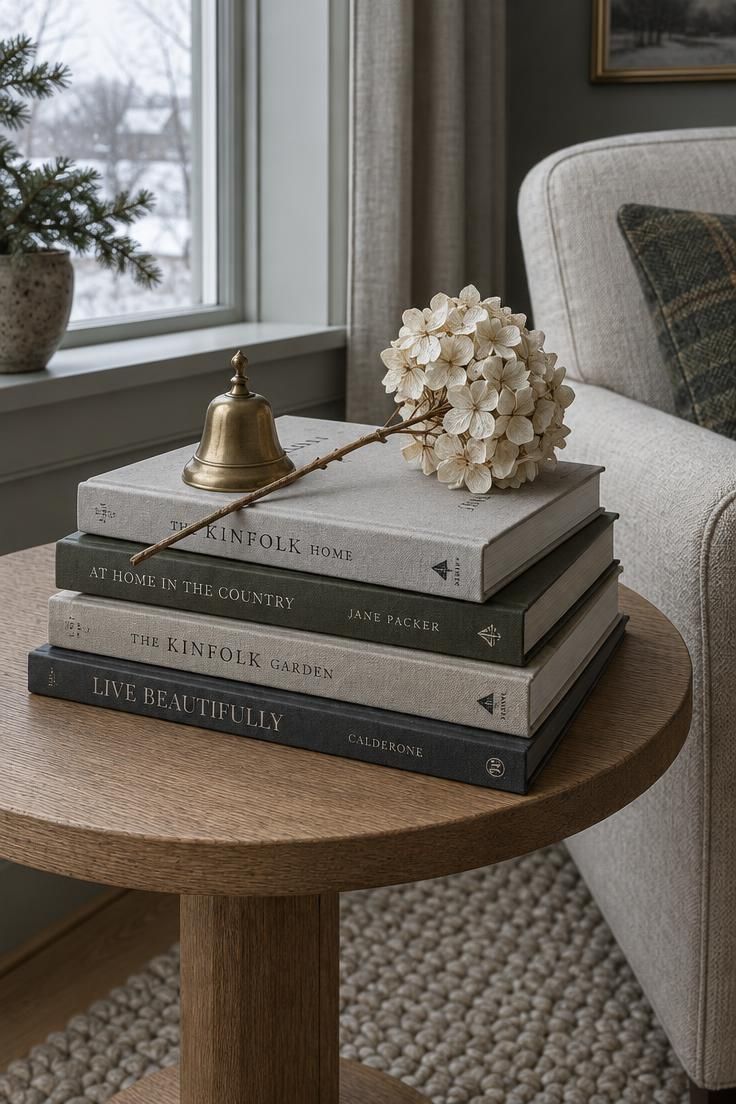
A winter book stack gives a side table a quiet sense of use without turning the surface into a display shelf.
Four hardcovers in muted gray, ivory, deep green, and warm brown sit like a small sculpture, while the brass bell on top adds a cold-season object with a soft metallic gleam.
The angles matter more than the titles.
Turning each spine a few degrees off the one below keeps the stack from looking like a retail pile, and a dried hydrangea stem laid across the top introduces a brittle, pale shape that reads as winter without overt holiday dressing.
On a side table next to an armchair, this arrangement leaves room for a mug or a folded pair of reading glasses at the edge.
Keep the bell small enough that the stack still feels like the main object, and swap out the stem when it starts to shed.
Style Blueprint:
- Four hardcover books in a muted winter palette
- Small unlacquered brass bell
- Single dried white hydrangea stem
- Round oak side table kept mostly clear
Design Pro-Tip: Turn each book spine a few degrees off the one below it so the stack feels relaxed and lived-in rather than perfectly aligned.
Conclusion
Winter home decor asks for a handful of deliberate additions rather than a full-room change.
Layered throws, bare branches, low candlelight, and a few frosted or metallic accents give a room a cold-season read that packs away easily when the weather shifts.
The key is to cluster objects into one composed moment instead of scattering them across every surface.
Pick two or three ideas that fit the room’s existing layout, then swap a single textile or botanical each month to carry the look into early spring.