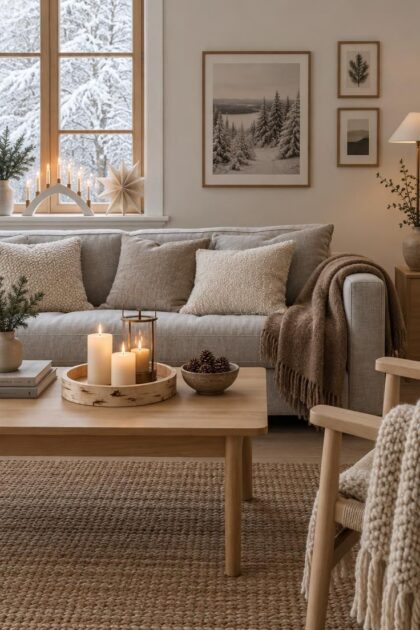
This post may contain affiliate links. If you make a purchase through these links, we may earn a commission at no additional cost to you.
A Scandinavian winter room starts with a light, quiet base, then adds seasonal warmth through texture, soft light, and natural materials.
The approach favors rearranging a few useful pieces over collecting more decoration, so the darkest months feel layered rather than crowded.
Small window displays, a dressed chair, a mantel composition, and a simple table scene all work within the same restrained palette.
Each idea below centers on one concrete arrangement that can fit an apartment or a larger house.
Keep the surrounding room calm, and let the seasonal layer do its work.
Window Candelabra With a Paper Star and a Single Potted Bulb
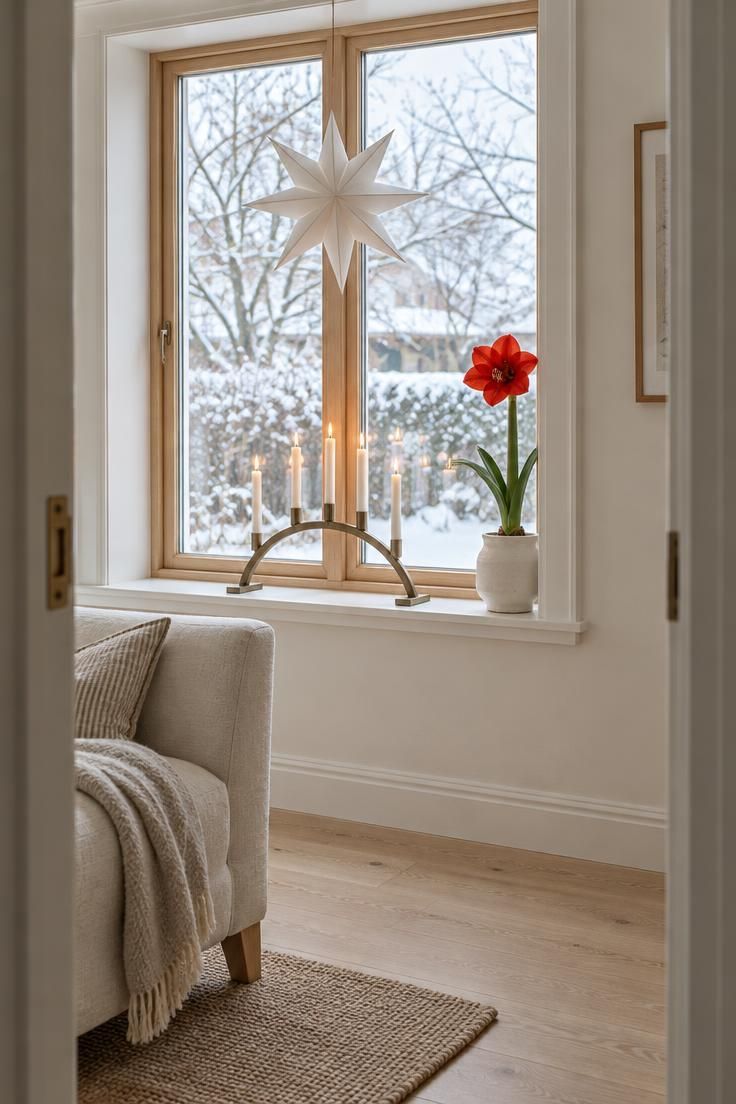
The classic Swedish winter window stacks three elements into one narrow vertical composition: a tiered advent candelabra on the sill, a star-shaped paper or fabric shade hanging just above it, and one small potted bulb in a clay or ceramic pot set slightly to one side.
Together they read as a single display from inside the room and from the street after dark, which is why the arrangement suits windows that face outward as much as inward.
Height matters more than quantity here.
The star should hang at or just below the top of the window frame, the candelabra should sit centered on the sill beneath it, and the potted bulb should be smaller than both so the shape stays readable.
In windows where flames would be left unattended, warm-white electric tapers or battery-operated candles keep the look intact without an open flame.
A narrow sill does not need all three pieces.
A star with a short cluster of candles beneath it carries the same idea in less width, and a bulb alone in a simple pot works in a small bathroom or hallway window.
Style Blueprint:
- Arched metal candelabra with warm-white tapers
- Folded paper star hung from a thin cord
- Single amaryllis in a plain white ceramic pot
- Pale wood frame with a white painted sill
Design Pro-Tip: If the sill catches strong afternoon sun, choose a paper star with a heavier, evenly colored surface so it does not become a glaring bright spot against the glass.
Clustered Candle Island on a Round Wooden Tray
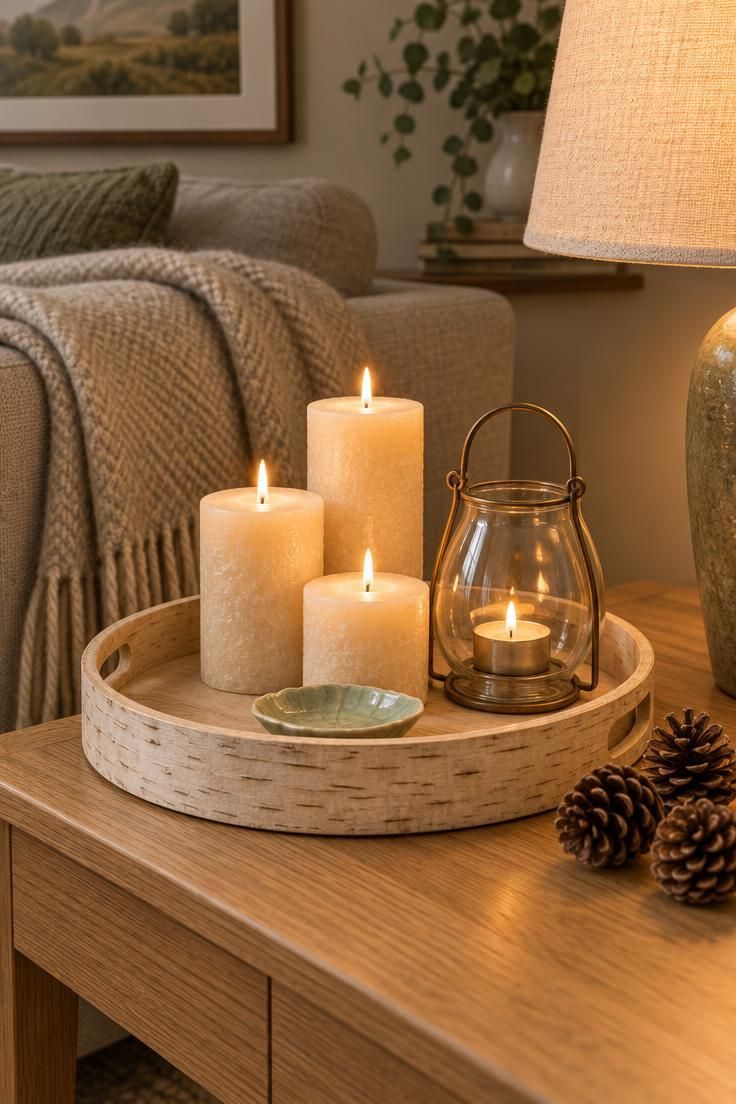
Grouping three to five candle sources at different heights on a round or oval light-wood tray turns scattered flames into one visual unit.
The tray edge defines where the arrangement ends, so a side table or low bench stays organized instead of collecting stray holders.
Heights that step up by a few inches keep the group from reading as a flat row, and muted finishes in cream, glass, and pale ceramic prevent the cluster from competing with the rest of the room.
A mix of forms does more work than a matching set.
A chunky pillar, a small lantern, and a low dish give the eye three shapes in one footprint.
Reflective glass or a glossy dish catches the flame and adds brightness without introducing another color.
Keeping the island near a seating area, but clear of book and blanket stacks, leaves room for a drink or a plate.
The practical advantage of the tray is portability.
When the surface is needed for a tray of snacks or an open book, the whole arrangement lifts away in one motion and returns just as easily.
A single potted amaryllis can anchor one edge of the tray in place of a fourth candle, giving the group a living element among the flames.
Style Blueprint:
- Round pale birch or oak tray
- Three cream pillar candles in stepped heights
- Small glass lantern with a votive
- One low ceramic dish or a single potted amaryllis
Sheepskin and Chunky Knit Draped Over a Pale Wood Armchair
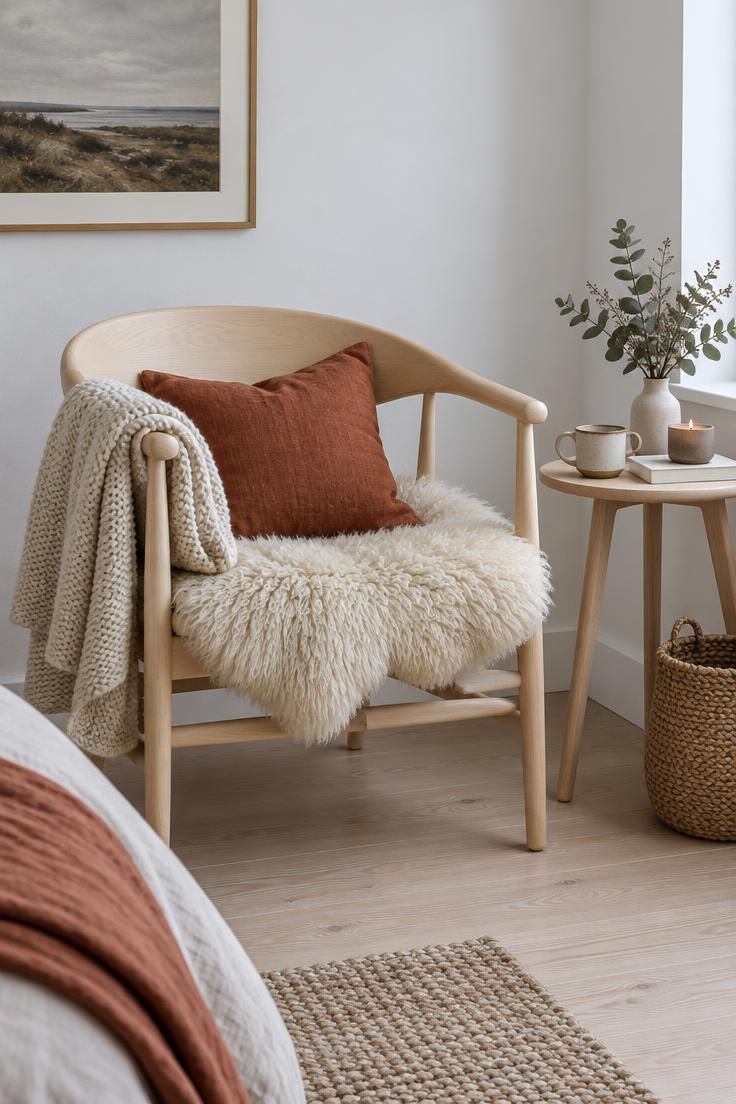
A single reading chair can carry a winter mood without any change to its structure.
The pale wood frame stays visible, a chunky knit throw folds over one arm, a sheepskin or faux-sheepskin lies across the seat, and one linen cushion in rust or faded red adds the only strong color.
The sheepskin gives the seat a soft, deep layer that makes the chair look inviting on a cold evening, and the folded throw signals that the chair is in use rather than styled for display.
Folding the throw over the arm, rather than spreading it flat, keeps the knit texture legible and leaves the seat open.
The cushion should be the smallest of the three elements so the textiles step up in scale from cushion to throw to sheepskin.
Real sheepskin requires more careful storage and cleaning than a quality faux version, and both benefit from a regular shake and airing during winter.
This setup suits a chair placed near a window or in a bedroom corner where a fireplace is not part of the room, since the warmth comes entirely from texture and color.
Style Blueprint:
- Pale birch armchair with a curved back
- Chunky cream knit throw folded over one arm
- Natural or faux sheepskin across the seat
- Single rust or faded red linen cushion
- Small light-wood side table
Neutral Sofa Layered With Wool, Linen, and Bouclé Cushions
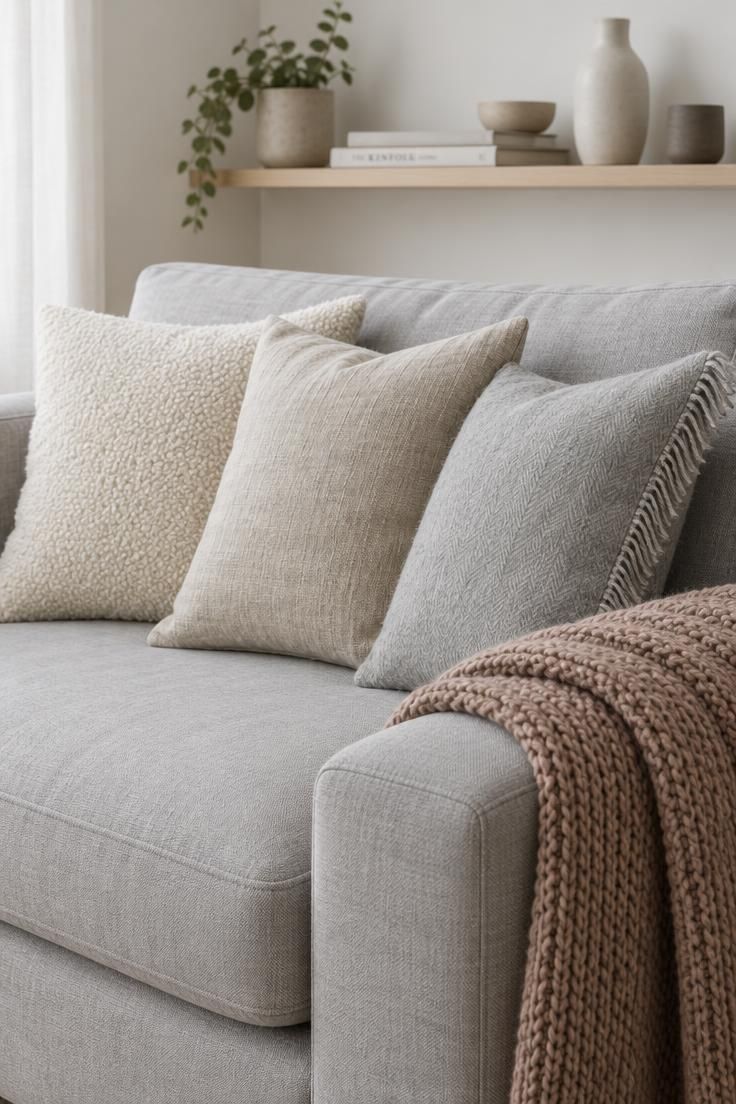
Depth on a pale sofa comes from texture, not pattern.
Three cushions in one warm neutral family, such as cream bouclé, oatmeal linen, and pale gray wool, read as a set while each surface catches light differently.
A throw in a deeper mushroom or clay tone finishes the arrangement and gives the eye one darker note to separate the layers.
Placement keeps the sofa usable.
The throw belongs diagonally across one corner or folded along an arm, not spread evenly over the whole seat.
Cushions should lean rather than stand in a rigid row, and the largest cushion typically sits at the back.
Cushions that sit too close in value can flatten into one mass, so one slightly darker tone earns its place.
This arrangement suits a small living room because it needs no wall color change and no large decorative object.
In households with pets, wool-blend cushion covers that can be spot-cleaned are easier to live with than dry-clean-only linen.
Style Blueprint:
- Cream bouclé cushion
- Oatmeal linen cushion
- Pale gray wool cushion with fringe
- Clay or mushroom chunky throw
- Pale wood shelf with matte ceramics nearby
Mantel of Spruce Garland, Taper Candlesticks, and Straw Stars
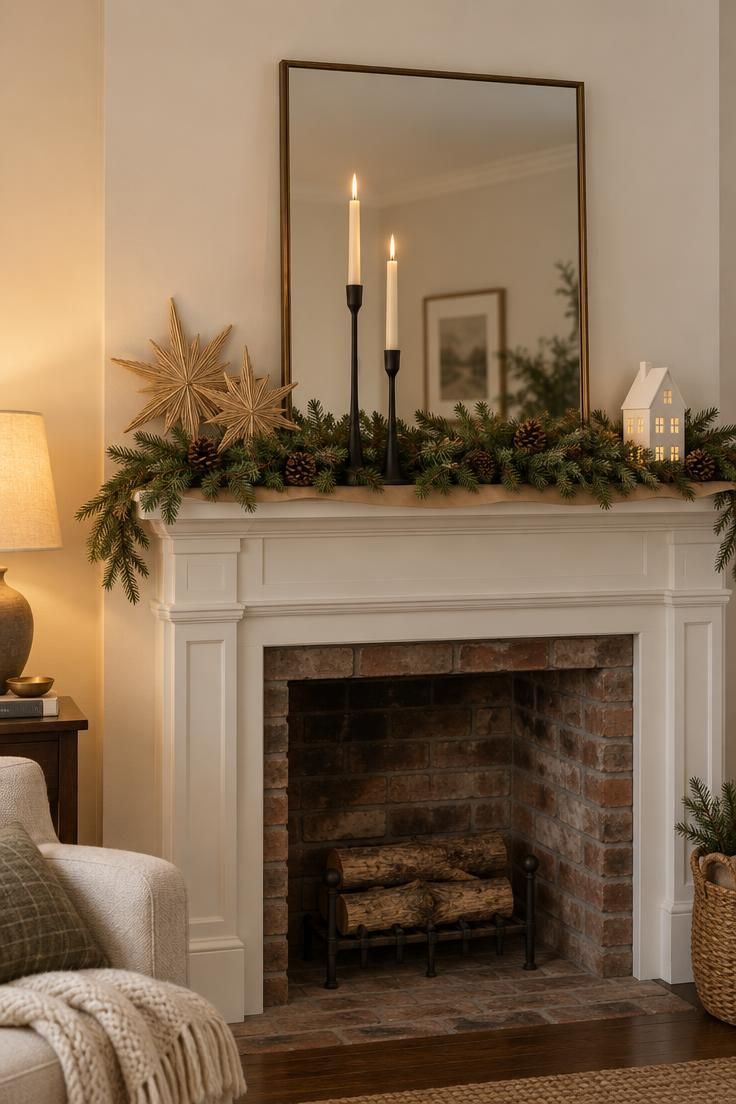
A mantel composition works best around one horizontal line.
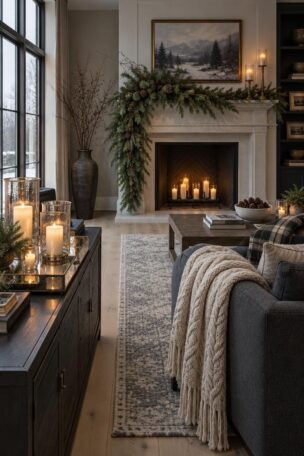
A spruce or fir garland laid across the center third of the shelf sets that line, and two or three taper candlesticks at slightly different heights rise above it.
One or two straw stars or a single straw goat at one end adds a folk note without filling the whole shelf.
The garland can hang slightly over the front edge in a place or two to soften the hard line of the mantel, though it should not drop low over an active fireplace opening.
Fresh greenery suits a cool room, while dried or preserved greenery holds up better above a working fireplace.
Pine needles will shed, so a runner of kraft paper or linen beneath the garland makes weekly cleanup a quick lift-and-shake job.
For a quieter alternative, replace the candlesticks with a short row of white ceramic houses.
The garland and the houses alone give the mantel a winter identity with no flame at all, which helps in homes where the fireplace is not in daily use.
Style Blueprint:
- Fresh spruce or fir garland with pinecones
- Two matte black or aged brass taper candlesticks
- Two straw star ornaments or one straw goat
- Linen or kraft paper runner beneath the greenery
- Leaning rectangular mirror behind
Light-Wood Sideboard Styled With a Ceramic House Village
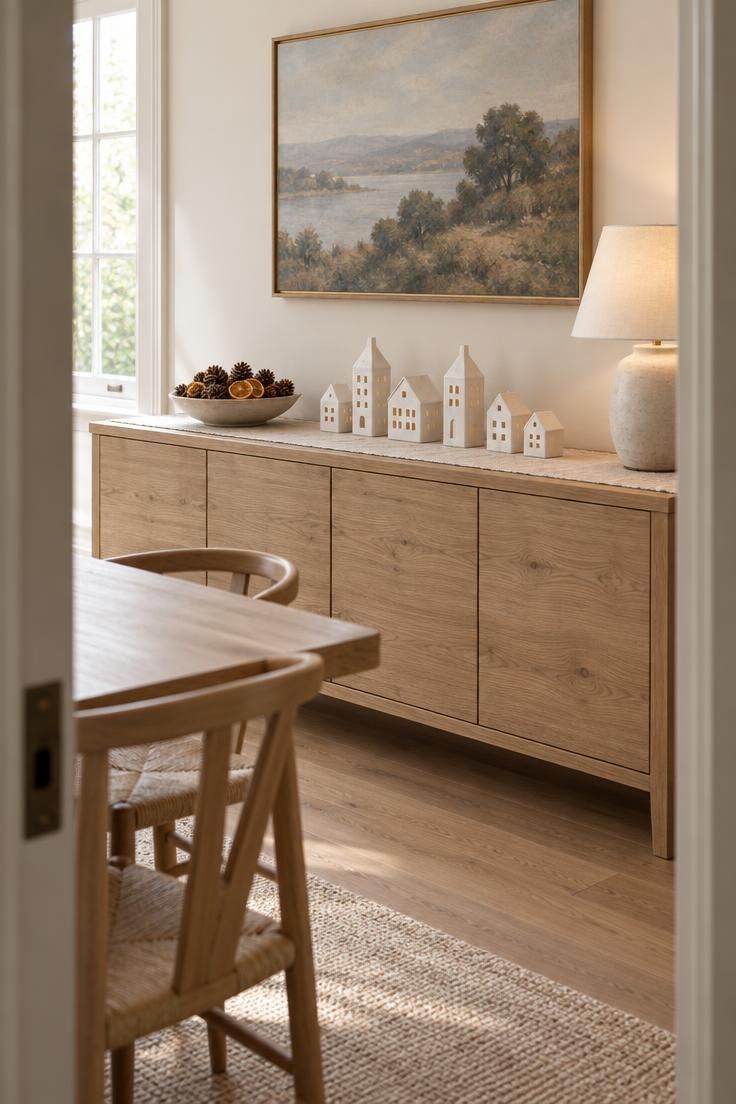
A light-wood sideboard makes a natural stage for a small winter village.
An unbleached linen runner laid across the top gives the group a soft base, and three to five white ceramic houses of varying heights gather in a loose row along it.
A shallow bowl of pinecones at one end balances the composition and continues the natural material story.
The display stays tight and grouped, leaving at least a third of the surface clear for daily use such as keys, a mail tray, or serving dishes.
House heights that step up in small increments read as one family, and unpainted or lightly glazed finishes keep the village quiet against the wood.
Because a sideboard is a broad horizontal plane, it fills quickly.
If the room already has a full mantel or crowded shelves, remove one or two houses rather than adding more.
Moving the group closer to the table lamp, or placing a short glass cloche over one house, refreshes the arrangement without a new purchase.
Style Blueprint:
- Light oak or pine sideboard
- Unbleached linen runner
- Three to five white ceramic houses in stepped heights
- Low bowl of pinecones and dried orange slices
- Fabric-shade table lamp at one end
Potted Amaryllis and Paperwhites Grouped in a Low Basket
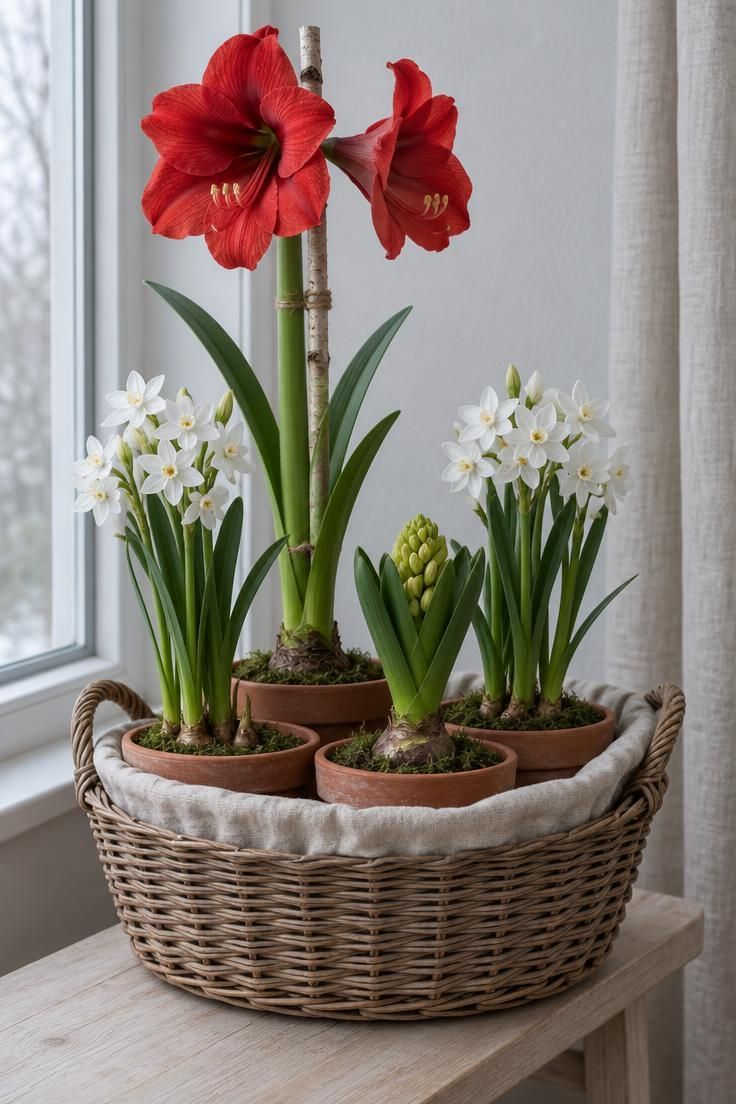
Winter bulbs work as living decor when their clay pots stay visible.
Three or four pots, such as a red amaryllis, two white paperwhites, and one hyacinth, sit inside a shallow woven basket lined with a folded linen tea towel.
The basket hides mismatched saucers, makes the whole group mobile, and keeps the Scandinavian winter decor grounded in natural materials rather than florist wrap.
Placement should favor cool, indirect light, whether on a windowsill, a piano top, or a low bench.
Amaryllis stems often lean once the blooms open, so a narrow bamboo or birch stake blends into the basket better than a bright plastic one.
Timing is part of the design.
Buying bulbs at different stages of growth staggers the blooms over several weeks instead of one crowded week, and moving the basket to a cooler spot at night in a warm, dry room can stretch the show.
Paperwhites carry a strong scent, so a bench or hallway basket keeps them out of a small dining area where the fragrance would sit close to the table.
Style Blueprint:
- Low woven willow basket
- Folded linen tea towel as a liner
- Terracotta pots with amaryllis, paperwhites, and hyacinth
- Slim bamboo or birch stakes
Folk Accent Shelf With a Dala Horse and Wool-Felt Ornaments
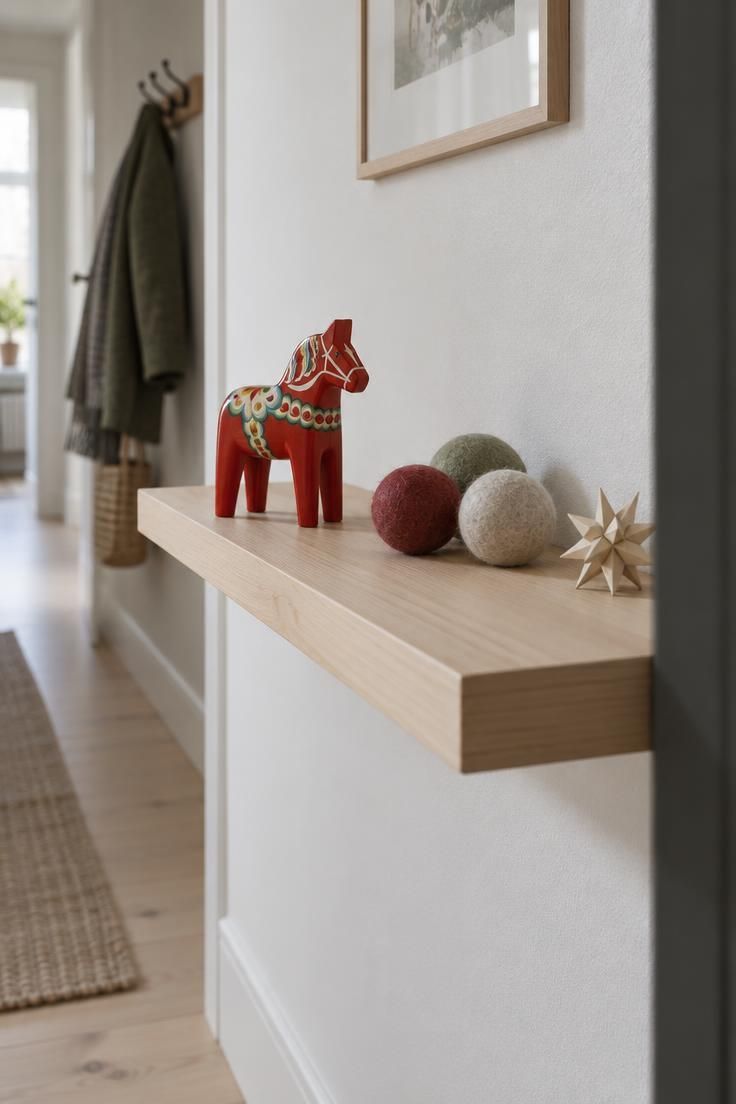
A single shelf or the top of a low bookcase can carry a folk-inspired winter accent without turning the whole room thematic.
One small carved Dala horse sits at the center or slightly off-center, with two or three wool-felt ball ornaments in muted red, green, and oatmeal beside it, and a small paper star or folded paper chain filling the last bit of space.
These pieces should group closely enough to read as one arrangement, with empty shelf around them.
That empty space is what keeps the accent from competing with the rest of the room, especially in a hallway where the eye passes quickly.
Red Dala horses are the most recognizable version, though an unpainted wooden horse is easier to match with a neutral palette and lets the felt ornaments carry the color.
A shelf painted or stained in the same light wood tone as nearby furniture keeps the composition connected.
A child’s room or a hallway is a natural home for a stronger folk motif, where the scale of the pieces stays modest against the surrounding walls.
Style Blueprint:
- Shallow pale wood shelf
- One small carved Dala horse
- Three wool-felt ball ornaments in muted red, sage, and oatmeal
- Folded paper star or paper chain
Linen-Dressed Winter Table With Bare Branches and Clove Oranges
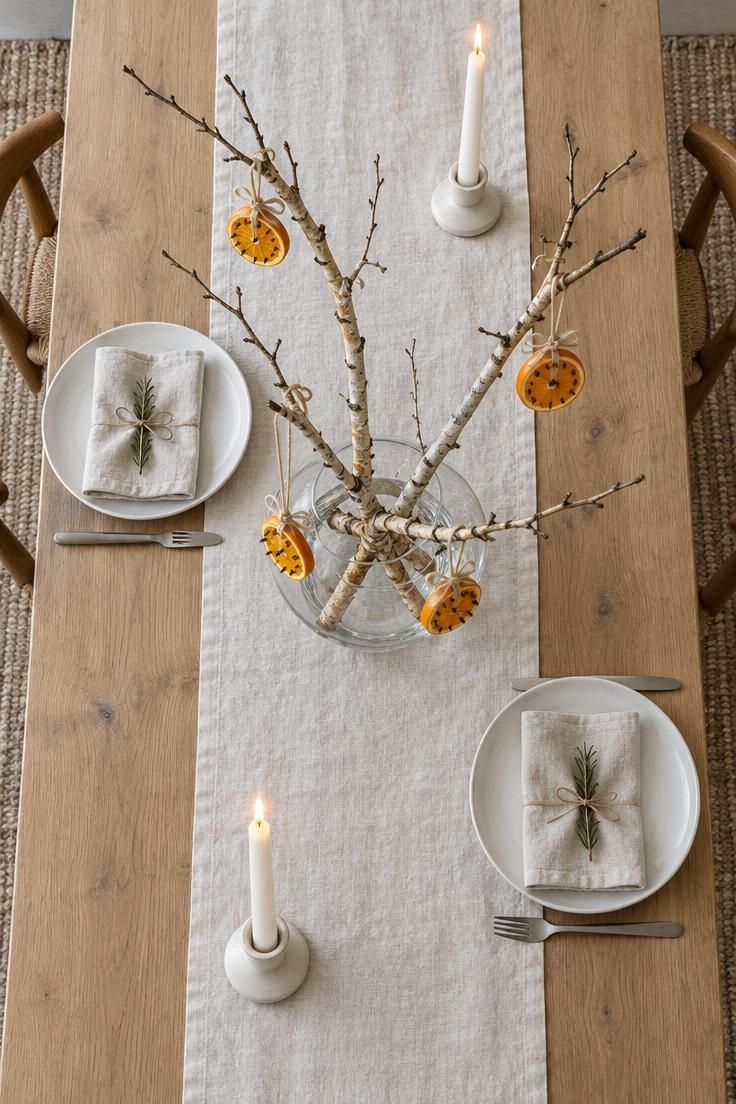
A winter dining table can stay simple and still feel seasonal.
A stonewashed linen tablecloth or runner sets a soft base, white stoneware plates sit unstacked at each place, and a low centerpiece of bare birch or larch branches in a clear glass or pale ceramic bowl anchors the middle.
Clove-studded orange slices tied to the branches with narrow linen string add color and a fresh scent while the fruit is new.
The centerpiece stays low enough for conversation across the table, so branches should be trimmed to roughly the height of a wine bottle, with two short tapers in matte ceramic holders at either end of the runner.
Height and restraint keep the table from feeling like a holiday spread that has to be cleared before dinner.
Dried citrus is best made a few days ahead in a low oven, and the slices keep in a paper bag for several weeks.
In a table used daily, a runner works better than a full cloth, since chairs and plates slide over it without disturbing the centerpiece.
Style Blueprint:
- Washed-linen runner in cool ivory
- Low clear glass bowl with bare birch branches
- Clove-studded orange slices tied with linen string
- Two matte white tapers in ceramic holders
- White stoneware plates and linen napkins
Bed Corner With a Waffle-Weave Blanket and a Wall-Mounted Swing Lamp
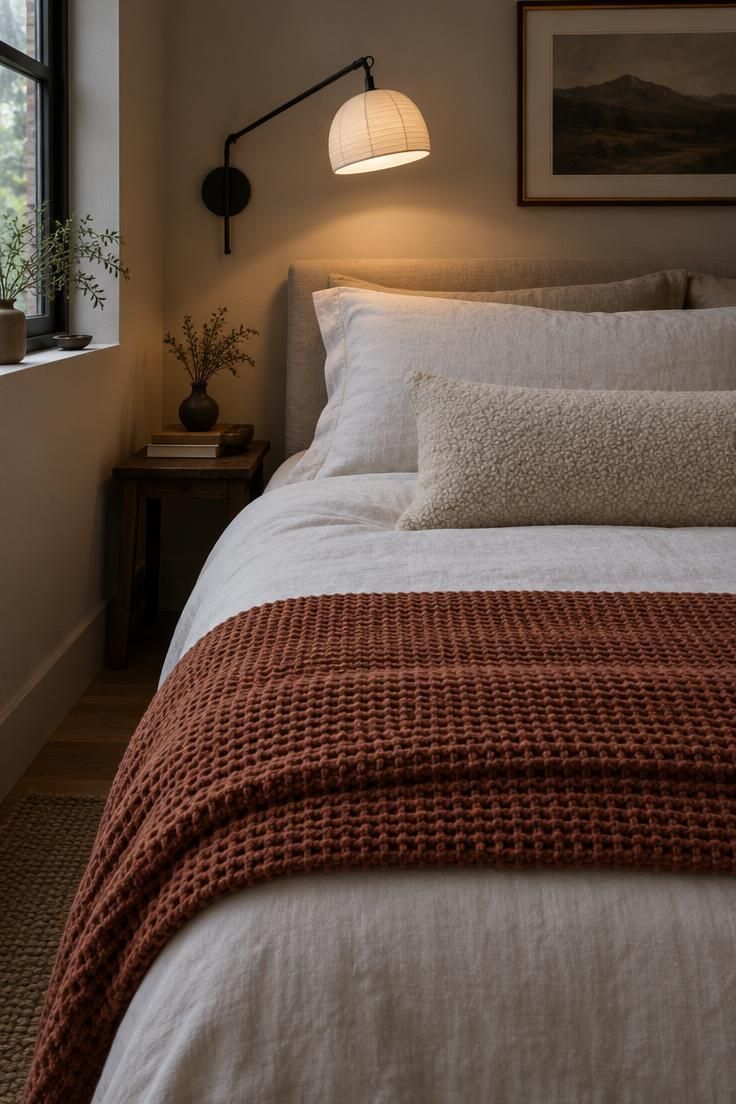
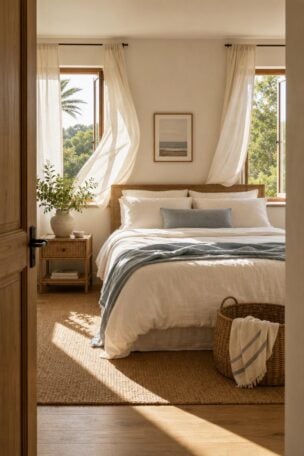
A bed reads warmer for winter with one change at the foot rather than a full cover swap.
A waffle-weave cotton or wool blanket folded across the end in muted rust, forest green, or deep blue adds a band of color, and a single long lumbar cushion in heavier bouclé or velvet finishes the line.
White or undyed linen underneath keeps the accent color from competing with the rest of the bedding.
A wall-mounted swing-arm lamp with a pale fabric or paper shade, angled toward the pillow, adds a second light layer that works alongside candlelight in the evening and keeps the bed from feeling dark during short winter days.
The lamp also makes the corner usable for reading without a full floor lamp crowding a small bedroom.
Waffle weave shows body lines and pet hair more than a smooth cotton, so a basket at the foot of the bed gives the blanket a place to go when it is not in use and keeps the fold crisp from day to day.
Style Blueprint:
- White and oat linen bedding
- Dusty rust waffle-weave cotton or wool blanket
- Long cream bouclé lumbar cushion
- Black swing-arm wall lamp with a paper shade
- Basket at the foot of the bed for storage
Design Pro-Tip: Fold the waffle blanket in thirds rather than halves so the textured edge shows along the foot of the bed, and the blanket stays easy to pull up on cold nights.
Hallway Bench With a Sheepskin Runner and a Tray of Wool Mittens
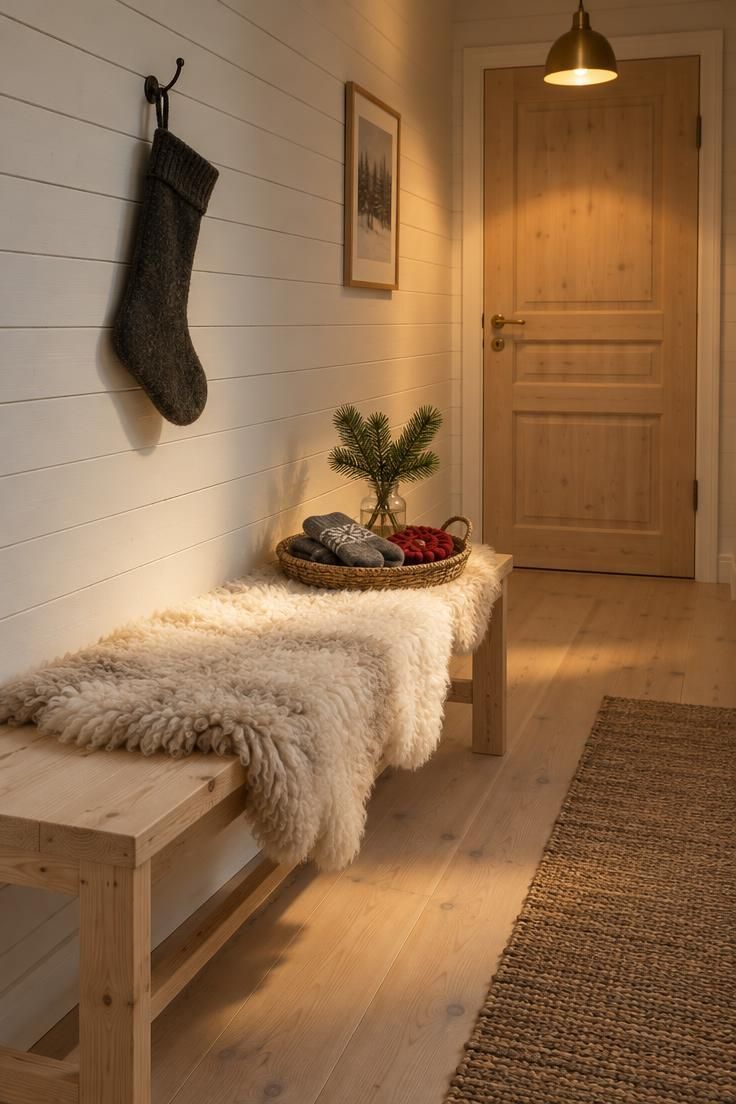
An entryway bench becomes a winter landing spot with two additions: a sheepskin or faux-sheepskin runner across the seat and a shallow woven tray on one side holding thick wool mittens, a felt trivet, and a small glass jar with pine sprigs.
The runner softens the bench and links it to the wool and sheepskin throws used elsewhere in the home, while the tray defines one corner as the drop zone.
A light pine or birch bench gives the clearest Scandinavian reference, though a painted bench also works if the sheepskin stays natural toned.
The tray keeps the mittens contained so the rest of the bench stays clear for sitting down to pull on boots.
In snowy weather, wool and pine sprigs collect moisture from wet gloves, so the tray should be emptied and wiped out weekly.
In a very narrow hall with no room for a tray, a single wool stocking hung on the wall above the bench carries the same idea in less depth.
Style Blueprint:
- Light pine or birch bench
- Natural sheepskin runner across the seat
- Low woven tray for mittens and a felt trivet
- Glass jar with pine sprigs
- Dark wool stocking on a wall hook
Staircase Wall With a Twig Star and a Sparse Eucalyptus Bundle
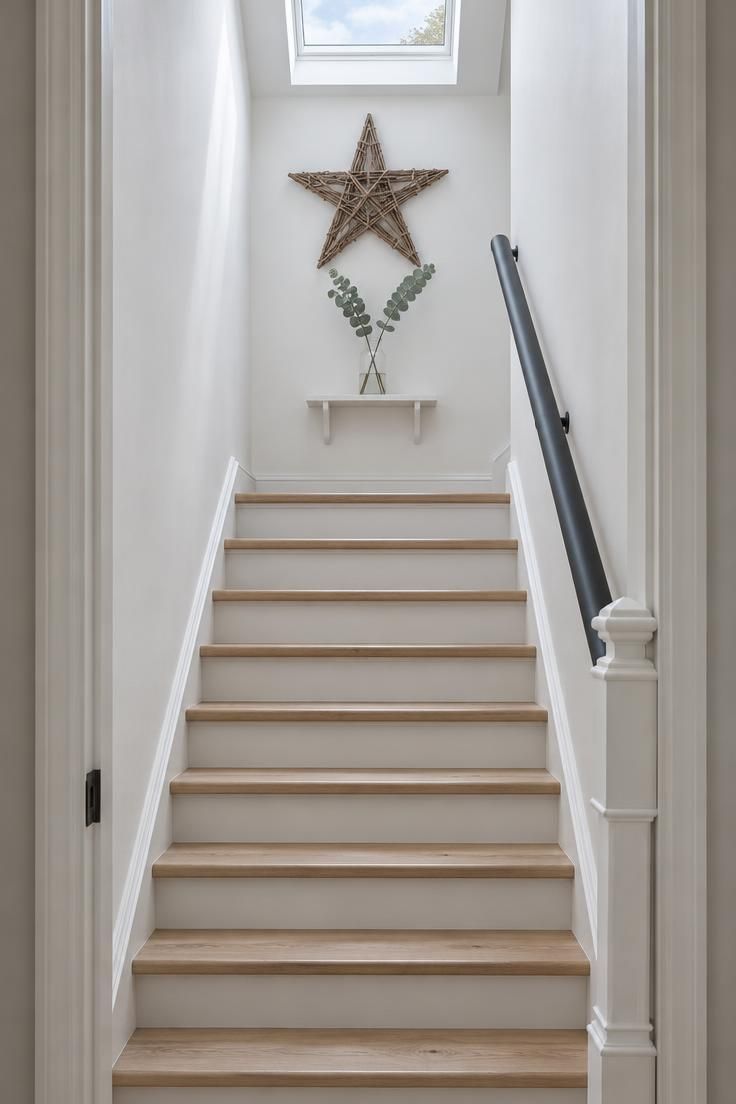
A bare staircase wall can hold a vertical winter display with no garland on the rail.
One large twig or paper star hangs at the midpoint of the wall, and a slim clear glass vase with two or three stems of fresh eucalyptus sits on a nearby step or a small wall-mounted shelf.
Keeping the arrangement off the floor leaves the stairway clear and makes the display read as part of the architecture rather than floor decor.
Twig stars look best against a flat warm white or pale gray wall, and the natural willow tone keeps the piece easy to leave up through late winter without feeling tied to one holiday.
Fresh eucalyptus dries to a muted green and can stay for several weeks, though dried leaves will drop if brushed against in a busy stairwell.
In a stairwell with no shelf, a single weighted paper star hung at the landing serves the same purpose.
The star can shift position from year to year, which keeps the display from feeling fixed.
Style Blueprint:
- Large natural willow or paper twig star
- Flat warm white or pale gray wall
- Slim clear glass vase
- Two or three fresh eucalyptus stems
- Small white wall-mounted shelf
Reading Nook With a Jute Rug, Sheepskin, and a Wall Lamp
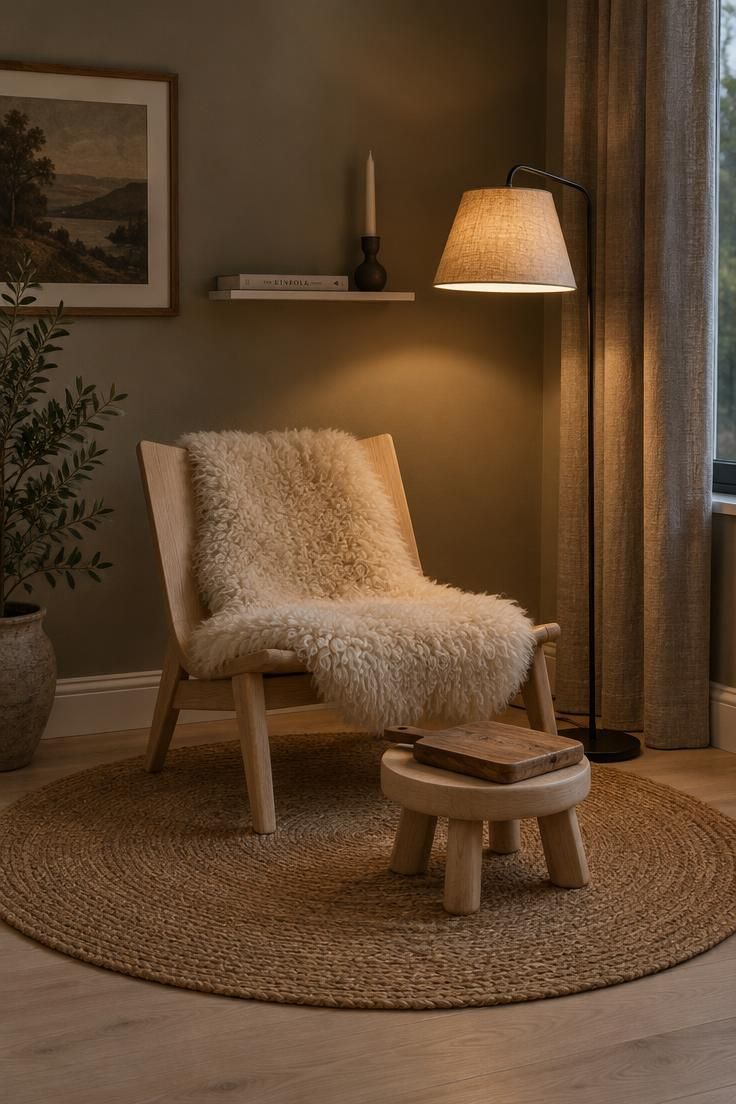
A corner of a living room or bedroom can become a winter reading nook with a rug, a chair, and one warm light.
A small jute or sisal rug anchors the space and gives the nook a boundary in an open room.
A low pale wood chair or slipper chair sits on the rug with a sheepskin over the seat, and a narrow floor lamp or wall-mounted reading lamp with a warm fabric shade stands close to the chair.
The jute rug absorbs sound and adds a natural texture, though it can feel rough under bare feet, so the sheepskin becomes a useful second layer rather than a purely decorative one.
A small footstool or a stack of two wood cutting boards gives books and a mug a place to land without a side table.
Keeping the wall shelf above the chair to one book and a single candlestick, rather than a full bookcase, preserves the calm of the corner.
The arrangement needs no permanent changes, so it fits a rented apartment as easily as an owned home.
Style Blueprint:
- Round jute or sisal rug
- Low pale wood slipper chair
- Natural sheepskin over the seat
- Narrow black floor lamp with a fabric shade
- Wood footstool or stacked cutting boards
Conclusion
Scandinavian winter decor works when a few warm materials and small light sources settle against a quiet background.
The pieces here, wool throws, candles, wooden trays, winter branches, and winter bulbs, are objects many households already own or can add one at a time, rather than a full seasonal reset.
Begin with a single window or one chair, then add only as much as the room still feels easy to keep tidy.
By the last gray afternoon of the season, the home reads as collected and calm, with each layer earning its place.