This post may contain affiliate links. If you make a booking or purchase through these links, we may earn a commission at no additional cost to you.
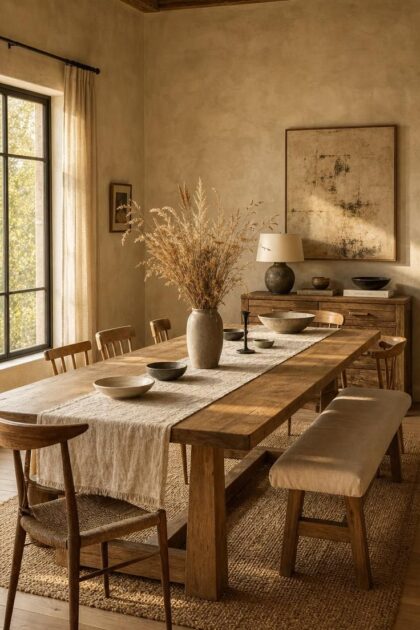
The best wabi sabi dining area is never the one that looks perfect.
It is the one where the table carries marks from years of shared meals, where light falls softly through undyed linen, and where every bowl on the shelf tells its own quiet story.
This approach to design invites honesty into a space most people try to polish.
These 13 ideas show how raw plaster, natural wood furniture, and handmade ceramics can build a dining room that feels as grounded as it does beautiful.
A Charred Cedar Bench Paired With a Rough Concrete Dining Table
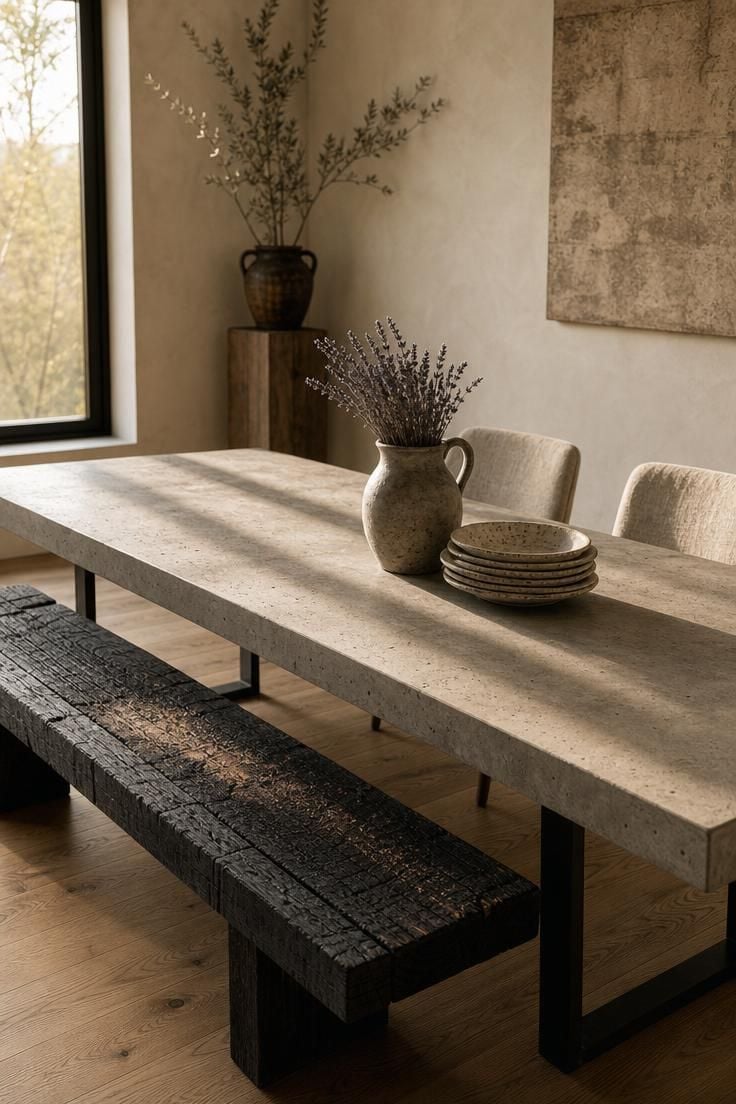
The tension between charred cedar and raw concrete makes this dining room feel alive without being loud.
Shou sugi ban wood carries a texture you want to run your hand across, all ridged black grain with warm brown undertones that catch the light at different angles.
Setting it against a pale concrete slab creates a material conversation that stays interesting over time, because both surfaces will continue to age and shift.
The matte black steel legs left unfinished at the welds add a small industrial note that keeps the room from feeling too precious.
One stoneware pitcher with dried lavender is enough to anchor the table without crowding it.
This earth tone palette of charcoal, cement, and dried purple reads as quiet confidence, not minimalism for its own sake.
The whole arrangement says something specific: this is a table where people sit for a long time.
Style Blueprint:
- Shou sugi ban (charred) cedar bench with visible grain texture
- Poured concrete table with matte surface and exposed air bubbles
- Matte black steel table legs with raw weld joints
- Stoneware pitcher with dried lavender as an off-center focal point
- Earth tone palette anchored in charcoal, cement, and bone white
Unglazed Terracotta Tiles as a Dining Room Accent Wall
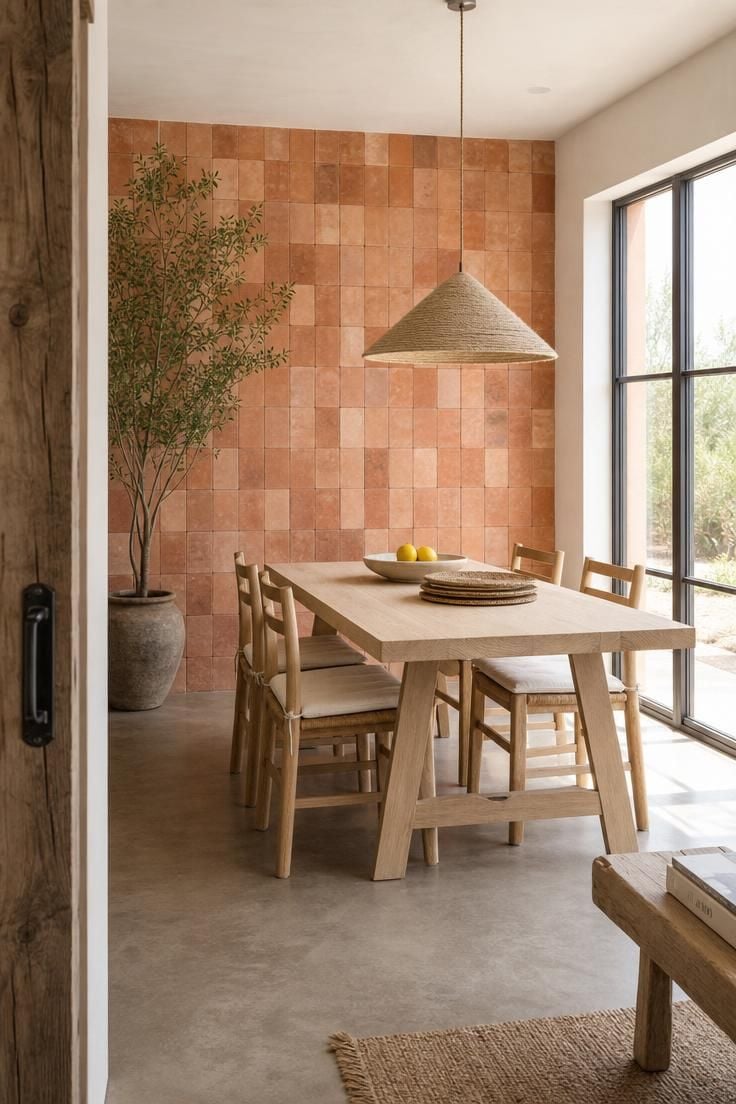
A wall of unglazed terracotta tiles brings color into a wabi sabi dining room without relying on paint.
Each tile fires at a slightly different temperature, so the tonal range from salmon to sienna happens naturally.
That variation is what makes the wall feel handmade rather than manufactured, and it rewards close looking.
Paired with pale oak and cream linen, the warm clay tones carry the room’s energy while everything else stays soft and neutral.
This kind of wabi sabi decor works because the color source is the material itself, not something applied over it.
The polished concrete floor grounds all that warmth with a cool, smooth counterpoint.
Style Blueprint:
- Unglazed terracotta tiles in varied tones (salmon to burnt sienna)
- Pale oak trestle table with simple straight lines
- Cream linen seat cushions on oak chairs
- Woven jute placemats for layered texture
- Polished concrete floor in warm taupe as a cool anchor
A Cracked Raku Bowl Collection on Rough-Hewn Floating Shelves
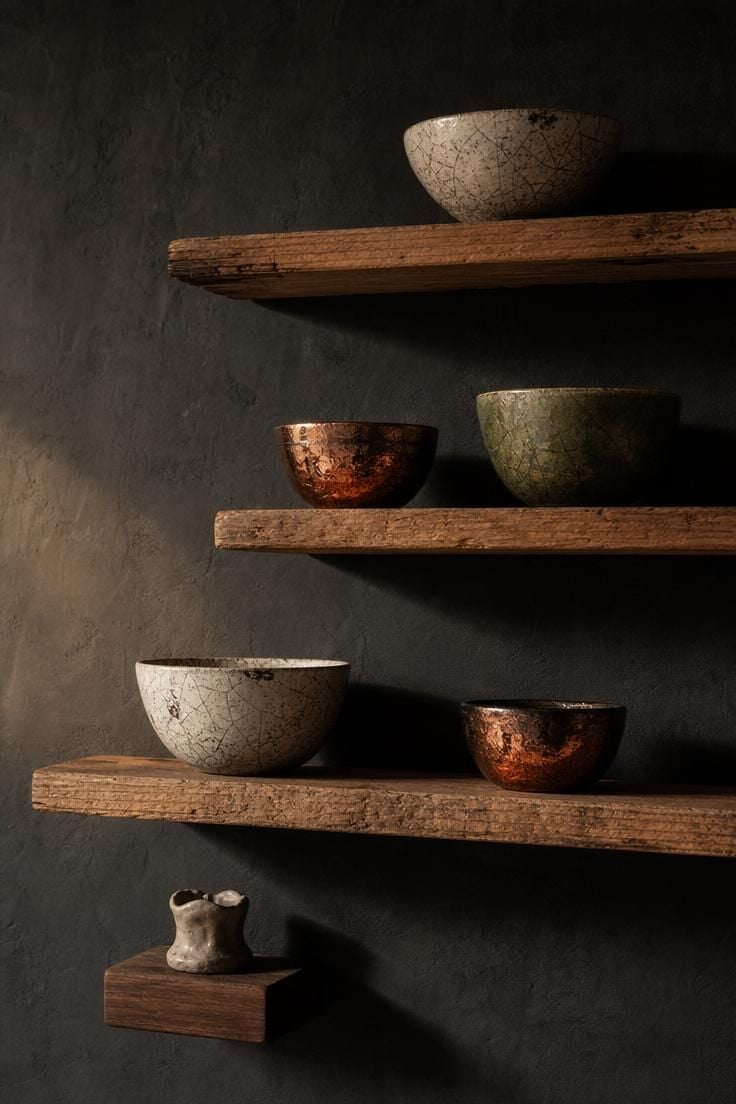
Raku pottery is made to crack.
The firing process creates a network of fine lines across the glaze that looks like a river seen from above, and no two bowls crack the same way.
Placing a collection of these handmade ceramics on rough pine shelves doubles the sense of imperfection, because the wood grain and the crackled glaze share the same unplanned quality.
The asymmetric arrangement with gaps between groups matters more than it seems.
Those empty spaces let each bowl hold its own presence rather than blurring into a line of objects.
Charcoal plaster behind the shelves drops the background away and pushes the pottery forward in the low light.
Copper and moss green glazes pick up even the smallest light source and reflect it back in unpredictable ways.
This is the kind of display that changes depending on what time of day you look at it.
Style Blueprint:
- Rough-hewn reclaimed pine floating shelves with visible grain
- Raku-fired bowls with crackled glazes in ash white, copper, and moss green
- Asymmetric arrangement with intentional gaps between groupings
- Charcoal plaster wall as a receding backdrop
- Low moody light source from one direction to activate glaze reflections
A Paper Cord Woven Dining Chair in Pale Ash Wood
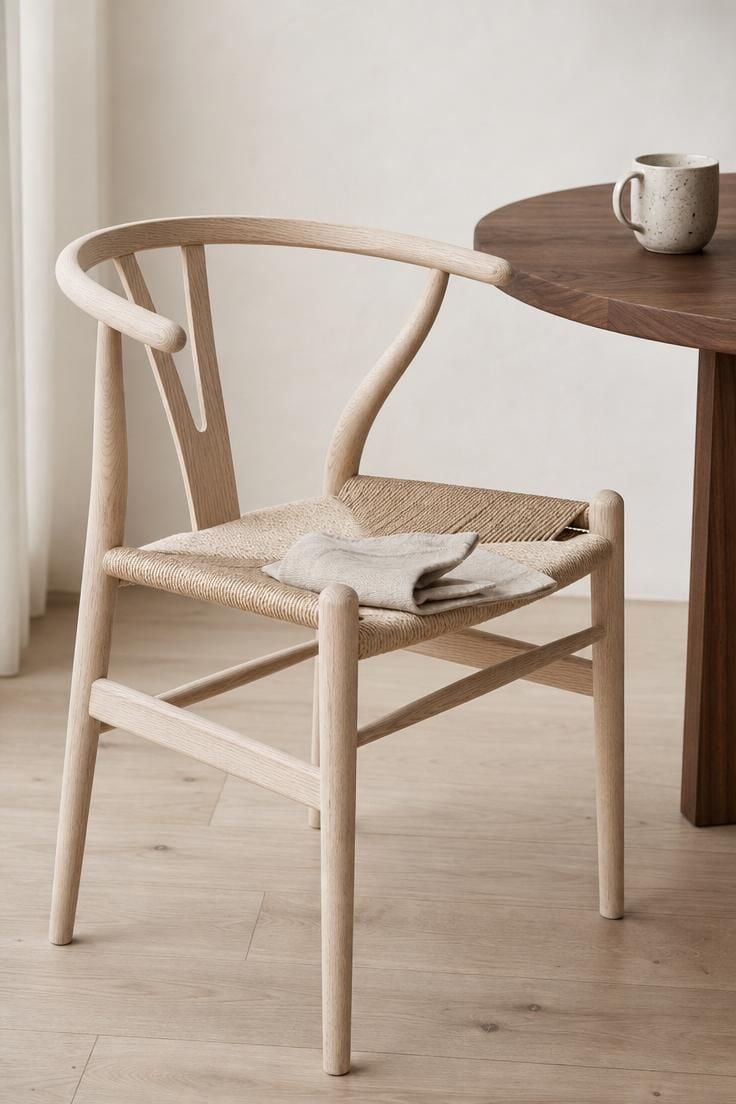
Paper cord weaving is one of those processes where the maker’s hand stays visible in the finished product.
Each section of the seat panel pulls at a slightly different tension, and over months of use, the cord darkens and compresses in patterns that follow how people actually sit.
That kind of aging is a feature in a japandi dining room, not a flaw.
Pale ash wood keeps the chair feeling light, almost skeletal, which gives it room to breathe at a crowded table.
When you use four or five of these chairs together, the slight variations between each woven seat become the most interesting thing in the room.
The round walnut table in the background softens every straight line the chair introduces.
Style Blueprint:
- Pale ash wood frame with clean, minimal joinery
- Hand-woven paper cord seat with visible weave irregularities
- Round walnut dining table as a curved counterpoint
- Wide-plank white oak flooring with matte finish
- Soft diffused natural light for even, shadowless illumination
Design Pro-Tip: Let your dining chairs arrive from different makers or different decades. When every seat tells its own story, the table feels gathered rather than purchased, and that collected quality is the heart of wabi sabi decor.
A Roman Clay Finish in Warm Mushroom on All Four Walls
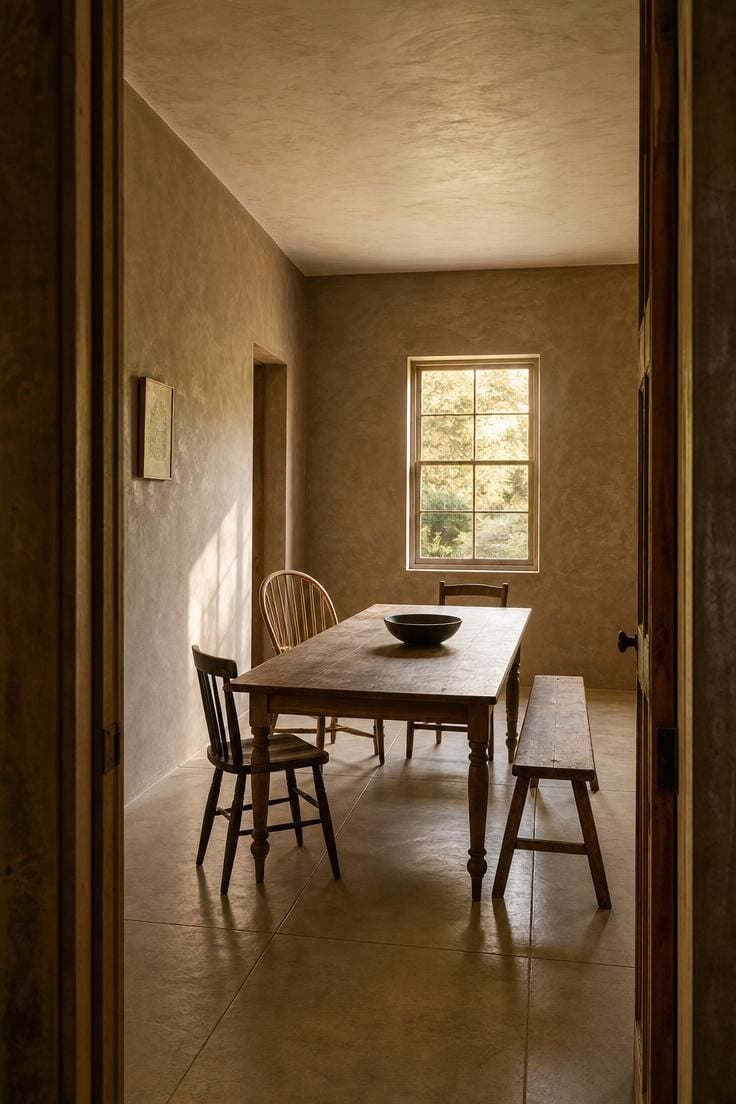
Roman clay on all four walls turns the room itself into the art.
Every trowel stroke leaves a directional mark in the plaster, so the surface looks different from every angle and shifts throughout the day as the light moves.
This warm mushroom tone sits right between brown and gray, never committing fully to either temperature, which makes it work as a backdrop for almost any wood tone in the room.
Lime wash walls on the ceiling in pale bone lighten the space overhead and keep the darker walls from closing in.
The furniture here is deliberately sparse: one long table, a few mismatched seats, one ceramic bowl.
In a minimalist dining room like this, the walls do the visual work so the table does not have to.
That single charcoal bowl on bare wood reads as quiet abundance, enough without being more.
Scored concrete flooring in warm almond keeps the palette unbroken from floor to wall.
The doorway framing draws you in like a painting, which is exactly what Roman clay walls deserve.
Style Blueprint:
- Roman clay wall finish in warm mushroom with visible trowel marks
- Lime wash ceiling in pale bone for lighter contrast overhead
- Long narrow oak dining table with turned legs
- Mismatched wooden chairs and a bench in varied wood tones
- Scored concrete floor in warm almond to keep the palette continuous
An Oxidized Copper Pendant Lamp Over a Scratched Pine Table
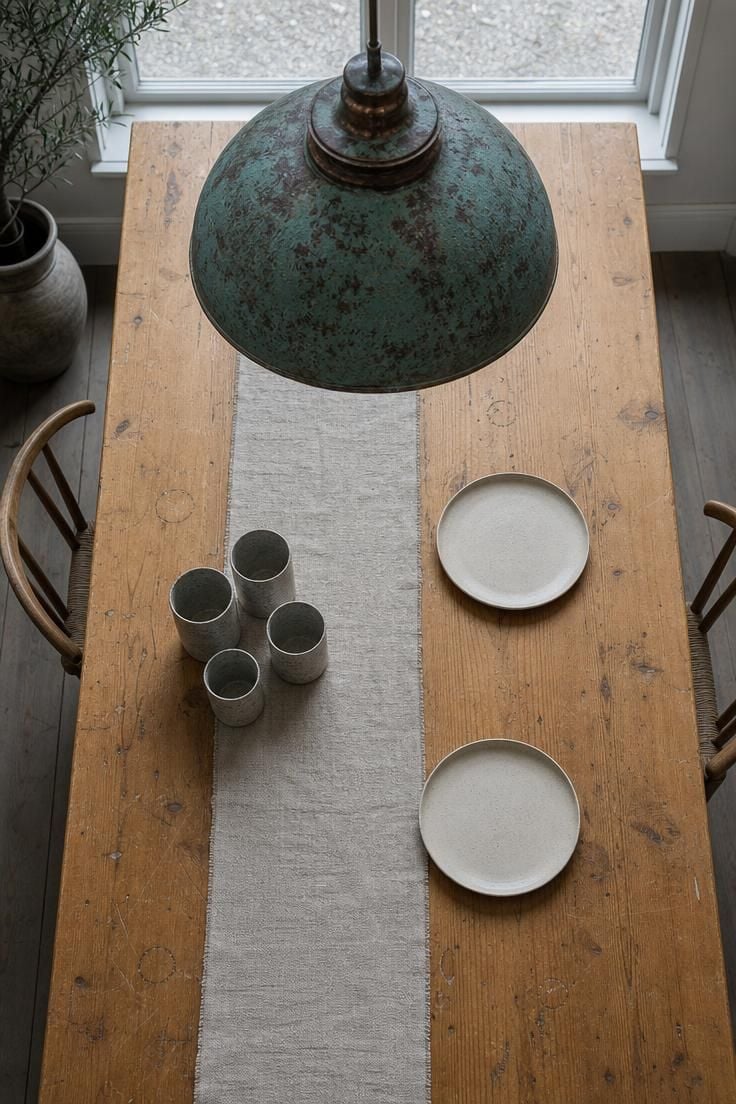
Copper that has turned green is copper that has been somewhere.
The verdigris patina on this pendant lamp tells you it has spent years oxidizing, and that history gives it more weight than any polished fixture could.
Hung low over a scratched pine farm table, the green-blue of the aged copper plays against honey-toned wood in a way that feels found rather than designed.
A linen table runner in oatmeal absorbs the cool overhead light and grounds the tableware grouping.
Those ceramic tumblers clustered loosely at one end of the runner give the table a sense of being mid-use, like someone just set them down after clearing a meal.
The scratches and water rings on the pine are not damage here.
They are proof that this table has hosted hundreds of dinners, and that record is worth more than a fresh surface.
Style Blueprint:
- Dome-shaped copper pendant lamp with heavy verdigris patina
- Long pine farm table with visible scratches, wear marks, and water rings
- Oatmeal linen table runner as a central textile layer
- Ceramic tumblers in speckled gray clustered loosely
- Cool overcast light filtering through for a silvery, calm atmosphere
Poured Plaster Windowsill Used as a Display Ledge
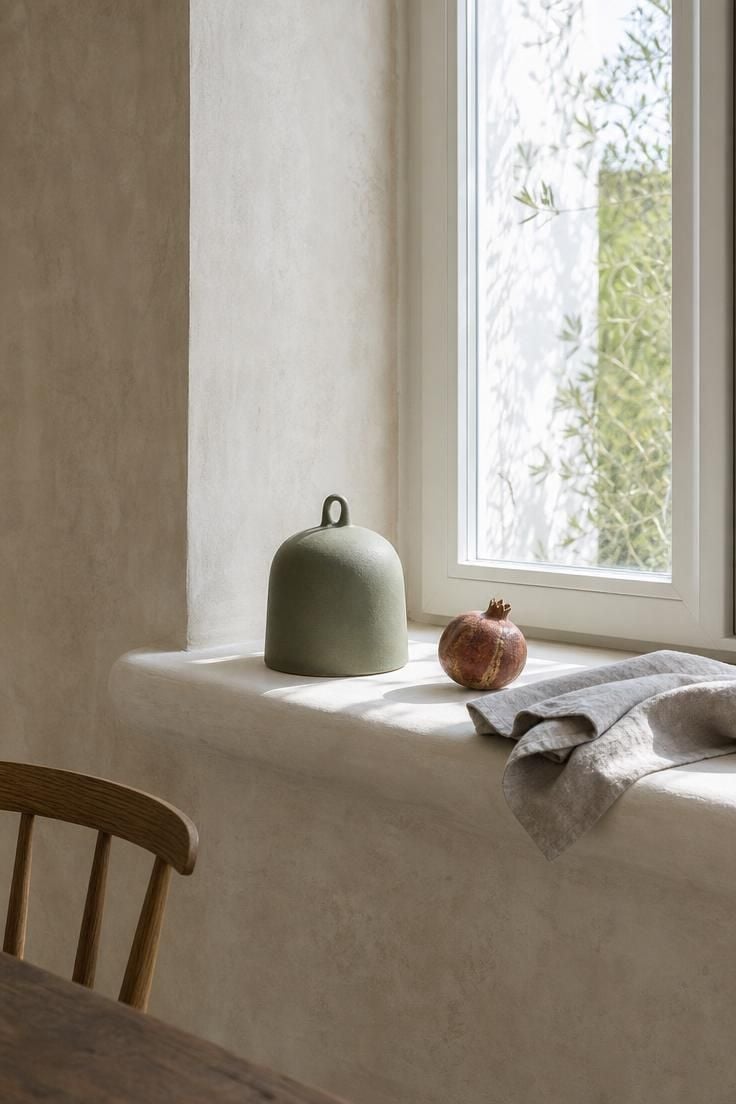
A poured plaster windowsill thick enough to hold objects turns dead space into a rotating gallery.
The rounded edges where the plaster was applied by hand soften the entire window opening and make it feel sculpted rather than built.
Placing a ceramic pendant light sample, a dried pomegranate, and a folded linen napkin here gives the sill three different textures to hold.
The bright midday light streaming through casts precise shadows of each piece across the smooth surface, and those shadows become part of the display.
This kind of arrangement changes with the seasons without any effort at all.
Style Blueprint:
- Deep poured plaster windowsill with rounded hand-applied edges
- Three rotating display objects in different textures and scales
- Strong midday light as an active design element casting shadow patterns
- Lime wash wall finish in pale pearl surrounding the window
- Seasonal flexibility built into the display concept
A Foraged Driftwood Centerpiece on a Dark Stained Maple Table
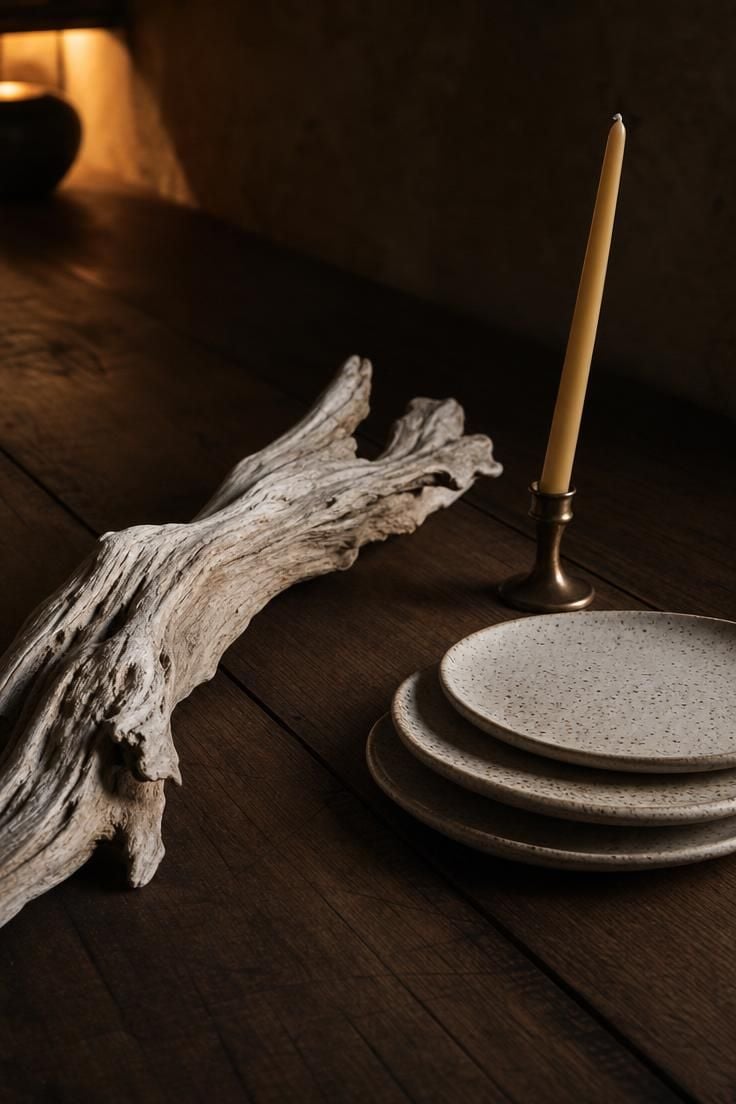
Driftwood has already been shaped by something bigger than a carpenter’s hand.
Sun, salt, and water stripped it down to its core grain and left a surface that feels almost like bone, smooth in places and rough in others with no pattern to predict.
Placing that silver-pale piece on a dark stained maple table creates a contrast so strong it holds the eye without any other help.
The stacked stoneware plates beside it are there for scale, giving the driftwood something human-made to lean against.
A bronze taper holder leaning slightly adds a sense of casual placement, as though someone set it down and walked away.
In moody low light, the amber glow picks up only the high points of the driftwood grain and the rim of each plate, leaving everything else in shadow.
This is a centerpiece that cost nothing and replaced nothing, which is exactly what makes it a wabi sabi dining area anchor.
The deep walnut-brown maple underneath acts like a dark stage, pushing all the lighter objects forward.
Style Blueprint:
- Sun-bleached foraged driftwood as a central sculptural piece
- Dark stained maple dining table for high contrast
- Stacked speckled stoneware plates in muted warm white
- Bronze taper holder with unlit beeswax taper at a slight lean
- Single directional warm light source to create depth and shadow
Design Pro-Tip: The strongest centerpiece in a wabi sabi dining area is almost always something you did not buy. A stone from a riverbed, a branch from the yard, or a piece of bark stripped by wind carries more presence than any store-bought object because it arrived with its own history.
A Reclaimed Barn Door Converted to a Sliding Pantry Panel
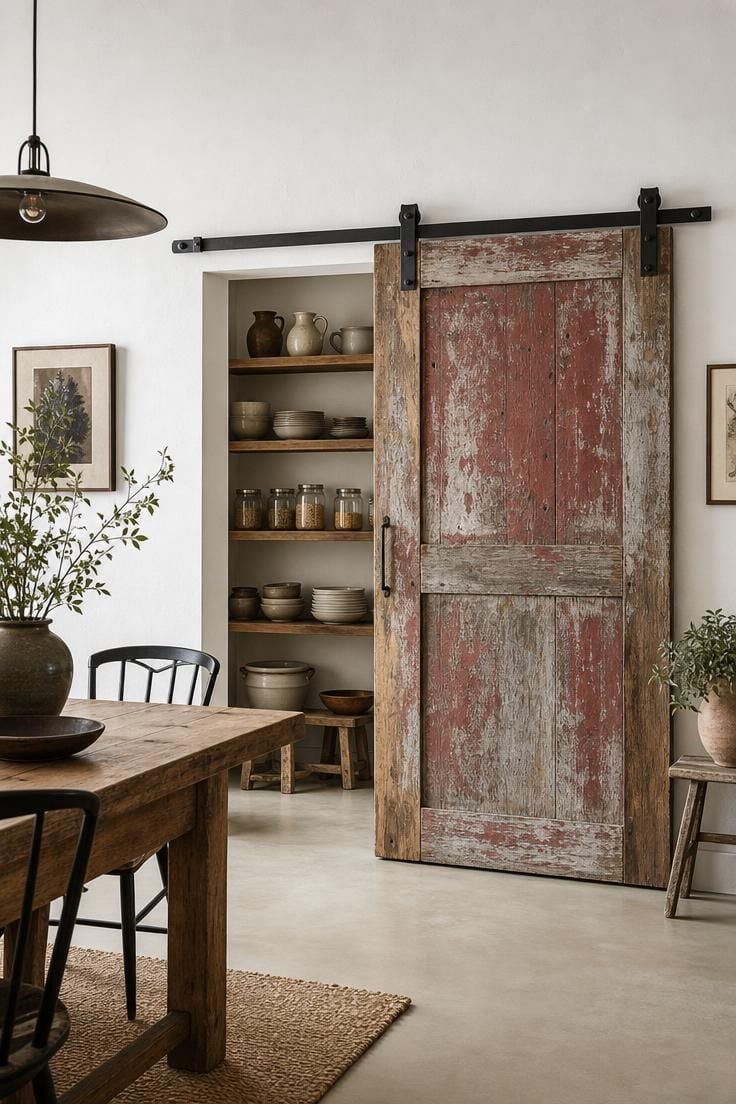
A reclaimed barn door brings decades of weather into a dining room in a single piece of natural wood furniture.
The layers of faded red and exposed silver wood underneath tell you this door stood outside for years, and that history is more interesting than any new finish.
Mounted on a matte black iron track, it slides open to reveal pantry shelves stacked with the kind of stoneware and glass jars that belong in a wabi sabi kitchen.
The peeling paint adds color without anyone having to choose a swatch.
Smooth concrete floors underneath create a material gap between the rough door and the polished ground that keeps both surfaces distinct.
White plaster walls on either side stay neutral so the door can be the loudest thing in the room.
Style Blueprint:
- Reclaimed barn door with layered faded paint and visible wood grain
- Matte black iron sliding track hardware
- Open pantry shelving with stacked stoneware and glass jars
- Smooth poured concrete floor in a pale warm tone
- White plaster walls as a neutral frame for the textured door
A Low Japanese-Style Dining Platform With Floor Cushions
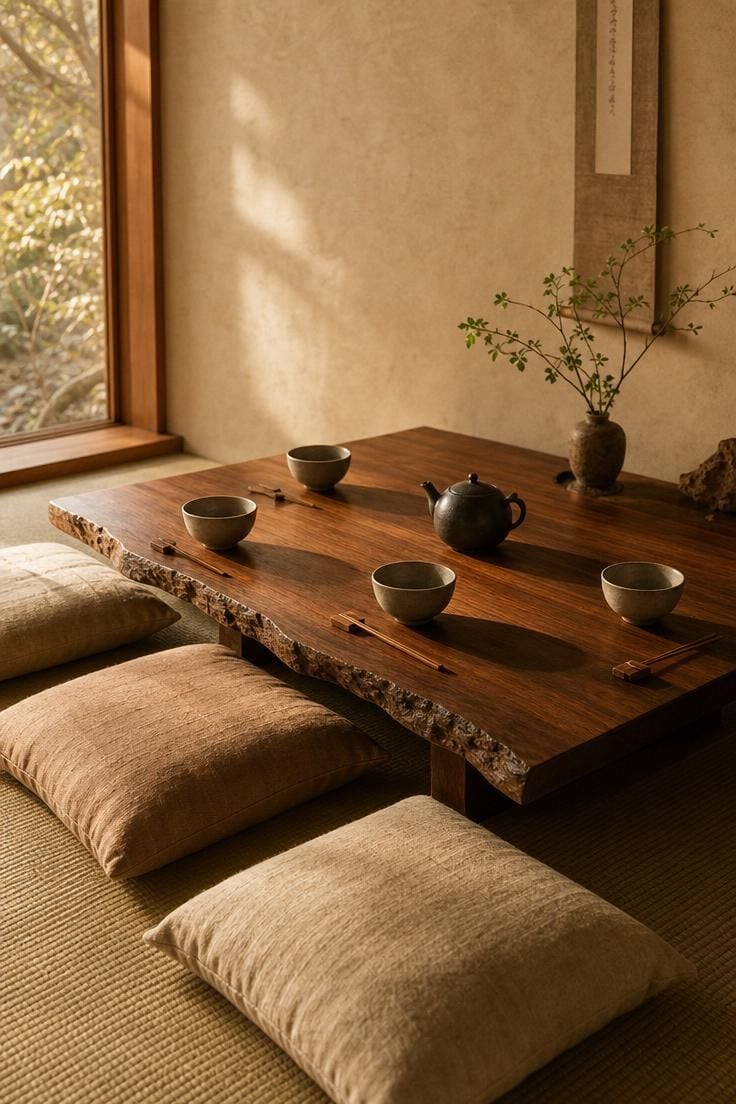
Sitting close to the ground changes how you experience a meal.
The low platform table shifts your entire posture, and with it your pace, because you cannot rush through a dinner when you are folded comfortably onto a floor cushion with nowhere else to be.
This live edge dining table variation sits just a foot off the ground, and that natural bark line along one side reminds you this was a tree not long ago.
Oiled chestnut deepens in color over years of use, which means the table you eat on in winter will look different by summer.
Linen-covered buckwheat hull cushions replace chairs entirely, and they compress and conform to each person who uses them.
Tea bowls and chopstick rests arranged for a meal bring a ritual quality to the table that Western place settings rarely achieve.
The woven rush matting underfoot connects the whole scene to its Japanese roots without forcing a theme.
Style Blueprint:
- Low chabudai-inspired platform table in oiled chestnut with live edge
- Linen-covered buckwheat hull floor cushions in natural beige and clay
- Matte ash tea bowls and warm charcoal ceramic teapot
- Wooden chopstick rests arranged for a meal setting
- Woven rush matting flooring for a grounded, tactile base
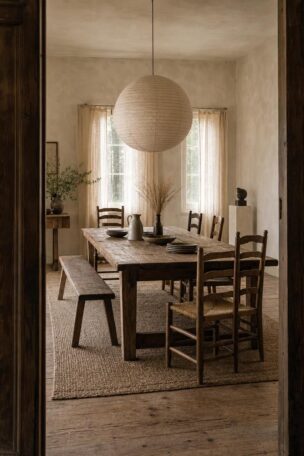
A Jute Rug Layered Over Wide-Plank White Oak Under the Dining Table
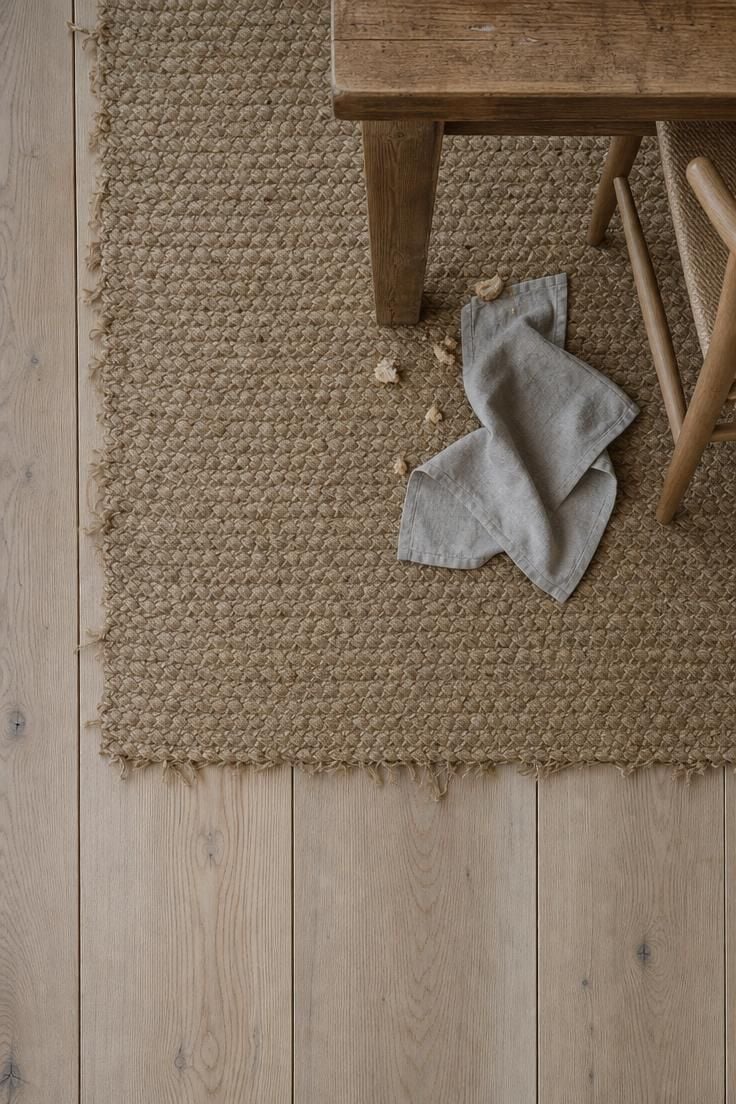
A jute rug under a dining table does something practical and visual at the same time.
It defines the eating zone in an open-plan room, drawing a soft boundary that furniture alone cannot create.
The braided texture against smooth long-grain oak gives your feet two completely different surfaces within a single step.
Fraying edges where the braid ends are a welcome sign of wear in a wabi sabi dining room, not a reason to replace anything.
That natural tan color sits so close to the oak underneath that the two materials feel like relatives rather than strangers.
Style Blueprint:
- Chunky braided jute rug in natural tan with intentionally fraying edges
- Wide-plank white oak flooring with matte oil finish beneath
- Rug sized to define the dining zone in an open layout
- Cool overcast light for flat, even texture visibility
- Lived-in accents like a dropped napkin or breadcrumbs near the edge
A Single Oversized Ceramic Vase in Matte Charcoal on a Sideboard
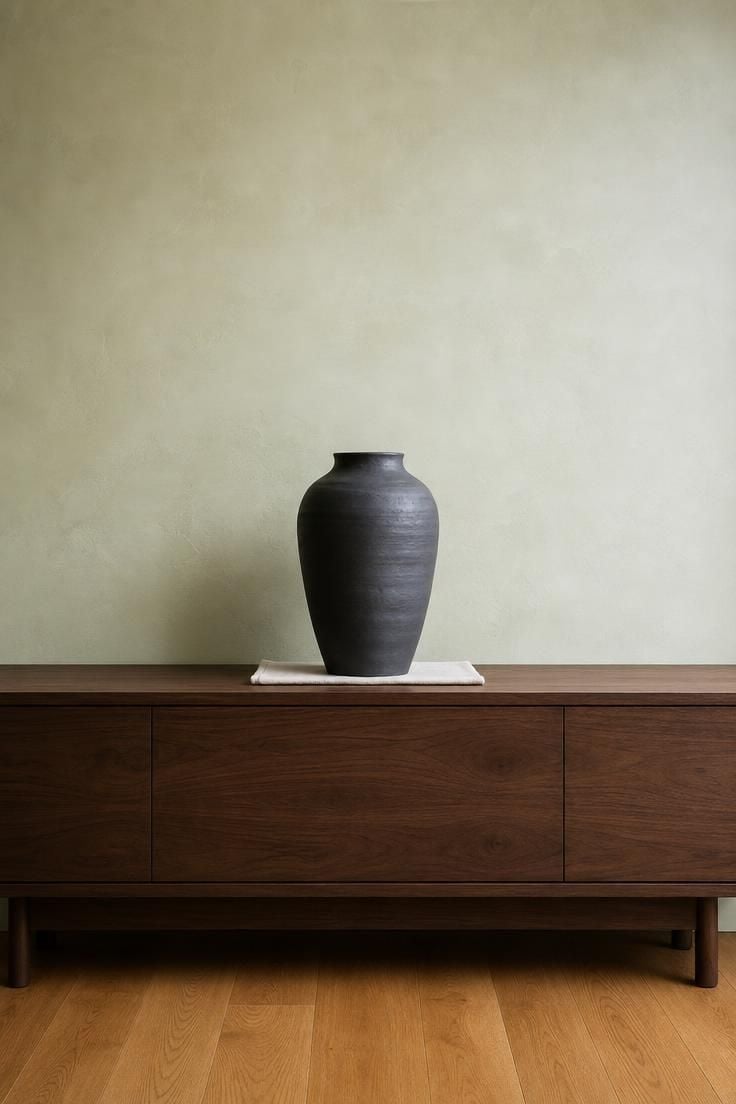
One object on an empty surface is a kind of courage.
Most people fill a sideboard because the space asks for it, but leaving the surface bare around a single vase forces the eye to slow down and actually see what is there.
This matte charcoal ceramic stands 18 inches tall with surface undulations that catch soft light differently along every curve.
The pale lime wash wall behind it acts as a canvas, and the faint trowel marks in the plaster add just enough texture to keep the background alive.
Walnut brown sideboard with honey oak flooring below creates a warm base that keeps the charcoal vase from feeling cold.
The ivory linen cloth underneath is the only other object, and it sits there purely to soften the transition between ceramic and wood.
Wabi sabi decor at this level of restraint takes discipline, because the temptation to add a stack of books or a second piece is always there.
What you leave out becomes the loudest statement in the room.
Style Blueprint:
- Single oversized ceramic vase in matte charcoal with surface undulation
- Low walnut sideboard with deliberately empty surface area
- Pale lime wash plaster wall as a textured backdrop
- Small ivory linen cloth beneath the vase for a soft transition
- Negative space as an intentional design element on both sides
Design Pro-Tip: When you place a single object on an otherwise empty surface, resist the urge to add a second. That empty space around it is not a gap that needs filling. It is the silence that makes the object speak, and in a wabi sabi dining room, what you leave out matters as much as what you keep.
A Hand-Stitched Sashiko Table Runner on Weathered Teak
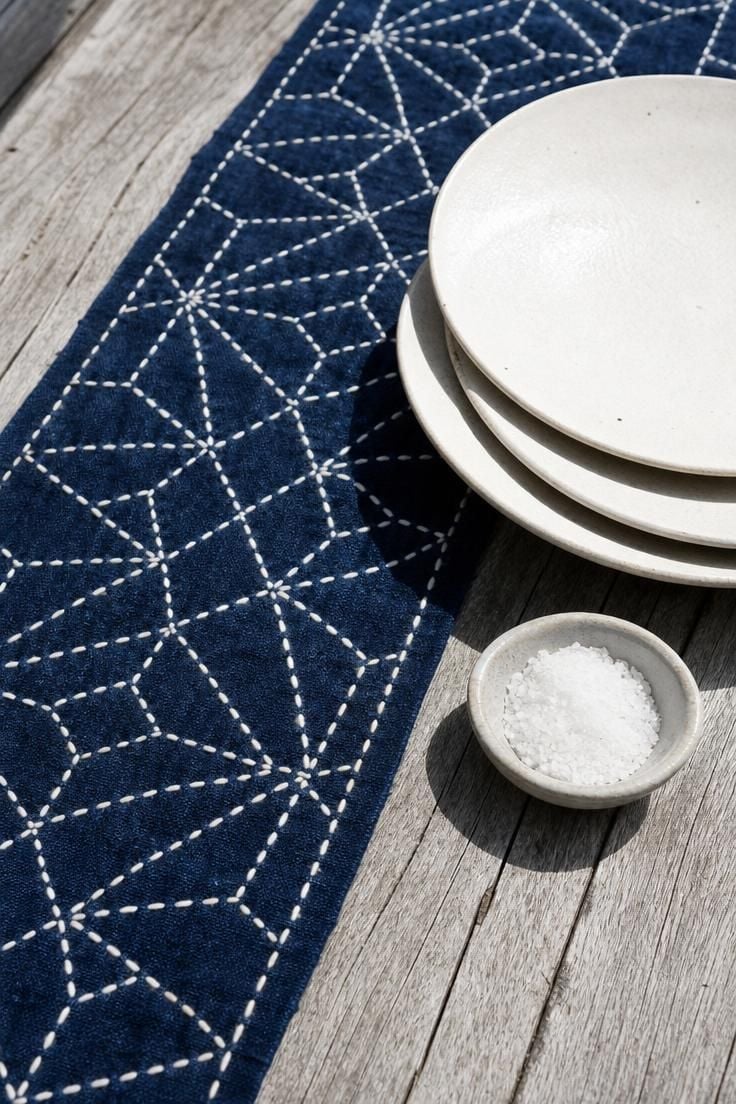
Sashiko stitching was originally a mending technique, a way to reinforce worn fabric so it could keep working.
That origin matters, because placing a sashiko runner on a dining table brings a philosophy of repair into the room.
The white thread against indigo-dyed cotton creates a geometric pattern that is precise but clearly handmade, with small variations in stitch length that a machine would never produce.
Weathered teak underneath has its own silver-gray patina, a color that only appears after years of sun exposure and natural aging.
Deep blue against silver gray is one of those pairings that looks like it was always meant to be, quiet but impossible to ignore.
White stoneware plates set on top of the runner overlap its edge just enough to connect the tableware to the textile layer beneath.
The hand-stitching brings a human presence to every meal before anyone sits down.
Style Blueprint:
- Hand-stitched indigo sashiko cotton table runner with geometric pattern
- Weathered teak dining table with silver-gray natural patina
- Simple white stoneware plates overlapping the runner edge
- Strong midday light to reveal stitch and grain textures
- Deep indigo and silver-gray as the primary color pairing
Conclusion
A wabi sabi dining area does not ask you to start over or spend more.
It asks you to look at what is already there with softer eyes.
The scratched table, the chipped bowl, the wall that needs a fresh coat of paint: these are not problems waiting to be fixed.
They are the textures that make a room feel like it belongs to someone.
Start with one honest material, one handmade object, one surface you leave unpolished, and let the room grow from there.