This post may contain affiliate links. If you make a purchase through these links, we may earn a commission at no additional cost to you.
The front door opens, and the world falls away.
A wabi sabi entryway does not shout for attention or demand perfection from every surface.
It greets you with worn wood, quiet stone, and the kind of calm that comes from leaving polish at the curb.
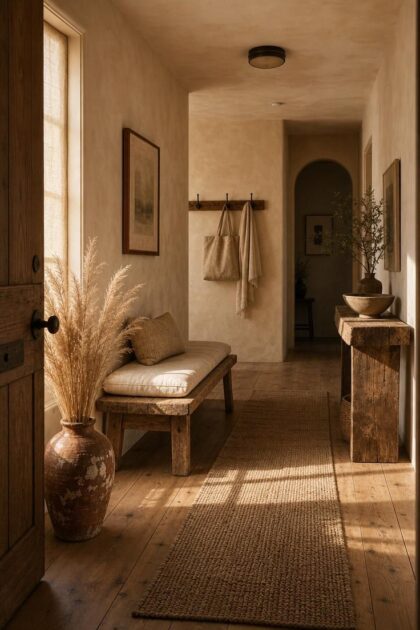
These 13 wabi sabi entryway ideas lean into raw materials, handmade objects, and open space to create a foyer that feels honest from the first step.
Reclaimed Oak Bench With a Hand-Loomed Linen Cushion
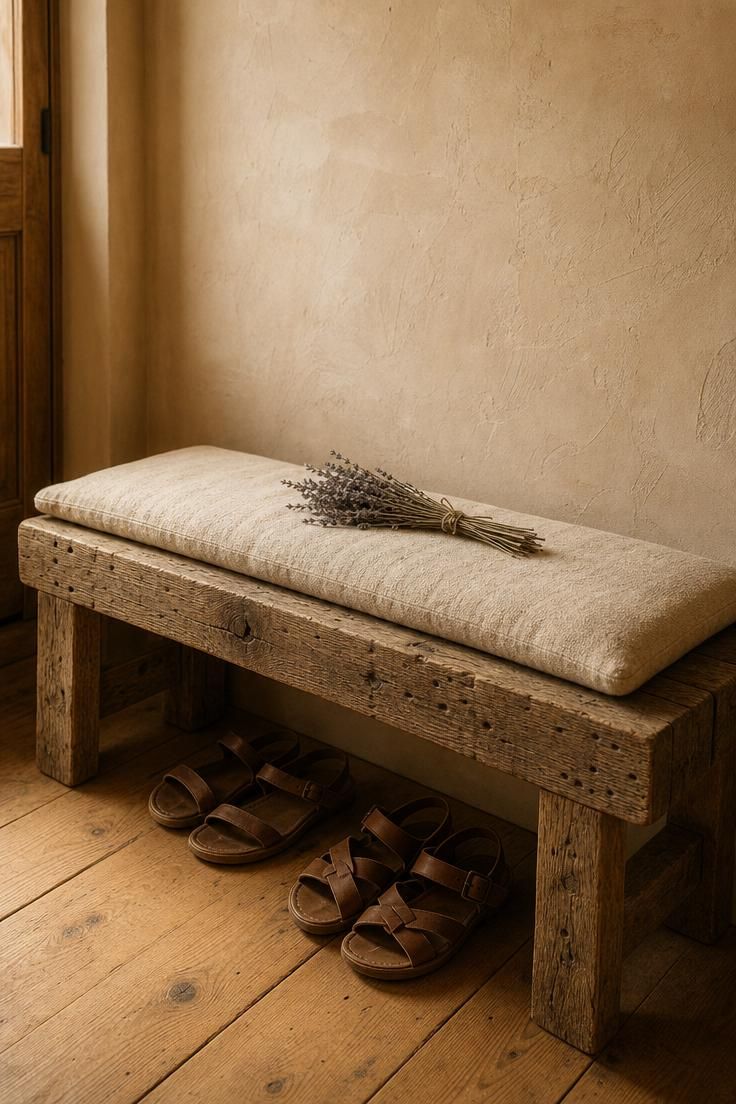
A reclaimed oak bench sets the entire tone for a wabi sabi entryway before anything else in the room registers.
The grain tells a story you did not write, and that is the point.
Old nail holes and knots are not flaws here, they are the proof that this wood carried weight long before it held your coat.
A hand-loomed linen cushion in oatmeal or clay softens the seat without hiding the wood beneath it.
Shoes tuck underneath in a row that stays casual, never lined up like soldiers.
The bench asks for nothing more than a wall and a few inches of floor, making it one of the most grounding pieces of wabi sabi decor you can place near a front door.
Style Blueprint:
- Reclaimed oak bench with visible grain, knots, and old nail holes
- Hand-loomed linen seat cushion in oatmeal, clay, or undyed cream
- Wide-plank pine or ash flooring beneath the bench
- Pale clay or putty-toned plaster wall behind the seat
- One dried botanical bundle resting on the cushion or bench arm
Lime Wash Walls in Pale Clay Above Tumbled Slate Tile
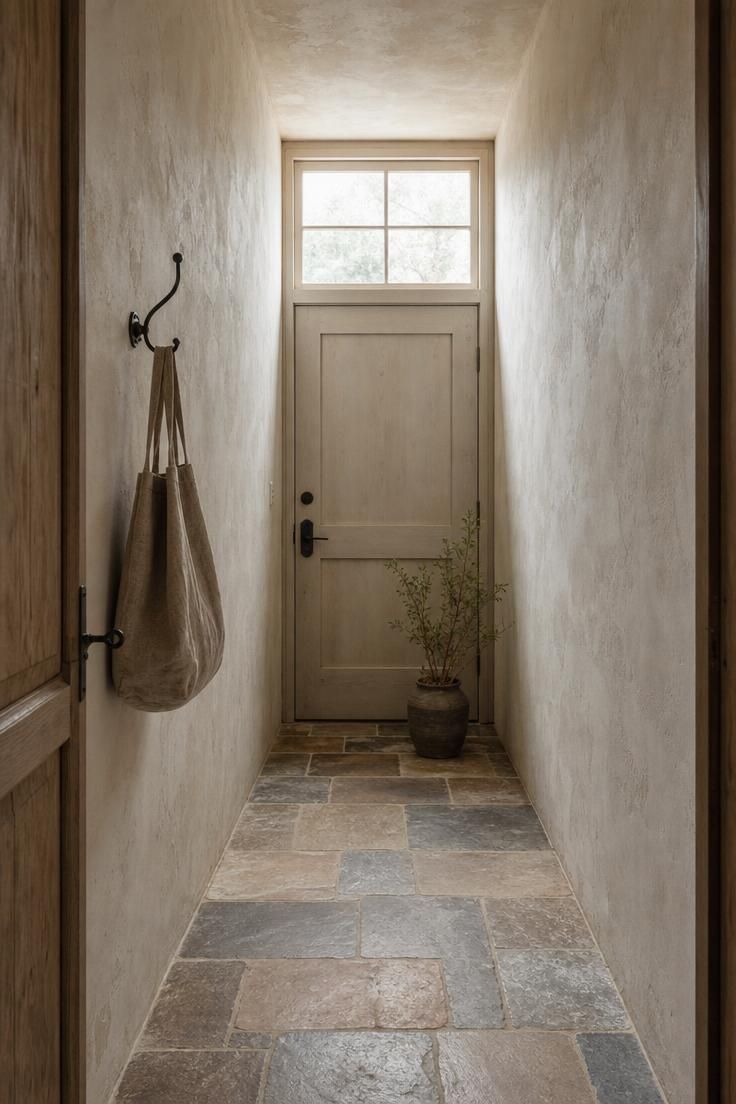
Lime wash walls give a wabi sabi entryway a surface that breathes and shifts with the hour.
The mineral pigment sits differently on every square inch, catching morning light in one spot and turning matte two feet over.
Pale clay tones work best near front doors because they read warm without competing with whatever you hang on them.
Trowel marks left visible in the finish add a handmade quality that flat paint cannot match, no matter how trendy the color.
Tumbled slate tile on the floor picks up the same earth tone palette and extends it underfoot with a texture you can feel through socks.
The slight irregularity of each tile edge keeps the floor from looking machine-cut, which is the whole idea.
This combination of lime wash walls and rough stone turns an ordinary hallway into something that feels carved from the landscape.
Style Blueprint:
- Lime wash or mineral paint in pale clay, warm putty, or soft greige
- Tumbled slate floor tile in mixed taupe, pewter, and sand tones
- Visible trowel marks left in the wall finish
- Iron coat hook or peg for a single bag or jacket
- Bare opposite wall preserving negative space
A Rough-Hewn Cedar Shelf With Iron Bracket Hooks
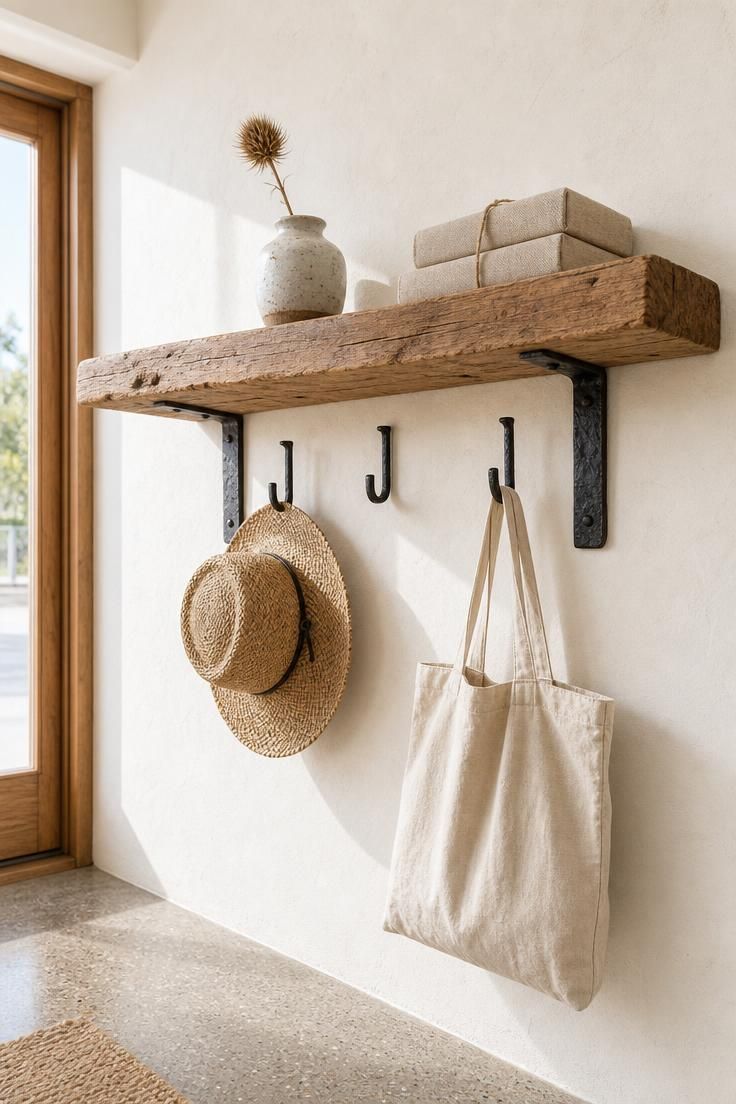
A single cedar shelf does more work than a full coat closet when it is placed at the right height near the door.
The rough-sawn edge looks best left untreated, with the natural red and blonde grain darkening over months of use.
Hand-forged iron L-brackets give the shelf its structure and its character at the same time, their slight asymmetry a reminder that a person made them.
Hooks welded to the bracket undersides hold bags, hats, and scarves without taking up any additional wall space.
The shelf surface becomes a landing pad for a ceramic vase with one dried stem, a small tray, or a stack of mail you will sort later.
Cedar carries a faint scent that fades slowly over the first year, adding one more sensory layer to the entryway experience.
This is the kind of dual-purpose piece that defines a japanese entryway, where every object earns its place through daily use.
Mounting it at chest height keeps the area below open for a bench, baskets, or clean floor.
Style Blueprint:
- Rough-hewn cedar plank, untreated, with visible grain and bark edge
- Hand-forged iron L-brackets with welded hooks beneath
- One ceramic vase with a single dried stem on the shelf surface
- Warm white or clay-toned plaster wall behind
- Poured concrete or wide-plank wood floor below
Stoneware Catch-All Bowl on a Live-Edge Walnut Console
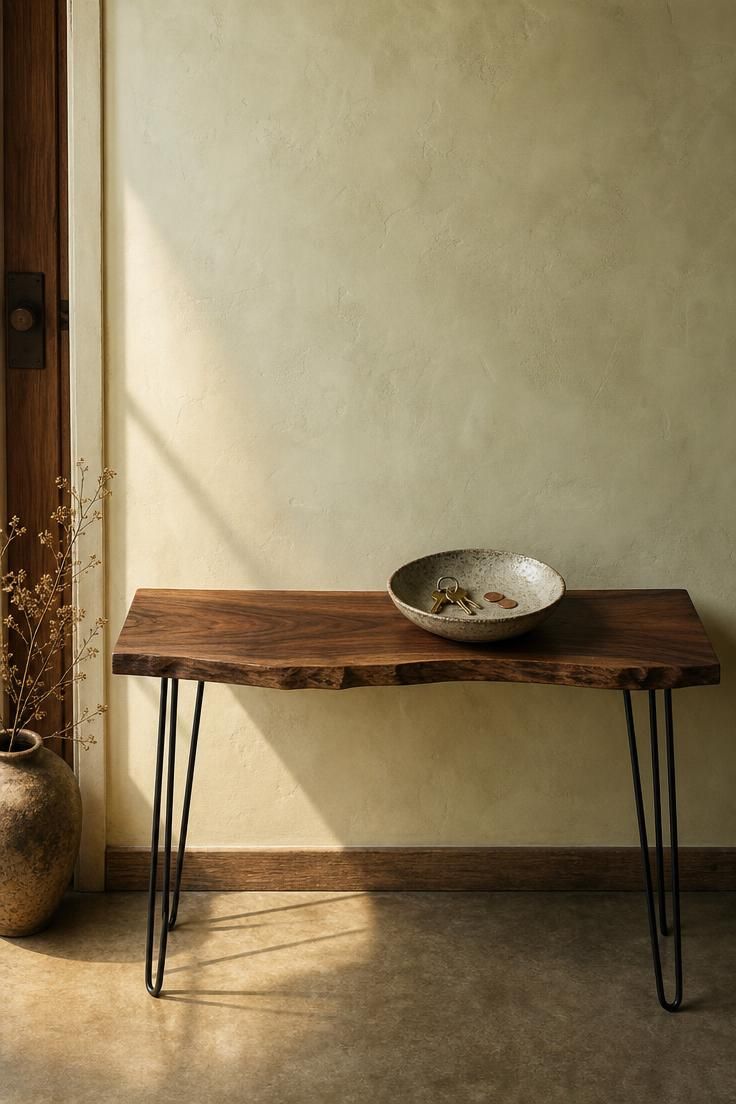
A live-edge walnut console anchors the wabi sabi entryway the way a kitchen island anchors a cooking space.
The natural edge of the wood slab, with its bark remnants and uneven curves, makes every reclaimed wood console feel singular.
Matte black hairpin legs keep the base light and let the wood do the talking.
One stoneware bowl with an irregular glaze is all the surface needs to serve its purpose as a landing spot for keys and pocket contents.
Placing the bowl off-center rather than dead middle is a deliberate choice rooted in the wabi sabi preference for asymmetry.
The negative space on the rest of the console is just as important as the bowl itself.
Style Blueprint:
- Live-edge walnut slab console with matte black hairpin legs
- Handmade stoneware bowl with irregular or ash glaze
- Bowl placed off-center on the console surface
- Pale lime wash or plaster wall behind, left bare
- Polished or raw concrete flooring beneath the console
Design Pro-Tip: Place the stoneware bowl off-center on the console rather than dead middle. Asymmetry is a core wabi sabi principle, and the slight imbalance draws the eye more naturally than a centered arrangement. Let the empty side of the surface breathe.
Dried Pampas Grass in a Chipped Terracotta Floor Vase
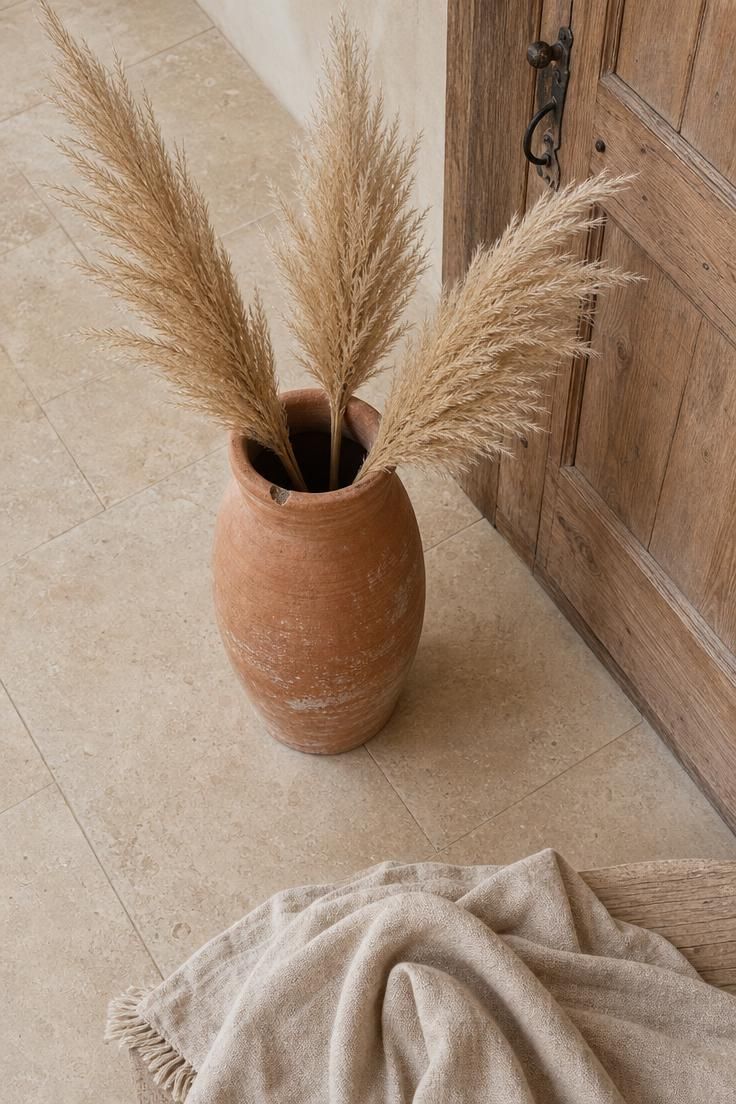
A floor vase filled with dried pampas grass is one of those wabi sabi entryway staples that works in every season and every floor plan.
The terracotta itself matters more than what sits inside it.
A chip near the rim or a streak of mineral staining across the belly gives the vessel a biography that a factory-fresh pot cannot offer.
Three to five plumes are plenty, and odd numbers always look less arranged than even ones.
Pampas grass holds its shape for a full year before it starts to shed, making it a low-maintenance choice for a space you walk through quickly.
Placing the vase on the floor rather than a table grounds the arrangement and keeps the eye level clear for coats and shelves.
Seasonal rotation is simple here: swap pampas for dried eucalyptus branches in spring or wheat stalks in late summer.
The vase itself never moves, only its contents change with the calendar.
Natural textures like terracotta and dried grass bring warmth to a minimalist foyer without adding clutter or visual noise.
Style Blueprint:
- Tall terracotta floor vase with visible patina, chips, or mineral deposits
- Three to five dried pampas grass plumes in cream or gold tones
- Large-format limestone or sandstone floor tile beneath the vase
- Placement on the floor beside the door or bench, not on a table
- Folded linen throw or runner nearby for layered texture
A Kintsugi-Repaired Ceramic Tray for Keys and Coins
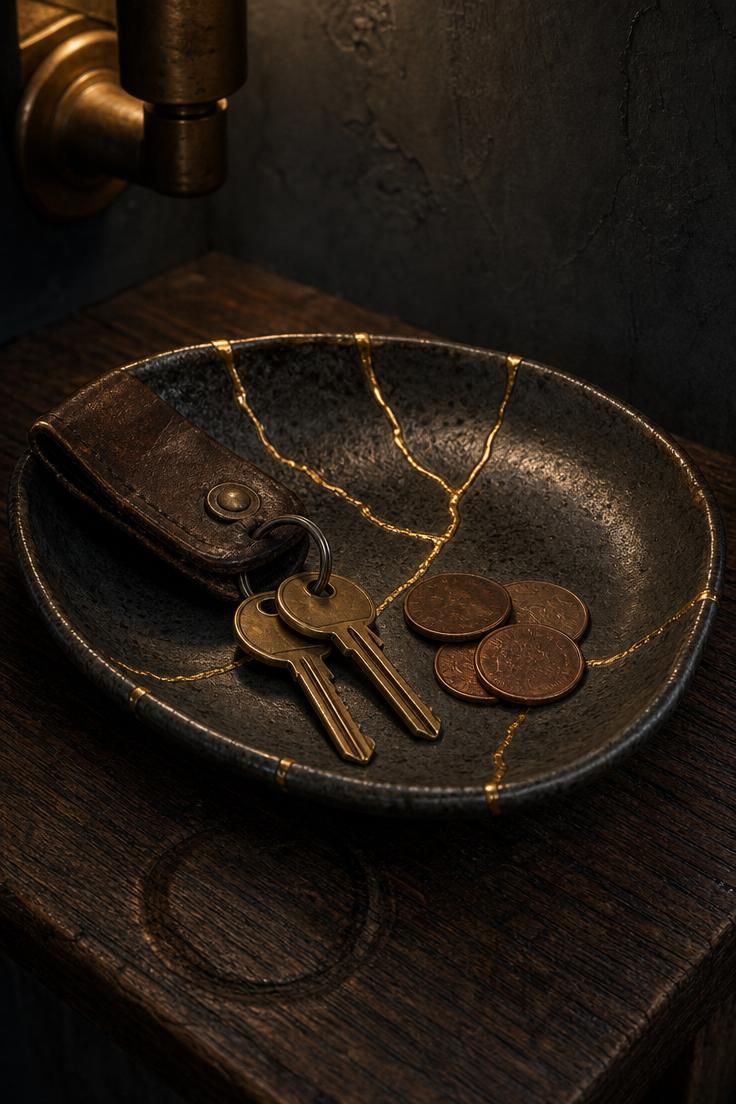
Kintsugi turns a broken dish into something more interesting than it was before the crack appeared.
The Japanese technique of filling fracture lines with gold or brass lacquer treats damage as a chapter in the object’s life rather than a reason to throw it away.
A small kintsugi tray near the front door catches keys, coins, and pocket clutter with a level of intention that a random dish from the cabinet cannot match.
The gold lines catch even low light, drawing the eye to the repair rather than away from it.
This is the kind of accent that teaches a room’s visitors something about the philosophy behind the space without a single word.
Pairing the tray with a weathered oak or walnut side table keeps the focus on materials that have already lived a little.
You can find kintsugi repair kits online and mend a favorite broken bowl yourself in an afternoon.
Style Blueprint:
- Shallow ceramic tray with visible kintsugi gold or brass repair lines
- Matte charcoal, cream, or stone-toned glaze on the ceramic body
- Dark weathered oak or walnut side table beneath the tray
- Brass or copper keys and small metal objects inside the tray
- Low ambient light from a wall sconce or nearby window
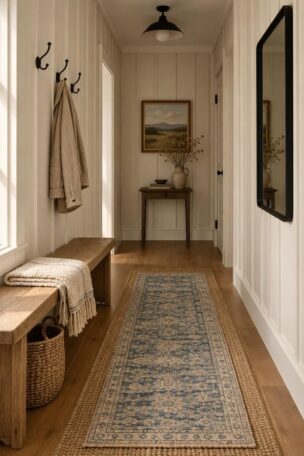
Jute Runner Over Wide-Plank Ash Flooring
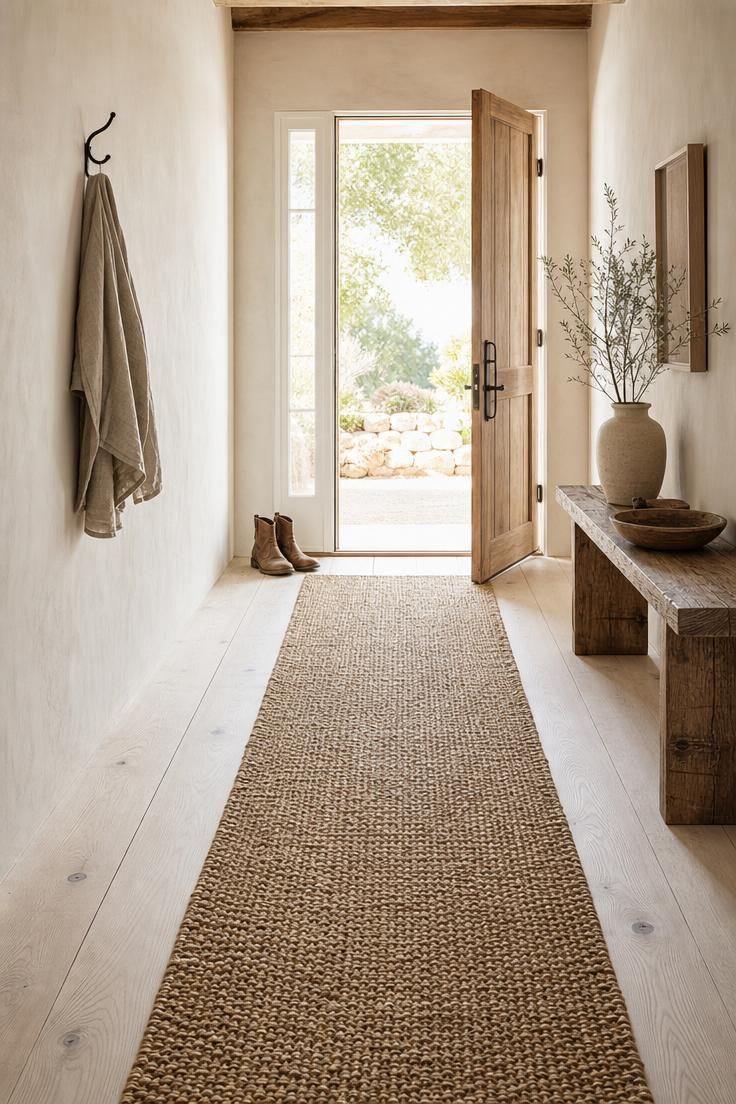
A jute rug laid down the center of an entryway hallway defines the path without boxing it in.
The handwoven weave adds a layer of texture underfoot that polished wood alone cannot deliver.
Wide-plank ash flooring with a whitewash or limed finish creates a pale canvas that lets the warm tan of the jute stand out.
The contrast between the smooth wood grain and the rough fiber weave is one of the simplest ways to introduce natural textures into a foyer.
Jute wears well in high-traffic zones, developing a softer hand over months of foot traffic rather than fraying or pilling.
A runner keeps the floor plan feeling open on either side, which matters in narrow hallways where wall-to-wall carpet would close the space down.
Pair the runner with leather boots and a linen jacket on a nearby hook for a landing zone that looks like it belongs in a japanese entryway.
Cleaning is simple: shake it out on the porch once a week and vacuum it flat.
Style Blueprint:
- Handwoven jute rug in natural tan or warm flax tones
- Wide-plank ash or pine flooring with whitewash or limed finish
- Runner centered in the hallway, leaving floor visible on both sides
- Worn leather boots or sandals placed beside the runner near the door
- Matte mineral paint on the walls in soft warm white
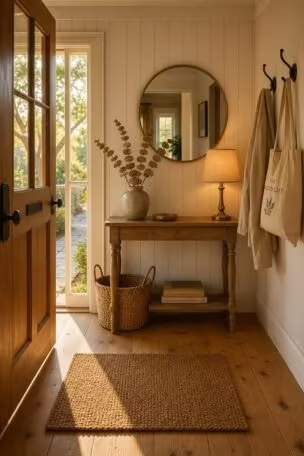
Woven Rattan Baskets Tucked Under a Driftwood Coat Rack
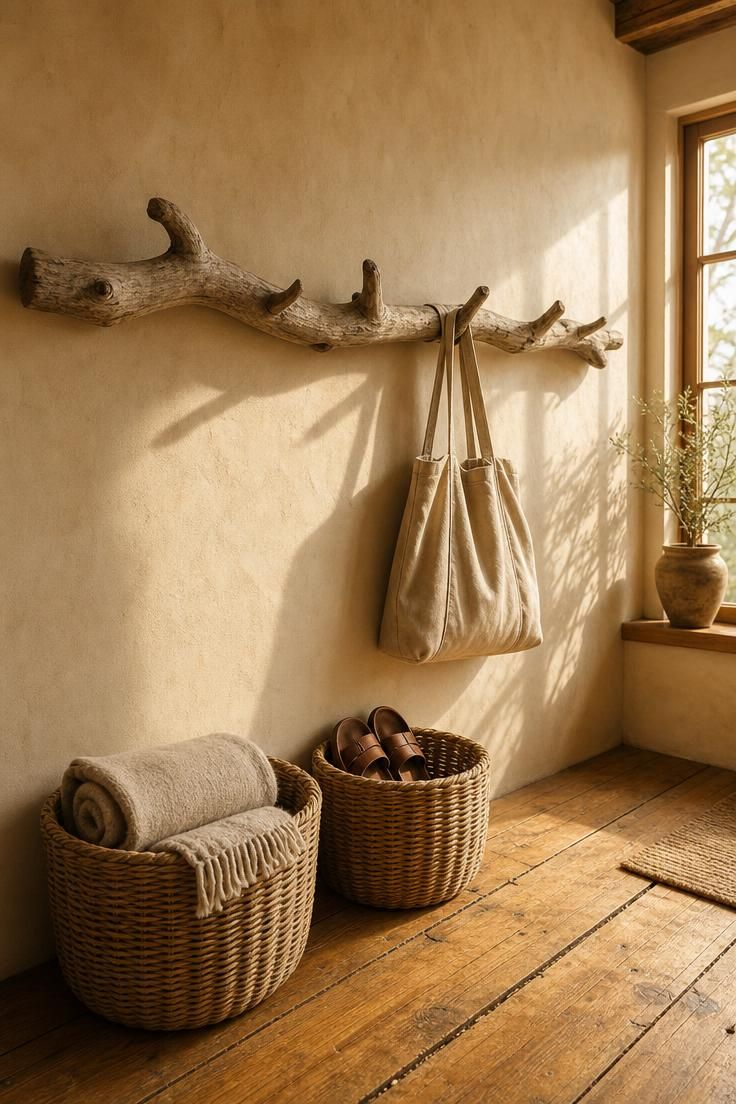
A driftwood branch mounted horizontally on the wall turns a piece of beach debris into the most talked-about feature in the room.
Every branch is different, with its own curves, knots, and smooth patches worn by salt and sand.
Woven rattan baskets tucked directly beneath the branch catch shoes, scarves, and blankets without needing a label or a lid.
The open weave of the rattan lets you see what is inside, which connects to the wabi sabi idea that useful objects deserve to be visible.
A single canvas or linen bag hanging from the branch is enough to show how the rack works without overloading it.
Style Blueprint:
- Wall-mounted driftwood branch with natural hooks and curves
- Two woven rattan baskets in mixed sizes on the floor below
- Reclaimed pine flooring with wide gaps and honey amber finish
- One cotton canvas or linen tote bag hanging from the branch
- Warm plaster wall in cream or pale clay behind the rack
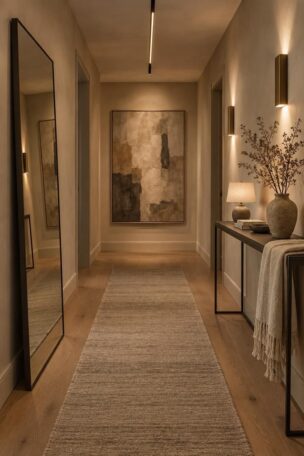
Hand-Thrown Ceramic Sconce Casting Soft Arc Light
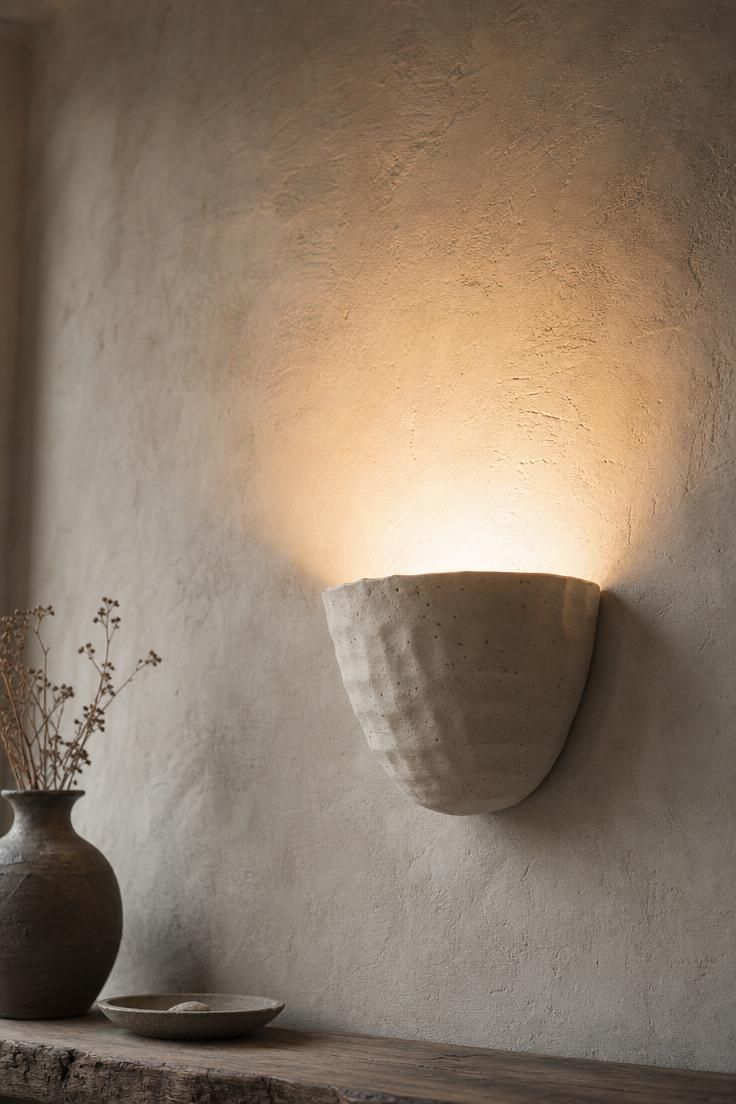
A hand-thrown ceramic sconce replaces the cold glare of a recessed ceiling light with something you actually want to look at.
The finger marks left in the clay during shaping become part of the design, visible proof that a potter sat at a wheel and made this piece by hand.
Mounting the sconce at shoulder height rather than overhead changes the way light moves across a plaster or lime wash wall.
The upward arc creates shadows that reveal every trowel mark and mineral grain in the surface above, turning the wall into a second piece of art.
A matte cream or stone-toned glaze with iron speckles ties the sconce back to the earth tone palette of the rest of the room.
One sconce on one wall is enough for a small foyer, and the restraint itself reinforces the wabi sabi commitment to less.
The warm amber glow it throws is softer than overhead light and far more flattering to every material in the space.
Style Blueprint:
- Hand-thrown ceramic wall sconce with visible finger marks in the clay
- Matte cream, stone, or ash glaze with iron speckles
- Mounted at shoulder height on a plaster or lime wash wall
- Warm amber bulb casting an upward arc of light
- Single sconce placement for restraint and focus
Design Pro-Tip: Position a ceramic sconce at shoulder height on the wall closest to the door rather than overhead. The low placement casts shadows upward, creating depth on a lime wash or plaster wall that overhead light would flatten completely.
A Single Ikebana Arrangement on a Raw Concrete Ledge
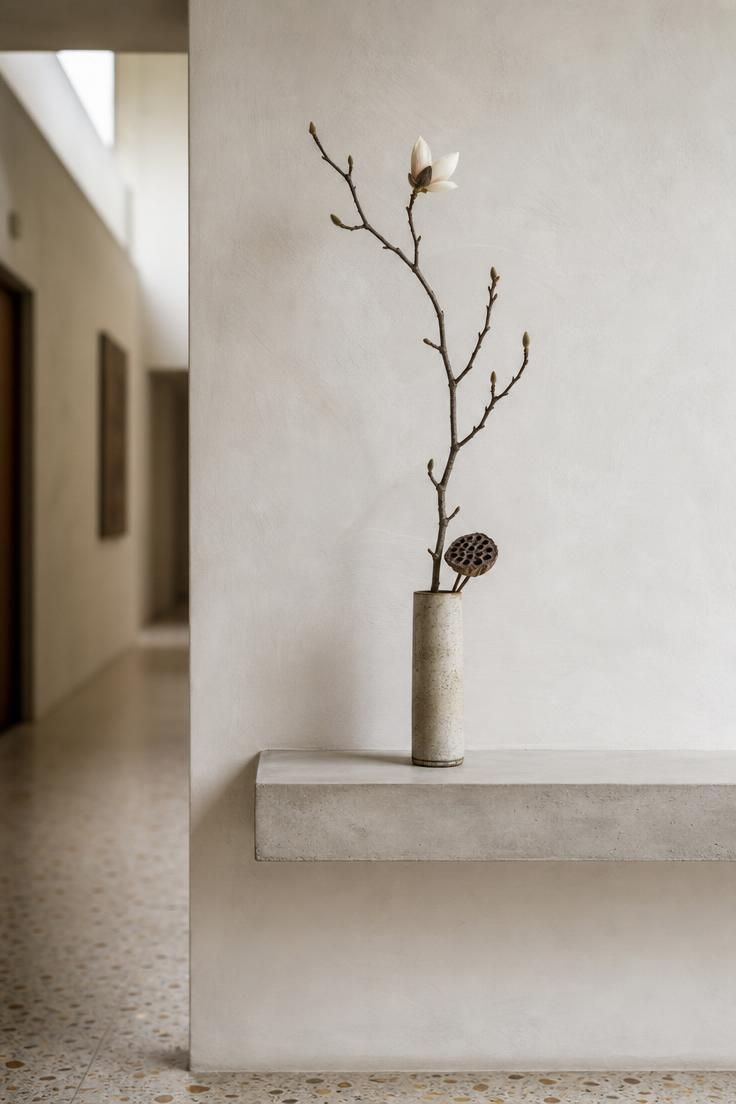
An ikebana arrangement on a raw concrete ledge distills the entire wabi sabi entryway philosophy into one square foot of wall.
The Japanese art of flower arranging prizes asymmetry, negative space, and the tension between a single living element and the stillness around it.
One bare branch reaching upward and one dried seed pod at the base is a complete composition, not a half-finished bouquet.
The narrow stoneware cylinder holding the arrangement should be simple enough to disappear behind the stems.
A raw concrete ledge adds a brutalist texture that contrasts with the organic curves of the branch, and the tension between the two keeps the eye interested.
Floating the ledge at waist height leaves the wall above and the floor below open, which matters in a space dedicated to calm arrival.
Swap the branch and pod with each season: cherry blossom cuttings in spring, a single dahlia stem in late summer, dried wheat in autumn.
The concrete ledge stays fixed as the permanent stage for a rotating cast of seasonal moments.
This is the kind of accent that gives a ceramic vase purpose beyond decoration, connecting the object to a living tradition.
Style Blueprint:
- Raw concrete floating ledge with smooth dove-toned finish
- Narrow stoneware cylinder in matte charcoal or ash glaze
- One bare branch and one dried element in an ikebana-style arrangement
- Soft white or pale plaster wall with faint lime wash texture
- Terrazzo or polished concrete floor with warm aggregate flecks
Iron Nail Hooks Mounted on a Charcoal Plaster Wall
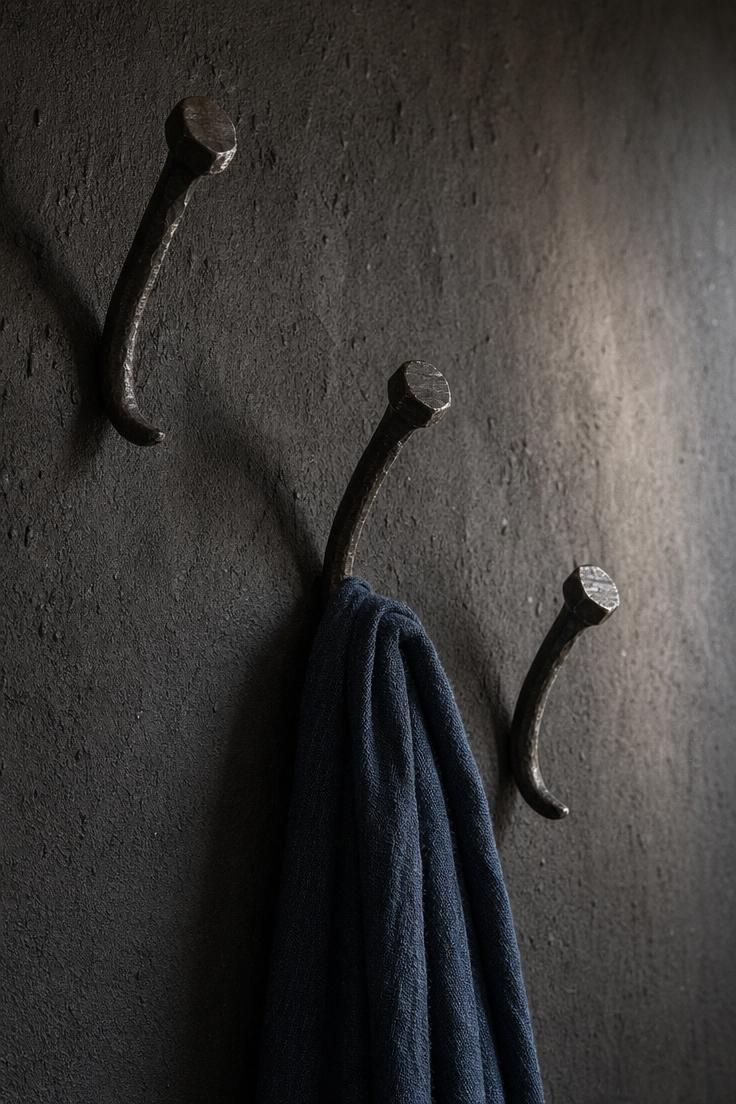
Hand-forged iron nail hooks are the smallest possible commitment to wabi sabi decor in an entryway, and they carry more weight than their size suggests.
Three to five nails mounted in a staggered row rather than a straight line give the arrangement a casual, hand-placed quality.
The hammer marks on each nail head are visible up close, a record of the blacksmith’s work that no factory hook can replicate.
A charcoal plaster wall makes the dark iron nearly disappear until something hangs from it, which is the right kind of surprise in a minimalist foyer.
Faded indigo linen or undyed cotton scarves look best on these hooks, their soft drape contrasting with the rigid metal.
Mounting the hooks without a backboard or rail keeps the wall clean and the installation reversible.
Style Blueprint:
- Hand-forged iron nail hooks with visible hammer marks on each head
- Three to five hooks in a staggered diagonal row, not a straight line
- Charcoal-toned plaster wall with visible sand aggregate texture
- Faded indigo, undyed linen, or natural cotton textile on one hook
- No backboard, rail, or additional hardware around the hooks
Linen Curtain Panel Filtering Light Through a Sidelight Window
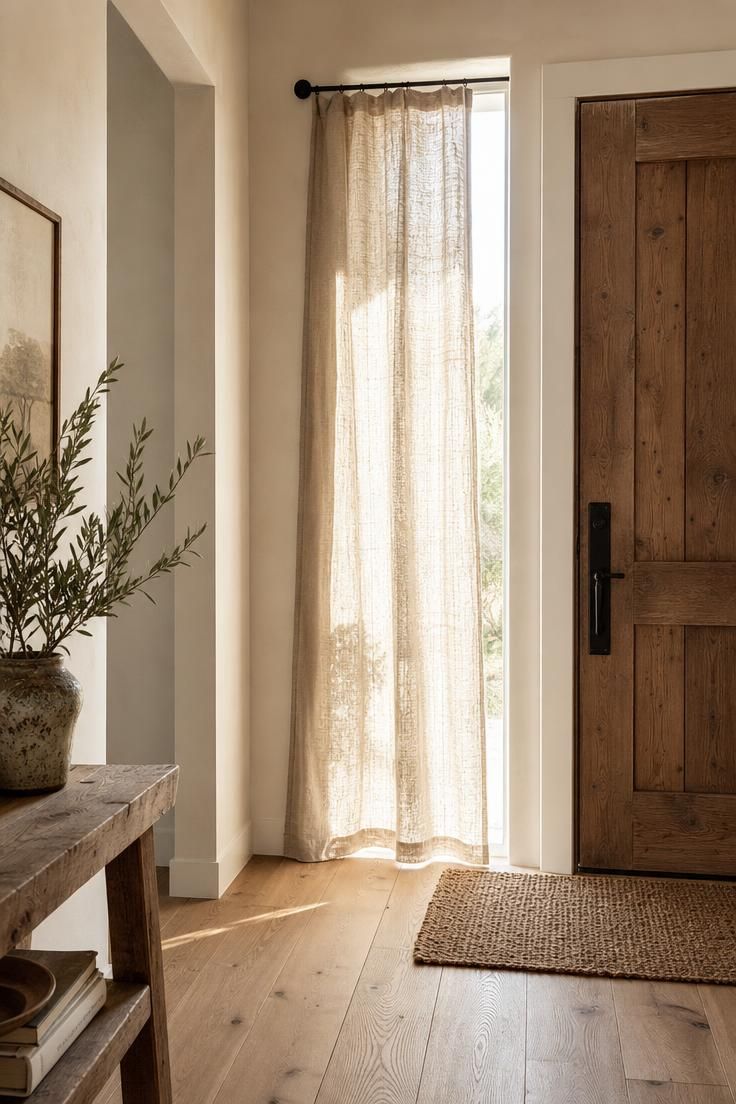
A single linen curtain panel over a sidelight window changes the quality of light in a wabi sabi entryway more than any fixture or bulb swap.
Undyed linen in its natural flax color filters midday sun into a soft amber wash that warms every surface it touches.
The weave of the fabric becomes visible in silhouette when the sun hits it directly, turning the curtain itself into a textural element.
A matte black tension rod is the simplest mounting method, requiring no drill holes and allowing easy seasonal removal.
The curtain should hang to the floor or just above it, with enough extra width to puddle slightly at the base for that lived-in look.
Pairing the linen panel with a reclaimed wood door and a seagrass threshold mat creates layers of natural fiber that reinforce each other.
This is one of the least expensive changes you can make in an entryway, and the effect on the room’s atmosphere is immediate.
Privacy improves without sacrificing daylight, which matters in entryways that face the street or a shared walkway.
Style Blueprint:
- Undyed linen curtain panel in natural flax or oatmeal tone
- Matte black tension rod mounted inside the sidelight window frame
- Curtain length reaching the floor with a slight puddle at the base
- Reclaimed wood front door with dark iron handle
- Woven seagrass or coir mat at the threshold
River Stone Tray With a Beeswax Pillar at the Threshold
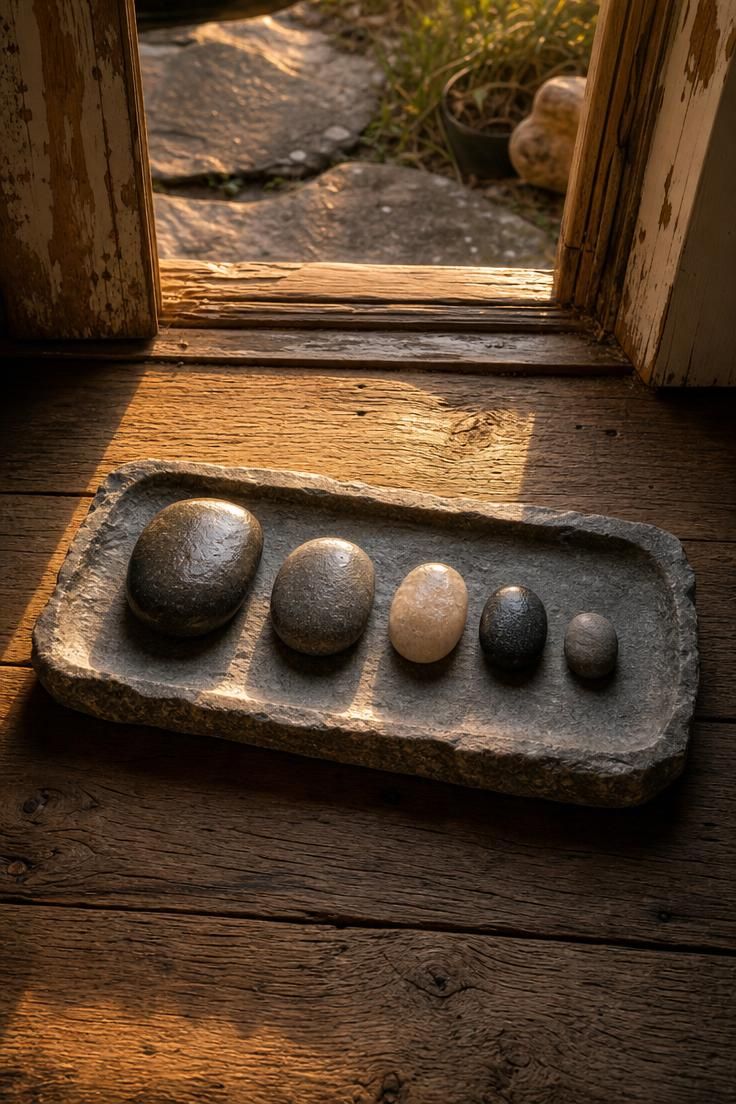
A stone tray at the threshold of the entryway marks the boundary between outside and inside with a material that has no expiration date.
Smooth river stones in three or four graduated sizes fill the tray without crowding it, each one worn by water over decades or centuries.
The variation in color from dove to charcoal with one pale quartz piece among them keeps the arrangement from looking like a kit.
A rough-cut soapstone tray with an unpolished surface holds the stones in place and adds its own layer of mineral texture.
Placing the tray near the threshold creates a small ritual of arrival, a visual pause before you step fully into the home.
A single beeswax pillar next to the tray, lit or unlit, adds a honeyed warmth that ties back to the golden tones of the wood floor.
The entire arrangement costs less than a restaurant dinner and lasts longer than almost any other piece of wabi sabi decor in the room.
Style Blueprint:
- Shallow hand-carved soapstone tray with rough unpolished surface
- Five smooth river stones in graduated sizes, dove to charcoal tones
- One pale quartz or limestone stone for contrast
- Beeswax pillar placed beside the tray on the floor
- Reclaimed wood threshold or wide-plank flooring beneath
Design Pro-Tip: Choose river stones in three or four different sizes rather than all the same. The variation in scale mirrors natural riverbeds and reinforces the wabi sabi idea that uniformity is less interesting than honest variety.
Conclusion
A wabi sabi entryway does not ask you to buy more or try harder.
It asks you to choose less, choose well, and let the materials speak for themselves.
Reclaimed wood, rough stone, handmade ceramics, and undyed linen all share one thing: they look better after years of daily contact than they did on the day you brought them home.
That is the quiet promise of this approach to the first room in your house.
Start with one piece, a bench, a hook, a single branch in a jute rug-lined hallway, and let the rest follow at its own pace.
The wabi sabi entryway you build will never be finished, and that is exactly the point.