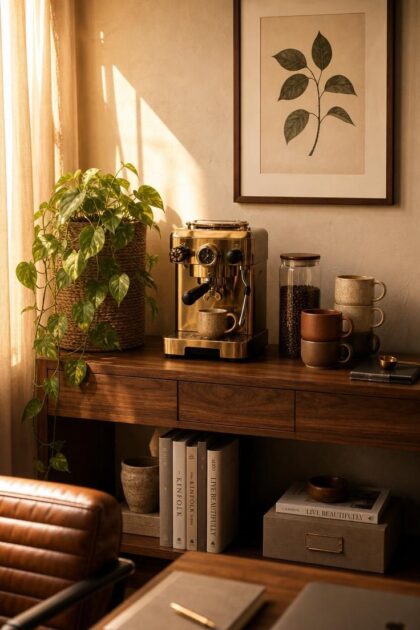
This post may contain affiliate links. If you make a booking or purchase through these links, we may earn a commission at no additional cost to you.
A good morning at the home office starts before you open your laptop.
It starts at the coffee bar, where the smell of fresh grounds and the warmth of a favorite mug set the pace for the hours ahead.
An office coffee bar gives you a reason to step away from the screen, even if just for a few minutes, and return with something that feels personal.
These 10 ideas pair function with character so your home office coffee station becomes the most inviting corner in the room.
Walnut Floating Shelves With a Brass Espresso Machine
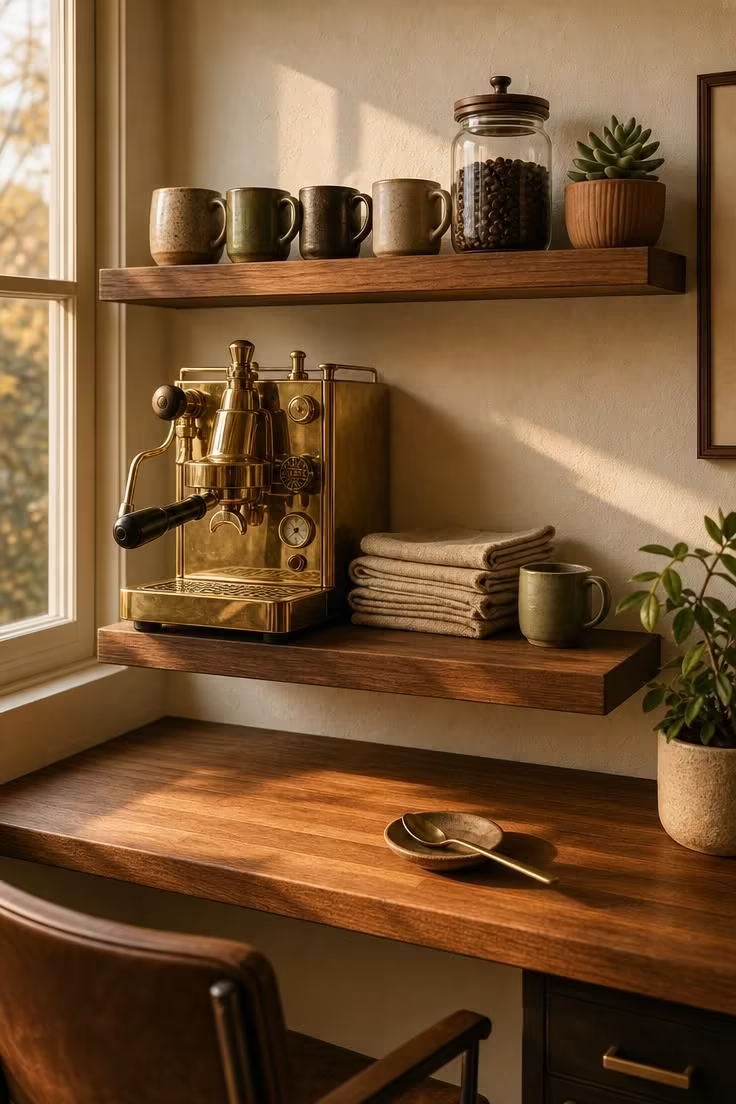
The richness of walnut grain against a white wall creates a contrast that feels grounded without being heavy.
Brass hardware picks up the golden tones in the wood and gives the coffee bar setup a collected, intentional quality.
Keeping only a few mugs on the upper shelf prevents the arrangement from looking cluttered or like a kitchen overflow.
The butcher block ledge below acts as a dedicated prep surface, wide enough for a cup and a spoon but narrow enough to leave the desk area untouched.
A small succulent at the end of the shelf adds a living element that softens the hard lines of metal and wood.
This kind of coffee nook ideas arrangement works best in offices with at least one window nearby, where natural light can warm the brass and deepen the walnut tones throughout the day.
Style Blueprint:
- Two walnut floating shelves (36-inch length, 10-inch depth) with concealed mounting brackets
- A brass or brushed gold espresso machine station with a matching portafilter
- Four handmade stoneware mugs in warm earth tones
- A slim butcher block ledge (minimum 24 inches wide, 12 inches deep)
- One small potted succulent in a ribbed clay planter
A Concrete Countertop Cart on Iron Casters
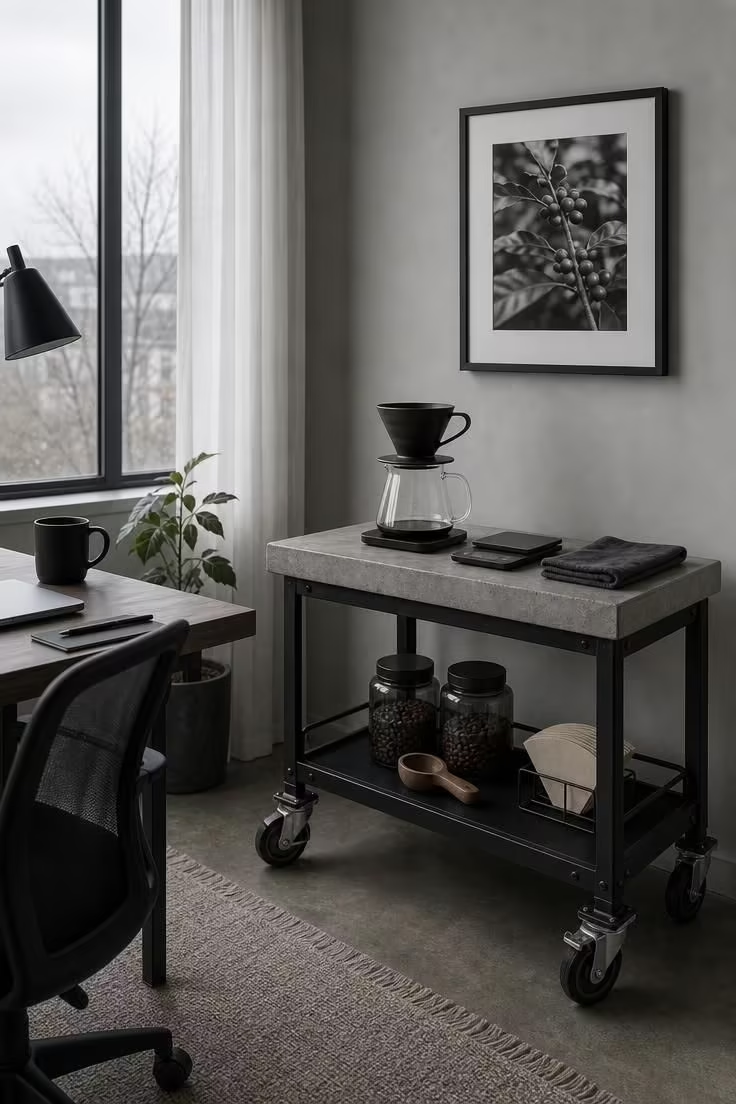
A cart on casters means the coffee bar moves where you need it, against the wall during focused work and closer to the desk during a long afternoon session.
Concrete as a countertop material reads as serious and tactile, with small air pockets and natural color variation that give each slab its own fingerprint.
The matte black pour-over dripper becomes the focal point here, sitting high enough on the carafe to catch the eye without competing with the desk setup across the room.
Smoked glass canisters on the lower shelf keep beans visible but muted, adding a layer of visual depth without bright colors or busy labels.
A digital scale next to the dripper signals precision, turning the morning coffee bar cart routine into something closer to a craft than a chore.
The single framed photograph above the cart anchors the station to the wall and prevents the whole arrangement from feeling temporary or afterthought-ish.
Pairing charcoal linen with the gray concrete ties the soft and hard textures together in a way that keeps the corner from feeling cold.
Style Blueprint:
- Rolling cart with poured concrete top and matte black iron frame (locking casters)
- Matte black ceramic pour-over dripper and clear glass carafe
- Two smoked glass canisters (32-ounce capacity) for bean storage
- A digital kitchen scale in black or stainless steel
- One framed black-and-white photograph (11×14 inches or similar)
White Subway Tile Backsplash Behind a Pour-Over Station
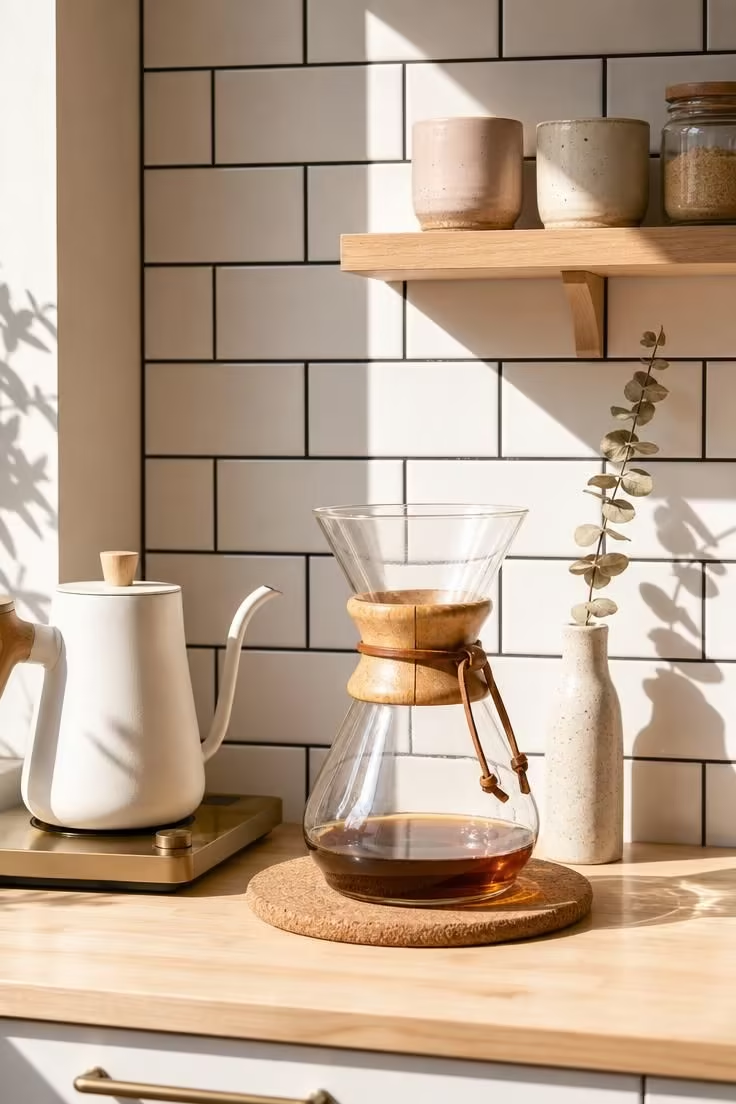
Subway tile behind a coffee station does something unexpected in an office, it borrows a kitchen material and reframes it as a design choice rather than a utility decision.
Dark grout against white tile draws the eye to the pattern itself, creating a backdrop that feels finished and deliberate.
The Chemex sits naturally at the center of this arrangement because its glass silhouette is clean enough to hold its own against the structured tile grid.
Cork underneath the brewer absorbs heat and sound, a functional detail that keeps the countertop free of scorch marks and rattling.
A gooseneck kettle with a wooden handle introduces a second texture, bridging the gap between the cool tile and the warm maple surface.
Dried eucalyptus in a bud vase brings a muted green into the palette without needing a living plant that requires regular watering in a workspace.
Keeping the shelf to just two cups and one jar enforces restraint, which is what makes a small coffee bar feel curated by taste rather than filled by habit.
This station works well in offices where the desk faces away from the coffee wall, so the tile catches peripheral light and adds brightness to the room even when you are not facing it directly.
Style Blueprint:
- Glossy white subway tile (3×6 inches) with charcoal grout, installed in a standard brick pattern
- A Chemex pour-over brewer (6-cup or 8-cup) on a round cork trivet
- Matte white gooseneck kettle with a wooden handle
- One open wooden shelf (24-inch length) with two ceramic cups and a sugar jar
- A narrow bud vase with dried eucalyptus or a similar dried botanical
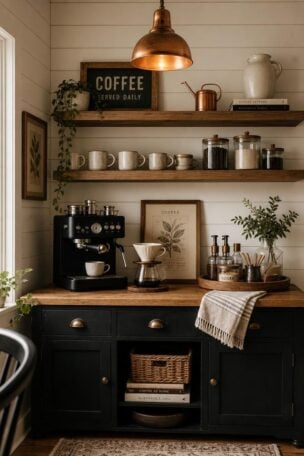
A Reclaimed Pine Shelf With Mason Jar Storage
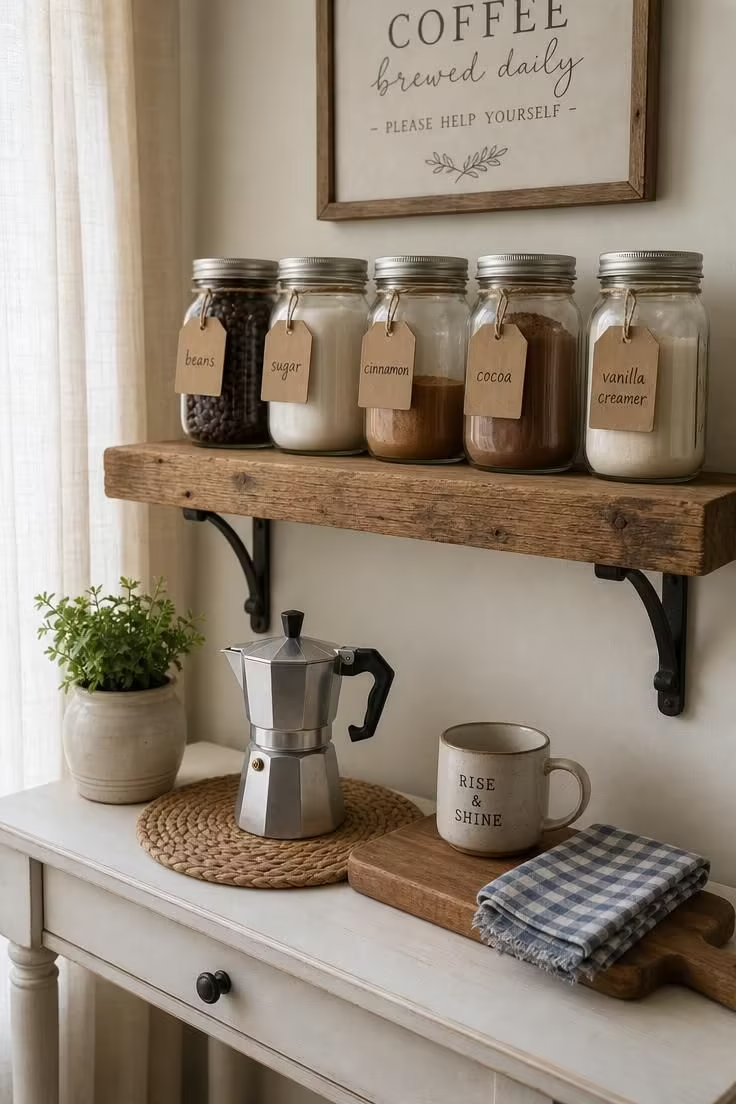
Reclaimed pine carries a warmth that new lumber cannot replicate, with knots and grain patterns that give the shelf a history before you place a single jar on it.
Mason jars labeled by hand bring a sense of daily ritual to the coffee station, turning pantry staples into a visual lineup that feels personal.
Wrought-iron brackets hold the weight of full jars without flexing, and their dark finish contrasts with the cream wall in a way that frames the shelf like a piece of mounted art.
The Moka pot below is a deliberate departure from modern espresso machine station designs, offering a slower, stovetop-rooted approach that fits the farmhouse tone.
A wooden cutting board under the pot doubles as a tray, catching drips and giving the small coffee bar a defined footprint on the console table.
Gingham cloth in a faded blue adds a textile layer that keeps the arrangement from feeling like all hard surfaces and glass.
Style Blueprint:
- One reclaimed pine plank shelf (36-inch length, minimum 8-inch depth, 3-inch thick) with natural wax finish
- Wrought-iron L-brackets in a dark matte finish
- Five wide-mouth mason jars (16-ounce or 32-ounce) with handwritten kraft tags and twine
- A classic stovetop Moka pot in brushed silver (6-cup capacity)
- A woven jute placemat and a gingham cloth napkin
Design Pro-Tip: Anchor your office coffee bar to one wall and resist the urge to spread it across two surfaces. A single dedicated wall creates a visual “destination” in the room, making the station feel intentional rather than scattered. This approach saves floor space and keeps the rest of the office clear for work.
Matte Black Pipe Shelving Against Exposed Brick
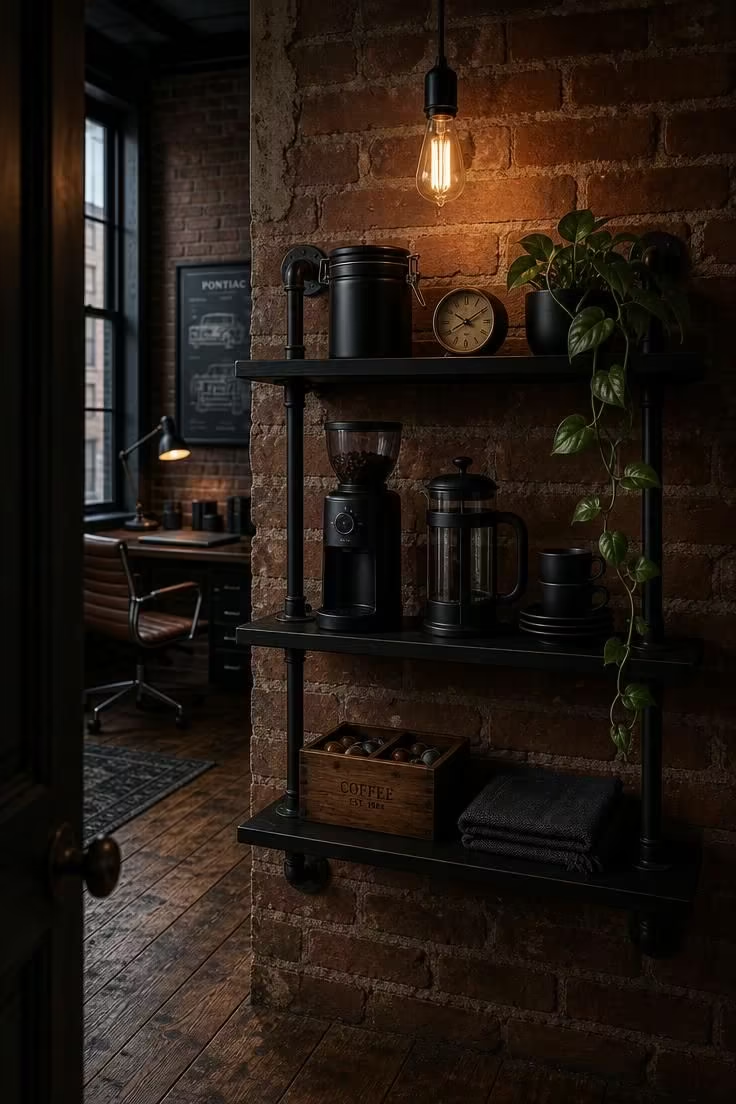
Exposed brick behind dark iron shelving creates a density of texture that makes the coffee corner feel like it belongs in a converted warehouse, even if the office is in a suburban spare bedroom.
The matte black finish on every metal surface, from the pipe fittings to the grinder housing, unifies the entire station under one tonal thread.
A French press on the middle shelf keeps the brewing method visible and accessible, sitting at a height that requires no bending or reaching during the morning routine.
The single Edison bulb above is more than decoration, it provides targeted light that lets you measure grounds and pour water with precision when the overhead room light feels too harsh.
Dark ceramic espresso cups stacked in a short column save shelf space and echo the color palette without introducing a new material.
A trailing pothos vine from the top shelf adds an organic curve to a setup that is otherwise all straight lines and right angles.
The weathered oak floor beneath grounds the whole arrangement, connecting the warmth of wood to the coolness of iron and brick.
Keeping the bottom shelf for storage, a box of pods and a folded towel, prevents the eye from traveling too low and maintains a strong visual center on the middle tier.
This layout is ideal for narrow walls or alcoves where a console table would protrude too far into the walking path of the office beverage station area.
Style Blueprint:
- Three-tier pipe shelving unit in matte black iron (industrial pipe fittings, flange-mounted)
- A matte black burr coffee grinder (manual or electric)
- A glass French press with a black or gunmetal frame (34-ounce capacity)
- One trailing pothos plant in a black ceramic pot
- A single Edison bulb pendant in a matte black socket
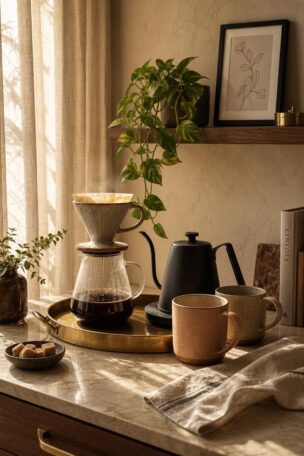
A Rattan Tray and Ceramic Mugs on a Teak Console
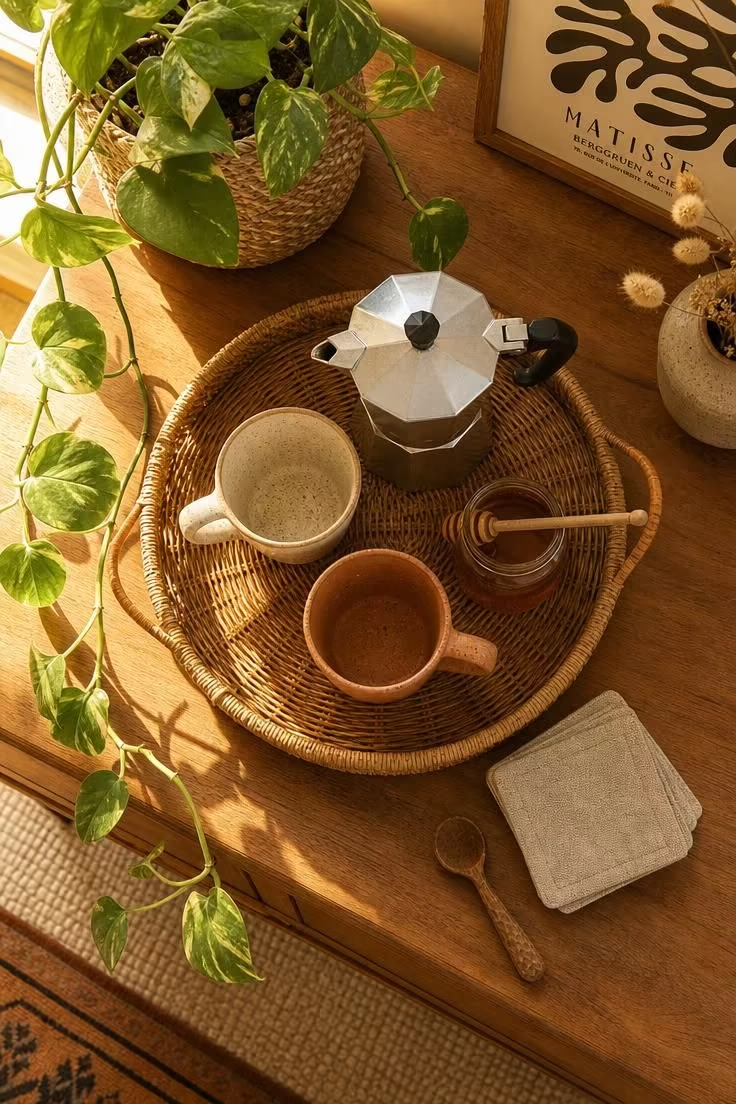
A round rattan tray corrals everything the coffee moment needs into one portable circle, making it easy to clear the console for other tasks during the day.
Teak as the console surface brings a density and warmth that lighter woods cannot match, with an oil finish that deepens over months of daily use.
Speckled ceramic mugs in off-white and terracotta add a handmade quality to the mug display, where the slight imperfections in glaze thickness become part of the appeal.
The honey jar with its wooden dipper introduces a sweetness option that feels more intentional than a bag of sugar packets tossed into a basket.
Trailing pothos in a seagrass basket gives the corner a living, breathing quality that balances the harder surfaces of metal and fired clay.
Linen coasters in a natural oat color sit ready without cluttering the tray, keeping the arrangement layered without being busy.
This vignette works best in offices where the desk is wood-toned, so the teak console reads as a companion piece rather than a mismatched accent from a different room.
Style Blueprint:
- A round rattan tray (14-inch diameter) with a flat base
- A teak console table (minimum 36 inches long, 12 inches deep) with an oil finish
- Two speckled ceramic mugs in earth tones (handmade or artisan-style)
- A brushed aluminum Moka pot (3-cup or 6-cup)
- A trailing pothos plant in a woven seagrass basket
Oak Cabinet With Glass-Front Doors and LED Strips
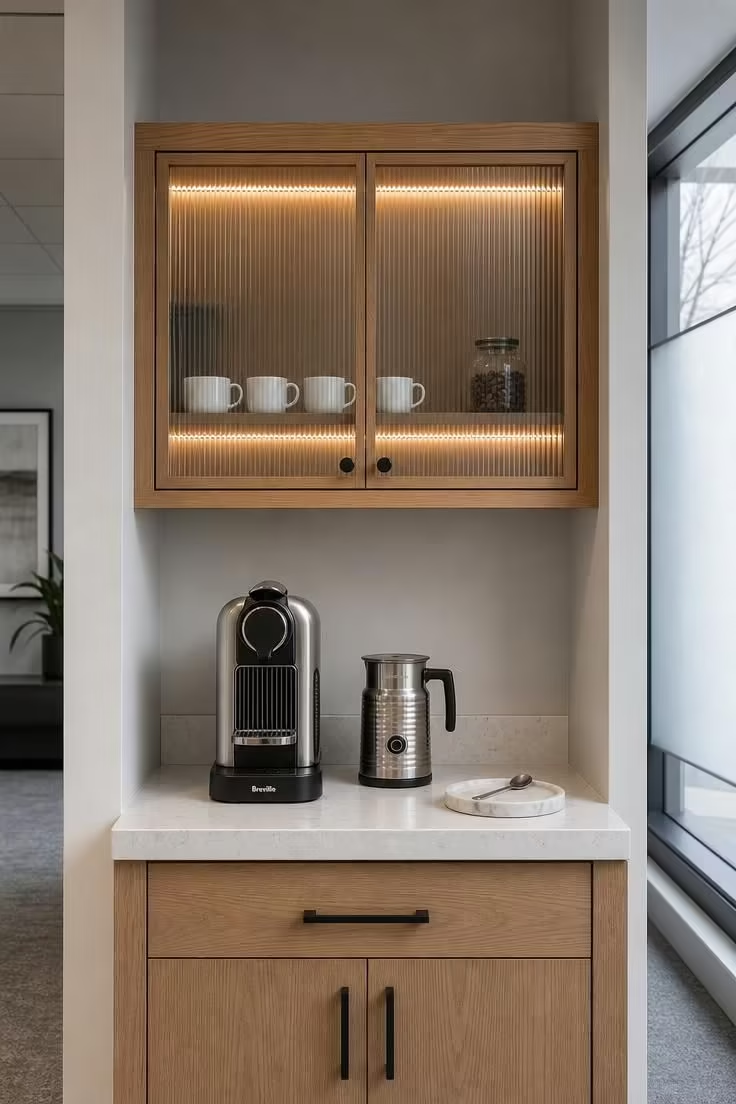
Ribbed glass on cabinet doors lets you see the shapes inside without exposing every label and fingerprint, creating a sense of order that flat clear glass cannot offer.
LED strips along the shelf edges turn the interior into a display case, drawing attention upward and away from the countertop below during evening work sessions.
Oak as the cabinet material carries enough grain to feel natural but reads cleaner than knotty pine or rustic reclaimed wood, fitting the modern tone of a quartz countertop.
A pod machine in brushed stainless steel keeps the morning process fast, a priority in a workspace where the coffee break should recharge rather than derail the morning.
The milk frother beside it opens up lattes and cappuccinos without a full espresso machine station footprint, adding versatility in under six inches of counter space.
A marble tray beneath the spoon and any drips protects the quartz from staining and gives the countertop a defined “active zone” that keeps the rest of the surface clean.
White porcelain espresso cups inside the cabinet match the quartz below, pulling the upper and lower halves of the station into one continuous palette.
This built-in approach works well in offices that share a room with a guest bedroom, where the coffee bar needs to look like furniture rather than a kitchen appliance cluster.
Style Blueprint:
- A narrow oak upper cabinet (24-inch width, 12-inch depth) with ribbed glass doors
- Warm-white LED tape strips (adhesive-backed, 3000K color temperature)
- A compact single-serve pod machine in brushed stainless steel
- A small round marble tray (6-inch diameter) for drip protection
- Four white porcelain espresso cups (3-ounce capacity)
Design Pro-Tip: Run your coffee bar accessories through a “one material, one color” test. If more than three different metals appear on the same surface (brass knobs, chrome machine, copper kettle, black iron bracket), the station starts to feel like a showroom display. Pick one dominant metal and let it repeat across hardware, fixtures, and accent pieces for a collected look.
A Linen Runner and Stoneware on a Narrow Ledge Shelf
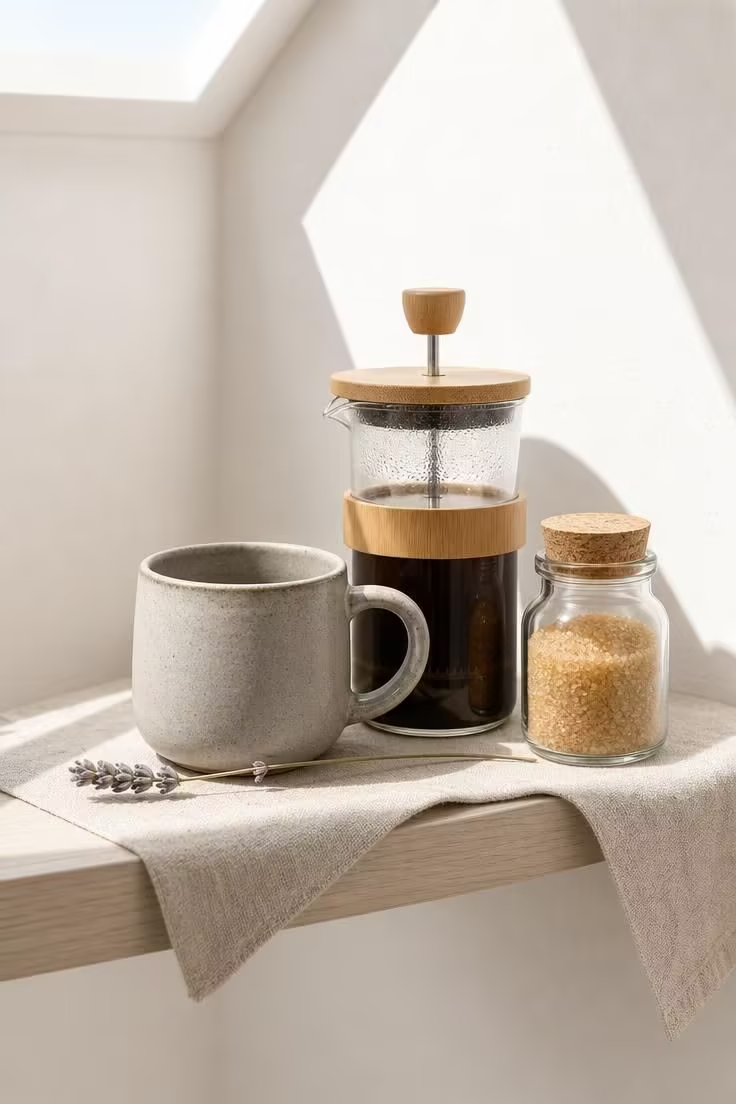
A narrow ledge shelf proves that a floating shelves coffee bar does not need depth or width to make an impression.
The linen runner softens the hard edge of the shelf and introduces a textile layer that makes even a single mug feel like a styled moment.
Stoneware in a matte ash glaze absorbs light instead of reflecting it, creating a quiet focal point that does not compete with a computer screen across the room.
A compact French press with a bamboo collar bridges the natural and the functional, keeping the brewing method accessible without adding bulk.
Raw turbinado sugar in a corked jar adds a warm amber tone that keeps the palette from reading entirely neutral.
Style Blueprint:
- A narrow floating ledge shelf in whitewashed oak (30-inch length, 8-inch depth)
- An oatmeal-colored linen runner (long enough to drape 2 inches over the front edge)
- One handmade stoneware mug in a matte ash or clay glaze
- A compact glass French press with a bamboo or wood collar (12-ounce capacity)
- A small corked glass jar of raw turbinado sugar
Chalkboard Wall Panel Behind a Vintage Grinder
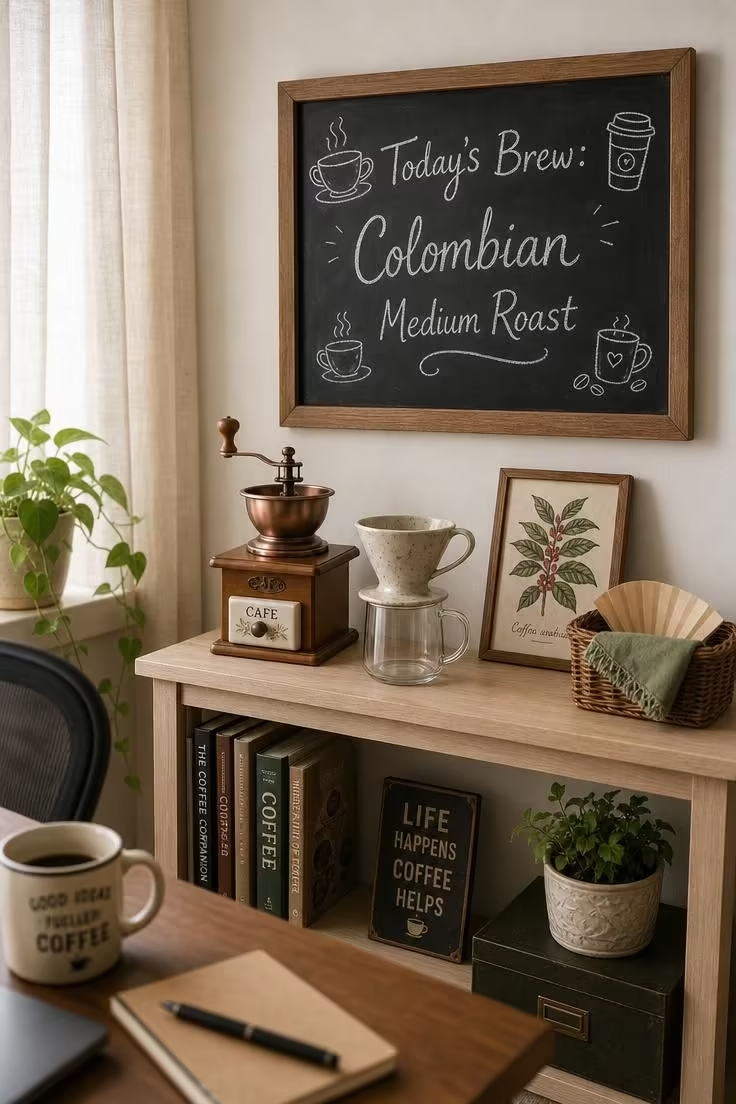
A chalkboard panel turns the coffee station into something interactive, where the day’s brew becomes a small announcement that changes with the bag you open.
Chalk script on a dark surface reads as playful without tipping into childish, especially when framed with clean edges and mounted at eye level.
The vintage hand-crank grinder in brushed copper is slower than an electric model, but the tactile process of grinding by hand adds a sensory pause to the workday that a button press cannot offer.
A ceramic pour-over cone sitting directly on a glass mug strips the brewing setup to its simplest possible form, no carafe, no server, just the cone, the filter, and the cup.
The wicker basket below corrals filters and napkins in a way that keeps the shelf surface clean while adding one more woven texture to the arrangement.
A propped botanical print at the back of the shelf introduces a green accent without needing a living plant, which can be difficult to maintain in a busy office space.
This coffee bar accessories setup suits creative professionals who want their workspace to feel less corporate and more like a neighborhood café they happen to work from.
Style Blueprint:
- A framed chalkboard panel (24×18 inches) with a slim wood or black metal frame
- A vintage hand-crank coffee grinder in brushed copper or brass with a ceramic catch drawer
- A ceramic pour-over cone in speckled cream or white
- A small wicker basket (approximately 8×6 inches) for filters and napkins
- Chalk markers or natural chalk for daily menu writing
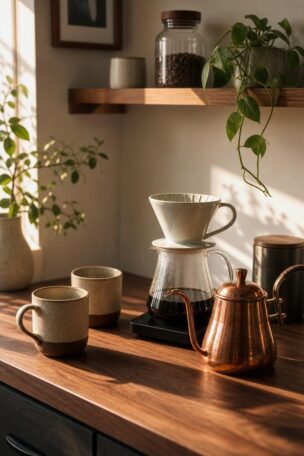
Terrazzo Countertop With Copper Pour-Over Kettle
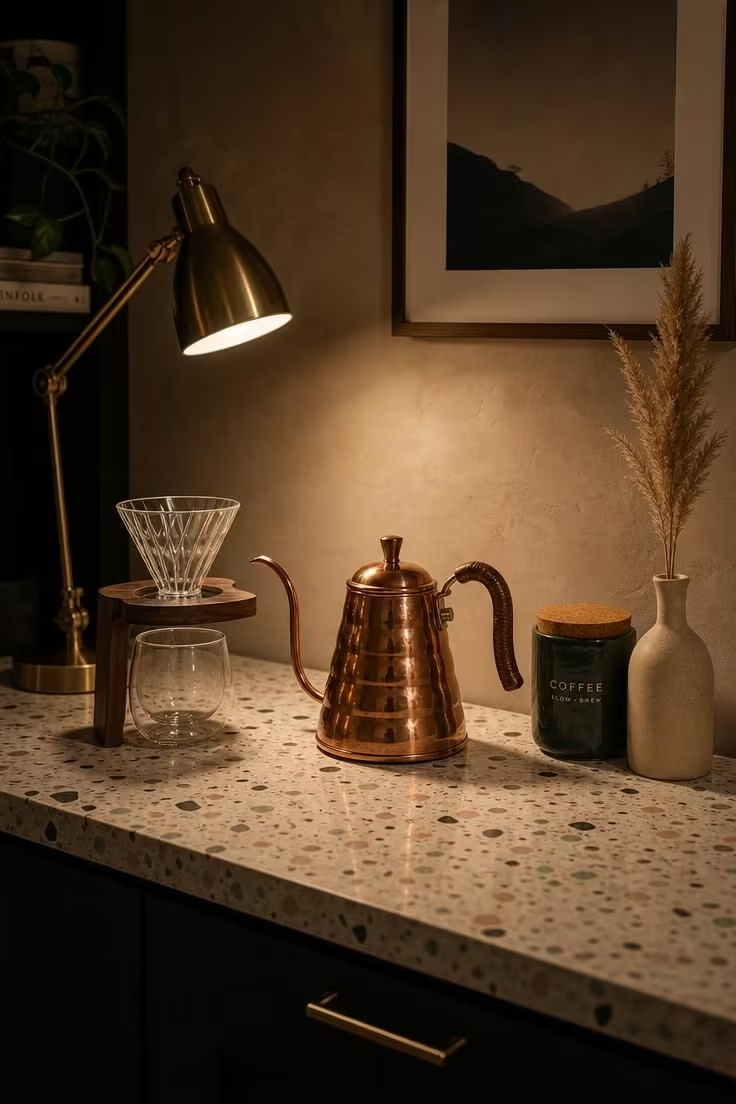
Terrazzo as a countertop surface scatters color across a white base, with each aggregate chip adding a point of visual interest that keeps the surface from reading as plain.
The copper kettle catches lamplight in a way that stainless steel or matte black simply cannot, shifting from orange to amber as the evening darkens outside.
A dark green canister next to the copper creates a color pairing that feels rich without being loud, grounding the warm metal with an earthy counterpoint.
Dried pampas grass in a slim vase adds height and movement to the arrangement, drawing the eye upward from the flat plane of the countertop.
A walnut stand beneath the glass dripper lifts the brewing process to a visible height, turning the pour into a small ceremony rather than a countertop task.
This evening-oriented setup suits professionals who work late and want their small coffee bar to feel like a reward rather than a utility stop.
Style Blueprint:
- A white terrazzo countertop with pastel and charcoal aggregate chips (can be a terrazzo tray if full counter is not feasible)
- A copper gooseneck pour-over kettle with a leather-wrapped handle
- A dark green ceramic canister with a cork lid (32-ounce capacity)
- A slim ceramic bud vase in a sand or putty tone for dried botanicals
- A walnut pour-over stand with a clear glass dripper and double-walled cup
Design Pro-Tip: Match your coffee bar’s lighting temperature to the mood you want. Warm-white LEDs (2700K-3000K) create a cozy café glow for morning and evening brewing, while neutral-white (3500K-4000K) keeps things crisp if your office already runs cool. Mixing color temperatures on the same station, one warm bulb and one cool strip, creates visual confusion that makes the whole setup feel off.
Conclusion
Every office coffee bar on this list starts with one decision: where in the room does the ritual belong.
A corner, a wall niche, a rolling cart, or a narrow ledge, the placement shapes the style more than any single piece of equipment.
The best home office coffee station setups blend what you need to brew with what you want to see, so the corner earns its space in the room.
Pick the layout that fits your office, choose one or two materials that make you reach for your mug a little more often, and let the rest follow from there.