This post may contain affiliate links. If you make a booking or purchase through these links, we may earn a commission at no additional cost to you.
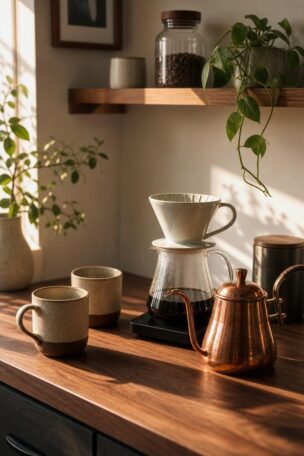
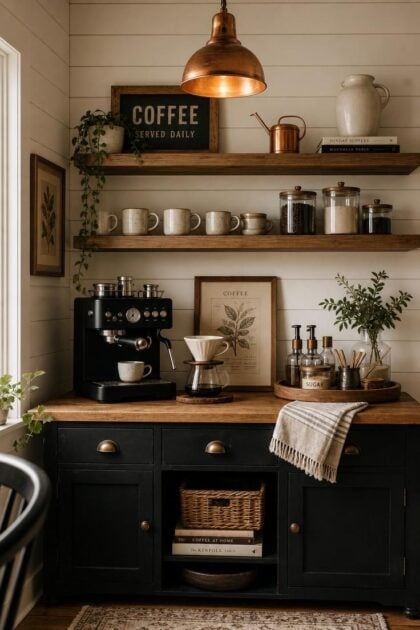
A farmhouse coffee bar turns an ordinary kitchen corner into the favorite part of your morning.
The appeal is in the mix of raw wood, worn finishes, and everyday objects arranged with just enough intention to feel collected rather than decorated.
You do not need a large footprint or a full renovation to build one, just a surface, a brewer, and a few materials that feel good under your hands.
These 13 ideas pair specific textures, containers, and layouts with scenes you can picture and recreate at home, whether you have a full wall or a narrow pantry nook.
Each farmhouse coffee bar setup here is designed to look as warm in person as it does on screen.
Whitewashed Pine Shelves Above a Soapstone Countertop
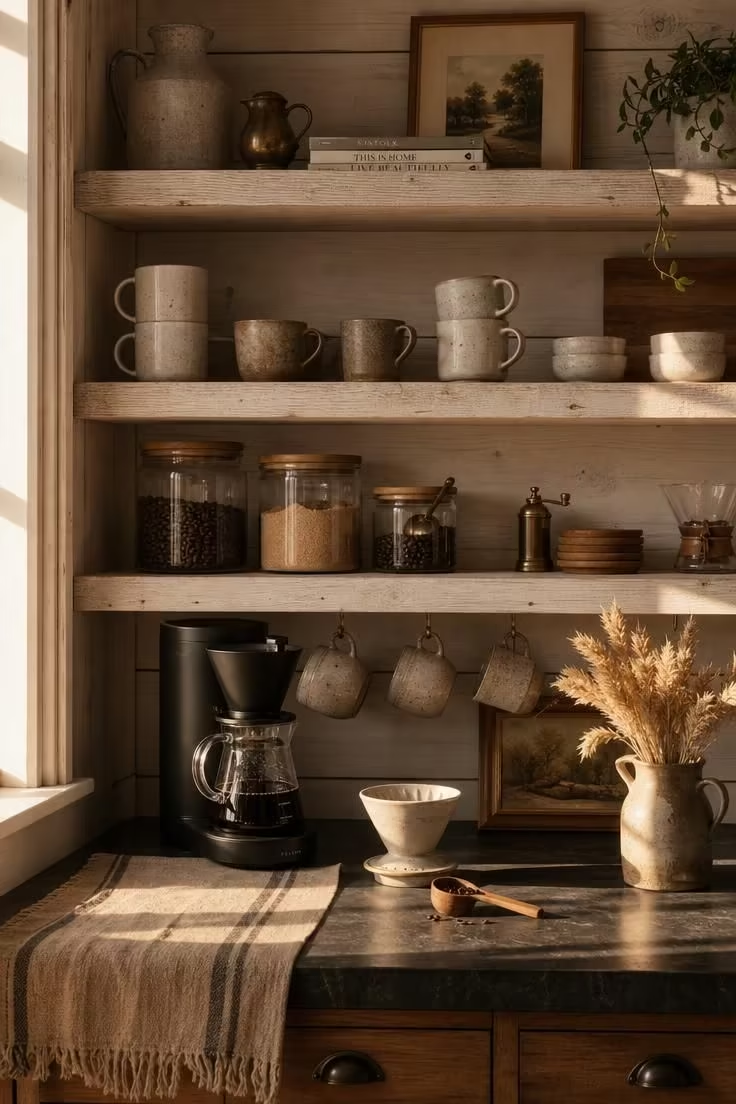
The soapstone grounds this open shelving coffee bar with a weight that lighter countertops cannot match.
Its dark matte surface absorbs the warm tones of the pine above it, creating a layered contrast that reads as collected over time rather than purchased in a single trip.
The whitewash on the pine lets the grain show through, which keeps the shelves from feeling flat or painted-over.
Brass hooks beneath the bottom shelf pull double duty, holding mugs within arm’s reach and adding a thin metallic line that connects visually with the canister lids above.
Dried wheat in a clay pitcher is a small detail, but it fills the vertical space between the brewer and the first shelf with something organic and textural.
The whole arrangement works because every piece sits at a slightly different height, giving the eye places to rest without any single item dominating.
Style Blueprint:
- Whitewashed pine open shelves with visible wood grain
- Soapstone or dark honed stone countertop
- Brass cup hooks mounted beneath the lowest shelf
- Stoneware mugs in cream and speckled clay finishes
- Glass canisters with wooden lids for beans and sugar
A Rolling Oak Bar Cart With Iron Caster Wheels
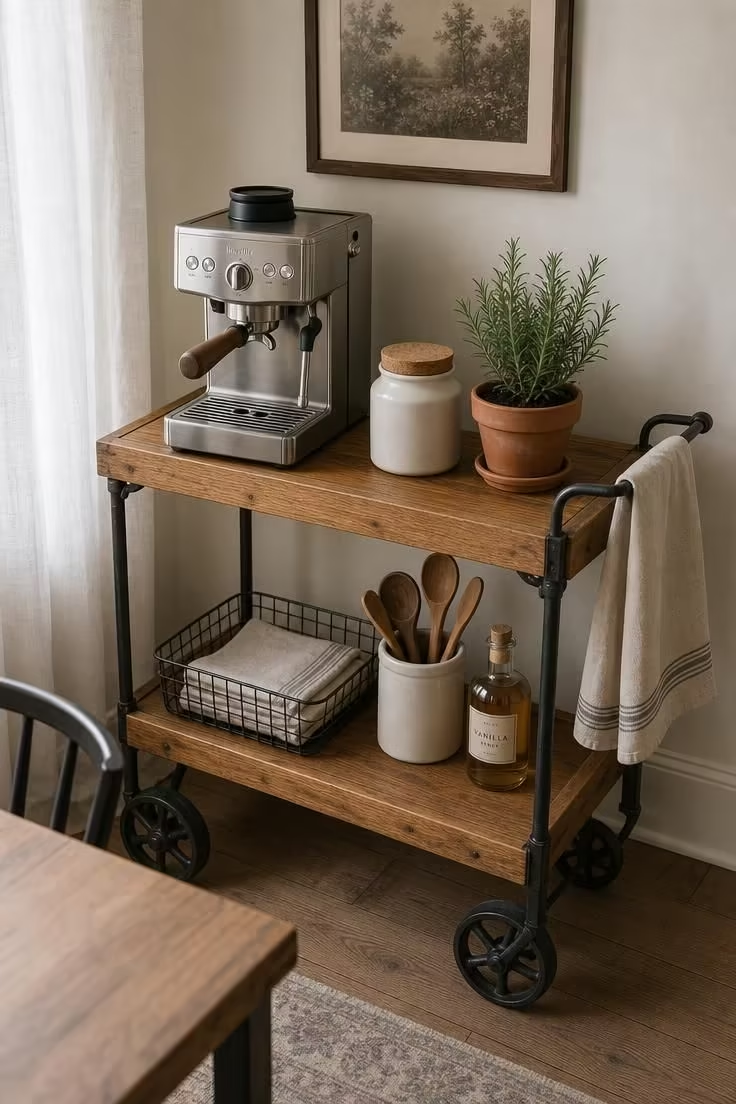
A coffee bar cart solves the biggest problem with a permanent station: commitment to one spot.
This oak and iron piece rolls wherever the morning takes it, from the kitchen counter to the dining room to a covered porch on warmer days.
The wrought iron frame keeps it from reading too precious, and the caster wheels add a workshop quality that balances the warmth of the wood.
Rosemary in a terra cotta pot is a smarter countertop plant than most options because it stays compact, smells good near coffee, and tolerates the dry indoor air around brewing equipment.
The lower shelf becomes a staging area rather than dead storage, with napkins and stirring spoons corralled in containers you can grab with one hand.
Keeping the cart stocked and ready means the coffee routine does not require opening a single cabinet.
A rolling cart like this also doubles as a farmhouse coffee station for hosting, moving from room to room as guests settle in.
Style Blueprint:
- Solid oak cart with wrought iron frame and caster wheels
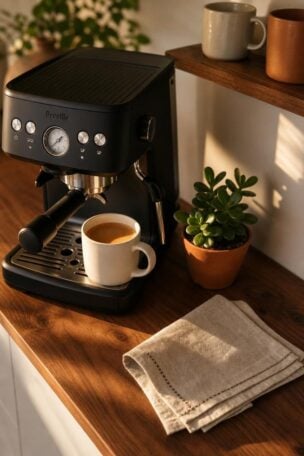
- Compact espresso machine with a wood handle accent
- Terra cotta herb pot (rosemary or thyme)
- Black wire basket for napkin and linen storage
- Cork-lidded glass syrup bottle on the lower shelf
Beadboard Backsplash With Matte Black Floating Shelf Brackets
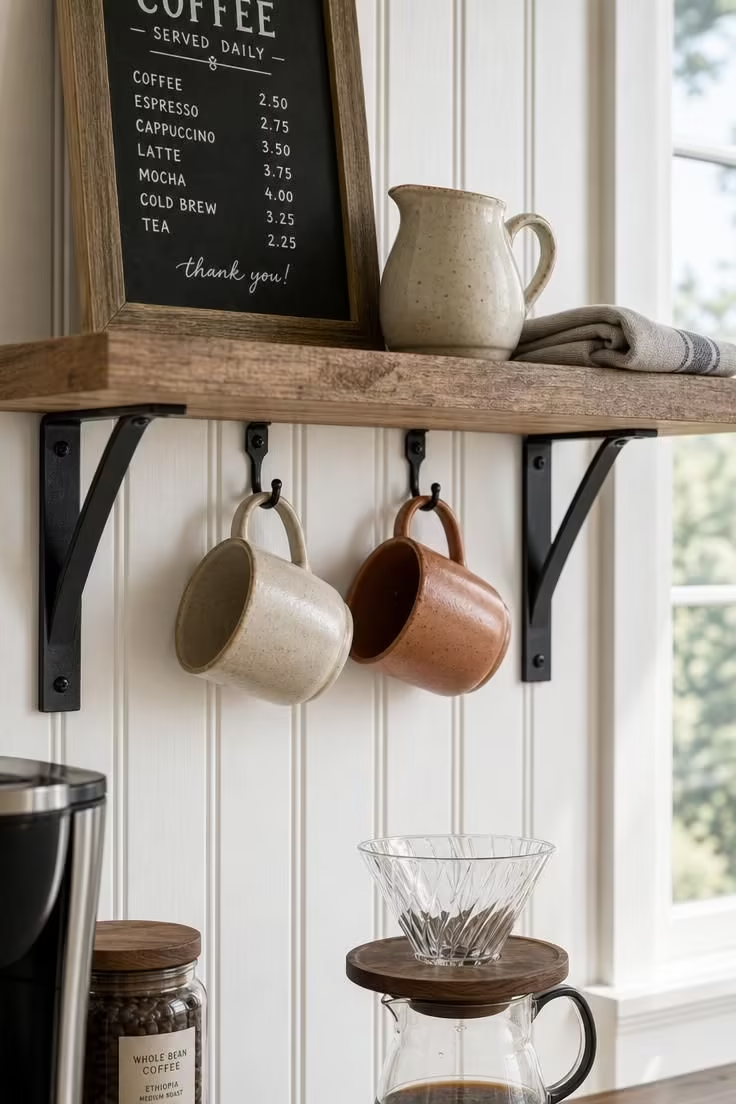
Beadboard does something that flat drywall never will: it gives a wall rhythm.
The vertical grooves catch light at slightly different angles across the surface, which means even a plain white backsplash has depth and movement when you look at it straight on.
Matte black L-brackets against that white field create the kind of contrast that anchors the whole station visually.
Heavy steel reads more honest than slim decorative brackets, and the extra material thickness supports real weight, not just two lightweight mugs.
Hooks screwed directly into the shelf underside turn dead space into active storage, keeping your most-used cups right where the brewing happens.
A hand-lettered chalkboard menu is a small indulgence that costs almost nothing but gives the station a sense of place, like a corner cafe that happens to be in your kitchen.
The bright midday light here is part of the design, not an afterthought, and placing a coffee bar near a window means you see the textures at their best during the hours you actually use the station.
This kind of countertop coffee station works in apartments and small kitchens where wall space matters more than counter depth.
Style Blueprint:
- Vertical beadboard paneling as backsplash
- Heavy matte black steel L-bracket shelf supports
- Small iron cup hooks beneath the shelf
- Hand-lettered chalkboard sign in a simple frame
- Glass pour-over dripper on a wooden base
A Repurposed Dresser With Chalk-Painted Drawers
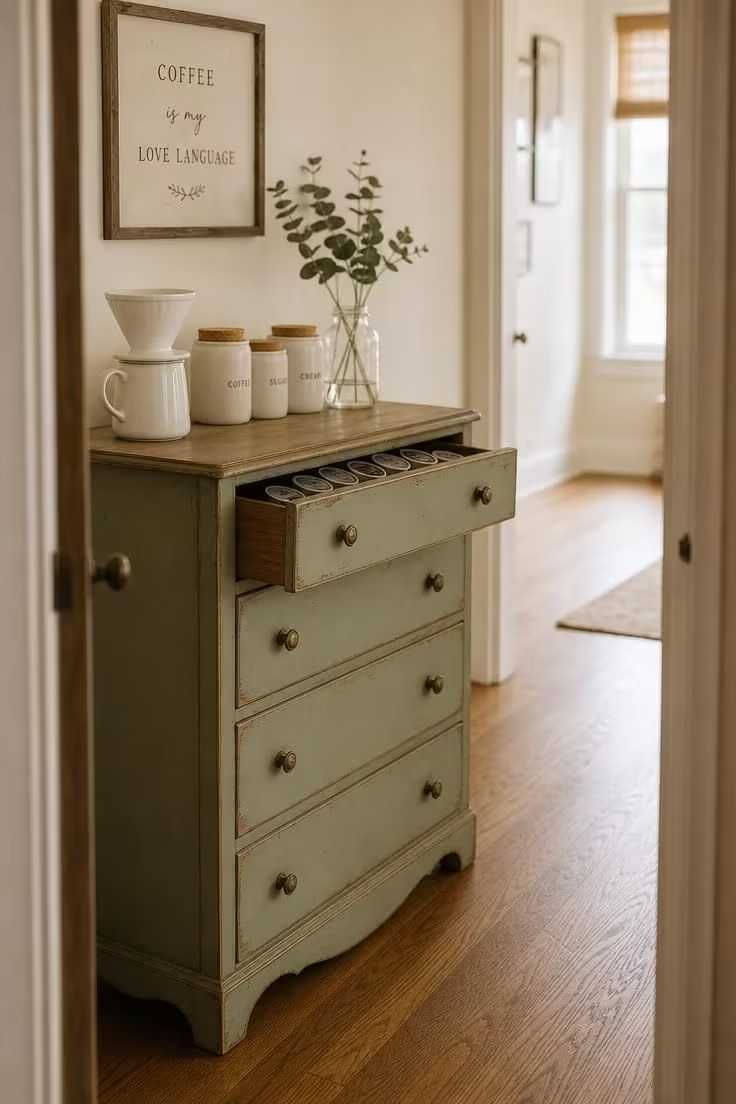
A dresser turned coffee bar is one of the most forgiving furniture projects you can take on.
The piece already has storage, a flat top surface, and enough visual weight to anchor a wall, so the conversion is mostly about what you put on it.
Chalk paint in sage green reads farmhouse without leaning too hard into the expected white or cream, and the slightly distressed edges give it a history it did not earn but wears convincingly.
Keeping the original brass hardware is the right call here, because new pulls would break the illusion of something found and repurposed over years.
That partially open top drawer is a practical choice, letting you grab a pod without bending down or searching through a canister.
A hallway placement makes this a rustic coffee bar that greets you on the way to the kitchen, turning a pass-through zone into a small destination.
Style Blueprint:
- Vintage dresser with chalk-painted body in sage or muted green
- Raw wood top surface left unsealed or lightly waxed
- Original brass knob hardware with natural patina
- Ceramic pour-over set and cork-stoppered canisters
- Top drawer left slightly open for quick pod access
Design Pro-Tip: When repurposing old furniture for a coffee bar, skip the urge to sand everything smooth. A few paint chips and worn corners tell a story that brand-new pieces cannot, and they hide the inevitable coffee drip stains far better than a flawless finish would.
A Galvanized Metal Tiered Tray With Mason Jar Canisters
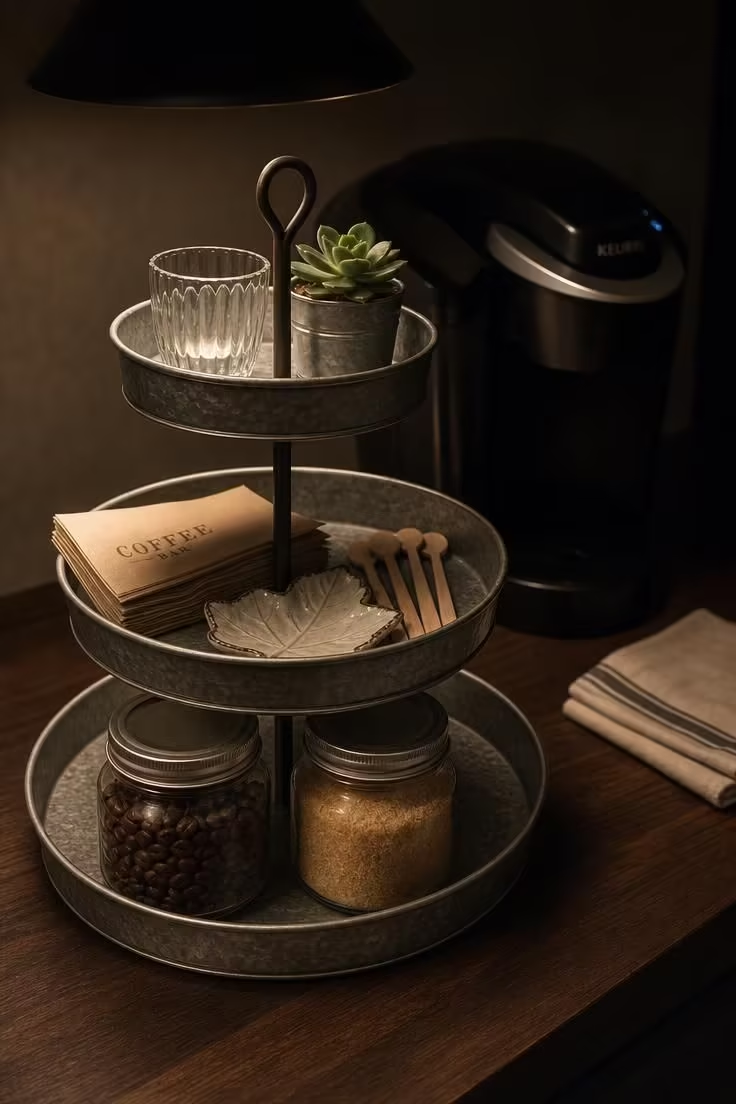
A tiered tray solves the clutter problem that every coffee bar eventually develops.
Sweeteners migrate, spoons accumulate, and napkins spread across the counter until the station looks less intentional and more like a drawer exploded.
The galvanized metal finish ties into the farmhouse vocabulary without competing with the brewer or the mugs for attention.
Mason jars as canisters are a practical choice here because you can see exactly how much coffee or sugar remains, and the zinc lids pick up the metallic tone of the tray itself.
Stacking upward rather than spreading outward keeps the footprint tight, which matters on a shared kitchen counter.
The kraft paper napkins are a small texture decision that pays off in the overall composition, adding a warm tan tone that softens the cool metal above and below.
Each tier serves a different function, storage on the bottom, tools in the middle, decoration on top, and that layering gives the arrangement a logic that random counter scatter never has.
Moody pendant light from above turns the tray into its own little scene, and the dark walnut beneath absorbs the ambient glow in a way that lighter surfaces would bounce back.
A tiered tray coffee bar setup like this works on any surface, from a dedicated counter to a dining room sideboard.
Style Blueprint:
- Three-tier galvanized metal tray as the organizing centerpiece
- Mason jar canisters with zinc or tin lids
- Wooden stirring spoons and a ceramic spoon rest
- Kraft paper napkin stack on the middle tier
- Small succulent in a zinc cup on the top tier
Shiplap Half-Wall Behind a Butcher Block Coffee Station
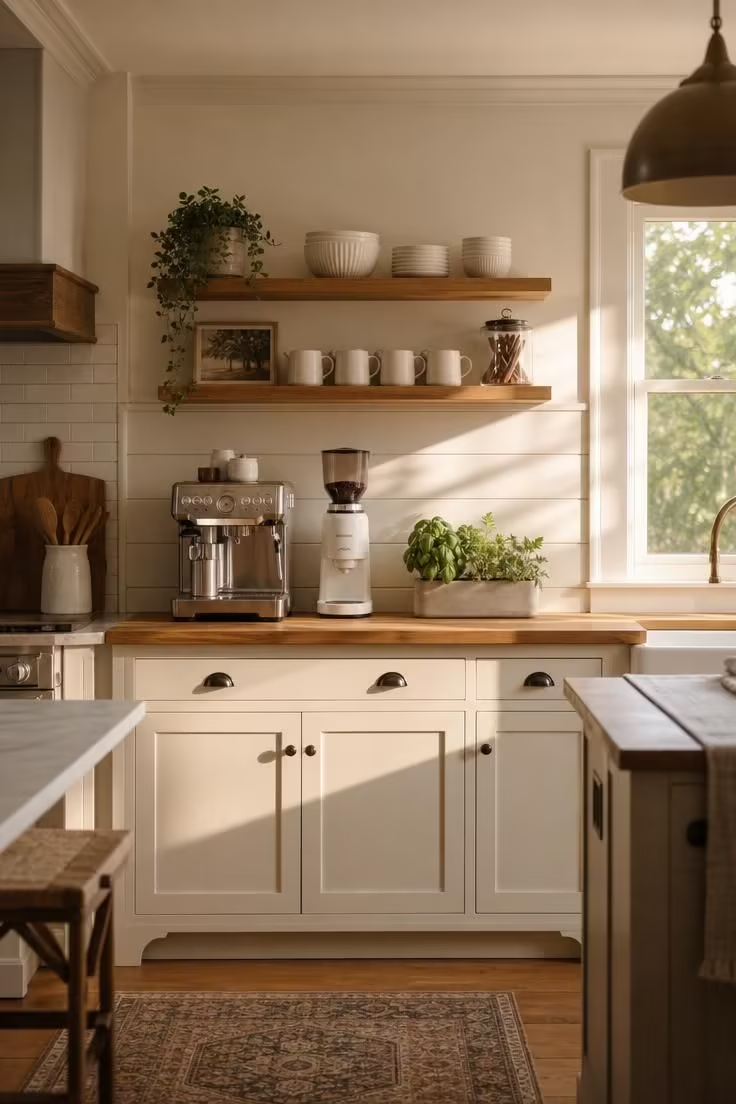
The shiplap half-wall trick gives you two textures on one wall without committing to floor-to-ceiling planking.
That horizontal line where the shiplap ends and the flat wall begins creates a subtle visual break that defines the coffee station’s territory within the larger kitchen.
Butcher block on top of that shiplap backdrop reads as a natural pair, because the wood grain direction runs perpendicular to the plank lines, and that cross-hatching adds dimension the eye picks up even from across the room.
A living herb planter beside the brewer is more than decoration; fresh basil and mint end up in iced coffee drinks, weekend brunches, or just making the corner smell good.
Open shelves above keep the farmhouse kitchen decor feeling functional rather than fussy, with stacked bowls and mugs earning their place through daily use.
Afternoon light from the side catches every groove in the shiplap and throws thin shadow lines across the planks, a detail you lose entirely with flat drywall.
This kind of shiplap coffee bar works best in kitchens that already lean farmhouse, where the planking connects to other wood or white-painted elements in the room.
Style Blueprint:
- Horizontal shiplap planks on the lower half of the wall
- Honey-toned butcher block countertop
- Open wood shelves above the shiplap line
- Live herb planter in a rectangular trough
- Stacked white bowls and cream ceramic mugs on display
A Wire Basket Collection for Pod and Filter Storage
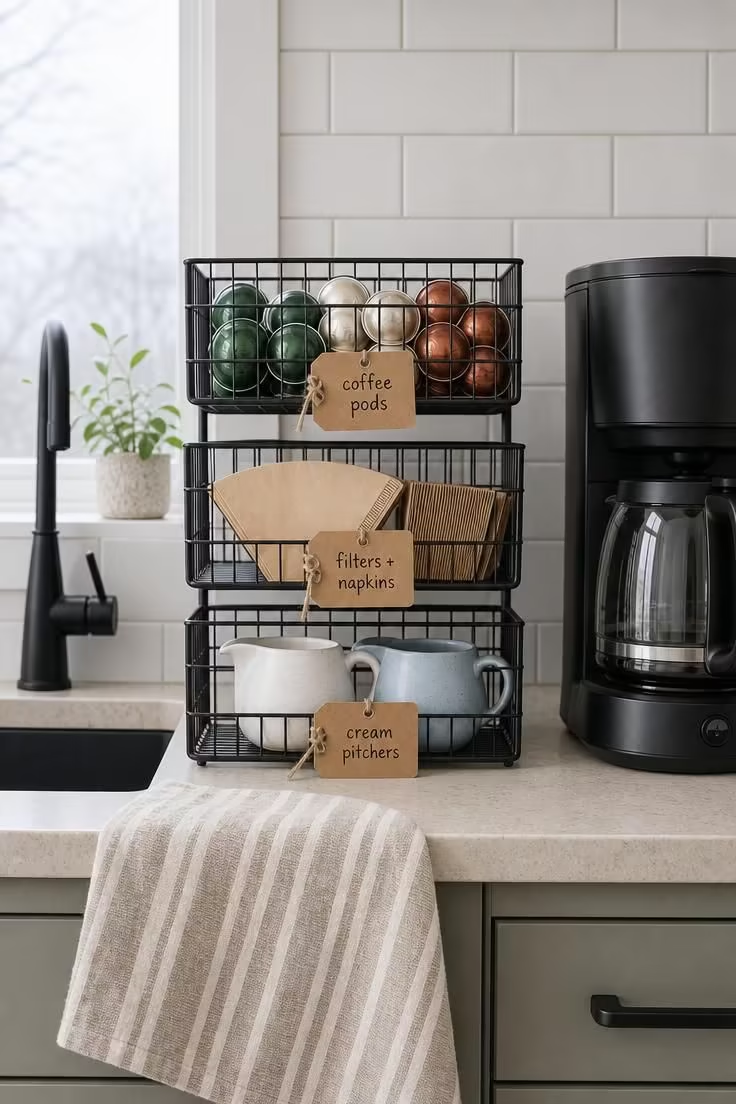
Wire baskets bring order to the counter without sealing everything behind a closed door.
You can see exactly what needs restocking, which means you never discover you are out of filters at the worst possible moment.
The black wire picks up the matte finish of the brewer beside it, tying the functional and decorative pieces together through a shared material language.
Kraft paper tags are a ten-minute project that makes the arrangement feel deliberate, and they are easy to swap out when you rotate pod flavors or switch from paper filters to a reusable cone.
Sorting by container means each hand reaches for the right basket without thinking, a small convenience that compounds over a hundred mornings.
The linen towel draped over the counter edge serves a real purpose, catching drips and giving you something to wipe your hands on, but it contributes a soft horizontal line that breaks up the hard geometry of the wire.
Cool overcast light is ideal for this kind of setup because it removes harsh shadows that would make the wire baskets look like a cage rather than a considered display.
A coffee bar shelf above this arrangement could hold mugs, keeping the counter zone strictly for brewing and supplies.
Style Blueprint:
- Three stackable black wire baskets in graduated sizes
- Kraft paper hang tags with twine ties for labeling
- Unbleached paper cone filters stacked vertically
- Small ceramic cream pitchers in white and pale blue
- Oatmeal-striped linen dish towel as a counter drape
A Pegboard Wall Panel With Wooden Pegs and Hanging Mugs
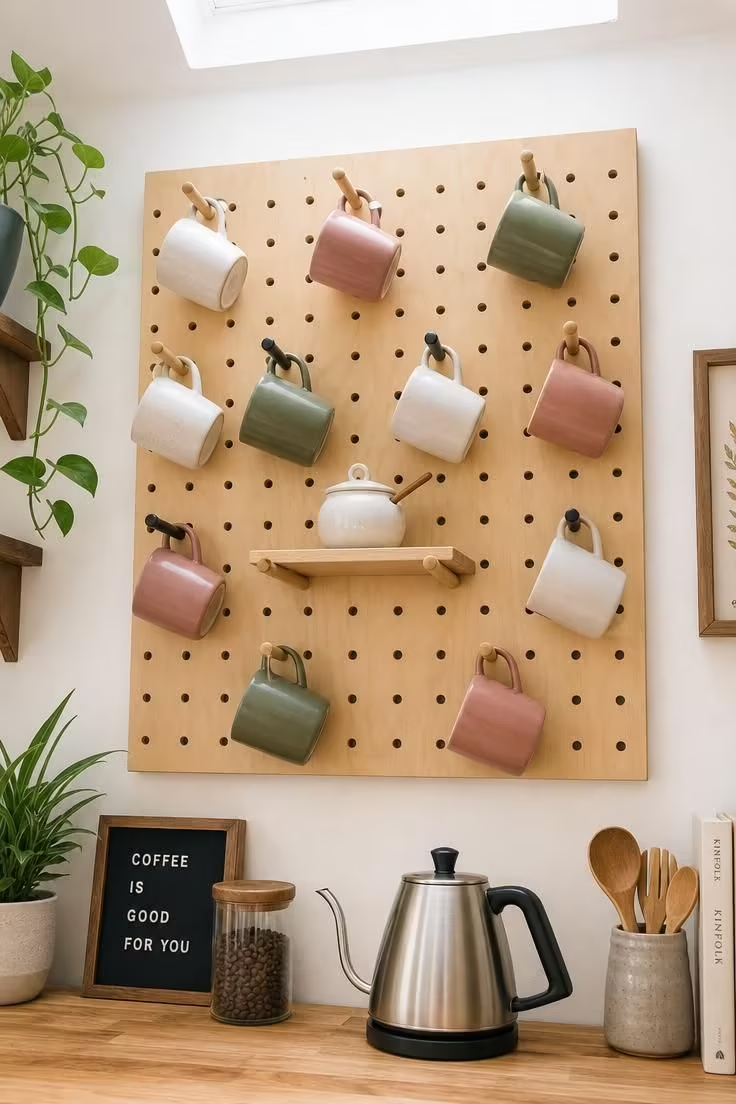
A pegboard condenses a full coffee mug display into a single vertical panel that takes up zero counter space.
The birch plywood reads warmer than painted hardboard, and each peg hole becomes a tiny design decision about where to hang the next cup.
Mixing wooden pegs with matte black metal ones adds a second texture layer that keeps the board from looking like a retail fixture.
Mismatched mugs are the whole point here, and the color variation across white, rose, and sage gives the panel a personality that matching sets never achieve.
Bright overhead light turns the peg holes into a subtle dot pattern across the board, a background texture that photographs well and keeps the eye moving.
Style Blueprint:
- Natural birch plywood pegboard panel (square or rectangular)
- Mix of wooden and matte black metal pegs
- Mismatched ceramic mugs in soft, muted tones
- Small shelf attachment for a sugar bowl or cream pitcher
- Stainless steel gooseneck kettle on the counter below
Design Pro-Tip: Hang your most-used mug at the lowest peg position, right at hand height when you are standing at the counter. Decorative or seasonal mugs go higher where they contribute to the visual arrangement without slowing down the morning routine.
Reclaimed Barn Door Mounted as a Coffee Bar Backdrop
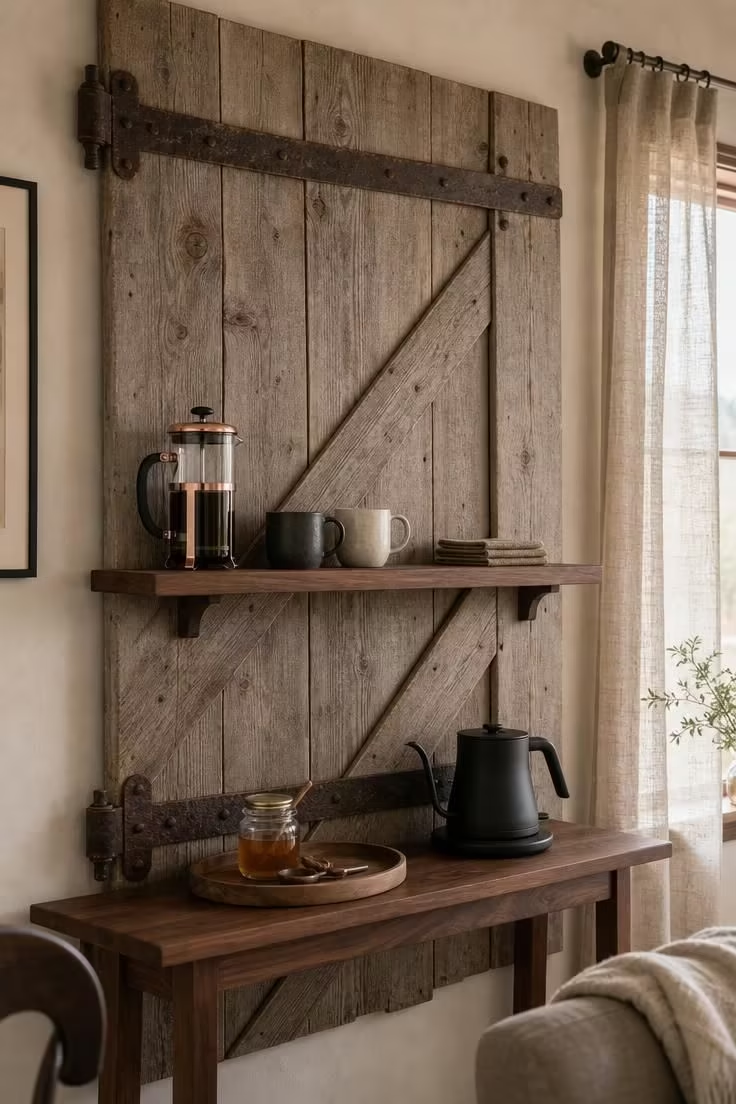
A barn door on the wall changes the scale of a coffee bar from a small counter arrangement to a full architectural statement.
The weathered wood surface gives the eye a massive texture field that no amount of smaller decor pieces could replicate, and the silvery driftwood tone works as a neutral backdrop that lets the mugs and brewer stand forward.
Original iron strap hinges are the detail that separates a real salvaged door from a home improvement store panel, and their dark patina against the lighter wood creates a graphic element almost like wall art.
Floating a shelf directly across the face of the door is a bold move, but it works because the shelf is narrow enough to read as furniture placed in front of the door rather than something that cuts through it.
A French press on this kind of backdrop feels right in a way that a pod machine might not, because the glass and copper echo the handmade, slower-paced character of the reclaimed wood behind it.
Soft diffused light is the correct choice for this scene, because direct sun would blow out the silver tones and flatten the texture that makes the whole setup worth building.
This kind of dramatic backdrop turns even a small farmhouse coffee station into the focal point of the room.
Style Blueprint:
- Full-size reclaimed barn door mounted flat against the wall
- Original iron strap hinges left in place for character
- Narrow floating walnut shelf across the door face
- Glass French press with a copper or brass-tone frame
- Slim walnut console table as the base surface
A Narrow Console Table in a Pantry Alcove
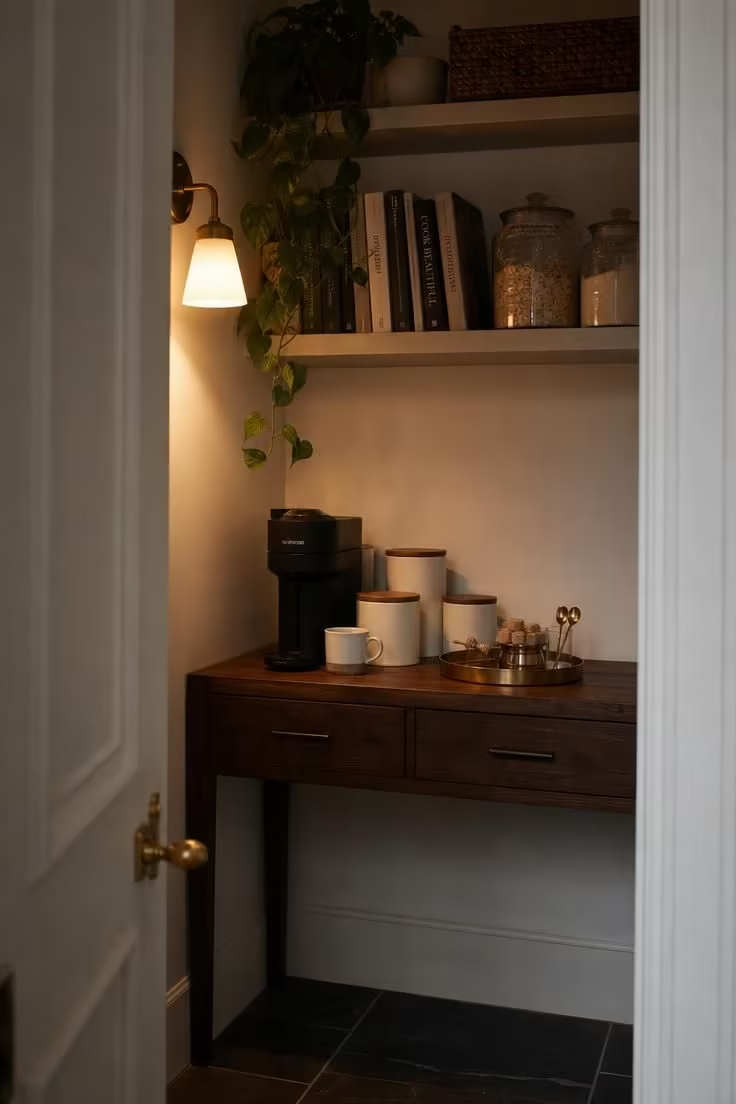
A pantry alcove is the kind of overlooked space that was practically designed for a coffee bar but rarely gets used as one.
The doorway frames the whole setup like a small stage, and that built-in sense of enclosure makes the station feel intentional rather than squeezed in.
Dark walnut against white pantry walls creates enough contrast to separate the coffee zone visually from the dry goods storage above, even though they share the same vertical column of space.
A brass wall sconce does more work here than overhead lighting would, because it throws light downward onto the brewing surface and leaves the upper shelves in a softer glow that recedes into the background.
The trailing philodendron vine draped over the shelf edge softens the hard horizontal lines of the shelving and introduces an organic curve that nothing else in the alcove provides.
Keeping the canister set to three pieces, coffee, sugar, and creamer, prevents the small console from feeling overcrowded.
A brass tray corrals the smallest items into one movable unit, which means you can lift the whole thing out to wipe down the surface underneath.
The dark slate floor grounds the walnut console and prevents the lower portion of the scene from washing out against the white walls.
This is a pantry-based farmhouse coffee bar that turns a storage room into a destination.
Style Blueprint:
- Slim dark walnut console table sized for a pantry alcove
- Compact single-serve brewer in matte black
- Ceramic canister set with wooden lids (three pieces maximum)
- Brass wall sconce for directed task lighting
- Small round brass tray for corralling sweeteners and spoons
Ladder Shelf Display With Stoneware Crocks and Greenery
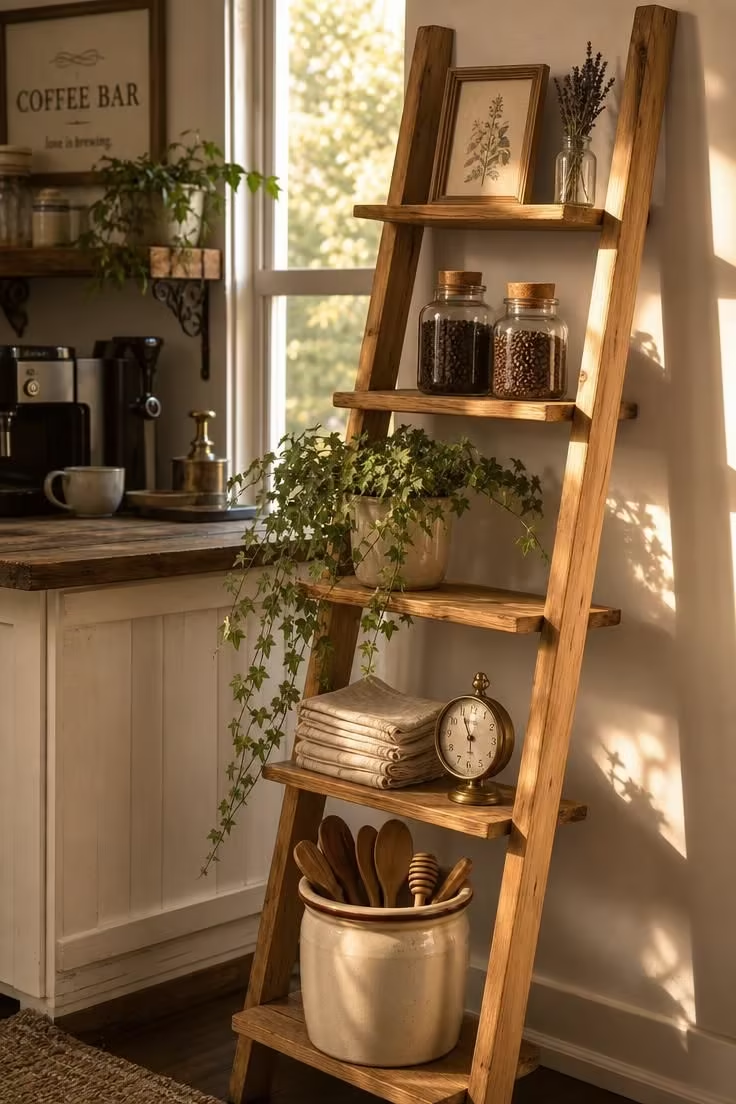
A ladder shelf gives a farmhouse coffee bar vertical storage without drilling a single hole in the wall.
The leaning angle means each tier sits at a slightly different depth, which creates a natural layering effect that flat wall shelves cannot reproduce.
Stoneware crocks on the bottom tier keep the heaviest items low, where the shelf is widest and most stable, and the cream glaze against warm pine is a color pairing that never gets old.
Trailing ivy on the middle tier is the living accent that ties the whole arrangement to something organic, and its cascading vines fill the gaps between tiers with green movement.
Glass canisters near the top let you monitor your bean supply from across the room, a practical detail that looks decorative from a distance.
The golden hour backlight turns the ivy leaves translucent and wraps the pine frame in a warm glow that flat front lighting would miss entirely.
Style Blueprint:
- Five-tier leaning ladder shelf in natural pine
- Large stoneware crock for wooden utensils on the bottom tier
- Potted trailing ivy or pothos on a middle tier
- Glass canisters with cork stoppers for coffee beans
- Small framed botanical print on the top tier
Concrete Countertop Section With Pipe Fitting Shelf Supports
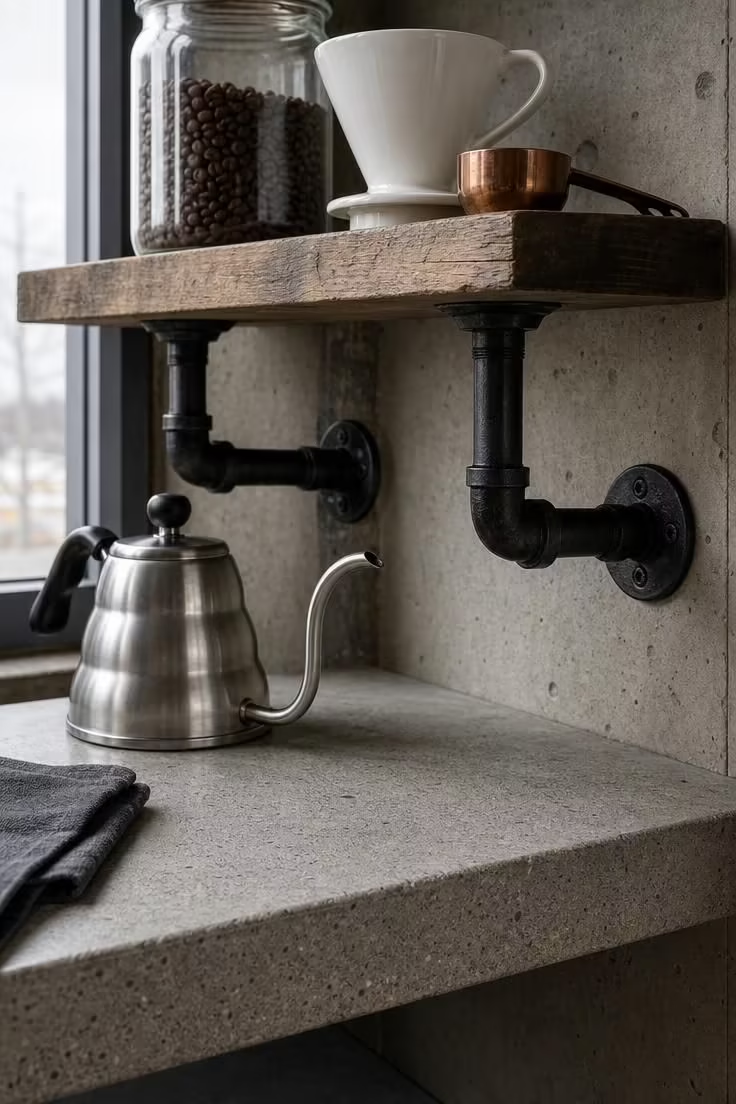
Concrete reads heavier than any other countertop material, and that weight gives a coffee bar corner an anchored, permanent feeling.
The fine aggregate visible in the surface means no two poured sections look exactly alike, which adds the kind of irregularity that farmhouse style depends on.
Black iron pipe fittings are the fastest way to bridge the gap between farmhouse and industrial without landing fully in either camp.
The bolted connection points are visible and unapologetic, treating the hardware as decoration rather than hiding it behind trim or paint.
A single thick shelf plank above the counter is enough storage for daily use, and the reclaimed wood grain contrasts with the smooth concrete below in a way that makes each material look better.
Copper measuring scoops and stainless steel kettles belong in this palette because their metallic tones sit between the warm wood and cool concrete, connecting the two surfaces without matching either one directly.
Cool overcast light is the ideal condition for concrete, because it removes the harsh highlights that make poured surfaces look cheap in direct sun and lets the matte texture speak for itself.
An open shelving coffee bar built with pipe fittings can be assembled in an afternoon with off-the-shelf plumbing parts and a single trip to a salvage yard for the shelf plank.
Style Blueprint:
- Poured concrete countertop section with visible aggregate
- Black iron pipe fittings as wall-mounted shelf brackets
- Single thick reclaimed wood shelf plank
- Ceramic pour-over dripper in matte white
- Copper measuring scoop as a functional accent piece
Design Pro-Tip: If you are pouring a concrete countertop yourself, add a beeswax sealer after curing. It darkens the surface slightly, brings out the aggregate pattern, and creates a barrier against coffee stains without the plastic sheen of polyurethane.
A Linen Curtain-Skirted Base Cabinet With Copper Hooks
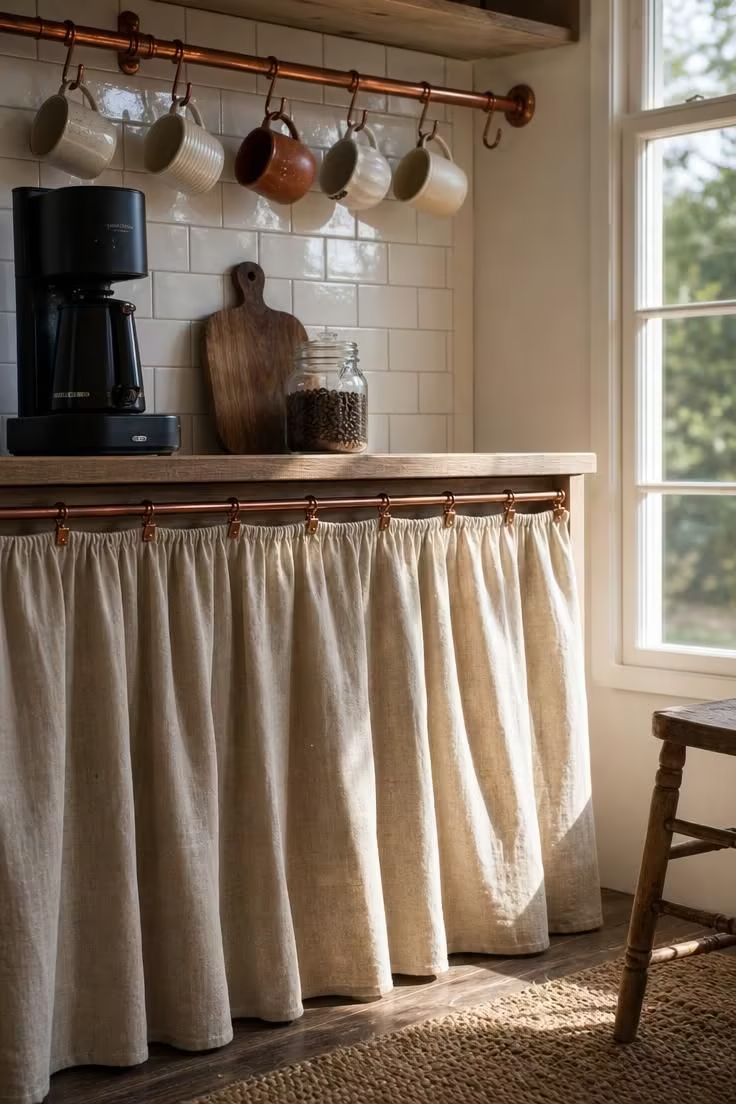
A linen curtain skirt hides everything a coffee bar accumulates, the backup filters, the bulk bean bag, the cleaning supplies, without the cost or permanence of cabinet doors.
The gathered drape adds a softness to the lower half of the station that hard cabinetry would not, and the slight wrinkle in the fabric is a feature, not a flaw, reading as relaxed rather than unkempt.
Copper curtain clips are the kind of small hardware choice that lifts the whole piece from improvised to intentional.
They pick up the warmth of the S-hooks and the mounted rod above, building a consistent copper thread through the arrangement that ties top and bottom together.
A coffee mug display on copper hooks is more accessible than a shelf and more visually interesting than a tree or rack, because the mugs hang at different heights depending on their handle size.
The mismatched shapes and tones across the five cups give the wall a collected quality, like each mug arrived from a different trip or gift.
Bright midday sun through the window makes the copper glow and lights up the linen weave, revealing the texture that softer light would flatten.
Style Blueprint:
- Gathered linen curtain skirt in unbleached oatmeal tone
- Small copper curtain clips attaching fabric to frame
- Mounted copper rod with S-hooks for mug hanging
- Mismatched ceramic mugs in white, cream, and terracotta
- Wooden cutting board leaned upright as a backsplash accent
Conclusion
A farmhouse coffee bar comes down to choosing one or two honest materials and letting them set the tone for everything else on the counter.
Wood, linen, iron, copper, stoneware, concrete: pick the ones that feel right in your kitchen and build from there.
The best setups here are not the ones with the most accessories but the ones where every piece earns its place by being used or loved.
Keep your favorite mugs where you can see them, store the daily supplies within arm’s reach, and let the seasonal details, a dried herb bundle, a fresh cutting of greenery, rotate through without overthinking it.
A farmhouse coffee bar does not need to be large or expensive to feel like the warmest spot in the house.