This post may contain affiliate links. If you make a purchase through these links, we may earn a commission at no additional cost to you.
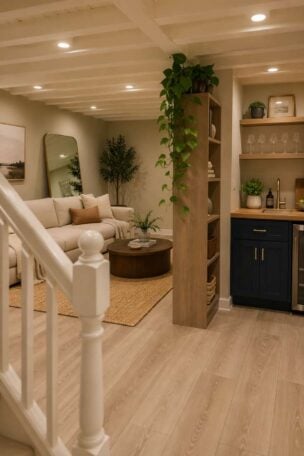
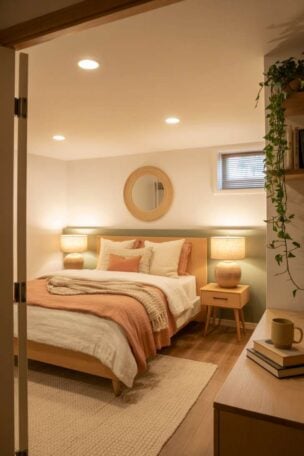
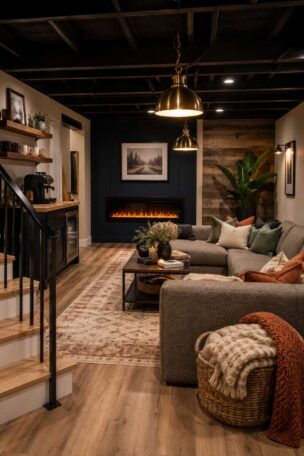
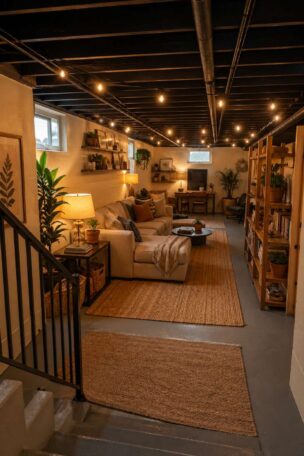
Your basement is sitting there right now, probably holding holiday boxes and a treadmill nobody uses.
But it could be something so much better — a home bar design that makes your friends text the group chat before they’ve even left.
Whether you’re dreaming of a speakeasy theme behind a hidden door or a simple dry bar you can build in a weekend, these 17 basement bar ideas cover every style, size, and budget.
The images do the heavy lifting here, so grab a drink and start saving.
A Speakeasy With a Secret Door
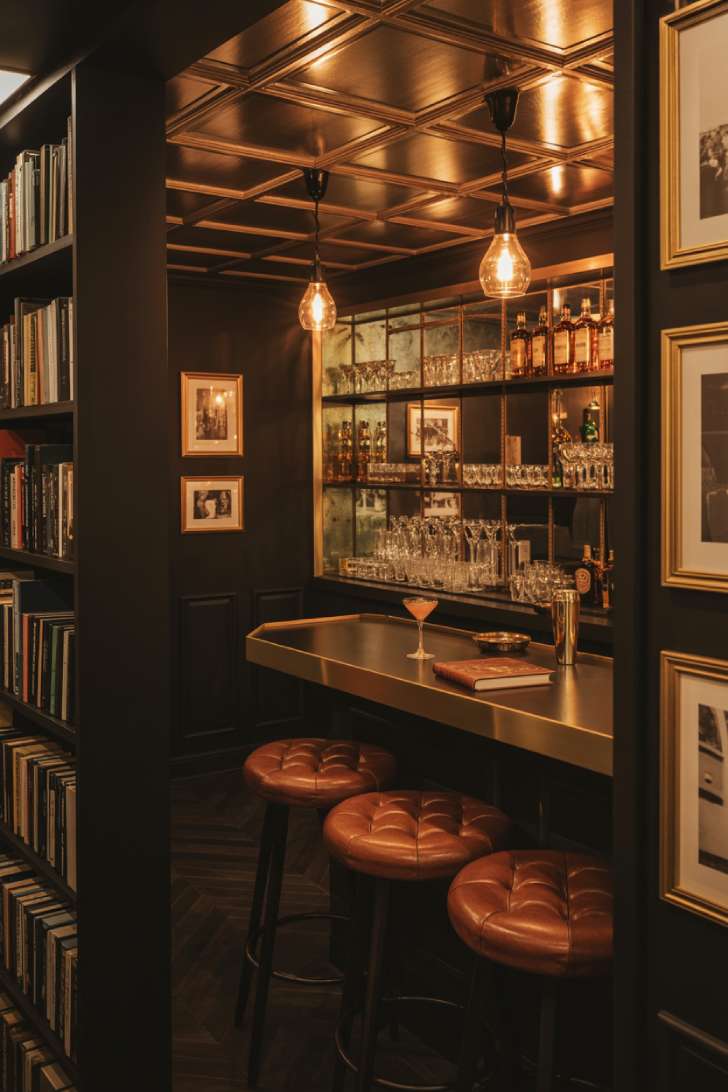
There’s a reason the speakeasy concept keeps showing up in finished basement remodel projects — it taps into something emotional.
The hidden entrance creates an instant rush of discovery, and once you’re inside, the dark tones and low lighting make the space feel separated from the rest of the house.
That separation is doing real work: when a room feels removed and enclosed, people relax faster and stay longer.
Dark wood, leather, and tin ceiling panels all absorb sound, too, which means conversation feels warmer and more intimate.
It’s not just decoration — it’s atmosphere by intention.
- Style Blueprint:
- Concealed bookshelf or panel door entry
- Tin or pressed-metal ceiling tiles
- Antiqued mirror back bar panels
- Tufted leather bar stools with brass footrails
- Exposed filament bulbs in matte black pendants
Rough-Hewn Reclaimed Wood Bar
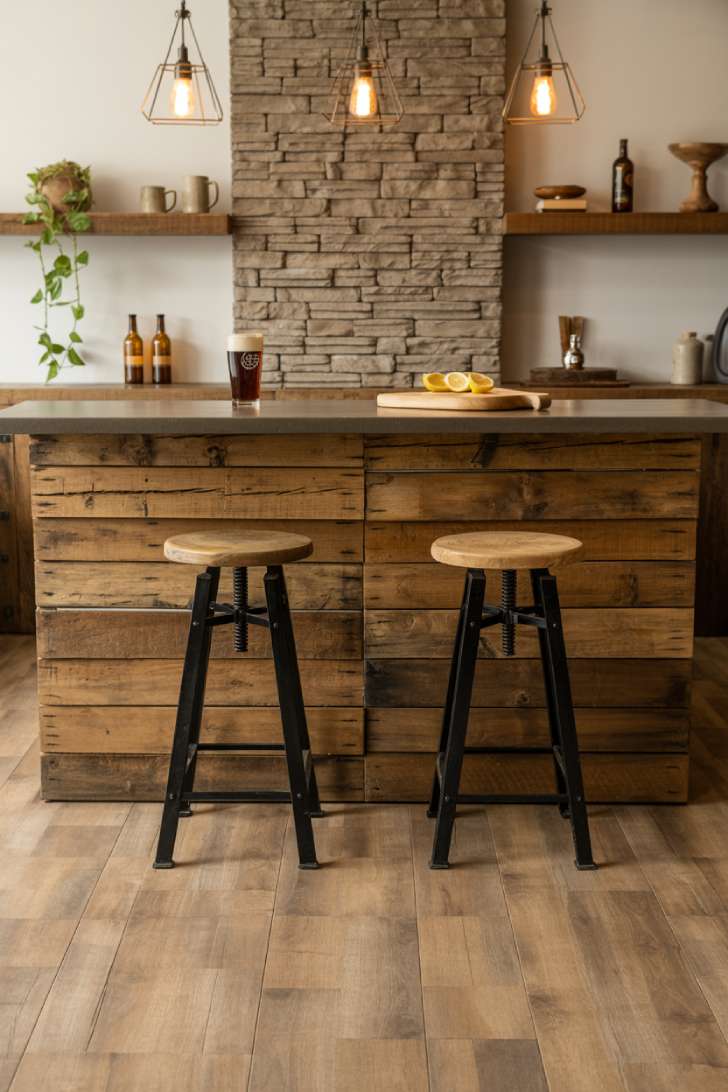
Reclaimed wood carries a kind of built-in personality that new materials just can’t replicate.
Every knot, nail hole, and color variation tells a different story, and that visual depth gives the eye plenty to rest on without the space feeling busy.
The stone accent wall behind the bar adds mass and permanence — it anchors the room and makes everything in front of it feel intentional.
Warm overhead light bouncing off rough natural textures creates a glow that mimics firelight, which humans are wired to find calming.
This is one of those basement bar ideas that works in large or small footprints.
If you’ve got a finished basement remodel underway, a reclaimed wood bar gives you character without a massive budget.
- Style Blueprint:
- Reclaimed barnwood or salvaged lumber bar top
- Stacked stone or ledger stone accent wall
- Wrought-iron or matte black pendant lights
- Backless stools with metal-and-wood construction
- Sealed matte countertop finish for spill resistance
Clean-Lined Modern Minimalist Bar
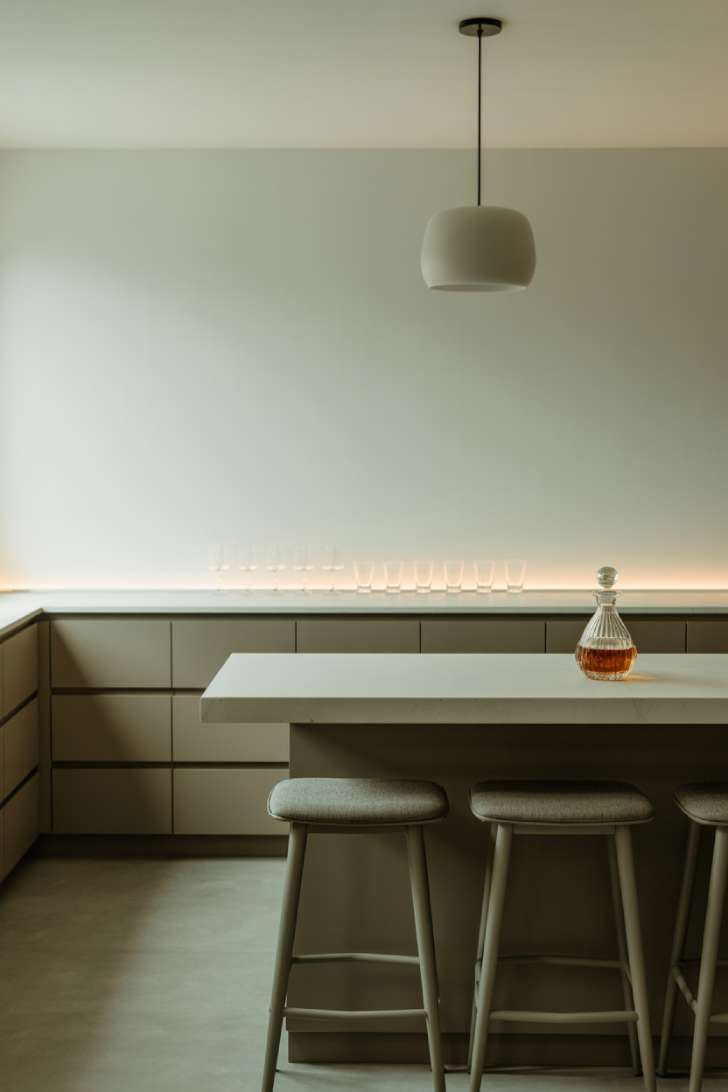
Minimalism in a bar setting works when every single piece has a purpose.
The waterfall countertop draws the eye along a continuous line, and the absence of hardware or visual clutter lets you focus on the materials themselves.
Cool-toned LED bar lighting ideas beneath the cabinets give the countertop a subtle glow that makes the surface feel like it’s floating.
There’s a psychological effect at play here: open, clean spaces lower visual stimulation and make people feel composed.
When the room isn’t competing for your attention, the drink in your hand becomes the main event.
This is a home bar design that photographs well and lives even better.
- Style Blueprint:
- Quartz or Dekton waterfall-edge countertop
- Handleless, push-to-open flat-panel cabinetry
- Under-cabinet LED strip lighting
- Low-profile upholstered stools with metal legs
- One statement pendant — nothing more
Design Pro-Tip: In a bar area with no windows, paint the ceiling a shade lighter than the walls to prevent the room from feeling compressed. A matte white or soft cream ceiling reflects ambient light back down into the space and creates the illusion of height — something that matters more underground than anywhere else in the house.
The Game-Day Sports Pub
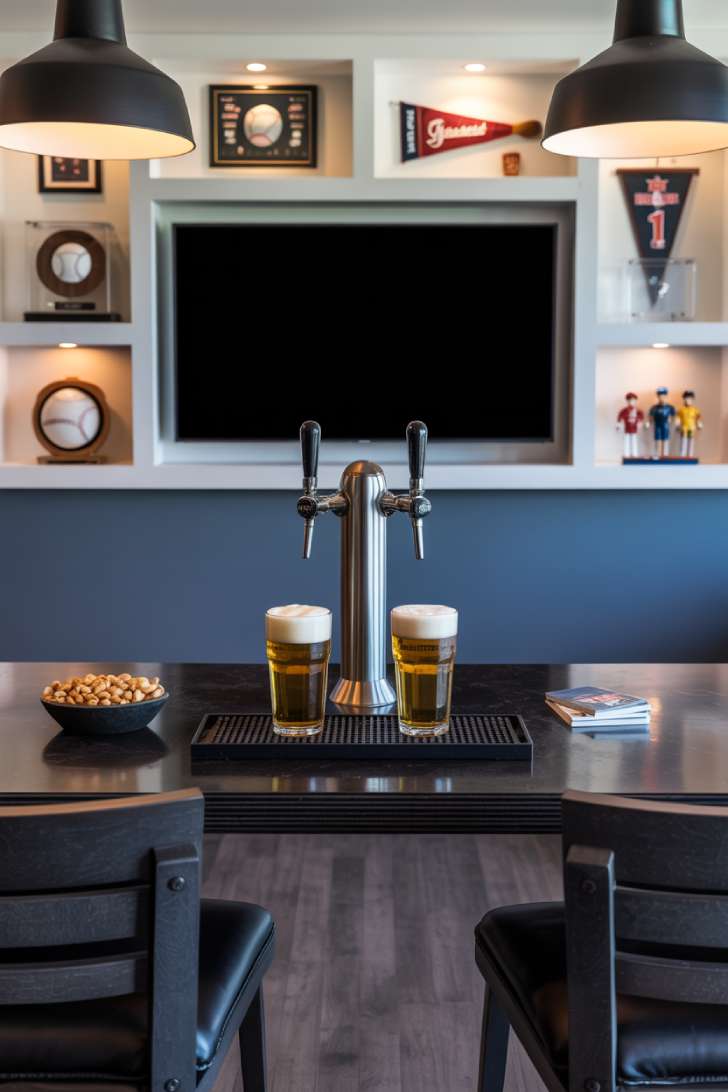
A sports bar at home succeeds when the TV placement and the kegerator setup are planned together.
The screen needs to be at a height where seated guests can watch comfortably without tilting their necks — roughly eye level from the stool.
The taps should be within arm’s reach of whoever’s playing bartender so the pour never interrupts the play.
What makes this space feel like more than a TV on a wall is the surrounding context: framed memorabilia, team colors woven into the palette, and dedicated lighting that separates the bar zone from the rest of the finished basement remodel.
A muted navy or charcoal wall behind the screen reduces glare and pulls the focus onto the picture.
This is peak basement entertainment space — purpose-built for noise, laughter, and cold beer.
- Style Blueprint:
- Large wall-mounted TV at seated eye level
- Under-counter kegerator with dual taps and drip tray
- Memorabilia display shelves with accent lighting
- Padded leather stools with backs and chrome footrests
- Muted dark wall paint behind the screen to cut glare
Traditional Wet Bar With Polished Stone
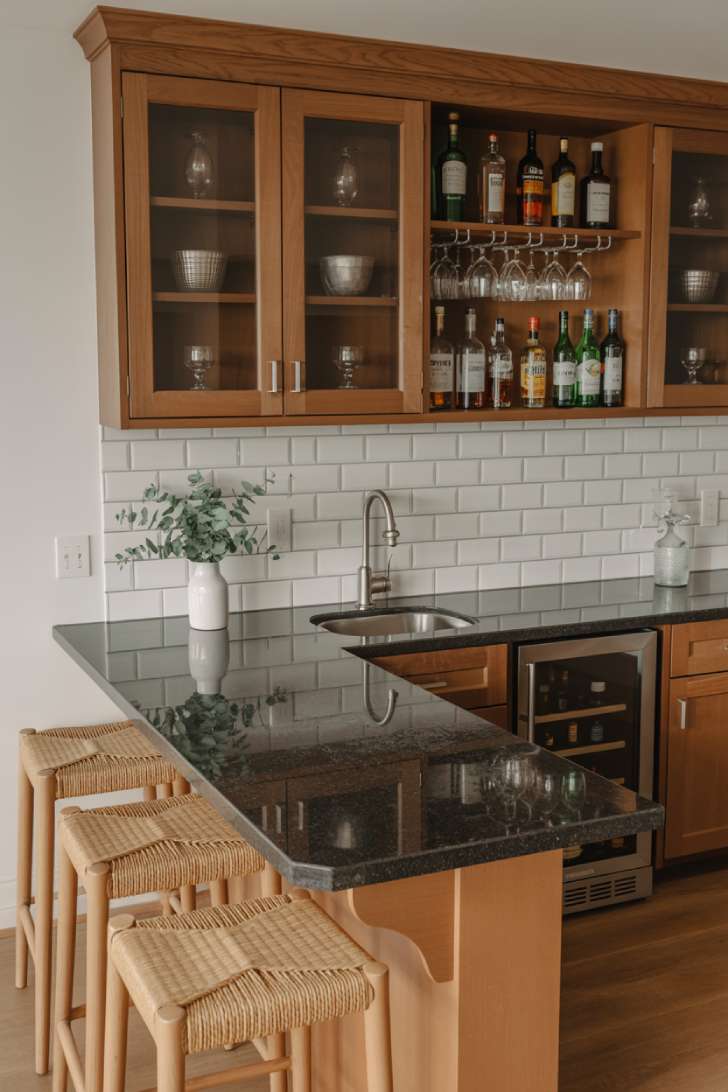
The wet bar vs dry bar debate usually comes down to one question: how far is your bar from the kitchen?
If the answer is a full flight of stairs, a sink changes everything.
You can rinse glasses, wash garnishes, and dump ice without leaving the room.
The L-shape is a natural fit for basements — it wraps into a corner, saves floor space, and creates a clear boundary between the bar area and the open room.
Granite and quartz are the most popular bar countertop materials for good reason: they resist staining from red wine and citrus, they clean up fast, and their polished surface reflects light in a way that makes the bar feel alive.
Subway tile on the backsplash is timeless because it’s simple, inexpensive, and plays well with almost every cabinet style.
- Style Blueprint:
- Polished granite or quartz L-shaped countertop
- Undermount sink with gooseneck faucet
- White subway tile bar backsplash tile
- Shaker-style cabinetry with glass-front uppers
- Built-in beverage fridge with glass door
The Hidden Nook Under the Stairs
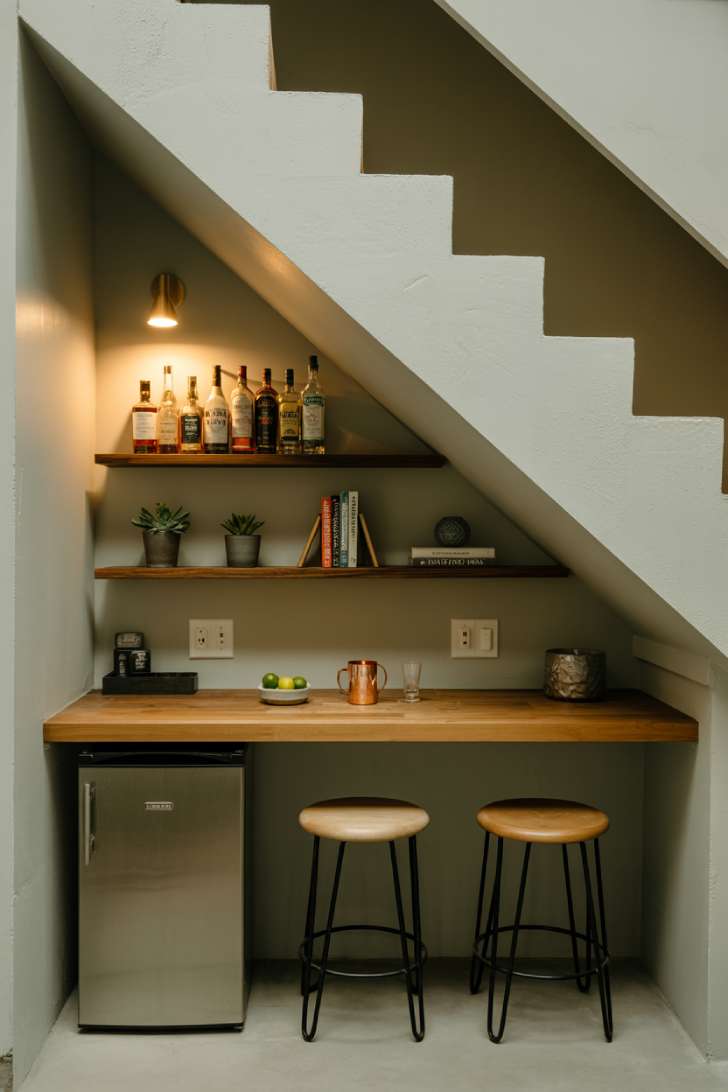
This is one of the most space-efficient basement bar ideas out there.
The angled ceiling beneath a staircase usually gets walled off or ignored, but it’s the perfect pocket for a small bar setup.
The diagonal line of the stairs creates a natural frame for floating shelves, and the low ceiling overhead makes the nook feel private — almost booth-like.
A floating countertop mounted to the wall saves floor space, and two stools are all you need.
The trick to making a small bar seating layout feel generous is to keep the counter clear and store everything on the wall above.
When every bottle, glass, and tool has a visible home, the space reads as curated instead of cramped.
- Style Blueprint:
- Floating butcher block countertop at bar height
- Compact mini fridge tucked underneath
- Angled floating shelves following the stair slope
- Single wall sconce in brass or black
- Hairpin-leg stools that tuck fully under the counter
Design Pro-Tip: When choosing bar stools for a tight space, look for backless stools with thin legs — hairpin, pedestal, or tapered — that can slide completely under the counter when not in use. This single choice can free up 18 inches of walking room in a narrow bar area, making the difference between a space that feels tight and one that feels just right.
Exposed Brick Industrial Bar
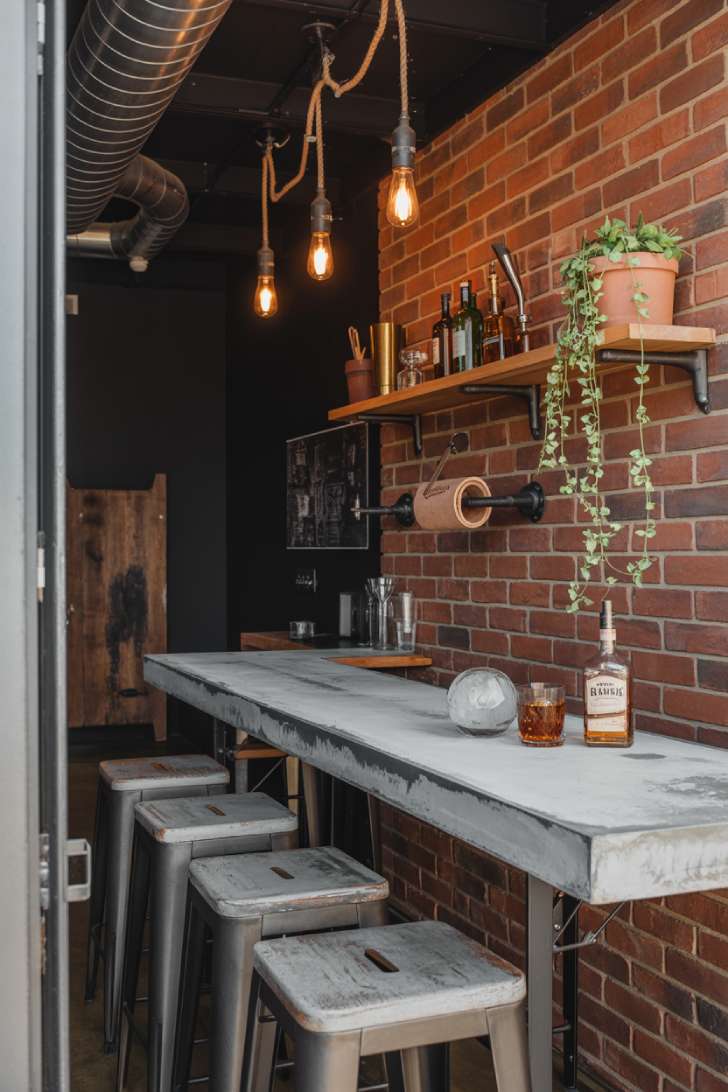
Exposed brick does something no painted wall can — it gives a room instant history.
The irregular texture of old brick absorbs light unevenly, creating natural shadows and depth across the wall that shift as the evening goes on.
Pair it with a concrete countertop and black steel, and you’ve got a space that feels like it belongs in a converted warehouse.
The raw materials work here precisely because they’re left unfinished.
Sealed concrete shows every water ring and scratch over time, and that wear adds character.
Visible ductwork on the ceiling, which most homeowners try to hide, becomes a feature when the rest of the room leans into the same honest, stripped-back aesthetic.
This look suits the kind of home bar design where whiskey neat is the default order.
- Style Blueprint:
- Poured or cast concrete bar counter with matte seal
- Full exposed brick wall (or brick veneer panels)
- Black steel pipe open shelving
- Edison bulb pendants on staggered-length cloth cords
- Black metal stools with reclaimed wood seats
Warm Farmhouse Chic Bar
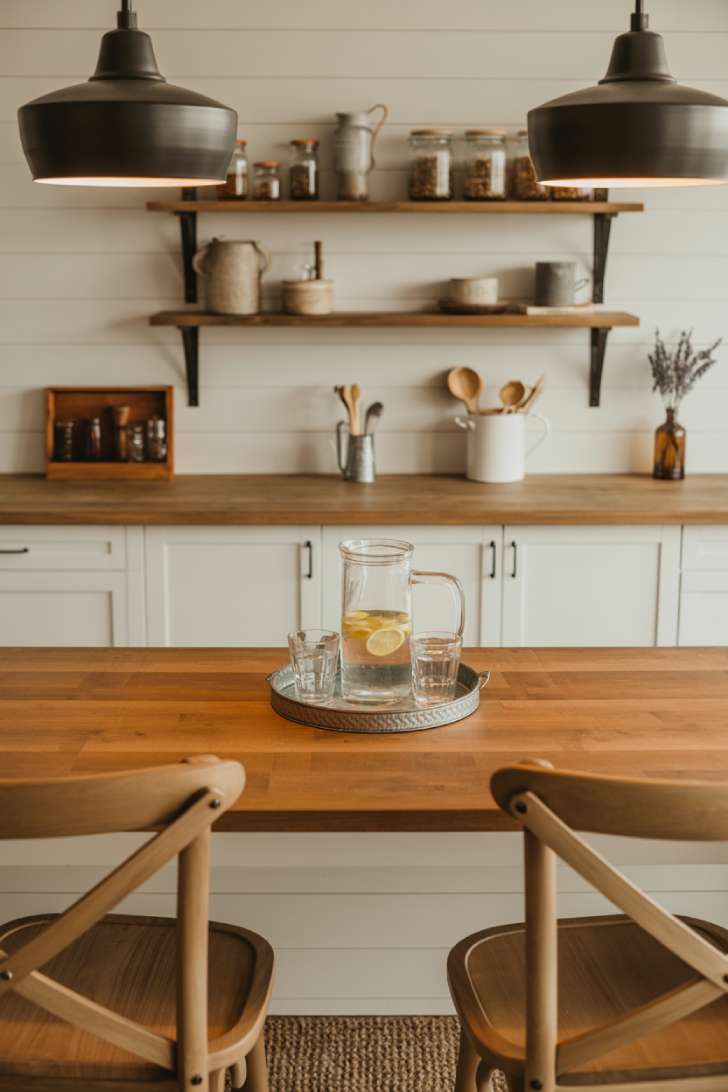
Farmhouse style works beautifully for basement bars that serve double duty — cocktail spot by night, coffee station by morning.
The white shiplap reflects whatever light you give it, making a low-ceilinged basement feel airier and more open.
Butcher block on the counter introduces warmth and a sense of approachability.
People tend to gather more easily around a bar that feels domestic rather than commercial.
The open shelving is doing psychological work, too: when you can see everything at a glance — the glasses, the pitchers, the bottles — the space feels welcoming instead of closed off.
It’s inviting you to help yourself.
That casual ease is exactly what farmhouse design does best.
- Style Blueprint:
- End-grain or edge-grain butcher block bar top
- White shiplap accent wall behind the bar
- Open wood shelves with stoneware and jars
- Matte black dome pendant lights
- Oil-rubbed bronze hardware on white shaker cabinets
A Dedicated Wine Bar With Glass Storage Wall
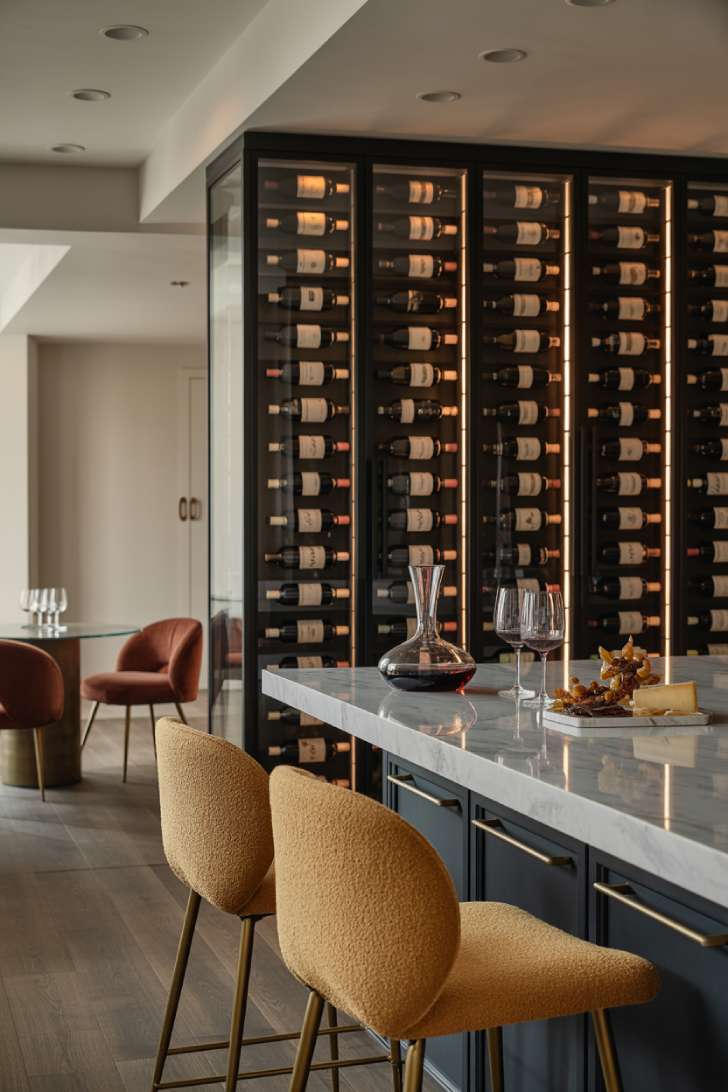
A glass-enclosed wine wall turns storage into a visual event.
The backlit bottles become the room’s artwork, and the amber glow filtering through red and green glass creates a color palette that no paint can match.
Honed marble on the counter (rather than polished) gives a softer, more contemporary feel — less flashy, more confident.
Navy cabinetry anchors the bottom half of the room with weight and richness.
The upholstered bar chairs in a textured boucle fabric signal that this isn’t a quick-drink bar — it’s a place to sit, pour slowly, and talk.
That’s intentional: a wine bar invites a different pace than a beer bar, and the furniture should reflect it.
Low, wide chairs instead of tall stools shift body language from perched and alert to reclined and relaxed.
- Style Blueprint:
- Glass-enclosed wine storage wall with LED backlighting
- Honed marble or light stone bar countertop
- Dark navy or forest green cabinetry with brass pulls
- Upholstered bar chairs in boucle, linen, or velvet
- Separate secondary seating nook for sipping
Design Pro-Tip: If you’re building a wet bar with a sink, position the sink at the far end or in a back corner — not at the center of the bar. A centrally placed sink breaks the visual line of the countertop and forces guests to look at a faucet instead of the bottles behind it. Pushing it to the side keeps the focal point where it belongs: on the bar back display.
Craft Brewery Tap Wall
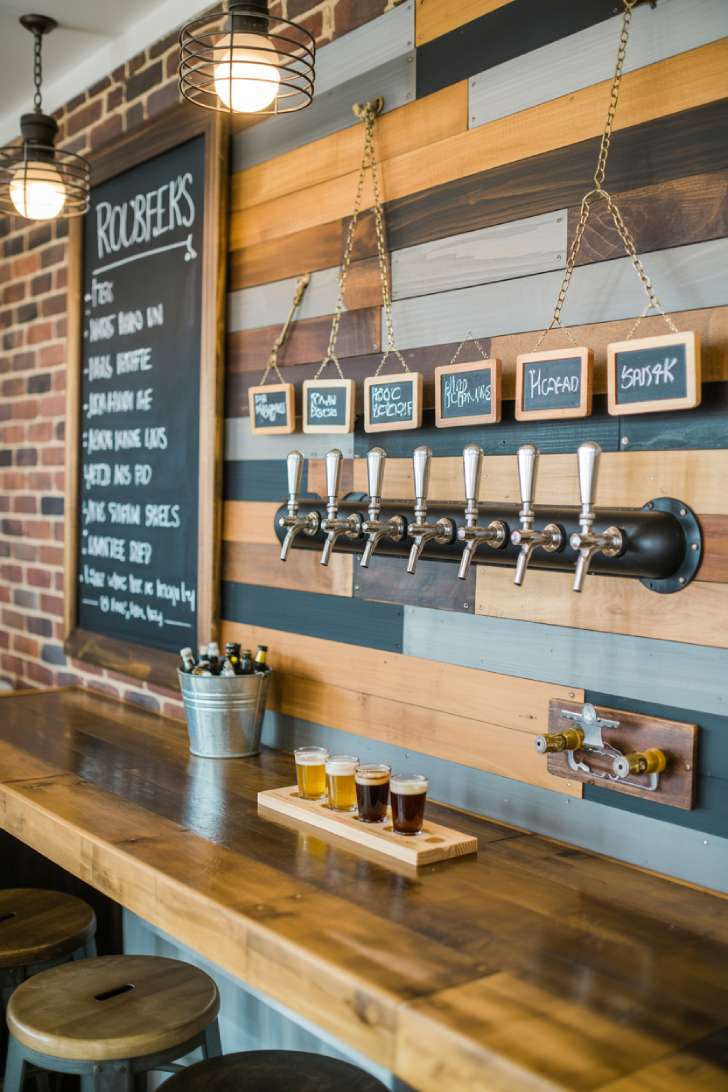
The tap wall is the star here, and it deserves the right backdrop.
Mixed-tone reclaimed planks behind the taps give the wall texture and color without competing with the stainless hardware.
Chalkboard labels on each tap handle let you swap names as your kegs rotate — it’s practical and it adds to the brewery vibe.
The flight board on the counter invites sampling, which changes the social dynamic of the bar.
Instead of everyone ordering their own drink and sitting separately, flights encourage sharing, comparing, and talking about what’s in the glass.
That shift from individual consumption to communal tasting makes the bar feel more like a destination.
A kegerator setup sits underneath the bar, keeping kegs cold and connected to the tap lines above.
This is a basement entertainment space designed around a single passion, and that focus is what makes it so satisfying.
- Style Blueprint:
- Under-counter kegerator with tap lines running to a mounted tap wall
- Reclaimed wood plank wall behind the taps
- Chalkboard tap labels and a framed chalkboard menu
- Wooden beer flight boards for tasting
- Metal cage pendant lights for an industrial brewery feel
Coastal Nautical Bar
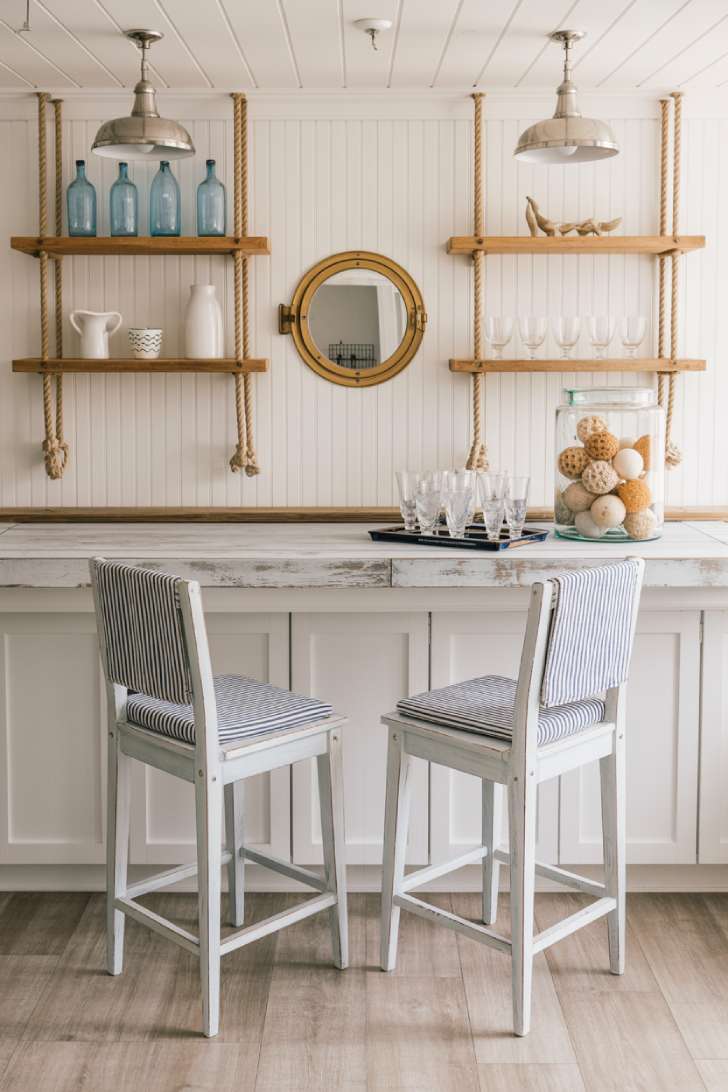
Blue, white, and weathered wood are the entire color story here, and that restraint is what keeps it from tipping into theme-park territory.
The porthole mirror is a playful touch without being cartoonish, and rope-hung shelves add texture that feels organic.
Bright, clean lighting is doing something specific in this design: it fights the underground feeling of a basement and replaces it with an openness that recalls a waterside bar.
Light tones on the floor, walls, and counter all bounce illumination around the room, making the space feel larger than it is.
This is a good reminder that bar lighting ideas don’t always mean dim — a coastal bar thrives on brightness.
The ticking-stripe cushions on the stools give the seating a casual comfort that invites bare feet and shorts.
- Style Blueprint:
- Whitewashed or driftwood-toned bar counter
- White beadboard paneling on the back wall
- Rope-hung open shelving with brass cleat hardware
- Porthole mirror in polished brass
- Ticking-stripe or navy-and-white cushioned stools
Dark Wood Irish Pub
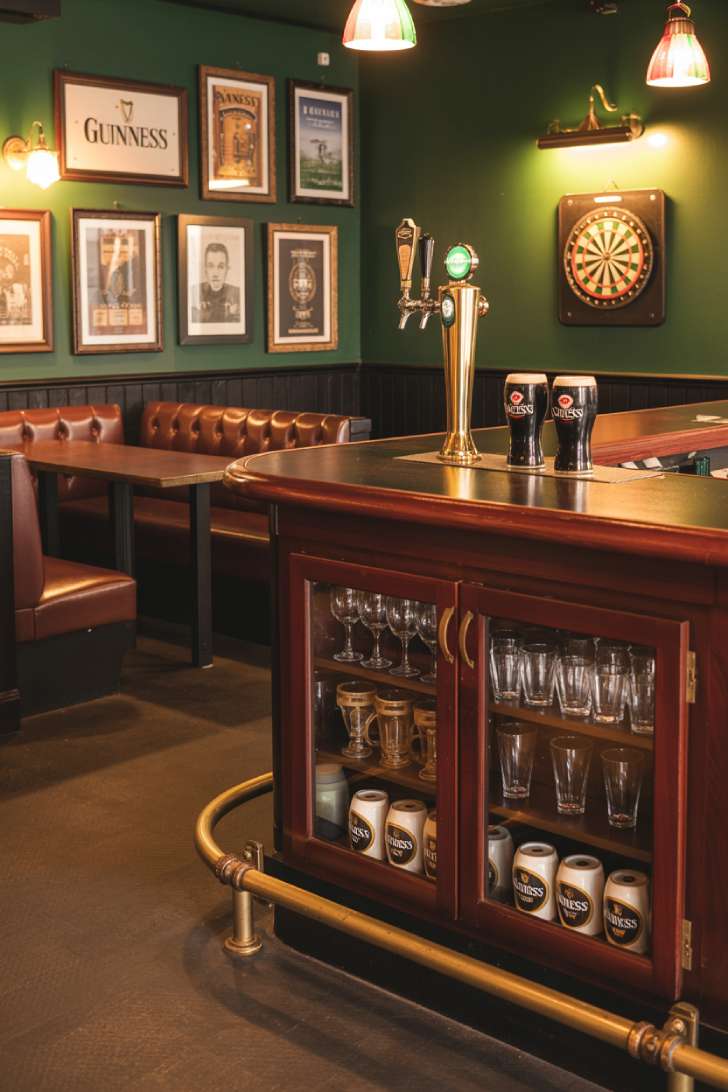
Everything about a pub is designed to make you stay.
The dark wainscoting and deep green walls create a sense of enclosure that feels protective, not claustrophobic.
Leather booth seating is positioned low and deep, so once you sit down, getting up feels like an effort you’d rather not make.
That’s not an accident — pubs have refined the bar seating layout over centuries.
The dartboard on the wall adds a participatory element that keeps people on their feet and moving between the bar and the game.
Brass fixtures — the foot rail, the taps, the sconces — pick up warm light and scatter it across the room in soft golden reflections.
This is a speakeasy theme’s friendlier, more boisterous cousin.
- Style Blueprint:
- Dark mahogany bar with brass foot rail
- Built-in tap system for stout and cider
- Hunter green walls with dark wood wainscoting
- Leather-tufted booth seating with a pub table
- Vintage brewery prints and a wall-mounted dartboard
Design Pro-Tip: Budget roughly two feet of bar counter per seat. If you want four stools, plan for at least eight feet of bar length. This sounds obvious, but it’s one of the most common miscalculations in basement bar builds — crowded seating makes people uncomfortable and shortens how long they’ll stay.
Marble and Brass Cocktail Lounge
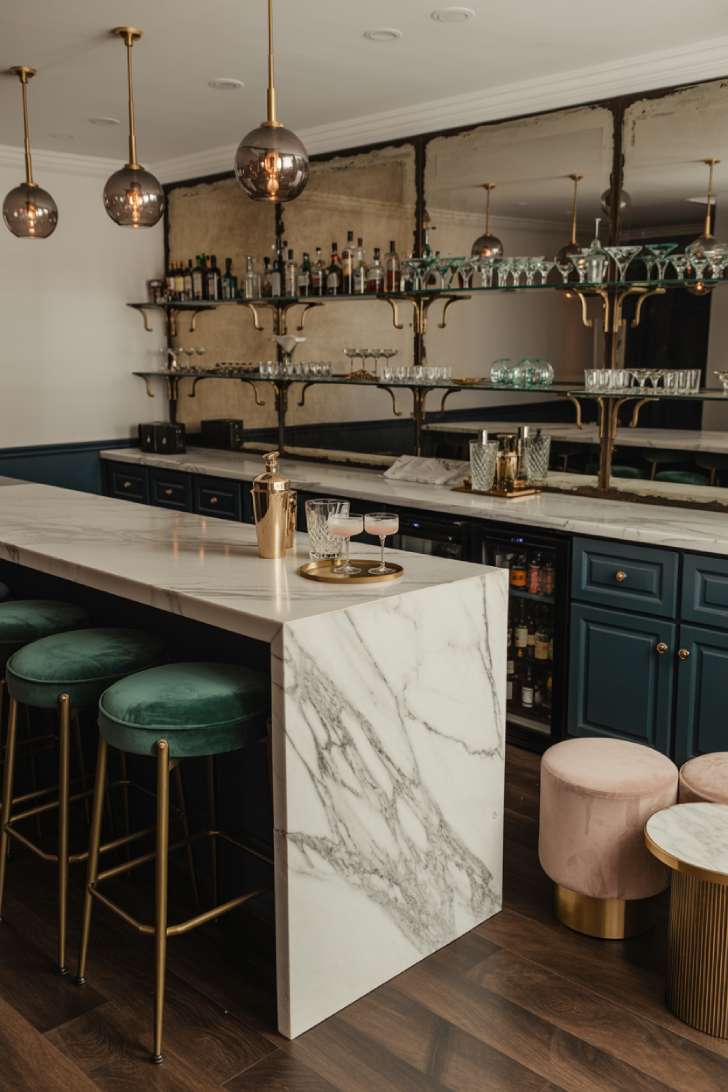
Marble and brass together create a visual shorthand for luxury that reads instantly.
The weight of a thick marble slab communicates permanence, and the cool surface temperature of natural stone makes every cocktail glass set upon it feel like an occasion.
The antiqued mirror behind the bar serves two purposes: it doubles the visual depth of the shelf display and it bounces warm pendant light back into the room.
Mirrors in bar design are one of the oldest tricks in the book, and they work just as well underground as they do in a Manhattan hotel bar.
Emerald green velvet on the stools introduces a jewel tone that lifts the palette and prevents the white-and-brass scheme from feeling sterile.
This is a home bar design that says the occasion is now.
- Style Blueprint:
- Carrara or Calacatta marble waterfall countertop
- Antiqued mirror back bar panels with glass shelves
- Brass-rimmed pendant lights with smoked glass shades
- Velvet-upholstered bar stools in emerald or sapphire
- Brass cocktail tools displayed on a marble tray
Pool Table and Bar Combo
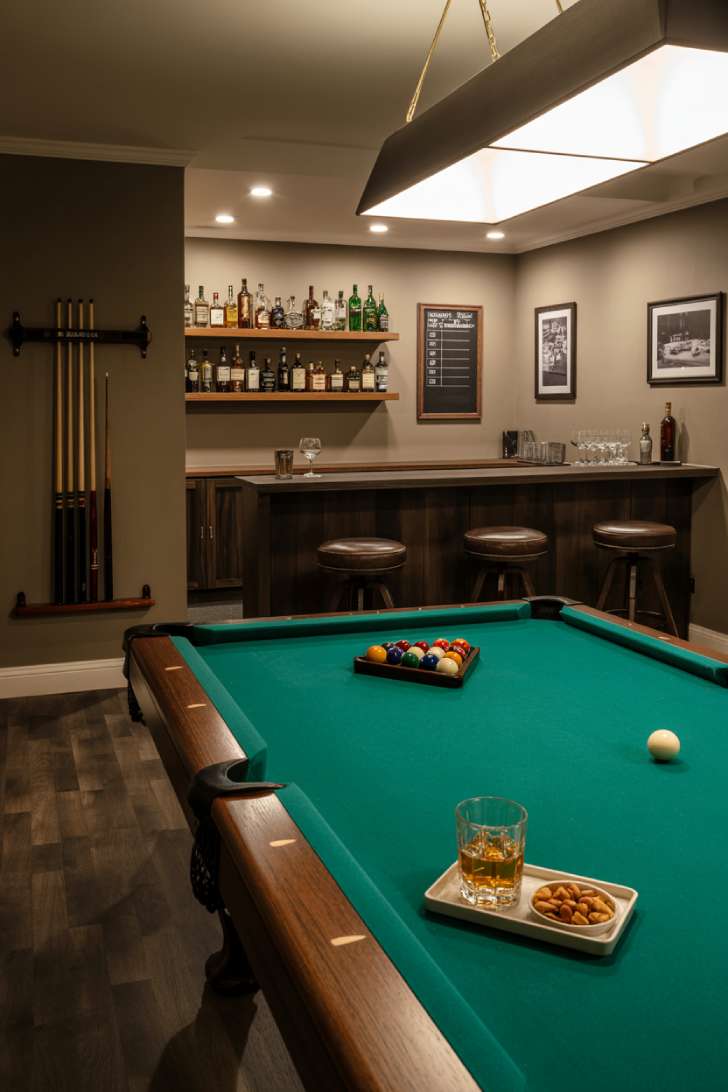
Pairing a bar with a game table changes the energy of the entire room.
The pool table becomes a social magnet — people orbit around it, watching, waiting for their turn, talking — and the bar gives them a place to land between rounds.
The long pendant light over the table creates a clear visual zone that separates the game area from the rest of the basement entertainment space.
That overhead light pool is doing important work: it defines the playing surface while leaving the surrounding areas slightly dimmer, which gives spectators at the bar the comfortable feeling of watching from the wings.
The chalkboard scoreboard between the bar and the table ties the two zones together and adds a playful, competitive element.
This layout works just as well with a shuffleboard table, foosball, or arcade machines in place of the pool table.
- Style Blueprint:
- Slate-bed pool table with quality felt
- Long rectangular pendant light over the game surface
- Wall-mounted cue rack and chalkboard scoreboard
- Dark butcher block bar counter with floating shelves
- Swivel stools for easy turning between bar and game
Budget-Friendly DIY Dry Bar
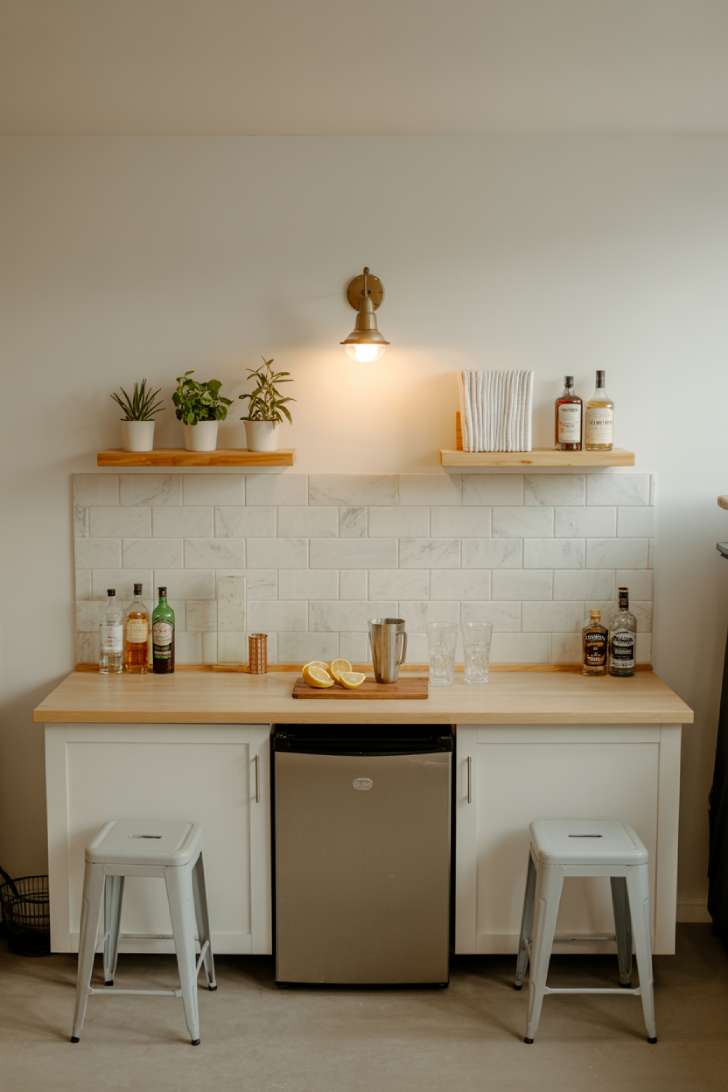
The wet bar vs dry bar question often comes down to budget, and a dry bar wins that contest every time.
No plumbing means no contractor, no permits, and no waiting.
Stock cabinets, a butcher block slab from a home center, and a peel-and-stick bar backsplash tile can bring this entire build in under $2,000 — a number that’s hard to argue with.
The visual trick here is restraint in styling.
A few well-chosen bottles, some fresh herbs for garnish, and clean white linens make the bar look intentional rather than improvised.
The plug-in wall sconce is a small but mighty move — it adds warm, focused light without any electrical work.
This is one of those basement bar ideas that proves a great-looking setup is more about editing and arrangement than spending.
- Style Blueprint:
- White stock base cabinets from a home improvement store
- Butcher block or laminate countertop
- Peel-and-stick tile backsplash
- Compact mini fridge between or beside the cabinets
- Plug-in wall sconce for warm, no-wiring-needed light
Design Pro-Tip: A dry bar can be converted to a wet bar later if you pre-plan the cabinet layout to accommodate a sink and leave access to nearby plumbing lines. Start with a dry setup to save money now, and leave the option open for the upgrade. It’s much cheaper to plan the space now than to tear it apart later.
Moody Black and Brass Statement Bar
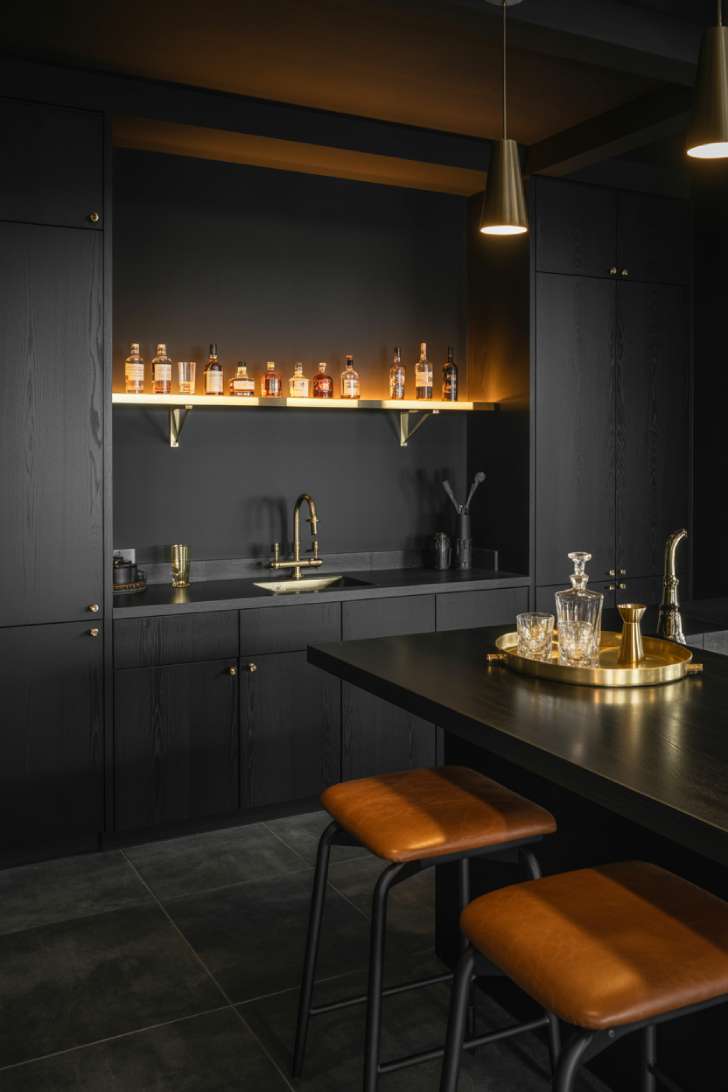
Black walls in a basement feel like a risk, but when the bar lighting ideas are right, the payoff is enormous.
The matte black surfaces absorb ambient light and push attention straight to the illuminated elements — the backlit shelf, the brass hardware, the glow beneath the counter.
Your eye has no choice but to follow the light, and that guided focus is what gives the room its sense of drama.
The cognac leather stool cushions introduce a warm organic tone that keeps the all-black palette from feeling cold or sterile.
Brass against black creates one of the highest-contrast combinations in interior design, and that contrast reads as luxury without needing marble or crystal to sell it.
The trick is restraint: too many brass elements and the room becomes gaudy.
A faucet, shelf brackets, pendant accents, and a few bar tools — that’s the ceiling.
- Style Blueprint:
- Matte black flat-panel cabinetry and walls
- Black honed granite or matte stone countertop
- Brass faucet, hardware, and shelf brackets
- LED-backlit floating glass shelves for bottle display
- Cognac or tan leather stools for warm contrast
Indoor-Outdoor Walkout Bar
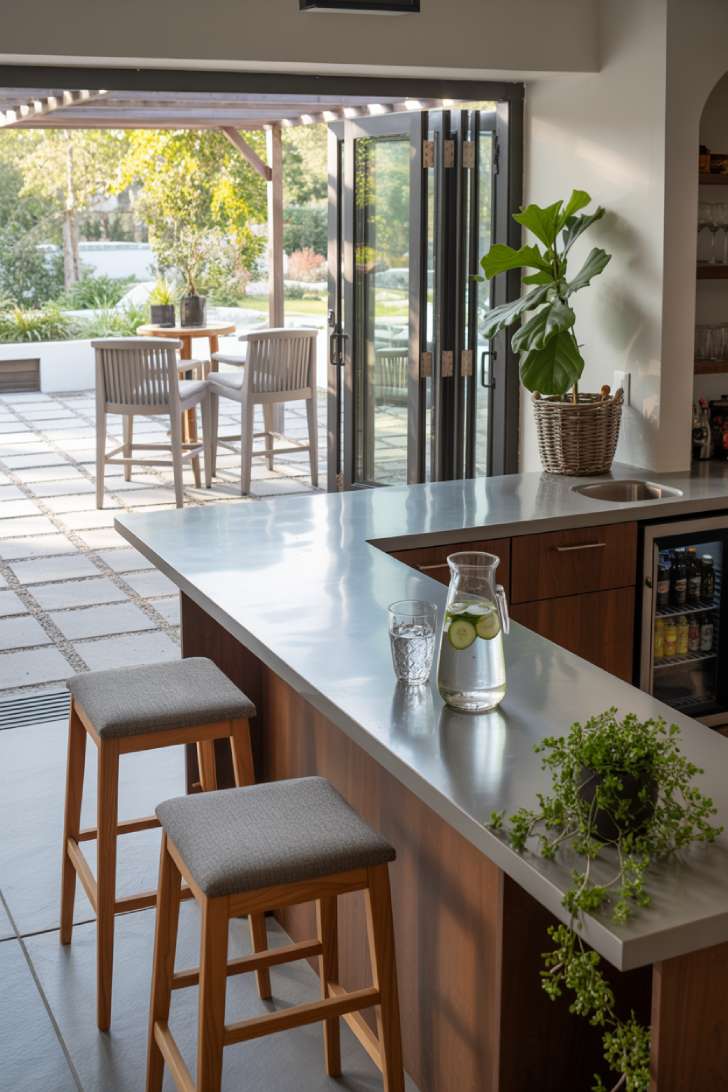
A walkout basement gives you something no other bar on this list can offer: daylight and an outdoor connection.
Positioning the bar perpendicular to the glass doors lets it serve guests on either side — inside on a cold night, outside on a summer afternoon.
The continuous countertop running through the doorway erases the boundary between the two zones.
That unbroken line is doing real perceptual work: it tells your brain that this is one space, not two.
The material transition from porcelain tile to flagstone underfoot subtly marks the threshold without interrupting the flow.
Indoor plants near the doors blur the edge even further.
If your basement has a walkout, this is the home bar design that makes the most of it.
The bar becomes a bridge between your indoor life and your backyard.
- Style Blueprint:
- Polished concrete or stone countertop extending through the doorway
- Large glass sliding or folding doors for full opening
- Weather-resistant teak or acacia bar stools for the outdoor side
- Built-in beverage fridge and undermount sink on the interior side
- Indoor plants at the transition point to connect inside and outside
Start Pouring
You don’t need a huge basement or a big budget to build a bar that becomes the best room in the house.
A compact dry bar under the stairs or a full wet bar with draft taps and stone counters — either one can turn overlooked square footage into the spot everyone gravitates to.
Pick the style that fits your space, steal the details that catch your eye, and start planning.
Your basement isn’t going to finish itself.