This post may contain affiliate links. If you make a booking or purchase through these links, we may earn a commission at no additional cost to you.
Basements have a reputation problem.
For decades they were storage graveyards — cardboard boxes stacked against cinder block walls, that treadmill no one touches, Christmas decorations from 2008.
But walk into a well-designed basement TV room and that reputation evaporates instantly.
The lower level of a house is actually the ideal spot for a dedicated media space: it’s naturally quieter than the floors above, it stays cooler in summer, and it receives almost no ambient light — which means your screen looks better down there than it would anywhere else in the house.
These 11 basement tv rooms prove just how good things can get when you stop using the space as overflow storage and start treating it like the room it was always meant to be.
The Dark Moody Theater
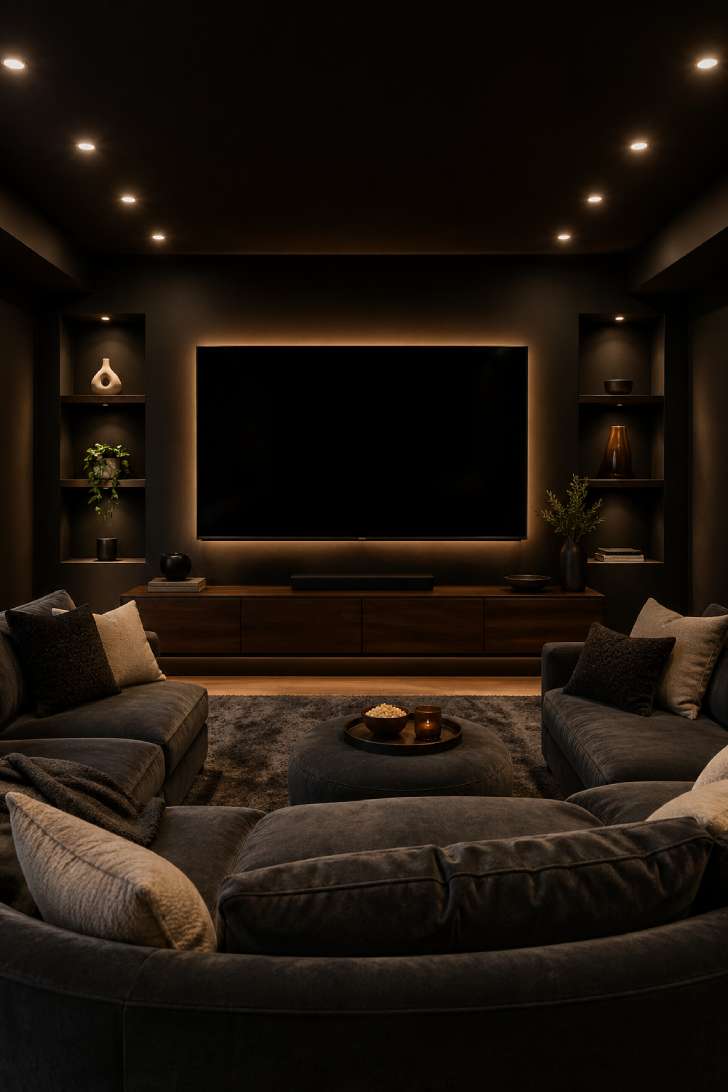
There’s a reason professional home theaters always go dark.
When the walls absorb light instead of reflecting it, your eyes stop fighting the screen — every color reads truer, every shadow holds its depth.
The charcoal palette here does something else, too: it signals to your nervous system that you’ve crossed a threshold.
Upstairs is the house. Down here, different rules apply.
The low-slung walnut console keeps the room grounded, while the amber bias lighting behind the TV reduces eye strain during long viewing sessions by bridging the contrast gap between the bright screen and the dark room behind it.
Velvet on a sectional might sound impractical until you’ve sat in it.
The pile holds heat, quiets the room slightly, and has a visual weight that cheap fabric simply can’t replicate.
Style Blueprint:
- Matte deep charcoal or near-black paint (Benjamin Moore “Onyx” or Sherwin-Williams “Black Fox” work well)
- Wide curved sectional in slate or charcoal velvet
- Warm amber LED bias lighting strip installed behind TV
- Low floating media console in dark walnut or espresso
- Deep-pile area rug in charcoal or graphite
The Casual Family Sectional Room
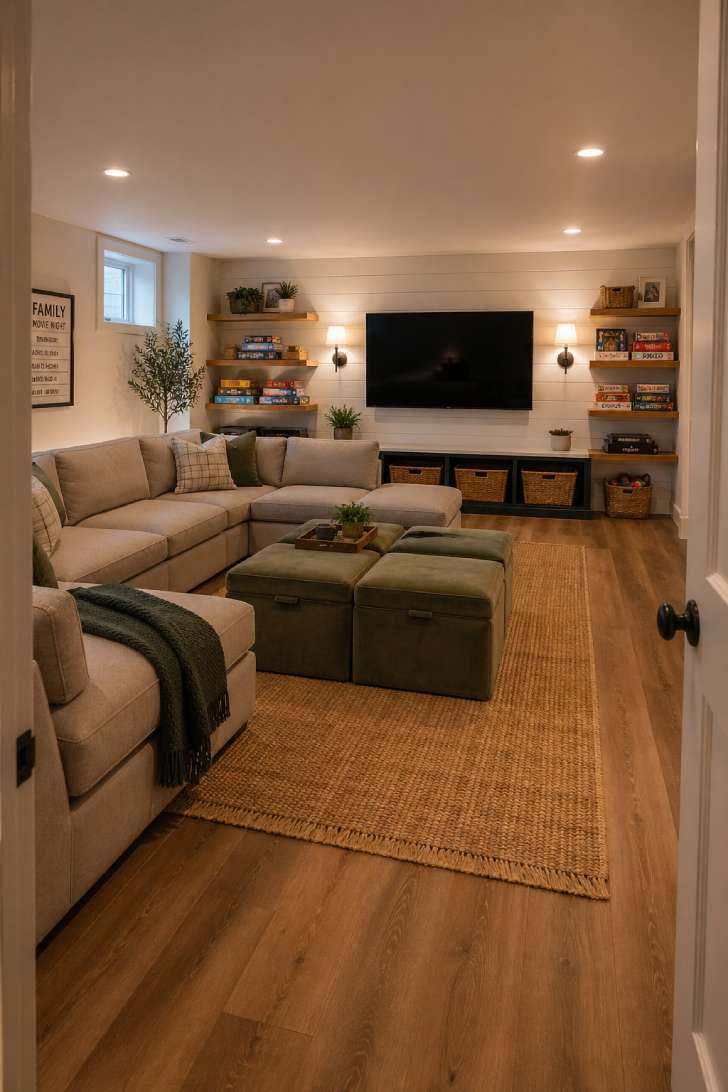
Not every basement TV room needs to be a home theater.
Some spaces just need to be good at being used — by kids on a Saturday afternoon, by adults watching a game on Sunday, by whoever needs a spot to decompress after a long week.
The L-shaped sectional is the workhorse of the family basement room.
It fits naturally against two walls, creates a clearly defined seating zone, and seats far more people than a standard sofa without making the room feel crowded.
Storage ottomans are one of the most underrated furniture decisions you can make for a basement.
They work as a coffee table, as extra seating when the room fills up, and as a hiding spot for the throw blankets, remotes, and controllers that would otherwise migrate across every surface.
Style Blueprint:
- L-shaped sectional in performance fabric (greige, warm beige, or stone)
- Four square storage ottomans in coordinating or accent color
- Luxury vinyl plank flooring in warm oak
- White shiplap or beadboard TV feature wall
- Large jute or wool area rug (at least 9×12 feet)
The Wood-Paneled Rustic Retreat
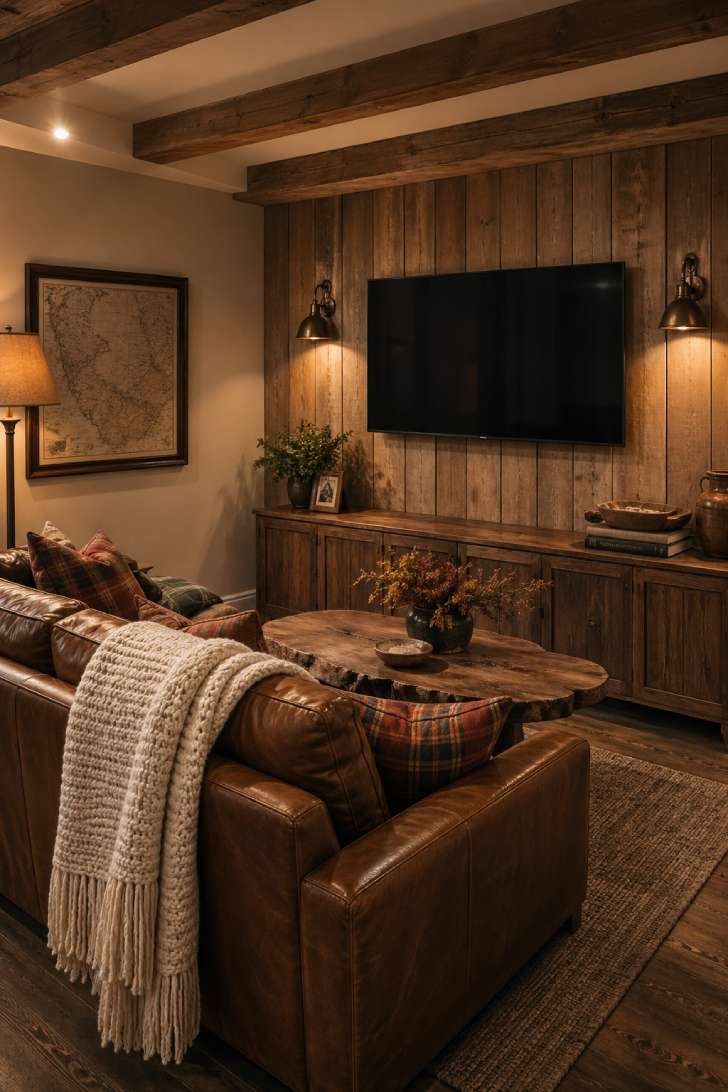
Wood paneling behind a television accomplishes something that most design elements don’t: it makes a flat screen look like it belongs there.
Without a feature wall, a mounted TV tends to read as a black rectangle floating on whatever paint color you chose.
Frame it in warm wood and the TV becomes part of the room’s architecture.
Leather is the right call for a rustic basement seating zone.
It ages gracefully — the cognac tone deepens with use, the cushions develop that broken-in character that fabric never quite achieves — and it wipes clean, which matters more in a basement than anywhere else in the house.
The dried botanicals on the coffee table are doing quiet work.
They add organic texture without requiring any care, and they bring a subtle earthiness that keeps the room from reading as a showroom.
Style Blueprint:
- Vertical shiplap or wide-plank wood panel feature wall behind TV
- Cognac or saddle brown leather sofa (3-seat or sectional)
- Aged brass wall sconces on either side of TV
- Live-edge coffee table in walnut or oak
- Chunky wool or sherpa throw in neutral or plaid
Design Pro-Tip: Mount your TV at the same height whether you’re going rustic, modern, or anything in between. The center of the screen should sit at eye level when you’re seated — typically 42 to 48 inches from the floor. Going higher strains your neck over long viewing sessions in ways you won’t notice until the next morning.
The Minimalist Floating Shelf Setup
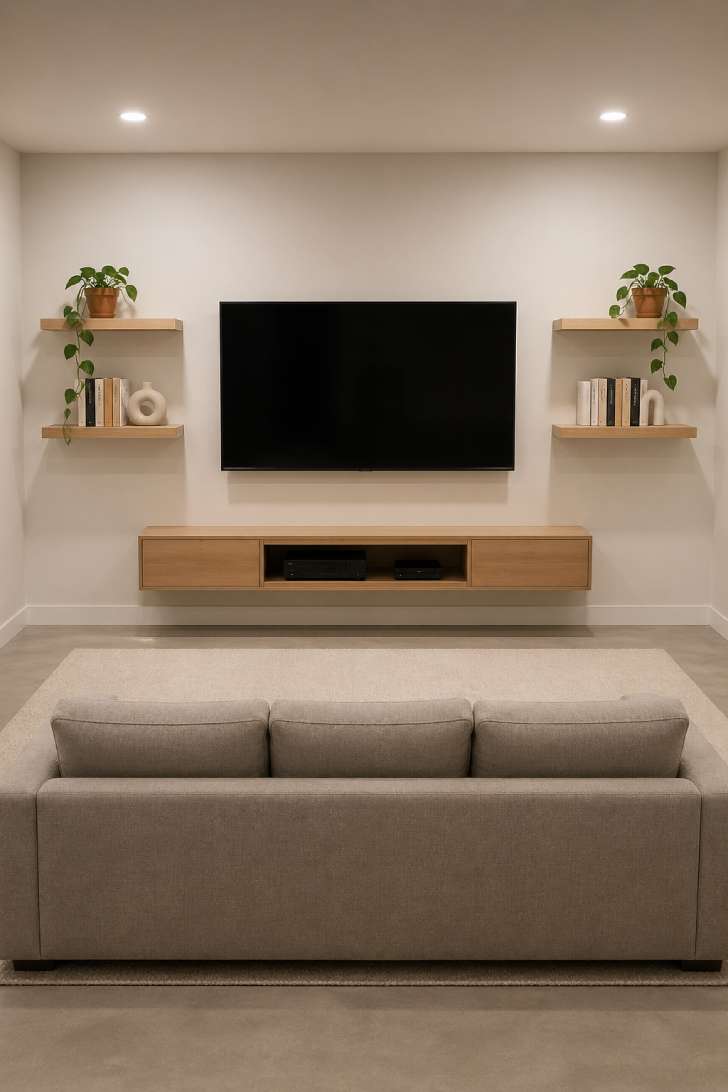
Restraint is harder to pull off than abundance.
Anyone can layer a room with objects and call it styled. Editing down to exactly what’s needed, and nothing more, takes a more deliberate eye.
The floating shelf approach works because it gives the TV wall visual context without crowding it.
Each shelf becomes a small composition — a book, a plant, one object — and the spacing between those compositions lets the wall breathe.
Routing cords through the wall is non-negotiable in a room like this.
A single visible cable running from TV to console undoes the entire effect of the setup.
It’s a two-hour job with the right tools, and it’s worth every minute.
Style Blueprint:
- Floating shelves in white oak or natural birch (2, symmetrically placed)
- Slim wall-mounted TV console in matching wood tone
- Low-profile linen or performance fabric sofa in warm gray or oatmeal
- In-wall cord routing system
- Trailing houseplant in a minimal terracotta or ceramic pot
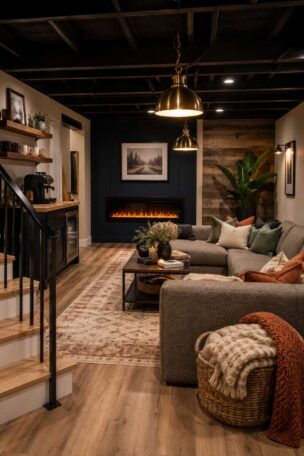
The Industrial Chic Basement
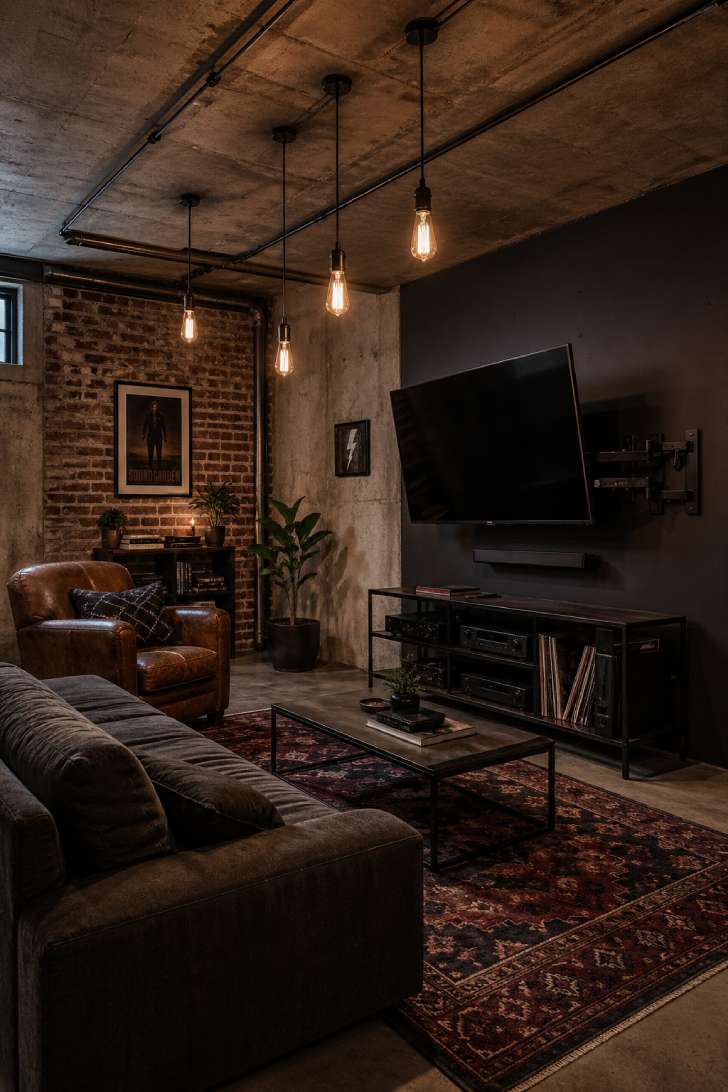
Most design styles try to smooth over whatever the building actually looks like.
Industrial design does the opposite — it starts with the bones and asks what needs to be added, rather than what needs to be hidden.
In a basement, this is a remarkably freeing approach.
Exposed concrete, low ceilings, raw support columns — these aren’t problems to solve in an industrial-styled space.
They’re the whole point.
The Edison pendants are doing the heavy lifting here in terms of atmosphere.
Hung at different heights on black cord, they break up the ceiling plane and add warmth to what could otherwise read as cold and hard.
The worn Persian rug is the pivot point of the room.
Its muted colors bridge the raw concrete and dark upholstery, and its age gives the space a layered, collected quality that new furniture alone can’t replicate.
Style Blueprint:
- Articulating TV mount arm in matte black
- Open metal media console (matte black or oxidized steel finish)
- Edison-style pendant lights on black cord (3–4 pendants)
- Distressed or vintage-style area rug in muted, dark tones
- Mix of concrete and dark painted surfaces (leave at least one raw wall)
The Built-In Entertainment Wall
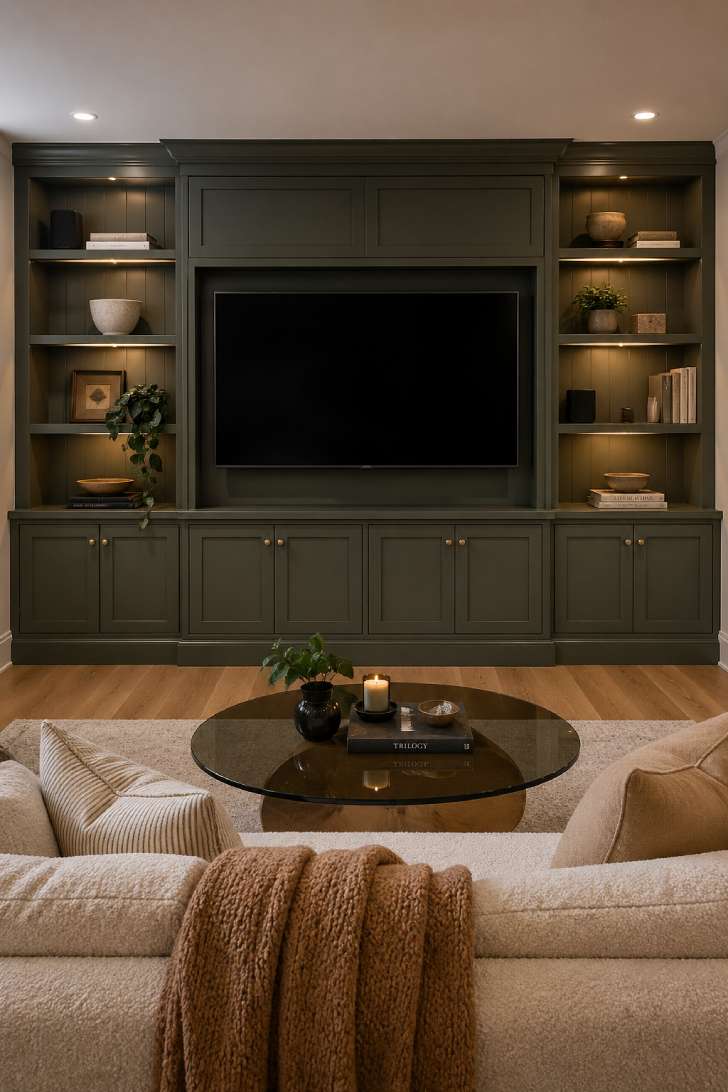
Built-in cabinetry is the longest-lasting investment you can make in a basement TV room.
Everything else — furniture, paint, lighting — can be changed for a few hundred dollars and an afternoon.
A well-built entertainment wall changes the room permanently, and it does it in the best possible way.
The sage green paint choice here is worth examining.
On plain walls it would feel trendy. On built-ins with clean Shaker profiles, it reads as architectural — a color that’s been there forever and will keep looking intentional long after every trend has moved on.
The boucle sofa against all that dark-painted woodwork is a study in contrast that works precisely because the tones are close.
Warm ivory against warm sage — they’re not fighting, they’re agreeing on temperature while disagreeing on depth.
Style Blueprint:
- Floor-to-ceiling built-in cabinetry with framed TV niche (painted, not stained)
- Integrated shelf lighting (warm LED strip inside open shelving sections)
- Deep sofa in boucle, textured linen, or performance velvet
- Oval or rectangular coffee table in smoked glass or stone
- Curated open shelf display: 1–2 plants, books, minimal ceramics only
Design Pro-Tip: When planning built-in cabinetry for a basement TV wall, always include at least two ventilated cabinets with cable pass-throughs for your AV equipment. Electronics generate heat, and enclosed cabinetry without airflow shortens their lifespan significantly. A $50 add-on during installation saves expensive equipment replacements later.
The Tiered Cinema Experience
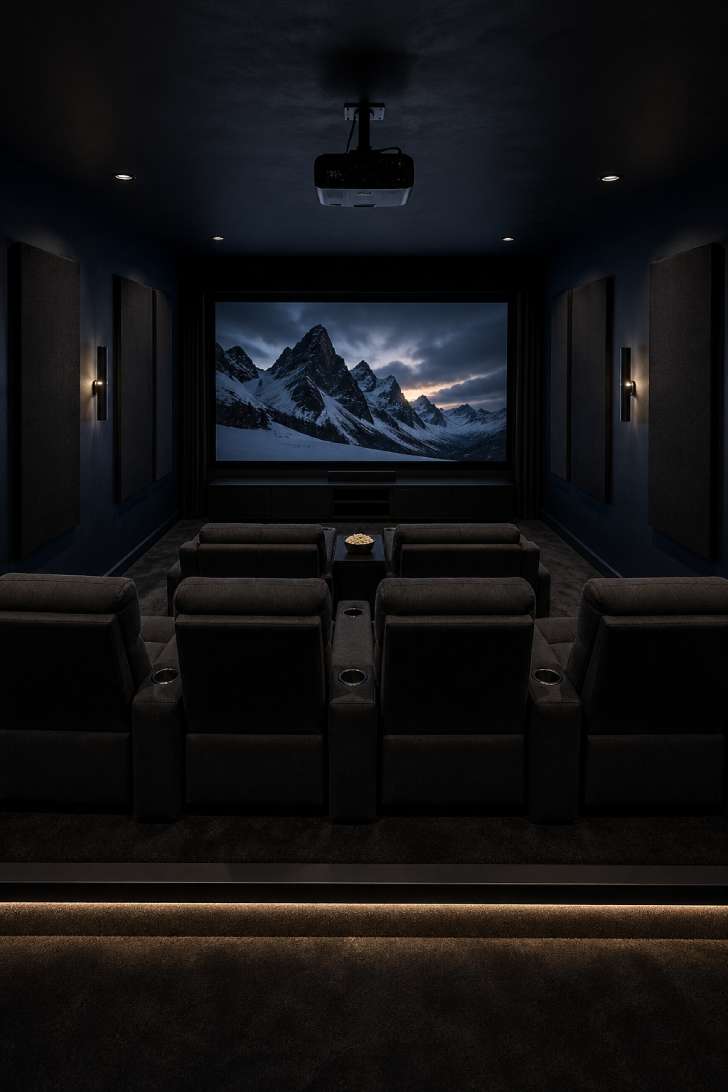
A tiered seating setup changes the function of a basement TV room entirely.
At that point you’re not designing a room — you’re designing an experience.
The second row of seats elevated on a platform ensures everyone in the back has an unobstructed view, which solves the primary practical problem of having more than four people watch something together.
Acoustic panels on the side walls aren’t just a technical detail.
At the room scale shown here, they’re a significant part of the visual design — their grid pattern and dark fabric add a texture to the walls that paint alone can’t achieve.
The recessed step lighting along the platform edge is one of those details that separates a professional installation from a DIY attempt.
It’s subtle enough to be invisible during a movie, bright enough to prevent anyone from tripping when they get up in the dark.
Style Blueprint:
- Raised platform (8–12 inches) for back row seating
- Individual recliners with cup holder armrests (4 seats across standard width)
- Ceiling-mounted projector with 120-inch+ screen
- Fabric acoustic panels on side walls
- Recessed LED step lighting along platform edge
The Boho Comfort Zone
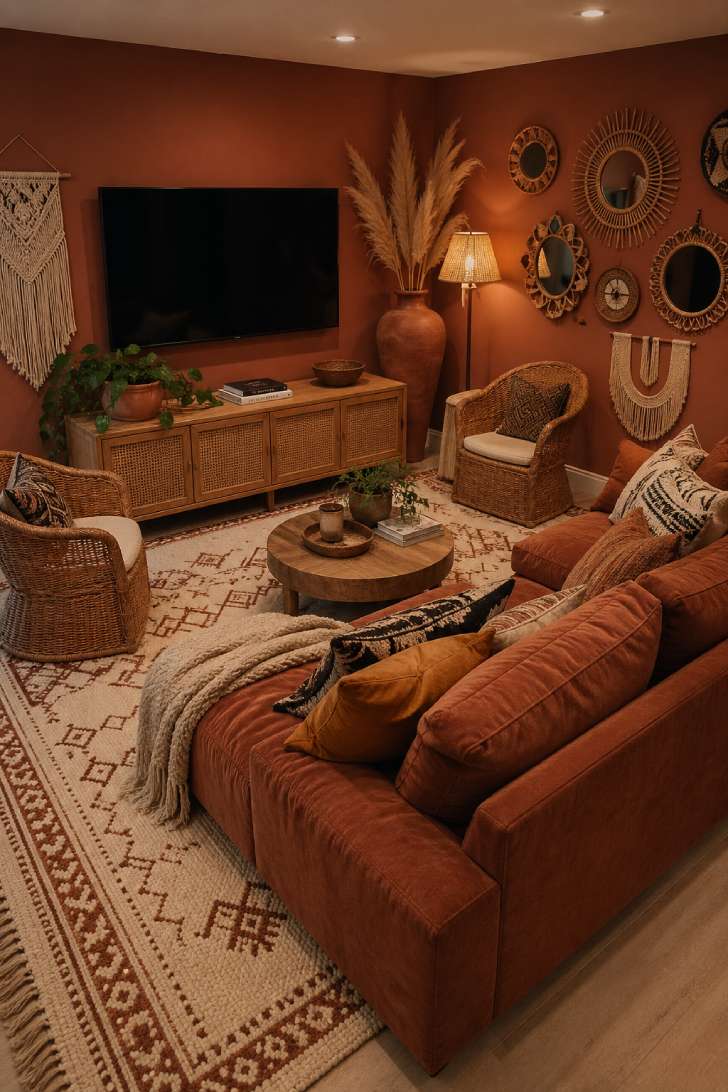
The boho basement TV room is the antithesis of the home theater setup.
It’s not optimized for screen performance or acoustic precision.
It’s optimized for how it feels to be in the room, which is an entirely different — and arguably more important — design goal.
Layering textiles is the core technique here.
A mud cloth pillow next to a woven stripe next to a solid amber isn’t chaotic — it’s deliberately imprecise, which is exactly the effect you want in a room that should feel collected over time rather than purchased in an afternoon.
Terracotta on basement walls does something unexpected: it warms the light.
Even the cool overhead LED of a recessed fixture starts to read warmer when it bounces off that clay-toned wall, which makes the room feel more naturally lit than it has any right to be, given that it’s underground.
Style Blueprint:
- Terracotta, warm clay, or saffron wall paint
- Rattan or natural wood media console (low profile)
- Mixed-pattern throw pillows (mud cloth, woven stripe, solid accent)
- Moroccan or vintage-style area rug in warm tones
- Gallery wall of woven textiles, rattan mirrors, or framed prints
The Sleek Modern Bar + TV Combo
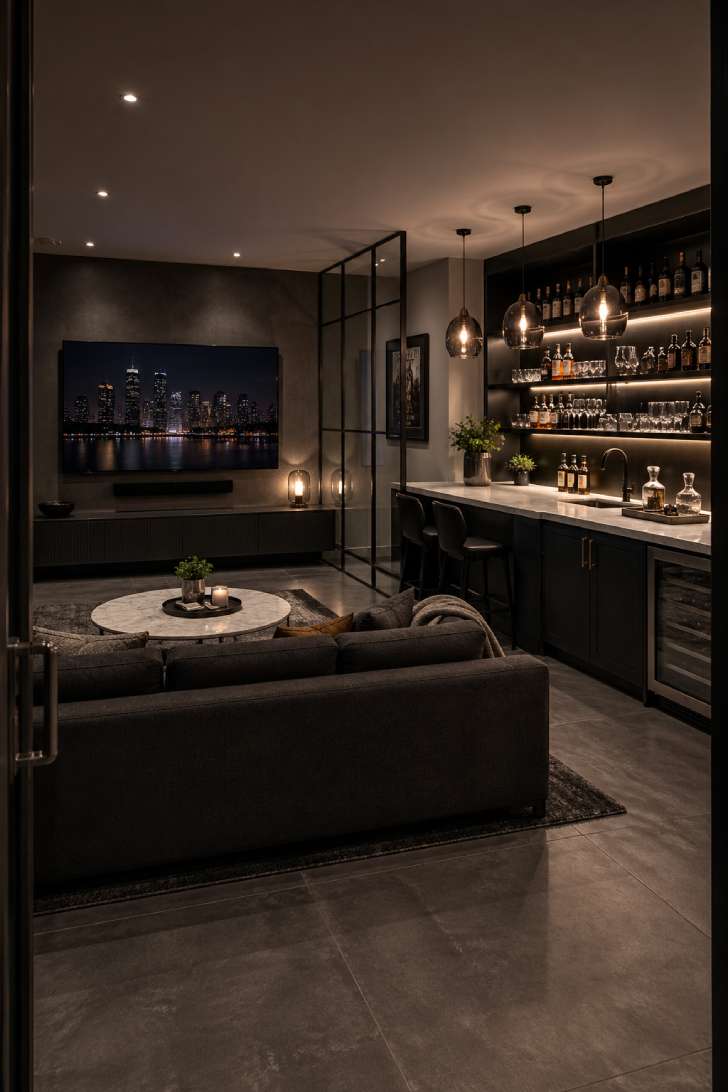
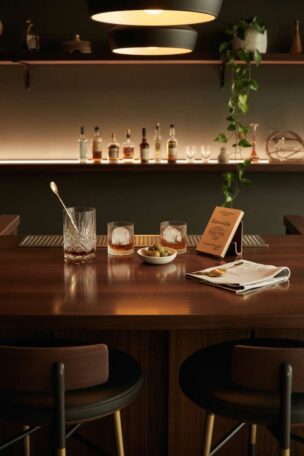
The bar-plus-TV basement configuration is the one guests remember.
It turns a media room into a destination — a place people actively want to go rather than end up in by default.
The design challenge is maintaining visual coherence between two functionally different zones in a single space.
The solution here is a consistent material palette: the same black-stained oak appears on both the media console and the bar shelving, and the dark charcoal of the sofa echoes the dark tile floor throughout.
Two distinct areas, one visual language.
The smoked glass pendants above the bar are doing double duty.
They define the bar zone as its own destination within the room while emitting a warm, amber-tinted light that doesn’t compete with the TV wall.
Style Blueprint:
- Custom wet bar with quartz countertop and open shelving
- Smoked glass or metal pendant lights above bar surface
- Low-profile floating TV console in matching wood or dark-stained finish
- Dark porcelain or concrete-look tile flooring
- Black leather counter stools (2–3, matching pendant finish)
Design Pro-Tip: If you’re combining a wet bar with a TV room, position the bar perpendicular to or on an adjacent wall — never directly behind the primary seating area. People moving to refill drinks will cross between viewers and the screen, which breaks the viewing experience. Parallel walls or adjacent placement keeps both zones functional simultaneously.
The Cozy Scandinavian Lounge
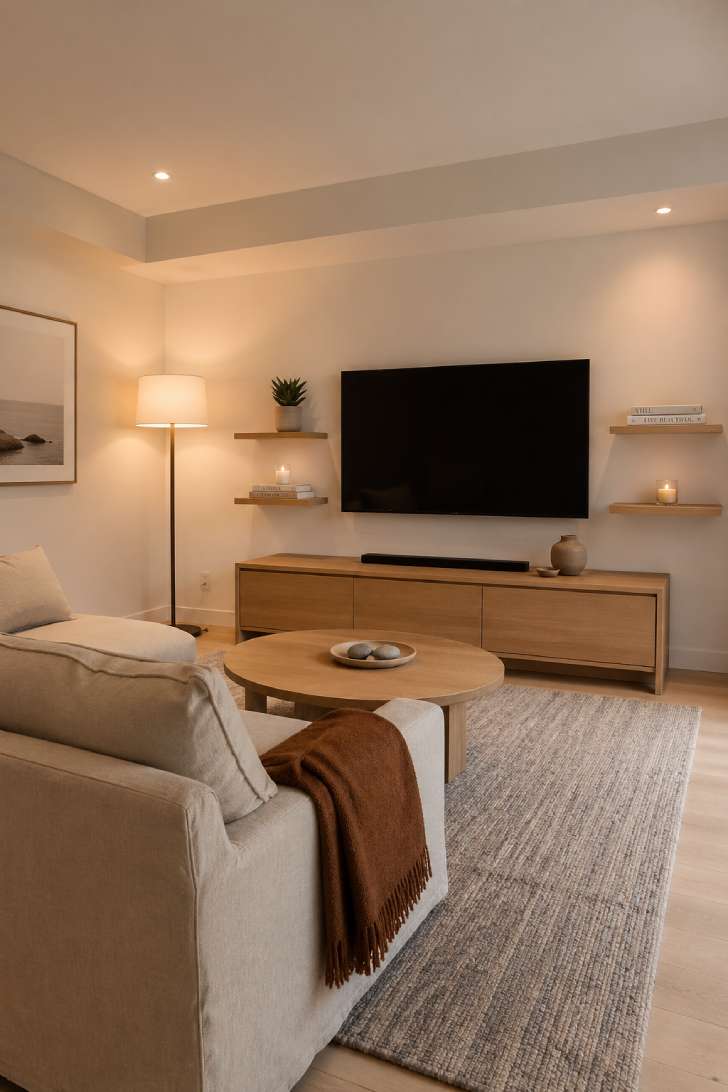
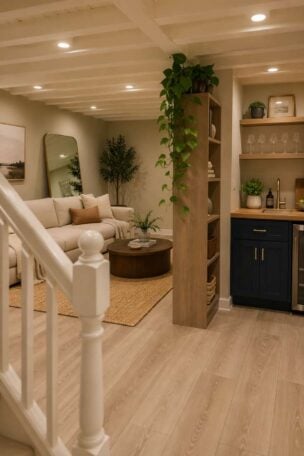
Scandinavian design works in basements for the same reason it was developed in Scandinavia — it extracts maximum warmth and comfort from minimal natural light.
The light blonde wood floors here are doing critical work.
In a room with no windows, pale flooring reflects whatever light exists back into the space, keeping the room from feeling like it’s pulling inward.
Dark floors in a windowless basement create a room that your body registers as underground.
Light floors — especially in a warm blonde tone — create a room your body simply registers as a room.
The loose linen slipcover on the sofa is a detail that captures the hygge principle better than almost anything else you could specify.
It looks lived-in and soft and washable — like the sofa has been in the family for years, and like it doesn’t mind one bit.
Style Blueprint:
- Light blonde or natural ash engineered hardwood flooring
- Slim media console in natural birch or white oak
- Linen sofa in unbleached, natural, or warm ivory tone
- Flat-weave area rug in soft gray and ivory
- Floor lamp with white drum or linen shade
The Multi-Use Game & TV Room
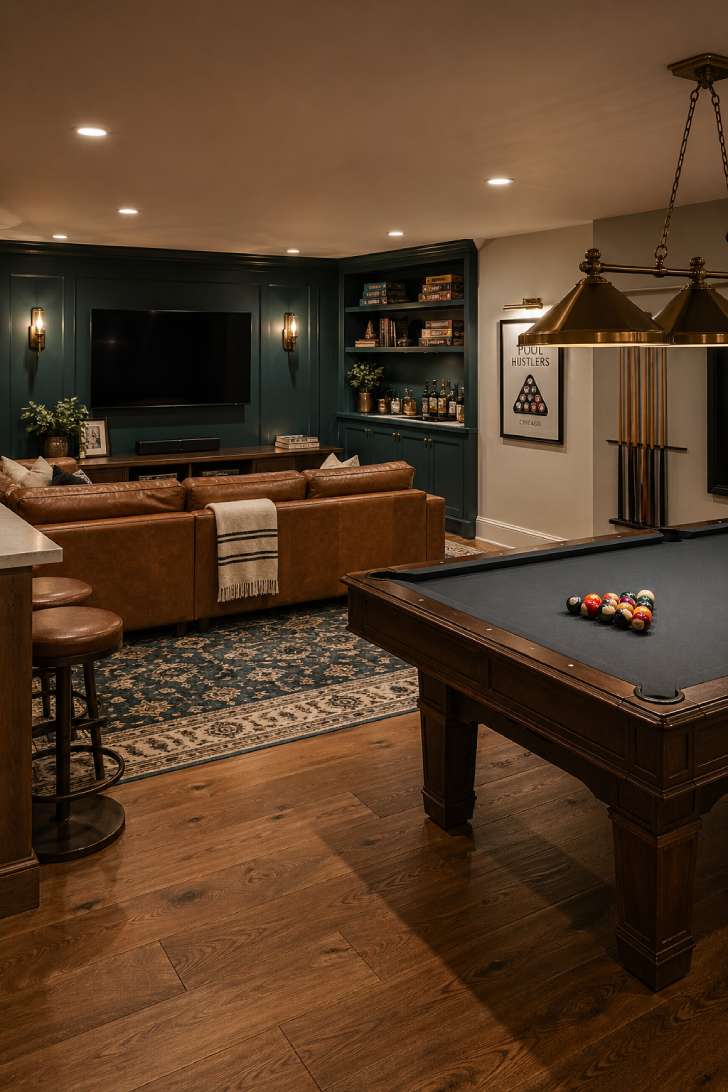
The multi-use basement is the most honest version of what most people actually want.
A TV room is great. A game room is great.
A room that does both without feeling like it’s compromised on either is better than both.
The key to making a dual-zone basement work is defining the areas through furniture and rugs rather than walls.
A wall creates a division that’s permanent and limiting. A rug creates a division that reads clearly in the room but keeps the space unified and easy to reconfigure.
The matched teal between the rug and the TV wall is the detail that makes the whole room feel designed rather than assembled.
It’s a color that appears in the floor covering, repeats on the wall, and gets picked up in small accents around the space — and that repetition is what makes a room feel like one decision was made, not twelve.
Style Blueprint:
- Large, bold-patterned area rug to define TV seating zone
- Pool table, foosball, or ping pong table in coordinating wood tone
- Matching overhead billiard or game table pendant light
- TV wall painted in rug’s dominant accent color
- Narrow built-in storage for games, puzzles, and accessories
Conclusion
Every basement has the same starting point: four walls, a floor, a ceiling, no view.
What separates a forgettable utility room from the most-used space in the house is a single decision — to take the design seriously.
These 11 basement tv rooms are proof that the lower level doesn’t need natural light or high ceilings or architectural drama to become something genuinely worth spending time in.
It needs a clear sense of what it’s for, furniture that commits to that purpose, and enough attention to light and material and texture that the room feels good to be inside.
Whether you’re drawn to the cinematic control of a dark home theater, the casual ease of a family sectional setup, or the personality of a boho comfort zone, the basement rewards that investment more than almost any other room in the house.
Start with the idea you can’t stop thinking about.
Build from there.