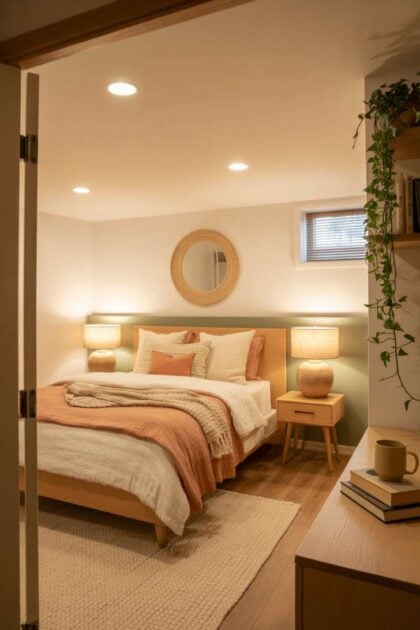
This post may contain affiliate links. If you make a purchase through these links, we may earn a commission at no additional cost to you.
Basement bedrooms have come a long way from the dark, neglected corners they used to be.
With smart lighting choices, the right flooring, and a little creativity with color and texture, a below grade bedroom can become the most comfortable and private room in your entire house.
Every idea in this list pairs a stunning visual with a quick, practical tip you can put to work in your own space — whether you’re building a cozy basement retreat, a guest suite, or a full-on underground bedroom decor overhaul.
Soft Neutrals and Layered Linen
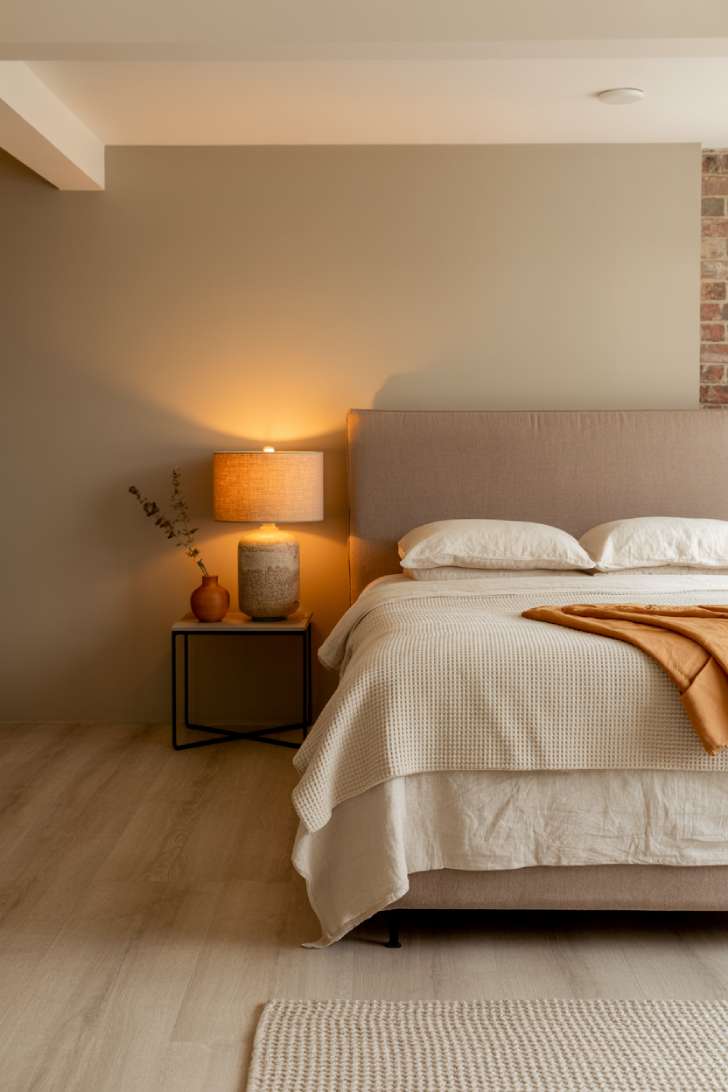
There’s a reason warm neutrals show up in nearly every list of basement bedroom ideas — they do the heavy lifting in a room that doesn’t get much daylight.
Light tones like greige, warm taupe, and creamy ivory bounce artificial light around the space, making the room feel larger than it actually is.
The layered bedding here isn’t just for looks.
Multiple textures — linen, waffle-weave cotton, leather — give your hands and eyes something to register as “comfort” the moment you walk in.
That single cognac throw anchors the whole palette and keeps the room from washing out into a sea of white.
When a room lacks windows, you need that kind of tonal depth to create visual warmth without clutter.
Style Blueprint:
- Linen-upholstered headboard in taupe or warm gray
- White linen sheet set with a waffle-weave blanket
- Cognac or caramel leather throw
- Slim iron or matte black nightstand
- Ceramic table lamp with linen shade
Rich, Dark Walls That Own the Underground Vibe
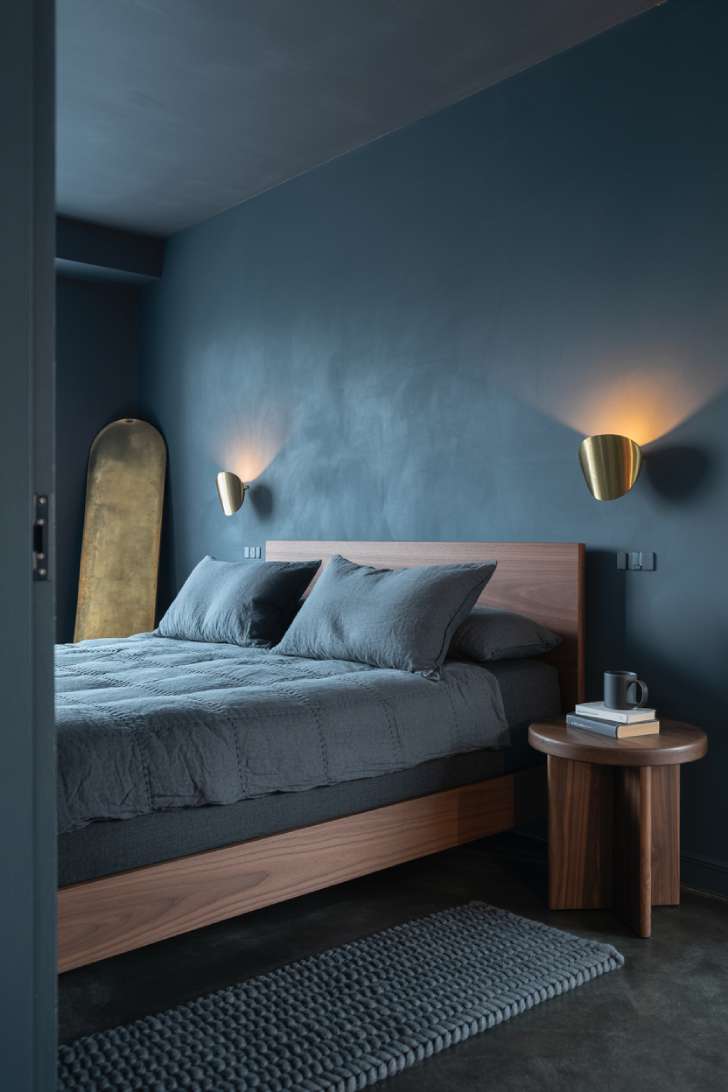
Here’s a counterintuitive move that works beautifully: instead of fighting the darkness of a basement, go all in on it.
A deep charcoal, navy, or forest green on every surface — walls and ceiling — creates a cocoon effect that feels intentional and luxurious.
The trick is contrast.
Brushed brass fixtures throw warm golden light that pops against dark walls, and a single oversized mirror bounces that glow around the room.
This approach plays on a simple psychological truth — dark, enclosed spaces signal rest and safety to our brains.
It’s the same reason people sleep better in pitch-black rooms.
Leaning into that instinct rather than battling it gives a basement bedroom a sense of purpose that light-and-airy rooms sometimes lack.
Style Blueprint:
- Deep matte paint in charcoal, navy, or forest green (walls and ceiling)
- Low-profile walnut or dark wood platform bed
- Pair of brushed brass wall sconces
- Oversized antiqued mirror (leaning or wall-mounted)
- Chunky wool area rug in a tonal dark shade
Vertical Wood Slats That Lift the Eye
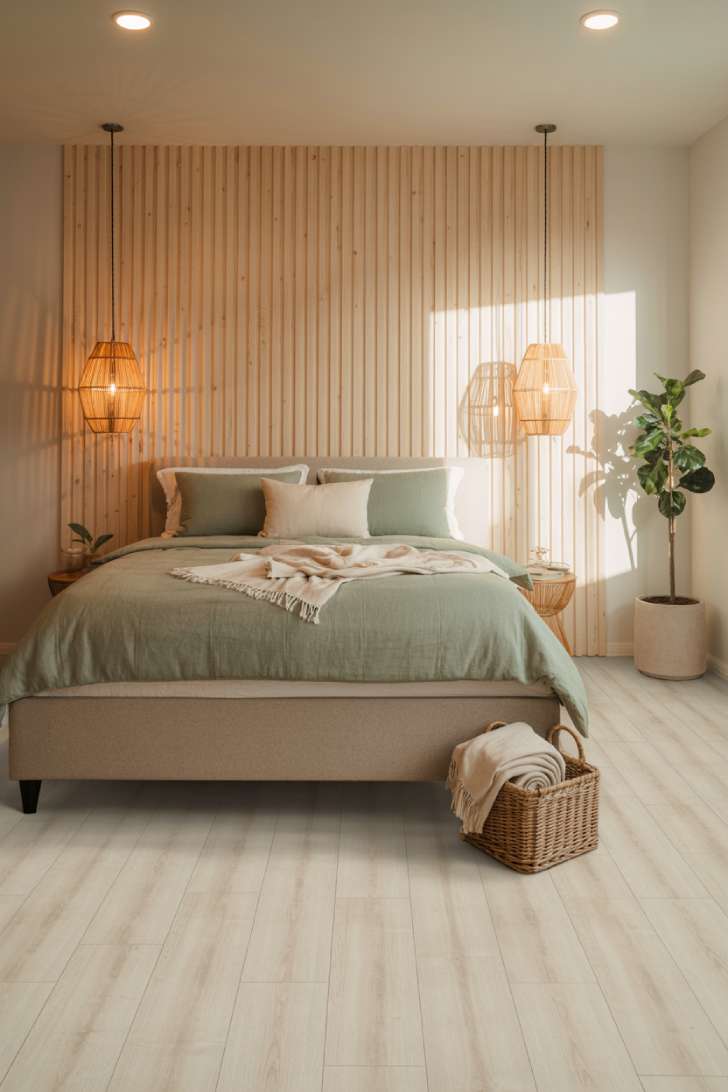
Vertical lines are one of the oldest visual tricks in interior design, and they’re especially useful in basement bedrooms where low ceiling bedroom design is a real concern.
These light ash slats pull your gaze upward automatically, creating the illusion of height even when the ceiling sits at seven feet.
The spacing between the slats adds depth and shadow play that a flat painted wall simply can’t deliver.
Pair this with rattan pendants hung at staggered heights, and the room suddenly feels like it has dimension and movement — two things basements desperately need.
Wood brings organic warmth to a space that’s literally surrounded by concrete and earth, and that natural connection has a calming effect that synthetic materials can’t replicate.
Style Blueprint:
- Light ash or birch vertical wood slats (floor to ceiling)
- Upholstered bed frame in bouclé or textured linen
- Pair of woven rattan pendant lights at staggered heights
- Sage green or soft earth-toned linen duvet
- Large-scale indoor plant in a simple ceramic planter
Bright White Guest Suite With a Statement Headboard
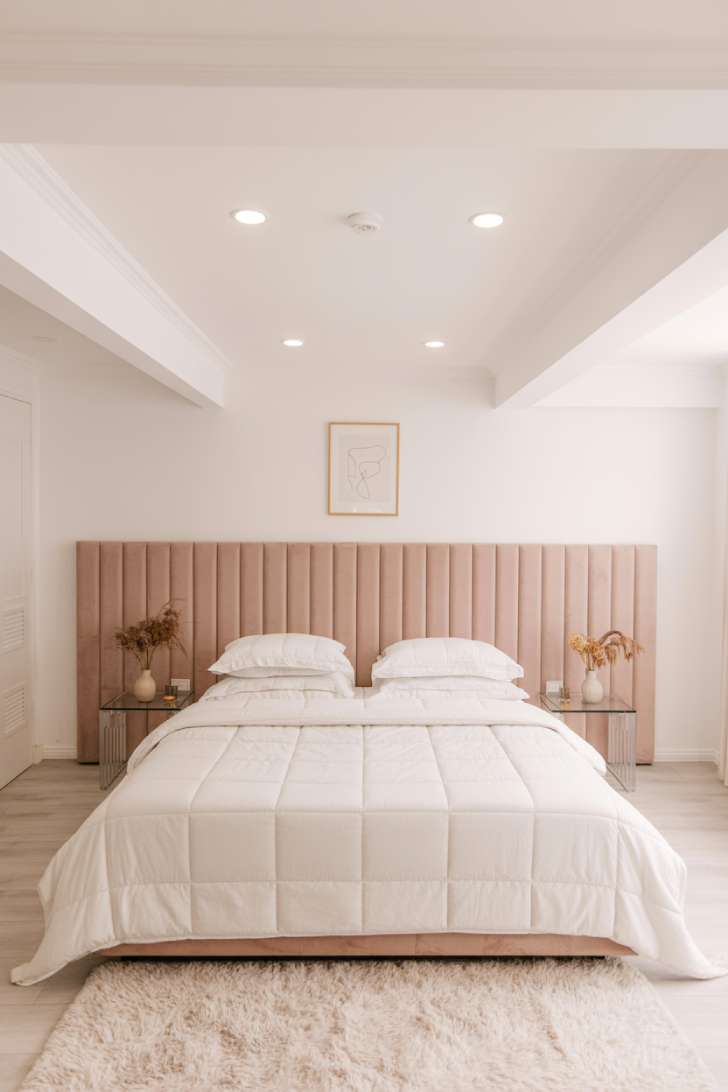
When a basement has no windows or only a tiny one, white walls are your best friend — they reflect every bit of light back into the room and prevent that closed-in feeling.
But a fully white room can read as cold and clinical without a strong anchor.
That’s where the oversized headboard comes in.
A big, channel-tufted piece in dusty blush or soft rose velvet gives the eye somewhere to land and injects personality without overwhelming the space.
The acrylic nightstands are a smart move here — they take up visual zero space and keep the room feeling open.
This is a basement guest room setup that makes visitors feel like they’ve checked into a boutique hotel rather than sleeping in someone’s lower level.
Style Blueprint:
- Warm white paint on all surfaces (walls, ceiling, trim)
- Oversized channel-tufted velvet headboard in blush or rose
- All-white hotel-quality cotton bedding set
- Clear acrylic nightstands
- Minimal line art in a slim gold frame
Design Pro-Tip: In a below grade bedroom with no natural light, swap your standard recessed bulbs for warm-white LEDs in the 2700K range. This color temperature mimics the golden tone of late-afternoon sunlight and tricks your brain into reading the room as naturally lit. Avoid anything above 4000K — it’ll make the space feel like a dentist’s office.
Built-In Bunk Room for Sleepovers and Family
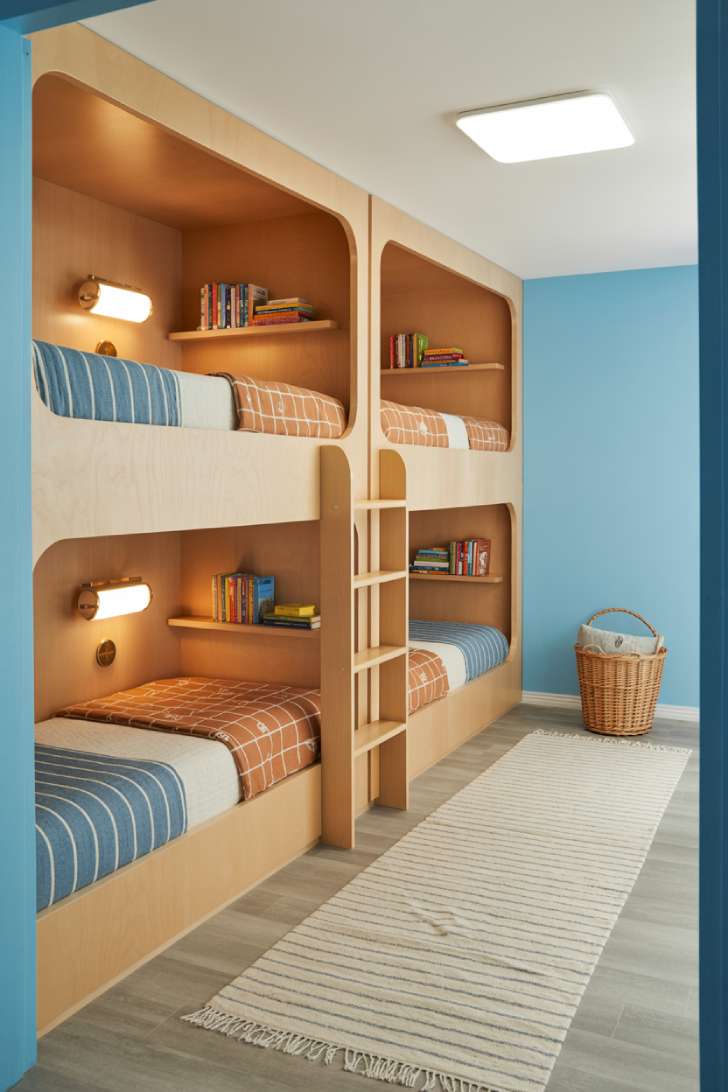
A basement bunk room is one of the smartest uses of an underground space, and kids absolutely love them.
The built-in design here makes all the difference — these aren’t freestanding metal bunks shoved against a wall.
They’re integrated into the architecture of the room, with individual reading lights and personal shelf niches that give each sleeper their own little territory.
That sense of personal space matters, especially for kids sharing a room.
The individual lighting for each bunk isn’t just practical for bedtime reading — it creates a feeling of coziness and privacy within a shared room, which is exactly what makes kids want to sleep down here instead of upstairs.
Coordinated-but-not-matching bedding adds visual interest and lets each child feel like their bunk is their own.
Style Blueprint:
- Custom built-in bunks in light maple or birch plywood
- Individual recessed brass reading lights per bunk
- Coordinated (not matching) cotton bedding in 2-3 colors
- Durable, washable flat-weave area rug
- Sturdy built-in ladder with rounded edges
The Murphy Bed That Disappears by Day
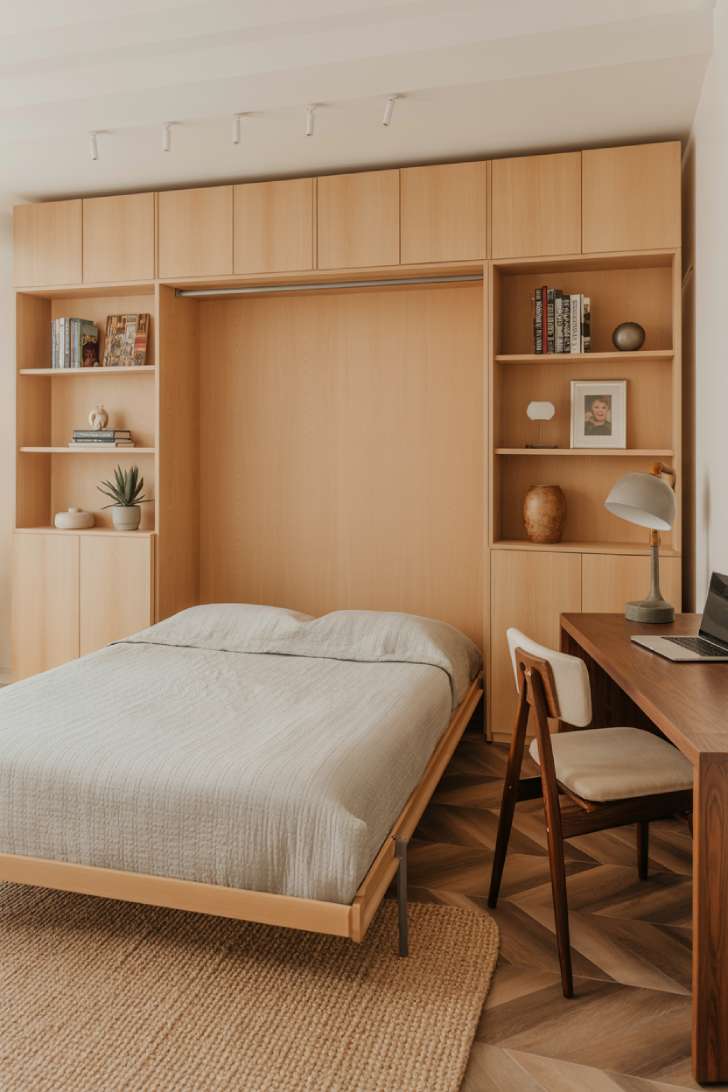
If your basement needs to be a home office by day and a basement guest room by night, a Murphy bed is the answer.
The custom cabinet shown here hides the bed completely when it’s folded up, leaving you with a full room for working, exercising, or lounging.
When guests arrive, you pull it down and the room transforms in seconds.
The integrated shelving on each side of the cabinet prevents the wall from looking like a giant blank panel when the bed is stored — it reads as a bookcase, not a hidden bed.
This dual-use approach is particularly smart for smaller homes where every square foot has to earn its keep.
The psychological benefit is real, too: a room that changes function feels more alive and purposeful than one that sits empty between guest visits.
Style Blueprint:
- Custom Murphy bed in white oak or painted MDF with cabinet surround
- Integrated open shelving on each side of the bed unit
- Herringbone or chevron patterned vinyl plank flooring
- Mid-century writing desk and chair
- Low-profile track lighting aimed at the cabinet wall
Exposed Brick and Industrial Edge
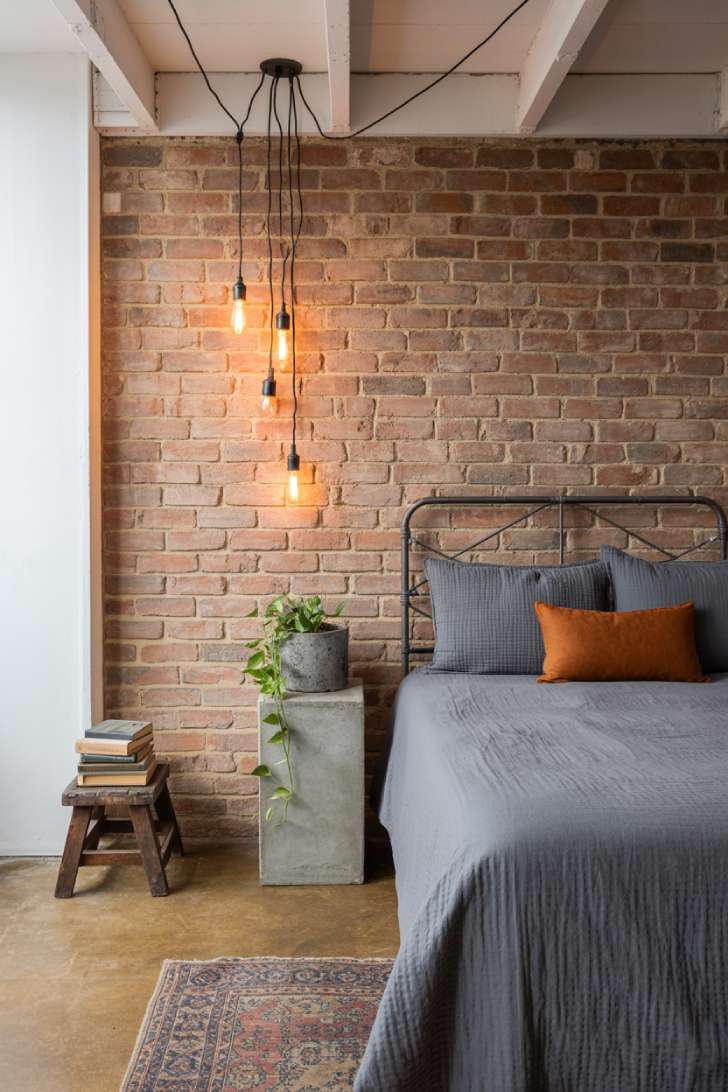
Not every basement needs to be polished and new.
If your home has original masonry walls, leaving the brick exposed can be one of the most striking design decisions you make.
The imperfections — the uneven mortar, the color variation, the slight roughness — give the room a sense of history and character that no paint color can match.
Pair that raw texture with simple industrial elements like a black iron bed frame and steel pipe fixtures, and the room tells a story without a single piece of conventional decor.
The vintage Persian runner is doing something important here: it introduces pattern, color, and softness all at once, breaking up the hard surfaces and making the room feel lived in rather than staged.
That balance between rough and soft is what makes underground bedroom decor like this feel authentic rather than forced.
Style Blueprint:
- Exposed original brick wall (sealed for dust control)
- Matte black iron bed frame with geometric headboard
- Vintage-style Edison bulb pendant lights on fabric cords
- Sealed and stained concrete floor
- Faded vintage Persian runner or kilim rug
The Cabin-Inspired Cozy Hideaway
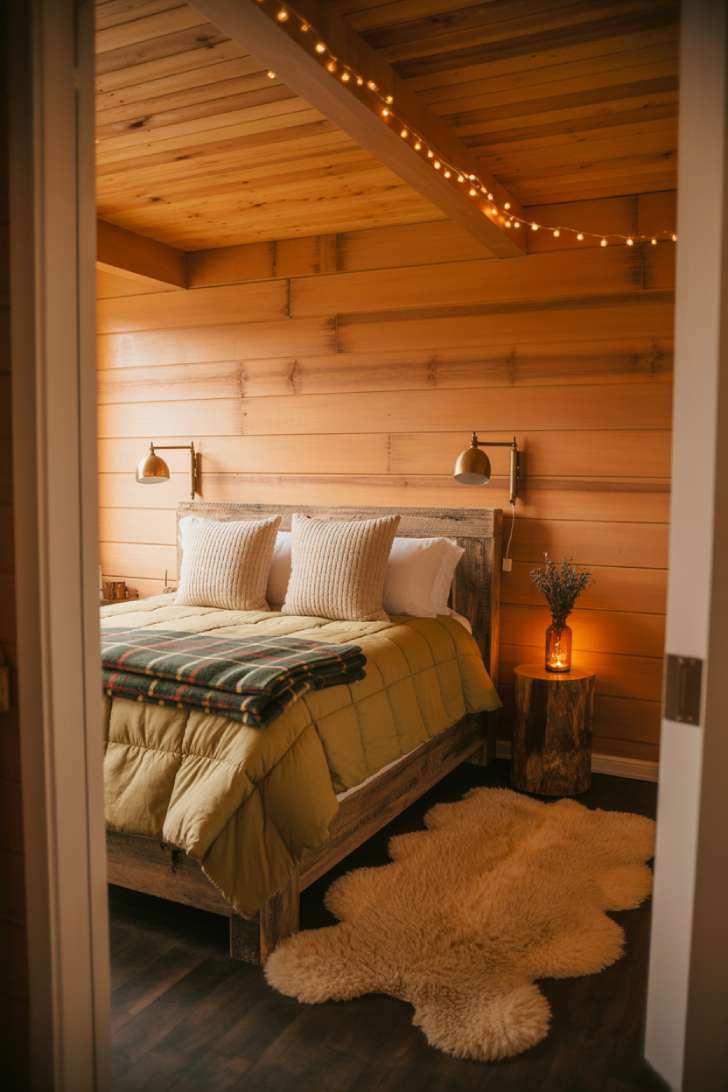
This is the basement bedroom idea for anyone who’s ever wanted to sleep in a cabin but lives in the suburbs.
Cedar or pine tongue-and-groove planking on walls and ceiling completely transforms a concrete box into a warm, wood-scented retreat.
The enclosed, low-ceiling nature of a basement actually works in your favor here — it amplifies that cabin feeling rather than fighting it.
Heavy textiles are the finishing touch that sells the whole concept.
A chunky knit throw, a plaid wool blanket, and a thick sheepskin rug create a sensory experience that signals warmth and rest to your body the moment you walk in.
There’s real science behind this: natural materials like wood and wool regulate moisture and temperature in ways that synthetic alternatives don’t, and our nervous systems respond to those organic textures with measurable relaxation.
Style Blueprint:
- Tongue-and-groove cedar or pine planking (walls and ceiling)
- Chunky reclaimed wood bed frame
- Plaid wool blanket and chunky knit throw pillows
- Large natural sheepskin rug
- Wall-mounted brass swing-arm reading lamp
Design Pro-Tip: Basement moisture control starts before you pick a single piece of furniture. Seal your foundation cracks, install a vapor barrier under the flooring, and run a dehumidifier set to keep humidity between 30 and 50 percent. If you skip this step, that gorgeous cedar wall will start warping within a year.
Low Platform Bed for Low Ceilings
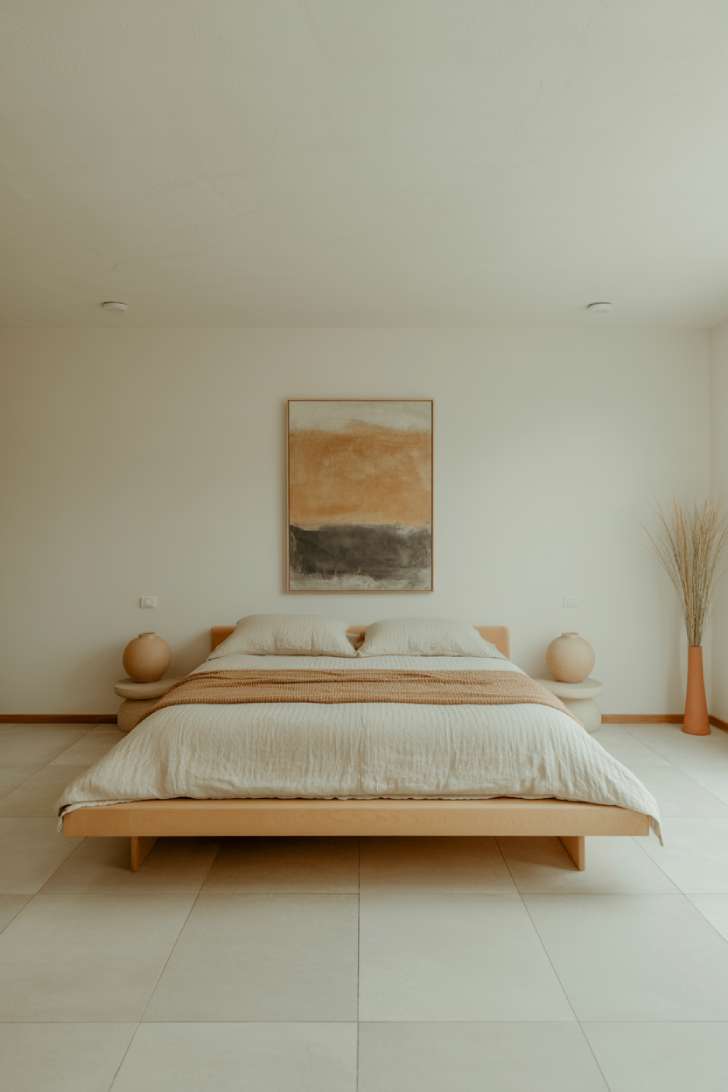
When your basement ceiling sits at seven feet or lower, a standard bed with a tall headboard can make the room feel like a tunnel.
A low platform bed — one that sits just inches off the floor — changes everything.
It creates more visual space between the top of the bed and the ceiling, which makes the room feel proportional rather than cramped.
The absence of nightstands is intentional here.
Placing lamps directly on the floor beside the bed reinforces that ground-level perspective and gives the room a calm, pared-back energy that high-furniture arrangements can’t match.
This kind of small basement bedroom layout works best with minimal decor — one statement art piece, one dried arrangement, nothing else.
Every object in a small room either adds calm or adds clutter. There’s no middle ground.
Style Blueprint:
- Low platform bed (6 inches off the floor) in light maple
- All-white organic cotton bedding with a single linen throw
- Floor-level ceramic table lamps (no nightstands)
- Large-format matte porcelain tile flooring
- One oversized piece of abstract art in muted tones
The Faux Window Illusion
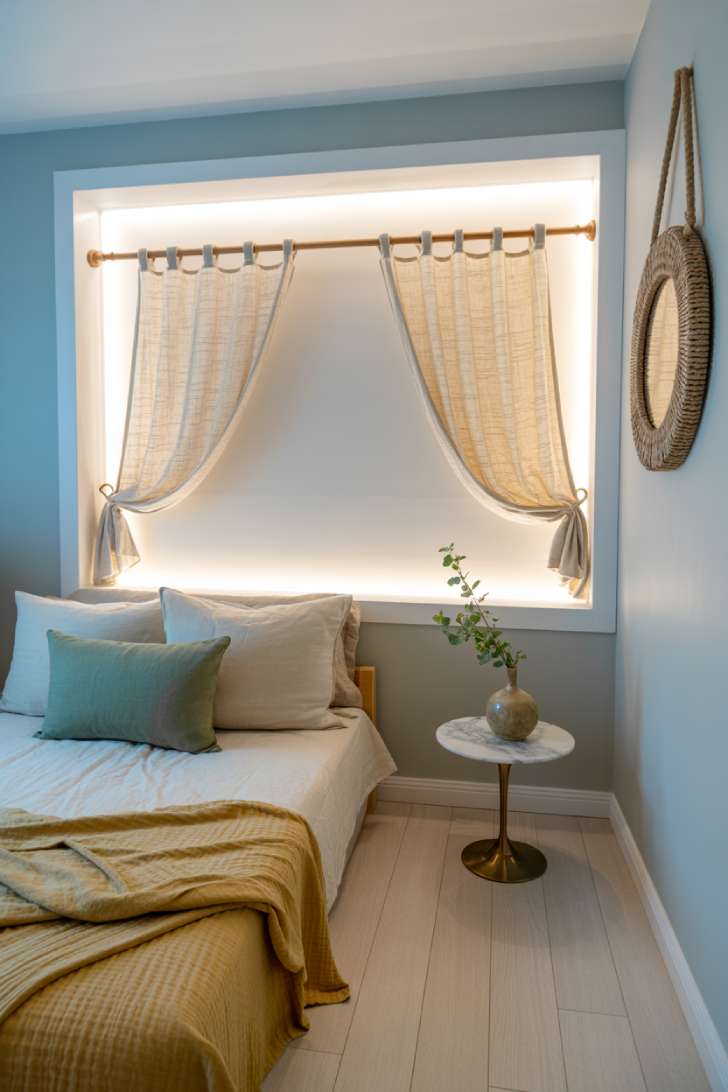
This is one of the most clever basement bedroom ideas for spaces with zero natural light, and the execution makes or breaks it.
A simple LED panel recessed into the wall and framed with real window trim reads as a genuine window — especially when you hang sheer curtains on each side.
Your brain processes the combination of light, frame, and fabric as “window” without questioning it.
The round mirror on the adjacent wall amplifies the effect by bouncing that faux daylight around the room, creating secondary light sources that feel natural.
Choosing a daylight-temperature LED (around 5000K) for the panel and pairing it with warmer lamps elsewhere in the room mimics the way real rooms feel when sunlight mixes with indoor lighting.
It’s a small detail that makes the illusion genuinely convincing.
Style Blueprint:
- Custom LED backlit wall panel (daylight color temperature)
- White painted wood window trim surround
- Sheer white linen curtains on slim brass rod
- Round woven mirror on adjacent wall
- Soft blue-gray wall paint
Bohemian Layers and Mixed Patterns
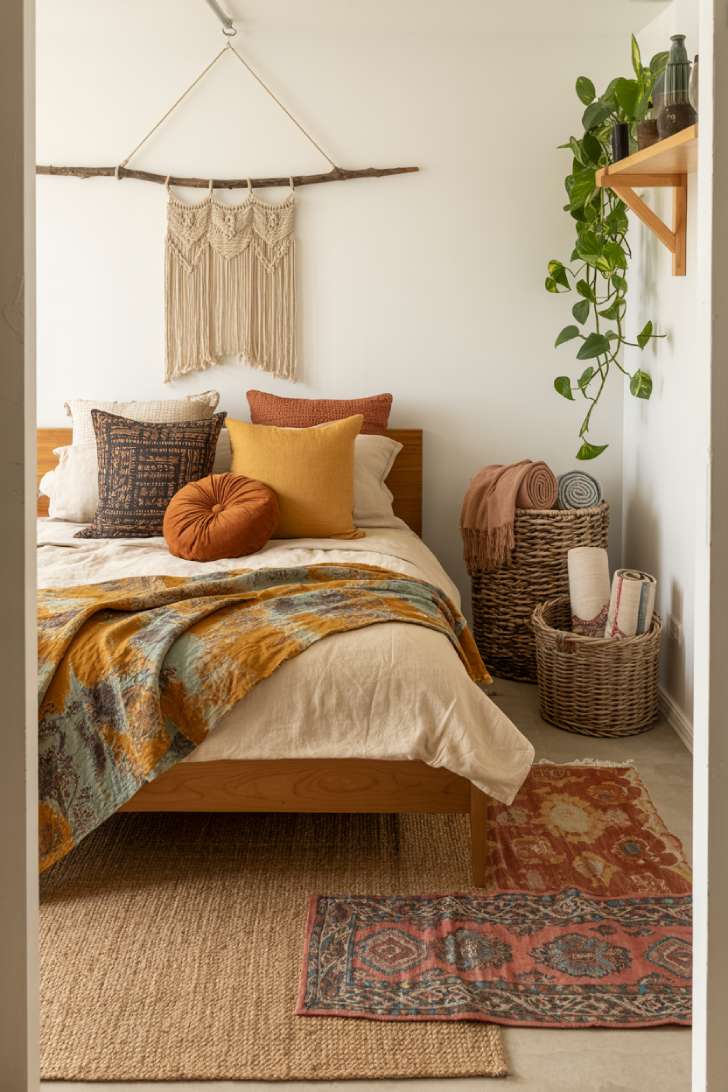
Boho style is practically made for basements.
The whole philosophy centers on layering — rugs on rugs, pattern on pattern, texture on texture — and that abundance of material is exactly what a below-grade room needs to feel warm instead of stark.
The layered rug situation here is doing something specific: the jute rug adds insulation from the cold concrete slab underneath, and the vintage Turkish rug on top adds color and personality.
You’re solving a practical problem and a design problem at the same time.
Macramé, woven baskets, and trailing plants bring organic movement to a room that has no wind, no outside view, and no shifting sunlight.
These elements compensate for the absence of nature by bringing its textures indoors.
The result is a room that feels collected and personal rather than decorated all at once from a single catalog.
Style Blueprint:
- Low walnut bed frame
- Layered rugs (jute base with vintage Turkish or kilim on top)
- Large macramé wall hanging on driftwood
- Mixed block-print and velvet throw pillows (3+ patterns)
- Trailing pothos or similar vine plant on a high shelf
The Teen Retreat With Personality
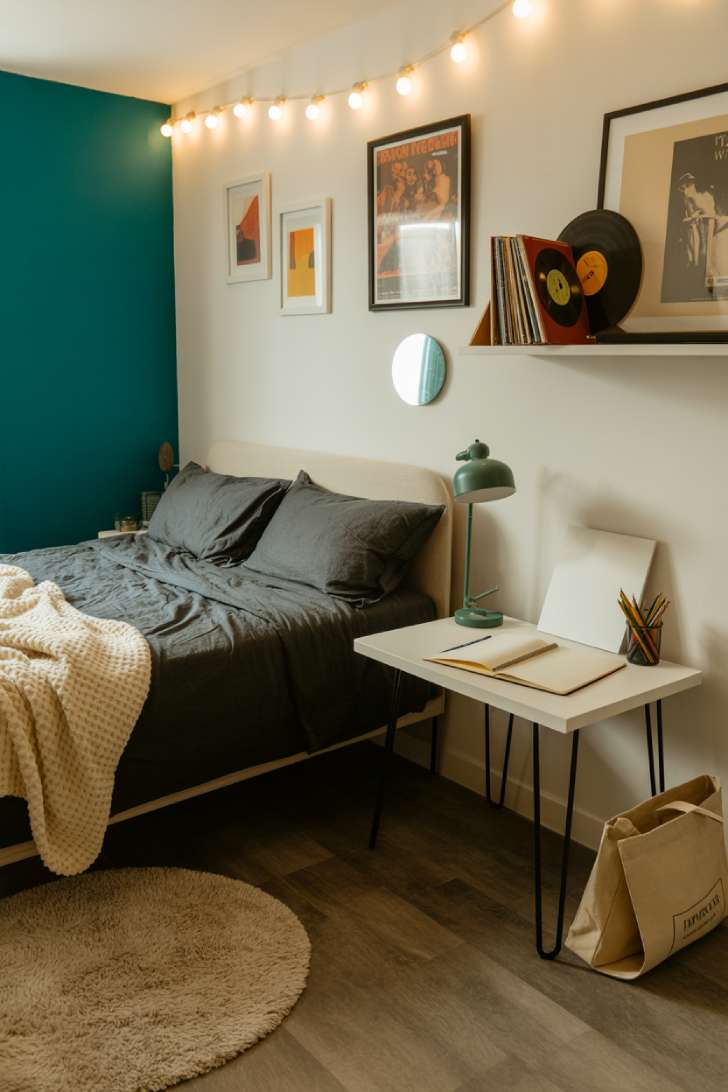
A basement bedroom is the perfect setup for a teenager who craves independence and privacy.
The physical separation from the main living area gives them a sense of autonomy, and the design possibilities down here are wide open for self-expression.
That bold teal accent wall sets the tone immediately — it’s a strong color choice that feels grown-up without being too serious.
The gallery wall is doing the real work, though.
A mix of art, personal items, and a small mirror creates a visual that feels authentic rather than Pinterest-perfect, which is exactly what a teen’s space should be.
The desk corner is small but intentional — a place to create, study, or just sit with headphones on.
Globe string lights add warmth without the overhead harshness that makes a room feel like a classroom.
Style Blueprint:
- Bold accent wall paint in teal, deep green, or navy
- Black metal bed frame with washed cotton bedding
- Curated gallery wall (mix of art prints, personal items, mirror)
- Compact desk with hairpin legs and a desk lamp
- Warm globe string lights along the ceiling edge
Design Pro-Tip: Every basement bedroom needs an egress window by building code — the opening must be at least 5.7 square feet with a sill no higher than 44 inches from the floor. Don’t skip this. It’s a safety requirement, and non-compliant rooms can cause serious problems if you ever sell your home.
Scandi-Inspired Clean Lines and Calm
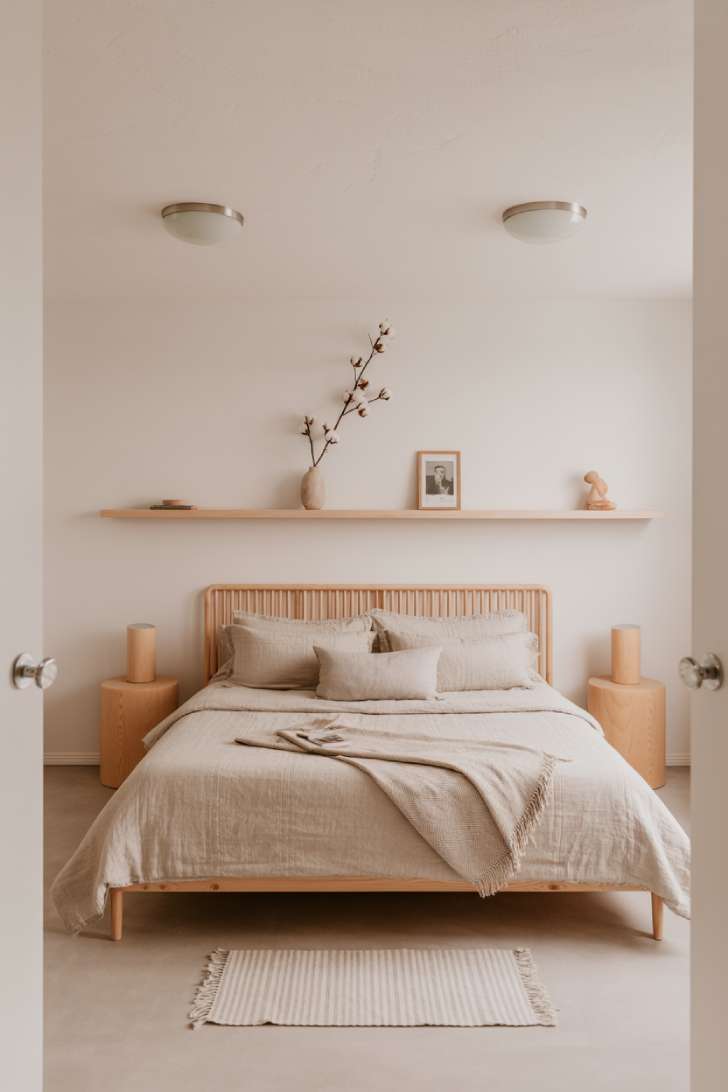
Scandinavian design was practically invented for small, light-challenged spaces — think Nordic winters with minimal daylight — so it translates perfectly to a basement bedroom.
The entire philosophy is about working with light and space rather than against them.
Every surface here is pale and reflective, but the room avoids feeling sterile through the subtle use of natural materials — birch plywood, cotton, wool, and ceramic.
These textures register as warm to your brain even when the color palette is cool.
The floating shelves above the bed serve a dual purpose: they replace bulky wall art and give you display space without adding visual weight to the room.
Notice how little is on them — that restraint is the whole point.
In a small basement bedroom layout, every empty surface creates breathing room.
Style Blueprint:
- Birch plywood bed frame with slatted headboard
- Stonewashed white linen bedding
- Slim birch floating shelves (2) with curated minimal objects
- Pale matte porcelain tile or light vinyl plank flooring
- Frosted glass cylindrical lamps (flush-mount and table)
Basement Suite With Private Bathroom
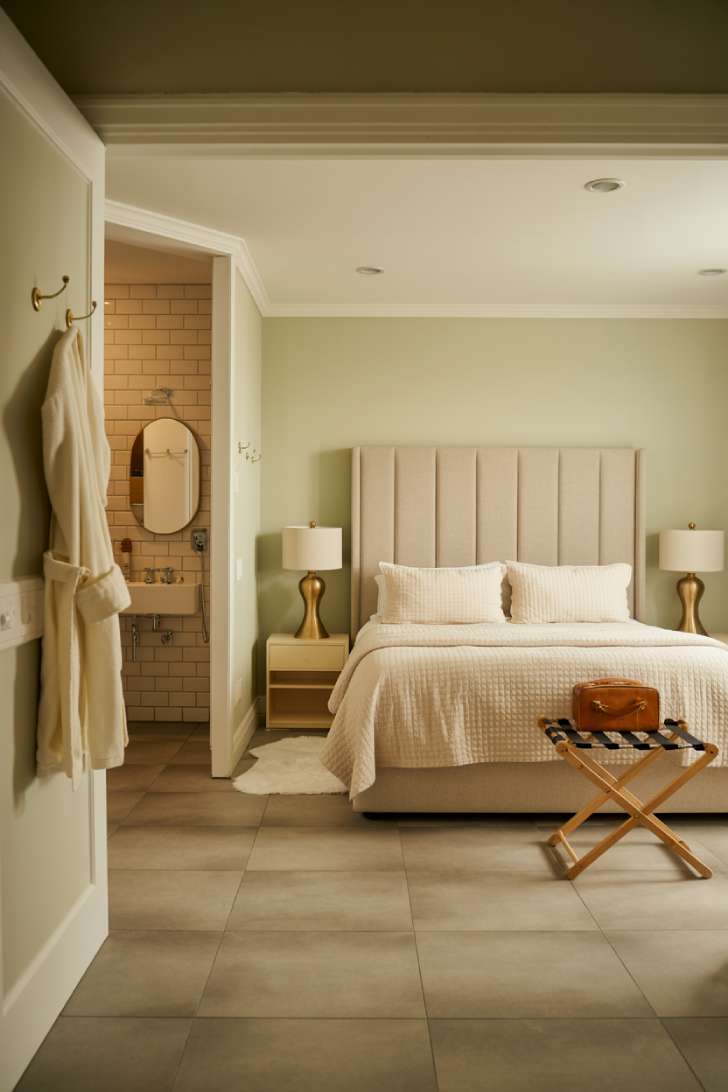
A basement guest room with its own bathroom is the kind of setup that turns occasional visitors into regular ones.
The privacy is the real draw here — guests have their own self-contained space, separate from the household’s daily rhythm.
The sage green on the walls hits a sweet spot: it’s warm enough to feel inviting but cool enough to feel fresh, and it pairs beautifully with brass fixtures and warm wood.
That folding luggage rack in the corner might seem like a small detail, but it signals something to guests — “We expected you. This room is ready.”
Hotel designers call these “anticipatory details,” and they’re what separate a spare room from a real guest suite.
The visible robe and the en-suite bathroom reinforce that message.
Basement soundproofing between this suite and the main floor overhead is worth every penny — your guests will sleep deeply and so will you.
Style Blueprint:
- Tall padded linen headboard in oatmeal or natural
- Sage green wall paint
- All-white matelassé coverlet and euro shams
- Folding brass luggage rack
- En-suite bathroom with subway tile and frameless glass shower
A Reading Nook That Makes the Room Multi-Purpose
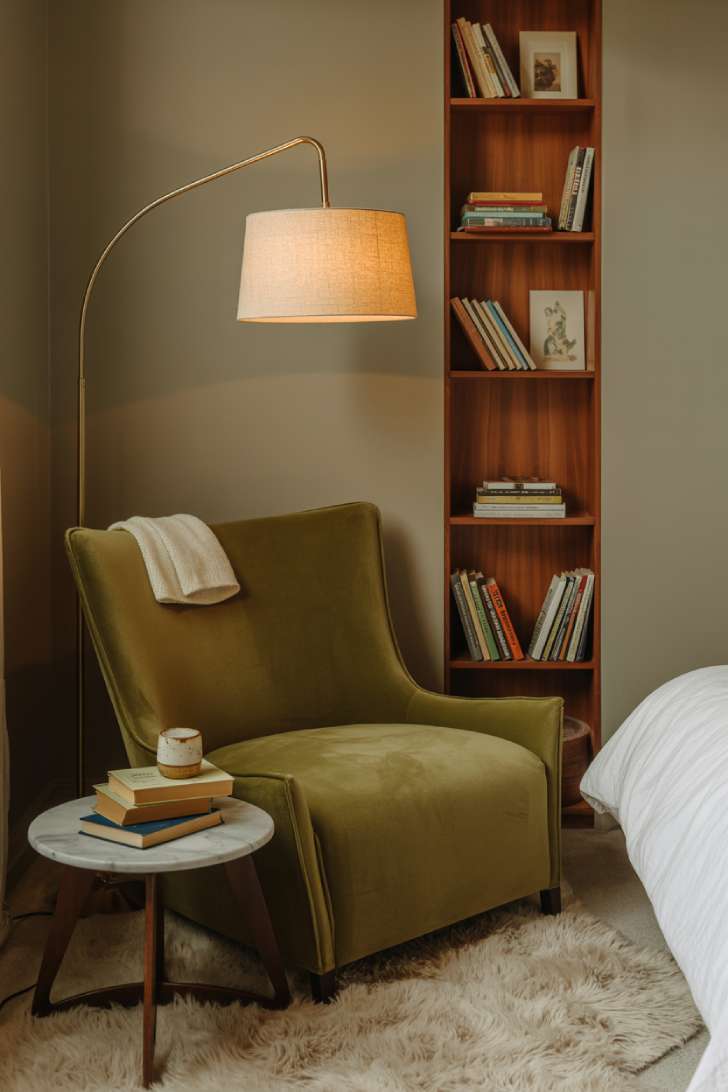
A reading nook turns a one-note bedroom into a room with two distinct zones — one for sleeping and one for waking life.
That distinction matters more in a basement than anywhere else, where the absence of windows can make a bedroom feel like it exists only for sleeping.
The deep velvet armchair, the directional reading lamp, and the nearby bookshelf create a pocket of activity within a restful room.
The arc of the floor lamp is doing something specific: it creates an overhead pool of light that defines the nook’s boundaries without any physical partition.
Your brain reads that lit circle as a separate “room within a room.”
The warm mushroom gray wall behind the chair is slightly darker than the rest of the bedroom walls, which reinforces the idea that this corner has its own identity.
Style Blueprint:
- Deep, wide armchair in velvet (olive, navy, or rust)
- Slim brass arc floor lamp with linen shade
- Small round marble side table
- Wall-mounted narrow bookshelf in walnut
- Plush high-pile wool rug beneath the chair
Recessed Lights and the Art of Layered Glow
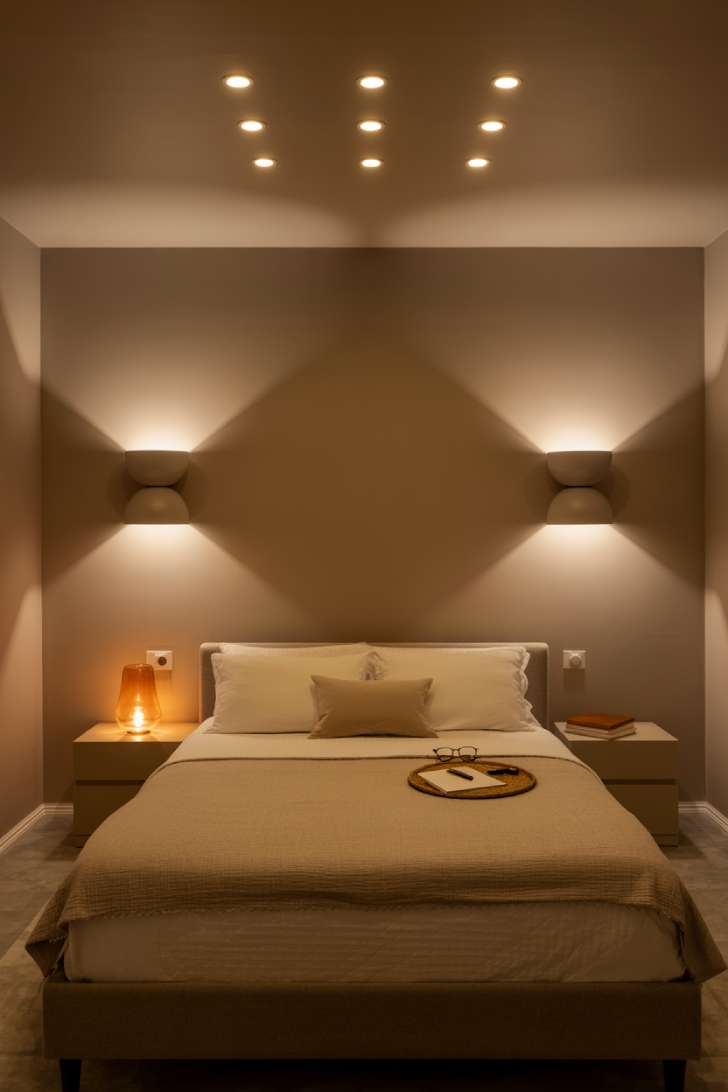
Below grade bedroom lighting is the single most important design decision in a basement bedroom, and the mistake most people make is relying on one source.
A single overhead fixture creates harsh shadows and flat, unflattering light.
Layering three types — ambient (recessed ceiling LEDs), accent (wall sconces), and task (table lamp) — gives you control over the room’s mood at any hour.
The recessed lights here are deliberately set to 2700K, which produces a warm golden tone that mimics late-afternoon sunlight.
Wall sconces that cast light up and down create vertical interest and prevent the ceiling from feeling like it’s pressing down on you.
The amber glass table lamp adds a fourth color of light — slightly warmer, slightly more golden — and that variation is what makes the room feel alive rather than fluorescent-lit.
Good basement flooring for bedrooms catches and reflects this layered light, so choose finishes with a slight warmth rather than cool gray tones.
Style Blueprint:
- Recessed LED ceiling lights (2700K warm white)
- Pair of matte ceramic wall sconces
- Handblown amber glass table lamp
- Warm greige wall paint
- Medium-toned vinyl plank flooring with warm undertones
Design Pro-Tip: Run your dehumidifier year-round in a finished basement, not just in summer. Winter condensation from temperature differences between the cold ground and your heated room creates moisture you can’t see — and that hidden dampness is what causes musty smells and mold behind your walls.
Egress Window Styled as a Design Feature
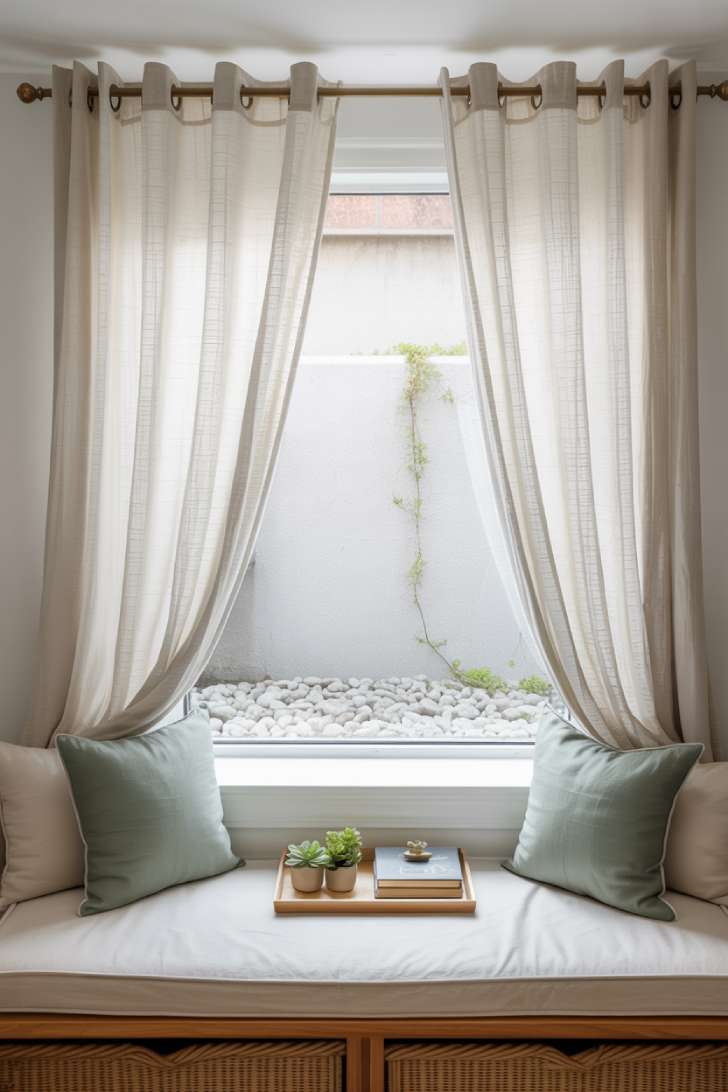
The egress window is the one thing every basement bedroom must have by code — and most people treat it like an eyesore to hide.
That’s a missed opportunity.
Hanging floor-length curtains from a ceiling-mounted rod that extends well beyond the window’s edges is the oldest trick in the book for making a small window look enormous.
When the curtains puddle slightly at the floor, the eye reads “tall window” rather than “small egress cutout.”
The built-in window seat beneath it turns dead space into functional seating and storage, and the cushion makes it feel like an intentional design feature rather than a safety requirement.
Cleaning up the window well outside with river stones and a trailing plant means even the exterior view becomes part of the room’s design story.
This approach turns the least attractive architectural requirement in an egress window bedroom into a genuine focal point.
Style Blueprint:
- Ceiling-mounted brass curtain rod extending 2 feet beyond window on each side
- Floor-length white linen curtains with slight puddle
- Built-in window seat with storage and linen cushion
- White river stones in the exterior window well
- Small potted succulents or trailing plants on the sill
Jewel Tones for Drama and Depth
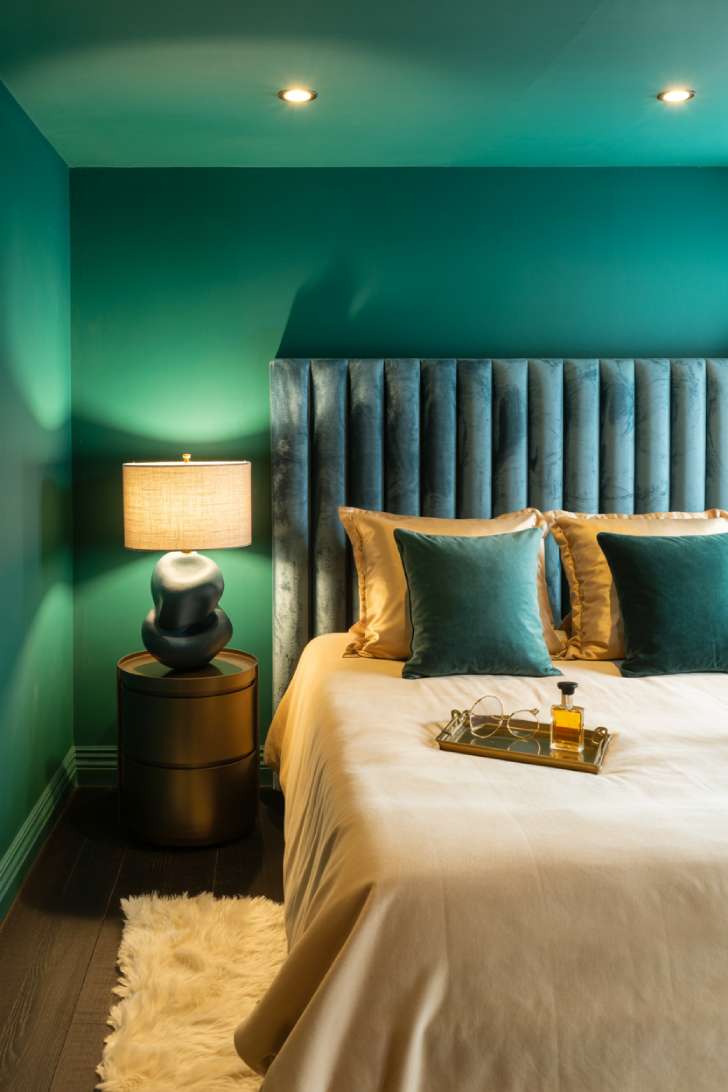
Jewel tones and basements are a natural match, even if it sounds counterintuitive.
These rich, saturated colors — emerald, sapphire, amethyst, ruby — actually look their best in rooms without direct sunlight.
Natural light can wash them out, but the controlled artificial light of a basement lets you see these colors at their fullest intensity.
The color-on-color pairing here — emerald walls with a sapphire headboard — creates depth that monochromatic schemes can’t achieve.
Your eye moves between the two hues, registering dimension rather than flatness.
Gold and brass accents warm the palette and add points of reflective light throughout the room, preventing the saturated colors from feeling heavy.
Painting the ceiling the same emerald as the walls wraps the room in color and creates that enveloping, “cocooned” sensation that makes people sleep soundly.
Style Blueprint:
- Saturated matte paint in emerald, sapphire, or amethyst (walls and ceiling)
- Deeply tufted velvet headboard in a contrasting jewel tone
- Cream silk or sateen duvet with jewel-toned accent pillows
- Dark bronze or brass nightstands and lamp bases
- Gold-toned geometric area rug
The Before-and-After That Changes Everything
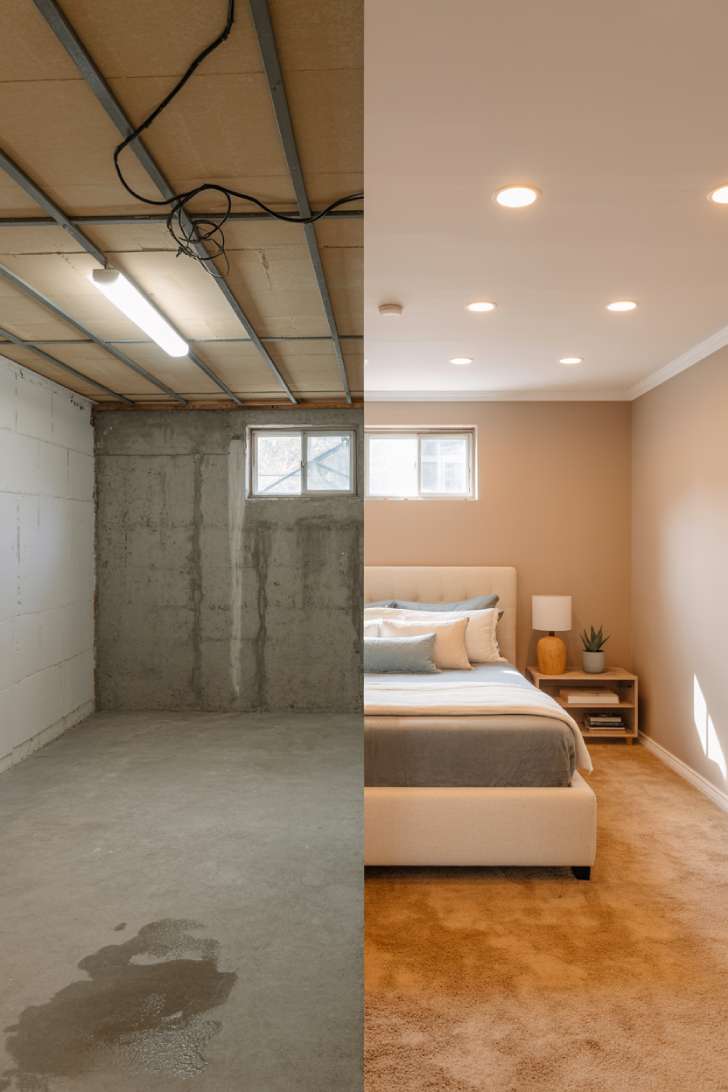
Nothing sells the potential of a basement bedroom like a side-by-side comparison.
And let’s be honest — most of us are staring at an unfinished space right now, wondering if it can really become something worth sleeping in.
It can.
The “before” here is about as rough as it gets: concrete block, fluorescent lights, stained floors, tangled wiring.
The “after” is a fully finished, properly lit, code-compliant bedroom that you’d never guess was underground.
The steps between those two states aren’t mysterious — they’re waterproofing, vapor barriers, insulation, drywall, flooring, an egress window upgrade, recessed lighting, and paint.
It’s work, and it’s an investment.
But the return is a whole new room in your house, and a finished basement consistently ranks as one of the highest-value home improvements you can make.
This before-and-after format is where people spend the most time looking, because it turns abstract ideas into tangible proof.
Style Blueprint:
- Moisture barrier and rigid foam insulation behind drywall
- Warm-toned luxury vinyl plank flooring over subfloor system
- Recessed LED lighting (warm white, evenly spaced)
- Code-compliant egress window with proper well and trim
- Warm putty or greige wall paint with white trim
Design Pro-Tip: Before you pick paint, flooring, or furniture, test your basement for moisture. Tape a square foot of plastic sheeting to the concrete floor and leave it for 48 hours. If condensation forms underneath, you’ve got moisture coming through the slab — and you’ll need to address that with waterproofing before installing any finished flooring.
Ready to Create Your Own Cozy Basement Retreat?
A basement bedroom doesn’t have to be dark, cold, or an afterthought.
With the right attention to lighting, moisture control, flooring, and a design direction that fits your taste, the lowest level of your home can become its most inviting room.
Pin your favorites from this list, start with the practical stuff — egress, moisture, insulation — and then have fun making it beautiful.