This post may contain affiliate links. If you make a purchase through these links, we may earn a commission at no additional cost to you.
Your basement is the quietest room in your house.
That’s not nothing.
Most people walk past the door, think “storage” or “laundry,” and move on. But once you start seeing it as a workspace, everything shifts.
The enclosed walls, the low ceilings, the distance from the main floor — those aren’t flaws.
They’re the raw material of the most focused, private work environment you’ll ever have at home.
These 13 basement home office design ideas are for anyone ready to take that space seriously.
The Dark and Moody Study
There’s a reason dark rooms appear in every film about writers, thinkers, and people doing their best work.
They pull focus.
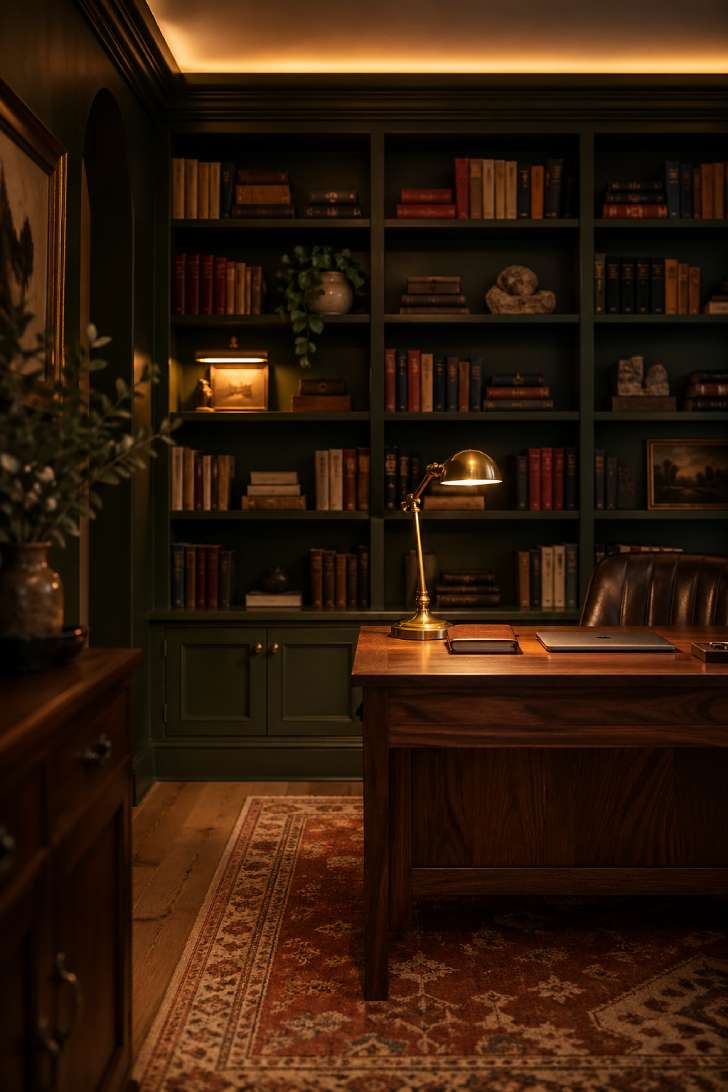
Deep navy or forest green walls absorb distraction.
A brass desk lamp throws a warm pool of light onto your work and nowhere else. The room contracts around you in the best possible way.
This basement home office design leans fully into that.
Tall built-in bookshelves line two walls, painted the same deep tone as the drywall so the books and objects on them become the color story.
A leather desk chair sits at the center. There’s nothing extraneous.
When every surface shares the same dark tone, the brain stops registering the walls as boundaries.
The room stops feeling small and starts feeling immersive.
That shift — from constricted to contained — is what makes below-grade workspaces so good for long stretches of focused work.
The ceiling isn’t closing in. It’s holding you in.
Style Blueprint:
- Deep green or navy wall + built-in paint in the same tone
- Warm brass desk lamp (single, directional beam)
- Walnut or dark oak desk
- Hand-knotted wool rug in warm, muted tones
- Leather task chair in cognac or black
The Scandinavian Basement Reset
This one is the counterargument to everything above.
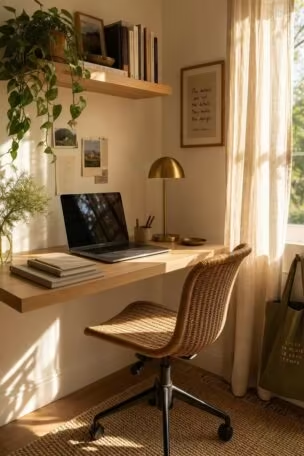
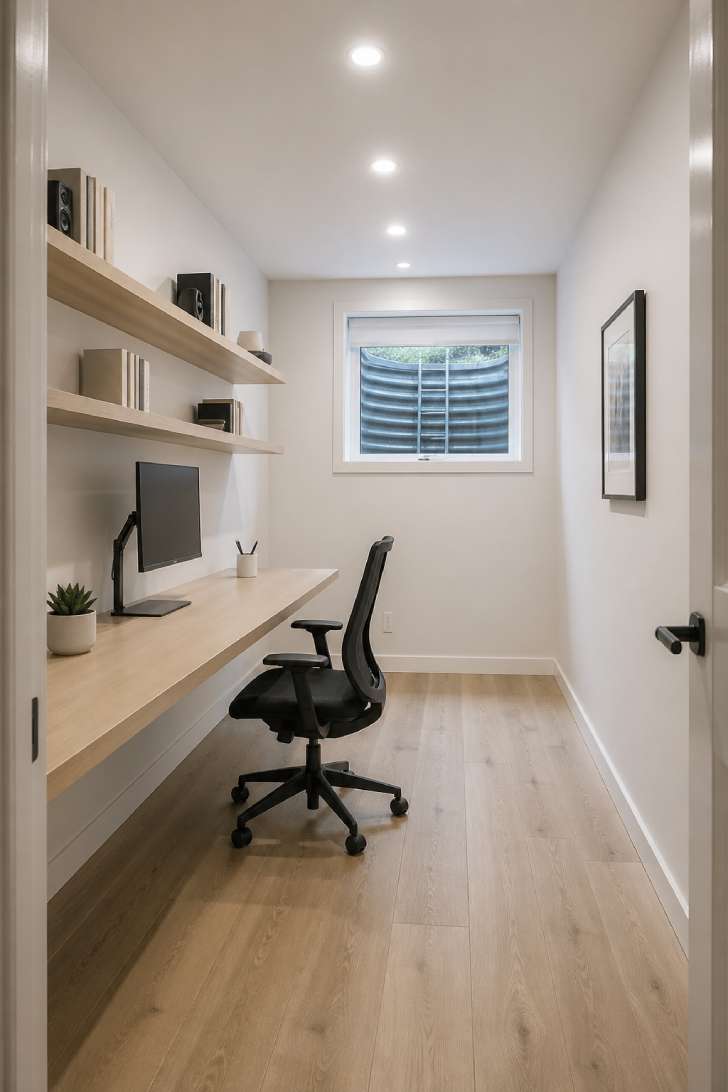
White walls. Light wood. A clean desk with nothing on it but a monitor, a plant, and a coffee cup that’s probably still warm.
A Scandinavian basement office works by making the room feel as visually open and bright as possible.
Cool white lighting around 5000K reinforces that effect, especially in a windowless space.
Against white walls and pale wood, the cooler light keeps surfaces looking crisp and reduces the heavy, enclosed feeling that darker basement finishes can create.
The lack of amber lighting also keeps the palette clean and consistent, which suits the restrained look of a small Scandinavian home office.
Style Blueprint:
- White or off-white paint on all walls and ceiling
- Wall-mounted floating desk in pale ash or birch
- Full-spectrum LED recessed lights (5000K)
- Light LVP flooring in natural wood tone
- Minimal open shelving, nothing decorative without function
The Industrial Studio
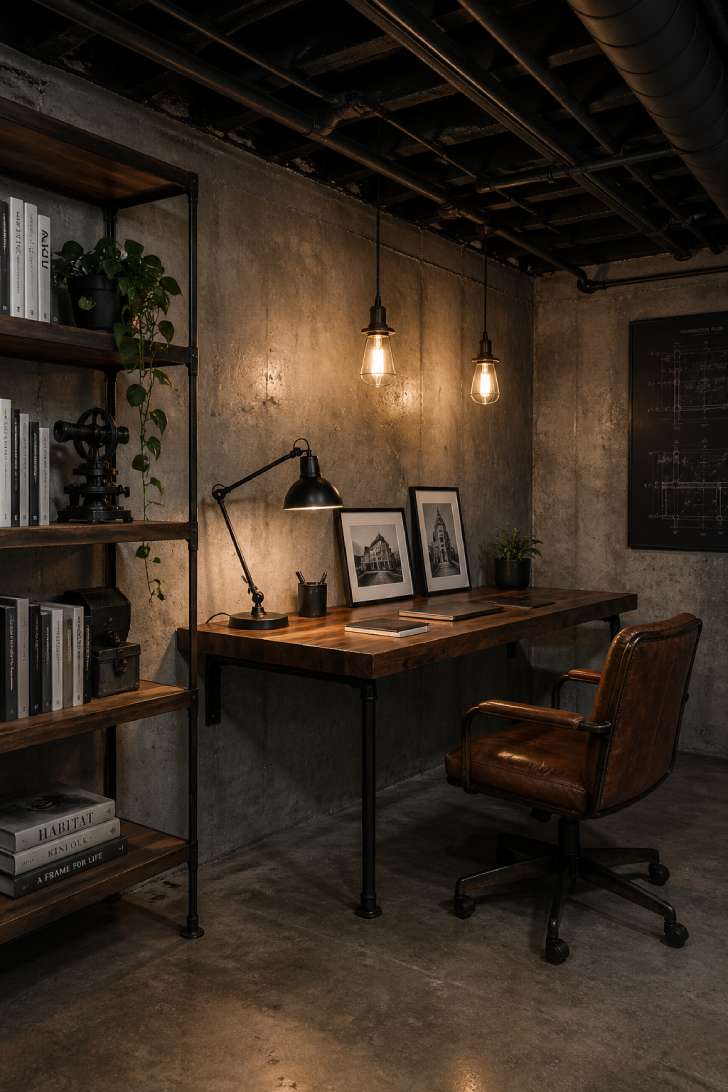
Exposed ductwork runs overhead. The walls are painted concrete. A black metal shelf holds a row of books, a plant, and a hard drive. This is not a problem to solve. It’s a look.
Painting every exposed element — pipes, joists, ducts — in the same flat black creates cohesion out of what might otherwise read as incomplete.
The eye scans the ceiling, registers “intentional,” and moves on.
Dark ceilings also absorb the Edison glow rather than bouncing it, which gives the room a warm, even ambient feel without a single overhead fixture doing traditional work.
This is a particularly useful trick for below-grade workspace renovation ideas where the mechanical systems are part of the architecture.
Style Blueprint:
- Flat black paint on all exposed ceiling elements
- Concrete walls sealed with semi-gloss clear sealer
- Black steel open shelving with reclaimed wood shelves
- Butcher block or thick-edge wood desk on pipe legs
- Edison-style pendant lights hung from exposed joists
The Full-Wall Built-In
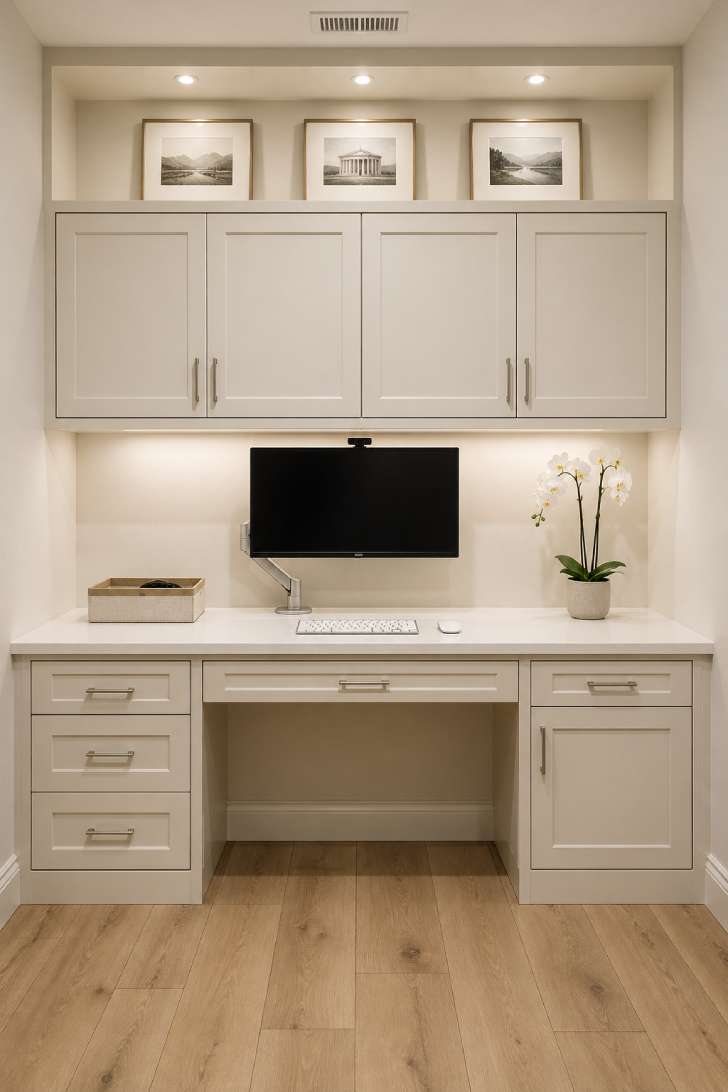
Built-ins change the way a room reads. A basement with a full-wall desk-and-cabinet system stops reading as a basement and starts reading as a room that was planned.
The continuous desk surface — running wall to wall without a gap — is what turns a work zone into a work environment.
There’s nowhere for clutter to accumulate off to the side. Every object has to earn its place on that surface.
The upper cabinetry closes behind doors, hiding everything from reference files to backup drives, which means the visual field during a work session is clean.
The built-in also solves the home office storage solutions challenge most basements face: there’s simply no good place to put things. The cabinetry makes “a place for things” into the baseline.
Style Blueprint:
- Floor-to-ceiling built-in in painted MDF or wood in warm white
- Quartz or thick wood slab desk surface running full width
- Inset cabinet doors with simple hardware
- Recessed LED strip above upper cabinets
- Wire management integrated behind lower cabinet panels
Design Pro-Tip: To visually raise a low basement ceiling, paint it 2–3 values lighter than the walls — not necessarily white. In a room with warm gray walls, a pale blush or barely-there cream ceiling will read as “higher” than a stark white. The contrast between wall and ceiling creates the optical lift. Combine this with wall-height built-ins or tall narrow mirrors to pull the eye upward before it reaches the ceiling line.
The Dual Workspace
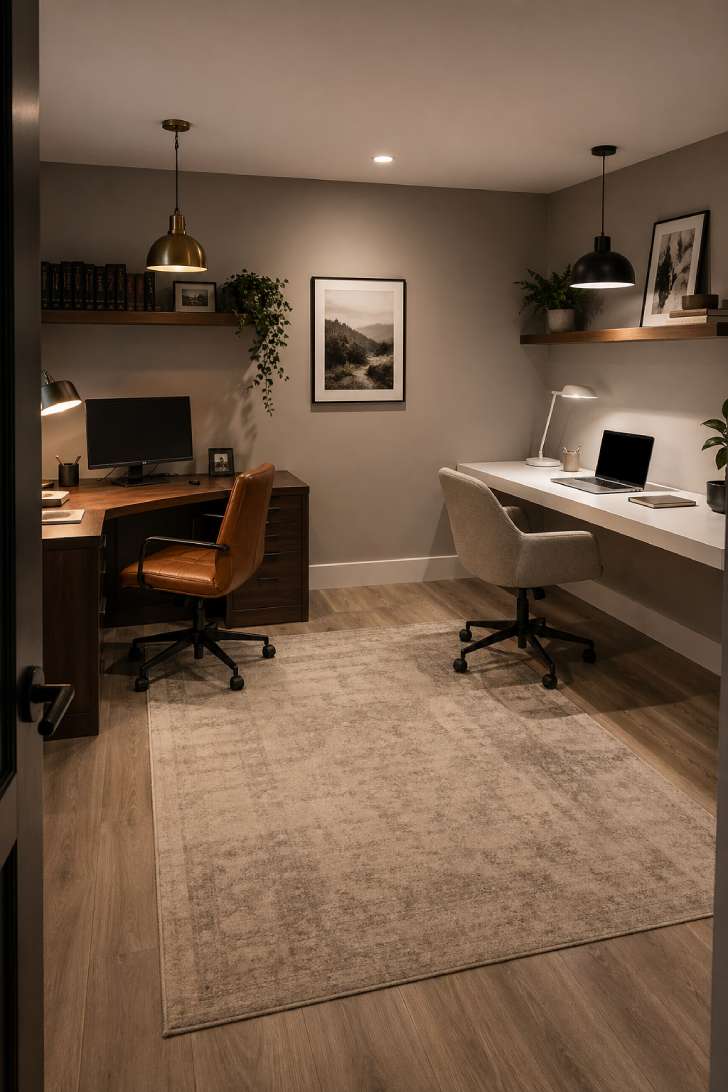
Two people. One basement. Neither compromising on their own setup.
What makes a shared basement workspace succeed is zone definition. Not physical walls, necessarily — but visual ones.
Two different pendant light fixtures, one per desk, is the simplest signal that each person has their own territory.
The rug anchors the shared circulation space. Each station’s objects, lamp, and chair express the person working there.
That subtle personalization matters more than it sounds.
The brain registers “my desk” before conscious thought does, and that sense of ownership makes focus easier for everyone in the room.
Style Blueprint:
- Two clearly separated desk zones, each with its own overhead light
- Different pendant styles per zone (different finish or form)
- One large neutral rug centered in shared floor space
- Each desk with its own small plant or personal object
- Warm greige or soft warm white walls shared across both zones
The Content Creator Studio
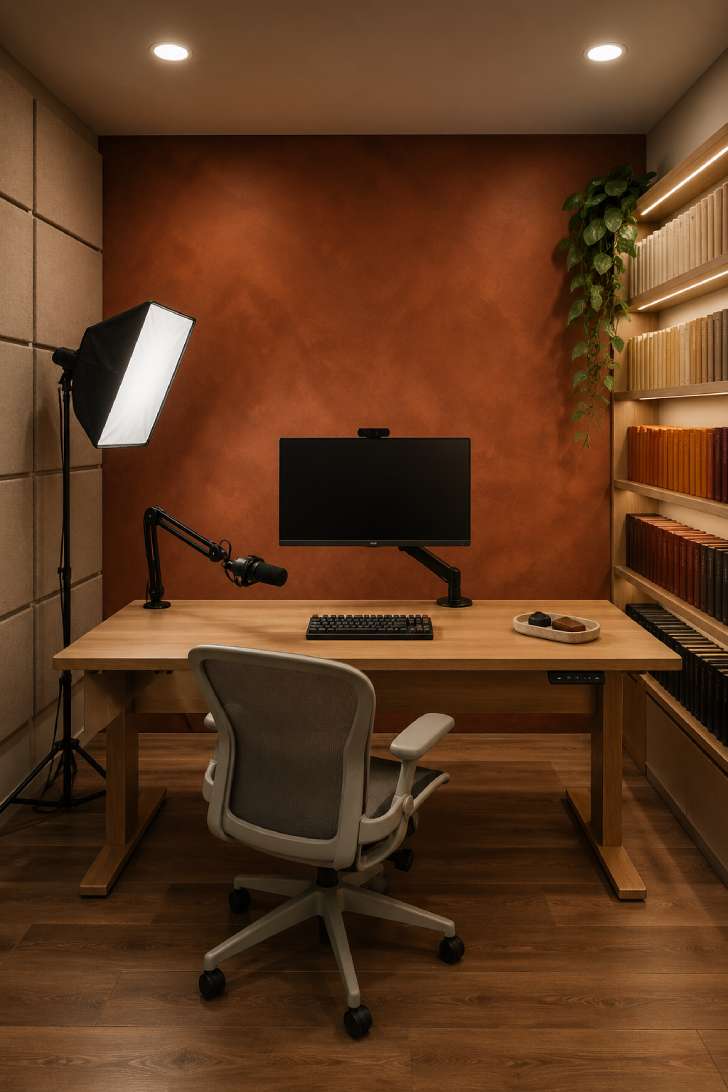
This one is set up for the camera. One wall is a backdrop — painted, textured, or both — and everything in front of it is arranged for how it reads on screen.
A backdrop wall works because it gives the eye a single, uninterrupted surface behind the person speaking.
Limewash plaster is particularly good for this — the texture reads as interesting but not distracting, and it doesn’t reflect light the way paint does.
The acoustic panels on the side wall are pulling double duty: they’re reducing the reverb that concrete basements create while also looking intentional.
Treating a work from home setup like a production environment, even at home, changes the quality of what comes out of it.
Style Blueprint:
- One dedicated backdrop wall in limewash plaster or deep matte paint
- Softbox or ring light on a stand, positioned at 45° to the desk
- Acoustic fabric panels on side walls (in a grid or offset pattern)
- Microphone on a boom arm (low-profile, stays off-camera when not in use)
- Curated open shelves styled for the frame — nothing incidental
The Library-Office Hybrid
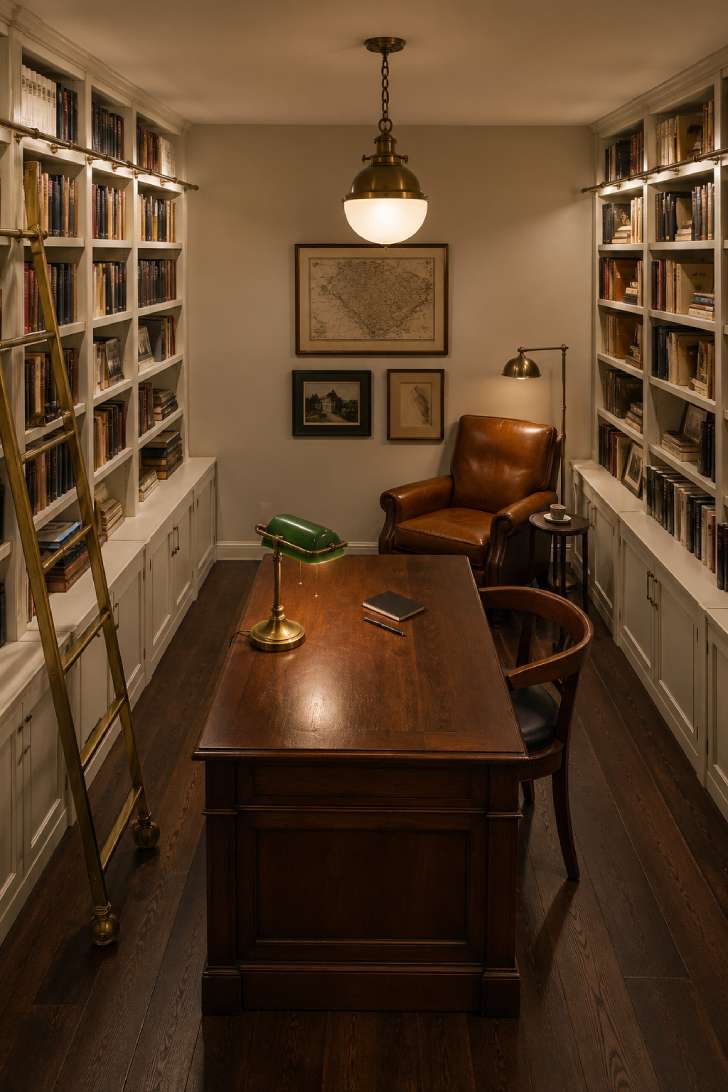
Floor-to-ceiling shelves on two walls. A rolling ladder on a brass rail. A writing desk in the center of the room that faces absolutely nothing and therefore faces your thoughts.
The library-office hybrid works because the books are the décor.
No art needed. No wallpaper. The spines of several hundred volumes, arranged by color or subject, create a wall surface that’s more visually interesting than anything you could buy.
The rolling ladder adds a vertical line that draws the eye up and past the ceiling height.
Most people forget how short the ceiling is when there’s something that interesting to look at.
This is one of the more successful basement renovation ideas for anyone with an existing book collection — the books become the justification for the room rather than an afterthought.
Style Blueprint:
- Floor-to-ceiling white-painted built-in shelves on two facing walls
- Brass rolling library ladder on a continuous rail
- Dark walnut or ebony-stained central writing desk
- Aged brass schoolhouse pendant over desk
- Deep caramel leather reading chair in one corner with floor lamp
Design Pro-Tip: The three-layer lighting rule for basements — ambient (recessed or overhead), task (desk lamp, under-shelf LED), and accent (shelf-integrated, floor-level, or behind furniture) — solves the “it still feels dim” problem that plagues otherwise well-designed below-grade workspaces. Most people install only ambient lighting and wonder why the room doesn’t feel alive. Adding task and accent layers adds depth. The room stops looking lit and starts looking designed.
The Japandi Corner Office
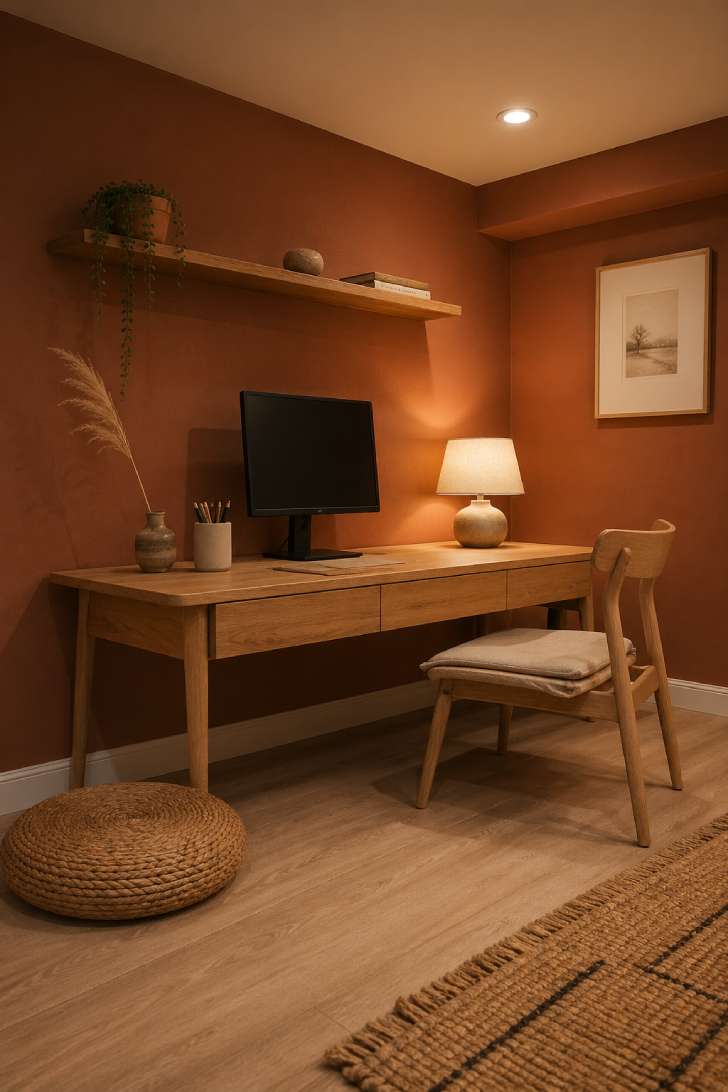
Warm neutrals. A low desk. A single plant chosen with the same care as a piece of furniture. Nothing here is accidental.
Low furniture does something counterintuitive in a basement: it makes the room feel taller.
By pulling the visual weight of every object toward the floor, the upper half of the room becomes open. In a 7.5-foot ceiling space, that matters.
The Japandi approach also brings a small home office aesthetic that doesn’t feel like you’re in a space you’re tolerating — every object is considered, and the space feels like a deliberate retreat rather than a converted utility room.
Style Blueprint:
- Warm clay or earthy tone on all walls (muted, not saturated)
- Low-profile solid wood desk with tapered legs in pale oak
- Single sculptural lamp (stone or ceramic base)
- One or two wabi-sabi style objects: dried stems, rounded stones, textured ceramics
- Natural fiber accent (woven cushion, jute rug, or linen textile)
The Maximalist Study
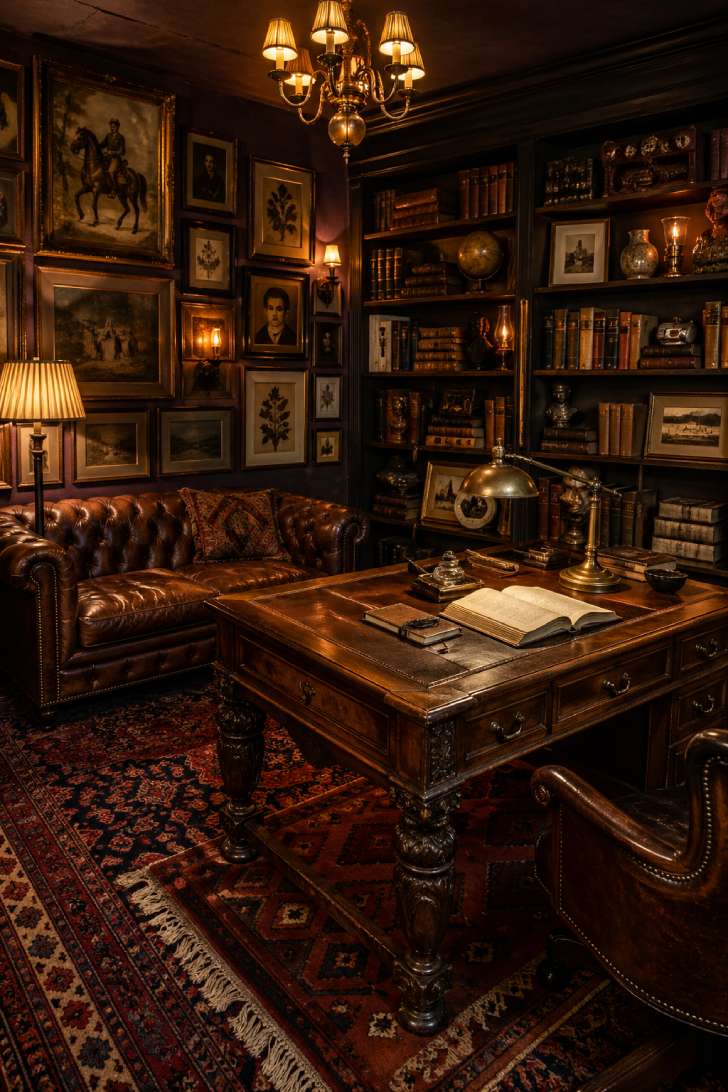
More books than shelves. More art than walls.
A rug on top of a rug. If the rest of this list has leaned spare, this one does the opposite.
The psychological mechanism here is saturation without chaos.
Every object in a maximalist space needs to be intentional — not random, not impulsive.
Books in this room are organized loosely by spine color and size, not alphabetically, which means the shelves read as a composition.
The layered rugs define zones within an otherwise undivided room.
The two light sources per zone (a sconce and a lamp, always) mean no part of the room goes fully dark, which keeps the visual weight from tipping into oppressive.
Dark home office aesthetic done this way feels like a creative mind’s natural habitat.
Style Blueprint:
- Deep jewel-toned or limewash walls (plum, forest green, midnight blue)
- Floor-to-ceiling open shelving, densely filled with books and objects
- At least two warm light sources per zone (sconce + floor lamp, or chandelier + table lamp)
- Layered rugs: one large traditional rug base, one smaller accent rug at the desk
- One large-scale statement object: globe, sculpture, antique trunk
The Modern Farmhouse Retreat
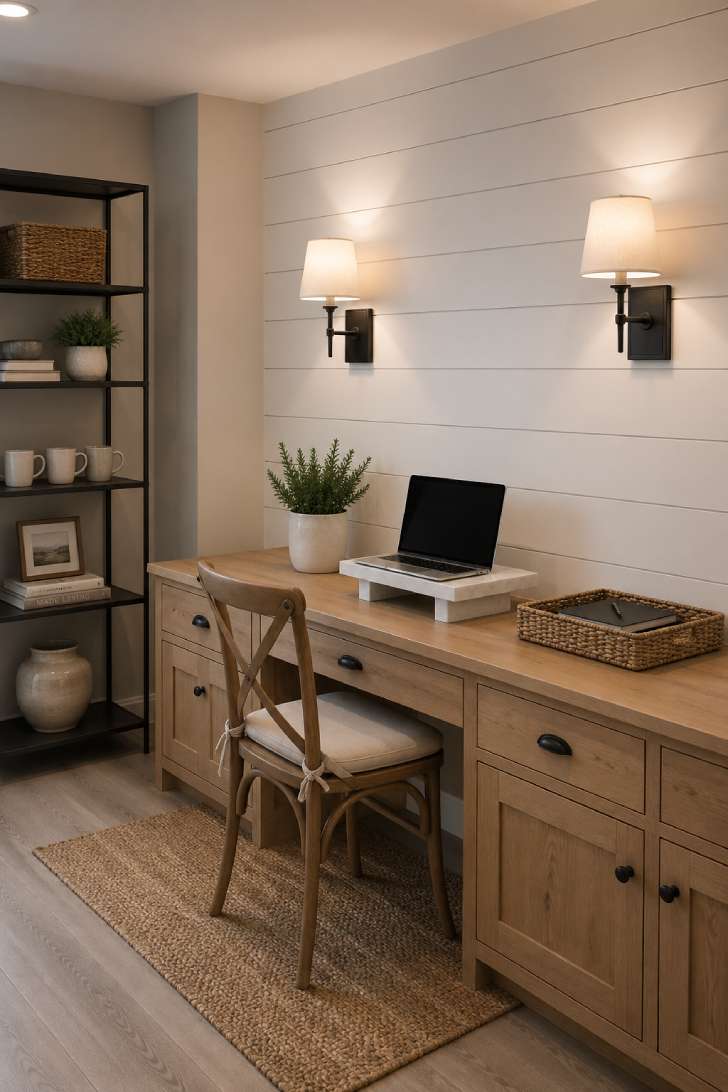
Shiplap on one wall. Black metal fixtures throughout. A wood desk with visible grain. Linen everywhere that can hold it.
Shiplap works in a basement because it adds texture to a wall that would otherwise be perfectly flat drywall — and in a room without windows, texture is one of the few things that keeps walls from feeling institutional.
The horizontal lines of the planks also guide the eye sideways across the longest wall rather than upward toward the ceiling, which keeps the proportions feeling balanced.
This is one of the most approachable basement finishing ideas for homeowners who want character without a large renovation budget.
Style Blueprint:
- White-painted shiplap on the primary accent wall
- Black metal fixtures: sconces, open shelving brackets, desk accessories
- Light-stained solid wood desk surface
- Linen or cotton upholstery on seating (tie-on cushion or slip cover)
- Woven jute or seagrass rug under the desk zone
The Mirror-Bright Minimal Office
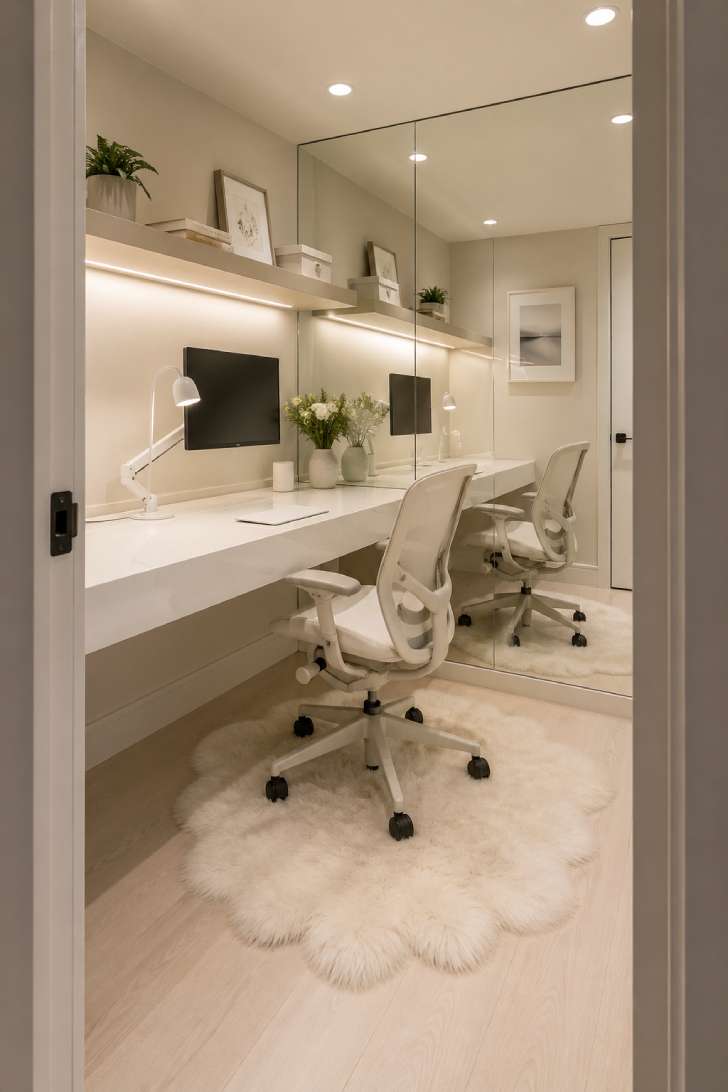
No windows. No problem — if you know what you’re doing with reflective surfaces and light color.
A full-wall mirror in a below-grade workspace is one of the highest-impact, lowest-cost interventions you can make.
The reflected room creates the visual impression of a second room opening off to one side, which effectively doubles the perceived square footage.
Combined with warm-toned recessed lights and an LED strip under a floating shelf, this approach solves the “it still feels like a basement” problem that plagues many home office lighting ideas treatments.
The light bounces. The space expands. The work from home setup becomes genuinely pleasant.
Style Blueprint:
- Full-wall frameless mirror panel opposite the desk
- Soft warm white paint on all remaining walls and ceiling
- LED strip under a floating shelf above desk
- Warm recessed lights at ceiling perimeter (3000K, not cool white)
- Light or blonde LVP with a white sheepskin rug
The Corner Reading Nook Add-On
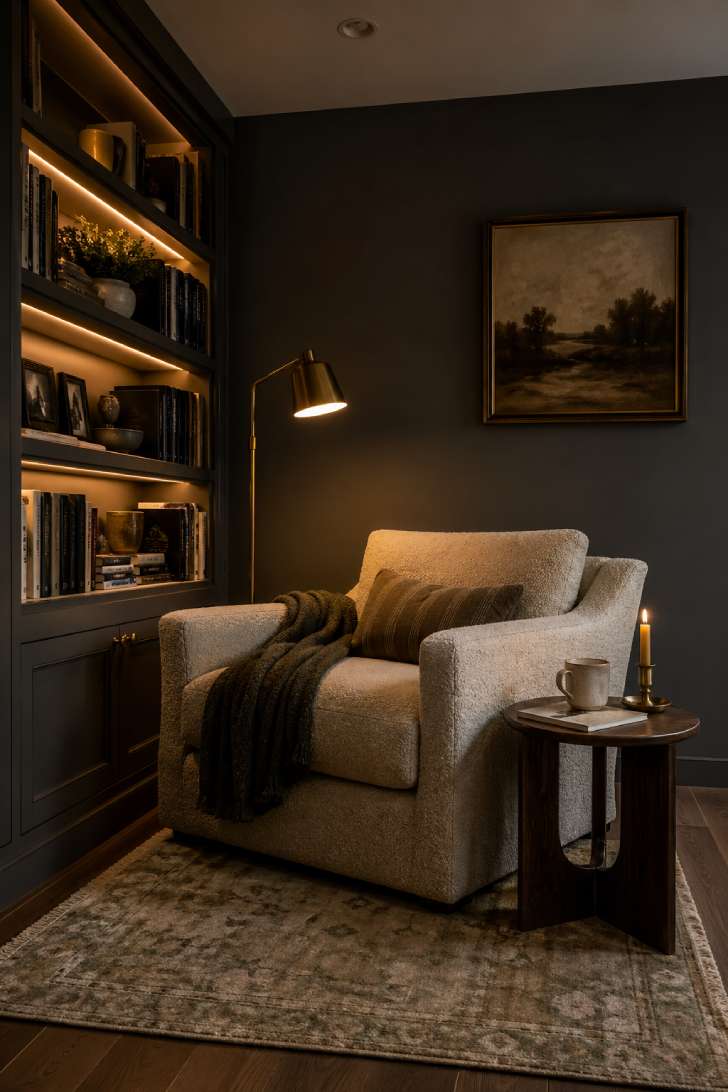
Every office is better with a chair that isn’t the desk chair.
The reading corner isn’t decorative. It’s functional in a different way than the desk is.
Studies on cognitive performance consistently show that switching posture — moving from sitting at a desk to sitting in a deep chair — helps with tasks that require synthesis, reflection, or reading rather than output.
Having that chair in the same room as the desk means the transition costs nothing.
You stand up, take four steps, and your posture changes, your eye line changes, and your brain registers something different enough to shift gears.
Every basement office with room for a reading nook is a better office for having one.
Style Blueprint:
- Deep, wide armchair in a tactile fabric (boucle, velvet, linen)
- Slim floor lamp positioned behind the chair’s left or right shoulder
- Small side table at arm height: just large enough for a mug and a book
- Small accent rug defining the nook from the desk zone
- Built-in or freestanding bookshelf within arm’s reach
The Acoustic-Ready Focus Room
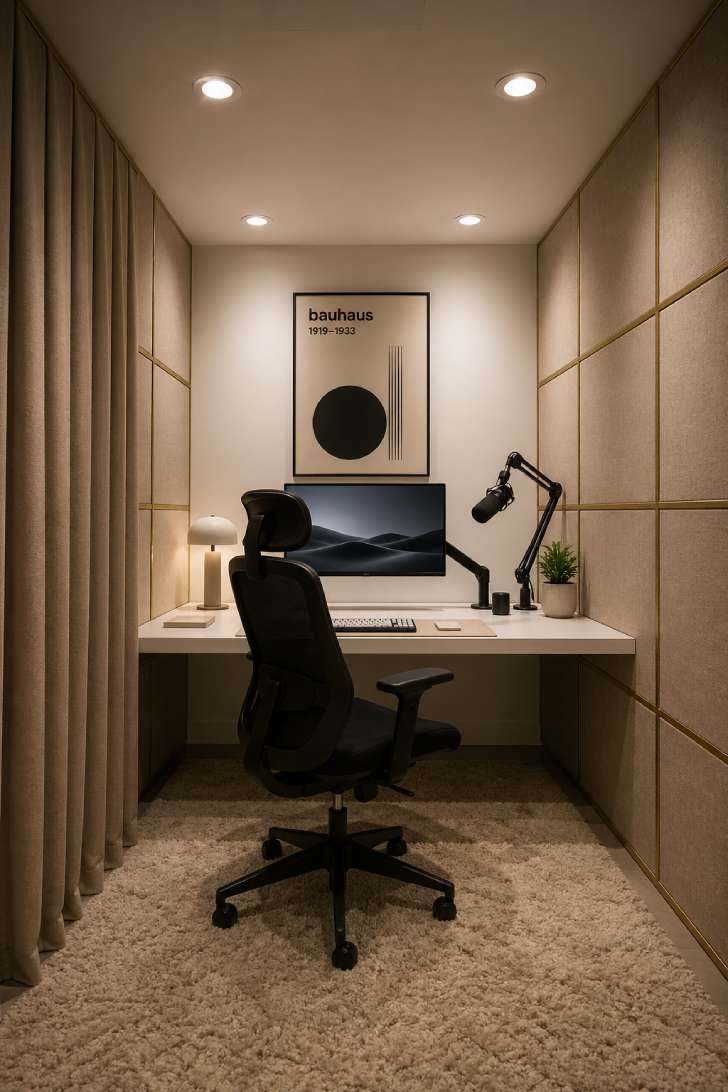
This basement office is built for one thing: concentration. No echo. No distraction. No ambient noise bleeding in or out.
Bare concrete walls and hard LVP floors create a room with a reverberation time (RT60) that makes video calls sound echoey and extended focus sessions feel subtly exhausting.
Fabric acoustic panels bring that RT60 down to a conversational level. The floor-length blackout curtains add a second soft surface.
The thick wool rug handles the floor. By the time all three are in, the room sounds the way a good conversation feels — clear, warm, no ringing edges.
For anyone building a serious work from home setup, the acoustic investment pays off faster than almost any other upgrade.
Style Blueprint:
- Acoustic fabric panels on side walls (linen or wool-faced, brass-trimmed framing)
- Heavy floor-length curtain on one wall, even without a window
- Thick wool rug running the full desk length
- Baffled recessed light housings (reduces ceiling flutter echo)
- Monitor arm + boom arm microphone for a clean, hard-surface-free desk
Finding Your Version
None of these 13 basement office ideas require the same budget, the same style, or the same square footage.
The dark study works in 120 square feet.
The dual workspace scales up to accommodate two different people with two completely different aesthetics.
The acoustic room can be built incrementally — one panel wall, one curtain, one rug — without committing to a full renovation at once.
What all of them share is the same starting point: taking the basement seriously as a space worth designing rather than a room to endure.
Once that decision is made, the enclosed walls become an advantage, the low ceiling becomes a detail to work with, and the quiet that already exists down there becomes the most valuable feature in your house.