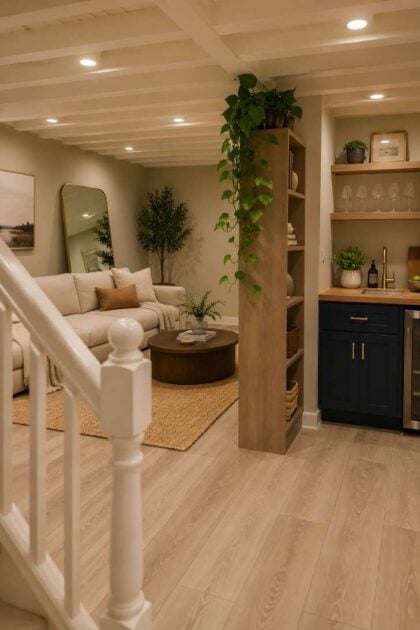
This post may contain affiliate links. If you make a purchase through these links, we may earn a commission at no additional cost to you.
A small basement doesn’t have to stay forgotten.
Most homeowners look at their lower level and see low ceilings, exposed pipes, and a faint smell of damp concrete.
Designers look at the same room and see a home theater, a private office, a wine closet, or a gym that costs a fraction of what an addition would run.
The trick isn’t square footage. It’s knowing which small basement ideas actually work when headroom is tight, natural light is scarce, and moisture is part of the deal.
These 13 ideas pull from real finished basement projects and current trends heading into 2026.
Each one accounts for the realities of below-grade living — basement moisture control, limited ceiling height, and the kind of awkward layouts that come with furnaces, support columns, and ductwork you can’t relocate.
The images do the heavy lifting here. Read for the details, but scroll for the inspiration.
Your Own Private Screening Room
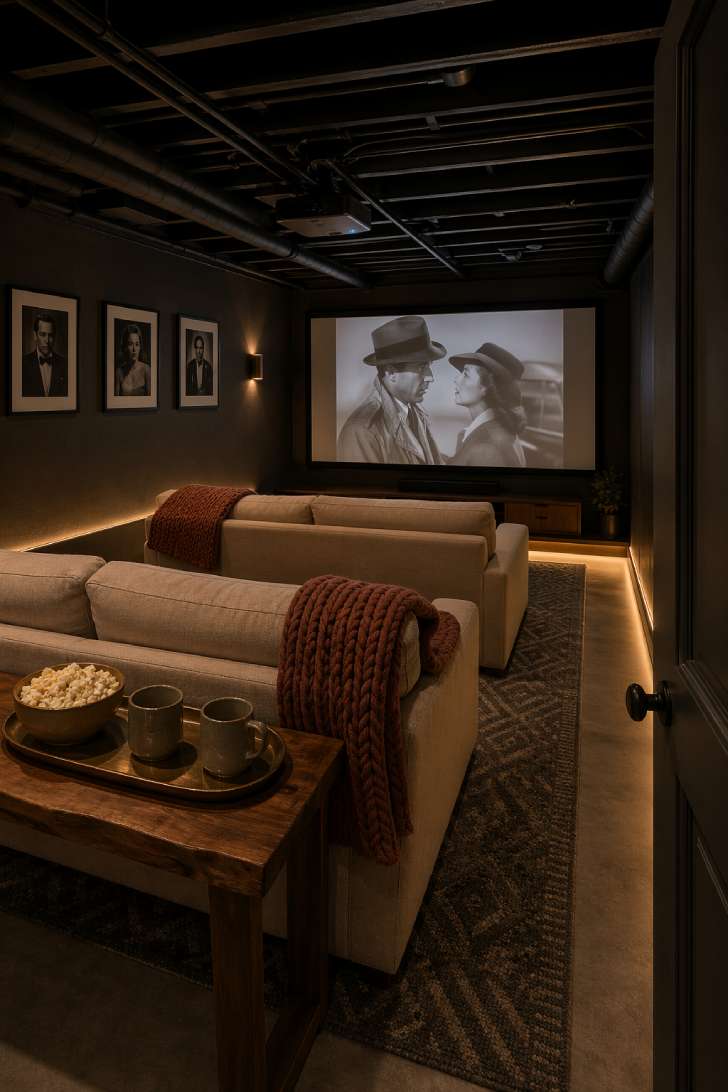
There’s a reason the basement home theater keeps showing up on every list of small basement ideas.
The room’s biggest weaknesses — no windows, low ceilings, enclosed walls — are a screening room’s best friends.
Darkness is a feature here, not a flaw.
Painting the ceiling, joists, ductwork, and pipes a single flat black removes the visual clutter overhead and lets the projector screen become the only focal point. Your eye stops hunting for where the ceiling ends and just settles into the picture.
That single-color trick also makes a 7-foot ceiling feel less oppressive because there’s no hard, bright surface pressing down on you.
The warm LED strips at floor level do something specific: they give your eyes just enough ambient reference so the room doesn’t feel disorienting in the dark, but they don’t compete with the screen. Warm color temperatures (2700K or lower) keep the space feeling relaxed rather than clinical.
Soft, deep-cushioned seating in a light neutral fabric bounces what little light there is, stopping the room from becoming a black hole.
Style Blueprint:
- Ceiling-mounted projector with matte white pull-down screen
- Recessed or baseboard LED strip lighting in warm white (2700K)
- Low-profile, deep-cushioned seating in a light upholstery
- Thick wool area rug over concrete or vinyl plank flooring
- Flat black paint on all exposed ceiling elements (joists, ducts, pipes)
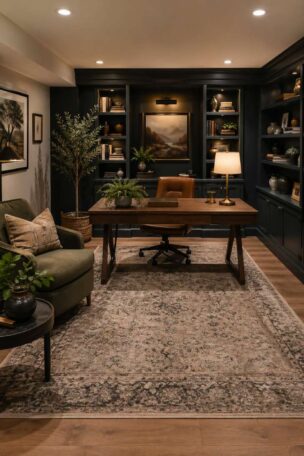
A Quiet Office Below the Noise
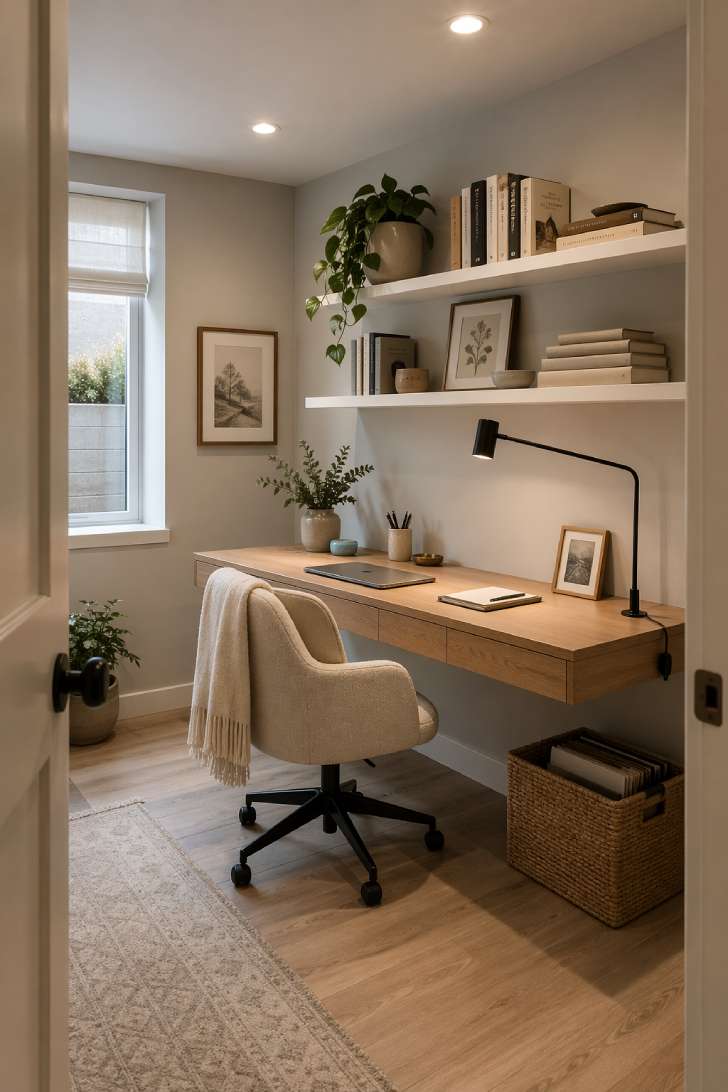
Working from home gets easier when your office is on a completely different floor from the kitchen, the TV, and whoever else is in the house.
A basement home office doesn’t need much room. A floating desk, a good chair, and a few shelves can fit against a single wall in under 30 square feet.
Light colors can make a noticeable visual difference down here. Pale gray or warm white walls bounce recessed ceiling light across the room, softening shadows and helping the walls feel less visually heavy.
Dark walls create more contrast and absorb more of that light, which can make a small basement office feel more enclosed.
If you have any opportunity to install a window well or egress window, take it. Even a small rectangle of daylight can change the composition of the room by adding a brighter focal point and a visible connection to the outdoors.
In a basement with no windows, the lighting can feel more uniform and enclosed over the course of the day, so introducing daylight where possible helps break up that closed-in appearance.
Running a separate HVAC supply vent to a basement office is worth the effort, too. Basements tend to run cooler than the floors above, and a dedicated vent can make the room more comfortable during long work sessions.
Style Blueprint:
- Floating or wall-mounted desk to free up floor space
- Adjustable task lamp (clip-on or desk-mounted, not a floor lamp)
- Light-toned luxury vinyl plank or laminate flooring
- Recessed ceiling lighting on a dimmer switch
- One or two floating shelves with a mix of function and warmth (books, plant, art)
The Compact Gym That Gets Used
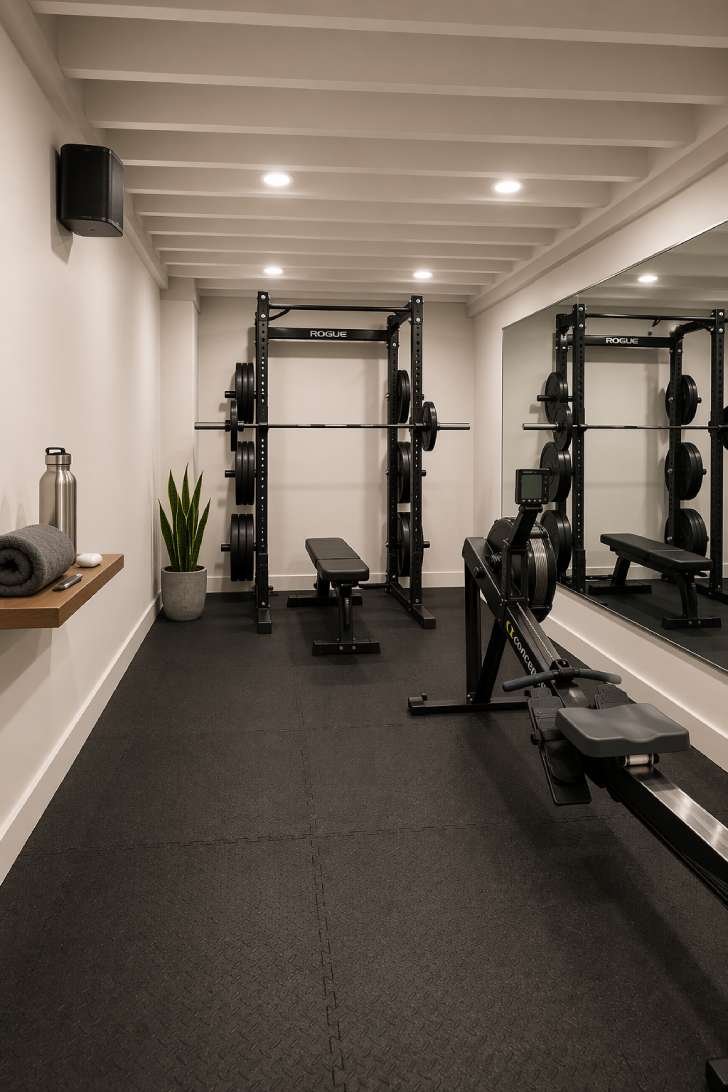
A gym membership costs money every month. A basement gym costs money once.
Under 200 square feet is enough for a squat rack, a flat bench, a set of dumbbells, and a rowing machine or stationary bike. The concrete slab underneath can handle the weight without complaint once you lay down rubber mats.
Mirrors are doing real work in this room, and it’s not about vanity. A large frameless mirror on one wall visually doubles the perceived size of the space. Y
our eyes register depth where there isn’t any. In a tight basement, that optical trick is worth more than an extra 50 square feet of actual floor area.
White-painted joists overhead keep the ceiling feeling as high as possible, and recessed can lights between the joists provide bright, even illumination without hanging down into the headroom.
Pendant fixtures or ceiling fans would be a disaster in a low-ceiling basement gym — one overhead press and you’d find out why.
Ventilation matters here more than in any other room on this list. A ductless mini-split or at least a dedicated supply vent from your existing HVAC system keeps air moving and the temperature bearable during a hard session.
Style Blueprint:
- Interlocking rubber floor mats (3/4-inch thickness minimum)
- Compact squat rack or folding wall-mounted rack
- Large frameless wall mirror
- Recessed can lighting (bright, 4000K-5000K color temperature)
- Wall-mounted fan or ductless mini-split for airflow
Design Pro-Tip: When your ceiling height is under 7.5 feet, skip drop ceilings entirely. Paint the exposed joists and ductwork a single color — white to open the room up, flat black to make the ceiling disappear. Both save every available inch of headroom, and either one looks better than sagging acoustic tiles.
A Bedroom That Meets Code
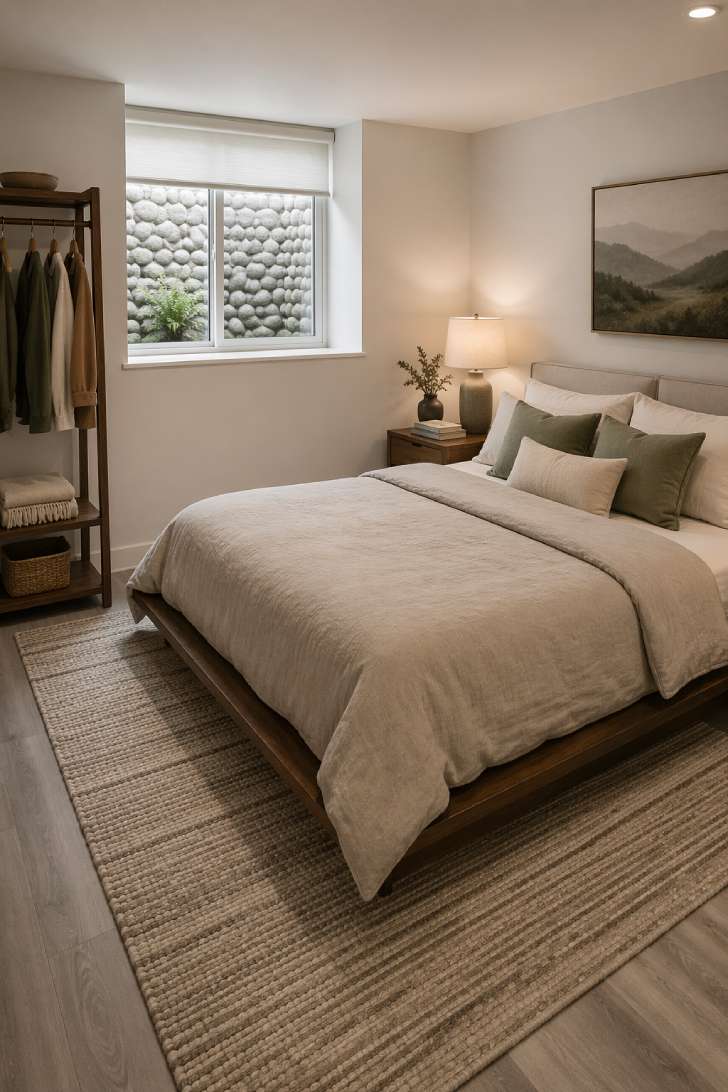
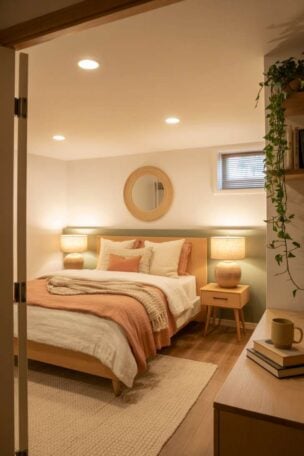
A basement guest room is one of the best returns on a finished basement — but only if it meets building code.
For the room to legally count as a bedroom, most codes require an egress window with at least 5.7 square feet of opening. That window also needs to be reachable (sill height no more than 44 inches from the floor) so someone could escape through it in an emergency.
Without that window, you can still design the room as a lounge or a sitting area. You just can’t market it as a bedroom or have guests sleep there regularly. That distinction matters if you ever sell the house.
The egress window does more than satisfy code. It connects the room to the outside. Even a small wash of daylight shifts the emotional register of the entire basement from “underground” to “garden level.”
The light doesn’t have to be dramatic — a soft gray morning glow through a linen shade is enough to make the room feel like a place someone belongs.
Low-profile platform beds work best here because they keep the visual center of gravity close to the floor, and that makes the ceiling feel taller by comparison. A tall headboard in a 7-foot room would eat the proportions.
Light-colored washed linen bedding adds texture and warmth without visual weight. Heavier, darker fabrics would pull the room down.
Style Blueprint:
- Low-profile platform bed (under 14 inches total height with mattress)
- Egress window meeting local code (5.7 sq ft minimum opening)
- Light-toned washed linen bedding with layered accent pillows
- Slim nightstand with ceramic lamp (warm bulb, 2700K)
- Light luxury vinyl plank or engineered wood flooring
A Wine Closet Behind Glass
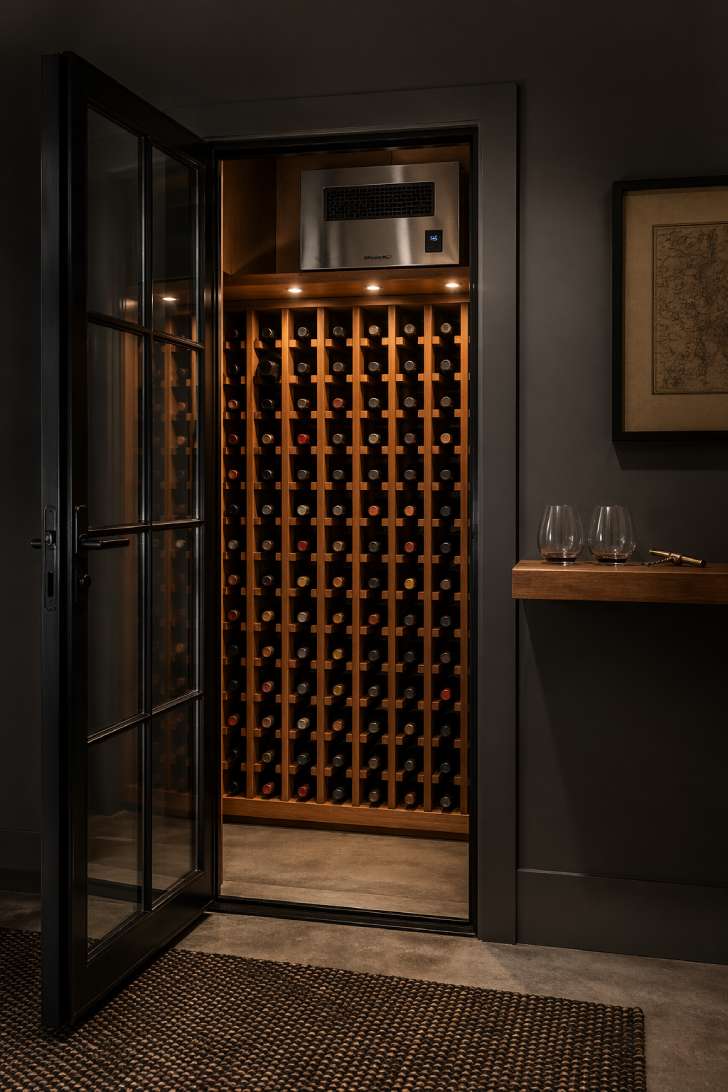
You don’t need a full room for wine storage. A closet works.
Basements sit at naturally cool, stable temperatures year-round, which makes them better for wine than almost any other spot in the house. A dedicated cooling unit dialed to around 55°F with humidity near 65% is all you need to keep bottles aging properly.
A glass-front door turns functional storage into something you actually want to look at. The transparency pulls the eye through the surface of the wall and into the collection behind it, making the closet feel like a design feature rather than a utility.
Warm-toned wood racking against a charcoal or dark-painted surround creates depth. The contrast between the lit interior and the darker wall around it draws the eye in and gives the small space a sense of occasion that a standard closet door would kill.
This is one of the best small basement ideas for homeowners who want to add personality to a finished basement without sacrificing usable floor space. The whole setup can tuck into an under-stair nook or a corner that would otherwise sit empty.
Style Blueprint:
- Glass-paneled closet door (slim black or brass frame)
- Adjustable oak or walnut wine racking (individual bottle slots)
- Compact wine cellar cooling unit (sized for closet volume)
- LED puck lights or strip lighting inside (warm, 2700K)
- Hygrometer to monitor humidity
A Playroom the Kids Can Own
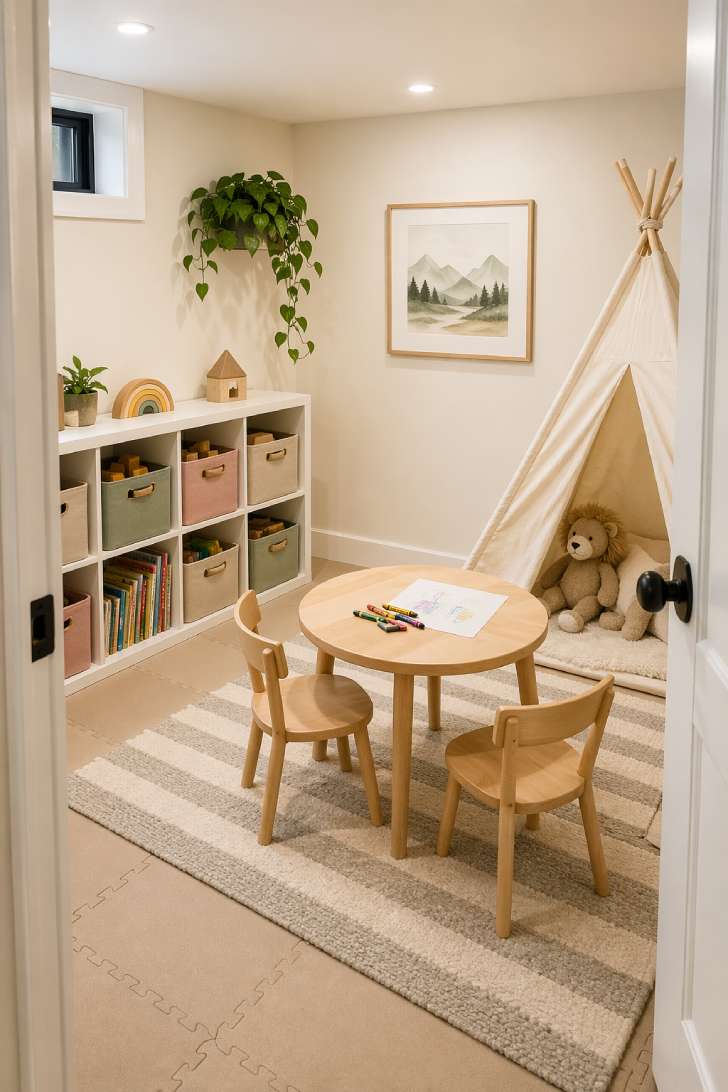
Giving kids their own space downstairs keeps the main living areas upstairs from drowning in toys and art supplies.
Foam tile flooring is the go-to for basement playrooms. It’s soft enough for falls, moisture-resistant enough for spills, and cheap enough that you won’t care when a section gets destroyed.
Carpet tiles with built-in padding are another good option — you can pull up and replace individual tiles when juice or paint gets the best of one.
Color choices in a kids’ playroom affect energy levels more than most parents realize. Bright primary reds and yellows ramp up stimulation, which sounds fun until it’s 4 p.m. and nobody can settle down.
Softer, muted tones — sage, dusty rose, oatmeal — keep the room feeling playful without pushing kids into overdrive. The toys themselves bring enough color.
Low, open storage at child height lets kids access and return their own things, which builds independence and (theoretically) keeps the mess contained.
If you have young children, a gate at the top of the basement stairs is non-negotiable.
Style Blueprint:
- Interlocking foam tiles or carpet tiles (moisture-resistant)
- Low bookcase with labeled fabric bins
- Child-sized table and chairs in natural wood
- Soft, washable area rug
- Recessed overhead lighting (no hanging fixtures in kid spaces)
Design Pro-Tip: In any small basement room, swap out one piece of bulky furniture for a built-in. A built-in bench with storage underneath, a wall-mounted desk, or recessed shelving saves floor space and makes the room feel custom — even on a budget.
Two Rooms Without a Wall Between Them
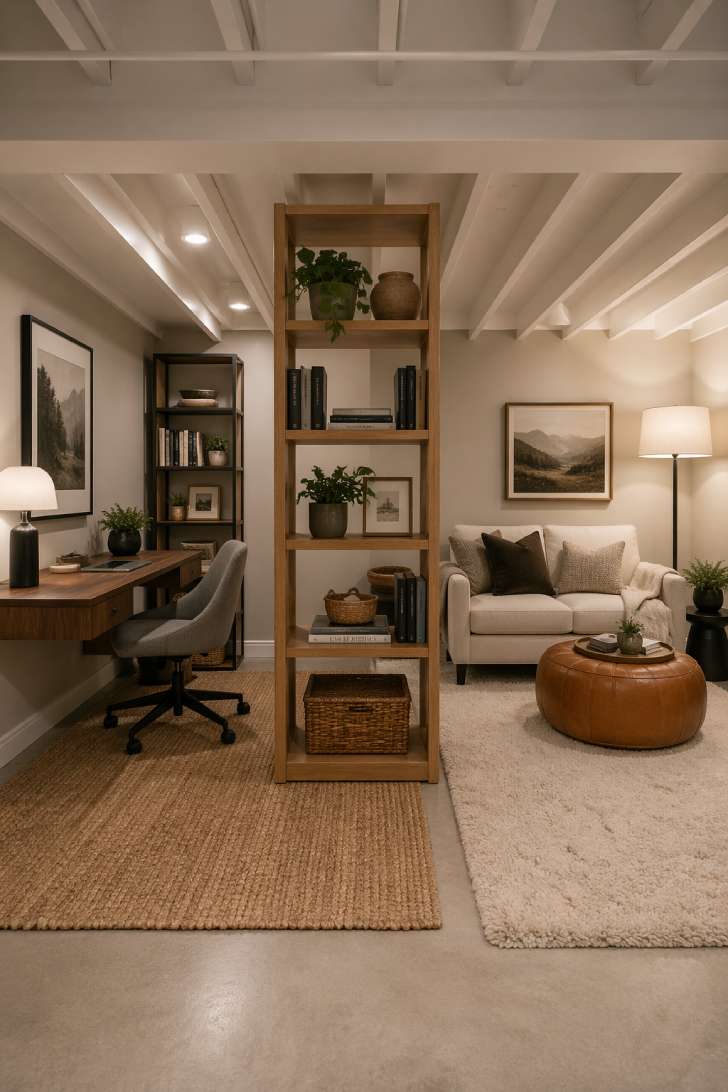
Building a full wall in a small basement is almost always a mistake. It chops the room in half, blocks whatever light exists, and can make both resulting spaces feel cramped.
Open dividers can define separate areas without closing off the room.
A tall, open-backed shelving unit creates a clear visual boundary between two zones while still allowing light and sightlines to pass through.
The vertical structure marks a transition between functions, but the open shelving keeps both areas visually connected within the same overall space.
Rugs can reinforce that separation.
Placing two distinct rugs, with different textures or shapes, under each zone gives each area its own visual footprint and helps establish where one function ends and another begins.
It is similar to the way an open restaurant floor can use separate tables, furniture groupings, and floor treatments to distinguish individual seating areas without adding walls.
This multi-zone approach works for all kinds of pairings: office and lounge, laundry and craft area, gym and media corner.
The idea is to keep light and openness shared while giving each function a clearly defined place.
Style Blueprint:
- Open-backed shelving unit (at least 5 feet tall, no solid back panel)
- Two distinct area rugs in contrasting textures
- Furniture scaled to each zone (compact desk, small loveseat — nothing oversized)
- Unified wall and ceiling color to tie the zones together
- Recessed lighting positioned to serve both sides
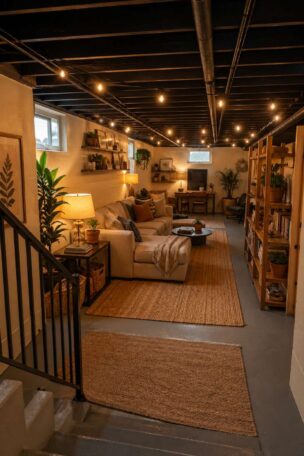
The Ceiling That Disappears
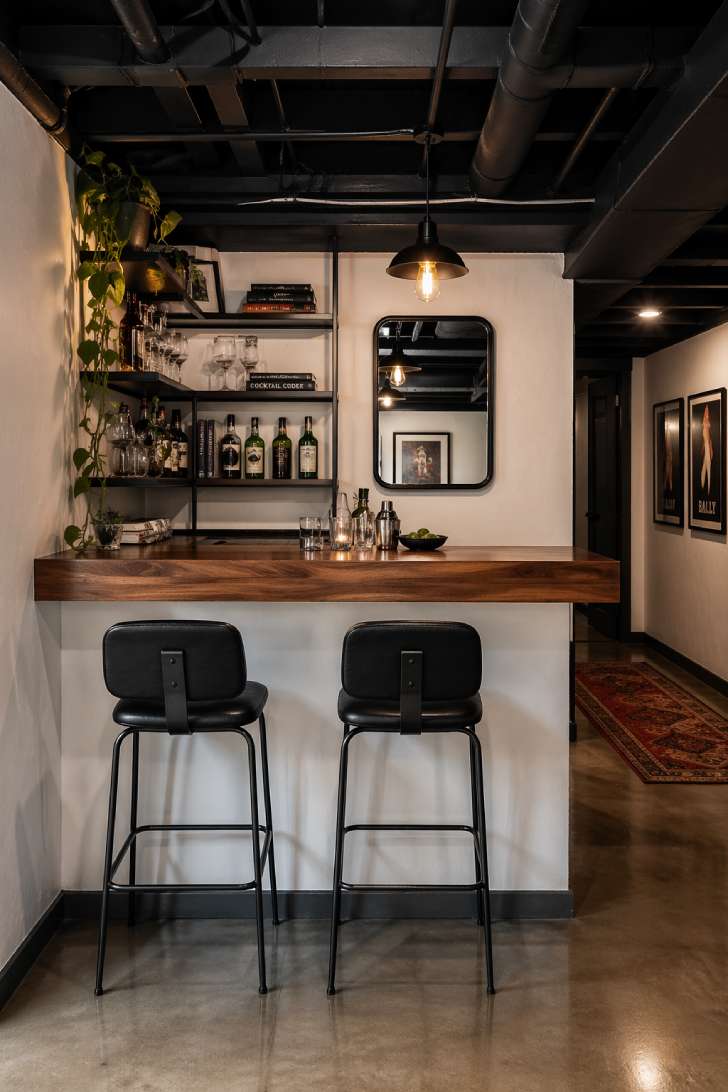
Drop ceilings eat up 4 to 6 inches of headroom. In a basement where you’re already at 7 feet or less, that’s headroom you can’t spare.
Painting everything overhead, including joists, ductwork, pipes, and electrical conduit, a single matte black creates one continuous dark plane instead of a patchwork of exposed structural elements.
Because the ceiling components share the same color and finish, their individual outlines become less prominent.
The overhead structure reads as a unified background rather than a collection of separate pipes, beams, and ducts.
It’s a similar visual approach to the black ceilings often used in theaters, where the overhead structure is kept dark so it stays visually secondary to the space below.
The contrast between a dark ceiling and light walls is doing the real work here.
Bright walls at eye level keep the room visually open and livable, while the darker ceiling adds depth and atmosphere without introducing more visible structural detail.
This basement lighting idea costs almost nothing, just paint and a few hours with a sprayer.
It works in media rooms, bar areas, gyms, and any other space where mood matters more than a polished, finished look.
And it preserves every single inch of that low ceiling basement height.
Style Blueprint:
- Matte black paint (flat sheen, spray application for even coverage on pipes and ducts)
- Light or white walls below the ceiling line for contrast
- Recessed can lights or minimal pendant fixtures that sit close to the joist line
- Polished or sealed concrete floor (or dark vinyl plank)
- One or two statement pieces at eye level to anchor attention downward
A Five-Foot Kitchen That Works
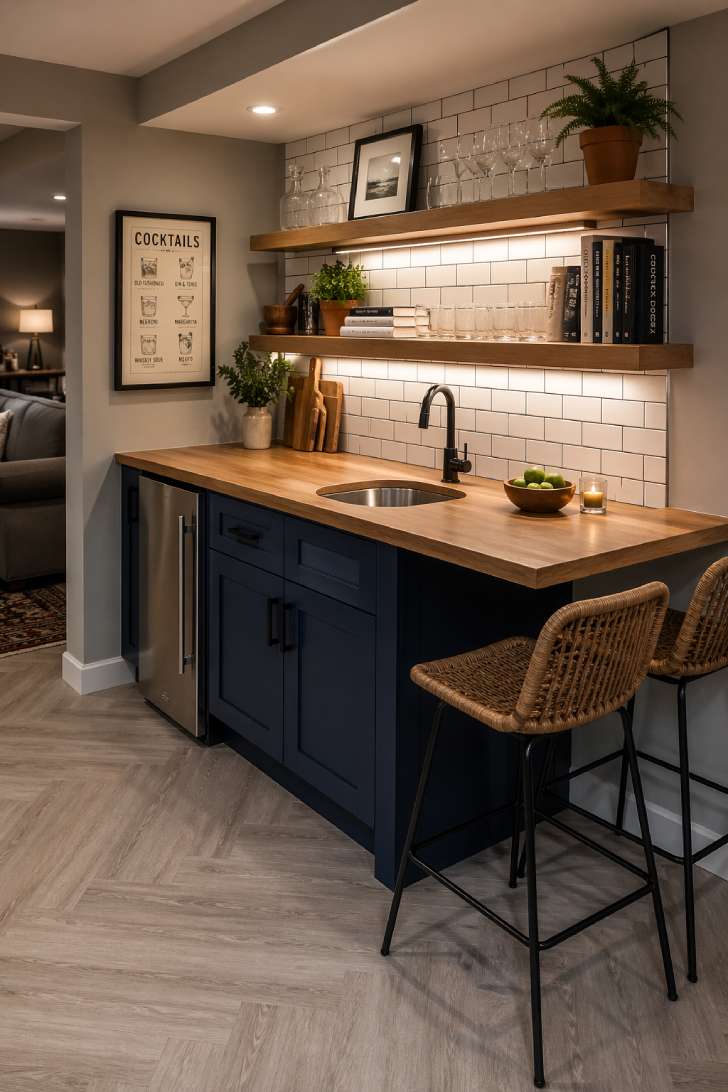
A basement wet bar or kitchenette doesn’t need to be big. Six feet of counter space, a sink, and a mini-fridge cover what most people actually use.
The smart move is building near existing plumbing lines. If your basement already has a water heater, a utility sink, or a bathroom, the drain lines and supply pipes are already there.
Running new plumbing across the entire basement to put the bar on the opposite wall can double the cost of the project.
Under-cabinet LED strips are the best basement lighting idea for a kitchenette because they illuminate the work surface directly without adding fixtures that hang down from an already low ceiling.
The warm glow they cast across butcher block or natural wood counter has an inviting, cafe-like quality that overhead fluorescents could never match.
Floating shelves instead of upper cabinets keep the wall above the counter feeling open. Closed upper cabinets in a small basement kitchen would make the space feel boxed in.
A short extension of the countertop with a couple of stools turns the kitchenette into a social spot, not just a prep area.
Style Blueprint:
- 6-foot countertop run (butcher block or quartz)
- Compact under-counter mini-fridge
- Small bar sink near existing plumbing lines
- Under-cabinet LED strip lighting (warm white)
- Two floating shelves in place of upper cabinets
Design Pro-Tip: Basement flooring options make or break the room. Luxury vinyl plank adds less than a quarter-inch of height, handles moisture better than hardwood, and comes in realistic wood-grain finishes. It’s the safest all-around pick for any below-grade space.
A Reading Corner That Earns Its Keep
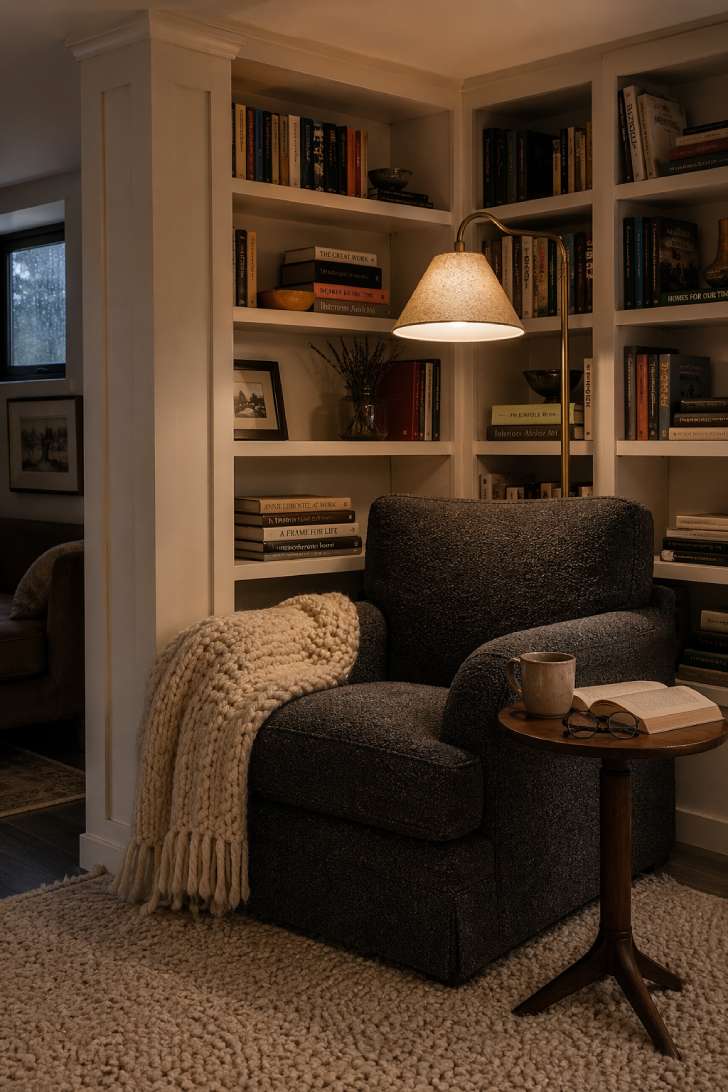
Not every corner of a basement needs a purpose-built room. Some just need a chair and a lamp.
A reading nook is the perfect use for those leftover pockets of space that are too small for furniture groupings but too visible to ignore.
The area beside a support column, a dead-end corner near the stairs, the strip of wall between two doorways — any of these can become a spot worth sitting in.
The oversized armchair is the anchor. It should be deep enough to curl up in and covered in something that feels good against bare arms — boucle, washed linen, soft cotton.
This is a sensory space. The texture of the fabric, the warmth of the lamp, the smell of old pages — these small physical details are what make someone choose to sit here instead of on the couch upstairs.
Built-in bookshelves turn the nook into a home library without eating floor space. Running them floor to ceiling draws the eye upward and counteracts the low ceiling by creating strong vertical lines.
Wrapping a support column in the same material as the shelving makes it look like a design choice instead of a structural compromise.
Style Blueprint:
- Deep, oversized armchair in a tactile fabric (boucle, linen, or velvet)
- Floor-to-ceiling built-in bookshelves
- Slim arc floor lamp with warm-tone bulb
- Small side table for a drink and a book
- Thick-pile wool rug to define the nook
A Laundry Room Worth Walking Into
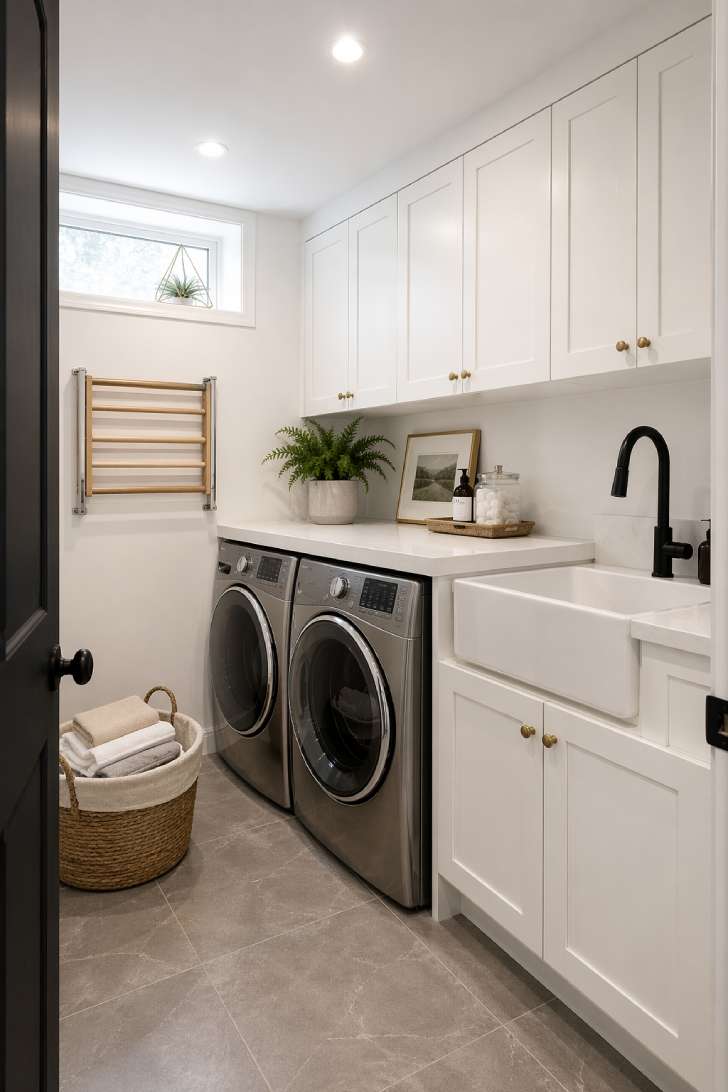
If the washer and dryer are already in the basement, you’re halfway there.
Most basement laundry setups are an afterthought — machines shoved against a wall with exposed pipes overhead and a wire shelf sagging under detergent bottles.
Upgrading the space doesn’t require moving anything. It just means building around what’s already in place.
A countertop across the top of a front-loading washer and dryer is the single best upgrade you can make. It gives you a dedicated folding surface, and suddenly the room feels like it was designed rather than assembled.
White quartz or butcher block both work; just make sure the surface can handle moisture and heat from the dryer vent.
Upper cabinets hide the clutter that makes laundry rooms look chaotic — detergent, stain removers, dryer sheets, the random collection of things that ends up on top of the dryer.
A utility sink for handwashing and stain treatment is worth the plumbing cost. Run the drain into your existing laundry standpipe to keep the job simple.
Ventilation is the piece people forget. The dryer produces heat and moisture with every cycle, and in an enclosed basement, that humidity has nowhere to go. Make sure the dryer vents to the outside, not into the room.
Style Blueprint:
- Countertop spanning washer and dryer (quartz, butcher block, or laminate)
- Upper cabinets with closed doors to hide supplies
- Utility sink with gooseneck faucet
- Wall-mounted folding drying rack
- Porcelain tile or vinyl plank flooring (moisture-resistant)
The Space Under the Stairs
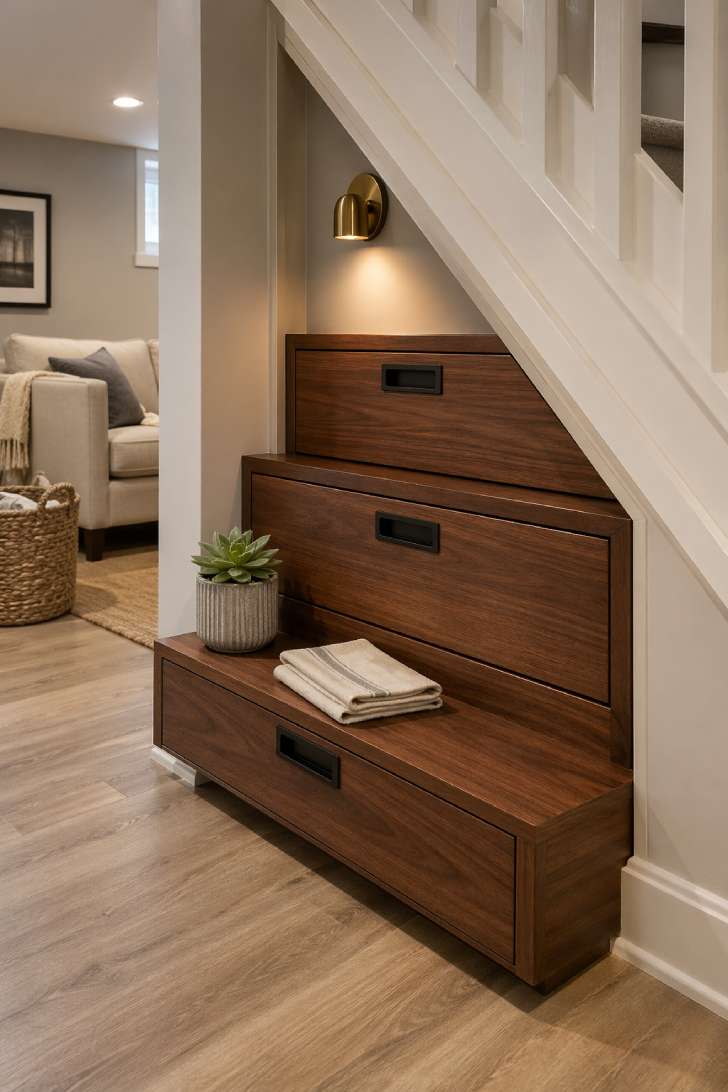
That triangle of space beneath the basement stairs is free real estate that most people fill with a vacuum cleaner and a pile of old shoes.
Built-in pull-out drawers that follow the slope of the staircase turn dead space into the most efficient basement storage solutions in the house. Graduated drawer sizes — tall in the back where the stairs are high, shallow in the front where they taper — use every cubic inch.
The alternative is a small desk nook. If the stair height at the tallest point is at least 4 feet, you can fit a compact writing surface, a wall-mounted light, and a stool underneath. It won’t be a full office, but it works for bill-paying, homework, or a quick laptop session.
Wine storage is another fit. The under-stair nook stays relatively cool and dark — decent conditions for short-term storage. A set of simple wooden wine slots built into the back wall can hold 30 to 50 bottles without taking a single square foot of usable basement floor.
The point is that this space exists in every home with a basement. Ignoring it is leaving free storage — or free function — on the table.
Style Blueprint:
- Custom pull-out drawers graduated to match the stair slope
- Recessed or matte black hardware (pulls or knobs)
- Wall-mounted light fixture inside the nook
- Matching wall paint to integrate the nook with the rest of the basement
- One display-worthy object on the top surface to make it feel intentional
Design Pro-Tip: Support columns can’t be removed, but they can be disguised. Wrap them in the same material as a nearby built-in (wood, drywall, stone veneer) and they’ll read as part of the design. Or build a small bar counter or shelf that wraps around the column and puts it to use.
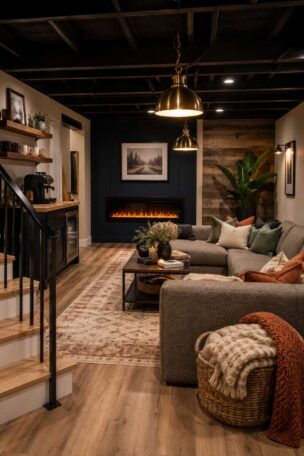
A Bright Lounge That Just Feels Good
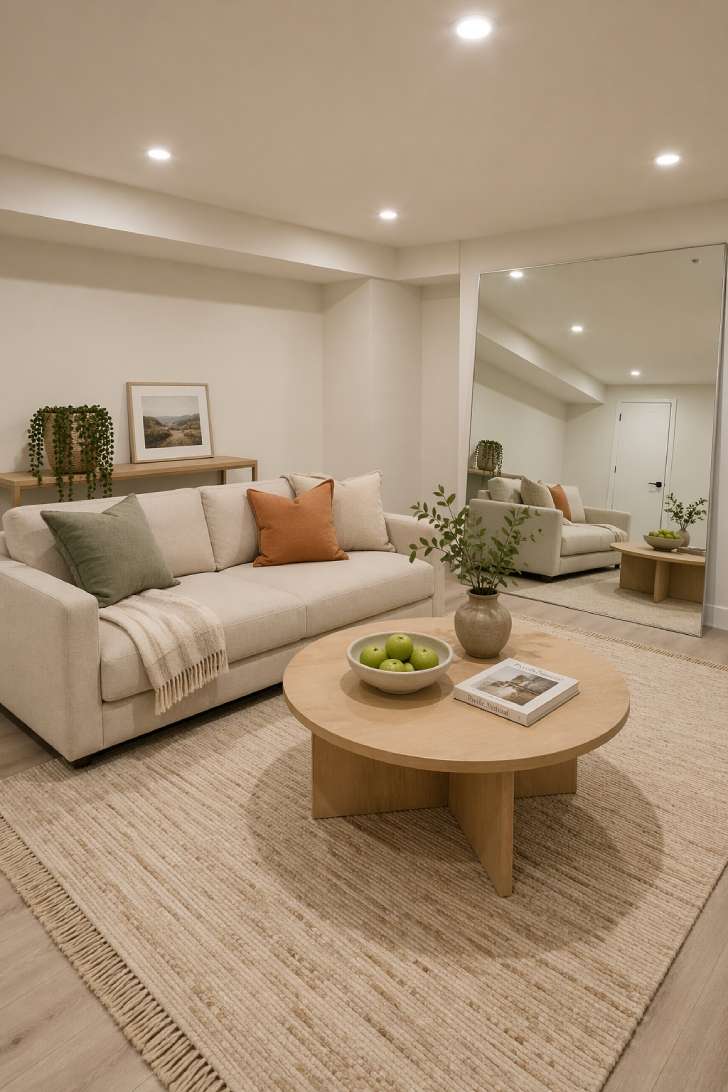
Sometimes you don’t need the basement to be anything specific. You just need it to be a comfortable room.
A general-purpose lounge is the most flexible of all finished basement ideas because it doesn’t lock you into a single use.
Movie night? Pull up a laptop.
Reading afternoon? Grab a blanket.
Kids want space? Let them spread out on the rug.
Light colors and low furniture help keep the room visually open.
Off-white walls and a light floor reflect recessed lighting across the space, creating a brighter, more continuous backdrop from wall to wall.
Low-profile seating, such as a sofa that sits close to the floor with a slim profile, leaves more visible space between the top of the furniture and the ceiling.
Tall, bulky pieces would fill more of that vertical space and make a low ceiling basement look more crowded.
The leaning mirror is one of the oldest tricks in small-space design, and it still works.
A large frameless mirror placed against a wall reflects the room back into the space, adding another layer of visible depth to the composition.
It doesn’t create more square footage, but it can make a windowless basement feel less visually enclosed.
Skipping all hanging fixtures, with no pendants, ceiling fans, or chandeliers, is part of the strategy.
In a basement with limited ceiling height, keeping the overhead plane clear helps preserve as much visible headroom as possible.
Recessed lights sit flush with the ceiling and provide illumination without adding another object into that vertical space.
Style Blueprint:
- Low-profile sofa or loveseat (seat height under 17 inches)
- Large frameless leaning mirror (at least 4 feet tall)
- Light-toned walls (off-white, warm white, pale greige)
- Light luxury vinyl plank flooring with a flat-weave area rug
- Recessed ceiling lighting only — no hanging fixtures of any kind
Before You Start
Whichever idea you pick, two things come first: fix the moisture and plan the lighting.
Everything else — paint colors, furniture, flooring — is a cosmetic decision you can change later.
But water coming through the foundation wall or a room lit by a single bare bulb will undermine any design, no matter how well thought out.
Get the boring stuff right and the rest is just choosing which room you want to walk into.