This post may contain affiliate links. If you make a purchase through these links, we may earn a commission at no additional cost to you.
Your basement is probably the most underrated room in your house.
It stays cool in the summer, it’s separated from the bedrooms, and it’s sitting there half-empty most of the year.
That makes it the perfect spot for a home fitness setup — a basement gym that actually gets used, not just talked about.
Whether you’ve got 100 square feet or 500, a low ceiling or a wide-open floor plan, this list covers 15 basement gym ideas that look great and work even better.
The focus here is on how these spaces look and feel, so you can find the one that fits your home, your budget, and your training style.
Let’s get into it.
The Minimalist Free-Weight Studio
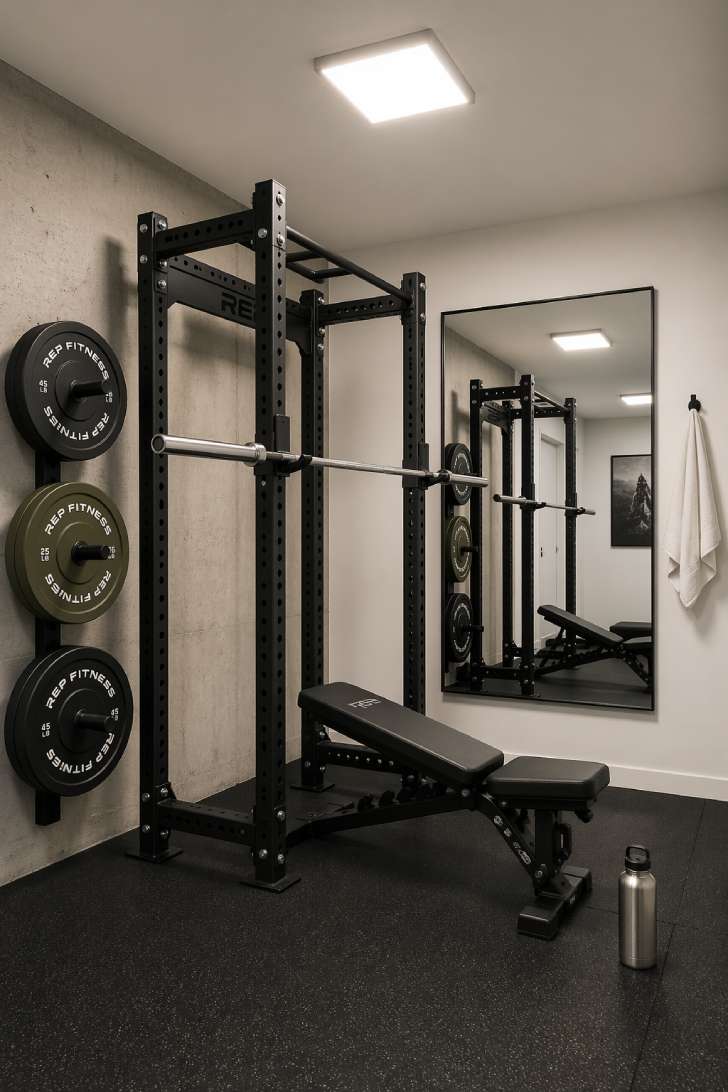
There’s something calming about a gym that has nothing extra in it.
A squat rack, a barbell, an adjustable bench, and a set of plates — that’s all you need to cover squats, bench presses, rows, overhead presses, and deadlifts.
The reason this setup works so well from a visual standpoint is the negative space.
When a room has open floor and clear sightlines, your brain reads it as organized and inviting rather than cluttered and stressful.
The wall-mounted plate storage is doing real work here — it keeps weight off the ground and turns the equipment itself into a display.
Rubber roll flooring over concrete keeps things quiet, protects the slab, and adds a finished feel without a renovation.
This is the garage gym alternative that lives inside your house.
Style Blueprint:
- Squat rack or power rack in matte black
- Olympic barbell and bumper plate set
- Adjustable flat-to-incline bench
- Rubber roll flooring (3/8″ to 3/4″ thick)
- Wall-mounted plate tree and barbell holder
The Compact Small-Space Setup
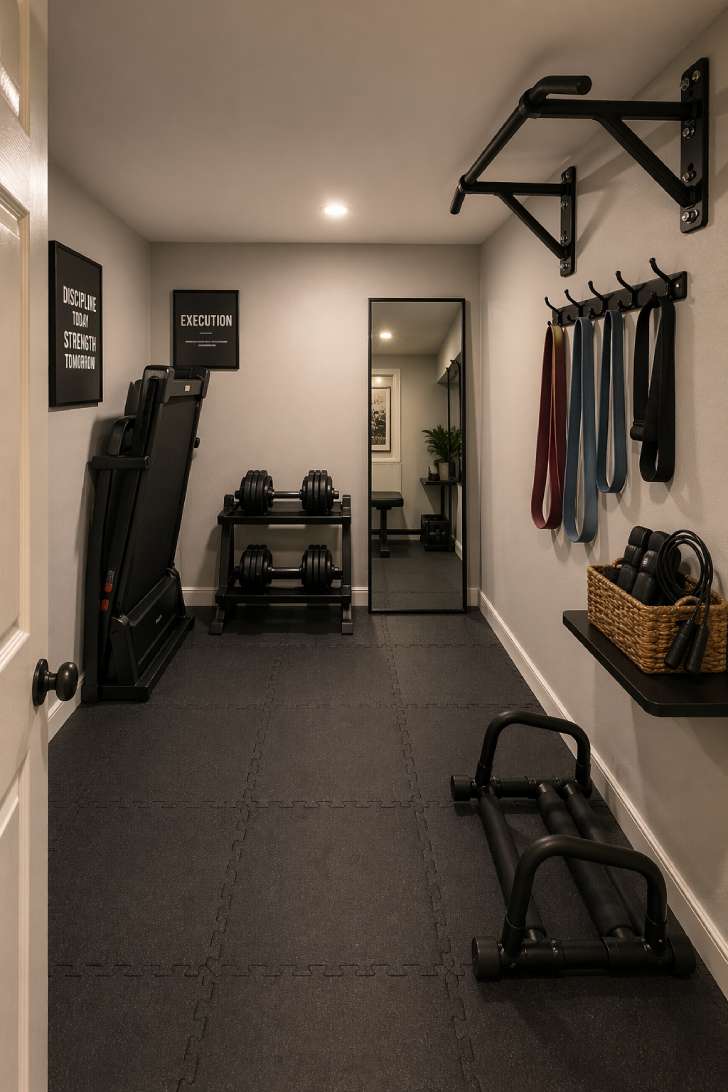
You don’t need a huge room.
The American Council on Exercise says 50 to 200 square feet is enough for a multi-purpose workout space, and this layout proves it.
The secret is choosing equipment that folds, stacks, or mounts to the wall.
Adjustable dumbbells replace an entire rack.
A foldable treadmill leans flat against the wall when you’re done.
Resistance bands hang from hooks and take up zero floor space.
When every item has a home, the room feels twice its actual size.
The mirror is doing psychological heavy lifting here — it creates depth in a tight room, bounces light around, and lets you check form on every rep.
If your basement workout room measures less than 150 square feet, this is your blueprint.
Style Blueprint:
- Adjustable dumbbell set (like Bowflex SelectTech or PowerBlock)
- Foldable treadmill or compact elliptical
- Wall-mounted pull-up bar
- Interlocking foam floor tiles
- Full-length wall mirror
The Low-Ceiling Training Room
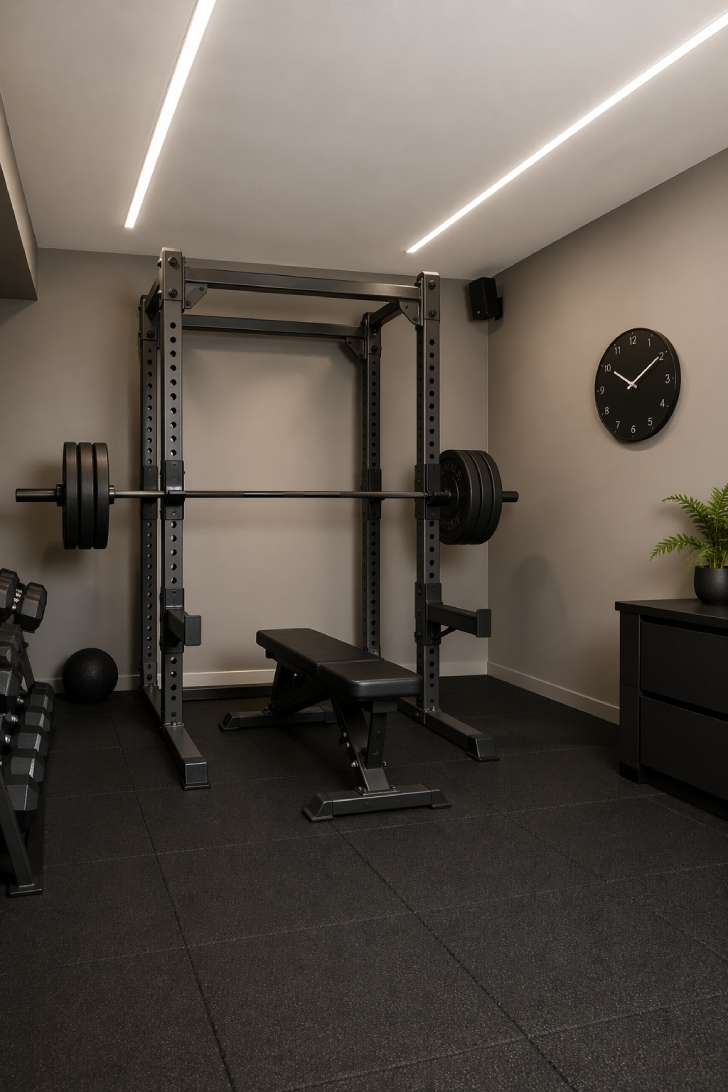
Low ceilings are the most common challenge in a basement gym, and most basements sit at 7 feet or just above.
That’s tight, especially if you’re tall.
The fix isn’t to skip strength training — it’s to choose the right equipment and the right movements.
Short-profile racks (72 inches and under) fit comfortably under a 7-foot ceiling.
Landmine presses, seated dumbbell presses, floor presses, deadlifts, and rows all work perfectly without any overhead clearance issues.
From a visual standpoint, painting the ceiling white and mounting lights flush to the surface keeps the room from feeling like it’s closing in on you.
Low ceiling gym setups actually benefit from horizontal emphasis — keep your eye drawn along the walls, not up.
That’s why wall-mounted accessories and a long mirror work better here than anything hanging from above.
Style Blueprint:
- Short-profile power rack (72″ or under)
- Landmine attachment for angled pressing
- Flush-mount or recessed LED strip lighting
- Low-profile adjustable bench
- Dark rubber tile flooring
Design Pro-Tip: If your basement has a drop ceiling, check what’s above the tiles before you accept the height as final. Many drop ceilings hide 18 to 24 inches of usable space. Removing the tiles and painting the exposed joists, pipes, and ductwork matte black gives you an industrial look and reclaims precious headroom for your gym.
The Cardio-First Basement
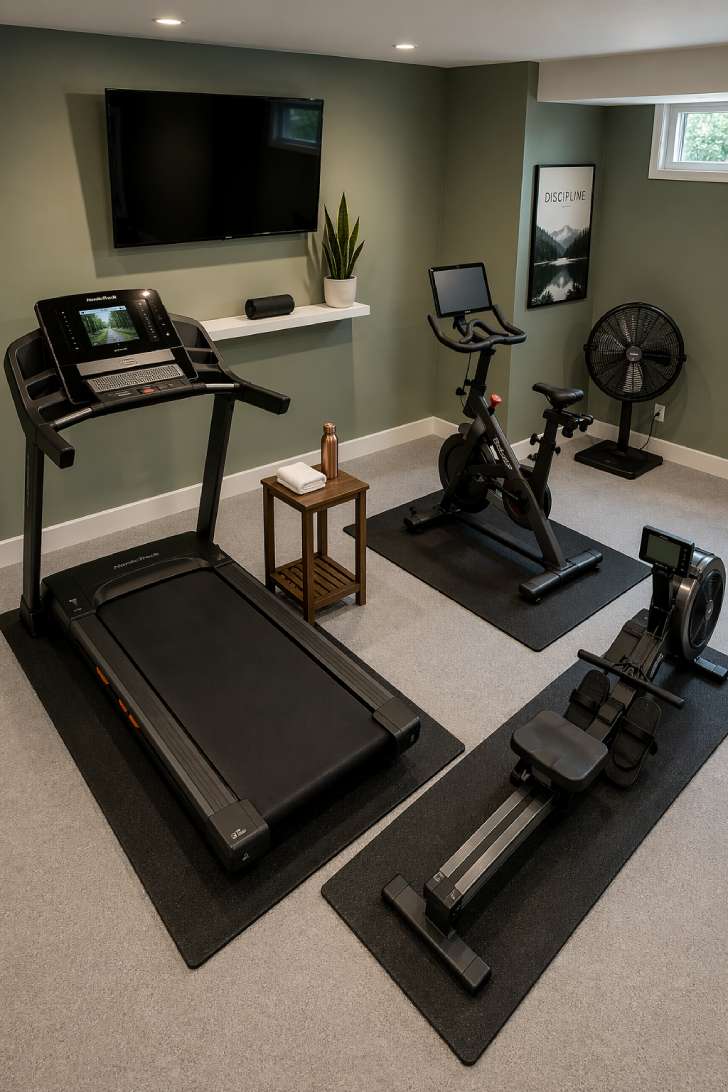
Some people don’t want to lift. They want to run, ride, or row.
A cardio-focused basement gym layout works best when each machine has its own rubber pad underneath for vibration control and noise reduction.
Treadmills are the loudest option — ellipticals and stationary bikes run much quieter if you share walls with living spaces above.
The TV is the anchor here.
Mounting it across from the main cardio machine turns a 45-minute session from a grind into something you actually look forward to.
Streaming a class on Peloton or Apple Fitness+ gives the space a studio feel.
The sage green walls aren’t random — cooler tones bring a sense of calm and endurance, which is exactly what you want for longer training sessions.
Style Blueprint:
- Treadmill, stationary bike, or rowing machine
- Thick rubber pads under each machine
- Wall-mounted TV for streaming workouts
- Oscillating fan or ceiling fan for airflow
- Cool-toned wall paint (sage, soft blue, or gray)
The Full Zoned-Out Gym
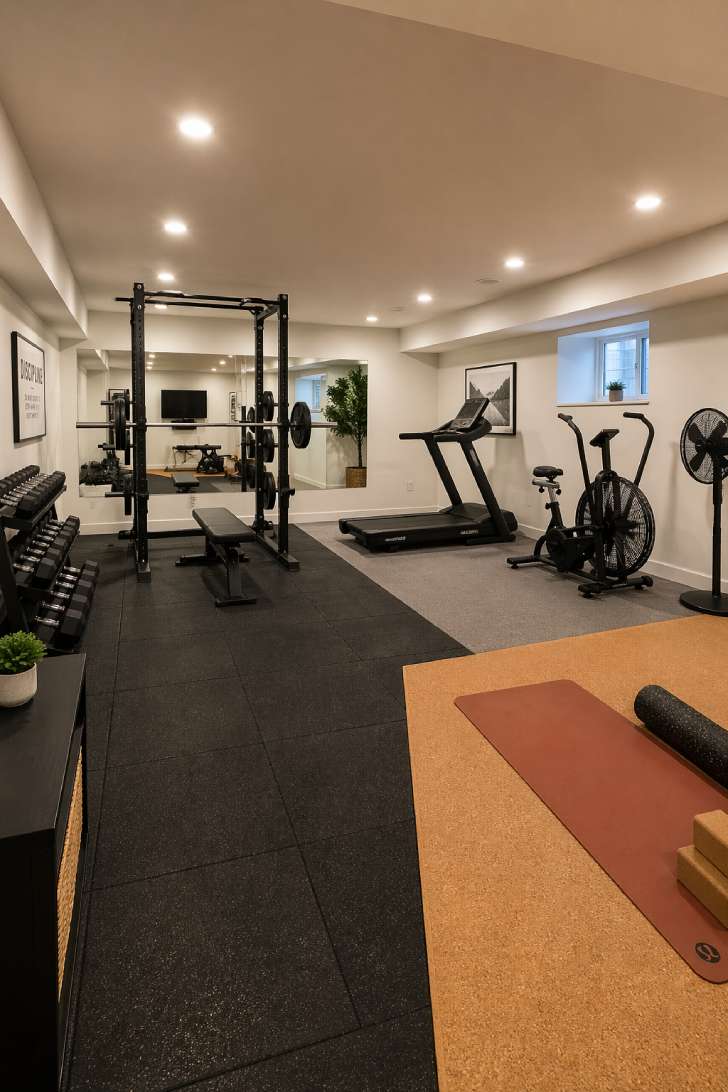
When you have the square footage, zone it.
Separate areas for strength, cardio, and stretching or yoga make a basement gym feel more like a commercial facility and less like a storage room with equipment in it.
The trick is using flooring changes to define each zone instead of walls or dividers.
Thick black rubber under the rack, lighter gray under the cardio machines, and a softer cork or foam surface in the stretching corner.
Your brain reads these material shifts as distinct rooms, even though the space is wide open.
Heavier equipment goes against the walls for stability.
The center of the floor stays clear for movement.
This is the basement gym layout that grows with you — start with one zone and add the others over time.
Style Blueprint:
- Two to three different flooring materials to define zones
- Power rack and dumbbell area against a wall
- Cardio machines near ventilation and outlets
- Yoga mat and foam roller in a quiet corner
- Full-wall mirror behind the strength zone
The Yoga and Recovery Corner
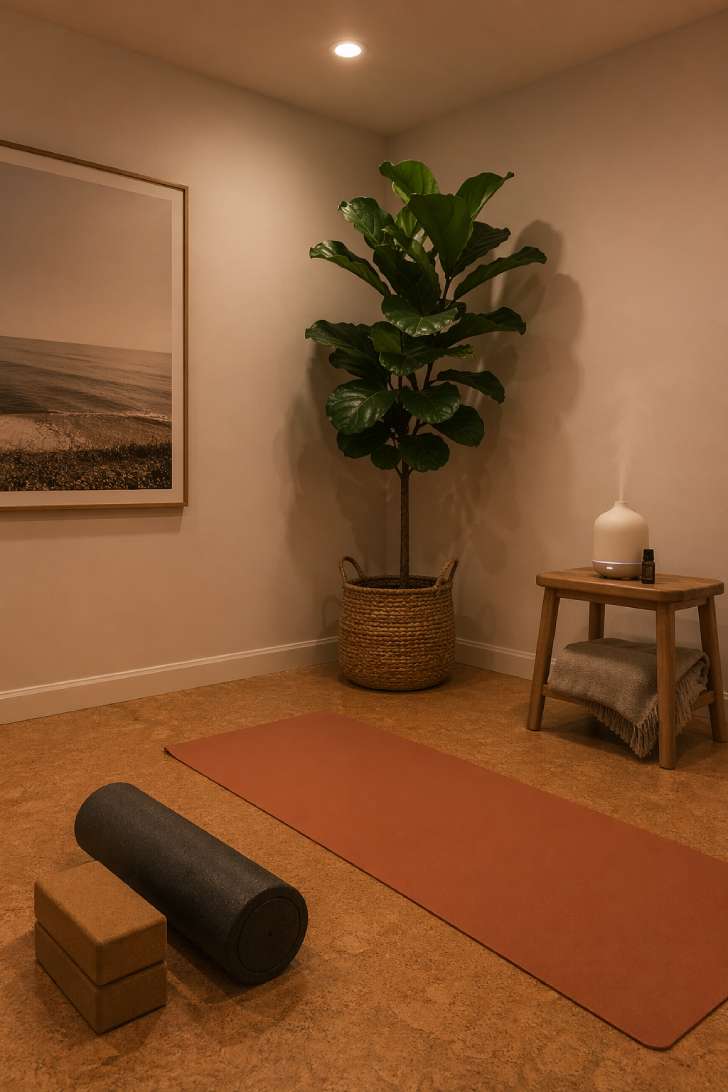
Not every square foot of your gym needs to feel aggressive.
A recovery corner, even a small one, gives the room a softer visual counterpoint to the workout area.
You can use it for stretching, cooling down, or simply creating a more comfortable transition between training and the rest of your day.
Warm materials like cork and linen introduce softer textures that contrast with metal equipment, rubber flooring, and other harder gym finishes.
Dimmable lighting helps define the corner visually.
Bright overhead lighting keeps the entire room feeling active, while softer illumination makes the recovery area feel more separate and relaxed.
If you train hard, it helps to have a dedicated place to wind down.
This corner takes up less than 64 square feet and costs almost nothing to put together.
Style Blueprint:
- Cork tile flooring
- Quality yoga mat, foam roller, and yoga blocks
- Dimmable warm-tone LED recessed light
- Potted plant in a natural-fiber basket
- Essential oil diffuser on a small wooden stool
Design Pro-Tip: The U.S. EPA recommends keeping indoor relative humidity below 60 percent and ideally between 30 and 50 percent when possibleAbove that, metal equipment rusts, rubber flooring breaks down faster, and mold becomes a real problem. Run a dehumidifier in your basement gym and check it with a hygrometer — especially during warmer months when moisture climbs.
The Daylight-Bright Workout Room
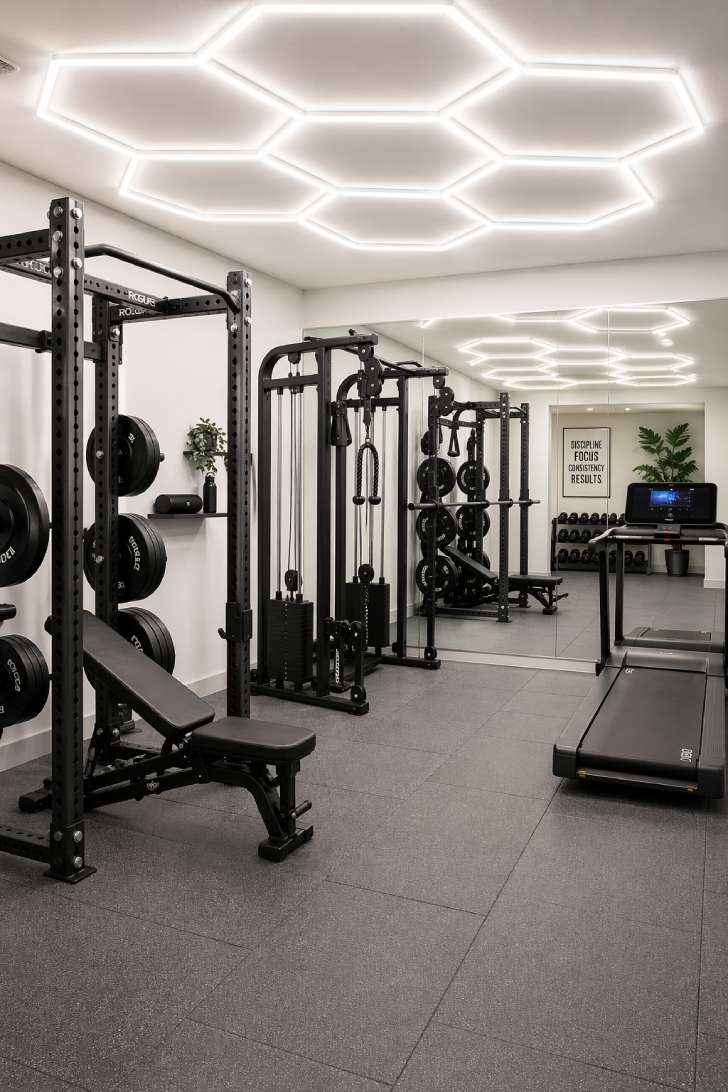
Basement gym lighting is the single biggest difference between a space you use every day and one you avoid.
Most basements come with one or two dim overhead bulbs, and that isn’t close to enough.
The target is 5000K color temperature, which mimics midday sunlight.
A limited palette and lower contrast give the room a quieter visual character.
For a 300-square-foot room, you need roughly 24,000 lumens total — that’s far more than standard residential fixtures deliver.
Modular hexagonal LED panels have become popular for home gyms because they spread light evenly across dozens of small bars instead of blasting it from one or two points.
The full-wall mirror isn’t just for form checks — it doubles the perceived light in the room by reflecting it back.
Pair white walls with bright LEDs and a mirror, and a windowless basement stops feeling underground.
Style Blueprint:
- Modular hexagonal LED ceiling panels (5000K)
- Full-wall gym mirror
- Bright white wall paint
- Medium gray rubber tile flooring
- Wall-mounted wireless speaker
The Soundproofed Lifting Den
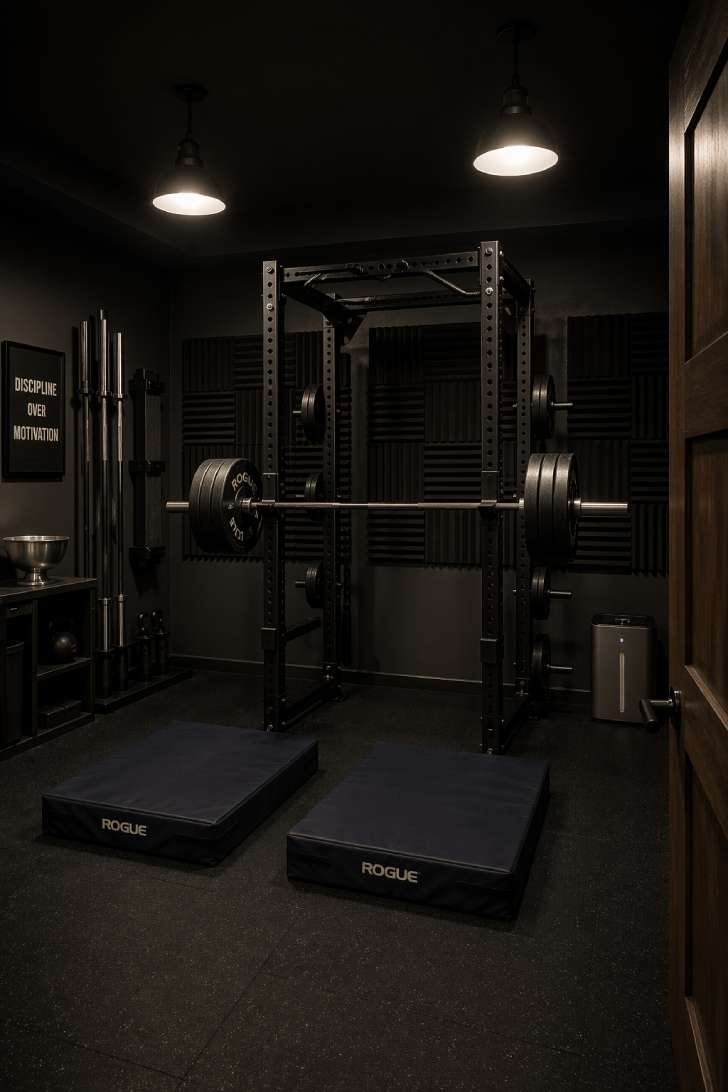
If you train early or late, gym soundproofing isn’t optional — it’s the thing that keeps the peace in your house.
Dropping a loaded barbell sends vibrations straight through the concrete slab and up into the floors above.
Thick rubber flooring is your first defense.
Three-quarter-inch rubber mats absorb a lot of impact, and adding crash pads under the deadlift area catches the rest.
Acoustic foam on the walls reduces airborne noise — the clanking, the grunting, the music.
A solid-core door with weatherstripping blocks far more sound than a hollow interior door.
The dark color palette here isn’t accidental.
Darker rooms with warm light create a cocoon-like focus that’s perfect for heavy training — your attention narrows, distractions disappear, and the only thing left is the next set.
Style Blueprint:
- 3/4-inch rubber mat flooring
- Acoustic foam panels on shared walls
- Crash pads or deadlift platform
- Solid-core door with weatherstripping
- Warm-tone pendant or shop lights
The Budget Build Under $500
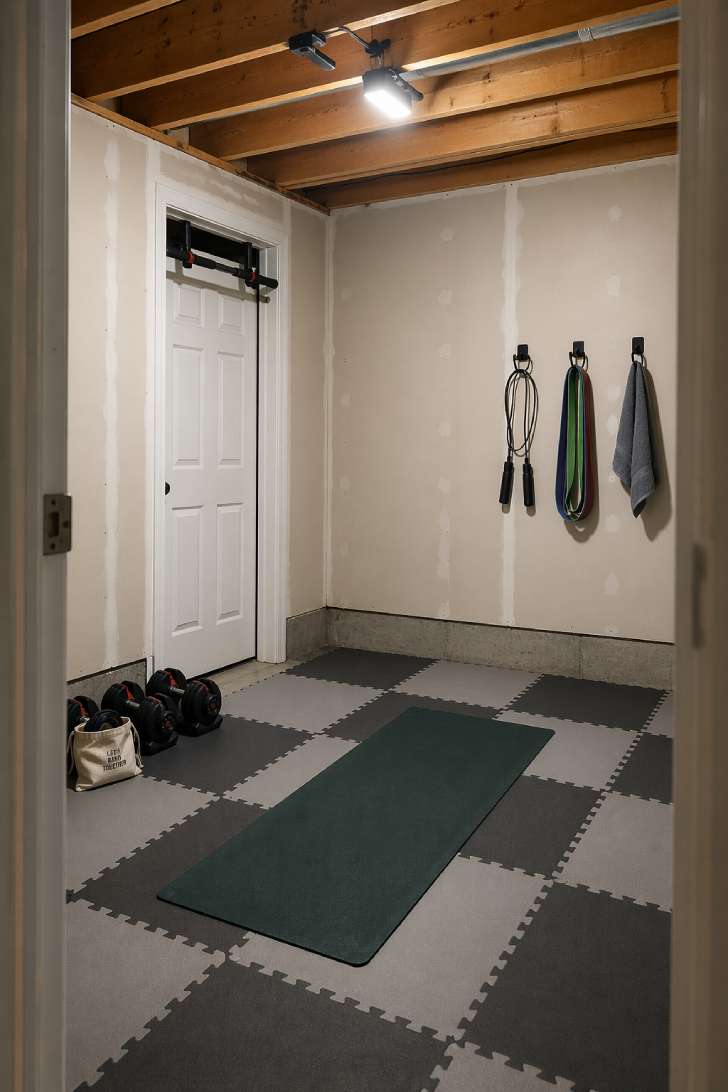
Let’s be honest — you don’t need to spend thousands.
Adjustable dumbbells run $80 to $150 secondhand on Facebook Marketplace.
A resistance band set with a door anchor costs about $30.
A doorway pull-up bar is $25 to $40.
A yoga mat, $15.
EVA foam interlocking tiles to cover a 10-by-10 area, around $40 to $60.
That’s a complete home fitness setup for well under $500, and you can hit every major muscle group with it.
The secondhand market is loaded with barely-used equipment from people who bought too much during the pandemic.
A budget gym still needs light, a clip-on LED throws enough brightness to make a dim basement usable.
Start here. Add later.
Style Blueprint:
- Adjustable dumbbells (new or secondhand)
- Resistance band set with door anchor
- Doorway pull-up bar
- EVA foam interlocking floor tiles
- Clip-on LED shop light
Design Pro-Tip: Before you lay any flooring, check your basement for moisture. Look for white powdery residue on the concrete (that’s efflorescence), stains, or musty smells. Fix water issues first. Laying rubber or foam over a wet slab traps moisture underneath and creates mold. A moisture barrier sheet beneath your flooring adds cheap insurance.
The Smart Tech Gym
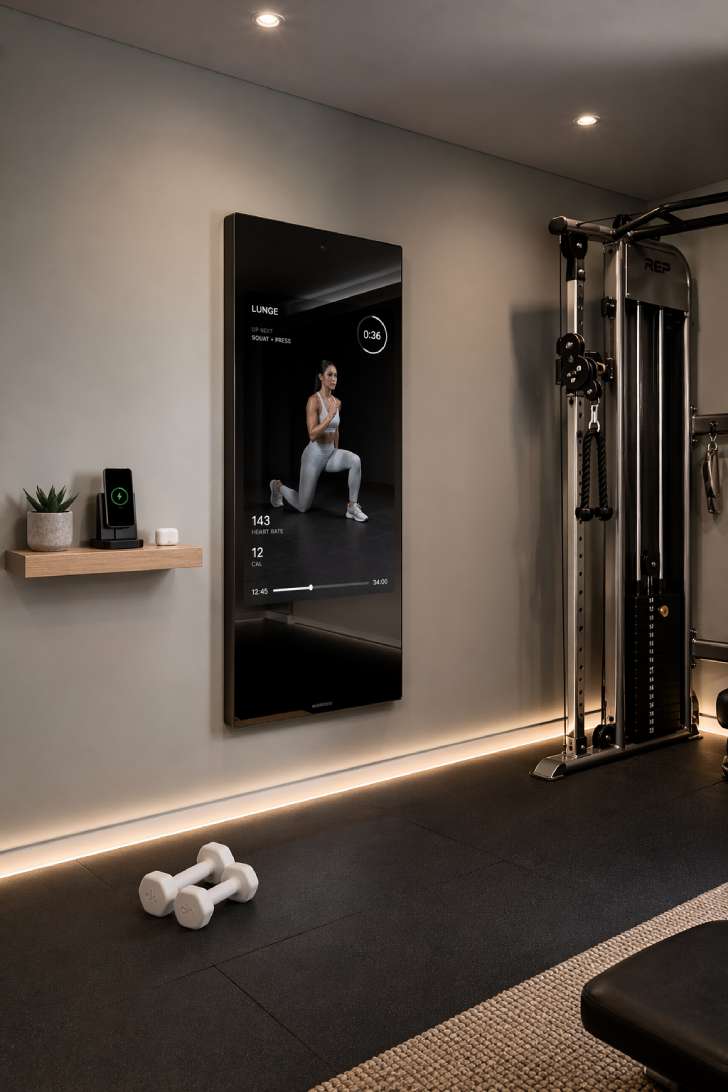
A smart fitness mirror turns a blank wall into a full workout studio.
It streams guided classes, tracks your reps, and reflects you back so you can check form — all in one screen.
If you pair it with a Bluetooth speaker and a wall-mounted TV, you’ve got a setup that rivals any boutique studio membership.
Ambient LED strip lighting along the base of the walls isn’t just aesthetic.
It adds warmth and depth to a room that would otherwise feel clinical, and it lets you soften the mood for recovery sessions or yoga.
The trick with a tech-heavy gym is restraint.
Hide the cables. Mount things to the wall. Keep the floor clear.
When the technology disappears into the room instead of dominating it, the space feels calm and intentional rather than cluttered.
Style Blueprint:
- Smart fitness mirror (Lululemon Studio, Tempo, or similar)
- Wall-mounted TV with streaming apps
- Bluetooth speaker system
- LED strip lighting along baseboards
- Wireless phone charger on a floating shelf
The HIIT and CrossFit Box
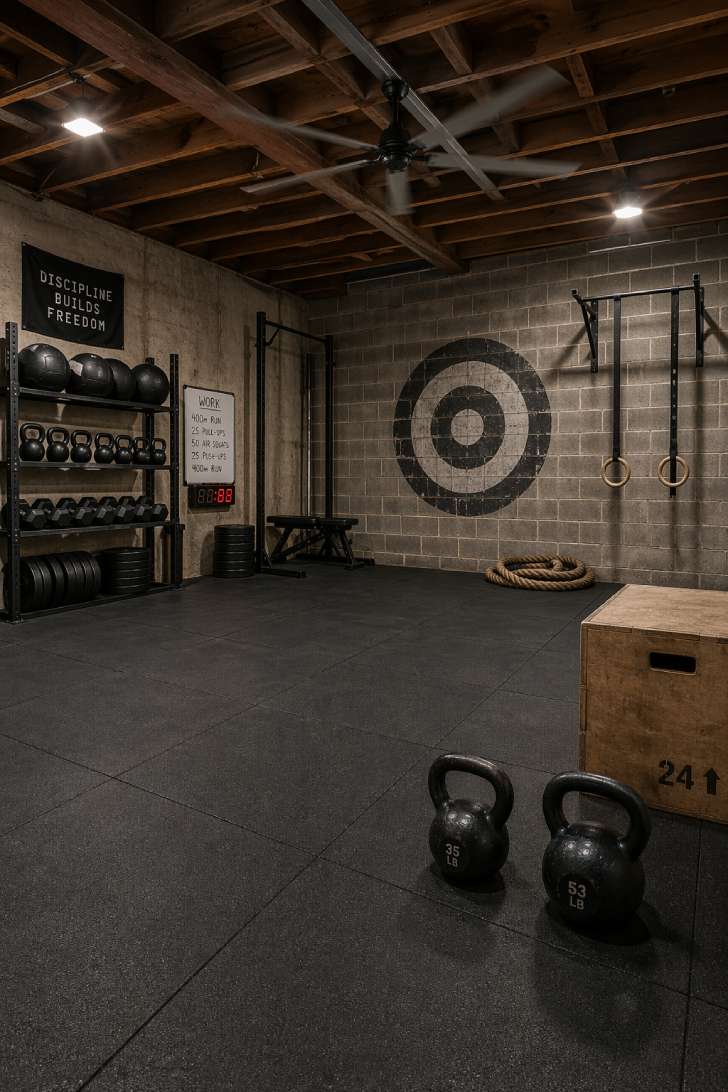
This one’s not pretty. That’s the point.
HIIT and CrossFit-style training need one thing above everything else — open floor.
An 8-by-8-foot clear area is the minimum for burpees, box jumps, kettlebell swings, and battle rope slams.
Bigger is better if you have it.
High-density rubber flooring is non-negotiable here.
The impacts are hard, the equipment gets dropped, and thin foam won’t survive.
Ventilation matters more in this type of training than any other — you’re breathing hard and generating a lot of heat.
A ceiling fan or a large box fan near a window (if you have one) keeps the air moving.
Without airflow, a basement turns into a sauna within minutes of a hard circuit.
Style Blueprint:
- High-density rubber tile flooring (3/4″ minimum)
- Plyo box, kettlebells, and battle rope
- Wall-mounted pull-up bar with gymnastic rings
- Industrial ceiling fan or high-velocity box fan
- Open floor space (8×8 feet minimum)
The Unfinished Raw Gym
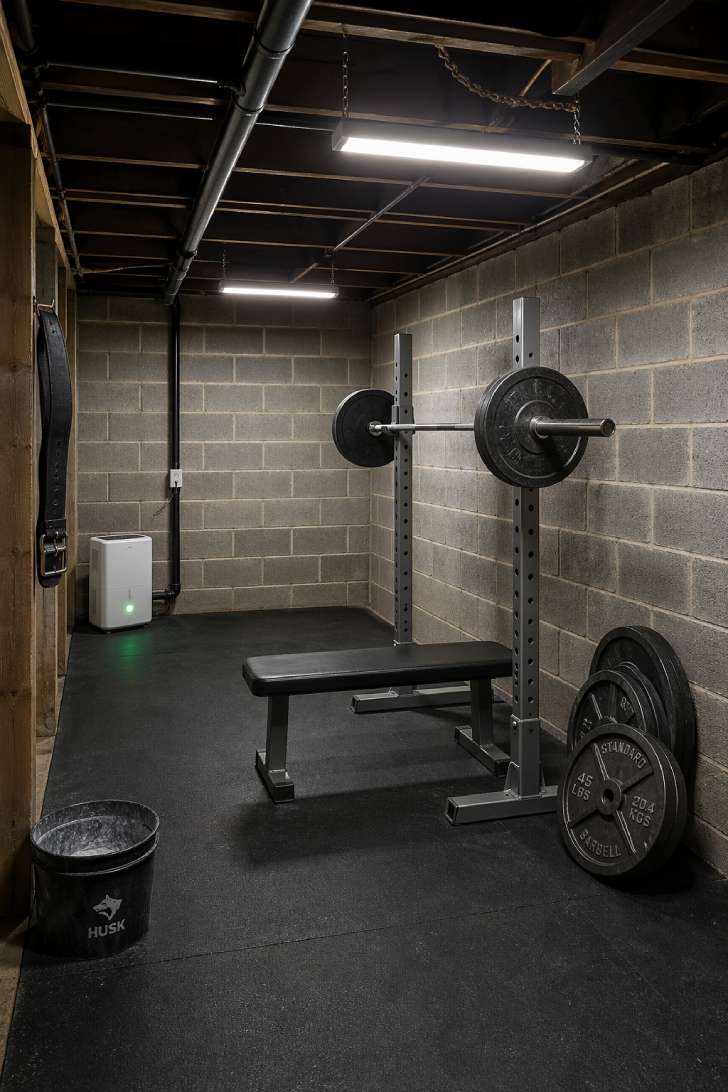
Not every gym needs a renovation budget.
Unfinished basements — exposed studs, bare concrete, visible pipes — can become a perfectly functional workout room with very little money.
Horse stall mats from a farm supply store are the best-kept secret in home gym flooring.
They’re 3/4-inch thick rubber, absurdly durable, and they cost a fraction of branded gym flooring per square foot.
Painting the exposed joists and ductwork matte black gives the space an intentional industrial look instead of an “I haven’t gotten around to finishing this” look.
Two LED shop lights hanging from the joists cost about $30 total and throw more than enough brightness for safe training.
A dehumidifier keeps the air dry and protects your equipment from rust — and in an unfinished space with no climate control, it’s a must.
This is the garage gym alternative for people who don’t have a garage.
Style Blueprint:
- 3/4-inch horse stall mats
- Squat stand and barbell set
- LED shop lights (2-pack)
- Matte black paint for exposed joists and ductwork
- Portable dehumidifier
Design Pro-Tip: Your basement gym needs enough electrical outlets to handle cardio machines, a TV, speakers, fans, and a dehumidifier — all without running extension cords across the floor. If your basement is short on outlets, have an electrician add a couple of dedicated circuits. It’s a small investment that prevents tripping hazards and blown breakers.
The Family-Friendly Multi-Use Room
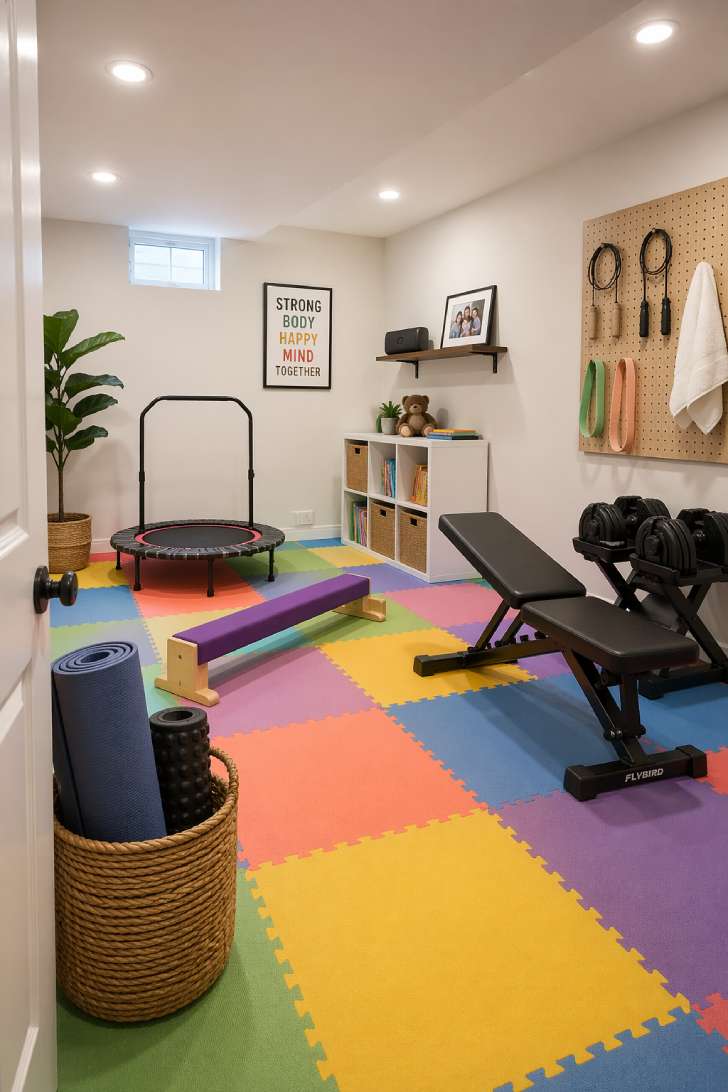
A gym that doubles as a family room gets used more than one that doesn’t.
Thick foam tile flooring is soft enough for kids to play on and cushioned enough for bodyweight exercises.
Foldable equipment — a collapsible bench, a treadmill that folds flat — stores against the wall in minutes and opens the floor up for other uses.
The pegboard is the unsung hero of this setup.
Hooks at different heights hold everything from jump ropes to resistance bands to towels, keeping the floor clear and the gear accessible for every member of the family.
A small basement gym like this works best when it feels inviting, not intimidating.
Warm paint colors, a family photo on the wall, and a Bluetooth speaker playing music turn it into a room that kids and adults want to be in.
Style Blueprint:
- Thick interlocking foam tile flooring
- Foldable adjustable bench
- Pegboard with hooks for bands, ropes, and towels
- Adjustable dumbbells in a compact rack
- Bluetooth speaker on a floating shelf
The Serious Powerlifting Dungeon
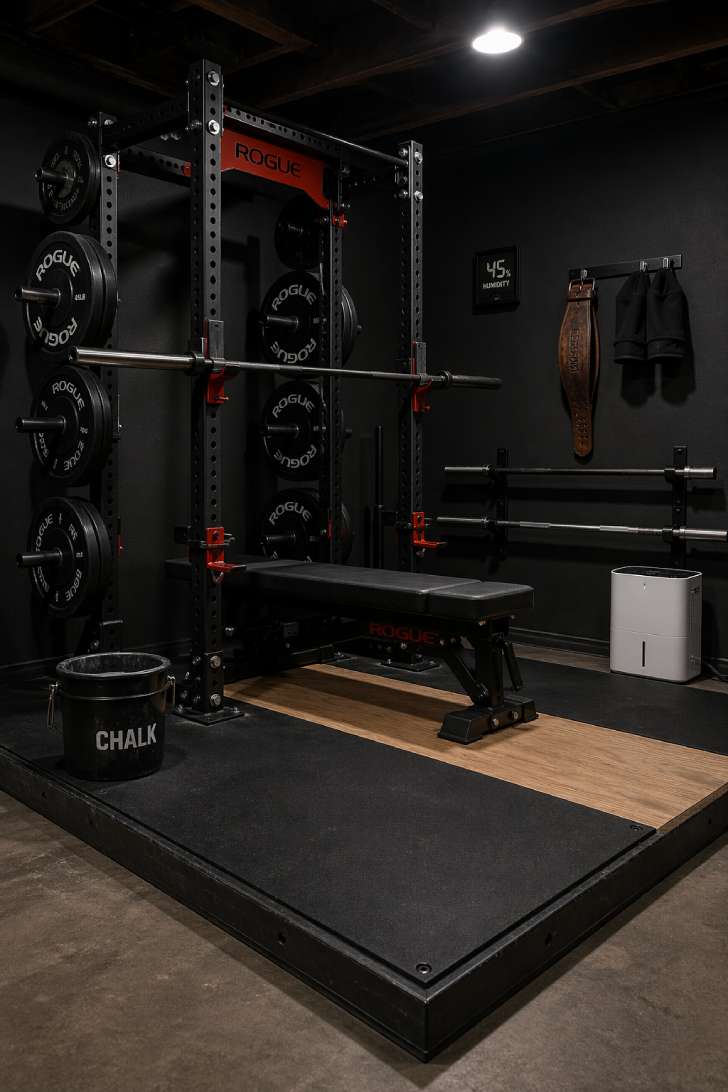
This room has one purpose, and everything in it reflects that.
A competition rack bolted to the concrete floor, a stiff power bar, a dedicated deadlift bar, and a platform built for heavy pulls.
The deadlift platform is worth building yourself — a sheet of plywood with horse stall mats on top absorbs impact from dropped barbells and protects the concrete underneath.
Bumper plates are the right call in a basement setting because they’re designed to be dropped without cracking the floor or shaking the house to pieces.
Chalk, a belt, knee sleeves, and barbell wall mounts — that’s the accessory list. Nothing else.
Rust is the enemy in a serious lifting room.
A dehumidifier running constantly and a hygrometer on the wall keep humidity in the 40% to 50% range, which protects every piece of metal in the room.
Style Blueprint:
- Competition power rack (bolted to floor)
- Deadlift platform (plywood + horse stall mats)
- Bumper plates and competition barbell
- Wall-mounted barbell holders
- Dehumidifier and hygrometer
The Motivation-Focused Showpiece
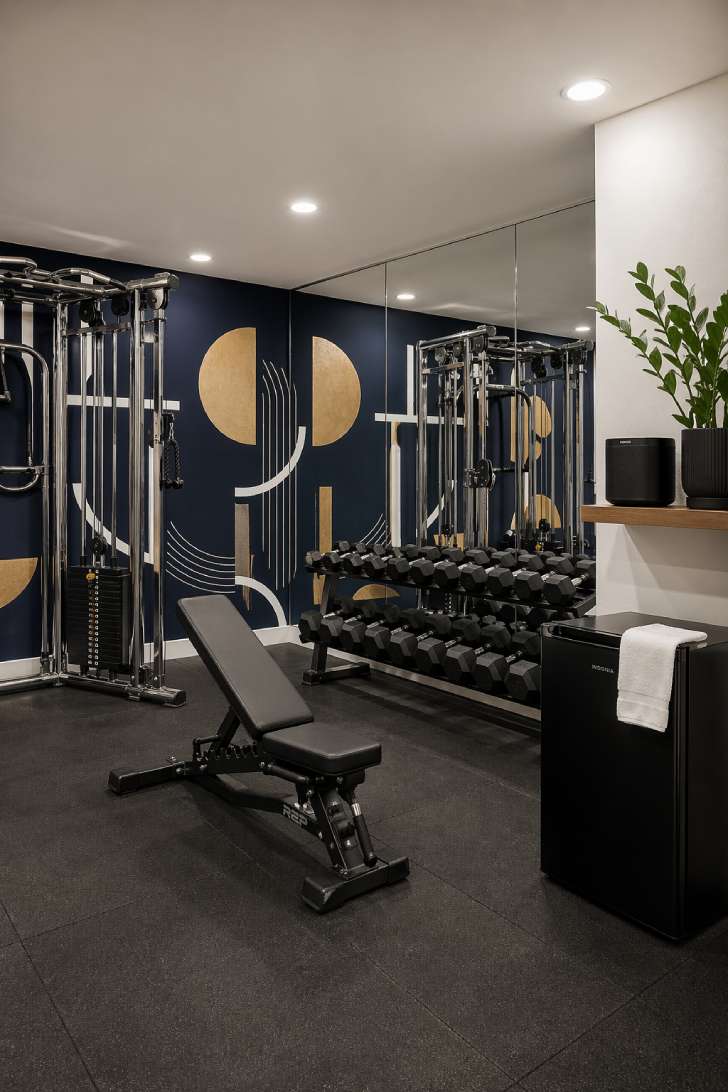
A gym you love looking at is a gym you’ll actually use.
This one treats the workout room like any other room in the house — with a color story, intentional decor, and a layout that feels curated rather than haphazard.
The accent wall is doing most of the emotional work.
Color affects how you feel in a space, and deep navy paired with metallic accents reads as confident and energizing without being overly aggressive.
The full-wall mirror opposite the accent wall reflects the mural, the light, and the equipment — creating visual depth that makes a basement feel like a ground-floor studio.
Every piece of equipment has a place. Nothing sits randomly on the floor. The mini fridge keeps water within arm’s reach.
This is the basement gym that gets shown off to visitors.
And it should — the best workout space is the one that makes you want to train.
Style Blueprint:
- Bold accent wall in a deep color (navy, charcoal, or forest green)
- Full-wall gym mirror on the opposite wall
- Coordinated equipment finish (all black, all chrome, or mixed metals)
- Mini fridge for water and drinks
- Floating shelf with speaker and plant
Design Pro-Tip: Ventilation is the thing most people forget. Basements don’t get natural airflow, and a hard training session fills the room with heat and moisture fast. If you have a window, crack it and put a fan next to it for cross-ventilation. No windows? A ceiling fan plus a portable air purifier with a HEPA filter keeps the air moving and clean.
Wrapping Up
You don’t need a perfect space to build a great basement gym.
You need a plan, the right flooring, decent light, and equipment that matches how you actually train.
Start with one idea from this list that fits your budget and your square footage, and build from there — the best home gyms grow over time, one piece at a time.