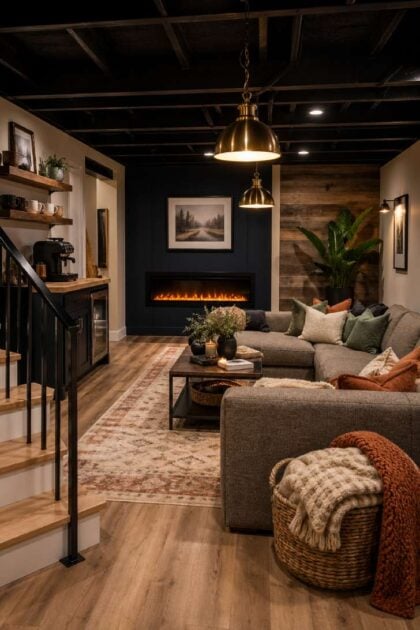
This post may contain affiliate links. If you make a purchase through these links, we may earn a commission at no additional cost to you.
Most basements share the same reputation.
Cold air, low ceilings, zero natural light, and that faint musty smell that clings to everything. It’s no wonder so many people treat the space as a glorified storage locker.
But here’s the thing: that cool, dark, tucked-away quality is exactly what makes a basement perfect for a cozy retreat. You just have to work with it instead of against it.
These 15 cozy basement design ideas show you how to pull that off, with image inspiration for every single one.
Warm Light, Layered Everywhere
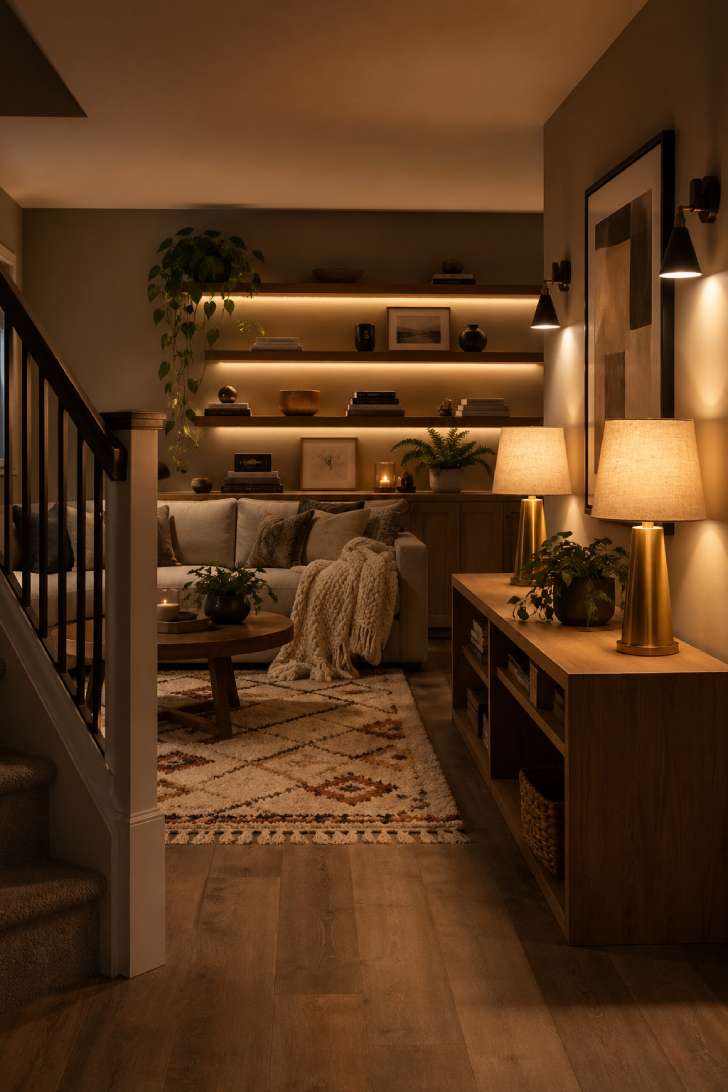
One overhead fixture does more harm than good in a basement. It flattens everything. Shadows disappear, depth vanishes, and the room starts to feel like a waiting room at a dentist’s office.
The fix is simple but the effect is dramatic: scatter your light sources across different heights and corners of the room.
A floor lamp near the reading chair. A pair of table lamps on the console. Sconces mounted at eye level. Maybe a strip of LEDs tucked behind a shelf where you’d never expect it.
When light comes from several directions at once, your brain reads the space as warm and safe.
It mimics the way firelight or late-afternoon sun fills a room, hitting surfaces at angles and creating pockets of brightness and shadow.
That variety is what makes a room feel alive rather than flat.
Stick to bulbs around 2700K.
That’s the warm end of the spectrum, the color of an incandescent bulb. Anything cooler and a windowless basement starts feeling like a fluorescent office.
Dimmable switches give you even more control. Morning coffee brightness is a different mood than Friday movie night, and the same room should be able to do both.
Style Blueprint:
- Warm-toned table lamps with linen or fabric shades (2700K bulbs)
- Wall-mounted sconces at eye level
- LED strip lighting for under-shelf or behind-furniture glow
- Dimmer switches on every circuit
- A floor lamp with an adjustable arm near seating
A Fireplace Without the Chimney
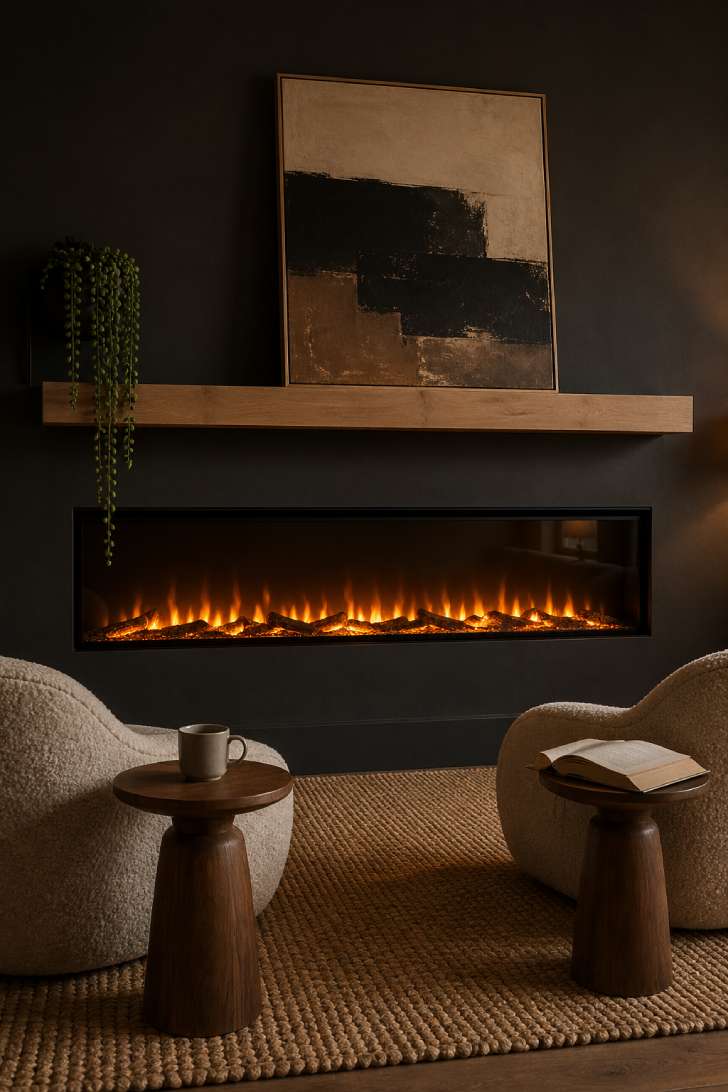
Nothing changes the feel of a room faster than visible fire.
An electric fireplace basement setup is one of the smartest moves you can make below grade, because you don’t need venting, a gas line, or a chimney. You plug it in and it works.
Modern units have come a long way from those cheap orange-ribbon inserts from the early 2000s. The realistic ones now use LED and holographic tech that genuinely fools the eye from across the room. Some produce enough heat to take the edge off a cold basement, which is a practical bonus on top of the visual warmth.
There’s a reason humans have gathered around fire for thousands of years. Even when the flame is simulated, your nervous system responds to it. The flickering light. The warm color. Your shoulders drop a little. You settle in.
Wall-mounted linear models look especially good in a basement because they sit low and wide, drawing the eye horizontally and making the room feel broader.
Style Blueprint:
- Linear wall-recessed electric fireplace (realistic flame setting)
- Floating mantel shelf in natural wood above the unit
- Two low armchairs angled toward the fireplace
- A thick jute or wool rug to anchor the seating area
- One piece of oversized art leaning on the mantel
Deep, Moody Walls That Lean Into the Dark
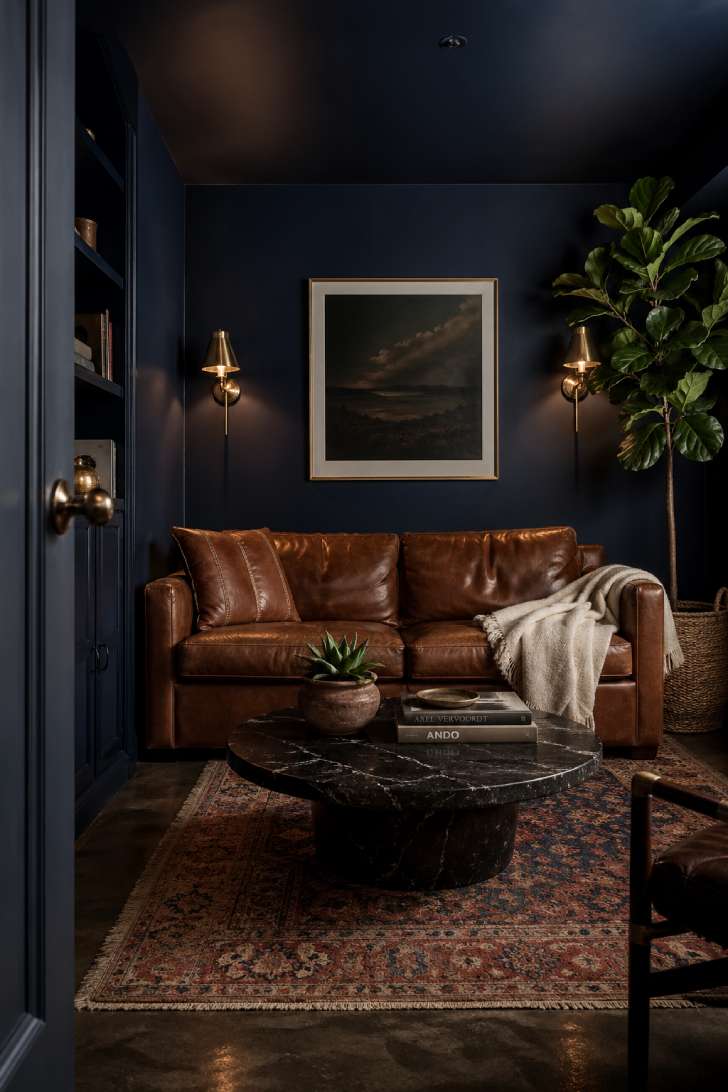
The instinct with a dark basement is to fight the darkness. Paint everything white, bounce light around, try to pretend there’s a window somewhere.
It rarely works. Stark white under artificial light in a below-grade room just looks cold and unfinished, like a space that isn’t done yet.
Going dark is counterintuitive, but it’s more effective. A coat of deep green, navy, charcoal, or terracotta on the walls tells the room to be what it already is: a den. A cocoon. Somewhere enclosed and protected.
Your brain processes enclosed, warm-toned spaces as safe. It’s why people gravitate toward the booth in the corner of a restaurant rather than the table in the middle of the room. Dark basement color schemes tap into that same instinct.
When you pair deep walls with warm metallic accents, like brass or gold-toned lighting, the light bounces off the metal and creates small points of brightness against the dark backdrop. That contrast is what gives the room its character.
Style Blueprint:
- Matte-finish paint in navy, deep green, charcoal, or terracotta
- Brass or gold-toned sconces or light fixtures
- A deep-seat leather sofa in cognac or saddle brown
- An antique or vintage rug in complementary warm tones
- One large-scale plant in a woven or terracotta planter
The Sectional That Swallows You Whole
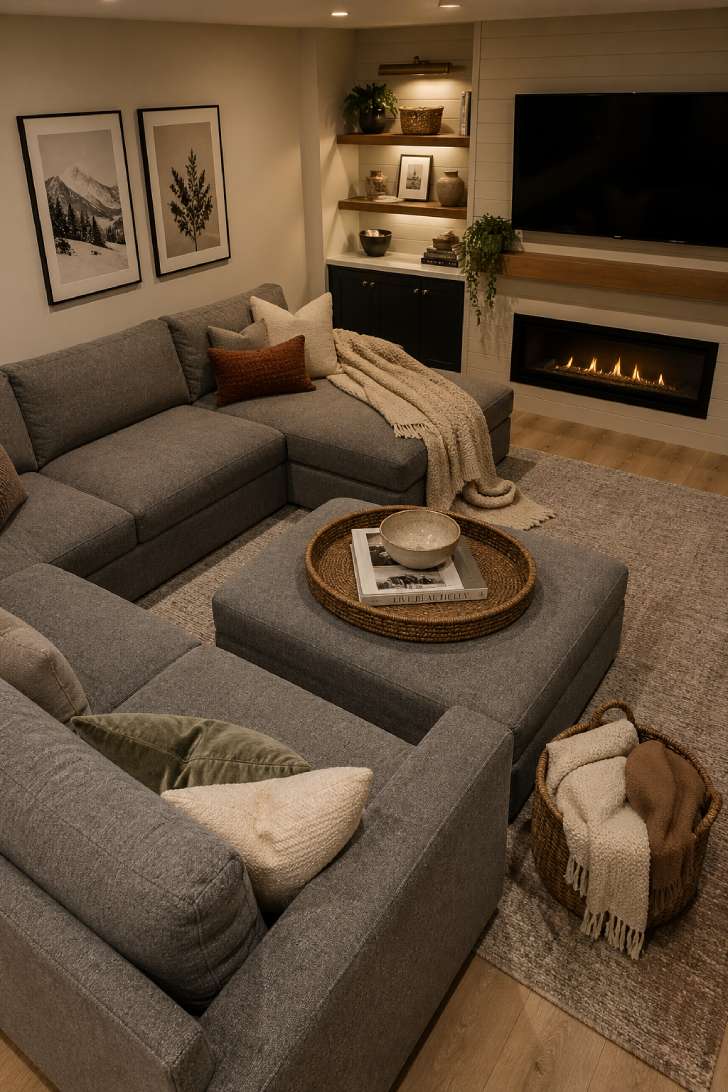
Size matters in a basement lounge. This isn’t the place for a loveseat and two accent chairs arranged around a coffee table like a furniture showroom.
An oversized sectional with deep seats and soft cushions tells everyone who walks downstairs that this room is for sinking in and staying put.
If your ceiling height is under eight feet, go with a lower-profile frame. A sofa that sits closer to the ground makes the distance between the seat and the ceiling feel more generous. It’s a visual trick, but it works.
The throw blanket basket isn’t just decoration, either. Basements stay cooler than the rest of the house year-round, even in summer. Having a blanket within arm’s reach turns that chill into a feature. People wrap up, get comfortable, and suddenly the cool air is part of the appeal.
An ottoman that doubles as storage gives you a place to stash remotes, board games, or extra pillows without cluttering the room.
Style Blueprint:
- Deep-seat U-shaped or L-shaped sectional in a neutral performance fabric
- 5-7 throw pillows in mixed textures (velvet, linen, knit, boucle)
- A chunky knit or woven throw blanket
- A woven basket stocked with additional blankets
- An upholstered storage ottoman
Design Pro-Tip: When choosing a sectional for a low ceiling basement, measure the back height of the sofa, not just the seat depth. Anything over 34 inches will start to crowd the room visually. Look for frames in the 28-32 inch range. Your ceiling will thank you.
Flooring That Handles the Worst and Still Looks Good
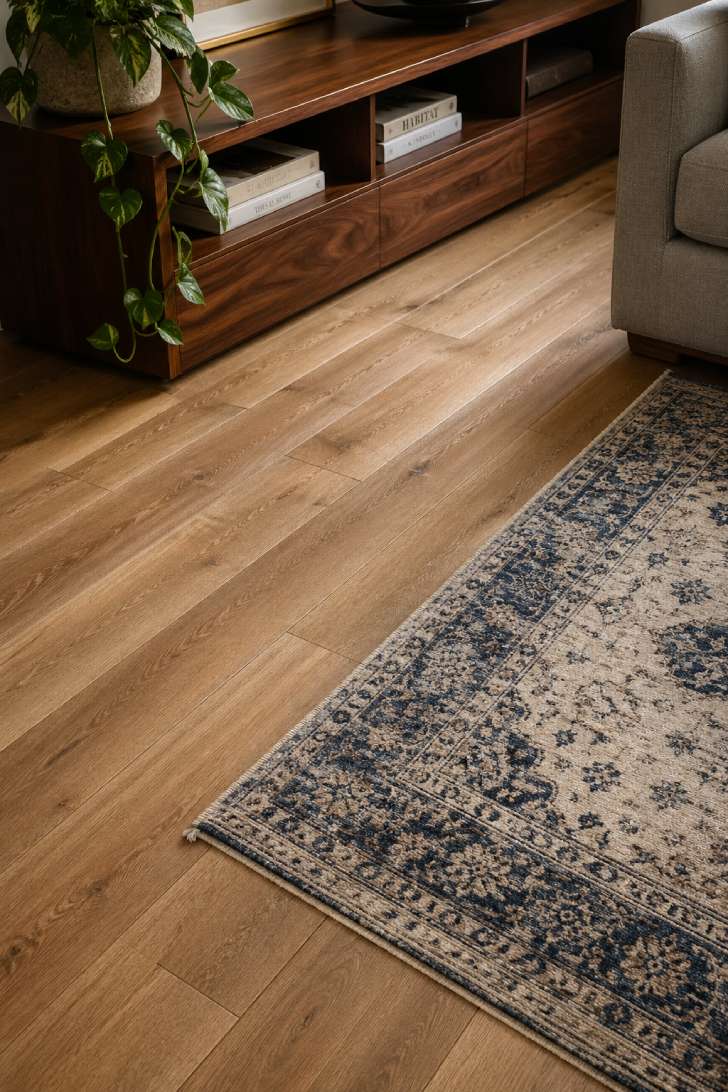
Basements and moisture have a complicated relationship. Even well-sealed foundations can see humidity spikes or the occasional water event, so any flooring you install needs to handle that reality.
Luxury vinyl plank has become the default recommendation for basement flooring options, and for good reason. It’s waterproof, it feels warmer underfoot than tile or polished concrete, and the better brands mimic real hardwood convincingly enough that most people can’t tell the difference at a glance.
Carpet tiles deserve a mention here too. They’re softer and warmer than any hard surface, and the modular design means you can pull up and replace a single damaged tile instead of tearing out an entire floor. If the basement floods, you lose a few tiles, not the whole room.
Layering area rugs on top of hard flooring is where the real coziness comes in. A thick wool or cotton rug defines a seating area, adds texture, and gives your feet something soft to land on when you step off the couch. It also helps with sound absorption, which matters more than most people realize underground.
Style Blueprint:
- Wide-plank luxury vinyl in a warm wood tone (honey oak, weathered walnut)
- A large low-pile wool area rug to anchor the main seating zone
- Carpet tiles in a neutral tone for secondary zones (play areas, hallways)
- Felt furniture pads under all heavy pieces
- A quality underlayment with moisture barrier beneath the LVP
The Painted Ceiling Trick
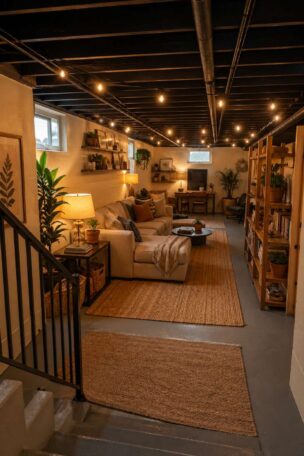
![ge 6] Alt text: A basement with a matte black painted exposed ceiling showing joists and ductwork, warm furnishings below, and brass pendant lights hanging down.](https://simplespaces.net/wp-content/uploads/cozy-basement-design-ideas-6.jpg "15 Cozy Basement Design Ideas That Banish the Cold Feel 6")
Finishing a basement ceiling with drywall is expensive and eats into headroom you probably can’t afford to lose. Drop ceiling tiles are the budget alternative, but they look exactly like what they are.
There’s a third option that’s become increasingly popular: leave everything exposed and spray it all one color.
When you paint the joists, ductwork, pipes, and conduit a single uniform black or dark gray, something interesting happens. The eye can’t distinguish individual elements anymore. Everything blends together and recedes upward, and the ceiling actually feels higher than it did before.
It reads as intentional rather than unfinished. Industrial rather than neglected.
The trick works best when the room below is furnished in warm, lighter tones. The contrast between the dark void above and the inviting space below creates visual depth that a flat white ceiling never could.
It’s also one of the cheapest low ceiling basement solutions available. A day of masking, a rented airless sprayer, and a few gallons of matte paint, and the job is done.
Style Blueprint:
- Matte black or dark charcoal spray paint for all exposed ceiling elements
- Pendant lights on long cords to bring light down from the dark ceiling
- Warm-toned furnishings below to create contrast
- Light-colored walls to keep the room from feeling cave-like
- Polished or sealed concrete floor in light gray as an optional complement
A Reading Corner That Earns Its Keep
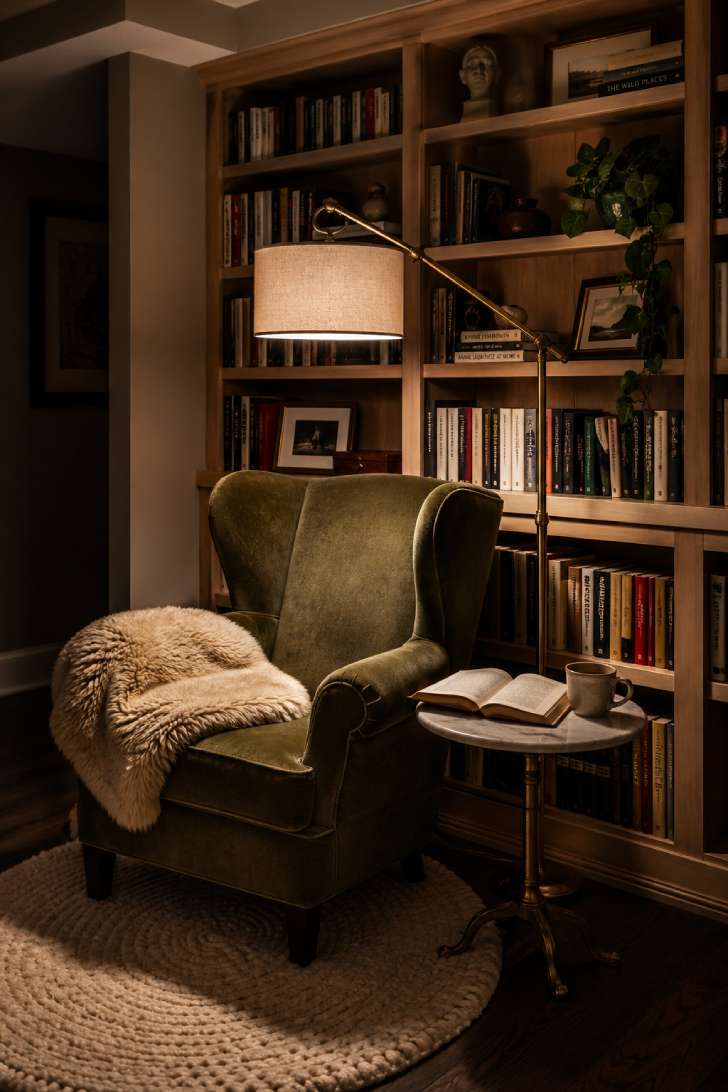
Not every corner of a basement needs to serve a group. Some of the coziest spaces are built for one person and a book.
A basement reading nook doesn’t demand much: a comfortable chair, a good lamp, a surface for your drink, and books within arm’s reach. That’s it. But getting each of those details right is what separates a reading corner from a chair shoved into an unused spot.
The chair should have a high back and generous arms. Wingback styles work especially well because they create a sense of enclosure around the reader, blocking peripheral distractions.
Lighting is non-negotiable here. A floor lamp with an adjustable arm that directs light downward onto the page is far better than relying on overhead light, which creates glare and shadows in all the wrong places.
And the bookshelves? They do more than hold books. A wall of filled shelves adds color, texture, and visual weight to a room. Books make a space look lived in and personal in a way that almost nothing else can.
Style Blueprint:
- A deep wingback armchair in a rich fabric (velvet, boucle, or heavyweight linen)
- An adjustable brass or matte black floor lamp with a fabric shade
- A small marble or wood side table at arm height
- Floor-to-ceiling built-in bookshelves on the nearest wall
- A sheepskin or chunky knit throw draped over one arm
The Basement Theater That Beats Any Living Room
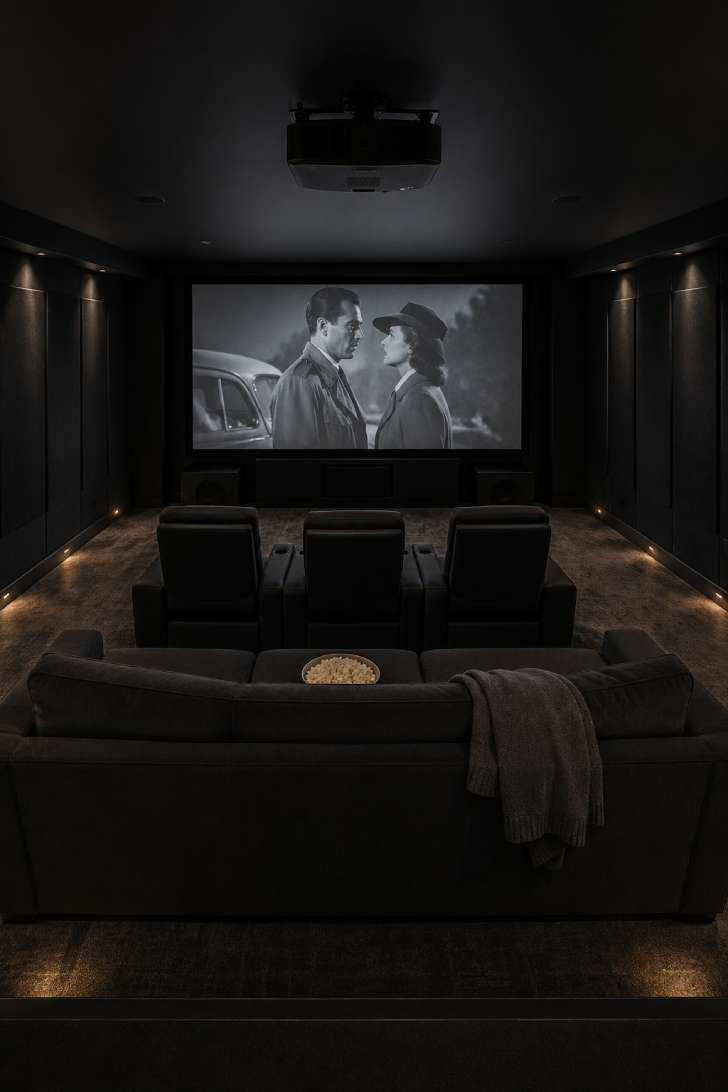
Basements were made for this.
Every quality that makes a basement lousy as a bedroom makes it perfect for a basement home theater setup. No windows to let in competing light. Thick walls and a concrete floor that contain sound. A separated location where a loud movie at midnight won’t wake anyone upstairs.
A projector and a 100- to 120-inch screen deliver a cinematic experience that no TV can match, and the prices have dropped enough that a solid 4K projector costs less than a high-end television.
Sound matters just as much as the picture. The enclosed concrete-and-wood structure of a basement actually helps here: bass response is naturally stronger in below-grade rooms. Acoustic panels on the walls, the fabric-covered kind that look like oversized art, tame echo and keep dialogue crisp.
For seating, dedicated theater recliners in the front row and a deep sofa on a low riser behind them give you two viewing tiers. The elevated back row means nobody’s head blocks anyone else’s view.
Style Blueprint:
- A 4K projector with a 100-120 inch fixed-frame screen
- Theater-style reclining seats (front row) and a deep sofa on a riser (back row)
- Fabric-wrapped acoustic panels on the side and rear walls
- Recessed amber floor lights along the aisles
- Matte black ceiling to eliminate light reflections
Design Pro-Tip: Mount your projector on the ceiling rather than placing it on a shelf behind the seating. Shelf-mounted projectors create a visible light beam at eye level that catches every head turn and hand gesture. Ceiling-mounted units throw the beam above everyone, and the image geometry is cleaner too.
A Coffee Bar That Gives the Basement a Social Center
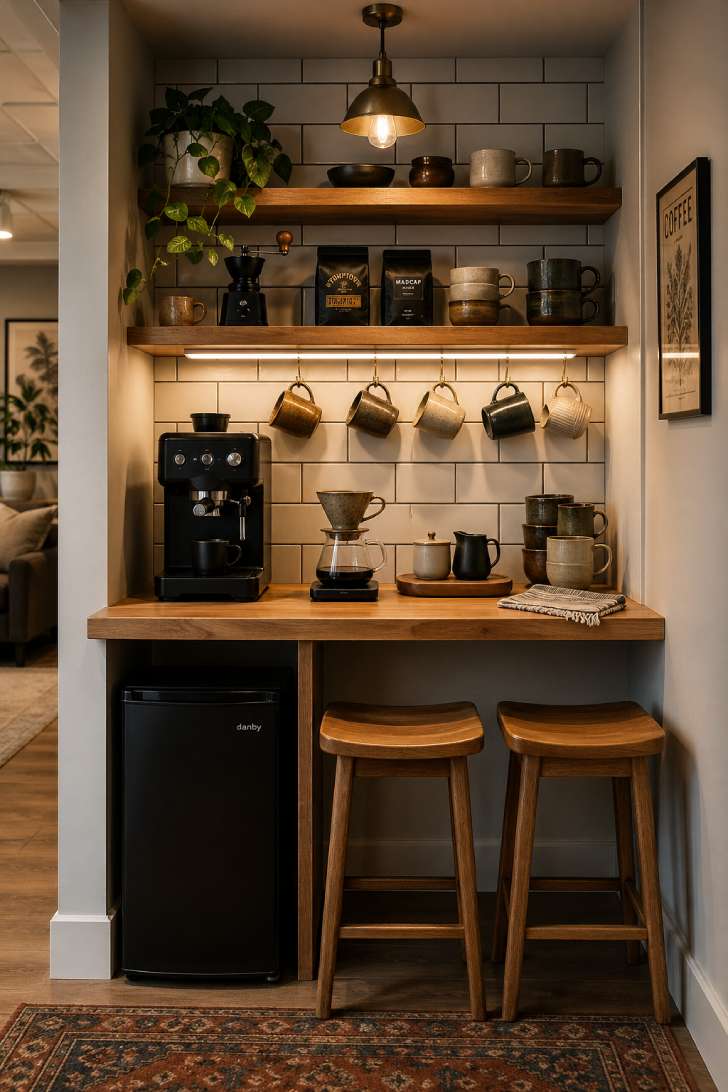
Every room benefits from a gathering point, a spot that gives people a reason to drift over and stay awhile. In a basement, a coffee bar or beverage station does exactly that.
It doesn’t need to be elaborate. A countertop, a mini fridge, some shelving for mugs and supplies, and a couple of stools create something that functions like a tiny cafe right in your home.
For families or anyone who doesn’t drink alcohol, a coffee bar version works perfectly. A decent espresso machine, a pour-over setup, mugs on hooks, and a small cabinet for beans and filters. It’s a destination rather than just a counter.
The positioning matters. Place it near the entry point of the basement, close to the stairs, so it’s the first thing people interact with when they come down. That establishes the space as social and welcoming before they even reach the main seating area.
Style Blueprint:
- A butcher-block or natural wood countertop (4-5 feet wide is plenty)
- A quality espresso machine or pour-over setup
- Floating shelves with brass mug hooks
- A compact mini fridge tucked under the counter
- Two backless stools for casual seating
Texture Overload, on Purpose
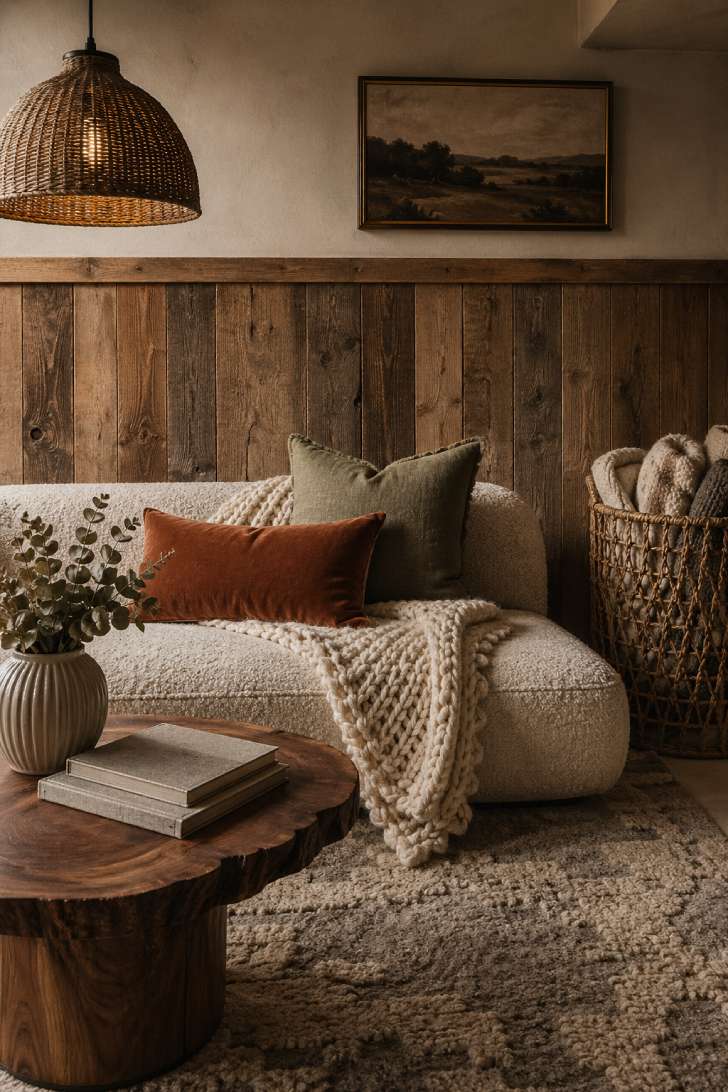
Smooth drywall, hard floors, and leather furniture create a room that looks clean but feels cold. Sound bounces off every surface. The air feels empty.
Texture is the antidote.
When you fill a room with different tactile qualities, something shifts. Woven baskets, knit blankets, nubby upholstery, rough wood, ribbed ceramics, heavy curtain fabric. Your eyes register the variety before your hands ever touch anything, and the room starts to feel warmer just by looking at it.
There’s a reason for this. Soft, irregular textures absorb sound and light rather than reflecting them. A room full of textured surfaces has a quieter, more muffled acoustic quality. Conversations feel more intimate. Music sounds warmer. Even silence feels different.
A basement accent wall in reclaimed wood adds one of the most powerful textures available. The visible grain, the knots, the variation in plank width and color all create visual warmth that painted drywall simply can’t match.
Style Blueprint:
- Boucle, velvet, or heavyweight linen upholstery on seating
- A chunky hand-knit throw in wool or cotton
- A reclaimed wood accent wall on one surface
- A thick hand-tufted or hand-knotted wool area rug
- Woven seagrass or rattan baskets and accessories
Reclaimed Wood on One Wall Changes Everything
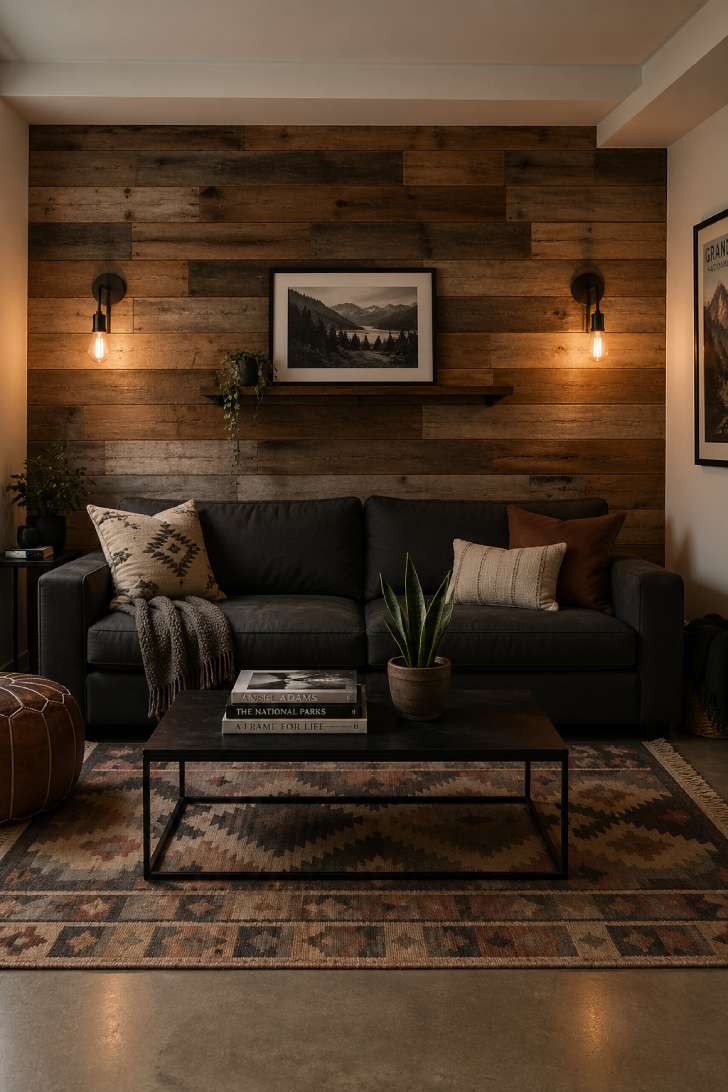
If you only do one thing to an unfinished basement wall, make it this.
A single basement accent wall in reclaimed wood, shiplap, or textured wood planks changes the entire character of a room. The rest of the walls can stay painted. It doesn’t matter. That one surface does all the heavy lifting.
Wood carries associations that run deep. Warmth. Shelter. Age. Something handmade and imperfect. A wall of planks with visible grain, nail holes, and color variation triggers all of those responses at once.
It pairs well with darker paint on the remaining walls if you want the den feel, or with soft white if you’re going for contrast. Either way, the wood becomes the anchor point of the room, the thing your eye goes to first.
Reclaimed material has the added benefit of being genuinely unique. No two planks look alike, and no two walls will ever match. That irregularity is what makes it feel real rather than manufactured.
Style Blueprint:
- Reclaimed wood planks in mixed natural tones for one focal wall
- Soft white or dark contrasting paint on the other three walls
- Wall-mounted sconces on or flanking the wood wall
- A low-profile sofa centered against the accent wall
- One floating shelf with a framed photo and a trailing plant
Design Pro-Tip: Before installing reclaimed wood on a basement wall, let the planks acclimate in the room for at least 48 hours. Basements have different humidity levels than the rest of the house, and wood that adjusts before installation is far less likely to warp or gap after it’s up.
Plants That Survive the Dark
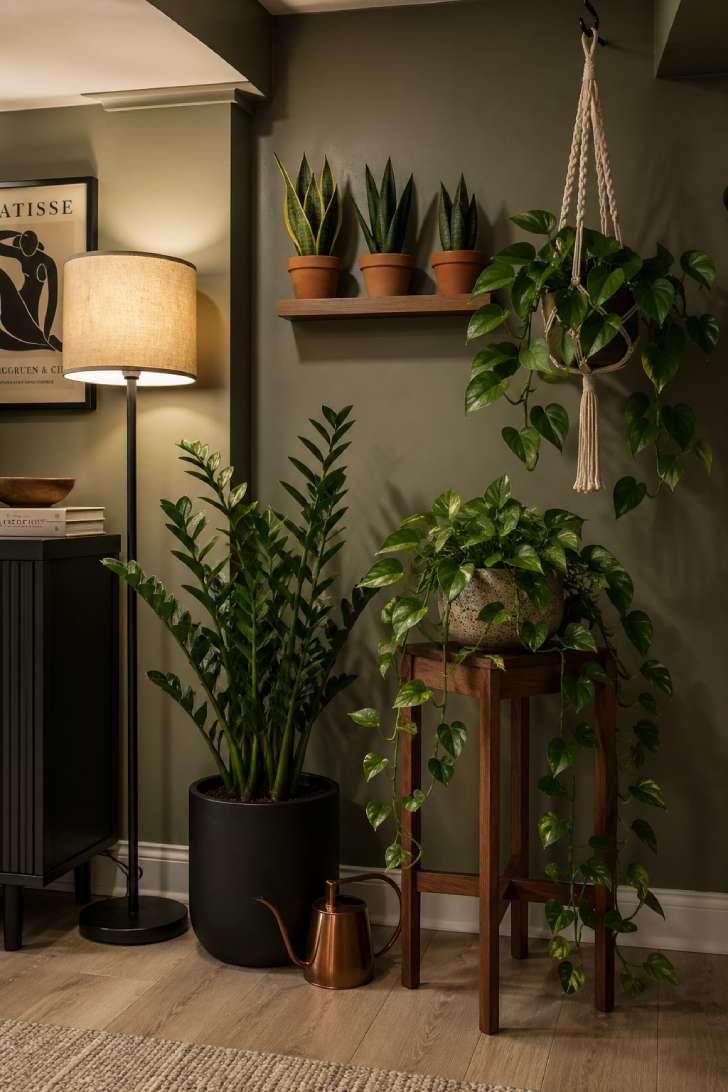
Greenery does something in a windowless room that no amount of decorating can replicate. It introduces life. Organic shapes. Color that shifts over time as leaves grow and turn.
The challenge, obviously, is light. Most houseplants want bright indirect sun, and basements don’t have it.
But a handful of species actually thrive in low-light conditions. Pothos will grow in almost anything, trailing its vines down from a shelf or hanging planter and filling a corner with green in a matter of months. Snake plants are nearly indestructible and tolerate dim conditions without complaint. ZZ plants, with their waxy, dark-green leaves, look sculptural and survive on neglect.
Grouping plants together at different heights creates a more impactful display than scattering them one by one around the room. A tall floor plant, a mid-height plant on a stand, and a trailing plant on a shelf or in a hanger gives you a layered arrangement that reads as intentional and lush.
Style Blueprint:
- A tall ZZ plant in a statement ceramic planter (floor level)
- A trailing pothos on a mid-height wooden plant stand
- 2-3 small snake plants on a floating shelf
- A macrame or ceramic hanging planter with a philodendron
- A grow light bulb in a nearby lamp if the basement is very dark
Zones That Give a Big Room Small-Room Warmth
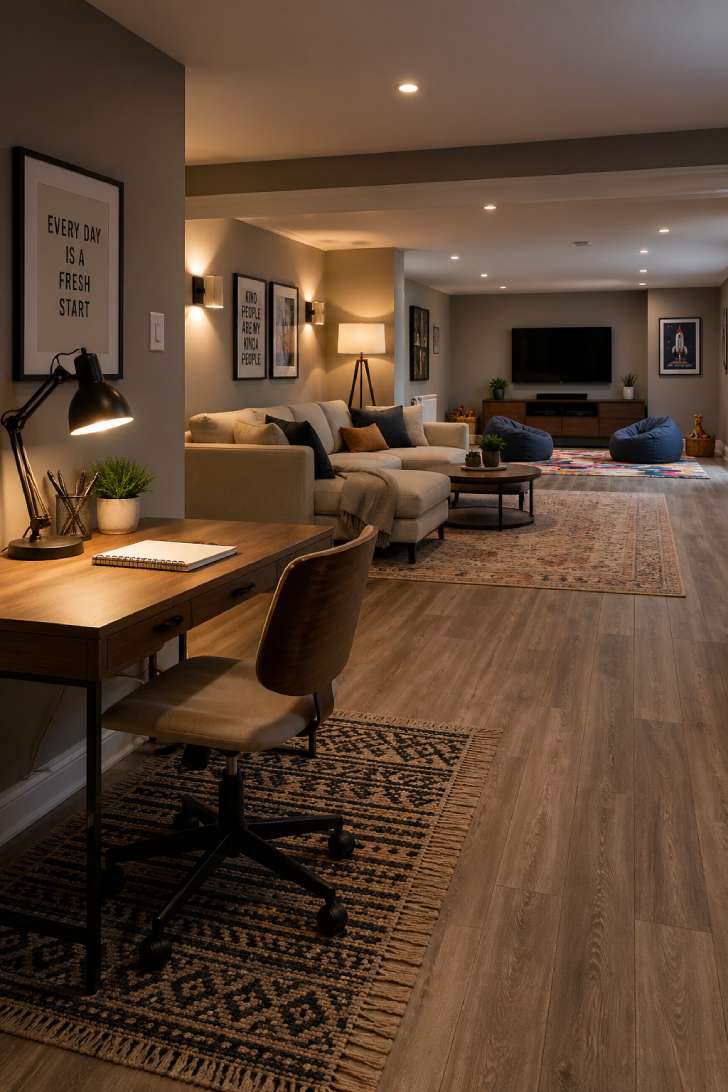
One big rectangular room feels like a gymnasium. Cozy is the opposite of that.
The answer isn’t building partition walls. It’s using basement furniture layout, rugs, and lighting to carve the open space into smaller pockets, each with its own purpose.
A large area rug beneath the sectional defines the lounge zone. A desk and task lamp in the corner become the workspace. A pair of beanbags on a colorful rug near the TV create a spot for kids.
Each zone gets its own lighting, and that’s the detail that really sells the separation. When the lounge has warm sconce light and the workspace has a bright focused task lamp, your brain reads them as two different rooms even though there’s no wall between them.
How you arrange the furniture determines whether a large open basement feels like a blank warehouse or a collection of cozy rooms that just happen to share a floor.
Style Blueprint:
- Distinct area rugs for each zone (different sizes, coordinating colors)
- A separate lighting source dedicated to each zone
- Furniture arranged to face inward within each zone
- One anchor piece per zone (sectional for lounge, desk for workspace, TV for media)
- A consistent wall color and flooring throughout to maintain cohesion
Curtains on Walls That Don’t Have Windows
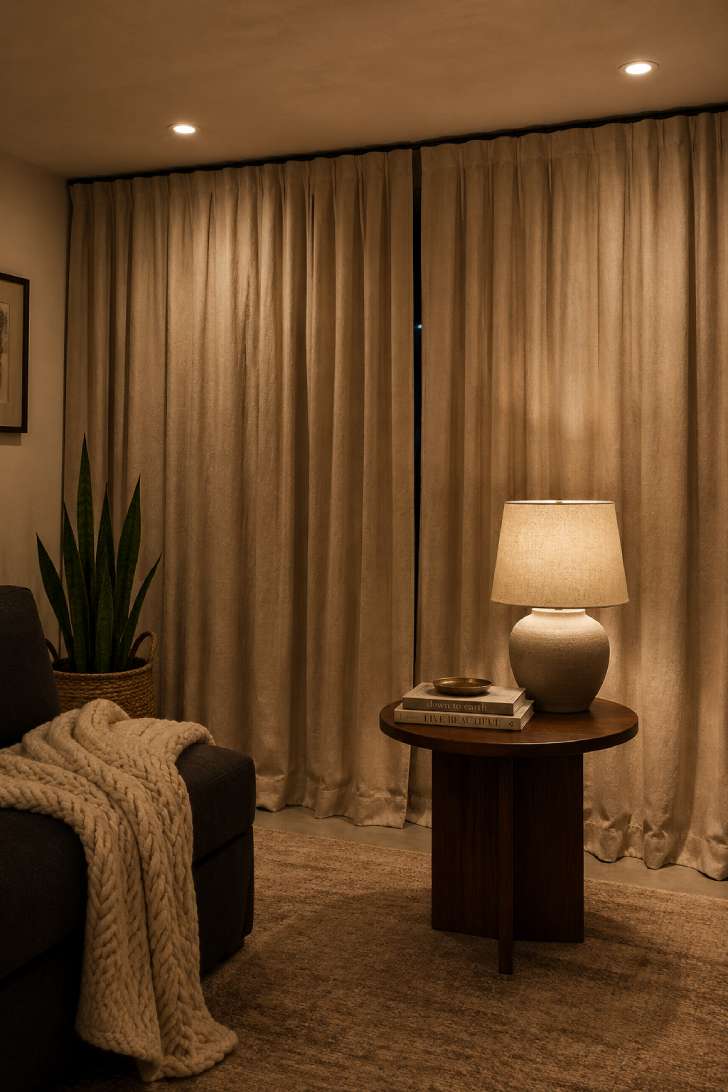
This one surprises people, but it works.
Hanging curtains on a wall that has no window behind it is purely a design move. The fabric softens the hard surface, absorbs sound, and adds a layer of visual warmth that paint alone can’t provide.
Floor-to-ceiling panels in a heavy natural linen or cotton make the wall feel taller. The vertical lines draw the eye upward, which is especially helpful in a low ceiling basement where every visual trick counts.
It also does wonders for acoustics. Hard parallel walls in a basement create echo. A curtain-covered wall breaks that reflection pattern and makes the room sound closer, quieter, more intimate.
Choose a warm neutral fabric. Natural flax, oatmeal, soft ivory. Something with visible texture and weight. Sheer curtains won’t do much here since there’s no light coming through. You want something that feels substantial when you run your hand across it.
Style Blueprint:
- Floor-to-ceiling linen or heavy cotton curtain panels in a warm neutral
- A ceiling-mounted curtain rod (matte black or brushed brass)
- Panels wide enough to cover the full wall with a slight gather
- A table lamp or sconce nearby to cast warm light across the fabric
- At least 8-foot rod height (mount as close to the ceiling as possible)
Design Pro-Tip: Hang your curtain rod so the panels just barely brush the floor rather than puddling on it. Puddled fabric looks luxurious in a bedroom but collects dust and moisture in a basement. A clean break at floor level keeps the look sharp and the fabric dry.
Dry Air Is the Invisible Foundation
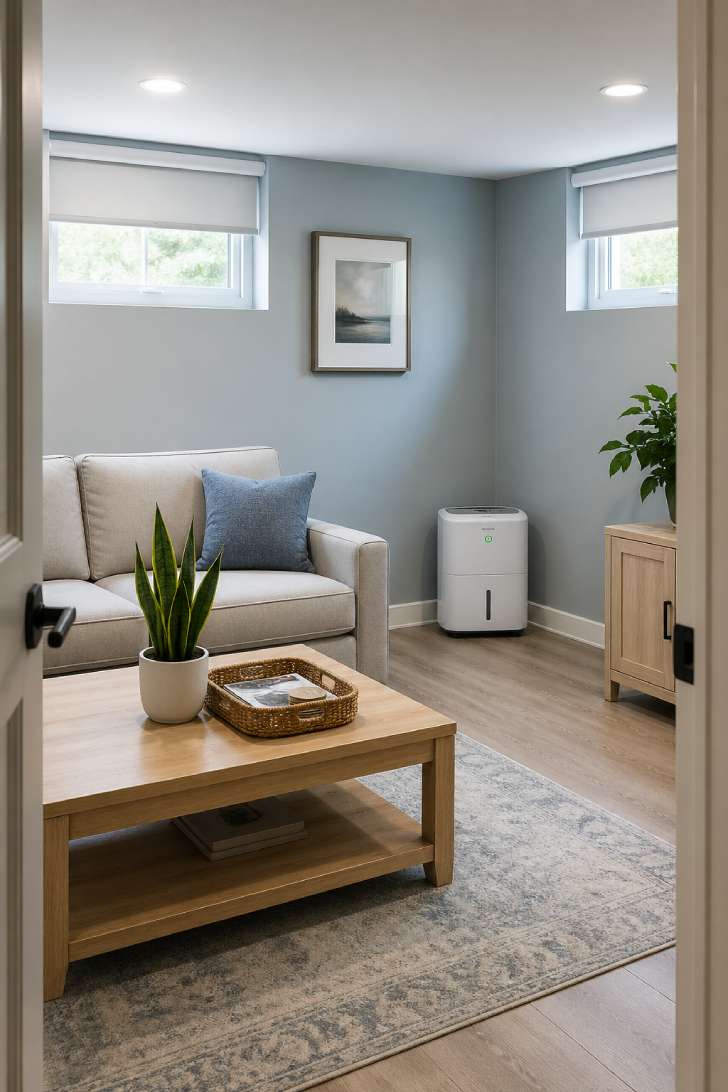
None of the ideas above matter if the basement smells like damp concrete.
Basement moisture control is the single most overlooked step in any below-grade renovation. You can install gorgeous flooring, buy the perfect sectional, paint the walls a beautiful color. If the relative humidity creeps above 50 percent, mold grows, wood warps, fabrics absorb that musty smell, and the room becomes a place nobody wants to sit.
A dehumidifier is close to mandatory. Good standalone units maintain humidity between 30 and 50 percent automatically, and modern ones are quiet enough that you forget they’re running.
If the basement has any history of water coming in through the walls or floor, address that first. Proper waterproofing, drainage, or a sump pump installation should happen before a single dollar goes toward furniture or finishes.
A dry basement doesn’t announce itself. You walk in and it just feels right. The air is clean. The surfaces are dry. There’s no underlying funk. It’s the invisible thing that makes every visible thing work.
Style Blueprint:
- A quality dehumidifier rated for your basement’s square footage
- A hygrometer to monitor relative humidity (target: 30-50%)
- Waterproofing treatment on walls and floor if needed
- A sump pump if there’s any history of water intrusion
- Moisture-resistant materials throughout (LVP flooring, mold-resistant drywall)
Turning a basement from cold storage into a warm retreat comes down to a few honest moves: better light, softer surfaces, and air you can breathe.
You don’t need to tackle all fifteen of these ideas at once. Pick two or three that match your space and your budget, start there, and let the room tell you what it needs next.