This post may contain affiliate links. If you make a booking or purchase through these links, we may earn a commission at no additional cost to you.
Most people walk through their hallway twenty or thirty times a day without really seeing it.
That changes the moment you put something intentional on the walls.
A single well-chosen piece, a row of prints, or even a coat of paint in an unexpected color can make a corridor feel like it belongs to the rest of your home instead of being a space you just pass through.
These 13 hallway wall decor ideas range from five-minute swaps to weekend projects, and every one of them looks like it took more effort than it actually did.
Whether you are working with a narrow entryway or a long stretch of bare wall, there is something here that fits.
Black-and-White Photography Grid on a Deep Olive Accent Wall

There is something about a strict grid of black-and-white images that makes a hallway feel deliberate rather than decorated.
The repetition of identical frames creates a clear visual rhythm that carries down the corridor.
Olive green behind the photos does the heavy lifting here. It is dark enough to give the wall depth but warm enough to keep the overall palette from feeling stark.
Print selection matters less than you might think.
What holds this look together is the consistent framing and the breathing room between each piece.
You could swap in family photos, travel shots, or even pages torn from old art books and the effect would hold.
What makes the arrangement feel especially cohesive is the repeated frame size, even spacing, and aligned edges.
Those elements create a strong visual structure, so the collection reads as one intentional composition rather than a series of unrelated pictures.
Style Blueprint:
- Nine matching thin black frames with white mats (11×14 or 8×10)
- Deep olive green wall paint (matte or eggshell finish)
- Slim natural oak console table (12 inches deep or less)
- One white ceramic vase with dried stems
- Warm-toned wide-plank flooring to contrast the cool wall color
A Slim Oak Picture Ledge With Rotating Watercolor Prints
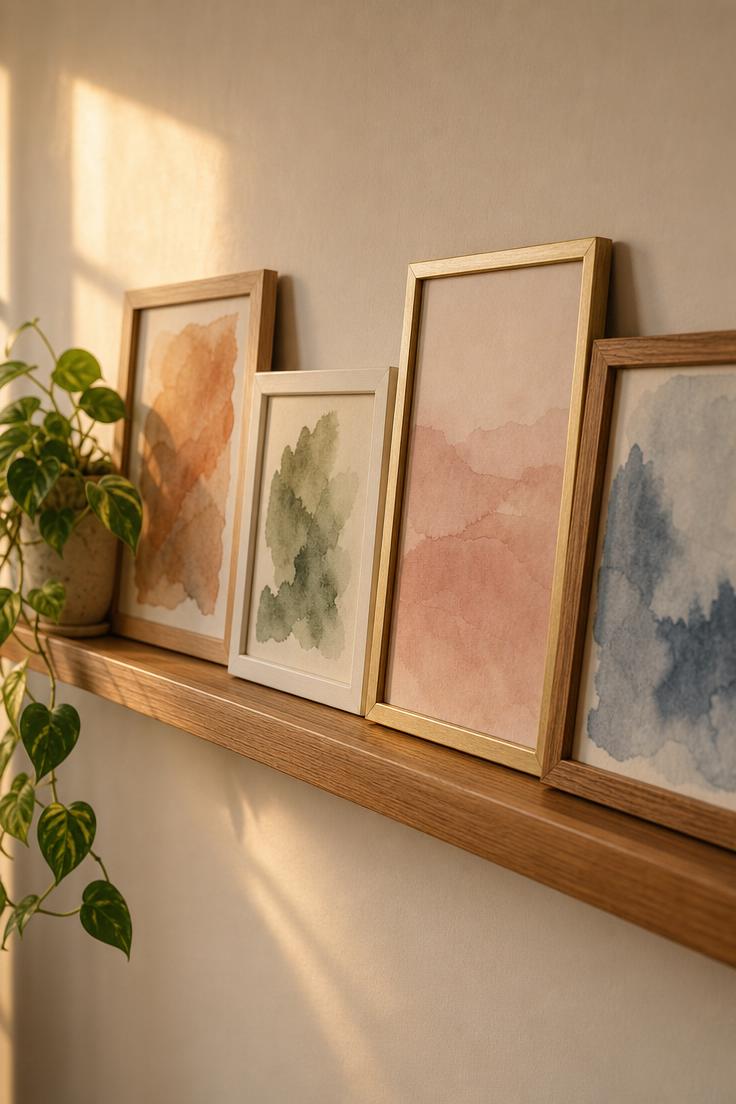
Picture ledges — a slim form of hallway shelving — solve the biggest problem with hallway gallery walls: commitment.
Instead of putting sixteen nail holes in the wall and hoping the arrangement works, you lean a few prints on a shelf and rearrange whenever you feel like it.
Oak reads warm without competing with whatever art you put on it.
The trick is mixing frame finishes — all-matching frames look like a catalog page, but two wood tones and a metallic or two makes the grouping feel like it happened over time.
Watercolors work well in hallways because their soft edges and translucent pigment keep the corridor feeling light even when wall space is limited.
Swap prints seasonally, add a postcard from a trip, or pull one out and leave an empty gap — the ledge looks good half-full.
That kind of flexibility makes a small hallway decorating project feel low-pressure and easy to live with.
Style Blueprint:
- Slim floating picture ledge in natural oak (36 to 48 inches long, 3.5 inches deep)
- Four small watercolor prints (5×7 or 8×10) in mismatched frames
- One small trailing plant in a ceramic pot
- Cream or warm white wall paint behind the ledge
- Brass or gold frame mixed in for a subtle warm accent
Arched Plaster Mirror With Integrated Brass Sconce Above

Placing a mirror at the end of a hallway does two things at once.
It creates a focal point that pulls your eye down the corridor, giving the space purpose.
And it bounces whatever light exists back into the darkest part of the hall.
The arched shape softens all the straight lines and right angles that make most hallways feel rigid.
Plaster frames have a hand-finished quality that drywall and painted wood just cannot replicate — there is a slight unevenness to the surface that catches light in a way manufactured frames do not.
A brass sconce above the mirror gives you hallway lighting that actually does something useful, unlike a single ceiling fixture that casts shadows straight down.
This pairing turns a dead-end wall into the most interesting spot in your corridor design.
Style Blueprint:
- Tall arched mirror with plaster or gesso frame (at least 24×40 inches)
- Articulated brass wall sconce (hardwired or plug-in with hidden cord)
- Soft greige or warm putty wall paint
- Natural fiber hallway runner in a sand or flax tone
- Pale hardwood or light-stained flooring
Handmade Ceramic Plate Collection on Warm White Plaster

Plates on walls feel old-world in the best possible way.
Each one has its own weight, its own glaze variation, its own thumb print from the potter who made it.
Hung in a loose cluster rather than a rigid line, they feel collected over years rather than ordered in one afternoon.
The warm white plaster behind them matters — a flat painted wall would flatten the whole arrangement, but the trowel marks in lime plaster create micro-shadows that give the wall its own life.
Mixing sizes keeps your eye moving across the group instead of reading it as a single block.
If you are looking for entryway wall art that feels personal, a plate wall is hard to beat — each piece has a story, and the collection grows naturally over time.
Bright midday light is this arrangement’s best friend because it throws shadows behind each plate, adding depth you could not get any other way.
Design Pro-Tip: When hanging dimensional objects like plates or baskets on hallway walls, use spring-loaded plate hangers rather than adhesive hooks. The weight of ceramic shifts with temperature changes, and mechanical hangers hold through it all. Space plates at least three inches apart so each piece reads individually.
Style Blueprint:
- Six handmade ceramic plates in varying sizes (6 to 12 inches in diameter)
- Spring-loaded plate hangers rated for the weight of each piece
- Warm white lime plaster or limewash wall finish
- Slim wrought iron shelf or bracket below the arrangement
- One dried herb or botanical bundle in a terracotta pot
Vertical Stack of Framed Vintage Botanical Maps

Vertical stacking is one of the best narrow hallway ideas for art display.
Three or four frames running top to bottom draw the eye upward and make the ceiling feel taller than it is.
Botanical maps — the old hand-drawn kind with garden plots and plant annotations — have a detail density that rewards a second look, which is perfect for a hallway you pass through multiple times a day.
Dark bronze frames against charcoal blue create a moody, library-like feel that turns a corridor into a room worth pausing in.
The picture light does the real work here.
Without it, the maps would fade into the dark wall.
With it, they glow.
Brass hardware against a blue wall is one of those combinations that just works without trying too hard.
If you cannot find actual vintage maps, botanical illustration prints from public-domain archives give you the same effect at no cost beyond the framing.
Style Blueprint:
- Three matching dark bronze or antiqued brass frames (sized to fit the wall width with margin)
- Vintage botanical maps or garden plan prints with linen or off-white mats
- Slim brass picture light (battery-operated or hardwired)
- Muted charcoal blue wall paint in matte finish
- Dark herringbone or parquet flooring below
Linen-Wrapped Cork Pinboard Framed in Raw Brass

A pinboard sounds casual, maybe even juvenile, until you frame it in brass and wrap the cork in linen.
Then it becomes something you actually want to look at every time you pass.
The beauty of this piece is that it changes.
A postcard goes up, a ticket stub comes down, a fabric swatch from a project you are considering gets pinned next to a photo that makes you smile.
Linen over cork gives the whole thing a tactile quality that bare cork just cannot match.
In hallway terms, a pinboard is a zero-commitment hallway gallery wall — everything is held by pins, nothing is permanent, and the composition shifts with your life.
Raw brass ages over time, developing a patina that makes the frame look more interesting the longer you have it.
Hang it at eye level where you will notice it on your way out the door.
Style Blueprint:
- Large cork board (at least 24×36 inches)
- Natural oatmeal linen fabric to wrap the cork
- Raw brass or unlacquered brass frame
- Brass or gold-toned push pins
- A rotating mix of personal ephemera: photos, pressed plants, notes, swatches
Dark Walnut Peg Rail With Straw Hats and Canvas Tote
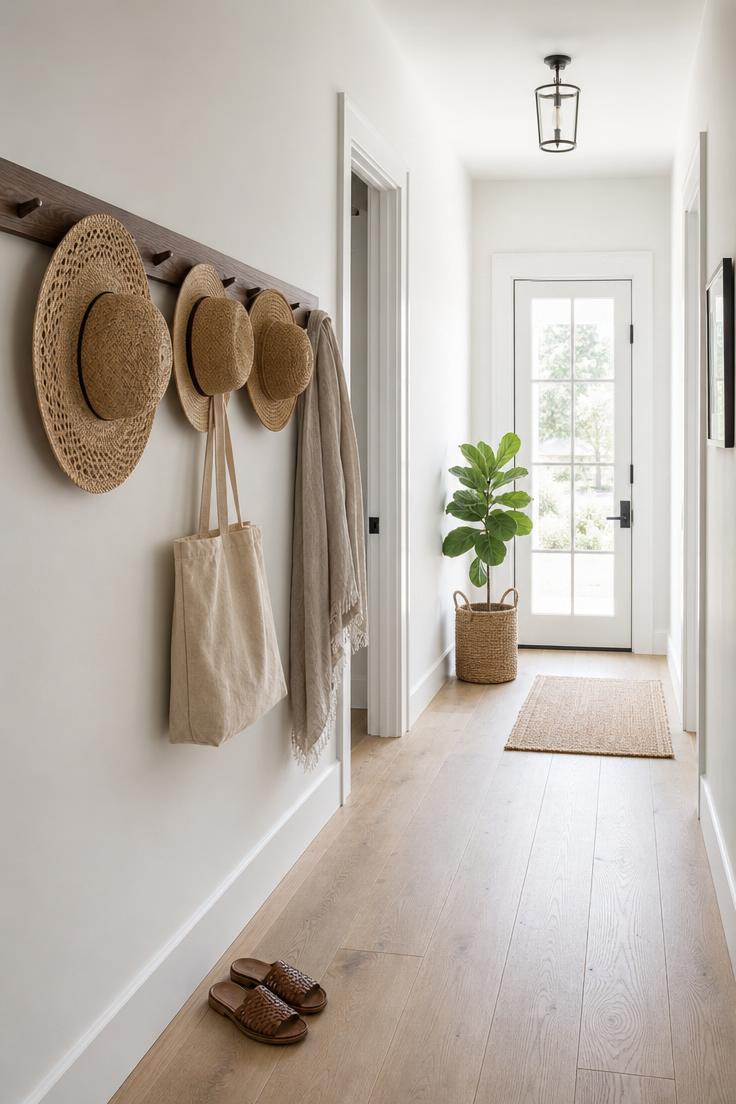
Peg rails have been around since the Shakers, and they still solve the same problem: how do you keep a hallway tidy without a closet?
Dark walnut against white walls creates a strong horizontal line that anchors the space and gives your eye something to follow down the corridor.
What you hang on the pegs matters.
Straw hats, a canvas tote, a linen scarf — these feel intentional and seasonal, not just dumped.
The line between hallway decor and hallway function disappears entirely with a peg rail because the useful things become the decorative things.
Walnut darkens over the years, which means the rail gets richer in color the longer it stays up.
Mount it at shoulder height, not too high, so reaching for your bag on the way out is natural rather than awkward.
This is one of those small hallway decorating ideas that costs under fifty dollars and changes the feel of the entire entry.
Style Blueprint:
- Dark walnut peg rail (48 to 72 inches long, with 6 to 8 pegs)
- Three to four items hung intentionally: hats, bags, scarves, a light jacket
- Chalky white or soft white wall paint
- Pale wide-plank flooring
- One potted plant in a woven basket near the door
Fluted Ribbed Glass Wall Panels Backlit With Warm LEDs
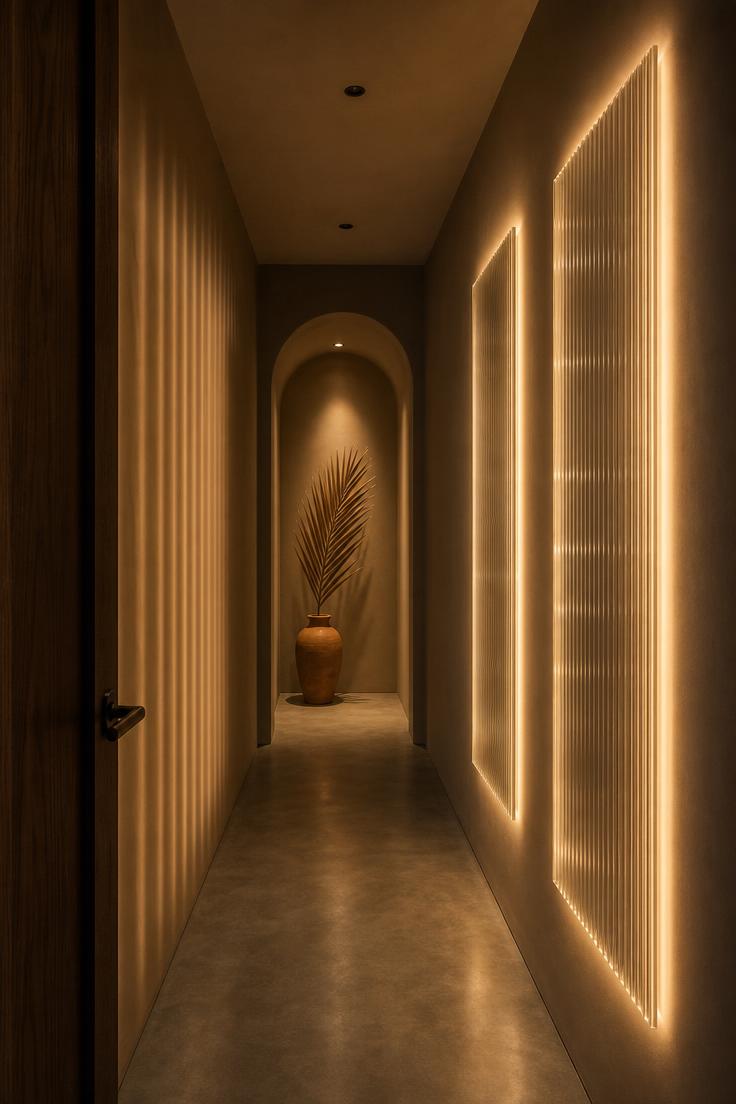
This idea sits at the intersection of wall decor and hallway lighting, and it handles both jobs beautifully.
Fluted glass — the kind with vertical ridges running its length — refracts light into soft parallel lines that shift and shimmer as you walk past.
Backlit with warm LED strips, the panels turn an ordinary corridor into something that feels like a boutique hotel.
The glass itself becomes the art piece.
No frames, no prints, no arrangement to fuss over.
During the day, the ribbed texture catches ambient light and adds subtle dimension.
After dark, the LEDs take over and the effect becomes theatrical.
Polished concrete underfoot bounces the warm glow back up, doubling the light without adding another fixture.
This is corridor design at its most architectural — the walls themselves become the feature.
Style Blueprint:
- Two fluted ribbed glass panels (sized to wall dimensions, typically 12×48 inches each)
- Warm white LED strip lights (2700K–3000K) with dimmer
- Flush-mount brackets or channel system for wall installation
- Soft warm gray wall paint
- Polished or sealed concrete flooring
Design Pro-Tip: When choosing LED strip lights for backlighting, stick to a color temperature between 2700K and 3000K. Anything cooler reads clinical, and anything warmer turns orange. A dimmer switch is worth the extra twenty dollars — it lets you set the mood low at night and brighter during a party.
A Single Oversized Abstract Oil Painting at the Corridor’s End
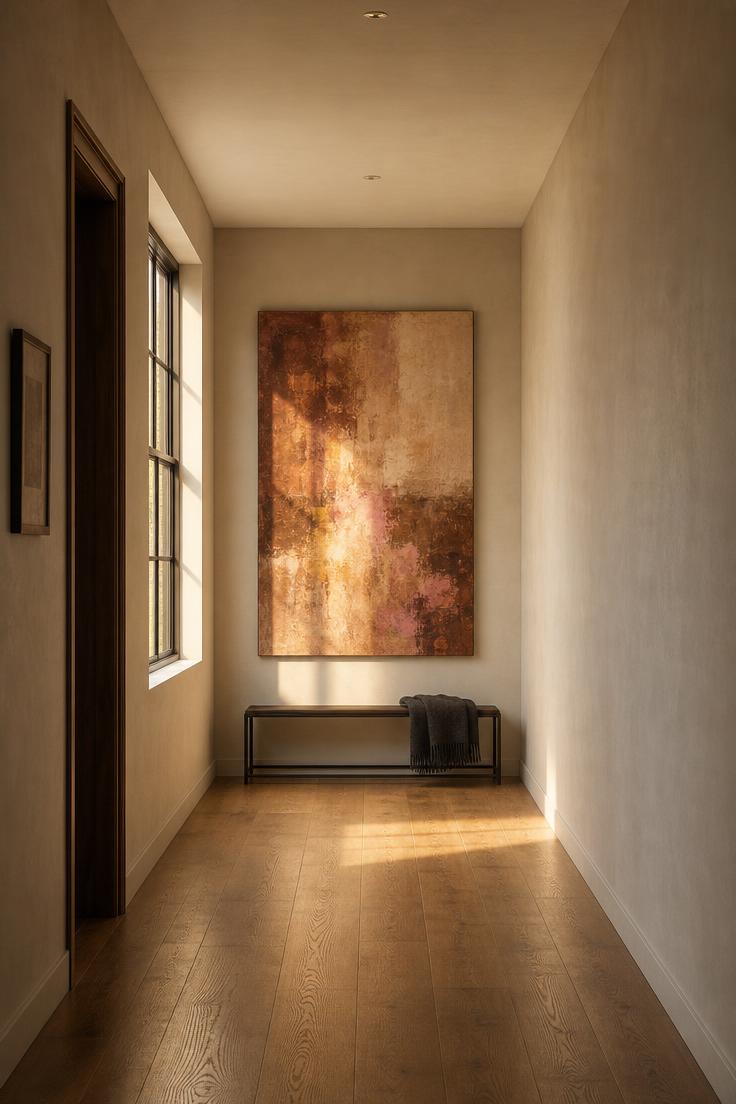
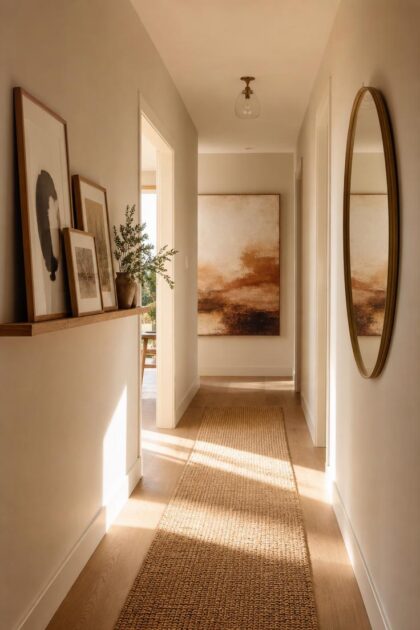
One big painting at the end of a hall does what ten smaller pieces scattered along the walls cannot — it gives the entire corridor a destination.
Your eye locks onto it the moment you turn the corner, and suddenly the hallway has a point.
Scale is everything here.
The painting should fill most of the wall, leaving just enough margin around the edges to let the wall color frame it naturally.
Unframed canvas with visible edges keeps the look relaxed rather than formal.
Abstract work is forgiving in this spot because you do not need to stand close to appreciate it.
From twenty feet away, you read color and texture, and that is enough.
The golden light hitting a textured oil surface creates dimension that flat prints just cannot offer — ridges of dried paint catch the light and cast tiny shadows across the canvas.
A slim bench below signals that this is a place to stop, not just pass through.
Style Blueprint:
- One oversized abstract oil painting (at least 36×48 inches, larger if the wall allows)
- Unframed stretched canvas or simple float frame
- Pale linen or warm cream wall paint
- Slim iron or metal bench beneath the painting
- Folded wool throw in a muted tone
Hand-Troweled Venetian Plaster in Pale Clay With No Art

Sometimes the wall itself is the decor.
Venetian plaster has a depth that paint cannot touch.
The layers of pigmented plaster troweled by hand create slight color shifts across the surface — lighter where the plaster is thinnest, deeper in the hollows where the blade pressed harder.
In a hallway, where you see the wall from constantly changing angles as you walk, this variation comes alive.
A recessed LED at the base washes light upward across the plaster surface, turning trowel marks into tiny ridges of light and shadow.
The decision to leave the wall bare takes confidence, but the result speaks for itself.
No art competes with the texture.
No frames interrupt the sweep of the surface.
This is hallway paint ideas taken to the next level — where the wall finish itself becomes the whole statement.
Style Blueprint:
- Professional Venetian plaster application in pale clay or warm sand tone
- Recessed LED strip light at floor level (warm white, 2700K)
- Wide-plank white oak or light natural flooring
- No wall-mounted objects or art
- Matching warm neutral on the opposite wall for cohesion
Woven Jute and Cotton Textile Hung From a Driftwood Rod
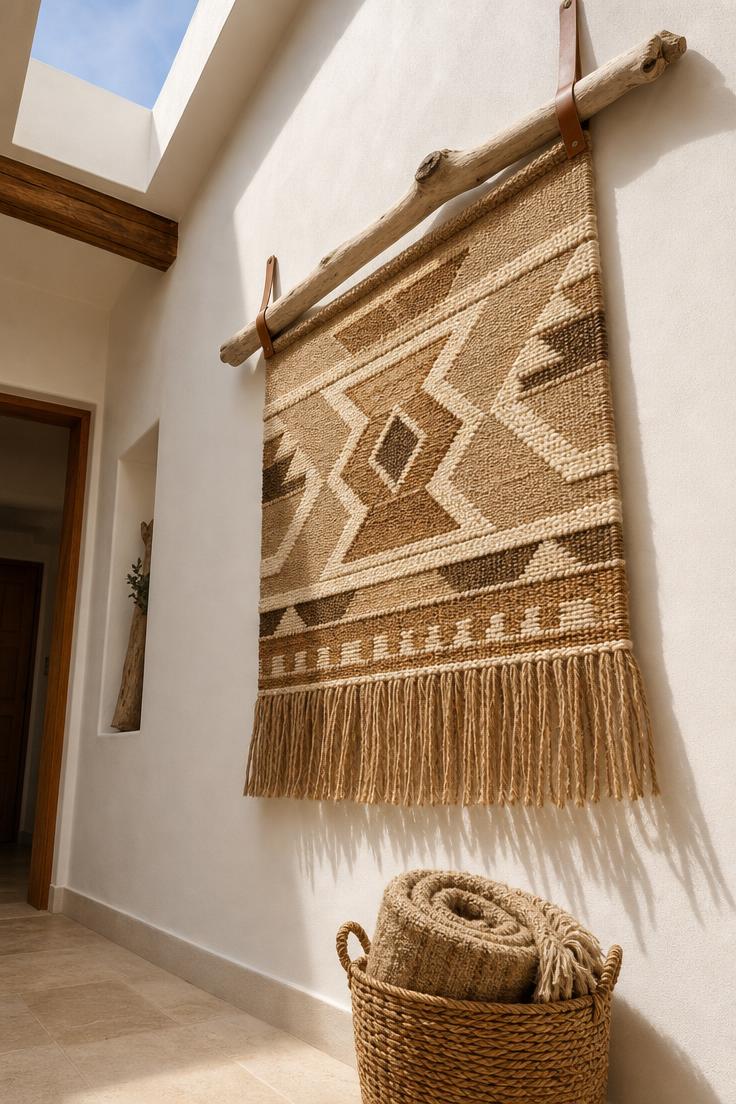
Textiles on walls do something hard surfaces cannot — they absorb sound.
Hallways echo.
Hard floors, bare walls, and minimal furniture create a tube that bounces every footstep and conversation back at you.
A woven piece breaks that up immediately.
Jute and cotton together give you structure and softness in one hanging.
The jute holds the shape, the cotton adds cream-colored warmth.
Driftwood as a hanging rod grounds the piece in the natural world without trying to be “beachy” about it.
Fringe at the bottom moves with air currents, adding a living quality that framed art just does not have.
If your hallway has a skylight or a high window, the light streaming down onto a textile creates shadow patterns on the wall below that change throughout the day.
Style Blueprint:
- One large handwoven textile (at least 24×36 inches plus fringe)
- Driftwood rod or smooth found branch (wider than the textile)
- Leather cord or straps for mounting
- Clean warm white wall paint
- Woven basket on the floor for visual anchoring
Stacked Mismatched Thrift-Store Frames in One Color Spray

This idea costs almost nothing and looks like it came out of a design magazine.
Hit the thrift stores, grab any frames that have interesting profiles — ornate, simple, oval, square, it does not matter.
One can of spray paint in a single color unifies the whole collection instantly.
The frames stay empty on purpose.
Each one becomes a small window showing the wall color behind it, which turns the wall itself into part of the art.
Mixing shapes and sizes keeps the arrangement from looking too planned.
Lean into the chaos a little.
Dusty sage against pale gray is quiet and sophisticated, but you could go bolder — all black on a white wall, or all terracotta on cream.
This is the kind of hallway decor project that works on any budget and in any size corridor.
Style Blueprint:
- Seven or more mismatched vintage frames from thrift stores or flea markets
- One can of spray paint in a single matte color (sage, charcoal, cream, or terracotta)
- Picture-hanging hardware suited to each frame’s weight
- Pale gray or soft neutral wall paint
- Frames arranged in a tight asymmetrical cluster with 2–3 inches between each
Iron Candle Sconces Flanking a Small Round Convex Mirror

Convex mirrors were a staple in old European hallways for a reason — the curved surface reflects a wide-angle view of the space, making even a short corridor feel expansive.
A small round one, no more than twelve inches across, is all you need.
Iron sconces on each side bring in warm, flickering light that flat electric fixtures cannot replicate.
The combination is old-fashioned in the best way.
Think a stone cottage in the Cotswolds or a narrow row house in Amsterdam.
Deep charcoal walls make the warm candlelight pop.
The amber glow reflects in the convex surface and scatters across the wall in a soft halo.
This setup works best in hallways that lead to private spaces — bedrooms, a reading room, a bathroom — where the mood should shift from public to personal.
It is one of the simplest hallway mirror ideas that still makes a strong impression on guests.
Design Pro-Tip: If open flames make you nervous, battery-operated LED pillar candles have come a long way. Look for versions with a real wax shell and a flickering warm-toned LED. From three feet away, most people cannot tell the difference, and you get the same reflected glow in the mirror without the fire risk.
Conclusion
A hallway with bare walls is a missed chance.
Every corridor has wall space that could hold something worth looking at — a mirror that catches light, a textile that absorbs sound, a painting that gives the whole stretch of floor a destination.
The ideas here cover a range of budgets, skill levels and time commitments, from a fifteen-dollar thrift-store frame project to a professional plaster finish.
Pick one that matches your hallway’s proportions and light, and start there.
You do not need to fill every wall.
One good idea is enough to make the whole space feel considered.
Find the perfect art size for your hallway with our wall art size calculator.