
This post may contain affiliate links. If you make a purchase through these links, we may earn a commission at no additional cost to you.
Your dining room walls do most of the talking before anyone pulls out a chair.
It’s the first surface your eyes hit when you walk in — and yet so many dining rooms leave those walls completely bare or settle for a single small frame that disappears against the paint.
That’s a missed opportunity.
The right dining room wall decor sets a mood, anchors the furniture below it, and gives the whole space a sense of intention.
These 15 ideas go specific — naming exact materials, finishes, and objects — so you can picture the look before you buy a single thing.
A Floor-to-Ceiling Chinoiserie Wallpaper Panel Behind the Sideboard

There’s something about a single panel of chinoiserie wallpaper that commands a room without shouting.
It works because the rest of the wall stays quiet — a solid paint color, usually warm white or soft cream — while this one section carries all the visual weight.
The navy background absorbs light in a way that makes the gold leaf details feel like they’re glowing from within.
Your eye follows the painted birds upward and the trailing branches downward, creating vertical movement that makes ceilings feel taller.
Pair it with a sideboard that has clean lines so the wallpaper stays the clear focal point.
Style Blueprint:
- One panel of hand-painted or printed chinoiserie wallpaper in a dark base color
- A mid-century or transitional sideboard in warm wood
- White ceramic ginger jars or simple pottery for the surface
- Warm white paint for the surrounding walls
- Brass or gold-toned accents to echo the wallpaper details
Vintage Oil Portraits Hung Salon-Style on a Dusty Rose Wall
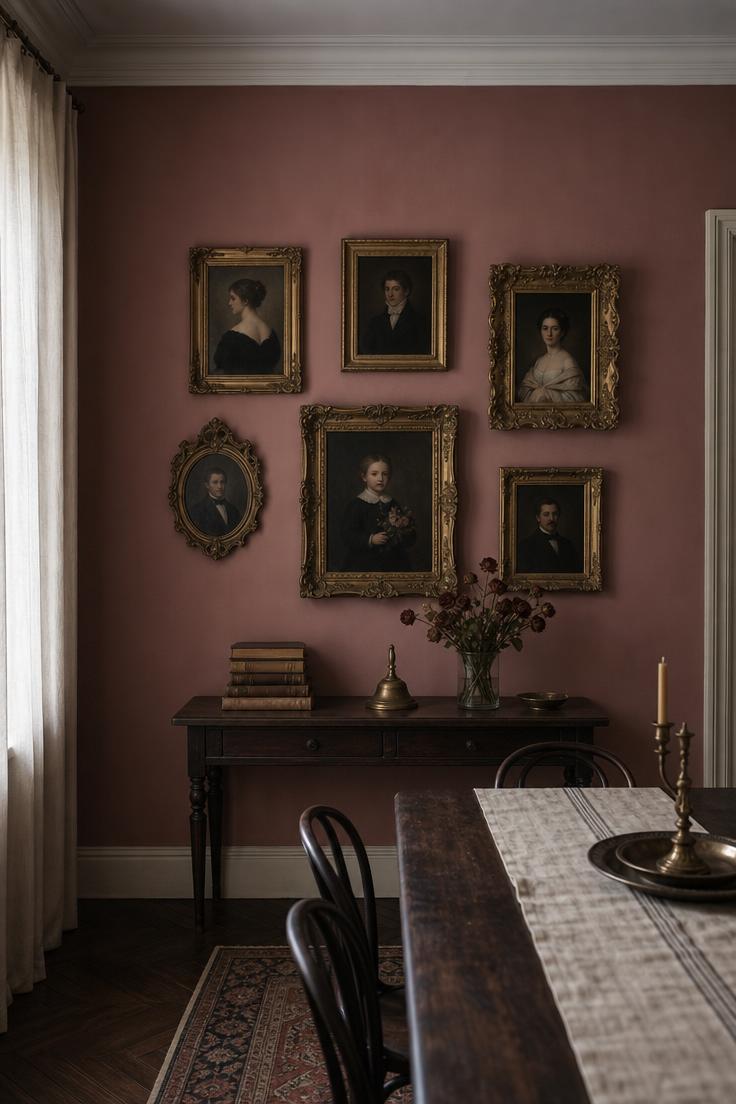
A salon-style hang — frames clustered together with only a few inches between them — has a weight that a single piece of wall art for dining room spaces can’t match.
The trick is choosing portraits with similar tones but different frame styles.
All gold, but one ornate and one simple, one rectangular and one oval.
The dusty rose wall color might sound risky, but it actually reads as a warm neutral when surrounded by gold frames and dark wood furniture.
These paintings don’t need to be expensive originals — estate sales, flea markets, and online vintage shops sell them for thirty to sixty dollars apiece.
What matters is the overall composition: hang the largest piece slightly off-center, then build outward from there.
Style Blueprint:
- Five to seven oil portraits in mismatched gold frames
- Dusty rose or muted mauve wall paint
- A dark wood console or narrow table below the arrangement
- Old books and brass objects for surface styling
- Dried flowers to tie the vintage mood together
An Arched Plaster Niche With a Single Ceramic Vase
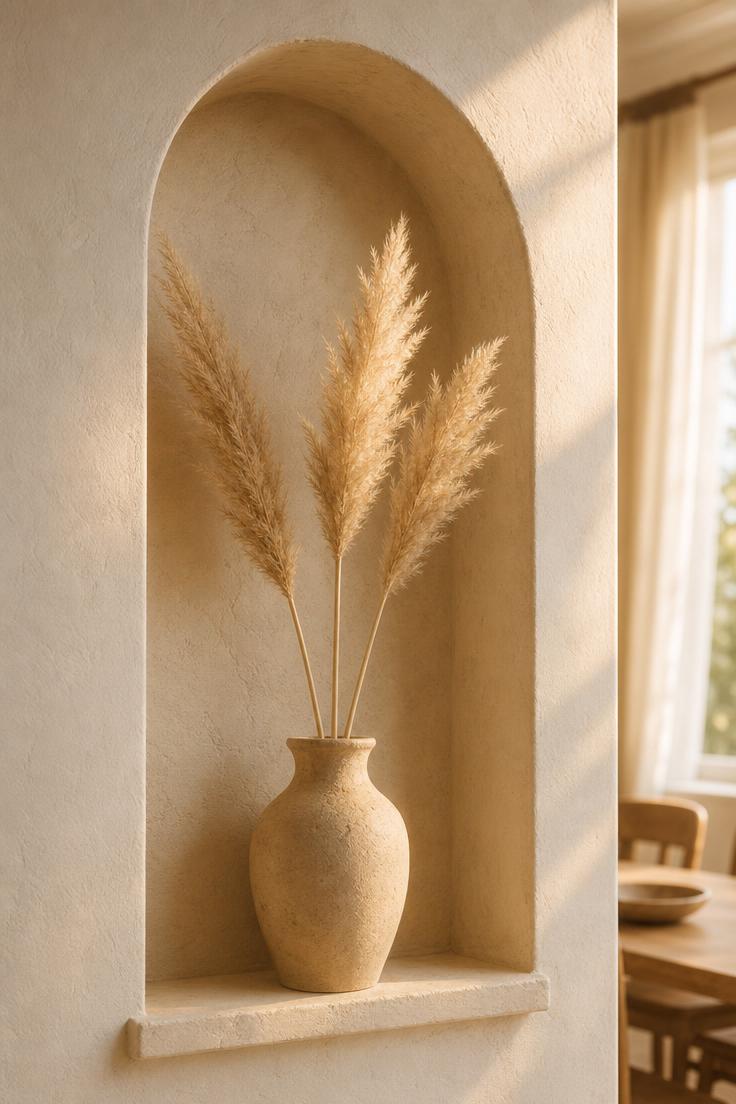
Arched niches have roots in Mediterranean and Middle Eastern architecture, and their appeal in dining rooms comes down to shadow.
The recessed shape creates depth and dimension on what would otherwise be a flat surface.
Raw plaster inside the niche adds texture that catches light differently throughout the day — cooler and flatter in the morning, warm and golden by late afternoon.
Keeping the contents simple is the whole point here.
One vase, maybe one sculptural object — that restraint is what gives the niche its presence.
You can build one with a prefabricated arch kit and joint compound if you’re comfortable with a weekend project, or hire a plasterer for the real thing.
Style Blueprint:
- A prefabricated or custom-built arched wall niche
- Raw lime plaster or Roman clay finish inside the niche
- One handmade ceramic vase in a muted earth tone
- Dried pampas, branches, or a single sculptural stem
- Warm white surrounding wall paint
Black Oak Floating Shelves Displaying Collected Stoneware

Floating dining room shelves give you permission to rearrange whenever the mood strikes.
Stain them black and suddenly they feel like an intentional design choice rather than an afterthought.
The dark tone of the wood frames whatever sits on top, the same way a dark mat frames a photograph.
Mix heights and shapes on the shelf — a tall vase next to a squat bowl, a framed piece leaning against the wall beside a trailing plant.
Leave a few inches of empty space between groupings so the arrangement can breathe.
The bench below is optional but smart — it gives the wall a grounded, finished feeling and adds seating you’ll actually use when guests overflow the table.
Style Blueprint:
- Two floating shelves in black-stained oak, 36 to 48 inches long
- Handmade stoneware in earth tones — mix shapes and sizes
- One small framed artwork leaned against the wall
- A trailing plant in a matte pot
- A linen-upholstered bench or low console below
Design Pro-Tip: When styling dining room shelves, use odd numbers in each grouping — three objects or five — and vary the heights so the eye moves in a zigzag rather than a straight line. One tall piece, one medium, one short. Repeat.
A Hand-Troweled Venetian Plaster Accent Wall in Warm Putty

An accent wall dining room approach works best when the wall itself becomes the art.
Venetian plaster does exactly that.
The trowel marks create a surface that shifts through the day — matte in shadow, softly luminous where light skims across the high points.
Warm putty reads differently from beige paint because it has actual depth and physical texture you can see from across the room.
This finish works in both modern and traditional dining rooms because it references old-world craftsmanship without committing to a specific period style.
The application takes skill — two or three thin coats, each troweled at a different angle, then burnished — so budget for a professional unless you’ve practiced on sample boards first.
Style Blueprint:
- Venetian plaster or Roman clay in warm putty, stone, or mushroom tones
- A large pendant or chandelier that casts directional light across the texture
- Simple furniture in warm wood to let the wall lead
- Muted textiles — linen, cotton — in complementary earth tones
- One wall only — the rest should stay smooth and quiet
Oversized Round Brass Mirror Above a Marble Console

A round mirror breaks up the rectangular geometry that dominates most dining rooms — rectangular table, rectangular windows, rectangular frames.
That contrast is what makes it feel so right on the wall.
The brass frame adds warmth without competing with the reflection, and a hammered finish gives it texture you can appreciate up close.
Hang it so the center sits at about 57 inches from the floor, which is standard eye level.
The dining room mirror decor trick that most people miss: position it to reflect a window or a light source, not the back of someone’s head at the table.
That reflected light can make a dark dining room feel twice as bright.
Style Blueprint:
- A round mirror, 36 to 42 inches in diameter, with a brass or gold-toned frame
- A narrow marble or stone console table below
- Taper candle holders in brass or ceramic
- Fresh fruit or flowers for a pop of natural color
- A warm white or soft cream wall behind
Blue-and-White Transferware Plates Arranged on a Dark Green Wall

Plate wall decor has been around for centuries, and it persists because it works on a very basic visual level — the circular shapes soften a room full of straight edges.
Blue-and-white transferware against hunter green creates a color combination rooted in English and Dutch decorating traditions.
Start collecting plates at thrift stores and antique markets.
They don’t need to match — in fact, a mix of patterns is more interesting than a uniform set.
Use adhesive disc mounts rather than wire plate hangers for a cleaner look on the wall.
Lay out the arrangement on the floor first, snap a photo, then transfer it to the wall.
The organic cluster shape — loose, imperfect, with slightly irregular spacing — feels more natural than a rigid grid.
Style Blueprint:
- Twelve or more blue-and-white transferware plates in assorted sizes
- Adhesive disc mounts for a clean, hidden hang
- A deep green, navy, or charcoal wall for maximum contrast
- A wooden plate rail below for additional display
- White linen on the table to echo the plate backgrounds
A Full-Wall Mural of Trailing Olive Branches on Linen Texture

A dining room wallpaper mural gives you the impact of a hand-painted wall at a fraction of the cost.
The linen texture in the background keeps it from looking flat or digital — it reads as something handmade even from inches away.
Olive branches as a motif work year-round because they don’t scream any particular season the way florals or autumn leaves might.
The silvery green of olive leaves pairs with practically every neutral you’d find in a dining room — cream, warm white, oatmeal, tan, gray.
Choose a mural with a loose, watercolor quality rather than a botanical illustration style; the softness keeps the room from feeling like a wallpaper showroom.
Install it on the wall your eye hits first when entering the room, and keep the remaining walls simple.
Style Blueprint:
- A peel-and-stick or paste-the-wall mural in a botanical motif
- Linen or paper-textured background in warm cream or off-white
- A round dining table in light wood to soften the lines
- Woven or rattan chairs for texture contrast
- Ceramic and stoneware table accessories in earth tones
Fluted Wood Panel Wainscoting in White Oak Below a Picture Rail
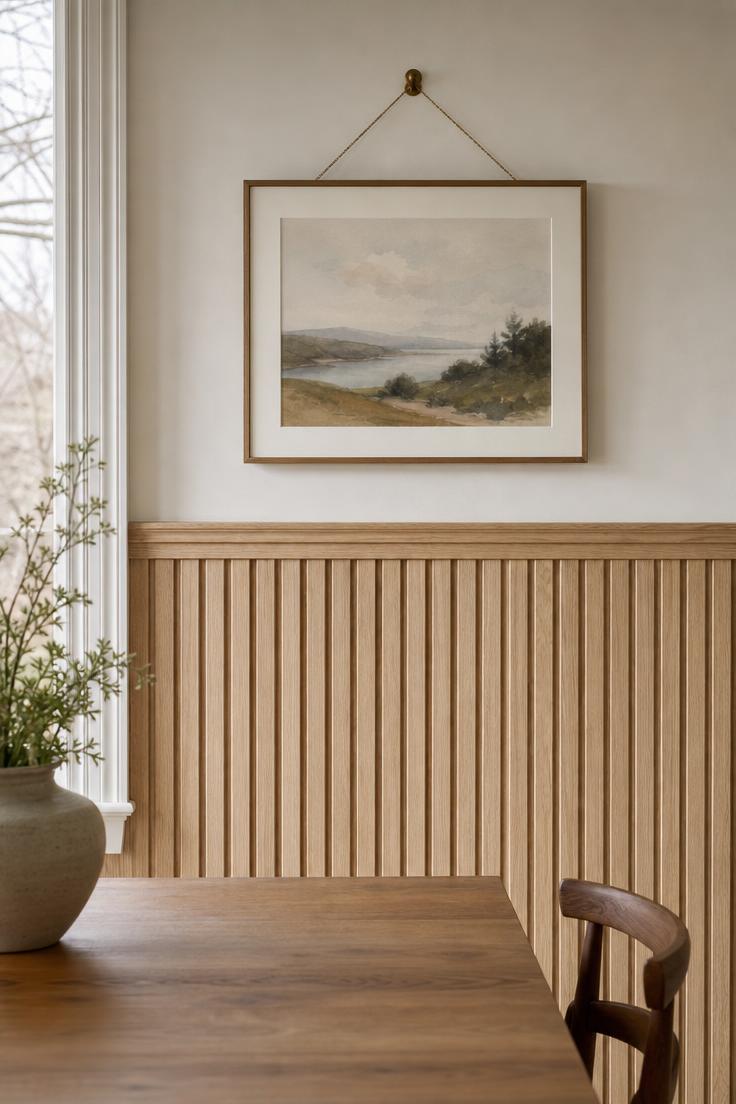
Dining room wainscoting has a reputation for being formal and traditional, but white oak fluting changes that completely.
The vertical grooves catch light in a way that smooth panels can’t — every shift in the sun’s angle creates a different pattern of highlights and shadows.
White oak’s natural grain has enough warmth and movement that it doesn’t need stain.
A clear matte sealant is all you need.
The picture rail above serves a practical purpose too: you can swap art without putting new holes in the wall, which is ideal if your taste changes seasonally or you collect pieces over time.
Keep the wainscoting at chair-rail height (32 to 36 inches) so it protects the wall from furniture scuffs.
Style Blueprint:
- Fluted white oak panels, 32 to 36 inches tall
- A picture rail molding in matching oak or painted to match the upper wall
- Brass picture hooks and wire for hanging
- Warm off-white or soft cream paint above the rail
- A clear matte wood sealant for the oak
Design Pro-Tip: When mixing wood tones in a dining room — say, oak wainscoting with a walnut table — keep the undertones in the same family. Both should lean warm or both cool. One honey-toned and one chocolate-toned wood can coexist beautifully, but pairing a red-toned cherry with a gray-toned ash will feel accidental.
A Pair of Brass Swing-Arm Sconces Flanking an Abstract Canvas

Dining room lighting usually lives overhead — a chandelier, a pendant, maybe a flush mount.
But wall sconces add a second layer that changes everything about how art looks after dark.
Swing-arm sconces in aged brass are practical because you can adjust their position, angling the light exactly where the painting needs it.
The linen shades diffuse the bulb into a warm, soft pool rather than a harsh spotlight.
This setup mimics how galleries light artwork, which is why it feels more intentional than a picture light clipped to the frame.
Choose an abstract canvas with colors that relate to your dining room palette but don’t match it exactly — a little tension between the art and the room keeps things interesting.
Style Blueprint:
- Two swing-arm wall sconces in aged or unlacquered brass
- Warm white linen drum shades
- One large abstract painting in earth tones with a thin frame
- A narrow credenza or console below for grounding
- A deep wall color — taupe, charcoal, or dark sage — to anchor the composition
Antique Textile Fragment Framed in Raw Linen Behind Museum Glass
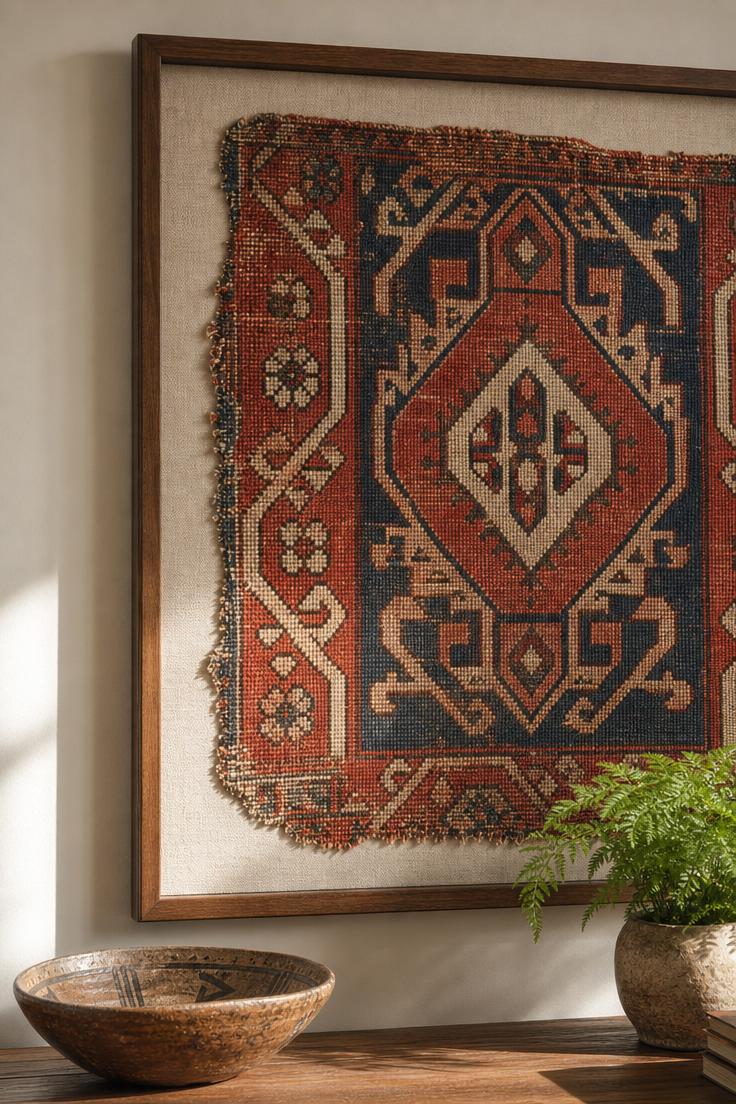
A framed textile fragment turns something that might otherwise end up folded in a closet into dining room art with genuine history.
Kilim fragments, vintage suzanis, kantha cloth, and mud cloth panels all work for this approach.
The raw linen backing matters — it creates a border that gives the textile room to breathe and prevents the irregular edges of the fragment from looking unfinished.
Museum glass eliminates the reflection that standard glass creates, so you see the textile itself rather than a reflection of your dining room window.
These pieces bring color and pattern to the wall in a way that feels earned and specific to you, not pulled from a catalog.
The faded quality of antique textiles — those sun-bleached reds and softened blues — pairs naturally with warm wood and linen upholstery.
Style Blueprint:
- One antique textile fragment, 18×24 inches or larger
- Raw linen backing for mounting
- A slim walnut or oak frame with museum glass
- Warm white or off-white wall paint
- Warm wood furniture below to echo the frame
A Grid of Four Oversized Black-and-White Photographs
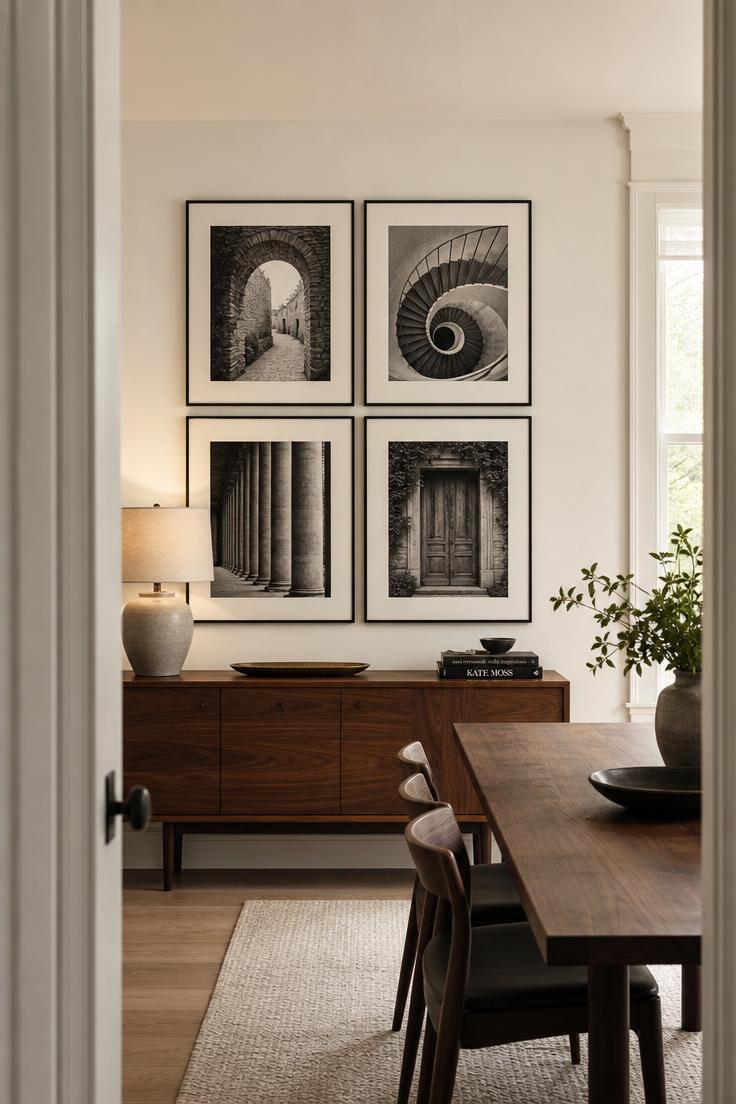
A dining room gallery wall doesn’t need to be complicated.
Four large photographs in identical frames, hung in a tight grid with exactly two inches between each frame — that’s it.
The uniformity is the design.
Black-and-white photographs work best for this because they remove color as a variable, letting composition and subject matter carry the impact.
Architectural subjects — arches, doorways, staircases, repeating patterns — feel right in a dining room because they echo the room’s own structure.
Print them at a scale that feels generous, not cautious.
A 24×30-inch print in a 30×36-inch frame (with mat) is about the minimum for a wall that’s eight feet wide.
Style Blueprint:
- Four matching black metal frames with wide white mats
- Black-and-white photographs printed at large scale
- Architectural or still-life subjects with strong lines
- Uniform spacing of 2 inches between frames
- A walnut or dark wood console below to anchor the arrangement
A Reclaimed Wood Beam Used as a Hanging Shelf for Art

This approach sits somewhere between a floating shelf and a gallery wall, and that in-between quality is what makes it work.
The beam itself has presence — old wood with nail holes, saw marks, and a patina that paint can’t replicate.
Hanging the art on leather straps from iron hooks adds a layer of dimension that flat-against-the-wall hanging doesn’t give you.
The frames swing slightly when you walk past, which sounds minor but actually makes the wall feel alive rather than static.
Vary the strap lengths so the frames hang at three distinct heights.
You can swap prints easily by just lifting a frame off its hook, which makes this ideal for people who like to rotate their dining room art with the seasons or their mood.
Style Blueprint:
- One reclaimed wood beam, 4 to 6 inches deep, 36 to 60 inches wide
- Small black iron hooks screwed into the top face
- Leather straps cut to varying lengths
- Three to five framed prints in simple natural wood frames
- A small trailing plant on top of the beam for a finishing touch
Design Pro-Tip: Hang dining room wall decor so that the center of the arrangement sits at 57 inches from the floor — but only on walls without furniture below. When art goes above a sideboard, buffet, or console, hang it 6 to 8 inches above the furniture surface instead, regardless of where that puts the center.
Handmade Ceramic Tile Mosaic in Earthy Terracotta and Cream
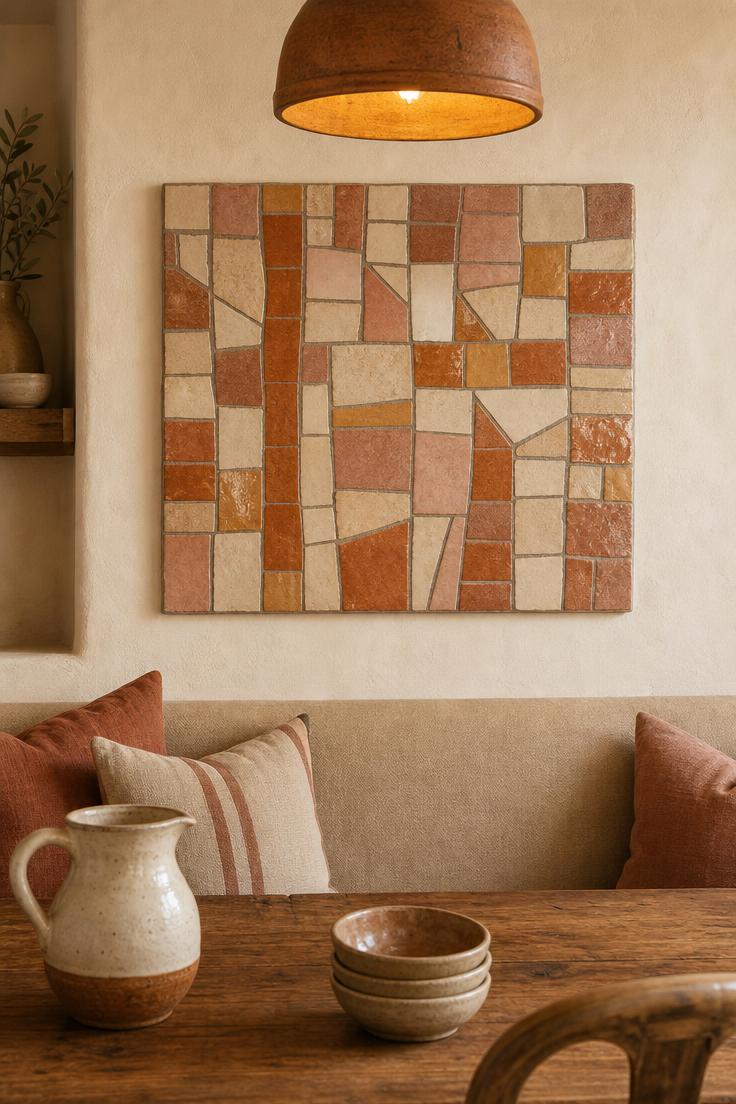
Ceramic tile on a dining room wall might sound like it belongs in a kitchen, but a mosaic panel framed by painted wall on all sides reads as art, not backsplash.
The handmade quality matters — factory tiles are too uniform to hold visual interest at this scale.
Look for tiles where you can see fingerprints in the glaze, slight warping at the edges, and color that varies from piece to piece.
The grout lines become part of the design, creating a grid that organizes the color variation.
Terracotta and cream is a combination that has worked in Mediterranean and North African architecture for thousands of years.
It brings warmth to a dining room without requiring warm lighting or warm paint — the wall itself radiates it.
Style Blueprint:
- Handmade ceramic tiles in terracotta, cream, and ochre
- A rectangular panel size, approximately 24×48 inches
- Warm gray grout for subtle contrast
- An upholstered banquette or bench below the panel
- Warm white surrounding walls to let the mosaic stand out
A Single Oversized Botanical Print in a Gilded Frame
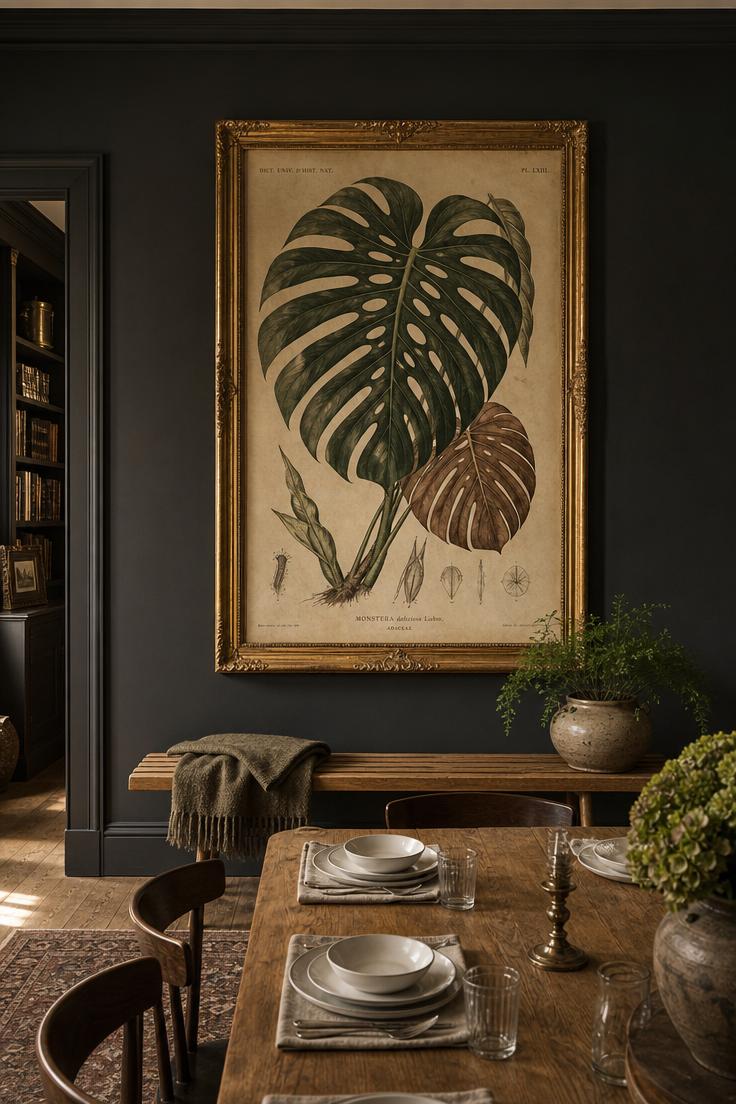
One big piece often does the work of ten small ones, and this is where that idea gets tested.
A 40-by-60-inch botanical print filling a charcoal wall creates a focal point strong enough to build the rest of the room around.
The gilded frame is doing real work here — it separates the art from the dark wall and catches light in a way that adds movement to an otherwise still surface.
Vintage-style botanical prints, the kind with Latin species names in small type at the bottom, carry an academic quality that suits a dining room’s purpose as a gathering and conversation space.
The charcoal wall makes the cream background of the print almost glow by contrast.
It’s a simple formula — dark wall, light art, ornate frame — but the effect is anything but simple.
Style Blueprint:
- One oversized botanical print, 40×60 inches or larger
- An ornate gilded frame — vintage or reproduction
- A charcoal, deep navy, or forest green wall
- A simple bench or console below to ground the composition
- Muted natural accessories — wool, ceramic, wood — to keep the mood consistent
Conclusion
The best dining room wall decor doesn’t try to be everything at once.
It picks a lane — a single oversized piece, a layered gallery arrangement, an architectural texture — and commits to it fully.
Most of these ideas work whether your dining room is a separate formal space or a corner of an open floor plan.
Start with the wall your eye hits first when you walk in.
That’s your primary wall, and it deserves the most attention.
From there, keep the remaining walls quieter so there’s room for the eye to rest.
Mix textures and scales across the room if you want depth — a smooth mirror on one wall, a rough plaster finish on another — but give each wall a clear purpose.
The dining room table gets all the credit at dinner, but it’s the walls that set the stage.