This post may contain affiliate links. If you make a purchase through these links, we may earn a commission at no additional cost to you.
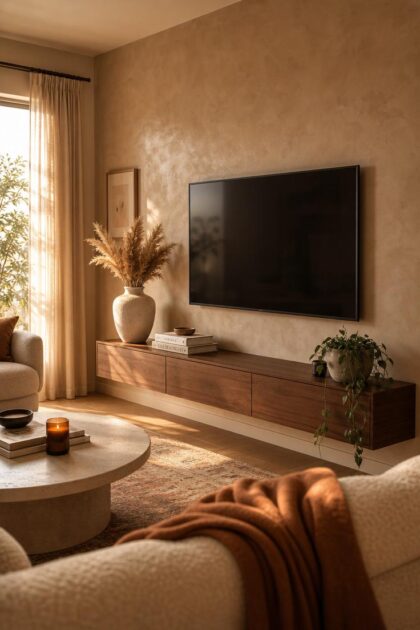
The TV wall is one of the most looked-at surfaces in any home, yet it’s often the least styled.
That black rectangle just sits there, stuck to a bare wall, draining all the warmth out of an otherwise put-together room.
It doesn’t have to be that way.
With the right materials, a few well-placed objects, and some attention to proportion, your tv wall decor can turn a dead zone into the most interesting wall in the house.
Here are 17 ideas that prove a screen and good design can share the same wall without fighting each other.
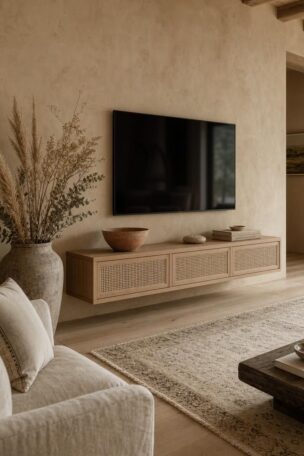
Limewashed Plaster Behind a Walnut Floating Console
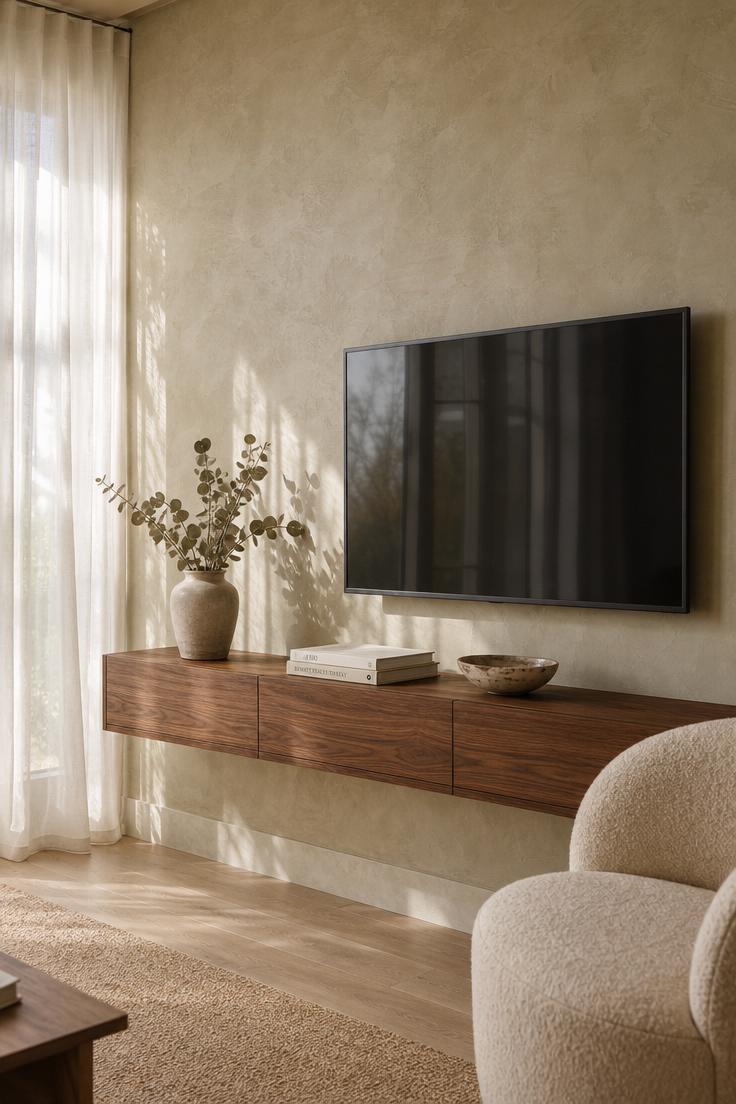
There’s something about limewash plaster that makes a tv wall design feel collected over time rather than assembled in a weekend.
The finish holds light in its texture — soft peaks and valleys that shift from warm cream to pale sand depending on the hour.
A walnut floating console grounds the screen without crowding the wall, and the open space beneath it keeps the room feeling light on its feet.
Plaster walls like this work with the eye’s preference for irregular surfaces; our brains read perfectly smooth walls as flat and institutional, while subtle texture registers as handmade and warm.
Style Blueprint:
- Limewash plaster in a warm off-white or sand tone
- Walnut floating console (at least 48 inches wide)
- Ceramic vase with dried eucalyptus or olive branches
- Linen-covered books for stacking
- Concealed cable management kit
Stacked Travertine Ledger Panels With Recessed LED Strip
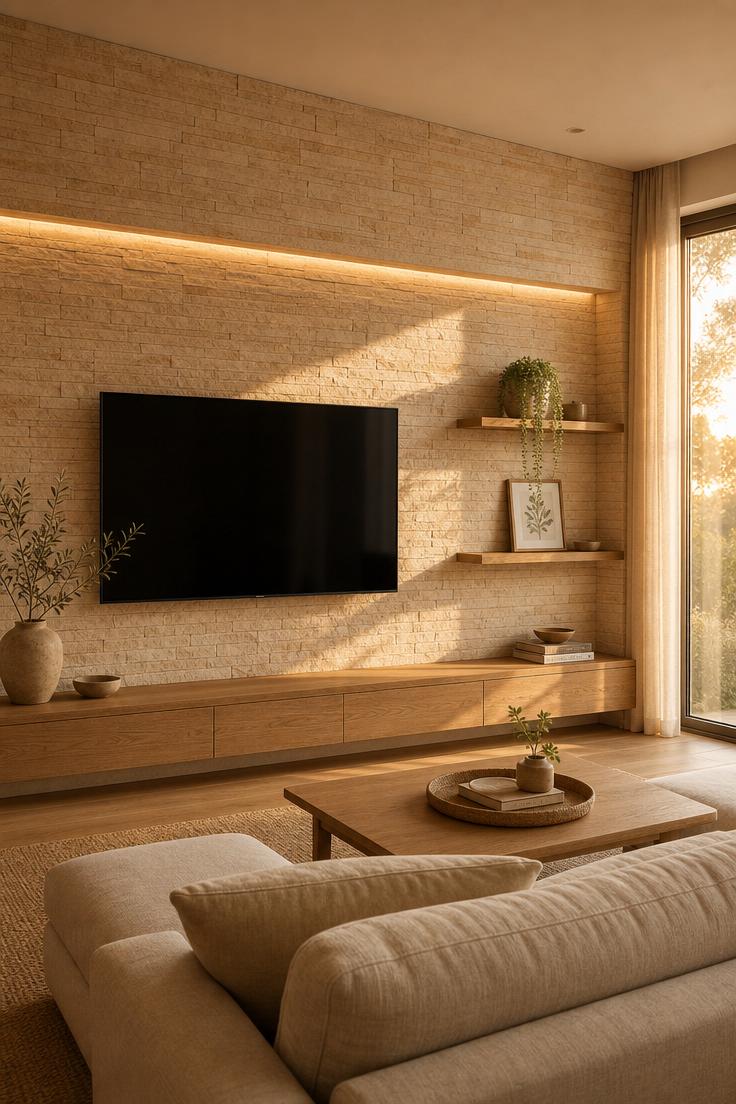
Natural stone on a tv accent wall brings a weight and permanence that paint alone can’t deliver.
Travertine ledger panels stack in thin, staggered rows that catch light along every edge, creating a surface that looks different from every seat in the room.
The recessed LED strip above the TV adds a wash of warm light that softens the transition between screen and wall — a trick that also reduces eye strain during evening viewing.
Stone surfaces absorb and re-radiate warmth, which gives the wall a physical presence you can almost feel from across the room.
Style Blueprint:
- Stacked travertine ledger panels (natural, unfilled finish)
- Recessed LED warm-white strip light
- Narrow floating oak shelves (asymmetric placement)
- Trailing indoor plant like string of pearls
- Small framed botanical print
A Floor-to-Ceiling Black Oak Slat Wall With Brass Sconces
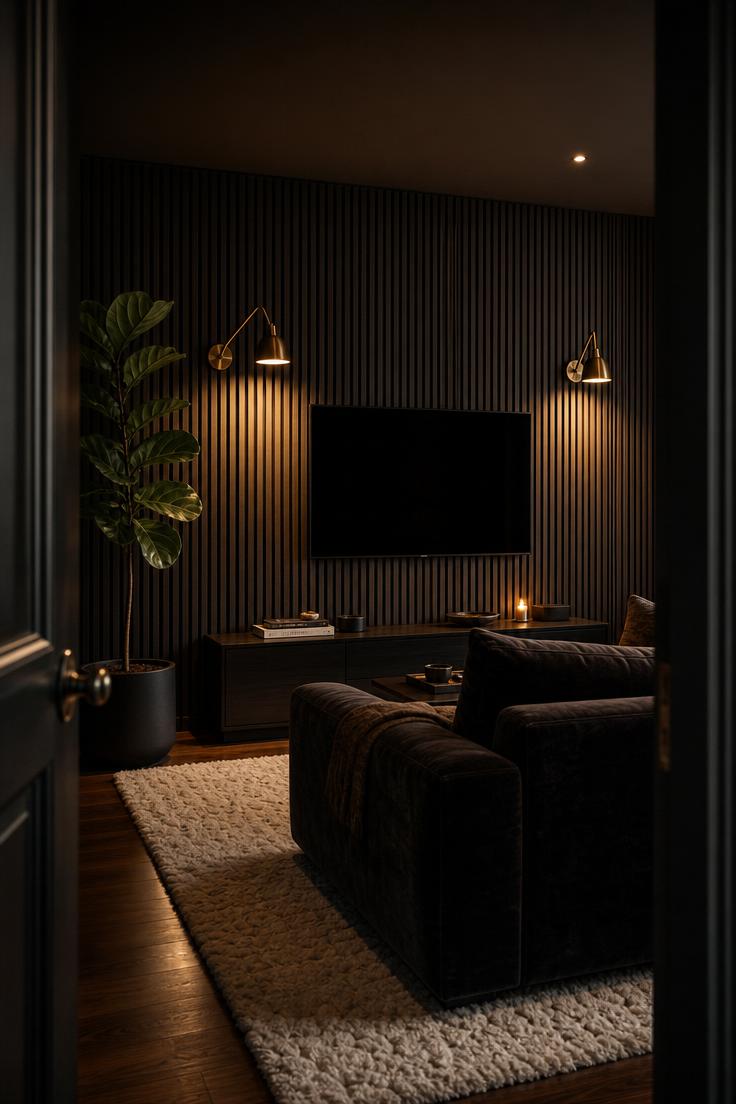
Dark vertical slats do something unexpected — they make the TV disappear.
When the screen is off, it reads as just another dark plane within the rhythm of the slats, which is exactly the point.
Brass sconces on either side break the monochrome palette with a flash of warmth, and their directional light rakes across the slats to create long, dramatic shadows.
Vertical lines draw the eye upward and make standard-height ceilings feel taller, which is why this treatment works especially well in apartment living rooms where square footage is tight.
Style Blueprint:
- Black-stained oak slat panels (floor to ceiling)
- Articulated brass wall sconces (warm-toned bulbs)
- Fiddle-leaf fig in a matte black planter
- Dark charcoal velvet sofa
- Ivory wool area rug for contrast
Oversized Woven Rattan Baskets Flanking a Mounted Screen
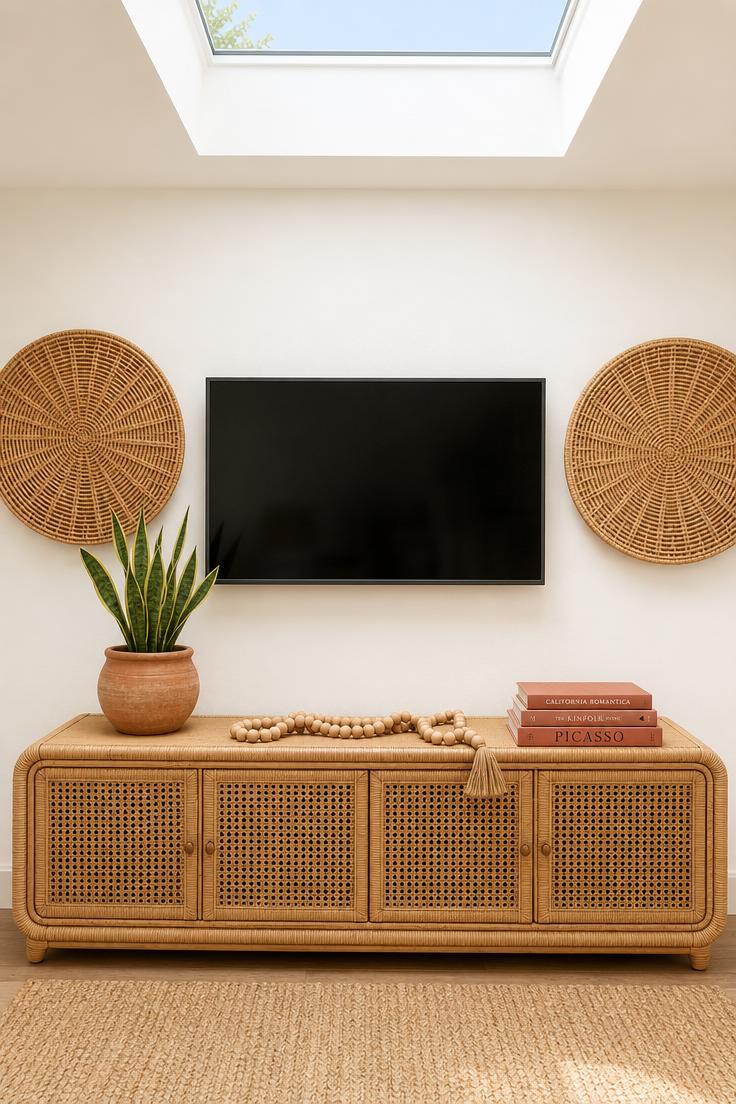
Round shapes next to a rectangular screen create a visual contrast that makes both elements more interesting.
These oversized rattan baskets — the kind you might find at a flea market or import shop — add texture, pattern, and dimension without the commitment of a permanent wall treatment.
Rattan brings a handcrafted quality that softens the hard edges of electronics and media furniture.
Our eyes naturally rest on circles because they have no sharp corners to snag attention; placing them beside the TV gives your gaze a comfortable place to land when the screen is dark.
Style Blueprint:
- Two oversized round woven rattan baskets (24-inch diameter)
- Rattan-wrapped media console with cane door fronts
- Snake plant in a ceramic pot
- Wooden bead garland
- Terracotta-toned books for console styling
Design Pro-Tip: When hanging objects beside your TV, keep them within 4 to 6 inches of the screen’s edge. Too much gap between the TV and the flanking pieces makes each element look stranded — close spacing reads as one intentional arrangement.
A Marble-Slab Accent Column Beside a Matte Black TV Frame
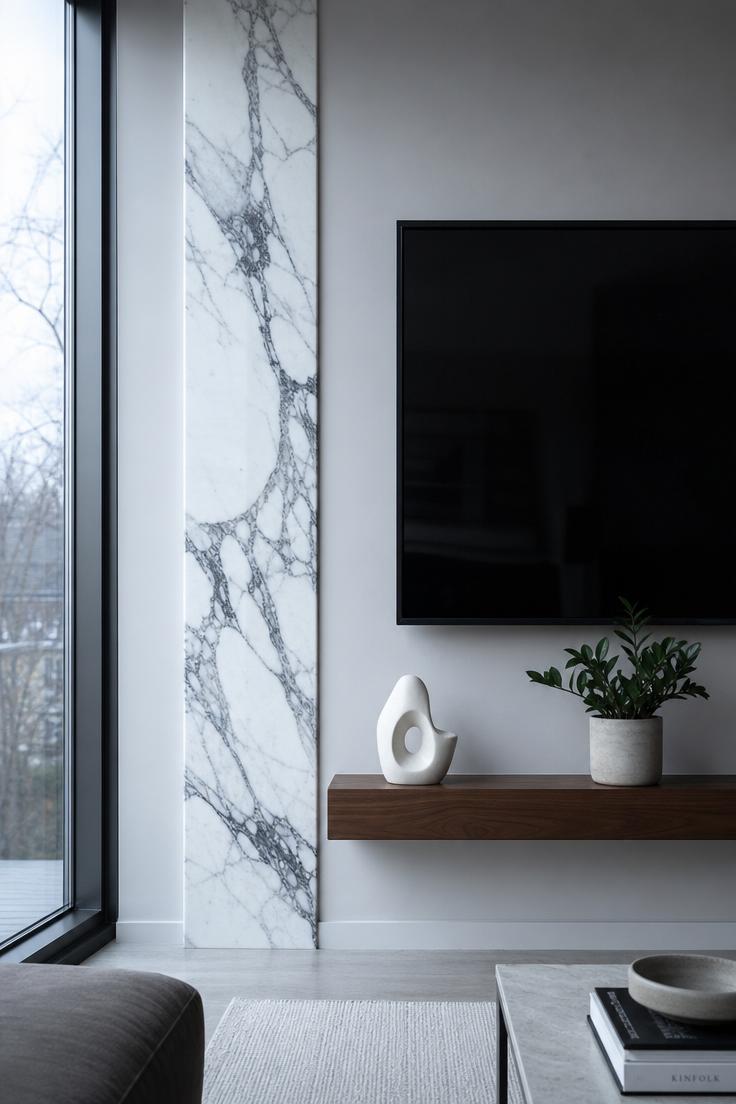
A single vertical marble slab beside the TV is a move borrowed from high-end hotel lobbies, and it works just as well at home.
The stone doesn’t need to cover the entire wall — one narrow column is enough to anchor the space and give the eye a material worth lingering on.
Calacatta marble, with its bold gray veining against a white ground, holds its own next to a dark screen without competing for attention.
Cool-toned stone paired with a matte frame gives the wall a gallery quality, where the TV feels like one element in a curated collection rather than the only thing worth looking at.
Style Blueprint:
- Single Calacatta marble slab (12 inches wide, floor to ceiling)
- Matte black slim TV frame
- Walnut floating shelf (width of TV or wider)
- Sculptural white ceramic object
- Small ZZ plant in a simple pot
Dried Pampas Grass Arrangement on an Asymmetric Shelf Set
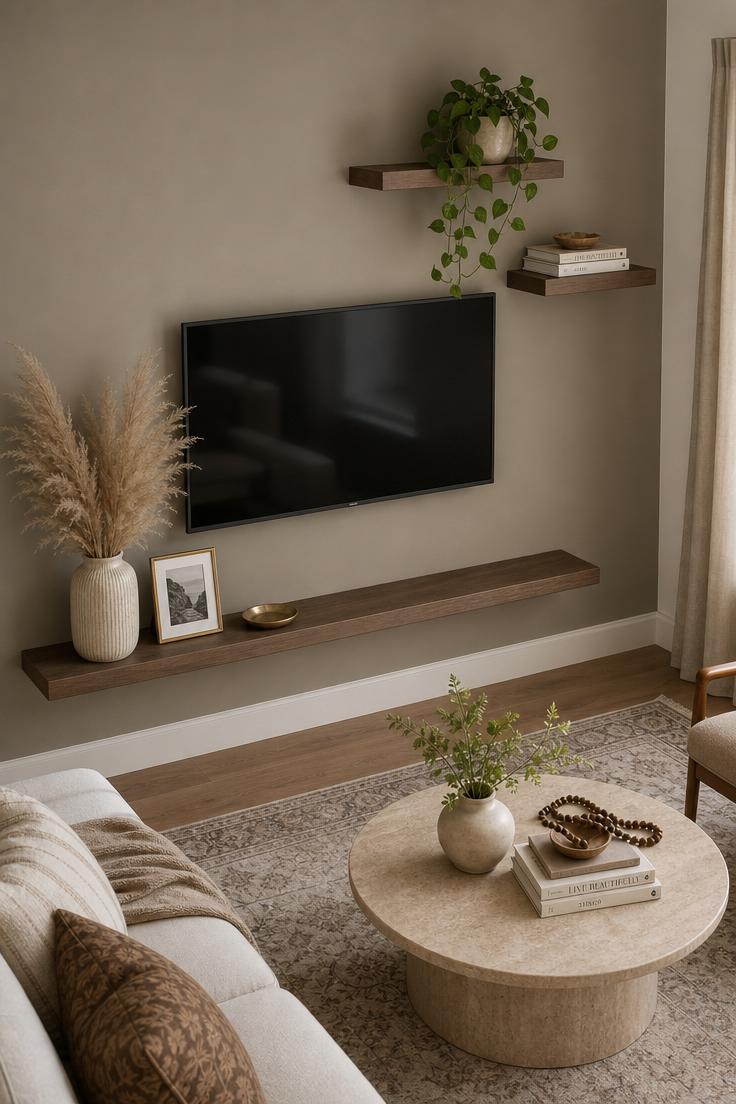
Symmetry is safe, but asymmetry is interesting.
Staggering tv wall shelves at different heights and widths around the screen creates a composition that looks designed rather than default.
Dried pampas grass adds height and movement to the arrangement — its feathery plumes soften the rigid geometry of shelves and screen.
The human eye follows visual weight, and placing the tallest object (the pampas vase) on the lowest shelf creates a stable base that lets the lighter items above feel like they’re floating.
Style Blueprint:
- Three floating shelves in different lengths (warm wood tone)
- Tall dried pampas grass in a ribbed ceramic vase
- Small framed black-and-white photograph
- Trailing pothos plant
- Brass dish or trinket tray
Venetian Plaster Feature Wall in Warm Clay With Oak Trim
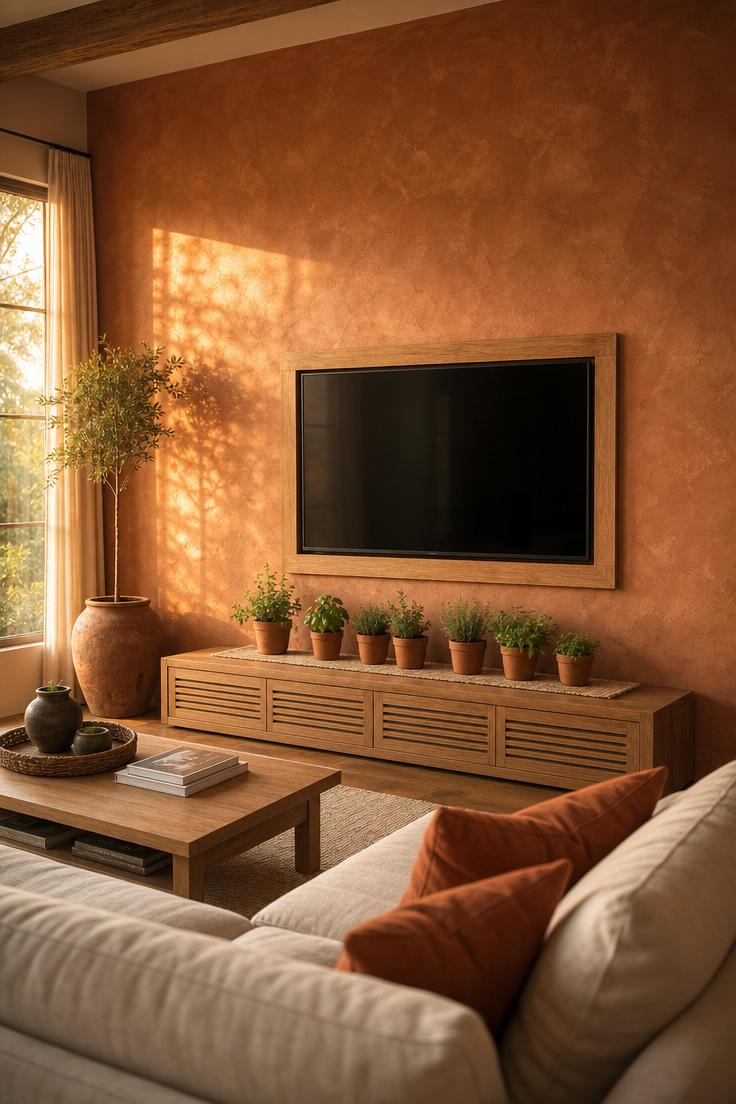
Venetian plaster has a depth that flat paint simply cannot replicate.
The trowel marks hold and release light across the surface, so the wall shifts from terracotta to amber to sienna as the sun moves through the room.
Framing the TV with slim oak trim is a small detail that makes a big difference — it gives the screen a finished edge and ties it to the wood console below.
Clay and terracotta tones are some of the most psychologically warm colors in interior design; they mimic the hues of sun-baked earth, which is why rooms finished in these shades feel grounding and restorative.
Style Blueprint:
- Venetian plaster finish in warm clay or terracotta tone
- Slim oak trim pieces for TV framing
- Low oak media console with slatted doors
- Small terracotta pots with herbs or succulents
- Woven linen table runner
Charcoal Porcelain Large-Format Tiles With Floating Timber Shelves
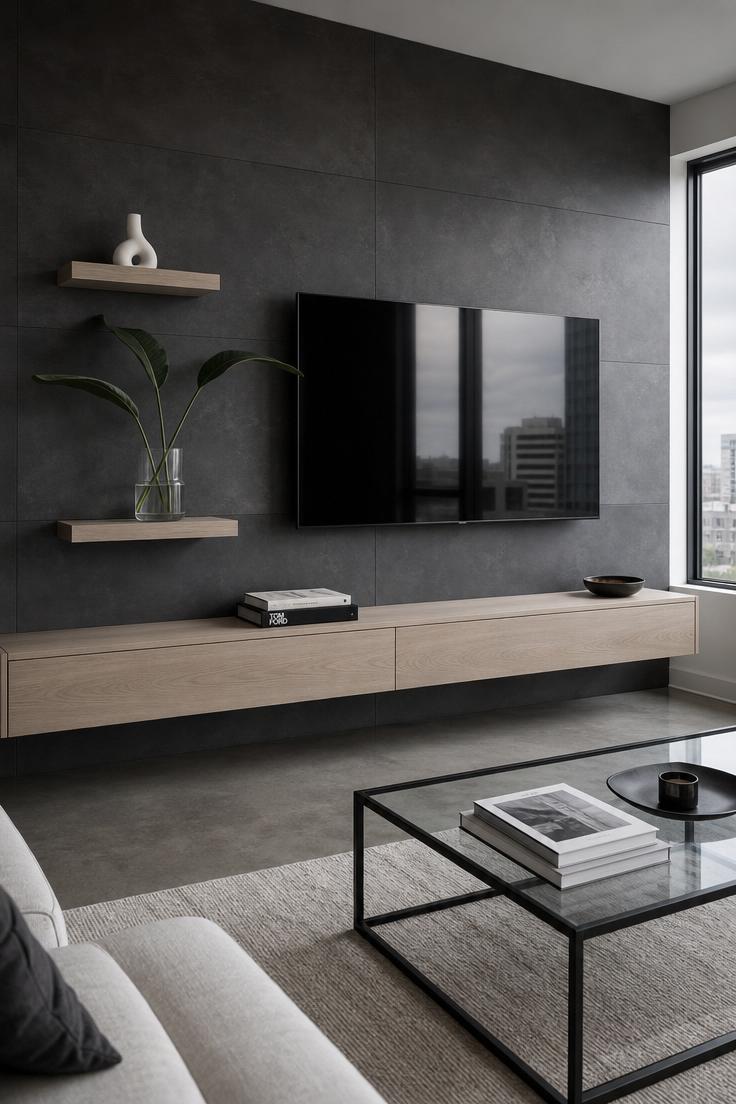
Large-format porcelain tiles in charcoal turn the tv wall panel into an architectural statement with very few grout lines to break the surface.
The near-monolithic look reads as polished and intentional, and the dark tone performs the same trick as a dark accent wall — the TV blends right in.
Floating timber shelves in a contrasting light wood prevent the wall from feeling too cold or industrial; they introduce a natural grain that interrupts the mineral smoothness of the tile.
Dark, matte surfaces absorb ambient light rather than bouncing it around the room, which creates a calmer viewing experience and reduces glare on the screen.
Style Blueprint:
- Large-format charcoal porcelain tiles (24×48-inch minimum)
- Two floating shelves in light ash or birch
- Small white sculptural vase
- Potted cutting or plant propagation in glass vessel
- Thin dark grout for minimal visual interruption
A Gallery Grid of Black Metal Frames Around the Screen
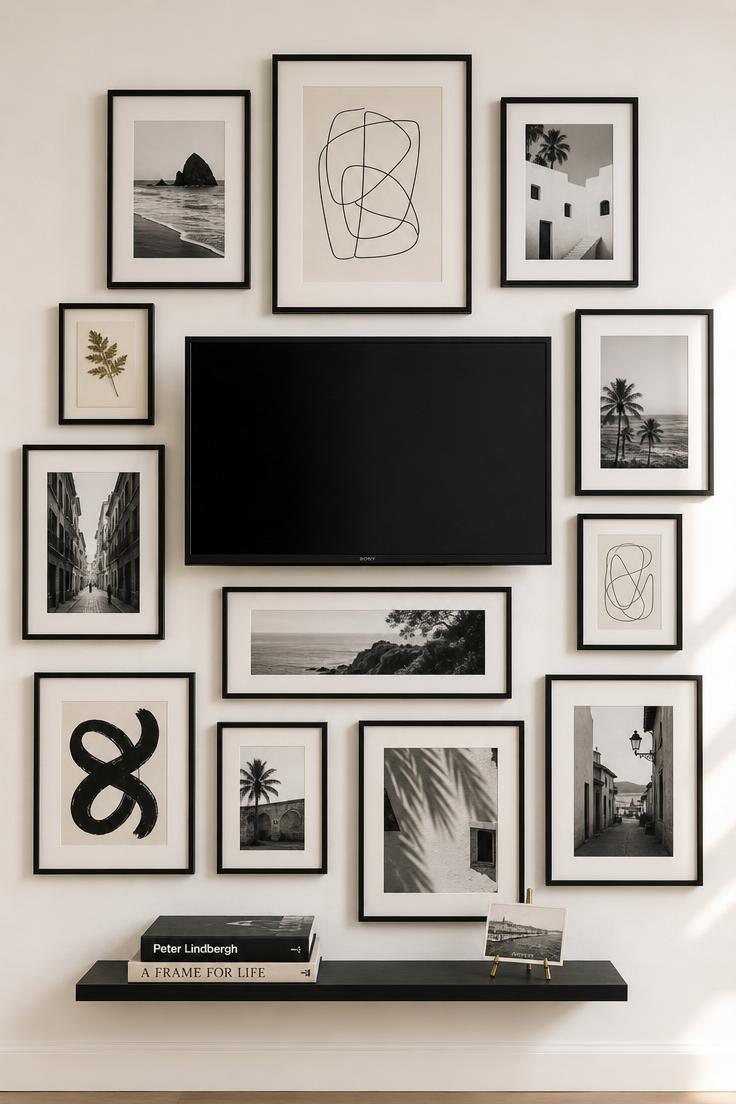
The trick with a gallery wall around the TV is to make the screen feel like just another frame in the collection.
Black metal frames in mixed sizes do this naturally — the TV’s dark bezel mirrors the frame color, so it settles into the arrangement without demanding separate attention.
Mixing media types (photography, line drawings, pressed botanicals) keeps the grid from looking like a catalog display.
A gallery arrangement taps into our desire for visual narrative; each piece becomes a chapter, and the TV is simply one more, which is why this approach works so well for people who want their wall mounted tv decor to feel personal rather than tech-forward.
Style Blueprint:
- Twelve thin black metal frames (mix of sizes from 8×10 to 16×20)
- Black-and-white photography prints
- Abstract line drawings or illustrations
- One pressed botanical specimen in a frame
- Narrow floating shelf with stacked art books
Design Pro-Tip: Start your gallery layout by taping paper templates of each frame to the wall before hammering a single nail. Arrange and rearrange on the wall using painter’s tape — it’s far easier to move paper than patch holes.
Board-and-Batten Millwork Painted in Sage Green
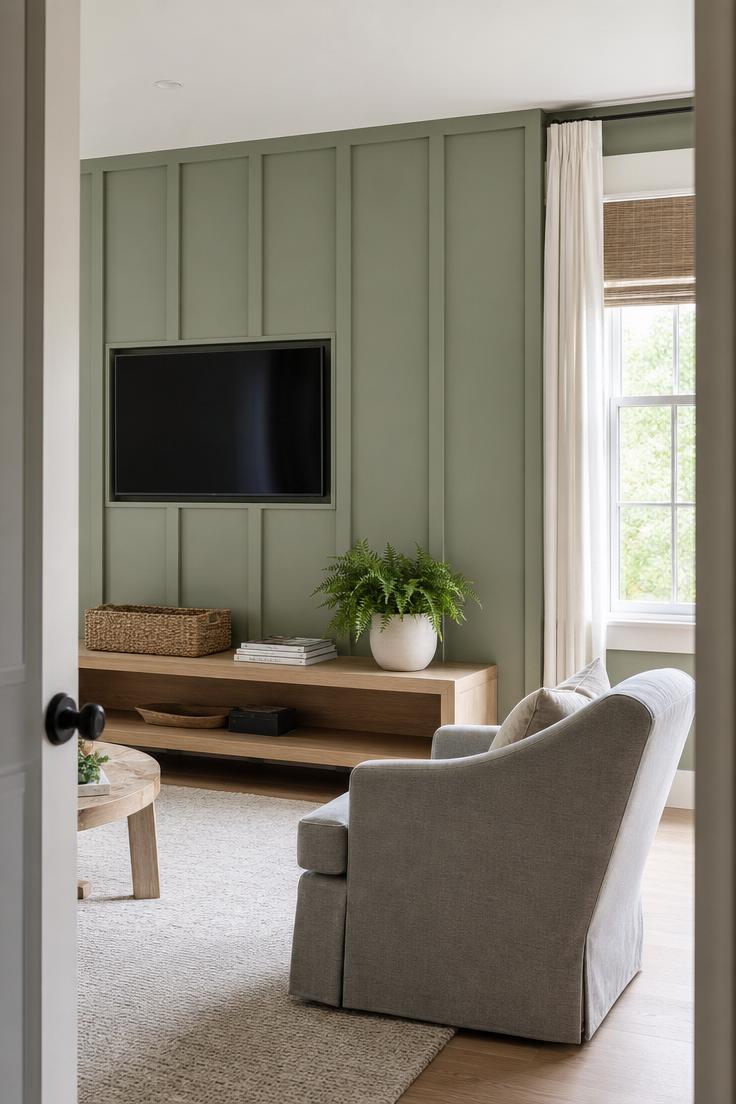
Board-and-batten is one of those architectural details that makes a room feel finished the moment it goes up.
Painting it in sage green gives the wall a living quality — something closer to a garden wall than a media center.
Recessing the TV between two battens (even by just half an inch) creates a built-in look without the expense of actual cabinetry.
Green is the color our eyes process most easily because of how human vision evolved in natural environments; even a muted sage pulls some of that outdoor calm indoors.
Style Blueprint:
- Board-and-batten millwork (floor to ceiling, painted sage green)
- Recessed TV mounting between battens
- Long white oak bench-style console
- Woven seagrass basket for storage
- Boston fern in a white ceramic planter
A Jute-Wrapped Console Table With Pothos Trailing Below the TV
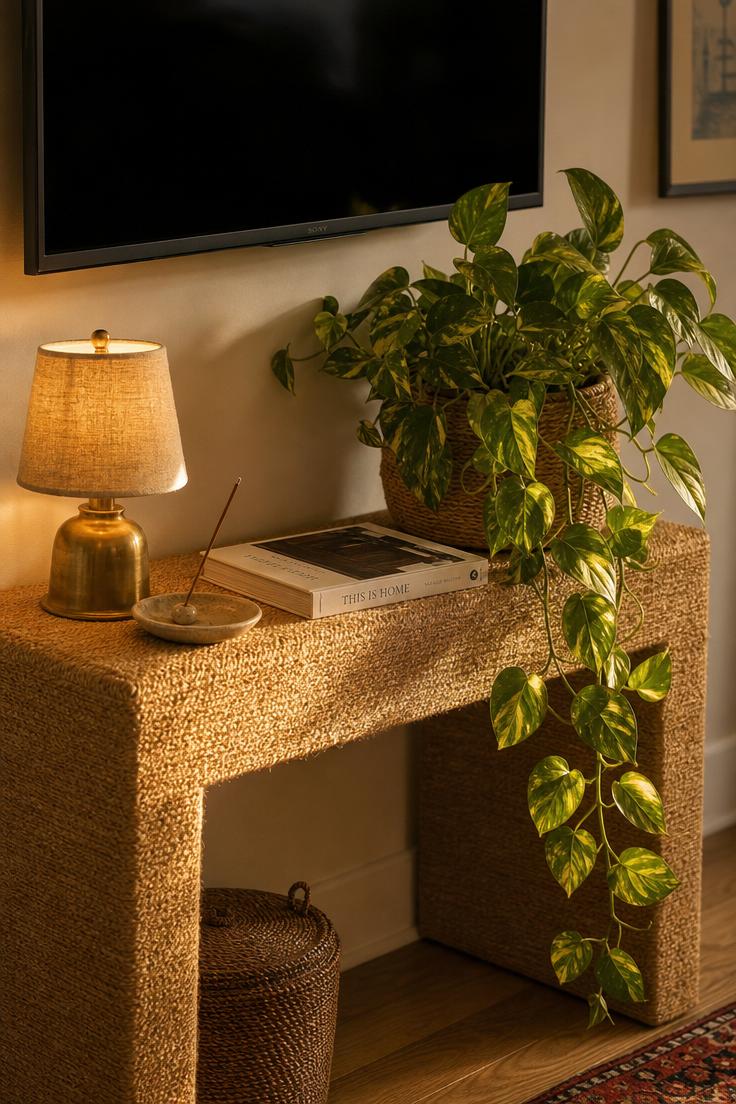
Plants do the heavy lifting in this setup.
A trailing pothos spilling across the console and down its side breaks up the hard lines of furniture and electronics with organic, unpredictable curves.
The jute-wrapped console adds another layer of natural texture — something you want to run your hand across, which is exactly the kind of tactile quality that makes a room feel inviting.
Living plants near screens create what environmental psychologists call a “biophilic bridge” — they connect the synthetic (the TV) with the natural (the greenery), making the technology feel less intrusive in your living space.
Style Blueprint:
- Natural jute-wrapped console table
- Large golden pothos in a woven basket
- Small brass table lamp with linen shade
- Ceramic incense holder
- Single hardcover book as a styling prop
Fabric-Wrapped Acoustic Panels in Oatmeal Linen
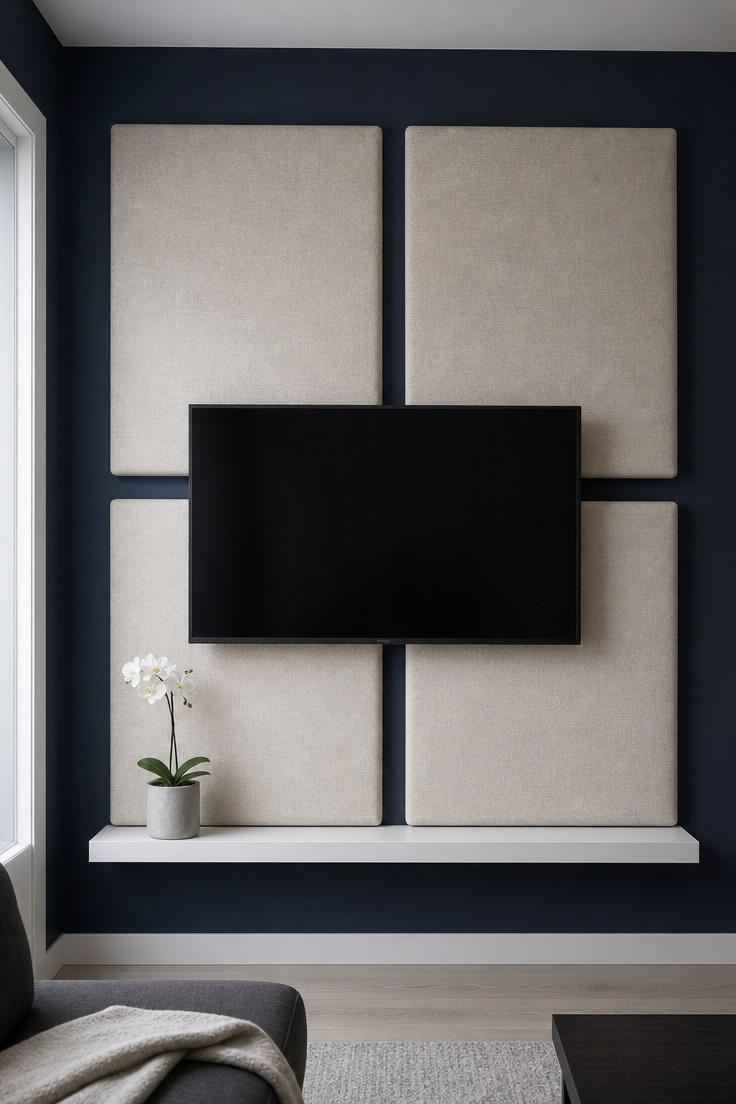
Acoustic panels are the workhorse of home theater design, but wrapped in oatmeal linen, they double as tv wall styling with real visual warmth.
The soft, padded surface absorbs sound reflections that hard walls bounce around the room — dialogue becomes clearer, and background music feels richer.
Setting them against a dark navy wall with visible gaps between each panel turns a functional sound treatment into a geometric design piece.
Soft materials near a hard glass screen create a sensory contrast that makes the viewing area feel more like a cocoon than a showroom.
Style Blueprint:
- Four large fabric-wrapped acoustic panels (oatmeal linen)
- Dark navy wall paint behind the panels
- Slim white floating shelf
- White orchid in a concrete pot
- Concealed TV mount for flush appearance
Reclaimed Barn Wood Planks in a Herringbone Pattern
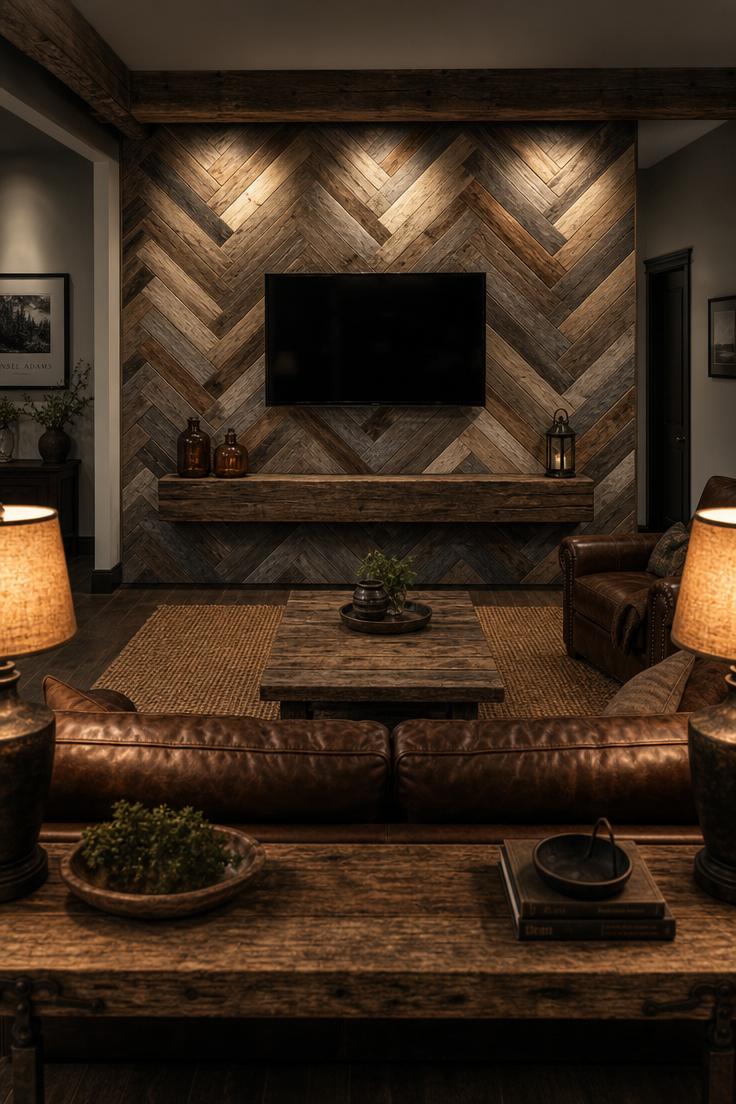
Herringbone takes reclaimed wood from rustic to refined in a single layout change.
The angled pattern adds movement and directionality that straight horizontal planks don’t have — your eye travels along the chevron lines rather than scanning flat across the wall.
A heavy reclaimed beam below the TV serves as a visual anchor, giving the screen something solid to sit above rather than floating amid all that pattern.
Mixed wood tones within the herringbone (pale blonde next to weathered gray next to warm brown) create a surface rich enough to compete with whatever is playing on screen.
Style Blueprint:
- Reclaimed barn wood planks (mixed tones for herringbone pattern)
- Heavy reclaimed wood beam as mantel shelf
- Amber glass bottles for shelf styling
- Small iron lantern
- Thick jute area rug
Design Pro-Tip: Reclaimed wood is beautiful but inconsistent. Before installing, lay out all planks on the floor and arrange them by tone so the lightest and darkest pieces are distributed evenly across the wall — this prevents dark clusters that pull the eye to one spot.
A Terrazzo Half-Wall With Matte White Paint Above
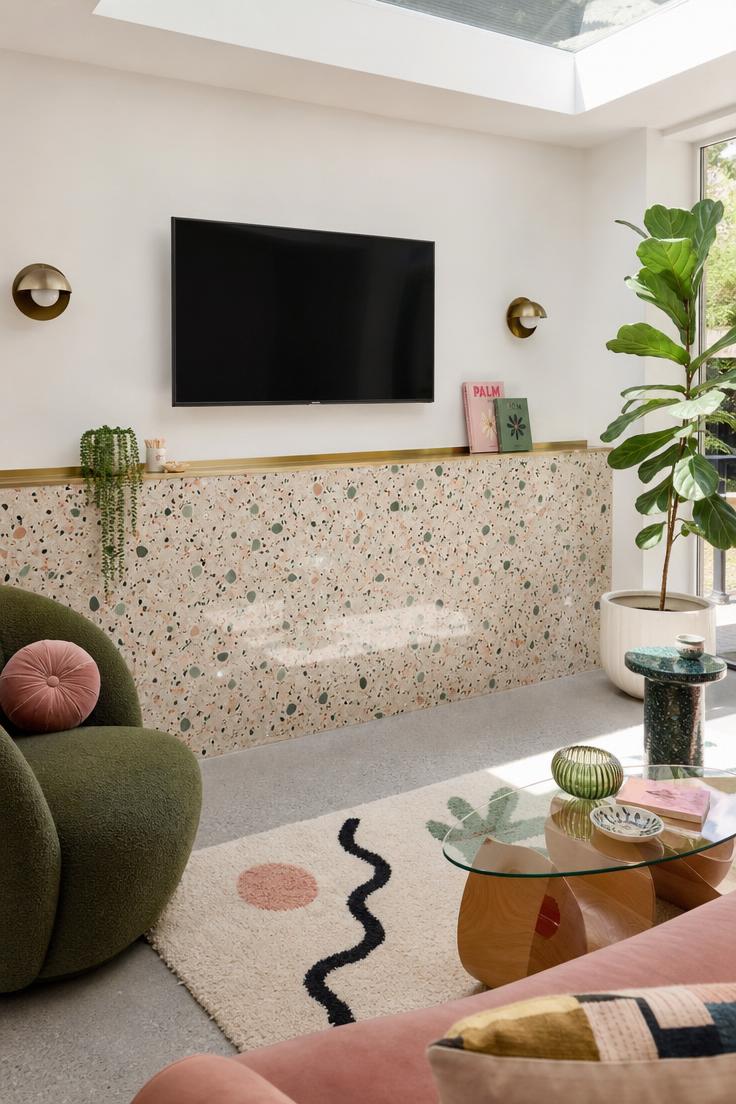
Half-wall treatments are an underused move in living room tv wall design.
By keeping the terrazzo to the lower 40 inches, you get the material’s full impact — those flecks of blush, sage, and charcoal — without overwhelming the room or competing with the screen above.
The transition line between terrazzo and matte white paint creates a natural horizon that the eye follows across the wall.
Terrazzo’s speckled surface has a playful irregularity that keeps your gaze moving, which is why it reads as lively and youthful compared to solid stone.
Style Blueprint:
- Poured terrazzo with blush, sage, cream, and charcoal chips
- Matte white paint for the upper wall section
- Slim brass transition shelf
- Trailing succulent in a small pot
- Two thin upright books as bookends
Smoked Mirror Panel With Thin Brass Trim Framing the TV
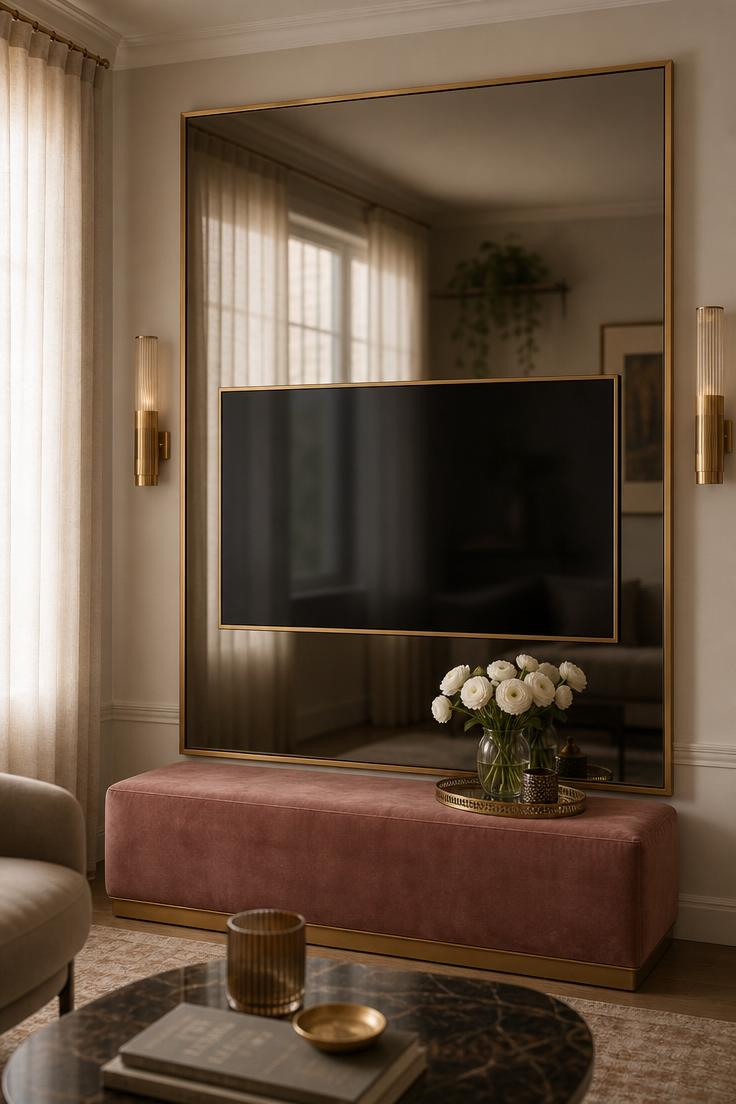
Smoked mirror behind the TV is a design trick that adds depth without adding physical space.
The semi-reflective surface picks up light and movement from the rest of the room, making the wall feel alive even when the screen is dark.
Thin brass trim around the perimeter ties the mirror and TV together into a single framed element — it looks intentional and finished, like a piece of furniture rather than a collection of separate things.
Mirror surfaces trick the brain into reading a wall as deeper than it actually is, which is why designers use them in small living rooms where the TV might otherwise make the space feel cramped.
Style Blueprint:
- Smoked mirror panel (approximately 4×6 feet)
- Thin brass trim for perimeter framing
- Velvet bench in dusty rose
- Small vase with fresh white ranunculus
- Tray for bench-top styling
Cane Webbing Insert Cabinets on Either Side of the Screen
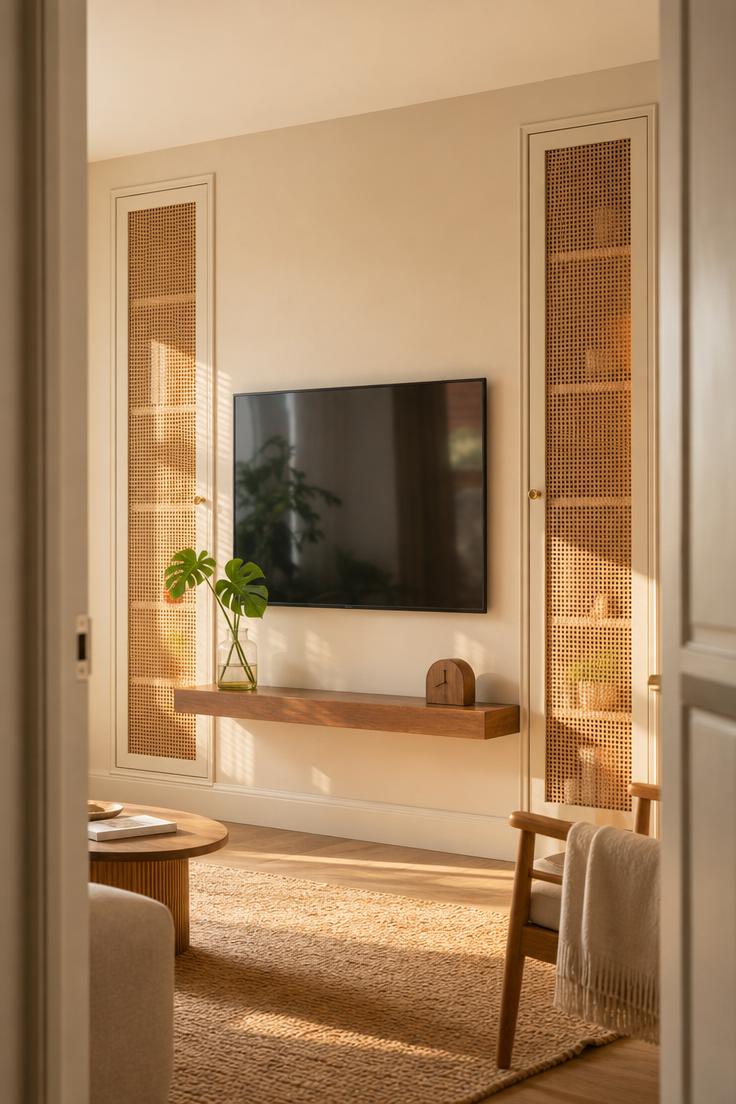
Cane webbing is the kind of material that does three things at once — it stores, it decorates, and it filters light.
Cabinets with cane door inserts give you covered storage for media equipment and clutter, while the woven texture adds visual warmth that solid doors can’t match.
Painting the cabinets the same color as the wall creates a built-in look that makes the TV area feel architectural rather than assembled.
The semi-transparent quality of cane webbing lets in just enough light to create depth without fully exposing what’s inside, which satisfies our desire for both order and visual interest.
Style Blueprint:
- Two tall narrow cabinets with cane webbing door inserts
- Warm cream paint (matching the wall color)
- Floating wood shelf below TV
- Monstera cutting in glass propagation vase
- Small wooden clock
A Hand-Painted Botanical Mural Behind a Slim Floating Shelf
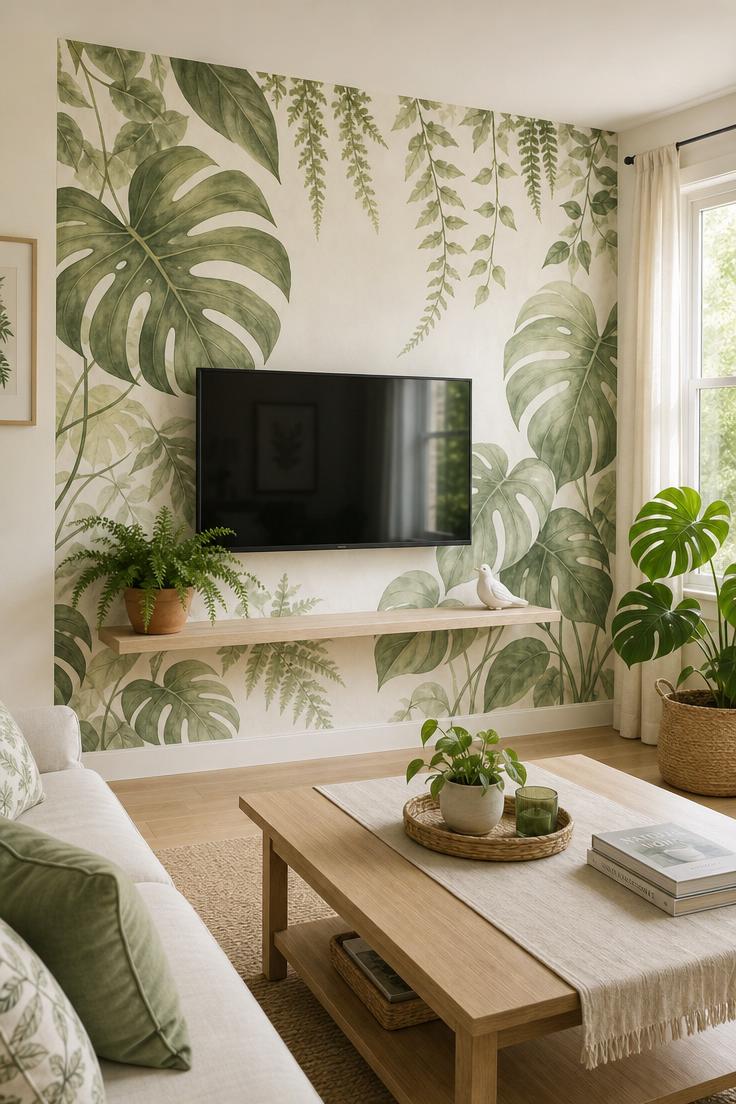
A mural turns the TV wall into the room’s main character.
Hand-painted botanicals in watercolor tones have a softness that printed wallpaper can’t replicate — the brushstrokes are visible up close, and the color bleeds slightly at the edges of each leaf, giving the wall an artistic imperfection.
Mounting the TV directly on the mural (rather than on a cleared section of wall) lets the screen become part of the scene instead of interrupting it.
Large-scale botanical motifs connect indoor spaces to the natural world in a way that small prints don’t — oversized leaves create an immersive effect, like sitting inside a greenhouse.
Style Blueprint:
- Hand-painted botanical mural (professional artist or DIY with stencils)
- Slim floating shelf in natural birch
- Small terracotta pot with a live fern
- White ceramic bird figurine
- Light wood coffee table to echo the shelf tone
Design Pro-Tip: If a full mural feels like a big commitment, paint it on removable wall panels instead. Mount the panels behind the TV area, and if you tire of the design in a year or two, swap them out without repainting the entire wall.
Conclusion
Every one of these 17 ideas starts with the same premise: the TV is staying, so make the wall around it worth looking at.
Whether you lean toward the warmth of Venetian plaster and reclaimed wood or the clean edge of marble columns and smoked mirror, the key is choosing one strong material or arrangement and letting it do the work.
You don’t need to cover every inch or spend a fortune — a single well-placed shelf, a pair of rattan baskets, or a coat of limewash can shift the entire mood of the room.
Pick the idea that matches the way your living room actually gets used, and start with one wall.
That’s all it takes.