This post may contain affiliate links. If you make a purchase through these links, we may earn a commission at no additional cost to you.
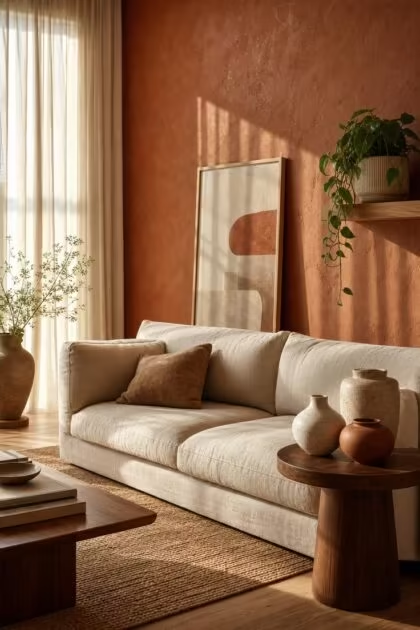
A single painted wall can carry an entire room.
It can set the tone before a single piece of furniture arrives, pull scattered colors into focus, or quiet a space that felt restless.
The right wall painting decor does more than add color — it adds character, dimension, and a sense of intention that flat paint alone never delivers.
These 11 ideas cover decorative painting techniques, bold interior wall colors, and wall art ideas you can adapt to any room in your home.
Whether you reach for a wide brush and a bucket of ochre or a roll of painter’s tape and a pint of sage, the walls are waiting.
A Dusty Rose Ombre Gradient Fading Into Warm White Above a Linen Daybed
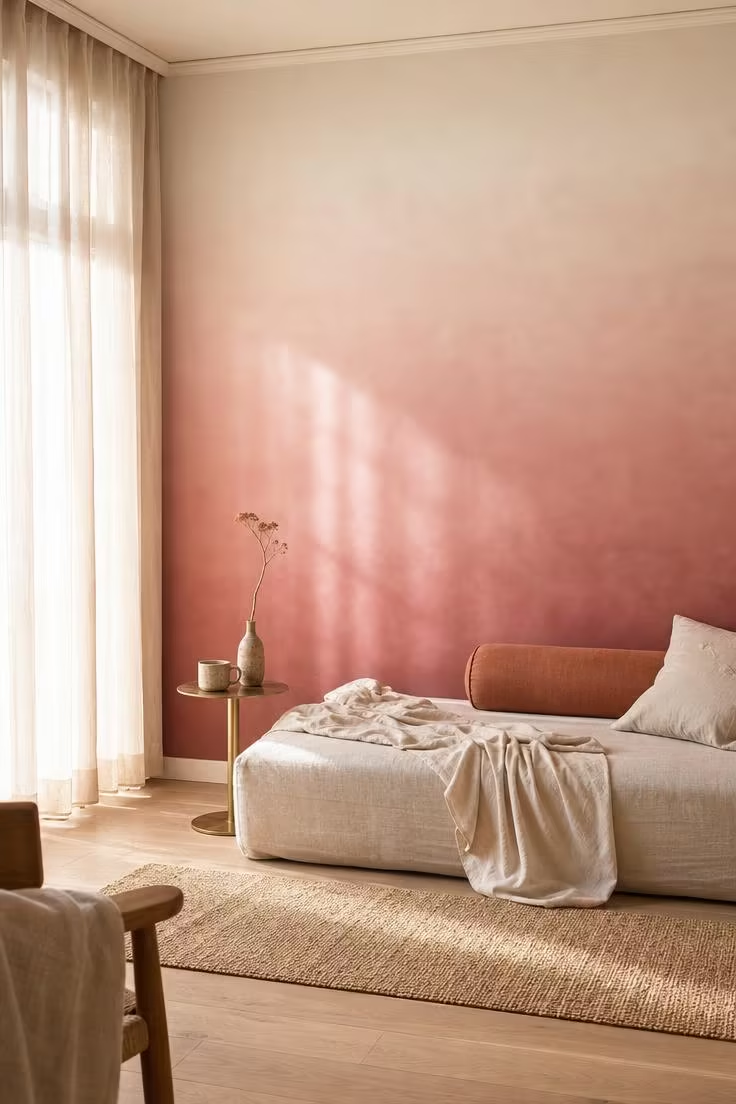
Ombre wall paint works because it gives the eye a path to follow.
The saturated rose at the base anchors the room at sitting height, right where you feel it most.
As the color lifts and fades toward the ceiling, the space opens up without losing its warmth.
This kind of wall paint design creates depth on a flat surface, something a solid color can never quite manage.
The linen daybed and brass details keep the palette grounded, preventing the pink from reading too sweet.
Dry-brush blending while the paint is still wet produces the soft transition; working in wide horizontal passes is the key to avoiding hard lines.
Style Blueprint:
- Dusty rose matte interior paint and warm white for the upper fade
- A wide flat brush (at least 4 inches) for blending the gradient
- A low-profile daybed or bench in natural linen or cotton
- One terracotta-toned accent pillow or throw
- A small brass or copper side table with one ceramic object
Matte Charcoal Paint With a Hand-Rolled Lime Plaster Texture in an Entryway
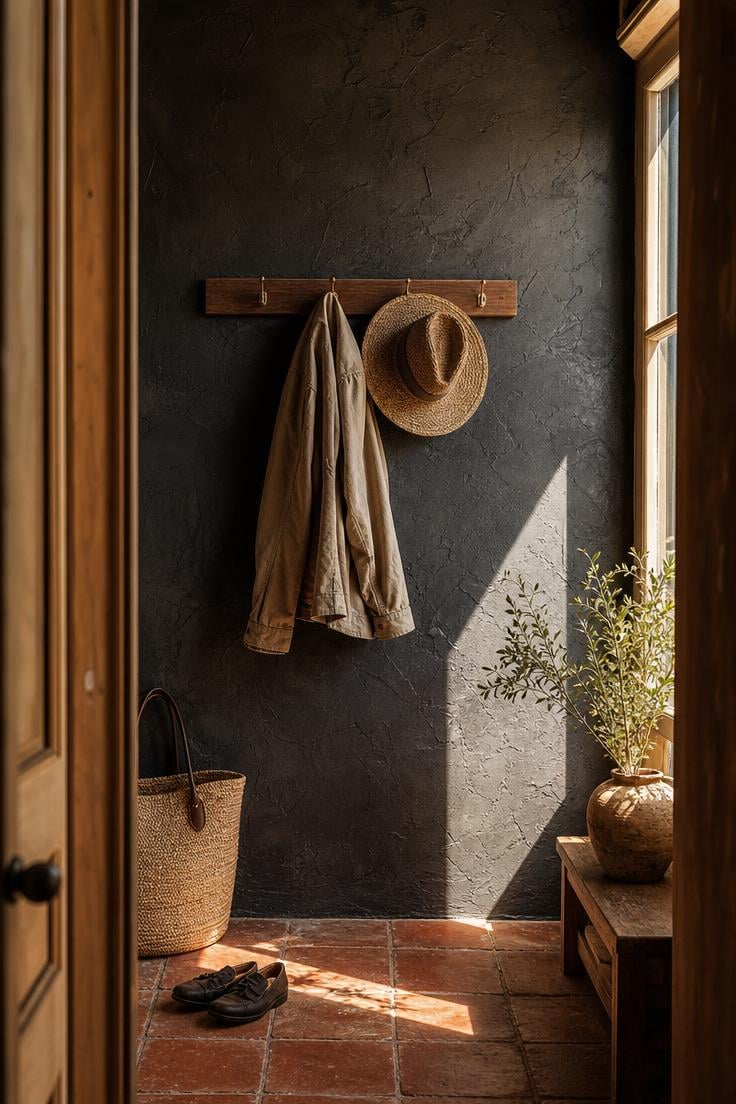
There is something about a wall you want to touch.
Lime plaster over a matte charcoal base creates a surface that shifts depending on where you stand and how the light hits it.
The trowel marks are the decoration here, each one catching a tiny shadow that changes through the day.
This is a decorative painting technique that rewards restraint; the wall needs nothing else on it.
Golden hour light turns the charcoal warm, almost brown, and the raised plaster ridges glow along their edges.
For the application, spread tinted lime putty in random crosshatch strokes with a Venetian plaster trowel, building up layers rather than covering in one pass.
Style Blueprint:
- Matte charcoal base coat paint (flat or dead-flat sheen)
- Pre-tinted lime plaster or lime putty in a dark gray tone
- A Venetian plaster stainless steel trowel
- Slim walnut or oak wall-mounted coat hooks
- Terracotta or stone-look floor tile in warm tones
A Painted Terracotta Arch Framing a Bedroom Alcove With Potted Fig Tree
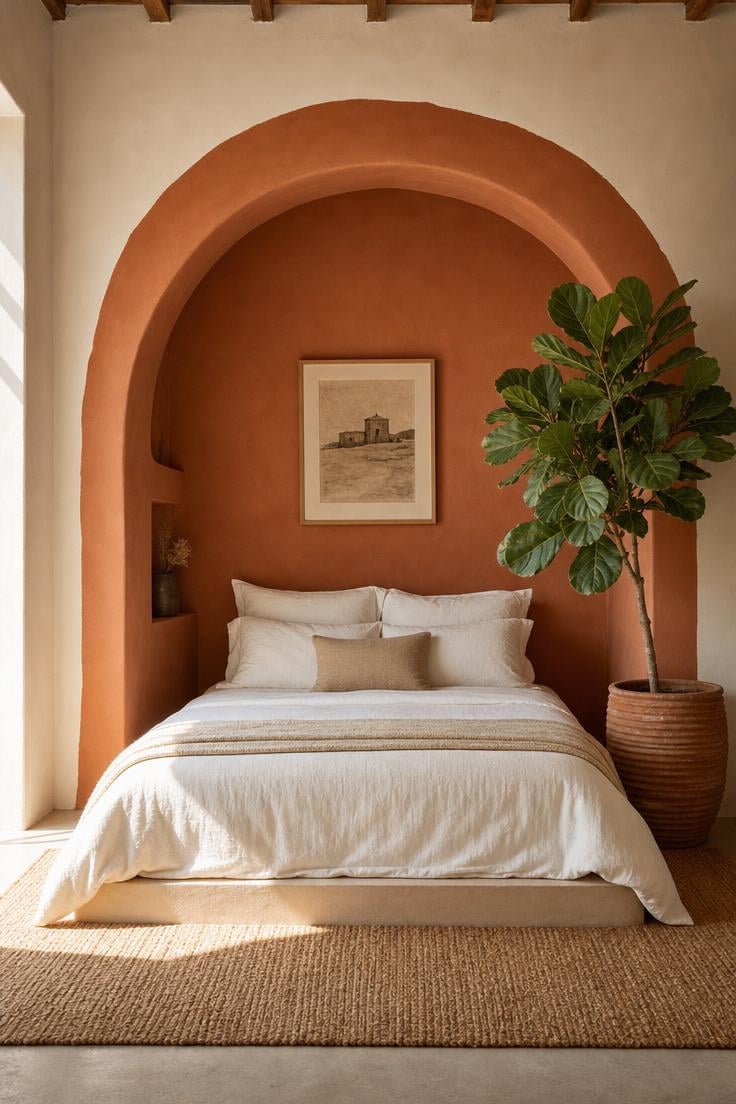
A painted arch tricks the brain into seeing architecture that isn’t there.
The curved shape suggests a doorway or a niche, giving the bed area its own sense of enclosure without building a single wall.
Terracotta against pale mushroom is a combination that reads warm without being heavy, and midday light keeps the colors honest.
The imperfect edge matters; a taped, razor-sharp line would look like a decal, but a freehand curve feels built into the room.
This accent wall idea turns flat drywall into something that belongs in a villa.
Sketch the arch shape using a pencil tied to a string pivot anchored at the center point, then paint with a large angled brush following the penciled line.
Style Blueprint:
- Warm terracotta matte paint and a pale mushroom or greige base wall color
- A pencil, string, and nail for sketching the arch curve
- A 3-inch angled brush for the freehand arch edge
- White linen bedding with a single neutral throw
- A tall potted plant in a clay or terracotta planter
Design Pro-Tip: When painting a freehand arch, load your brush with less paint than you think you need. A slightly dry brush gives you control on the curve and prevents drips. You can always go back for a second pass once the shape is set.
Sage Green Color Blocking With Cream Trim Around a Home Office Desk
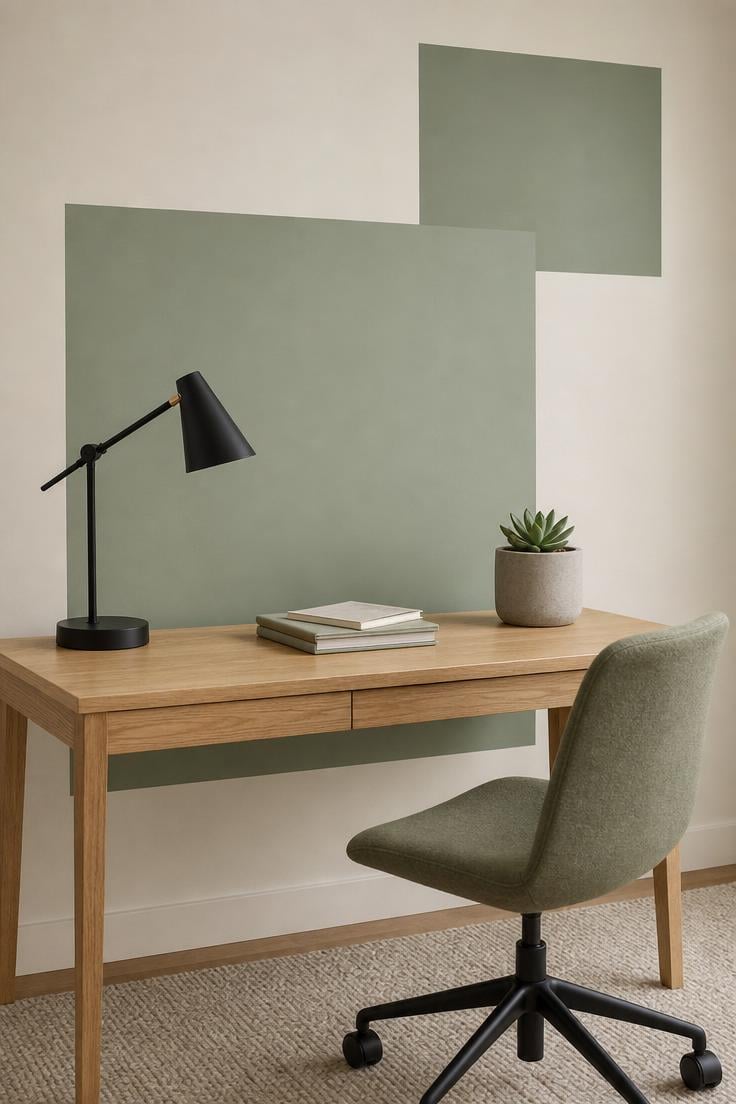
Color blocking walls gives a room structure without hanging a single thing.
Two painted rectangles behind a desk create a visual zone that says “this is where work happens” without relying on shelves, boards, or frames.
Sage green on cream is calm enough to sit in front of for hours but carries enough contrast to feel intentional.
The cool overcast light keeps the green from going too yellow, which matters in a workspace where accurate color perception helps.
Clean taped edges are the goal here; use a small foam roller for even coverage and peel the tape while the paint is still slightly tacky to avoid chipping.
This is one of the more forgiving accent wall ideas because small imperfections disappear when you step back and see the full composition.
Style Blueprint:
- Sage green matte paint and cream or warm white base wall color
- Low-tack painter’s tape and a small foam roller
- A slim-profile desk in light oak or birch
- One matte black desk lamp (swing-arm or task style)
- A single small plant in a concrete or ceramic pot
Navy Blue Sponge-Textured Accent Wall Behind a Brass-Framed Bar Cart
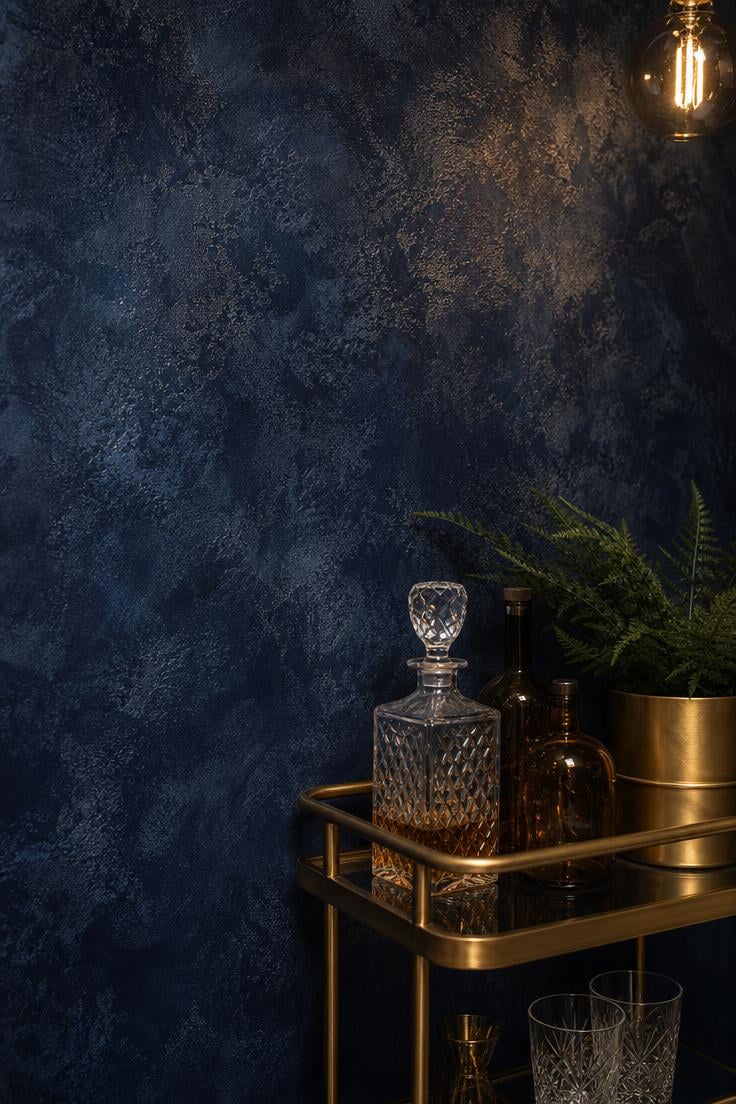
Sponge texturing is one of those faux paint finish methods that got a bad reputation in the 1990s and deserves a second look.
The difference now is restraint: navy over navy, tone on tone, instead of the bold contrast combinations from decades past.
Under warm low light, the mottled surface ripples like deep water, and the brass cart picks up that same golden glow against the blue.
A natural sea sponge produces better results than a synthetic one because its irregular pores leave random, organic marks.
Apply the base coat in deep navy, let it dry fully, then dab a slightly lighter navy glaze in overlapping, random passes.
The close-up perspective here reveals the texture that you would miss from across the room, and that layered depth is exactly what makes this wall worth touching.
Style Blueprint:
- Deep navy matte base coat paint and a navy-blue tinted glaze (one shade lighter)
- A natural sea sponge (not synthetic)
- A slim brass or gold-toned bar cart
- Amber glass bottles and one crystal decanter for warm reflections
- A small trailing plant in a brass or copper cachepot
Design Pro-Tip: When sponging, wring out the sponge until it’s barely damp and dab onto a paper plate first to check the impression. The most common mistake is overloading the sponge, which turns delicate mottling into blotchy smears.
A Floor-to-Ceiling Geometric Diamond Pattern in Warm Clay and Ivory on a Dining Wall
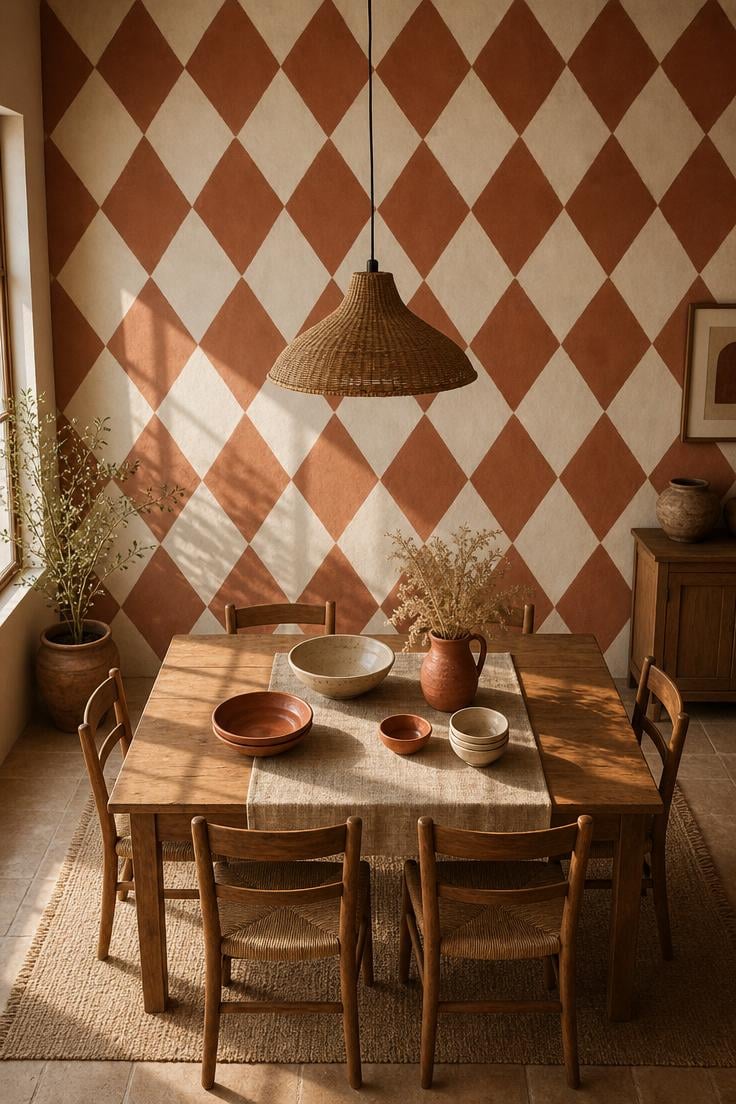
A diamond grid turns a flat dining room wall into something that holds your attention across the table.
The alternating warm clay and ivory create a rhythm that moves the eye upward and across without overwhelming the food or the people sitting in front of it.
Golden afternoon light plays along the diamond edges, highlighting the subtle difference between the two tones.
This interior wall color pairing works because clay and ivory sit close together on the warm spectrum; they contrast without clashing.
Measure and tape the grid before painting, working in alternating shapes so you can remove the tape for crisp lines.
The slight organic imperfection of a hand-painted grid keeps the pattern from looking like wallpaper, and that handmade quality is the whole point.
Style Blueprint:
- Warm clay matte paint and ivory or cream matte paint
- Low-tack painter’s tape and a measuring level for the diamond grid
- A simple oak or wood dining table with clean lines
- Stoneware serving bowls in warm neutrals
- A woven rattan pendant light
A Freehand Abstract Brushstroke Mural in Ochre and Burnt Sienna on a Stairwell Wall
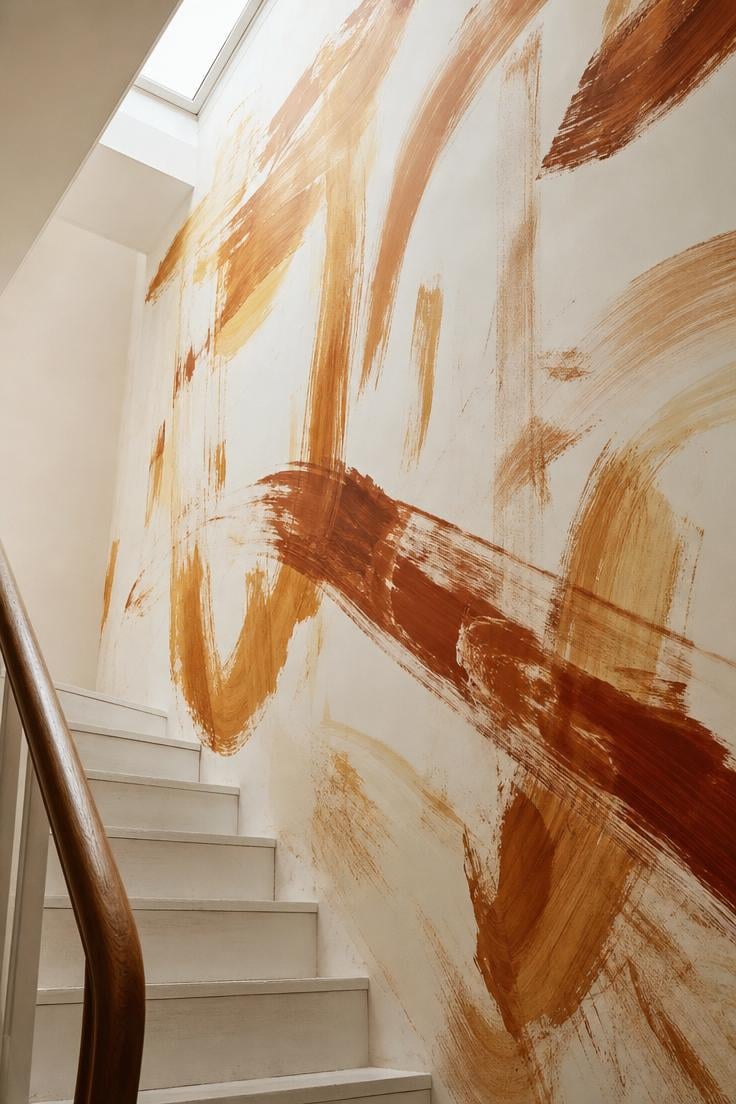
A stairwell wall is one of the most underused surfaces in any home.
It’s tall, it’s visible from multiple angles, and people pass it every day without a second thought.
Freehand abstract brushwork in ochre and burnt sienna changes that entirely.
The diagonal strokes follow the natural line of the stairs, creating movement that pulls you upward.
This painted mural approach works best when the strokes vary in opacity; some thick and saturated, some thin enough to see the white wall underneath.
The skylight overhead creates a natural gradient of illumination, bright at the top and softer below, which adds another layer of depth that the artist didn’t even have to paint.
Use oversized flat brushes (at least 6 inches wide) and thin the paint slightly with water for the translucent passes.
Work fast, before the paint dries, and resist the urge to correct every mark.
Style Blueprint:
- Ochre and burnt sienna interior paint (matte or eggshell finish)
- Two to three oversized flat brushes (6-inch width minimum)
- A drop cloth and painter’s tape for the stair treads and handrail
- A spray bottle of water for thinning paint on the wall
- White or off-white base wall color in matte finish
Thin Vertical Pinstripes in Warm White and Pale Oat on a Nursery Wall
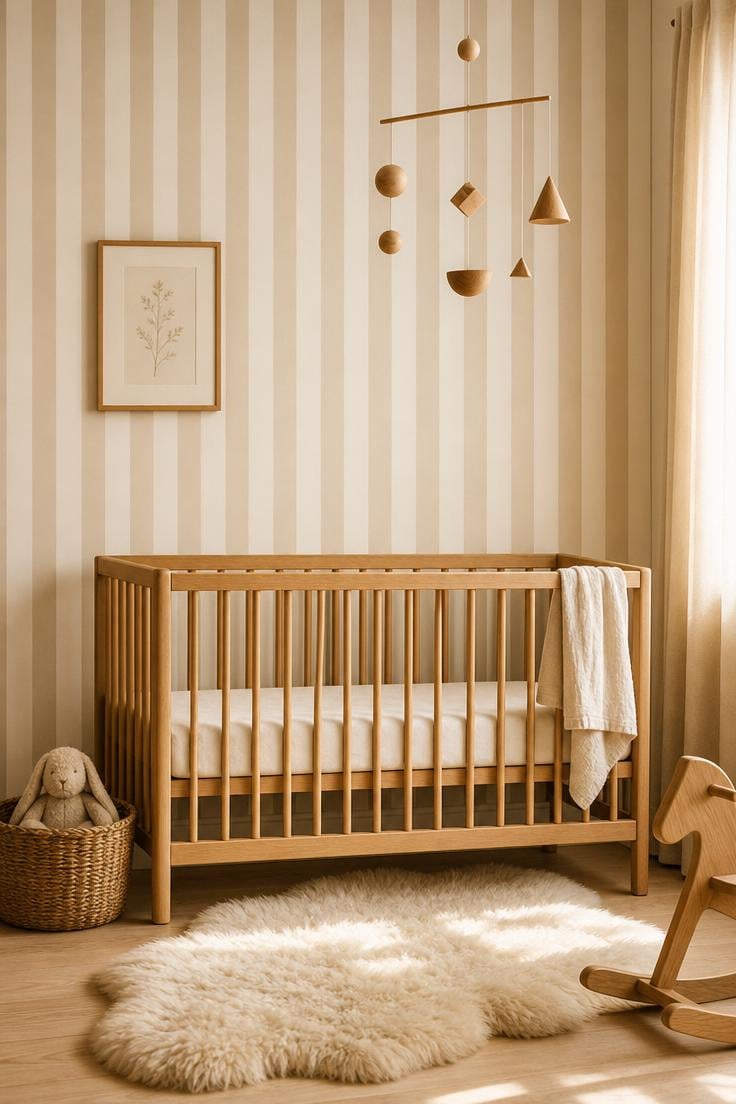
Pinstripes in a nursery might sound formal, but in pale oat on warm white, they read as softly textured rather than structured.
The vertical lines add rhythm to the wall without introducing a bold color or a busy pattern.
Warm morning light picks up the subtle contrast between the oat stripes and the white base, creating just enough visual interest to hold a wandering gaze.
This wall art idea works on the principle that gentle repetition soothes; the evenly spaced lines create a sense of order that both parents and babies respond to.
A laser level keeps the lines straight, and a small flat brush or thin foam roller guided by tape makes the application forgiving.
The finished effect is closer to woven fabric than painted stripes, which is exactly why it belongs in a room meant for rest.
Style Blueprint:
- Pale oat (a warm beige-gray) matte paint and warm white base coat
- A laser level for marking straight vertical lines
- Low-tack painter’s tape and a thin foam roller or small flat brush
- A natural wood crib with linen or cotton bedding
- A sheepskin or soft woven rug in cream tones
Design Pro-Tip: For pinstripes, always seal the tape edges with the base coat color first and let it dry before rolling on the stripe color. This prevents the stripe paint from bleeding under the tape and gives you lines sharp enough to pass for wallpaper.
Deep Forest Green Chalkboard Paint on a Kitchen Pantry Wall With Handwritten Labels
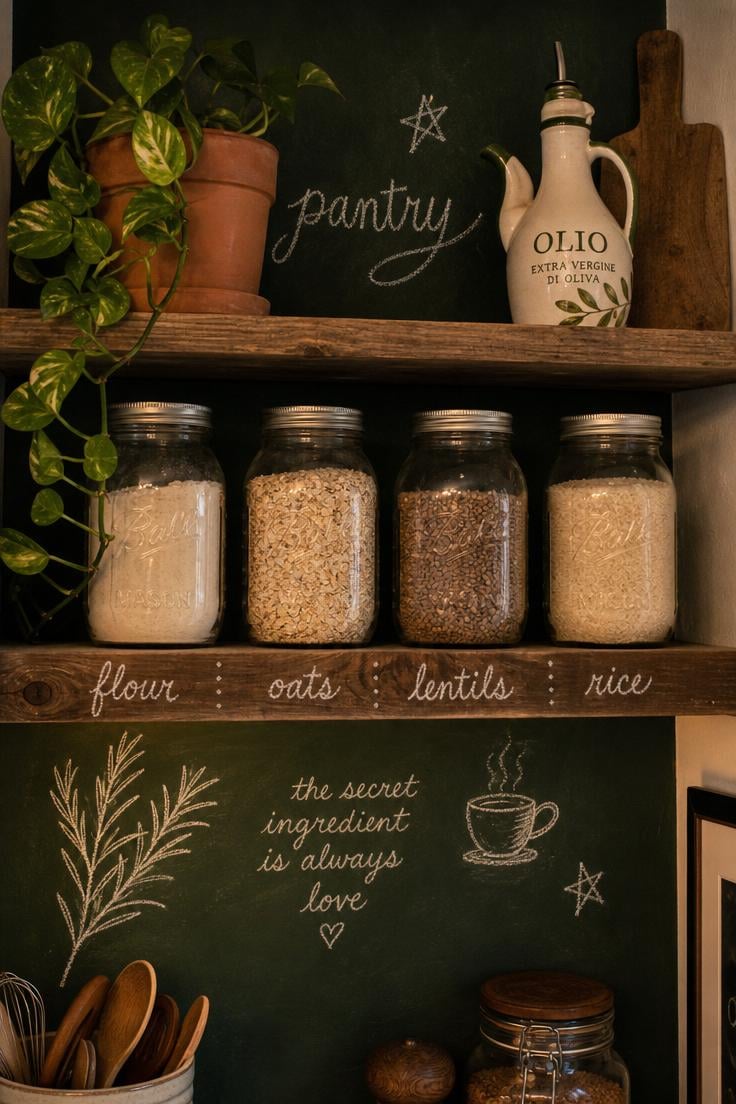
Chalkboard paint in forest green gives a pantry wall the look of an old European shopfront.
The deep green reads richer and more grounded than the standard black chalkboard, and the white chalk labels pop against it with clean contrast.
Handwritten lettering adds personality that printed labels never deliver; every word looks like someone cared enough to pick up the chalk.
The small illustrations between the labels, a rosemary sprig, a coffee cup, keep the wall from feeling like a grocery list and push it into wall painting decor territory.
Warm under-cabinet light hitting the matte chalkboard surface creates a soft glow without any glare, which matters in a room where you stand close to the wall.
Apply two coats with a foam roller, cure for 48 hours, then season the entire surface by rubbing the flat side of a chalk stick across it before writing anything.
Style Blueprint:
- Deep forest green chalkboard paint (matte, writable finish)
- White chalk sticks and chalk markers for detailed lettering
- Open pine or light wood wall-mounted shelving
- Mason jars and glass canisters for dry goods
- A small trailing plant in a terracotta pot
A Muted Lavender Half-Wall With Raw Plaster Finish Above in a Bathroom
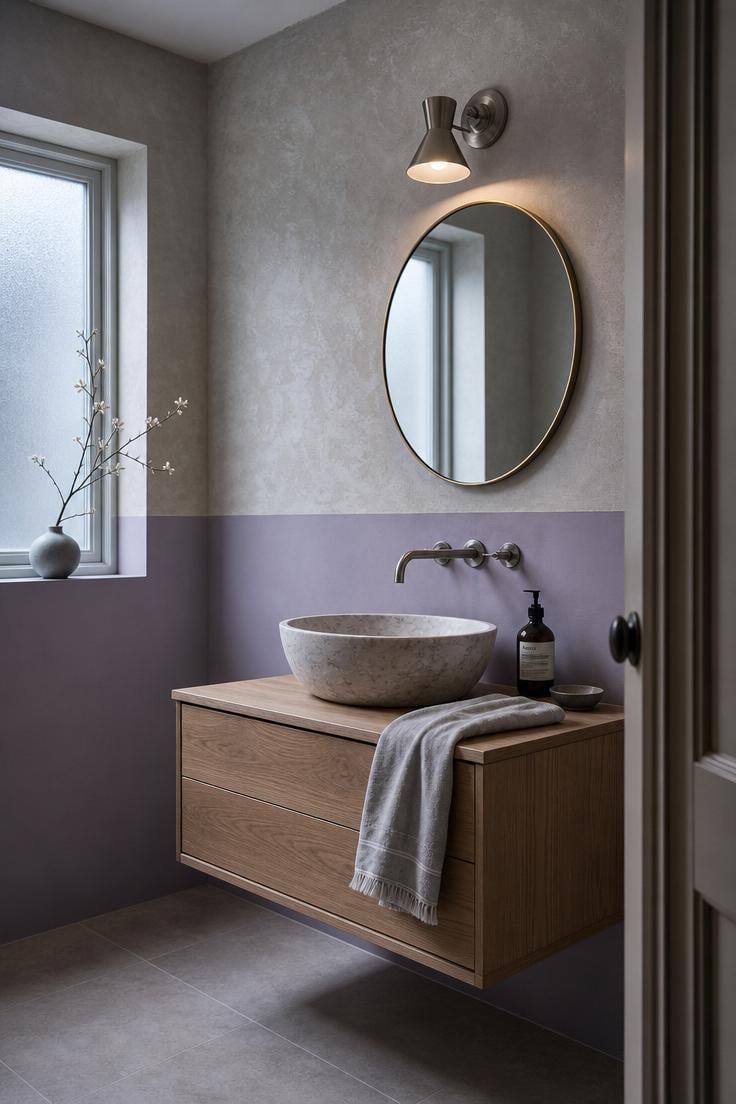
The half-wall technique gives a bathroom two distinct textures without doubling the effort.
Muted lavender below the midline provides color that is soft enough for a space meant for quiet mornings.
Raw plaster above it adds a tactile, unfinished quality that prevents the room from feeling too polished or clinical.
Cool overcast light shifts the lavender slightly blue, which pairs well with the warm gray of the exposed plaster.
The contrast between the smooth painted surface and the rough troweled texture above creates visual tension that makes the wall interesting from across a small room.
Tape a level line at the desired height, paint the lower section in satin finish for moisture resistance, and apply a thin skim coat of untinted plaster above, leaving trowel marks visible as the decorative element.
Style Blueprint:
- Muted lavender satin-finish paint (moisture-resistant for bathrooms)
- Pre-mixed skim coat plaster and a plaster trowel
- Painter’s tape and a long spirit level for the dividing line
- A wall-mounted vanity in white oak or light wood
- A stone or concrete vessel sink and a brushed nickel sconce
A Painted Ceiling Mural of Trailing Vines and Small Birds on Pale Sky Blue in a Reading Nook
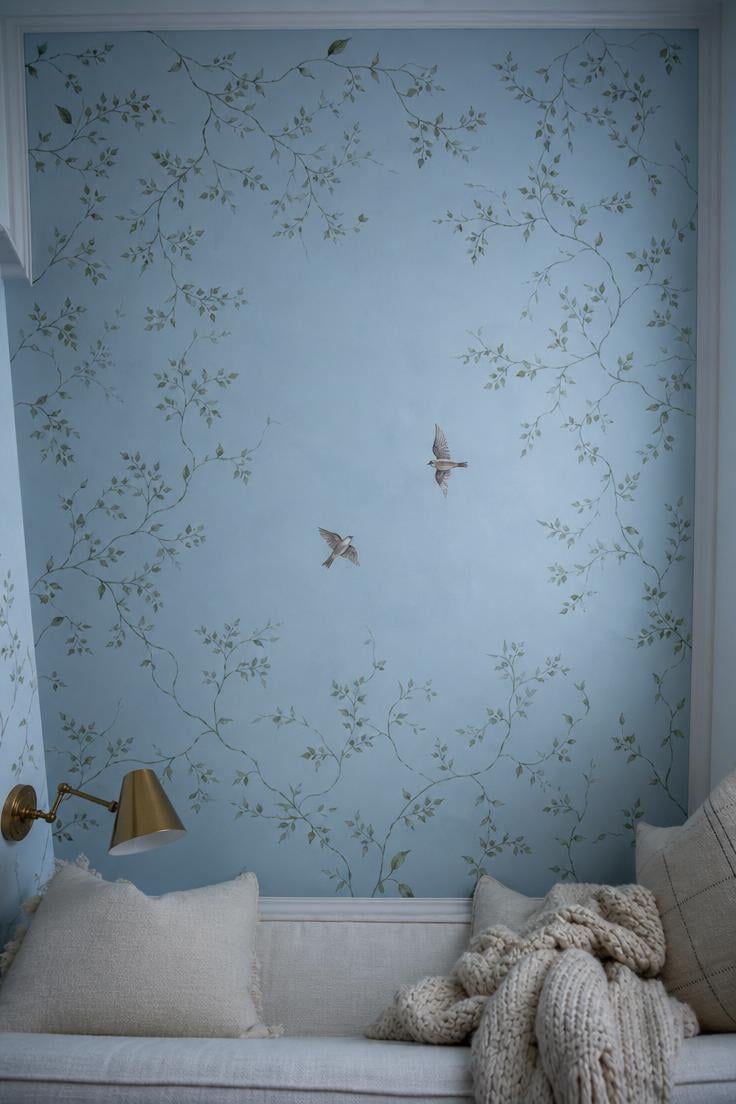
Most people forget to look up, and that is exactly what makes a painted ceiling so effective.
In a small reading nook, the ceiling is close enough to study, and trailing vines in muted green against pale sky blue create a canopy that makes the space feel sheltered.
The birds add a hint of life and movement to an otherwise still scene.
This ombre wall paint concept, applied overhead instead of vertically, plays on the same principle of color fading into open space, but the orientation surprises.
Cool afternoon light keeps the sky blue reading true rather than washing it out.
Paint the base coat first, sketch the vine paths with pencil, and then use a thin round brush for the stem linework and a small filbert brush for the leaves and birds.
The ceiling is the largest unused surface in most homes, and treating it as a canvas turns a reading corner into a place worth lingering.
Style Blueprint:
- Pale sky blue matte ceiling paint and muted green for vine linework
- A thin round detail brush and a small filbert brush for leaves and birds
- Warm brown and soft gray paint for the bird details
- A built-in or freestanding bench with natural linen cushions
- A wall-mounted brass reading lamp (swing-arm style)
Design Pro-Tip: When painting a ceiling mural, tape a small mirror to the floor directly below your work area. Checking the reflection saves your neck and gives you a true perspective of how the composition reads from the seated position below.
Conclusion
Eleven ideas, eleven different techniques, and not one of them requires tearing down a wall or hiring a contractor.
Wall painting decor at its best treats every surface as a chance to add something personal to a room.
An ombre gradient, a freehand mural, a sponge-textured accent, or a simple set of pinstripes can shift the entire feel of a space for the cost of a few cans of paint and an afternoon.
Start with the technique that matches your comfort level and the room that needs it most.
Test your colors and your method on a large sample board before committing to the wall.
And remember that the imperfections, the brushstroke that isn’t perfectly straight, the arch edge that wobbles slightly, are often what make a painted wall feel like it belongs to you and not to a catalog.