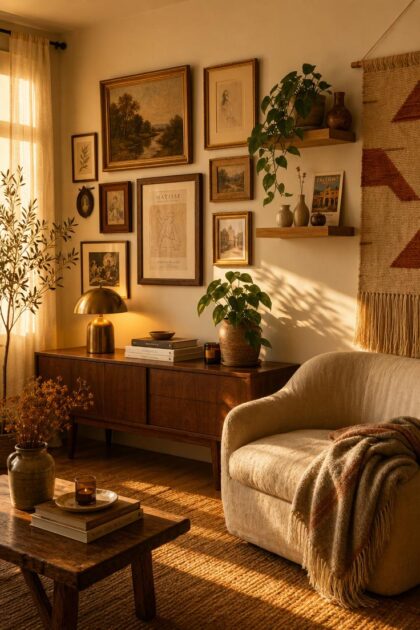
This post may contain affiliate links. If you make a purchase through these links, we may earn a commission at no additional cost to you.
Blank white walls are common in apartments, and they can make a space feel unfinished or temporary.
The good news is that many wall decor ideas can be adapted for renters using options such as removable hooks, adhesive strips, lightweight pieces, and arrangements that require little or no permanent alteration.
Whether you are working with a narrow hallway or a wide living room wall, these 13 apartment wall decor ideas focus on specific materials, textures, and arrangements that can add warmth and personality without committing to major changes.
Many of these ideas use removable methods, but wall finishes, adhesives, housing rules, and lease terms vary.
Check your lease or dorm policy and test removable products in an inconspicuous location before applying them.
No removable product can be guaranteed to leave every painted or finished surface unchanged.
A Mismatched Thrift-Store Frame Gallery Wall in Warm Gold and Walnut Tones
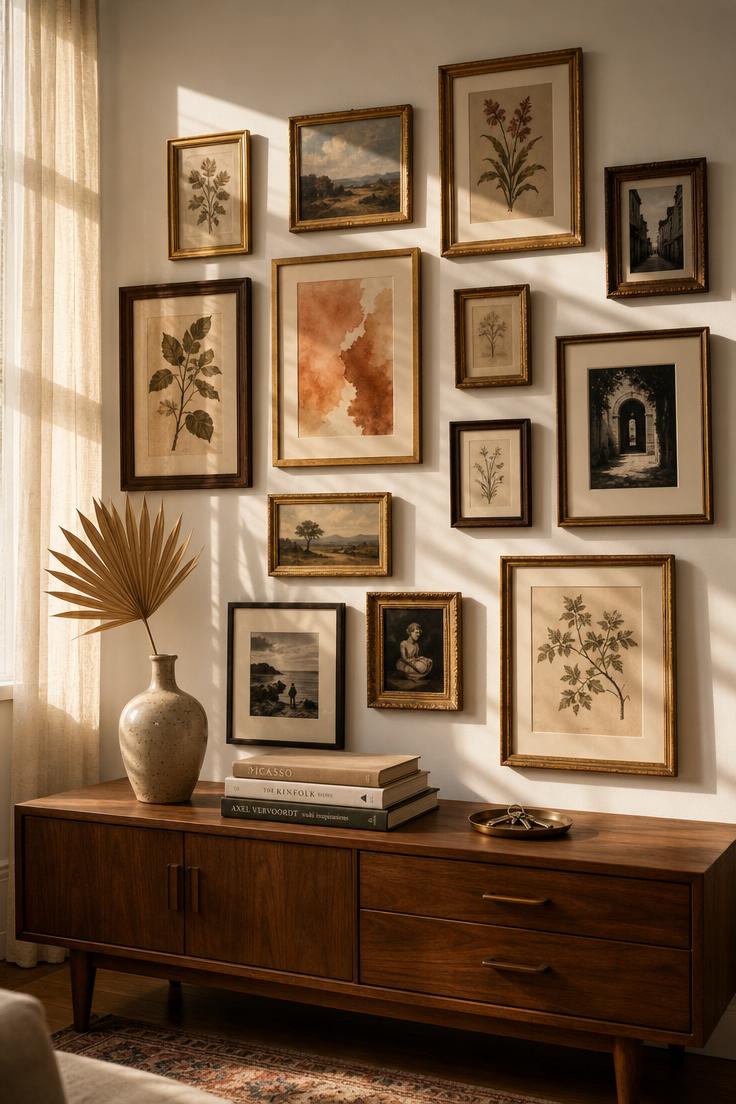
A gallery wall built from thrift-store frames is one of the most personal ways to fill a large blank wall in any apartment.
The trick is not matching every frame, but connecting them through a shared warmth, like gold leaf next to walnut next to brushed brass, so the collection feels gathered rather than purchased all at once.
Salon-style hanging, where pieces sit at varied heights and cluster loosely around a center point, gives the arrangement a relaxed energy that a rigid grid cannot match.
Start by laying every frame on the floor and shifting them around until the balance feels right, then trace each one on kraft paper and tape the templates to the wall before hammering a single nail.
Coordinating mat colors in cream or white ties even the most mismatched frames together.
This kind of wall art doubles as a conversation piece, and it grows with you every time you find a new print at a weekend market.
Style Blueprint:
- 8-12 vintage frames in gold, brass, and walnut wood finishes
- A mix of botanical prints, photographs, and one abstract piece
- Ivory or cream mat boards to unify different frame sizes
- A low credenza or console table below to anchor the arrangement
- Kraft paper templates and painter’s tape for layout planning
A Linen-Wrapped Canvas Triptych in Muted Sage on a Cool Gray Wall
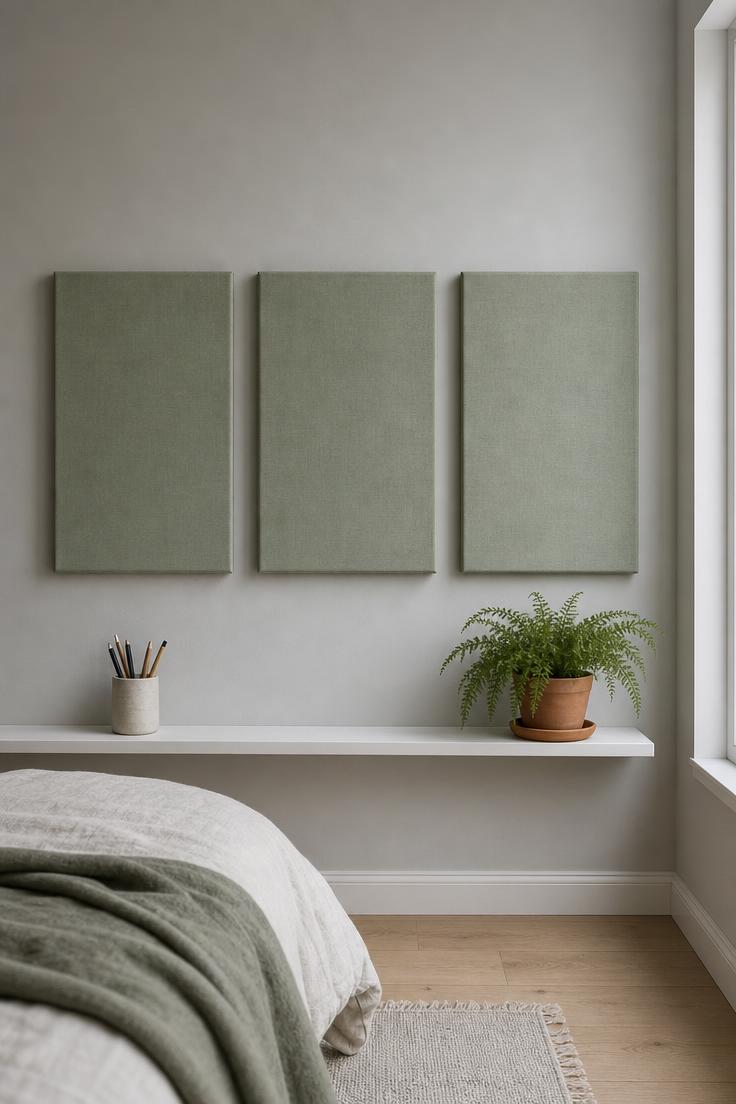
Linen-wrapped canvases bring texture to a wall without any printed image at all, which makes them a good fit for anyone who prefers a quieter approach to wall art.
The fabric itself becomes the focal point, its natural weave catching light in a way that changes throughout the day depending on where the sun sits.
Making them is straightforward: stretch dyed or natural linen over standard artist stretcher bars using a staple gun, fold the corners like wrapping a gift, and hang each canvas with a single adhesive hook.
A triptych format, three identical pieces in a row, creates a sense of order that calms down a busy room.
Sage green works well against cool gray or warm white walls, but linen also takes dye beautifully in ochre, dusty rose, or slate blue.
This is one of the most affordable wall decor projects for a small apartment, and the materials cost less than a single framed print.
The soft, matte surface absorbs sound in the same way a woven wall hanging does, which is a welcome bonus in apartments with thin walls.
Style Blueprint:
- Three artist stretcher bar frames (16×24 inches each)
- Pre-dyed linen fabric in sage green or another muted tone
- A staple gun and fabric scissors for wrapping
- Adhesive hooks rated for 3-5 pounds each
- A level and measuring tape for even spacing
Peel and Stick Wallpaper in Navy Herringbone Behind a White Bookshelf
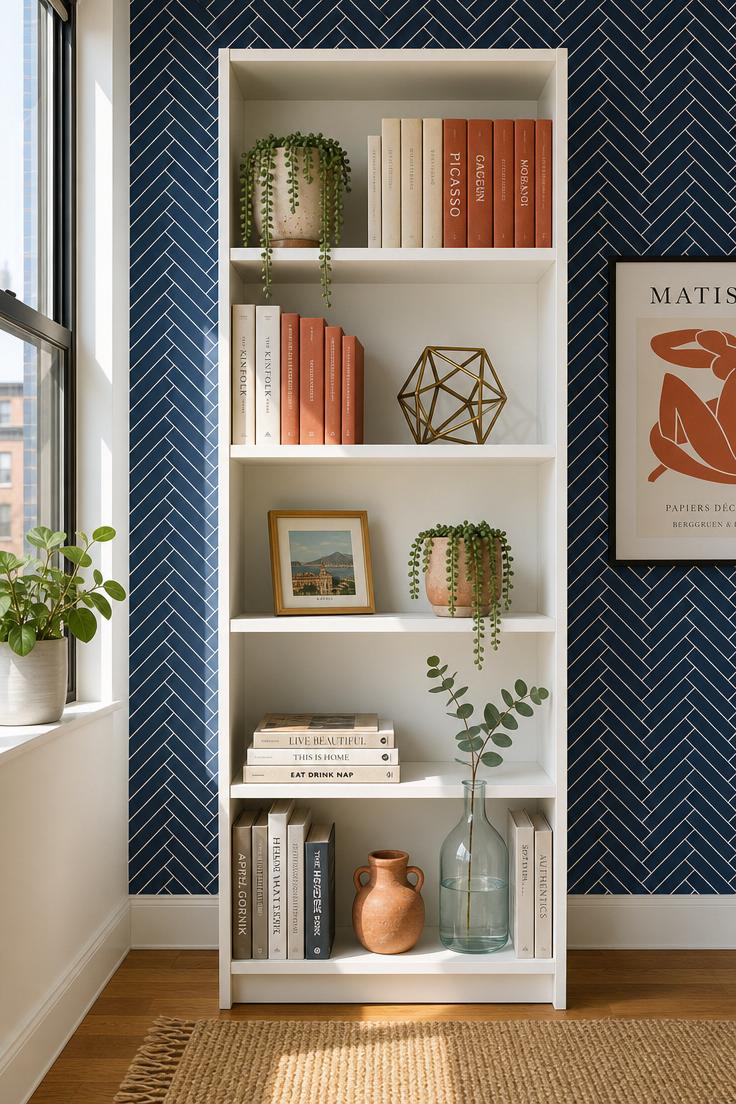
Peel and stick wallpaper is the fastest way to add an accent wall to an apartment without touching a paint roller.
Navy herringbone is a pattern that reads as both classic and modern, giving a small room depth and structure without overwhelming the space.
Applying it behind a bookshelf or console table is a smart move, because the furniture covers any imperfect seams along the bottom edge and frames the pattern like a backdrop.
Most renter friendly peel and stick wallpaper brands peel off cleanly and leave no residue, which means you can change the pattern whenever a new lease starts.
The contrast between a deep navy wall and white furniture creates a layered look that photographs well and feels much more intentional than a single coat of builder-grade eggshell.
If a full wall feels like too much, try applying a single strip inside a bookcase or along the back of a shallow niche for a smaller dose of the same effect.
One roll typically covers about 28 square feet, so measure the wall before ordering to avoid running short mid-project.
A sharp utility knife and a plastic smoothing tool are the only supplies needed beyond the wallpaper itself.
Style Blueprint:
- Navy herringbone peel and stick wallpaper (measure wall first)
- A white or light-colored bookshelf to contrast against the pattern
- A plastic smoothing tool and utility knife for clean application
- Styled shelf objects in brass, terracotta, and green tones
- A natural jute rug to ground the arrangement
A Cluster of Matte Black Round Mirrors in Graduated Sizes Above a Nightstand

Mirrors do more work than almost any other piece of wall decor in a small apartment, because they bounce light into corners that would otherwise stay dim.
Grouping several round mirrors together instead of hanging one large rectangular mirror creates something sculptural, almost like a piece of abstract art made entirely from reflections.
The matte black frames keep the arrangement grounded and prevent it from looking too precious or overly decorative.
Graduated sizes, from a 6-inch disc up to an 18-inch centerpiece, give the cluster movement and keep the eye traveling across the wall.
Adhesive-backed mirror hooks work well for lightweight mirrors under five pounds, making this a zero-drill project.
Place the cluster above a nightstand, a narrow console, or a small desk to turn a forgotten wall into a bright, open focal point.
Style Blueprint:
- Five to seven round mirrors in matte black frames (6 to 18 inches)
- Adhesive mirror hooks rated for the weight of each piece
- An oak or walnut nightstand or console below
- One trailing plant nearby to add an organic reflection
- Even spacing of about 1-2 inches between mirror edges
Design Pro-Tip: When arranging a cluster of objects on a wall, whether mirrors, frames, or plates, start with the largest piece slightly off-center and build outward. Perfectly centered arrangements look stiff. Shifting the anchor piece two or three inches to one side creates a natural, collected look that feels less like a store display and more like something that grew over time.
A Raw Linen Pocket Organizer With Dried Eucalyptus Sprigs on a Kitchen Wall
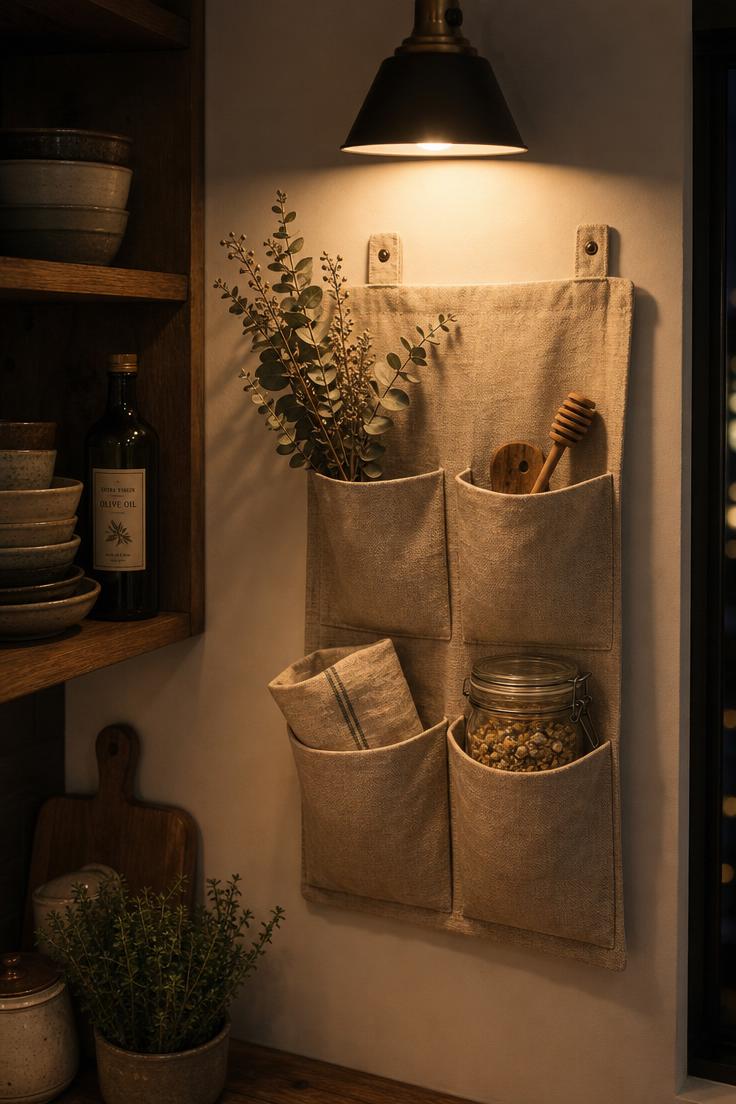
A linen pocket organizer is one of those objects that blurs the line between wall decor and daily utility, which is exactly why it works so well in an apartment kitchen.
The pockets hold items you actually reach for, dried herbs, a favorite wooden spoon, a cloth napkin, so the wall stays functional instead of purely decorative.
Hanging it from a single adhesive hook or a removable over-door bracket keeps the installation renter friendly and damage-free.
Dried eucalyptus sprigs tucked into one pocket bring a muted green tone and a faint herbal scent that makes the whole corner feel more alive.
Raw, unbleached linen has a rough texture that softens over time with handling and washing, aging in a way that synthetic organizers never do.
The vertical format takes up very little wall space, making it a good option for narrow strips of wall between a cabinet and a doorframe.
You can sew one from a single yard of linen fabric and a few straight seams, or find ready-made versions at craft markets and linen goods shops.
Pairing it with open wooden shelving and ceramic dishes reinforces the warm, handmade feel without adding clutter.
A single warm pendant light above turns this small corner into one of the coziest spots in the apartment after dark.
Style Blueprint:
- A raw linen wall pocket organizer with 3-4 deep pockets
- Dried eucalyptus, wooden utensils, and a glass jar for filling
- One adhesive hook or removable bracket for hanging
- Open wooden shelving nearby with ceramic bowls
- A warm pendant light or battery-operated sconce above
Floating Shelves in Light Birch With Ceramic Bud Vases and Postcard Prints
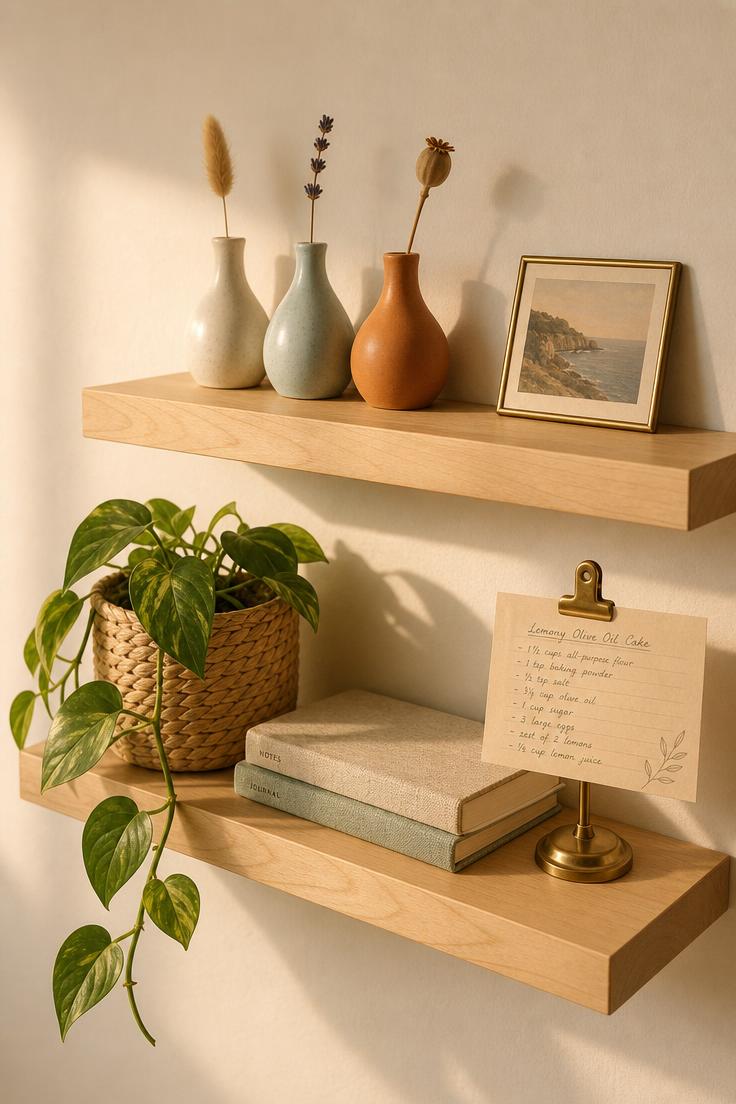
Floating shelves give apartment walls a third dimension that flat frames and prints simply cannot deliver.
Light birch wood keeps the look airy and modern, and its pale grain pairs well with warm white and cream wall colors found in most rental units.
Adhesive-mount shelf brackets now support up to 15 pounds per bracket, which means a pair of birch shelves can hold ceramics, small plants, and framed postcards without any drilling.
The styling matters as much as the shelf itself: group objects in odd numbers, vary the heights, and leave breathing room between items so the arrangement does not look crowded.
A trailing pothos or string-of-pearls plant adds a living element that changes week to week, keeping the wall display from ever feeling static.
Rotating the postcards and small prints with the seasons is one of the easiest ways to keep your living room wall feeling fresh without buying new furniture.
Birch shelves also work well in bathrooms, entryways, and bedrooms, making them one of the most versatile wall mounted storage solutions for apartment living.
Style Blueprint:
- Two light birch floating shelves (24-36 inches long)
- Adhesive-mount shelf brackets rated for 15 pounds each
- Three to four ceramic bud vases in muted tones
- A small trailing plant in a woven basket or ceramic pot
- Postcard prints or clip stands for easy rotation
A Single Oversized Abstract Print in a Slim Oak Float Frame Leaned Against a White Wall
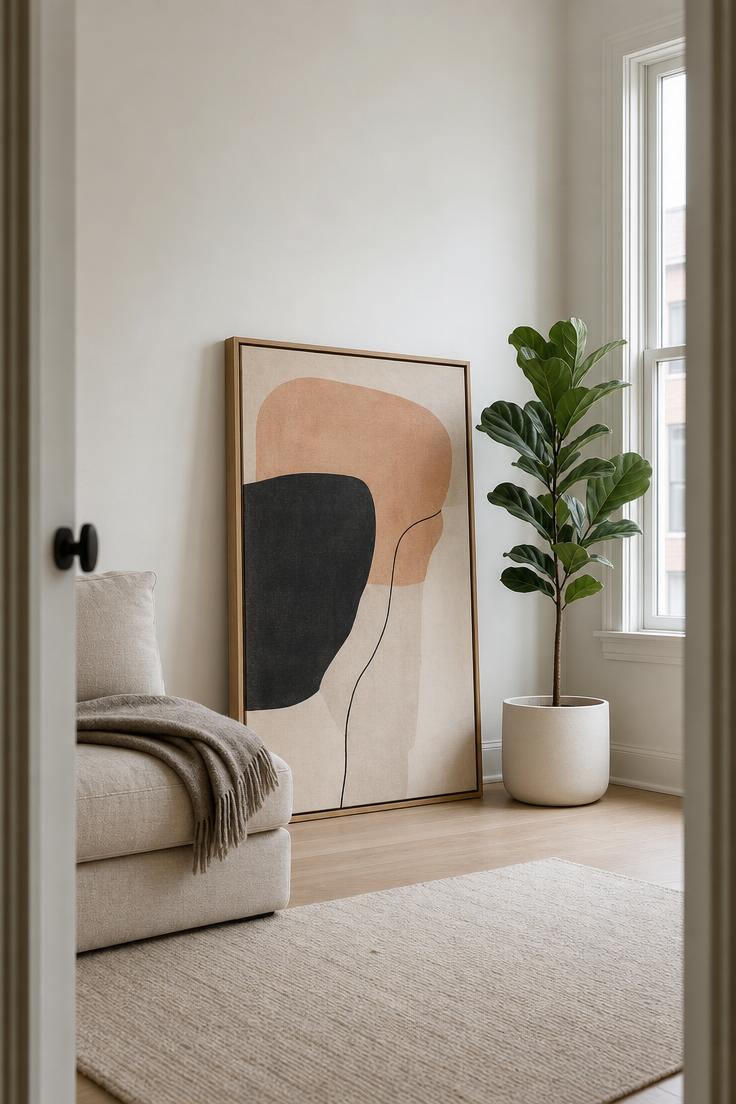
Leaning a single large print against the wall is the most renter friendly way to make a bold statement without drilling a single hole.
The scale does most of the work here: a 36×48-inch piece commands attention in a way that a cluster of small frames simply cannot replicate.
A slim oak float frame adds a clean edge without competing with the artwork, and the visible gap between the canvas and the frame gives the piece a gallery quality finish.
Choosing an abstract in muted, livable tones like peach, charcoal, and cream keeps the room feeling warm rather than sterile or cold.
Resting the piece directly on the floor against the baseboard creates a casual, low-effort mood that fits the relaxed energy of most apartment living rooms.
If the print is too heavy to lean safely, a small furniture bumper pad behind the top edge prevents it from sliding or scratching the wall.
This approach works especially well on a wide living room wall where a gallery wall would feel too busy and a single small frame would get lost.
A tall plant beside the print balances the composition and softens the hard rectangle of the frame.
Style Blueprint:
- One oversized abstract print (36×48 inches or larger)
- A slim natural oak float frame with a quarter-inch reveal
- A matte white ceramic planter with a tall leafy plant
- A furniture bumper pad to prevent wall scratching
- Clear floor space for leaning, no shelf or console needed
A Grid of Pressed Fern Specimens in Clear Acrylic Clip Frames
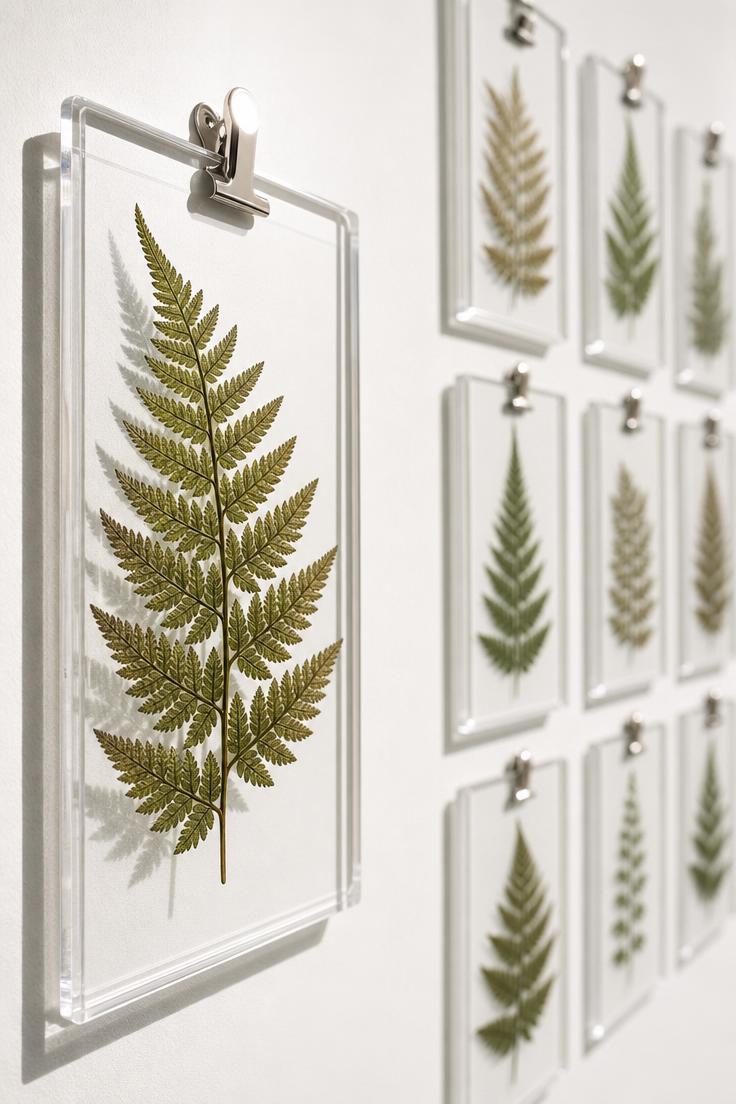
Pressed fern specimens behind clear acrylic have a clean, almost scientific quality that works well in apartments with a modern or minimal aesthetic.
The translucent leaves catch midday light and cast faint green shadows on the wall behind them, which adds a layer of depth that opaque prints lack.
A 3×3 grid of identical clip frames creates a gallery wall effect with very little visual weight, since the acrylic nearly disappears against a white wall.
Pressing ferns at home takes about two weeks between the pages of a heavy book, and the results look just as polished as store-bought botanical prints.
This is one of the most affordable wall art projects for an apartment, with each clip frame costing only a few dollars.
Style Blueprint:
- Nine clear acrylic clip frames (8×10 inches each)
- Nine different pressed fern fronds or botanical specimens
- A level and measuring tape for precise grid spacing
- Small adhesive hooks or nails for lightweight hanging
- A heavy book and parchment paper for pressing plants
Design Pro-Tip: Odd-number grids (3×3, 5×3) hold visual tension better than even ones (2×2, 4×4). Even grids feel complete and closed, which can make them look like a product display. Odd grids leave a sense of movement, as though the collection is still growing, and that small asymmetry is what makes a wall arrangement feel personal rather than catalog-perfect.
A Woven Wall Hanging in Cream and Rust on a Matte White Dowel Above a Reading Chair
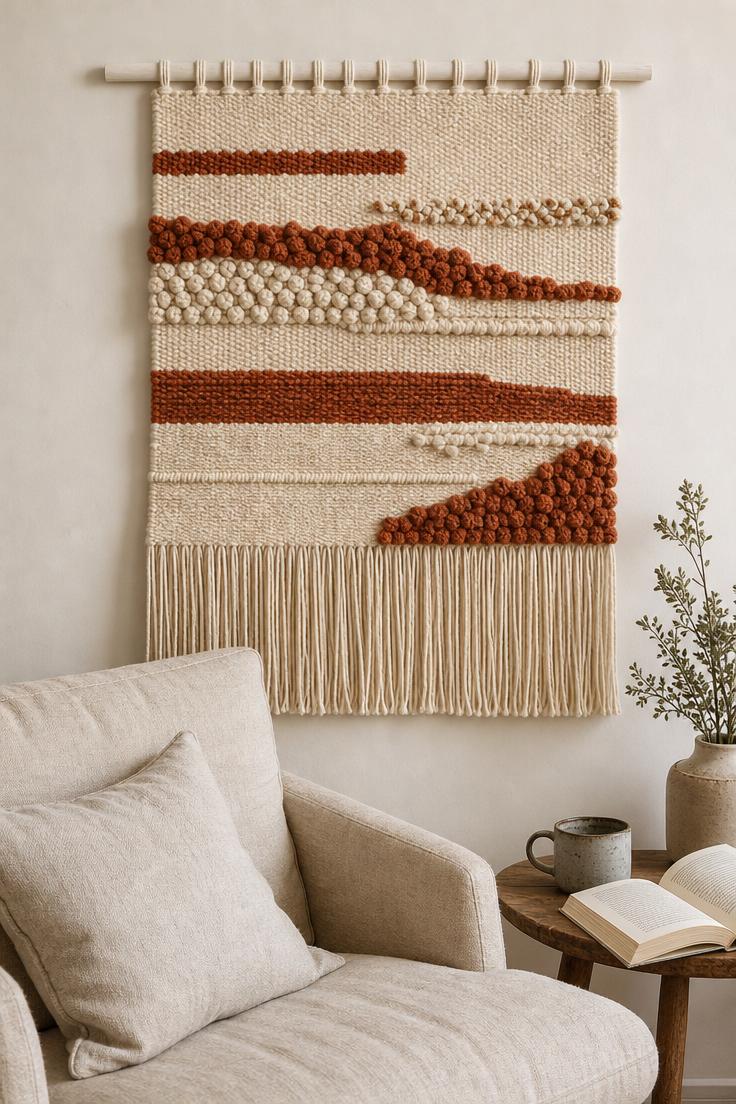
A woven wall hanging fills a wall the way a painting does, but with a warmth and tactile depth that no flat print can match.
The combination of cream cotton and rust-dyed wool gives this piece a color palette that feels grounded and earthy without leaning too dark or too heavy.
Hanging it from a painted wooden dowel is the simplest mounting method, requiring only two adhesive hooks spaced a few inches apart.
The fringe along the bottom edge adds movement, catching any passing breeze and shifting slightly throughout the day.
Textiles also absorb sound, which is a real benefit in apartments where noise passes easily through shared walls.
Placing the hanging above a reading chair or a low bench creates a self-contained corner that feels intentional, like a room within a room.
This is one of the best ways to anchor a living room wall or bedroom wall without committing to a heavy, permanent installation.
Style Blueprint:
- One large woven wall hanging (at least 30×40 inches)
- A matte white or natural wood dowel for mounting
- Two adhesive hooks rated for the combined weight
- A low reading chair or bench positioned directly below
- A small side table with a ceramic mug and a book for styling
Battery-Operated Brass Sconces Flanking a Framed Ink Drawing on a Dark Green Wall
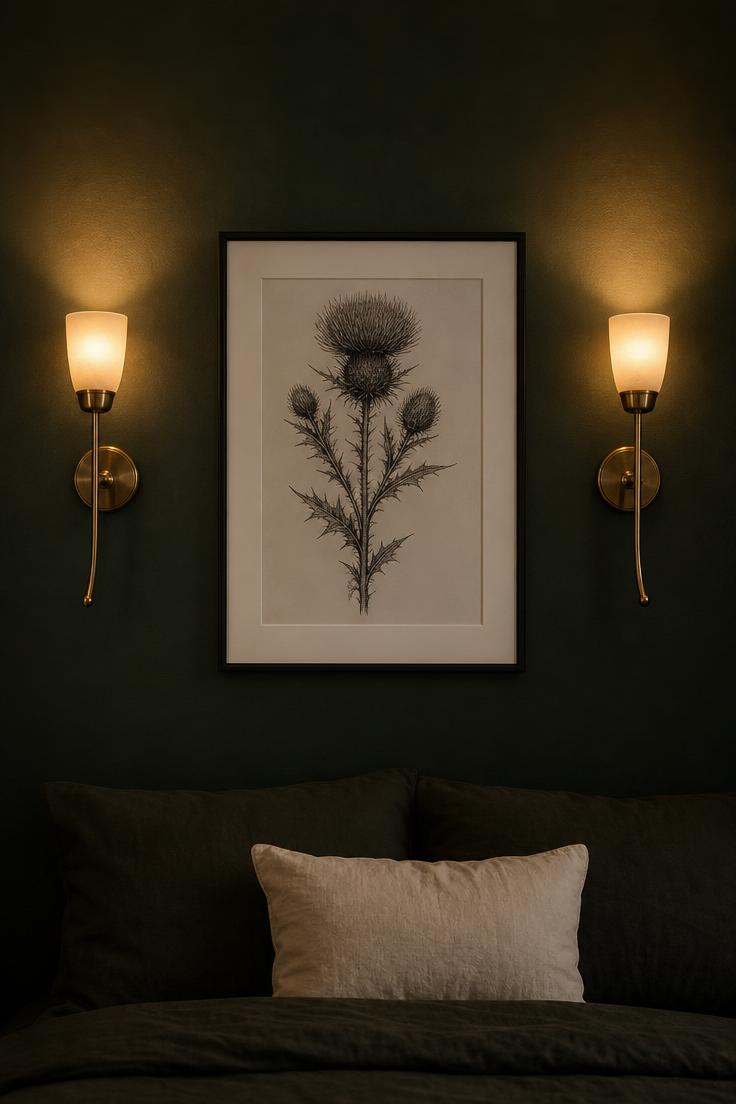
Lighting changes a wall more than almost anything you can hang on it, and battery-operated sconces make that change possible in apartments with no existing wiring.
Flanking a framed piece with two matching sconces borrows a trick from gallery design, where directed light turns a simple print into a focal point.
Brass sconces against a dark green wall create a rich contrast that reads as both warm and slightly formal, like a study in an old townhouse.
The frosted glass shades diffuse the bulb’s glow into a soft halo rather than a harsh spot, which keeps the mood relaxed rather than clinical.
Most battery-operated sconces mount with a simple adhesive plate, and the batteries last several months with regular evening use.
Turning them on after dark gives the bedroom an atmosphere that overhead ceiling lights, the standard in most rental apartments, simply cannot provide.
This pairing works with any framed wall art, but ink drawings and line illustrations look particularly striking under warm uplight because the shadows deepen the line work.
Positioning the sconces at equal height, about six inches out from each side of the frame, keeps the arrangement balanced.
A dark accent wall painted with renter friendly peel and stick wallpaper in matte green gives the sconces a backdrop that absorbs light and makes the brass glow even warmer.
Style Blueprint:
- Two battery-operated brass wall sconces with frosted glass shades
- A framed black ink drawing in a slim black metal frame
- Adhesive mounting plates for damage-free installation
- A dark green accent wall (painted or peel and stick wallpaper)
- Spare batteries for 3-6 months of evening use
A Row of Vintage Botanical Prints in Matching White Frames Along a Hallway
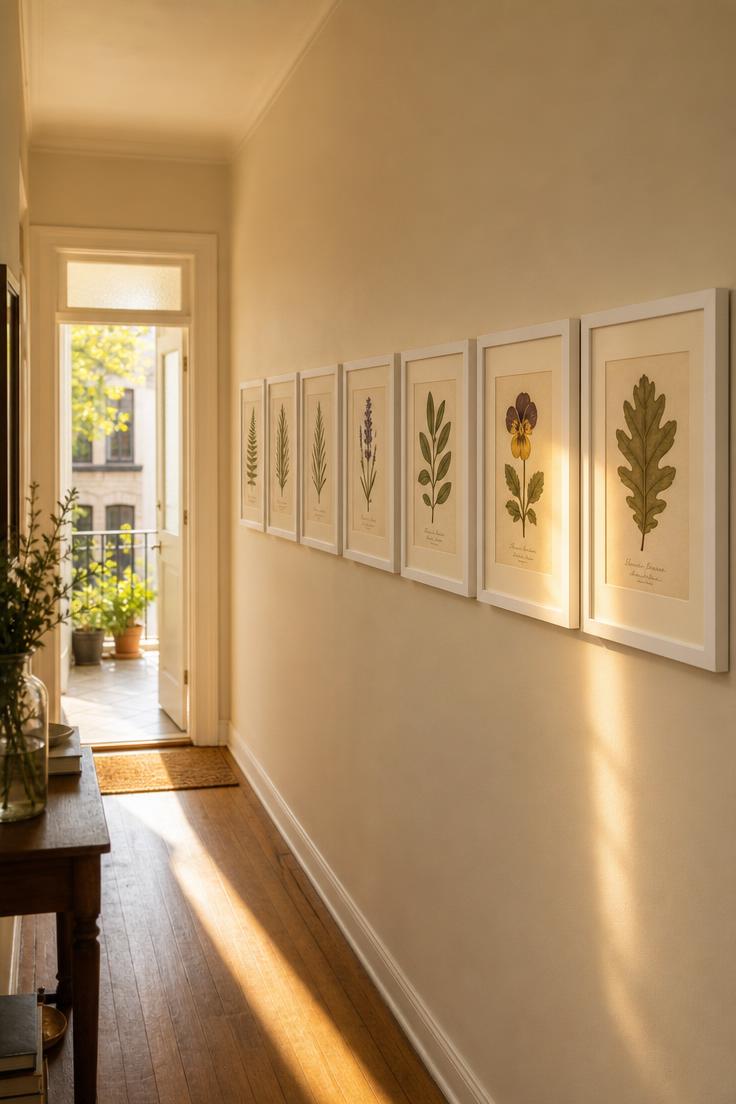
Hallways are the most overlooked walls in any apartment, and a straight row of matching frames turns them from pass-through spaces into something worth pausing in.
White frames with cream mats create a clean, unified look that keeps the arrangement from feeling cluttered, even in a narrow corridor.
Vintage botanical prints are easy to source as digital downloads, and printing them on matte paper at a local shop costs a fraction of buying pre-framed art.
Hanging them in a perfectly level horizontal line at eye height, about 57 inches from the floor to the center of each frame, gives the hallway a gallery-like rhythm.
Using the same frame size and style for every print is the key to making this work, because the repetition is what creates the sense of calm.
This approach suits apartments where the hallway connects the bedroom to the main living space, turning a daily walk into a small visual event.
Style Blueprint:
- Six matching white wood frames with cream mat boards
- Vintage botanical prints (digital downloads, matte paper)
- A level, measuring tape, and painter’s tape for alignment
- Small nails or adhesive hooks spaced evenly at 57-inch center height
- A woven doormat at one end for grounding
Design Pro-Tip: The standard museum hanging height of 57 inches from the floor to the center of the artwork works in most apartments, but adjust down by two or three inches in hallways where you view the art while walking rather than standing still. Your eye line drops slightly when you are in motion, and lowering the row by a small amount keeps the prints feeling accessible instead of floating above you.
Removable Washi Tape Geometric Shapes in Terracotta and Cream on a Bedroom Wall
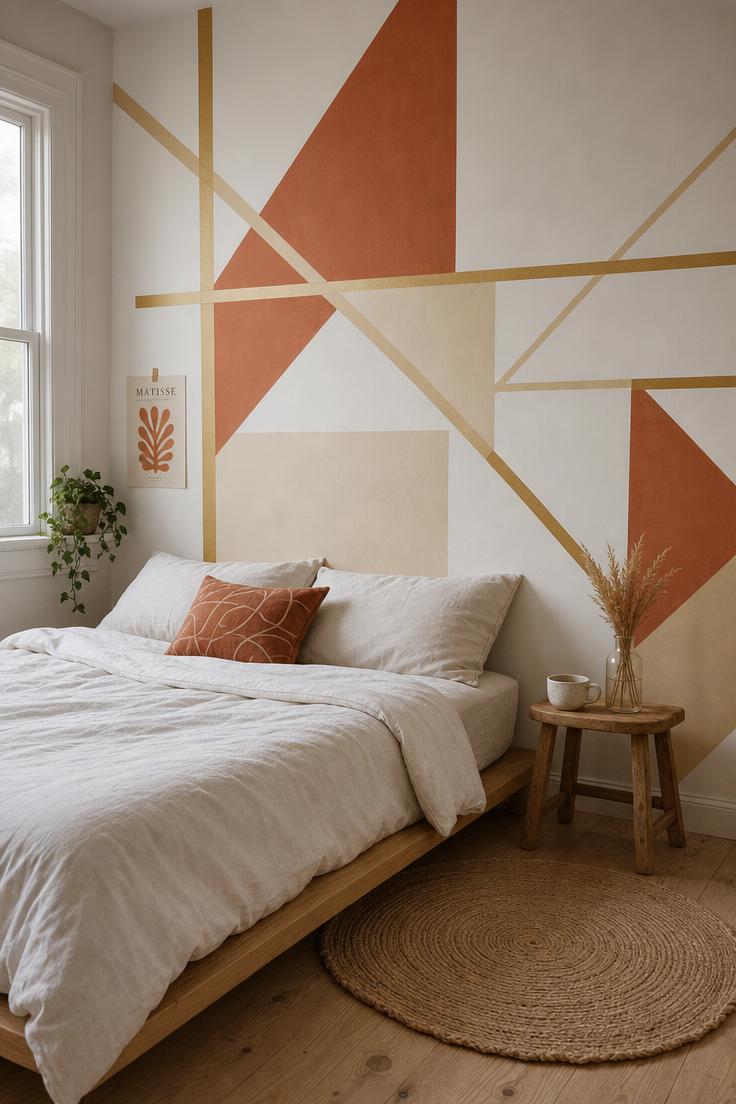
Washi tape turns a blank bedroom wall into a piece of large-scale abstract art for less than ten dollars, which makes it one of the most accessible apartment wall decor projects on this list.
The tape peels off without leaving residue, so there is no risk to the paint or the security deposit.
Terracotta, cream, and matte gold tones create a palette that feels warm and grounded, avoiding the primary-color brightness that makes some tape art look like a children’s playroom.
Working with large geometric shapes, overlapping triangles, offset rectangles, and long diagonal lines, gives the wall a mid-century graphic quality that holds up from across the room.
Planning the design with light pencil marks first prevents the need to peel and reapply tape, which can stretch it out and weaken the adhesive.
The flat, matte finish of washi tape absorbs light instead of reflecting it, so the pattern reads as part of the wall itself rather than something stuck on top.
Mixing two or three tape widths, from 15mm detail strips to 30mm bold lines, adds variety to the pattern and keeps it from looking monotonous.
This project works best on a single accent wall behind the bed, where the pattern acts as a headboard substitute and a room-defining backdrop at the same time.
Style Blueprint:
- Washi tape rolls in terracotta, cream, and matte gold (2-3 widths)
- A ruler and light pencil for planning geometric shapes
- A flat white or off-white wall surface for best contrast
- A utility knife for clean tape edges at corners and intersections
- An eraser to remove pencil guidelines after taping
A Hanging Wooden Peg Rail With Rotating Art, Tote Bags, and a Small Round Mirror
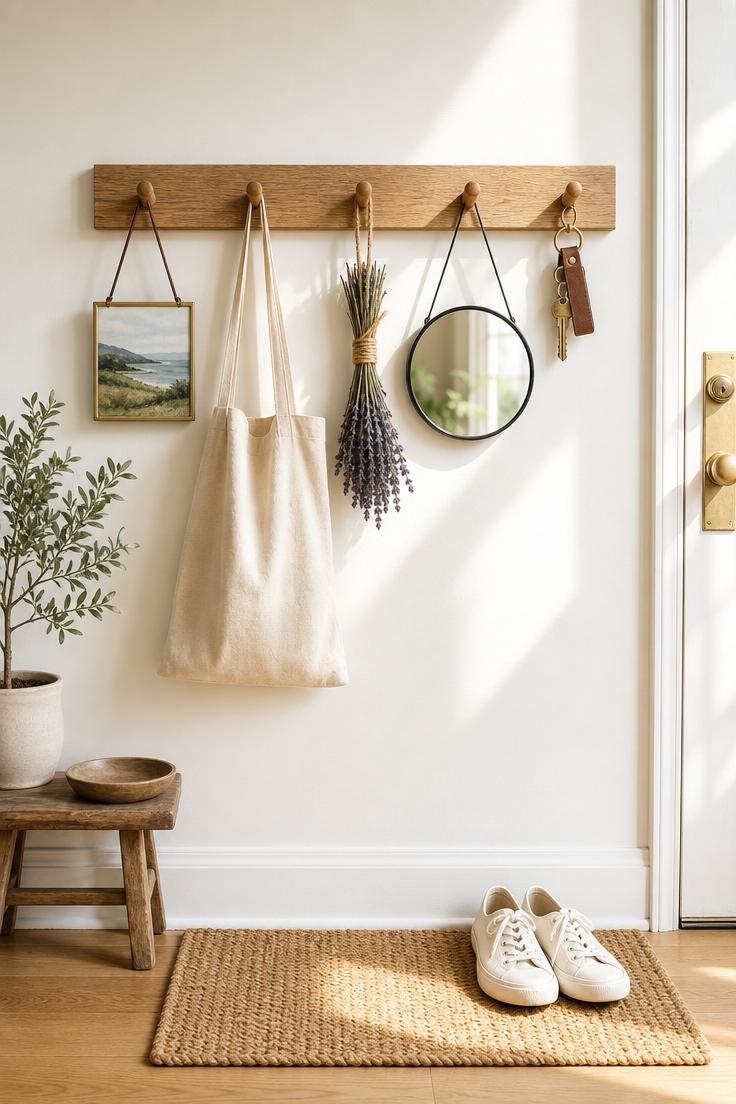
A wooden peg rail is one of the most flexible wall mounted pieces you can install in an apartment, because what hangs on it changes with the week, the season, or the mood.
Five pegs can hold a framed print, a tote bag, a hat, a mirror, and a set of keys all at once, turning a bare entryway wall into a functional vignette.
Oak is the best wood choice for a peg rail because it is hard enough to hold weight without bending and its warm grain complements most apartment color schemes.
Swapping the framed print for a holiday wreath in December or a straw hat in July keeps the wall feeling current without buying new furniture or rearranging the room.
Mounting with two adhesive strips rated for 10 pounds each keeps the installation renter friendly and avoids any holes in the wall.
The small round mirror on one peg gives you a last-second check before heading out the door, which is a practical detail that most entryway setups miss.
Dried lavender on another peg adds a subtle scent that greets you each time you walk in, layering a sensory detail on top of the visual one.
Style Blueprint:
- One oak wooden peg rail with 5-6 evenly spaced pegs
- Two adhesive mounting strips rated for 10+ pounds
- A small framed print with a leather hanging loop
- A small round mirror with a cord for peg hanging
- Dried lavender, a canvas tote, and a key fob for styling
Conclusion
The best apartment wall decor does not have to be expensive, permanent, or complicated.
Every idea on this list works with adhesive hooks, removable tape, or nothing more than a bare wall and a frame leaned against it.
Start with one wall, the one you see first when you walk through the door or the one you face from the couch, and build from there.
Mix textures over time: a woven wall hanging beside a row of floating shelves, a peg rail near a gallery wall, a set of mirrors across from a linen triptych.
The goal is not a finished room but a living one, where the walls change as you do.
Not sure what size artwork will fit your space? Use our wall art size calculator to choose dimensions that work with your wall, furniture, and layout.