This post may contain affiliate links. If you make a purchase through these links, we may earn a commission at no additional cost to you.
A mirror is one of those rare objects that works twice — once as decoration, once as a trick of physics.
Hang one across from a window and the room fills with borrowed light you didn’t know you were missing.
Prop one against a bedroom wall and the space reads as deeper, quieter, more intentional.
Mirror wall decor sits at the intersection of the practical and the pretty, and that’s exactly why it keeps showing up in rooms that feel finished without being overdone.
These 15 ideas cover a range of styles, from salvaged architectural pieces to clean-lined modern glass, so you’ll find something here no matter what your walls look like right now.
A Fluted Brass-Framed Mirror Over a Marble Console Table
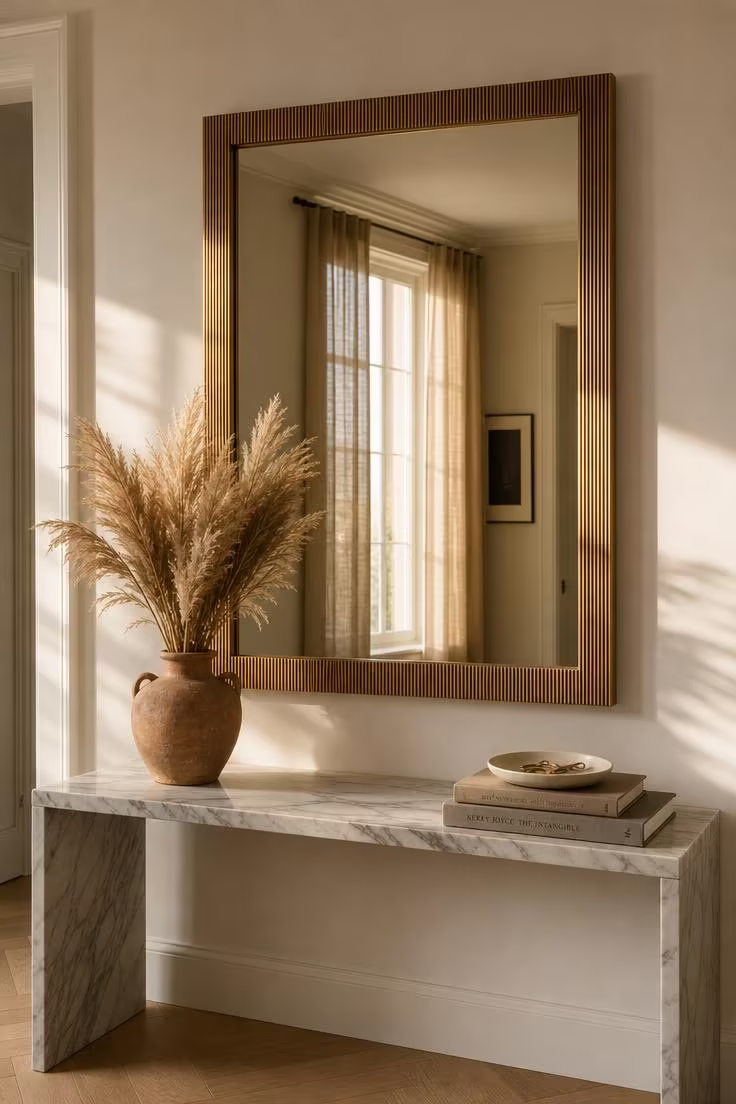
There’s a reason brass keeps coming back — it warms up a room the way overhead lighting never quite manages to.
This particular pairing works because the fluted texture on the frame catches light in thin vertical lines, creating a subtle glow that a flat frame would miss entirely.
The marble console below it plays the opposite role: cool, smooth, still.
Your eye moves between the two surfaces almost without realizing it, and that back-and-forth is what makes the arrangement feel alive rather than staged.
The terracotta vase is doing more work than it looks like, too — its matte, earthy finish breaks up all that polished metal and stone and pulls the whole thing back toward something human.
Style Blueprint:
- Rectangular mirror with vertically fluted brass frame (at least 24 x 36 inches)
- Slim marble console table with tapered legs
- One handmade terracotta vase with dried pampas or wheat stalks
- Cloth-bound books in muted tones for the console surface
- Sheer linen curtains in the reflected window
Smoky Bronze Tinted Mirror Panels on a Dining Room Wall
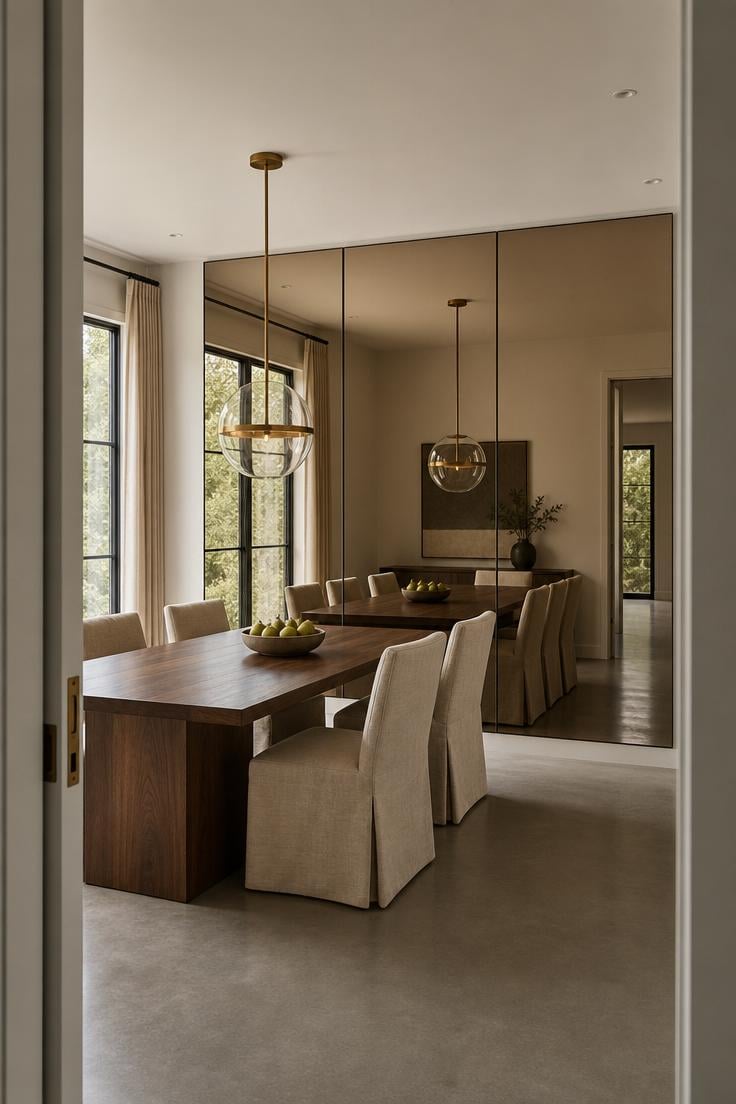
Bronze-tinted glass does something clear mirrors can’t — it filters.
Every reflection picks up that warm, smoky tone, which means the room you see in the mirror is softer and warmer than the room you’re standing in.
That sounds like a small thing, but it changes the entire mood of a dining space.
Clear mirror panels on a dining wall can feel like eating in a restaurant — a little too public, a little too bright.
The bronze tint dials that back, creating depth without the clinical edge.
If your dining room has cool tones — concrete floors, gray walls, steel light fixtures — these panels will pull warmth into the space without you having to repaint a single thing.
Style Blueprint:
- Three large rectangular bronze-tinted mirror panels (each at least 24 x 48 inches)
- Professional installation with minimal visible seams
- Walnut or warm-toned wood dining table as the primary reflected object
- Pendant lighting positioned to appear in the reflection
- Neutral linen or cotton upholstered dining chairs
A Salvaged Church Window Frame Fitted With Mirror Glass
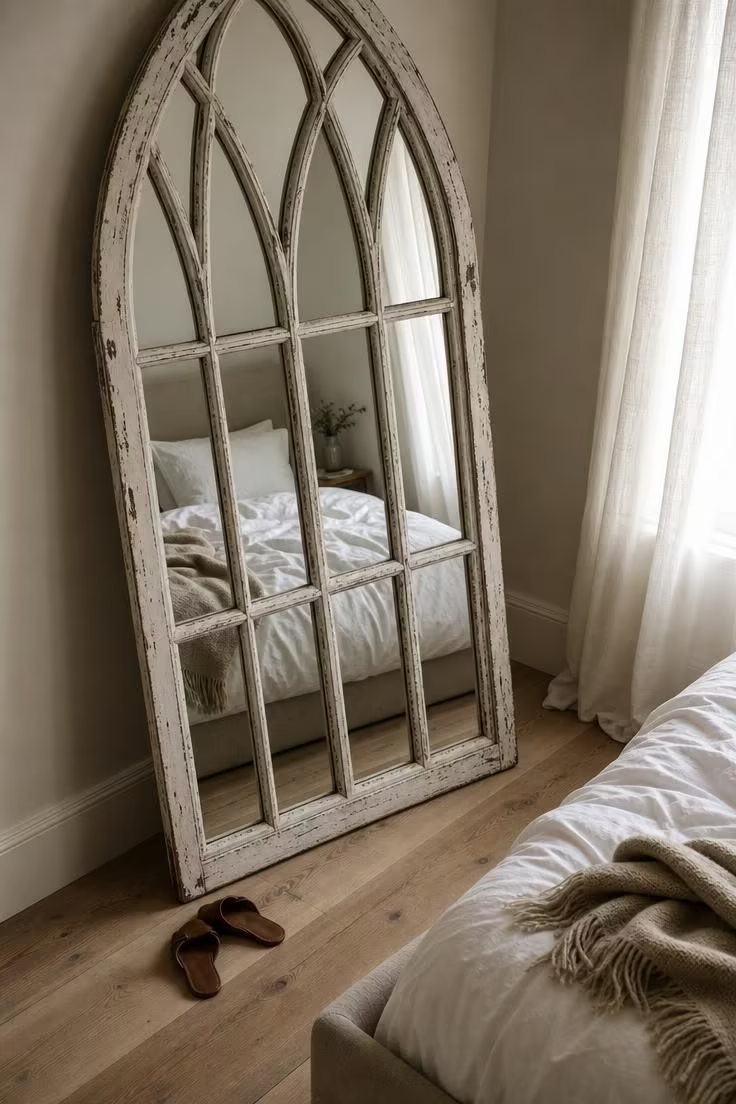
Something happens when you put mirror glass into a frame that was built for stained glass and open sky.
The shape — that pointed gothic arch — pulls your eye upward in a way that a rectangular mirror simply doesn’t.
Your brain reads it as an opening, a window to somewhere else, even though what you’re seeing is your own bedroom reflected back at you.
The chipped paint matters here, and not in some forced “shabby chic” way.
Those layers of old paint tell you this frame has been through something, and that history gives it a weight that no new arched mirror from a catalog can match.
Lean it rather than hang it — the casual angle keeps it from feeling like a church relic on display.
Style Blueprint:
- Salvaged arched window frame (at least 5 feet tall) with original paint intact
- Mirror glass cut to fit each pane section
- Low-profile linen-upholstered bed nearby
- White or cream bedding with a single textured throw
- Wide-plank wood floors, light or medium tone
A Cluster of Hand-Hammered Copper Disc Mirrors
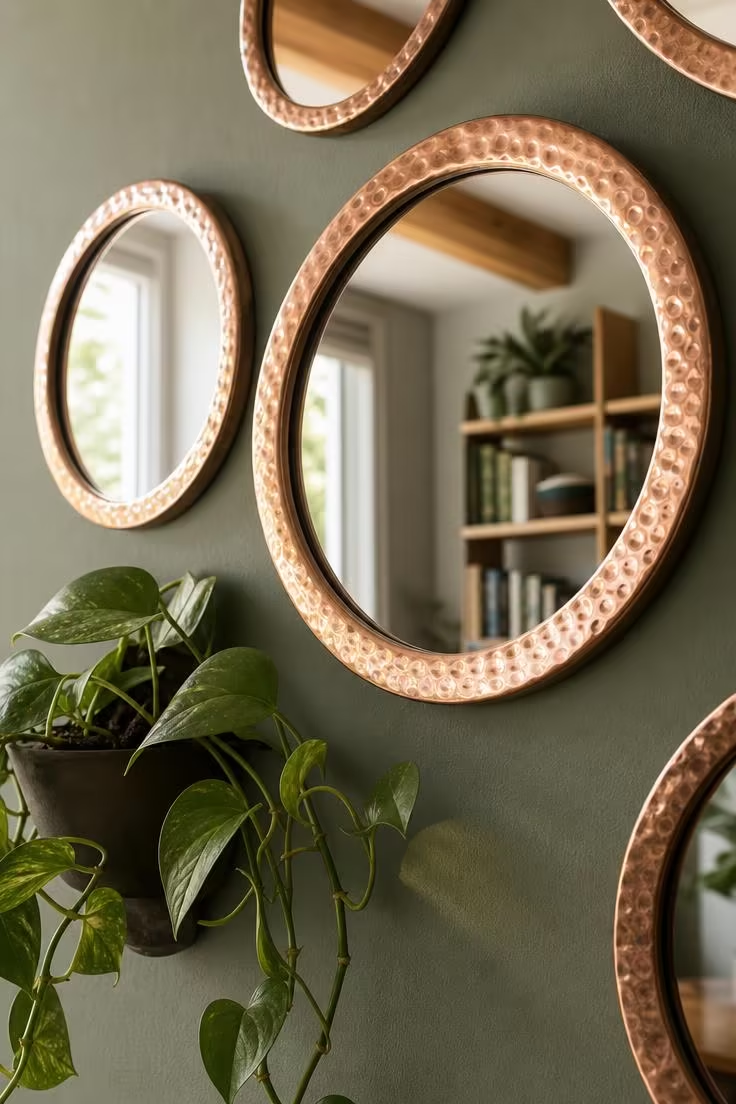
A mirror gallery wall like this one is all about controlled chaos.
Too symmetrical and it reads as a store display; too scattered and it just looks like you couldn’t decide where to put things.
Start with the largest disc slightly off-center, then build outward, letting each smaller mirror find its own spot.
Copper frames add another layer to this, because the metal changes color over time.
Fresh copper is almost pink; after a few months in a room with moderate humidity, it shifts toward a richer brown with green undertones.
So the wall you hang today won’t look exactly the same six months from now, and that kind of slow change is something most decor just can’t give you.
The sage green wall behind it isn’t accidental — green and copper are complementary in the color wheel’s logic, which is why this pairing feels right without anyone needing to explain why.
Design Pro-Tip: When arranging a mirror cluster, lay all the pieces on the floor first and take a photo from above. Adjust until the spacing feels uneven but balanced — no two gaps the same width, no straight lines forming accidentally. Transfer the arrangement to the wall using painter’s tape markers.
Style Blueprint:
- Five to seven round mirrors with hand-hammered copper frames in mixed diameters
- Deep sage green or forest green wall paint (matte finish)
- Irregular spacing between mirrors (1 to 4 inches, varied)
- One trailing plant nearby to echo the organic feel
- Golden hour or warm side lighting to catch the hammer marks
Full-Length Antiqued Mirror in a Raw Oak Frame
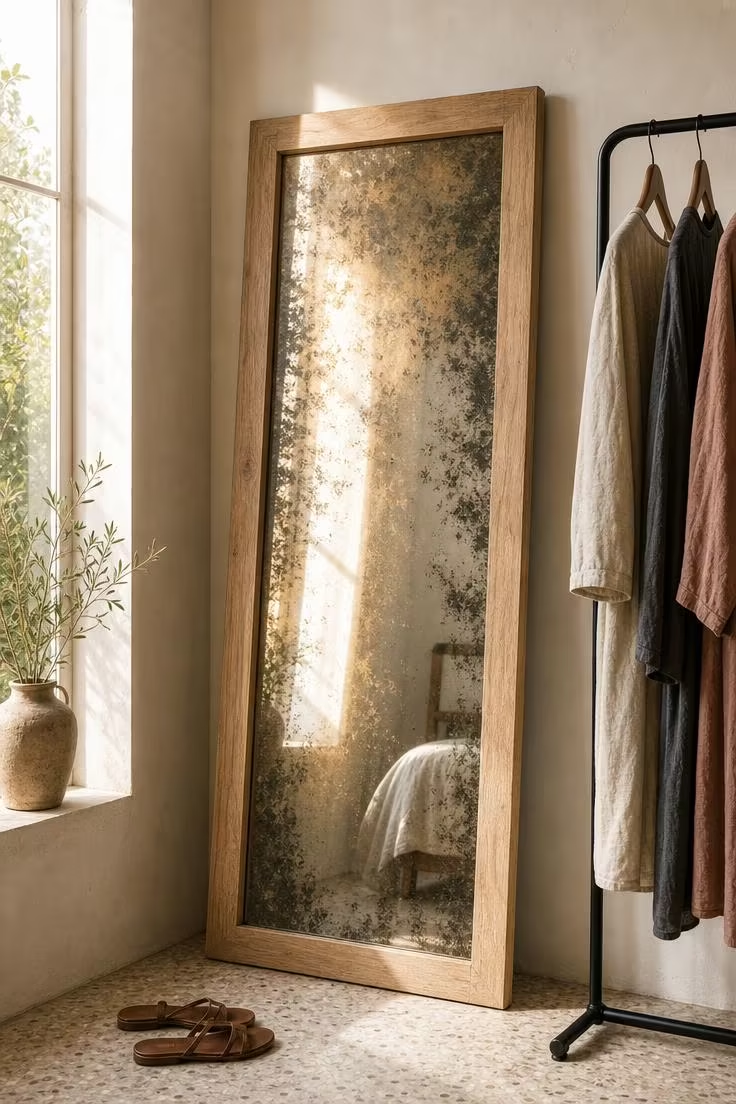
Antiqued silvering is one of those finishes that sounds fussy but actually does the opposite of fussy.
Those mottled patches and dark spots break up your reflection into something softer and less precise.
You see yourself, but not in that high-definition way that a brand-new mirror delivers.
It’s closer to how you’d look reflected in an old shop window — recognizable, but gentler.
The raw oak frame works here because it’s also imperfect: visible grain, no lacquer, no stain.
Two imperfect surfaces side by side create a coherence that one imperfect surface alone wouldn’t.
If you’re using a statement mirror like this as mirror wall decor in a bedroom or dressing area, keep everything around it simple — the foxed glass is already doing plenty of visual work.
Style Blueprint:
- Full-length mirror (at least 6 feet tall) with antiqued/foxed silvering
- Raw, unfinished white oak frame with visible grain
- Simple matte black clothing rack or wall hooks nearby
- Neutral linen garments as background texture
- Pale flooring (terrazzo, light wood, or concrete)
A Convex Porthole Mirror on an Exposed Brick Accent Wall
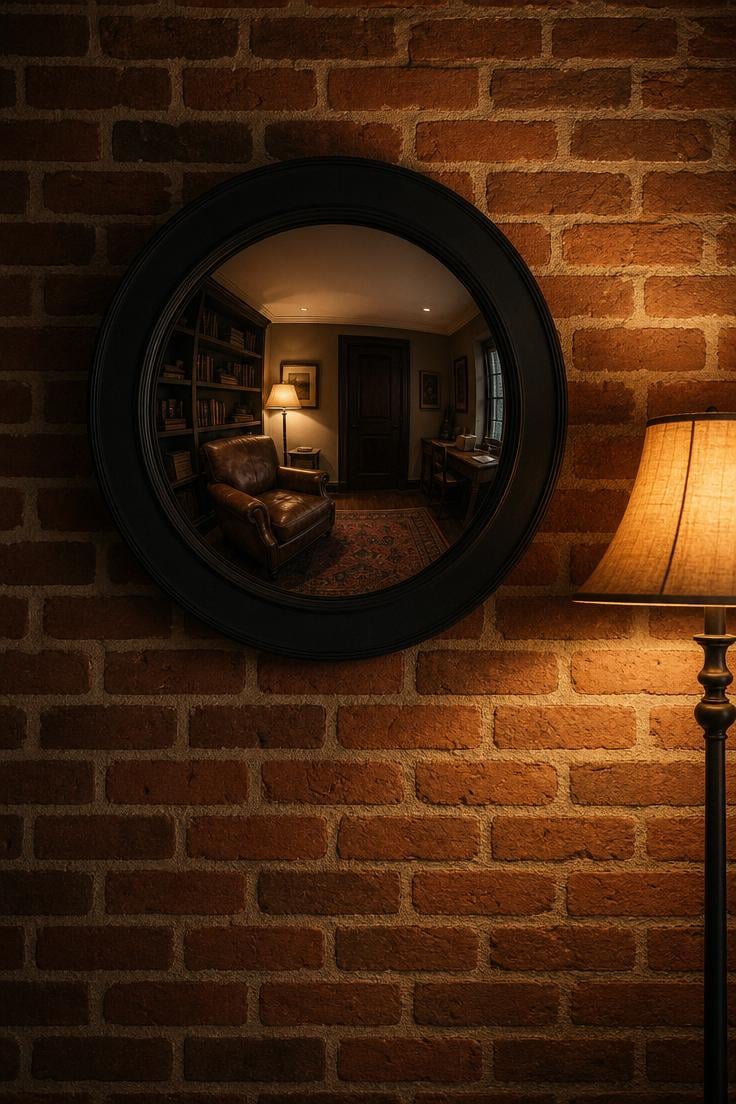
Convex mirrors bend the room around themselves.
Everything in the reflection curves inward toward the center, which gives you this strange, compressed panorama of your space.
It’s the same effect you see in old Flemish paintings — a whole room captured in a single round surface.
On a brick wall, that effect gets even more interesting because the brick’s rough texture contrasts with the mirror’s perfect curve.
The matte black iron frame disappears into the darker mortar lines, so the glass itself seems to float.
This is the kind of piece that works best alone — no gallery wall, no shelf below, just the mirror and the brick and whatever light you give it.
Style Blueprint:
- Convex round mirror, 20 to 26 inches in diameter
- Heavy matte black iron frame
- Exposed brick wall (red, brown, or whitewashed)
- Single warm-toned floor lamp or wall sconce for directional light
- No competing wall decor within three feet of the mirror
Beveled Frameless Mirror Strips Arranged Vertically
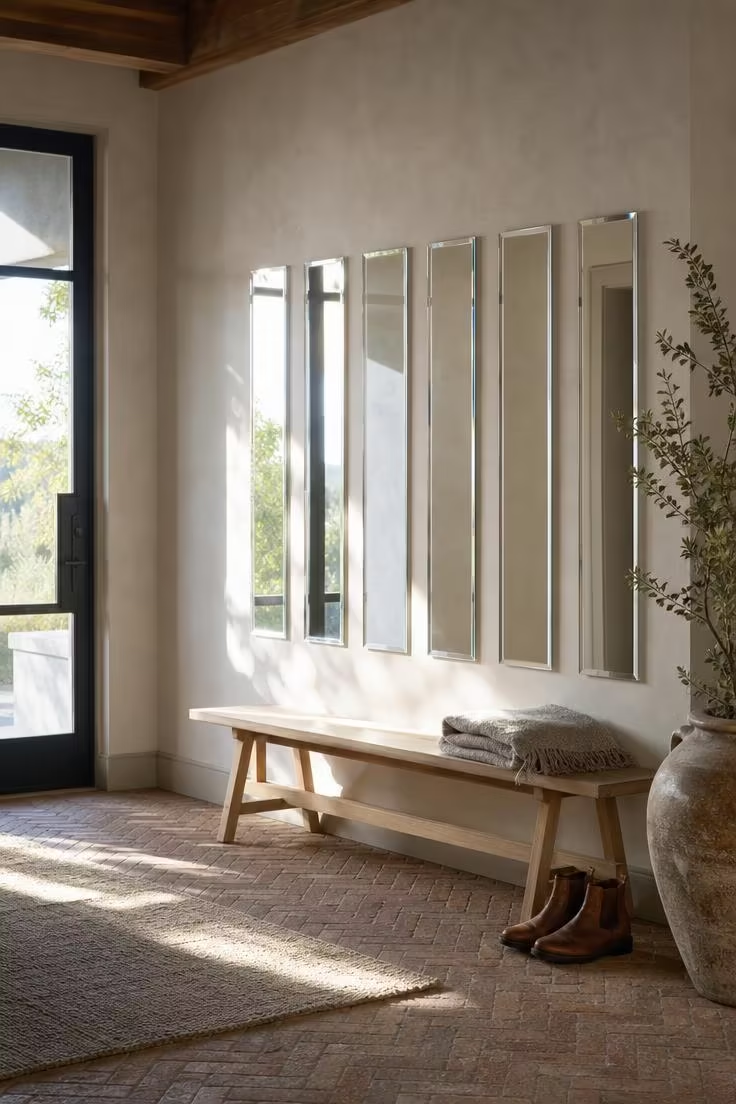
Strip mirrors are an underused idea, and it’s hard to understand why.
Six narrow pieces mounted with small gaps between them create a fractured reflection — you move past and your image slides across the strips like frames in a film reel.
The beveled edges do the real work here, catching light and throwing tiny rainbows along the wall at certain times of day.
Without frames, the mirrors almost merge with the plaster, giving the wall a liquid quality rather than a decorated one.
This arrangement is especially good in entryways, where you want a mirror for a quick check on your way out but don’t want the full-on confrontation of a single large mirror staring at you from across the hall.
The fractured reflection is friendlier — it gives you pieces of yourself rather than the whole picture.
Style Blueprint:
- Six narrow frameless mirrors with beveled edges (each roughly 6 x 36 inches)
- Pale plaster or matte white wall
- Consistent 1-inch spacing between strips
- Slim entryway bench or console in light wood below
- Herringbone or patterned floor tile to add visual interest at ground level
A Moroccan Star-Shaped Mirror With Bone Inlay Border
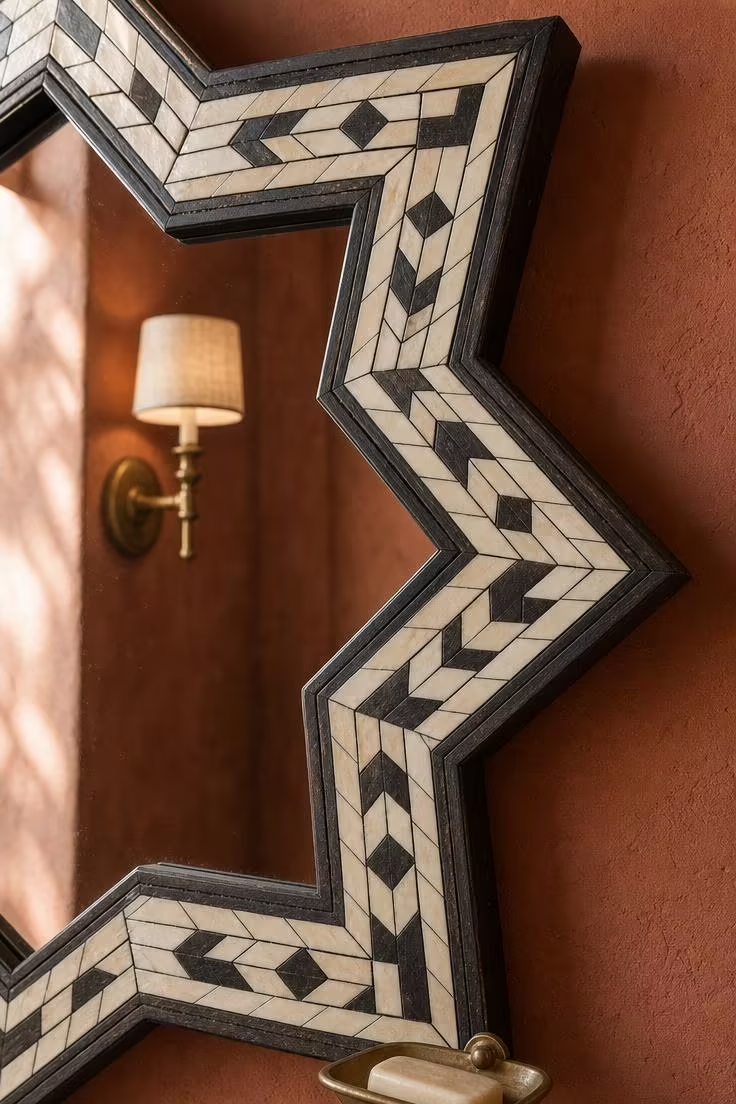
Bone inlay is one of those materials that photographs beautifully but looks even better in person, because the slight unevenness of each hand-set piece catches light differently depending on where you’re standing.
The star shape pulls your eye outward from the center mirror along each point, which means you spend time looking at the craftsmanship of the border before you even register the reflection.
That’s a different relationship than most mirrors ask for — usually you look through a mirror, but here you look at it first.
On a terracotta wall, the white bone and dark resin border stands out without clashing.
Terracotta’s warmth keeps the whole scene grounded, while the black-and-white geometric pattern adds structure.
This is mirror wall decor that doubles as a conversation about where it came from and who made it.
Style Blueprint:
- Eight-pointed star-shaped mirror with hand-set bone inlay border
- Terracotta, clay-washed, or warm ochre wall
- Simple brass wall sconce nearby for warm accent light
- No competing patterns on the surrounding wall
- Small brass or ceramic accessories to echo the artisan feel
A Sunburst Mirror in Blackened Iron Above a Fireplace Mantel
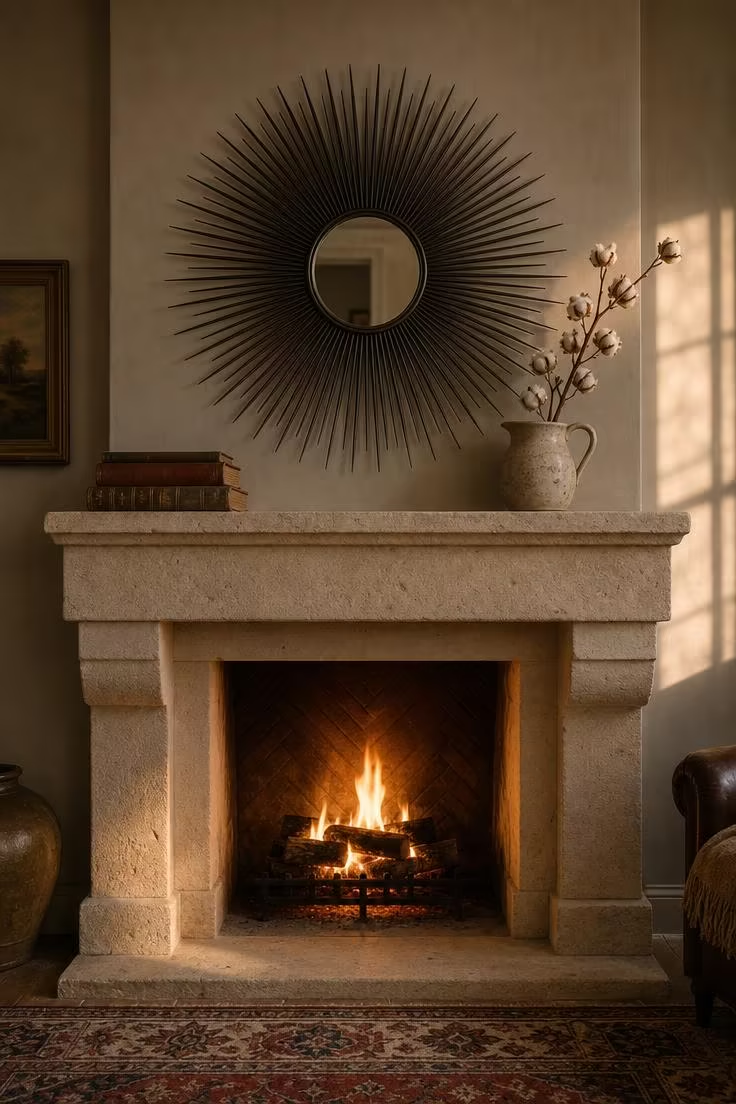
When the rays outsize the mirror this dramatically, the piece stops being a mirror and starts being a sculpture that happens to reflect.
The blackened iron absorbs light — it doesn’t bounce anything back.
So the only bright point on the entire wall is that small center circle of glass, which means your eye goes straight to it and stays there.
It’s the same principle that makes a spotlight work: darkness around the edges concentrates attention at the center.
The limestone mantel below anchors all that dark iron with something solid and pale.
Without that counterweight, the sunburst could feel heavy or severe.
With it, there’s a balance — black iron floating above warm stone, fire glow mixing with the last of the daylight.
Design Pro-Tip: Hang mirrors so the center point sits between 57 and 60 inches from the floor when there’s no furniture below. Above a mantel or console, leave 4 to 8 inches of space between the top of the furniture and the bottom edge of the mirror. And always check that the mirror’s width is roughly two-thirds the width of whatever sits beneath it.
Style Blueprint:
- Sunburst mirror with blackened iron rays (36 to 42 inches total diameter)
- Small center mirror (8 to 12 inches) for maximum ray-to-glass ratio
- Limestone, stone, or light-colored fireplace mantel
- Styled mantel with books, stoneware, and one organic element
- Warm wall color (putty, greige, or warm white)
Arched Floor Mirror With Slim Brushed Steel Frame Beside a Reading Chair
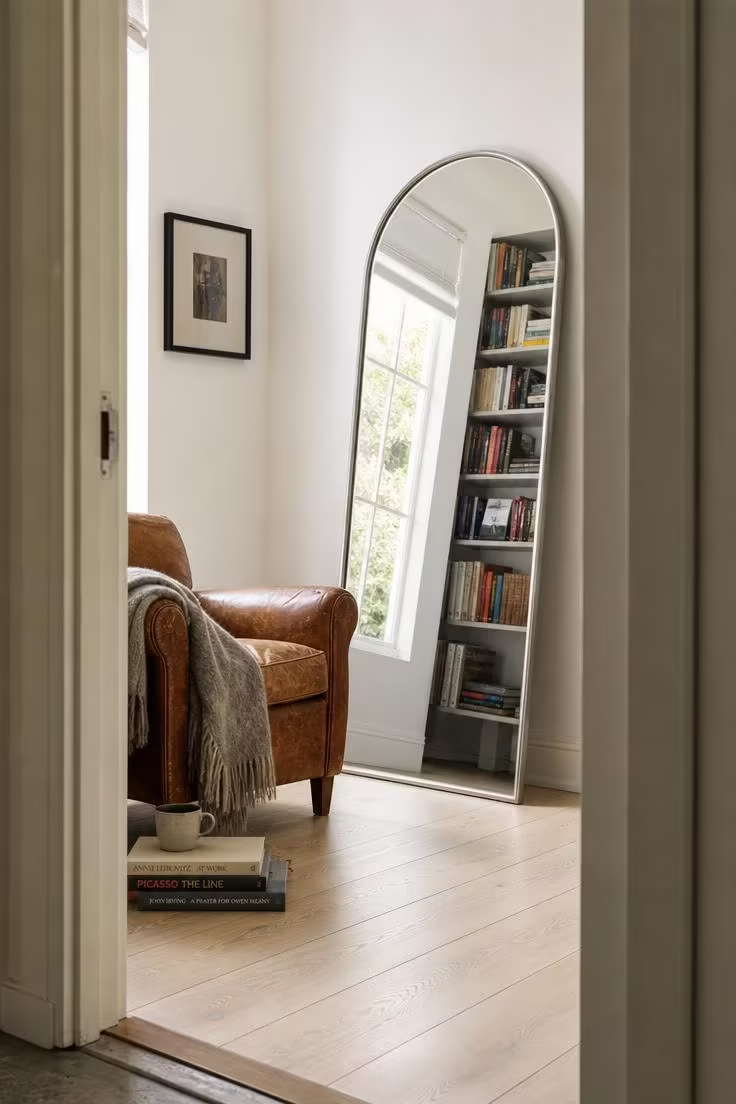
Leaning a mirror against the wall instead of mounting it sends a signal — this room is lived in, not curated for a photo.
The slight forward tilt means the mirror reflects the ceiling just a bit, which adds unexpected height to whatever it shows you.
An arched mirror reads as a statement mirror in any room, but the steel frame keeps it from tipping into anything fussy.
Steel is cool and industrial; the arch is warm and classical.
Between those two impulses, you get something that fits in a modern apartment as comfortably as it would in an older home with crown molding and built-ins.
Position it where it can catch a bookshelf or a window — the best part of a floor mirror is showing the room its own best angle.
Style Blueprint:
- Arched floor mirror (5.5 to 6.5 feet tall) with slim brushed steel frame
- Leaned against a wall at a 5 to 10 degree angle
- Reading chair in worn leather or heavy linen nearby
- Bookshelf or window in the mirror’s line of reflection
- Pale wide-plank wood flooring
Vintage Foxed Mirror Tiles in a Herringbone Pattern
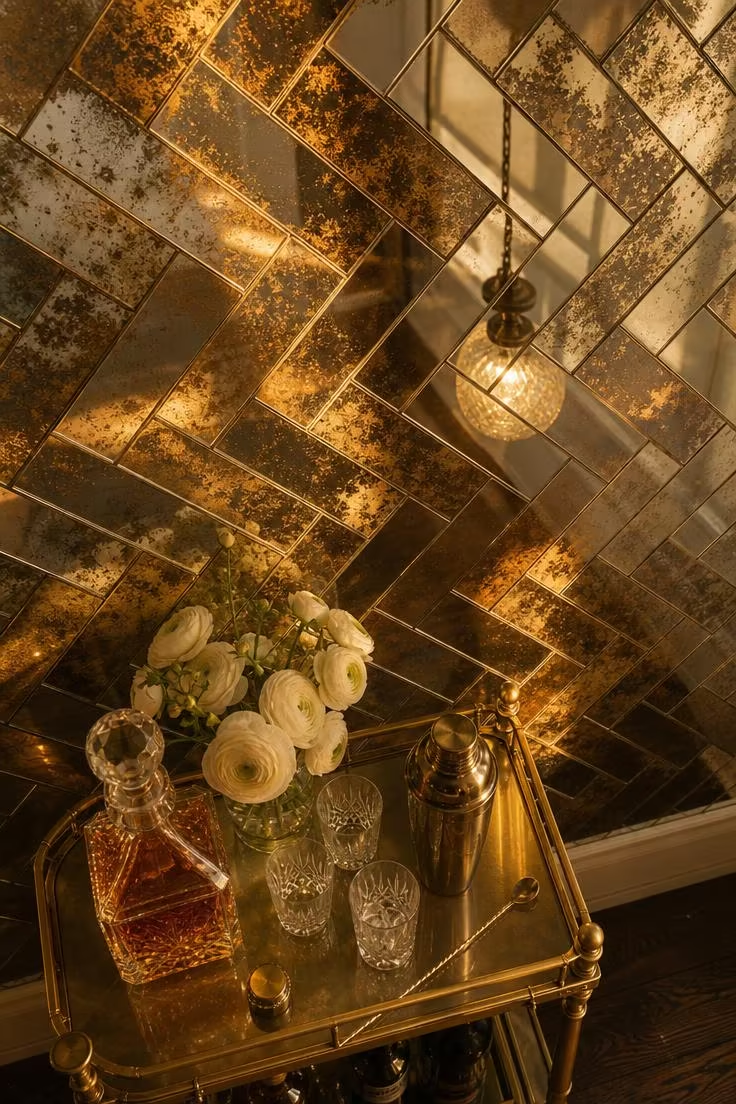
Each tile in this arrangement has its own personality.
Some are clouded almost completely, throwing back a blurred amber glow rather than a clear reflection.
Others are still sharp enough to show you the room behind you.
That variation is the point — a wall of perfectly uniform mirror tiles would look like a gym or a dance studio, but this patchwork of old glass reads as something with history.
The herringbone pattern adds architecture to what could otherwise just be a bunch of tiles stuck to a wall.
Those angled lines create a sense of movement, pulling your eye diagonally rather than straight across.
Behind a bar cart, the effect is especially good: glassware and bottles catch the fractured reflections and multiply, making your modest collection look twice its actual size.
Style Blueprint:
- Rectangular mirror tiles (4 x 8 inches) with varied foxing and antiquing
- Herringbone arrangement with thin grout lines or adhesive mounting
- Brass or gold-toned bar cart positioned below
- Crystal glassware and decanters to multiply in the reflection
- Low warm lighting to activate the amber tones in the foxed glass
A Cane-Wrapped Round Mirror in a Sunlit Breakfast Nook
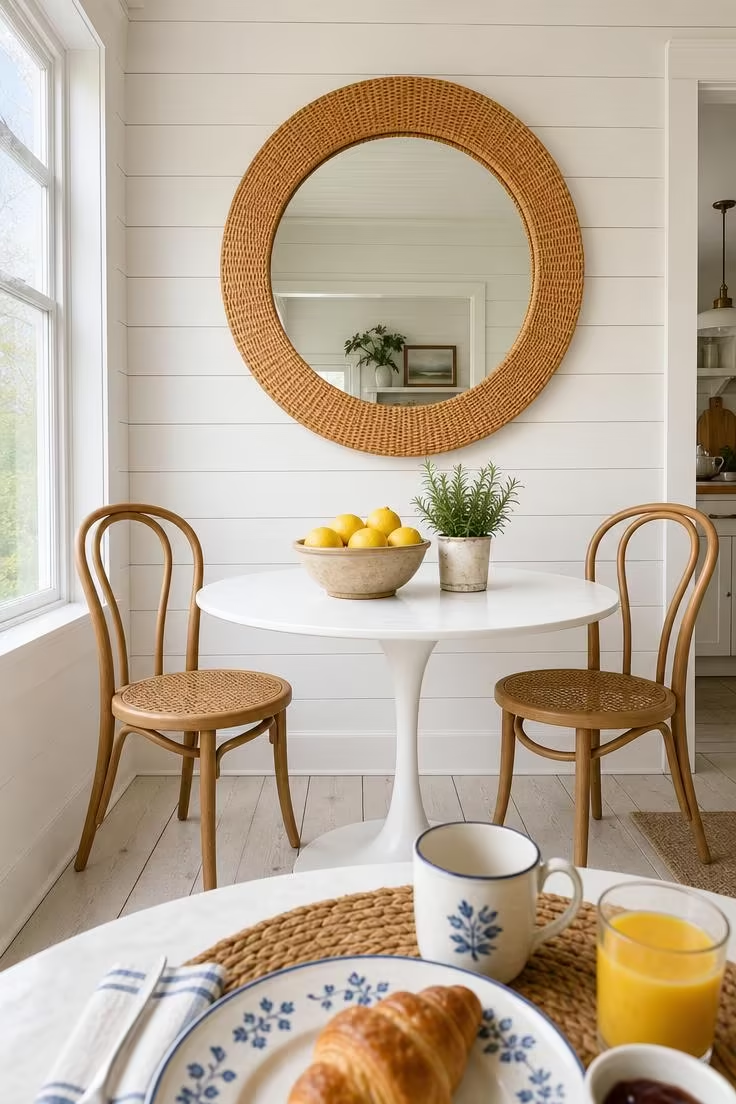
Cane absorbs light where glass reflects it, and that contrast is what makes this pairing so easy on the eyes first thing in the morning.
The woven texture creates a warm border that softens the mirror’s brightness — almost like a picture frame made of sunlight.
Round mirror decor works especially well in small nooks because the shape has no corners to bump up against the edges of the space.
A square or rectangular mirror in a tight breakfast corner can feel boxy and cramped; a circle just floats.
The shiplap behind it adds horizontal lines that play against the round shape, and neither pattern cancels the other out.
Keep the table simple — a tulip base or slim legs so nothing competes with the mirror for attention.
Style Blueprint:
- Round mirror (26 to 30 inches) with natural cane or rattan wrapping
- White shiplap or tongue-and-groove wall paneling
- Small tulip table or round pedestal table below
- Fresh fruit or herbs on the table for color and life
- Bentwood or light-framed chairs that don’t block the view
A Pair of Tall Narrow Mirrors Flanking a Bedroom Window
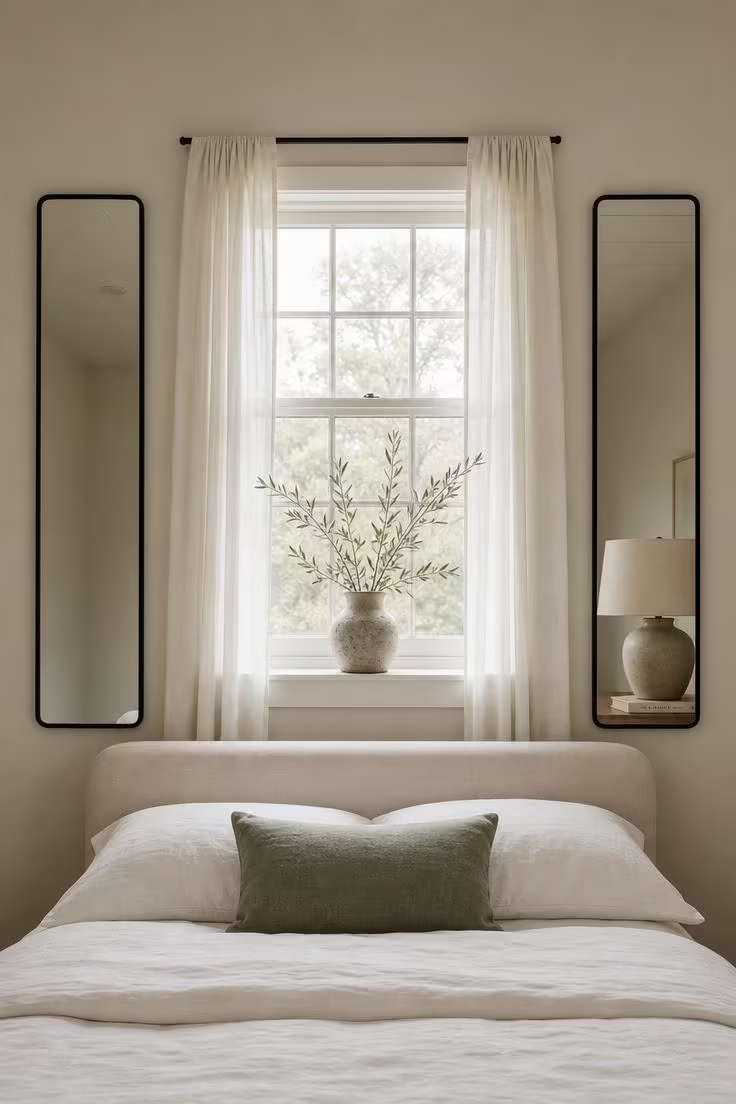
This is one of the simplest mirror arrangement ideas, and one of the most effective.
Two mirrors on either side of a window triple the amount of light reaching the room.
Each mirror catches the window from a different angle, which means the light they bounce back hits different parts of the space.
One mirror lights up the bedside table; the other brightens the opposite corner.
The symmetry creates a sense of calm that bedrooms need more than any other room.
Nothing about this arrangement competes for your attention — it just quietly makes the room feel bigger, brighter, and more balanced.
The slim matte black frames practically disappear against most wall colors, which is the point: these mirrors are tools, not showpieces.
Design Pro-Tip: To get the most light from your mirrors, hang or lean them directly across from your room’s best light source — a window, a glass door, even a well-placed lamp. Position the mirror at a 0 to 45-degree angle relative to the light. You’ll notice the difference most on overcast days, when reflected light does the heaviest lifting.
Style Blueprint:
- Two identical narrow mirrors (10 to 14 inches wide, 54 to 62 inches tall)
- Slim matte black or dark bronze metal frames
- Centered on either side of a window with 4 to 6 inches of space
- Light linen curtains on the window between
- Neutral bedding and minimal nightstand styling
An Irregularly Shaped Wavy Mirror on a Limewash Wall
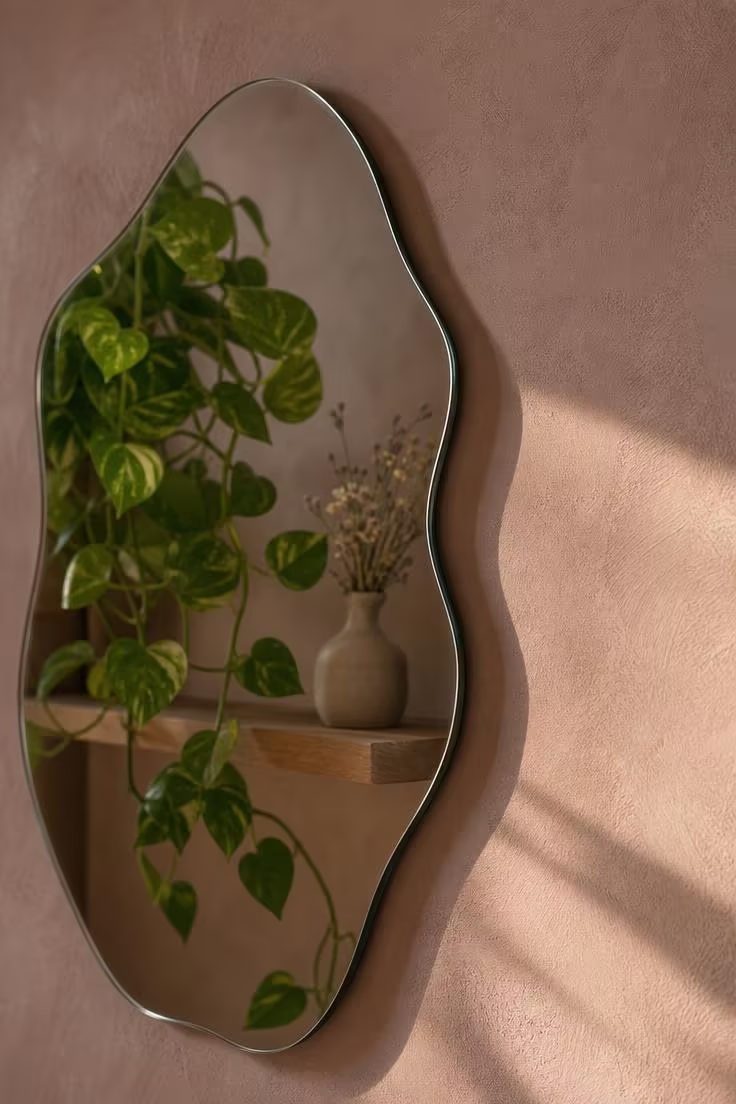
Straight edges tell your brain exactly where the mirror ends and the wall begins.
A wavy edge blurs that boundary.
The glass seems to melt into the plaster, especially on a limewash wall where the surface is already soft and imperfect.
This kind of frameless mirror works best on textured walls — smooth drywall doesn’t give it enough contrast.
The limewash’s chalky, matte finish makes the mirror’s glossy surface pop in a way that feels intentional rather than accidental.
There’s something about the combination of an irregular shape and a hand-applied wall finish that reads as personal.
Neither element is mass-produced, and the room knows it.
Style Blueprint:
- Organic wavy-edged frameless mirror (18 to 24 inches wide, 26 to 34 inches tall)
- Limewash, Roman clay, or textured plaster wall in a warm tone (clay pink, warm white, or soft sand)
- Trailing plant nearby to soften the composition
- No frame — the polished edge is the only border
- Minimal surrounding decor to let the shape speak
A Row of Identical Round Mirrors Descending a Staircase Wall
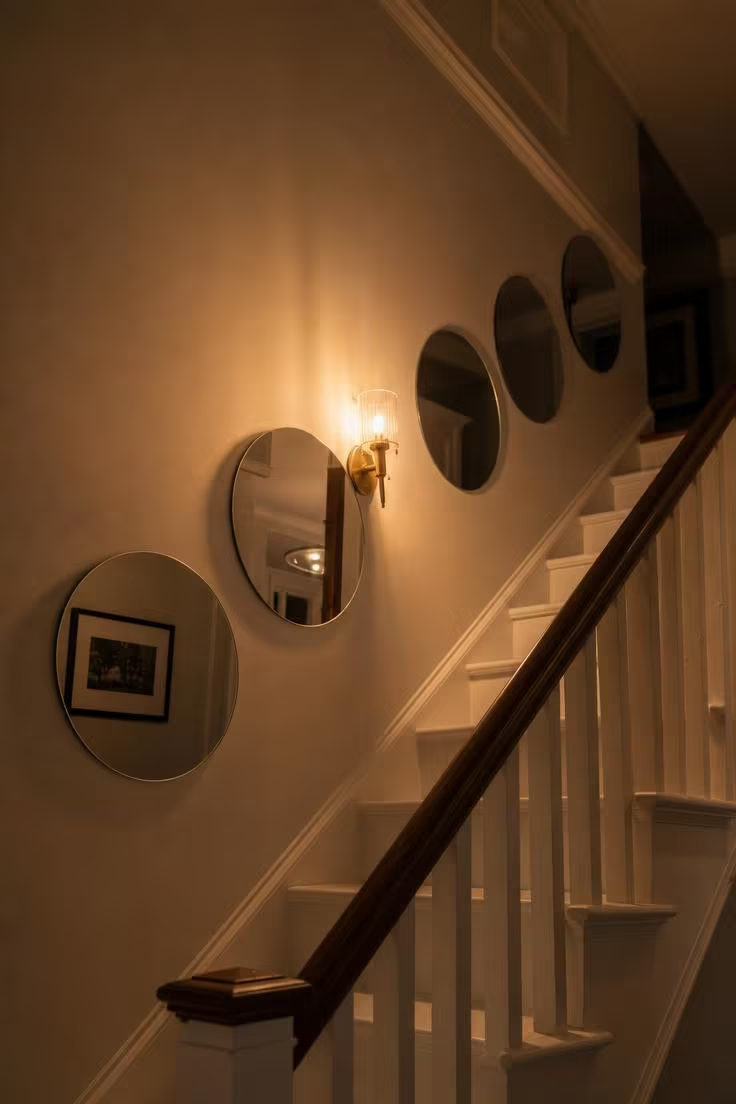
Repetition turns five separate mirrors into one continuous line.
Your eye follows them down the staircase the same way it follows the handrail — naturally, without thinking about it.
Each mirror captures a different slice of the space because each one sits at a slightly different height and angle.
One catches the ceiling fixture, the next the landing, the next a doorway.
Together, they create a kind of fragmented panorama of the whole stairwell.
Frameless mirrors work best here because frames would add visual weight to an already complex surface — stairs, handrail, wall, sconce.
The entryway mirror at the bottom of a staircase is a familiar idea, but spreading that concept across the full wall with matching discs is something most people haven’t tried.
It takes about an hour with a level and a pencil, and the result is a staircase that actually gives you something to look at on the way up and down.
Style Blueprint:
- Five identical round frameless mirrors (12 to 16 inches each)
- Even spacing (8 to 12 inches between centers) following the stair angle
- White or light-colored staircase wall
- Warm brass wall sconce positioned midway along the row
- Dark wood handrail for contrast
Conclusion
Mirrors don’t ask for much — a wall, some light, and a little thought about what they’ll reflect.
But they give back more than almost any other piece of decor you can hang.
A single well-chosen mirror can make a dark room brighter, a small room deeper, and a blank wall suddenly interesting.
You don’t need to commit to all 15 of these mirror wall decor ideas at once.
Pick the one that fits where your room needs it most — the hallway that swallows light, the bedroom wall with nothing on it, the dining room that feels a little closed-in.
Start there, and let the mirror do what mirrors have always done: show you a better version of the space you already have.