This post may contain affiliate links. If you make a purchase through these links, we may earn a commission at no additional cost to you.
Your basement is probably the most overlooked room in your house right now.
It sits there, collecting dust and holiday decorations, while your living room drowns in LEGOs and your kitchen table disappears under finger paint.
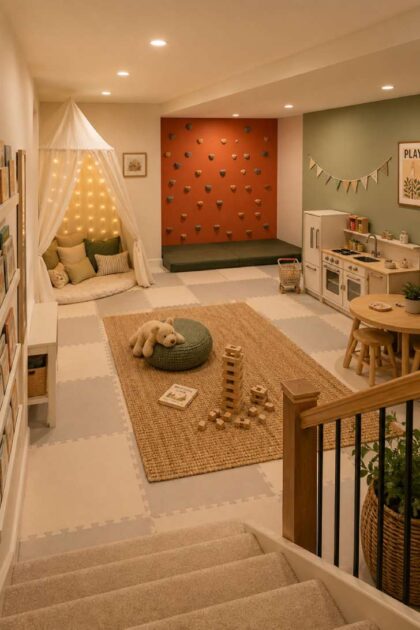
Turning that lower level into a dedicated kids play area gives your children a world of their own — and gives you back the rest of your home.
These 13 basement playroom ideas range from quiet reading corners to full-on climbing walls, and each one is designed to make the space feel warm, bright, and genuinely fun.
Let’s get into it.
The Soft-Floor Adventure Zone
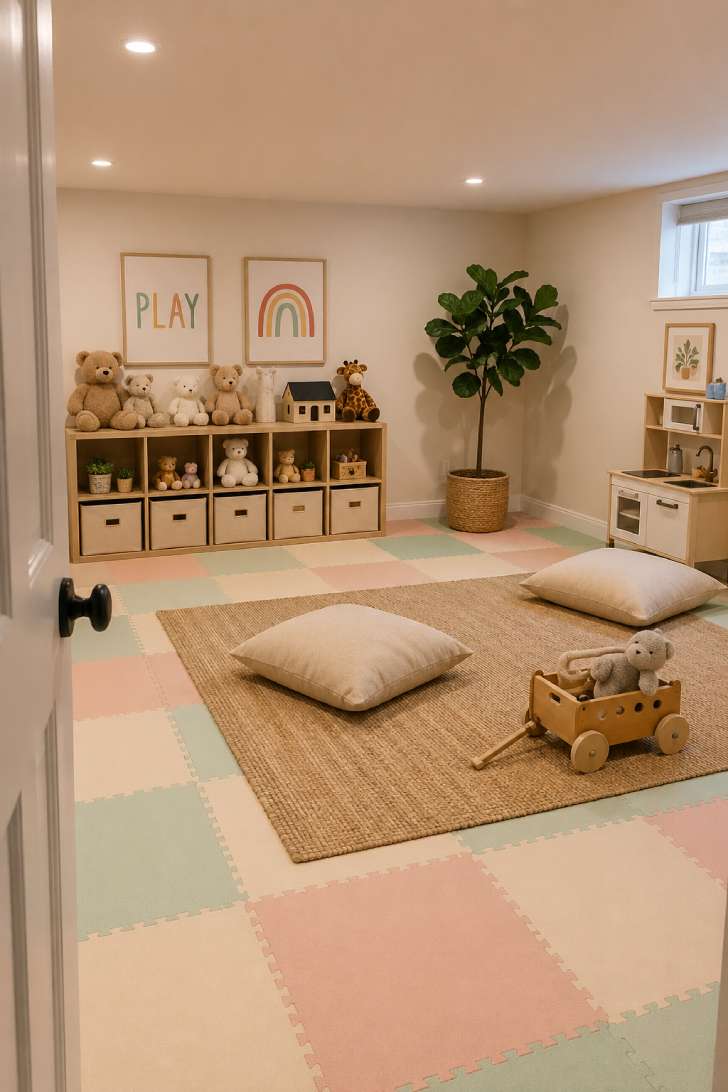
Everything starts with what’s under their feet.
Interlocking foam tiles — the good ones, at least 3/4 inch thick — absorb the impact of tumbles that would bruise on concrete or hardwood.
Go with a muted palette instead of primary colors and the room immediately feels more like a designed space than a daycare.
The open center encourages the kind of free, unstructured play that child development experts keep talking about — the kind where kids invent their own games instead of following instructions on a screen.
Something about a soft, clean floor invites kids to sit down and just start building.
Warm tones on the walls and gentle overhead lighting make the space feel safe, which changes how long children are willing to play independently.
Style Blueprint:
- Interlocking foam floor tiles in neutral or pastel tones
- Low wooden storage cube unit
- Two oversized linen floor cushions
- Woven jute area rug
- Potted greenery for a grounding natural element
A Tucked-Away Reading Nook
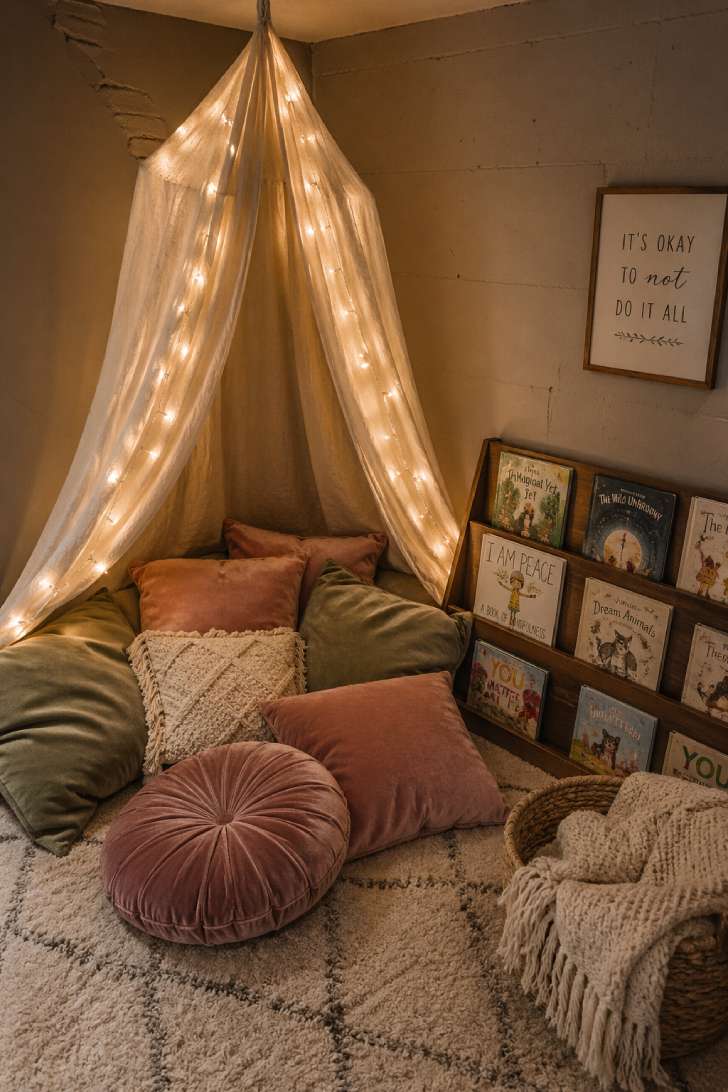
Every playroom needs a spot where the energy can come down.
This reading nook works because of the canopy — it creates a sense of enclosure without walls, which makes children feel protected and focused.
The low bookshelf with forward-facing covers matters more than you’d think.
Kids pick books by their covers, not their spines, so displaying them face-out doubles the chance they’ll actually reach for one.
Fairy lights add just enough warmth to make the corner feel separate from the rest of the room.
The velvet cushions in dusty rose and sage bring texture that invites touch, and touch is what draws a child into a space and keeps them there.
Style Blueprint:
- Sheer linen canopy with ceiling hook
- Velvet floor cushions in two complementary colors
- Low forward-facing wooden bookshelf
- Warm-white fairy light strand
- Woven basket with cotton throw blanket
The Art Station Wall
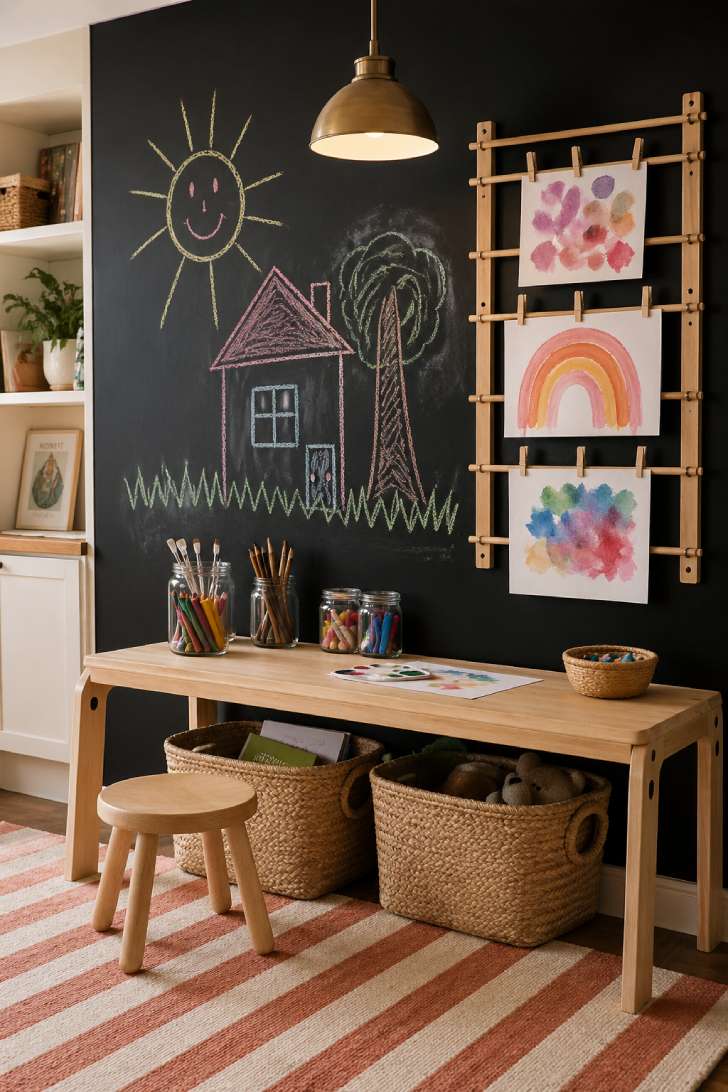
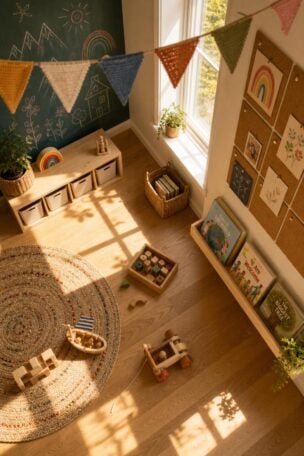
A chalkboard wall does something sneaky — it tells kids that drawing on walls is allowed here.
That permission changes the energy of the whole room.
The birch table at their height means they can sit down and start creating without asking for help, and the glass jars full of supplies are visible and reachable.
Mounting a drying rack on the playroom wall solves the wet-painting-on-the-kitchen-counter problem permanently.
The washable rug underneath is non-negotiable unless you enjoy scrubbing dried tempera paint off foam tiles.
What makes this corner work from a mood standpoint is the contrast — that dark chalkboard wall against the light wood and warm textiles creates a focal point that pulls kids in.
Style Blueprint:
- Matte chalkboard paint on one accent wall
- Light birch wood child-height table
- Glass jars and a wooden art supply caddy
- Wall-mounted drying rack with clothespins
- Washable cotton area rug
Built-In Climbing Wall
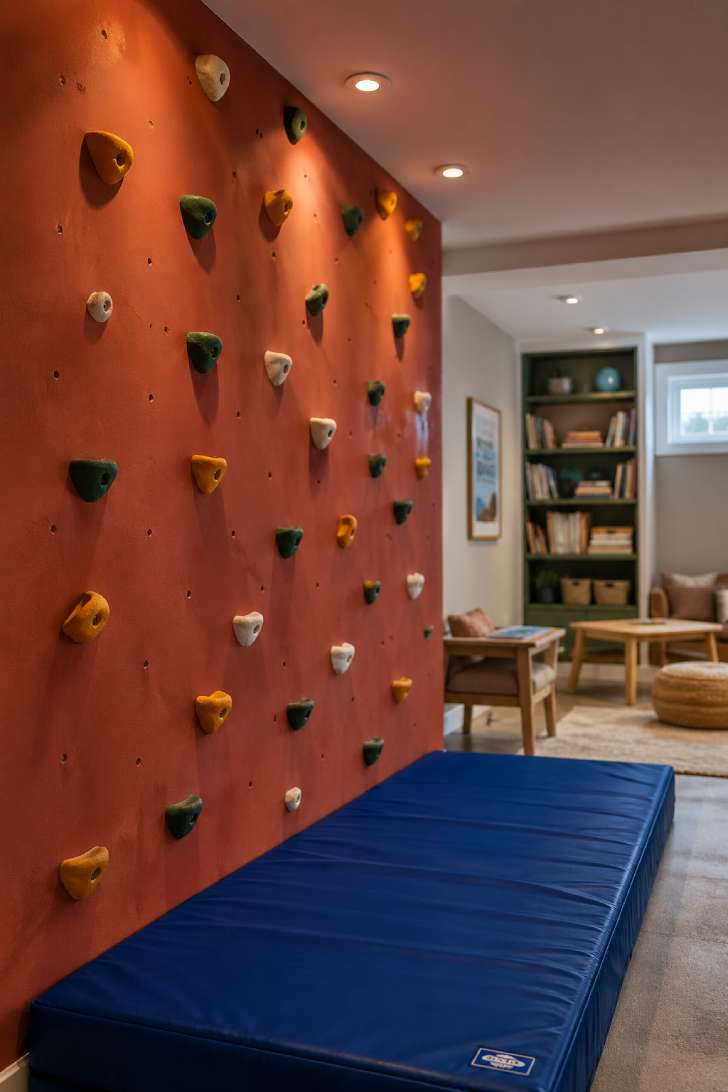
Physical play gets overlooked in playroom design, but a basement can provide room for active features as well as quieter activities.
A climbing wall takes up a single vertical surface and gives children a physical challenge they can return to as their skills develop.
Placing the holds in a winding path rather than a straight vertical line can create different movement options and difficulty levels without requiring a taller wall.
Warm terracotta on the wall keeps the installation from looking institutional, and coordinating holds can make the climbing feature feel integrated into the playroom rather than added as an afterthought.
Because this is active-play equipment, the installation needs more planning than an ordinary decorative wall.
The supporting wall, anchors, climbing holds, fall zone, and impact-attenuating surface should match the climbing system and its intended users.
Follow the manufacturer’s installation requirements, keep the designated fall area clear, and supervise children appropriately rather than improvising structural attachment details from a decorating article.
Style Blueprint:
- Rock climbing holds in 3 coordinating colors
- Impact-attenuating surface appropriate for the climbing system
- Warm-toned accent paint on climbing wall
- Recessed directional ceiling lights
- Rubber-backed floor runner outside the designated fall area
Design Pro-Tip: Basements often need more than one light source. Instead of relying on a single overhead fixture, combine general ceiling lighting with warmer decorative lighting and targeted accent lighting where needed. Layering the sources can reduce dark corners and make the room feel brighter and more comfortable.
Montessori-Inspired Open Shelving Corner
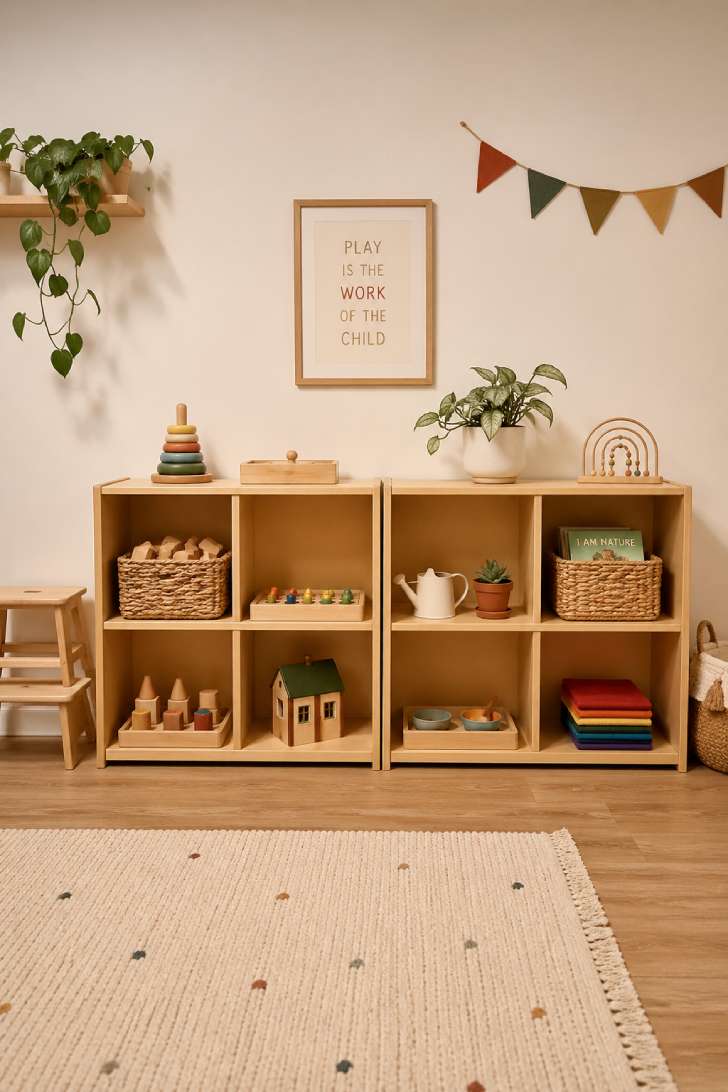
The Montessori approach to toy storage ideas comes down to one rule: less out, more rotation.
Instead of dumping every toy into a bin, you display a handful of activities on low, open shelves and swap them every week or two.
Kids engage more deeply with fewer choices — that’s not philosophy, it’s behavioral research.
The seagrass baskets keep things contained without hiding them, so children can scan their options at a glance.
A step stool nearby signals independence.
The whole corner works because it respects the child’s eye level and reach, which sounds obvious but most playroom storage is designed for adult convenience.
When everything has a visible home, cleanup becomes a matching game instead of a chore.
Style Blueprint:
- Two low wooden cubby shelving units
- Woven seagrass storage baskets
- Activity trays for individual play setups
- Small wooden step stool
- Light oak luxury vinyl plank flooring
Indoor Swing and Monkey Bar Zone
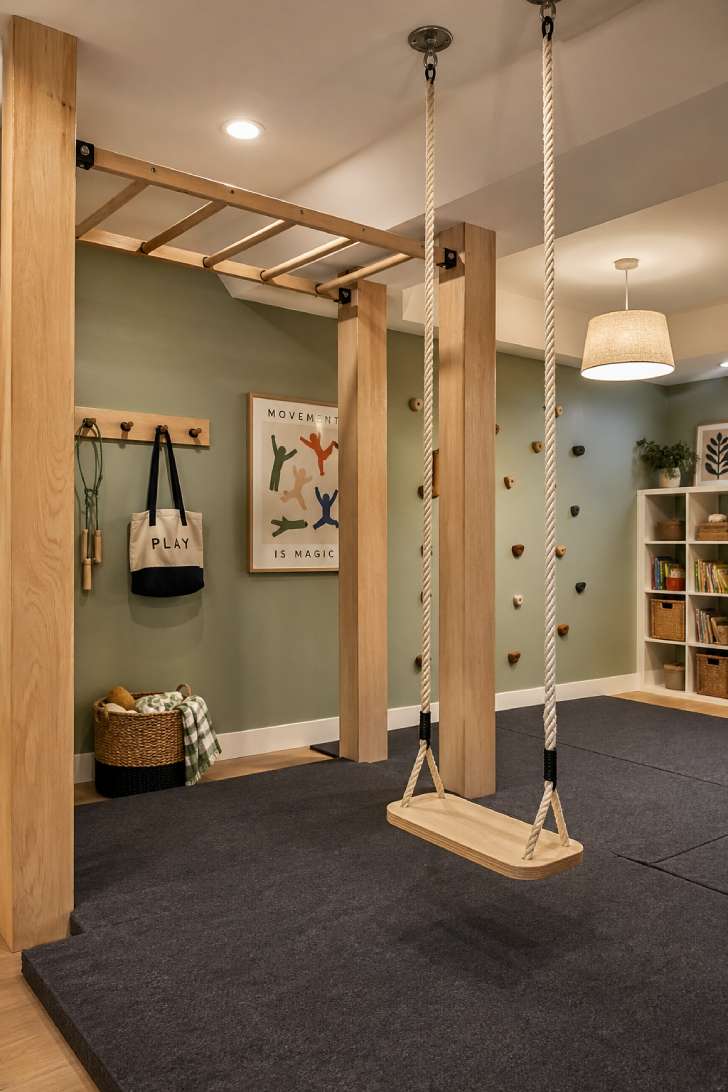
This is the idea that makes parents nervous — and makes kids lose their minds with excitement.
A ceiling-mounted swing can turn an underused basement into an active play space, especially when paired with monkey bars mounted between structural columns.
Do not assume that an exposed basement joist can support a swing.
Suspended play equipment creates dynamic loads, and joist dimensions, span, condition, connection details, and equipment requirements all matter.
Use a manufacturer-approved mounting method, and have the structure assessed when the load path is uncertain.
A charcoal gymnastics mat covers the landing zone and looks intentional rather than aftermarket.
Sage green on the walls keeps the area from feeling like a garage gym.
Indoor swinging activates the vestibular system, helping children practice balance, movement awareness, and spatial orientation through play.
The linen pendant light softens the overhead glow so the space reads as a room, not a facility.
Style Blueprint:
- Ceiling-mounted birch wood swing with cotton rope
- Wall-mounted wooden monkey bars
- Thick charcoal gymnastics crash mat
- Simple wooden wall hooks for gear
- Linen pendant shade for warm ambient light
The Miniature Kitchen and Market
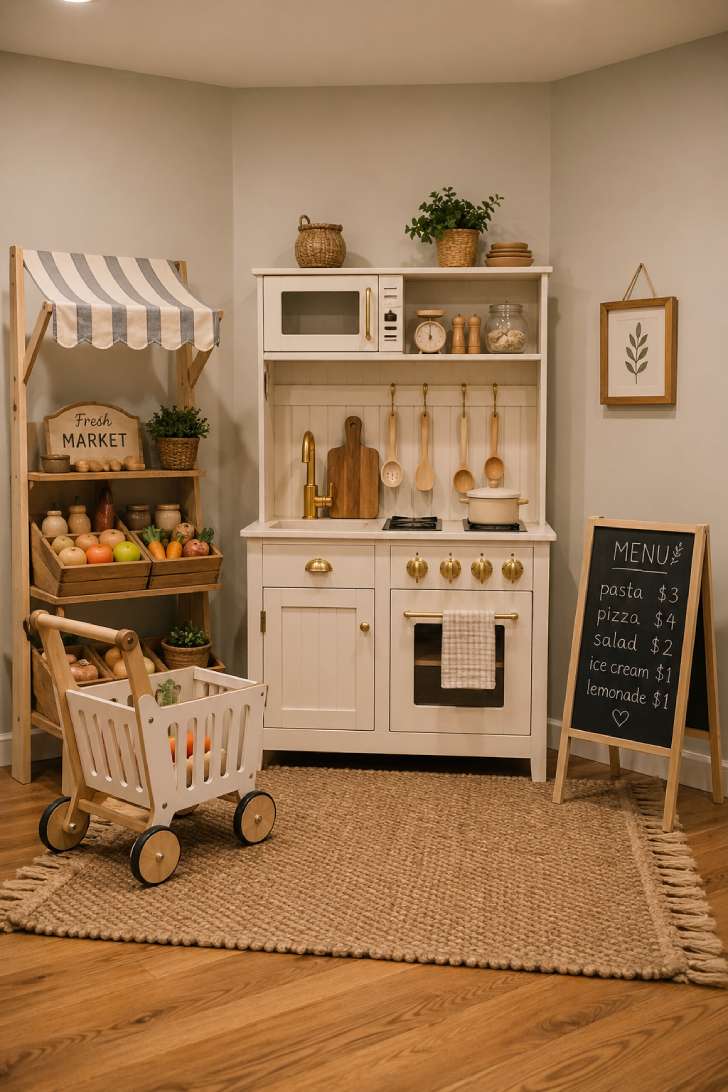
Pretend play is where kids rehearse real life.
A play kitchen with actual knobs that turn and doors that open teaches sequencing — you get the pan, then the food, then you “cook,” then you serve.
Adding a market stand next to it creates a whole economy: one child shops, another cooks, and they negotiate over wooden tomatoes.
The brass hardware on the kitchen elevates it from toy to furniture, which matters when this room is visible from the stairwell.
A chalkboard menu easel lets them practice writing without it feeling like homework.
The jute rug and warm wood tones ground the whole vignette so it feels like a real room within a room.
Style Blueprint:
- Wooden play kitchen with brass hardware details
- Market stand with canvas awning
- Miniature wooden shopping cart
- Small chalkboard easel
- Woven jute rug with fringe
Cozy Movie Corner
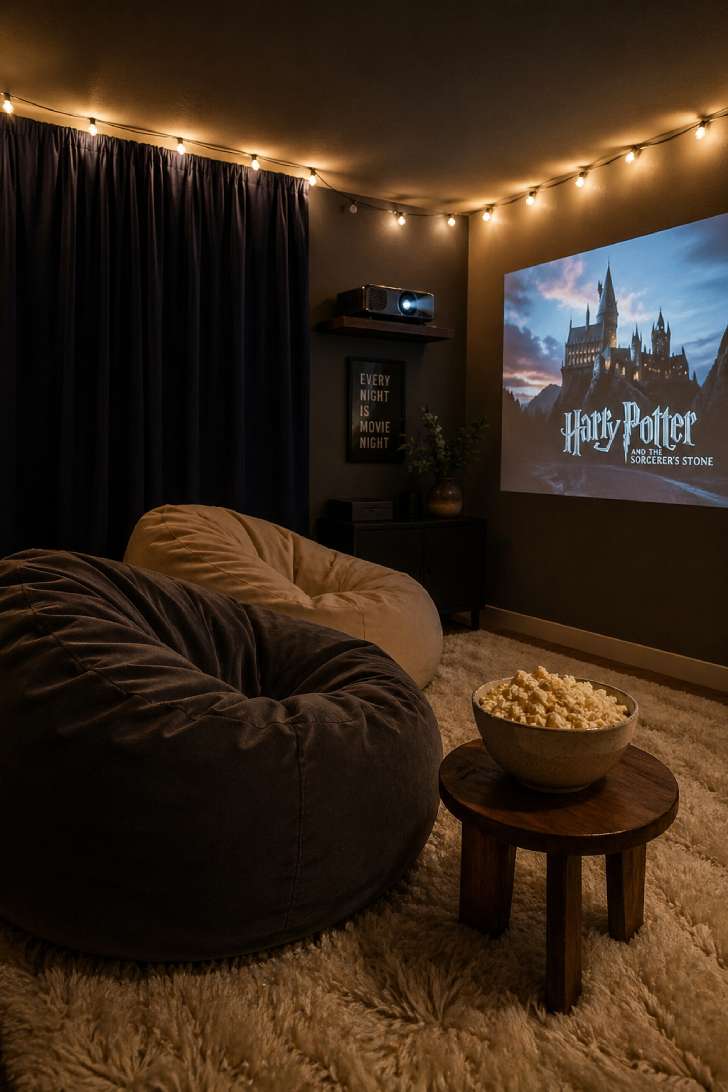
Design Pro-Tip: Acoustic panels wrapped in fabric (linen or felt work well) do double duty in a basement — they absorb the echo that makes below-grade rooms sound hollow AND they reduce the noise that travels up through the floor joists to the rooms above. Mount a few behind the movie corner and the sound difference is immediate.
A projector turns any blank wall into a screen, and it costs less than a large TV.
The blackout curtain behind the seating creates a visual boundary that says “this is the theater zone” without building a wall.
Bean bags beat a couch here because kids rearrange them every time — sometimes they pile both into a nest, sometimes they drag one across the room for a solo viewing spot.
The shag rug makes the floor comfortable enough to lie on, which is where most kids end up anyway.
String lights at the ceiling give just enough ambient light to move around safely without killing the movie atmosphere.
A ceramic popcorn bowl on a wooden side table is a small touch, but it signals ritual — this spot is for slowing down.
Style Blueprint:
- Two oversized velvet bean bag chairs
- Plush cream shag rug
- Compact projector on a floating shelf
- Navy linen blackout curtain
- Warm-white string lights for ambient light
The LEGO and Building Station
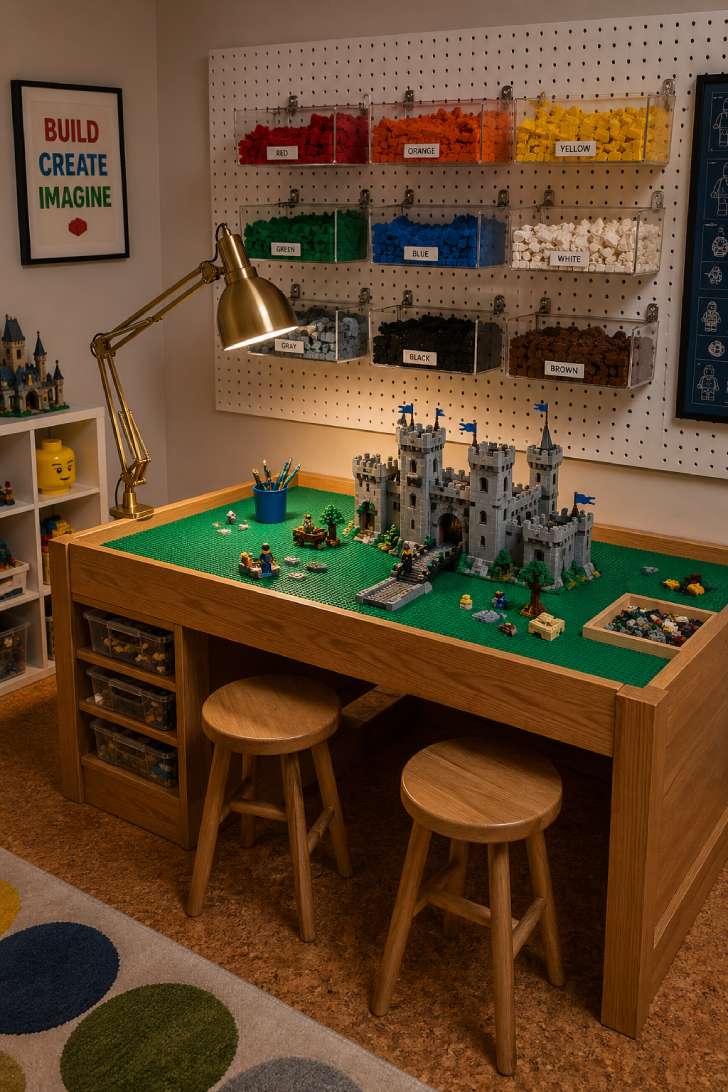
If your kids build with LEGO, blocks, or magnetic tiles, this station pays for itself in sanity.
The built-in baseplate surface means projects stay in progress without taking over the dining table.
Sorting bricks by color on a pegboard wall does two things: it cuts down the time kids spend searching (which is when frustration kicks in) and it makes cleanup a color-matching activity.
A task lamp with an adjustable arm matters because small-piece building requires direct light, and overhead fixtures cast hand shadows right where kids are working.
Cork flooring underneath is forgiving when a creation crashes — and they all crash eventually.
The warm brass lamp and the wooden stools keep the station feeling like part of the room’s children’s activity room aesthetic rather than a utility table shoved in a corner.
Style Blueprint:
- Large wooden table with inset baseplate surface
- White pegboard with clear acrylic sorting bins
- Brass adjustable task lamp
- Cork flooring
- Two small wooden stools
Sensory Play Corner
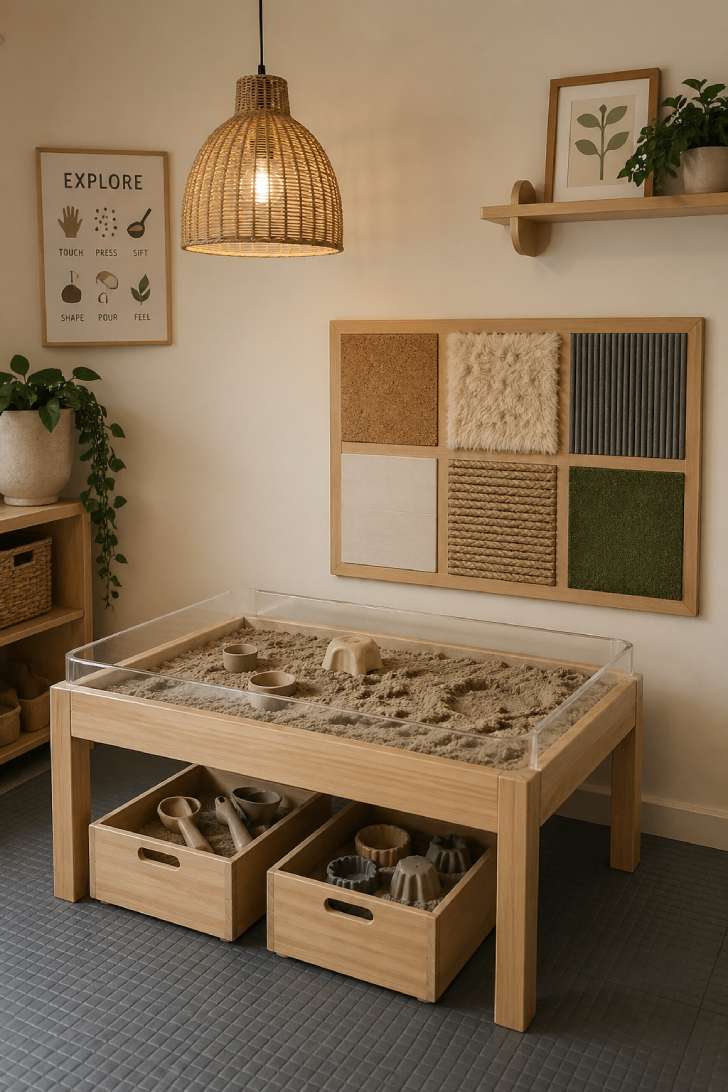
Sensory play isn’t just for toddlers — it calms kids of all ages.
Running fingers through kinetic sand, pressing against different textures on a wall panel, scooping and pouring — these repetitive actions regulate the nervous system.
The sand table with a clear acrylic lid means you can close it up at the end of the day and the mess stays contained.
A textured wall panel is one of the cheapest things you can build for a playroom, and kids gravitate toward it instinctively.
The waterproof mat beneath everything is the invisible hero of this corner.
One pendant light with a woven rattan shade keeps the overhead illumination soft and warm, which matches the calming intent of the space.
Style Blueprint:
- Wooden sand table with acrylic lid
- Textured wall panel with 5+ material samples
- Slate gray waterproof floor mat
- Wooden bins with sensory tools (scoops, molds, funnels)
- Woven rattan pendant light
Music and Dance Stage
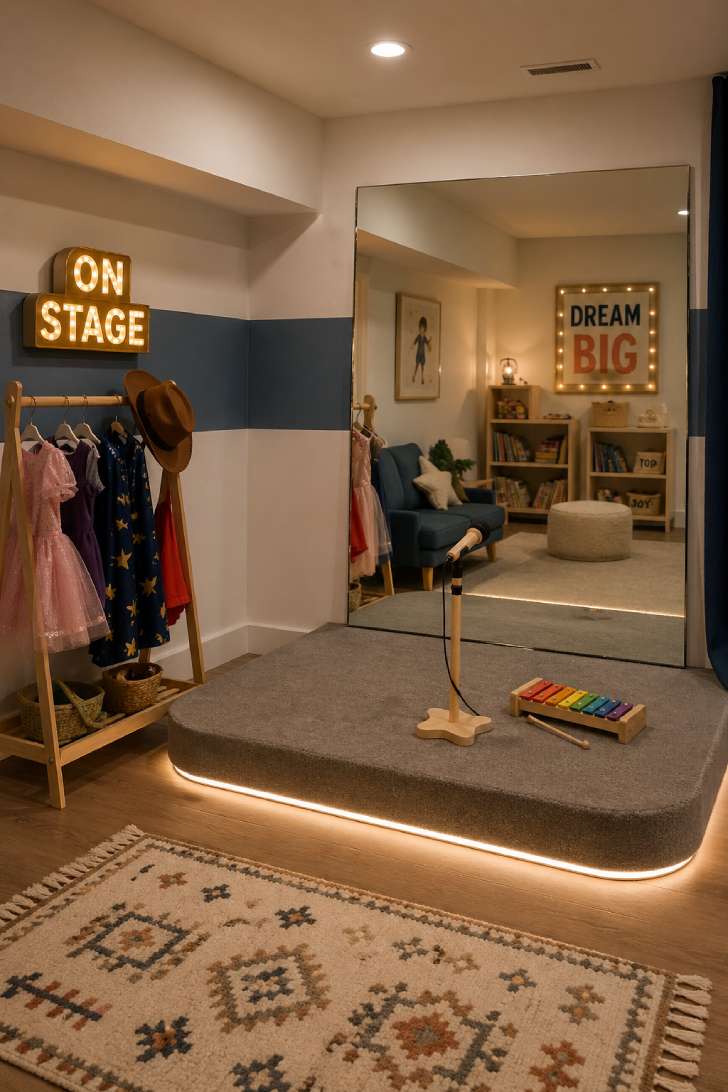
Kids perform whether you give them a stage or not.
Giving them one just directs the energy.
A six-inch foam platform defines the “stage” without creating a fall hazard, and felt covering makes it soft enough to dance on barefoot.
The frameless mirror is the real draw — kids can watch themselves move, which builds body awareness and keeps them engaged for surprisingly long stretches.
A costume rack nearby turns the stage into a full indoor play space for dramatic play, which is how children process emotions and social situations they can’t articulate yet.
The LED strip at the base of the platform adds just enough drama to make the space feel special without requiring any wiring beyond a peel-and-stick strip and a plug.
Style Blueprint:
- Low foam platform with felt covering
- Large frameless floor-leaning mirror
- Small wooden costume rack
- Toy microphone on a wooden stand
- Warm-white LED strip light for the platform edge
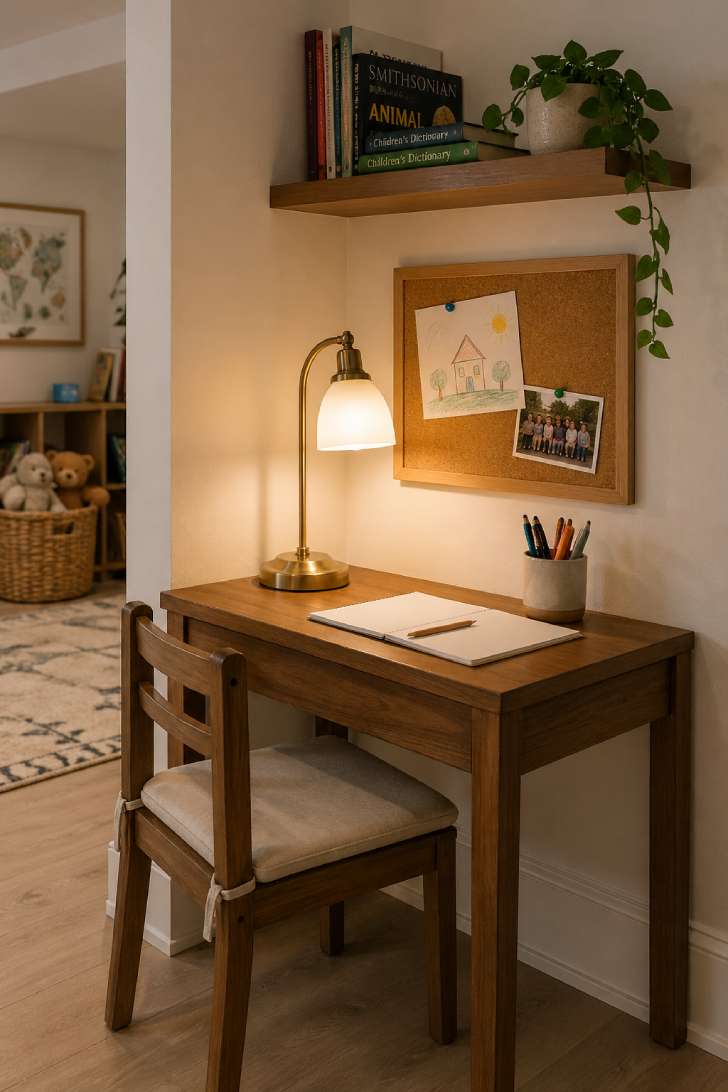
Homework and Craft Desk Nook
Design Pro-Tip: Rotate toys every two weeks. Box up half the playroom inventory and swap it later — kids treat “new” rotated toys with the same excitement as something from a store, and the reduced clutter makes playroom organization dramatically easier.
Not every minute in the playroom needs to be loud.
A dedicated desk nook gives older kids a quiet landing pad for homework, drawing, or journaling away from the commotion of the main play zones.
The cork bulletin board above the desk makes it personal — a pinned drawing or a class photo turns generic furniture into their space.
Brass task lighting provides the focused beam that overhead lights can’t match, and the frosted glass shade keeps the glare comfortable.
A single trailing plant on the floating shelf brings a tiny bit of life into a below-grade room, and research on biophilic design suggests even small amounts of greenery improve focus and mood.
Keeping this nook visually distinct from the play areas — cleaner lines, quieter colors — helps kids shift gears when they sit down.
Style Blueprint:
- Clean-lined wooden desk at child height
- Brass desk lamp with frosted glass shade
- Cork bulletin board
- Floating shelf with books and a trailing plant
- Simple wooden chair with linen seat cushion
The Indoor Treehouse Hideaway
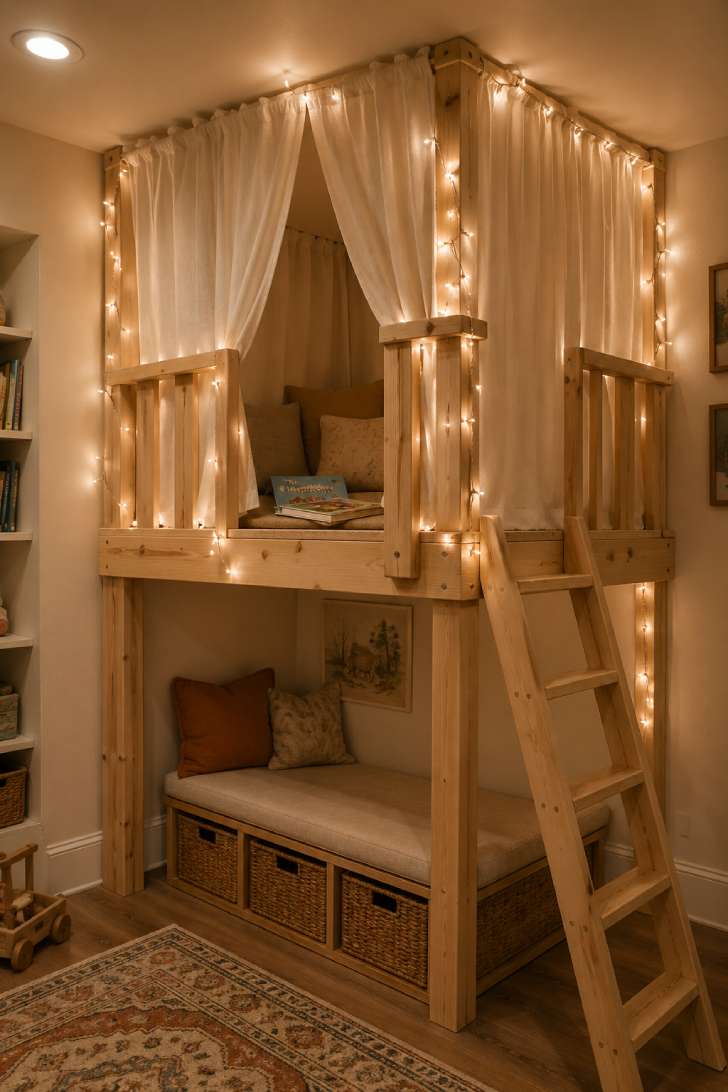
This is the showpiece — the idea that makes kids gasp when they come downstairs.
A raised loft platform turns unused vertical space into a hideaway, but the platform height should be determined as part of the overall design rather than treated as inherently safe at a particular measurement.
Guarding, allowable openings, ladder or stair access, fall protection, ceiling clearance, structural construction, and other requirements depend on the specific configuration and applicable rules.
The sheer curtains are the secret ingredient.
They create a sense of enclosure and mystery without completely closing off the space.
Fairy lights winding around the railing posts add a warmth that overhead fixtures can’t replicate — it’s the difference between a room and a place.
Below the loft, a cushioned bench with woven baskets serves double duty as seating and toy storage ideas that actually get used.
Kids may return to this kind of space because it combines an elevated play area with a smaller, enclosed-feeling retreat.
Style Blueprint:
- Pine wood loft structure with appropriately designed access and guarding
- Sheer cotton curtains in natural white
- Fairy light strands suitable for the installation location
- Two small cushions and a book stack for the loft
- Cushioned bench with woven storage baskets below
Conclusion
A basement playroom doesn’t need to be complicated or expensive to be great.
It needs zones that match how your kids actually play — somewhere to move, somewhere to create, somewhere to rest.
The ideas here all share a few things in common: soft playroom flooring, warm basement lighting, storage at kid-height, and a look that feels like a real room instead of a toy explosion.
Start with one or two ideas that fit your children’s current interests, build out from there, and don’t be afraid to rearrange as they grow.
The best indoor play space is the one that keeps evolving.
Your basement has been waiting for this.