
This post may contain affiliate links. If you make a purchase through these links, we may earn a commission at no additional cost to you.
A big blank wall is not a problem to solve.
It is an invitation to set a color story, anchor a mood, and shape the way a room feels the second someone walks in.
Most advice stops at “hang a large print,” and that leaves a lot of square footage unaddressed.
The large wall decor ideas here pair specific materials, finishes, and compositions so you can picture the result before you pick up a hammer.
Whether you are working with an open living room, a long hallway, or a wall above a staircase, each section offers a concrete scene you can adapt to the proportions and palette of your own home.
An Aged Copper Sheet Panel Riveted to a Warm Taupe Plaster Wall
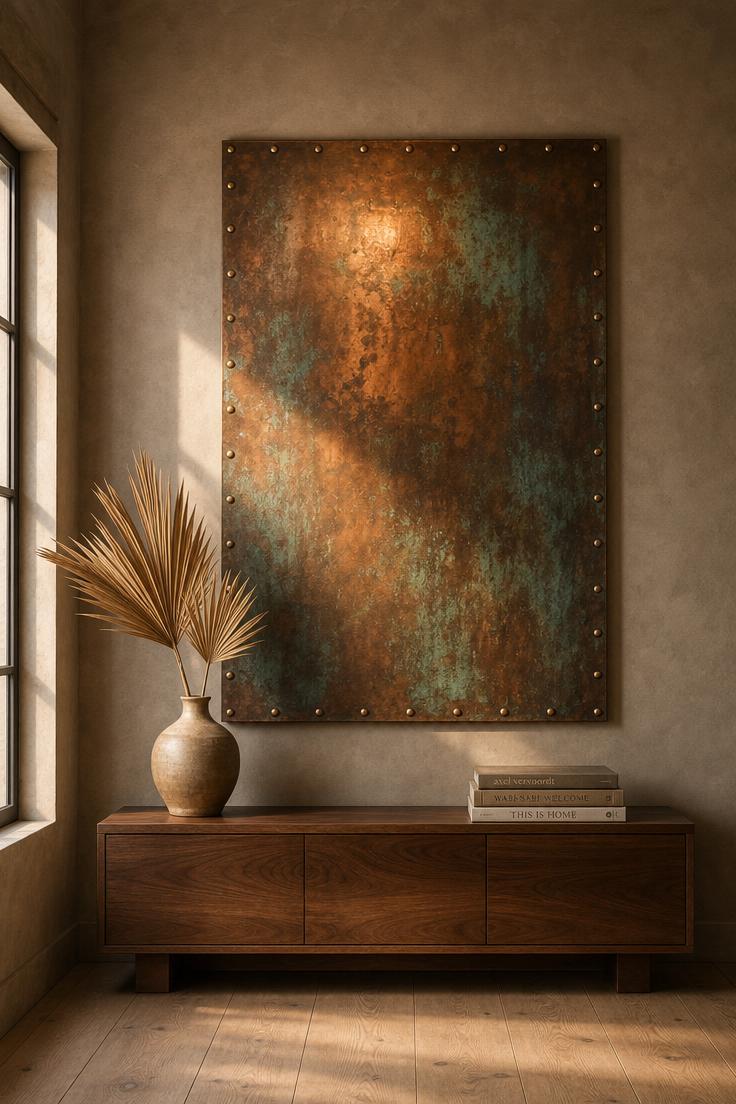
There is something deeply grounding about copper on a wall.
The patina never sits still, shifting from green to amber to a dark penny brown depending on where you stand and how the light moves through the room.
A single sheet of pre-patinated copper, mounted with visible brass rivets, turns a plain plaster surface into the most interesting thing in the house.
The material reads as oversized wall art without asking you to commit to a subject or a style that might feel dated in a few years.
Raw copper will develop its own character over months, darkening near humidity and brightening where hands touch it.
Pre-patinated sheets skip the wait and arrive with a finish that already looks decades old.
Pair the warm metallics with a taupe or cream wall, and the copper becomes the anchor for everything else in the room, pulling together camel leather, warm wood, and linen upholstery without competing for attention.
Style Blueprint:
- One pre-patinated copper sheet panel, minimum 36 by 60 inches
- Brass or copper rivets, 8 to 12 per edge
- Warm taupe or cream matte plaster wall finish
- Low-profile walnut or oak credenza below the panel
- Dried botanical arrangement in a neutral ceramic vessel
A Floor-to-Ceiling Indigo Shibori Fabric Stretched Over a Bamboo Frame
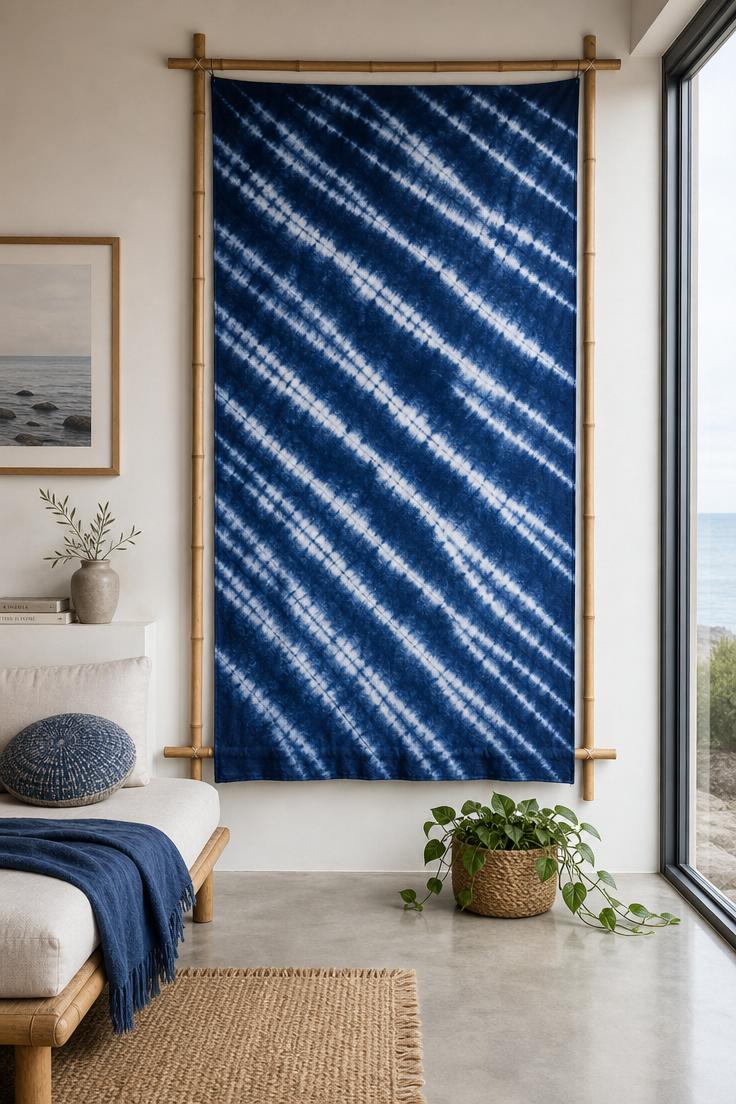
Fabric on a wall does something that paint and framed art cannot.
It absorbs sound, softens hard surfaces, and moves just enough in a breeze to remind you that the room is alive.
A hand-dyed shibori panel in deep indigo brings all of that plus a pattern that no machine can replicate, because every fold and twist during the resist process produces one-of-a-kind lines.
Arashi shibori wraps the cloth around a pole before dyeing, creating the diagonal wave pattern visible here, and kumo ties small sections into tight knots for a clustered ring effect.
Bamboo rails at the top and bottom keep the fabric taut without the bulk of a traditional frame, which is one of the more practical wall hanging ideas for renters who want to avoid heavy hardware.
The result works in Japandi, coastal, and bohemian rooms with equal ease, because the simplicity of indigo and white adapts to nearly any palette.
Style Blueprint:
- Hand-dyed indigo shibori cotton panel, arashi or kumo pattern
- Natural bamboo rails at top and bottom for mounting
- White or pale gray wall background
- Low daybed or bench with linen upholstery nearby
- Trailing green plant at floor level for organic contrast
An Arrangement of Hand-Carved Teak Sunburst Medallions on a Sandy Limestone Wall
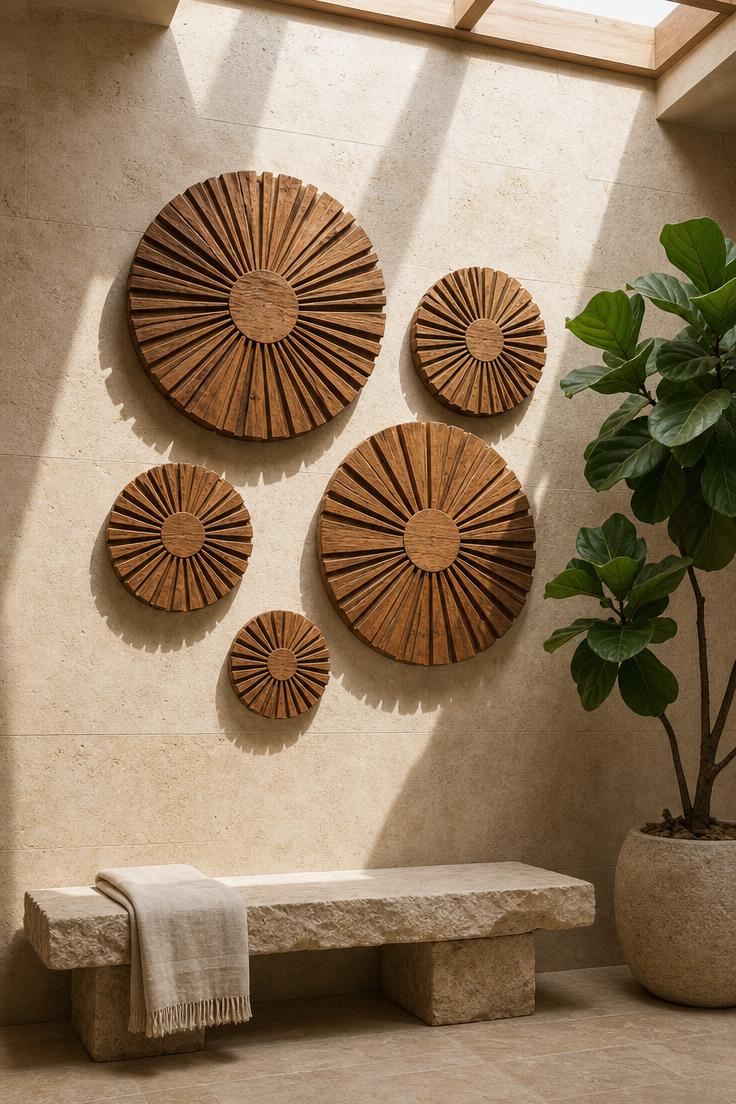
Carving turns a flat disc of wood into something that changes every hour of the day.
When overhead light hits these teak medallions at noon, every groove fills with a short, hard shadow that makes the sunburst pattern pop with contrast.
By evening, those same grooves go soft and nearly disappear, and the whole arrangement reads as a set of warm wooden moons rather than radiating suns.
That shifting quality is what separates three-dimensional wall pieces from flat prints, and it rewards you with a different view depending on when you walk past.
Grouping five to seven medallions in graduated sizes creates a composition that reads as one large piece from across the room but reveals individual detail up close.
The key to the arrangement is leaving uneven spacing between the discs, with tighter gaps near the center and wider breathing room at the edges, so the cluster feels organic rather than gridded.
Teak weathers well indoors and out, making these medallions a good option for covered patios or sunrooms where a metal wall sculpture might feel too cold.
The honey and brown tones of natural teak pair well with limestone, warm concrete, and sand-colored plaster walls.
Style Blueprint:
- Five to seven hand-carved teak sunburst medallions, 12 to 30 inches in diameter
- Sandy limestone, warm concrete, or sand-toned plaster wall
- Wall-mount hardware rated for the weight of solid teak
- One tall green plant nearby for vertical balance
- Cream or natural linen textile on adjacent furniture
A Stacked Trio of Oversized Charcoal Landscape Photographs in Matte Aluminum Frames
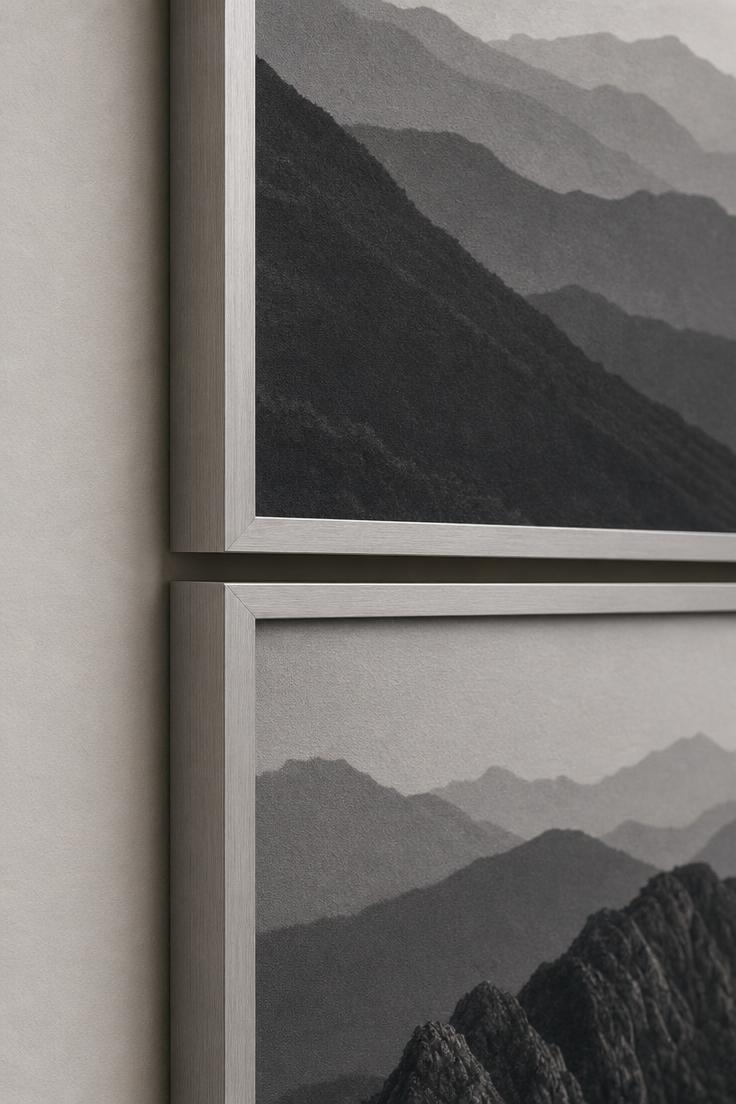
Stacking photographs vertically is one of the most underused blank wall solutions for narrow or tall wall segments.
Three large prints in a column draw the eye upward and make a room feel taller, which is the opposite of what a single wide piece does.
Matte paper and brushed aluminum frames keep the presentation restrained, letting the tonal range of charcoal photography do the work.
The gap between frames matters more than you might expect: one and a half inches is enough to separate the images visually without breaking the sense of a unified column.
Wider gaps make three individual pictures; tighter gaps make one awkward mass.
Charcoal landscapes in matte finish absorb rather than reflect light, which means you can hang them opposite a window without worrying about glare, a problem that glossy large canvas prints often create.
Style Blueprint:
- Three matte charcoal landscape photographs, each 30 by 40 inches
- Slim brushed aluminum float frames with 1.5-inch spacing between them
- Pale warm gray or white wall behind the stack
- North-facing or diffused ambient light to minimize reflections
- Low-profile furniture below to preserve the vertical emphasis
Design Pro-Tip: When hanging a vertical stack of frames, align the center of the middle piece at 58 inches from the floor. This puts the full arrangement at comfortable viewing height whether you are standing or seated nearby. Use a laser level, not a bubble level, for stacks taller than three feet, because even a one-degree tilt at the top frame will be visible from across the room.
A Full-Height Moss and Fern Living Wall Panel Bordered by Blackened Steel
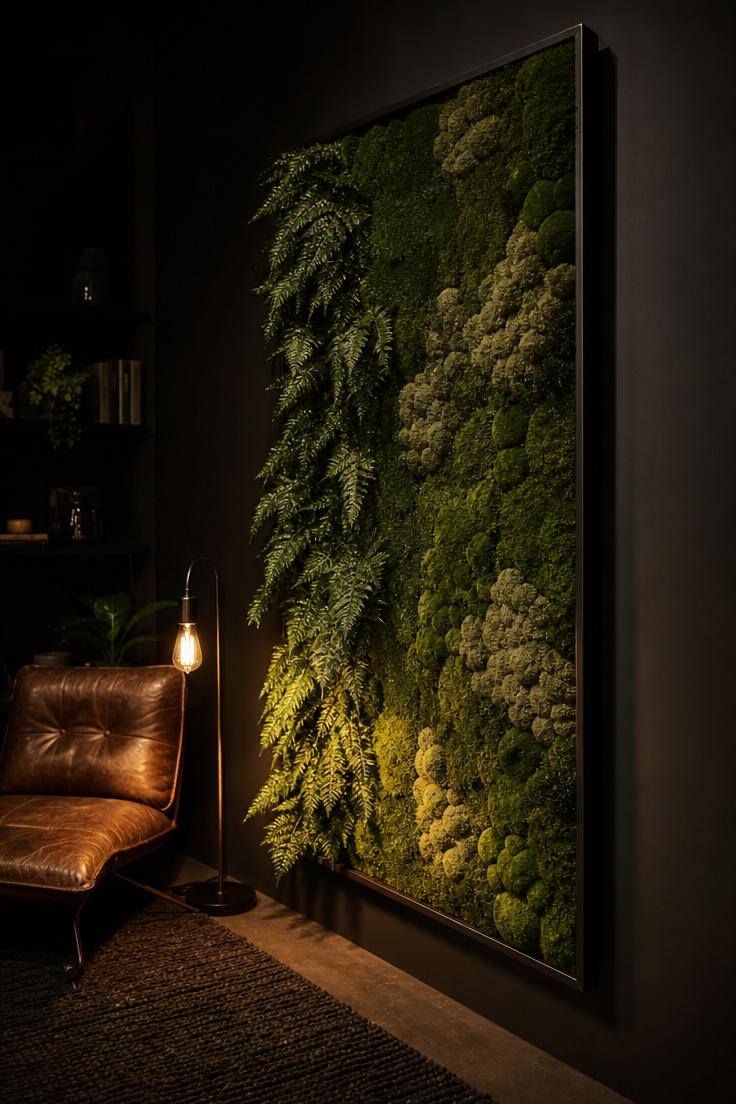
Walking into a room with a moss wall feels like stepping through a door between the city and a quiet stretch of forest floor.
The texture alone does most of the work: sheet moss lies flat and velvety, reindeer moss rises in soft rounded clumps, and preserved fern fronds feather outward with a papery delicacy that catches even the smallest air current.
Preserved moss requires no watering, no sunlight, and no soil, which makes it practical as permanent large wall decor in rooms where a living plant wall would struggle.
The blackened steel border gives the whole panel a gallery quality, framing the organic mass the way a shadow box frames a collected object.
Low moody light is the best friend of a moss wall because it deepens every shade of green and hides the edges where individual moss sections meet, creating the illusion of one continuous surface.
This accent wall design works well in home offices, reading rooms, and bedrooms where quiet atmosphere matters more than bright color.
Moss panels also absorb a measurable amount of ambient noise, softening echoes in rooms with hard floors and high ceilings.
The maintenance schedule is close to zero: occasional misting with water in very dry climates and keeping the panel out of direct sunlight to prevent color fade.
A statement art piece made from living material carries a weight and presence that paint and canvas simply cannot replicate.
Style Blueprint:
- Preserved moss and fern panel, approximately 4 by 8 feet, professionally assembled
- Welded blackened steel or matte black metal frame
- Deep charcoal, dark navy, or forest green wall color
- Warm filament floor lamp or wall sconce for directional low light
- Leather or dark textile seating nearby to reinforce the moody palette
A Wide Horizontal Canvas of Abstract Color Fields in Ochre and Stone
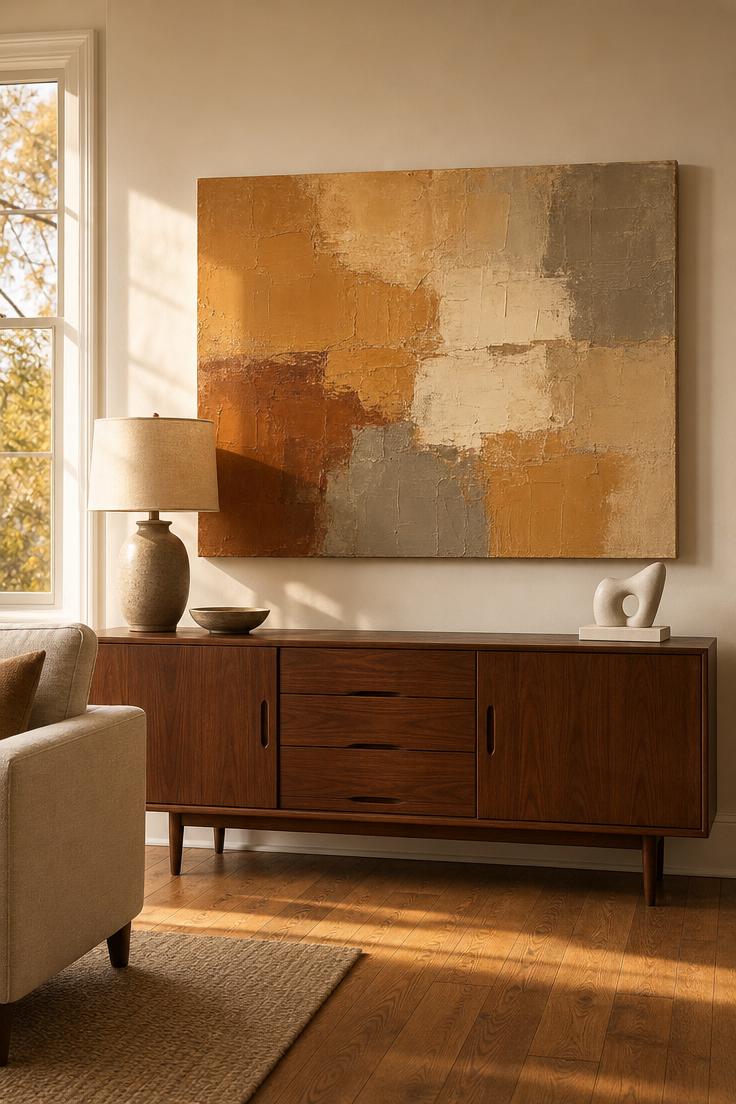
Color field painting works on large walls because it fills the space with mood rather than subject matter.
There is no landscape to interpret, no figure to identify, just layers of ochre, sienna, stone, and cream that shift in warmth depending on the time of day and the color temperature of the light in the room.
Palette knife application leaves ridges thick enough to cast their own tiny shadows, which means the surface changes character when you walk past it, catching light at one angle and releasing it at another.
A horizontal orientation stretches the eye sideways and makes a wall feel wider, which is useful above long furniture like credenzas, dining sideboards, and low media consoles.
Gallery-wrapped edges let you skip the frame entirely, keeping the look clean and letting the paint continue around the sides.
If you prefer a finished border, a slim oak float frame adds structure without competing with the color.
The warm earth tones pair naturally with linen, walnut, warm leather, and dried grasses, making this one of the easier oversized wall art pieces to integrate into an existing room without redecorating around it.
Style Blueprint:
- One wide horizontal canvas in earth tone color fields, approximately 60 by 36 inches
- Gallery wrap or slim oak float frame
- Soft warm white wall
- Low walnut or oak credenza below the canvas
- Ceramic lamp with linen shade and a small sculptural accent on the credenza
A Grid of Hand-Thrown Terracotta Disc Tiles Glazed in Salt White
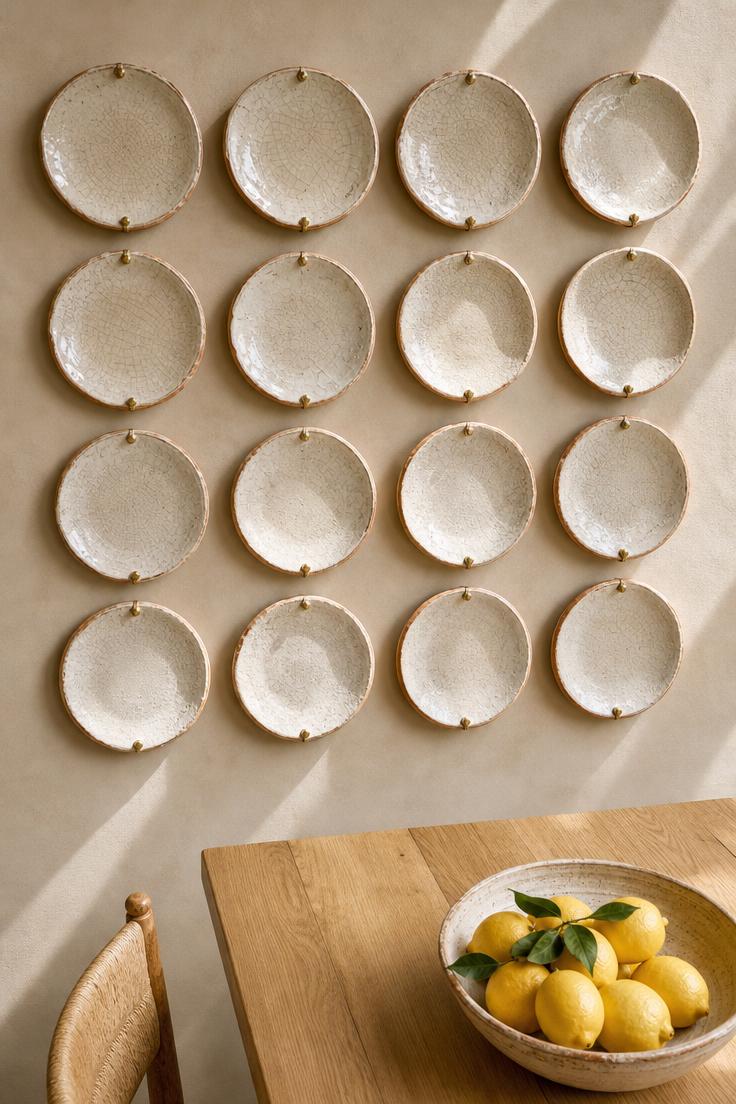
Sixteen small discs arranged in a tight grid read as one large piece from across the room, but each tile rewards a closer look with the irregularities that only handmade clay can produce.
No two discs are exactly the same diameter, and the salt glaze pools slightly differently on every surface, creating a subtle variation that a factory tile could never match.
The crackle pattern in the glaze develops during cooling and gives each disc the character of old ceramic found in a Mediterranean market.
Brass standoffs hold the tiles a quarter inch off the wall, and that small gap lets light slip behind each disc and throw a faint circular shadow that adds a quiet layer of depth.
This is a different approach to gallery wall layout, using a structured grid of identical objects instead of a collection of varied frames, and it works well in dining rooms, kitchens, and entryways where a traditional gallery wall might feel too busy.
The warm terracotta edge visible at the rim ties the arrangement to earth-toned interiors without committing the entire wall to a strong color.
Mounting sixteen tiles requires careful measuring, so mark the grid on the wall with painter’s tape and a level before drilling any holes.
A consistent two-inch gap between tiles keeps the grid legible without making the spacing feel too airy or too tight.
Style Blueprint:
- Sixteen hand-thrown terracotta discs, approximately 8 inches in diameter
- Salt white crackle glaze finish
- Brass standoff spacers, quarter inch from wall
- Warm linen, cream, or sand-toned wall
- Two-inch consistent spacing in a 4-by-4 grid
Design Pro-Tip: When mounting a grid of objects, work from the center outward rather than from the top left corner. Find the center point of your intended grid area, place the four center pieces first, and build outward. This method keeps the grid centered on the wall even if your outer measurements are slightly off, and it prevents the common mistake of a grid that drifts gradually to one side.
A Pair of Arched Venetian Plaster Panels in Warm Putty Flanking a Window
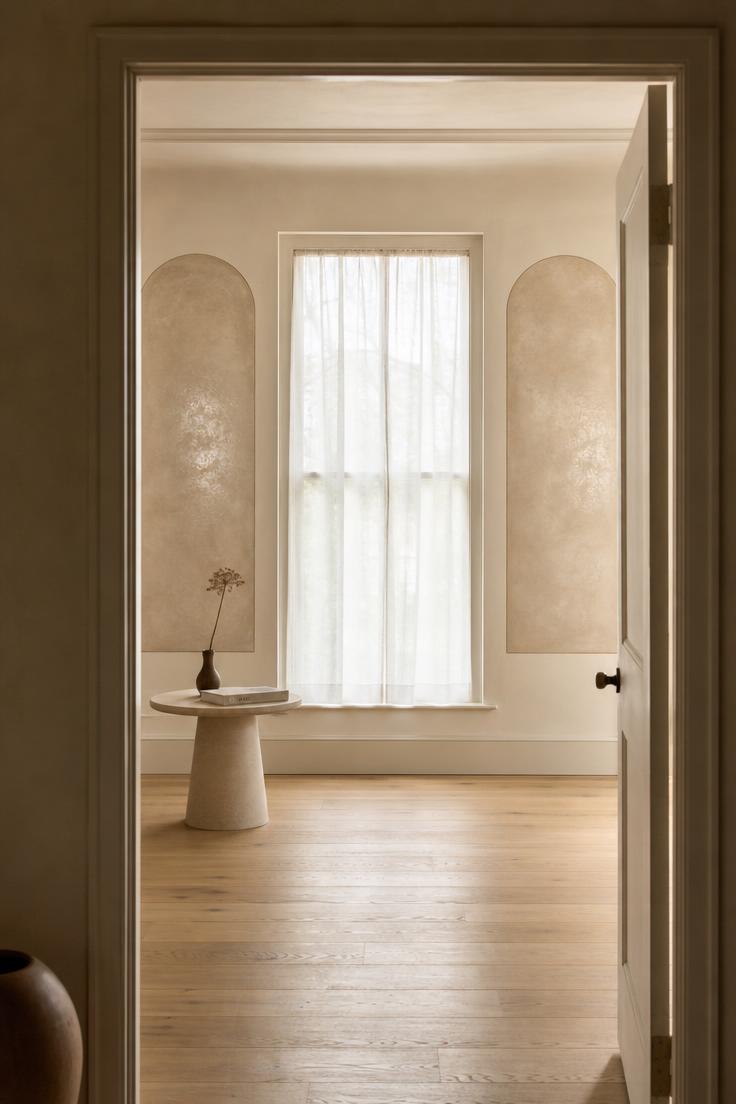
Venetian plaster has a warmth that flat paint can never reach, because the layered application creates depth within the surface itself.
Light moves across a polished plaster panel differently than it moves across a flat wall, catching on slight ridges and releasing a soft sheen that shifts as you walk past.
Placing two arched panels on either side of a window frames the light source and gives the wall architectural weight without adding shelves, sconces, or any hanging hardware.
The arch shape softens the geometry of a rectangular window and nods to Mediterranean and Romanesque architecture.
DIY plaster kits have made this look accessible for confident home improvers, though hiring a plasterer produces a more refined finish with fewer visible trowel marks.
Style Blueprint:
- Two arched plaster panels, approximately 18 by 36 inches each
- Venetian plaster in warm putty, burnished to a soft sheen
- Tall window between the panels with sheer white linen curtains
- Wide plank light oak or pale wood floor
- Minimal furniture nearby to let the panels and window breathe
A Row of Tall Vertical Driftwood Planks Joined With Blackened Iron Straps
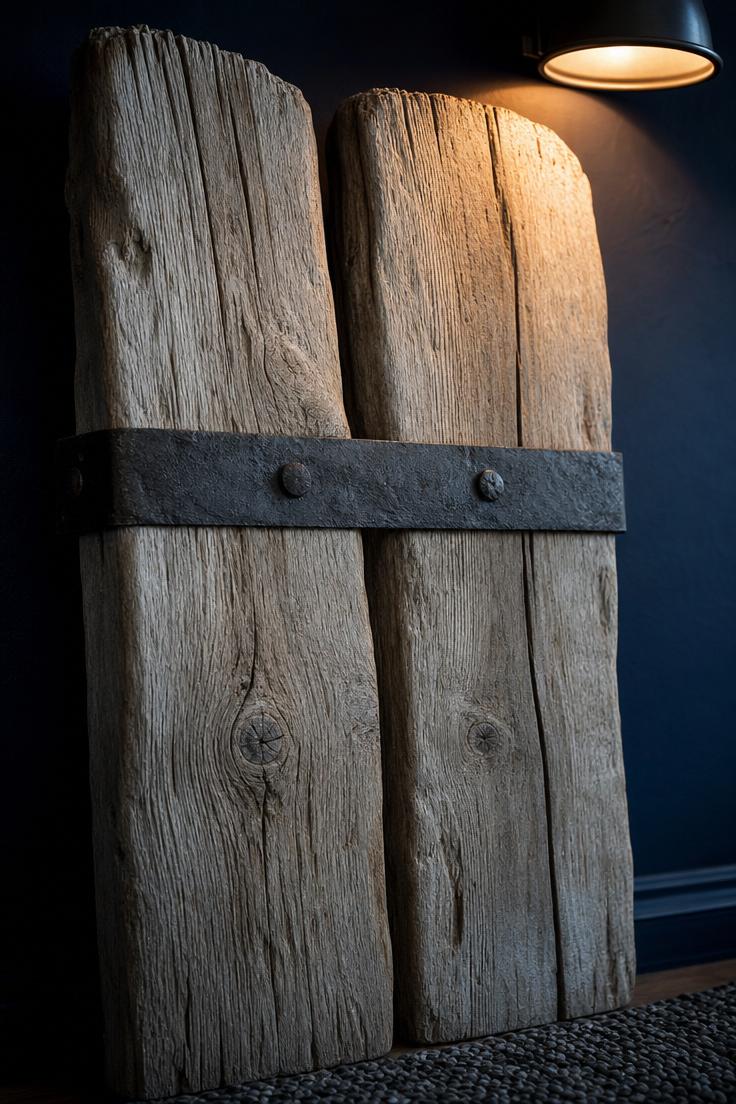
Driftwood carries a history that no lumber yard can sell you.
Salt water, sun, and sand wear away the soft grain and leave behind a surface that is hard, pale, and full of long curving lines that follow the wood’s original growth pattern.
Joining five or six planks side by side with horizontal blackened iron straps turns loose beach finds into a wide rustic panel that reads as a single sculptural object.
The iron straps add structure and contrast: their dark flat surface against the silver-gray wood creates a visual rhythm that breaks up what would otherwise be a monotone surface.
Hung on a deep navy wall, the pale wood jumps forward and the iron nearly disappears, making the driftwood feel like it is floating.
This approach delivers an accent wall design without altering the wall itself, which matters in rental spaces or historic homes where permanent changes are not an option.
Pairing a driftwood panel with mirror wall decor on an adjacent wall doubles the texture by reflecting the wood grain from a different angle and bouncing light back into the darker corners of the room.
Style Blueprint:
- Five to six tall driftwood planks, each 6 to 8 inches wide, 5 feet tall
- Two horizontal blackened iron straps with visible nail heads
- Deep navy, charcoal, or dark green wall color
- Wall sconce with a warm filament bulb for directional light
- Dark wool rug or textile at floor level
An Oversized Woven Seagrass Disc Mounted on a Deep Olive Accent Wall
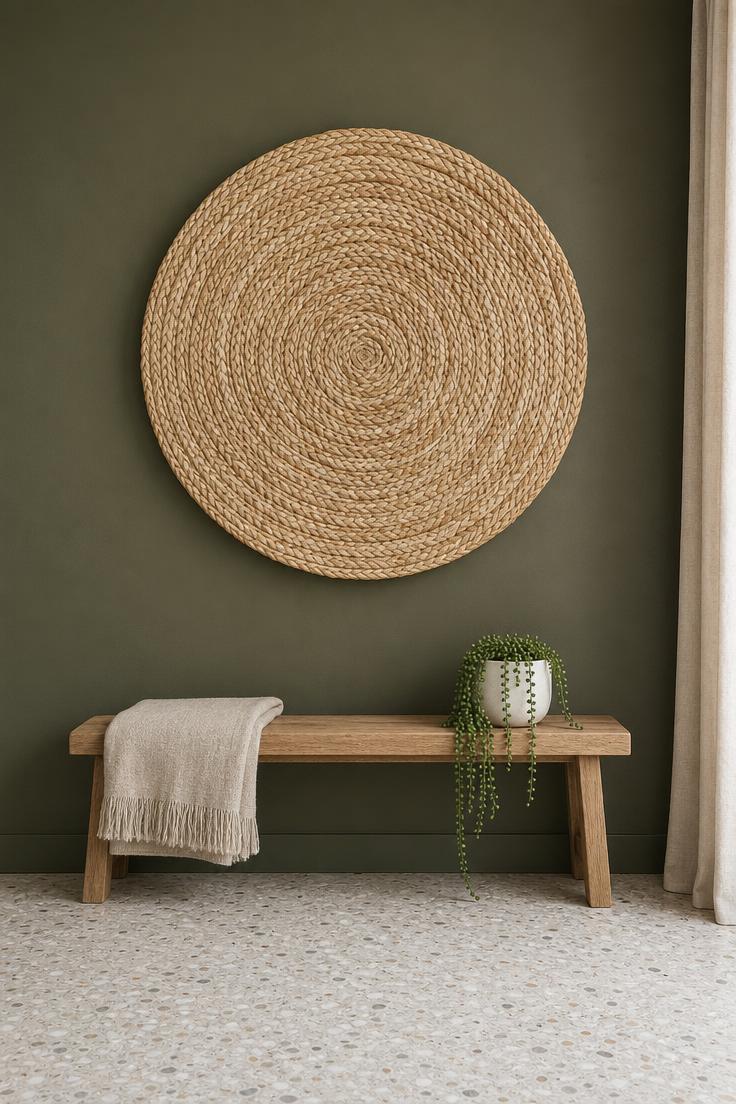
A single round form on a wall reads completely differently from a rectangle.
Where a framed print aligns with the horizontal and vertical lines of a room, a disc breaks that grid and introduces a softer geometry that pulls the eye to its center.
At forty inches across, a woven seagrass disc fills a wall the way a large framed piece would, but with a texture that invites touch rather than distance.
The tight spiral weave creates concentric rings that shift from pale straw at the outer edge to warm honey near the center, giving the piece its own built-in focal point.
Deep olive green is an underused wall color that makes natural fiber textures glow, because the warm tones of seagrass and the cool green create a complementary contrast that neither dominates.
A floating shelf display below the disc, holding a few small objects at varied heights, adds a second layer of interest without crowding the wall.
Mounting a heavy woven disc requires a sturdy anchor, so use a French cleat rated for at least twice the weight of the piece, and check that the wall stud behind it can support the load.
The beauty of this approach is its restraint: one material, one shape, one strong wall color, and nothing else needed.
Seagrass holds up well in dry indoor environments and only deepens in color over time, making it a long-term large wall decor choice that ages gracefully.
Style Blueprint:
- One oversized woven seagrass disc, 36 to 48 inches in diameter
- Deep olive, sage, or forest green wall paint in matte finish
- French cleat mounting hardware rated for heavy fiber art
- Low natural oak bench or console below the disc
- Trailing plant in a matte white or cream ceramic pot
Design Pro-Tip: When hanging a single oversized round piece, measure the wall from corner to corner and mark the dead center at 58 inches from the floor. Hang the disc so its center point aligns with your mark. A single round object that drifts even slightly off-center will look more wrong than a group of mixed pieces with intentionally uneven spacing, because our eyes expect perfect symmetry from a circle.
A Bold Hand-Painted Geometric Mural in Terracotta, Slate, and Cream
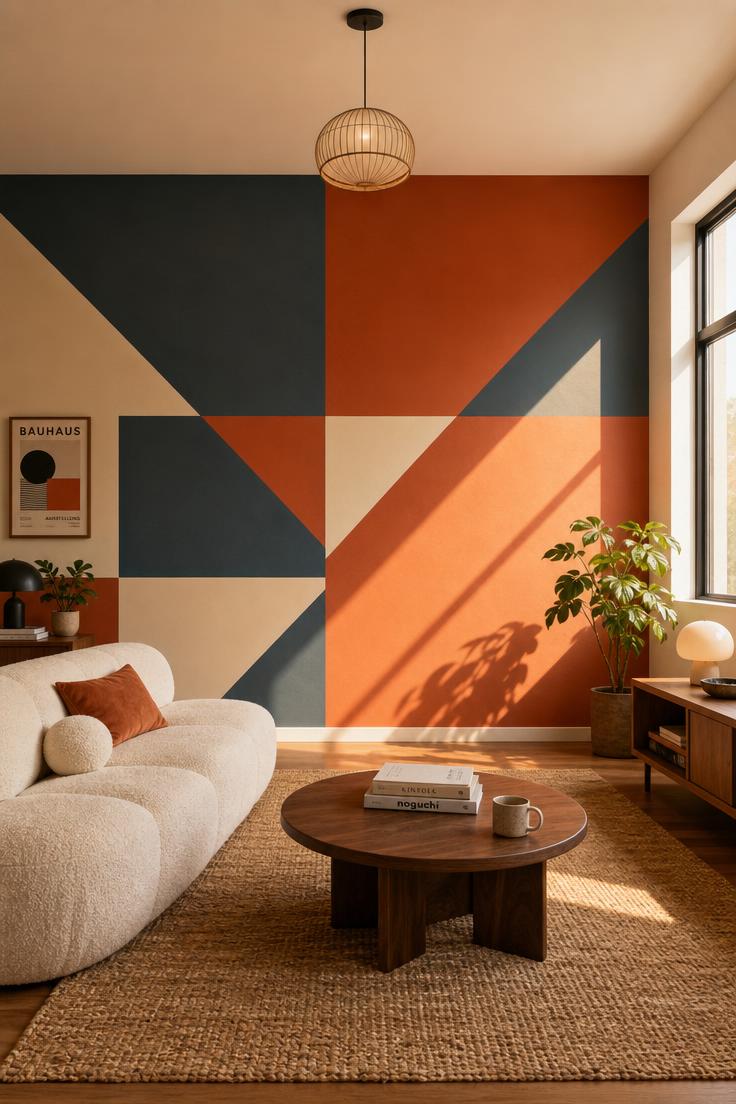
Painting directly on the wall is the most committed form of large wall decor, and it is the most rewarding because the wall itself becomes the art.
Painter’s tape and three cans of flat-finish paint are all you need for a geometric mural, which makes this one of the most affordable options on this list despite its high visual impact.
The trick is choosing colors that live well together in daylight and in lamplight: terracotta warms up at golden hour, slate cools down, and cream bridges the two so the wall never feels like it tilts too far in one direction.
Large geometric shapes, triangles spanning two feet and rectangles stretching to the ceiling, keep the mural from feeling like wallpaper or a busy pattern.
This is a blank wall solutions approach that requires no hooks, no frames, and no objects at all, which makes it ideal for rooms where you want impact without the risk of things falling or shifting.
Peel-and-stick vinyl decals offer a removable alternative if you want the geometric look without permanent paint, though the color saturation and surface finish of real paint will always look richer.
Style Blueprint:
- Three flat-finish interior paint colors: terracotta, slate blue-gray, and cream
- High-quality painter’s tape for crisp lines
- Full wall cleared of existing art and hardware
- Warm-toned furniture (walnut, oak, cream textiles) to complement the mural palette
- Jute or natural fiber rug to ground the bold wall
Conclusion
A single well-chosen piece or composition can change the way an entire room feels, and none of the ideas here require a renovation budget or a professional installer.
The common thread across all eleven approaches is specificity: a particular material, a defined color relationship, and a clear sense of how light will interact with the surface.
Start with the wall that bothers you most, the one you walk past every day wishing it had something on it.
Measure it, consider the light it gets at different hours, and match that information to one of the scenes above.
Large wall decor works best when you commit fully to one idea rather than splitting the difference between two, so pick the option that made you pause the longest and give it the whole wall.
Not sure what size artwork will fit your space? Use our wall art size calculator to choose dimensions that work with your wall, furniture, and layout.