This post may contain affiliate links. If you make a purchase through these links, we may earn a commission at no additional cost to you.
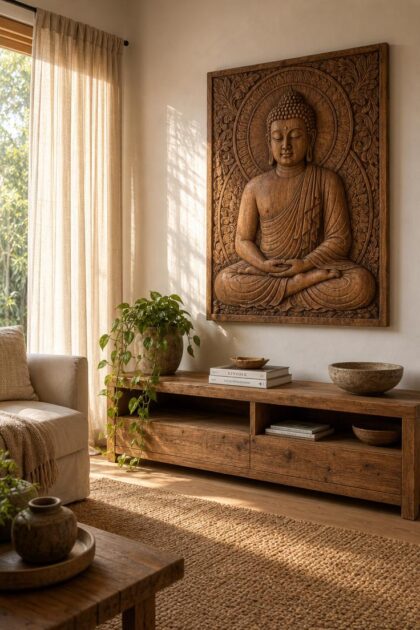
There is something about a Buddha figure on a wall that changes the way you breathe in a room.
It does not demand attention the way a bold abstract painting might, but it holds your gaze with a kind of quiet gravity.
The seven ideas in this collection range from hand-carved teak panels warmed by late afternoon light to black iron lotus grids reflected in bathwater, and each one pairs specific materials, textures, and lighting to shape a different mood.
Whether you are building a full meditation room decor scheme or just want a single piece that makes your living room feel a little more grounded, these buddha wall decor ideas offer a clear starting point.
A Hand-Carved Teak Panel With Gold Leaf Accents Above a Low Console
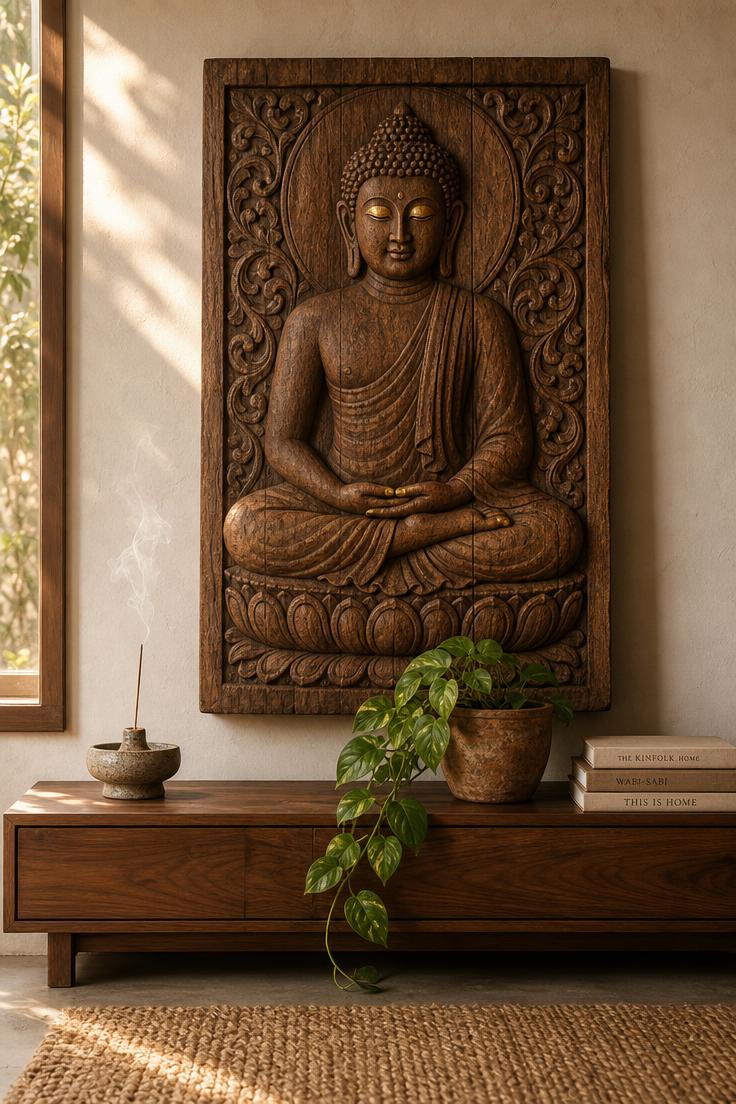
There is a reason hand-carved teak has been the material of choice in Chiang Mai workshops for centuries, and you feel it the moment this kind of piece goes up on a wall.
The slight asymmetry of a human hand shows in the curve of the Buddha’s closed eyelids, in the uneven depth of the lotus petals at the base, and in the way no two panels from the same carver look exactly alike.
Gold leaf applied sparingly, just on the fingertips and the bridge of the nose, catches light at specific angles and draws your eye without overwhelming the natural warmth of the wood.
A low console below the panel grounds the arrangement and gives you a surface for objects that support the mood: a trailing pothos, a ceramic holder with a thin thread of smoke, a few well-worn books.
Mango wood and reclaimed teak offer similar warmth at different price points, so this look scales to nearly any budget.
Positioning the carved wooden panel at seated eye level, roughly 48 to 54 inches from the floor to center, keeps the Buddha figure as a natural resting point for your gaze when you sit down across the room.
Style Blueprint:
- A hand-carved teak or mango wood Buddha panel, 30 to 36 inches wide
- A low-profile console or credenza in walnut or dark oak
- A trailing pothos or philodendron in a terracotta or stoneware pot
- A ceramic incense holder in a muted earth tone
- A natural jute or sisal area rug
A Bronze Buddha Face Mounted on Exposed Brick With LED Backlighting
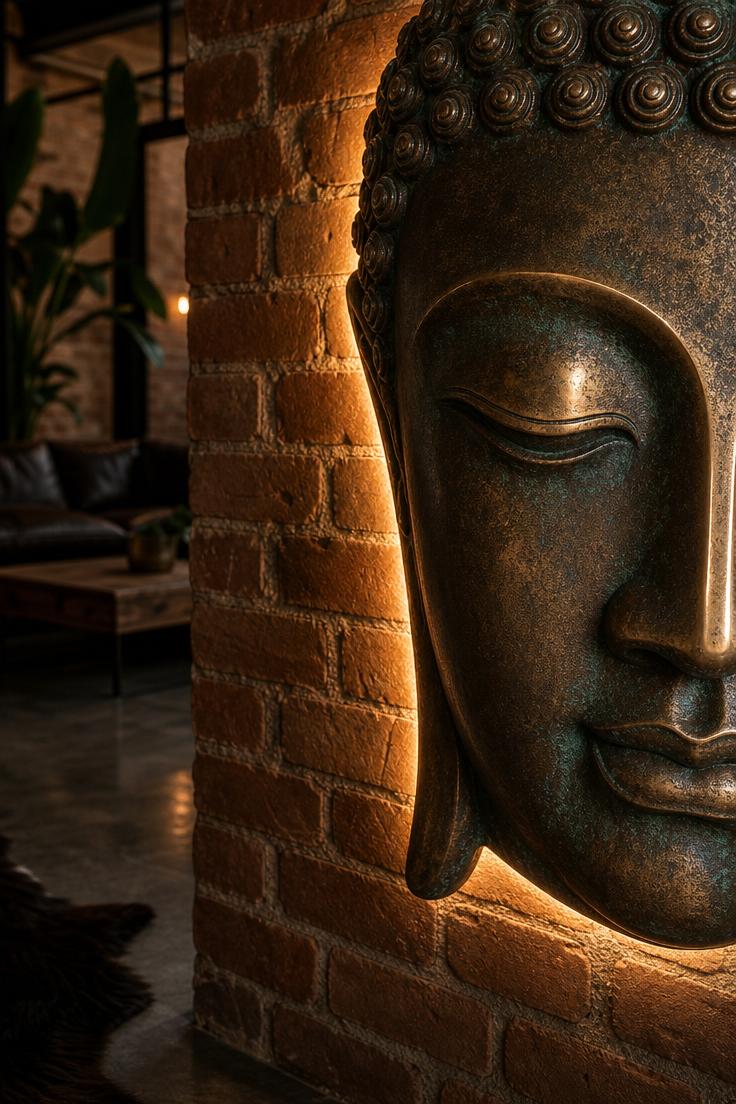
A single bronze profile on a brick wall does more work than most gallery walls combined, and it does it with almost no visual clutter.
The half-face format is what makes this piece hit differently than a full figure, because it asks you to fill in the rest mentally, and that small act of imagination keeps your attention locked.
Bronze buddha sculpture pieces like this one develop character over years as the patina deepens, turning bright metal into a surface that reads like a map of humidity, air quality, and time.
The warm-white LED strip behind the casting is the real trick here, turning a flat wall-mounted object into something with a glow and a shadow that changes depending on where you stand in the room.
Red brick, smooth bronze, and the faint shimmer of light create a three-way material conversation that lands somewhere between industrial loft and temple anteroom.
A dimmer switch on the LED strip lets you shift the room from bright and social to low and contemplative in two seconds, which makes this setup surprisingly functional for everyday living.
Below the piece, keep the floor simple: polished concrete or dark hardwood, a sheepskin or a thick wool rug, and nothing else within a few feet of the wall.
The negative space around a single bold piece is what gives it room to breathe, and crowding the area with shelves or side tables dilutes the impact immediately.
Style Blueprint:
- A half-face bronze Buddha casting, 20 to 24 inches tall
- A warm-white LED strip light with adhesive backing and a dimmer switch
- An exposed brick, concrete, or dark plaster wall
- A sheepskin or thick wool rug in a neutral tone
- Polished concrete or dark-stained hardwood flooring
A Five-Panel Canvas Print of a Reclining Buddha in Muted Grey Tones
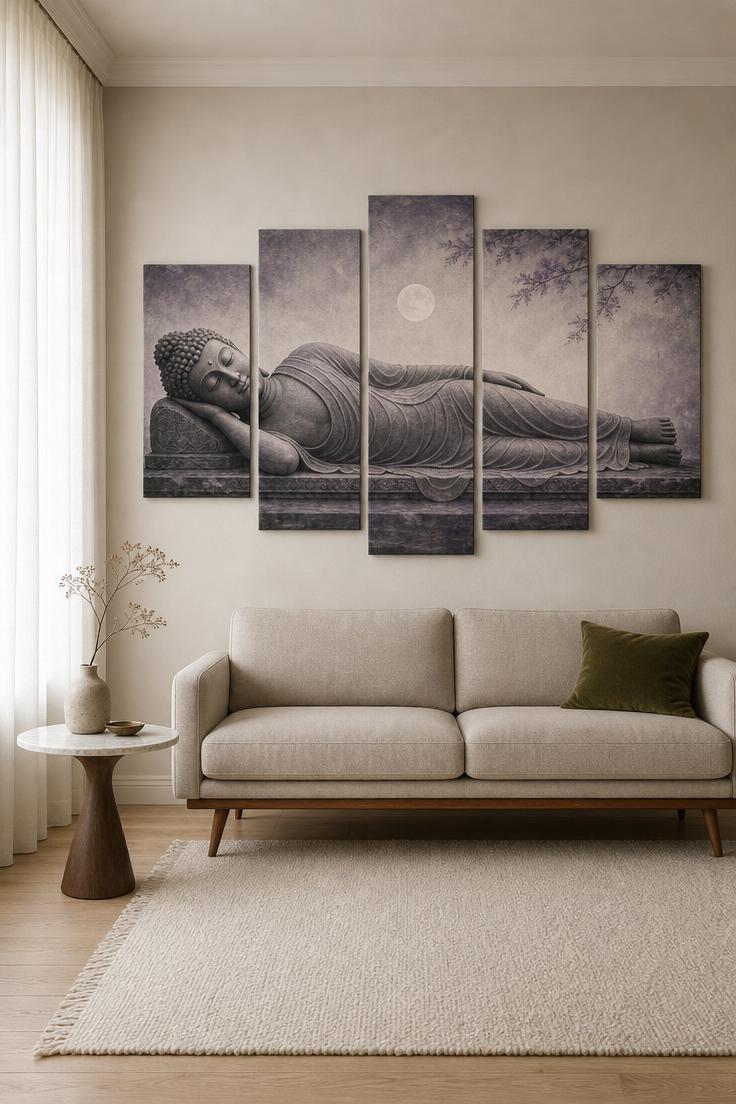
The reclining Buddha communicates something entirely different from a seated meditation pose, and that distinction matters when you are choosing buddha wall art for a room where you actually want to rest.
The parinirvana posture is about release rather than concentration, about letting go rather than gathering inward, and that energy carries into the space around it.
A five-panel spread across 60 inches gives the image a cinematic quality that a single framed print cannot match, and the staggered panel heights add a rhythm your eye follows from left to right like reading a sentence.
Muted greys and off-whites with a hint of lavender keep the piece from overpowering a light-toned room, letting it function as a backdrop rather than a spotlight.
The spacing between panels matters more than most people realize: 1.5 to 2 inches creates a sense of continuity, while anything wider than 3 inches breaks the image into disconnected fragments.
A buddha canvas print in this format is one of the most accessible entry points for anyone new to this type of wall art, with options available from under $40 to several hundred depending on print quality and canvas depth.
Pair it with furniture in soft, rounded shapes and muted natural fabrics so the room reads as a single coherent thought rather than a collection of competing statements.
Style Blueprint:
- A five-panel canvas print of a reclining Buddha, total span 55 to 65 inches
- A mid-century modern sofa in oatmeal, sand, or light grey linen
- Sheer white or off-white linen curtains for diffused light
- A round side table in marble, light oak, or brass
- A cream or ivory wool area rug
A Balinese Stone Carving Set Into a Garden Wall With Trailing Ferns
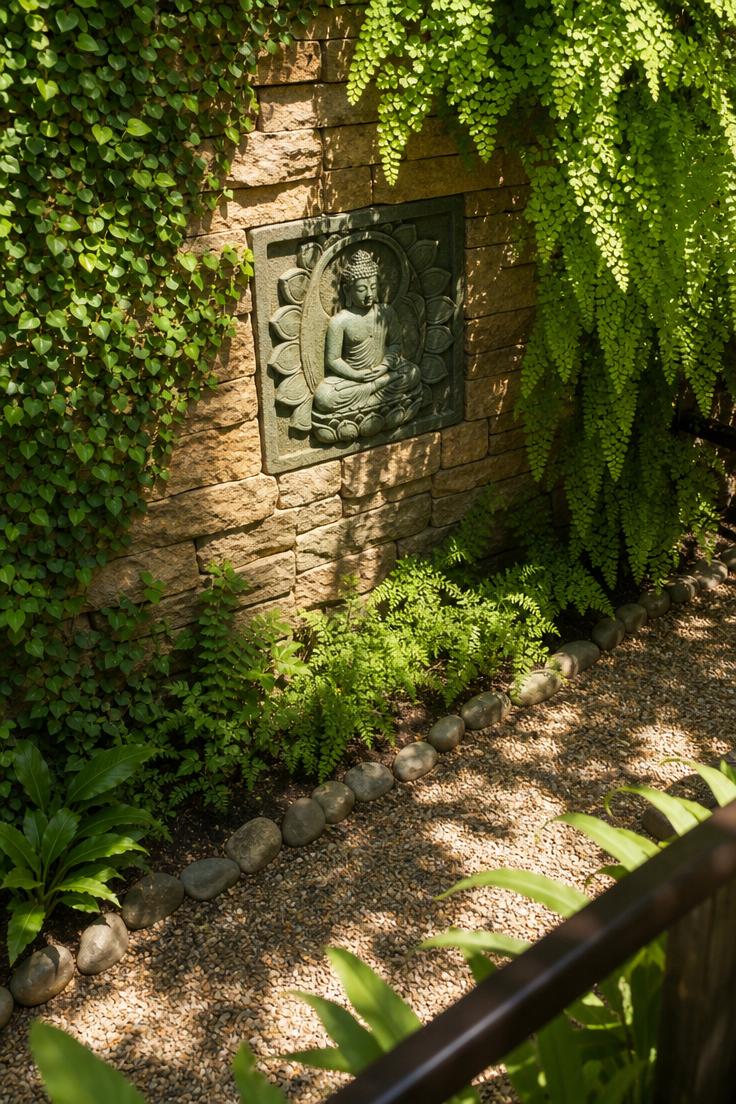
Zen wall decor does not have to stop at the front door, and a stone carving recessed into a garden wall proves that point better than any indoor arrangement could.
The Balinese tradition of integrating spiritual figures into garden architecture goes back centuries, and the approach works because stone and greenery already speak the same visual language.
Volcanic rock and greenstone handle rain, frost, and direct sun without losing their definition, and over time they pick up a layer of moss and lichen that makes the carving look like it grew out of the wall rather than being placed there.
Maidenhair ferns and creeping fig are the natural partners here, softening the stone edges and creating a living frame that changes with the seasons.
This is the kind of buddha wall decor that rewards patience, because it gets better every year rather than fading.
Style Blueprint:
- A volcanic stone or greenstone Buddha carving, 16 to 20 inches
- A stacked stone or rendered garden wall with a recessed niche
- Maidenhair ferns, creeping fig, or Boston ferns for framing
- River stones or light gravel at the base
- A narrow gravel or stepping-stone path alongside the wall
Design Pro-Tip: When mounting any buddha wall art outdoors, face the piece north or east to keep direct afternoon sun from bleaching the surface. Morning light or dappled shade through a tree canopy will always look more natural than harsh midday glare, and the softer light extends the life of painted or leaf-finished surfaces.
A Hammered Brass Mandala With a Central Buddha Silhouette on White Plaster
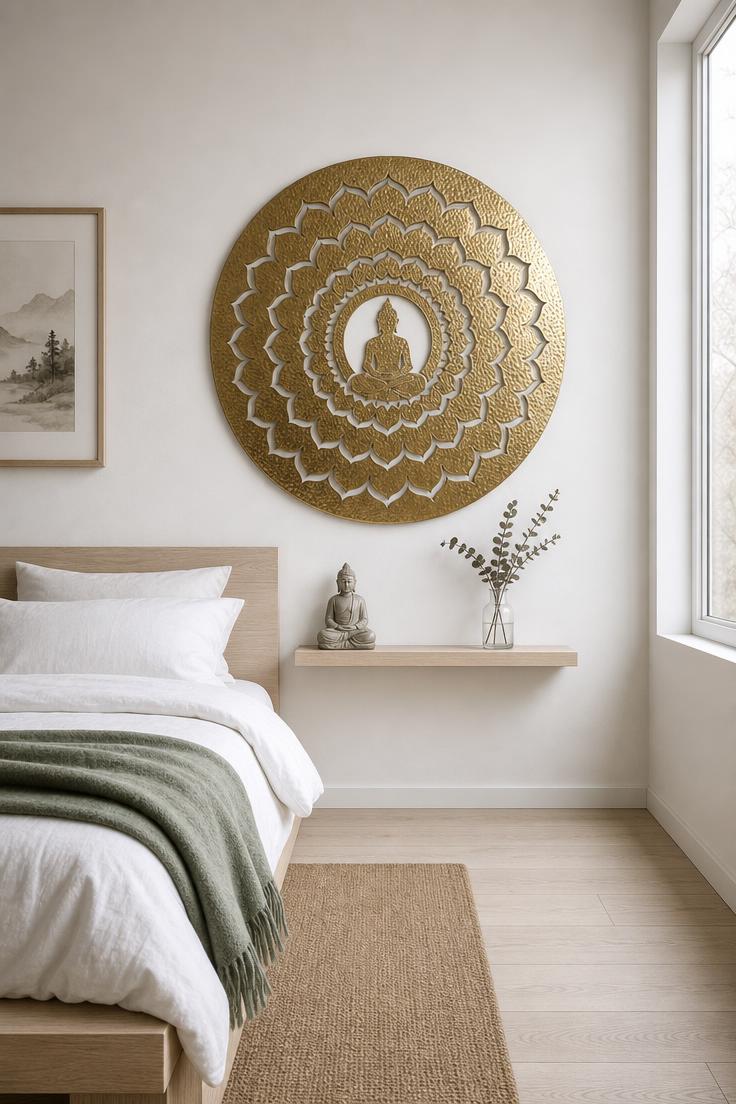
A mandala wall hanging in hammered brass brings a warmth that most Scandinavian-inspired bedrooms lack, and the tension between the golden metal and the cool white plaster is exactly what makes the pairing work.
The concentric rings of lotus petals give your eye a path to follow inward, from the outer edge to the central Buddha silhouette, mimicking the way a mandala functions in meditation practice.
What makes the cut-out silhouette clever rather than merely decorative is the faint shadow it casts on the wall behind it, adding a second, softer version of the figure that shifts with the angle of daylight through the day.
Hammered brass, as opposed to smooth or brushed metal, breaks light into dozens of tiny reflections across its surface, and in cool overcast light those reflections are gentle rather than glaring.
A floating shelf just below the mandala with a small ceramic figure and a sprig of dried eucalyptus creates a miniature altar without any of the formality that word usually implies.
The circular shape of the disc is a welcome contrast in a room full of rectangles, bed frame, nightstand, window frame, and it softens the overall geometry of the space.
This is meditation room decor that works equally well in a bedroom, a hallway niche, or the wall above a writing desk where you want a single point of visual stillness.
Keep the surrounding wall completely bare for at least 12 inches in every direction so the mandala reads as a deliberate focal point rather than part of a crowded arrangement.
Style Blueprint:
- A hammered brass mandala disc, 28 to 32 inches in diameter, with a Buddha cutout
- A smooth white plaster or matte-finish painted wall
- A low platform bed in pale ash, birch, or whitewashed oak
- White linen bedding with a single accent throw in sage, slate, or dusty rose
- A slim floating shelf with a ceramic statue and dried eucalyptus
A Woven Rattan Buddha Medallion Paired With Dried Pampas and Linen
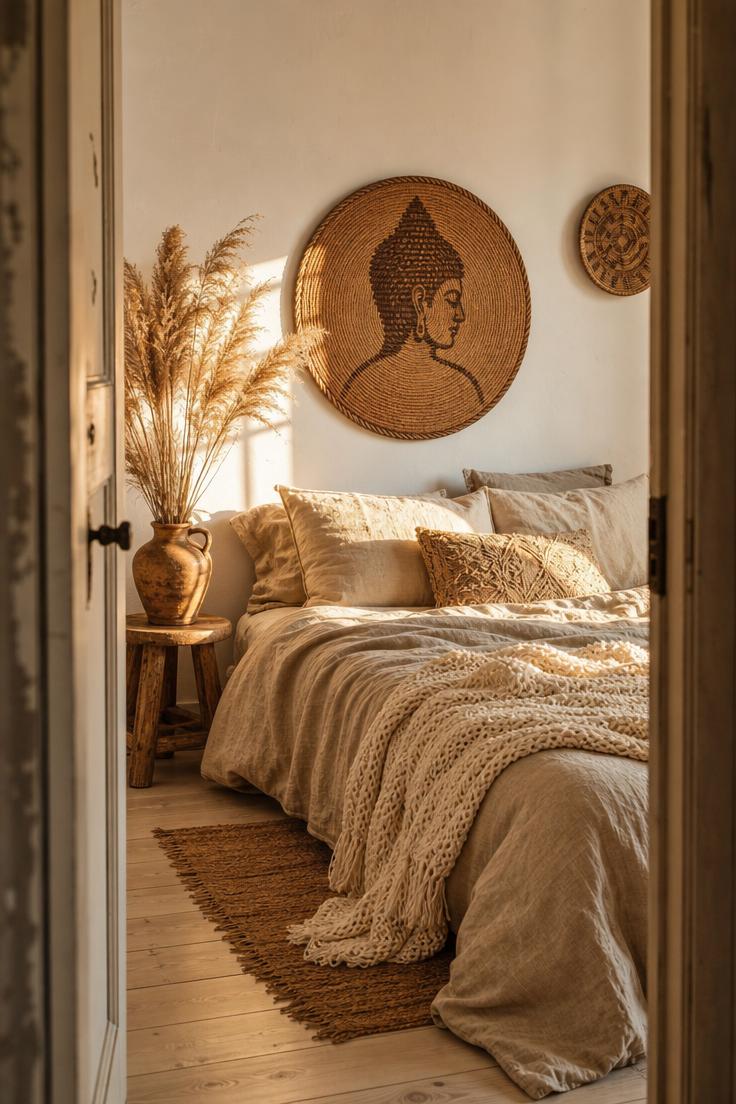
This is bohemian wall decor at its most relaxed looking, which of course means someone thought carefully about every object in the frame.
The rattan medallion reads as a natural extension of the room’s material palette rather than a statement piece dropped in from a different style, and that sense of belonging is what makes it work.
Darker palm fibers woven into the center to form the Buddha profile give the piece just enough contrast to register from across the room without screaming for attention.
Dried pampas in a clay jug and a chunky knit throw bring in the layered, collected quality that defines this style, where everything looks like it arrived over months of travel rather than a single afternoon of shopping.
Late golden light does the heavy lifting here, warming the rattan to amber and casting long shadows that make the flat weave look three-dimensional.
Rattan is lightweight and mounts with a single nail or adhesive hook, making it one of the most renter-friendly options for buddha wall art in any room of the house.
Style Blueprint:
- A circular woven rattan medallion with a Buddha profile, 26 to 30 inches
- Oatmeal or natural linen bedding with a chunky knit throw
- A tall arrangement of dried pampas grass in a handmade clay or ceramic jug
- A low wooden stool or bench as a bedside surface
- Whitewashed or warm white walls
A Black Iron Lotus Grid With a Seated Buddha Centered Over a Bathtub
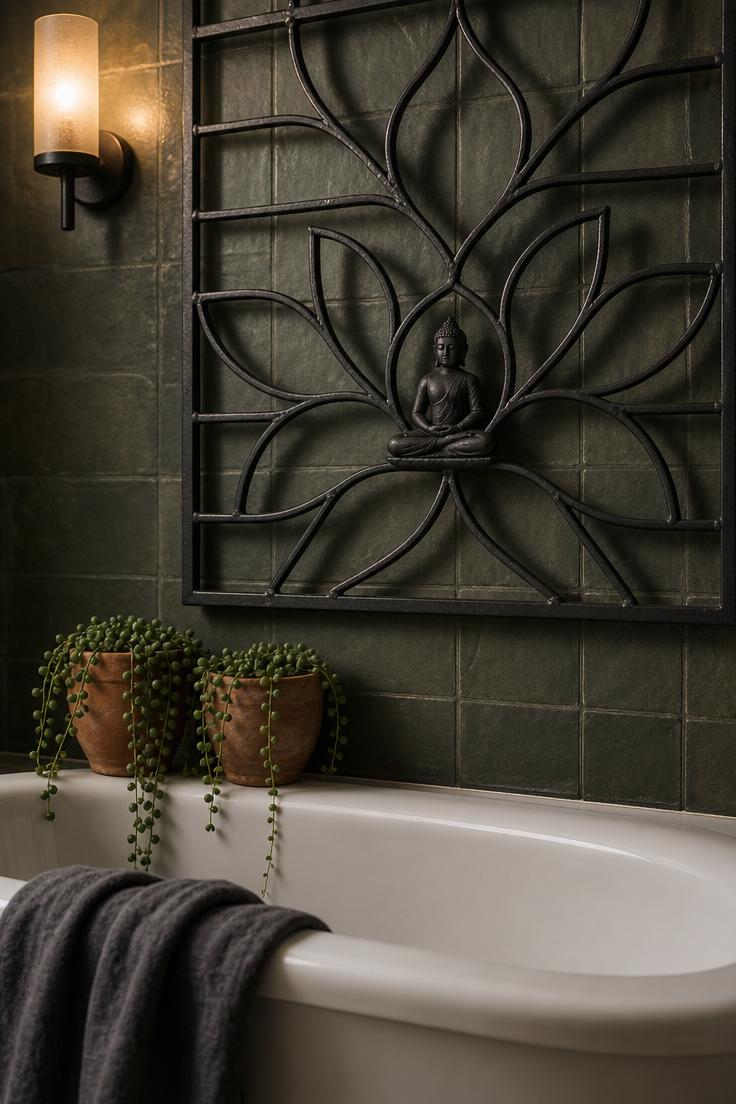
Placing buddha wall decor in a bathroom invites a conversation about cultural respect, and it is worth having that conversation before you mount anything above a tub.
In many Buddhist traditions, positioning a Buddha figure in a bathroom is considered disrespectful, so the choice comes down to personal intention and awareness rather than a blanket rule.
If you do go this route, a black iron lotus grid offers a way to reference the imagery through abstraction rather than a literal depiction, with the seated figure reduced to a minimal silhouette within a geometric framework.
The matte powder-coated finish stands up to bathroom humidity without rusting, and the dark iron against sage green tile creates a color combination that feels both grounding and slightly unexpected.
Lotus wall art in iron has a graphic quality that reads more like architectural hardware than devotional art, which softens the spiritual connotation and lets the piece function as a design element first.
Thai buddha art styles translate particularly well into this format because the elongated features, the flame-shaped ushnisha, and the narrow shoulders become clean geometric lines when reduced to a welded silhouette.
Low ambient light from a single frosted sconce throws the grid’s shadow onto the surrounding tile, multiplying the lotus pattern across the wall in a way that changes every time you shift the light angle.
Style Blueprint:
- A black powder-coated iron lotus grid with a seated Buddha silhouette, 20 to 26 inches
- Dark sage green, deep teal, or charcoal matte tile for the wall
- A freestanding white porcelain or matte stone bathtub
- Trailing plants like string-of-pearls or pothos in small terracotta pots on the tub ledge
- A frosted glass wall sconce for low, diffused ambient light
Design Pro-Tip: When hanging metal buddha wall art in a bathroom, apply a thin coat of clear matte sealant to every joint and edge before mounting. Bathroom humidity accelerates corrosion at welded seams and mounting points first, and a five-minute sealant application can add years to the piece. Check the sealant once a year and reapply if it looks chalky or peeled.
Conclusion
These seven ideas share one thing in common: each one asks you to pair a single buddha wall decor piece with specific materials, light, and negative space rather than filling a wall with competing objects.
A carved teak panel above a low console, a bronze face glowing on brick, a rattan medallion warmed by late sun, they all work because the surrounding room supports the piece instead of fighting it.
Start with the mood you want, pick the material and scale that fits your space, and let the rest of the room stay quiet.