This post may contain affiliate links. If you make a purchase through these links, we may earn a commission at no additional cost to you.
Most homes are sitting on hundreds of square feet that nobody uses.
That unfinished basement with the exposed pipes and the pile of holiday bins?
It could be the coziest room in your house.
A basement family room gives you something rare: a below grade living room that stays cool in July, stays quiet when the rest of the house is chaos, and costs a fraction of what a new addition would run you.
The 15 ideas below are built around real design choices, from basement flooring ideas to basement ceiling options, each one shown through the kind of image you’d tear out of a magazine and tape to your fridge.
Let’s get into it.
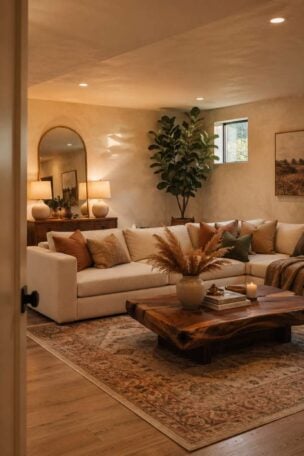
The Warm Neutral Retreat
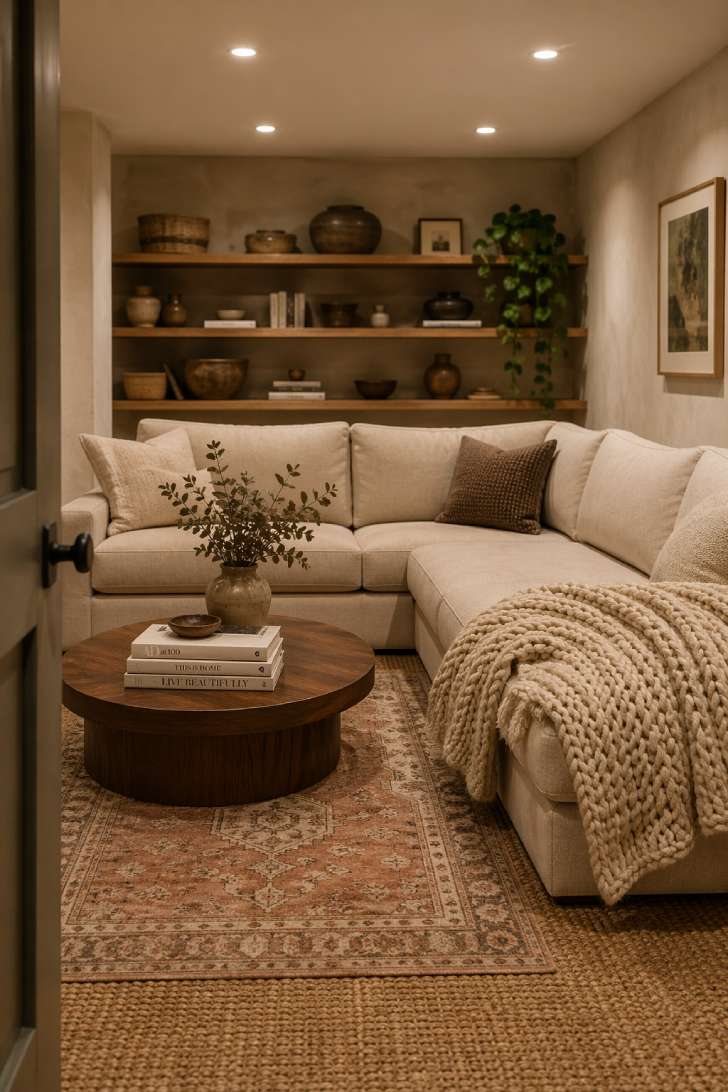
There’s a reason warm neutrals keep showing up in finished basement ideas, and it has nothing to do with playing it safe.
Below grade, concrete walls and limited natural light can give the room a cooler visual character.
Cool-toned paint colors such as pale grays and icy whites can reinforce that effect, especially when paired with hard surfaces and artificial lighting.
Warm earth tones create a softer contrast.
Clay, taupe, warm sand, and creamy off-whites introduce warmer color into the room and help balance the cooler appearance of concrete and low-light conditions.
Texture adds another layer to the composition.
A linen sofa diffuses light across a matte, woven surface instead of creating a slick reflection.
A jute rug introduces visible texture and a natural material contrast against smooth flooring and finished walls.
These elements are not just decorative afterthoughts.
Together, warm color, matte textiles, and varied surface textures can make a basement look softer, more layered, and more visually connected to the rest of the home.
Style Blueprint:
- Linen or slipcover sectional in oatmeal, cream, or soft tan
- Layered rugs: jute base with a vintage runner on top
- Limewash or matte-finish paint in a warm clay or taupe
- Open wood shelving with a mix of books, pottery, and one trailing plant
- Chunky knit or waffle-weave throw in a natural, undyed fiber
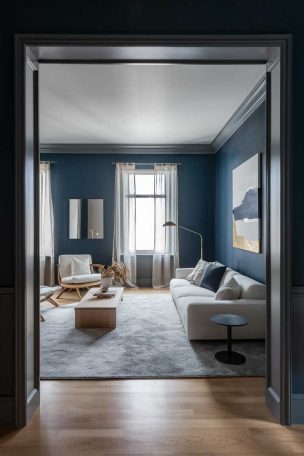
The Moody Dark-Walled Lounge
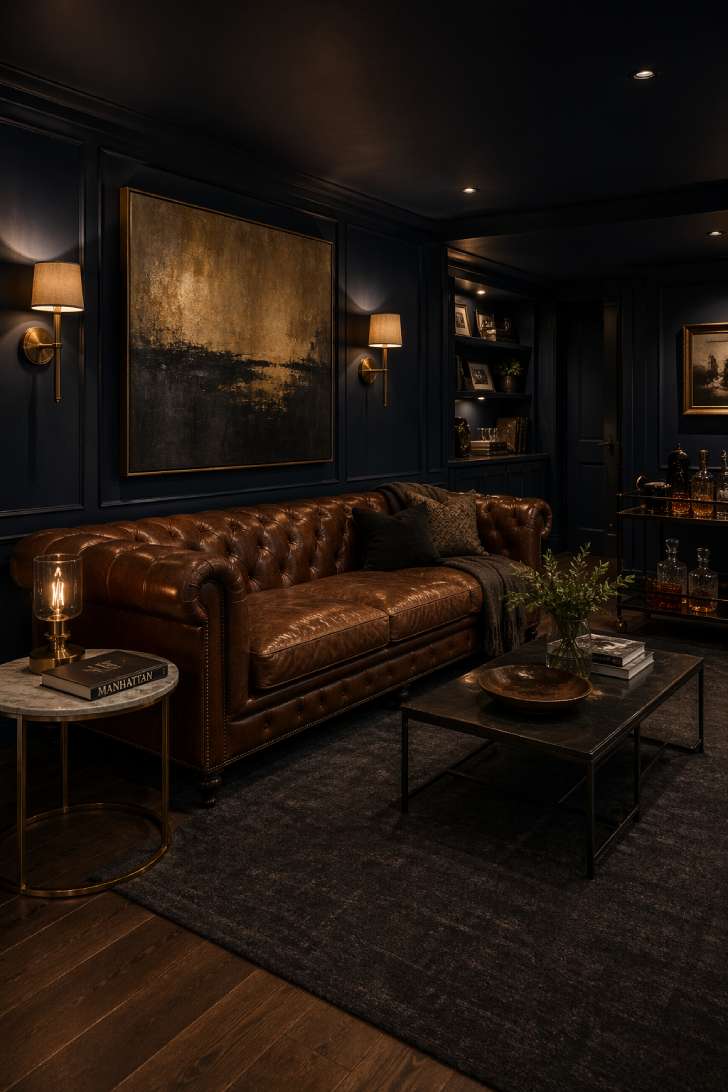
Going dark in a basement sounds counterintuitive. It isn’t.
When a room has no natural light to begin with, painting it pale just highlights the absence.
You notice there are no windows.
You notice the light is all artificial.
The room feels like it’s trying to be something it isn’t.
Dark walls do the opposite.
They lean into the enclosed nature of the space and turn it into a feature.
Navy, deep charcoal, forest green: these colors wrap around you. The room stops competing with daylight it doesn’t have and starts feeling intentional.
The trick is in the basement lighting design.
You need warm, directional sources placed at different heights.
Sconces at eye level while seated, a table lamp for close-up warmth, and recessed cans on dimmers for general fill.
Three layers of light, minimum. Without them, dark walls just feel like a cave.
With them, the room glows.
Brass and warm metals are doing something specific here, too. Against a dark backdrop, metallic surfaces catch and scatter light in small, organic reflections.
Your eye moves around the room instead of stopping at the dark wall and going flat.
That movement is what makes a dark room feel alive rather than heavy.
Style Blueprint:
- Matte paint in navy, deep charcoal, or forest green (walls and ceiling, same color)
- Leather seating with visible patina or texture
- Three layers of warm lighting: sconces, table lamp, dimmable recessed cans
- Brass or aged gold accents on hardware, frames, and fixtures
- One oversized piece of art with warm metallic or muted tones
The Open-Concept Media Room
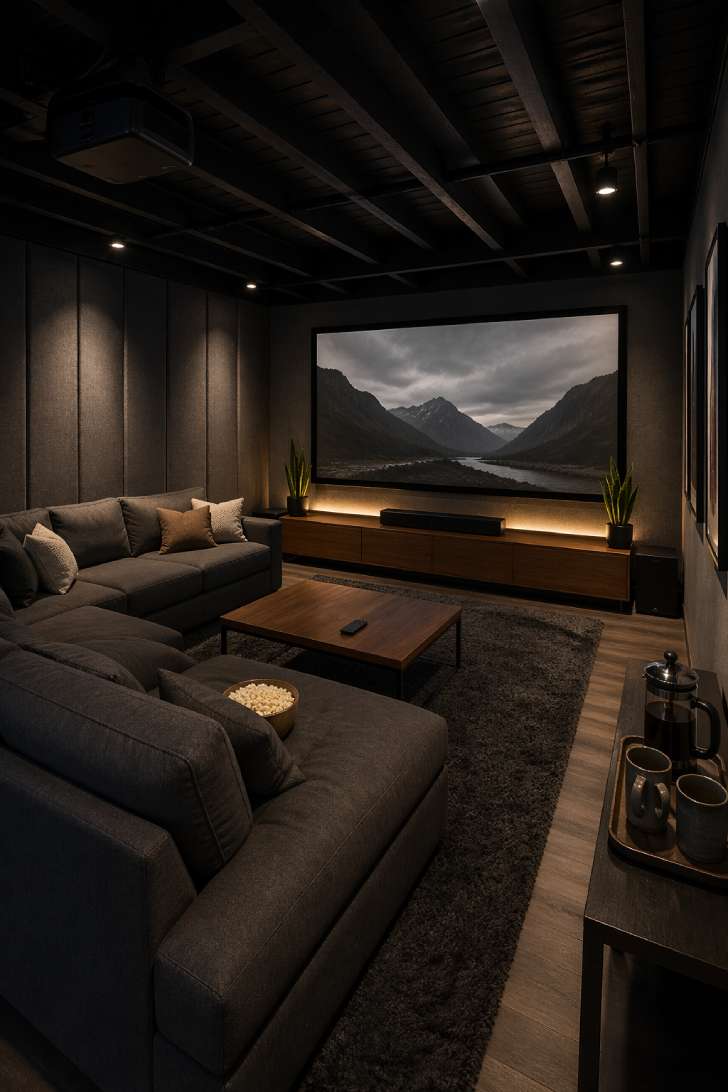
Basements were made for watching movies. That’s not an exaggeration.
The naturally dark environment means zero glare on screens, which is a problem every above-grade media room has to solve with blackout curtains and careful window placement.
Down here, you skip all of that. Hang the screen, mount the projector, dim the lights. Done.
A projector and screen setup works better than a TV in most basement media rooms because the image scales up without the bulk.
A 120-inch projected image in a dim basement looks cinematic. A 120-inch TV looks like a showroom display.
The acoustic panels on the walls aren’t just for looks.
Basement rooms with drywall, concrete, and hard flooring bounce sound around in ways that muddy dialogue and make action sequences feel like noise.
Felt-covered panels or even thick woven wall hangings absorb those reflections.
Your ears can actually pick out what people are saying on screen. It’s one of those upgrades that feels minor until you experience it.
Keeping the layout open (one big sectional, no extra furniture cluttering sightlines) lets the room flex between movie night and regular family hangout.
Push the blankets aside, turn the lights up, and it’s just a comfortable basement living space again.
Style Blueprint:
- Ceiling-mounted projector with a flush or recessed screen (100-inch minimum)
- Deep sectional in a dark performance fabric
- Acoustic panels or heavy textile wall treatment on at least two walls
- LED strip backlighting behind the media console in warm amber
- Low, long media console in walnut or dark wood
The Rustic Farmhouse Basement
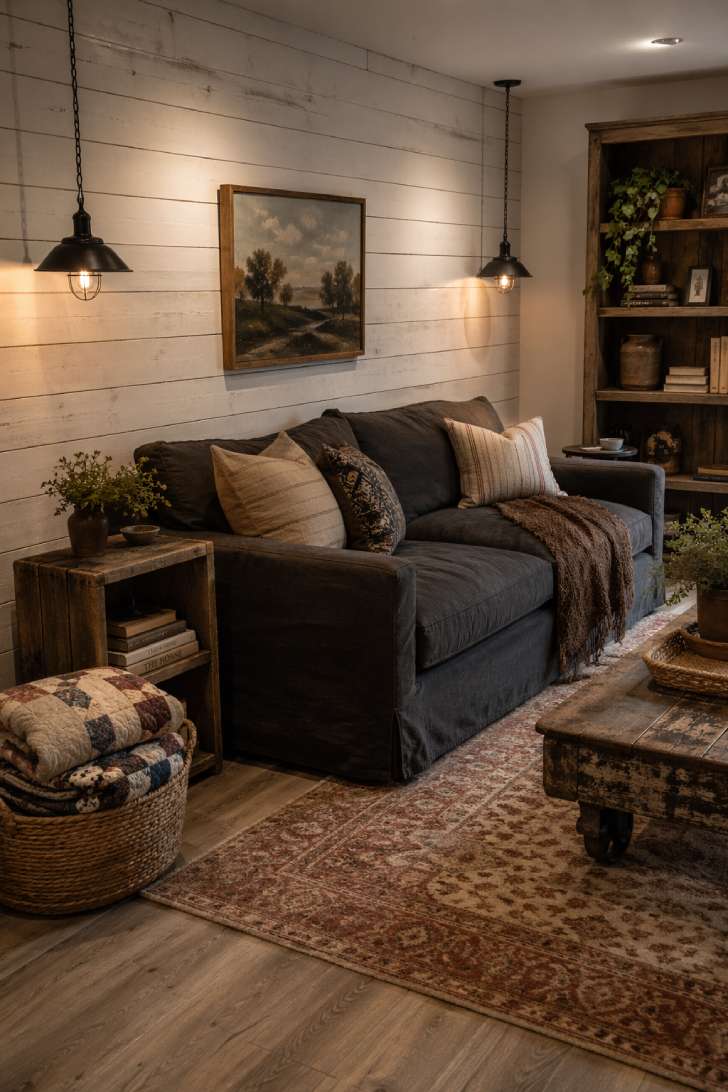
Farmhouse style translates well to basements for a simple reason: it was never about perfection.
Shiplap and reclaimed wood hide minor wall imperfections that would show through flat drywall.
That’s a practical win in a basement where foundation walls are rarely ruler-straight.
A weathered white finish on the wood catches light differently across each plank, creating visual movement without any color at all.
The flooring choice matters here. Real hardwood in a basement is a gamble because of moisture.
Luxury vinyl plank in a weathered oak finish gets you the same visual warmth with none of the risk.
It’s waterproof, it handles temperature swings, and from across the room, most people can’t tell the difference.
That makes it one of the smartest basement flooring ideas for this aesthetic.
Mixing old and new keeps the look from tipping into theme-park territory. A reclaimed wood bookcase next to a modern iron pendant light.
A vintage wool rug under a contemporary linen sofa.
The tension between those elements is what makes a room feel collected over time rather than ordered from a catalog.
Style Blueprint:
- Shiplap or reclaimed wood accent wall in weathered white or natural finish
- Luxury vinyl plank flooring in a weathered or whitewashed oak
- Iron or matte black pendant lights with exposed filament bulbs
- One large woven basket for throw storage
- Mix of vintage (crate, old books, stoneware) and modern (clean-lined sofa, metal side table) pieces
Design Pro-Tip: When picking luxury vinyl plank for a basement, go with a rigid-core (SPC) product rather than a flexible (WPC) one. Rigid core handles the minor unevenness of concrete slabs without telegraphing imperfections through the surface, and it won’t expand or buckle from basement humidity swings. Look for planks with an attached cork or foam underlayment to add warmth underfoot.
The Kid-Friendly Play and Hangout Zone
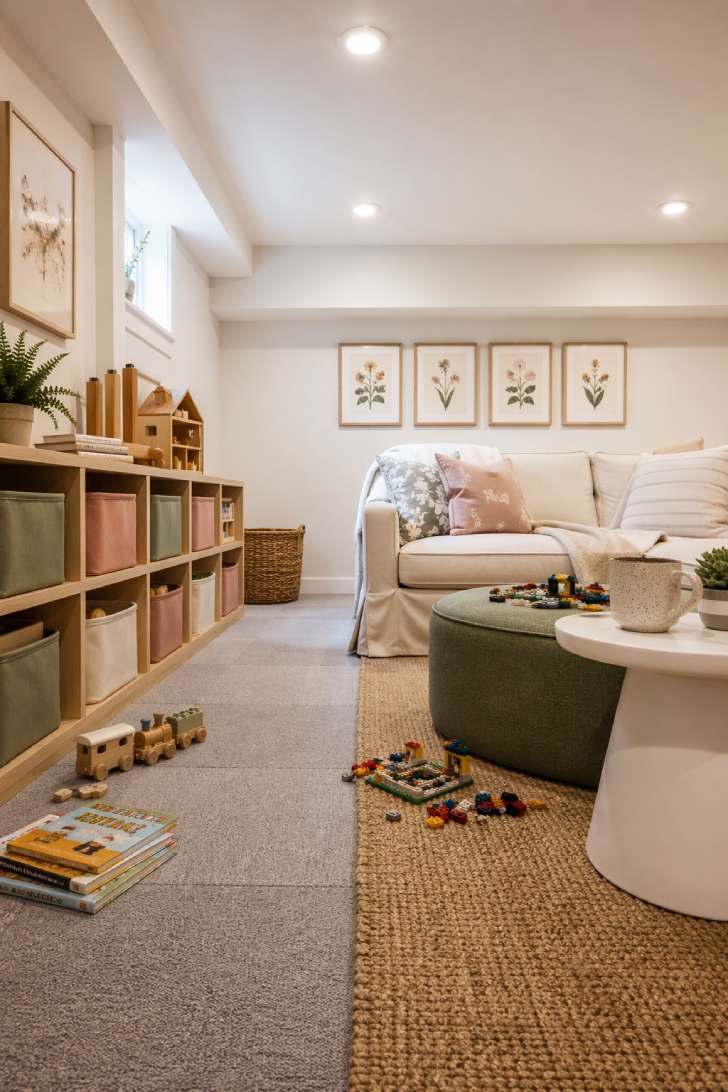
A room designed for kids doesn’t have to look like a daycare.
The cubbies-and-bins system is doing double duty here.
Low, open shelving lets even small children put things away themselves, which keeps the room from becoming a disaster zone by 10 a.m.
But because the bins are in muted, coordinated colors instead of primary-bright plastic, the storage blends into the room’s palette when everything is put away.
Carpet tiles are the real hero of this small basement layout. If a juice box erupts on one tile, you pull that tile up, clean it or toss it, and snap in a replacement.
Try doing that with wall-to-wall carpet.
The modular format also lets you create a visible boundary between the play zone and the adult seating area without building a wall.
The slipcovered sofa is non-negotiable if kids are part of the equation.
Spills happen. Markers happen.
A removable, machine-washable slipcover means you stop panicking about the couch and start actually sitting on it.
Pair it with an ottoman instead of a coffee table and you’ve removed a hard-edged piece of furniture from the center of the play area.
Keeping the wall color light and the overhead lighting bright and even helps the basement feel more open and visually balanced despite the lack of windows.
The brighter surfaces reflect more of the available light across the room, while even overhead illumination reduces dark corners and strong contrast between activity zones.
Together, those choices give the play area a clearer, lighter visual composition and help it feel distinct from a darker, more relaxed seating zone.
Style Blueprint:
- Low, open-front cubbies in birch or maple with fabric storage bins in muted tones
- Carpet tiles in a neutral color (removable and replaceable)
- Washable slipcovered sofa in canvas or heavy cotton
- Round upholstered ottoman instead of a hard-edged coffee table
- Bright, even overhead lighting with flush-mount LED fixtures
The Basement Bar and Gathering Spot
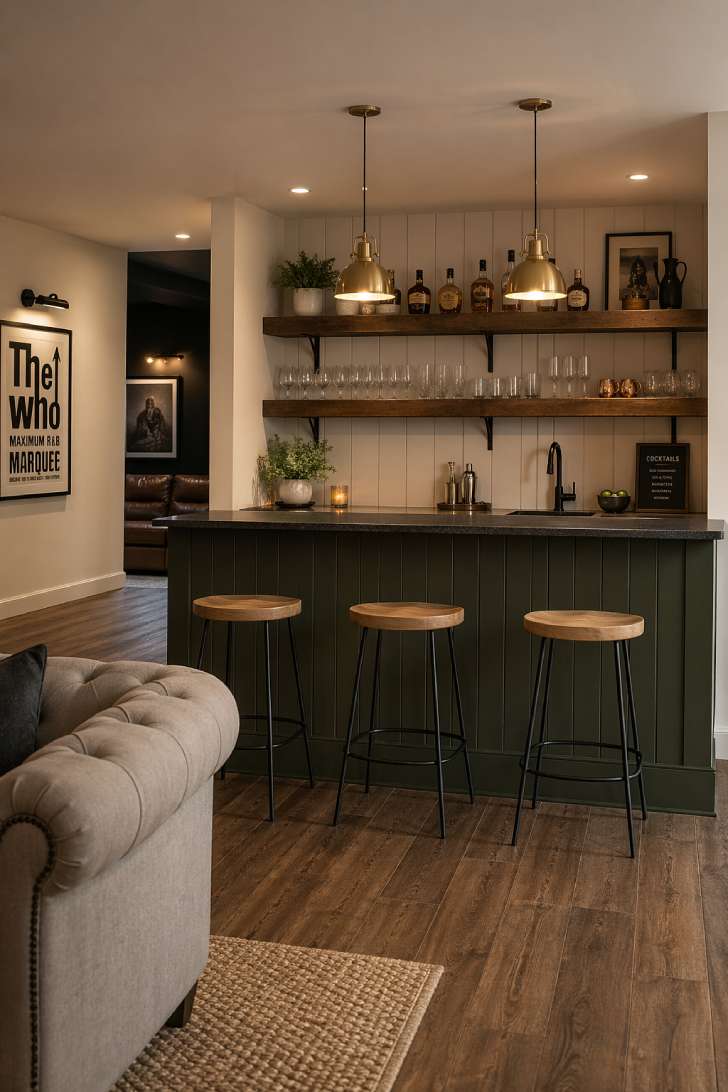
A bar doesn’t need its own room.
One wall is enough.
A five- to eight-foot run of counter with a small sink, an undercounter fridge, and some open shelving above gives you a fully functional bar that takes up maybe 30 square feet.
The rest of the basement stays open for the family room.
Pendant lights above the bar create a visual anchor that separates it from the rest of the space without any physical barrier.
When those lights are on and the room’s recessed cans are dimmed, the bar naturally draws people toward it.
That’s a trick restaurants use constantly: directional light tells people where to gather.
Open shelving above the bar, rather than upper cabinets, keeps the area from feeling like a kitchen dropped into your living space. It also forces a bit of curation.
You put out what looks good. Everything else goes in lower cabinets or a nearby closet.
The stool choice matters more than you’d think.
Backless stools tuck completely under the counter when not in use, keeping the walkway clear.
In a basement where every inch of floor space counts, that’s a real advantage over bulky backed bar chairs.
Style Blueprint:
- Soapstone, butcher block, or quartz countertop on a painted shiplap or paneled base
- Undercounter beverage fridge and a small bar sink
- Open reclaimed wood shelving on iron brackets
- Three backless counter-height stools in wood and metal
- Two pendant lights hung at slightly different heights above the counter
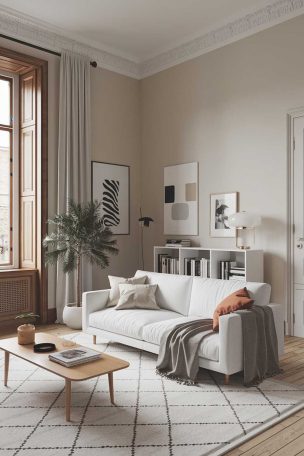
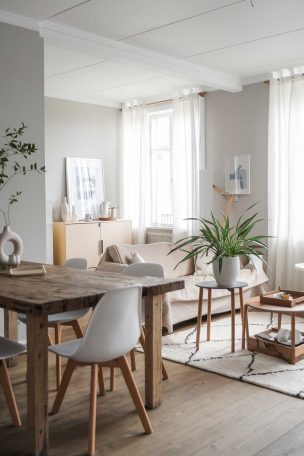
The Scandinavian-Inspired Bright Basement
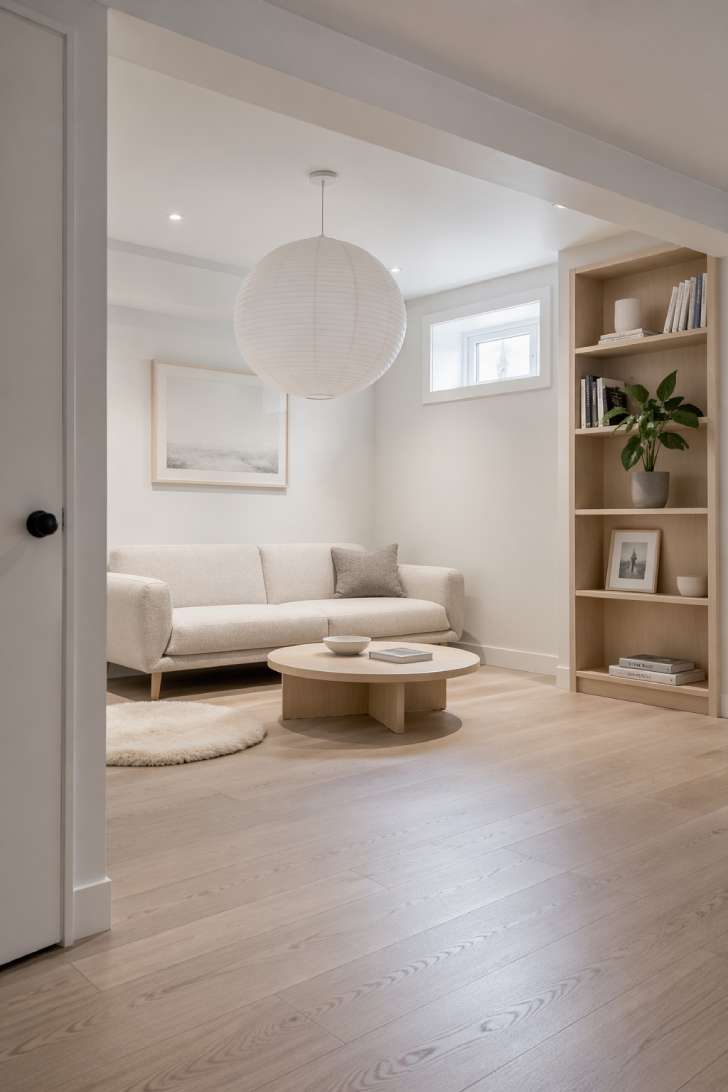
Scandinavian design was built for rooms that don’t get much natural light. That makes it a surprisingly good match for a below grade living room.
The whole philosophy grew out of Nordic winters, where daylight disappears for months.
Every material choice, every color decision in Scandinavian interiors, exists to maximize and distribute whatever light is available.
Pale walls reflect artificial light evenly.
Blonde wood warms the palette without absorbing light the way dark furniture does.
Paper lanterns and diffused fixtures scatter illumination softly instead of creating harsh pools and shadows.
Keeping the furniture low-profile has a specific effect in a room with seven- or eight-foot ceilings.
It increases the visible gap between the top of the sofa and the ceiling, which makes the ceiling feel higher than it is.
Your eye measures room height from the tallest piece of furniture up, not from the floor.
A sofa with a 30-inch back creates more perceived ceiling height than one with a 36-inch back.
Restraint is the hard part. In a room this spare, every object reads individually.
A single cluttered shelf would break the entire composition. If you’re drawn to this look, commit to editing ruthlessly.
Three things on the coffee table, not seven. Five books on the shelf, not thirty.
Style Blueprint:
- Low-profile sofa in bouclé, linen, or cotton in oatmeal or warm white
- Blonde wood furniture (birch, ash, or light oak) with tapered legs
- One large diffused pendant light (paper lantern or frosted globe)
- Pale wide-plank flooring (engineered oak or light-toned LVP)
- Minimal accessories: one plant, one textile, one framed piece per surface
The Industrial Exposed-Ceiling Look
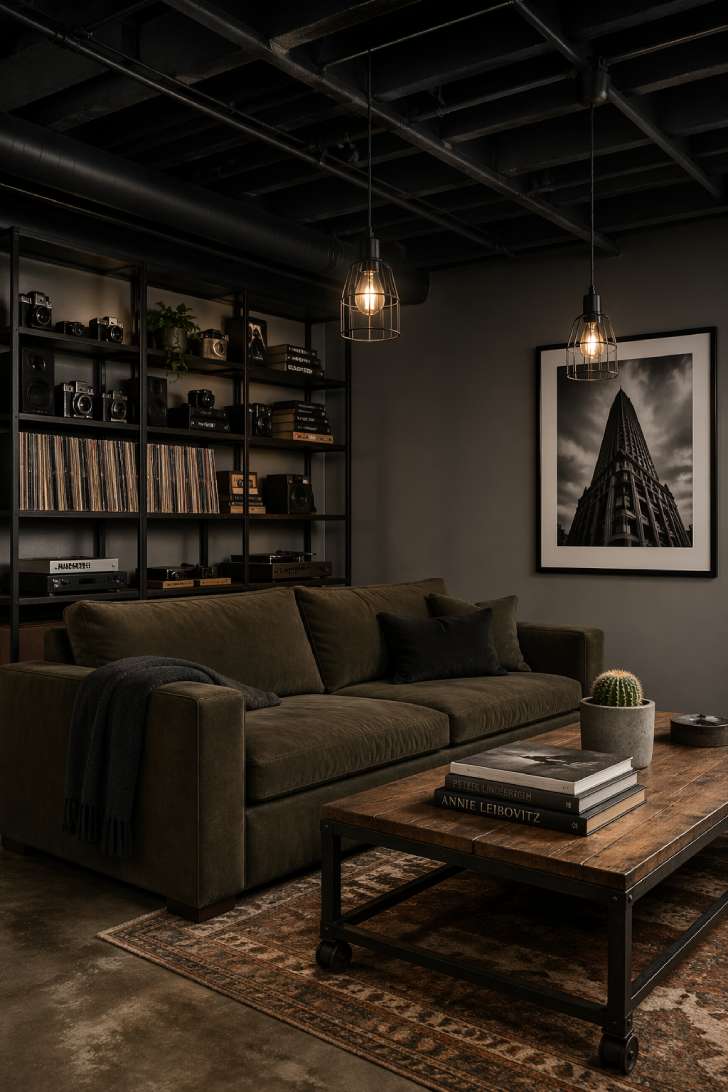
Painting the ceiling joists and mechanical systems one flat dark color is the single cheapest way to gain headroom in a basement.
A drop ceiling eats three to four inches.
Drywall on the underside of the joists eats at least an inch, plus you lose access to everything above.
Painting everything matte black costs a few gallons of paint and a weekend with a sprayer, and you keep every fraction of an inch.
The dark ceiling works because of a visual principle: dark surfaces recede.
Your eye doesn’t track the exact height of a dark plane the way it does a white one.
The ceiling blurs upward and feels farther away.
It’s why theaters paint everything above the stage black. You stop seeing the infrastructure and start seeing the room.
This is one of the most practical basement ceiling options for older homes where the foundation height is tight.
If your unfinished ceiling sits at seven feet or just below, this approach lets you meet that threshold without any construction at all.
the rest of the room should lean into the industrial mood rather than fight it.
Polished or stained concrete floors (or LVP that mimics concrete), raw metal shelving, reclaimed wood surfaces.
These materials look intentional against exposed mechanical systems. Pair them with a formal dining table and silk curtains, and the ceiling just looks unfinished.
Design Pro-Tip: When painting an exposed basement ceiling, use a paint sprayer, not a roller. Spraying gets into every crevice around pipes, conduit, and ductwork in a fraction of the time. Use a flat or dead-flat sheen. Any gloss at all on the ceiling will catch light and draw the eye up to exactly the details you’re trying to hide.
Style Blueprint:
- All ceiling joists, pipes, and ductwork painted matte black (one uniform color)
- Concrete, stained concrete, or concrete-look LVP flooring
- Furniture in canvas, waxed cotton, or distressed leather
- Black metal shelving and black steel accent pieces
- Warm industrial pendant lights on long cords hung from joists
The Cozy Home Theater Setup
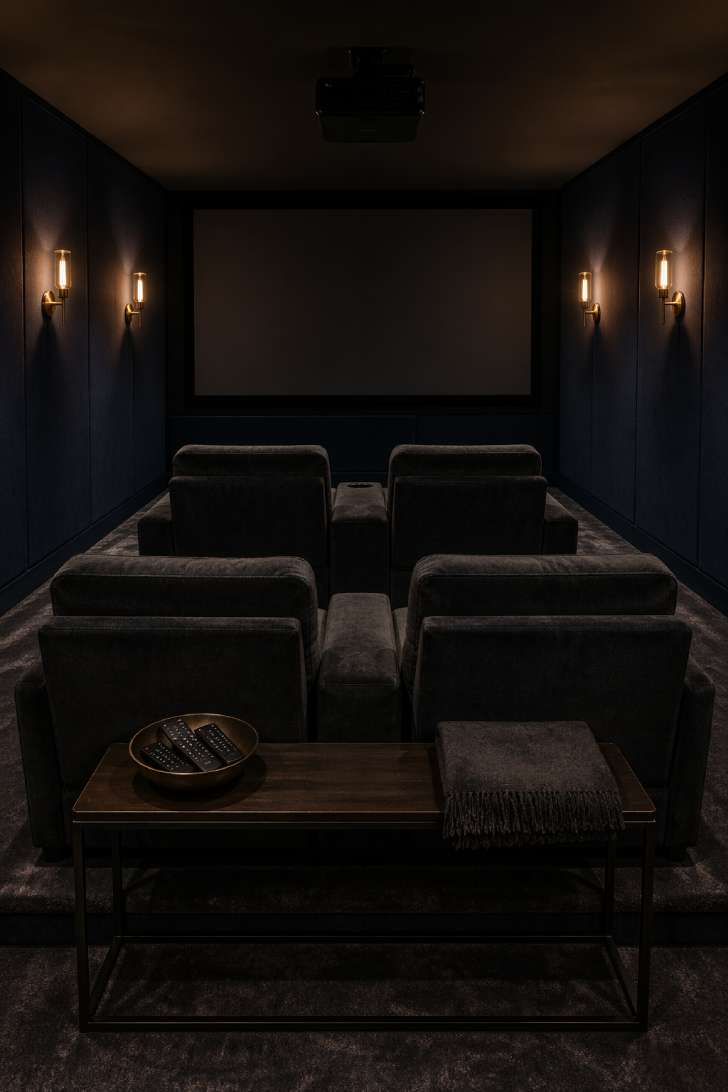
If you’re going to build a home theater, the basement is the right place for it. Period.
No windows to light-seal. Natural sound isolation from the floor above. Consistent temperature.
Every problem a main-floor theater has to solve with expensive treatments, a basement solves by existing.
Tiered seating changes the experience entirely.
Raising the back row just six to eight inches on a simple framed platform means the people in back can see over the heads in front.
It sounds like a small detail until you’ve watched a movie from the second row of a flat room, craning your neck around someone’s head for two hours.
The acoustic fabric on the walls is doing the real work.
Hard drywall surfaces bounce sound in every direction, creating echoes and muddying the audio.
Fabric-wrapped panels absorb mid- and high-frequency reflections, which cleans up dialogue and gives the soundstage actual depth.
Your $300 soundbar sounds like a $1,500 system in a properly treated room.
Carpet on the floor is a deliberate choice here, even though it’s generally not recommended for basement flooring ideas.
In a theater room, carpet absorbs sound reflections off the floor, adds warmth underfoot for a room you’ll be sitting in for hours, and eliminates the footstep noise that hard floors produce every time someone gets up for a drink.
This is the one basement room where carpet makes more sense than LVP.
Style Blueprint:
- Projector and screen setup, 100-inch minimum
- Tiered seating: recliners or theater chairs in front, sofa on a raised platform in back
- Acoustic fabric panels on side walls in a dark, light-absorbing color
- Dark carpet on the floor for sound absorption
- Dim brass or bronze wall sconces on dimmers for aisle lighting
The Reading Nook and Library Corner
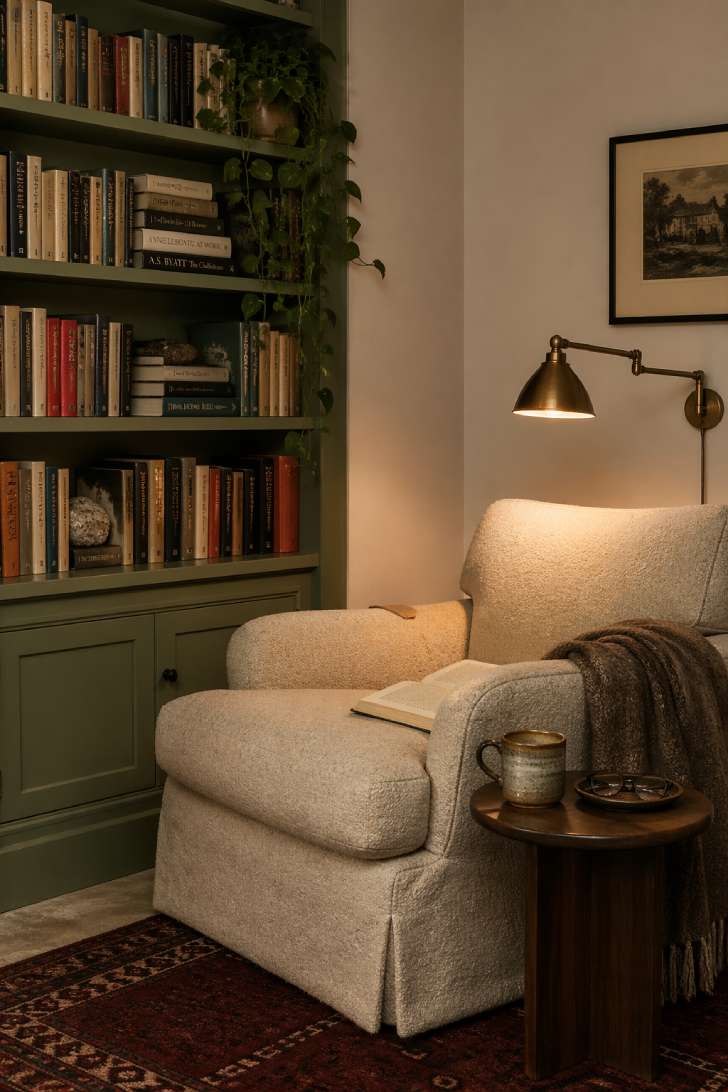
A reading corner doesn’t need a whole room. It needs a good chair, a good lamp, and a wall of books.
Built-in shelving works better than freestanding bookcases in a basement for a couple of reasons.
It sits flush against the wall, so it doesn’t eat into the room the way a deep bookcase does.
And it can be built right over the foundation wall, which means the shelves themselves act as a secondary insulating layer and hide any imperfections in the concrete behind them.
The reading lamp is the single most underrated element. Overhead lighting is too diffuse for reading. It washes the page in flat light and creates no contrast.
A swing-arm wall-mounted lamp puts a focused beam exactly where you need it and swings out of the way when you stand up.
It’s a better reading light than a floor lamp because it doesn’t take up any floor space and doesn’t wobble when someone walks past.
Placing this nook in a corner of a larger basement family room creates a zone that feels separate without walls.
The tall bookcase acts as a visual divider. The directional reading lamp creates a pool of light that belongs only to the person in the chair.
You’re in the same room as the rest of the family, but you’re also somewhere else.
Style Blueprint:
- Deep, wide armchair in a textured wool or heavy linen
- Floor-to-ceiling built-in bookcase, painted in a contrasting accent color
- Brass swing-arm wall-mounted reading lamp
- Small round side table at armrest height
- Thick wool area rug to define the reading zone
Design Pro-Tip: When building floor-to-ceiling shelving in a basement, leave a two-inch gap between the back of the shelves and the foundation wall. This air gap prevents moisture from wicking into the shelf material and lets you run a dehumidifier behind the unit if needed. Paint the back panel of the shelving unit rather than the wall itself for the same reason.
The Multifunctional Guest-Ready Room
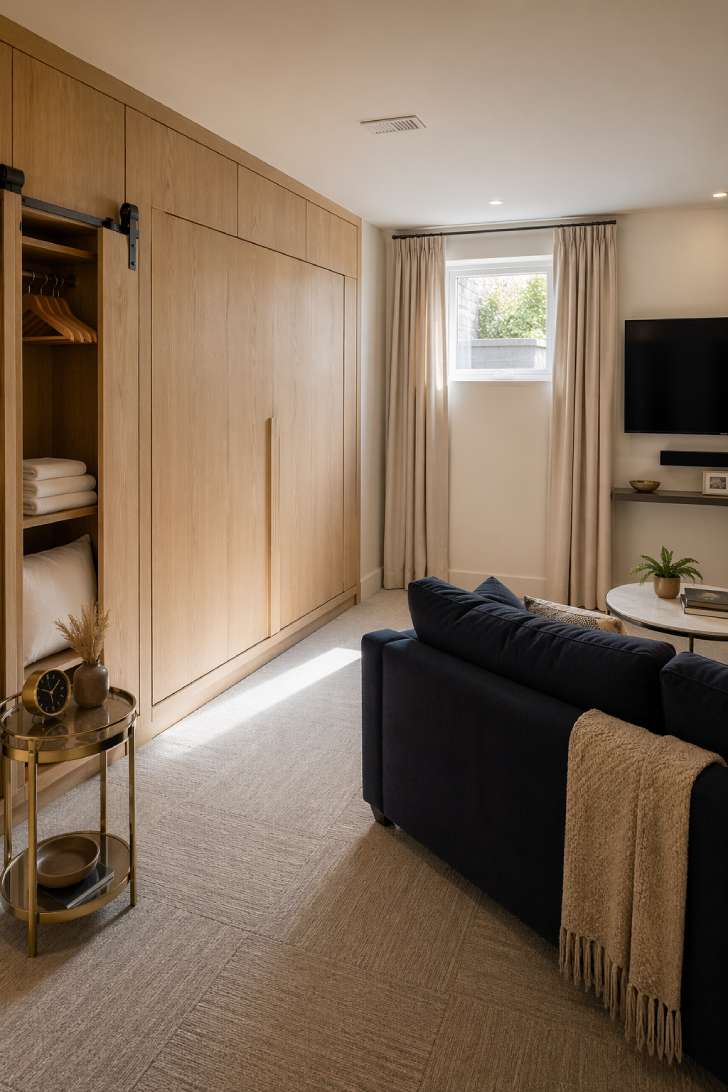
A Murphy bed is the best piece of furniture nobody thinks about until they need it.
When it’s folded up, you have a full family room.
When guests arrive, you pull it down and the room transforms in thirty seconds.
No inflatable mattress on the floor. No sleeper sofa with a bar digging into someone’s spine.
A real queen mattress that disappears when the visit is over.
The egress window is doing two jobs.
First, it meets building code for a sleeping area, which typically requires a window opening of at least 5.7 square feet.
Second, it brings in the only natural daylight this room gets.
Dressing it with full-length curtains instead of a small valance makes the window feel larger than it is, and linen filters the light softly without blocking it.
Including a small closet or wardrobe with a few hangers, a stack of towels, and an extra pillow elevates the guest experience from “crashing in the basement” to “staying in a proper guest room.”
It takes maybe six square feet of floor space and completely changes how the room feels to the person sleeping there.
This kind of dual-purpose basement remodel inspiration is especially practical in smaller homes where dedicating an entire room to guests who visit a few times a year doesn’t make sense.
Style Blueprint:
- Queen Murphy bed with custom built-in cabinet in wood veneer or painted finish
- Narrow closet or wardrobe with a few hangers and spare linens
- Code-compliant egress window dressed with full-length linen curtains
- Compact loveseat or settee facing a wall-mounted TV
- Carpet tiles or soft LVP for comfortable barefoot use
The Fireplace-Anchored Family Room
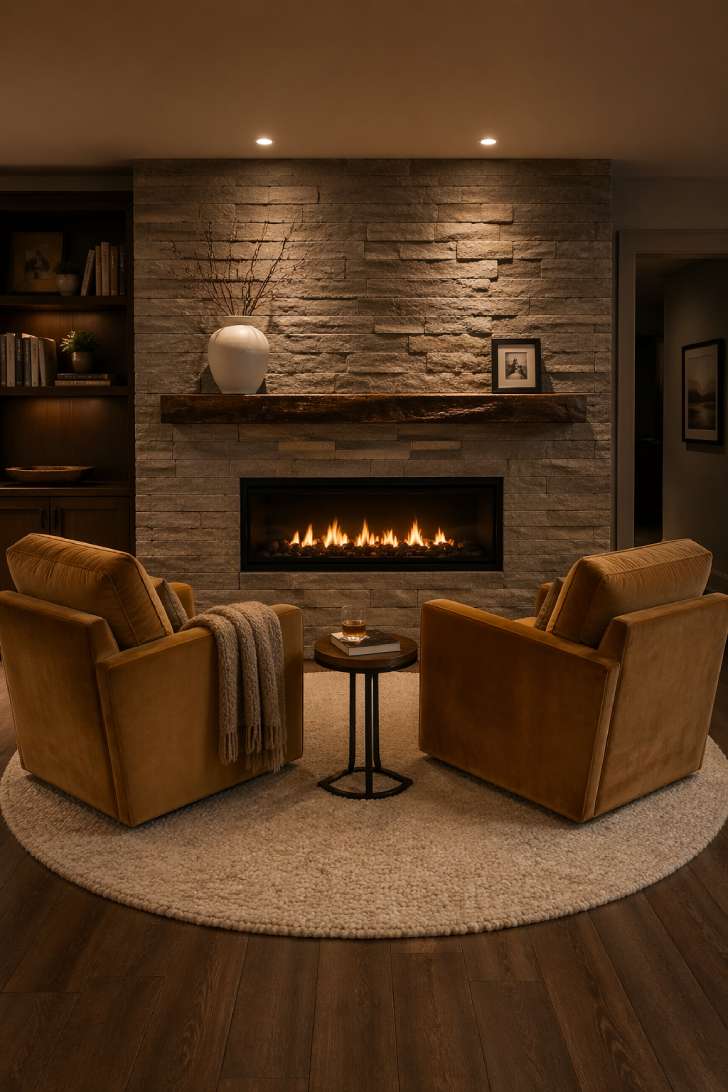
A fireplace turns a basement from a room you use into a room you’re drawn to.
Gas fireplace inserts can be a practical option because many direct-vent models can exhaust through an exterior wall rather than relying on a traditional masonry chimney.
A fireplace can create a strong basement focal point, but a fuel-burning appliance is a safety and code decision before it is a styling decision.
Choose an appliance listed for its intended location, follow the manufacturer’s installation and clearance requirements, and have gas, venting, and electrical work completed by qualified professionals where required.
Do not treat an unvented gas appliance as a simple alternative to venting. Combustion equipment can introduce carbon-monoxide and indoor-air concerns, and local restrictions vary.
The CPSC recommends carbon-monoxide alarms on every level of the home and outside sleeping areas, together with proper use and maintenance of fuel-burning appliances.
From a design perspective, a stone surround running from floor to ceiling can help a low basement feel taller by creating a strong vertical line that draws the eye upward.
Without that vertical emphasis, much of the furniture and visual weight may sit within the lower half of the room, reinforcing the impression of a low ceiling.
A full-height surround breaks that horizontal emphasis and gives the fireplace more architectural presence.
Arranging furniture around the fireplace instead of automatically orienting every seat toward a TV can also change how the room functions.
Two chairs angled slightly toward each other create a more conversational arrangement, with the fireplace acting as a shared visual anchor rather than a screen that demands continuous attention.
Style Blueprint:
- Listed linear gas fireplace suitable for the proposed basement installation
- Direct-vent configuration where compatible with the building and manufacturer’s requirements
- Floor-to-ceiling stone, tile, or concrete surround
- Live-edge or thick-slab wood mantel installed with required clearances
- Two comfortable armchairs angled toward each other
- Large round area rug positioned with appropriate clearance from the appliance
Design Pro-Tip: If a gas fireplace is appropriate for the basement, a direct-vent model can offer an important indoor-air advantage because it draws combustion air from outdoors and exhausts combustion gases outdoors through a sealed system. Do not select a fireplace by appearance alone; confirm that the specific appliance, vent route, clearances, and installation comply with its listing, manufacturer instructions, and applicable local requirements.
The Bold Maximalist Basement
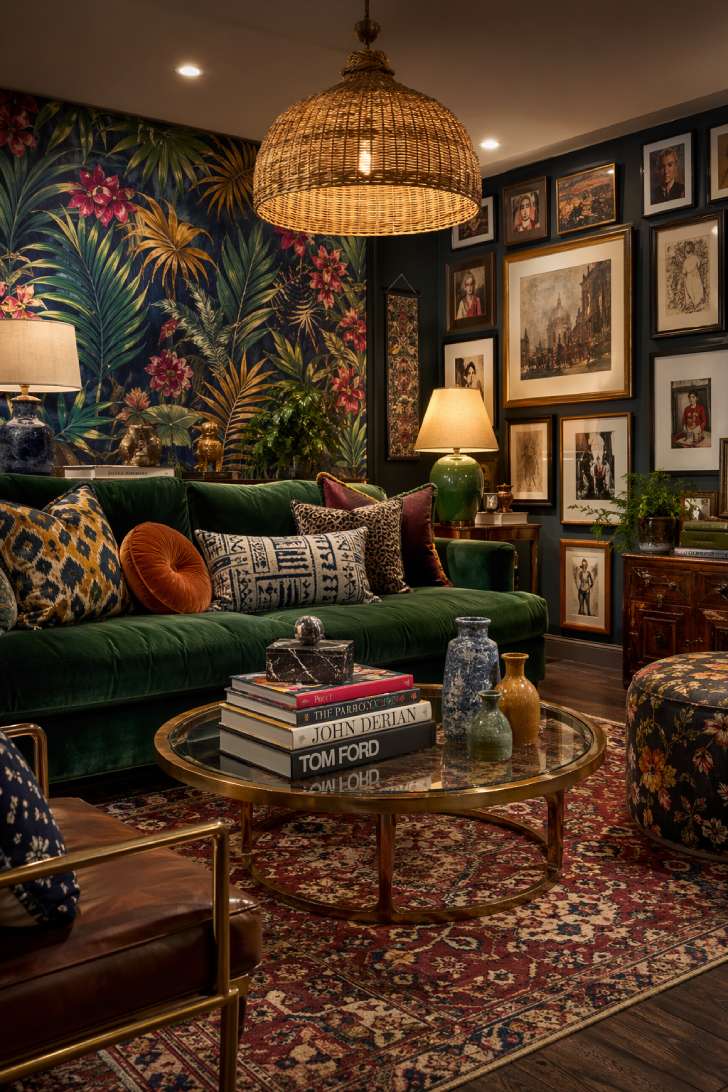
Basements are actually the best place in a house to go maximalist.
There are no windows to compete with. No views to frame. No natural light cycling through the room and changing the way colors read throughout the day.
The light is controlled and consistent, which means bold wallpaper, saturated color, and dense art walls look the same at noon as they do at midnight.
That controlled environment lets you push further than you could in an above-grade room.
A botanical wallpaper in deep jewel tones that might overwhelm a living room with three windows feels contained and intentional in a basement.
The walls are the view.
The gallery wall works on the same principle. In a room without windows, blank walls feel like boundaries.
Covering them with a dense arrangement of art, photographs, and objects makes them feel active and interesting.
Your eye travels across the wall instead of stopping at it. The room feels larger because there’s more to look at.
Mixing textures is what keeps maximalism from reading as cluttered.
Velvet, silk, rattan, brass, ceramic, wool.
Each material reflects and absorbs light differently. Velvet swallows light and creates depth. Brass catches it and throws it back.
That interplay gives the eye places to rest and places to move, which is the difference between a room that feels rich and a room that feels messy.
Style Blueprint:
- Bold, large-scale wallpaper on at least one wall (botanical, geometric, or scenic)
- Velvet sofa in a saturated jewel tone
- Layered throw pillows in mixed patterns, textures, and scales
- Dense gallery wall with a mix of art sizes and frame finishes
- At least three different light sources: pendant, table lamps, and overhead
The Modern Minimalist Family Room
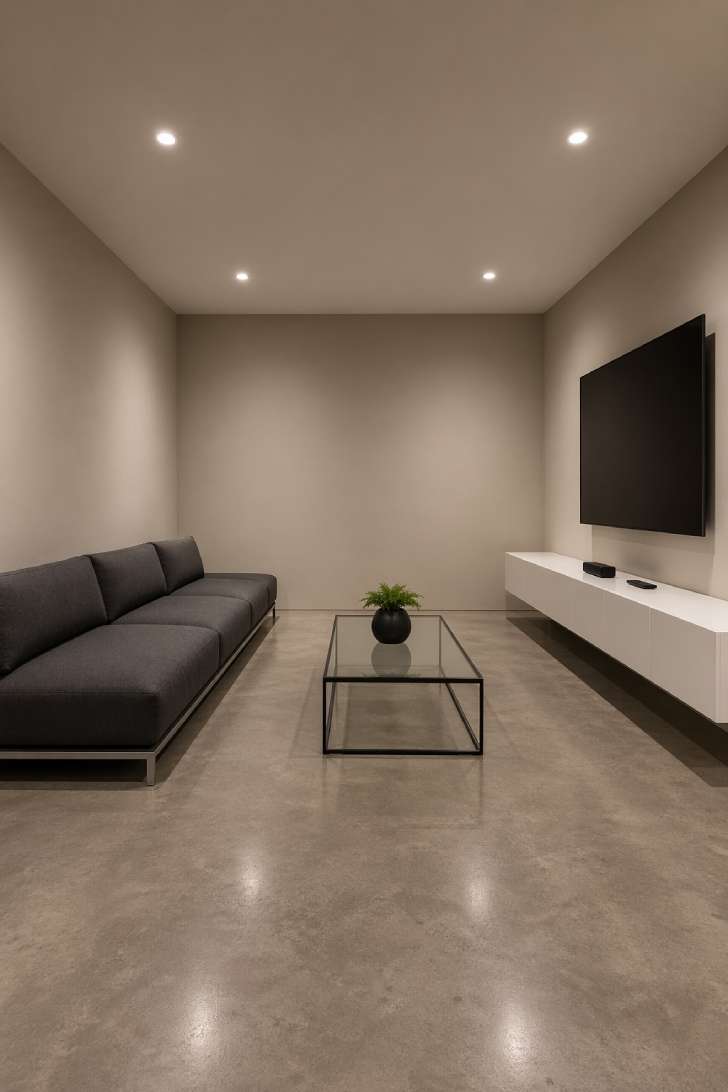
Minimalism is harder to pull off than maximalism. You can’t hide behind accessories.
Every piece in the room stands alone and gets scrutinized individually. The sofa has to be exactly right because there’s nothing next to it to distract from it.
The coffee table has to earn its place because it’s the only thing on the floor between you and the TV. In a room this spare, a wrong piece doesn’t just look out of place.
It wrecks the composition.
Low furniture serves a functional purpose in a minimalist basement.
When the ceiling is seven feet or a little more, a standard 18-inch seat height sofa leaves about five feet between the top of your head and the ceiling while seated.
Drop to a 14-inch seat height and you gain four visible inches of ceiling space above you. That perception shift is real and immediate.
The polished concrete floor is a choice that fits this aesthetic perfectly and also happens to be one of the most practical basement flooring ideas available.
The slab is already there.
Grinding and sealing it can cost less than installing a separate finished flooring system on top of it, and the smooth surface contributes to the clean visual that minimalism demands.
Exposed concrete can be durable, but a concrete basement slab does not eliminate moisture concerns.
Water intrusion, vapor movement, indoor humidity, coatings, adhesives, rugs, and furnishings can all be affected by basement moisture. Investigate persistent moisture before covering or finishing the slab.
Hidden storage is what makes this room livable rather than just photographable.
Blankets, remotes, game controllers, books, all of it goes inside the floating console or in a closet behind a flush door.
The commitment to this look is a commitment to putting things away.
Style Blueprint:
- Low-profile sofa (14-inch seat height or lower) in a muted solid color
- Slim, minimal coffee table in steel, glass, or thin marble
- Floating media console with closed storage
- Polished and sealed concrete floor or large-format gray porcelain tile
- Flush-mount recessed LED lighting with no visible fixtures
The Cottage-Style Basement Escape
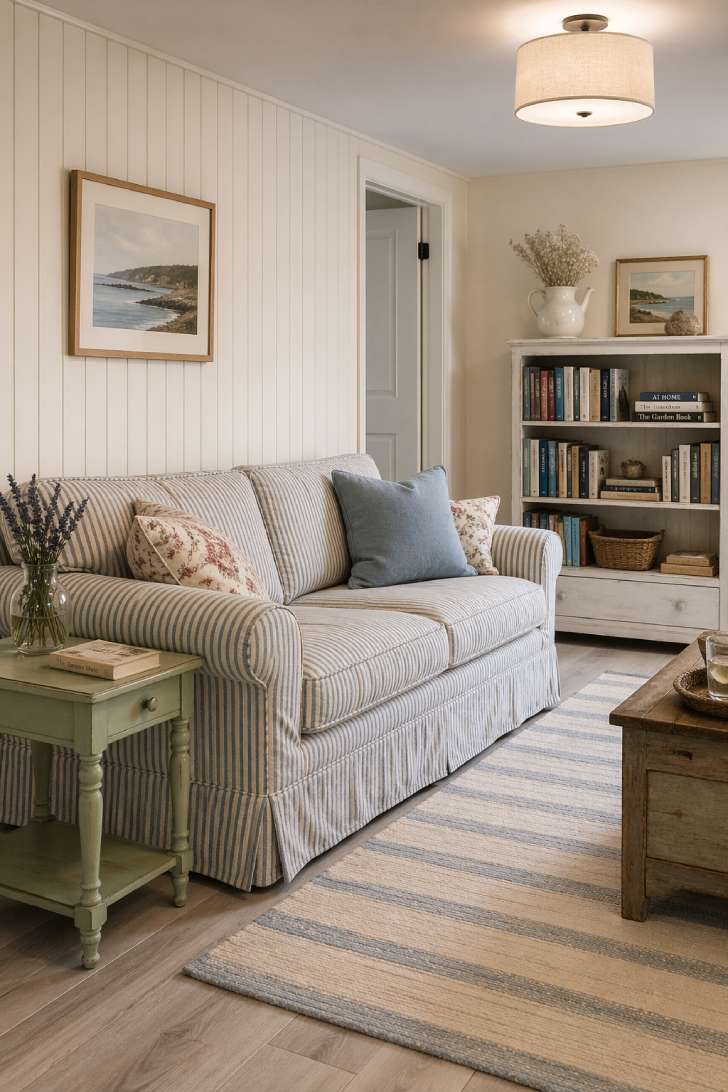
Cottage style and basements share something in common: both are at their best when they feel a little imperfect.
Beadboard on the ceiling is an underrated alternative to both drywall and drop ceilings in a basement. It’s thinner than most drop ceiling systems, so you lose less headroom. It hides minor joist irregularities. And it adds a visual texture that reads as intentional character rather than unfinished infrastructure. Painted in the same warm white as the walls, it wraps the room in a continuous soft surface.
The ticking stripe fabric on the sofa is a cottage staple for a practical reason: stripes hide wear patterns and minor stains better than solid fabrics. In a family room that gets daily use, that translates to a sofa that looks good for years without showing its age.
Thrifted and vintage accessories aren’t just a style choice here.
They solve the “everything matches too perfectly” problem that makes rooms feel staged.
A painted side table with real wear marks, an ironstone pitcher from a flea market, a framed watercolor from a local artist.
These pieces carry the slight irregularities that brand-new furniture never has.
That imperfection is what makes a room feel lived in, which is the whole point of cozy basement decor.
Whitewashed or limed flooring keeps the room feeling light without going fully white.
The grain of the wood still shows through, adding warmth and texture.
On LVP, this finish is especially forgiving of dust and minor scuffs because the variation in the pattern camouflages everyday wear.
Design Pro-Tip: If you use beadboard on a basement ceiling, run the planks perpendicular to the joists and nail directly into them. This avoids the need for furring strips, saving you about an inch of headroom compared to a drop ceiling. Prime both sides of the beadboard before installation. Priming only the visible face lets moisture wick into the raw back side, which can cause warping over time.
Style Blueprint:
- Painted beadboard on ceiling and/or one accent wall in warm white or cream
- Rolled-arm sofa in ticking stripe, linen, or faded floral
- Distressed painted furniture (side table, bookcase) in sage, soft blue, or antique white
- Whitewashed or limed wide-plank LVP
- Vintage accessories: ironstone, old books, framed watercolors, dried botanicals
A Room Your Family Actually Wants to Be In
The best basement family room ideas share one thing: they take the so-called disadvantages of being underground and turn them into the design itself.
Dark? Make it a theater or a moody lounge.
Low ceilings? Paint them black and call it industrial.
No windows? Go maximalist and let the walls become the scenery.
Every idea in this list starts with the same practical foundation: handle the moisture, pick the right flooring, and layer your lighting so the room doesn’t feel like a bunker.
After that, style is just a conversation between your taste and the space you’ve got.
Pick the one that matches how your family actually uses a room, not the one that looks best in a photograph.
Then start with the paint.