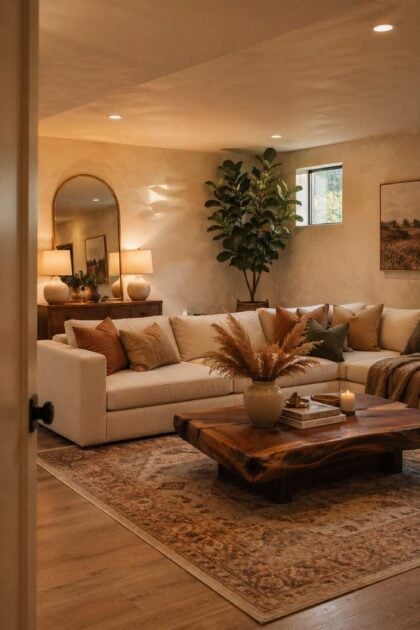
This post may contain affiliate links. If you make a purchase through these links, we may earn a commission at no additional cost to you.
There’s something about a below-grade room that makes it the perfect blank canvas.
Maybe it’s the quiet. Maybe it’s the way the rest of the house sits above you, muffling footsteps and street noise, wrapping you in a kind of stillness that upstairs rooms never quite achieve.
A basement living room, done well, becomes the spot everyone gravitates toward on a Friday night or a rainy Sunday morning. It’s where movie marathons happen, where kids sprawl across floor cushions, where you finally read that book you’ve been meaning to start since last October.
These 17 basement living room ideas cover everything from moody media lounges to bright, airy family hangouts. Grab the ones that fit your space, your budget, and the way you actually live.
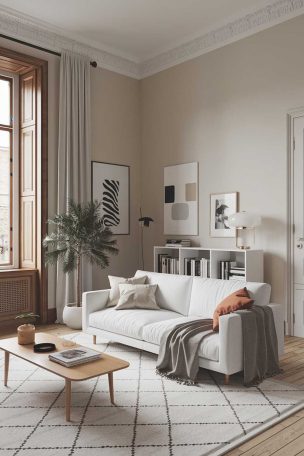
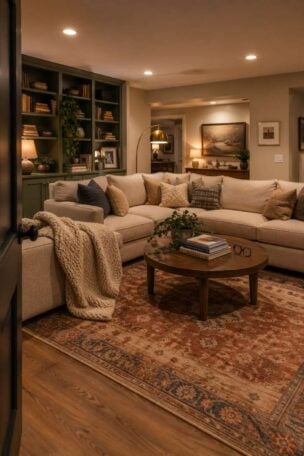
The Warm Neutral Cocoon
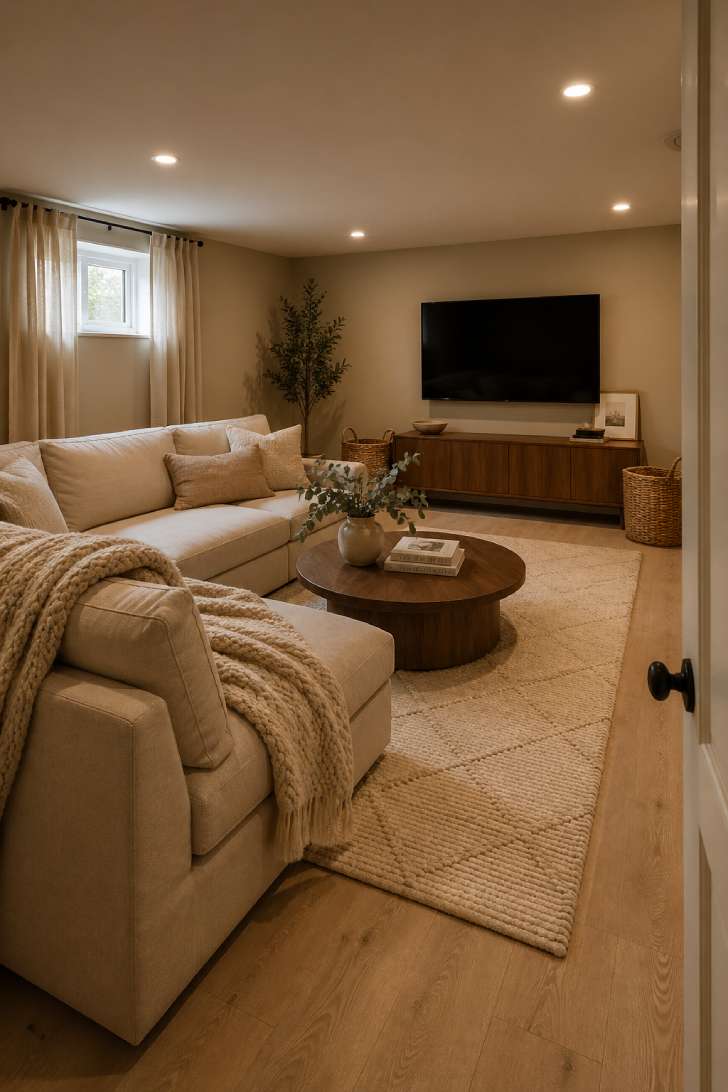
Warm neutrals work harder in a basement than almost anywhere else in your home.
The reason comes down to how your eyes process a room with limited natural light. Cool grays and pure whites can read as flat or clinical when they don’t have strong sunlight to bring them to life. Taupe, oatmeal, warm greige, and sand tones carry their own warmth, which means the room feels inviting whether it’s noon or midnight.
Texture does most of the heavy lifting in a monochromatic palette. A chunky knit throw against a smooth linen sofa, a woven rug on top of vinyl plank flooring, dried branches in a matte ceramic vase. Each surface catches light differently, creating depth that color alone can’t deliver.
Keep the furniture low to the ground. A sectional with a seat height around 16 or 17 inches makes an 8-foot ceiling feel noticeably taller, and it shifts the whole room’s center of gravity downward, which reads as relaxed rather than cramped.
Style Blueprint:
- Low-profile linen sectional in oatmeal or sand
- Wide-plank LVP flooring in light oak
- Chunky knit throw blankets in tonal neutrals
- Round walnut coffee table
- Woven rattan storage baskets
The Moody Media Lounge
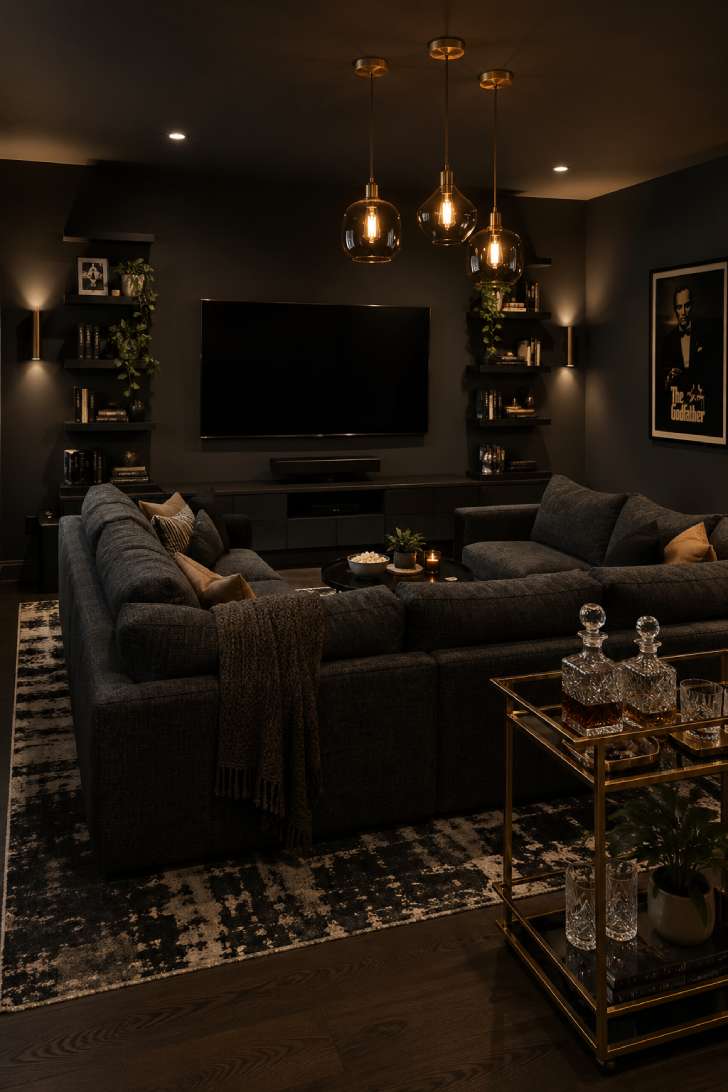
Going dark in a basement might sound counterintuitive. It isn’t.
Rooms that fight their nature (painting every wall white, flooding the space with overhead fluorescents) often end up feeling like they’re trying too hard. Leaning into the darkness works because it turns the basement’s biggest perceived weakness into a deliberate mood.
Deep charcoal, navy, or forest green on the walls creates a cocoon effect that actually makes a media room feel more comfortable, not less. Your pupils relax in dim, warm-toned light, which is exactly what you want when you’re watching a film or winding down after a long day.
The trick is balancing all that darkness with intentional light sources. Brass pendants with warm-toned bulbs create amber pools that draw the eye. A gold bar cart catches and reflects that light. Trailing plants on floating shelves add life without competing with the moody palette.
Style Blueprint:
- U-shaped sectional in dark bouclé
- Wall paint in deep charcoal or navy
- Brass pendant lights with smoked glass
- Low bar cart in brushed gold or brass
- Dark-stained hardwood or LVP flooring
The Bright and Airy Family Room
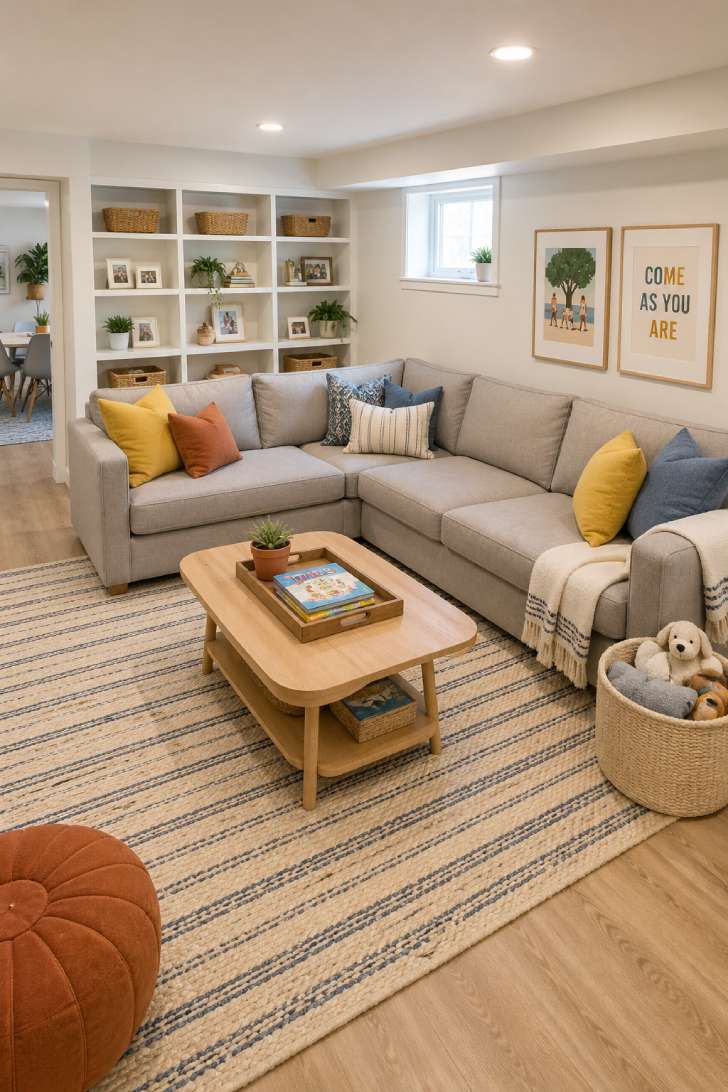
White walls in a basement get a bad reputation, but they can absolutely work if the lighting is right.
Flush-mount LED panels rated at 4000K–5000K simulate daylight convincingly. Combined with white walls and a light floor, they push the brightness high enough that the room stops feeling underground. The result is a space that photographs almost identically to a main-floor living room.
Color comes in through accessories rather than architecture. Mustard, dusty blue, and terracotta pillows are easy to swap with the seasons, and they pop hard against a white-and-gray base. Open shelving loaded with woven baskets, framed photos, and trailing plants adds visual warmth without making the space feel cluttered.
Rounded furniture edges matter more than you might expect in a basement family room. Kids run, corners are at head height, and sharp edges on coffee tables become a real concern. A white oak table with soft curves solves the safety issue while looking intentional and modern.
Style Blueprint:
- L-shaped cotton sofa in soft gray
- Light maple LVP flooring
- Flush-mount LED panels (4000K–5000K)
- Open white shelving with baskets and plants
- Rounded-edge coffee table in white oak
Design Pro-Tip: When choosing paint for a basement living room, buy one shade warmer than what you’d pick for an upstairs room. Colors always read cooler underground because of the reduced natural light. That “too warm” swatch at the paint store? It’s probably the right one once it’s on your basement walls.
The Fireplace Focal Point
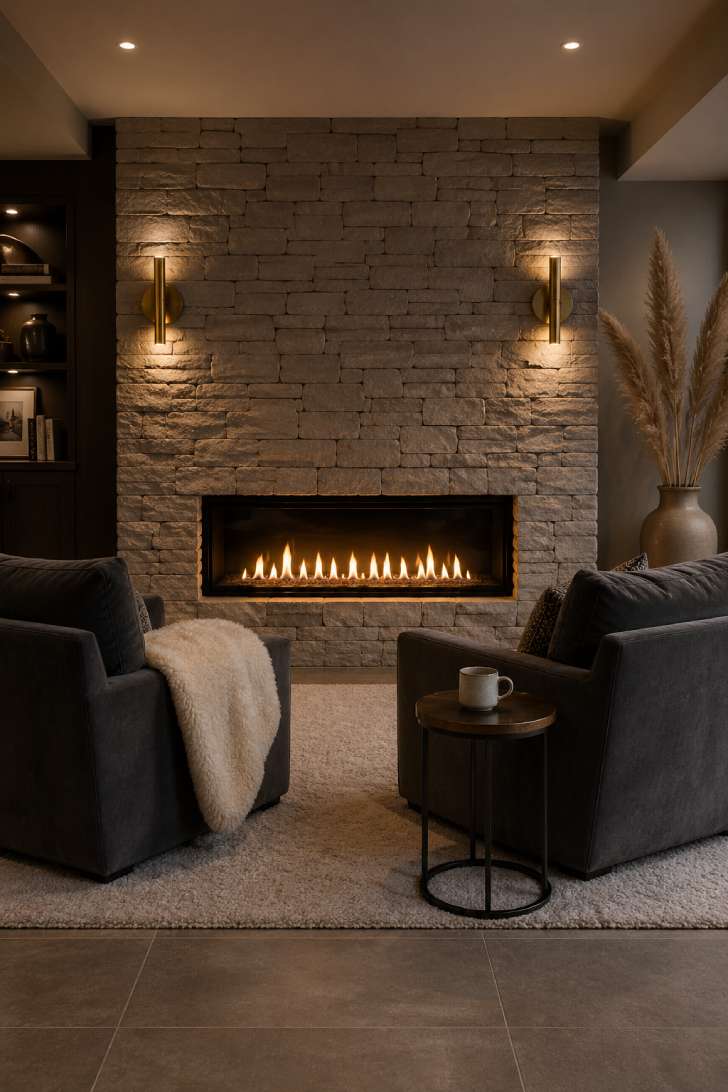
A fireplace changes the entire energy of a below-grade living space.
It gives the room a center, a place where the eye lands and the body wants to settle. Without a fireplace, basement living rooms sometimes struggle with focus. The TV works as a gathering point, but it doesn’t generate warmth, and it doesn’t look like much when it’s turned off.
Modern linear gas units are designed for exactly this kind of installation. Direct-vent models pull combustion air from outside and exhaust through a wall or rim joist, so they work in fully below-grade basements where a traditional chimney isn’t an option. The horizontal flame line feels contemporary without being cold.
The surround material matters more than the unit itself from a design perspective. Natural limestone stacked floor-to-ceiling adds height and texture. Concrete, large-format porcelain slabs, and even reclaimed wood planks all work, depending on the vibe you’re after.
Style Blueprint:
- Linear gas fireplace (direct-vent, 48″ wide)
- Floor-to-ceiling natural limestone surround
- Deep armchairs in performance velvet
- Brass wall sconces flanking the fireplace
- Warm gray porcelain tile flooring
The Rustic Retreat
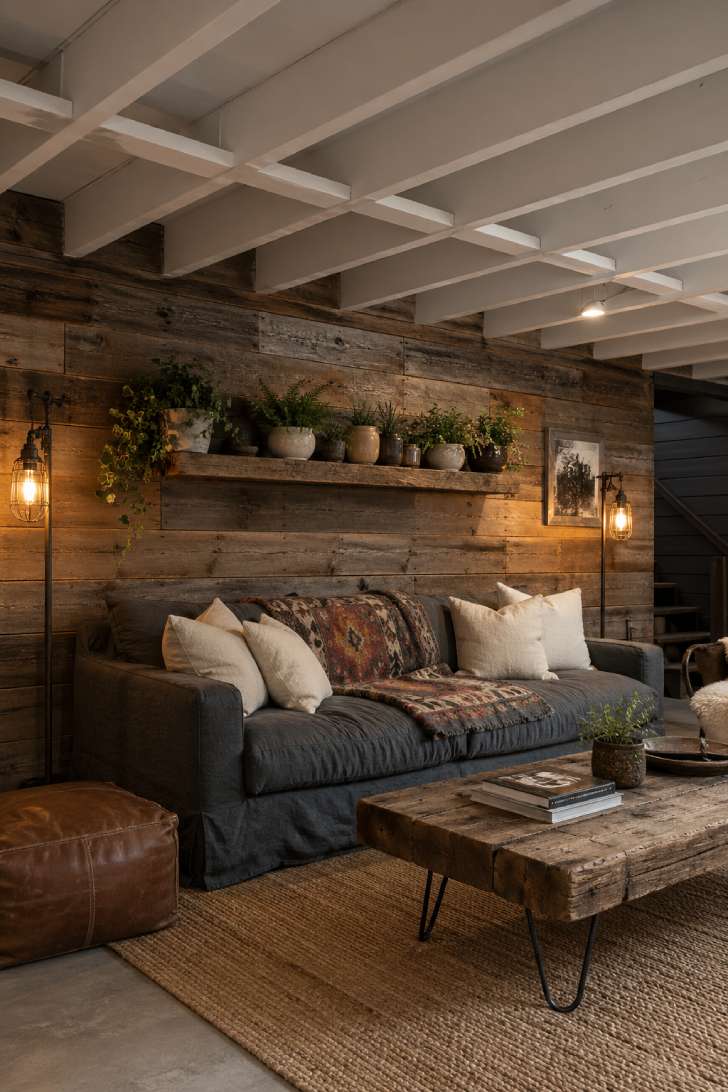
Exposed joists, concrete walls, unfinished surfaces. Basements come with raw materials that most rooms don’t.
Instead of covering everything up, a rustic approach leans into those imperfections. Painting the exposed ceiling joists matte white brightens the room and draws attention to the structure rather than hiding it. Reclaimed barnwood on the walls adds warmth and a sense of history that drywall and paint can’t replicate.
The psychology here is grounding. Natural, unrefined materials like wood, jute, and weathered iron connect us to something older and simpler. Research on biophilic design consistently shows that rooms with visible natural materials reduce stress hormones and lower heart rate. You feel it in your shoulders when you walk into a space like this.
Industrial lighting pairs naturally with rustic materials. Edison bulbs in simple iron fixtures give off that amber glow that makes everyone look better and every room feel warmer.
Style Blueprint:
- Reclaimed barnwood wall cladding
- Exposed ceiling joists painted matte white
- Oversized linen sofa in washed charcoal
- Rough-hewn coffee table with iron hairpin legs
- Industrial floor lamps with Edison bulbs
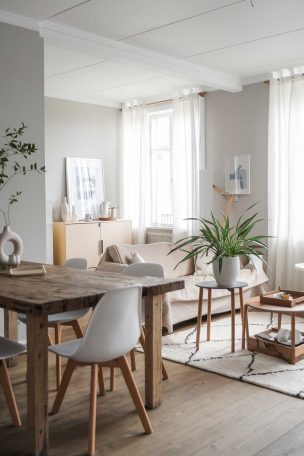
The Scandinavian-Inspired Basement
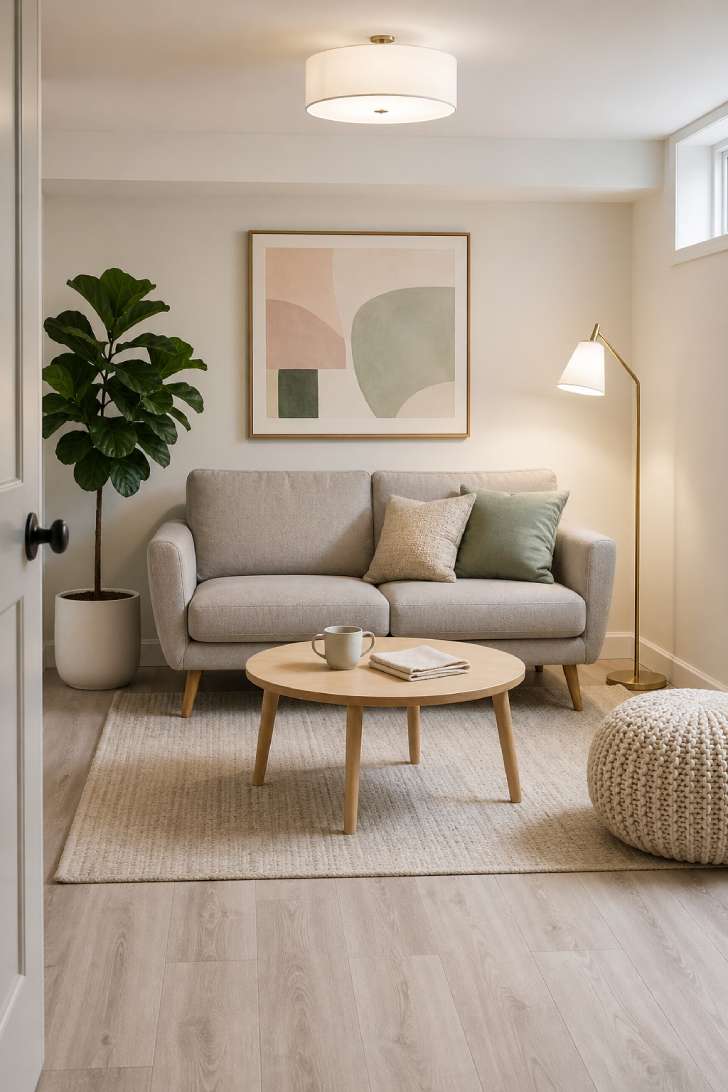
Scandinavian design and basements share a surprising connection. Both deal with limited daylight.
Northern European interiors evolved to maximize whatever light was available during long, dark winters. The same principles (pale tones, reflective surfaces, minimal clutter, strategic lighting) solve the same problem in a below-grade space.
The discipline of editing is what makes this style work underground. Every piece of furniture earns its place. A two-seater sofa instead of a sprawling sectional. One statement plant instead of a cluster. A single art print instead of a gallery wall. The negative space between objects lets light travel further and makes the room feel larger than its square footage.
Material quality replaces quantity. A wool sofa, a birch coffee table, a brass floor lamp. You notice each piece individually because there’s room to see it.
Style Blueprint:
- Two-seater sofa in light gray wool
- Pale birch or ash coffee table
- Light ash LVP flooring
- Single statement houseplant in matte white planter
- Slim brass floor lamp with white shade
Design Pro-Tip: In a small basement living room, resist the urge to push all furniture against the walls. Floating a sofa even 6 to 8 inches away from the wall creates the illusion of more space because it breaks the visual line between the furniture and the wall. It also lets air circulate behind the cushions, which helps manage moisture in a below-grade room.
The Layered Textural Haven
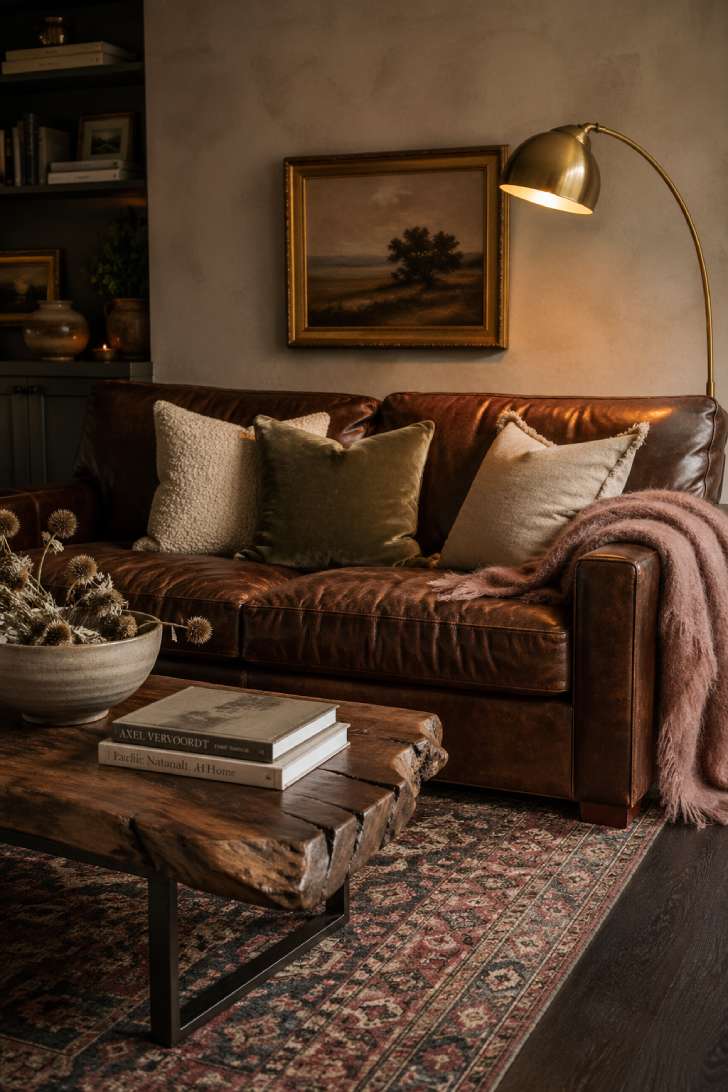
Texture is the secret weapon for any room that doesn’t get much sunlight.
Color needs light to perform. A beautiful blue velvet pillow looks muddy in a dim room. But texture works regardless of brightness because it registers through contrast, shadow, and touch, not through hue.
Leather against bouclé. Limewash against raw linen. A polished walnut slab against the rough weave of a vintage rug. Each pairing creates a micro-contrast that your brain reads as richness and complexity.
A limewash finish on the walls is worth the extra effort in a basement. Unlike flat paint, limewash has a subtle depth and variation that shifts as light moves across it throughout the day. It catches lamplight beautifully, creating a sense of movement on walls that would otherwise feel static.
Style Blueprint:
- Deep sofa in tobacco-brown leather
- Limewash wall finish in warm putty
- Live-edge walnut coffee table on steel base
- Vintage Turkish or Persian area rug
- Brass arc lamp for directional warmth
The Built-In Entertainment Wall
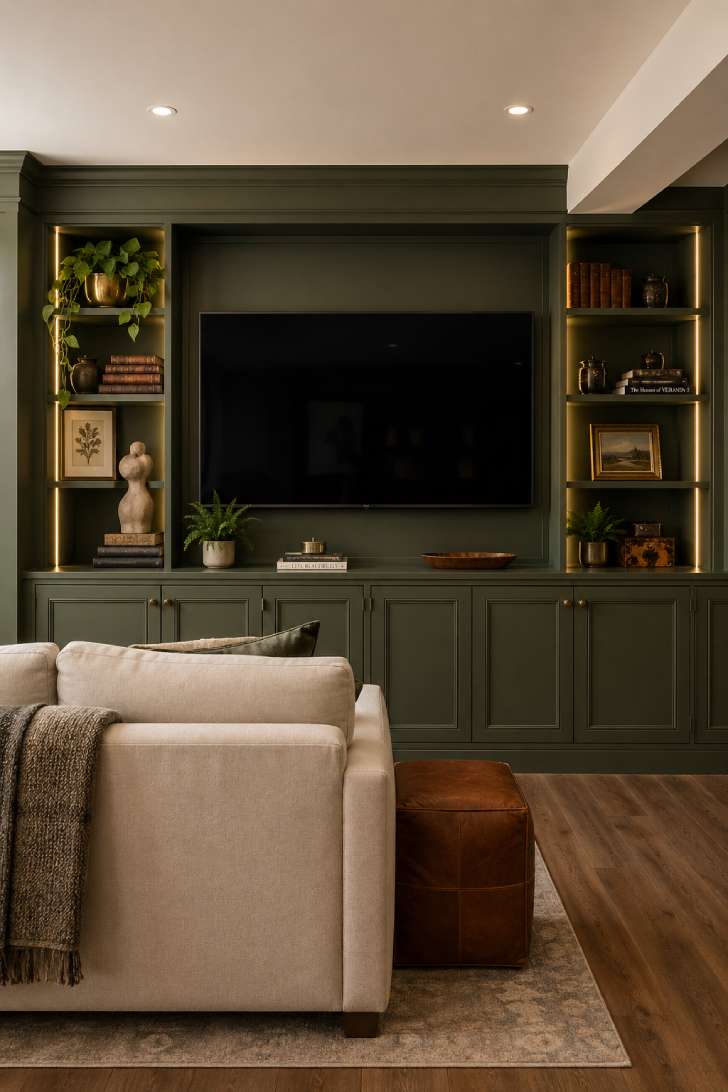
Built-ins solve two problems that basement living rooms face constantly: storage and personality.
Below-grade rooms tend to accumulate clutter because they’re where things get stashed out of sight. Custom cabinetry with closed lower sections hides the mess, while open upper shelving gives you a place to display the objects that give the room its character.
Painting the built-ins in a color rather than white turns the entire wall into a design statement. Sage green, navy, or even a soft terracotta creates a rich backdrop for the TV and makes the shelving feel like furniture rather than architecture.
Integrated LED strip lighting is the finishing touch that separates a good built-in from a great one. Warm LED strips tucked along the vertical edges of the shelving bays cast a glow behind displayed objects, creating depth and drama without adding a single additional fixture to the room.
Style Blueprint:
- Custom built-in cabinetry painted in sage green
- Recessed TV mount at center
- Integrated warm LED strip lighting
- Curated shelf displays with plants and art
- Cream sofa with clean lines
The Conversation Pit Revival
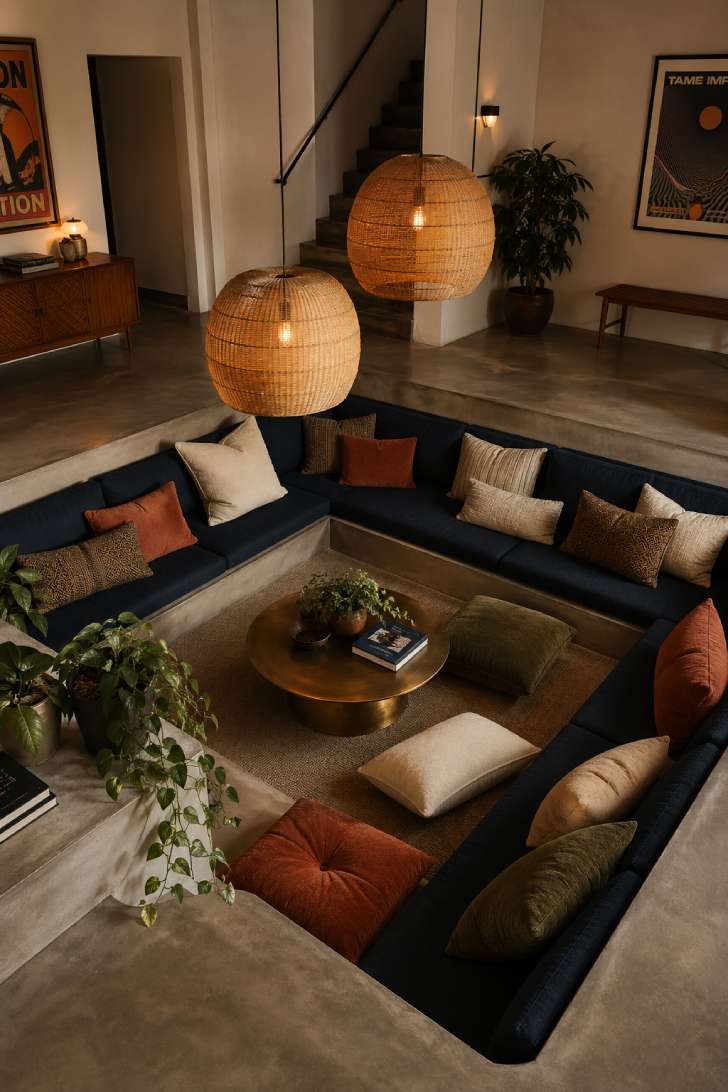
The conversation pit is coming back, and basements are where it makes the most sense.
Sinking the seating area even one step (about 7 to 8 inches) below the surrounding floor creates a defined zone without building a single wall. The step down signals to your body that you’re entering a different kind of space, one meant for settling in rather than passing through.
The psychology is simple but effective. Lowered seating makes you feel sheltered. The surrounding floor level acts as a visual boundary, like the raised edge of a nest. People sit longer, talk more freely, and physically relax faster in enclosed seating areas compared to open-plan arrangements.
In a basement, the extra depth required for the sunken floor is often already available in the slab. A contractor can excavate and re-pour a section of concrete for less than you’d expect, especially if the basement is already being finished.
Style Blueprint:
- Sunken floor area (7–8 inches below grade)
- Built-in bench with performance fabric upholstery
- Oversized floor cushions in mixed earthy tones
- Low round brass-topped coffee table
- Woven rattan pendant lights
Design Pro-Tip: Performance fabrics (Crypton, Sunbrella, Revolution) aren’t just for outdoor furniture. In a basement living room, they resist mildew, repel spills, and hold up to the kind of heavy use that below-grade hangout spaces attract. They’ve come a long way in terms of feel and appearance. Many are indistinguishable from natural fabrics now, and they’ll last years longer in a moisture-prone environment.
The Library Lounge
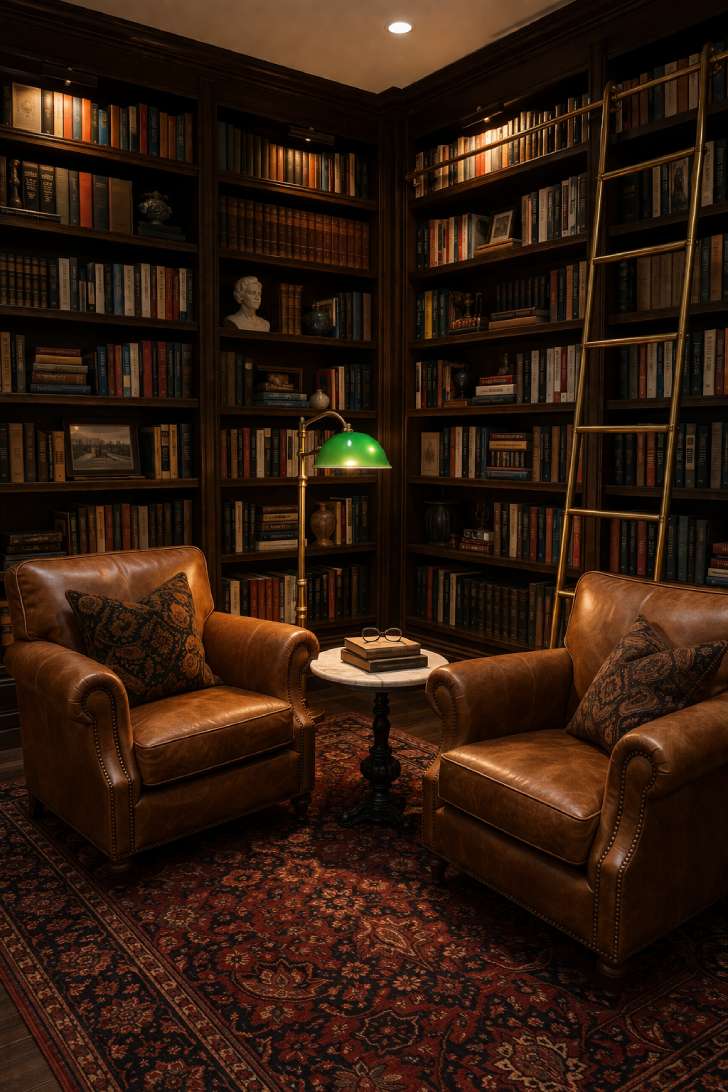
Basements are quieter than any other room in the house. That makes them ideal reading rooms.
The thermal mass of the concrete and earth surrounding a below-grade space absorbs sound in ways that framed walls simply can’t. Add floor-to-ceiling bookshelves (books themselves are excellent sound absorbers), and you have a room that approaches the hush of an actual library.
Walnut shelving with a natural finish brings warmth to what could otherwise feel like a dark box. The key is filling the shelves completely. Half-empty bookshelves look temporary. Packed shelves look deliberate and lived-in, and the varied spines of real books create a kind of organic, unrepeating texture that no decorator can fake.
A rolling brass ladder is partly functional and partly theatrical. It extends your usable shelf height to the ceiling without requiring a step stool, and it adds a classic reference point that ties the whole room together visually.
Style Blueprint:
- Floor-to-ceiling walnut bookshelves
- Rolling brass library ladder
- Deep club chairs in camel leather
- Brass reading lamp with green glass shade
- Rich Persian-style area rug
The Indoor-Outdoor Connection
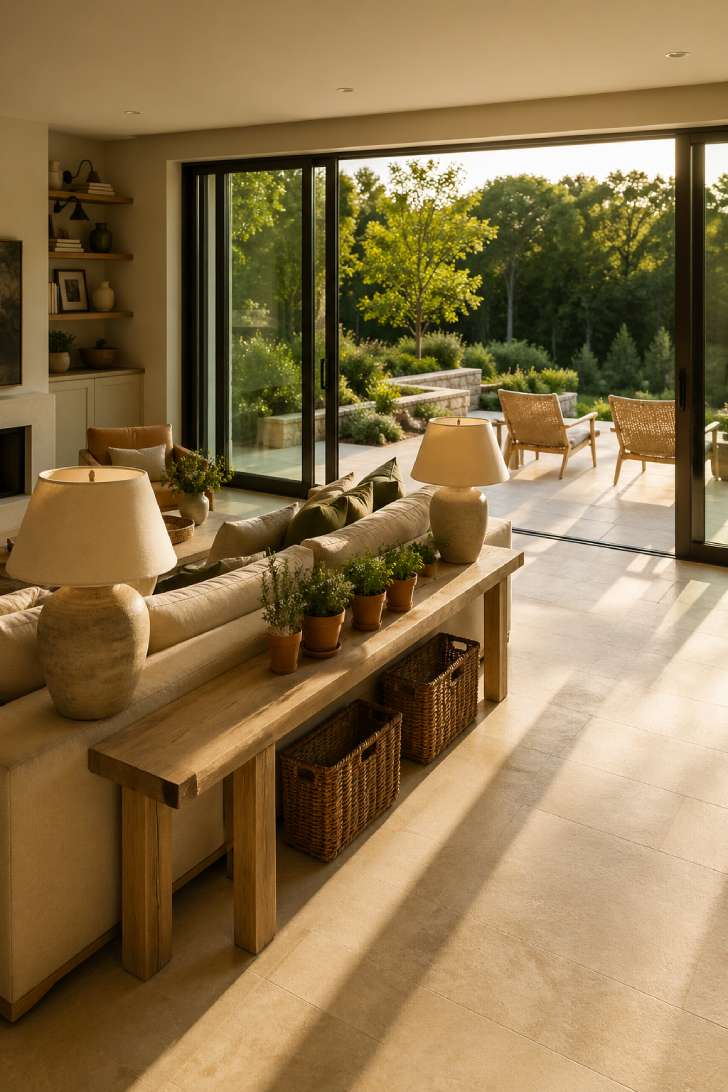
If your basement has a walkout, you have an opportunity that most below-grade spaces don’t: a real connection to the outdoors.
Floor-to-ceiling glass doors erase the boundary between inside and outside. Running the same flooring material (porcelain tile works best because it handles both environments) from the living room through to the patio reinforces that continuity. Your eye reads the two zones as a single room, which makes the indoor space feel twice its actual size.
Light changes everything about how a basement living room functions. A walkout oriented to the south or west receives direct sunlight for hours, which means you can grow herbs on the console table, you can skip the daylight-simulating LED panels, and you can enjoy the thing that most basement living rooms can’t offer: watching the sky change color at the end of the day.
Style Blueprint:
- Floor-to-ceiling glass sliding doors
- Travertine-look porcelain tile (interior and exterior)
- Large cream linen sofa facing the windows
- Potted herbs on a console table
- Low-slung woven chairs for the patio
The Mid-Century Modern Basement
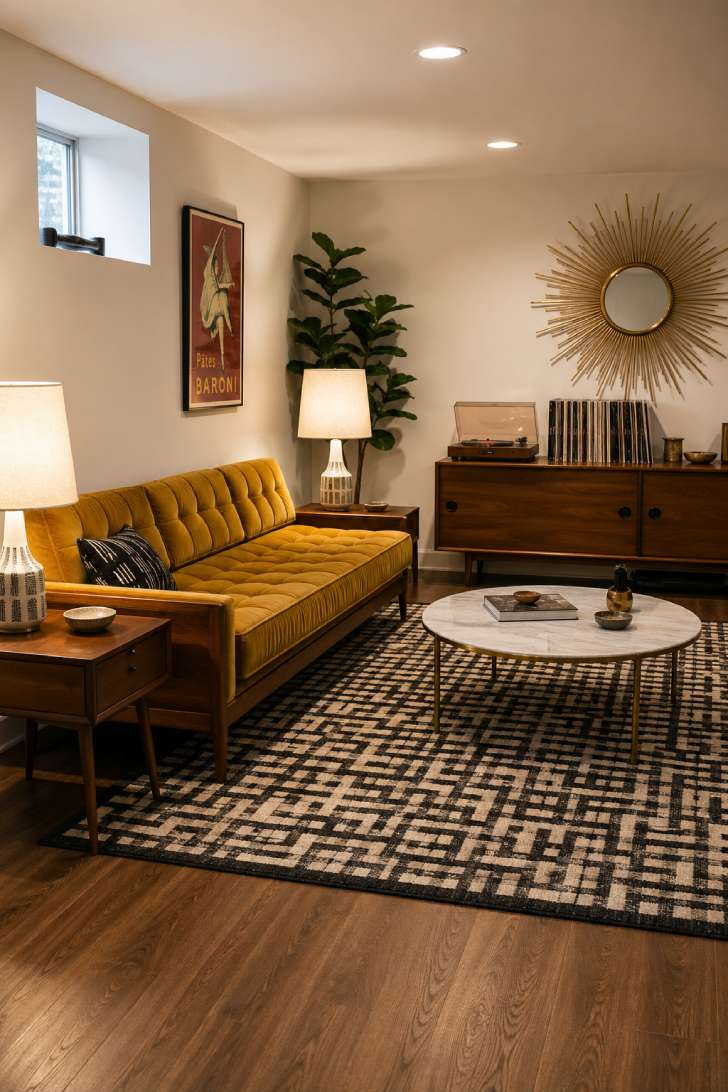
Mid-century modern furniture was designed for smaller spaces. That makes it a natural fit for basements.
The defining features of the style, low profiles, tapered legs, and clean horizontal lines, all work in favor of a room with limited ceiling height. A sofa frame in oiled walnut with slim legs lifts the piece off the floor, letting light pass underneath and making the room feel less heavy.
A walnut credenza with sliding doors is the mid-century answer to the media console. It hides cable boxes, game systems, and clutter behind clean panels, and it doubles as a surface for a record player or turntable setup that becomes part of the room’s personality.
Mustard yellow is the accent color that ties the whole era together. It’s warm enough to counteract the coolness of a below-grade space, and it pairs beautifully with walnut, brass, and black-and-white graphic patterns.
Style Blueprint:
- Walnut-framed sofa with mustard velvet cushions
- Oiled walnut credenza with sliding doors
- Round marble-and-brass coffee table
- Brass sunburst mirror
- Geometric black-and-white area rug
Design Pro-Tip: Basements are prone to temperature swings. An area rug on top of LVP flooring isn’t just decorative. It adds a layer of insulation between your feet and the concrete slab below, which can be 10 to 15 degrees cooler than the air temperature. Wool rugs insulate best, followed by jute and cotton. Synthetic rugs look fine but offer almost no thermal benefit.
The Multipurpose Flex Room
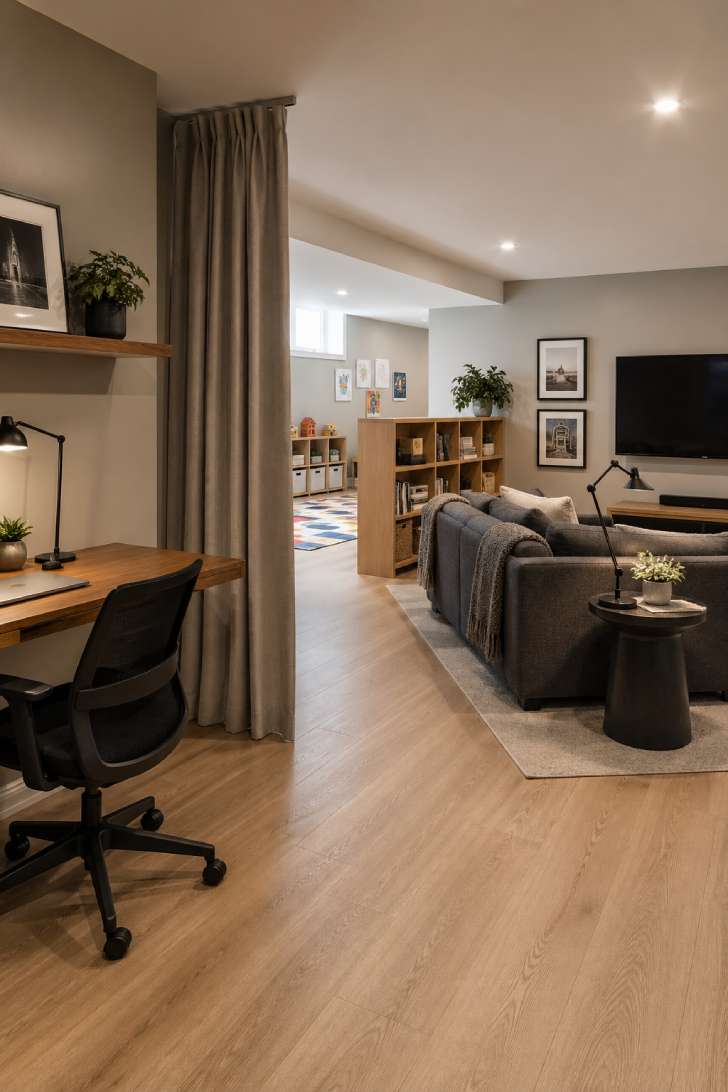
Most basements need to do more than one thing. The best ones do it without looking like a mess.
Zoning is the answer, and it doesn’t require building walls. A floor-to-ceiling curtain in a quiet neutral separates a workspace from the lounge area. A low bookcase creates a visual boundary between the adult living space and a kids’ play zone without blocking sight lines.
The floor is the thread that ties everything together. Keeping one consistent flooring material across all zones prevents the room from feeling chopped up. Light oak LVP works because it’s warm enough for the living area, practical enough for the play zone, and clean enough for the office.
Furniture scale is what makes or breaks a multipurpose basement. Each zone needs pieces that fit its footprint, not full-size office desks, not oversized sectionals. A slim wall desk, a compact two-seater sofa, a low storage unit. Smaller pieces create breathing room between zones, which is what makes each area feel intentional rather than squeezed in.
Style Blueprint:
- Slim walnut wall desk for office nook
- Floor-to-ceiling linen curtain as divider
- Compact two-seater sofa in charcoal flannel
- Low white oak bookcase as room divider
- Consistent light oak LVP flooring throughout
The Jewel-Toned Statement Room
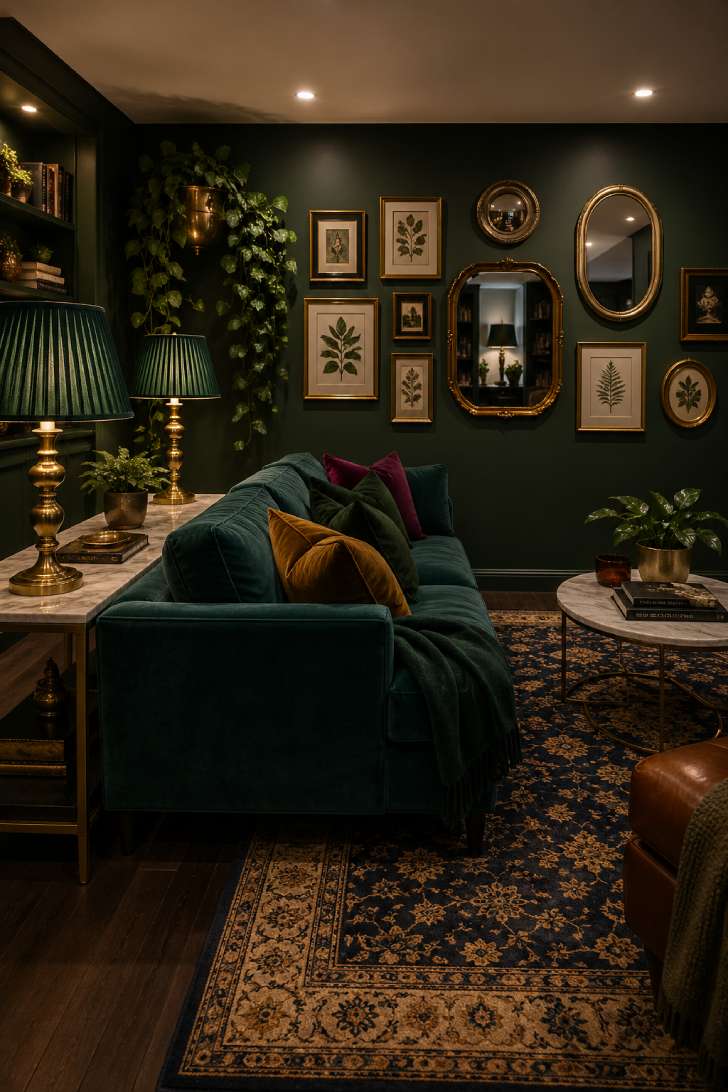
Playing it safe with color is the most common mistake in basement design.
A pale, neutral basement can work beautifully (see idea number one), but many homeowners default to beige or gray not because they love it, but because they’re afraid of making a dark room darker. The reality is that a confident jewel tone like emerald, teal, or deep plum can make a basement feel more like a real room than any safe neutral.
The effect works because saturated color creates its own visual energy. It doesn’t need sunlight to perform the way a pastel does. Emerald green is just as rich under lamplight as it is at noon, and the warmth of brass, gold, and amber fabrics glows against it in a way that feels almost magnetic.
A gallery wall in gold frames adds points of reflection throughout the room. Mixed with vintage mirrors, those frames bounce light in unpredictable directions, making the space feel more dynamic and alive than a single overhead fixture could.
Style Blueprint:
- Velvet sofa in deep teal or emerald
- Wall paint in rich emerald green
- Brass table lamps with silk shades
- Gold-framed gallery wall with botanical prints
- Vintage-inspired area rug in navy and gold
The Cozy Cottage Basement
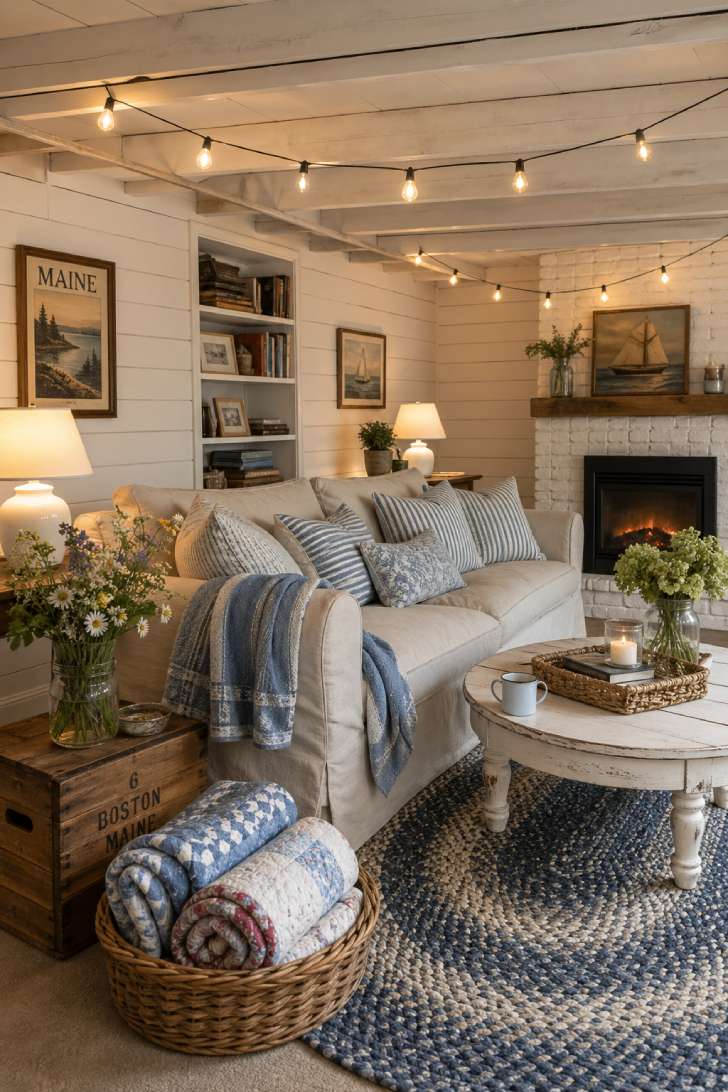
Cottage style works in a basement because it embraces imperfection.
Shiplap walls hide uneven concrete or old drywall patches behind a texture that reads as charming rather than unfinished. Whitewashed beams celebrate the ceiling structure instead of concealing it. Distressed furniture looks intentional rather than damaged. Everything about the style says, “This room doesn’t take itself too seriously,” and that relaxed attitude translates directly to how people behave when they’re in it.
The palette stays soft: whites, creams, faded blues, natural linen. These tones reflect light efficiently, which helps compensate for limited windows. Cotton and linen fabrics breathe well in a below-grade room that can sometimes feel stuffy, and they drape in a casual way that feels right for the aesthetic.
String lights along the ceiling beams are a small detail that does a lot of work. They add warmth, create a sense of enclosure (like a starlit porch), and draw the eye upward to the ceiling in a way that makes the room feel taller.
Style Blueprint:
- White-painted shiplap wall paneling
- Slipcovered sofa in natural unbleached linen
- Distressed white farmhouse coffee table
- Blue-and-cream braided oval rug
- Edison string lights along ceiling beams
The Minimalist Zen Space
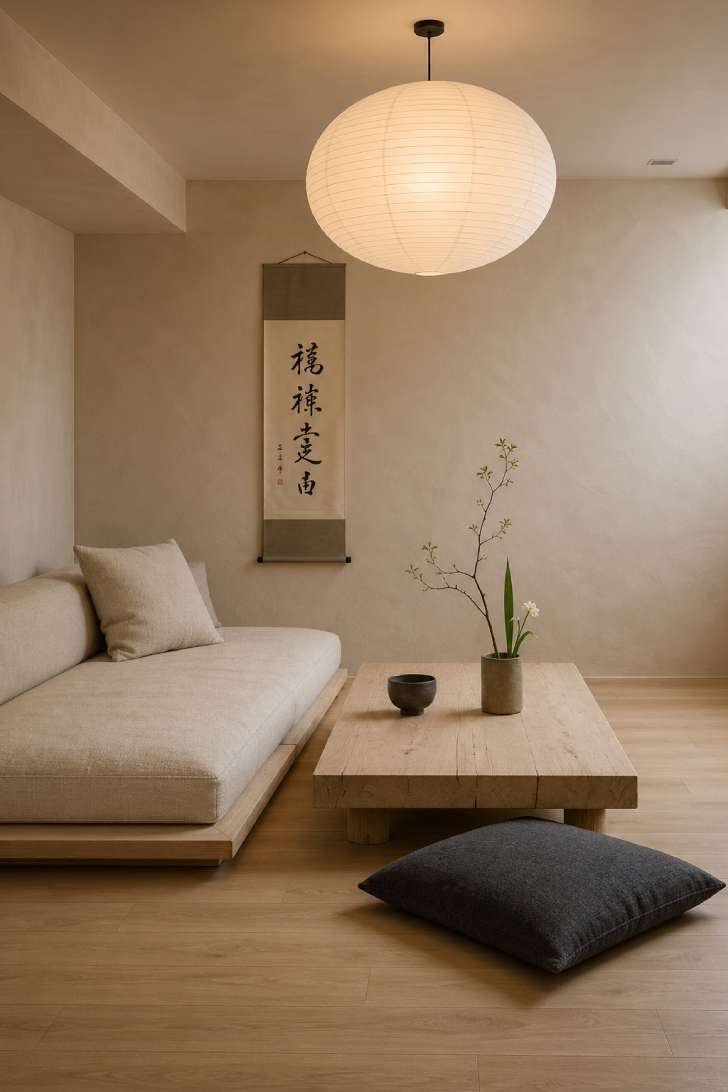
Less furniture means more air. In a basement, air is the most expensive commodity.
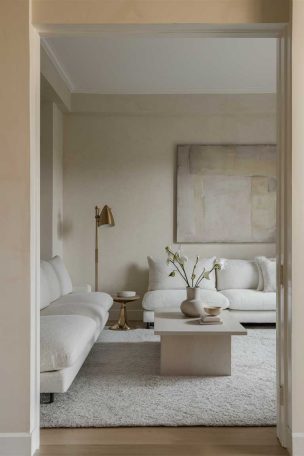
A minimalist approach strips the room down to its core needs: a place to sit, a surface for a cup of tea, and light to see by. Everything else goes. The result is a room that feels spacious regardless of its actual dimensions, because your eye can travel from wall to wall without being interrupted.
The Japanese concept of ma (negative space as a positive element) is particularly powerful underground. Leaving large sections of wall and floor empty gives the room a sense of calm that busy, heavily furnished spaces can’t achieve. The plaster walls, with their subtle hand-troweled texture, provide just enough visual interest to prevent the room from feeling sterile.
A paper lantern pendant handles the lighting challenge beautifully. It diffuses light in all directions, creates no harsh shadows, and its round shape softens the rectangular geometry of the room. One large lantern does the work of three or four recessed fixtures, with more character and warmth.
Style Blueprint:
- Low platform sofa in natural undyed cotton
- Raw pale wood slab coffee table
- Light bamboo-look LVP flooring
- Large round paper lantern pendant
- Minimal wall art (one statement piece)
Design Pro-Tip: Humidity is a basement’s invisible enemy. Before investing in any upholstered furniture, leather, or natural wood pieces, run a dehumidifier for a week and check the reading. Below 50% relative humidity is safe for most furnishings. Above 60%, and you’ll eventually see mold on fabric, warping in wood, and a musty smell that no amount of styling can cover. A good dehumidifier costs a fraction of replacing ruined furniture.
The Bold Accent Wall Basement
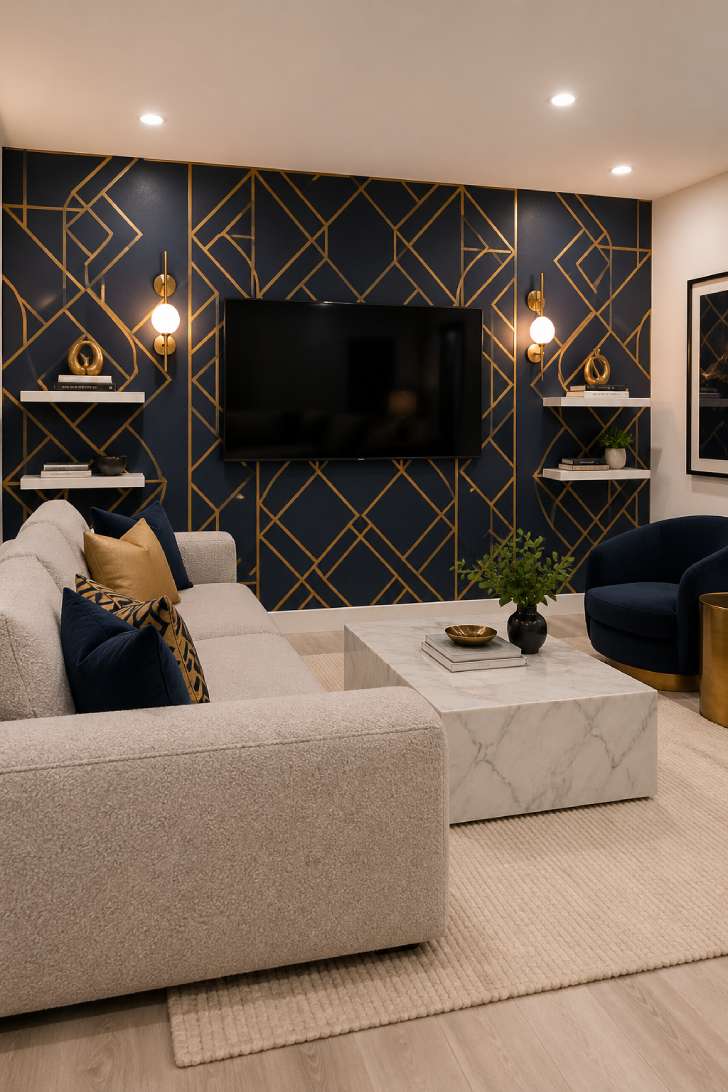
One bold wall is all you need.
The accent wall concept works so well in basements because it solves the focal-point problem and the visual-interest problem simultaneously. You don’t need to commit to dark walls on all four sides. One wall in a striking wallpaper or deep paint color gives the room its identity, while the remaining white walls keep the overall space feeling open and bright.
Large-scale geometric patterns in a two-tone palette (navy and gold, charcoal and cream, forest green and white) read as sophisticated rather than busy. The scale matters. Small, intricate patterns can make a wall look cluttered and visually noisy at close range. Larger motifs breathe, and they create a rhythm that feels intentional from across the room.
Mounting the TV directly on the accent wall integrates the screen into the design rather than fighting it. Flanking it with sconces and slim floating shelves frames the entire setup as a composed vignette, not just a screen on a wall.
Style Blueprint:
- Large-scale geometric wallpaper in navy and gold
- Light gray bouclé sofa
- White marble waterfall coffee table
- Brass wall sconces with frosted globes
- Whitewashed oak LVP flooring