This post may contain affiliate links. If you make a purchase through these links, we may earn a commission at no additional cost to you.
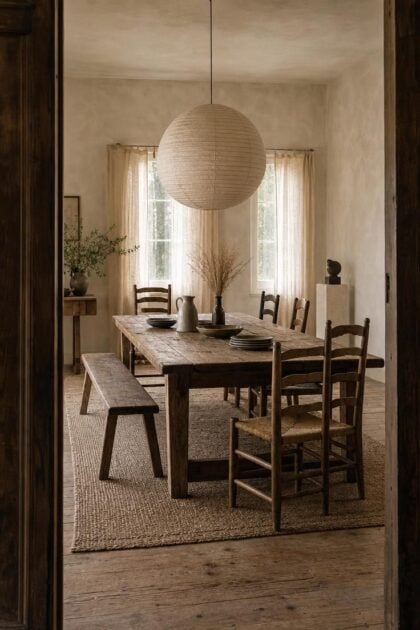
A wabi sabi dining room invites you to sit longer, eat slower, and notice the grain of the wood under your fingertips.
This Japanese philosophy finds beauty in imperfection, in the crack that tells a story and the surface that carries the memory of use.
Every idea here centers on materials left close to their natural state, objects shaped by hand rather than machine, and a quiet palette drawn from earth and stone.
These 10 rooms prove that a dining space needs honesty more than it needs polish.
A Live Edge Walnut Slab Table With Butterfly Key Joints
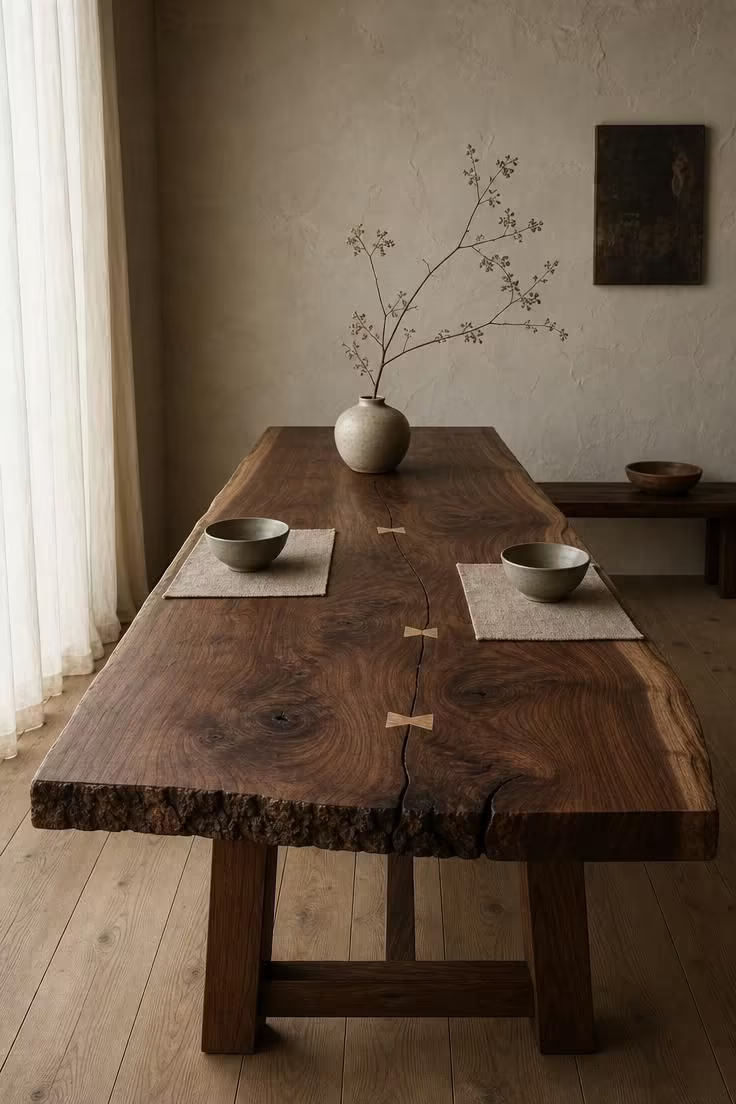
The live edge walnut slab is where a wabi sabi dining room begins, because nothing else in the space can compete with the authority of a raw wood surface.
That bark edge running the length of the table is not a decorative choice but a refusal to cut away what the tree actually looked like.
Butterfly key joints in a lighter maple or white oak fill cracks honestly, turning structural repair into visible craft.
A matte oil finish lets the grain stay touchable, without the plastic sheen of polyurethane that separates your hand from the wood.
Pairing this live edge dining table with simple linen placemats and unglazed stoneware keeps the focus where it belongs, on the slab itself.
Over time, the oil finish darkens unevenly, and that patina becomes the table’s autobiography.
Style Blueprint:
- Walnut slab, 2-3″ thick, with natural bark edge and matte oil finish
- Butterfly key inlays in contrasting maple or white oak
- Undyed flax linen placemats
- Hand-thrown ceramic bowls in warm gray
- Wide-plank oak flooring in matte natural finish
A Washi Paper Pendant Lantern Over a Low Cedar Bench
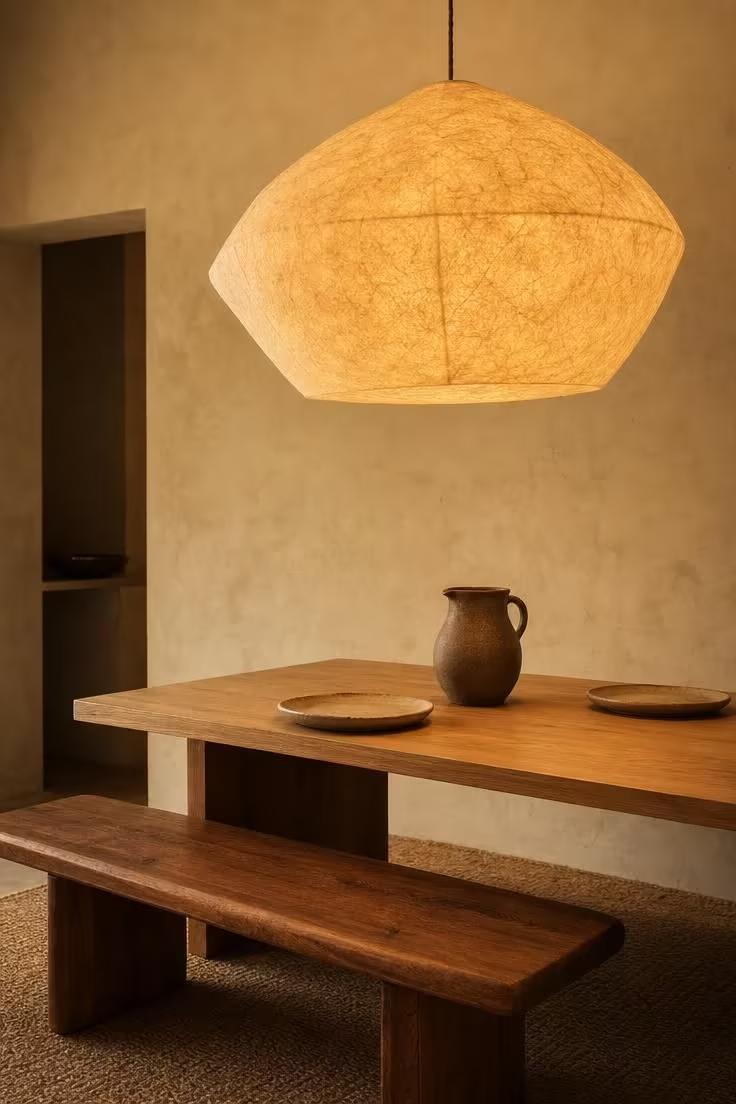
The washi paper pendant is one of those objects that looks almost too simple until you see it lit.
Handmade from mulberry bark fibers, the paper lets light pass through in a way that removes every hard edge from the room.
Shadows soften, faces look warmer, and the meal below the lantern feels more like a gathering than a routine.
A low cedar bench at 17 or 18 inches replaces standard dining chairs with something closer to the ground, which changes posture and pace.
You sit a little more deliberately on a bench this low, and that deliberateness carries into the conversation.
Cedar’s natural oils give it a faint woody scent that other dining furniture cannot offer.
Choosing a pendant this size, somewhere between 18 and 24 inches in diameter, gives the lantern enough presence to anchor the space without crowding it.
Style Blueprint:
- Washi paper pendant lantern, 18-24″ diameter
- Low cedar bench, 17-18″ seat height, with rounded edges
- Rectangular oak dining table with matte finish
- Woven jute rug beneath the table
- Warm-toned bulb at 2200K color temperature
Hand-Thrown Stoneware Place Settings on Raw Linen
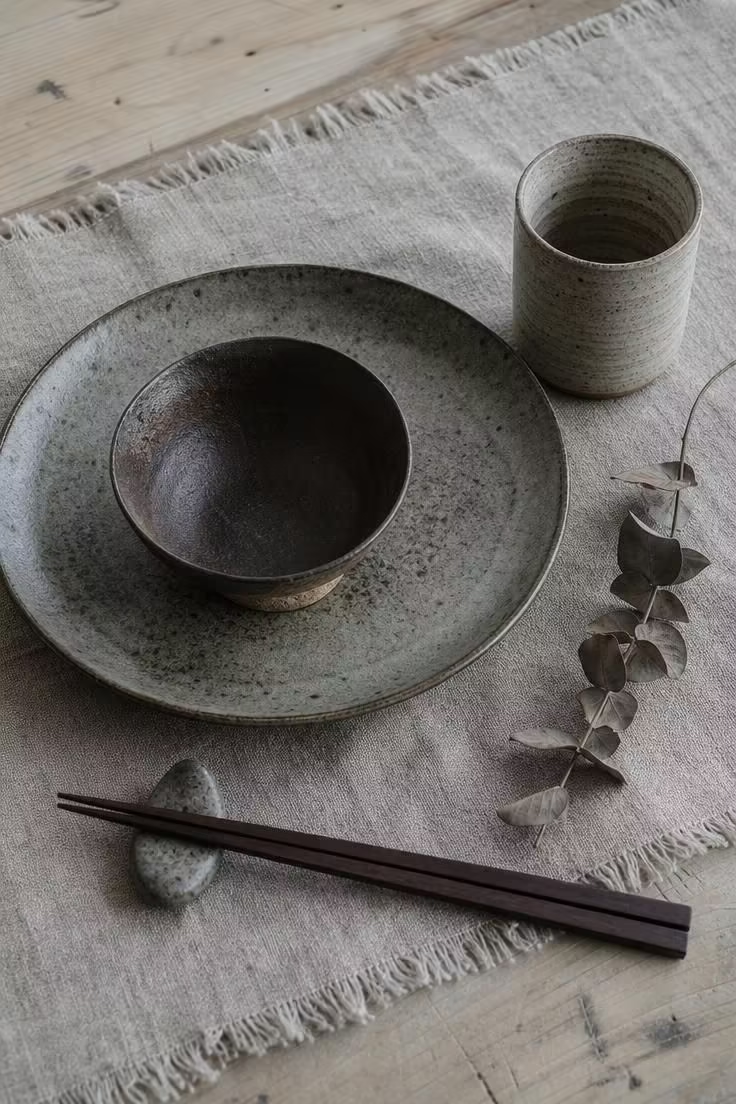
There is a particular satisfaction in picking up a ceramic bowl and feeling that it was made by someone’s hands, not stamped by a machine.
Ash-glazed stoneware carries a surface that shifts between gray, green, and brown depending on the angle of light hitting it.
No two pieces from the same kiln firing look exactly alike, which means your place settings have the kind of character that matched china never will.
The exposed clay foot at the base of each bowl is a deliberate choice, left unglazed to show the raw material beneath the surface.
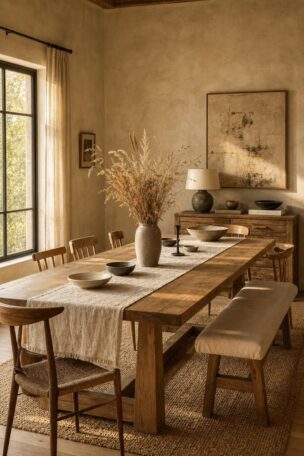
A linen table runner in undyed flax grounds these handmade ceramics with a textile that shares their philosophy of leaving things close to their original state.
Frayed edges on the runner are not sloppiness but a visual echo of the irregular rims on the pottery above.
Setting walnut chopsticks on a small ceramic rest adds a layer of intention without adding clutter.
This kind of place setting works because every piece earns its spot through texture, weight, and the quiet evidence of a human touch.
Style Blueprint:
- Stoneware dinner plate in ash glaze, 10-11″ diameter
- Smaller bowl in iron oxide glaze with exposed clay foot
- Ceramic tumbler in speckled oatmeal with visible throwing rings
- Undyed flax linen table runner with frayed edges
- Walnut chopsticks with ceramic rest
Lime-Washed Plaster Walls Behind a Farmhouse Trestle Table
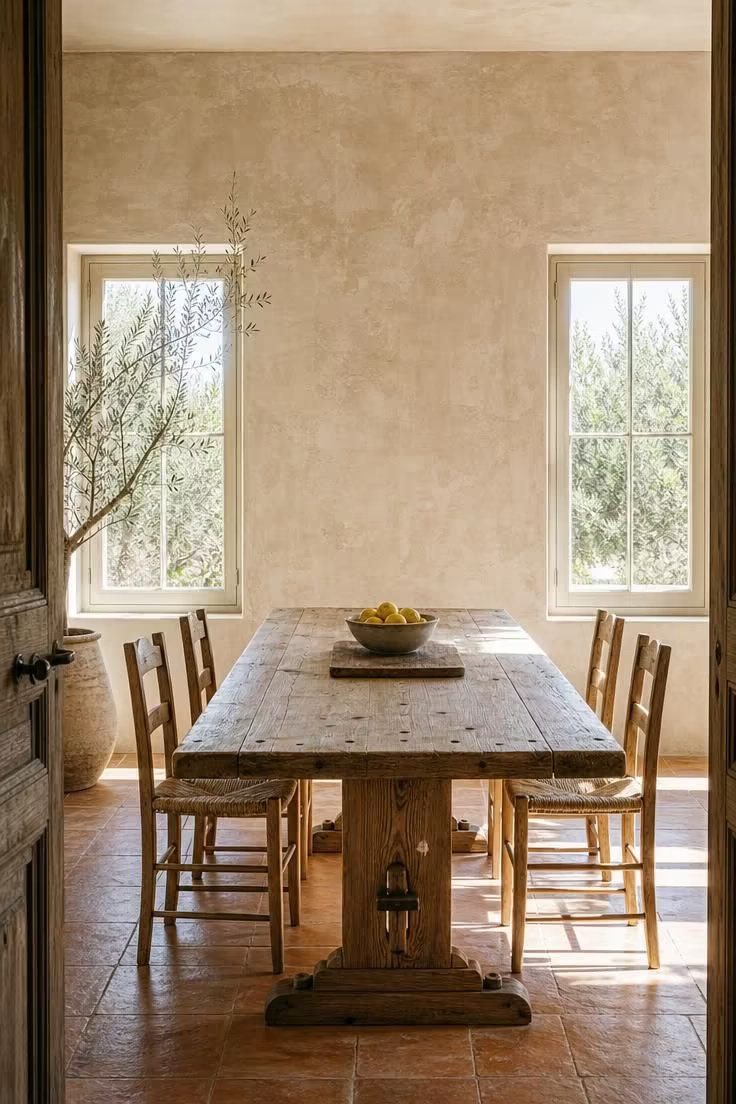
Raw plaster walls give a wabi sabi dining room something that paint never can, which is the sense that the wall itself has a surface worth touching.
Lime wash plaster in a warm putty or pale clay absorbs and reflects light differently across its trowel-marked surface, so the wall shifts in appearance as the day moves from morning to afternoon.
A farmhouse trestle table in reclaimed pine sits against this backdrop with the confidence of furniture that was built to last generations, not seasons.
Visible peg joinery and a lightly sanded top that still carries saw marks refuse to hide the table’s working history.
The pairing of earth tone palette walls with reclaimed wood creates a room that feels like it grew from the ground it sits on.
Terracotta tile underfoot completes the material story without introducing anything synthetic or sealed.
Style Blueprint:
- Lime wash plaster walls in warm putty or pale clay
- Farmhouse trestle table in reclaimed pine with peg joinery
- Rush-seat dining chairs in natural finish
- Terracotta tile flooring in matte unglazed finish
- Wooden cutting board and ceramic bowl for simple table decor
Design Pro-Tip: When applying lime wash, work in thin, overlapping layers rather than one thick coat. Each pass creates slightly different opacity, giving the wall a living depth that reads as naturally aged plaster instead of a single flat color.
Woven Rush-Seat Ladderbacks Around a Raw Oak Pedestal
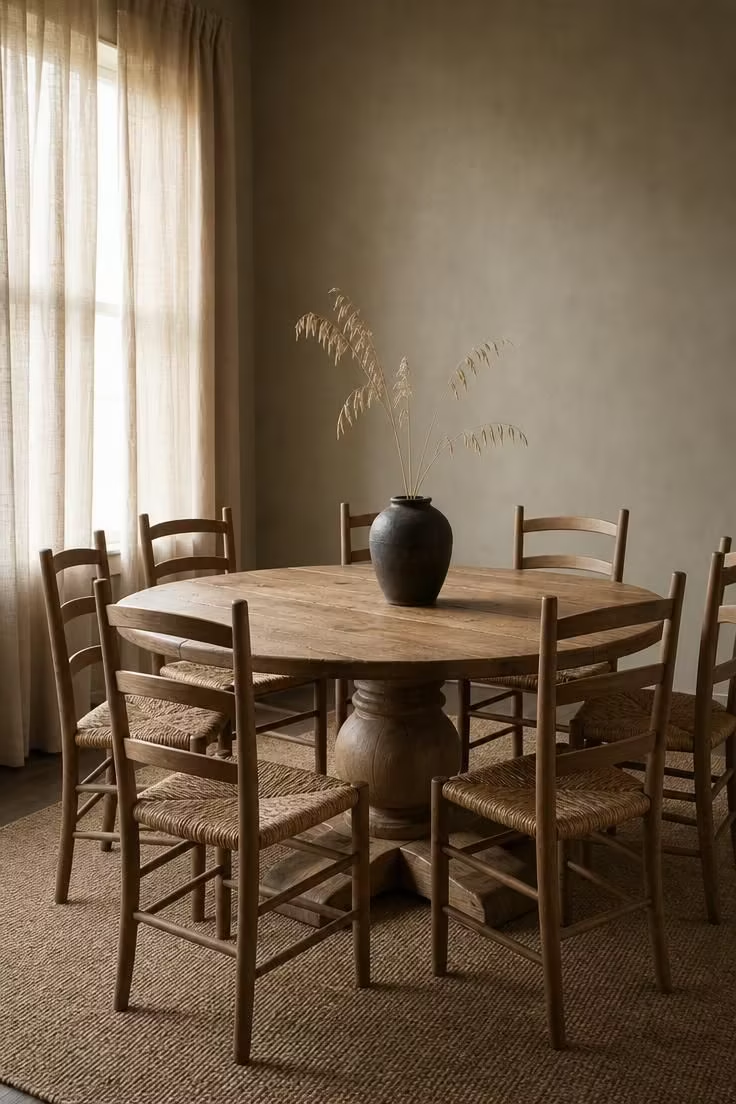
A round table changes the social geometry of a wabi sabi dining room in a way that rectangular tables cannot.
Everyone faces the center, no one sits at the head, and the conversation moves around the circle rather than splitting into sides.
The hand-planed oak top on this pedestal table has gentle undulations you can feel when you run your palm across it, proof that a blade rather than sandpaper shaped the surface.
Ladderback chairs in ash with hand-woven sea grass seats bring an organic modern dining quality to the room without leaning toward rustic kitsch.
The weave pattern on each seat is slightly irregular because human hands do not repeat themselves exactly, and that inconsistency is the point.
Leaving the oak pedestal unsealed or lightly oiled means it will darken and soften over years of meals, spills, and wiped-down surfaces.
A sisal rug under the table adds another layer of natural fiber that absorbs sound and softens the room’s acoustics.
Six chairs around a round table of this size leaves just enough room for elbows, plates, and the kind of comfortable closeness that makes dinner feel like an event worth showing up for.
This arrangement works because every element, from the rush seats to the open-grain oak, tells the same story of materials valued for their honesty.
Style Blueprint:
- Round raw oak pedestal table with hand-planed top, 54-60″ diameter
- Ladderback chairs in ash with hand-woven sea grass rush seats
- Stoneware vase in dark charcoal, 6-8″ tall
- Sisal rug in tight natural weave
- Sheer flax linen curtain panels for diffused light
Iron Candelabra and Beeswax Tapers on a Slate Slab
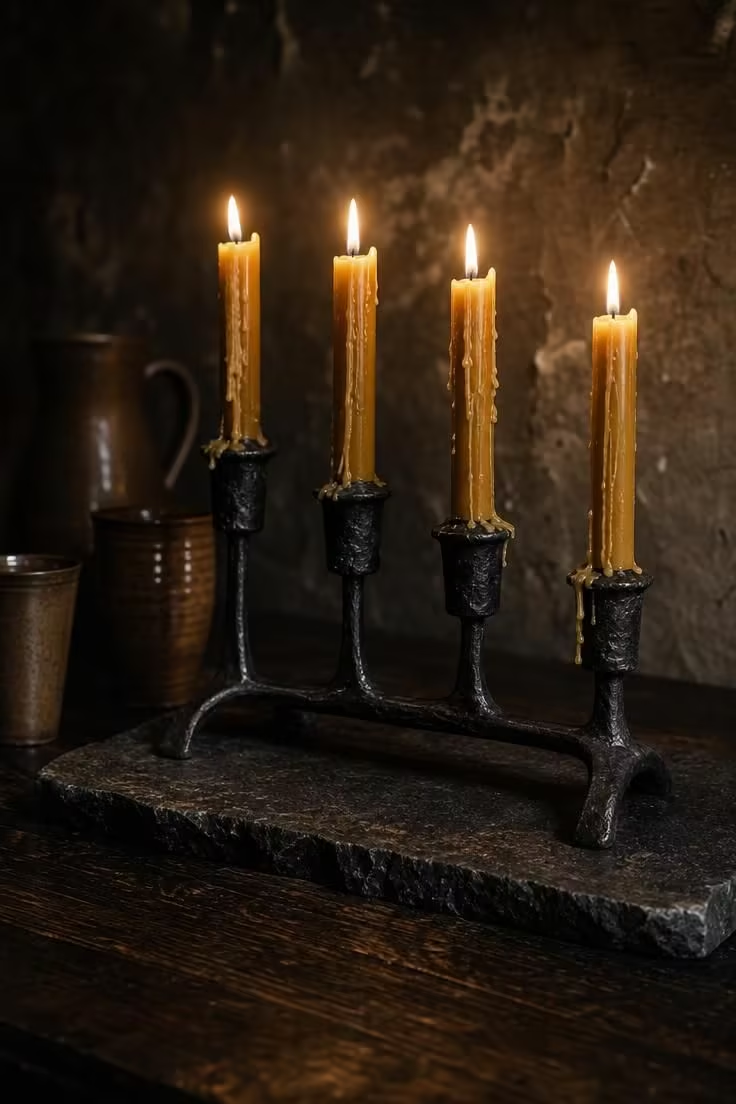
Beeswax burns with a warmer, more golden light than paraffin, and that small difference changes the entire atmosphere of a dinner table.
A hand-forged iron candelabra carries the marks of its making in every dent, ridge, and uneven curve of the metal.
The wabi sabi decor philosophy prizes this kind of object because it refuses the uniformity of factory production.
Setting the candelabra on a thick slate slab with chipped, raw edges gives it a stage that matches its character, hard material made soft by imperfection.
As the beeswax tapers burn down through an evening, the drips that trail over the iron holders become part of the object’s evolving shape.
This is wabi sabi at the dinner table in its most direct form, light and material changing together in real time.
A pair of stoneware tumblers nearby picks up the warm amber glow, and the whole scene feels like it belongs to a slower century.
Style Blueprint:
- Hand-forged iron candelabra in matte black with visible hammer marks
- Beeswax taper candles in natural honey tone
- Slate serving slab, approximately 12×18″, with raw chipped edges
- Dark oak tabletop as the surrounding surface
- Stoneware tumblers and ceramic pitcher in muted brown
Dried Foxtail Grass in a Salt-Glazed Ceramic Bottle
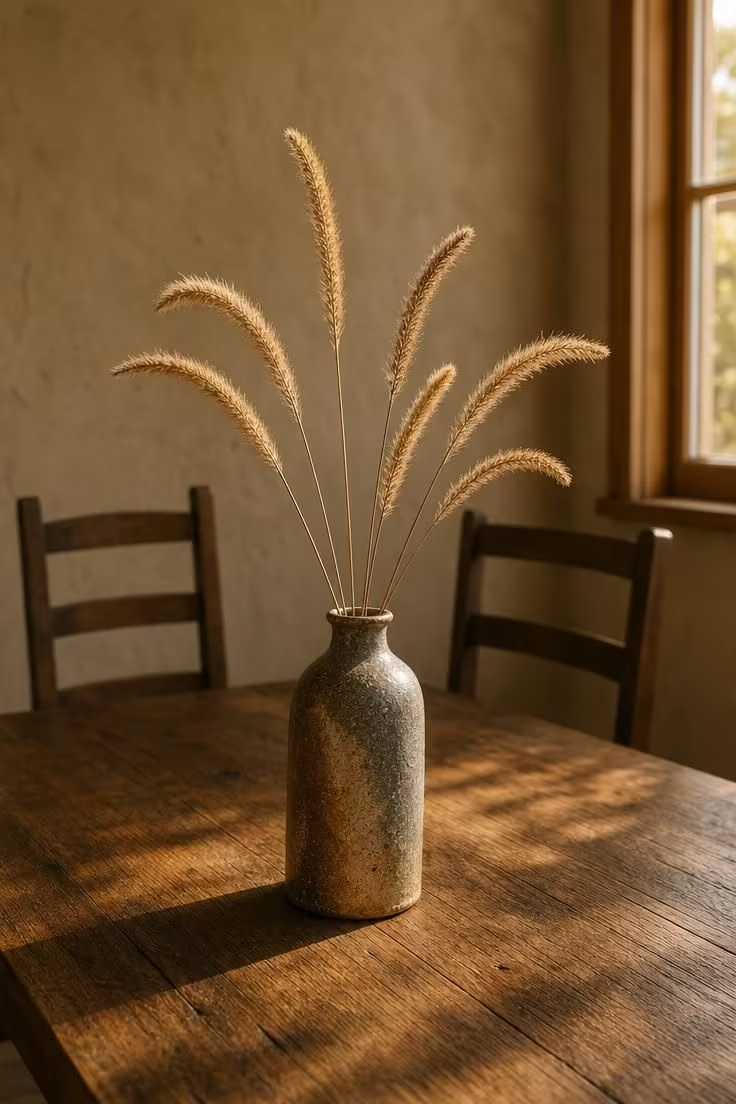
A single ceramic bottle with a few stems of dried grass is the wabi sabi answer to the question of what belongs at the center of a dining table.
The salt-glazed surface on this bottle is unpredictable by nature, because the sodium vapor from salt thrown into the kiln lands differently on every piece.
Some areas glaze smooth and glossy, others stay rough with an orange-peel texture, and patches of ash leave brown and amber deposits that look like weathering.
Foxtail grass or dried oat stalks bring the outdoor landscape indoors without the maintenance or the artifice of fresh-cut flowers.
When the light hits those seed heads at an angle, the shadows they cast across the table surface become a second, shifting centerpiece.
Leaving the rest of the table empty around this single vessel is what separates wabi sabi decor from conventional styling, where the impulse is always to add more.
A Japanese dining room tradition of single-object arrangements, called chabana, informs this approach to centerpiece design.
This spare arrangement also makes clearing the table for dinner a matter of moving one object rather than an entire display.
Style Blueprint:
- Salt-glazed ceramic bottle, 8-10″ tall, with orange-peel texture and ash deposits
- Dried foxtail grass or oat stalks, 5-6 stems
- Reclaimed elm table surface with hand-rubbed wax finish
- No additional table decor near the centerpiece
- Raw plaster wall backdrop in warm sand
Design Pro-Tip: Rotate your dried botanical arrangement with the seasons. Foxtail grass and oat stalks work through summer and fall, bare dogwood branches suit winter, and dried pussy willow or chamomile carry spring. This rotation keeps the centerpiece from becoming invisible through familiarity.
A Kintsugi Serving Bowl on Floating Black Iron Brackets
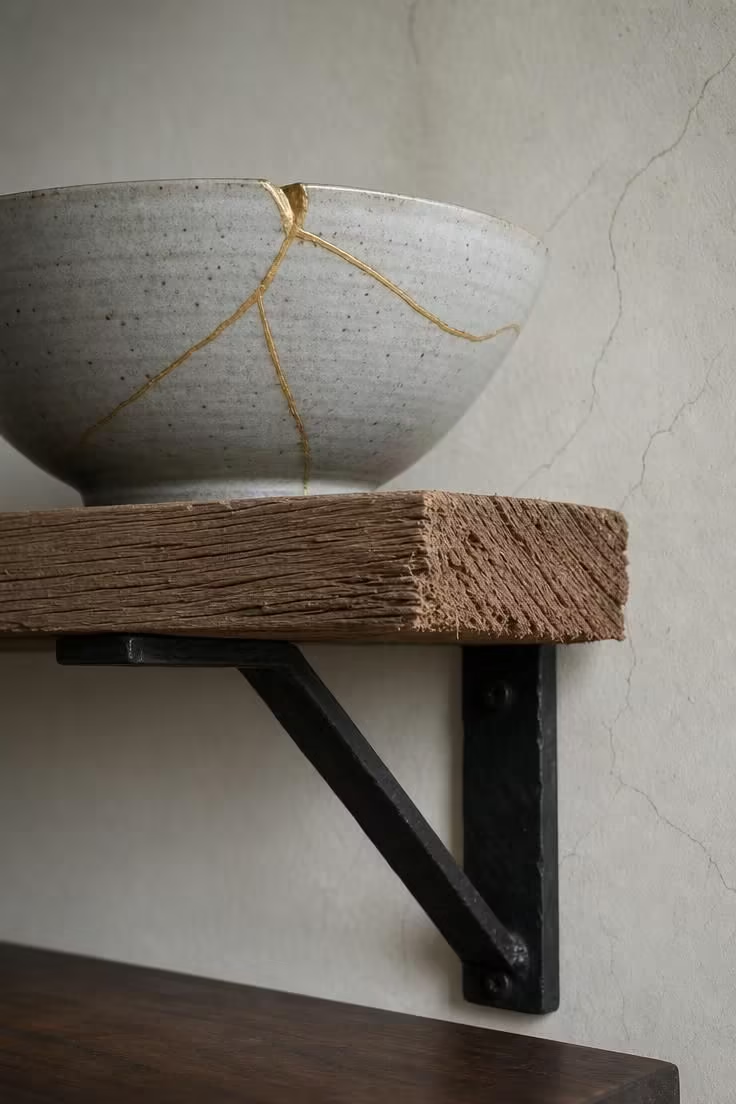
Kintsugi treats damage as part of an object’s history rather than a reason to throw it away.
The gold lacquer filling each crack in this stoneware bowl turns a break into a bright seam that draws the eye instead of hiding the repair.
Displaying a kintsugi piece on a floating shelf at eye level means it becomes something you notice every time you sit down at the dining table.
The rough-sawn cedar shelf and matte black iron brackets keep the display honest, avoiding the gallery-like preciousness that would contradict the philosophy behind the bowl.
This is a natural wood furniture approach to display, where the shelf itself carries as much texture as the object it holds.
Style Blueprint:
- Kintsugi repaired stoneware bowl in gray-white, approximately 10″ diameter
- Gold urushi lacquer repair lines
- Floating shelf in rough-sawn cedar, 24-30″ long
- Matte black hand-welded iron brackets
- Off-white plaster wall backdrop
Hand-Scraped Wide-Plank Hickory Floors Under a Slab Bench
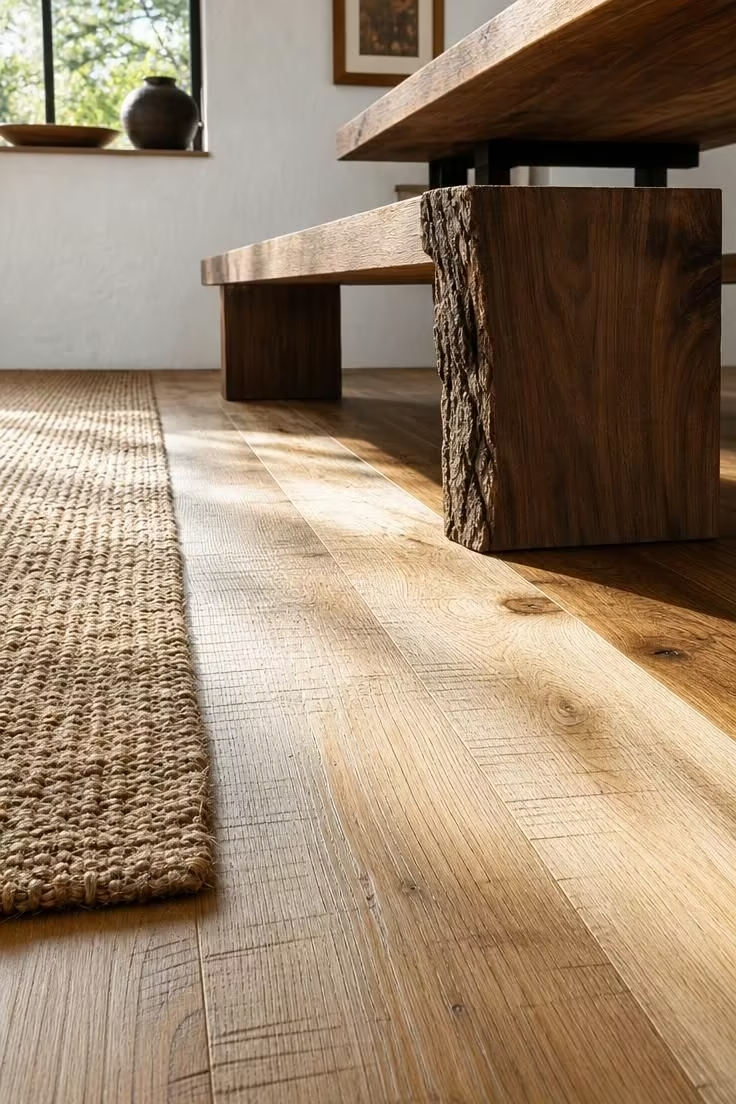
The floor in a minimalist dining room rarely gets the attention it deserves, which is a missed opportunity in a wabi sabi space where every surface should invite touch.
Hand-scraped hickory planks carry a texture you can feel through your socks, with shallow ridges and valleys that catch light in a way machine-sanded floors never will.
Hickory’s natural color variation, from pale cream to warm caramel within the same board, creates visual movement without any stain or dye.
A matte finish with a soft, chalky quality lets the wood breathe and age without the artificial protection of high-gloss sealant.
Over years, these floors develop wear patterns around the dining table legs and under the bench that record the room’s daily life.
A slab bench with a bark-edged leg connects the furniture directly to the floor in material and spirit, both honest wood left close to its original form.
The wide plank width at 7 to 9 inches gives each board enough surface area to display its individual grain pattern as a distinct piece of the larger floor.
Style Blueprint:
- Hand-scraped hickory planks, 7-9″ wide, in natural color variation
- Matte polyurethane or hardwax oil finish with chalky quality
- Slab dining bench in walnut with bark-edge leg
- Woven jute floor runner alongside the bench
- Simple white plaster walls for contrast
Sheer Flax Panels Framing a Courtyard Through Arched Windows
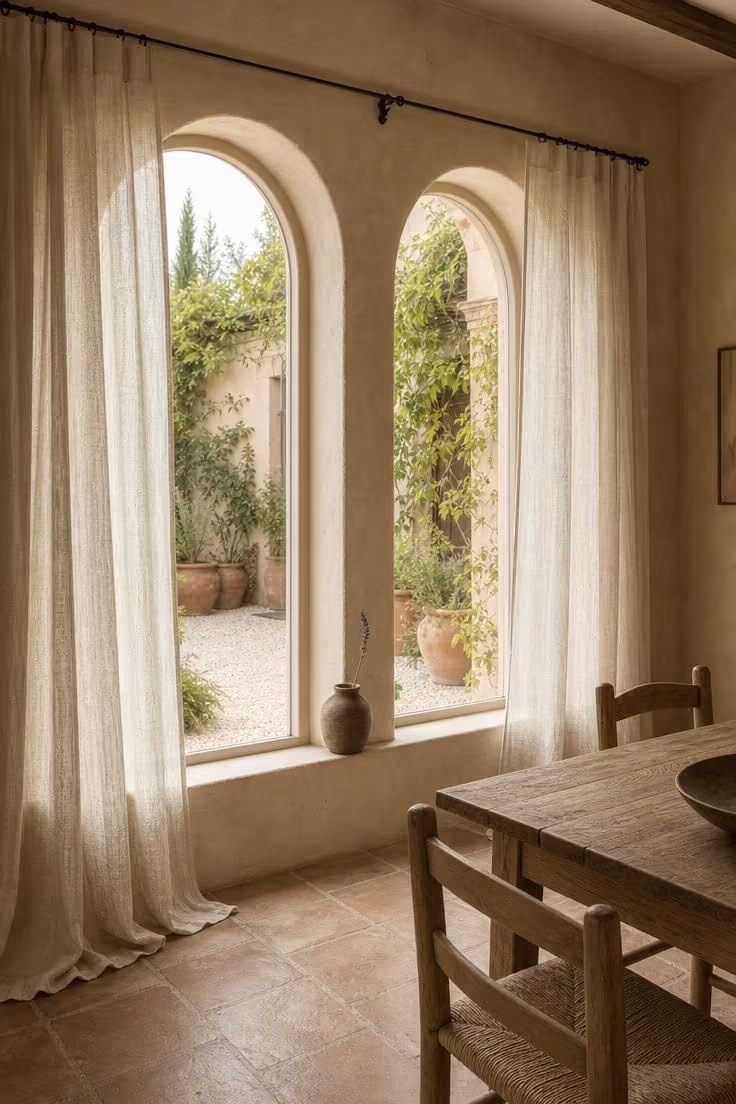
The boundary between inside and outside matters deeply in wabi sabi spaces, and sheer flax panels are the gentlest way to manage that boundary.
Flax linen in its natural off-white state filters sunlight without dimming the room, turning direct glare into a soft, even glow that reaches every corner.
Arched windows add a curved geometry that softens the rectangular lines of walls, tables, and shelving, giving the room a more organic feel.
The slight pooling of fabric on the floor is deliberate, suggesting relaxed abundance rather than precise measurement.
Looking through these panels toward a courtyard with terracotta pots and climbing greenery connects the earth tone palette inside to the living landscape outside.
A wrought iron curtain rod with minimal hardware keeps the window treatment honest and avoids the fussiness of decorative finials or gathered valances.
Style Blueprint:
- Sheer flax linen panels in natural off-white, floor length with slight pooling
- Wrought iron curtain rods with simple rings
- Arched windows with raw plaster surrounds in warm cream
- Terracotta tile flooring extending to the window wall
- Small ceramic vase on windowsill for a single botanical accent
Design Pro-Tip: Hang your curtain rod 4 to 6 inches above the window frame rather than directly on it. This draws the eye upward, makes the ceiling feel taller, and gives sheer panels more vertical drape, which improves the way light filters through the fabric.
Conclusion
A wabi sabi dining room does not ask you to buy a matching set of anything.
It asks you to find a table with a surface worth running your hand across, chairs that settle into the body instead of forcing it upright, and light that softens rather than exposes.
Every idea here, from the live edge walnut slab to the sheer flax panels, shares one thread: materials left honest and surfaces allowed to carry the marks of time.
Start with one piece that was clearly made by hand, whether that is a stoneware bowl or a linen table runner with frayed edges, and let it set the tone for everything that follows.
The room will build itself around that first honest object.