This post may contain affiliate links. If you make a booking or purchase through these links, we may earn a commission at no additional cost to you.
Traditional eclectic decor is less a matched look than a deliberate conversation between old and new.
A classic wood sideboard can sit beside a mid-century accent chair, and a Persian-style rug can carry a modern abstract painting on the wall above it.
The warmth readers respond to usually comes from a few quiet decisions, such as a repeated color, a repeated metal, or one strong anchor piece, rather than from filling every surface.
Each idea here pairs a specific composition with the materials, finishes, and collected objects that make it read as intentional.
Expect to see where contrast helps, where editing matters, and how a single room can hold several eras without feeling like a showroom.
A Camelback Sofa Under a Gallery of Mixed-Era Portraits
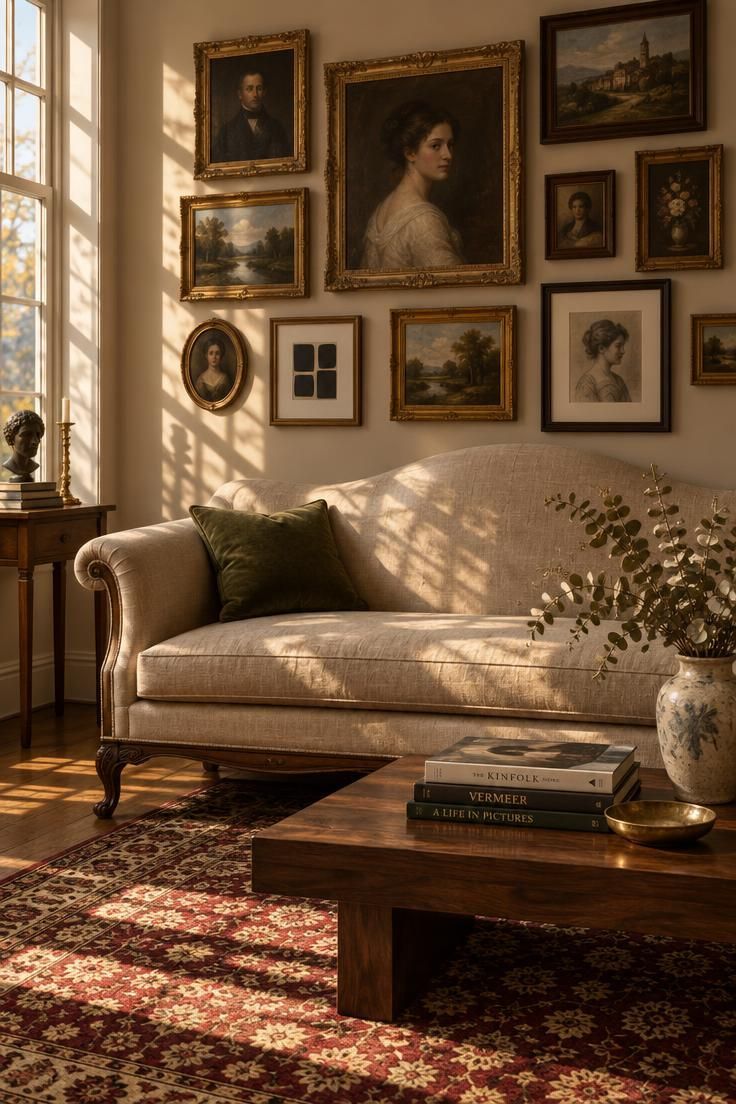
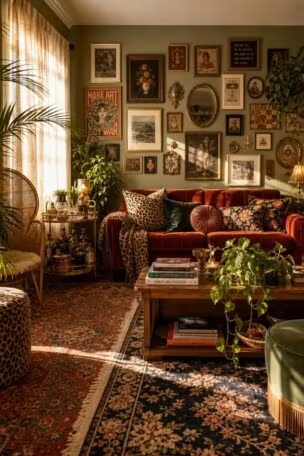
A camelback sofa brings a formal, familiar silhouette to the room, and the mixed portrait wall above it supplies the collected quality that defines traditional eclectic style.
Variation in frame size and finish keeps the arrangement from reading as a matched set, while consistent hanging gaps and a shared midline hold it together.
Carrying one tone, oxblood or olive or navy, through the rug, a cushion, and a single frame mat gives the eye a thread to follow.
The low, wide coffee table matters here, since a tall table would interrupt the travel from sofa to wall.
A dense gallery invites dust on frame tops and glass, so a soft brush and occasional glass cleaner keep the arrangement legible.
A wall that looks crowded in person often looks right at a distance, which is why removing two frames before adding one tends to improve the result.
One modern abstract among the portraits prevents the wall from reading as a period room.
Add mixed patterns through a pair of small accent cushions on the camelback sofa, using a stripe and a faint plaid that share one color with the portrait wall.
Style Blueprint:
- One traditional anchor, such as a camelback or Chesterfield sofa in a solid, slightly formal silhouette
- A gallery wall mixing portrait formats, frame styles, and eras rather than one matched set
- A repeated color thread, such as oxblood, olive, or navy, echoed in the rug, a cushion, and one frame mat
- A low, wide coffee table so the eye travels from sofa to wall without interruption
Design Pro-Tip: Hang the largest frame first at a comfortable viewing height, then build outward in both directions so the gallery stays balanced even if you add pieces later.
A Persian-Style Rug Layered Over a Worn Jute Base
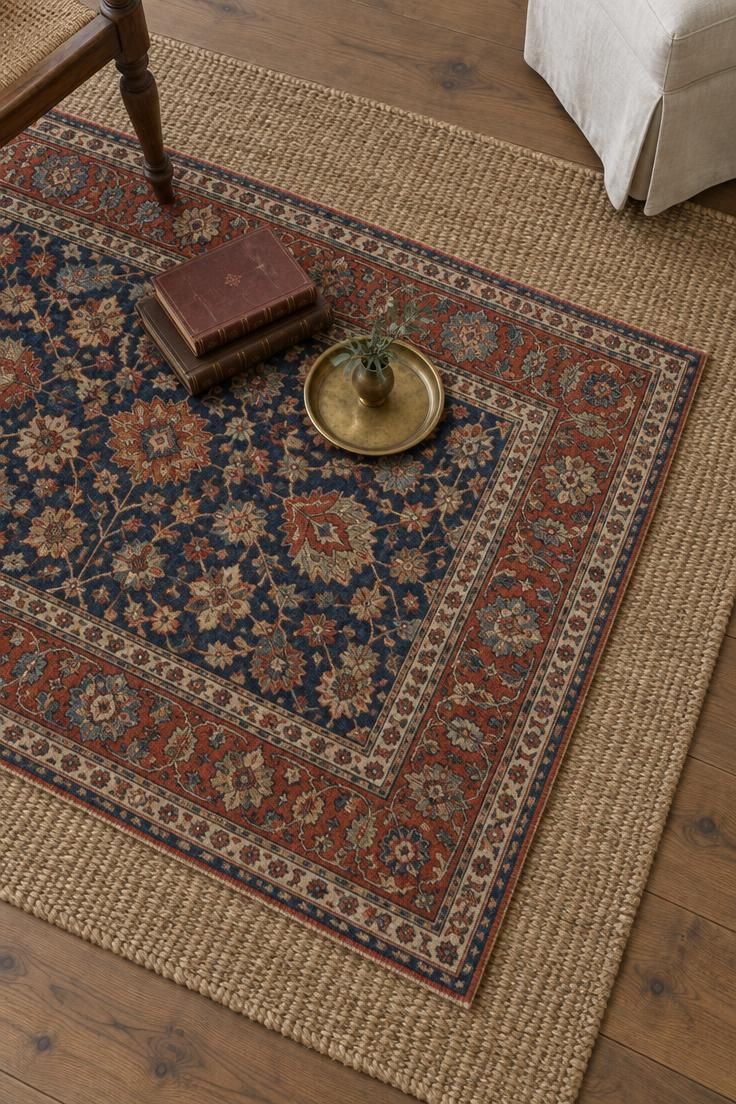
Layering rugs gives a floor both quiet and pattern, since the neutral base settles the room while the traditional motif on top supplies color and detail.
A visible margin of the base rug on all sides signals that the layering is intentional rather than accidental.
At least one shared color between the two rugs and the upholstery keeps the pairing from splitting into two separate schemes.
Low-pile or flatweave choices work well where the layered edge sits under furniture legs, since a thick pile can create a visible ridge.
Two rugs also mean two cleaning routines, and grit works its way between the layers over time.
Lifting the top rug periodically to vacuum underneath and check for dye transfer is worth the effort.
A slightly faded vintage rug over a crisp new jute creates a productive old-meets-new tension.
In a compact room, one patterned rug with a jute border achieves a similar effect with less visual weight, and two strong patterns of similar scale will compete, so choose one dominant motif and one quiet texture.
Layered rugs work best when the base is quiet and the top carries the pattern.
Style Blueprint:
- A larger neutral base rug in jute, sisal, or flatweave wool
- A smaller patterned rug in a traditional motif, placed straight or at a slight angle
- A visible margin of the base rug on all sides so the layering reads as intentional
- At least one color shared between the two rugs and the upholstery
- Low-pile or flatweave choices where the layered edge sits under furniture legs
A Wood Sideboard Displays Collected Ceramics and Brass Candlesticks
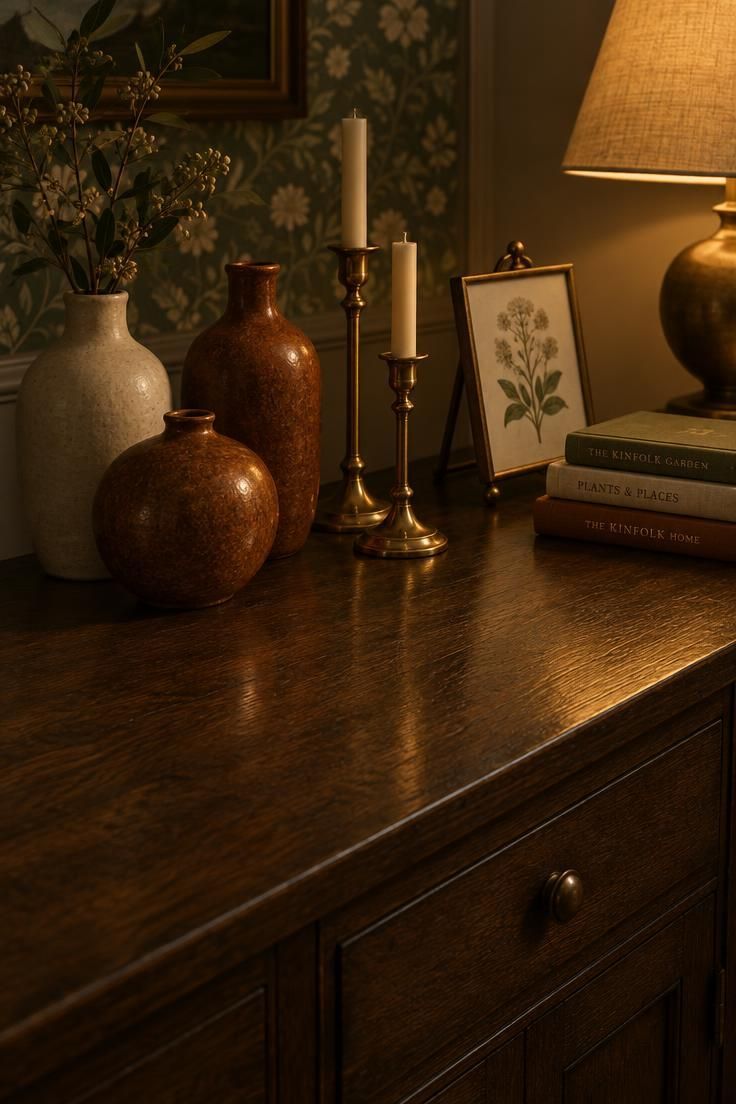
A traditional wood sideboard gives collected objects a stable stage, and the grouping on top supplies the eclectic layer.
Odd-numbered arrangements read as composed because the eye settles on a centerpiece and two flanking objects rather than scanning a row.
Material contrast does most of the work here: matte ceramic against polished brass against wood grain adds depth without introducing more color.
Leaving at least a third of the surface empty lets the display breathe, and that margin often matters more than the objects themselves.
Brass can be polished or allowed to patina, but the choice looks better when it stays consistent across the house.
Open displays require regular dusting, especially on ceramic shapes with carved or fluted detailing and the cups of candlesticks.
A very small object on a wide sideboard can look stranded, so grouping it with a taller piece or a stack of books gives it company.
Rotating two or three objects seasonally refreshes the display without a full restyle.
Style Blueprint:
- One traditional wood sideboard as the anchor surface
- A curated grouping of ceramics, brass, and one framed piece rather than a spread of small objects
- A repeated metal, such as brass or unlacquered bronze, tying the display together
Design Pro-Tip: Before settling a sideboard display, step back and check it from across the room; objects that seem fine up close often reveal uneven spacing or a missing vertical element from that distance.
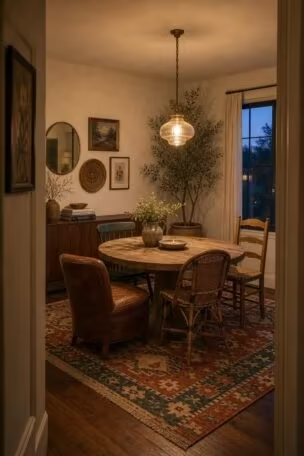
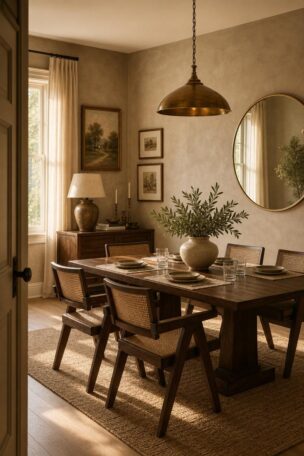
Mismatched Wood Dining Chairs Around a Pedestal Table
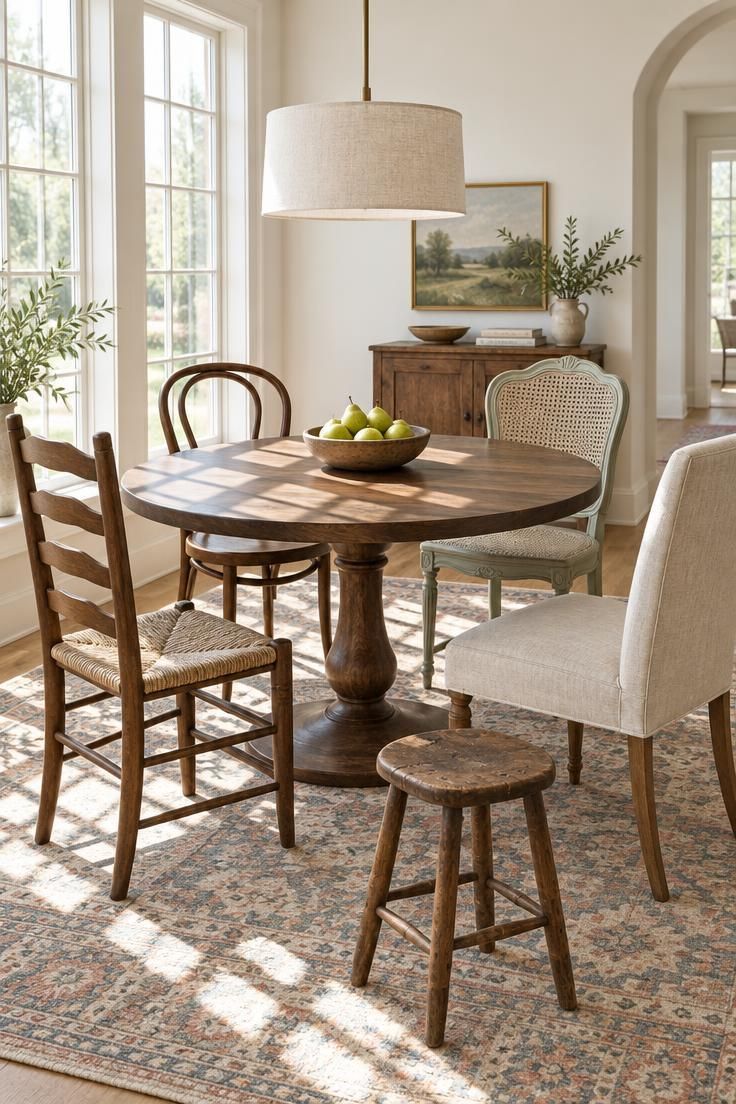
Mismatched chairs around a classic table are one of the clearest expressions of traditional eclectic decor, since the table stays formal and grounded while the seating supplies the sense of accumulation.
Chairs from at least three different eras or finishes create the mix, though shared seat height and depth keep the group usable.
A repeated material or color across the chair mix, all wood or one shared cushion fabric, supplies the cohesion that keeps the variety from turning into noise.
Painting two of the mismatched chairs the same color creates a repeated thread that reads immediately.
At least one upholstered chair softens the group and gives a longer meal a comfortable seat.
Five chairs around a round table usually reads more deliberate than six crowded ones.
Wooden chair joints and cane seats need occasional tightening and gentle cleaning, and upholstered seats need spot care when spills happen.
Style Blueprint:
- One classic table, such as a pedestal, farmhouse, or trestle, as the traditional anchor
- Chairs from at least three different eras or finishes, unified by a shared seat height
- A repeated material or color across the chair mix, such as all wood or one shared cushion fabric
- A rug or floor finish that ties the varied wood tones together
A Wallpapered Accent Wall Behind a Wingback Reading Corner
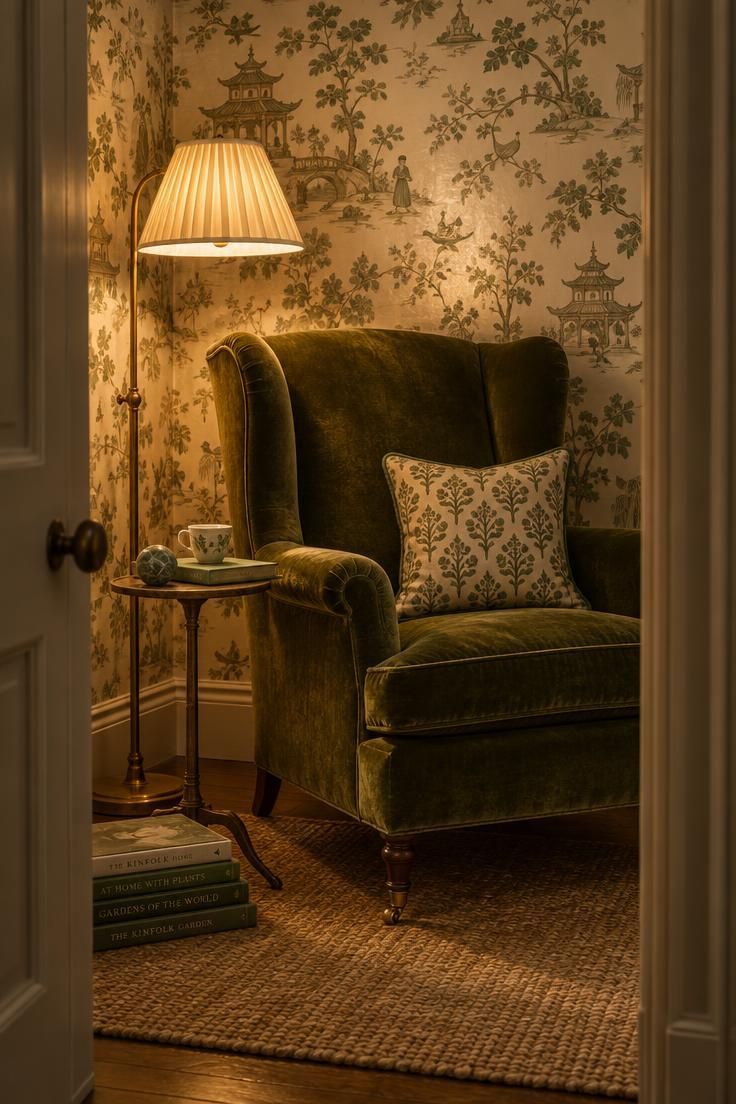
A wingback chair in a solid velvet against a patterned wall reads as calm because the chair becomes a visual resting place within the pattern.
Chinoiserie, block print, or toile works as a backdrop when it stays on one wall rather than covering the whole room.
A floor or table lamp with a fabric shade warms the corner and makes it usable after dark, and a small side table holding a lamp, a book, and one collected object keeps the composition tight.
Pulling one color from the wallpaper into the chair, a cushion, or the rug ties the pieces together without extra effort.
Wallpaper on a single wall is easier to change than a full room, though a strong motif still commits the corner to a mood.
Removable wallpaper and a freestanding lamp allow the same composition in a rental.
A patterned wallpaper behind a patterned chair creates competition, so choose one to lead, and a modern abstract print on the wallpaper wall bridges the traditional motif and a contemporary eye.
Style Blueprint:
- A patterned wallpaper on one wall, such as chinoiserie, block print, or toile, used as a backdrop rather than a whole-room scheme
- A traditional wingback or club chair in a solid, contrasting upholstery
- A floor or table lamp with a fabric shade to warm the corner
- A small side table holding a lamp, a book, and one collected object
- One repeated color pulled from the wallpaper into the chair, cushion, or rug
Design Pro-Tip: Before committing to an accent wall, tape up a large sample of the wallpaper and live with it for a few days, because pattern that reads as subtle in a small swatch can feel much bolder at full scale.
A Collected Bookshelf with Blue-and-White Porcelain and Vintage Globes
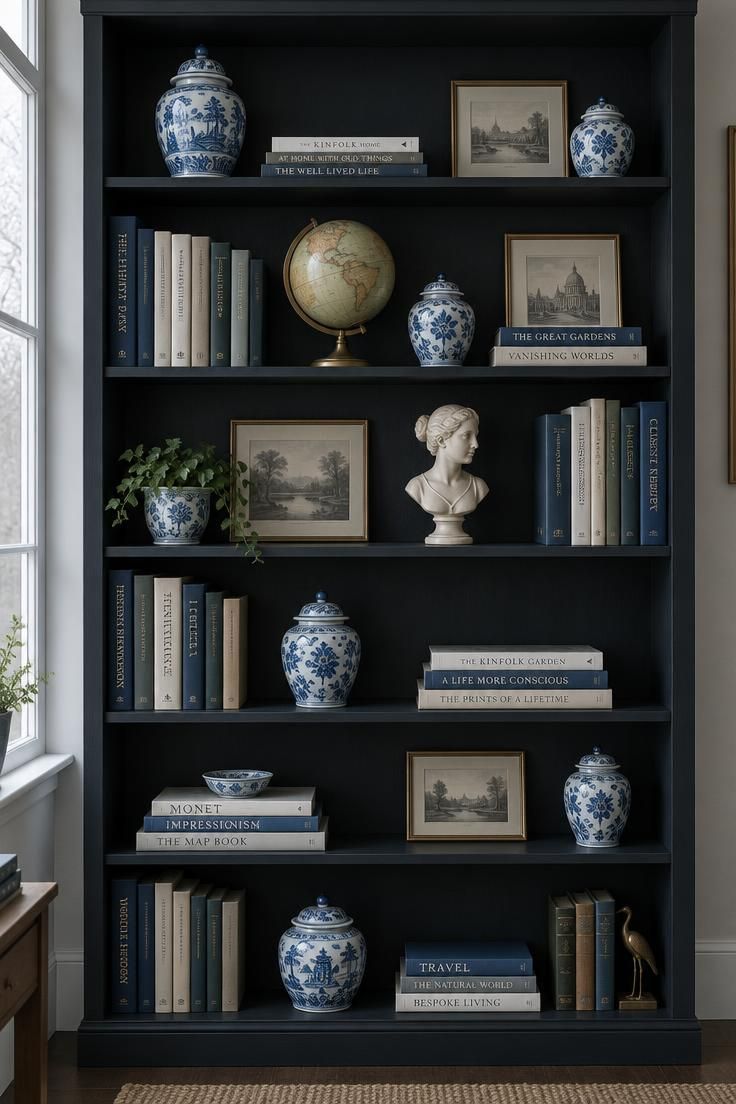
A repeated collection is what turns a bookshelf from storage into a display, since a known motif across multiple shelves reads as curatorial rather than incidental.
Blue-and-white porcelain, vintage globes, or brass objects all work, and picking one theme keeps the shelves from becoming a jumble.
Shelf density matters as much as the objects: mixing horizontal book stacks with vertical rows and leaving some negative space gives the eye places to rest.
Vintage and antique mixing shows up naturally here, since an old globe beside a new ceramic jar reads as accumulated over time.
Open shelving needs regular dusting, while glass-front shelves reduce dust but hide the texture that makes the collection worth showing.
Dense styling looks rich in a photograph but can be impractical for everyday access to books.
A single tall narrow shelf carries the same idea in a compact footprint.
Style Blueprint:
- An open or glass-front bookshelf as the display frame
- A collection theme, such as blue-and-white porcelain, vintage globes, or brass objects, repeated across shelves
- Deliberate variation in shelf density so the eye has places to rest
A Velvet Slipper Chair Beside a Block-Print Cushion Bench
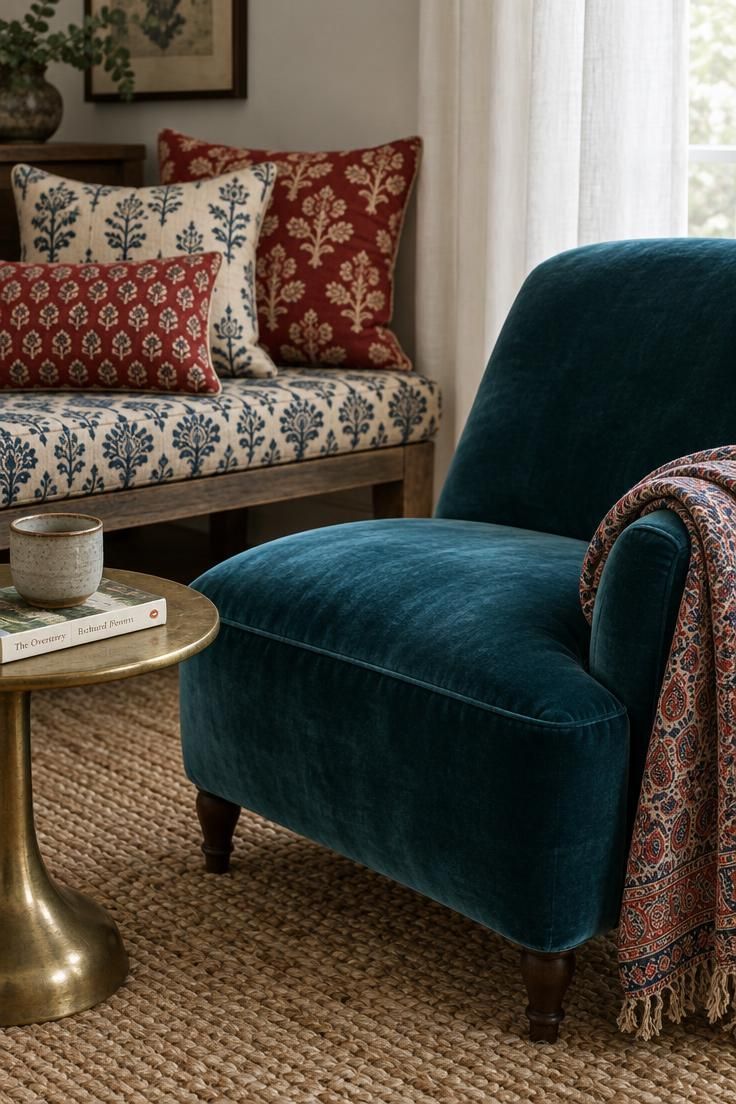
Velvet beside block print works because the sheen of one contrasts with the matte cotton of the other, giving the eye both richness and texture in a small area.
A jewel-tone velvet piece acts as the color anchor, and the cushions in a contrasting but related palette build on it; a patterned throw can bridge the two when the cushion palette and the velvet feel disconnected.
Velvet benefits from occasional brushing with a soft garment brush, following the nap direction.
Strong jewel tones commit the room to a specific mood, and a neutral throw or cushion can dial the intensity down without undoing the scheme.
A slipper chair is low-backed and reads best with a low bench or ottoman rather than a tall piece beside it.
A rough natural-fiber rug under velvet and block print adds a third texture that keeps the grouping from feeling too smooth.
Style Blueprint:
- One jewel-tone velvet piece, such as a chair, sofa, or ottoman, as the color anchor
- Block-print or kilim cushions in a contrasting but related palette
- A patterned throw to bridge the two
- A small brass or wood side table to ground the grouping
Design Pro-Tip: When pairing velvet with a patterned textile, pick a pattern that shares at least one color with the velvet, since the shared tone is what makes the contrast feel intentional rather than accidental.
A Console Vignette with a Leaning Mirror and Layered Art
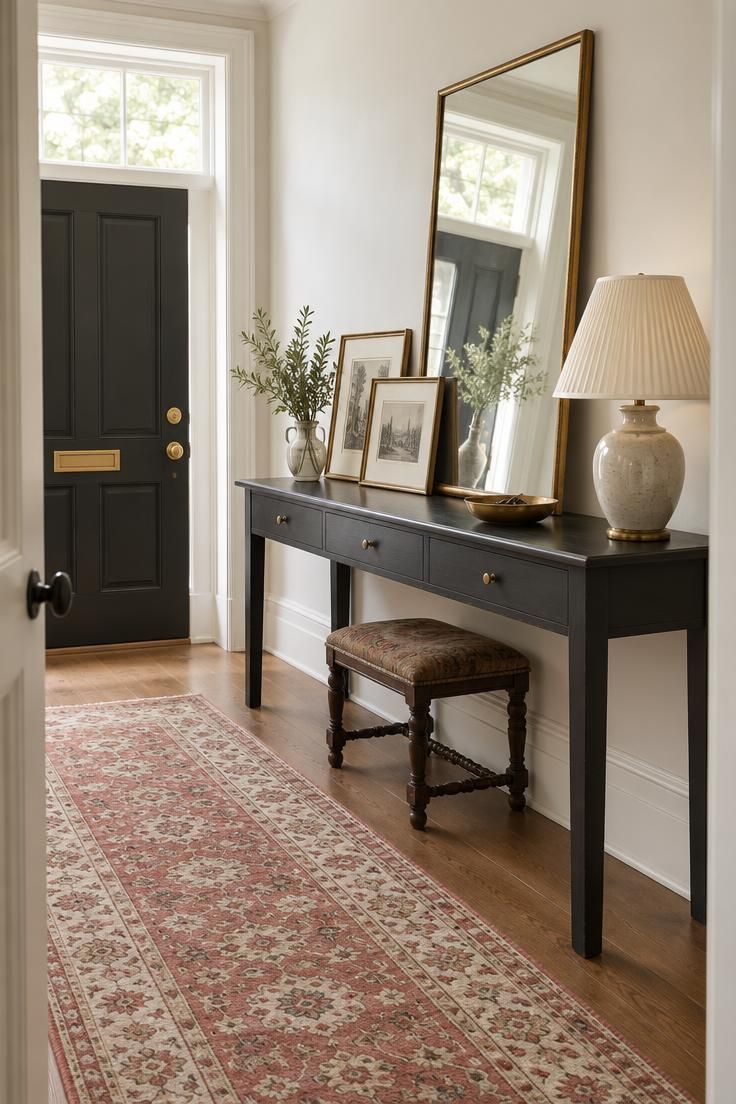
A leaning composition reads as collected and unfussy in an entry while still giving the eye a strong vertical element.
A slim console in wood, marble, or a painted finish provides the horizontal base, and a large leaning mirror supplies the anchor above it.
Two or three small framed pieces layered in front of or beside the mirror build the accumulated quality without clutter.
A table lamp or pair of candlesticks adds warmth, and a shallow bowl or tray catches keys and mail so they do not spread across the surface.
Leaning art and mirrors need stable placement and periodic dusting behind the glass.
A freestanding console and leaning mirror avoid permanent changes in a rental.
A patterned runner in a high-traffic entry needs more frequent vacuuming than a living-room rug, and a narrow console crowds quickly, so two or three styled items usually suffice.
Style Blueprint:
- A slim console in wood, marble, or painted finish
- A large leaning mirror as the vertical anchor
- Two or three small framed pieces layered in front of or beside the mirror
- A table lamp or pair of candlesticks for warmth
- A shallow bowl or tray to catch everyday objects
A Bedroom Corner with a Vintage Textile Quilt and Collected Art
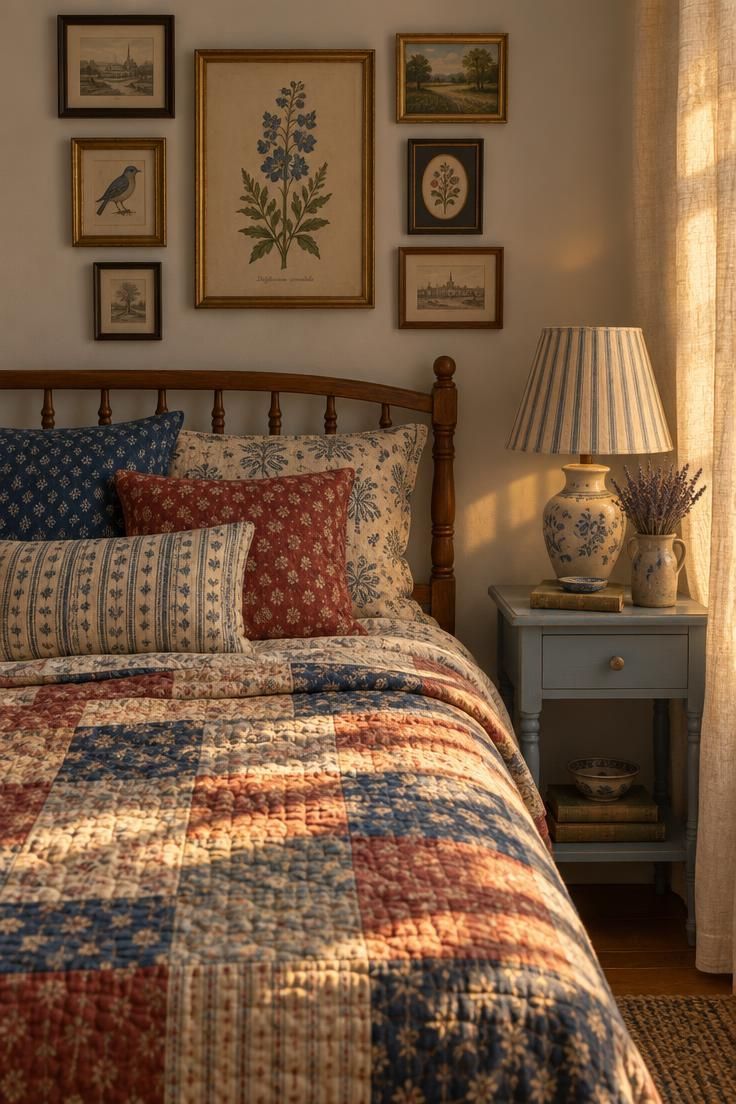
A vintage quilt carries age and pattern, while mismatched pillows in at least three patterns add the layered quality that reads as traditional eclectic decor.
Keeping the pillow palette shared, even when the patterns differ, holds the bed together.
A cluster of small framed art above the bed often reads better than one large piece, since the variety of frames echoes the collected theme.
One or two colors pulled from the quilt and repeated in the pillows and the art create a visible thread.
Vintage quilts can be fragile, and a duvet underneath protects the quilt from daily wear while simplifying laundering.
Many quilts are hand-wash or spot-clean only, so checking the textile before washing matters.
A cluster of small frames above a bed can read as one composition when the overall cluster roughly mirrors the bed width.
One modern photographic print among vintage pieces keeps the wall from reading as a period room.
Layering in global textiles, such as an embroidered coverlet or a woven runner at the foot of the bed, adds a worldly note to the collected look.
Style Blueprint:
- A vintage quilt or coverlet as the primary textile
- Mismatched pillows in at least three different patterns but a shared palette
- A cluster of small framed art above the bed rather than one large piece
- A painted or wood nightstand with a lamp and one collected object
Design Pro-Tip: When clustering frames above a bed, sketch the outline on paper first and tape the paper to the wall overnight, since seeing the shape at full scale reveals whether the cluster feels balanced with the headboard.
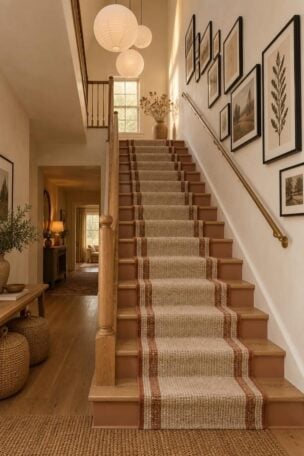
A Stairwell Gallery that Climbs with the Steps
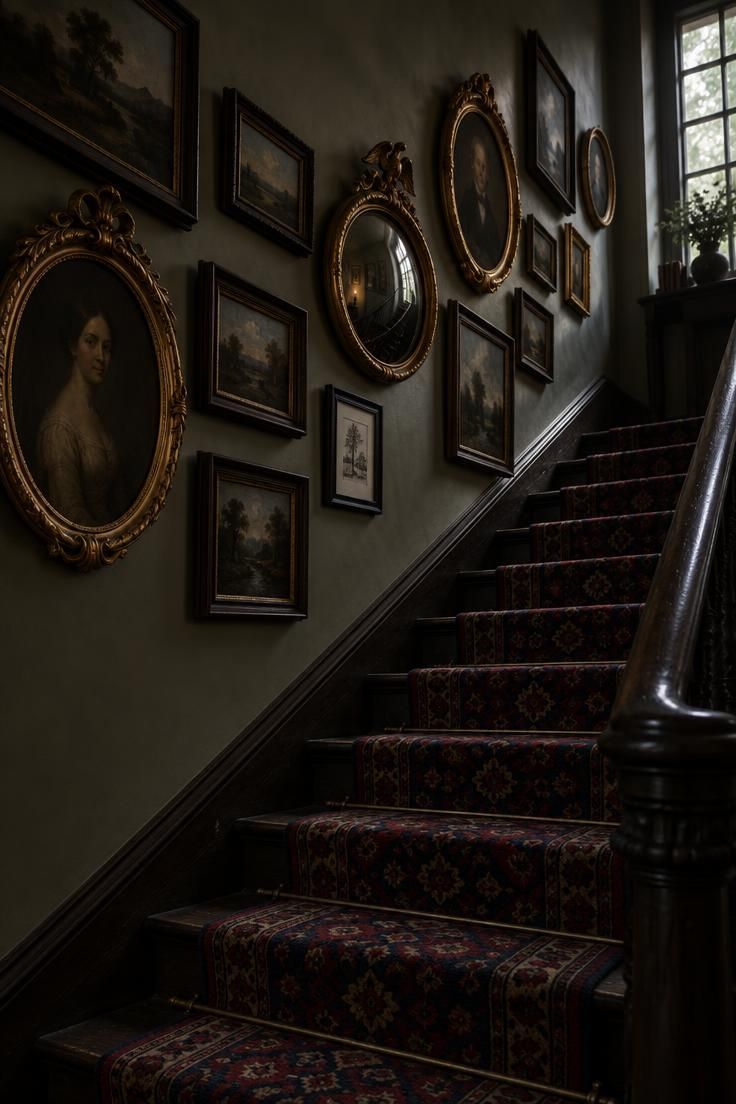
A stairwell gallery works when the composition follows the stair line, since the eye naturally travels that diagonal and a gallery that echoes it feels intentional.
Mixed frame shapes and finishes, oval, rectangular, gilt, dark wood, supply the variety, and one larger anchor piece near the middle of the run gives the eye a stopping point.
A consistent hanging gap between frames holds the arrangement together even as sizes vary.
Measuring from the stair nose rather than the floor keeps frames from reading as accidental, since floor-based measurements drift along a slope.
Mixing gilt, dark wood, and a single black frame gives the wall depth without adding color, and repeating one frame finish at least three times ties the composition together.
One small modern ink drawing among traditional portraits keeps the wall contemporary.
Stairwell daylight is often uneven, so the composition should read in both bright and shadowed conditions.
Style Blueprint:
- Mixed frame shapes and finishes, such as oval, rectangular, gilt, or dark wood
- One larger anchor piece, such as a convex mirror or a bold portrait, near the middle of the run
- A consistent hanging gap between frames even as sizes vary
- At least one repeated color across the frames, mats, or art
- A stair runner with a traditional motif to bridge the wall and the floor
A Powder Room with Patterned Wallpaper and a Vintage Mirror
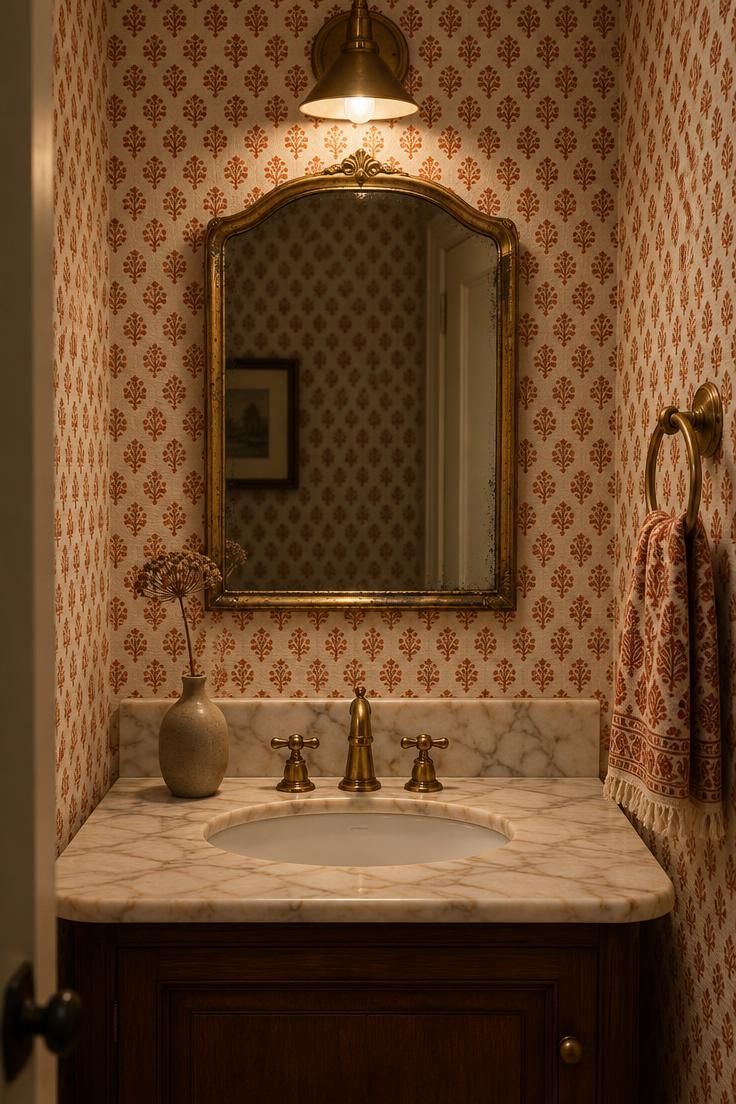
Traditional eclectic rooms often use one small space to hold a bolder pattern, and a powder room suits that approach because the walls contain the motif within a compact footprint.
A vintage or antique mirror with a wood, gilt, or painted frame gives the small room a focal point with age.
Repeating one metal across the faucet, towel ring, and light fixture ties the details together without extra color.
A single tone pulled from the wallpaper and echoed in the hand towel, a small vase, or a soap dish creates a quiet thread.
Powder rooms are humid, so checking that the wallpaper and adhesive suit the space before committing is worth doing.
Brass fixtures benefit from a consistent care routine, whether that means polishing or allowing patina.
A large motif can feel crowded in a tiny room, and a smaller repeat usually reads better at close range.
Style Blueprint:
- A patterned wallpaper, such as chinoiserie, block print, or a small-scale motif, on all walls
- A vintage or antique mirror with a wood, gilt, or painted frame
- A single repeated metal, such as brass or unlacquered bronze, across faucet, towel ring, and light fixture
Conclusion
Traditional eclectic decor works when a few anchoring pieces and a handful of repeated threads, a color, a metal, a scale, hold the variety together.
Each of these ideas can stand alone, but they compound, and a layered rug, a collected shelf, and a mixed-chair dining set in the same home reinforce one another.
Starting with one strong anchor, adding contrast in stages, and editing as you go tends to work better than filling every surface at once.
Warmth in this style comes from the accumulation of specific, chosen things rather than from following a single period rule.