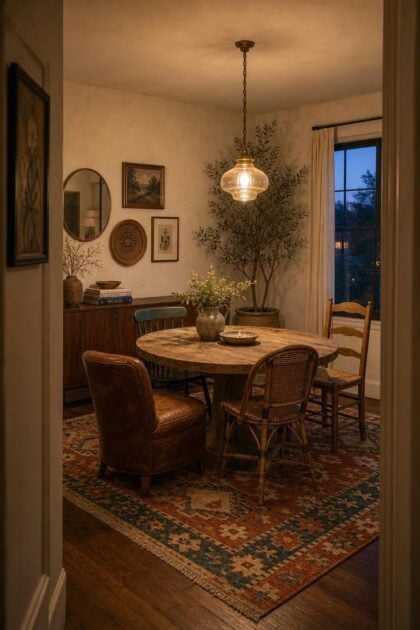
This post may contain affiliate links. If you make a purchase through these links, we may earn a commission at no additional cost to you.
An eclectic dining room is not a room of mismatched leftovers.
It is a deliberate act of curation, a place where a walnut farm table, a brass chandelier, and a worn kilim can share a meal without competing for attention.
The dining room is the most personal gathering space in a home, the place where collected objects and inherited pieces earn their place through texture, scale, and a shared color story.
True eclectic dining room design succeeds when one element repeats, a single wood tone, a saturated hue, a material, or a silhouette, until the room feels assembled over time rather than purchased in a single afternoon.
Below are some ideas of warmth, contrast, and personality, each leaning on one concrete anchor so you can see exactly how disparate pieces become a coherent room.
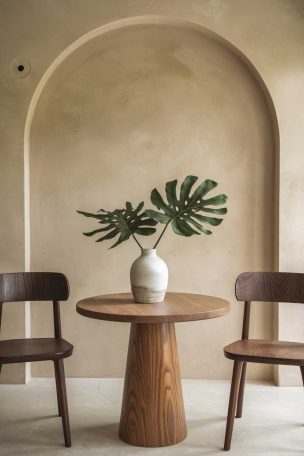
The Limewashed Plaster Arch and the Single Oversized Woven Pendant
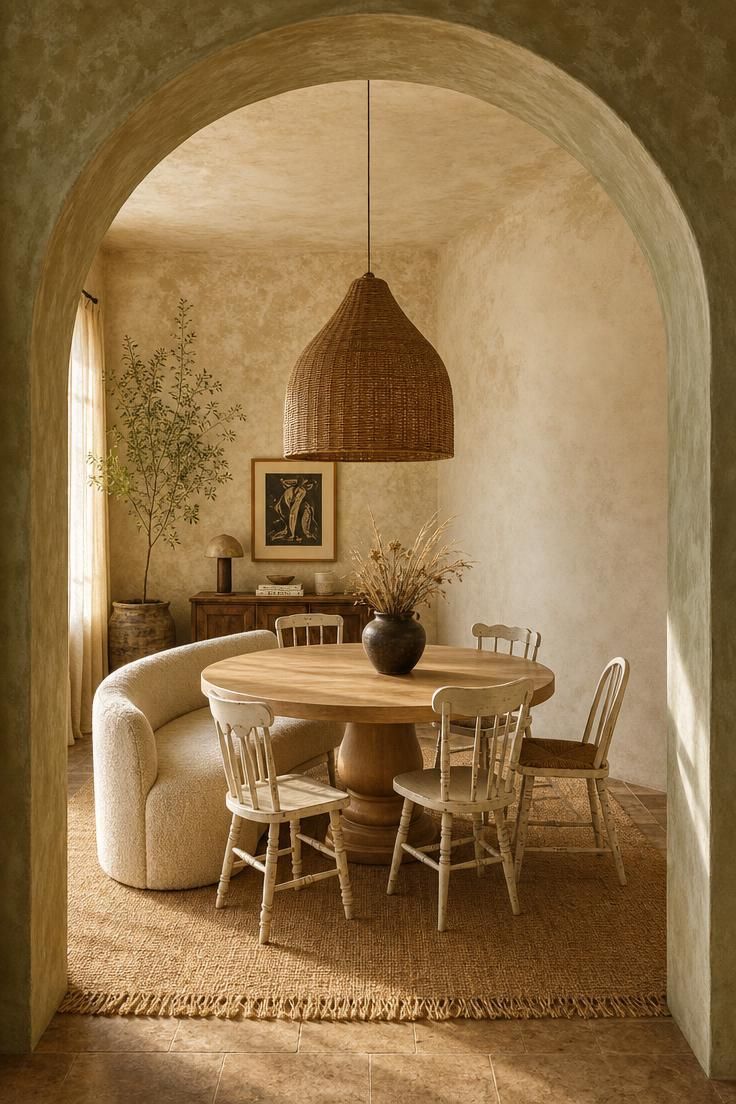
A plaster arch gives the eye a frame before it even reaches the furniture.
That single architectural move turns a collection of different chairs into a composition instead of an accident.
The oversized woven pendant fills the arc and draws the ceiling down.
The round table below reads as intimate.
Mismatched chairs painted one muted tone share enough visual language to sit together comfortably.
The jute rug adds a rough, natural base layer.
It never competes with the plaster’s soft mottling.
Style Blueprint:
- Frame the mix with one architectural move, an arch, a plaster reveal, or a deep window return.
- Keep the table round and simple to soften the composition and ease movement.
- Repeat one woven material in the pendant, a seat, or a floor basket.
- Mismatch chair silhouettes but paint them one muted tone.
- Leave one wall completely bare so the wall texture itself reads as the visual pause.
A Charred-Wood Sideboard Under a Gallery Wall of Round Convex Mirrors
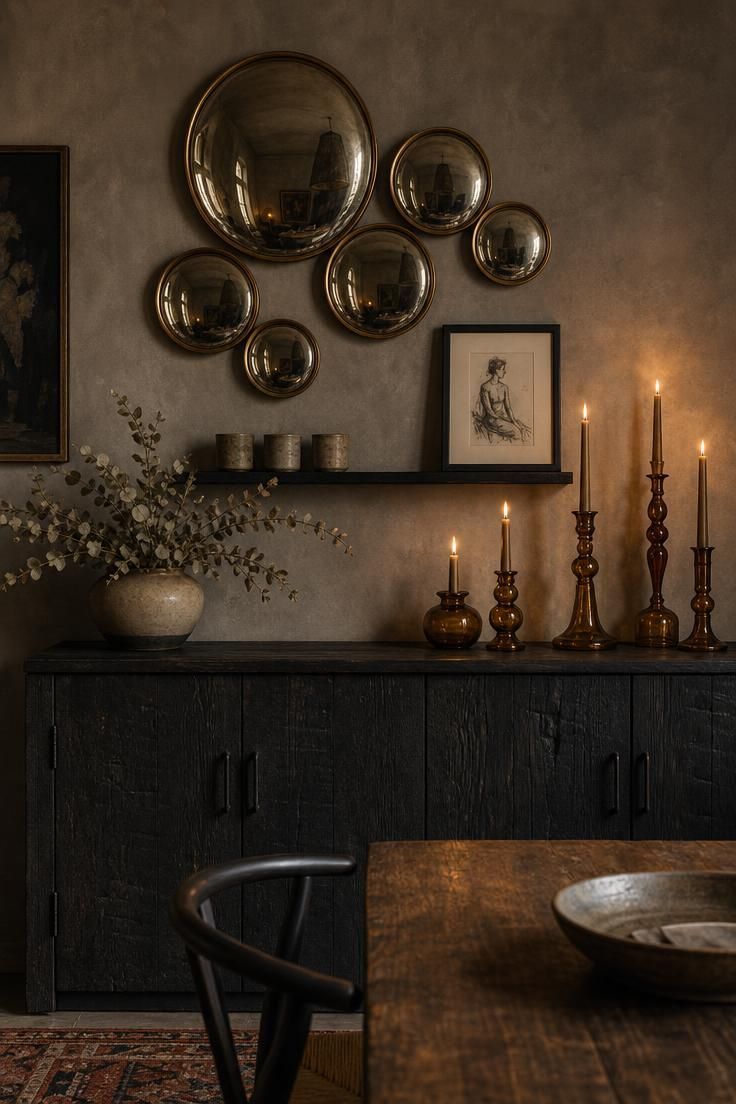
The charred finish gives the sideboard a rough, tactile quality.
That quality keeps a wall of mirrors from feeling too formal.
Round convex mirrors scatter low light in soft fragments.
A dark corner becomes a gently active surface.
Amber glass repeats the warmth of the brass, binding the small objects into the larger composition.
A single matte black frame keeps all that warm metal from becoming precious.
Layering heights, tall candlesticks, mid-level mirrors, low vessels, gives the wall dimension without clutter.
The dining table edge in the foreground reminds you this is a room for meals, not a display case.
Style Blueprint:
- Use a sideboard with an intentionally rough, darkened finish to offset the formality of mirrors.
- Cluster round mirrors rather than hanging one large piece.
- Repeat an amber or brass accent at least three times in candlesticks, frames, or glassware.
- Add one matte black element to disrupt the warm metals.
- Layer heights deliberately with tall candlesticks, mid-level mirrors, and low vessels.
A Cracked-Ice Glass Globe Above a Travertine Slab Table
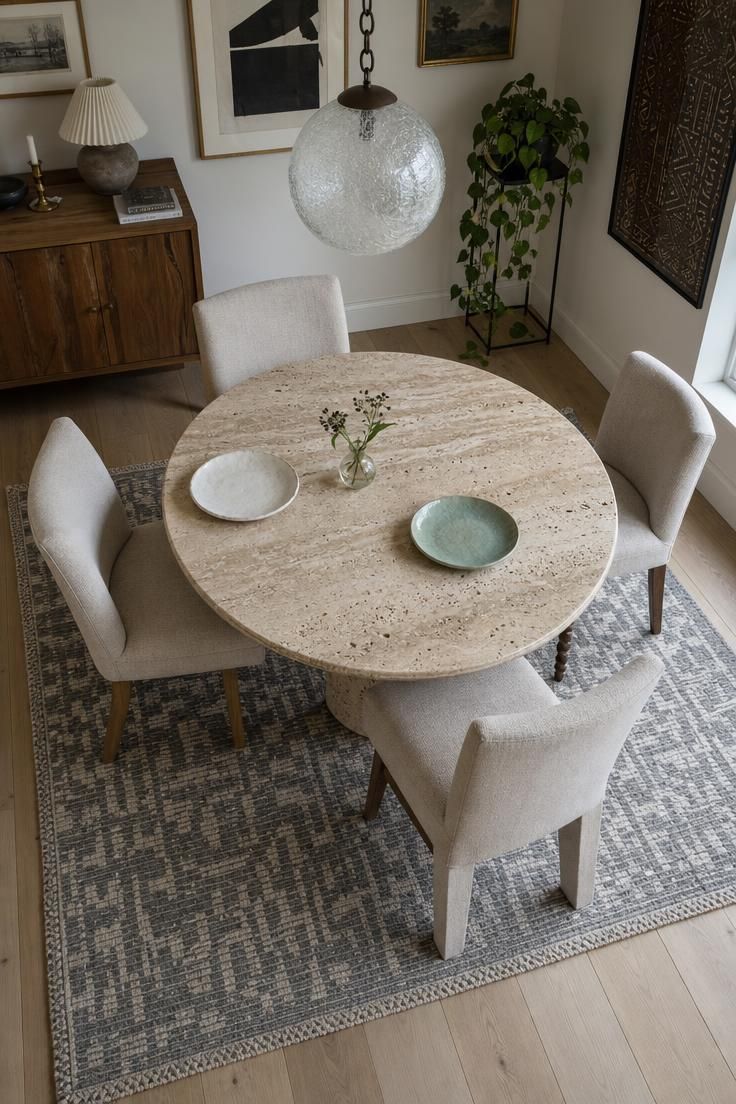
Travertine sets the temperature here.
Its pale, pitted surface cools down the warmth of wood and upholstery.
The cracked-ice glass pendant diffuses overcast light rather than throwing a harsh beam.
The whole room stays soft because the pendant spreads light evenly across every surface.
Oat linen upholstery wraps every chair in the same calm tone, even though the legs below differ.
That single black steel plant stand acts as a sharp vertical line, giving the palette a bit of spine.
A low-contrast rug lets the stone tabletop stay the visual anchor.
The pale oak floor recedes quietly, so every other material gets a clear voice.
This modern eclectic dining room also works as a boho dining room when the textile layers stay soft and natural.
Style Blueprint:
- Let a stone tabletop set the room’s temperature.
- Choose one frosted or crackled glass pendant to scatter light rather than focus it.
- Use oat or greige linen on every chair to unify mixed leg shapes.
- Add exactly one black or near-black element to sharpen the palette.
- Keep the rug low-contrast so the table remains the anchor.
A Checkerboard Encaustic-Tile Floor Under a Painted Iron Table
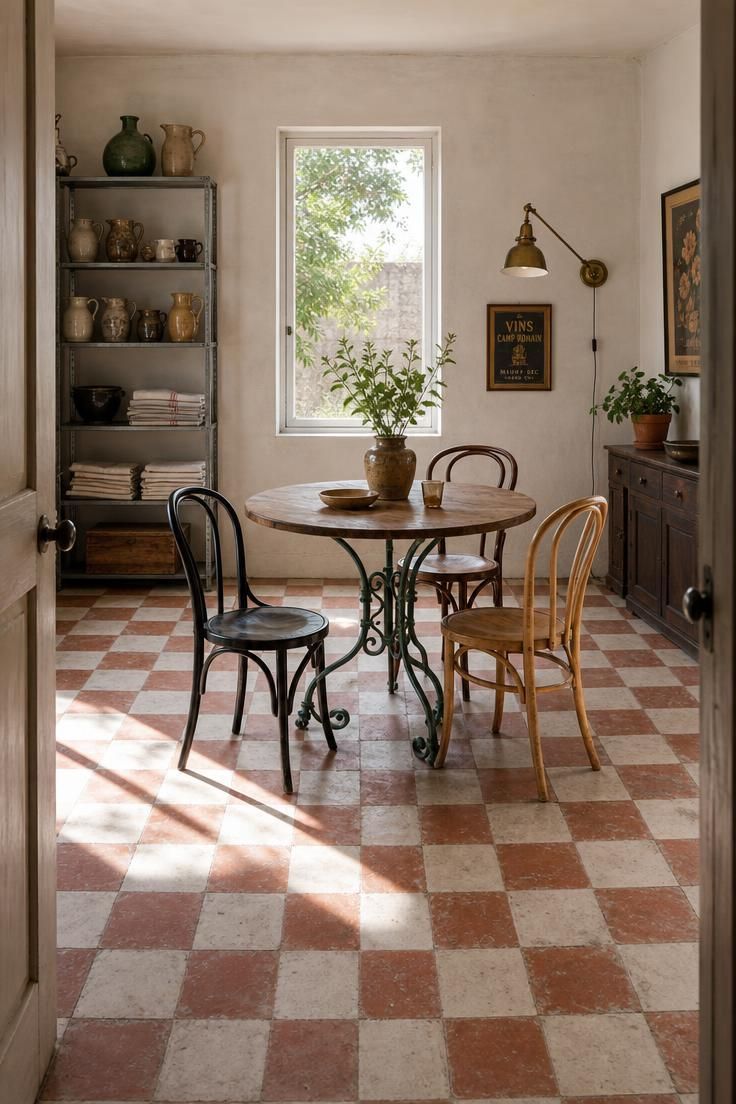
Patterned floor tile is the room’s loudest voice, so every other surface stays quiet.
The checkerboard in faded terracotta and chalk white gives the room its color story and its sense of age.
Bentwood chairs in three different stains keep the same silhouette.
The eye accepts their differences without hesitation.
A brass pharmacy lamp on the wall works better than a central pendant because the floor already carries enough visual weight.
The raw steel shelf unit adds a utilitarian note that keeps the tile from feeling too decorative.
Colorful dining room choices like this work best when one surface carries the pattern and everything else steps back.
Style Blueprint:
- Use patterned floor tile as the primary decorative surface.
- Keep walls and window treatments minimal when the floor is busy.
- Mix bentwood chairs in different stains but the same silhouette.
- Choose one wall-mounted task lamp over a central pendant.
- Echo the tile’s terracotta in one small object, a ceramic jug or a woven basket.
Design Pro-Tip: In an eclectic dining room, pick one high-energy surface, tile, rug, or wallpaper, and let every other surface whisper. The contrast between loud and quiet is what makes collected pieces feel intentional rather than accidental.
A Chinoiserie Mural Panel Above a Waxed Oak Bench
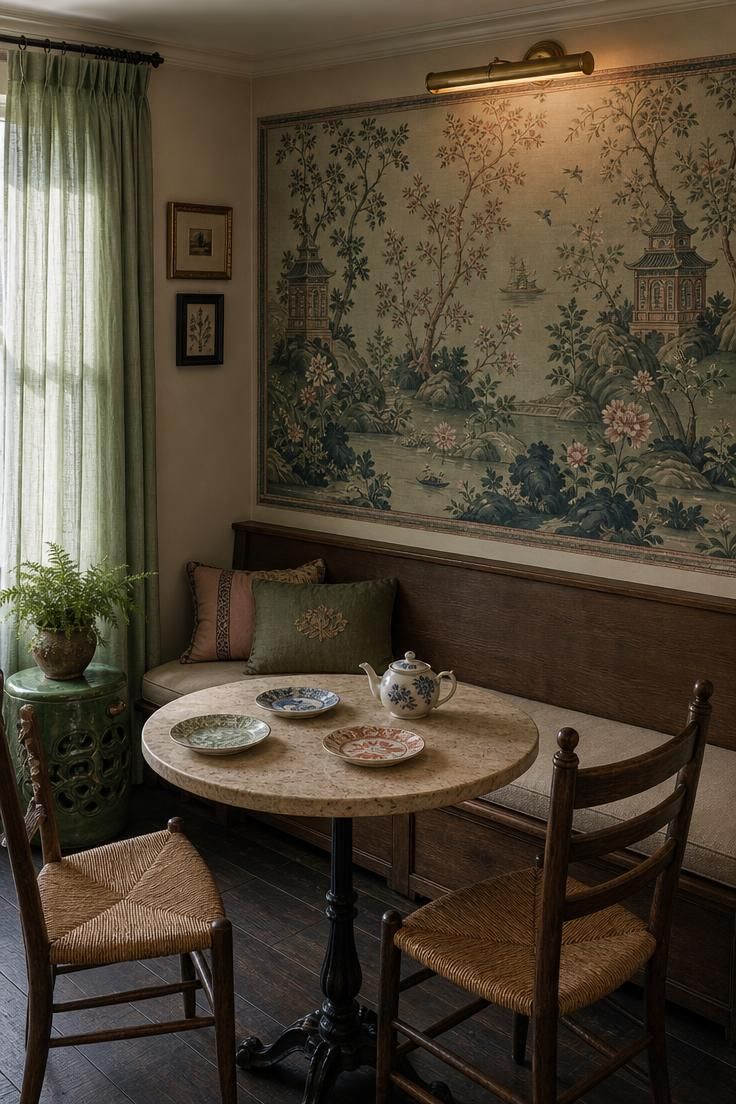
Treating a chinoiserie panel as framed artwork rather than full wallpaper gives the room a collected, old-world feel.
The brass picture light above the mural makes the painted scene feel like part of a private collection.
A long bench paired with a small round table creates an easy, convivial arrangement.
No symmetry or stiffness holds it back.
The mural’s sage, blush, and indigo tones repeat in the linens, ceramics, and upholstery.
The whole vignette pulls together cleanly.
Dark-stained floors give the pale mural and waxed oak bench a strong, grounded base.
A couple of blue-and-white ceramic pieces nod to the mural’s heritage without copying it directly.
This vintage dining room moment shows how one wall treatment can guide every other choice.
Style Blueprint:
- Treat a chinoiserie panel as framed artwork and mount a picture light above it.
- Pair a long bench with a small round table for an asymmetric seating arrangement.
- Let the mural’s palette repeat in linens, ceramics, and upholstery.
- Use a dark floor to anchor pale walls and a pale bench.
- Include one or two blue-and-white ceramic pieces to reference the mural’s tradition.
A Worn Tobacco Leather Banquette Along a Striped Plaster Wall
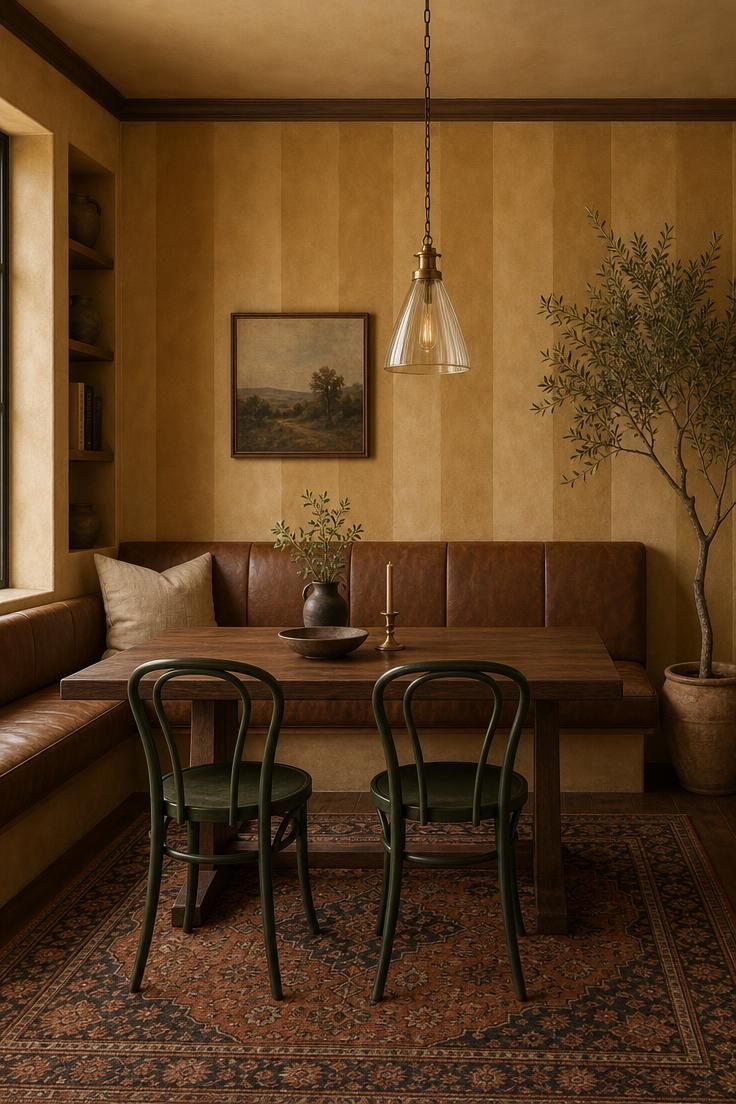
Worn leather brings instant warmth and the feeling of a room that has hosted many long dinners.
The hand-troweled plaster stripes add texture without introducing another competing pattern.
Tobacco brown pairs naturally with one saturated secondary color, here deep green, which the potted olive tree echoes.
A rectangular walnut table stays unadorned so the leather banquette remains the room’s most dominant surface.
The narrow brass and glass pendant hugs the table length rather than competing with the seating.
The worn Persian runner extends the room’s sense of age and softens the transition from wood floor to table.
For dining room styling tips, start with one material you love and let every other decision support it.
Style Blueprint:
- Use a worn leather surface for immediate warmth and a sense of age.
- Add vertical plaster stripes for texture without adding another pattern.
- Pair leather’s brown tones with one saturated secondary color.
- Keep the table rectangular and unadorned so the banquette dominates.
- Choose a narrow pendant that follows the table length.
A Polished Chrome Sputnik Over a Woven Seagrass Table Mat
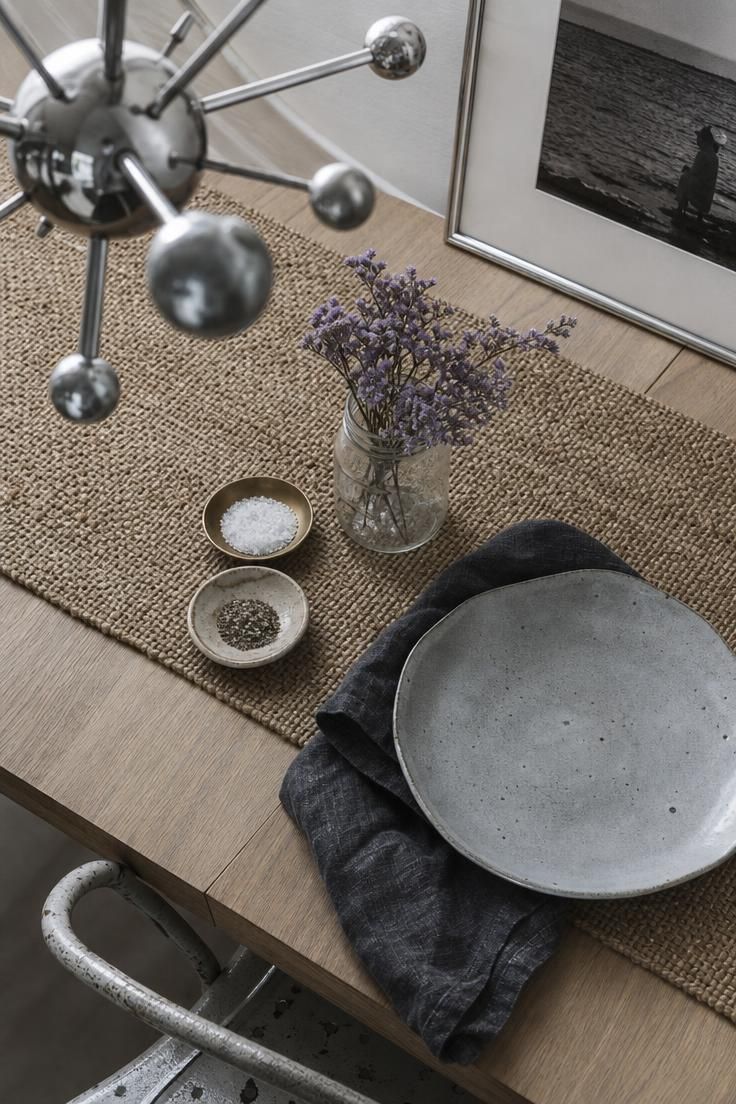
Polished chrome cools down warm wood and linen instantly.
The room’s mood shifts from cozy to crisp.
The seagrass mat acts as a visual half-step between the oak table and the simple place settings.
Keeping the tabletop palette to three tones, wood, gray, and one metallic, makes the detail feel composed rather than random.
A framed print leaning against the wall instead of hung introduces a casual, lived-in gesture.
Letting one steel chair arm enter the frame reminds you this is a functioning dining room, not a still life.
The overcast window light keeps the chrome from glaring and gives the gray ceramics a soft, even glow.
Style Blueprint:
- Move one highly polished metallic fixture into view to cool down warm wood and linen.
- Use a woven table mat or runner as a visual bridge between the table and place settings.
- Keep the tabletop palette to three tones, wood, gray, and one metallic.
- Lean one framed art piece against a wall rather than hanging it.
- Let one chair element enter a detail crop to signal a functioning dining room.
A Cobalt Blue Painted Hutch With Unlacquered Brass Pulls
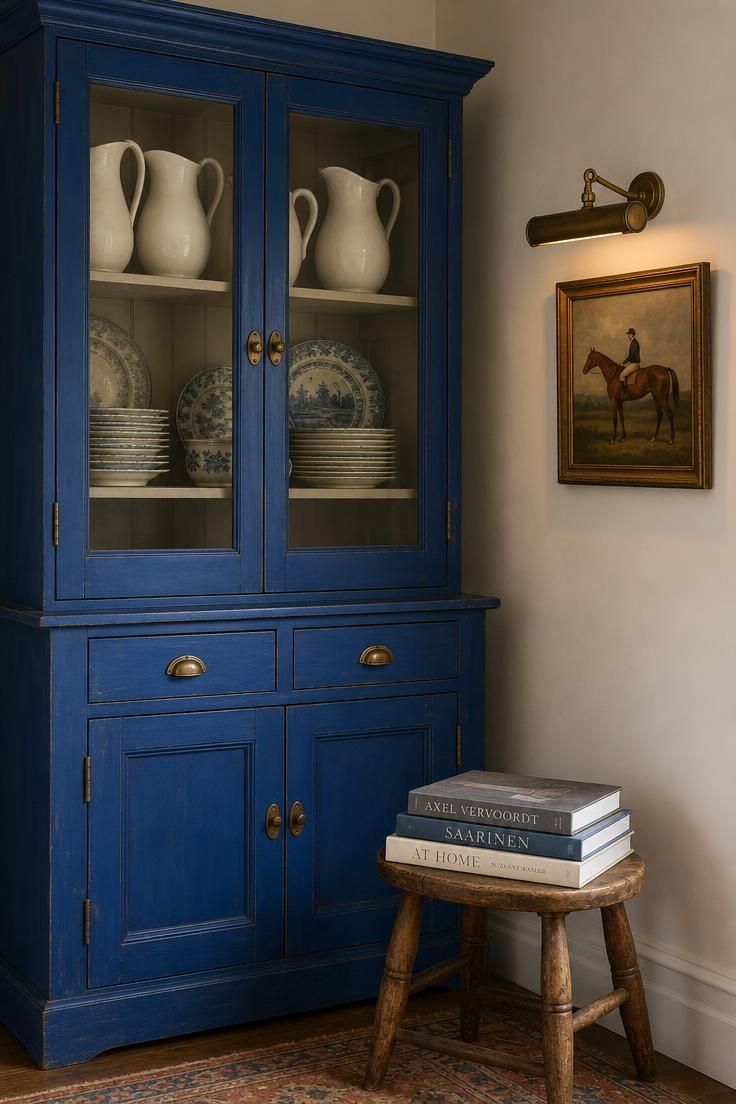
A saturated cobalt hutch gives the whole eclectic dining room decor an anchor of color that feels bold but not chaotic.
Unlacquered brass pulls will darken and warm with handling, which adds to the collected-over-time feeling.
White ironstone and blue-and-white plates behind glass keep the tall piece from feeling visually heavy.
The small oak stool in front breaks the hutch’s strong verticality and adds a practical layer.
A single traditional oil painting nearby, lit with a small brass fixture, balances the hutch’s formality and grounds it in the room’s history.
Style Blueprint:
- Choose one saturated, slightly unexpected color for a tall storage piece.
- Leave brass unlacquered so it darkens and warms with use.
- Display white or blue-and-white ironstone behind glass to lighten the piece.
- Place a small stool or bench in front to break the hutch’s verticality.
- Hang one traditional painting nearby with a small brass picture light.
A Raw Steel Window Frame and a Single Stoneware Vessel on the Floor
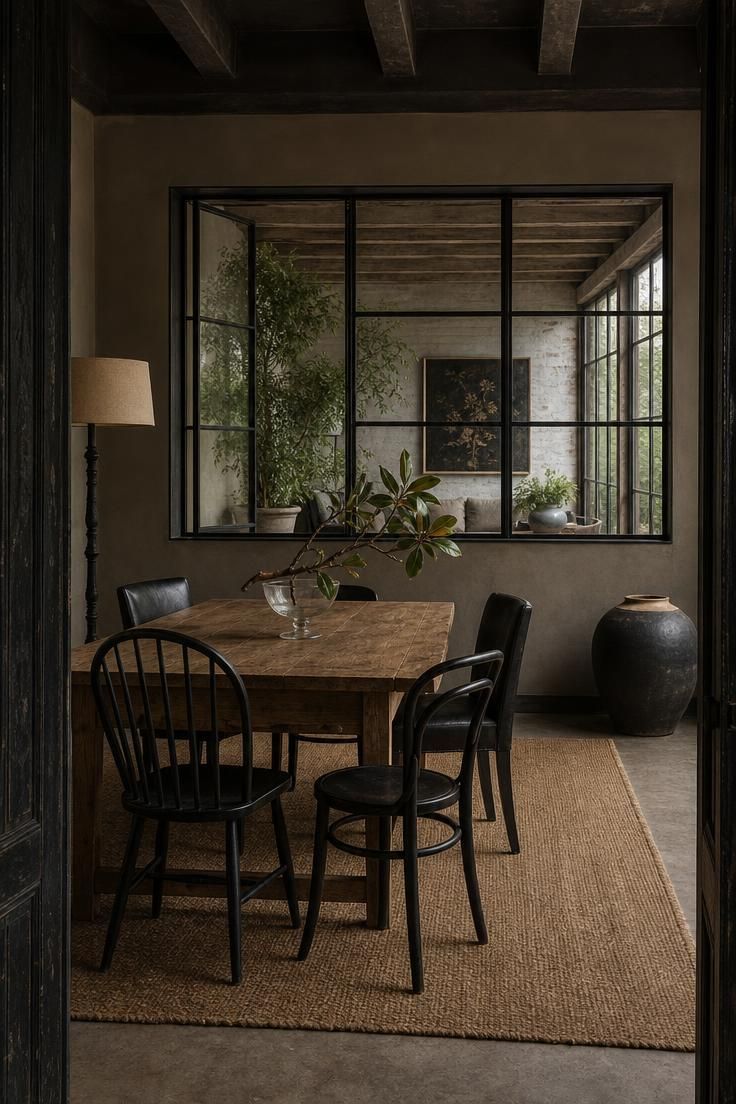
The steel window frame acts as another piece of furniture.
Its dark grid organizes the whole room cleanly.
Placing one large ceramic vessel on the floor instead of a tabletop turns it into a sculptural anchor.
Mixing chair types in dark or blackened finishes lets their differences show through silhouette, not color.
Raw wood and raw steel grow warmer when they sit side by side.
Each unfinished quality brings out the other’s tactility.
The near-bare table, one branch, one bowl, keeps attention on the architecture.
Low moody light softens the steel’s hard edges and makes the jute rug’s caramel fibers glow.
Style Blueprint:
- Treat a window frame or door frame as a piece of furniture that orders the room.
- Place one large ceramic vessel on the floor as a sculptural anchor.
- Mix chair types in dark or blackened finishes so silhouette carries the variety.
- Use raw wood and raw steel together.
- Keep table decor nearly bare to let architecture lead.
A Sun-Faded Dhurrie and a Single Columnar Pedestal Table
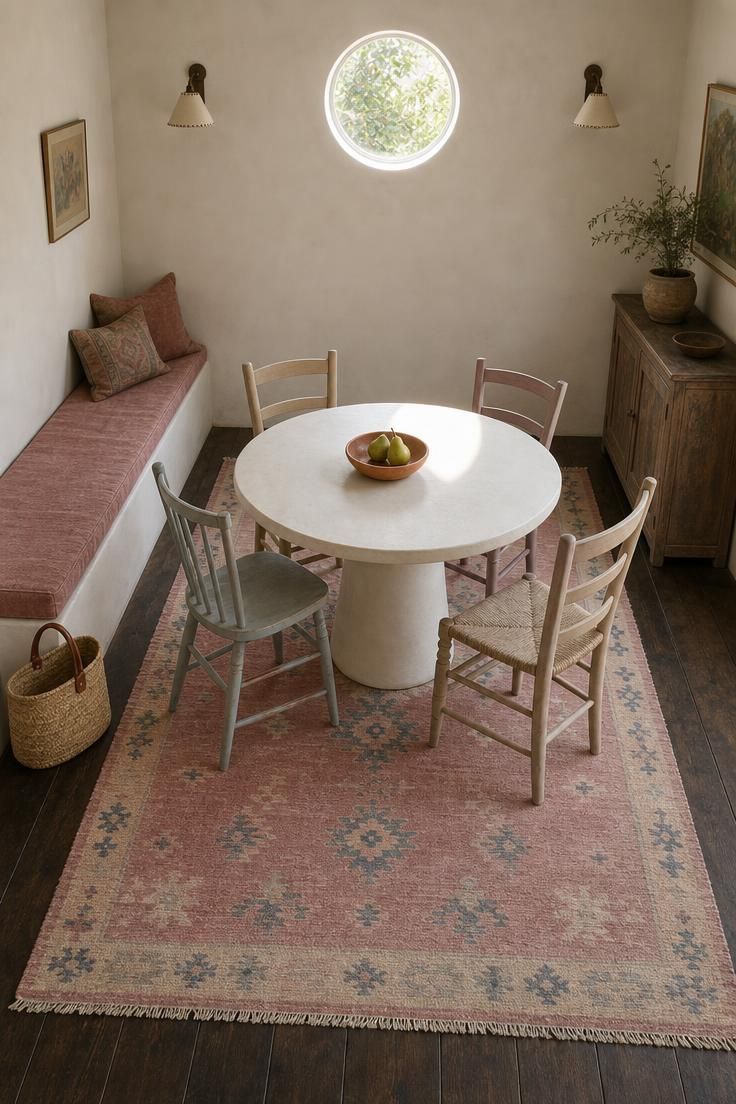
Letting a faded rug hold the room’s palette is an easy way to make a mixed style dining room look planned.
The dhurrie’s rose, sand, and pale indigo tones repeat in the chair paint and bench cushion, so every seat belongs.
A plaster pedestal table keeps the room’s center visually light, even with dark floors pushing up from below.
Chairs with different backs, ladderback, spindle, X-back, read as a family when they share one finish range.
The circular window’s bright pool of daylight makes the table feel like the room’s natural gathering point.
Skipping a central pendant in favor of wall sconces keeps the high ceiling open and airy.
One dining room styling tip here is to treat an unusual window shape as the deciding factor for table placement.
Style Blueprint:
- Let a faded rug hold the room’s palette and pull its tones into chair paint and cushion fabric.
- Use a plaster or painted pedestal table to keep the center visually light.
- Choose chairs with different backs but one finish family.
- Let an unusual window shape dictate table placement.
- Consider skipping a central pendant in favor of wall sconces.
Design Pro-Tip: When mixing multiple chair silhouettes, stay disciplined with finish. Same tone, different form reads as intentional. Different form and different finish reads as a garage sale. One variable at a time.
A Bone-Inlay Octagonal Table and a Cluster of Paper Lanterns
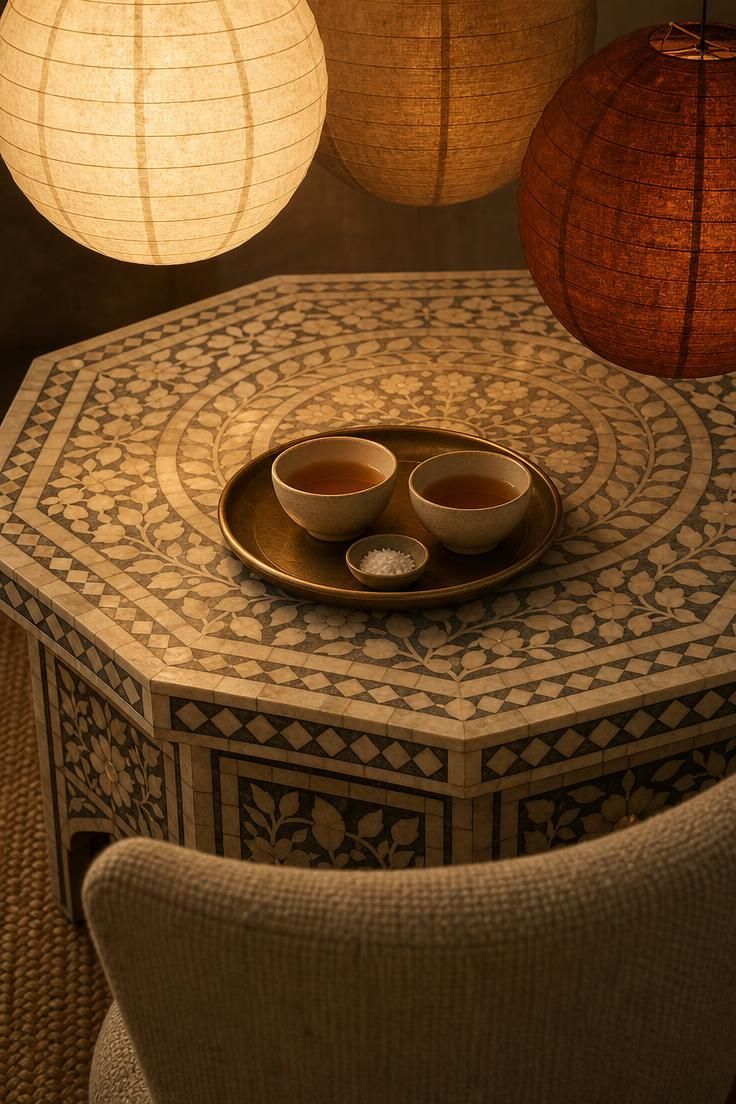
A bone-inlay table already provides enough pattern to carry the whole room.
Clustering paper lanterns at staggered heights adds an informal, slightly kinetic quality above the detailed surface.
The lantern tones, ivory, dun, rust, repeat in the room’s other textiles and objects.
The cluster feels grounded because of that repetition.
Keeping tabletop props small and few lets the inlay read clearly without visual competition.
The oat linen chair back and rush matting at the frame’s edges suggest a larger room without revealing it.
Warm light through paper diffuses into a honeyed glow that flatters the bone’s cream tones.
Style Blueprint:
- Use a bone-inlay or detailed tabletop as the room’s only highly patterned surface.
- Cluster paper lanterns at staggered heights for an informal fixture arrangement.
- Choose lantern tones that repeat elsewhere in the room.
- Keep tabletop props small and few.
- In a close crop, let one chair edge and a floor mat hint at the larger room.
A Raw Reclaimed-Board Wall and a Single Lacquered Red Chair
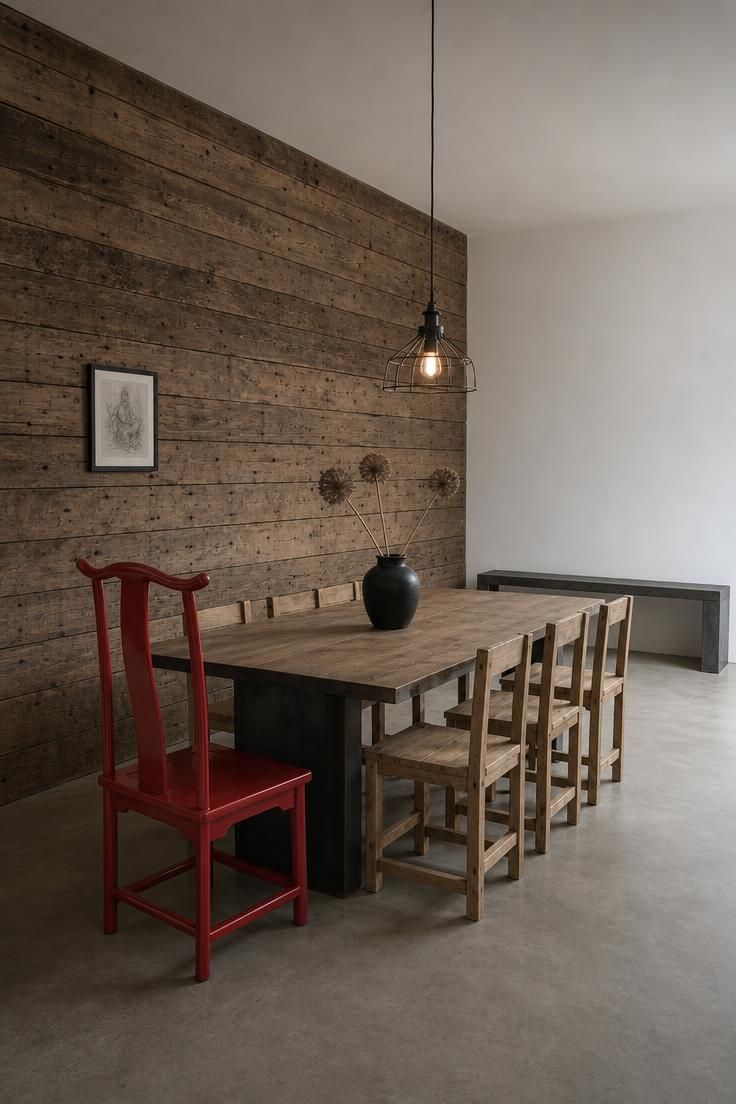
The reclaimed wall gives the room its age and shadow.
That rough backdrop makes every other object feel more considered.
Keeping five chairs raw and neutral lets the single lacquered red chair act as a punctuation mark rather than a distraction.
A bare bulb in a steel cage adds an industrial, unpretentious note that suits the raw material palette.
The charcoal drawing on the textured wall nearly disappears, which is right; it adds depth without competing.
Dried allium stems in a matte black vase echo the wall’s rough, dry quality.
The red chair’s high-gloss surface stands apart from every matte texture in the room, making its color feel deliberate and earned.
Unique dining room furniture like that single red chair can shift the entire mood of a room.
Style Blueprint:
- Turn one wall into the room’s primary texture with reclaimed boards.
- Keep most seating raw and neutral so one vivid chair can punctuate.
- Use a bare bulb or cage pendant for an industrial note.
- Place one dark artwork on the textured wall.
- Let dried stems stand in for fresh flowers to match the raw palette.
A Blush Velvet Slipper Chair and an Oxblood Persian Runner
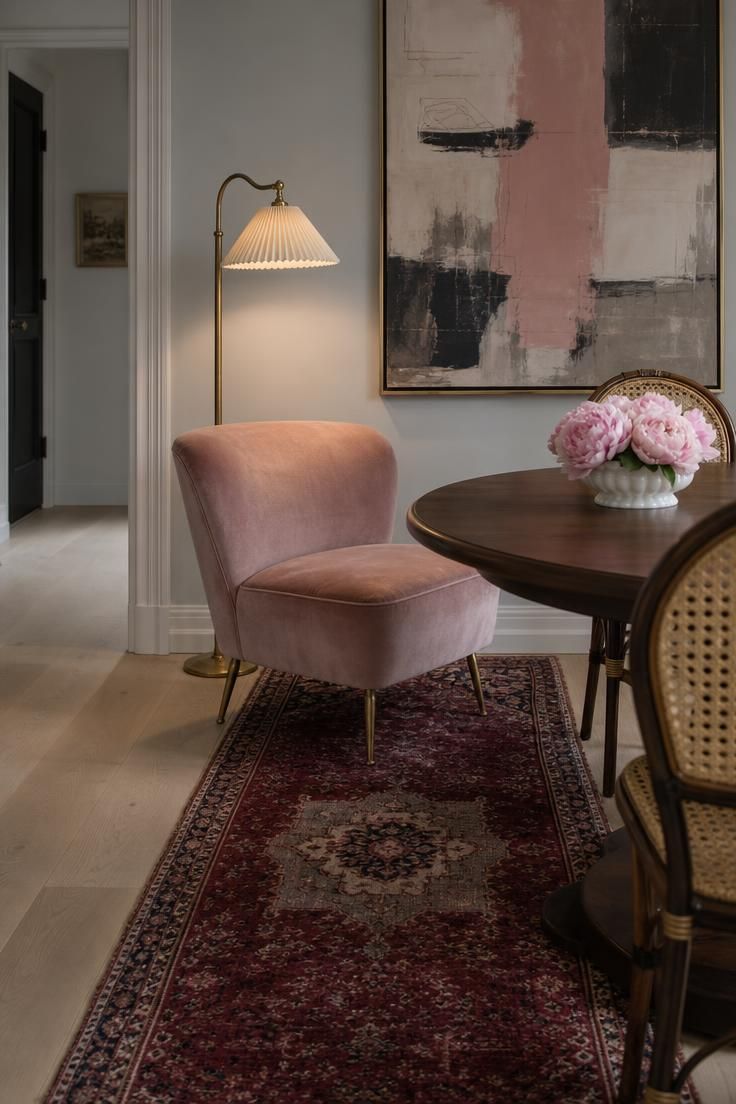
A blush velvet slipper chair softens the harder materials around it; the corner takes on a plush, tactile note.
The oxblood runner anchors the vignette with a deep, faded red that feels old and grounded.
Positioning the brass floor lamp to pool light directly on the velvet makes the chair a second focal point after the table.
The large abstract painting in rose, charcoal, and cream keeps the wall loose and contemporary against the runner’s formality.
A woven cane chair at the frame’s edge signals the room’s mixed-material logic without distracting from the main vignette.
The mostly bare pale oak floor gives the runner and chair a clear, quiet base.
Style Blueprint:
- Introduce one upholstered piece in a soft saturated tone to soften hard wood and brass.
- Use a runner rather than a full rug when the area is small or the table is round.
- Position a floor lamp to pool light on the upholstered chair.
- Keep wall art large and abstract to counterpoint formal textiles.
- Let one cane or woven chair share the frame to show the mix.
A Copper-Banded Mirror and a Stoneware Dinner Service on Open Shelving
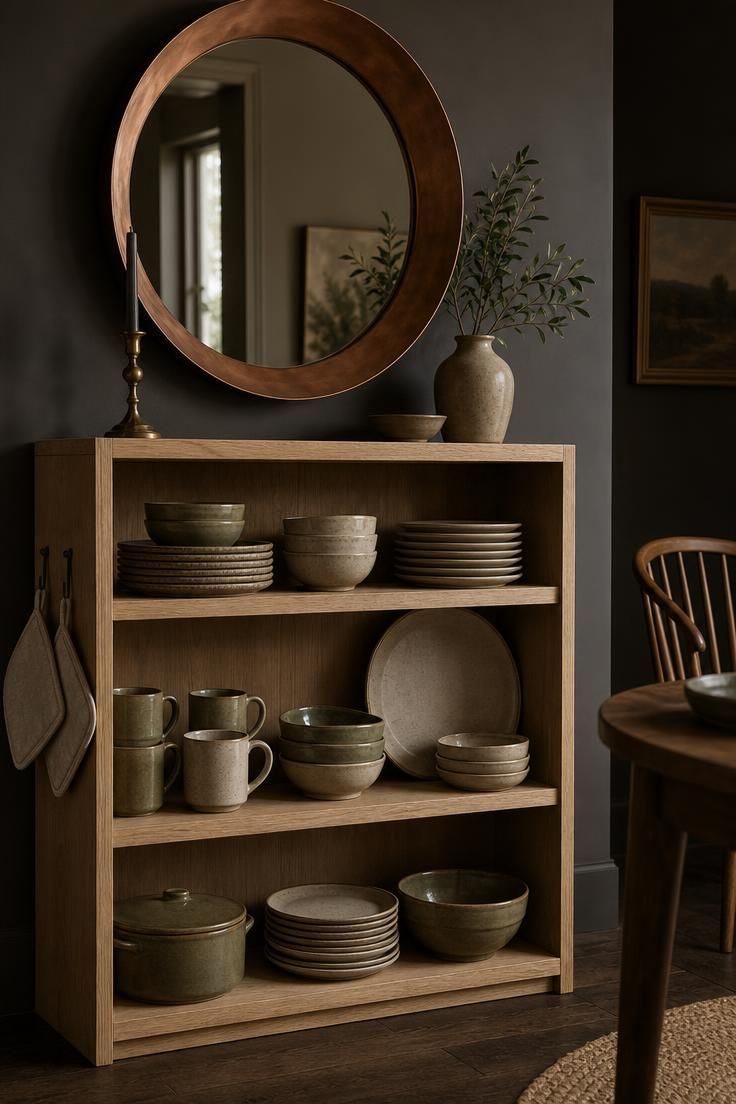
Open shelving becomes a display surface when the dinner service itself carries a muted, consistent palette; stacks of olive, sand, and cream stoneware read as an installation rather than storage.
Leaning one platter against the wall breaks the horizontal rhythm of stacked plates and adds a sculptural pause.
The copper-banded mirror and patinated brass candlestick warm the composition against the dark charcoal wall.
Dark walls let the shelves, mirror, and ceramics carry the light, which makes the whole vignette glow.
Linen potholders keep the textile accents neutral so the glazed surfaces stay the room’s main color source.
The visible spindle chair at the far edge reminds you this is still a dining room, not just a display wall.
Style Blueprint:
- Use open shelving to store and display a full dinner service in one tone family.
- Lean one platter against the wall to break the horizontal rhythm of stacked plates.
- Add one metallic element to warm the composition.
- Paint the surrounding wall dark so the shelves and ceramics carry the light.
- Keep textile accents neutral and linen-based.
Conclusion
An eclectic dining room grows from arranging the pieces you already trust, whether that is a bone-inlay table inherited from a relative or a single ten-dollar lacquered chair found at a thrift store.
Every room in this list works because one element repeats, a shared tone, a material, a silhouette, a finish.
Begin with one anchor, a rug, a wall texture, a dominant light fixture, and build outward slowly, letting negative space and a calm palette do the unifying.
The most successful eclectic dining room design feels collected, familiar, and deeply lived-in, never designed overnight.
Warmth comes not from matching sets but from the honest wear of objects that have earned their place at the table.