This post may contain affiliate links. If you make a purchase through these links, we may earn a commission at no additional cost to you.
This guide explores the art of the cozy eclectic home, where mismatched eras, layered textures, and warm lighting converge to create spaces that feel collected rather than decorated.
Each of the ideas below anchors itself in a specific, photographable scene designed to inspire your own layered sanctuary.
You will find concrete materials, finishes, and styling techniques alongside practical blueprints you can adapt to any room.
The goal is not clutter but curated comfort.
Every object earns its place by adding warmth, story, or tactile invitation.
A Cognac Leather Chesterfield Anchored by a Faded Oushak Rug
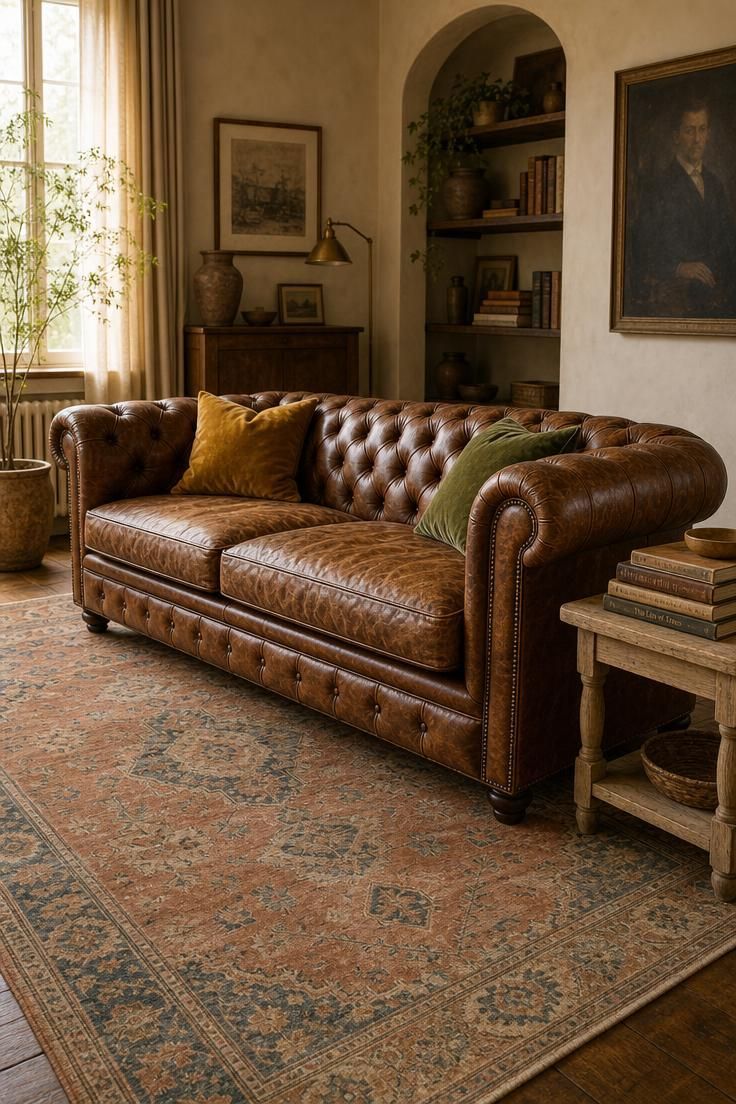
A chesterfield in worn cognac leather does the heavy lifting in a cozy eclectic home because it brings instant history to a room without trying too hard.
Leather absorbs warmth and reflects it back through a patina that only age can produce, making the seating area feel anchored rather than temporary.
The faded Oushak rug beneath it softens the formality of the tufted silhouette while introducing secondary colors that can guide every other choice in the space.
Keeping the sofa front legs on the rug while leaving hardwood visible at the edges preserves a sense of breath around the composition.
This setup works because the mixed textures, leather, wool, velvet, and oak, all share a worn quality that reads as collected over decades.
A linen throw slouched over one arm adds the final note of ease.
The result is a seating area that invites you to sit down and stay.
Style Blueprint:
- A cognac or tobacco-toned leather chesterfield sofa with visible creasing and softened edges.
- A faded Oushak or Anatolian rug in muted terracotta, slate blue, and cream.
- Two or three velvet pillows in mustard, olive, or dusty rose.
- A pale oak side table or campaign stool holding hardcover books and a ceramic mug.
- A limewash wall finish in warm greige or soft plaster tone behind the sofa.
A Limewashed Reading Nook Built Around a Bouclé Swivel Chair
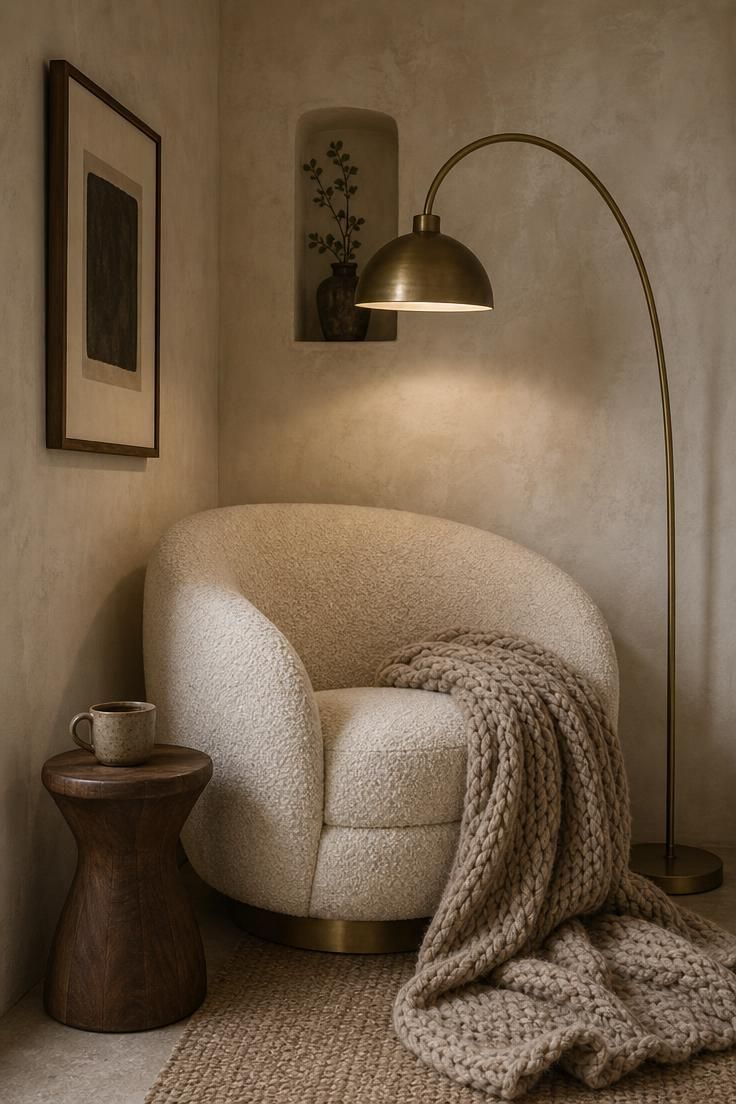
The corner reading nook succeeds as a cozy eclectic home moment because it compresses comfort into a single sculptural gesture.
The bouclé chair curves inward, reducing visual noise and creating a sense of enclosure even in an open room.
Limewashed walls in warm taupe provide a mottled, plaster-like backdrop that absorbs light rather than bouncing it back harshly.
A brass arc lamp positioned to hover just over the shoulder creates one focused pool of light, which makes the nook feel intimate even when the rest of the room is dim.
The low walnut stool doubles as a side surface without adding visual weight.
Allowing the chunky knit throw to puddle slightly on the floor keeps the scene from feeling stiff or overly staged.
It is a quiet corner that rewards sitting with a book and a warm drink.
Style Blueprint:
- Limewash or Roman clay wall finish in warm taupe or soft sand tone.
- A curved bouclé or shearling swivel chair as the focal seat.
- A brass arc or pharmacy floor lamp with the shade hovering just over the shoulder.
- A low walnut stool or stack of books as a side surface for a mug or small plant.
- A nubby wool or alpaca throw draped over one arm and puddling on the floor.
Mixed Wood Tones Around a Live-Edge Walnut Dining Table
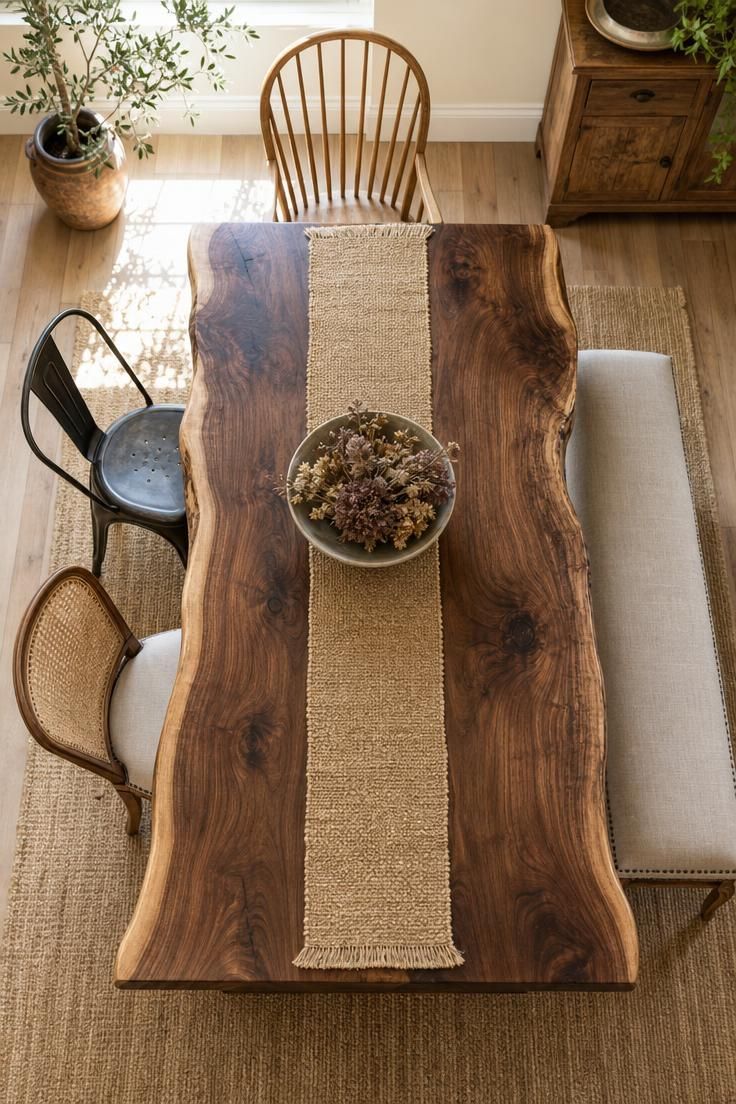
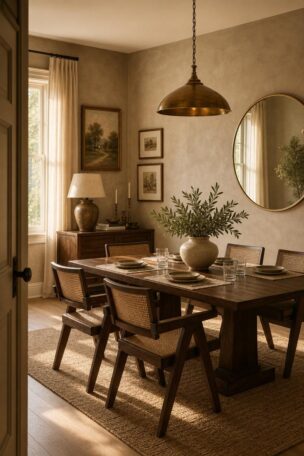
The dining room becomes a study in mixed wood tones when a live-edge walnut table anchors the composition.
Intentionally seating the table with three or four different chair styles breaks any expectation of a matching set and allows each piece to read as an individual find.
The jute runner down the center threads a natural, neutral line through the visual variety, giving the eye a resting place.
A low ceramic bowl of dried eucalyptus or pampas adds height and organic shape without requiring maintenance.
The contrast of wood grains, from oak to walnut to cane, creates rhythm without shouting for attention.
This is a practical table that also works as a still life when viewed from above.
It proves that eclectic decor does not require chaos, just thoughtful variety anchored by one strong surface.
Style Blueprint:
- A live-edge walnut or acacia dining table with visible grain and natural edges.
- At least three distinct chair styles: a Windsor, a metal café chair, and a cane-back.
- A padded bench in natural linen for a fourth seating option.
- A jute or sisal runner down the table center.
- A low ceramic bowl styled with dried eucalyptus, pampas grass, or sculptural branches.
A Deep Olive Accent Wall Behind a Brass Étagère of Apothecary Glass
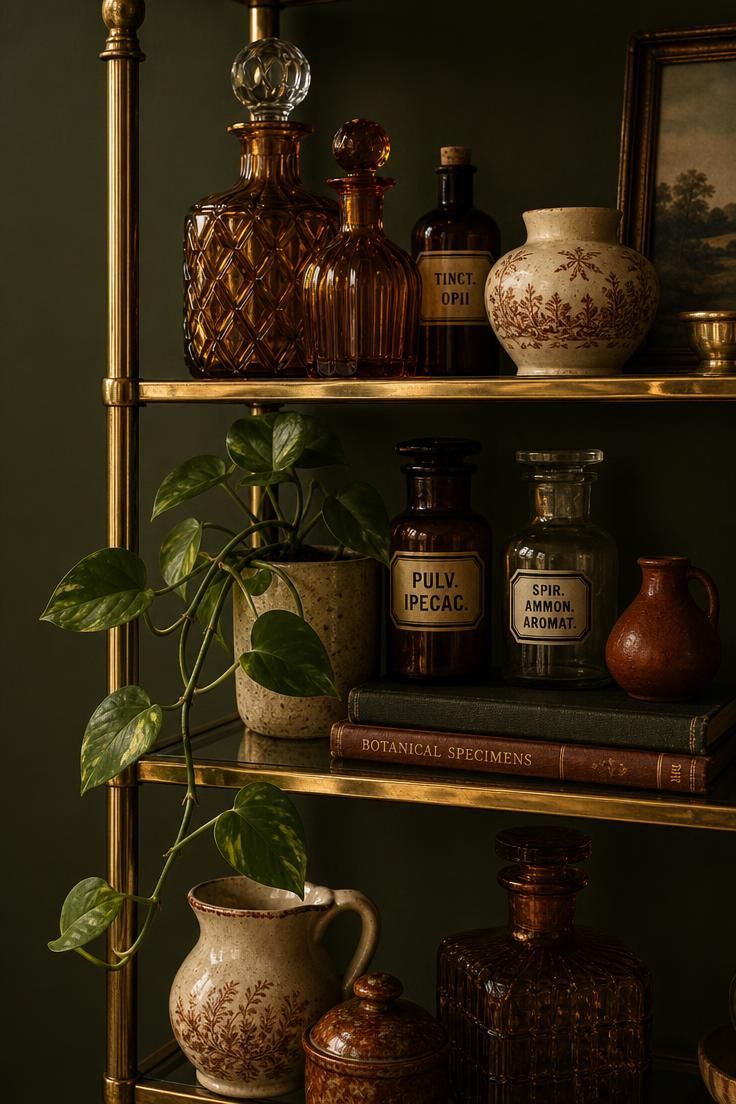
Painting the wall behind open shelving in deep olive changes the entire energy of a corner from forgettable to enveloping.
The dark color recedes, making the brass shelving and amber glass appear to float forward.
Vintage apothecary bottles in varying heights and shapes catch the low light and glow like small lanterns.
A single trailing pothos on an upper shelf introduces a living line that softens the metal and glass.
The ceramic vessels in cream and rust pull the olive wall and brass tones together without competing with them.
Leaving about one-third of each shelf empty keeps the display from tipping into visual noise.
This is a quiet lesson in warm neutral palette thinking.
Even a saturated dark green can serve as a warm neutral when it carries olive and earth undertones.
Style Blueprint:
- A deep olive or forest green painted wall behind the shelving.
- A brass étagère, ladder shelf, or open metal shelving with visible patina.
- Amber glass apothecary bottles, decanters, and mismatched ceramic vessels in cream and rust.
- One trailing plant such as pothos or ivy on an upper shelf.
- Approximately one-third of each shelf left empty for breathing room.
Design Pro-Tip: When styling open shelving in a cozy eclectic home, use the rule of thirds: one-third books, one-third objects, one-third empty space. The negative space gives your collected pieces room to breathe and prevents the vignette from reading as clutter.
A Vintage Suzani Throw Layered Over a Cane Headboard
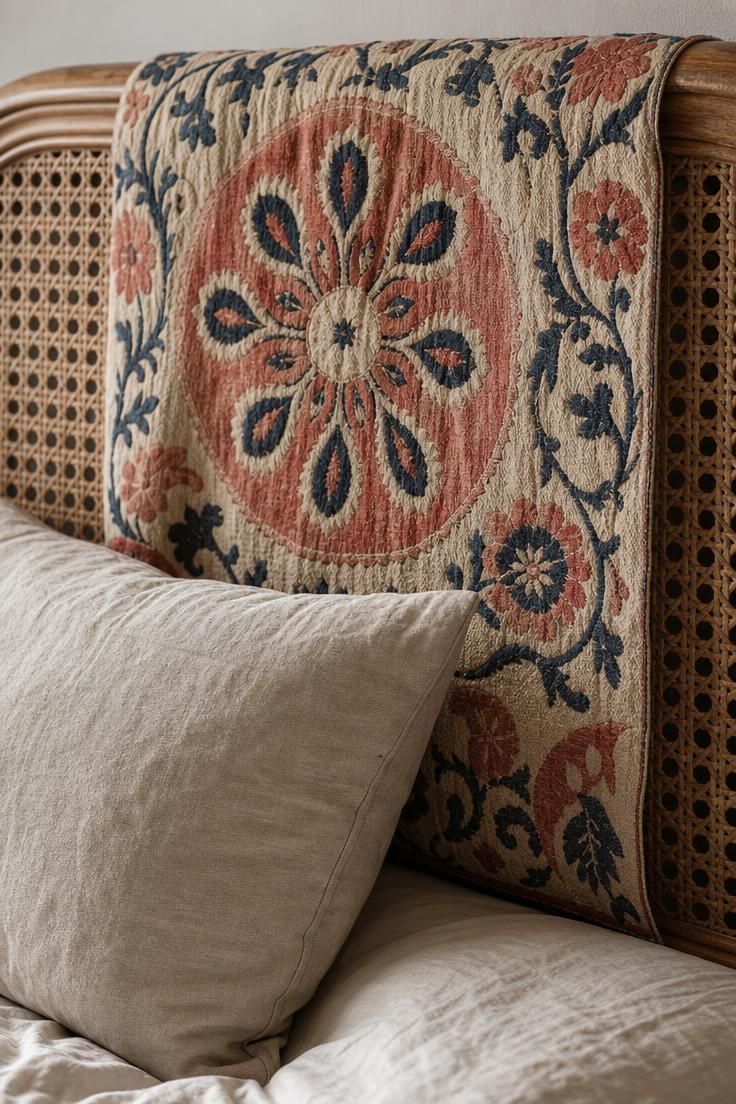
A cane headboard already brings texture and age, but draping a vintage Suzani over its top edge adds a layer of personal history.
The embroidered medallion pattern in faded coral and indigo gives the bed a focal point without requiring art on the wall behind it.
The asymmetry of the drape keeps the arrangement from feeling too composed.
Pairing the textile with linen bedding in warm white allows the embroidery to lead while maintaining a restful sleeping surface.
The cane weave behind the Suzani adds depth, creating a visual sandwich of pattern and texture.
This one move makes a simple bed into the centerpiece of a cozy home decor story.
It also demonstrates textile layering at its most direct, one piece doing the work of color, pattern, and warmth.
Style Blueprint:
- A cane, rattan, or carved wood headboard with visible texture and age.
- A vintage Suzani or embroidered textile draped asymmetrically over the top edge.
- Linen or washed-cotton bedding in warm white or oatmeal.
- One or two throw pillows in faded coral, indigo, or ochre pulled from the Suzani.
- A warm plaster or soft cream wall behind the bed to let the embroidery stand out.
A Terrazzo Console Styled With Travel-Collected Curios and a Gilt Mirror
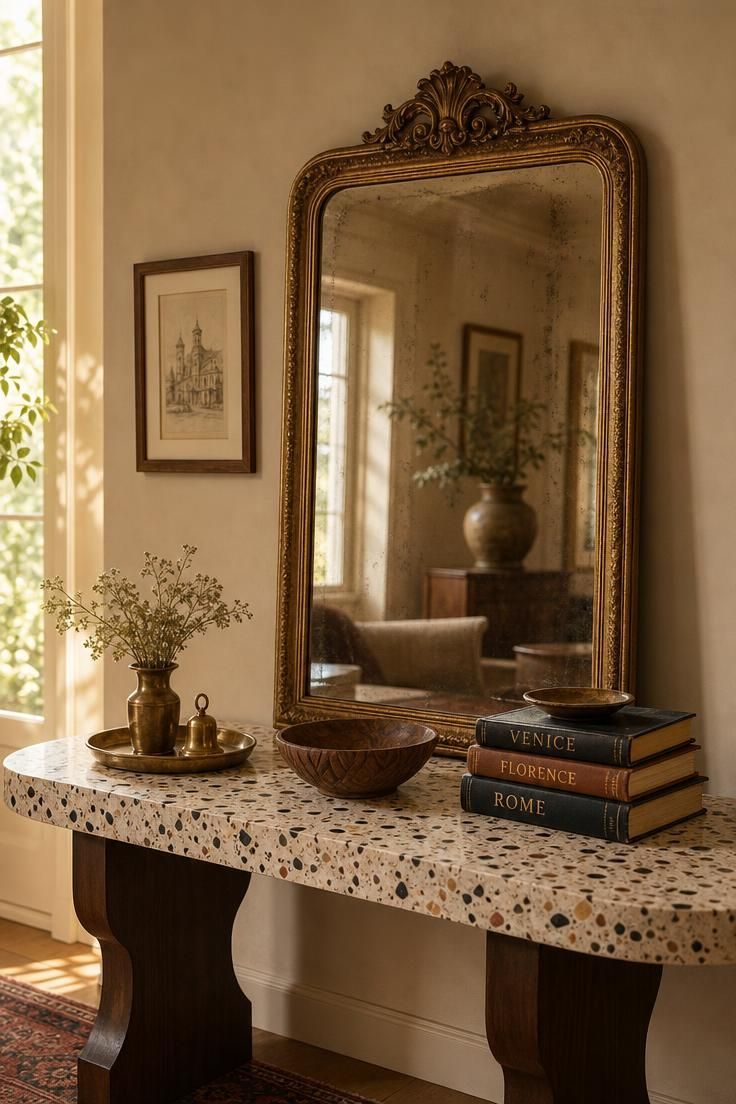
The console table becomes a quiet gallery for travel-collected curios when its surface is limited to a few meaningful objects.
The terrazzo top brings speckled color and a cool stone contrast to the warm wall and brass accents.
Leaning the gilt mirror slightly off center keeps the composition from feeling like a hotel lobby.
A brass tray gathers small items, a match striker, a smooth stone, a tiny sculpture, into one intentional grouping.
The carved wood bowl and stack of vintage travel books add height variation and a sense of narrative.
A single stem in a bud vase introduces a living note without demanding upkeep.
This scene captures the vintage and modern mix that defines a cozy eclectic home.
Old mirror, new console, collected objects, and one organic gesture all share the same surface.
Style Blueprint:
- A console with a terrazzo, travertine, or honed marble top and a simple wood or metal base.
- An antique gilt or carved wood mirror leaning slightly off center against the wall.
- A brass tray holding small curios such as a match striker, a stone, or a tiny sculpture.
- A carved wood or ceramic bowl and a short stack of vintage travel books.
- One organic element: a single stem in a bud vase or a small potted plant.
Layered Moroccan and Berber Runners in a Sunlit Hallway
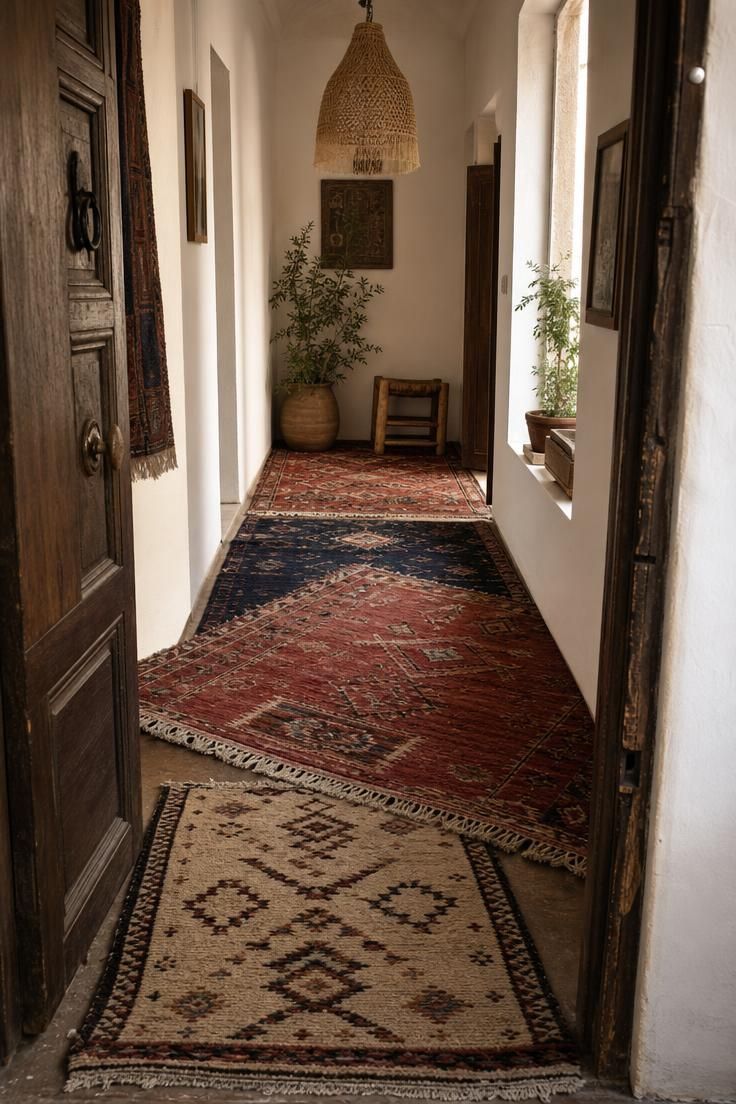
Layering runners in a hallway is one of the simplest ways to make a transitional space feel intentional.
The overlapping edges of vintage Moroccan and Berber rugs create a casual, collected rhythm underfoot.
Offsetting them at irregular intervals keeps the path from looking like a runner catalog spread.
Allowing one runner to extend under a doorway threshold invites movement and connects the hallway to the next room.
A woven pendant light at the far end anchors the vista and gives the eye somewhere to rest.
The faded red, indigo, and cream of the rugs warm the walls without requiring paint or art.
This is cozy lighting and textile layering working together in a narrow space that might otherwise be ignored.
Style Blueprint:
- Two or three vintage Moroccan or Berber runners in different widths and patterns.
- Runners offset so their edges overlap at irregular intervals.
- One runner extending under a doorway threshold to invite movement.
- A woven rattan or wicker pendant light hung at the far end of the hallway.
- Warm white or soft greige walls to let the rug colors dominate.
A Wicker Pendant Cluster Above a Reclaimed Oak Bench
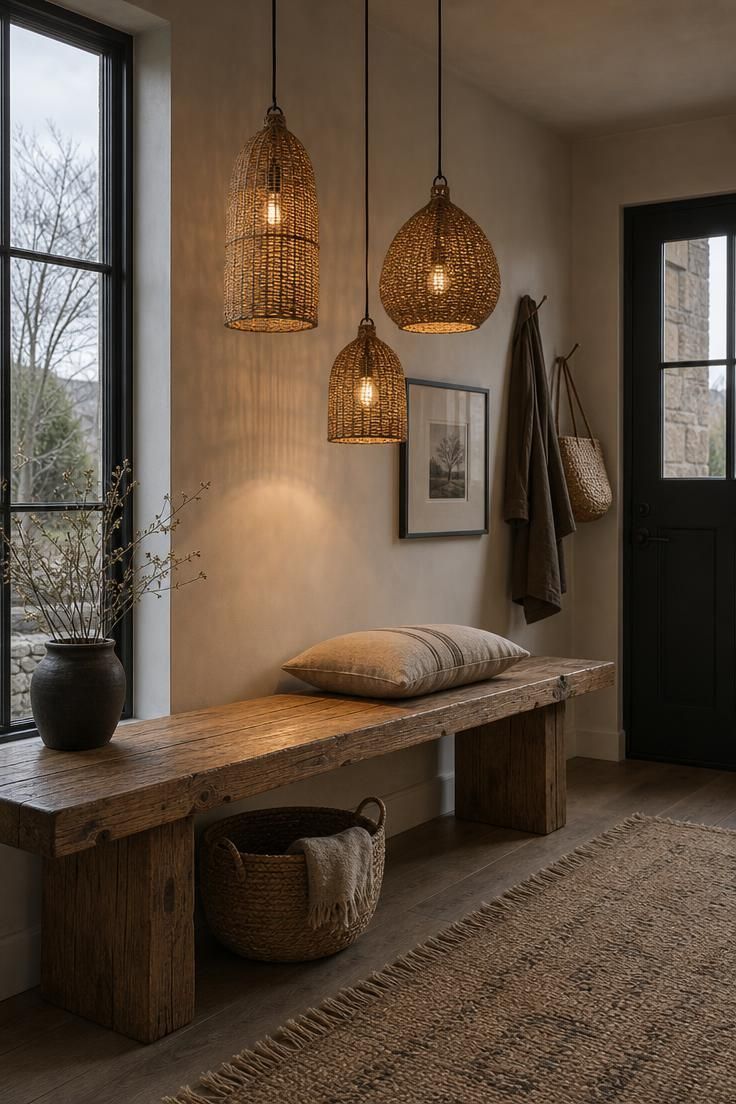
The entryway gains architectural presence when a cluster of wicker pendants hangs above a long oak bench.
Varying the pendant heights breaks the ceiling plane and makes the light feel organic rather than installed.
The reclaimed oak bench anchors the composition, its worn surface and visible grain connecting the entry to older building traditions.
A single long linen cushion in a muted neutral softens the seat without competing with the pendants.
Sliding a large woven basket beneath the bench adds storage and another layer of natural fiber.
The cool overcast light from a nearby window balances the warm glow of the pendants.
This scene proves that a cozy eclectic home can begin at the threshold, with woven texture and warm overhead light preparing you for the rooms beyond.
Style Blueprint:
- A cluster of two or three wicker or rattan pendants hung at slightly different heights.
- A reclaimed oak bench or church pew beneath the pendants.
- A single long linen or wool cushion in a muted neutral tone.
- One large woven basket or lidded storage trunk slid beneath the bench.
- Minimally accessorized surrounding walls so the pendants and bench remain the focal point.
A Brass Bar Cart Styled With Amber Glass and a Marble Top
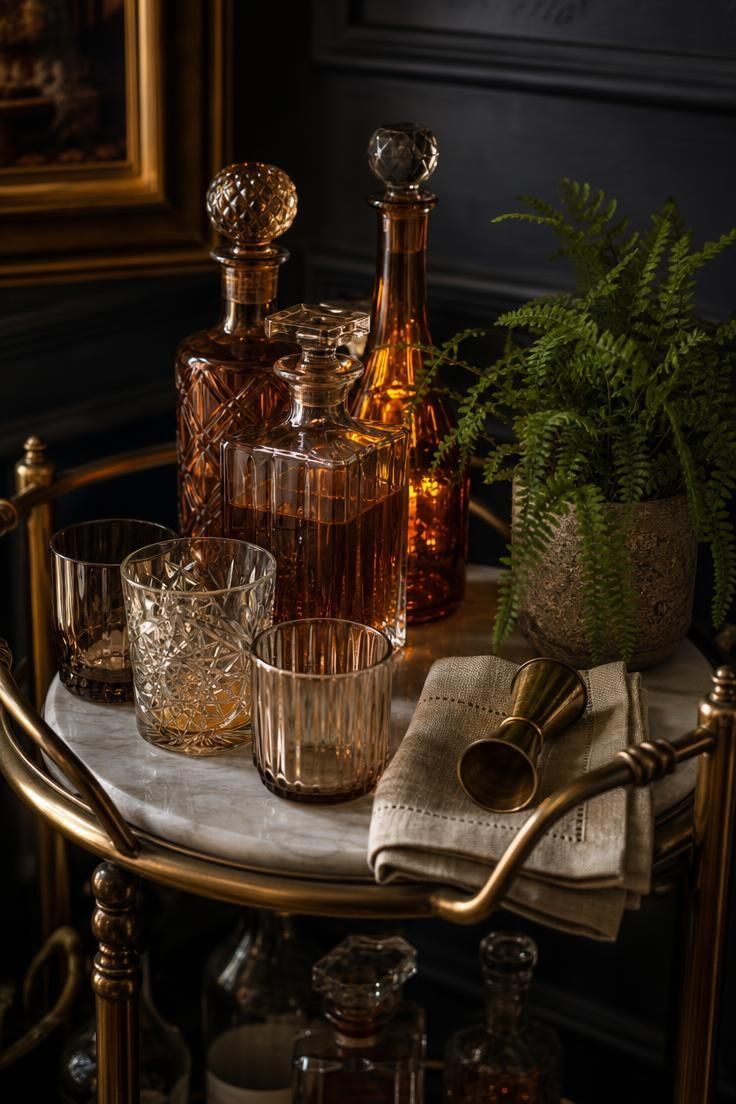
A vintage brass bar cart brings movable hospitality to any room while offering a stage for small collections.
The marble top catches the low moody light and gives the amber glass something reflective to sit on.
Decanters of varying heights create a skyline of warm color that glows when lit from the side.
Mismatched crystal tumblers add variety without breaking the palette of brass, amber, and green.
A small potted fern introduces a living element that keeps the cart from feeling like a hotel minibar.
The folded linen napkin beneath the brass jigger is a quiet nod to ritual and preparation.
This is curated clutter at its most functional, every object earning its place on the cart.
Style Blueprint:
- A vintage or vintage-style brass bar cart with visible patina and casters.
- A marble, glass, or mirrored top surface to catch and reflect light.
- Two or three amber glass decanters in different heights and shapes.
- Mismatched crystal or cut-glass tumblers with a brass jigger or cocktail tools.
- One small potted plant or a single stem in a bud vase as a living element.
A Scalloped-Edge Dining Table Beneath a Beaded Chandelier
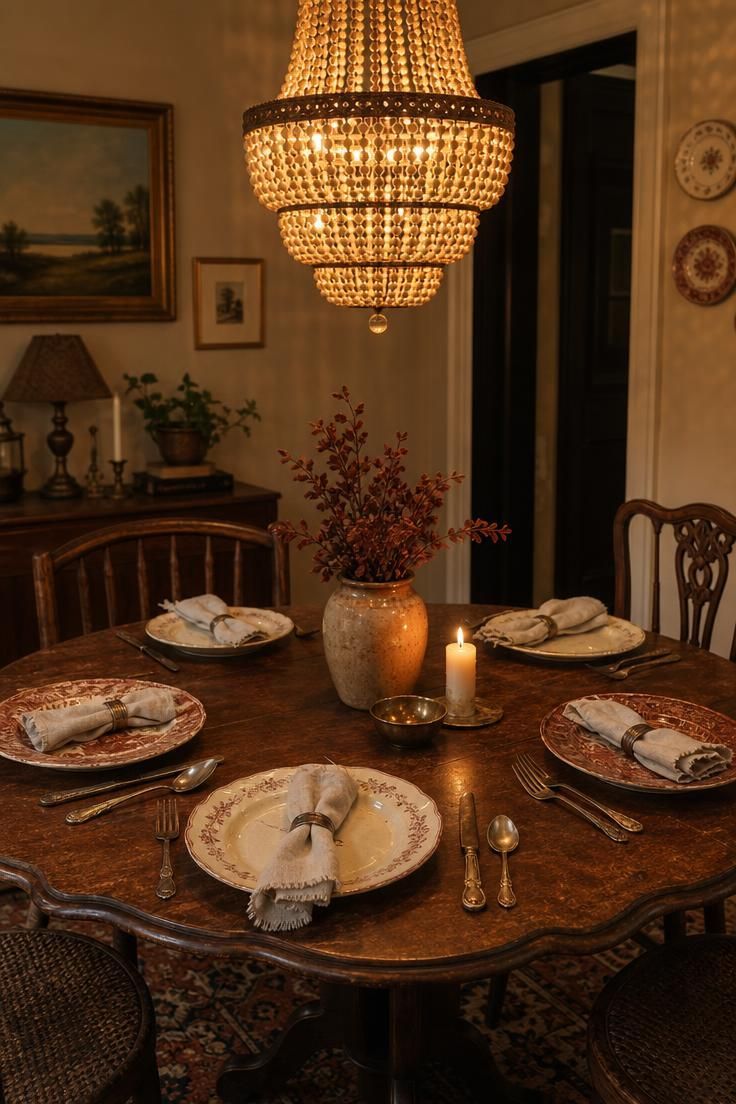
A scalloped-edge dining table brings a soft, carved detail to the dining room that modern rectangular tables often lack.
Hanging a beaded chandelier slightly lower than typical dining height creates an intimate ceiling plane over the table.
The beaded tiers catch warm golden light and scatter it across the table surface, making even a simple meal feel like an evening occasion.
Setting the table with mismatched ceramic plates in cream, rust, and olive keeps the eclectic energy alive without adding pattern.
Vintage flatware with varying handle patterns continues the story of collected pieces rather than purchased sets.
Linen napkins in natural tones tie the settings together.
This tablescape works because the table edge, the chandelier, and the plates all share a handmade quality.
Style Blueprint:
- A round or oval dining table with a scalloped, fluted, or carved edge detail.
- A beaded, capiz shell, or tiered metal chandelier hung slightly lower than typical dining height.
- Simple linen or cotton napkins in natural tones.
- Mismatched ceramic plates, perhaps one cream, one rust, one olive.
- Vintage or heirloom flatware with varying handle patterns unified by color.
Design Pro-Tip: Eclectic tablescapes feel cohesive when you repeat one element across all place settings, such as a napkin color or a plate material, while allowing every other element to vary.
A Jungle-Print Wallpaper Wrapping a Window Reading Nook
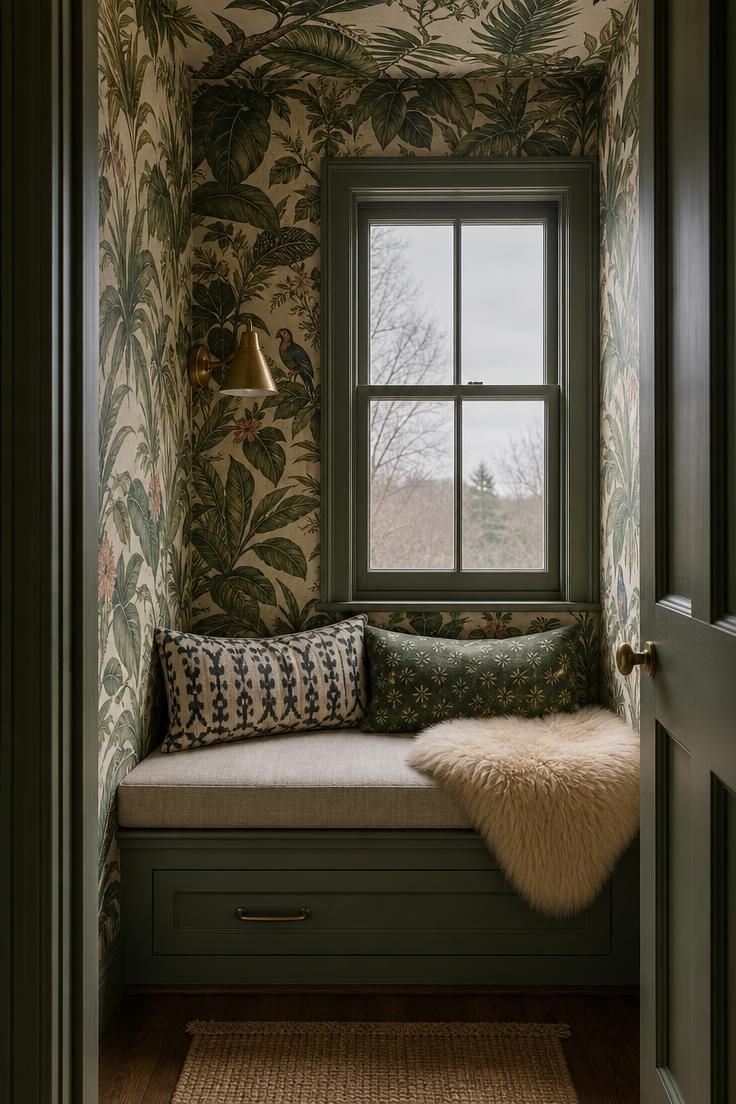
Wrapping a small window nook in jungle-print wallpaper turns an awkward recess into a destination.
The botanical pattern wraps the walls and window recess, making the nook feel like a room within a room.
A built-in bench with a solid linen cushion gives the eye a place to rest amid the pattern.
The sheepskin throw on one end adds tactile comfort and contrasts with the paper’s painted leaves.
Two lumbar pillows in patterns that share a color from the wallpaper connect the soft furnishings to the walls.
A brass wall sconce above the bench creates a focused pool for evening reading.
The cool overcast light from the window keeps the dense pattern from feeling heavy.
Style Blueprint:
- Botanical or jungle-print wallpaper wrapping the walls and window recess of a small nook.
- A built-in or freestanding bench with a custom linen cushion in a solid color pulled from the wallpaper.
- A sheepskin or faux-fur throw on one end of the bench.
- Two lumbar pillows in contrasting patterns sharing a color from the wallpaper.
- A small brass or ceramic wall sconce mounted above the bench for focused reading light.
A Glass Curio Cabinet Packed With Ceramic Figurines and Vintage Books
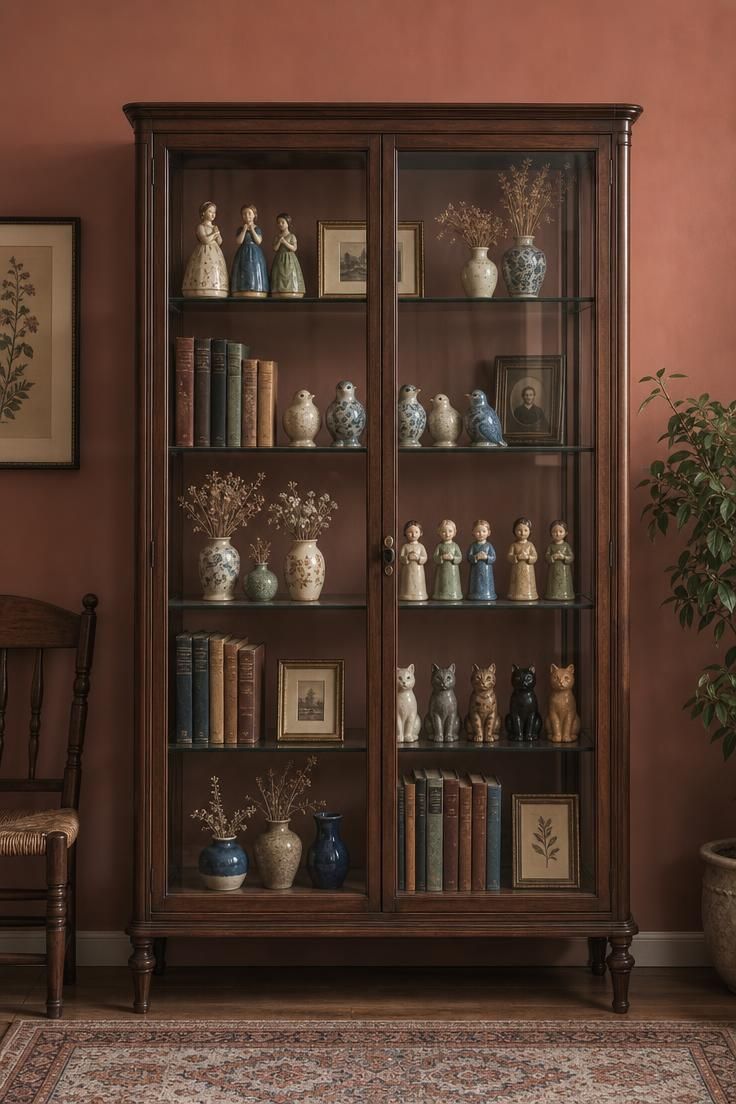
A glass curio cabinet packed with small collections becomes a museum of personal history in the middle of a living room.
Grouping ceramic figurines in threes and fives creates small still lifes on each shelf.
Small framed photos tucked among the objects add a layer of memory and warmth.
Vintage books, some standing and some stacked, give the shelves horizontal and vertical structure.
A few dried botanical stems in small vases bring an organic note to the glass and ceramic.
Painting the wall behind the cabinet in muted terracotta frames the piece and makes the interior objects glow.
The glass front slightly reflects the room’s light while revealing the contents, creating depth and a sense of protected treasures.
This is gallery wall ideas translated to shelving, a vertical collection rather than a horizontal one.
Style Blueprint:
- A glass-front curio cabinet or secretary desk with visible patina or painted finish.
- Ceramic figurines, small framed photos, and vintage books arranged on the shelves.
- Objects grouped in threes or fives with varying heights and materials on each shelf.
- One or two dried botanical stems in small vases.
- A muted terracotta or dusty rose wall behind the cabinet to frame the piece.
An Emerald Velvet Headboard Studded With Brass Nailheads
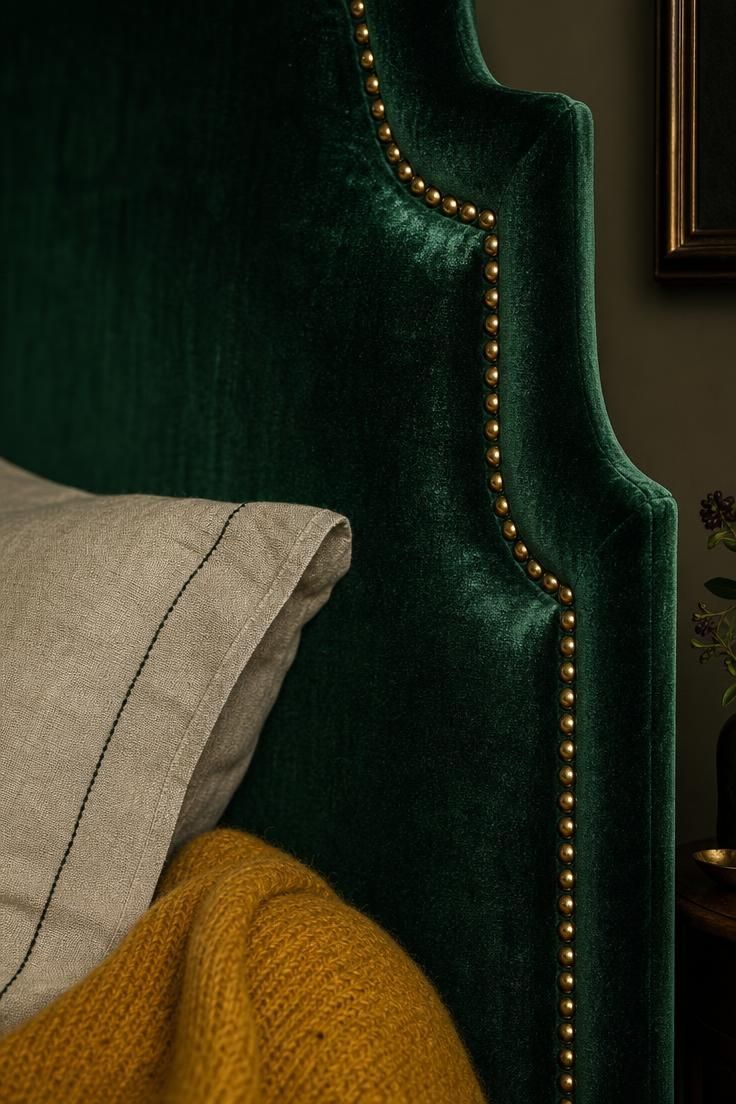
An emerald velvet headboard studded with brass nailheads brings saturated color and metallic contrast to the bed.
The velvet’s nap catches low moody light and glows, making the headboard read as a warm, soft surface rather than a flat panel.
Brass nailheads march along the edge, their precise spacing adding structure to the plush fabric.
Pairing the emerald with linen shams in warm white keeps the bed from feeling too dark or heavy.
A mustard wool throw at the foot of the bed introduces a second warm hue that talks to the brass.
Keeping the surrounding walls a deeper neutral helps the headboard feel like a jewel set into the room.
This is cozy home decor that leans into color without losing calm.
Style Blueprint:
- An emerald, forest, or teal velvet headboard with visible nap and depth.
- Brass nailhead trim or edge detailing for metallic contrast.
- Linen or washed-cotton shams in warm white or oatmeal.
- A throw blanket in mustard, rust, or another warm hue at the foot of the bed.
- Deeper neutral walls in charcoal, greige, or soft taupe to let the velvet glow.
A Macrame Wall Hanging Layered Over Striped Wallpaper
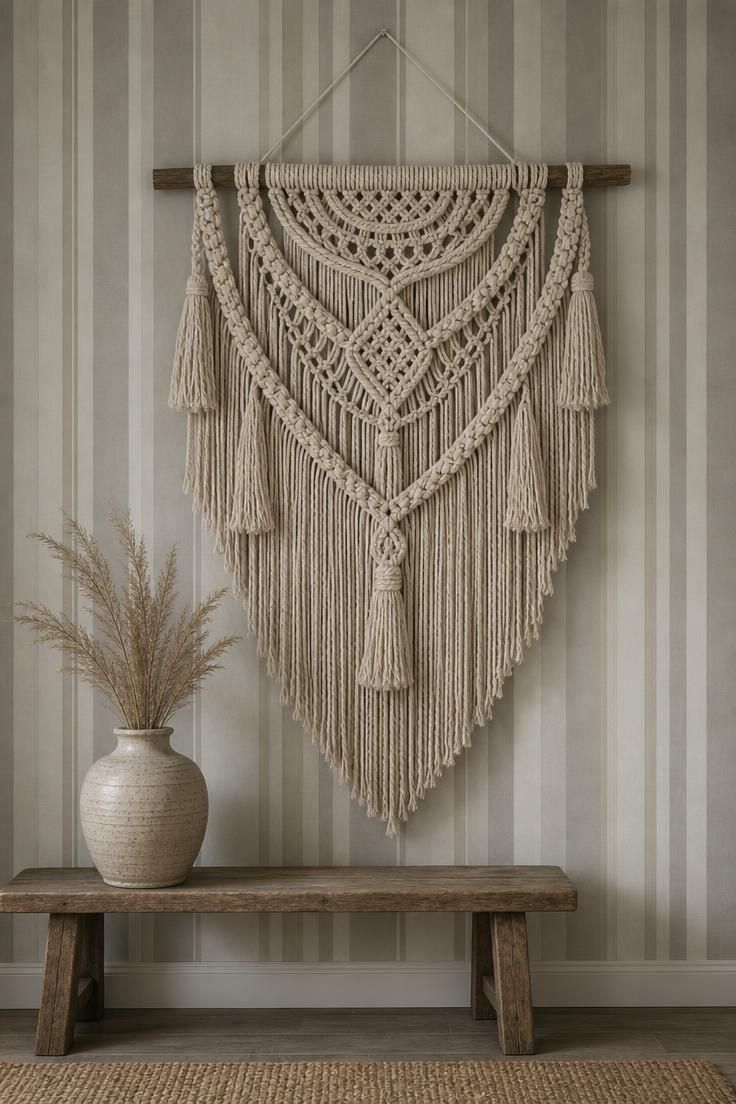
Layering a large macrame wall hanging over striped wallpaper creates a conversation between geometric order and organic fiber.
The vertical stripes provide a quiet rhythm that the macrame interrupts with knotted, irregular texture.
Keeping the wallpaper tonal and muted prevents the two patterns from fighting.
A low bench beneath the hanging grounds the composition and gives the wall art a three-dimensional anchor.
The single ceramic vessel with dried grass extends the vertical line upward while adding a natural, sculptural form.
This scene works because it uses only a few objects but gives each one enough visual weight.
It is a strong argument for treating one wall as a complete composition rather than scattering small pieces across a room.
The result feels like a collected corner rather than a decorated wall.
Style Blueprint:
- A muted tonal striped wallpaper, hand-painted or paste-paper, on a single focal wall.
- A large macrame, woven, or fiber-art wall hanging mounted over the wallpaper.
- A low bench, daybed, or woven stool beneath the wall hanging.
- A single ceramic vessel with dried grass, pampas, or tall branches.
- Minimal furniture and objects to let the pattern and fiber art lead.
A Checkerboard Marble Floor Grounding a Jute-Rug Living Room
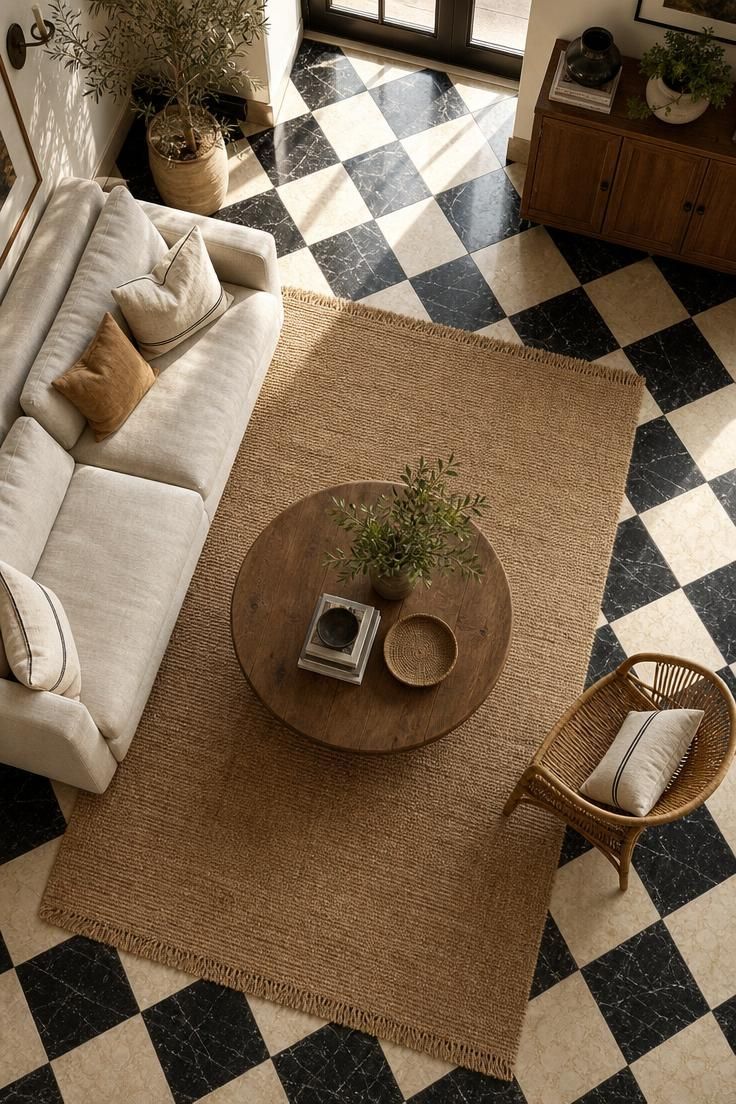
A checkerboard marble floor brings bold geometric pattern to the base of a room while a jute rug softens its impact.
The natural weave of the jute contrasts with the polished stone and creates a warm zone for the seating group.
Leaving a border of checkerboard visible around the rug keeps the floor as an active design element rather than hiding it completely.
The linen slipcovered sofa, round wood coffee table, and rattan chair each bring a different material family to the rug’s perimeter.
From above, the composition reads as a layered study in black, cream, jute, wood, and linen.
This is a perfect example of a vintage and modern mix.
Classic marble flooring, natural fiber rug, and contemporary casual seating all share the same frame.
The bright midday light keeps the checkerboard from feeling too formal or heavy.
Style Blueprint:
- Black-and-cream checkerboard marble, terrazzo, or encaustic tile flooring.
- A large jute or sisal rug layered over the checkerboard with a visible tile border.
- A linen or cotton slipcovered sofa on one edge of the rug.
- A round or oval wood coffee table at the rug’s center.
- A rattan, cane, or wicker chair at an adjacent edge to vary seating silhouettes.
A Vintage Steamer Trunk Repurposed as a Coffee Table
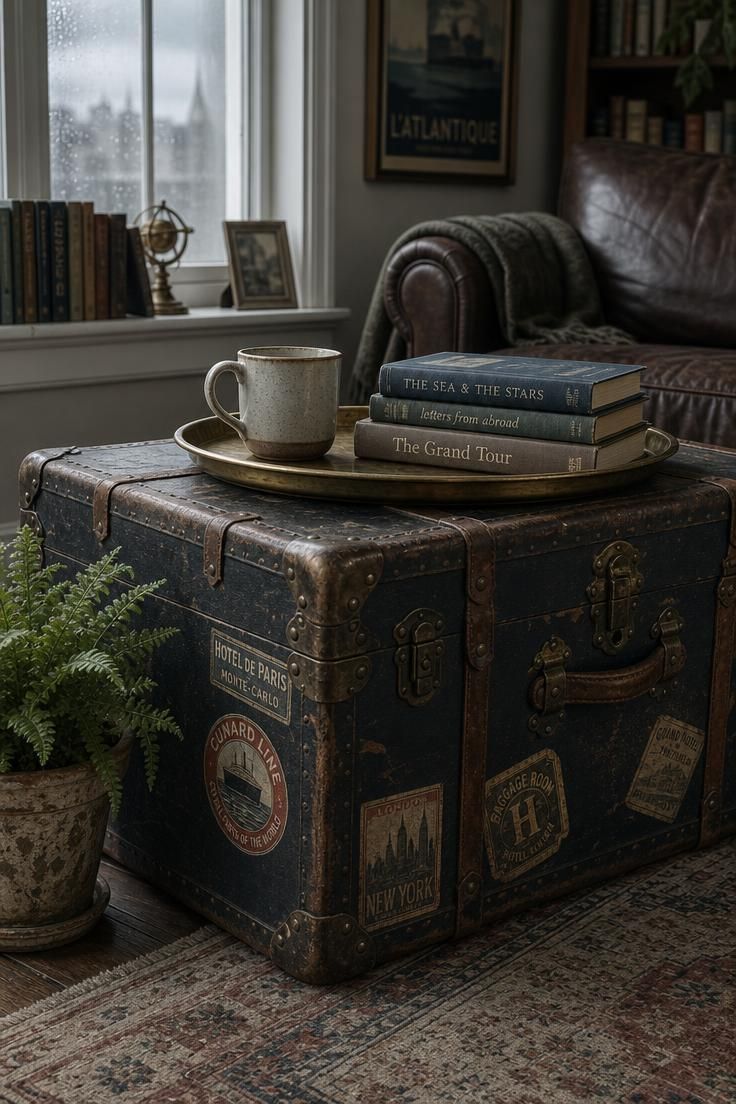
A vintage steamer trunk brings storage, story, and surface to a living room in one weathered package.
The leather straps, metal corners, and travel stickers tell a visual story of movement and age that no new coffee table can match.
Placing a round brass tray on top defines a stable surface for a ceramic mug, small books, and a bowl while preventing the trunk from looking cluttered.
The potted fern on the floor beside the trunk adds a green contrast that softens the hard edges of the leather and metal.
Keeping the surrounding seating low, a floor cushion, a pouf, or a very low bench, maintains the trunk’s presence as the center of the arrangement.
The cool overcast light lets the worn surface details show without harsh shadows.
This is indoor plants decor and vintage furniture working together to create a calm, grounded center.
Style Blueprint:
- A vintage steamer trunk with visible leather straps, metal hardware, and travel stickers.
- A round brass or aged-metal tray on top to define a stable surface for objects.
- One or two small books, a ceramic mug, and a small bowl styled on the tray.
- A potted fern or trailing plant on the floor beside the trunk.
- Low seating pieces such as a floor cushion, pouf, or very low bench.
Conclusion
The cozy eclectic home lives in the tension between density and pause, pattern and neutral rest, old and new.
Its governing logic is simple.
Choose a warm, unifying envelope through wall color, flooring, or lighting, and then layer specific, tactile, story-rich objects within it.
The sixteen scenes above all share that structure, a strong anchor piece surrounded by supporting materials that echo its colors and textures.
Begin with one anchor, a rug, a sofa, a headboard, a trunk, and build outward from its era, its patina, and its palette.
Collect slowly, display with intention, and leave room for the home to hold the evidence of a life in progress.