This post may contain affiliate links. If you make a purchase through these links, we may earn a commission at no additional cost to you.
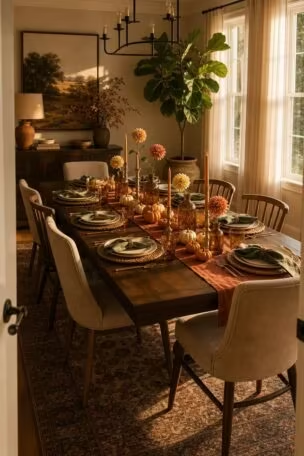
A Thanksgiving aesthetic begins with the table and spreads outward through the rooms where people gather.
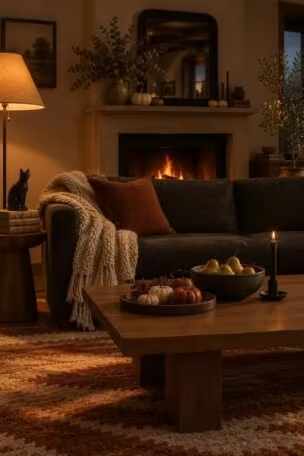
Warm wood, cream linen, dried stems, and low candlelight carry the harvest mood better than a scatter of seasonal motifs.
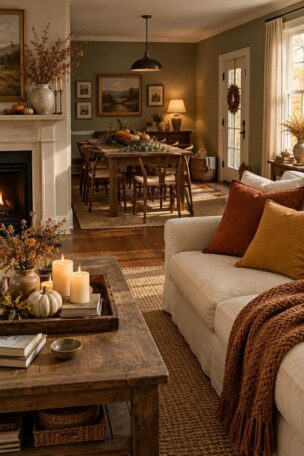
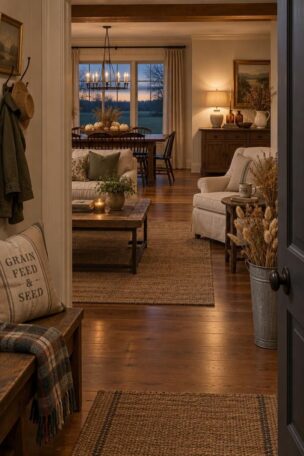
The ideas here move from the entry to the mantel, the sideboard, the dining table, the sofa, and the porch, so every surface greets guests with the same earthy welcome.
Each one pairs a single surface with a simple composition that is easy to repeat and easy to put away.
The result is a home that feels generous without feeling busy.
Cream and Sage Gourd Cluster on the Entry Console
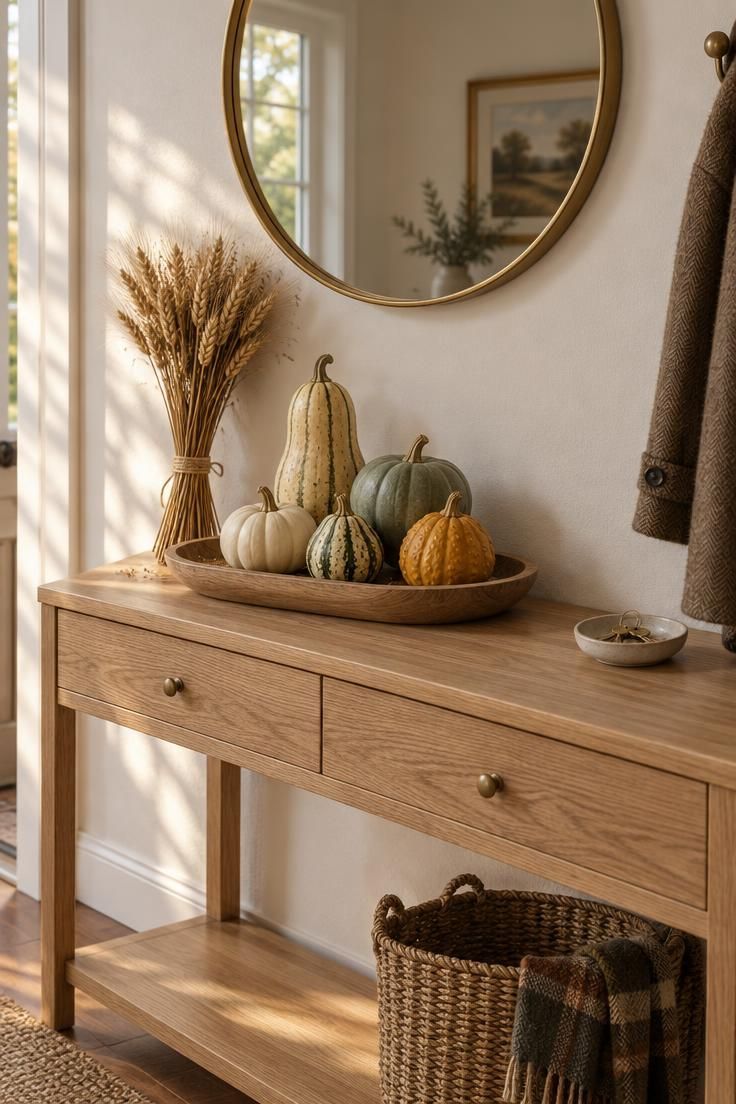
The entry sets the tone before anyone reaches the dining room, so a small, contained composition works harder than a wide spread of decorations.
A low tray holds the gourds together and gives them a defined edge, which keeps a narrow console from looking scattered.
Cream, sage, and soft gold read as earthy and quiet, and the mix of sizes lets the grouping feel collected rather than purchased as a set.
Height matters on a console, especially one with a mirror above it.
A single bunch of dried wheat behind the tallest gourd adds a vertical line without hiding the reflection or crowding the wall.
The tray also catches any stems or petals that drop, so the surface stays tidy with a quick lift rather than a full restyle.
Scale the cluster to the furniture.
A generous console can carry five gourds and a full bundle of wheat, while a slim apartment entry looks better with three gourds and one thin branch.
Leaving open space at each end of the tray keeps the composition from pressing against the mirror or the edge of the console.
Gourds can mark an unsealed wood surface over time, so the tray does more than organize the look.
Wipe the gourds and the tray every few days, and remove any that soften at the base.
Style Blueprint:
- Low oval wooden tray with a matte finish
- Five gourds in cream, sage, and soft gold, varied in size
- One bundle of dried wheat stems
- Small ceramic dish for keys
Dried-Stem Mantel with Varied Candle Heights
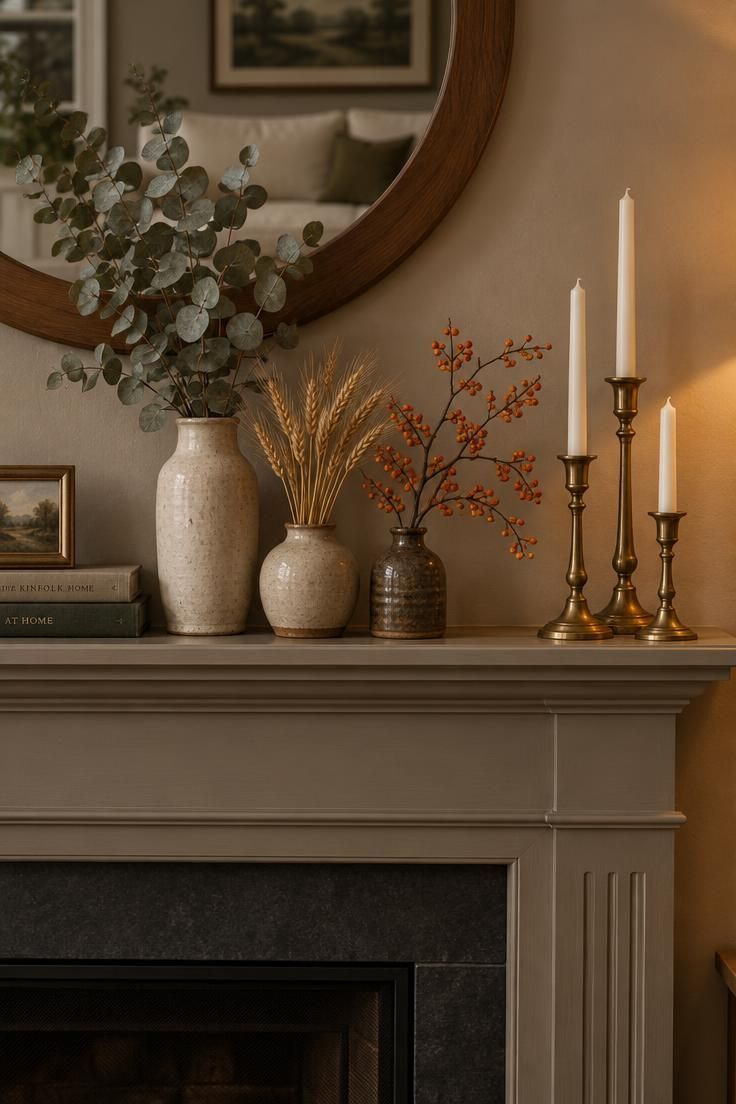
A mantel reads as a focal point even when the fireplace is cold, and this arrangement gives it weight at both ends without lining objects up like a shelf display.
Dried eucalyptus, wheat, and bittersweet bring three different textures: soft silver-green leaves, stiff golden stalks, and small berry clusters.
Placing the tallest vessel off-center and clustering the brass on the opposite side creates a gentle diagonal that the eye follows across the shelf.
The dried eucalyptus mantel display depends on restraint.
Three vessels are enough for a standard mantel, and a fourth usually pushes the grouping toward clutter.
Keep the stems a little taller than the vases so the leaves arch rather than stand straight up, and let a few stems fall to one side.
Candle height does more for the composition than candle count.
Three tapers at different heights, grouped close together, form a small vertical cluster that balances the wider spread of stems.
Spacing them evenly across the mantel flattens the look and competes with the vessels.
Repeat the brass somewhere else on the shelf, in a frame or a small dish, so the metal reads as a thread rather than an accident.
Dried stems shed, so a quick pass with a soft brush every few days keeps the mantel and the shelf below it clean.
Style Blueprint:
- Three small vessels in ceramic and stoneware
- Dried eucalyptus, wheat, and bittersweet stems
- Three brass candlesticks in varied heights
- Round wooden mirror above the mantel
- One small brass accent elsewhere on the shelf
Rhythmic Mini Gourd Line Along a Raw Wood Bench Board
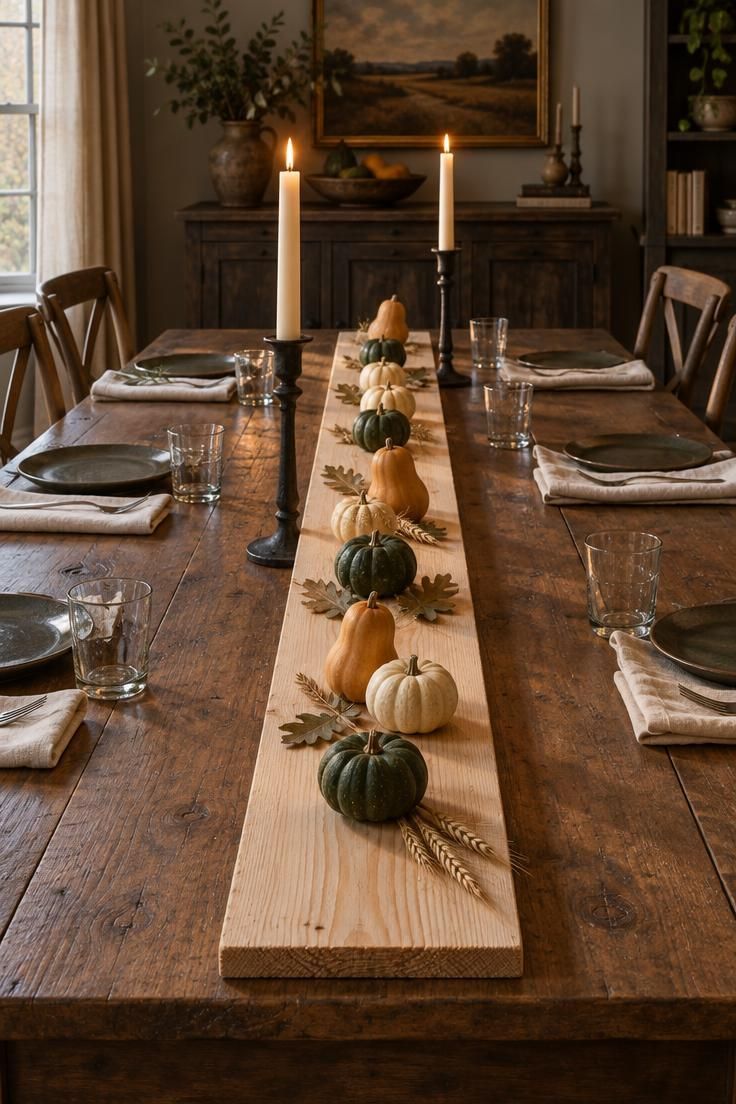
For a linen table runner, a bare board down the table works as a slower, more sculptural stand-in for a runner.
The raw pine reads as a found piece from a workshop or shed, while the small gourds sit on it like a harvest row rather than a gathered pile.
Spacing them unevenly keeps the center loose enough that serving platters can enter from the side without forcing the display to move.
The arrangement relies on rhythm more than symmetry.
Two cream gourds might sit near each other, then a green gourd, then a pause with a flattened oak leaf, then a butternut gourd beside a wheat sprig.
The board stays visible between objects, so the grain becomes part of the composition instead of a hidden base.
Scale matters here.
Mini gourds, not full pie pumpkins, keep the line low and leave sightlines open across the table.
A small candlestick at each end, placed slightly off-center, frames the board from behind without making the table feel formal.
For a narrower table, use a shorter board or a wood cutting board laid flat and reduce the line to five or six gourds.
The same idea still holds when only a few objects share the center.
Style Blueprint:
- Unfinished pine board as a low platform
- Mini green, cream, and butternut gourds in a spaced line
- Flat oak leaves and dried wheat sprigs tucked into the gaps
- Dark iron taper candlesticks placed off-center behind the board
- Cream linen napkins beside each place setting
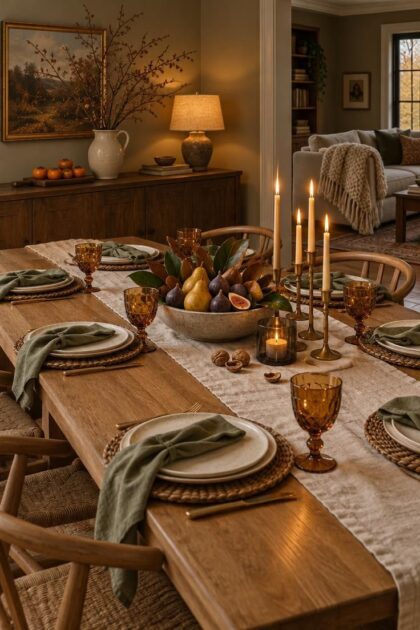
Low, Wide Harvest Bowl as the Table Centerpiece
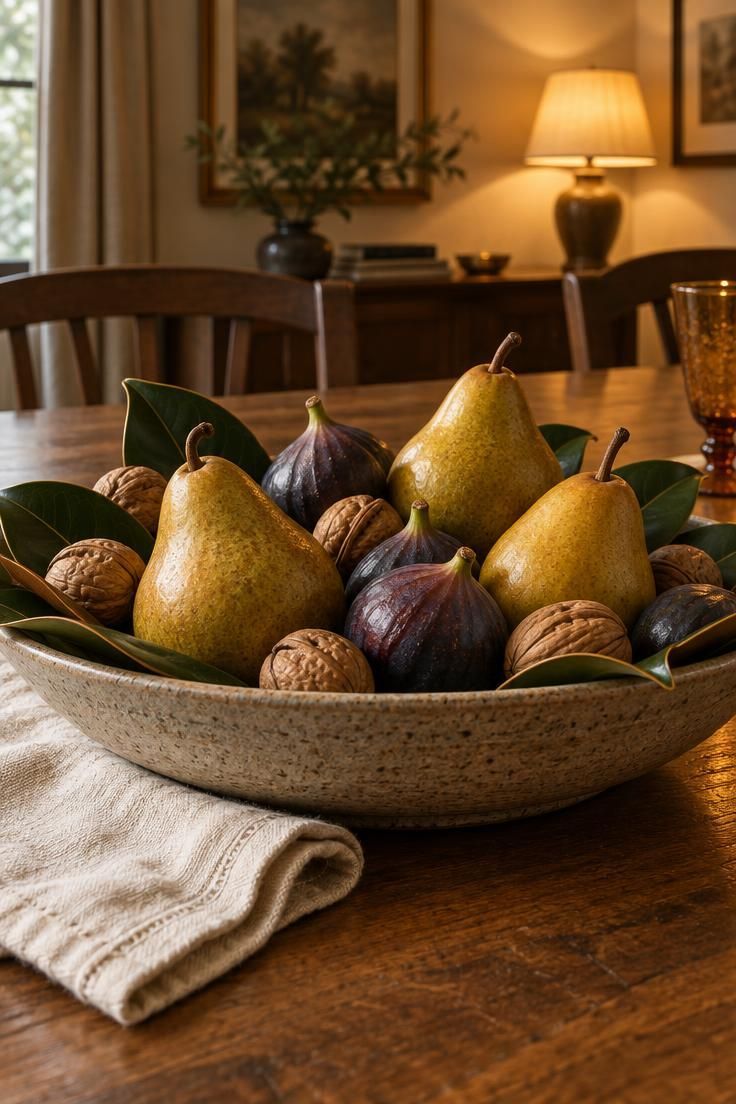
The harvest table centerpiece succeeds when it stays below seated eye level.
A wide, shallow bowl lets guests see one another across the table while still delivering the impression of plenty.
Pears, figs, and walnuts in shell give three shapes and three earth tones, and magnolia leaves tucked between the fruit fill the gaps so the bowl reads full rather than half-empty.
Width does more than height here.
A bowl that spreads toward the edges of the table feels generous, while a tall arrangement in the same footprint becomes a wall.
Choose firm fruit that will hold through a long meal, and keep the leaves near the surface so they do not hide the fruit.
Surface protection is part of the styling.
A small linen cloth under the bowl catches moisture from the fruit and keeps an unsealed wood table from marking, and it adds a soft edge against the hard stoneware.
Swap the cloth for a tray if the table will be cleared and reset between courses.
For a longer table, two smaller bowls with different fruit work better than one oversized piece.
Splitting the arrangement keeps sightlines open at both ends and lets each end of the table have its own small moment.
For a more relaxed feel, substitute the walnuts with a few smooth river stones in similar brown tones, which keeps the same visual weight without any food waste to clean up afterward.
Style Blueprint:
- Wide, shallow unglazed stoneware bowl
- Whole pears, figs, and walnuts in shell
- Magnolia leaves for filler
- Small cream linen cloth beneath the bowl
Amber and Smoke Glass with Taper Candles
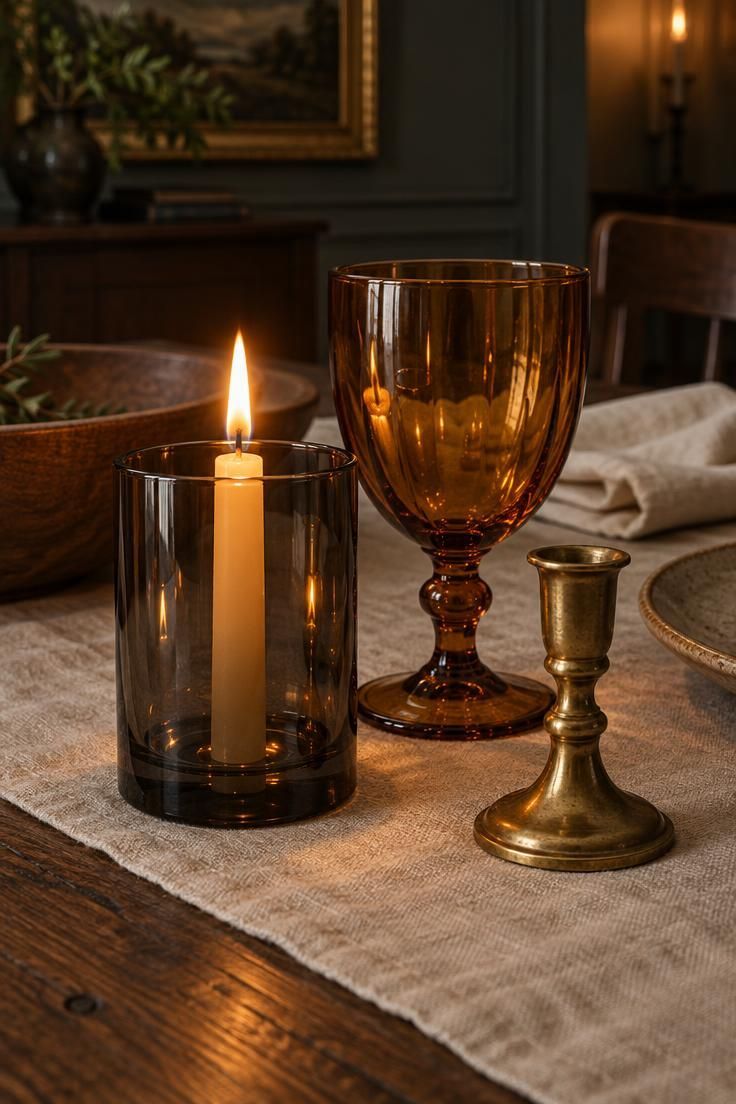
Glass and candlelight add depth to a table without changing the centerpiece.
Amber goblets at each place catch the warm light and echo the harvest palette, while smoke-glass votives sit between settings as small dark notes that keep the table from reading too sweet.
The pairing of stoneware and brass tableware with this glass gives the setting a mix of matte and shine that looks collected over time.
Clustering the candles on one side of the table is the difference between a composition and a row.
A small group of tapers at varied heights forms a bright counterweight to the bowl at the center, and the flames reflect in nearby glass, doubling the light without adding objects.
Lining candles down the middle splits the table and competes with the food.
Keep the cluster small so it does not rival the harvest bowl.
Two or three tapers with one or two votives is enough for a standard table, and the varied heights keep the group from looking like a matched set.
Amber and smoke glass show water spots and fingerprints more than clear glass, so a quick polish before guests arrive keeps the surfaces clean.
Store the pieces wrapped rather than stacked to protect the rims between seasons.
Style Blueprint:
- Amber goblets at each place
- Two or three smoke-glass votives
- Brass candlesticks with tapers in varied heights
- Cream linen cloth beneath the cluster
Sideboard Harvest Still Life with Stoneware Pitcher and Persimmons
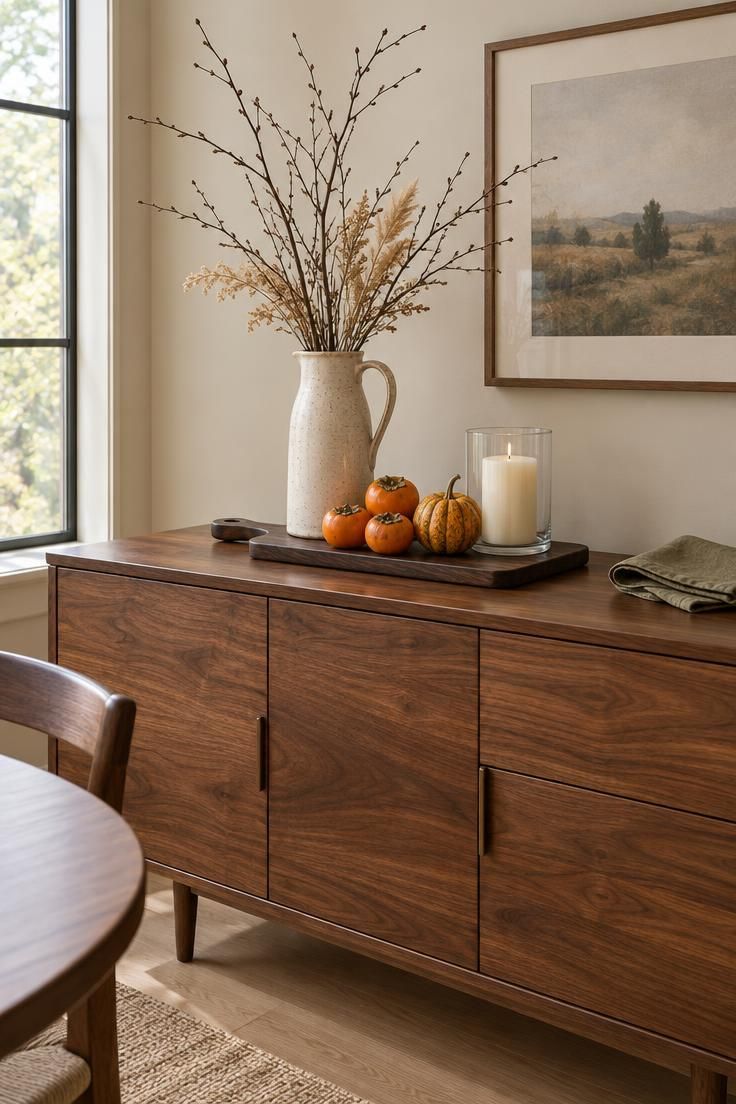
A sideboard gives a static arrangement room to breathe, and it holds up through dinner because nothing on it needs to move.
A tall stoneware pitcher of bare branches or dried grasses gives the surface a vertical anchor, while a wooden serving board underneath contains the smaller objects and makes the whole grouping easy to shift if the sideboard is needed for serving.
Persimmons bring a warm orange note that feels specific to late autumn, and an odd-numbered cluster of three keeps the arrangement from looking paired or symmetrical.
A single small gourd and one pillar candle round out the group without crowding it.
The board defines the edge of the composition, so the eye reads it as one still life rather than a collection of loose objects.
Match the wood tones to the dining table so the rooms feel connected.
A walnut sideboard with a dark board and a light oak table can still work together if the pitcher and ceramics repeat across both surfaces.
Carrying one material from room to room is what makes the house feel decorated as a whole.
Bare branches and dried grass shed a little, and persimmons soften over a week or two.
Check the fruit every few days, and replace any piece that dimples.
The board also keeps moisture and color from reaching the walnut finish.
Style Blueprint:
- Tall cream stoneware pitcher
- Dark wooden serving board
- Three persimmons and one small gourd
- Unlit pillar candle in a glass holder
Chunky Knit Throw and Plaid Pillow Swap on the Sofa
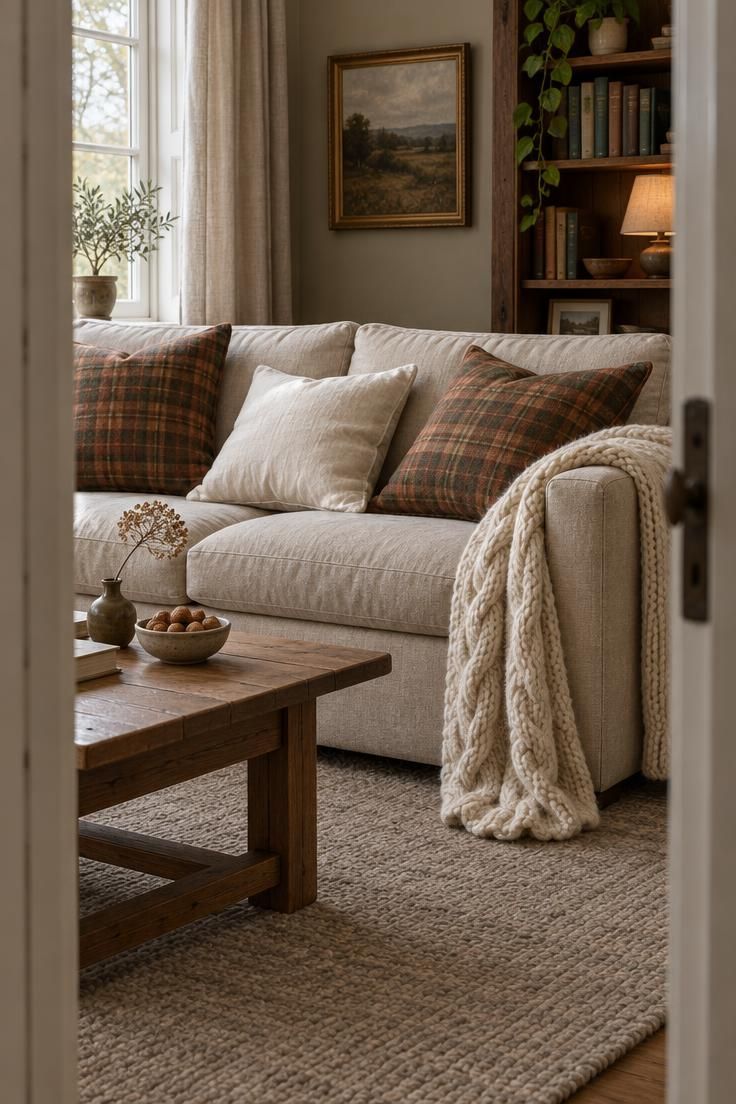
The seating area carries the seasonal palette without requiring new furniture.
A fall throw pillow swap is the simplest version of this idea: keep the solid pillows that already work, and change two covers to plaid or windowpane wool in rust, olive, or mustard.
The existing solids give the eye a rest between the patterns and keep the sofa from looking like a theme display.
A chunky knit throw adds texture that a woven blanket cannot match.
Draping it over one arm and letting it fall low looks relaxed, while folding it into a neat square reads as staged.
The column of knit also softens the hard line of the sofa arm, which helps in a small living room where furniture edges dominate.
Choose a plaid with a muted ground so it does not fight the table linens in an open-plan room.
Rust and olive sit comfortably with sage napkins and cream stoneware, while a bright red plaid pulls the eye away from the dining table.
Wool covers and a chunky knit need a light shake and a fold between uses, and they should be stored clean at the end of the season.
Swap the covers back after November and keep the ivory knit in place through winter.
Style Blueprint:
- Chunky ivory or oatmeal knit throw
- Two plaid wool pillow covers in rust and olive
- One solid ivory pillow kept in place
- Oatmeal wool rug beneath the sofa
Kitchen Counter Herb and Citrus Moment
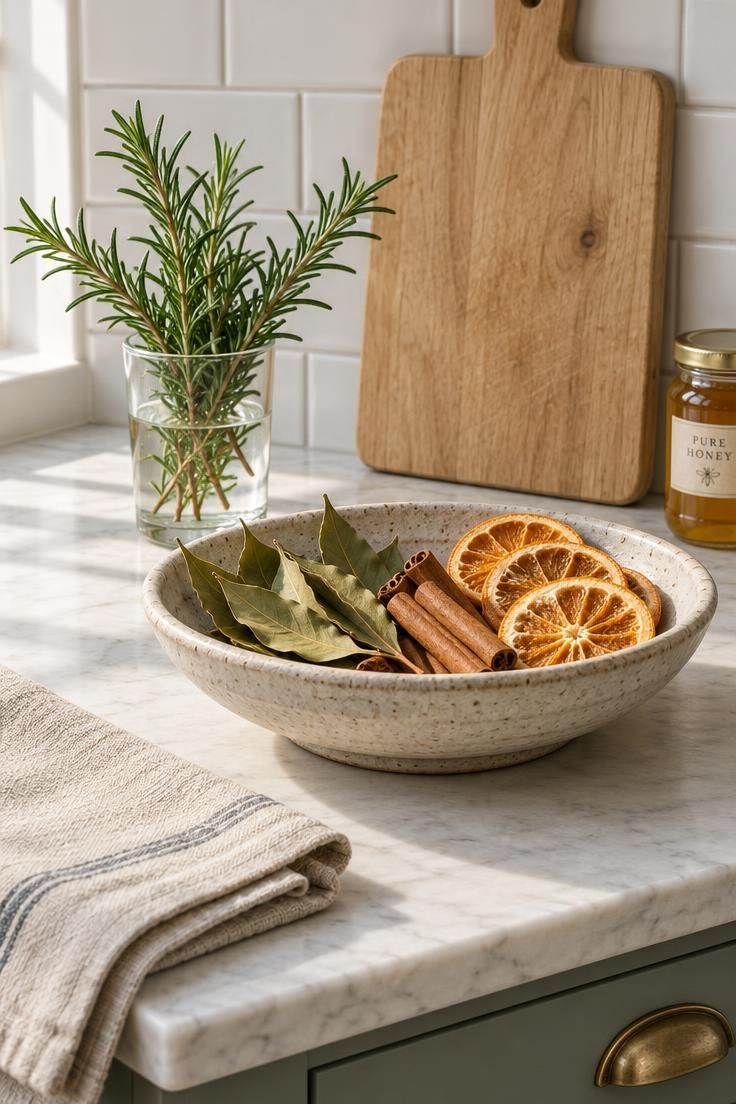
The kitchen can echo the Thanksgiving aesthetic without giving up workspace.
A shallow matte bowl of bay leaves, cinnamon sticks, and dried orange slices sits at the end of an open counter and connects to the dining table through its materials.
A small glass of fresh rosemary or sage beside it brings a living green note and a scent that carries into the next room.
Keeping the arrangement small is the point.
The bowl lifts away in one motion when the counter is needed for cooking, and the glass of herbs moves to the windowsill.
A tray under the bowl would add another layer of containment, though a shallow bowl with a wide base is usually stable enough on its own.
Dried orange slices and bay leaves last for weeks, while fresh herbs fade in a few days.
Change the water and trim the stems every other day, and replace the rosemary when the leaves begin to droop.
Rotate the orange slices if they darken unevenly against the glass.
Match the bowl to the stoneware on the table so the two rooms read as one palette.
A cream or unglazed bowl with a wooden cutting board nearby ties the kitchen to the dining room without adding another color.
Style Blueprint:
- Wide shallow stoneware bowl
- Bay leaves, cinnamon sticks, and dried orange slices
- Small glass of fresh rosemary or sage
- Folded beige linen towel
Porch or Doorway Welcome with a Woven Basket and Pumpkins
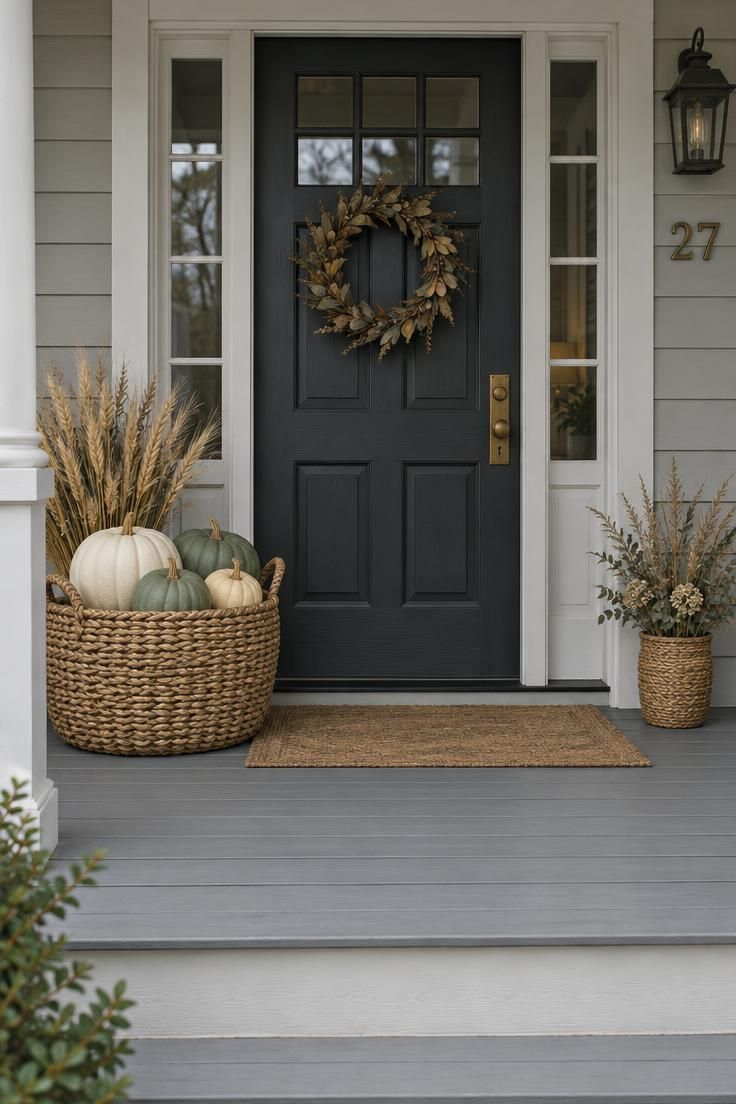
The porch is the first view of the home, and a generous basket of pumpkins gives the doorway a harvest welcome that reads from the walk.
A wide, low woven basket holds several cream and sage pumpkins with wheat stems leaning against its back edge, and a matching pot of dried grasses on the other side of the door balances the composition.
Keep the pumpkins whole rather than carved so the display reads as Thanksgiving rather than Halloween.
Cream and sage sit comfortably beside the dried grasses and the wheat, and the woven basket ties the porch to the interior through texture rather than color.
A simple burlap mat finishes the doorway without adding another pattern.
Because the basket and pot are movable, the arrangement can come inside if rain is expected.
Choose a basket with a flat base so it sits level on the porch floor, and keep the wheat stems tucked behind the pumpkins so wind does not scatter them.
Overcast light flatters the muted palette, and the porch will hold the same look through most of November.
Check the pumpkins every few days and remove any that soften, and shake out the basket before storing it for the year.
Style Blueprint:
- Wide low woven basket
- Cream and sage pumpkins, kept whole
- Wheat stems tucked behind the pumpkins
- Small matching pot of dried grasses
The Halloween-to-Thanksgiving Edit
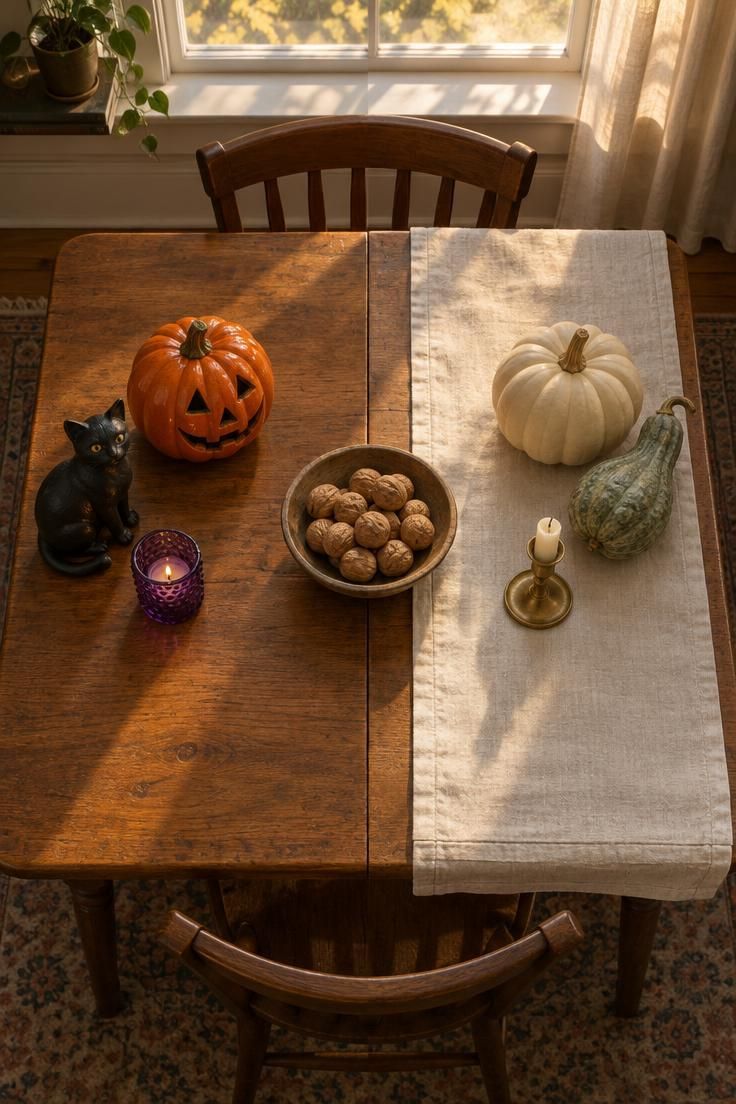
Most homes already hold a mix of October decorations when November begins, and the edit is often more useful than a full reset.
Remove the objects that clearly belong to Halloween: jack-o'-lanterns, black cats, skeletons, spiderwebs, and faux tombstones.
What remains can usually be shifted toward the harvest palette with a few changes.
Keep the whole pumpkins and gourds, but prefer cream, sage, and muted heirloom colors over bright orange.
Painted or glittered pumpkins pull the eye toward October, so set those aside for storage.
Replace purple, black, and neon accents with olive, rust, and wood tones, and let the table settle into the earthier range.
One new material signals the shift more clearly than a dozen small changes.
A brass candlestick or an ivory linen runner adds a Thanksgiving note to a table that still holds October pieces, and it gives the eye something new to land on.
Add the new material first, then remove the Halloween objects that no longer fit around it.
Pack the seasonal pieces together at the end of November so next year's edit is faster.
Gourds and dried stems go into one box, and the brass, cream ceramics, and wool textiles stay out through winter.
Style Blueprint:
- Whole pumpkins in cream, sage, and heirloom colors
- Ivory linen runner
- Small brass candlestick
- Shallow bowl of walnuts
- Storage box for gourds and dried stems
Design Pro-Tip: Choose two or three materials, such as linen, brass, and dried stems, and repeat them from the entry through the dining room so the seasonal look reads as one home rather than separate displays.
Conclusion
The Thanksgiving aesthetic holds together when a few materials repeat from room to room instead of gathering on a single mantel.
Choose linen, brass, and dried stems, or wood, stoneware, and wool, and carry those threads from the entry console to the table and on to the sofa.
Keep the centerpieces low, the glassware warm, and the colors earthy, then stop adding objects before the tabletops feel crowded.
When the holiday ends, pack the gourds and dried stems away and leave the brass, cream ceramics, and wool textiles in place through winter.