This post may contain affiliate links. If you make a purchase through these links, we may earn a commission at no additional cost to you.
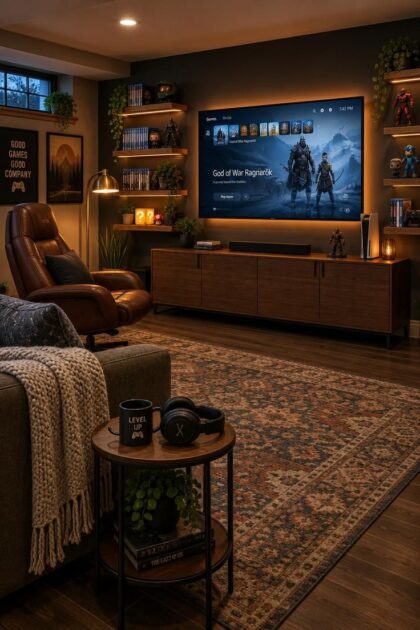
A man cave gaming room works best when personal style and practical comfort share the same space.
Long solo sessions ask for comfortable seating, sensible storage, and lighting that keeps the screen readable without flattening the room.
Occasional visitors change the equation, so seating and layout need to flex without losing the retreat-like feel.
The ideas below arrange color, furniture, shelving, and light around a residential setup, with a clear palette and layout direction in each one.
Because these rooms often serve more than one purpose, the tradeoffs of guest use, tight corners, and upkeep for open shelving and dark finishes get a fair look too.
Matte Black Display Wall with Warm Brass Shelving
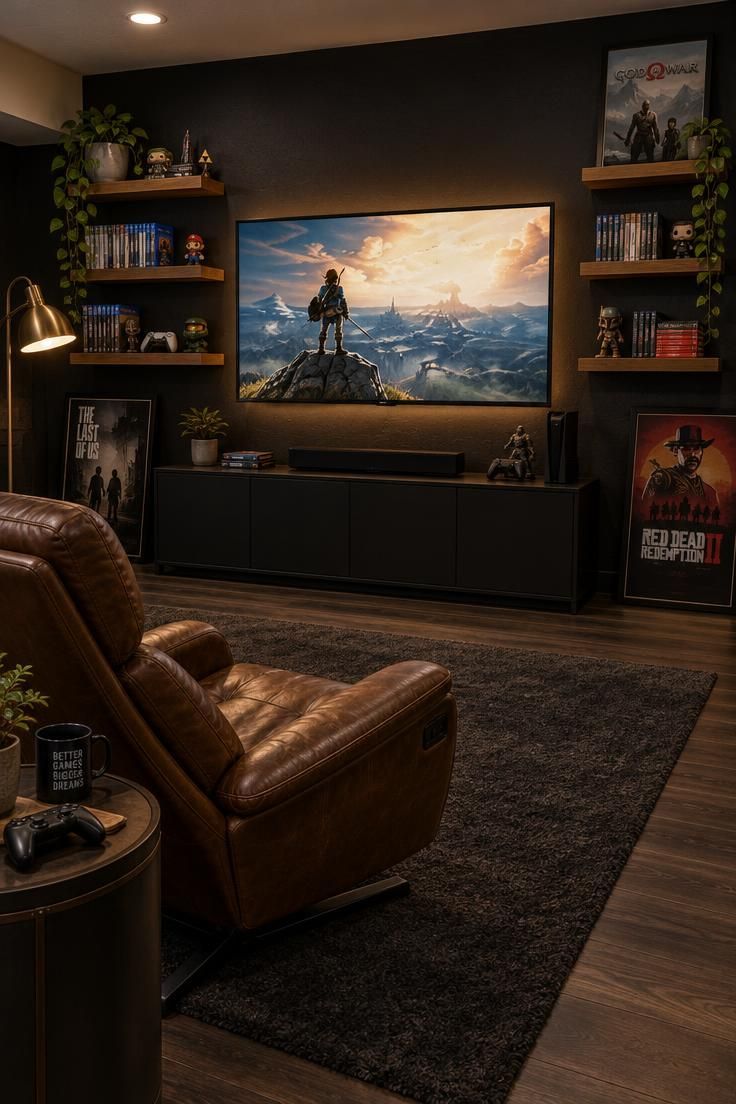
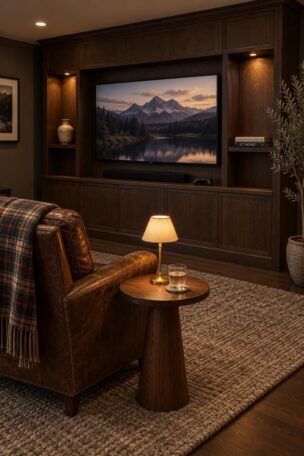
A near-black wall behind the screen gives this man cave gaming room a clear focal anchor.
Everything else in the composition relates to that dark rectangle, which keeps the eye from wandering and makes the screen read as the room’s center.
Floating shelves in warm brass or wood tone flank the display and hold games and small collectibles, so the wall carries display duty without feeling crowded.
A low console with closed doors hides controllers and cables, which preserves the clean look of the dark backdrop.
That choice matters in a dark room, where loose clutter shows up as busy shapes against a flat surface.
Closed storage trades easy access for visual calm, a fair swap for anyone who tidies before guests arrive.
Dark walls can make a small room feel heavy without contrast and layered light.
A charcoal rug and a leather gaming chair add texture and a midtone buffer between the black wall and the floor.
Warm light from a floor lamp or a soft glow behind the screen keeps the palette from collapsing into one flat value.
A narrow shelf above the screen works well for framed art instead of more game boxes, which breaks up the horizontal line the screen creates.
Rotating a few pieces seasonally keeps the wall from reading as a static display case.
Dusting the open shelves is part of the routine here, so fewer, better-chosen objects pay off over time.
Style Blueprint:
- Matte black paint in a flat finish for the feature wall
- Brass or warm wood floating shelves with a slim profile
- Low console with closed doors to hide hardware and cables
- Brown leather gaming chair with a visible grain
- Charcoal low-pile rug to ground the seating zone
Design Pro-Tip: Keep shelf styling to two or three heights by leaning a framed piece against the back and stacking a short row of game cases in front, which reads as one considered arrangement rather than a scatter of objects.
Compact Retro Arcade Corner with Checkerboard Rug
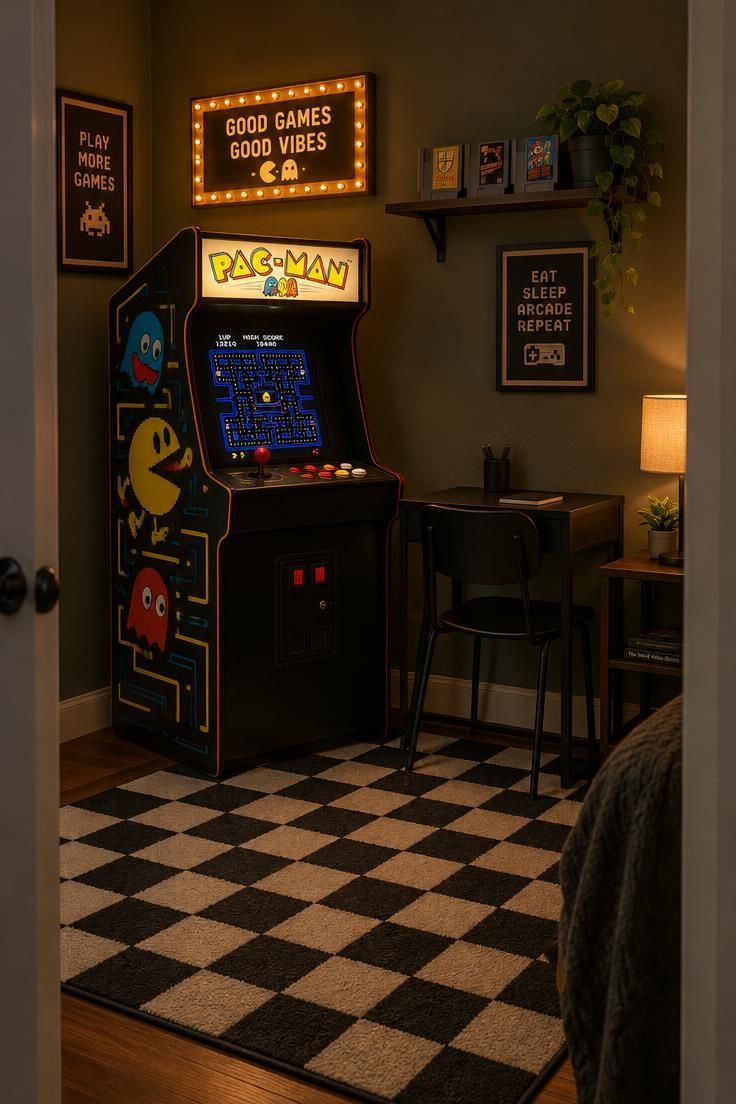
A compact arcade cabinet or CRT-style monitor can serve as a secondary focal point in a corner gaming desk layouts plan, giving the space a second draw without competing with the main screen.
The checkerboard or geometric rug defines the zone on the floor and adds pattern without making the room feel busy.
Pattern like this works best when the rest of the palette stays quiet, since a bold rug and busy walls together cancel each other out.
Neon-style signage works as decorative lighting here, placed above or beside the cabinet where its glow lands on a plain surface.
The sign should read as an accent rather than the room’s main light source, so the space still needs a lamp or ceiling fixture for everyday use.
Blackout curtains or a simple roman shade help control glare on the small screen, which matters more in a corner where light comes from the side.
Above the cabinet, a wall-mounted shelf holds a few retro titles or figurines and keeps the collection visible without adding floor furniture.
This is one of the more compact corner gaming desk layouts, so every surface earns its place.
The desk and chair stay minimal and can double as a side table or a spot for a drink during a break.
The main tradeoff is floor space.
A corner setup limits how far back seating can go, and a large TV or multiple monitors will not fit comfortably.
This layout suits PC or single-screen gaming and a reader who wants a defined arcade mood in a small footprint.
Style Blueprint:
- Compact arcade cabinet or CRT-style monitor as the corner anchor
- Black and cream checkerboard rug to mark the zone
- Decorative marquee-style sign placed above the cabinet
- Slim floating shelf for cartridges or small figurines
Design Pro-Tip: Choose a checkerboard with a cream base rather than bright white, which settles the pattern into a darker room and keeps the contrast from reading as a loud graphic.
Deep Green Sports Lounge with Framed Jersey Wall
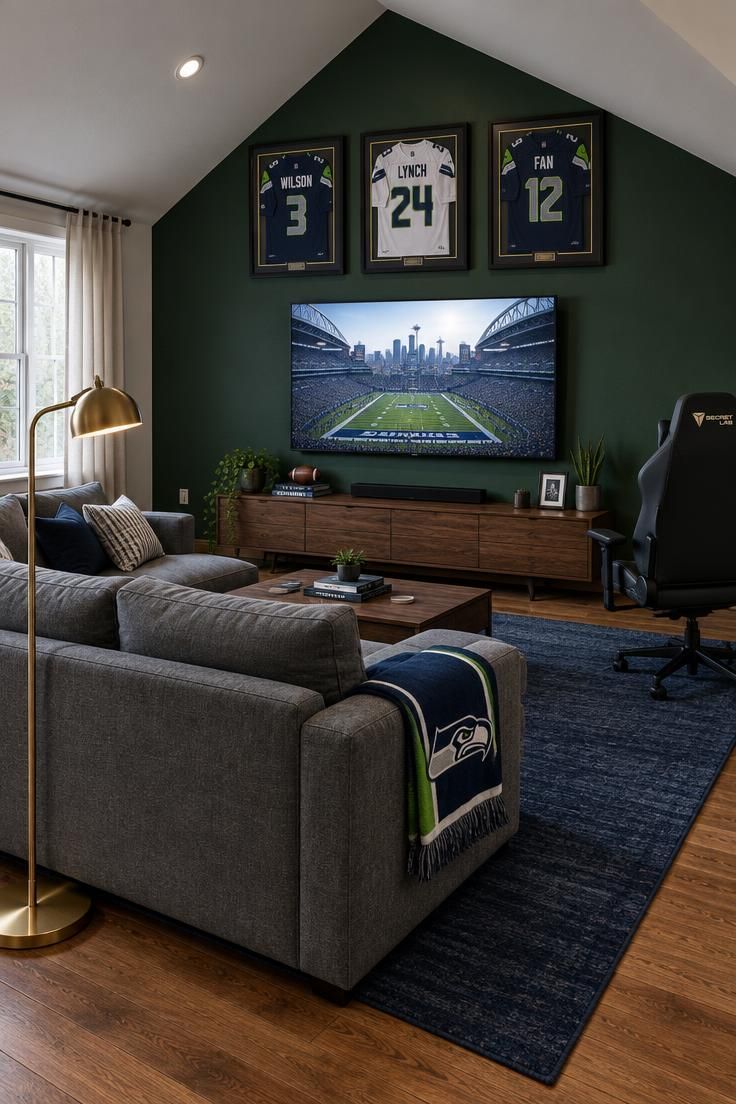
Framing jerseys on a deep green or navy wall turns a collection into the room’s backdrop art.
The low media console beneath the screen keeps gaming hardware out of sight, so the wall reads as display first and equipment second.
A wall color this saturated needs a warm wood or brass note to keep it from going cold, and the console and floor lamp supply exactly that.
A sofa or sectional faces the screen for movie nights, with a gaming chair placed to the side for closer play.
This split seating is the central decision in the layout: a sofa invites company and watching, while a chair suits long sessions and closer screen distance.
A room used mostly for solo nights can lean on the chair and keep the sofa for occasional guests.
Team colors appear only in small accents such as a throw or a single side chair, which keeps the room from feeling like merchandise at home.
One or two color notes against deep green read as personality; a full team palette starts to look like memorabilia.
This is where collector display shelving earns its keep, since closed shelving can hold the overflow while the wall keeps only the best pieces on view.
Framed jerseys need occasional dusting and should stay out of direct sunlight, since fabric fades over time.
A curtained window solves both the glare and the fading problem.
The green wall itself can show scuffs near seating, so a washable finish is a practical choice.
Style Blueprint:
- Deep green or navy wall paint behind the screen
- Three matching frames for jerseys, hung in a level row
- Low walnut media console with closed storage
- Gray sectional paired with a separate gaming chair
- Brass floor lamp and navy area rug for warmth
Design Pro-Tip: Match all jersey frame moldings and mat widths so the row reads as one collection, then let the jersey colors supply the variety against the deep wall.
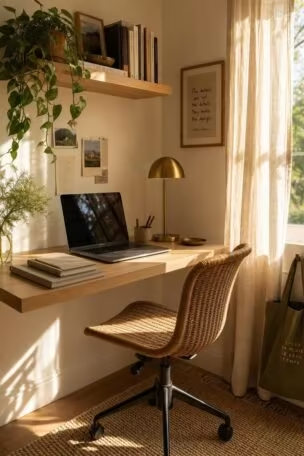
Minimalist Workstation with Hidden Cable Tray
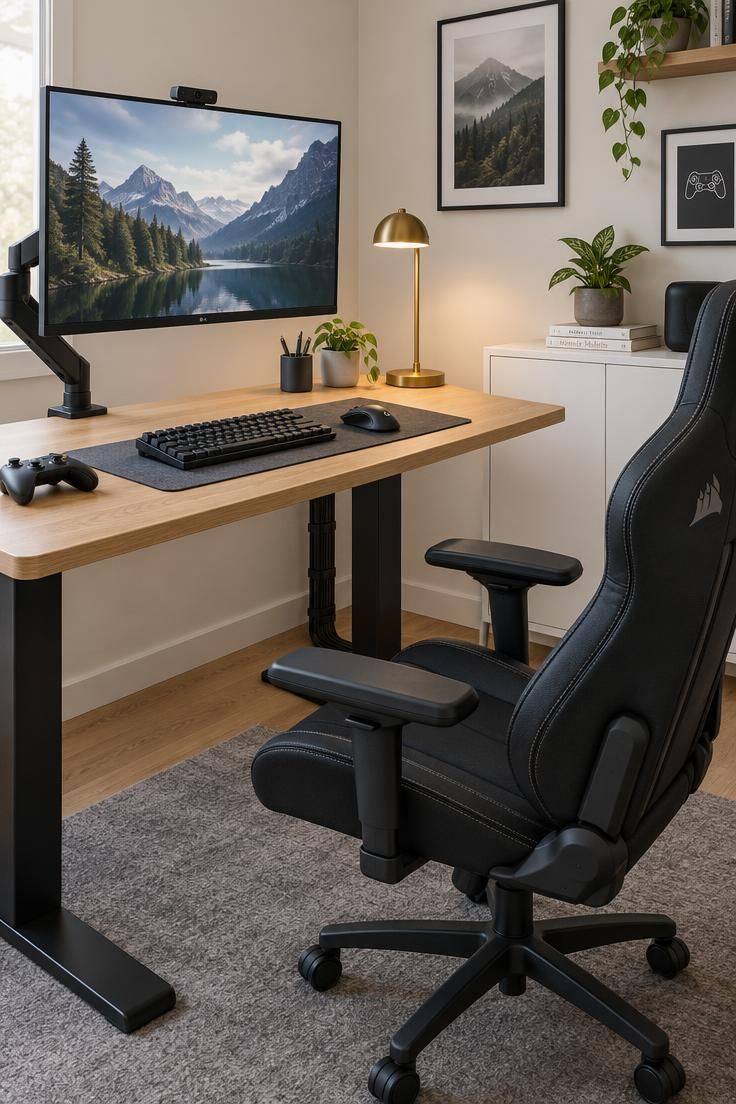
A desk-first layout puts the work surface against a wall rather than facing a lounge area, which suits a small room where the screen and the seating sit close together.
A single large display on a monitor arm keeps the surface clear, and a cable tray or under-desk channel hides most of the wiring.
The visual payoff is a desk that reads as a clean plane, which makes a compact room feel less crowded.
Storage stays mostly closed in this setup: a low cabinet or drawer unit holds controllers, headsets, and games.
Closed storage hides the small clutter that open shelves put on display, and the tradeoff is that favorite games are less visible.
A light wood desktop against a neutral wall keeps the room from feeling like a closet, with one brass task lamp adding warmth at the desk edge.
This desk-first approach is one of the more adaptable multi-use guest gaming rooms, since a clear desk can become a work surface between sessions, and the closed cabinet keeps spare cables and accessories out of the way.
The main benefit is that the layout works in a corner or along one wall, but it offers limited seating for guests.
Anyone weighing this against a lounge layout should think about how often the room hosts more than one person.
A desk-first room is at its best for solo sessions and focused play, and a folding side chair covers the occasional visitor without committing floor space to a sofa.
A low-pile rug under the chair protects the floor and visually separates the work zone from the rest of the room.
Style Blueprint:
- Light oak desk sized to the wall run
- Single monitor on a slim arm with a cable tray beneath
- Low closed cabinet in white or pale gray
- Small brass task lamp for a warm accent
Design Pro-Tip: Run the rug so it extends a few inches past the chair’s rolled-back position, which keeps the chair from catching on the floor edge and marks the desk zone in a shared room.
Gallery-Style Poster Wall Above a Low Sofa
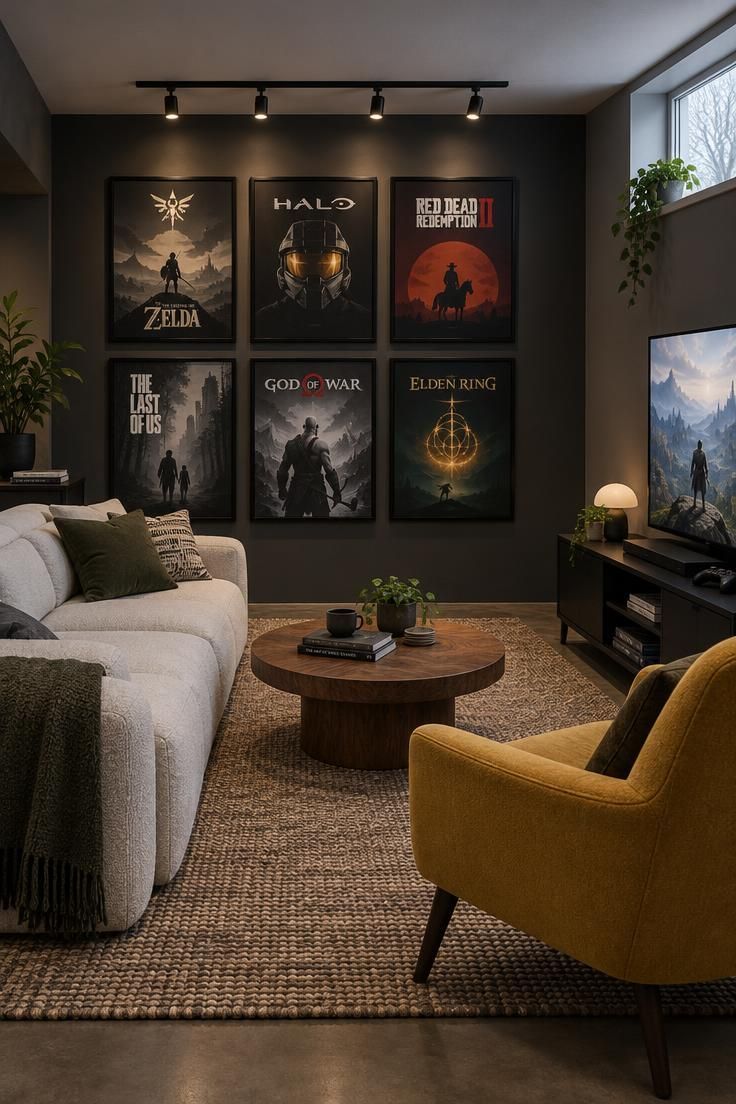
A grid of framed game posters can carry the visual weight of a room where the screen plays a smaller role.
Six or eight frames in a tight, even arrangement read as one piece of art rather than a scatter of prints.
Black frames against a neutral wall keep the grid orderly, and one warm wood accent, such as the coffee table, softens the geometry.
The TV may sit above the console or on an adjacent wall, and the display wall stays the anchor either way.
A comfortable armchair or beanbag placed perpendicular to the sofa gives a second seating option for closer play.
That perpendicular placement also keeps sightlines open, so the poster wall stays visible from both seats.
Open poster displays need more dusting and may fade in bright light, so the room benefits from curtains or blinds.
Glass in the frames adds a cleaning step, and matte frames show less glare than glossy ones.
A neutral palette with black frames and one wood accent keeps the focus on the collection rather than the wall color.
Anyone building this look should decide early whether the wall is for posters, shelves, or both.
A mixed wall of frames and shelving can work, but it needs a clear grid or alignment to hold together.
Keeping the poster grid pure and moving collectibles elsewhere is the simpler path.
Style Blueprint:
- Six to eight matching black frames arranged in an even grid
- Low ivory sofa with a shallow back to keep sightlines open
- Round wood coffee table for a warm midtone
- One accent armchair in a saturated color
- Track or picture lighting aimed across the poster wall
Design Pro-Tip: Lay the frame grid out on the floor first and photograph it from above, then match the spacing exactly on the wall so the gaps stay consistent at eye level.
Industrial Loft with Exposed Duct and Sectional Seating
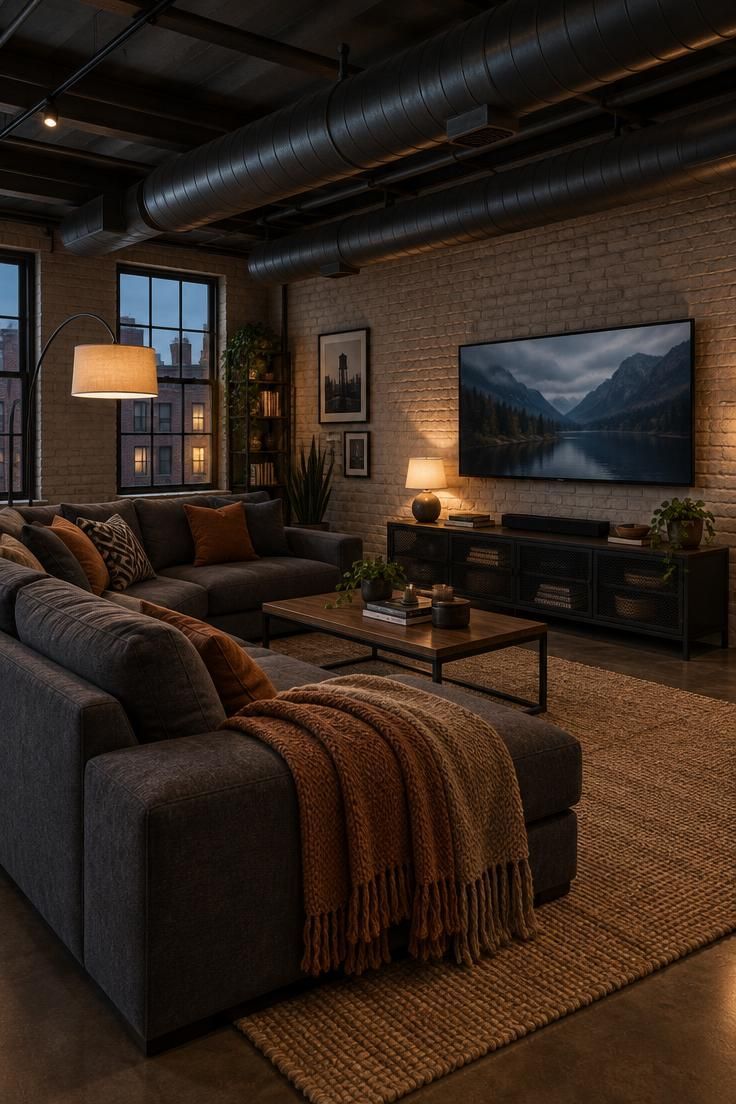
An exposed ceiling or unfinished material gives a garage-conversion or loft-style room its character, and warm textiles balance the hard surfaces.
A large modular sectional anchors the room and can be rearranged for solo gaming or movie nights.
The exposed duct or beam reads as a design feature here, and the section treats it as visual character rather than a structural topic.
A dark-stained wood or metal console holds the gaming system and media devices, and its low profile keeps the wall from feeling top-heavy.
Warmth comes from a large area rug, curtains, and a few throw blankets rather than paint, which suits a room where the walls may be brick or block.
A jute rug under the sectional softens the concrete or sealed floor and gives the seating a defined edge.
Large spaces can feel cold, so multiple light sources do the work: a floor lamp, a table lamp, and a soft strip behind the screen.
Pools of light at different heights keep the room from reading as one flat dark volume.
The brick and metal surfaces catch light differently, which adds texture without extra decor.
The sectional is the practical center of this layout.
It can face the screen for movie nights or angle toward a side table for conversation.
Blankets stored in a basket beside the sofa make the room easier to use on cold evenings, and they add a soft texture against all the hard industrial finishes.
Style Blueprint:
- Large charcoal modular sectional as the room anchor
- Black metal media console with a low profile
- Jute or natural fiber rug to warm the floor
- Two or three warm-toned throw blankets
- Tall floor lamp plus a small table lamp for layered pools of light
Choosing the right rug size helps define the seating area and makes a spacious industrial loft feel more cohesive.
Use our Rug Size Calculator to find the ideal dimensions for your sectional and room layout, ensuring the rug extends comfortably beneath the furniture.
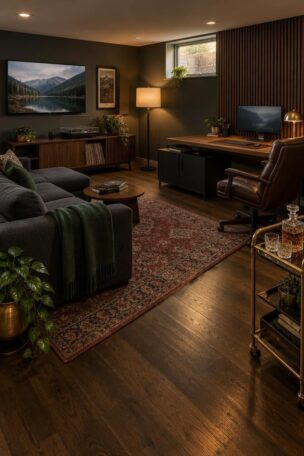
Low-Ceiling Basement Den with Layered Table Lamps
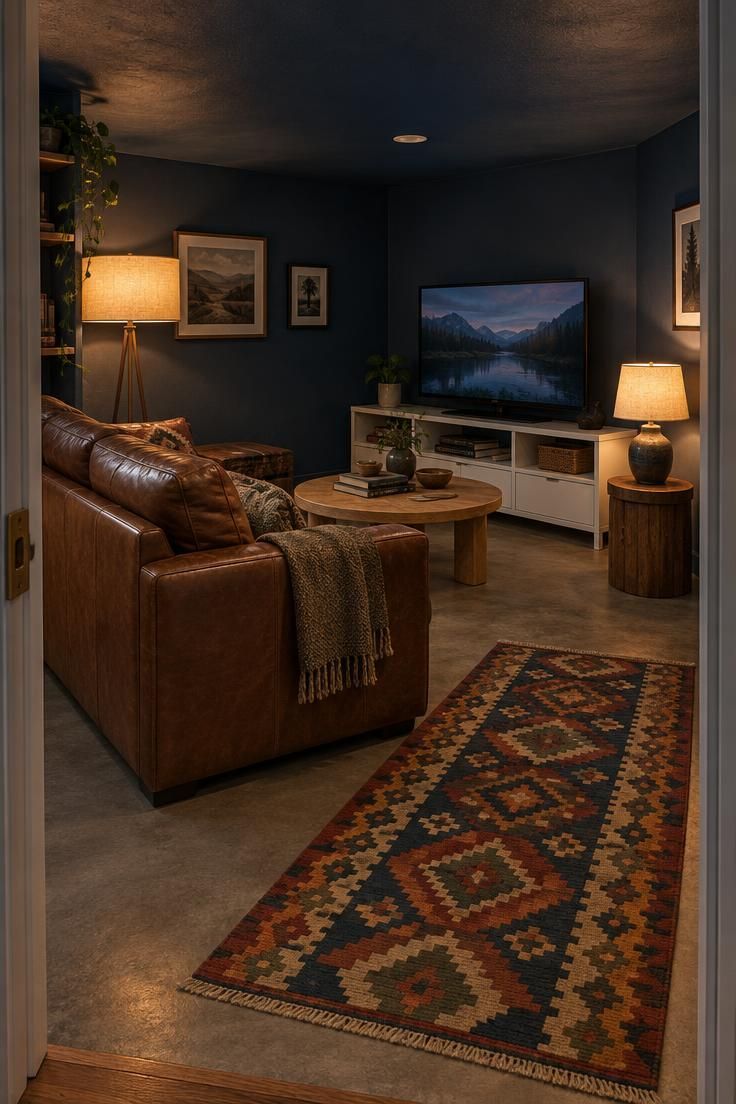
A low ceiling can be treated as a feature rather than a flaw.
Dark ceiling paint and low, wide furniture lean into the cozy height instead of fighting it.
A sectional or two-seater sofa sits close to the ground, with a low coffee table and floor cushions for extra seating.
Wide, low pieces keep the ceiling line visually quiet.
Multiple table lamps and a floor lamp provide layered light without overhead glare.
In a room this low, ceiling fixtures can feel close and harsh, so lamps at seated height do more work.
Warm shades on the lamps keep the blue walls from going cold, and a fabric shade diffuses light across the ceiling.
The main gaming station uses a wall-mounted TV and a console on a low bench, which keeps the equipment at a comfortable viewing height without adding tall furniture.
Tall shelving can feel oppressive here, so storage stays low and wide.
Closed benches and low cabinets hold games and blankets out of sight.
A patterned kilim runner adds visual interest if the floor is carpeted, and it marks the walkway between seating and screen.
The runner is easy to swap seasonally, which suits a room where the dark palette might start to feel uniform.
Care is simple: vacuum the runner and dust the lamp shades now and then.
Style Blueprint:
- Dark blue paint carried onto the ceiling for a unified shell
- Low, wide leather sofa or sectional
- Two or three table lamps with fabric shades
- Low white media bench under a wall-mounted TV
- Patterned kilim runner to break up the floor
Design Pro-Tip: Choose lamp shades in a warm off-white rather than stark white, which keeps the light soft against dark blue walls and flatters leather seating.
Corner Desk Layout with Vertical Slim Shelving
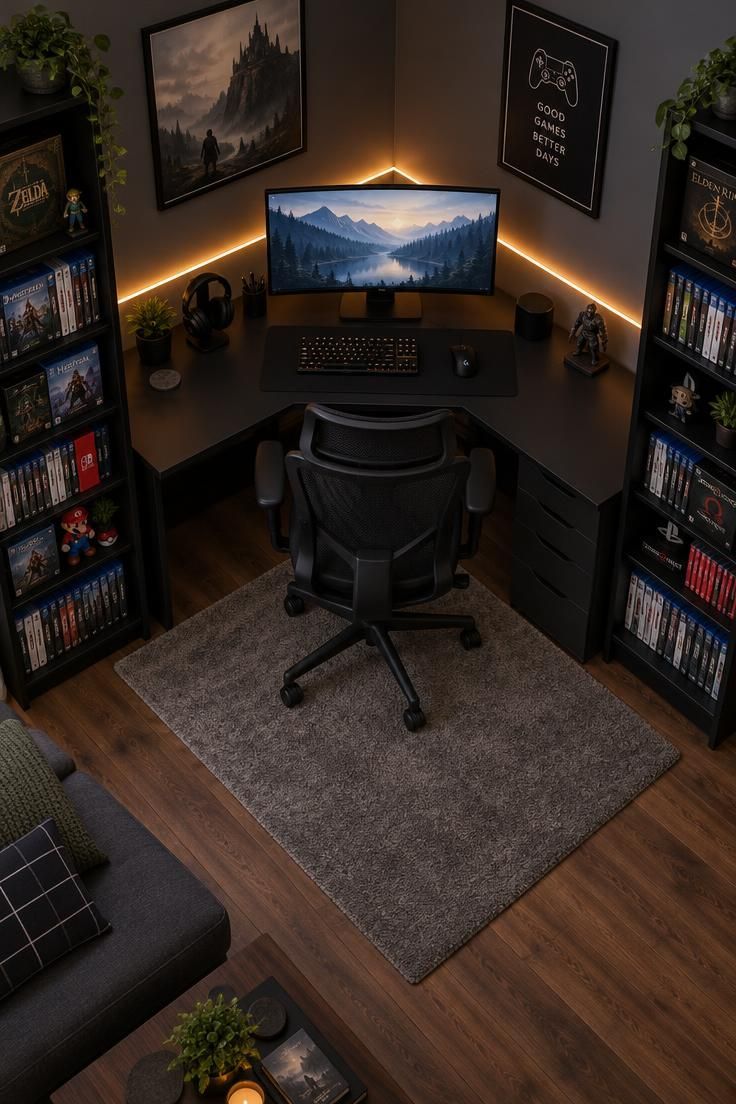
The smallest version of a man cave gaming room can live in one corner, using vertical space to make up for a small floor plan.
An L-shaped or simple corner desk holds a single monitor and keyboard, with a tower or console placed on a low shelf underneath.
Slim, tall shelving units on either side store games, headphones, and a few collectibles without taking up floor space.
A wall-mounted pegboard or magnetic board above the desk holds small accessories, and the visual organization matters more than the hardware.
A consistent grid of hooks and small bins keeps the board from reading as clutter.
The rug under the chair defines the zone and keeps the corner from feeling like an afterthought.
The main limitation is that a corner desk rarely supports a large TV or multiple monitors, so this layout is best for PC or single-screen gaming.
Anyone who mainly plays on a console with a big screen will want a different arrangement.
For a reader with one screen and a growing game collection, the vertical shelves do the heavy lifting.
Keeping the shelves tidy is the ongoing task.
Game boxes stacked spine-out read as a colorful wall, while mixed sizes and loose items start to look messy.
A quick weekly straighten keeps the corner feeling intentional rather than improvised.
Style Blueprint:
- Black L-shaped desk sized to the corner walls
- Two tall, narrow bookshelf units flanking the desk
- Single monitor on a simple stand
- Small gray rug to define the chair zone
Design Pro-Tip: Turn game boxes spine-out on the shelves and group them by color family, which turns a working collection into a patterned wall without extra decor.
Dual-Purpose Guest Room with Fold-Down Wall Bed
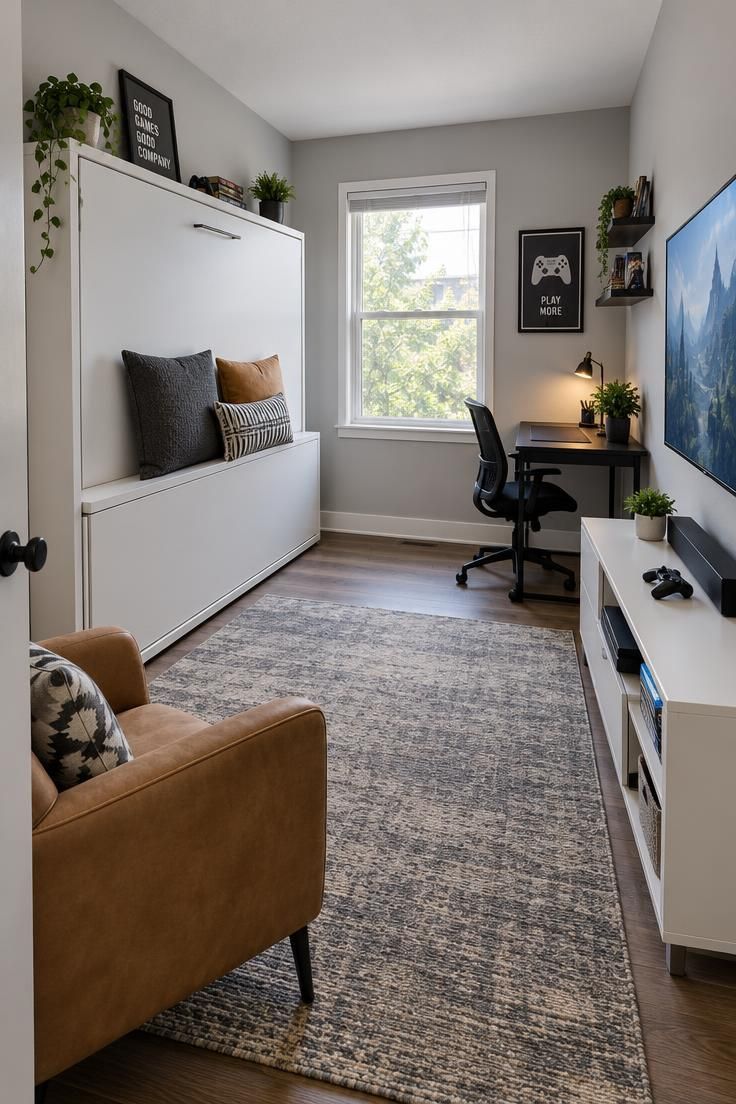
A man cave gaming room that also serves as a guest bedroom needs a layout that flips between two functions.
A fold-down wall bed or a cleverly styled daybed makes that possible.
When the bed is folded away, the room feels like a full gaming lounge; when guests visit, the bed becomes the main function.
The closed panel reads as a clean wall plane in between.
The desk and gaming chair slide to one wall, and the TV is mounted opposite the bed so it works for both uses.
This furniture placement keeps the center of the room clear, which is what allows the quick changeover.
A tan armchair in the corner gives a place to sit that is not the bed.
Storage is mostly closed: a tall cabinet hides bedding and extra pillows, while a small bookshelf holds games.
Closed storage matters in a dual-purpose room, since bedding and guest items need a home that does not clutter the gaming setup.
The palette stays light and neutral, and one dark accent wall gaming setups can borrow the idea of a single dark wall to keep a cozy feel without making the room too small.
The main tradeoff is that the room cannot have a permanent large sofa, so seating is limited to the bed or a single accent chair.
Readers who host frequently may find a daybed with a firm mattress a better fit than a wall bed, since it doubles as seating without a daily fold-away routine.
Style Blueprint:
- Fold-down wall bed or a styled daybed as the room’s core piece
- Light gray walls with one darker accent wall
- Small black desk and chair that tuck against the side wall
- Low white media stand under a wall-mounted TV
- Tall closed cabinet for bedding and guest supplies
Design Pro-Tip: Choose a fold-down bed with a flat, unadorned panel on the outside, which reads as a plain wall in gaming mode and keeps the room from looking like a bedroom all day.
Warm Wood Vinyl Listening Nook with Compact Gaming Desk
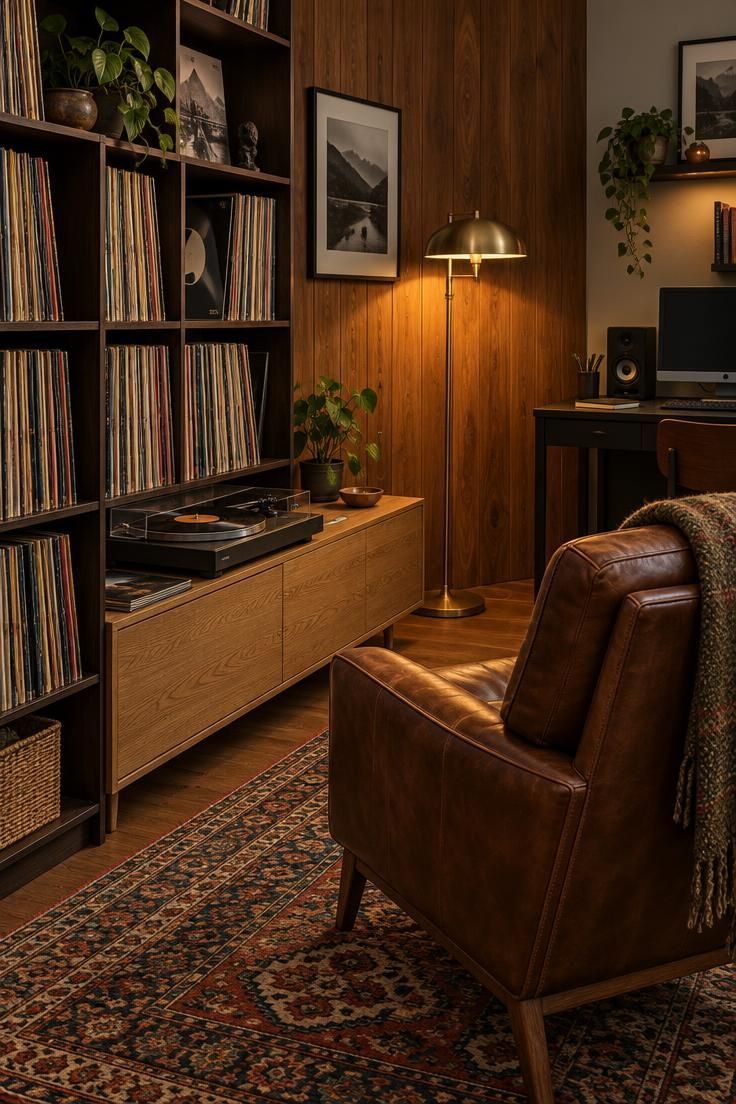
A vinyl listening area and a small gaming desk can share one man cave gaming room without competing for attention.
One wall holds a row of record shelves and a turntable on a low cabinet, while the adjacent corner has a compact desk and monitor.
Keeping the two zones on different walls lets each read as its own moment without the room feeling split.
The palette leans on warm woods, leather, and brass, which sets this apart from tech-focused setups and gives the room a den-like feel.
A comfortable armchair or small sofa faces the turntable for listening sessions, and the gaming chair can be pulled up for play.
The room works because the two activities share a mood rather than a color scheme.
Rugs, curtains, and upholstered surfaces serve as visual and comfort elements here, softening a room that might otherwise be all hard shelves and wood paneling.
The storage decision depends on collection size: open shelves for easy browsing or closed cabinets to protect vinyl from dust.
A mix of both, open shelves at eye level and closed cabinets below, is a practical middle path.
The turntable cabinet should sit at a comfortable height so records are easy to flip through while standing or seated.
That height decision shapes the whole wall, since the shelves above need to line up with the cabinet top for a clean run.
Style Blueprint:
- Warm wood paneling on one wall
- Dark wooden record shelves with a low oak turntable cabinet
- Brown leather armchair angled toward the shelves
- Compact black desk in the adjacent corner
- Patterned wool rug and a brass floor lamp
Design Pro-Tip: Keep the turntable cabinet top aligned with the lowest record shelf so the wall reads as one continuous run of wood, which makes a shared room feel planned rather than pieced together.
Dark Reflective Surfaces with LED Strip Accents
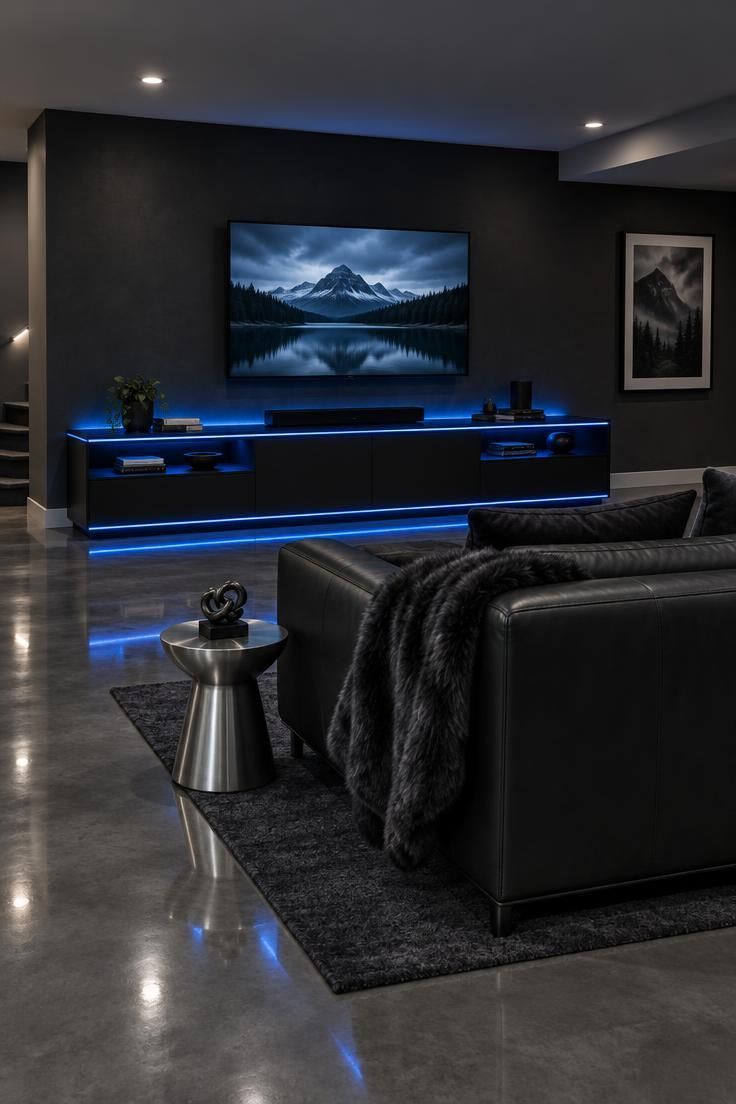
Dark, slightly reflective surfaces give a modern man cave gaming room a more dramatic look.
A matte charcoal wall with a built-in or freestanding media wall provides a smooth backdrop for the TV, while slim LED strips outline shelves or the back of the console.
The strips are layered decorative lighting, adding colored lines that trace the room’s geometry without illuminating the whole space.
A black or dark gray sofa with a low back keeps sightlines clear, which matters in a room where the media wall is the main visual event.
A glossy floor or high-sheen rug reflects the strips, so the colored lines double on the floor and the room gains depth.
The low sofa keeps that reflection visible from the seated position.
The main drawback is upkeep: dark glossy surfaces show dust and fingerprints, so the room needs regular wiping.
A microfiber cloth and a quick pass along the console edges handles most of it.
Accents stay minimal, with one silver or chrome side table, a single piece of framed art, and perhaps a dark faux-fur throw.
A room this dramatic can overpower a collection, so display pieces should be few and well lit.
That restraint is what separates a polished look from a room that feels like a showroom.
Readers who love displaying dozens of figures may want to soften the finish to satin and let the collection carry the color.
Style Blueprint:
- Matte charcoal wall with a long black media console
- Thin LED strips along console edges or shelf backs
- Black leather sofa with a low back
- High-gloss floor or sheen rug to catch the light
- One silver or chrome side table as the sole metal accent
Design Pro-Tip: Run LED strips along the back edge of the console rather than the front, which throws the glow onto the wall and keeps the light source itself out of view from the sofa.
Conclusion
A man cave gaming room works when the layout matches how the space is actually used.
Long solo sessions suit a desk-focused corner or a warm listening nook, while a household that hosts movie nights leans toward a lounge arrangement with a sectional or sofa.
Dark walls and layered lighting define the retreat feel, but every direction still needs practical storage and comfortable seating to hold up over time.
Picking one or two visual directions and adapting them to the available square footage keeps the room personal without turning it into a showroom.
The best result is a space where the gaming equipment, the collection, and the lounge seating read as one cohesive room rather than separate zones.