This post may contain affiliate links. If you make a purchase through these links, we may earn a commission at no additional cost to you.
A man cave office has to solve an odd puzzle: it must be bright enough for a keyboard and dim enough for a lounge chair.
Most of these rooms live in basements, spare bedrooms, garages, or a shared corner that has to hold its own against the rest of the house.
Each has to carry a desk and a reason to stay after five.
The directions below handle that split in different ways, using walls, seating, storage, and light so one room can hold two identities without either one losing.
Wall-Mounted Desk with Floating Shelves for Small Rooms
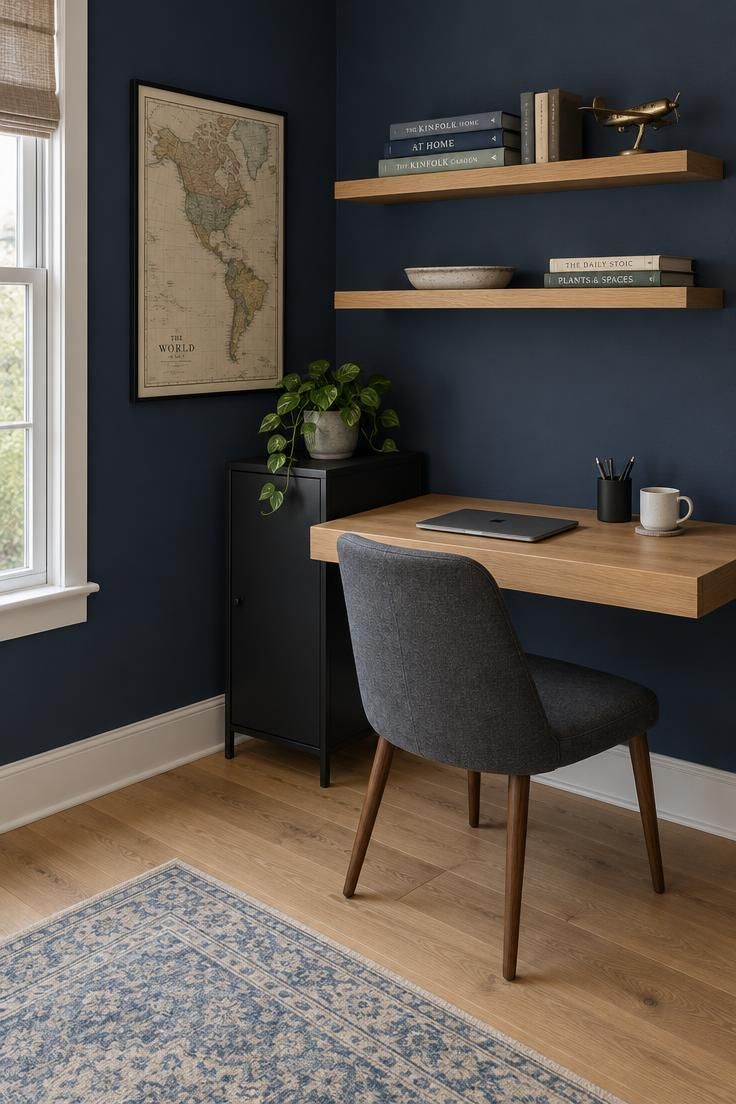
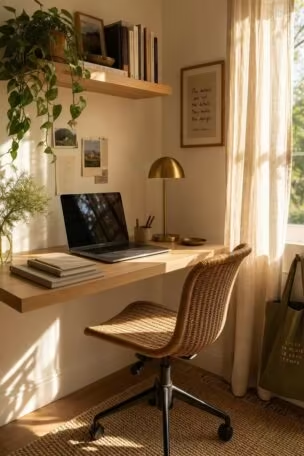
A wall-mounted desk with floating shelves for small rooms solves the floor space problem first and the storage problem second.
With no legs and no footprint, the desk keeps the middle of the room open, which matters in a bedroom that still has to hold a bed or in a corner that doubles as a hallway.
The shelves above can stagger in height so the lowest one clears a monitor and the upper ones hold books, a few collectibles, and a small tray for papers that would otherwise migrate across the desk surface.
A narrow cabinet tucked below the shelf run gives office supplies a closed home, which keeps the open shelves from absorbing every stray object.
Task light should come from a wall-mounted or clamp-style lamp so the desk surface stays free for actual work.
A single large framed map or numbered print on the adjacent wall carries enough personality for the whole corner; a cluster of small pieces would crowd the composition.
This approach suits renters and anyone working with a modest budget, since the main pieces are one desk, one shelf run, and one light.
One decision point: a wall-mounted desk can only hold everyday work items, so files, printers, and hobby gear need that separate closed cabinet or a closet nearby.
Style Blueprint:
- Light oak floating desk paired with matching floating shelves at staggered heights
- Slim black metal cabinet with a soft-close door for office supplies
- Low-profile fabric chair in dark gray with slim wooden legs
- One large framed map or numbered print on the adjacent wall
Dark Paneled Feature Wall Home Office
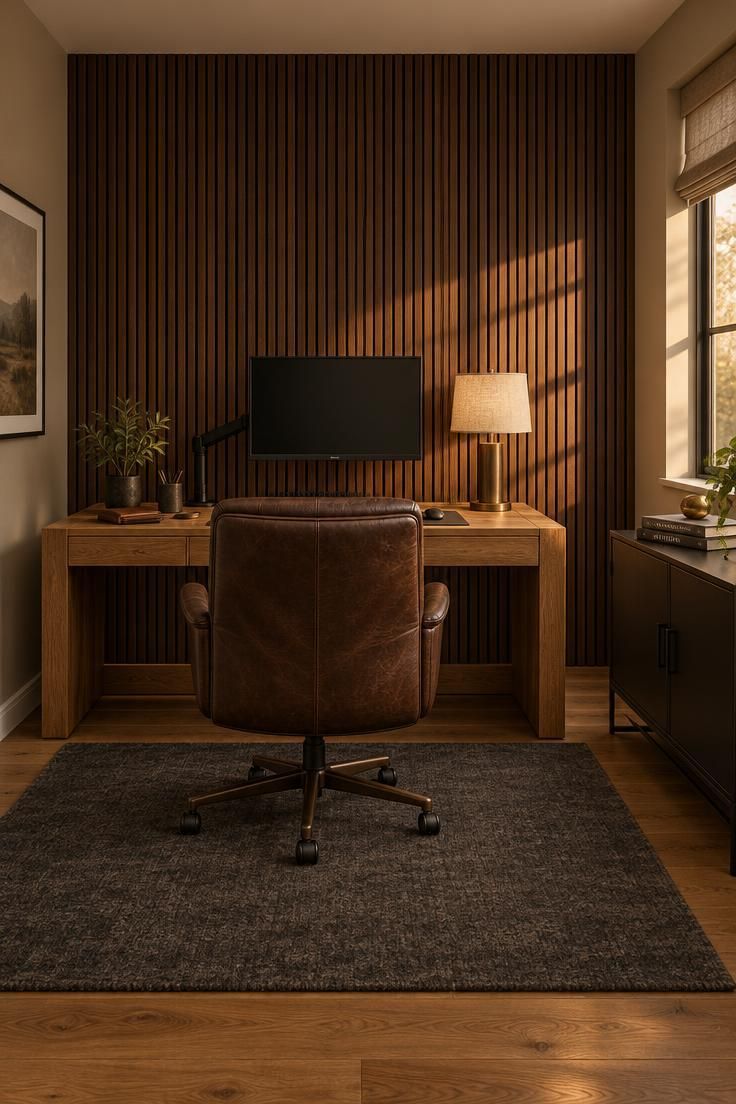
The dark paneled feature wall home office works because it commits one wall instead of the whole room.
Cladding only the wall behind the desk in vertical slats or painted panel boards gives the work zone a strong identity while the surrounding walls stay in a lighter warm neutral, which keeps a small or windowless room from closing in.
Tone matters here: dark walnut and charcoal set the cave mood, while a mid-tone oak or painted board keeps the composition from turning heavy.
The desk sits directly against the panels, and one leather desk chair is enough to warm the arrangement.
A low horizontal console or closed file cabinet to the side balances the tall vertical lines and gives paper, chargers, and cables a place to disappear.
A single matte black or bronze desk lamp can carry the accent role on its own, since the slats already provide pattern.
For a man cave office, this is often the most efficient move available: the wall behind the desk becomes deliberate framing for video calls, and the rest of the room can stay flexible for lounge seating or a bar cart later.
The tradeoff is that slats and panel boards collect dust in their grooves, so a vacuum brush attachment or a microfiber cloth earns a spot in the room's regular care.
Cost also rises with the amount of wall covered, and a single paneled wall sits at the affordable end of that range.
Style Blueprint:
- Vertical wood slats or painted panel boards in deep walnut or charcoal on one wall only
- Surrounding walls in a warm mushroom or stone neutral
- Oak desk with a matte black monitor arm and one bronze desk lamp
- Dark brown leather desk chair with visible grain
- Low black metal console with closed doors to balance the vertical panel lines
Design Pro-Tip: If the paneled wall sits behind your monitor, keep the desk accessories in two tones at most so the slat pattern stays readable instead of competing with a shelf of colorful objects.
Vintage Club Study with Leather Wing Chair
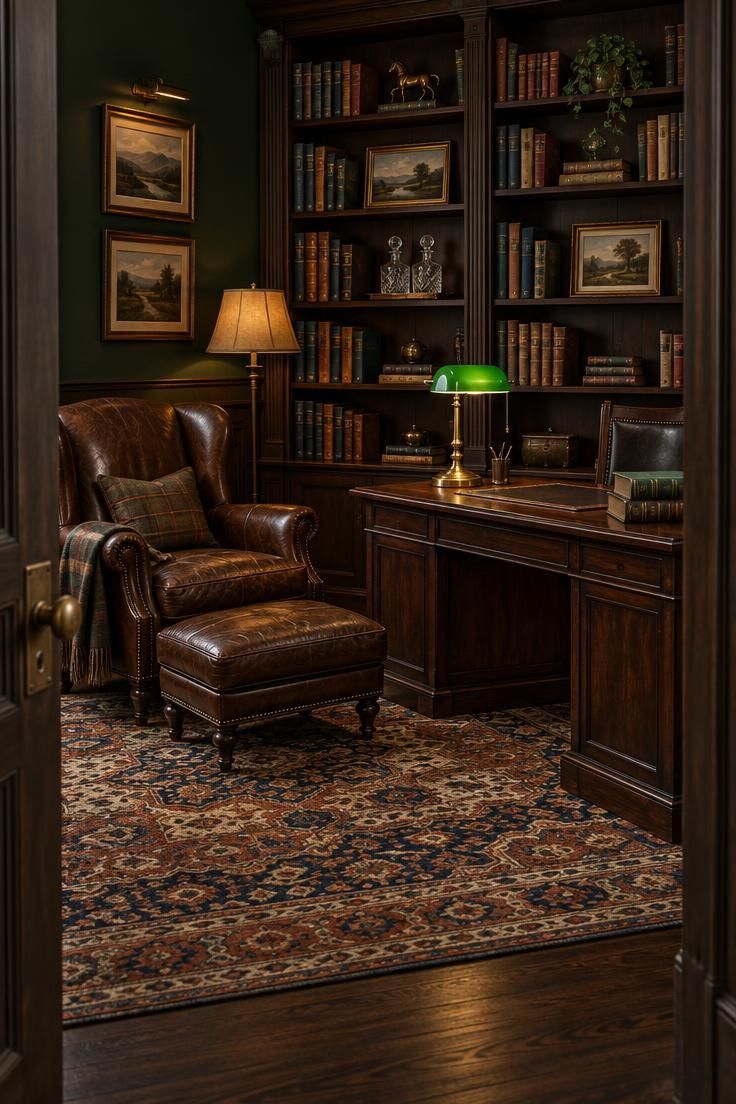
The vintage club study with leather wing chair leans on pieces that already read as established: a wing chair, a button-tufted desk chair, and a generously sized wood desk with turned legs or a trestle base.
The palette stays in deep green or oxblood, with brass hardware and a warm wood floor.
One wall carries floor-to-ceiling bookshelves in a dark stain, styled with books, a few decanters, and small framed prints rather than a uniform run of matching spines.
The desk faces into the room rather than toward the wall, which lets the wing chair sit behind it as a conversation anchor instead of a decorative leftover.
Lighting is best kept low and layered: one lamp on the desk, one floor lamp near the chair, and no overhead glare.
This is the most space-hungry direction in the group, and it shows its best when the room has enough floor area that the desk, chair, and footstool do not crowd the walking path behind the desk.
A smaller version can work by dropping the footstool and using a single tall bookcase instead of a full shelf wall.
Leather and dark wood both show dust and dryness, so a leather conditioner and a soft cloth for wood surfaces belong in the room's routine.
The look also reads as formal, which suits readers who take a lot of calls and want a background that signals substance rather than hobby.
Style Blueprint:
- Deep forest green or oxblood walls with dark wood paneling on the lower section
- Brown leather wing chair with a matching footstool
- Broad mahogany or dark walnut desk with turned legs or a trestle base
- Floor-to-ceiling bookshelves in a dark stain, styled with books and a few decanters
- Brass desk lamp with a green glass shade
Moody Basement Workspace with Lounge Seating
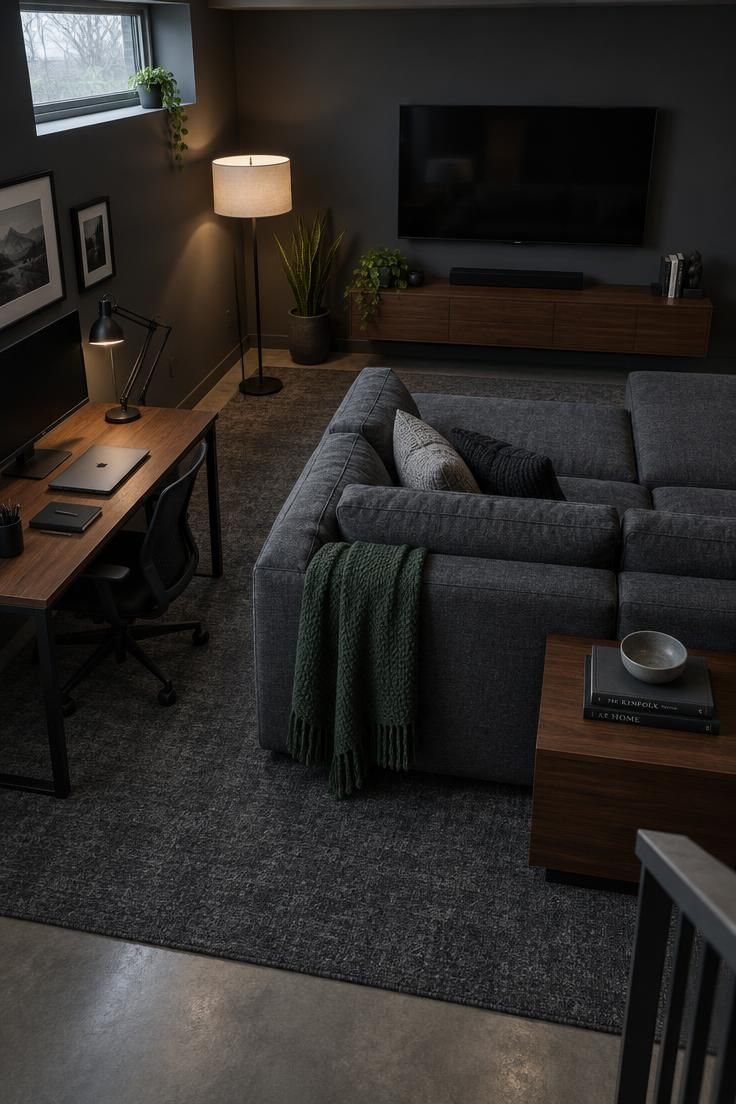
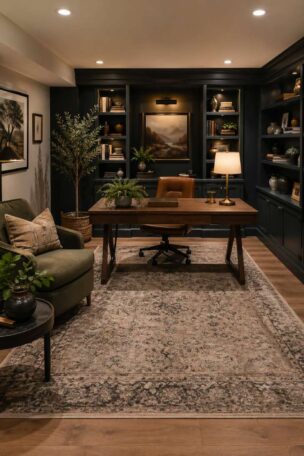
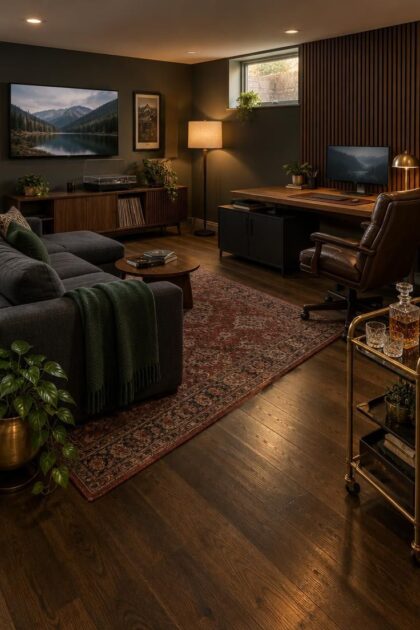
A moody basement workspace with lounge seating treats the room as two rooms in one.
The work zone needs a practical desk, a monitor, and its own task light, while the lounge zone gets a sofa, a sectional, or recliners arranged around a media wall.
The color story stays dark and slightly cool: charcoal-gray walls, a black-framed sectional, and a gray-brown desk that does not fight the seating.
Lighting carries the whole transition: a floor lamp throws focused light over the lounge, the desk has an articulated task lamp, and the ceiling source stays on a dimmer for evening.
Keep the desk on a side wall rather than opposite the screen, so the viewing sightline stays clean.
Soft textiles do real work in a large open basement, where a bare floor and hard walls make the room feel hollow; a thick rug under both zones and a knit throw on the sofa change how the room carries sound and how it feels underfoot.
The practical benefit is a clean handoff between work and leisure: closing the laptop does not require rearranging furniture.
One limitation: a windowless basement can make daytime work feel dim, so a brighter task light at the desk matters more here than in an upstairs room.
Style Blueprint:
- Charcoal-gray walls with a black-framed sectional facing a media wall
- Compact gray-brown desk on a side wall with an articulated task lamp
- Floor lamp with a linen drum shade between the two zones
- Low-pile dark gray rug and a deep green knit throw for softness
Garage Workshop Desk Area with Pegboard Storage
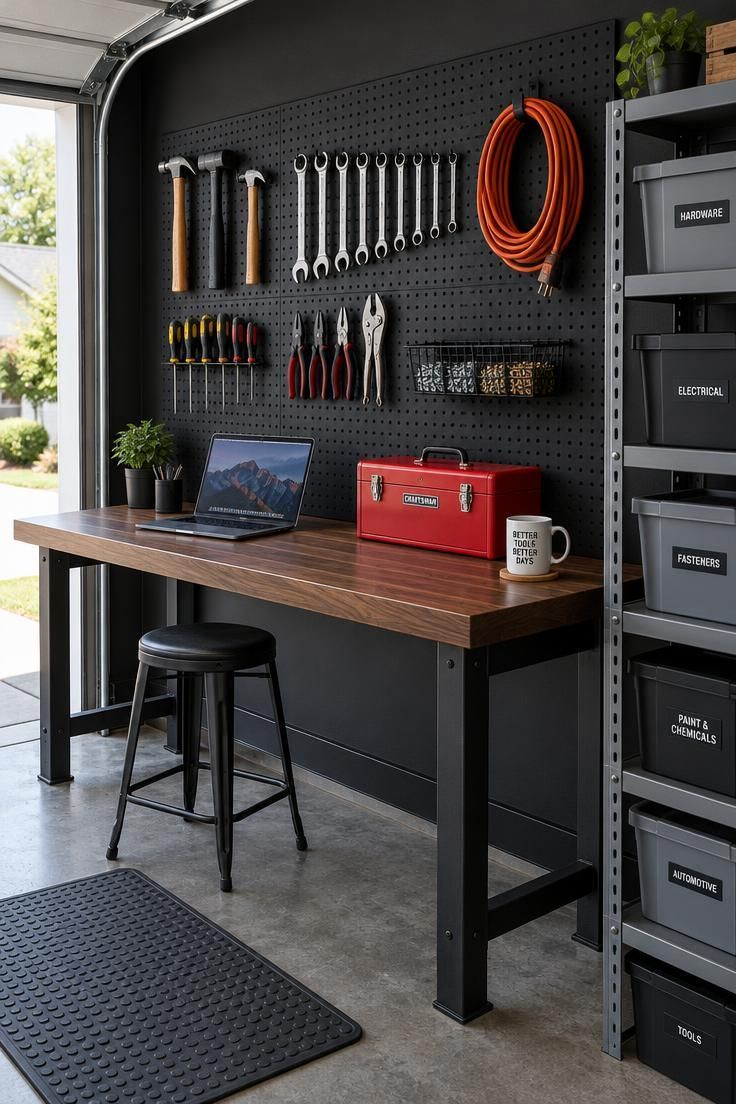
A garage workshop desk area with pegboard storage turns a rough space into something orderly without pretending it is a finished room.
The pegboard gets painted one strong color, black, red, or gray, so the hooks, baskets, and tool outlines read as a graphic element rather than visual clutter.
A simple workbench or desk with a stained wood top sits below, using the same materials vocabulary as the pegboard frame.
Open metal shelving on one side holds labeled bins for cords, spare parts, and hobby gear that would otherwise land on the desk.
The value here is reach: tools, chargers, and small gear stay within arm's length while the desktop stays clear for a laptop and a notebook.
Good light on the pegboard wall is worth prioritizing, since a dim corner turns the tool silhouettes into dark shapes and the whole area into a cave in the wrong sense.
Dust is the real maintenance item in a garage, and a shop vacuum with a brush attachment keeps pegboard holes and shelf tops from filling in.
Temperature swings also shape how the room is used across seasons, so a desk area near the house door is often more usable in winter than one at the far wall.
Style Blueprint:
- Matte black, red, or gray pegboard panels covering one wall
- Black metal hooks and a wire basket for tools, cords, and small parts
- Long desk with a thick walnut-stained wood top on black metal legs
- Gray metal open shelves with labeled bins for overflow storage
Design Pro-Tip: Outline each tool with a marker directly on the pegboard before adding hooks, so empty spots announce what is missing instead of waiting for you to notice.
Speakeasy-Style Office with Bar Cart and Framed Art
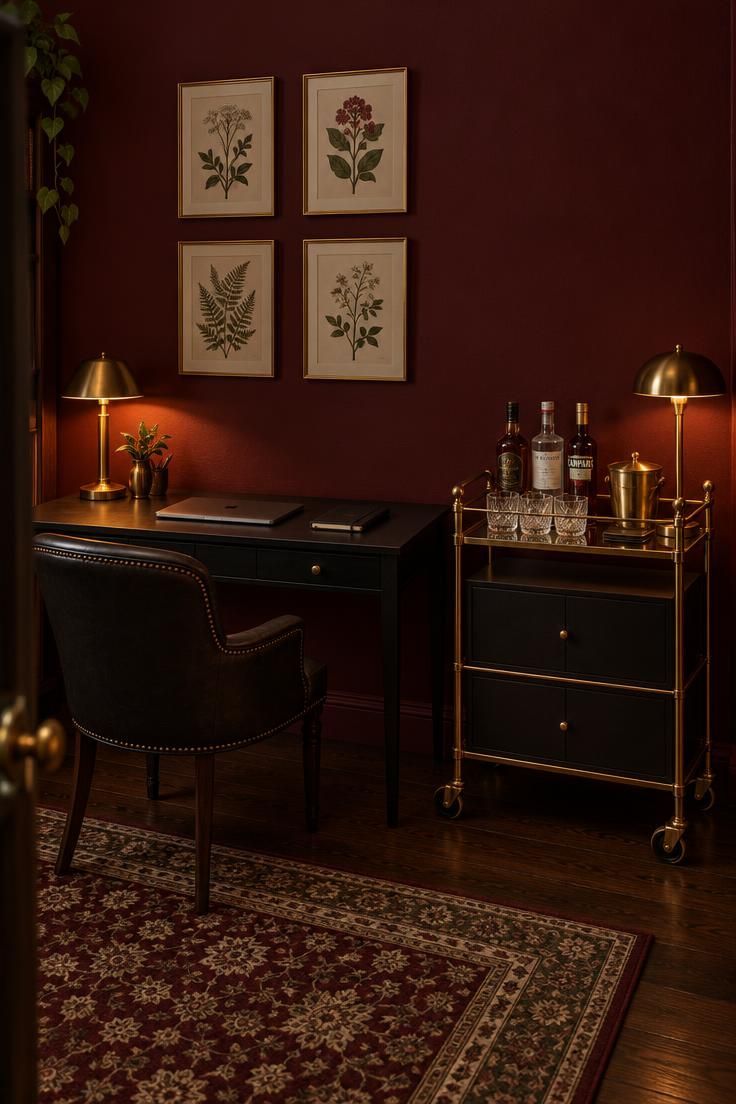
A speakeasy-style office with bar cart and framed art compresses the whole cave idea into one corner.
The desk is deliberately modest so the bar cart and the art carry the room's expression, which makes this direction workable at a small scale.
Walls in dark teal or burgundy set the tone, and a tight gallery of three or four prints above the desk keeps the dark color from swallowing the wall.
The cart does double duty: bottles, glasses, and an ice bucket on top, closed lower shelves for paper, chargers, and anything else that would break the mood.
A door matters here more than in the other directions, since the point is that the space feels separate from the rest of the house.
Keep the gallery to a small grid rather than a sprawling arrangement; four pieces in matching frames hold together against a saturated wall, while a scattered cluster will fight it.
Maintenance is minimal beyond dusting the glassware and wiping the cart's brass surfaces, though bottles and glasses do take up shelf space that would otherwise hold supplies.
Style Blueprint:
- Deep teal or burgundy walls in a flat or eggshell finish
- Compact black desk with a nearly clear surface
- Brass bar cart with closed lower shelves for supplies
- Tight grid of three or four framed prints in matching thin gold frames
- One brass table lamp as the primary light source
Industrial Loft Desk with Metal Shelving and Concrete-Look Wall
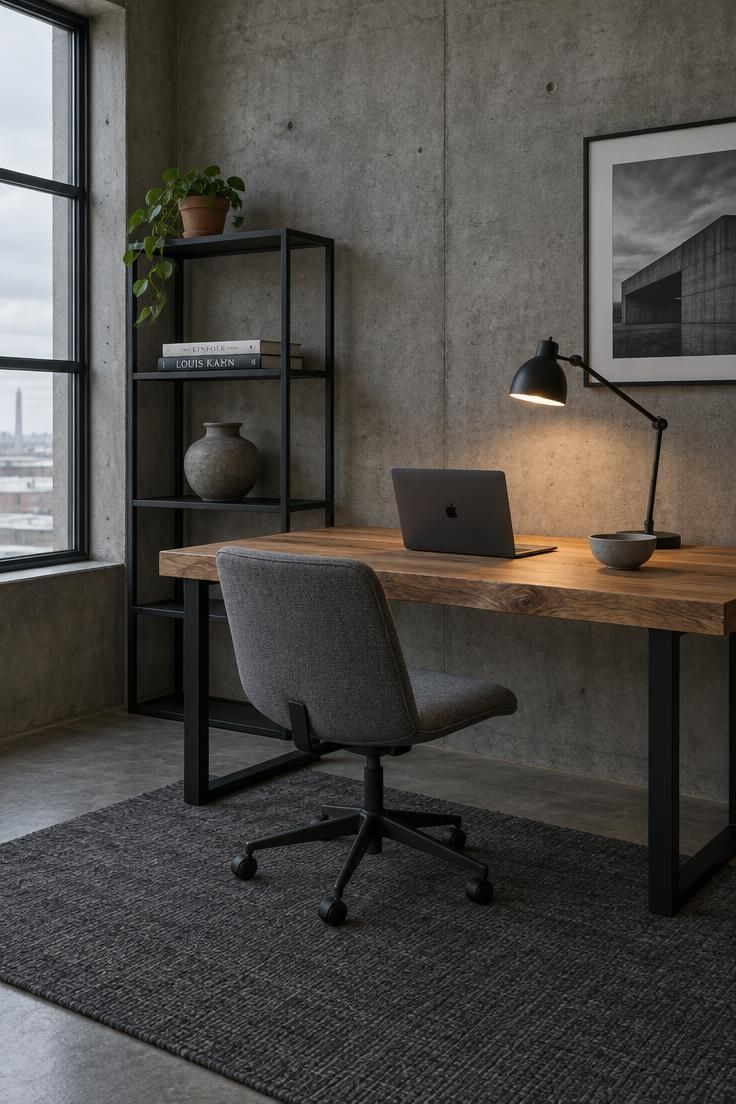
An industrial loft desk with metal shelving and concrete-look wall builds the room from materials that do not ask for special treatment.
A concrete-look wall finish, black metal shelving, and a desk made from a salvaged wood slab or a dark stained board on metal legs set the palette at gray, black, and warm brown.
Styling on the open shelves stays edited: two large books, a plant, one heavy ceramic object, and empty space between them.
Large objects read better than small ones against a hard wall, and the gaps keep the shelving from looking like a storage room.
Art is optional here because the material contrast between the wood slab, the black steel, and the gray wall already carries the composition.
Hard surfaces like concrete and metal make a room feel bright and reflective, so a rug and a fabric chair do practical work as well as visual work: they soften how the space sounds and how it feels to sit in for a long stretch.
The aesthetic also hides everyday wear better than a polished finish, which suits a room that doubles as a workshop or hobby space.
Style Blueprint:
- Concrete-look wall finish in cool gray
- Desk with a thick wood slab top on black steel legs
- Black metal shelving unit styled with two or three large objects
- Low-back gray fabric office chair
- Charcoal wool rug over a hard floor
Rustic Shelving Wall with Workbench Desk and Leather Stool
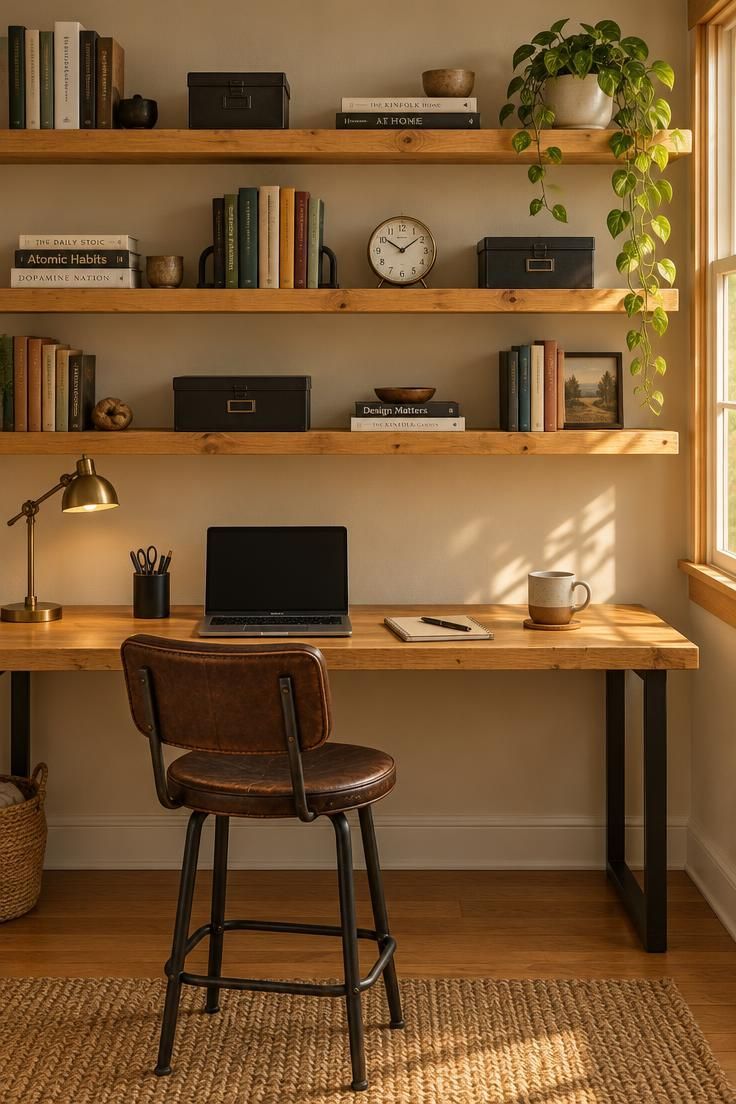
A rustic shelving wall with workbench desk and leather stool treats the shelf wall as the room's main backdrop and lets the desk be a working surface rather than a statement piece.
The shelves are styled in a controlled rhythm: books, boxes, a plant, and a metal-framed clock or sign, with clear gaps so the eye can rest.
The desk is intentionally not a traditional office desk; a heavy wood-topped trestle or sawhorse base reads as a bench, and a low leather stool or an industrial task chair suits that geometry better than an executive chair.
A wide surface is the point here, leaving room for a laptop, paperwork, a coffee cup, and a few personal objects without rearranging anything for a meeting.
One practical advantage: because nothing is built in, the shelving and desk can be moved or reused if the room changes purpose later.
This direction also works with a mix of new and secondhand pieces, since honey-toned wood and black metal appear in nearly every furniture category and price band.
Maintenance comes down to dusting the open shelves and conditioning the leather stool a few times a year.
Style Blueprint:
- Three long rustic wood shelves in a light honey tone
- Shelf styling in a rhythm of books, black metal boxes, and one plant
- Wide workbench-style desk with a heavy wood top on metal legs
- Dark brown leather and metal stool or an industrial task chair
- Woven jute rug in natural tan
Design Pro-Tip: Leave one full shelf section empty on purpose when you style a rustic shelving wall, since the blank space gives the eye a rest and makes the surrounding objects read as chosen rather than accumulated.
Pressed-Tin Backbar Office with a Counter-Height Work Shelf
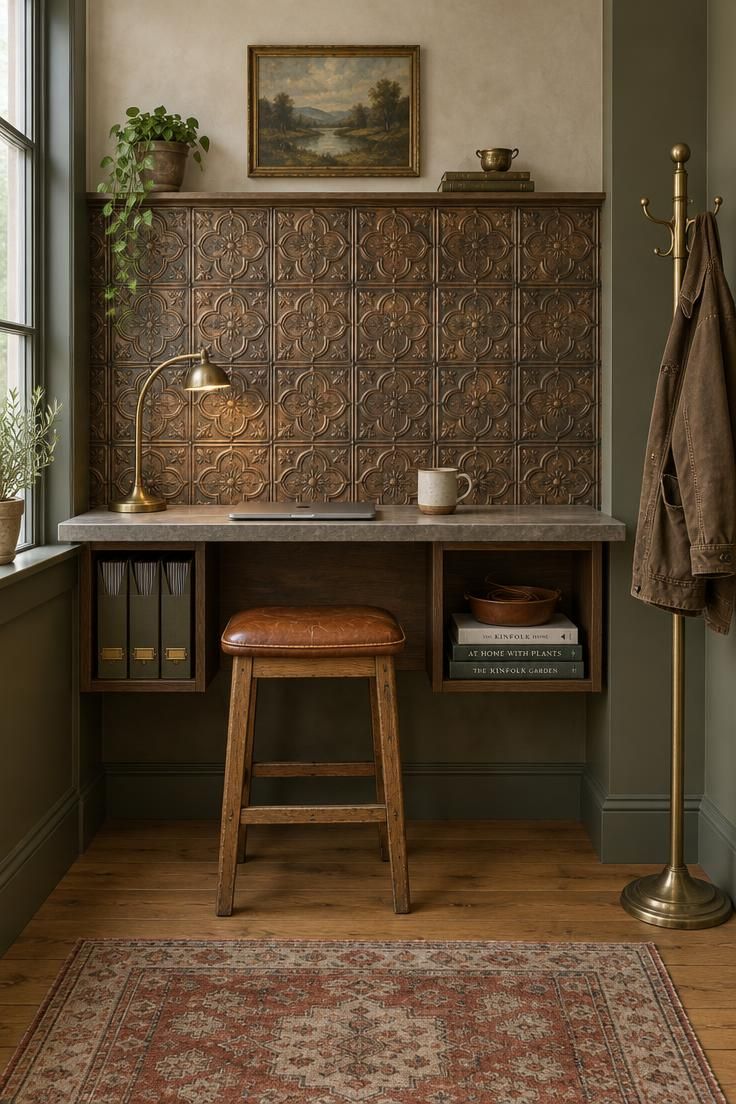
A pressed-tin backbar panel gives an office a collected, slightly old-world feel without copying the dark lounge seating, oversized screen, or wall-mount arrangement used elsewhere in this article.
The panel or a convincing pressed-tin reproduction becomes the visual anchor behind a narrow counter-height shelf, while the desk itself stays shallow enough for a laptop, a lamp, and one or two everyday items.
Choosing bronze, copper, or antique gray tin with visible rubbed edges keeps the texture subtle, so the wall reads as a backdrop to the work area rather than a shiny showpiece.
Finishing the side wall in a muted tone such as olive, slate blue, or warm putty gives the metal a quieter frame and makes the corner feel like part of an older storefront or club room.
A worn oak stool or low wooden bench works better than an upholstered desk chair because it keeps the arrangement open and easy to step past, while closed storage in low cubbies or a nearby floor chest matters more than open shelving here.
Since the tin already supplies the room’s pattern, extra display pieces would compete with it, so this idea suits a smaller nook or a hallway-adjacent office corner where a full desk and media setup would fill the floor too quickly.
Style Blueprint:
- Pressed-tin panel in bronze, copper, or antique gray as the back wall feature
- Narrow counter-height shelf in blackened wood or dark stained oak
- Small brass or black gooseneck task lamp
- Worn oak stool, bench, or low wood seat with leather or woven padding
- Low cubbies or a nearby floor chest for closed storage
Library Lounge with a Writing Desk and Floor-to-Ceiling Shelves
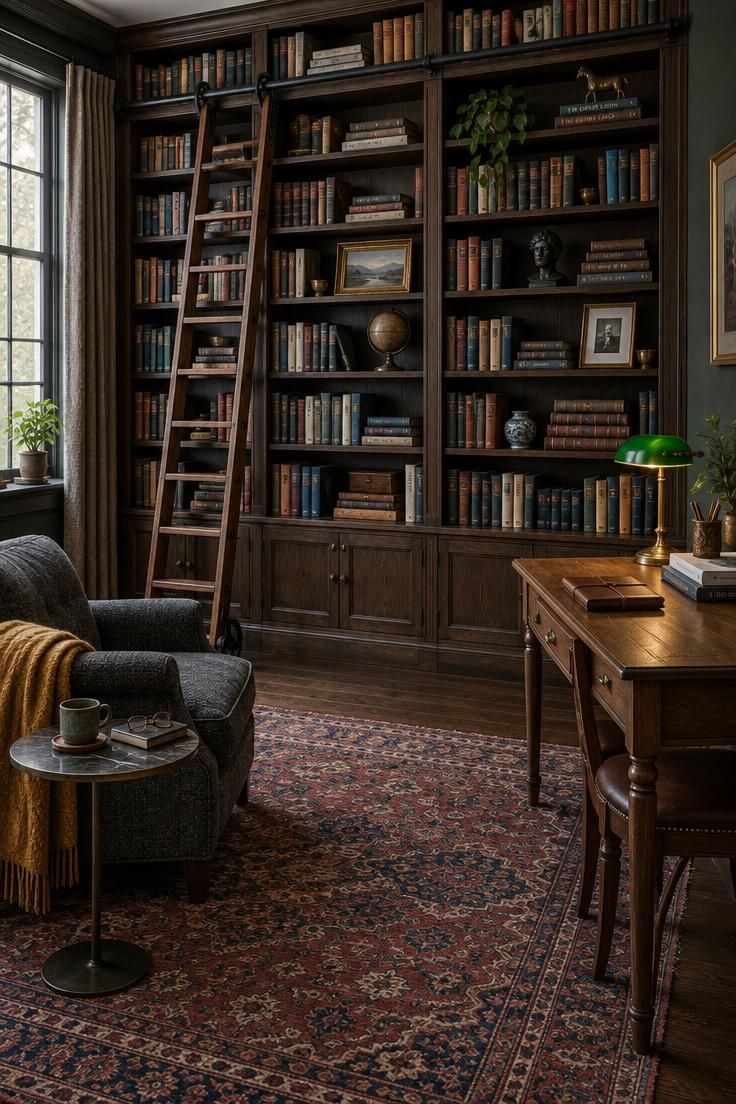
A library lounge with a writing desk and floor-to-ceiling shelves creates a dense, bookish wall around a small work surface.
The shelves run the full height of the wall, and a rolling ladder makes the top reach usable rather than decorative.
Books, small sculptures, and storage boxes fill the shelves, though the spacing between groupings matters more than the total quantity.
The desk is set perpendicular to the shelf wall instead of facing into the spines, which leaves the wall visible from the desk chair and keeps a narrow room from feeling like a hallway with a library attached.
A single lounge chair in a different fabric, tweed, wool, or velvet, sits near the desk for reading and gives the room a second seat without adding another work surface.
This look depends almost entirely on shelf styling: too many small items and the wall reads as a retail display, while a few large volumes and modest gaps make it read as a library.
Dusting is the ongoing cost of an open shelf wall, and a long-handled duster plus a step stool keeps the upper rows in reach.
Style Blueprint:
- Floor-to-ceiling dark wood bookshelves on one wall with a rolling ladder on a metal rail
- Narrow writing desk in a medium wood tone, set perpendicular to the shelves
- Small green banker's lamp as the desk light
- Low armchair in charcoal tweed, wool, or velvet near the desk
- Worn Persian rug in red and blue over dark stained oak
Music Room Office with Guitar Wall and Vinyl Storage
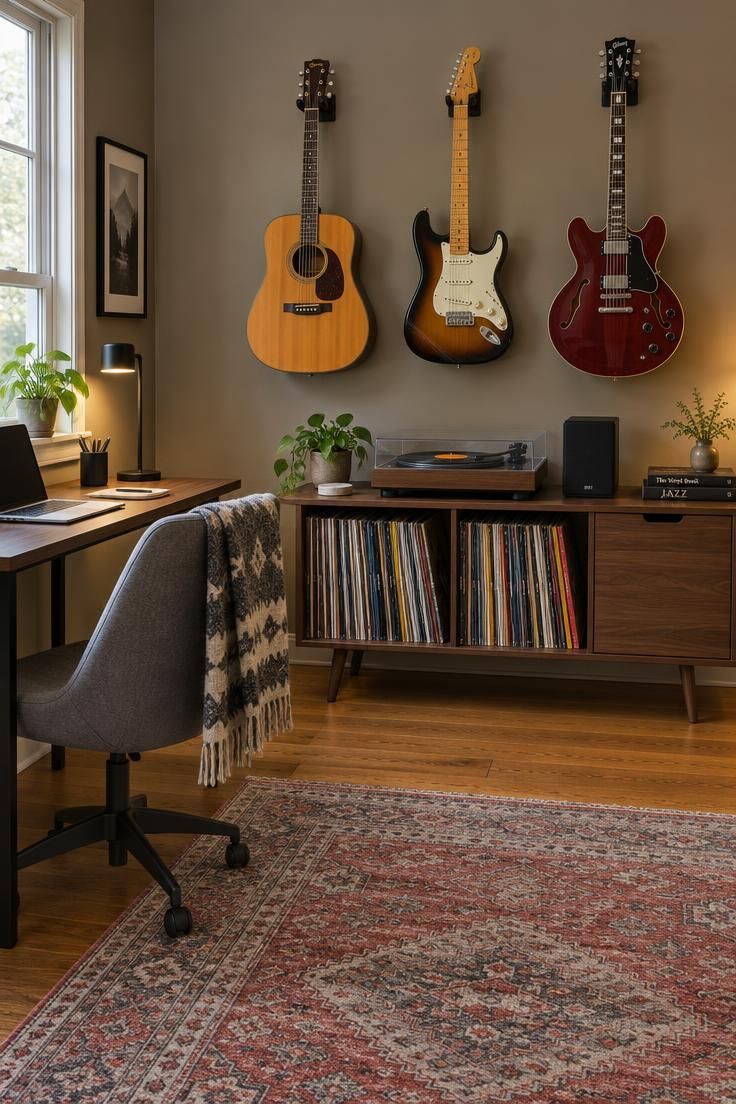
A music room office with guitar wall and vinyl storage centers the room on one wall of displayed instruments.
Two or three guitars, a bass, or a few hand instruments hang at a consistent height, which keeps the wall from reading as a random collection and makes the display a backdrop rather than clutter.
The desk sits to the side and faces away from the instrument wall, so the display stays a background instead of a busy video-call frame.
Vinyl storage in a low cabinet or freestanding rack sits under the instruments, with the turntable on top and the speakers placed where they can be reached without moving anything.
A simple upholstered chair works better here than a heavy executive chair, since the atmosphere is closer to a studio than a boardroom.
Keeping instruments visible but off the desk has a practical payoff: they stay within reach for a break without eating the work surface.
The tradeoff is dust on the instruments and the turntable, so a soft cloth and a turntable cover earn their place in the routine.
Vinyl collections also grow, so leaving at least one empty cubby from the start avoids a stack forming on top of the cabinet.
Style Blueprint:
- Three guitars on black wall mounts at a consistent height
- Low walnut record cabinet with a turntable on top and vinyl in the lower cubbies
- Compact desk facing away from the instrument wall
- Gray upholstered task chair with a folded wool blanket
- Flat-weave rug in faded red and gray
Design Pro-Tip: Hang the instrument wall at a consistent height and keep the space below the guitars clear, so the display reads as one deliberate band rather than scattered equipment around the room.
Conclusion
The best man cave office is the one that fits the room, not the one filled with the most stuff.
A small corner with a wall-mounted desk and a bright task lamp can carry more personality than a full basement with mismatched lounge furniture and a desk pushed against the far wall.
The directions above work because each one separates the two identities instead of pretending they can be fully merged.
Work gets light and clear surfaces, the cave side gets dark walls and comfortable seating, and both share the square footage without fighting over the same wall.