This post may contain affiliate links. If you make a purchase through these links, we may earn a commission at no additional cost to you.
A retreat works best when it feels personal without feeling loose.
Deep wall tones, warm wood, leather that has earned its patina, and light placed where it is needed can give a spare bedroom, a finished basement, or a converted garage the calm of a room that was considered rather than filled.
Cozy comes from texture and low light, while a classy read comes from restraint: fewer finishes, fewer objects, and closed storage that hides the working parts.
The ideas below range from a single wall treatment to a full seating group, and each one can stand alone or combine with another.
Begin with the piece that fits the space you actually have.
Walnut Slat Wall Behind a Low-Slung Lounge
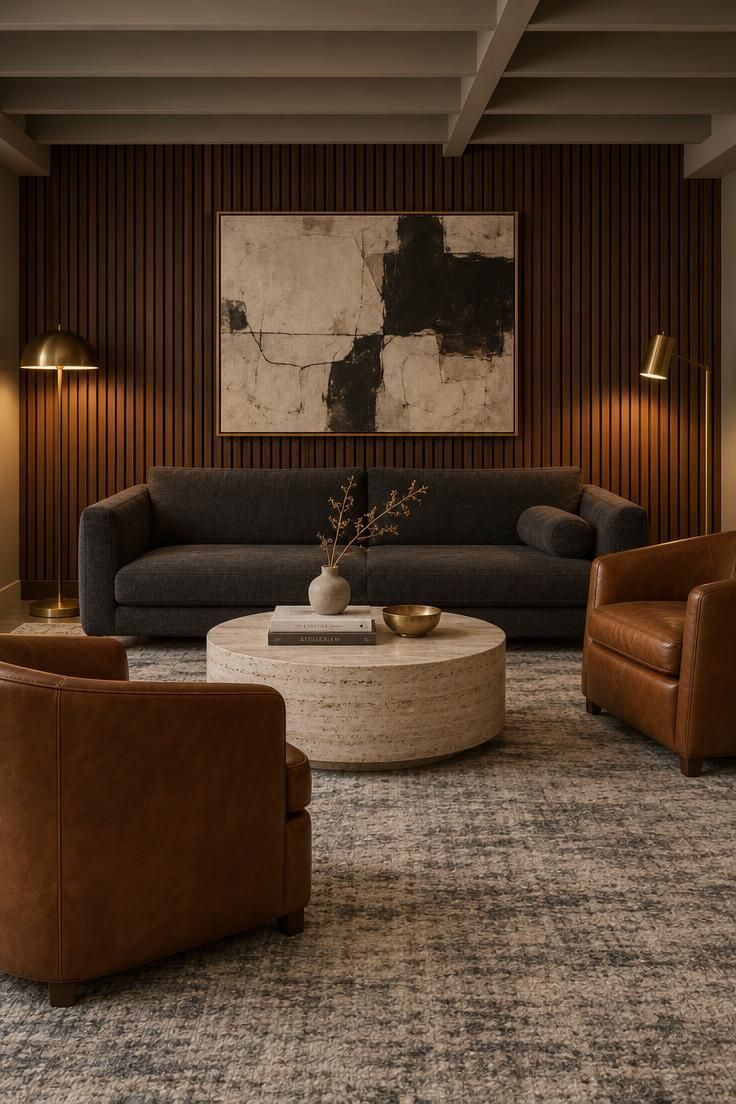
A vertical walnut slat wall gives one surface a repeating rhythm that a flat painted wall cannot match, and the dark grain reads warmer under low light than under bright daylight.
Because the slats are a visual finish, the seating in front of them should stay low and horizontal: a sofa with a low back, two club chairs with a modest profile, and a coffee table that sits close to the rug’s center.
The round travertine table softens the straight lines above it, and a single large canvas hung on the slats keeps the wall from becoming a display of many small things.
Warm, dimmable floor lamps at each end of the group give the room a lit perimeter instead of a bright center, which is the pattern that finished basement lounge lighting usually depends on when there are no windows to work with.
Wood slats gather dust in the horizontal gaps, and a basement collects it faster than an upper floor, so a dry microfiber cloth passed over the faces every few weeks keeps the grain reading sharp.
Choosing low seat heights matters more here than the depth of the room, since tall furniture in front of a tall wall pushes the whole composition upward.
Style Blueprint:
- Vertical walnut slats on one accent wall only, with painted drywall elsewhere
- A low-back sofa in charcoal or graphite plus two cognac leather club chairs
- A round travertine or stone coffee table that breaks up the linear wall
- One large abstract canvas in cream and charcoal, hung on the slats
- Two dimmable brass floor lamps placed at opposite ends of the seating group
Design Pro-Tip: Repeat the walnut tone on a narrow floating ledge below the artwork so the wall and the seating area share one material instead of competing.
Marble-Topped Bar Cart with Tucked-Away Glassware
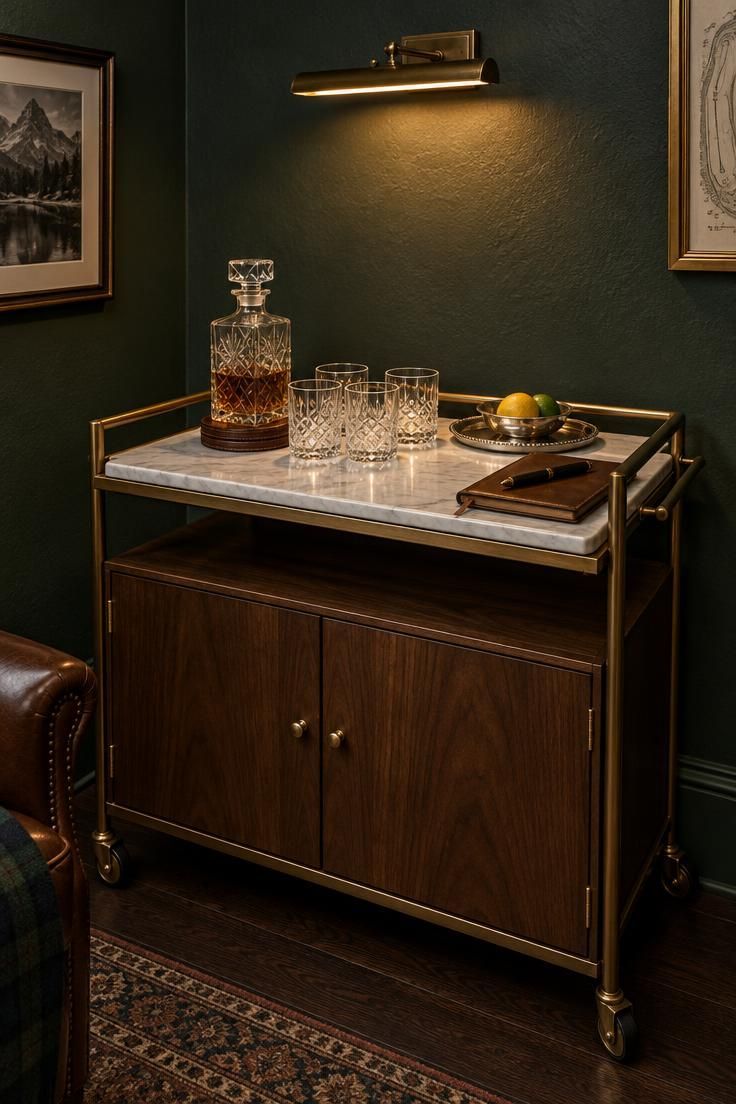
A bar cart earns its place in a classy man cave when the top surface stays edited and the lower half stays closed.
Honed marble has a matte, chalky surface that catches a picture light without throwing glare, and it pairs naturally with brass and walnut.
Four or five glass types are enough for most serving, and a single decanter plus a small tray for bitters or a citrus dish gives the cart a composed look that a crowded row of bottles cannot.
The closed cabinet below is the part that keeps the idea working, since open shelves collect every odd bottle and half-empty box until the cart reads as a storage unit rather than a piece of furniture.
Marble is vulnerable to acidic spills, so a coaster or a small tray under anything wet protects the stone from etching, which is a practical reason to keep the tray on the surface rather than tucked away.
Leaving one zone of the top empty or holding only a short stack of cocktail napkins creates the negative space that makes the rest read as a deliberate arrangement.
Style Blueprint:
- A brass and walnut cart with a honed marble top and a closed lower cabinet
- Four matching rocks glasses, one decanter, and a small silver tray
- A leather coaster stack and one low dish for citrus or bitters
- A picture light or wall sconce aimed at the cart rather than the ceiling
- A deep green or navy wall behind the cart for contrast against the marble
Design Pro-Tip: Keep a small lidded bowl on the marble top for a single scent object, and store the coasters in a shallow drawer so the surface stays spare.
Picture-Lit Display Wall Above a Low Leather Bench
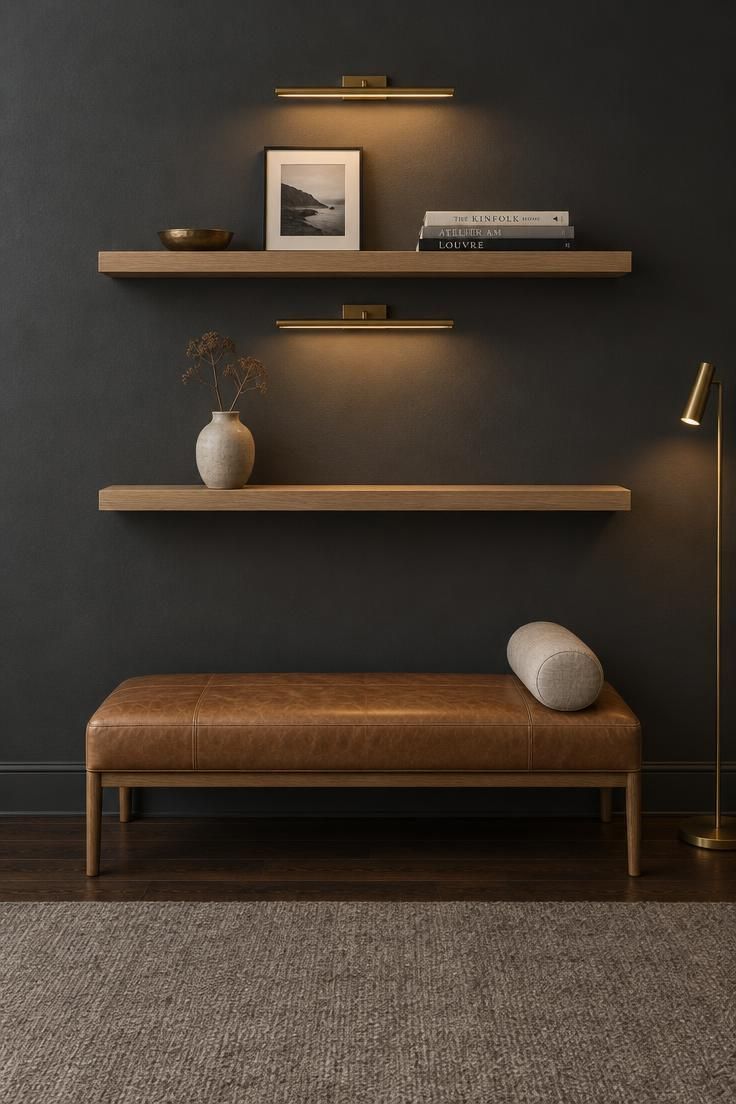
A display wall with picture lights turns a flat surface into a focal point by controlling where the eye lands.
Two shelves with five or six objects total give each piece enough room to be seen, and small brass picture lights mounted above the shelves add a gallery effect without a ceiling fixture.
The low leather bench beneath the shelves grounds the wall and doubles as a place to sit while pulling on shoes or setting down a bag.
Shelf spacing should follow the tallest object on each shelf rather than a fixed interval, and every shelf benefits from at least one open zone so the arrangement does not read as a full row.
Spacing objects wide also makes dusting easier, since each item can be lifted and wiped without rearranging a cluster.
Pointing the picture lights at the objects rather than the wall reduces glare on framed pieces with glossy surfaces.
Style Blueprint:
- One wall in deep charcoal with two floating white oak shelves
- Small brass picture lights above each shelf on warm white bulbs
- Five or six objects total, spaced wide with one empty zone per shelf
- A low tan leather bench with a single round pillow in oatmeal linen beneath the display
- A warm gray wool rug to soften the floor under the bench
Design Pro-Tip: Aim the picture lights slightly downward at the objects and keep the wall behind them dark so the beams read as pools of light rather than a wash.
Tobacco Leather Club Chairs Around a Round Game Table
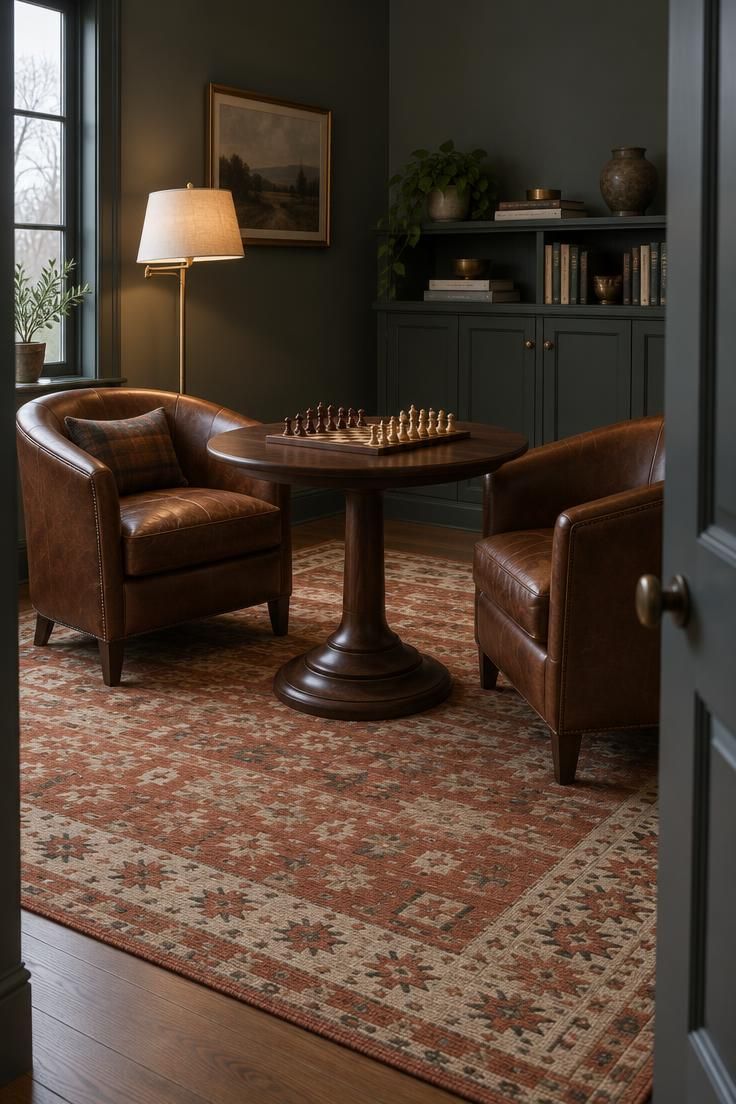
A round pedestal table with two leather club chairs creates a conversation nook with leather club chairs that feels intentional rather than leftover.
The chairs should angle slightly toward each other rather than sit square to the table, which lets the group read as a place for two people rather than a dining setup.
A wool rug gives the chairs and table a shared boundary, with a visible border that keeps the grouping from looking squeezed onto the floor.
When comparing rug sizes, check how the chairs look pulled out as well as tucked in, since the arrangement needs to feel composed in use.
A single floor lamp behind one chair pools light on the tabletop and leaves the rest of the room dimmer, which is what makes the table feel like a destination.
A round table for two does not suit larger gatherings, so an oval table with three or four chairs is the better pick if the room is meant to host groups.
Keeping the surface to one game, one shallow tray for cards or dice, and one pen keeps the tabletop ready without becoming a catch-all.
Style Blueprint:
- Two tobacco leather club chairs with low backs, angled toward each other
- A round pedestal table with a dark walnut top
- A rust-and-ivory flat-weave wool rug extending past the chairs
- One brass floor lamp behind a chair for directed light on the table
- A shallow wooden tray holding dice, cards, and a pen
Design Pro-Tip: Store the game pieces in a small lidded box under the table so the surface can clear between sessions.
Moody Velvet Lounge Seating Against Warm Oak Paneling
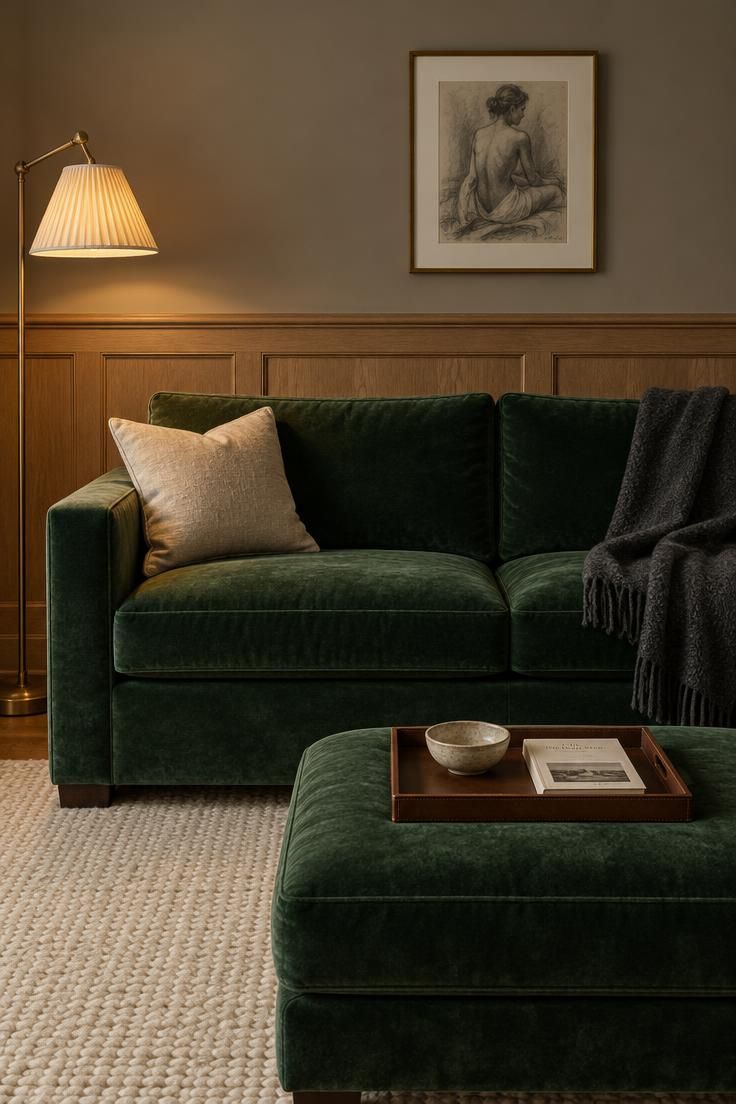
Green velvet against warm oak creates a moody lounge with warm wood tones, where the softness of the pile sits against the straight grain of the paneling.
Keeping the palette to three main elements, green, oak, and off-white, plus a single metal accent such as aged brass, makes the corner read as a considered choice rather than a color collection.
The ottoman can serve as a footrest, an extra seat, or a low table with a tray on top, which makes it useful in a corner that cannot fit a full coffee table.
Velvet shows wear in the spots where hands and arms rest, so occasional vacuuming with an upholstery tool keeps the pile from matting.
One linen pillow and one wool throw are enough soft goods; more cushions start to look styled rather than lived in.
Style Blueprint:
- An emerald green velvet sofa with a matching ottoman
- Warm white oak paneling on the lower wall with matte greige above
- Aged brass lamp bases as the single metal accent
- One linen pillow and one wool throw, no more
- A small leather tray on the ottoman holding two objects
Closed Bar Cabinet with Antique Mirror Front
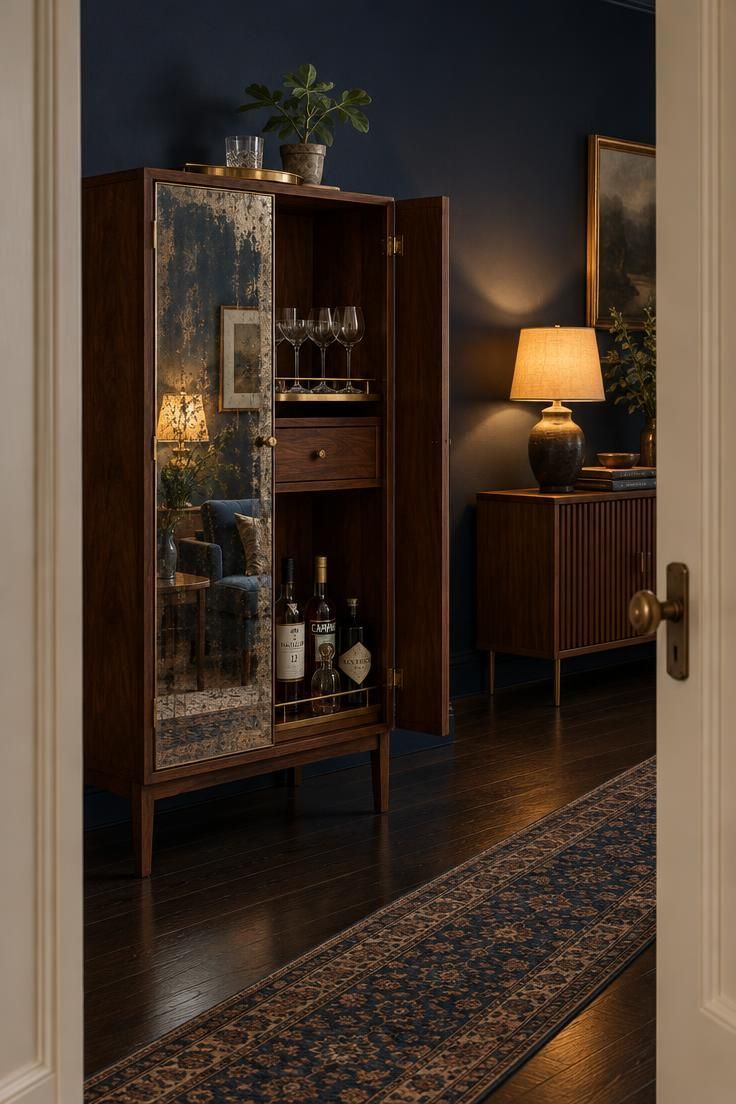
An antique mirror front on a closed bar cabinet does two jobs at once: it hides the working parts and it reflects light back into a small room.
Inside, the heaviest bottles belong on the lowest shelf, glasses on a dedicated tray so they can be lifted out as a set, and openers and pourers in one shallow drawer.
Placing the cabinet near an outlet keeps options open for a small interior light or a compact beverage cooler, which the reader can decide based on the room’s existing power access.
An antique mirror can make the cabinet feel like a display piece, so the objects around it should stay few: one plant, one small tray, and perhaps a single framed photo on the adjacent wall.
Interior light strips on a battery pack help in a cabinet that reads too dark inside, and warm white is the better choice for showing bottles without a clinical look.
Style Blueprint:
- A tall cabinet with an antique mirror or distressed glass front
- Deep navy paint on the wall behind, in a matte finish
- Bottles stored low, glassware on a removable tray, tools in one drawer
- A small brass tray and one potted fig on the top surface
- A warm table lamp on an adjacent surface for reflected light
Leather Strap Bookshelves Over a Deep Seated Reading Chair
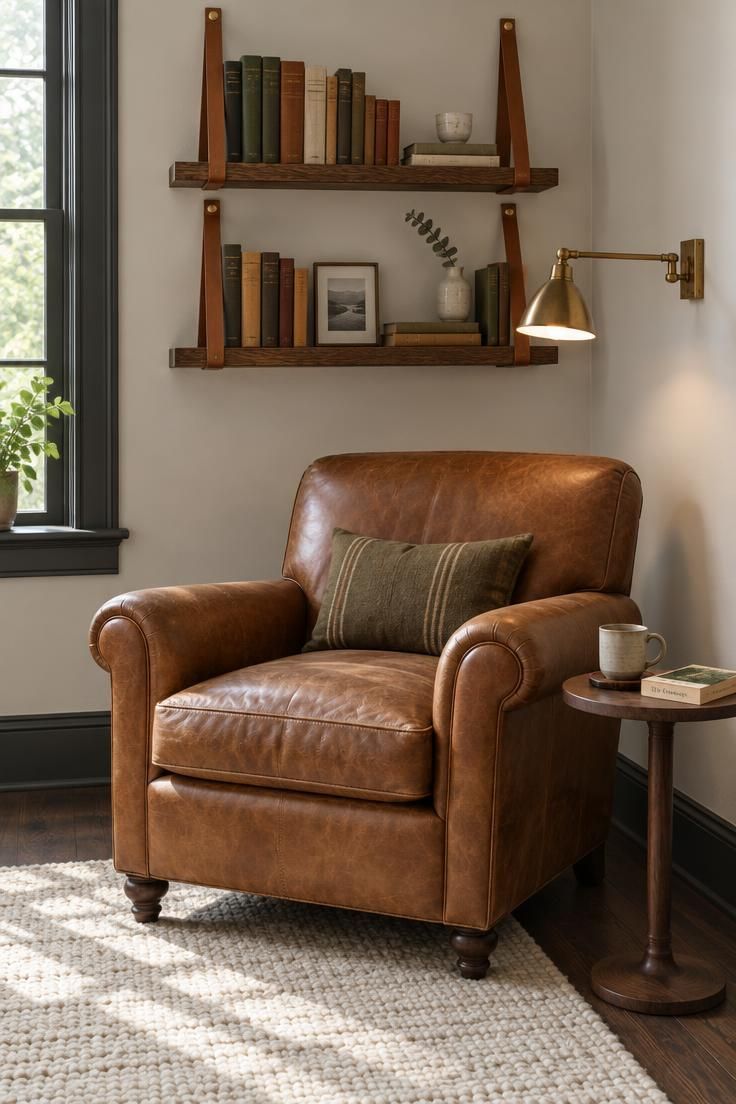
Leather strap supports give open shelving a softer detail than metal brackets, and the natural material echoes the chair without becoming a matchy set.
A mix of hardcover books and three or four personal objects works better than a full row, and keeping most spine colors muted with one or two brighter volumes as accents makes the shelf feel collected.
Positioning the chair under a swing-arm sconce lets the reader aim light at the page and keep the room dimmer than a floor lamp would allow.
The side table only needs room for a mug, a small notebook, and the current book, so a compact round top is enough.
Open shelves collect dust, so keeping the collection small and rotating it once or twice a year makes wiping down a shorter job.
Style Blueprint:
- A deep-seated tan leather chair with rolled arms
- Two stained oak shelves on natural leather strap supports
- A brass swing-arm sconce on a warm white bulb
- A compact round walnut side table for a mug and the current book
- Books in muted earth tones with one or two brighter spines
Design Pro-Tip: Match bookends to the leather straps or use simple black metal so the shelf ends stay quiet.
Slate-Topped Console with Decanters in a Darkened Hall
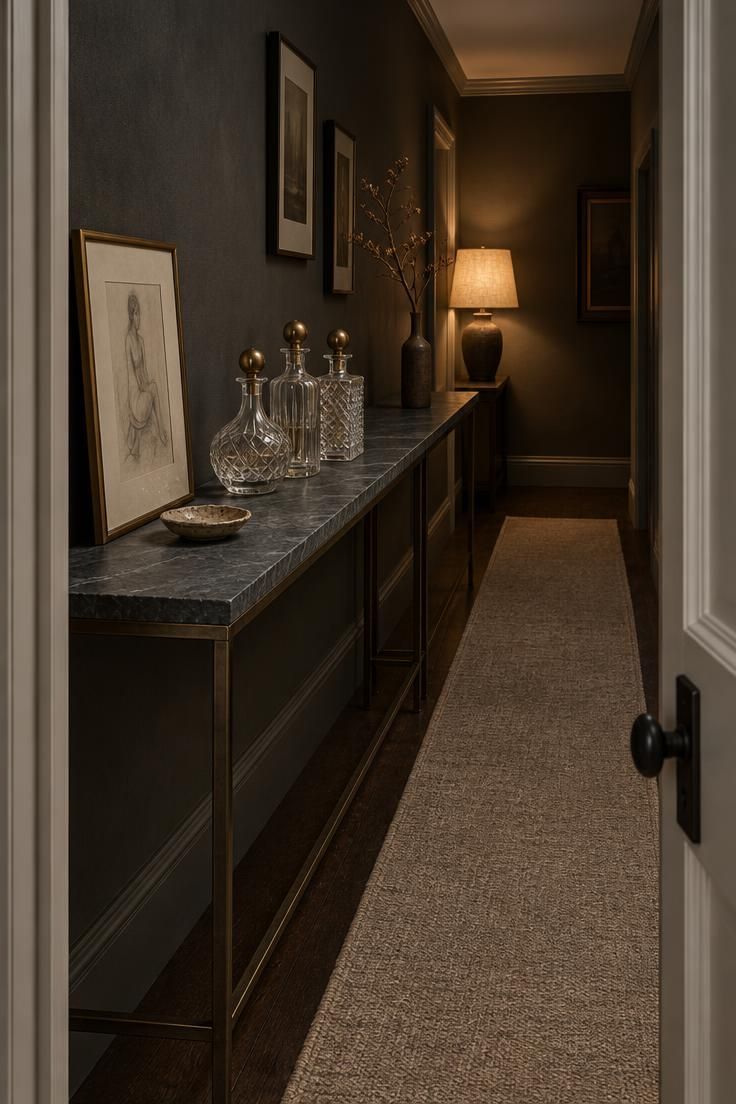
A slate-topped console against a dark hallway wall turns a pass-through into a place to pause and pour.
Slate reads heavier than wood, and paired with dark metal legs it gives the setup a library-like quiet.
Three decanters in a row, a low dish for corks, and one framed piece leaning rather than hung keeps the surface simple and easy to change while leaving room for a stack of cloth napkins or a small box for matches.
Slate is porous enough that spills should be wiped right away, and a shallow tray under the decanters protects the stone from rings while small felt pads prevent scuffs when the bottles shift.
Style Blueprint:
- A long slate-topped console with oil-rubbed bronze legs
- Three decanters with matching stoppers, arranged in a row
- A shallow tray or low dish for corks and small tools
- One framed sketch leaning against the wall rather than hung
- A single linen-shaded lamp at the far end for directed glow
Design Pro-Tip: Use small felt pads under the decanters so the stone does not pick up scuffs when the bottles are moved.
Woven Wool Rug Anchoring a Navy Blue Seating Group
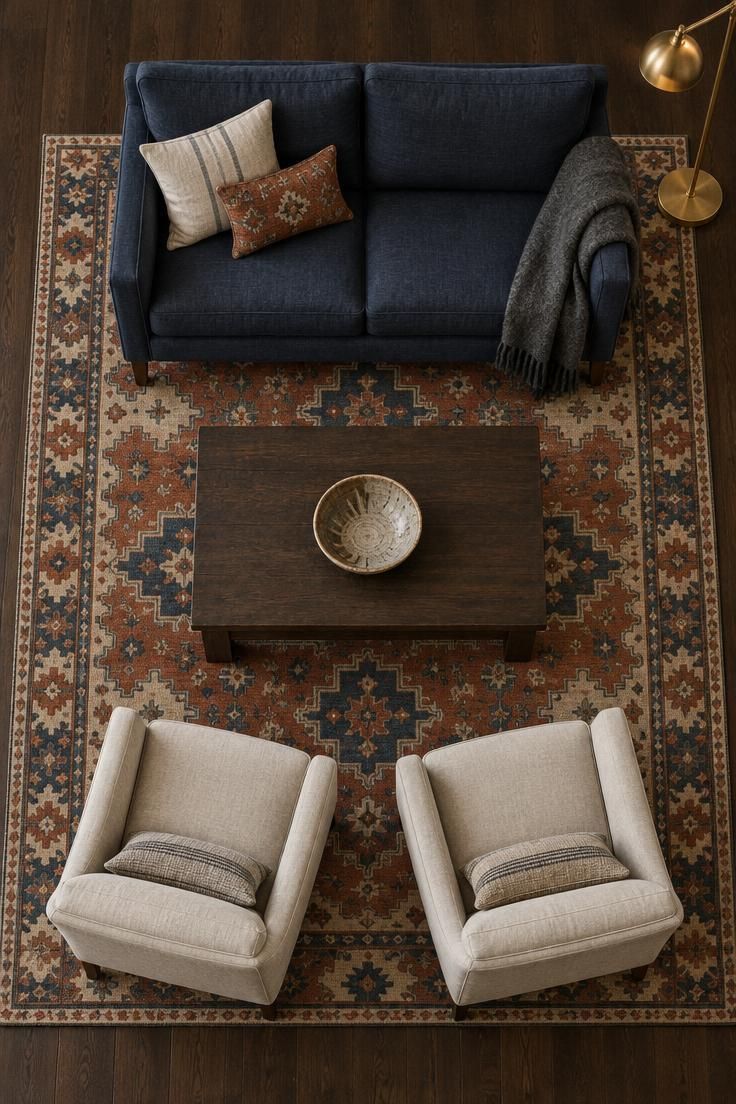
A large flat-weave rug sets the color story for the room and keeps seating from floating, which matters most in a basement with a poured concrete or tile floor.
Front legs on the rug is a common convention because it draws a clear boundary around the group, though back legs can stay on the floor if the rug is too small to reach.
The loveseat and chairs should sit close enough that someone can set a drink down without standing, which is the practical test for whether the group is arranged for conversation or just arranged.
One floor lamp and one table lamp keep the lighting layered; a single overhead fixture doing all the work tends to flatten the room.
A light rug shows footprints in a high-traffic basement, so a pattern with a darker edge hides them better than a solid field.
Style Blueprint:
- A large flat-weave wool rug in rust, navy, and ivory
- A navy loveseat paired with two oatmeal linen armchairs
- A low dark-stained wood coffee table
- One charcoal wool throw and one brass floor lamp
- Front legs of every seat on the rug, back legs optional
Design Pro-Tip: Rotate the rug every few months so wear spreads evenly, especially in a room used daily.
Industrial Pipe Shelving with Warm Edison Bulb Lighting
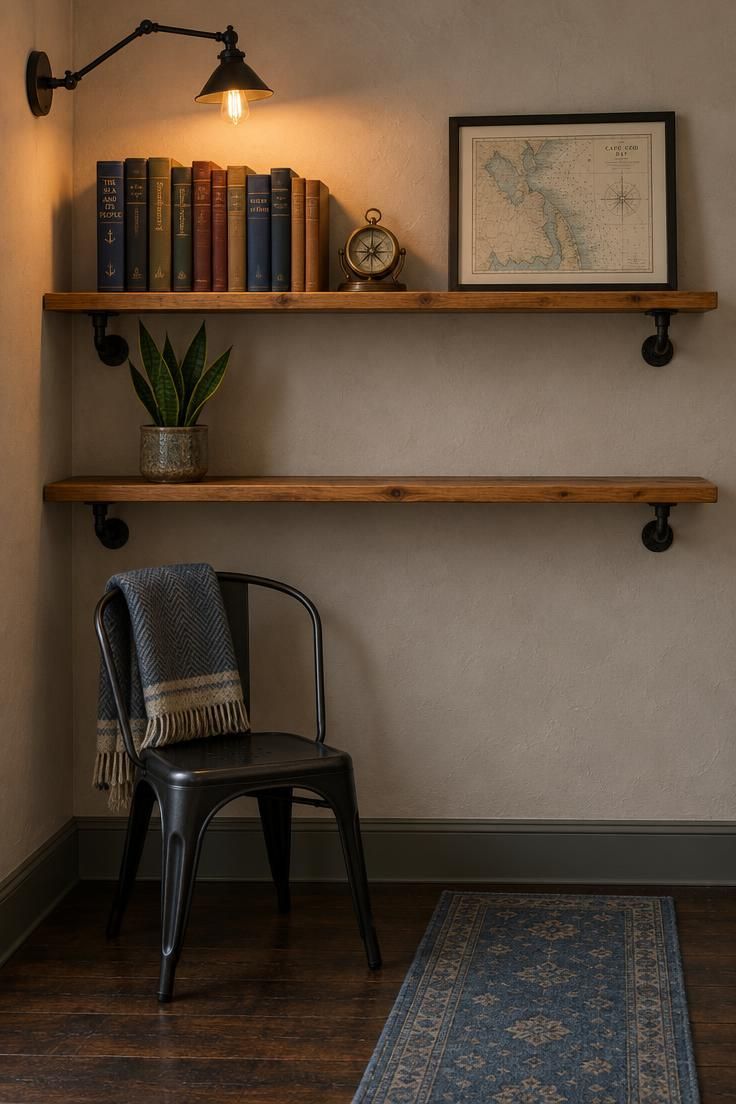
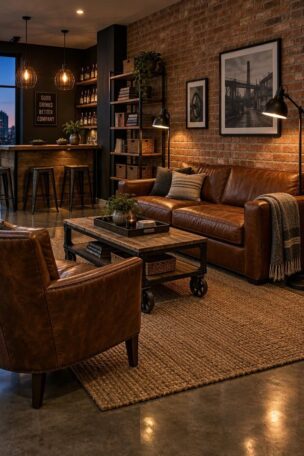
Iron pipe brackets with waxed pine boards give shelving a workshop-adjacent feel, and the two materials work because the wood softens what the metal alone would make cold.
Uneven shelf spacing, taller at the bottom for large books and tighter above for small objects, looks considered rather than uniform.
A black swing-arm lamp with an exposed Edison bulb pulls the eye to the upper shelf, and pointing the bulb toward the shelf rather than the room keeps the light from spilling everywhere.
The bulb should be dimmable and low wattage so the exposed filament does not create glare against the wall.
Rough pine holds dust in its grain, so the shelves need an occasional wipe with a dry cloth to keep their warm tone.
Style Blueprint:
- Two waxed pine shelves on black iron pipe brackets
- A swing-arm wall lamp with a dimmable exposed Edison bulb
- A row of hardcover books, a brass compass, and one framed chart
- One small trailing plant and one empty shelf zone
- A bare wall around the shelves so they read as the feature
Brass Picture Lights Over a Single Grayscale Artwork
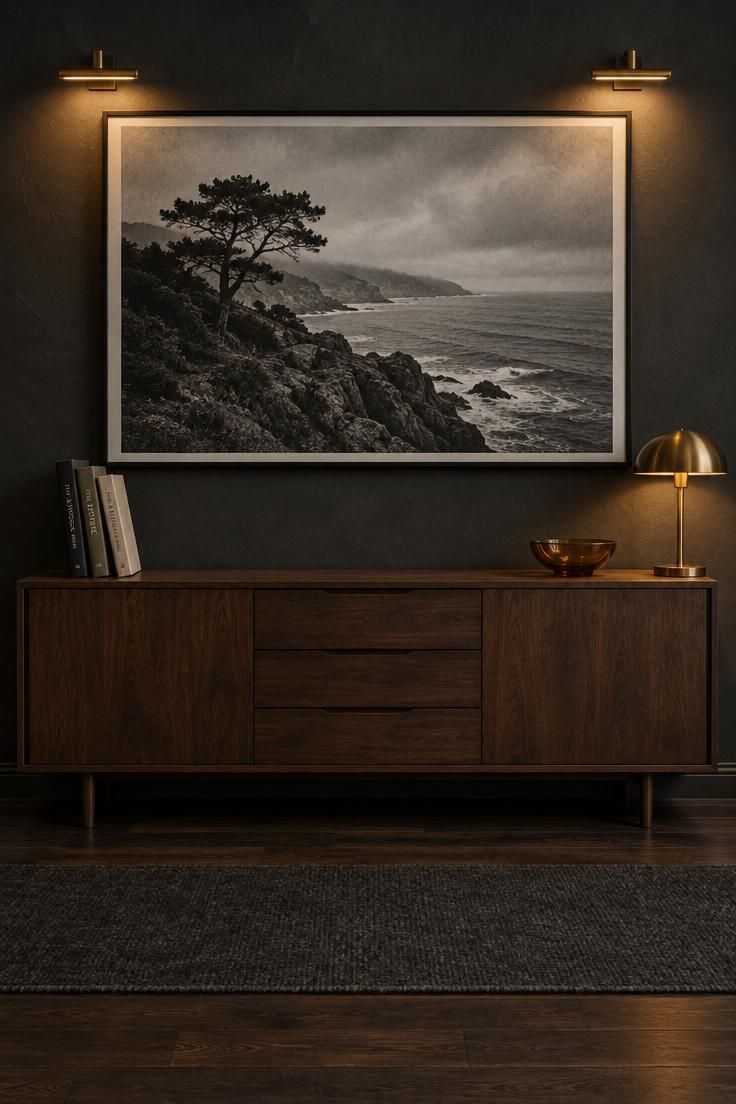
One oversized grayscale artwork hung above a low sideboard turns a single wall into the room’s focal point without a gallery of small frames.
Two brass picture lights at the upper corners spread an even wash across the piece and keep the sides from falling dark.
The sideboard below should hold only two or three objects so the artwork stays the subject; a short stack of books and a ceramic bowl are enough.
Positioning the artwork’s center at roughly standing eye level is a reliable starting point, though the exact height will shift with ceiling height and the furniture beneath.
A grayscale piece can feel cool against warm wood, which is why brass frames and a single amber or rust object on the sideboard balance the temperature.
Style Blueprint:
- One oversized black-and-white artwork on a matte charcoal wall
- Two brass picture lights at the upper corners on warm white bulbs
- A low dark walnut sideboard beneath the artwork
- Two or three objects on the sideboard, no more
- One amber or rust accent to warm the grayscale palette
Leather and Brass Bar Stools at a Reclaimed Wood Counter
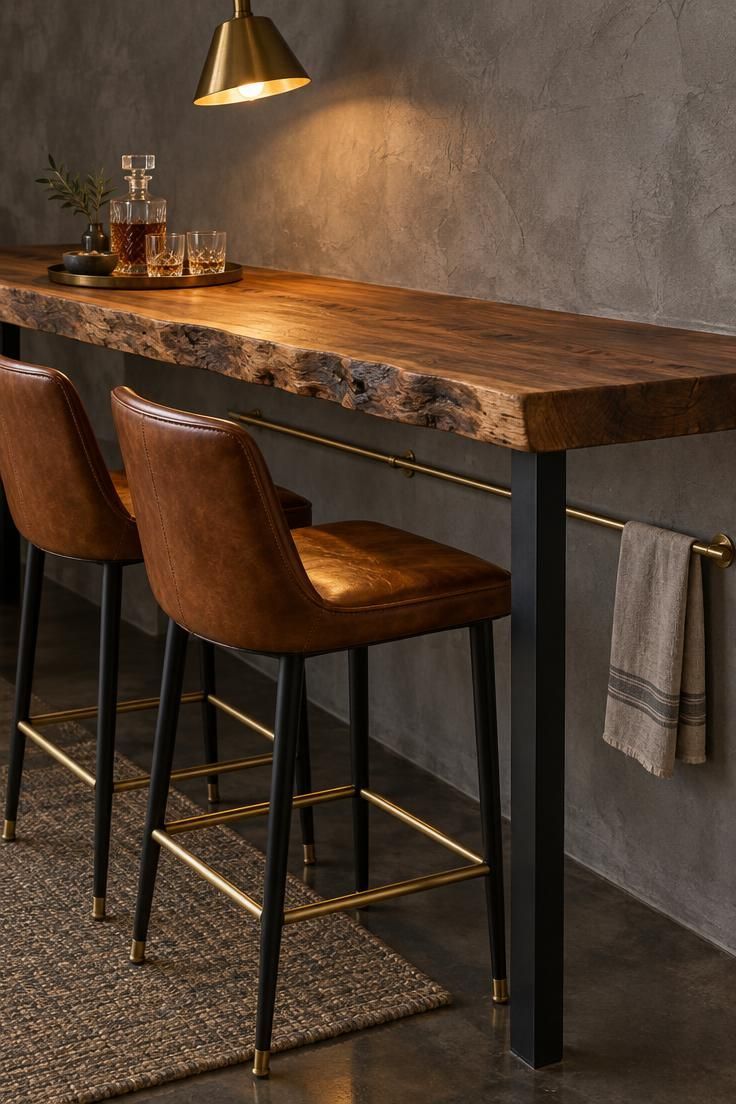
A reclaimed slab counter supported by simple steel legs gives a bar-height surface that can serve quick meals, hold a laptop, or work as a standing bar when guests visit.
Leather and brass bar stools echo the wood tone while the brass footrests add a small glint that keeps the setup from reading too matte, and lightweight stools that move easily are better for a multipurpose counter because they can shift out of the way when the surface is needed for something else.
A short tray with a decanter and two glasses keeps the top mostly clear, while a small brass rail on the wall below allows a towel or a small pouch to hang within reach.
A reclaimed slab may have uneven edges and small splits, which adds character but should be checked for splinters, and a food-safe finish is worth considering if the surface will be used for meals.
Style Blueprint:
- A thick reclaimed wood slab counter on black steel legs
- Two leather bar stools with brass footrests, easy to move
- A small tray with a decanter and two low glasses
- A bare wall behind the counter with one narrow brass rail
- A single warm pendant aimed at the counter, not the room
Design Pro-Tip: Keep the countertop to one tray so the wood stays the visual subject rather than the objects on top of it.
Gallery Wall of Black-Framed Sketches Over a Leather Sofa
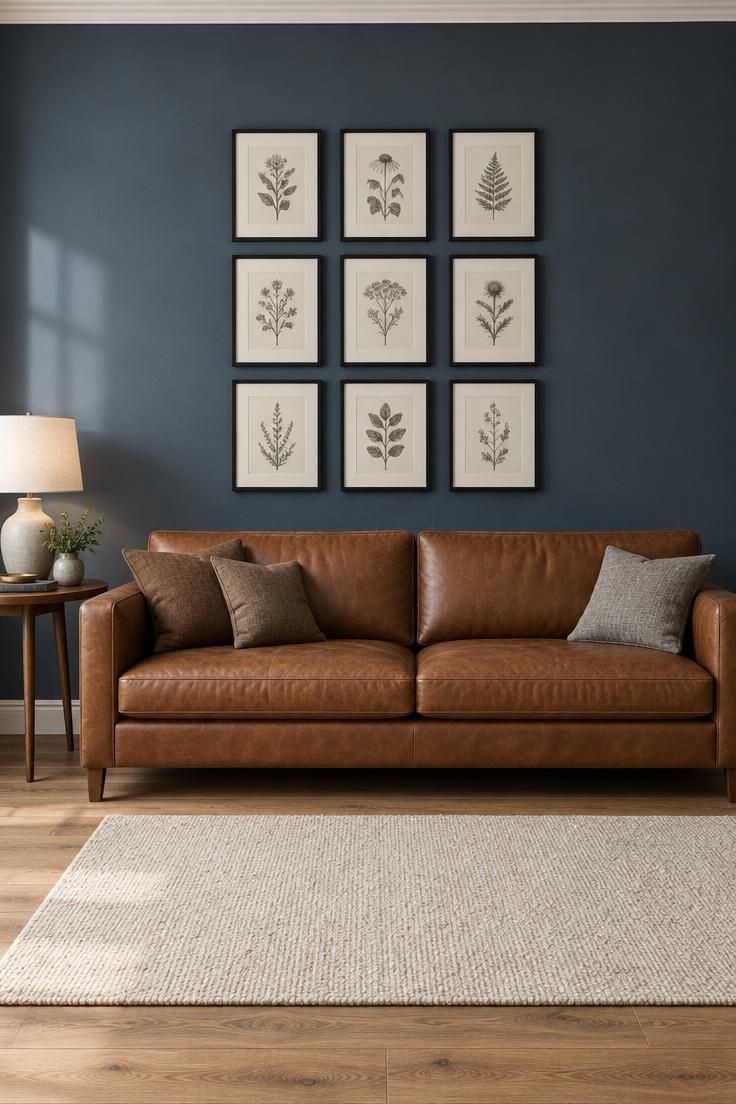
A tight grid of small black-framed sketches above a leather sofa makes a formal, studious wall from prints that cost far less than one large original.
Identical frames and mats do the heavy lifting; even when the sketches inside are prints, the repeated border makes the collection read as one piece.
Aligning the grid with the sofa’s width rather than the full wall keeps the group visually tied to the furniture below.
A dark frame grid can feel heavy on a light wall, so a deep blue or gray paint behind it works better than off-white.
Two or three pillows in muted tones are enough on the sofa; more soft goods start to compete with the frames above.
Style Blueprint:
- Nine small black-framed sketches in matching ivory mats
- A tight three-by-three grid aligned to the sofa’s width
- A cognac leather sofa as the base for the group
- A deep blue-gray wall behind the frames
- Two or three pillows in muted brown and gray, no throw
Design Pro-Tip: Lay the grid out with removable paper templates first so the spacing reads even before anything is placed.
Stone-Topped Cabinet as a Whiskey Decanter Station
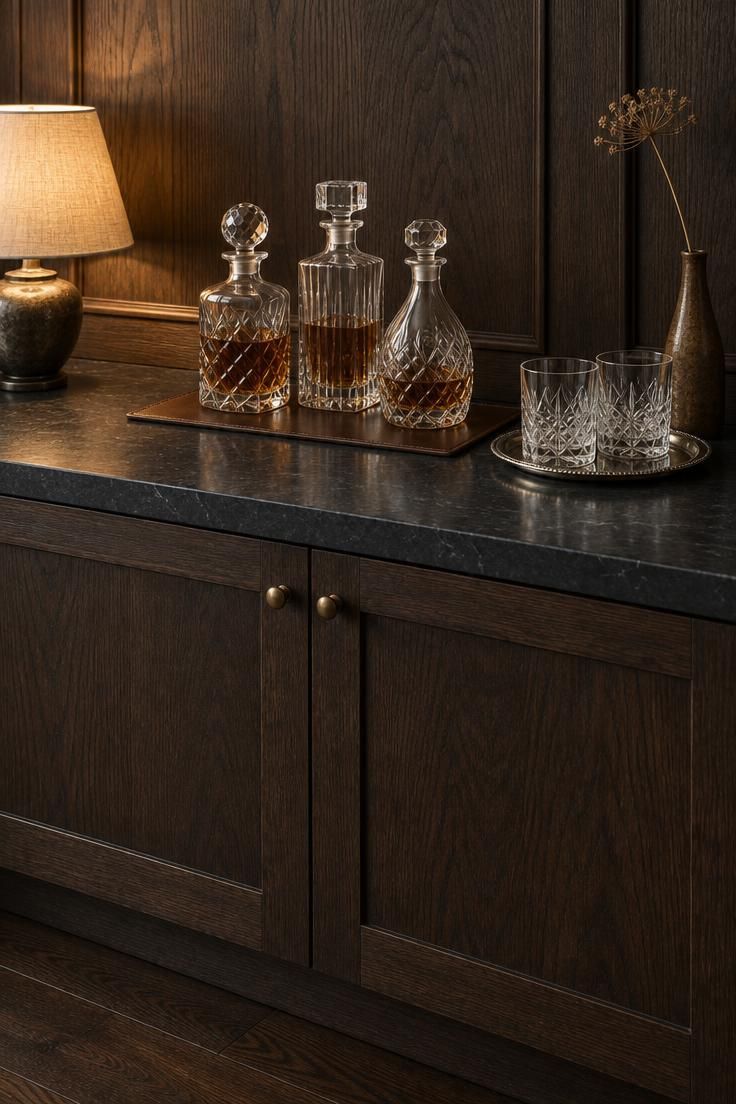
A low cabinet with a honed black stone top against dark wood paneling creates a whiskey bar corner with closed storage that holds the display at eye level without extending into the room.
Three decanters on a thin leather mat, two squared glasses on a small tray, and one low vase form the whole arrangement, which keeps the surface from collecting odds and ends.
Stone reads heavier than wood and gives the setup an old-fashioned club feel, while the closed doors below hide extra bottles and cleaning supplies.
A stone top is durable but can chip if a decanter is set down hard, so the leather mat under the tray absorbs the impact and prevents ring marks.
The paneling behind should be stained a deep brown rather than painted so the grain remains visible against the black stone.
A single low-wattage lamp on the cabinet washes the stone and crystal in warm light without a bright overhead beam competing for the eye.
Style Blueprint:
- A low cabinet with a honed black stone top and closed doors
- Dark stained wood paneling behind, not painted
- Three matching decanters on a thin leather mat
- Two heavy glasses on a small silver tray
- One narrow vase with a single dried stem and a small linen-shaded lamp
Wingback Chair and Side Table in a Quiet Reading Nook
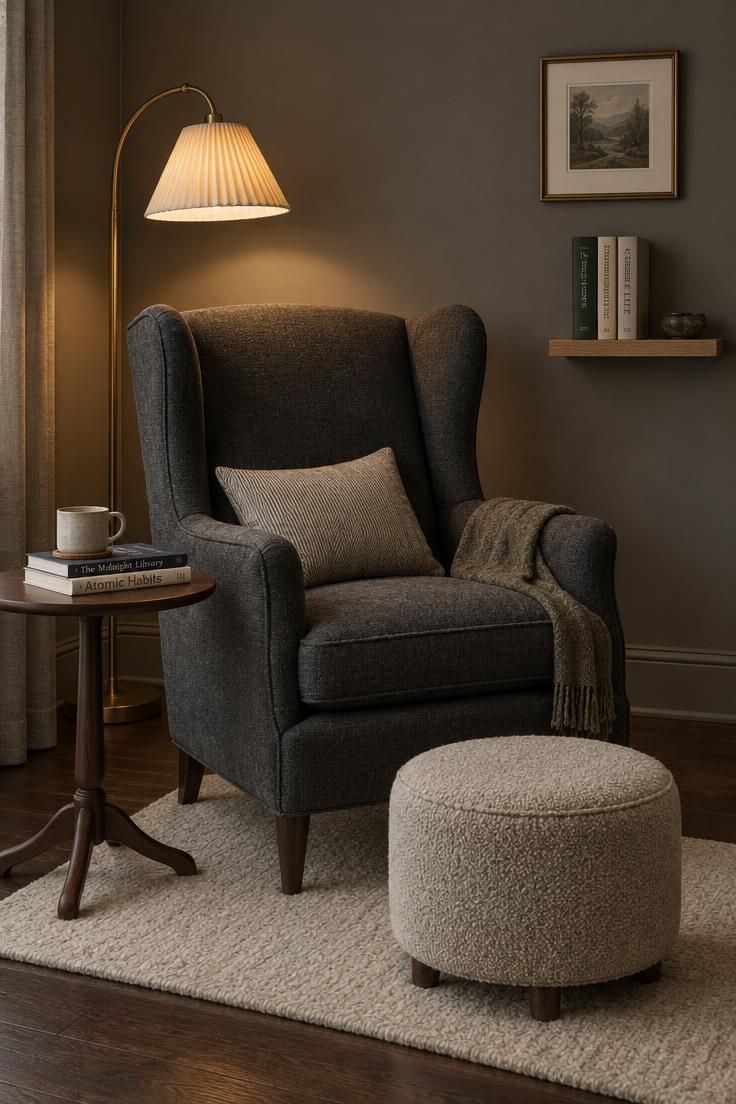
A wingback chair placed in a corner with a side table and a floor lamp creates a reading nook that reads as deliberate rather than leftover.
The high back of the wingback gives visual enclosure even in an open room, which is why it works well in a shared space that also serves as a home office or guest room.
Placing the floor lamp to one side of the chair rather than directly behind it keeps the page lit without glare, and a swing-arm or arc lamp makes that placement easier.
The side table only needs enough room for a mug and a short stack of paperbacks, so a compact round top is the right scale.
A shelf within arm’s reach of the chair is more useful than one above it, since reaching up while seated is awkward and risks knocking things loose.
A winged chair can overpower a small room, so a scaled-down version or an underused corner is the better fit.
Style Blueprint:
- One oversized wingback chair in charcoal gray or deep brown boucle
- A compact round walnut side table for a mug and paperbacks
- A brass floor lamp placed to the side of the chair, not behind
- A narrow floating shelf within arm’s reach, holding three or four books
- A small wool ottoman in front of the chair to soften the footprint
Design Pro-Tip: Add the ottoman in a slightly different texture from the chair so the corner gains depth without gaining furniture.
Conclusion
A retreat reads as classy when the surfaces are edited rather than erased: warm wood, stone, leather, and low layered light doing the work while closed storage keeps the working parts out of view.
Each idea here can stand alone, and most pair well with one or two others from the list.
Start with the piece that matches the room you have, whether that means one accent wall, one seating group, or one bar cabinet, and add only as far as the space still feels relaxed.
The result is a room that works as well for a quiet hour alone as it does for a few friends on a Saturday evening.