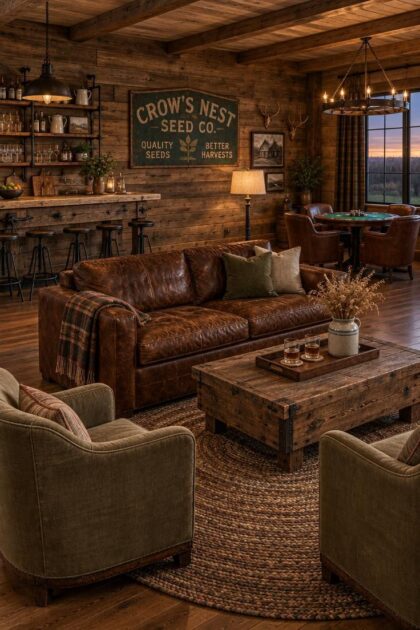
This post may contain affiliate links. If you make a purchase through these links, we may earn a commission at no additional cost to you.
A country man cave takes its cues from worn leather, rough wood, and rural keepsakes rather than sleek finishes or matched furniture sets.
The layouts that work best pick one strong focal point, then build seating, lighting, and storage around it so the room feels lived-in without turning into a cluttered prop room.
What follows focuses on that practical translation of mood into concrete choices: the wall treatment behind the focal point, the shape of the seating group, how a bar is built, which objects go on display, and the way light pools over all of it.
Treat any single idea as a complete starting point, or combine several in a larger room.
The aim is simple: a space that holds up through a long game night with friends.
Reclaimed Plank Wall Behind the Main Lounge
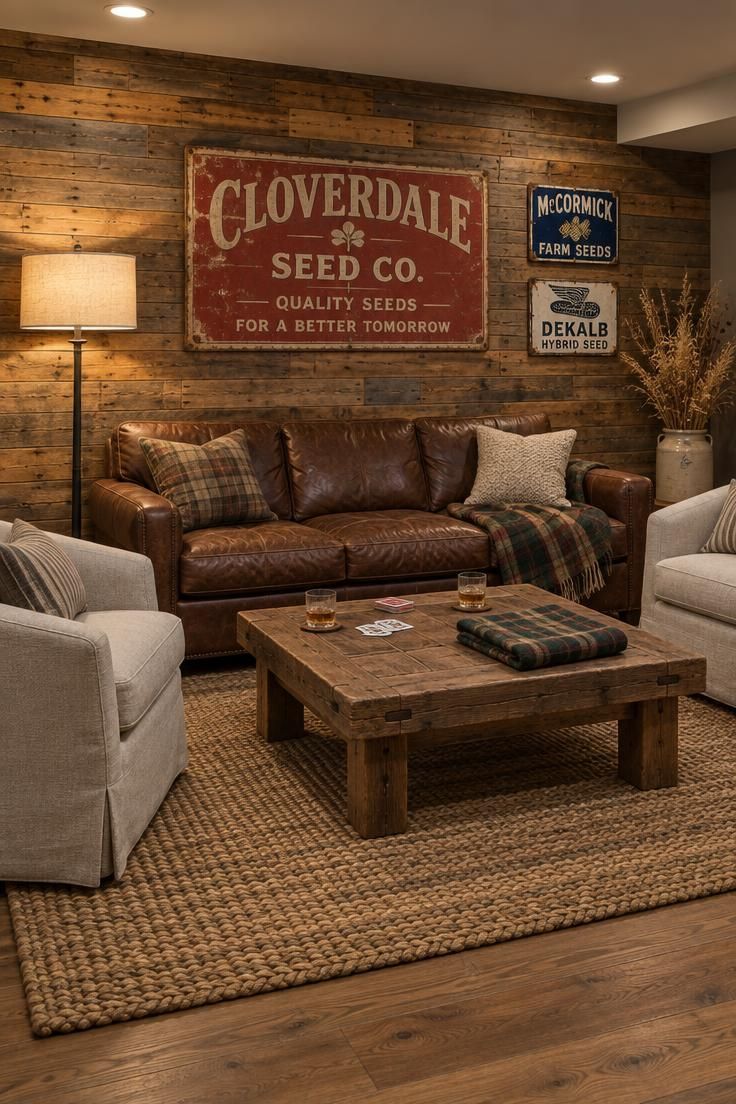
A reclaimed plank wall behind the main seating area gives the room its strongest textural cue and pulls the eye away from clutter.
Wide, varied-toned boards with a matte finish read as old wood rather than new paneling.
Horizontal boards stretch a low-ceilinged den visually, an effect that matters in basements and converted garages where the ceiling sits closer than in the rest of the house.
A single large piece, such as an old crosscut saw or a set of framed seed-company graphics, anchors the wall with more authority than a scatter of small nails.
That edit is where vintage farmhouse signs earn a place: rather than covering every surface, one or two large pieces carry the theme while the plank wall does the rest of the work.
The tradeoff is that a full plank wall in a small room makes the space feel darker.
Leaving the surrounding walls in a warm cream or soft sage keeps the wood from closing in, and stained boards in lighter honey or gray tones behave better in tight rooms than near-black stains.
When only one wall receives wood, the seating arrangement becomes easier to balance around it: the sofa or chairs can center on that wall, and the remaining walls stay calm enough to hold lamps, shelves, and a screen without competing.
Plan the wall composition first, since it determines where outlets, art, and the main seating axis land.
Style Blueprint:
- Reclaimed or reclaimed-look wide-plank boards in mixed brown, honey, and gray tones, matte finish, installed horizontally
- One oversized rural object or sign as the wall's single anchor, with one or two smaller pieces supporting it
- Surrounding walls in warm cream or soft sage to keep the room from darkening
- A braided jute or wool rug to define the lounge zone on the wood floor
Bar Built from a Repurposed Workbench
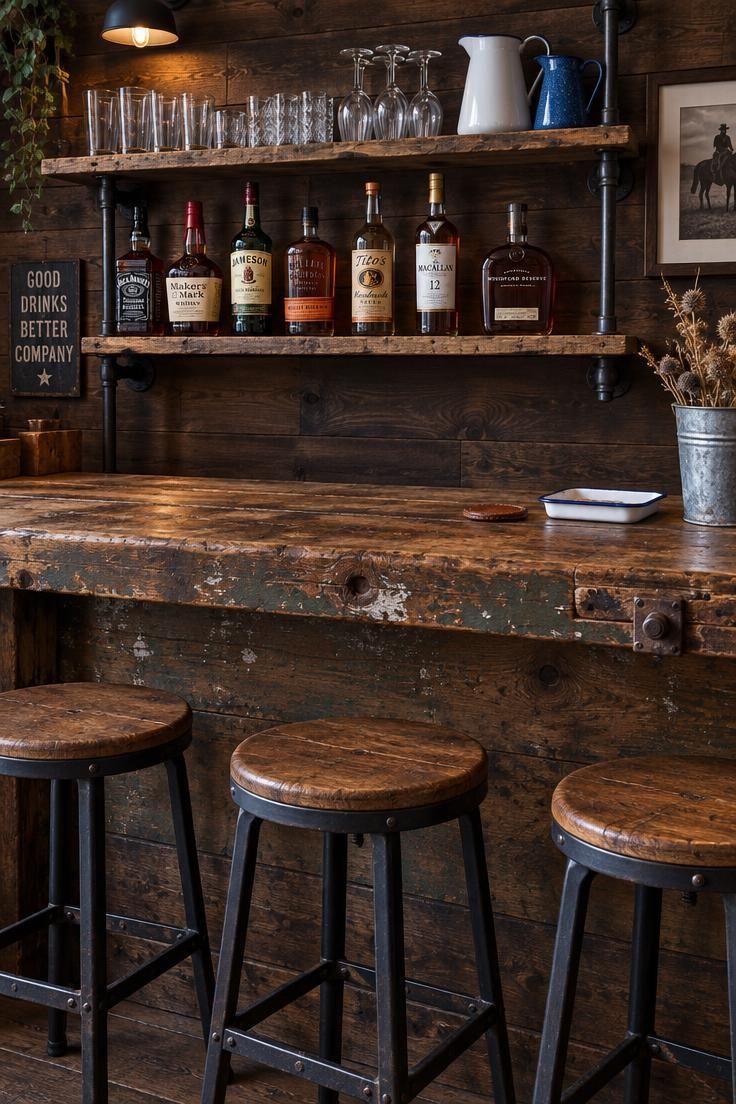
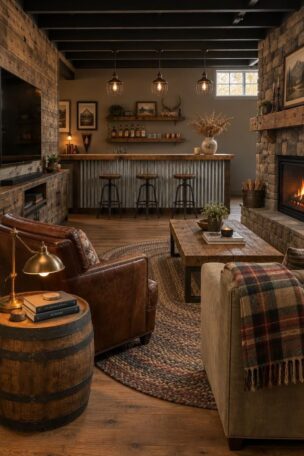
A bar built from a repurposed workbench or heavy farm table gives guests a natural place to gather without stealing attention from the main seating.
Look for a piece with visible saw marks, chipped paint, or a stained top, and keep the front simple so the wood remains the main event.
A reclaimed wood bar of this kind works because the wear is genuine rather than applied, and the counter height lands where people naturally lean while watching a game.
Blackened-iron stools contrast with the wood and keep the seating light enough to move when the floor needs clearing.
Open shelving above the bar works best when it stays sparse.
A few enamelware pitchers and one orderly row of bottles read as intentional, while a full liquor-store display turns the wall busy.
Closed lower cabinets behind the bar handle the overflow, which keeps the visible composition clean.
Dust is the main limitation: open shelves and rough wood need more frequent wiping than a sealed cabinet, and bottles left out collect film over time.
The rugged, useful look is the payoff, and it is something a polished bar top cannot provide.
Style Blueprint:
- A workbench, farm table, or repurposed cabinet with genuine wear as the bar base
- Black iron or dark metal stools with wood seats, kept to a count the counter can seat comfortably
- Two open shelves in pipe-and-plank or simple wood brackets, styled with glassware, enamelware, and a short row of bottles
- A galvanized or enamel tray to corral small items and make wiping down easier
Leather Club Chairs Around a Felt-Lined Game Table
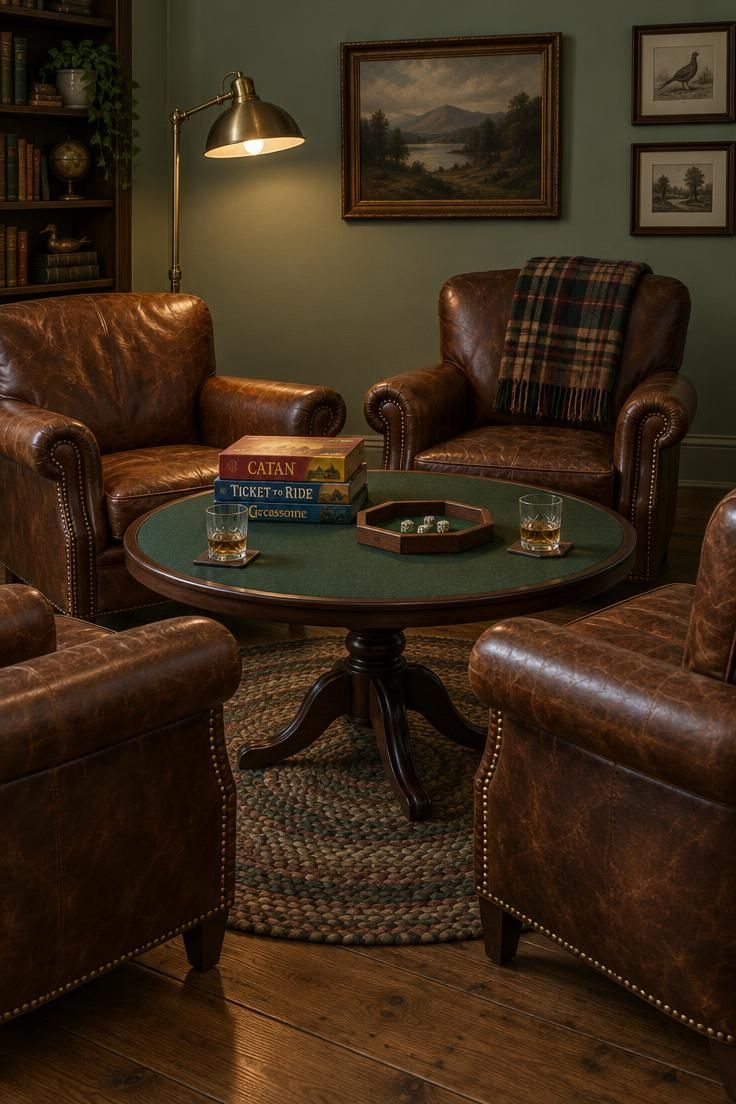
Leather club chairs in worn brown or deep oxblood create a comfortable, conversation-focused cluster around a small square or round game table.
Chairs with rolled arms and brass nailhead trim suit a room that leans rustic, while simpler leather-and-wood frames fit a more utilitarian scheme.
The table should feel heavy enough to hold drinks and cards without wobbling, and a felt or canvas top softens the sound of glasses and dominoes landing.
This arrangement works best in a corner away from the main traffic path, so nobody has to walk behind the chairs to reach the bar.
Four chairs is the practical ceiling for an intimate game cluster.
A fifth chair turns the circle into a row and pushes the table into a larger footprint than most dens can spare.
Where there is no room for a coffee table, a low side table holds a lamp, remotes, or a drink within reach of two seats.
Keep the table surface clear between game nights so the cluster stays easy to reset.
Style Blueprint:
- Four or fewer leather club chairs in worn brown or oxblood, mixed with one non-matching chair if the room can take it
- A heavy round or square game table with a felt or canvas top in dark green, charcoal, or tan
- One warm floor lamp with a fabric shade positioned behind the seating rather than overhead
- A small braided rug under the table to mark the game zone
Design Pro-Tip: Set the game table on a rug that extends at least a chair's depth beyond the table edge, so players can pull seats back without catching a leg on the floor transition.
Vintage Farmhouse Signs as a Single Gallery Wall
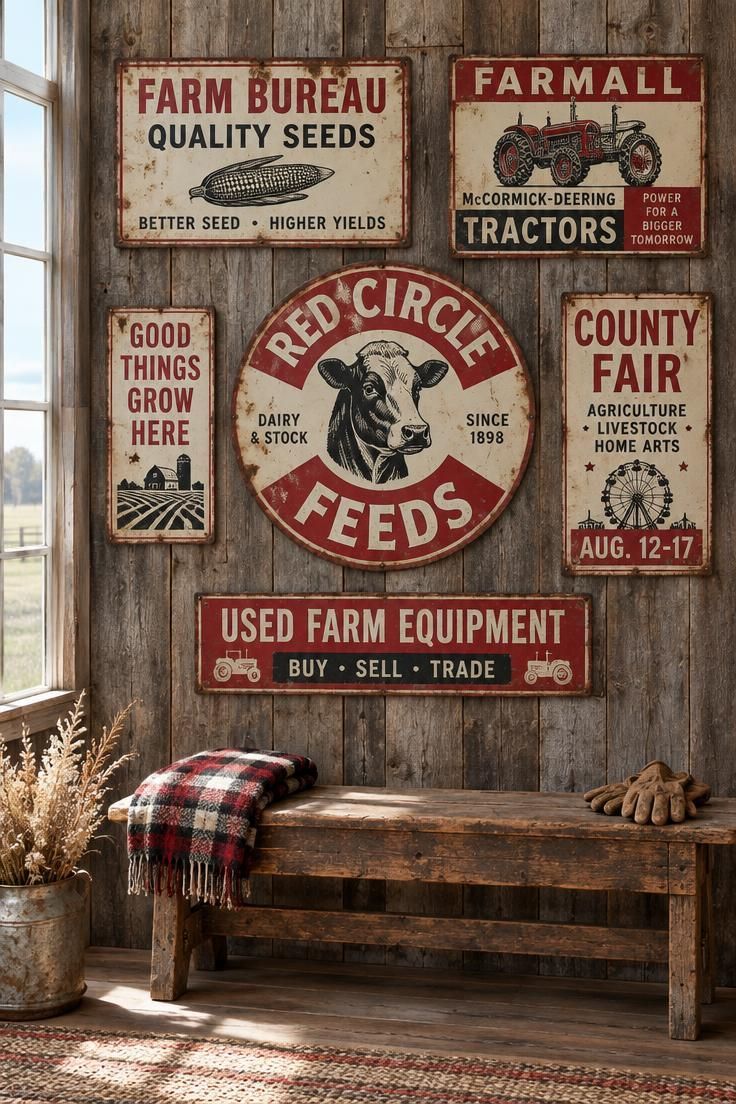
Vintage farmhouse signs work best grouped into one deliberate gallery rather than scattered around the room.
Choose signs with faded paint, chipped edges, and simple typography: feed brands, county fairs, tractor companies.
Keep the accent colors to three or four tones so the grouping holds together.
Spacing matters more than symmetry here.
Use the largest sign as the anchor and let smaller pieces radiate outward with roughly equal gaps, allowing the rustic barn wood accent wall to show through between them.
The visible wall is what keeps the composition from becoming a collector's display case.
Hang smaller signs away from door swings and high-traffic paths so they do not get bumped, and reserve the tightest clustering for a wall that is not walked past closely every day.
The same grouping translates well above a low cabinet or behind a poker table, where the signs sit at a comfortable viewing height from a seated position.
Signs vary widely in weight and condition, so treat each one as an individual piece when planning the arrangement rather than assuming a uniform set.
Style Blueprint:
- One large anchor sign, ideally round or boldly shaped, at the center of the grouping
- Three to five smaller signs in a tight three-tone palette of faded red, cream, and black
- A barn wood or painted plank wall left visible between pieces
- A low bench or cabinet beneath the grouping to ground it and add function
Layered Lighting for Game Night Brightness and Low Glow
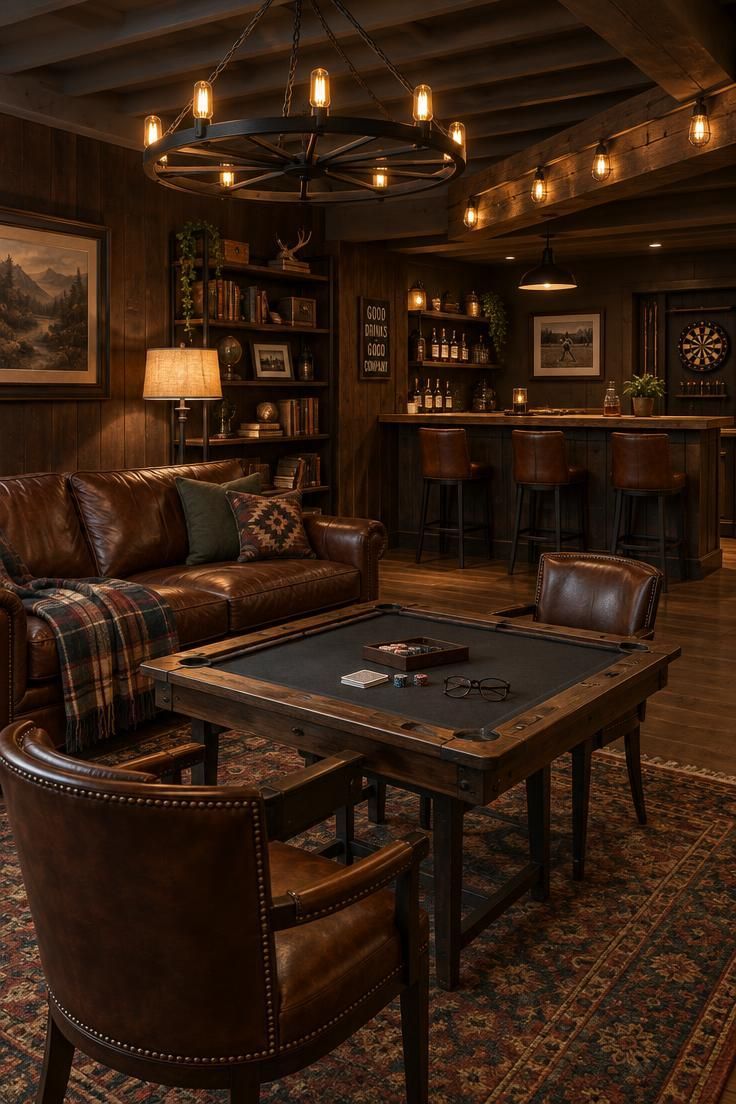
Layered lighting moves the room from casual afternoon hangout to late-night poker den without shifting a single piece of furniture.
Start with an overhead fixture, such as a wagon-wheel chandelier or a black iron cage light, and keep its bulbs warm and dimmable so the ceiling glow does not flatten everything below.
Add one or two floor lamps near the seating group for reading cards and score sheets, using fabric shades that pool light low rather than spraying it across the room.
Small table lamps on the bar or a sideboard provide background light for guests moving between zones.
This is the reasoning behind layered lighting for country interiors: each layer handles a different job, and no single bright source has to do all of them.
A string of heavy-duty lights along a ceiling beam adds a quiet glow near a cooler or bar without lighting the whole space.
Dark walls and leather absorb a great deal of light, so a room like this often needs more fixtures than a pale modern space of the same size.
Dimmers are the practical control point.
They let the same fixtures carry both a bright game-night setting and a low evening glow, and they cost far less than adding fixtures later.
Style Blueprint:
- One dimmable overhead fixture in black iron, wagon-wheel, or cage style with warm bulbs
- One or two floor lamps with fabric shades positioned at the seating group
- A pendant over the bar and one or two small table lamps for background light
- A string of heavy-duty lights along a beam or shelf underside for a low accent glow
Galvanized Metal Counter on a Tubular Steel Frame
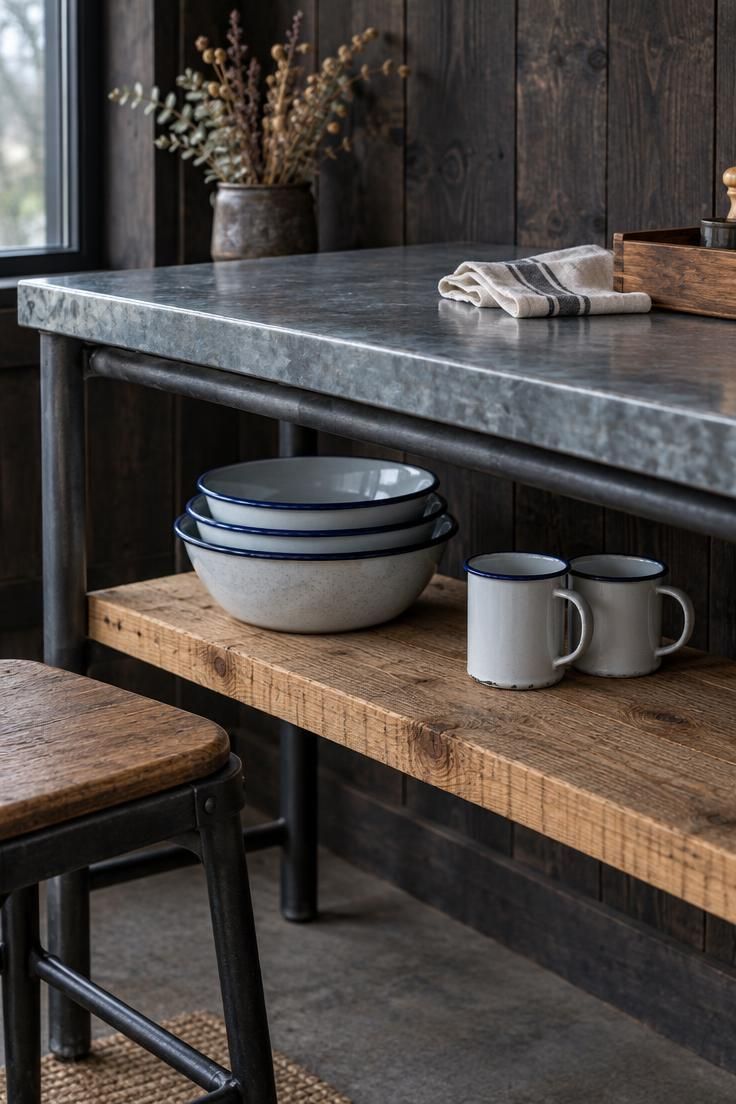
A counter with a galvanized metal top and a tubular steel frame gives the room a workshop-inspired country character that wood alone cannot match.
The smooth metal surface wipes down easily after a night of spills, and it catches light from nearby lamps without turning glossy.
Keep the base simple: dark steel legs and a lower shelf made from a single plank, so the piece reads as functional rather than as a design statement.
Pairing the metal with wooden stools softens the cool tone and repeats the room's warm browns.
The main limitation is noise.
Metal tops ring when a glass is set down hard, so this piece works better against a wall or in a corner where the sound is contained.
Metal also shows water spots and fingerprints more than wood, which is a fair trade for the easy cleanup if the counter sees heavy use.
Measure the depth against the stool row before committing: a deep counter pushes seats into the walking path, while a shallow one leaves no room for a plate and a glass together.
Style Blueprint:
- A galvanized or brushed steel top with a visible edge and slightly softened patina
- A tubular steel base in oiled dark gray or blackened finish
- One rough-sawn plank shelf below for enamelware, bowls, and mugs
- Wooden stools rather than metal ones to warm the composition
Canvas and Plaid Textiles in a Reading Nook
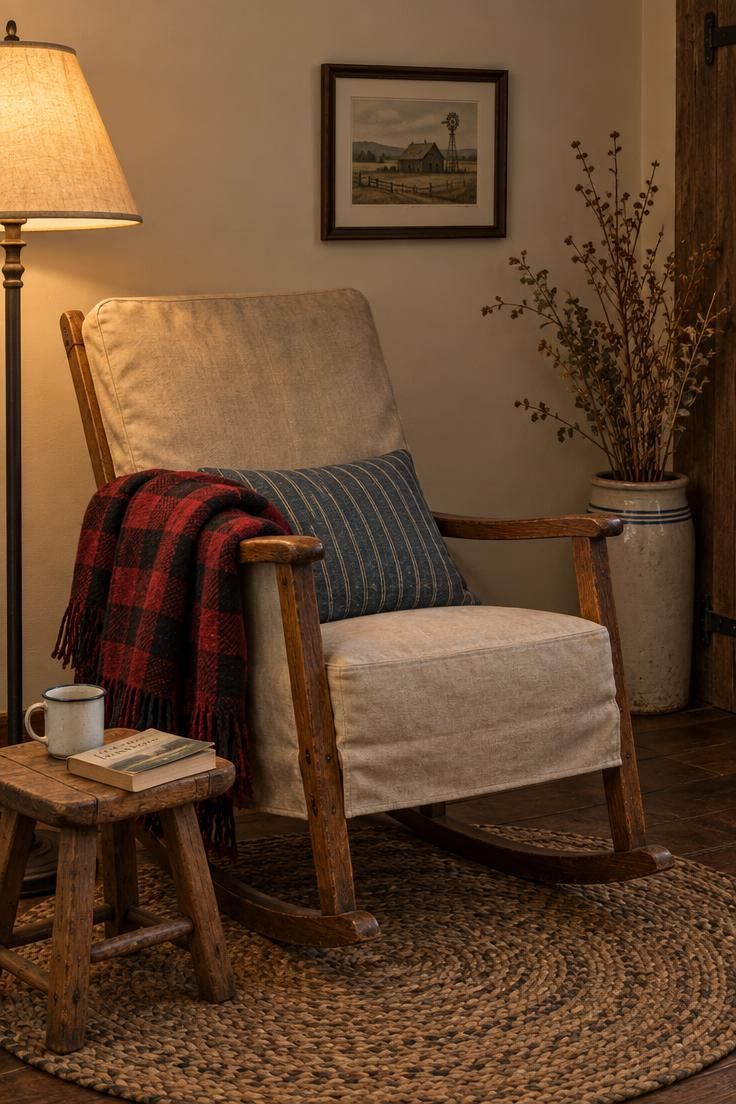
A small reading nook or corner chair can carry the country look through layered textiles without demanding more wall space or another furniture piece.
Choose a deep armchair or an old wooden rocker, then add a canvas slipcover, a wool plaid throw, and a striped or ticking cushion to soften the seat.
A braided or jute rug under the chair separates the nook from a nearby bar or game area and catches the occasional spill.
Keep the palette to two or three repeated tones: oatmeal canvas, deep red plaid, a faded indigo stripe.
Repetition makes the fabrics look collected rather than clashing.
Canvas and wool need more attention than synthetic blankets.
Wool sheds and holds dust, and canvas slipcovers show marks between washes, so a nook near direct heat or a busy walking path is the wrong spot for either.
A position slightly off the main circulation route keeps the textiles cleaner and makes the corner feel like a destination rather than a passage.
If the chair doubles as overflow seating on game night, choose a slipcover that can be removed and washed rather than a fixed upholstery job.
Style Blueprint:
- A deep armchair or wooden rocker with a removable canvas slipcover
- One wool plaid throw in red, black, or green, folded rather than draped flat
- A ticking or striped cushion for contrast on the seat
- A small braided jute or wool rug to define the nook
- A warm floor lamp with a parchment or linen shade placed at the chair's side
Design Pro-Tip: Fold wool throws lengthwise over one arm rather than spreading them across the back, so the plaid pattern reads as a deliberate accent and the chair keeps its shape between uses.
Stone or Slate Surround for a Freestanding Stove
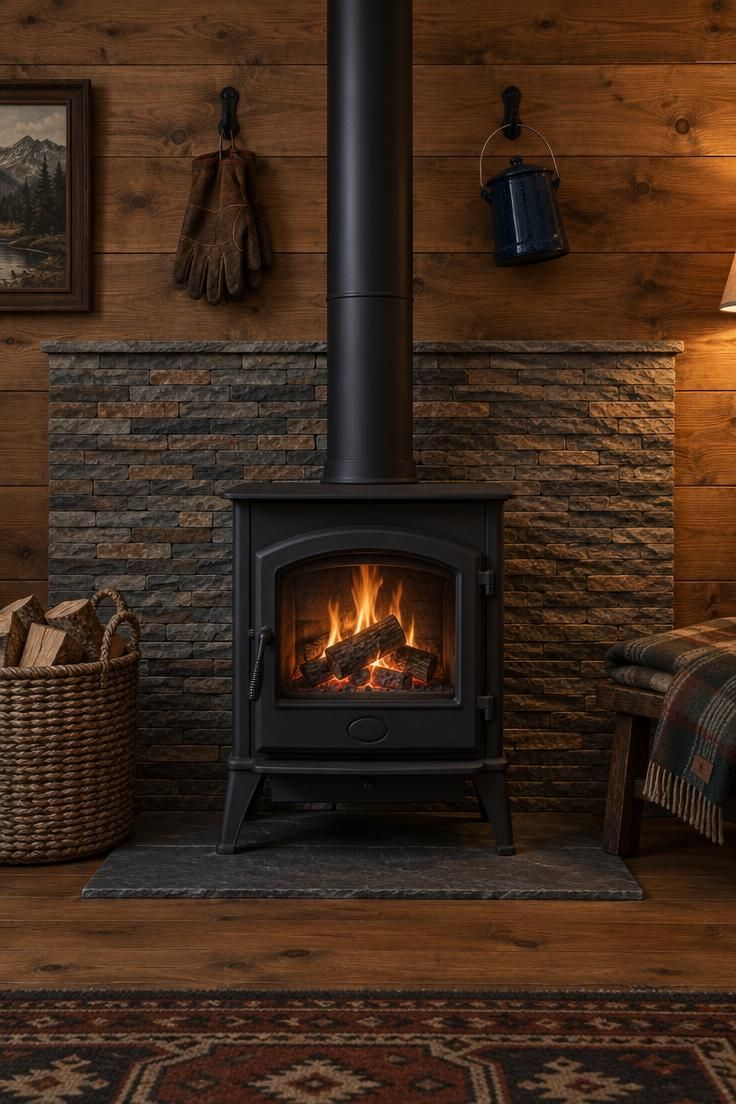
A freestanding stove or wall-mounted fire feature can anchor a country man cave, and the stone or slate surround gives it the weight that a bare unit lacks.
Stacked slate in gray and brown tones offers a quieter texture than ledge stone and pairs well with wide-plank wood walls.
Keep the surround low and wide rather than tall and narrow, so the stove reads as part of the wall instead of an appliance parked in front of it.
A broad, low band of stone also leaves wall space above for hooks, a small shelf, or a single framed piece.
One or two black iron hooks above the surround hold a small pot or a pair of leather gloves, reinforcing the utilitarian character of the wall.
Stone and slate need regular dusting, especially near the hearth, and the material should be chosen for its coloration as much as its texture since slate varies considerably between lots.
Any stove, flue, hearth, and clearance decisions belong to a separate technical project with local requirements and qualified trades, not to the decorative planning covered here.
Style Blueprint:
- A low, wide surround in stacked slate or stone in mixed gray and brown tones
- A wide-plank or barn board wall behind, left visible above the surround
- One or two black iron hooks above the stone for gloves, a pot, or a small tool
- A woven log basket and a folded wool blanket to soften the hearth zone
Wagon Wheel Shelf and Rail Storage for Hats and Gear
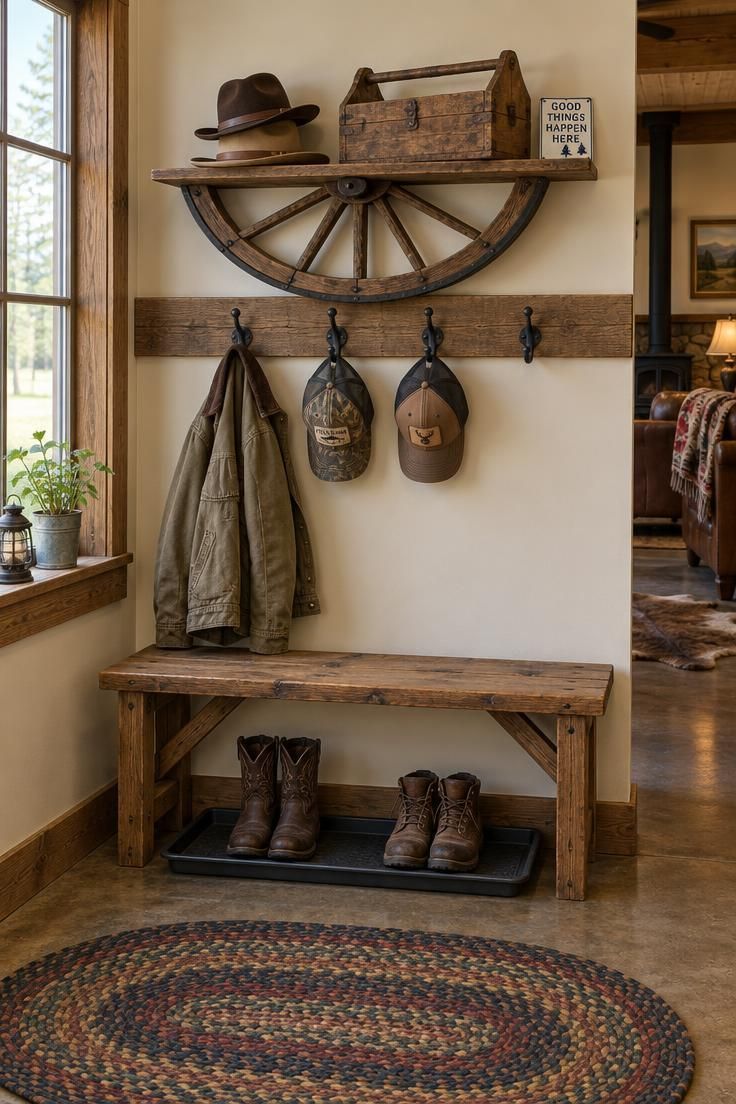
A shelf built from a halved wagon wheel or a pair of wooden rails gives the room a place for hats, jackets, and small gear without sacrificing the country look.
A deep shelf above a coat rack or bench holds more than it appears to, especially when paired with wooden pegs or antique hooks along its underside.
Style the shelf with objects that look good from below: enamelware pitchers, stacked felt hats, an old wooden toolbox.
Keep the hooks below for daily items such as caps and jackets.
This setup works particularly well near the entry when the man cave opens onto a mudroom or garage, where a braided rug and a boot tray complete the zone.
The limitation is visual.
Without editing, the shelf becomes a catch-all, so one or two closed baskets hide smaller clutter and keep the display readable.
Rotate the shelf contents seasonally rather than adding more hooks, since the wall reads best with a small, deliberate set of objects.
Style Blueprint:
- A halved wagon wheel or paired wooden rails used as a single deep shelf
- Black iron hooks or wooden pegs beneath for daily-use items
- A bench with a boot tray to complete the entry zone
- One or two closed baskets to contain clutter without hiding the display
- A braided oval rug to mark the drop zone
Blackened Iron and Glass Lantern Pendants
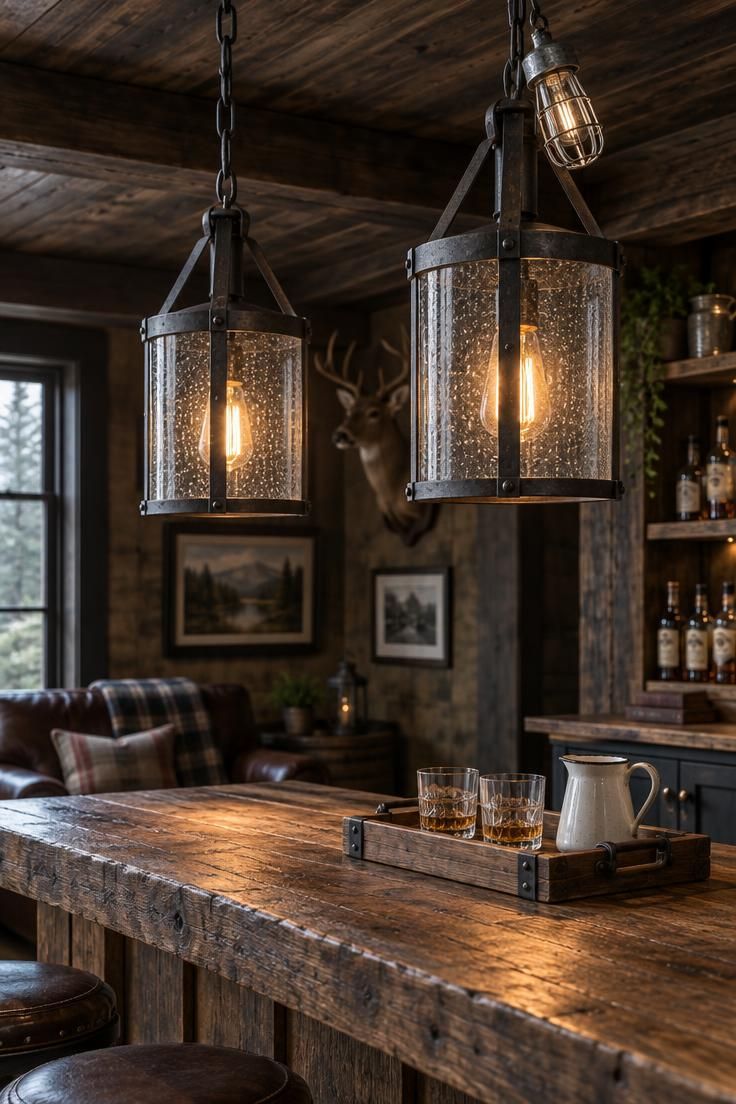
Pendant lights made from blackened iron and seeded glass bring a barn-lantern look to specific zones without overwhelming the rest of the lighting plan.
Hang one low over the bar counter to define that area, and a second over the game table to keep cards and chips visible.
Seeded or ribbed glass softens the bulb and keeps the light from turning harsh, which matters in a room otherwise lit by table lamps.
Choose pendants with exposed metal straps and a simple shape rather than decorated versions, so they read as old barn fixtures instead of theme decor.
Black fixtures disappear against dark wood ceilings, so a small piece of light-colored metal, such as a galvanized bulb cage or a painted beam above, helps them stand out.
Seeded glass collects dust and drips from cooking or drinks nearby, so plan on wiping the shades every few weeks to keep the light even.
Two pendants usually read better than three over a home bar.
A third fixture crowds the counter and flattens the pools of light that make the zone feel separate.
Style Blueprint:
- Two matching lantern pendants in blackened iron with simple strap details
- Seeded or ribbed glass shades to soften the bulb
- Warm bulbs on a dimmer so the bar can go bright or low
- One light-metal accent, such as a galvanized cage, to keep the fixtures visible against dark wood
Design Pro-Tip: Hang bar pendants so their lowest point sits just above eye level for someone standing at the counter, which keeps faces lit and sightlines open across the room.
Pegboard and Wooden Crate Storage for Board Games
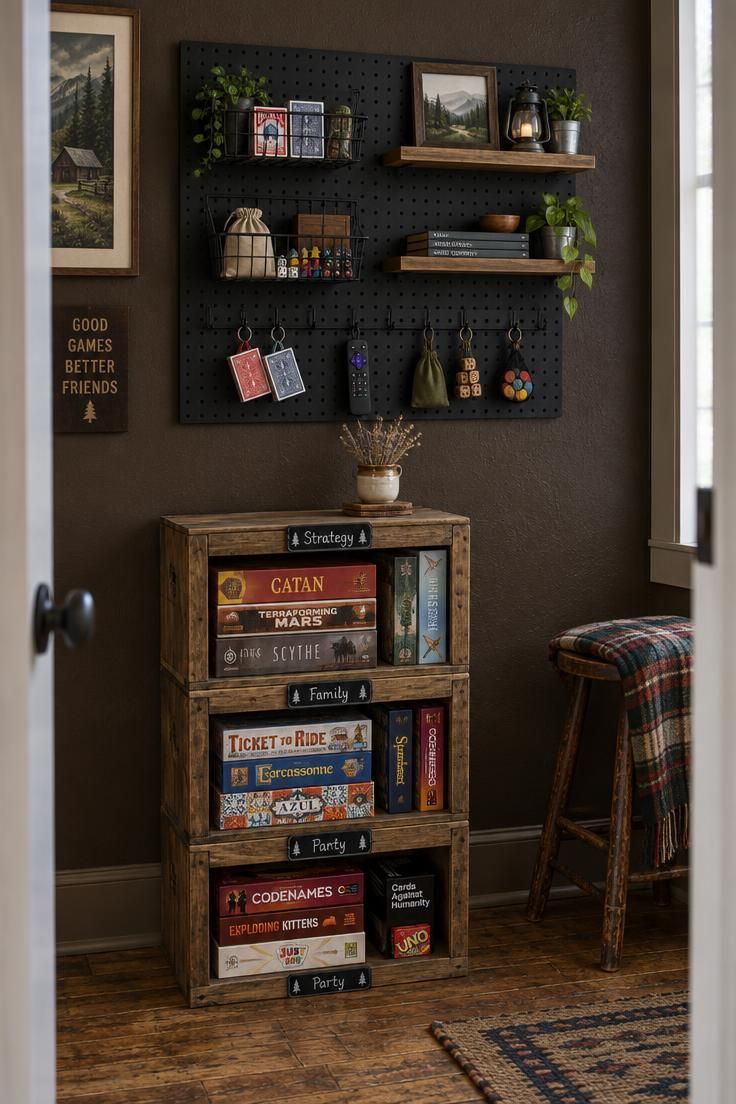
Pegboard and wooden crates give game-night equipment a dedicated home without hiding every piece away or turning the room into a storage closet.
Paint the pegboard a dark brown or black to match the walls, then hang wire baskets, small shelves, and hooks for cards, remotes, and loose pieces.
Below, stack two or three sturdy wooden crates on their sides so the open tops face the room and can hold larger boxes or rolled game mats.
Stenciled letters or chalkboard tags help when the collection grows, though keeping labels minimal stops the wall from reading like a to-do list.
Open storage draws the eye, so this setup works best on a side wall away from the main focal point.
It also needs occasional sorting, since a crate that stays neat on day one will not stay that way after a few game nights.
A quick monthly pass to pull out broken boxes and missing pieces keeps the display looking intentional rather than accumulated.
One advantage of crates over a closed cabinet: guests can see what is available and grab a game without asking, which keeps the room in use instead of staged.
Style Blueprint:
- A pegboard panel painted to match the wall, in black or dark brown
- Wire baskets and two small shelves for cards, remotes, and small pieces
- Three wooden crates stacked on their sides with open tops facing the room
- Small chalkboard tags or stenciled labels kept minimal and uniform
Conclusion
A country man cave comes together through sequence rather than a single showpiece.
One rough material leads to the next: a reclaimed plank wall sets the tone, a workbench bar gathers the group, a wagon-wheel shelf keeps everyday gear close without hiding it.
The practical choices carry the room through a long game night.
Extra lighting layers keep cards readable after dark.
Easy-to-clean counters survive spilled drinks.
Enough closed and labeled storage keeps the space from becoming a display museum.
Start with the focal point, build the seating around it, and let the rest of the room support the same worn-in, unhurried mood.