This post may contain affiliate links. If you make a booking or purchase through these links, we may earn a commission at no additional cost to you.
A guitar room starts with the instruments, then builds everything else around them.
Wood, leather, and warm lamplight give the space a settled feel that makes playing at home easy to sink into.
The best rooms balance display with daily use, so guitars stay within reach instead of becoming wall decoration.
That balance shapes every choice below, from how instruments hang to where the amp sits.
Hang a Warm Wood Slat Wall for Acoustics and Display
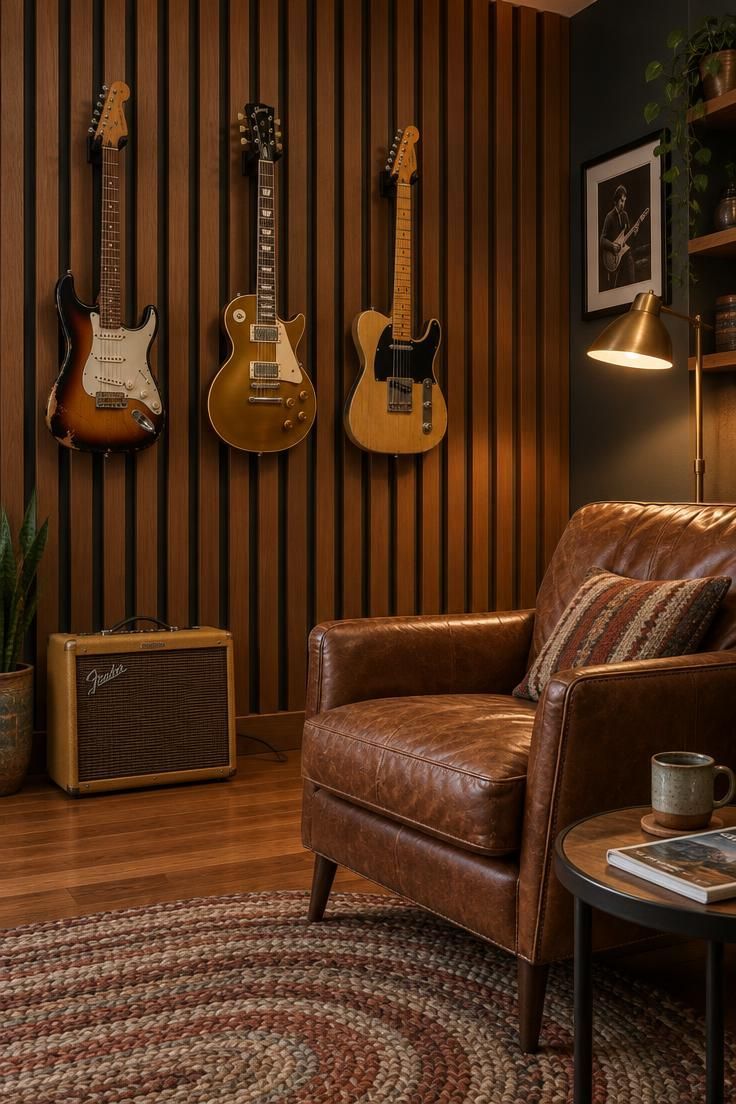
Vertical wood slats in a medium brown tone add texture behind hanging guitars without competing with the instruments themselves.
Spacing the slats a finger-width apart lets the dark painted wall show through, which gives the surface visible depth instead of reading as a solid panel.
Two or three electric guitars mounted in a row at seated-eye height sit comfortably inside the grid the slats create.
Each instrument reads as a framed piece rather than a tool left on a wall.
A slat wall of this kind can soften some of the room's echo, and in a man cave guitar room it works best when one or two rugs are added elsewhere to absorb more reflection.
Design Pro-Tip: Choose a slat color within two shades of the guitar bodies so the instruments still read as the focal point instead of blending into the wall.
Style Blueprint:
- Vertical wood slats in a medium brown tone with dark paint showing between them
- Three electric guitars hung in a single aligned row at seated-eye height
- A worn leather armchair angled toward the display
- A small tweed amp on the floor and a braided wool rug in muted rust and cream
Use a Floating Shelf with Fretboard Bookends for a Hero Guitar
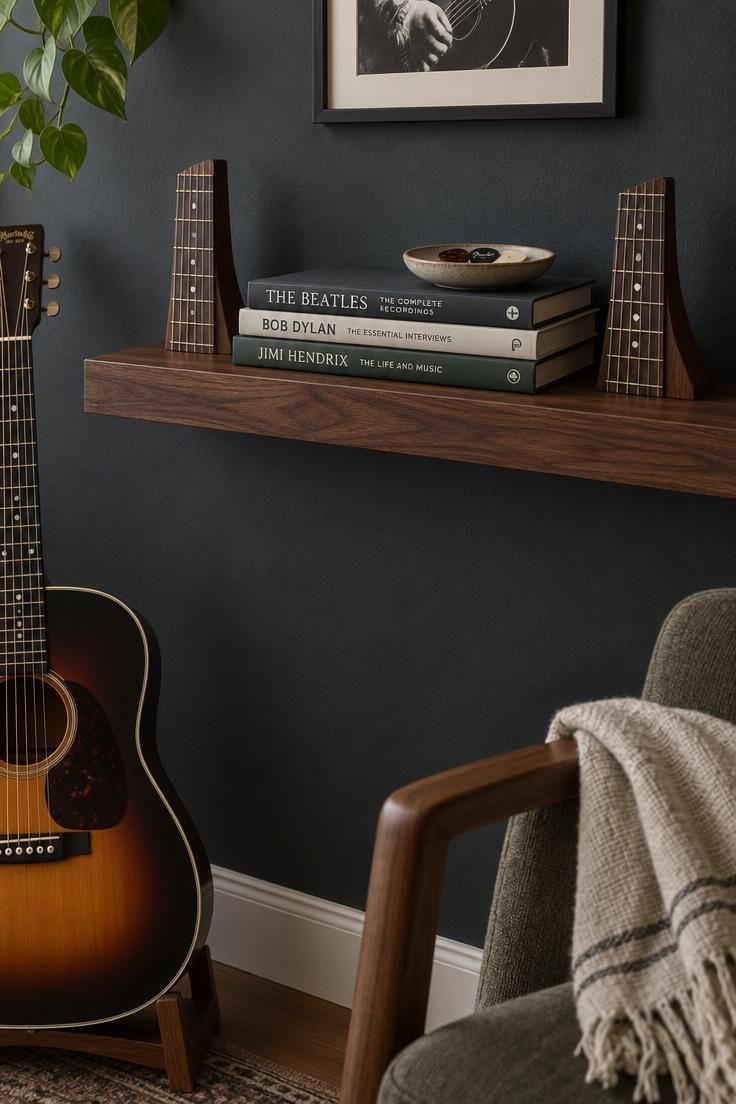
A floating shelf finished in black walnut gives a single guitar a gallery-like presentation without asking the wall to carry a row of hooks.
Setting one acoustic guitar on a low stand in front of the shelf, rather than on it, lets the instrument lean slightly and catch light along its curves.
Two bookends shaped like oversized fretboards anchor the shelf ends and echo the instrument's own geometry.
Keeping the shelf otherwise limited to a small stack of music books and a ceramic dish for picks prevents the arrangement from turning into clutter.
This approach suits a room where one guitar deserves attention and the rest can stay cased.
The tradeoff is dust: an instrument left out on a stand needs regular attention, so the setup works best when that guitar is played often enough to stay clean.
Style Blueprint:
- A black walnut floating shelf on a deep charcoal wall
- Fretboard-shaped bookends at each end of the shelf
- One acoustic guitar on a low stand in front of the shelf, not on it
- A short stack of music books and a shallow ceramic pick dish as the only shelf objects
- A linen throw nearby to soften the wood and metal
Build a Compact Corner Nook with a Fold-Down Seat
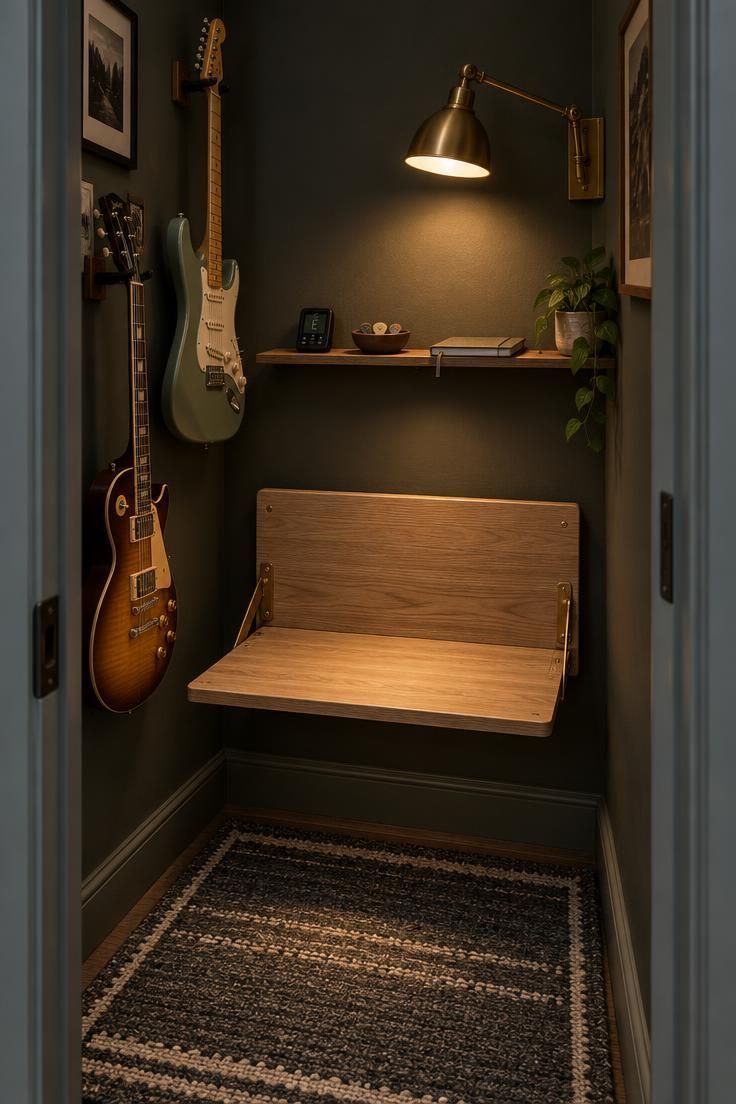
An unused corner can hold a small guitar room layout that folds away when the space needs to serve another purpose.
A fold-down wooden bench on one wall keeps the floor clear, while two guitars hung vertically on the adjacent wall stay at arm's reach during practice.
A wall-mounted swing-arm lamp positioned over the seat provides task light that can be aimed at a fretboard or a notebook.
At shoulder height, a narrow wall shelf holds a tuner, picks, and a small notebook without crowding the bench below.
This setup suits one or two players at most, and it works best for shorter practice sessions rather than long evenings.
Players who stand while playing will find the bench less useful, and the narrow footprint leaves little room for a floor stand or a second chair.
Style Blueprint:
- A light wood fold-down bench mounted on one wall
- Two electric guitars hung vertically on the adjacent wall at staggered heights
- A brass swing-arm lamp aimed over the seat
- A narrow shoulder-height shelf for a tuner, picks, and a notebook
- A low pile rug in charcoal and cream to define the zone
Stack Tweed Amps Under a Low Console and Rotate Guitars
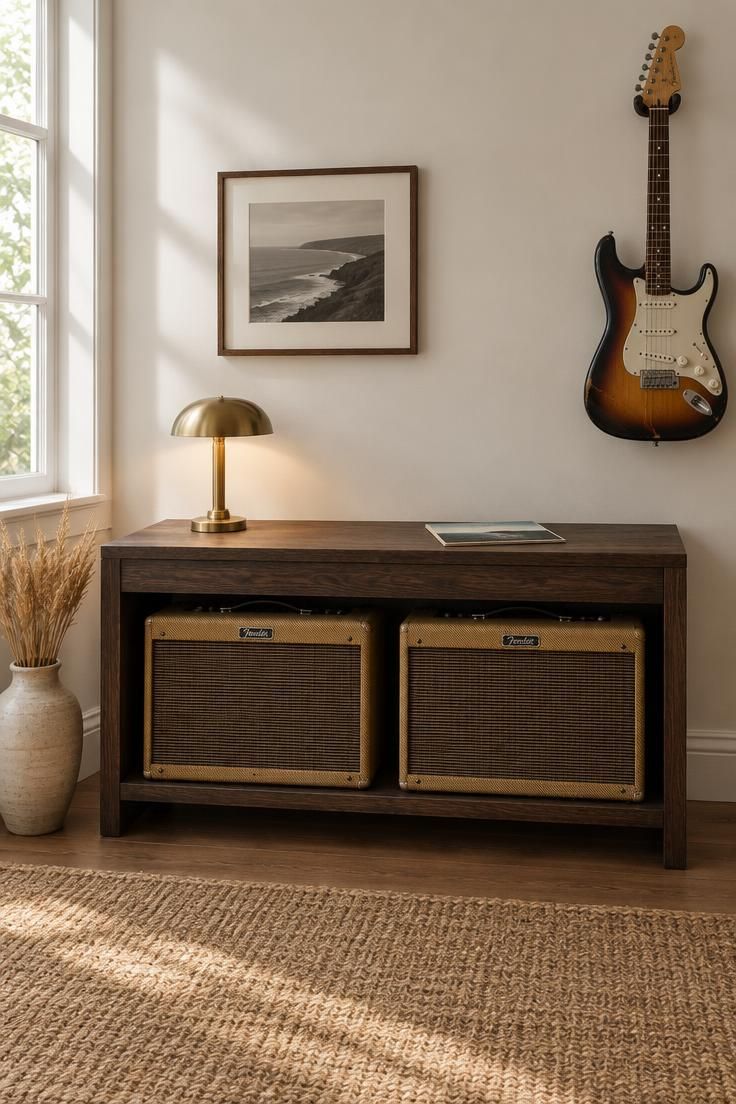
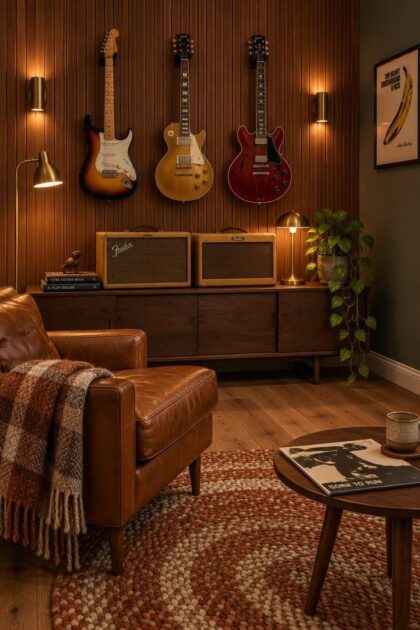
A low, wide console in dark stained oak can anchor a wall and give vintage guitar room decor a calm center.
Placing two tweed amplifiers side by side under the console, with their top edges just below the shelf above, keeps the mass of the gear low and orderly.
The console top stays mostly clear except for a small lamp and a record sleeve, which lets the wood and the amp grille cloth carry the visual interest.
Moving one or two guitars from a floor rack onto wall hangers near the console each week changes the display without adding permanent wall clutter.
Keeping the amps off the floor on the console's lower shelf also makes vacuuming easier and reduces the chance of accidental kicks.
The rotation habit only works if hangers are already in place and the guitars being swapped are roughly similar in size, since a large acoustic can overwhelm a spot sized for a solid-body electric.
Style Blueprint:
- A low, wide console in dark stained oak
- Two tweed amplifiers on the lower shelf, tops just below the shelf above
- A small brass lamp and a single record sleeve as the only console-top objects
- One electric guitar on a wall hanger to the right
- A natural jute rug to warm the floor
Create a Padded Practice Wall with Hanging Tapestry and Floor Cushions
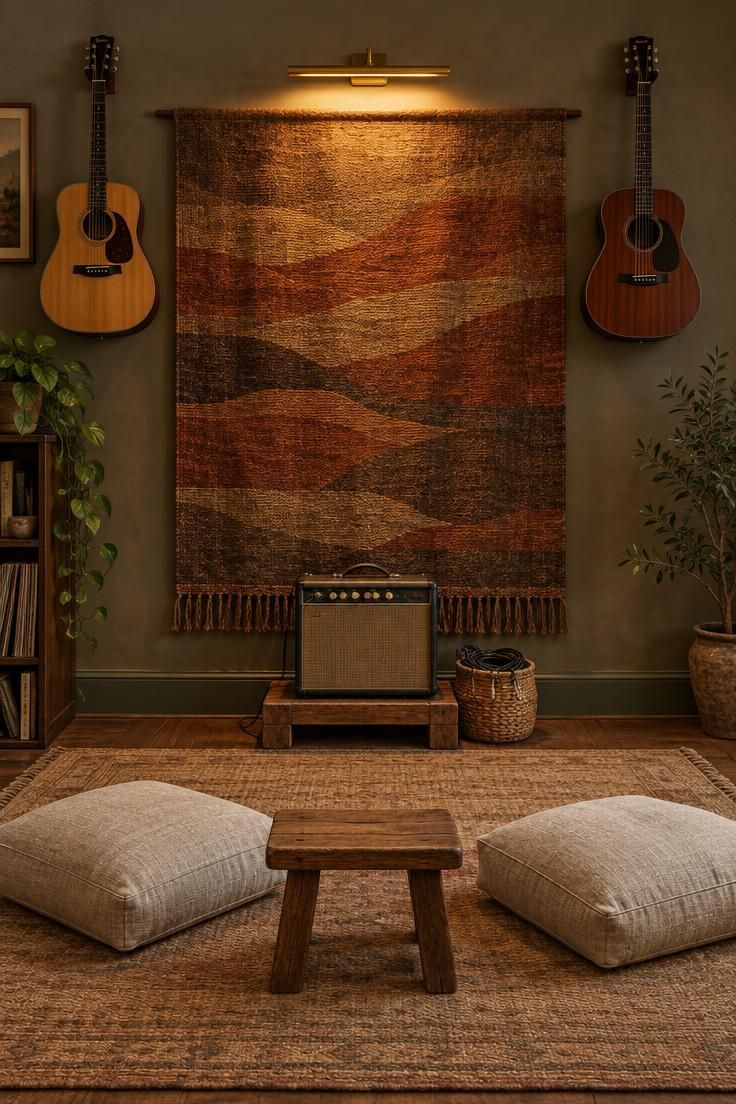
A wall behind the primary practice seat padded with a large woven wall hanging gives the eye a rest from wood and metal surfaces.
Two floor cushions in oatmeal linen and a low wooden stool face a small tube amp on a riser, creating a seated guitar practice corner setup with a low profile.
Two acoustic guitars hung high on the padded wall keep the instruments visible without crowding the seating, and an oversized woven piece softens room sound in a space with hard floors and few upholstered pieces.
Hanging a heavy wall hanging may require sturdy hooks rated for the weight, and a piece that large is not a quick swap once installed.
The arrangement favors seated practice rather than standing, so players who prefer to stand should keep the stool optional and leave floor space open.
Style Blueprint:
- A large woven wall hanging in muted rust and brown covering the practice wall
- Two acoustic guitars hung high above the textile
- Two linen floor cushions and a low wooden stool facing the amp
- A small tube amp on a low wooden riser
- A brass picture light washing warm light across the weave
Arrange a Rack of Worn Road Cases as an Amp Stand and End Table
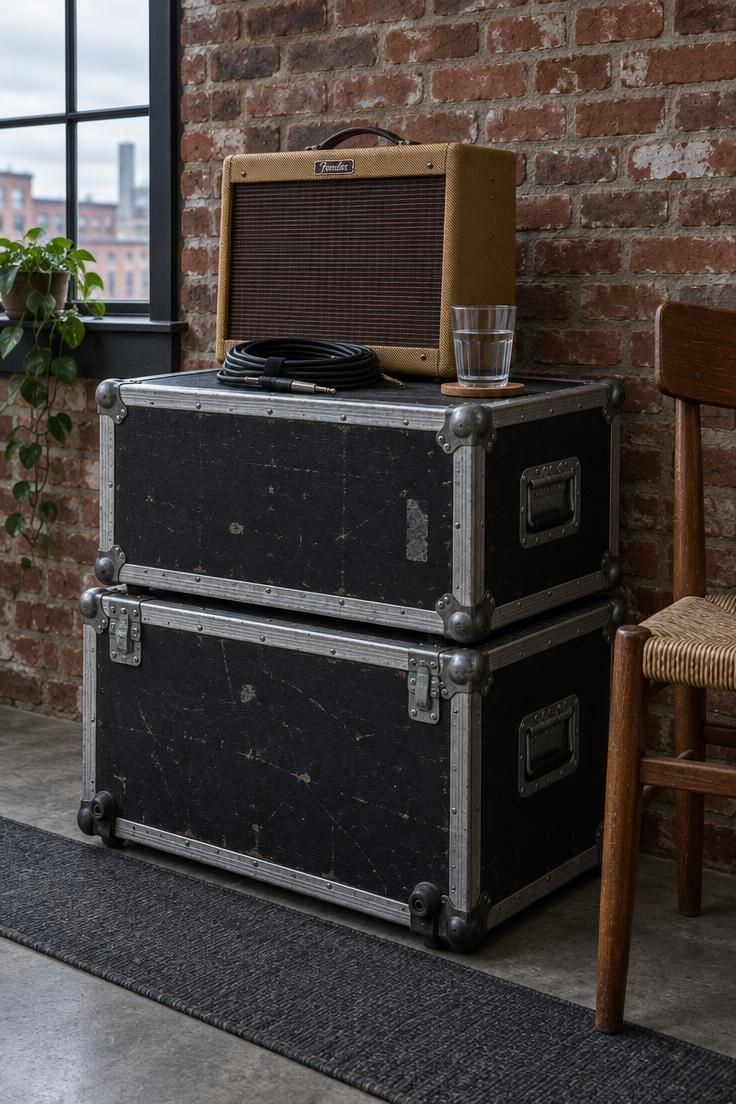
Two stacked vintage-style road cases with metal corners and rubber feet can serve as an amp stand in one corner of the room.
A small amplifier on top of the stack sits at a useful height, and the cases beneath give the industrial look real weight.
Beside the stack, a single sturdy wooden chair with a woven seat provides a place to sit without competing for attention.
The top of the road case stays clear except for a coiled cable and a small water glass on a cork coaster, which keeps the arrangement looking deliberate.
These amplifier display stand ideas also add hidden storage, since one case can hold cables and accessories out of sight.
A stack like this should feel stable when bumped, so the cases need to be heavy or weighted down, and a light empty case on top of a light empty case is not a good pairing.
Style Blueprint:
- Two stacked black road cases with metal corners and rubber feet
- A small tweed amp on top of the stack
- A coiled cable and a cork coaster with a glass as the only surface objects
- A single sturdy wooden chair with a woven seat beside the stack
- A thin charcoal runner rug over a concrete floor
Hang a Grid of Black Metal Wall Hooks for a Mix of Guitar Types
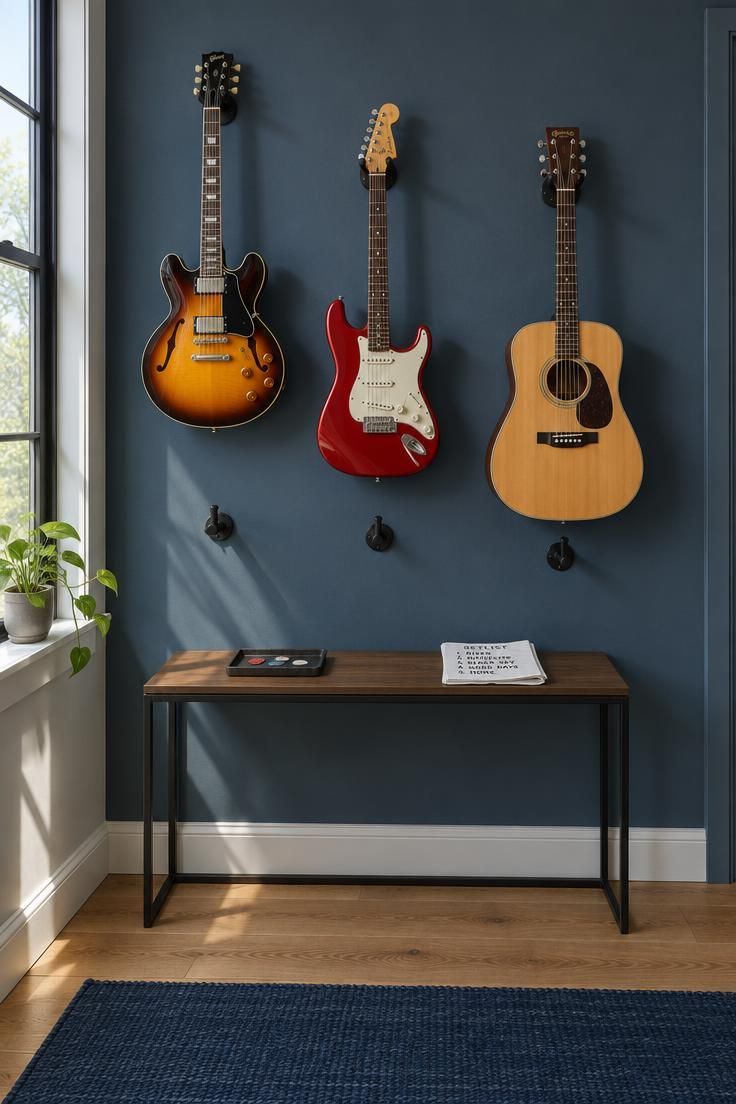
A wall section painted in deep blue-gray gives a grid of black metal wall hooks a quiet backdrop.
Arranging the hooks in three columns and two rows allows a mix of instruments, such as a solid-body electric, a thinline semi-hollow, and an acoustic, to hang together.
Because those body depths differ, the instruments create a staggered third dimension on the wall rather than a flat line.
Setting the hooks at different heights within the grid, with the most played guitar at shoulder height, keeps daily use practical.
The metal hooks are visually simple and let the guitar finishes carry the wall.
Spacing needs to account for the widest body, since instruments hung close together can touch when they sway slightly after being lifted down.
Style Blueprint:
- A deep blue-gray wall as the backdrop
- A grid of black metal hooks in three columns and two rows
- A mix of solid-body, semi-hollow, and acoustic guitars at staggered heights
- The most played guitar positioned at shoulder height for easy access
Place a Lounge Chair and Floor Lamp Beside a Low-Boy Amp
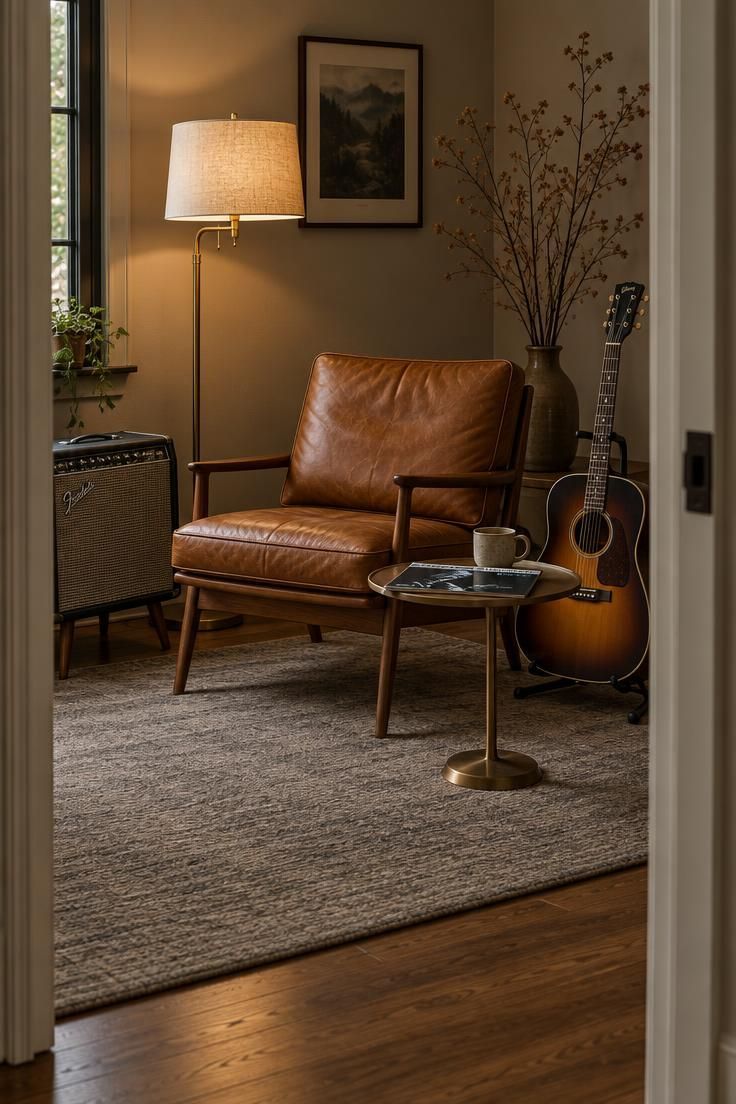
A reading and listening corner built around a mid-century lounge chair in cognac leather separates the lounge zone from the display wall.
A vintage brass floor lamp with a linen shade provides soft ambient light that flatters leather and wood without glare.
Placing a low-boy amplifier on short angled legs to the left of the chair makes the amp read as furniture rather than gear.
A guitar on a floor stand just within arm's reach of the chair, plus a small side table holding a record sleeve and a coffee mug, completes the arrangement for guitar display wall ideas that prioritize comfort over density.
The chair should not block the amp's front grille if a clear listening line matters to the player.
This layout takes more floor space than a stool and a stand, so it suits a room with at least one open corner to spare.
Style Blueprint:
- A mid-century lounge chair in cognac leather
- A vintage brass floor lamp with a linen shade
- A low-boy amp on short angled legs to the left of the chair
- A guitar on a floor stand within arm's reach
- A small round side table with a record sleeve and a mug
Hang a Row of Framed Album Covers Above a Low Guitar Rack
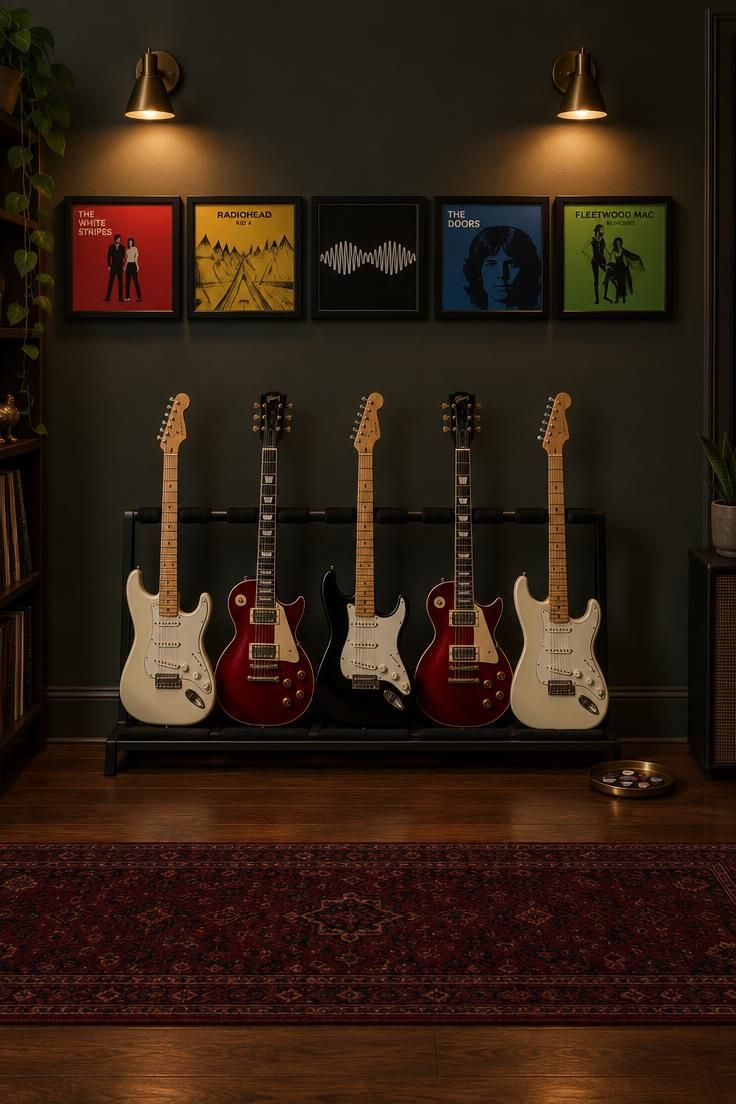
A long wall in a narrow room can carry a horizontal row of black frames, each holding a vinyl album cover with a bold, single-color graphic.
Hanging the frames at standing-eye height and placing a low five-guitar floor rack directly beneath them along the baseboard stacks two rhythms on one plane.
Keeping the rack tidy with guitars in a loose alternating order by body color prevents the lower half from reading as storage.
A forearm-width gap between the rack and the frames keeps the wall from feeling crowded.
Choosing album covers that pick up some of the colors in the guitars helps tie the two displays together.
A pair of softly glowing wall sconces above the frames can then highlight the artwork and instrument finishes while keeping the room’s mood warm and understated.
The framed album covers add a second visual rhythm above the instruments and reinforce a collector mood without adding more gear.
Dusting framed art and guitars alike becomes a regular task in a narrow room, since the low rack sits close to foot traffic and collects lint from the floor.
Style Blueprint:
- Five black frames in a horizontal row, each holding a graphic album cover
- A low five-guitar floor rack aligned directly beneath the frames
- Guitars alternated by body color for visual rhythm
- A forearm-width gap between rack and frames
- A thin runner rug in deep burgundy along the floor
Use a Rolling Metal Tool Cart as a Pedalboard and Accessory Station
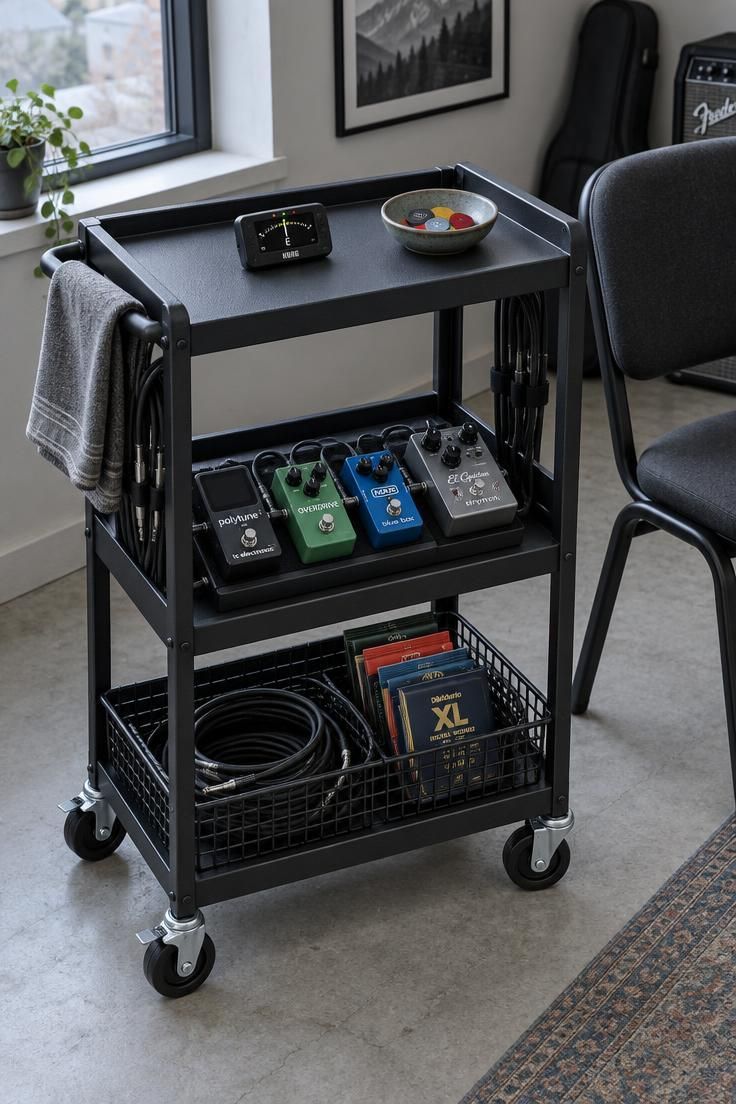
A compact steel utility cart with two or three shelves, powder-coated in matte black, can sit beside the main practice chair as a moving station for pedals and accessories.
The pedalboard parks on the middle shelf with cables tucked behind the cart's side rails, which keeps the floor clear.
The top shelf holds a tuner, picks, and a small notebook, while a metal basket on the bottom shelf stores extra cables, strings, and a string winder.
Because the cart rolls closer during practice and pushes against the wall afterward, a small room stays flexible.
The cart's wheels should lock so it does not drift when a pedal is pressed.
A loaded cart can be heavy to move, so anyone who rearranges the room often should keep the bottom shelf light and the heaviest items on the middle shelf.
Style Blueprint:
- A matte black powder-coated steel utility cart with locking casters
- A small pedalboard on the middle shelf with cables tucked behind the rails
- A tuner and shallow bowl of picks on the top shelf
- Coiled cables and string packs in the bottom basket
- A folded cloth on the cart handle for quick wipe-downs
Conclusion
A man cave guitar room works best when the instruments come first and everything else supports them.
Display, seating, and storage should match how often the room is actually played, not how it looks on a quiet afternoon.
Small changes, such as a wall rack, a low amp, or a soft rug, often do more than a complete remodel.
Keeping the room editable lets guitars rotate in and out of view, so the space stays alive instead of turning into a static showroom.