This post may contain affiliate links. If you make a booking or purchase through these links, we may earn a commission at no additional cost to you.
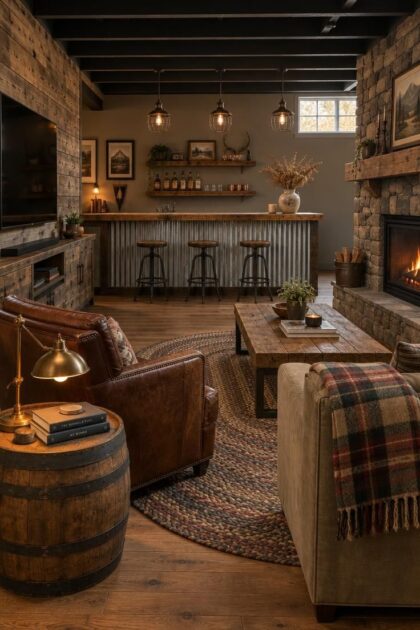
A rustic man cave draws on the warmth of wood, stone, leather, and time-worn materials to create a space that feels personal and rugged rather than polished.
The look fits basements with low ceilings, converted garages, lofts, and spare bedrooms, and each of those rooms asks for a different balance of texture and light.
Too often the same barnwood-and-antlers formula gets repeated until every rugged room looks alike.
The ideas below separate rustic into distinct directions: cabin, industrial, western, workshop, and a few hybrids in between.
Choose the version that matches the architecture you already have and the way you actually use the room.
Reclaimed Timber Media Wall with Blackened Steel Shelving
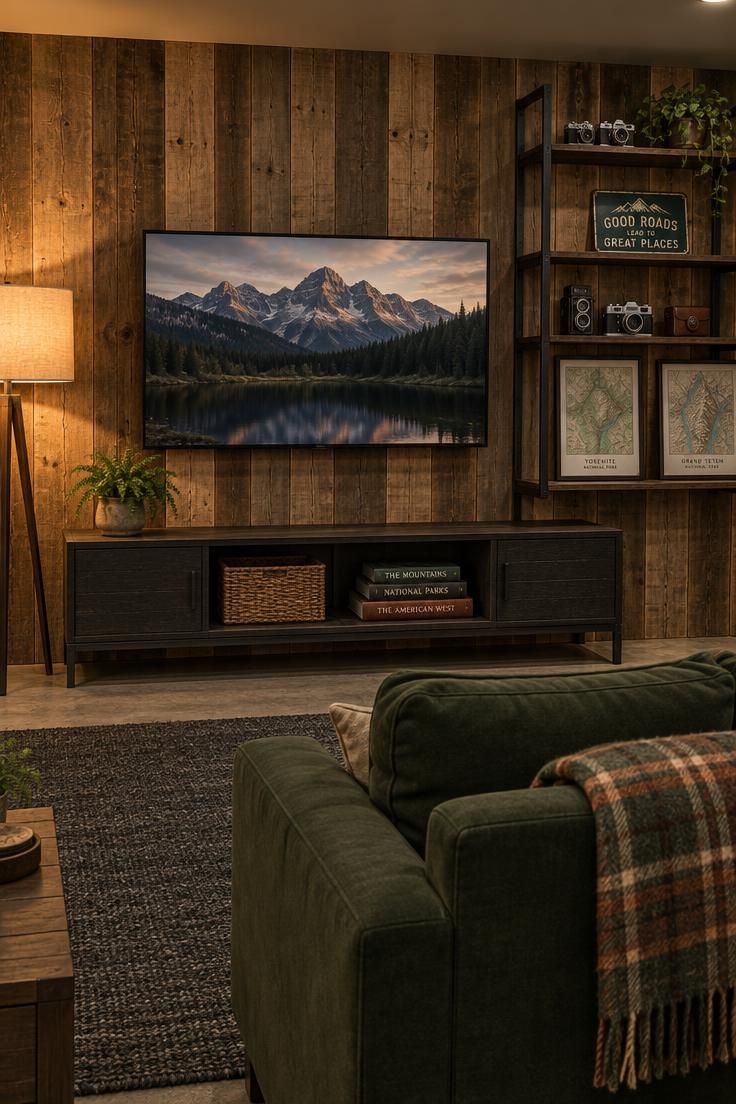
A reclaimed wood feature wall behind the television carries more visual weight than a painted wall, so the planks need variety to stay interesting.
Mixing plank widths and tones keeps the surface from reading as a single flat brown field.
Blackened steel shelves to one side give the television a companion element, holding media boxes, a few old tools, and framed maps without turning the whole wall into storage.
Keep the floor clear with a low media console that repeats the dark metal finish, which lets the wood grain stay the focus.
In low light the rough-sawn surface picks up the lamp glow along the grain, which is why a dark neutral wall on the adjoining sides keeps the room from feeling like a cabin museum.
The wood works as a backdrop when the screen is on and stands on its own when it is off.
Open shelving collects dust, so limiting the objects to a small group makes routine cleaning faster and the display sharper.
Style Blueprint:
- Vertical reclaimed planks in a mix of brown and gray tones
- Blackened steel open shelving mounted to one side of the screen
- Low dark media console with closed storage
- Charcoal wool rug and a deep green sofa for contrast
Design Pro-Tip: Group shelf objects in odd numbers and vary their heights so the display reads as composed rather than cluttered.
Barnwood Accent Wall with a Sliding Door and Enamelware Display
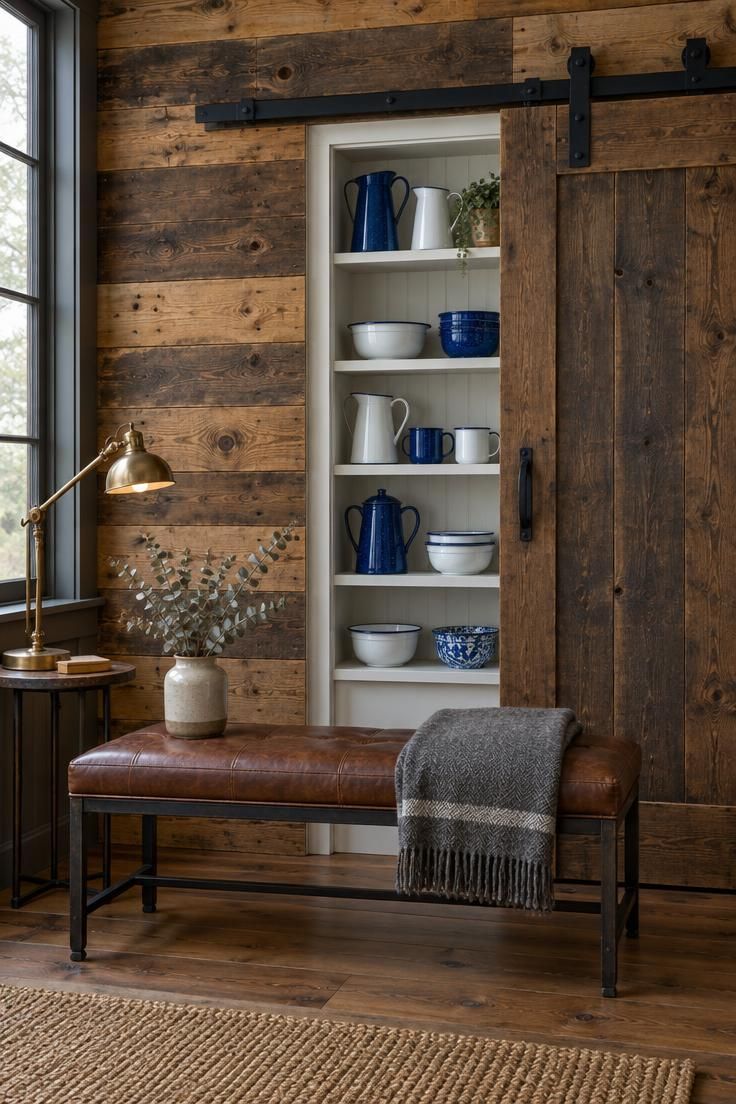
Barnwood brings nail holes, knots, and a faded patina that new lumber cannot copy, and running the boards horizontally widens a narrow wall.
A black metal sliding door track turns a plain surface into a working feature, with one panel covering or revealing the shelving behind it.
That door becomes both storage cover and display piece, which is useful in a room where wall space is limited.
Pair the wall with a simple canvas sofa and a jute rug so the busy wood grain has something quiet to sit against.
Sorting reclaimed boards into a consistent color family before anything goes up saves a second trip, because tone varies from piece to piece even within one barnwood accent wall.
Dust the wood faces and the open shelf contents on a regular schedule, since both surfaces show buildup quickly.
Style Blueprint:
- Horizontal reclaimed barnwood in a single color family
- Black metal sliding door hardware with one panel
- Blue and white enamelware grouped on open shelves
Design Pro-Tip: Place a small bench or stool near the wall so the room gains a secondary seating spot without competing with the focal feature.
Leather Club Chair and Barrel Table in a Lofted Corner
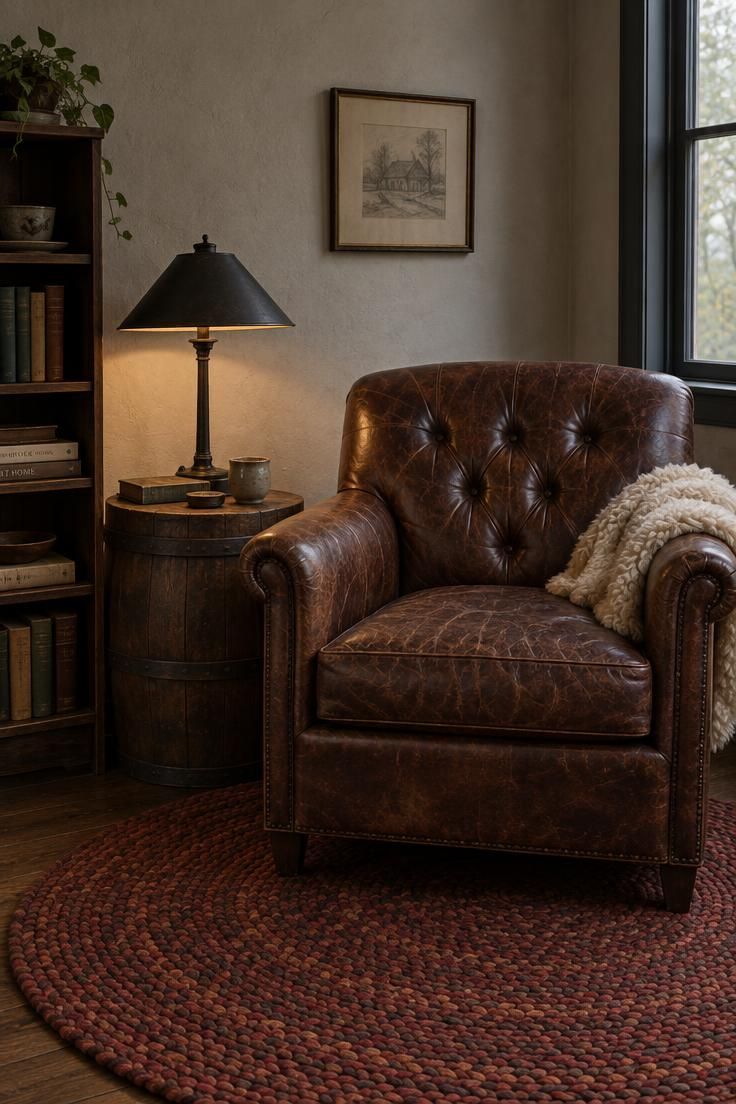
A leather club chair carries patina and button details that read well against a light plaster wall, where the dark leather stands out rather than blending in.
Its rounded arms and deep seat suit a corner that would feel cramped with a full sofa.
A round barrel table fits a narrow corner better than a square side table because the curve leaves more walking room at the edges.
A braided wool rug in faded red anchors the grouping and separates the seating from the floor around it.
A single low bookshelf in dark wood keeps the corner from becoming a decorating catchall, holding a few volumes and one object rather than a pile.
Leather needs occasional conditioning to stay supple, and that routine is part of owning the piece rather than an optional extra.
Choosing a barrel table with a closed top also hides a drink coaster and a remote when guests arrive.
Style Blueprint:
- Worn brown leather club chair with visible patina
- Round barrel side table in dark wood
- Faded red braided wool rug
- Black metal floor lamp with a wide shade
Design Pro-Tip: Layer a small sheepskin or wool throw over one arm of the chair to soften the seating without covering the leather's character.
Reclaimed Wood Bar Top over Galvanized Metal Cabinets
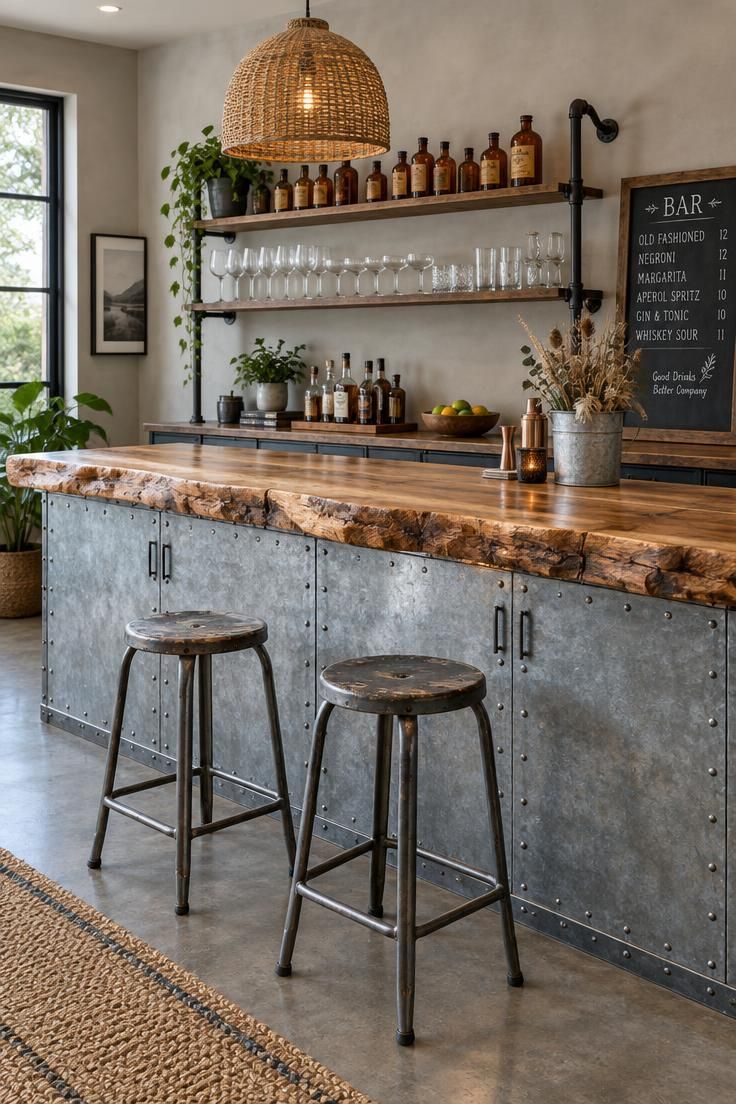
A thick reclaimed wood bar top with a live edge draws the eye along its length, and the grain becomes the room's main texture.
Galvanized metal lower cabinets as the base push the look toward a workshop feel while hiding less-used items behind doors, which open shelving cannot do.
A pipe shelf above holds glassware and a few vintage bottles within easy reach of anyone standing at the bar.
The visual difference between a rough slab and a smooth-planed top comes down to how much you want the wood to dominate; rough surfaces read louder and suit larger rooms.
Two metal stools keep the seating simple, and a woven pendant overhead defines the bar zone without extra furniture.
Galvanized steel shows fingerprints, so a quick wipe after gatherings keeps the doors looking even.
Style Blueprint:
- Thick reclaimed wood slab with a live edge
- Galvanized metal cabinet base with simple pulls
- Black pipe shelf for glassware and bottles
- Two backless metal stools
- Woven pendant light over the counter
Design Pro-Tip: Add a short wood or brick backsplash only behind the bar sink area if the room has plumbing already roughed in, leaving the rest of the wall simple.
Stone Fireplace Wall with Log Mantel and Iron Tools
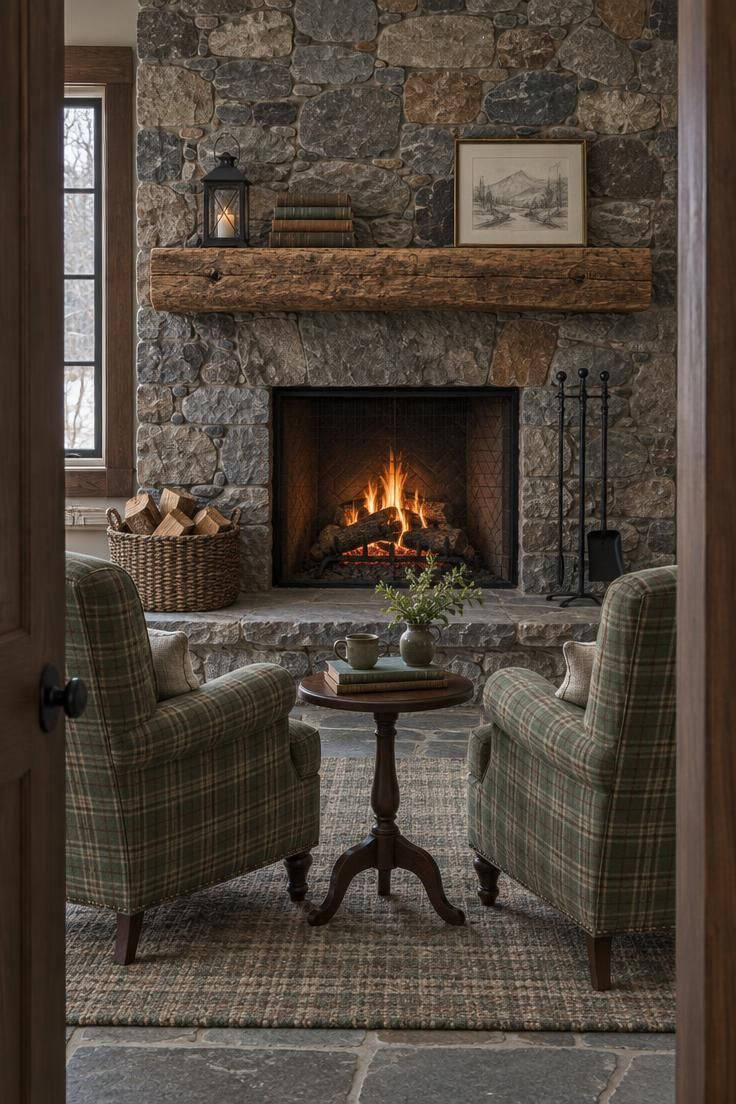
A stacked stone wall in irregular gray and brown stones anchors the room with more visual weight than any other surface can carry.
A hand-hewn log mantel across the middle ties the stone to the wood tones elsewhere in the space.
Iron fireplace tools to one side keep the hearth practical and add a dark metal note against the lighter stone.
Flanking the fireplace with two simple upholstered chairs in a muted plaid creates a conversation pair without blocking the wall.
Stone surfaces collect dust in the crevices, so periodic vacuuming with a brush attachment keeps the texture from going dull.
A full stone wall can overwhelm a narrow room, and stone-look panels offer the same visual weight with a thinner profile.
Style Blueprint:
- Stacked stone in mixed gray and brown tones
- Rough hand-hewn log mantel
- Black iron fireplace tool set
- Two plaid upholstered chairs
Design Pro-Tip: Keep the mantel display to three objects, such as a small lantern, a stack of old books, and a single framed sketch, so the stone remains the star.
Exposed Beam Ceiling with Painted Joists and Cage Lights
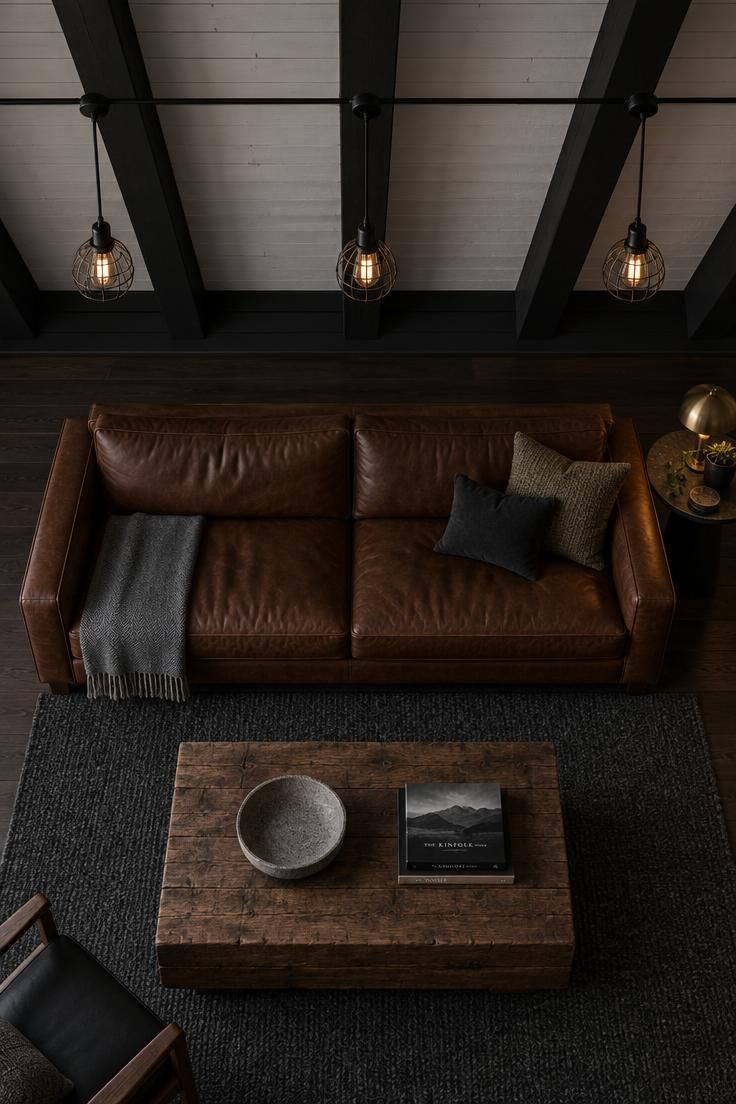
Leaving the ceiling framing exposed and painting the joists matte black against a white deck turns raw structure into a deliberate pattern.
The grid of dark lines gives the ceiling a finished quality that bare framing does not have.
Three metal cage lights on a straight cord run define the seating area below and repeat the black of the joists.
A leather sofa and chunky wood coffee table ground the room with warm tones that balance the dark ceiling.
A low room can feel lower under a dark ceiling, and leaving the joists unpainted or white is the common alternate when headroom is tight.
A soft gray wall color bridges the black above and the wood tones below without adding a third strong hue.
Style Blueprint:
- Matte black painted joists against a white deck
- Metal cage lights on a straight cord run
- Brown leather sofa with a gray wool throw
- Chunky wood coffee table
Design Pro-Tip: Run the cord line straight and use evenly spaced hooks so the lights read as a fixture rather than a temporary string.
Rustic Basement Lounge with Pegboard Tool Display and Workbench Side Table
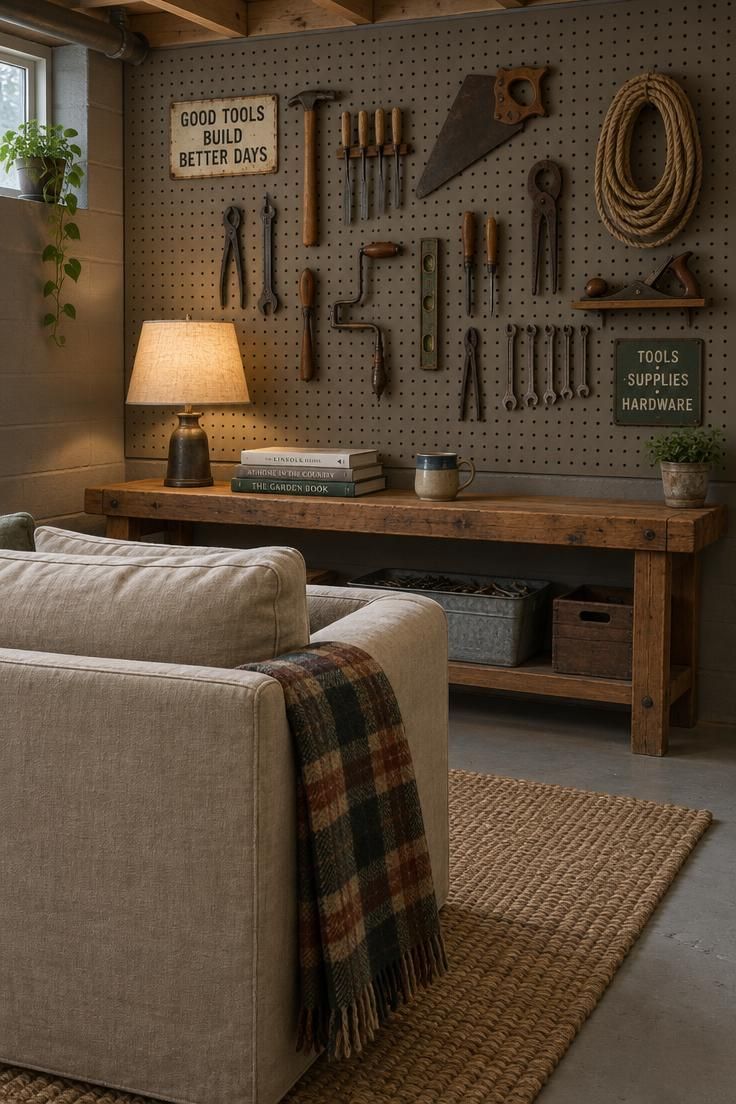
A pegboard wall turns storage into display, letting old tools, coiled rope, and small metal signs sit in the open instead of disappearing into a cabinet.
The distinctive move is using a low workbench as a side table along the same wall, so the rustic man cave gains a surface for drinks and a lamp without a separate piece of furniture.
A deep canvas sofa in a light neutral keeps the room from tipping into full workshop territory, while a folded plaid wool blanket over one arm adds warmth near the workbench.
Painting the pegboard a warm gray instead of raw brown helps individual tools stand out against the backing.
Pegboard collects dust in every hole, and a basement adds humidity to the mix, so occasional tidying, a quick wipe of exposed tools, and a small bin for loose hardware are part of keeping the wall readable without letting small items creep across the floor.
Style Blueprint:
- Warm gray painted pegboard with varied hooks
- Low wood workbench used as a side table
- Deep oatmeal canvas sofa
- Folded plaid wool blanket
- Small bin for loose hardware
Design Pro-Tip: Paint the pegboard a warm gray so the tools stand out without making the wall feel busy.
Rustic Home Bar with Barrel Stools and Edison Bulb Signage
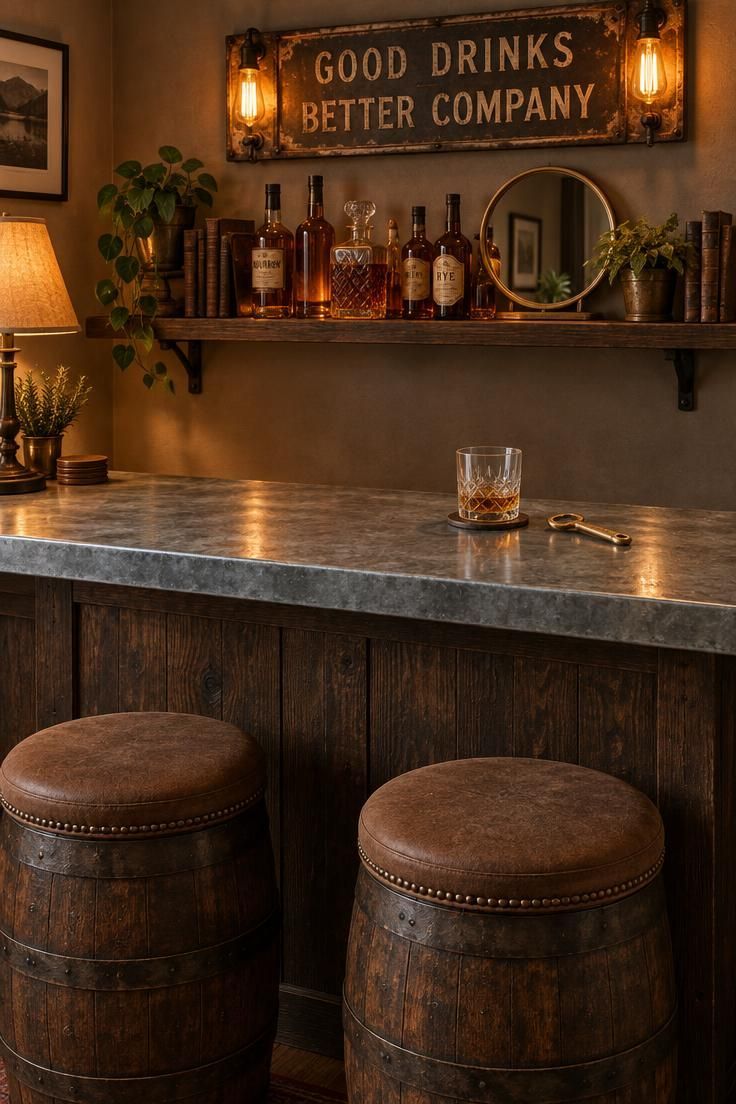
A dark wood bar front paired with a zinc counter gives this rustic basement lounge a compact footprint with a strong material story.
Two barrel-shaped stools tuck under the counter and take up less floor space than full chairs with backs.
The warm glow of the sign's exposed bulbs bounces off the zinc surface and the wood grain, which makes the bar read as the room's bright point.
A few amber glass bottles and a single small mirror keep the back shelf from feeling closed in on a narrow wall.
Dark bar walls can shrink a small room, and a lighter wood stain is the straightforward alternate when the space is tight.
The sign's bulbs need dusting and occasional replacement, which is routine maintenance rather than a one-time task.
A wall-mounted bottle opener on the bar side adds function without taking up counter space.
Style Blueprint:
- Dark stained wood bar front
- Zinc counter top with soft patina
- Two barrel-shaped stools
- Vintage-style metal sign with exposed bulbs
Design Pro-Tip: Use a wall-mounted bottle opener on the bar side, as it adds function without taking up counter space.
Weathered Plank Wall with Mounted Antlers and Woven Blanket
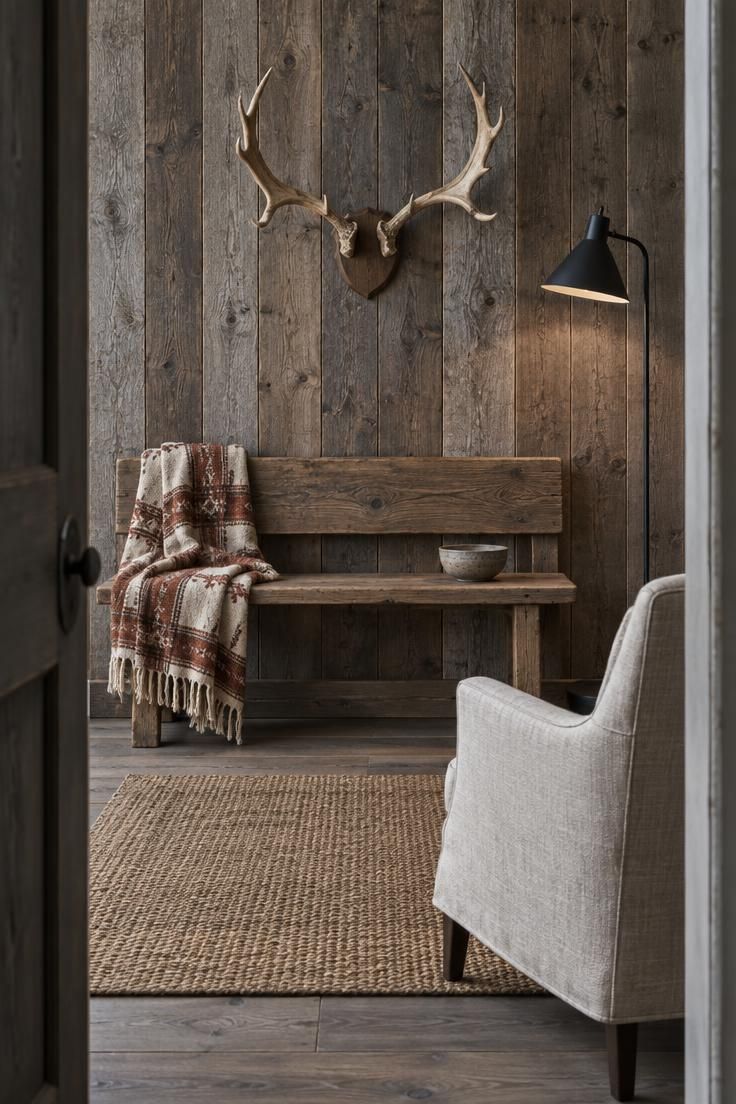
Weathered gray-brown planks set a neutral backdrop that lets the antlers and the blanket pattern carry the visual interest.
Varying the board widths breaks up what would otherwise be a repetitive horizontal rhythm.
A simple wood bench under the antlers gives the wall a function beyond display and provides a spot to set a bag or pull on boots.
The gray tones in the wood also make it easier to pair the wall with cooler textiles.
Genuine antlers need occasional dusting, and hanging them well means checking that the mount stays snug over time.
Without lighter furnishings opposite, the wall can slide toward hunting lodge cliché, so a cream linen chair balances the darker wood.
Style Blueprint:
- Weathered gray-brown planks in varied widths
- Mounted antlers centered above a wood bench
- Cream and rust woven wool blanket
- Jute rug and a black metal floor lamp
Design Pro-Tip: Choose a blanket with one dominant color from the wall's palette so the bench corner looks intentional.
Garage Bay Game Room with Checked Concrete Floor and Metal Cart
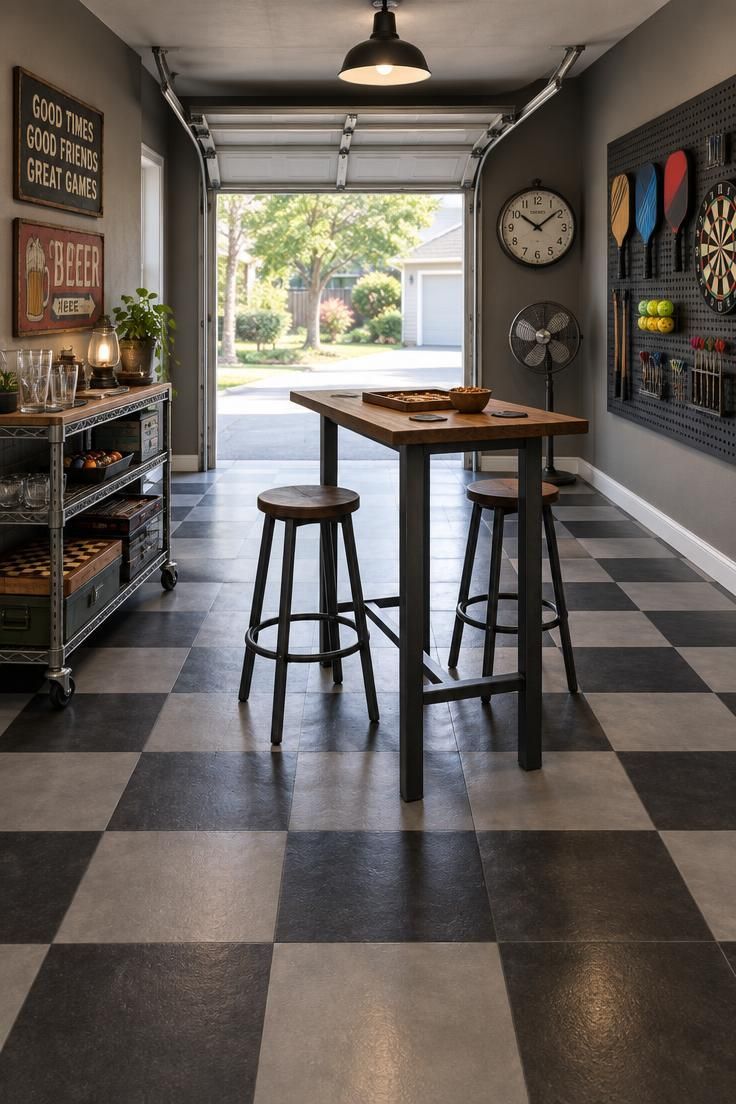
A painted checkerboard pattern on the concrete floor defines the play zone without adding furniture or rugs.
Keeping the concrete exposed suits a garage bay where the floor sees heavy traffic and occasional grit.
A rolling metal cart along one wall holds game pieces, glasses, and a few old signs, and its wheels let the layout change from week to week.
A high-top wood table with two stools handles cards or board games and stores against the wall when the floor needs to open up.
The painted pattern wears with vehicle use, so it works best treated as a decorative surface that gets touched up occasionally.
Cart wheels roll best on smooth concrete, and keeping the load light makes the cart easier to move when the room resets.
Style Blueprint:
- Black and gray checkerboard painted concrete floor
- Rolling metal cart for game pieces and glassware
- High-top wood table with two backless stools
- Large pegboard for paddles and darts
Design Pro-Tip: Use a large pegboard on the opposite wall to hold paddles, darts, or other game gear without taking floor space.
Western Ranch Corner with Cowhide Rug and Rope-Wrapped Table
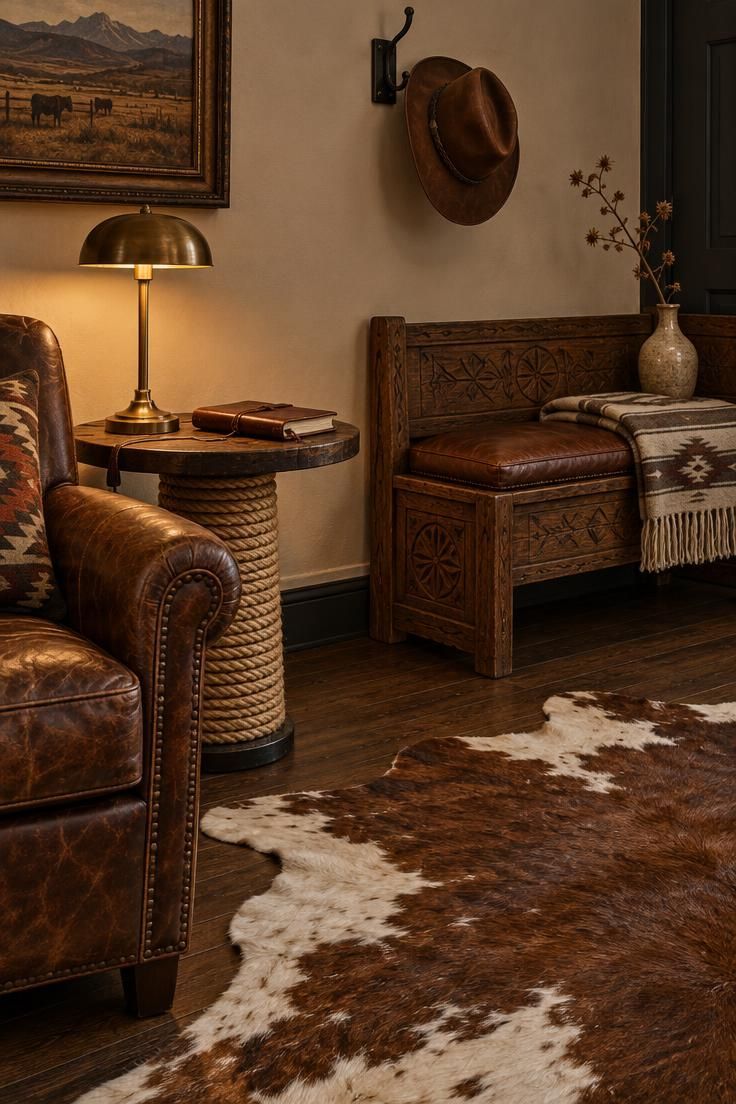
A natural cowhide rug anchors this rustic home bar corner with an irregular shape that softens the hard edges of the floor.
Its brown and white pattern pairs naturally with the rope texture on the side table's base.
Hanging a wide-brim leather hat on a wall hook above a carved wood bench adds a personal note that reads as collected rather than purchased as a set.
A worn leather recliner or armchair completes the seating and keeps the corner from feeling like a display.
Cowhide rugs need regular vacuuming without a beater bar and should stay dry to preserve the hair side.
The rope wrap on the table is a decorative finish and may need re-gluing over time where hands rest.
Style Blueprint:
- Natural cowhide rug
- Round side table with a rope-wrapped base
- Wide-brim leather hat on a wall hook
- Carved wood bench with a leather cushion
Design Pro-Tip: Limit the ranch references to three items, such as the rug, the hat, and the table, so the corner stays rustic rather than themed.
Dark Timber Wall with Brass Wall Lamps and a Folding Game Table
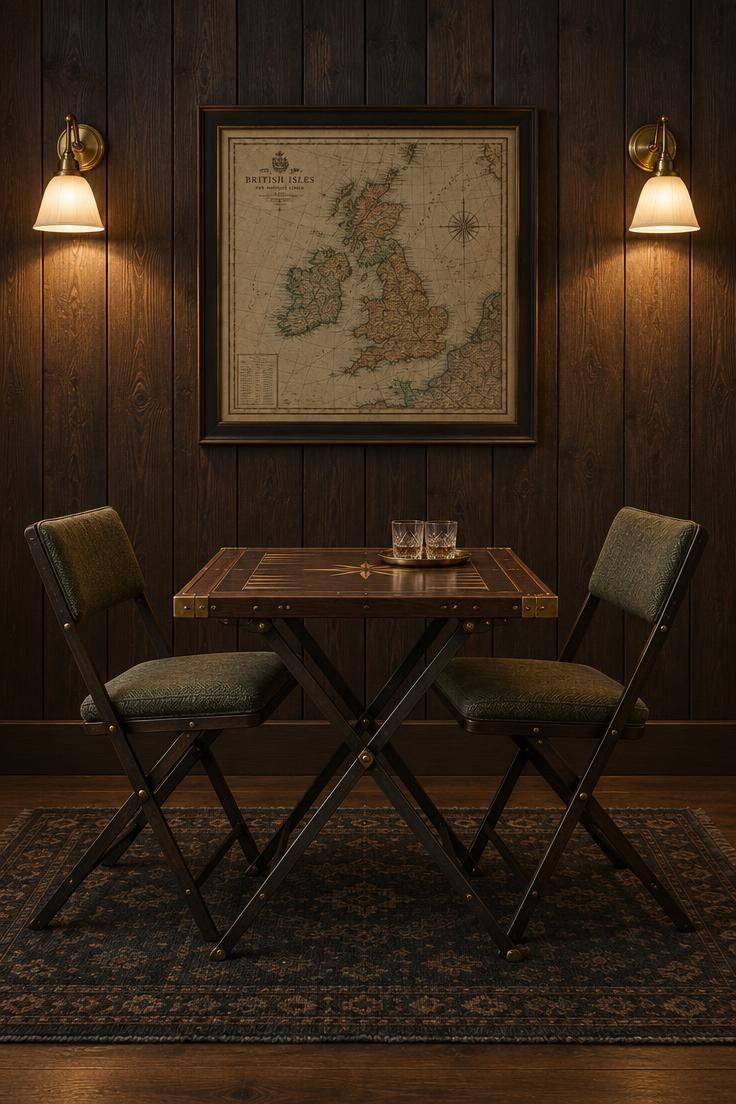
Dark-stained timber planks running vertically floor to ceiling make the brass wall lamps read as the room's jewelry, while the frosted glass shades wash light downward and give the table below a pool of warmth.
Vertical planks suit a low ceiling because they draw the eye upward rather than across.
A folding wood and metal game table in front lets the room convert to open floor space when the game is over, though the tradeoff is no built-in storage the way a cabinet-based game table would offer.
The dark wall shows dust in bright light, so a soft duster belongs in the routine.
The two upholstered chairs store flat and keep the setup from claiming the corner permanently.
Style Blueprint:
- Dark-stained vertical timber planks
- Two brass wall lamps with frosted shades
- Folding wood and metal game table
- Large framed vintage map
Design Pro-Tip: Hang a single large framed map on the wall between the lamps to break up the wood expanse without cluttering the surface.
Brick Wall with Black Pipe Shelving and a Shuffleboard Table
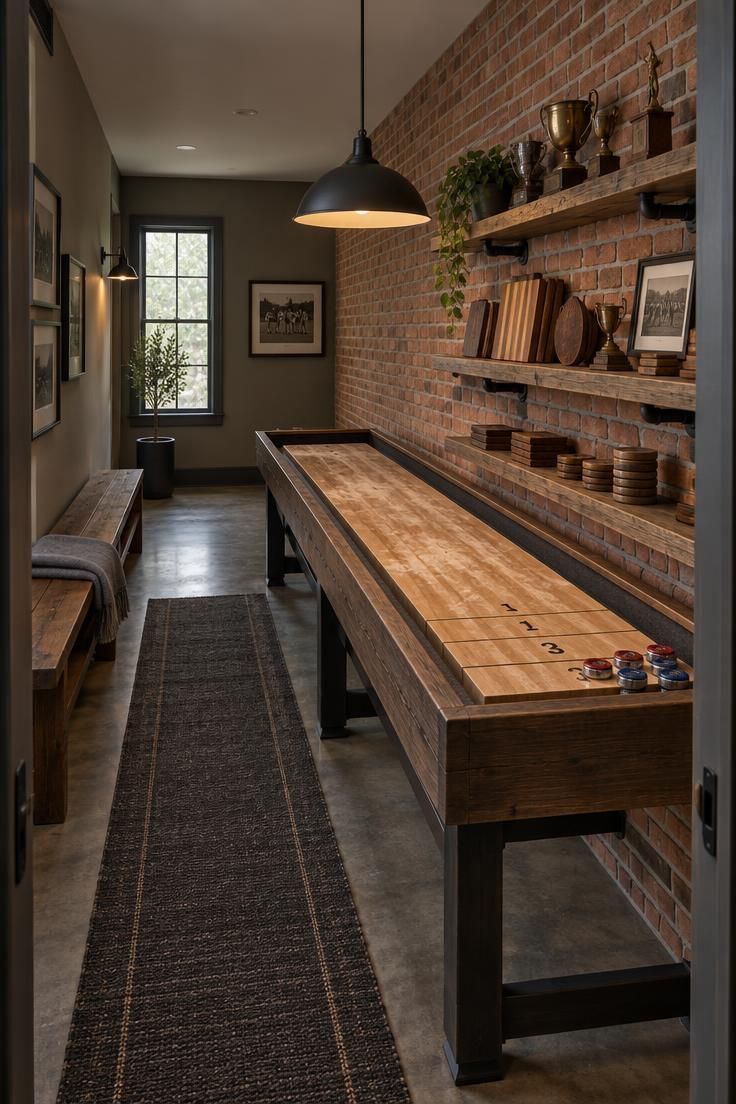
An exposed brick wall in its original red-brown tone provides a natural grid of mortar lines that organizes the room without any added trim.
Black pipe brackets with thick wood shelves echo the industrial fixtures and hold scorekeeping tools, coasters, and a few vintage trophies.
A shuffleboard table in front of the wall becomes the room's centerpiece and gives the shelves a purpose tied to play.
A long low bench along the opposite wall seats spectators without competing with the table.
Brick collects dust in the mortar joints, so a soft brush vacuuming now and then keeps the surface from looking tired.
A shuffleboard table takes a long run, and at least six feet of clear space at each end makes play comfortable.
Style Blueprint:
- Exposed red-brown brick wall
- Black pipe brackets with thick wood shelves
- Long shuffleboard table
- Low spectator bench with a gray blanket
- Vintage trophies and coasters on the shelves
Design Pro-Tip: Use the pipe shelves to hold scorekeeping tools, coasters, and a few vintage trophies so the wall stays part of the game zone.
Conclusion
A rustic man cave works best when the materials feel connected to the building or the owner's story, not when every surface reaches for the same brown palette.
Mixing one or two strong rustic elements, such as a stone wall, a barnwood bar, or a leather chair, with simpler finishes keeps the room from becoming a theme park.
The strongest version of this style edits the tools, hides some storage, and leaves a bit of empty wall so the eye can rest before landing on the next texture.