This post may contain affiliate links. If you make a booking or purchase through these links, we may earn a commission at no additional cost to you.
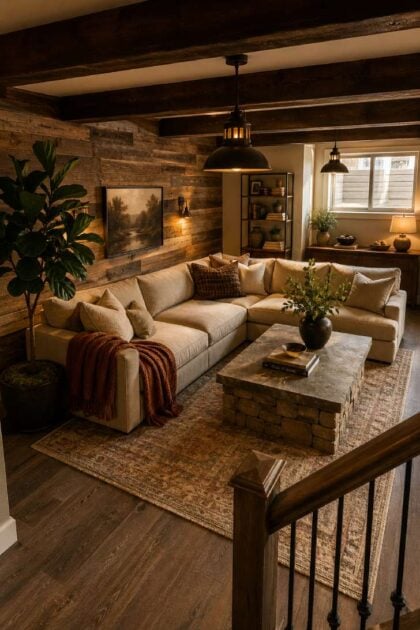
There’s something about a basement wrapped in natural wood and stone that just makes you want to sink into the nearest armchair and stay a while.
Most basements start out the same way — concrete walls, low ceilings, that faint musty smell nobody talks about.
But the right rustic touches can turn all of that into your favorite room in the house.
These 12 ideas will show you how to bring warmth, character, and real personality to the space below your feet.
Grab a coffee. Let’s get into it.
Reclaimed Wood Accent Wall
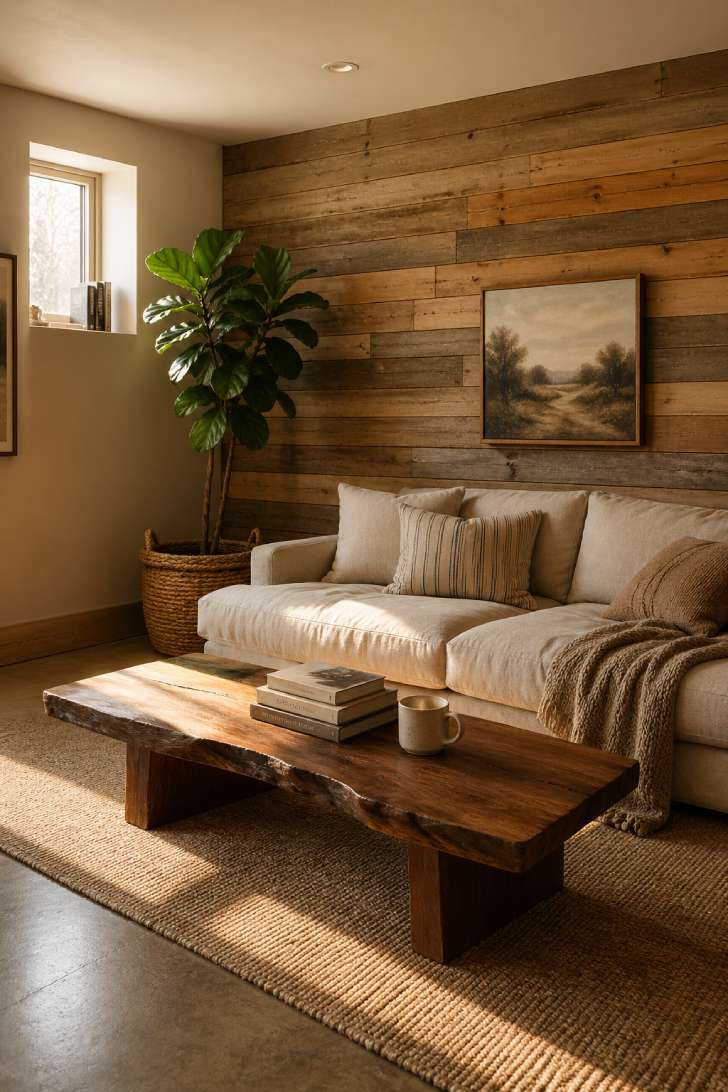
That mix of honey, gray, and pale oak tones on a single wall does something no paint color ever could.
Each plank carries its own history — old barn boards, salvaged fence posts, warehouse flooring from another decade.
Your eye moves across the grain patterns without realizing it, and the whole room feels grounded because of it.
Wood with visible knots and natural imperfections triggers a psychological response that reads as “safe” and “authentic” to most people, which is exactly why the space feels so inviting even though it’s technically underground.
Style Blueprint:
- Reclaimed wood planks in mixed tones (gray, honey, pale oak)
- Low-profile linen sofa in cream or oatmeal
- Raw-edge walnut coffee table
- Jute or sisal area rug
- One large potted plant in a woven basket
Stone Fireplace Gathering Spot
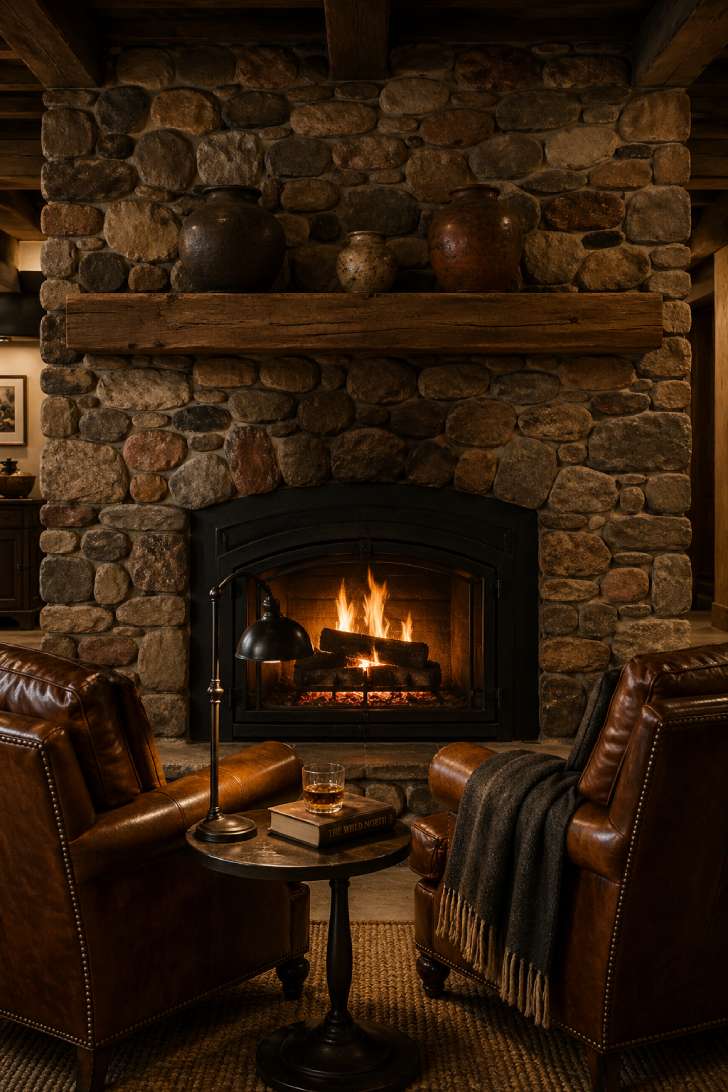
A stone fireplace in a basement changes everything about how people use the room.
Suddenly it’s not the place where you store holiday decorations — it’s where Friday nights happen.
The dry-stacked stone gives off a raw, mountain-lodge quality that polished marble or tile simply can’t replicate.
And those leather chairs angled toward the hearth? That arrangement creates an intimate conversation zone that naturally pulls people in, because we’re hardwired to gather around fire.
The uneven stone surface catches light at different angles throughout the evening, which keeps the wall from ever looking flat or monotonous.
Style Blueprint:
- Dry-stacked natural stone in warm neutrals (tan, gray, muted rust)
- Matte black iron firebox insert
- Two leather club chairs with brass nailhead trim
- Chunky reclaimed timber mantel
- Wool throw blanket in a dark neutral
Exposed Beam Ceiling Lounge
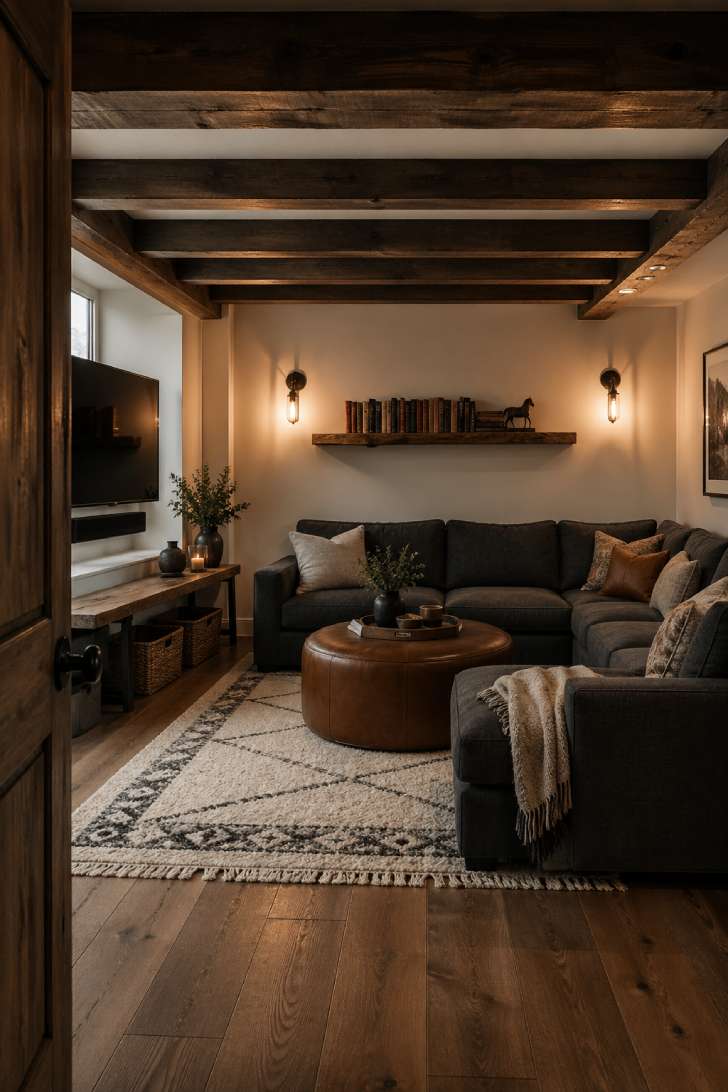
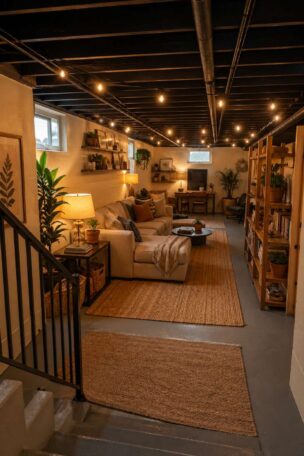
Most people look at exposed beams in a basement and see a problem.
The right finish changes the whole story.
Dark-stained wood against white ceiling panels creates contrast that actually makes low ceilings feel taller — your eye reads the white space between the beams as height, even when there isn’t much of it.
Iron sconces with Edison bulbs reinforce the rustic character without competing with the beams for attention.
The warm amber glow they throw upward onto the wood grain adds depth and dimension that overhead can lights would completely wash out.
Style Blueprint:
- Dark-stained exposed ceiling beams against white panels
- Deep charcoal linen sectional sofa
- Wide-plank engineered hardwood flooring in walnut tone
- Iron wall sconces with warm Edison bulbs
- Live-edge floating shelf for display
Rustic Basement Bar With Reclaimed Wood
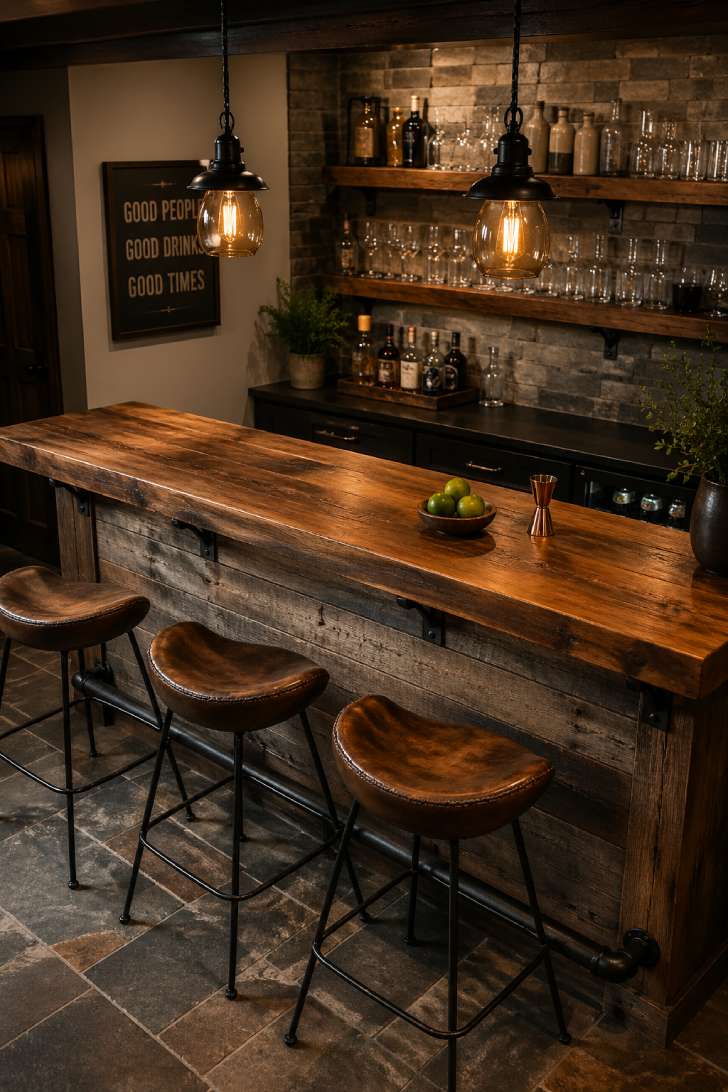
A basement bar built from reclaimed barn wood feels earned somehow — like it’s been there for decades even when the seal is still fresh.
The rough gray-brown patina of salvaged planks pairs perfectly with black iron pipe hardware, and that combination reads as rugged without trying too hard.
Saddle-style stools in distressed leather keep the look consistent from top to bottom.
What makes this setup work on a deeper level is the material contrast between the rough wood front, the smooth butcher block top, and the cool stone backsplash behind the shelves.
Your brain picks up on those texture shifts subconsciously, and it keeps the space feeling layered and interesting rather than one-note.
Style Blueprint:
- Reclaimed barn wood bar front with gray-brown patina
- Black iron pipe footrail and shelf brackets
- Thick sealed butcher block bar top
- Distressed leather saddle stools
- Matte black pendant lights with amber glass shades
Design Pro-Tip: When mixing rustic materials, stick to no more than three primary textures in any single zone — wood, stone, and metal is a classic trio. Adding a fourth (like glass or ceramic) works only as an accent, not a main player. Too many competing textures make a rustic space feel cluttered instead of collected.
Cabin-Style Basement Bedroom
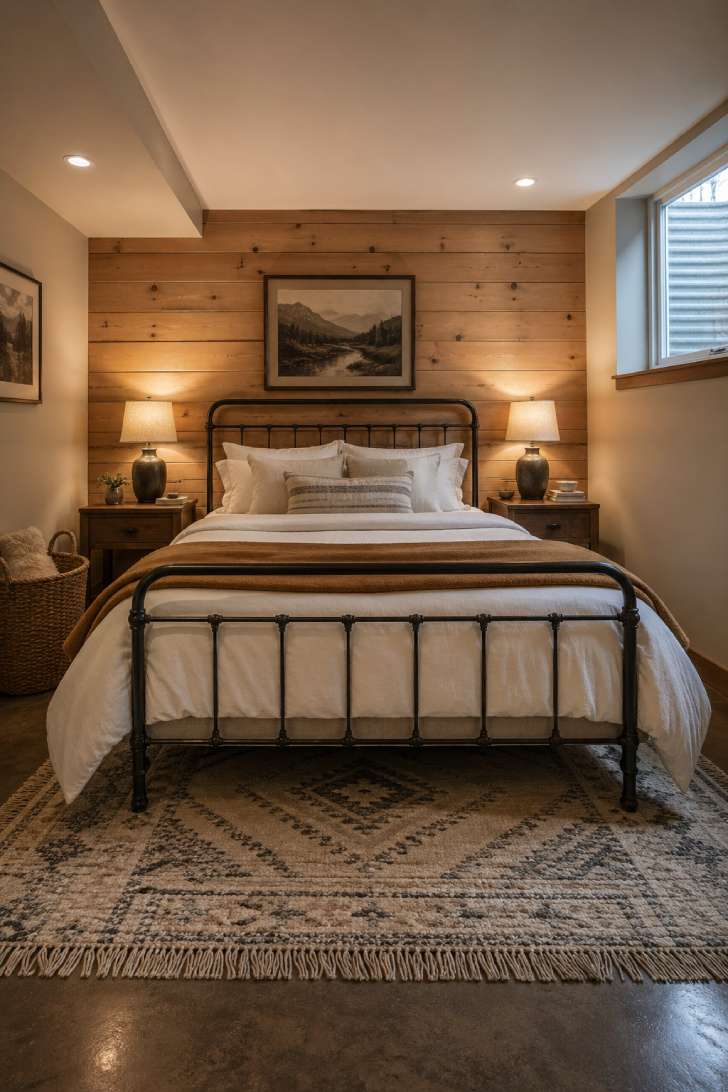
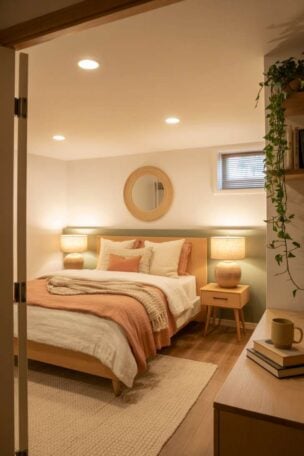
A basement bedroom can feel like a cave or it can feel like a mountain cabin.
The difference comes down to materials and light.
Tongue-and-groove pine planks on the headboard wall bring that lodge warmth without making the room feel dark — especially with a light honey stain that reflects lamp light back into the space.
Wrought iron against soft white linen creates one of those satisfying visual contrasts where the hard and soft elements make each other look better.
Keeping the bedding simple and mostly white is a smart move underground, because it bounces every bit of available light around the room and prevents that closed-in feeling basements are notorious for.
Style Blueprint:
- Tongue-and-groove pine plank accent wall in light honey stain
- Wrought iron queen bed frame
- White linen bedding with a camel wool blanket
- Ceramic table lamps with linen shades
- Cream-and-gray kilim rug on polished concrete
Rustic Wine Cellar Nook
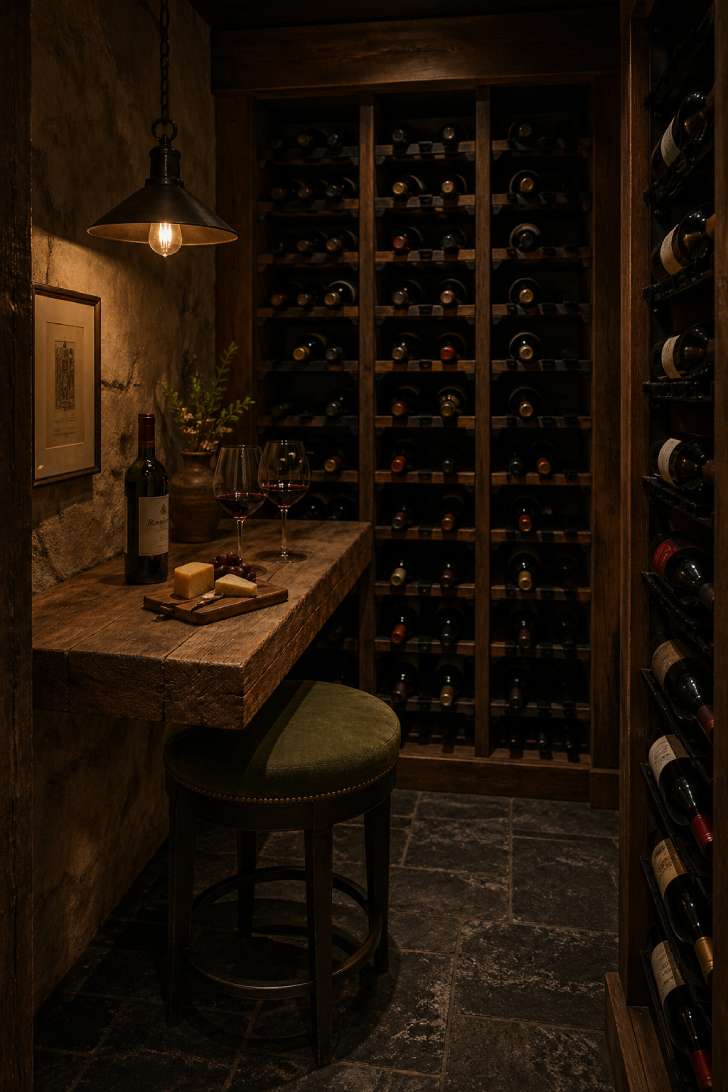
You don’t need a full wine cellar to get the effect of one.
A single alcove — even one carved out of a closet or dead corner — can become a wine nook that feels intentional and special.
Dark walnut racks against a stone or concrete backdrop create that old-world cellar atmosphere immediately.
The low pendant light over the tasting ledge does something clever: it defines the nook as its own distinct zone within the larger basement, giving it an almost private, secret-room quality.
Basements naturally stay cooler and more temperature-stable than upstairs rooms, which happens to be exactly what wine storage needs — so you’re working with the space instead of against it.
Style Blueprint:
- Dark walnut wine racks with black iron cradles
- Reclaimed oak tasting ledge (single thick slab)
- Dark slate flooring with natural cleft texture
- Wrought iron pendant with warm single bulb
- Small upholstered stool in olive green velvet
Warm Basement Lighting With Industrial Fixtures
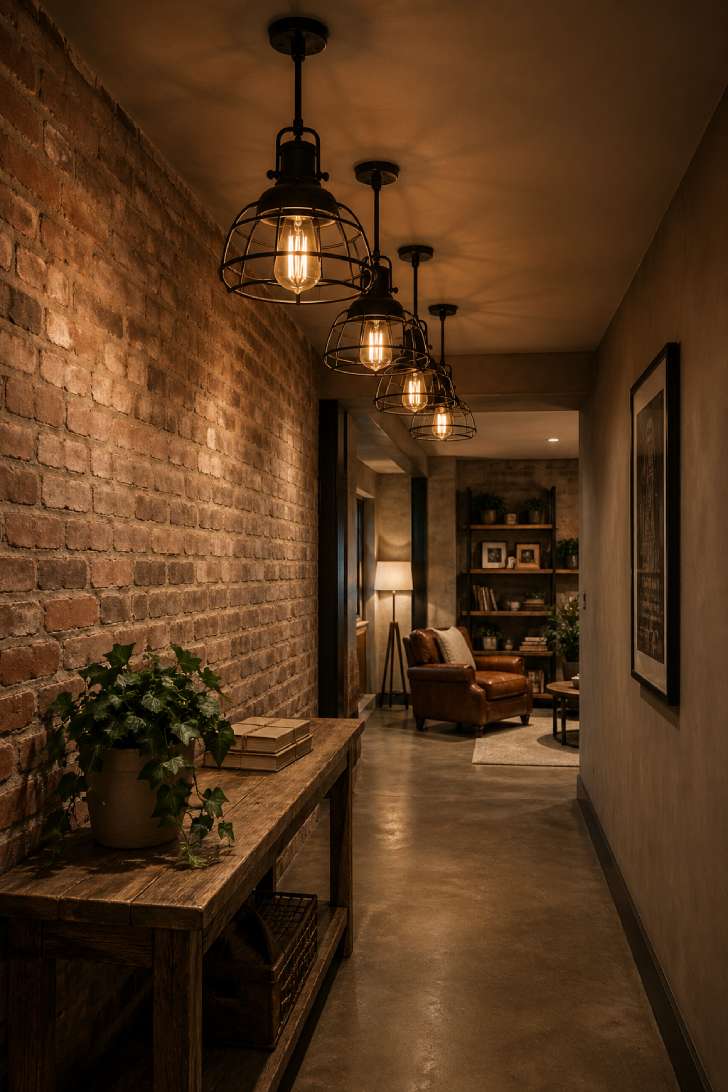
Lighting makes or breaks a basement.
Get it wrong and you’ve got a fluorescent-lit storage unit; get it right and people forget they’re underground.
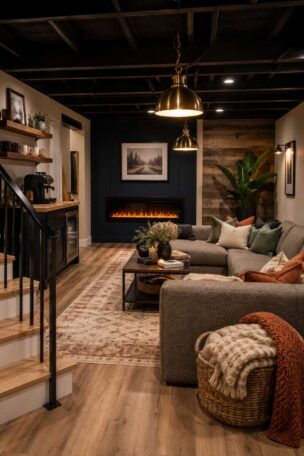
Industrial cage pendants in matte black iron are one of the most effective rustic lighting choices because they do double duty — they throw warm light downward while casting interesting shadow patterns onto surrounding surfaces.
That interplay between light and shadow on textured walls (brick, stone, wood) is what gives a rustic basement its soul.
The Edison bulb glow sits in that warm amber range (around 2200K) that mimics firelight, which triggers the same comfort response our brains have relied on for thousands of years.
Style Blueprint:
- Matte black iron cage pendant lights (set of four)
- Warm amber Edison bulbs (2200K range)
- Exposed brick on one or more walls
- Reclaimed wood console table
- Stained concrete floor in warm gray
Earth Tone Basement Living Room
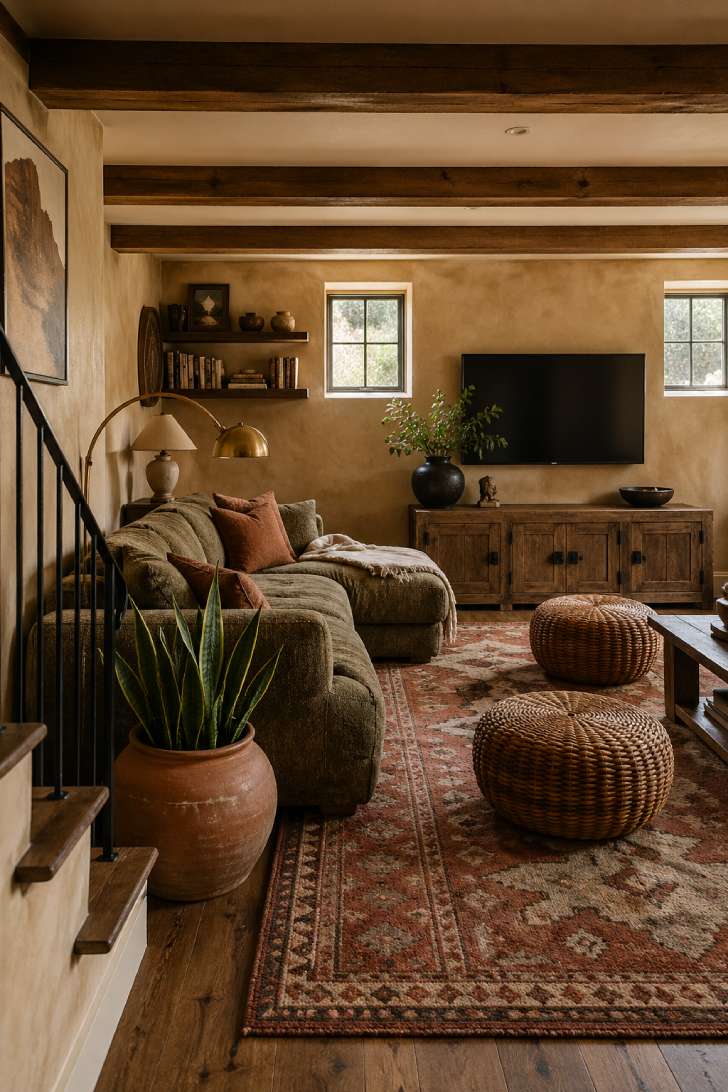
Earth tones do something specific in a basement that they don’t quite do anywhere else in the house.
Because basements already sit below ground level, colors pulled from the earth itself — terracotta, clay, olive, sand — feel completely natural there.
They don’t fight the space; they agree with it.
An olive-green sofa against warm sand walls creates a palette that reads as intentional and grown-up without feeling dark or heavy.
The mix of textures here matters: nubby fabric, smooth plaster, rough wood, woven rattan. Each surface catches and reflects light differently, which keeps a room with limited natural light from going flat.
Style Blueprint:
- Low-profile sofa in olive green nubby fabric
- Reclaimed wood media console with iron hardware
- Smooth plaster walls in warm sand tone
- Hand-knotted wool rug in rust and cream
- Woven rattan poufs for extra seating
Design Pro-Tip: In basements with limited natural light, skip pure white paint on the walls. A warm sand, soft clay, or pale mushroom tone will actually make the room feel brighter because it plays nicely with warm artificial light instead of fighting it. White walls under warm bulbs can look dingy — earth neutrals glow.
Rustic Game Room With Timber Accents
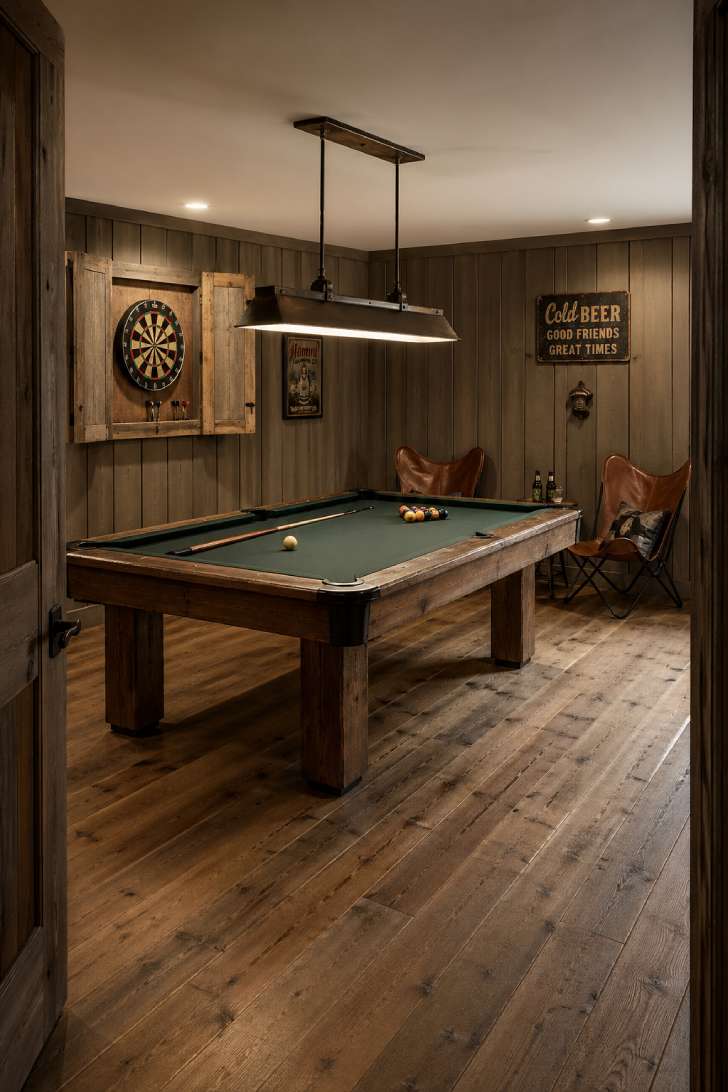
A game room needs a different energy than a lounge or a bedroom.
It should feel a little more charged, a little more social — like a place where something is about to happen.
Heavy timber legs on a pool table ground the room and give it presence that a standard lightweight table can’t match.
Board-and-batten paneling on the walls adds vertical lines that draw the eye upward, which is a useful trick for counteracting low basement ceilings.
The combination of a focused overhead pendant (directly above the playing surface) with softer ambient light around the perimeter creates natural zones — the bright center for action, the dimmer edges for watching and conversation.
Style Blueprint:
- Full-size pool table with chunky timber legs
- Industrial linear pendant in aged bronze
- Board-and-batten wall paneling in medium ash stain
- Leather butterfly chairs for spectator seating
- Wide-plank hickory flooring with natural grain variation
Rustic Mudroom-Style Basement Entry
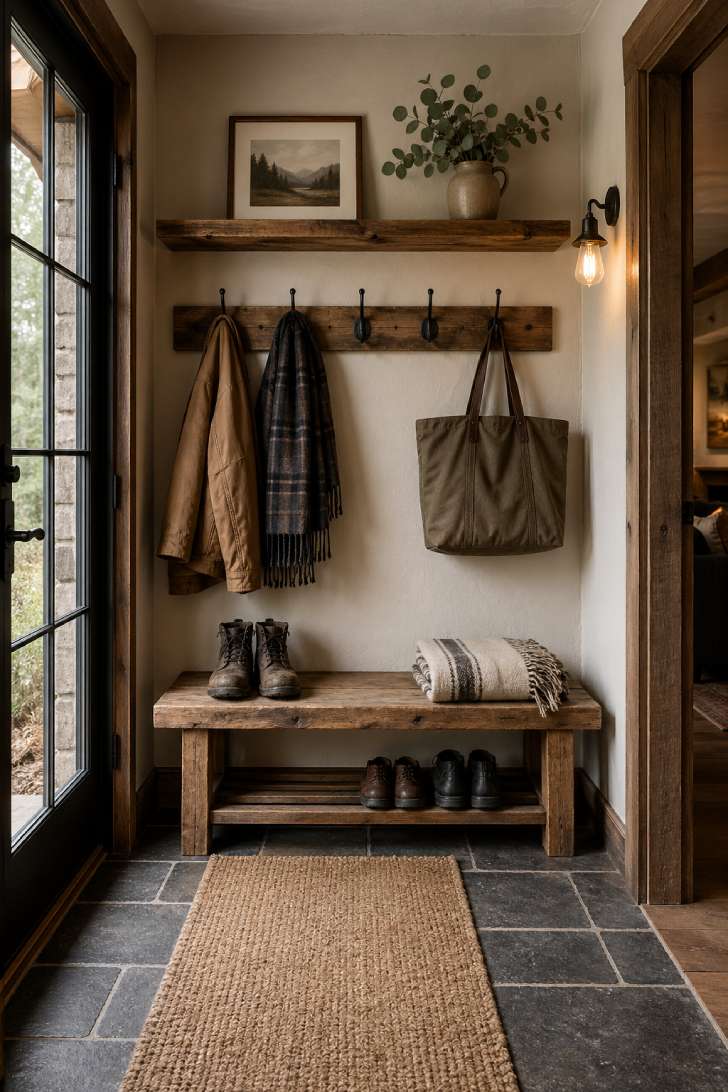
If your basement has an exterior entrance, that transition zone between outside and in deserves attention.
A few well-placed rustic elements turn a cold, forgotten stairwell landing into something that actually welcomes you.
The reclaimed wood hook board does the heavy lifting here — it’s functional (coats, bags, hats) and it immediately sets the tone for the rest of the basement.
Slate tile on the floor handles wet boots and tracked-in dirt without showing every scuff, and it picks up the cool gray tones that connect to stone and iron throughout a rustic space.
Keeping this area simple and practical actually serves the design better than trying to make it decorative, because a mudroom that looks like it gets used feels more authentic than one staged for a photo.
Style Blueprint:
- Reclaimed wood plank board with black iron coat hooks
- Rustic pine bench with slatted shoe shelf
- Warm charcoal slate tile flooring
- Rough-sawn timber floating shelf
- Sisal runner rug for the walkway
Design Pro-Tip: Your basement’s entry point sets expectations for the entire space. Invest in a strong first impression at the door or stairwell landing — even just a textured rug, a wall-mounted hook rail, and a single warm sconce will signal that this floor of the house is intentional, not an afterthought.
Farmhouse-Inspired Basement Laundry Corner
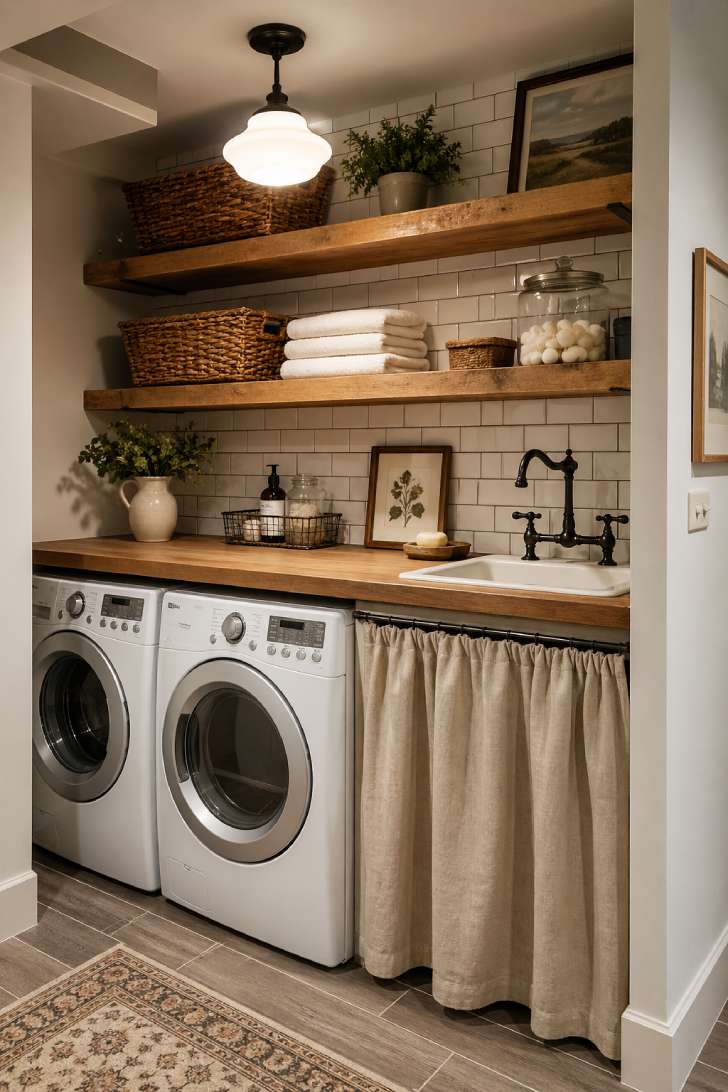
Laundry in the basement is a reality for a lot of homes, and pretending it doesn’t exist is a missed opportunity.
Framing the washer and dryer with a butcher block countertop and open shelving above turns a utility corner into something that actually looks good.
White subway tile with dark grout is a farmhouse staple that works hard in a laundry zone — it’s easy to wipe down, it reflects light well, and the dark grout lines add visual rhythm without demanding attention.
The linen curtain below the counter is a smart rustic detail: it hides cleaning supplies and detergent bottles while keeping the look soft and lived-in, which a cabinet door would make too formal.
Style Blueprint:
- Butcher block countertop spanning washer and dryer
- White subway tile backsplash with dark gray grout
- Open rough-sawn oak shelving with wicker baskets
- Farmhouse sink with black iron bridge faucet
- Natural oatmeal linen curtain for under-counter storage
Cozy Reading Nook Under the Stairs
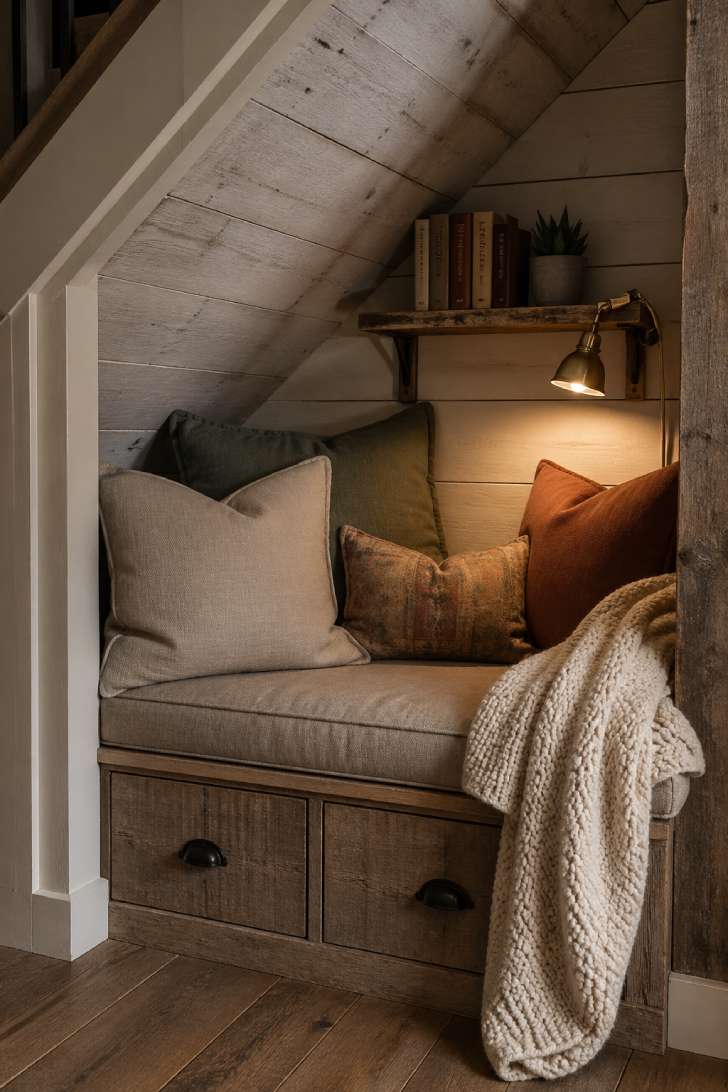
The triangular space under a staircase is one of the most underused spots in any basement.
Filling it with a built-in bench and some plush cushions creates a reading nook that feels like it was always meant to be there.
Whitewashed shiplap on the angled ceiling keeps the small space from feeling cramped — the light finish opens it up while still reading as unmistakably rustic.
This kind of tucked-away spot works so well because it triggers a sense of enclosure that psychologists call “prospect and refuge” — you can see out into the room, but you’re sheltered on three sides, which makes the brain relax.
It’s the same reason window seats and corner booths feel so appealing.
Style Blueprint:
- Reclaimed shiplap in soft whitewashed finish on ceiling
- Built-in bench with plush oatmeal linen cushions
- Throw pillows in muted sage, rust, and cream
- Small reclaimed wood wall shelf with clip-on brass reading light
- Chunky knit throw in cream
Wrapping It Up
A rustic basement doesn’t need a six-figure renovation or a team of contractors.
Most of these ideas start with one strong material choice — a reclaimed wood wall, a stone fireplace surround, a set of iron light fixtures — and build from there.
The key is working with what basements already have going for them: cooler temperatures that suit cozy textiles, lower light levels that welcome warm amber bulbs, and that slightly removed-from-the-world feeling that makes the whole space perfect for unwinding.
Pick one idea from this list that speaks to your home.
Start there.
The rest will follow.