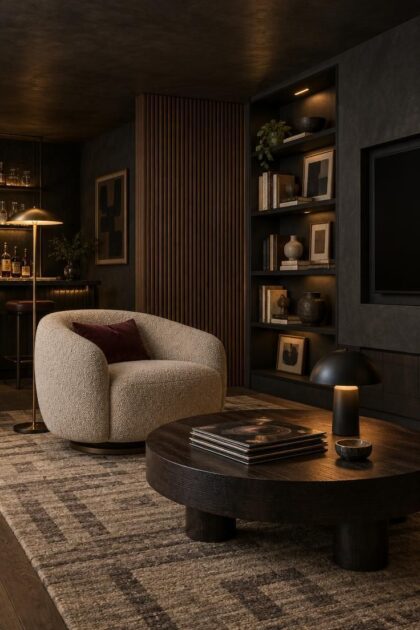
This post may contain affiliate links. If you make a purchase through these links, we may earn a commission at no additional cost to you.
A moody man cave is not simply a room painted dark.
It is a contrast strategy, assembled from deep color, warm light, layered texture, and a deliberately narrow palette.
Done well, the space feels enveloping without going flat, because pooled light and shadow carry as much weight as the walls.
What follows is a set of visual directions for combining surfaces, lighting, seating, shelving, and objects into a retreat that keeps its character from the first lamp switched on to the last record spinning.
Charcoal Envelope with Tinted Ceiling
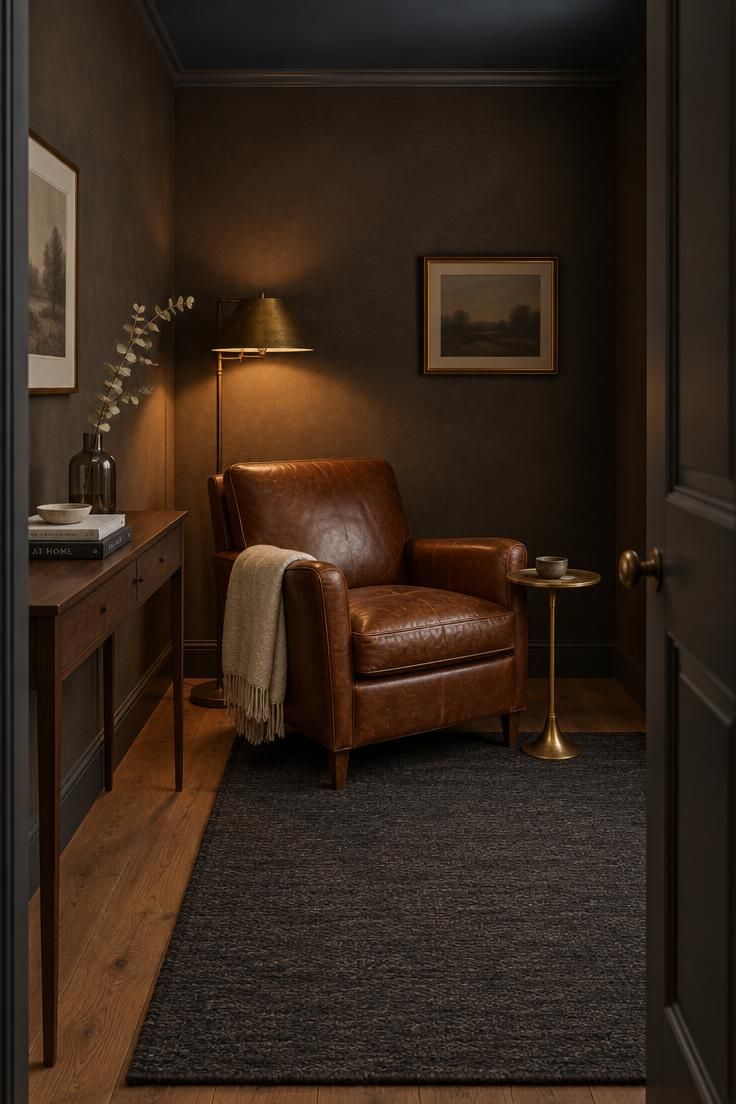
Deep walls and a tinted ceiling do the quiet structural work in this scheme, because values that sit close together let the eye register the room as one continuous envelope.
The paint color becomes a backdrop for light rather than a feature competing with it.
Choose a saturated base such as charcoal-brown, ink, or a blackened forest green, and take the ceiling one or two steps lighter with a tinted ceiling paint so the room closes in without pressing down.
Trim offers the main decision: matched trim makes the walls dissolve edge to edge, while bone or cream trim draws a crisp line that frames the dark.
Dark surfaces show scuffs, fingerprints, and dust more readily than mid tones, so a matte finish that can be touched up by the can is easier to live with than a high-gloss one.
In a small room, pair the deep envelope with one reflective element, a mirror, a glass tabletop, or a polished metal lamp base, to keep the space from reading cramped, and anchor the arrangement with a leather club chair.
Where ceilings run low, a tinted ceiling beats a full black one, since the softened value still lets light travel upward.
Style Blueprint:
- Matte charcoal-brown wall paint carried onto the ceiling one value lighter
- Matched trim for an uninterrupted edge or bone trim for deliberate contrast
- One aged brass or polished metal accent to bounce light
- A flatweave rug in a tone close to the floor
Design Pro-Tip: Paint a large sample board and lean it against the wall at different times of day before committing, since a deep color shifts noticeably between morning and evening light.
Three-Source Warm Lighting Strategy
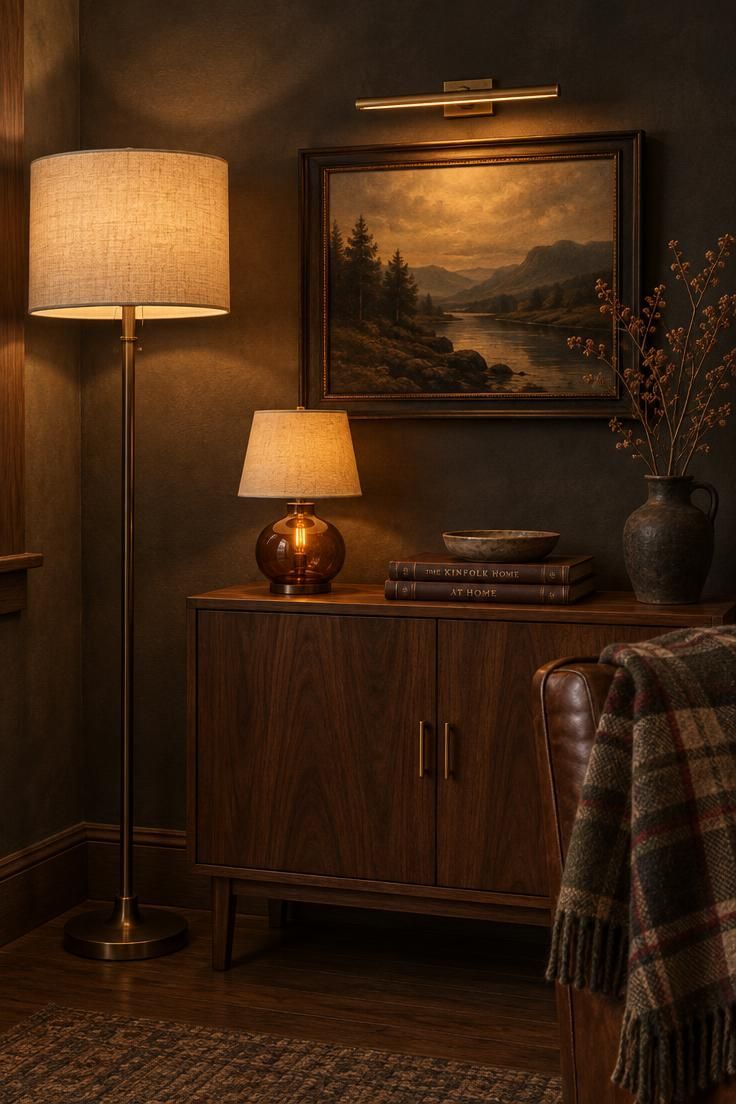
Warm layered lighting is the engine of a moody man cave, and it works by distribution rather than brightness.
Three or more small sources at different heights create overlapping pools of light and shadow, which is what the eye reads as atmosphere.
A corner floor lamp sets the base, a table lamp on a side surface brings light to seated eye level, and a picture light or wall sconce adds a third plane that grazes a focal object.
Warm bulbs and shade materials such as linen, parchment, or amber glass reinforce the wood, leather, and brass already in the room, while cool sources turn the same surfaces gray.
Independently switched lamps let the room move from one low pool of light to a full glow without changing a single object.
More lamps do mean more cords, so group sources near existing outlets and run cable along baseboards where it can be concealed.
Plug-in fixtures deliver the same visual result when hardwired options are not part of the plan.
Style Blueprint:
- One floor lamp with a linen or parchment shade
- One table lamp in amber glass or ceramic
- A brass picture light or slim wall sconce for a third height
- Warm bulbs across every fixture for a consistent cast
- Independent switches so each source can stand alone
Oversized Boucle Swivel Chair in a Shadowed Corner
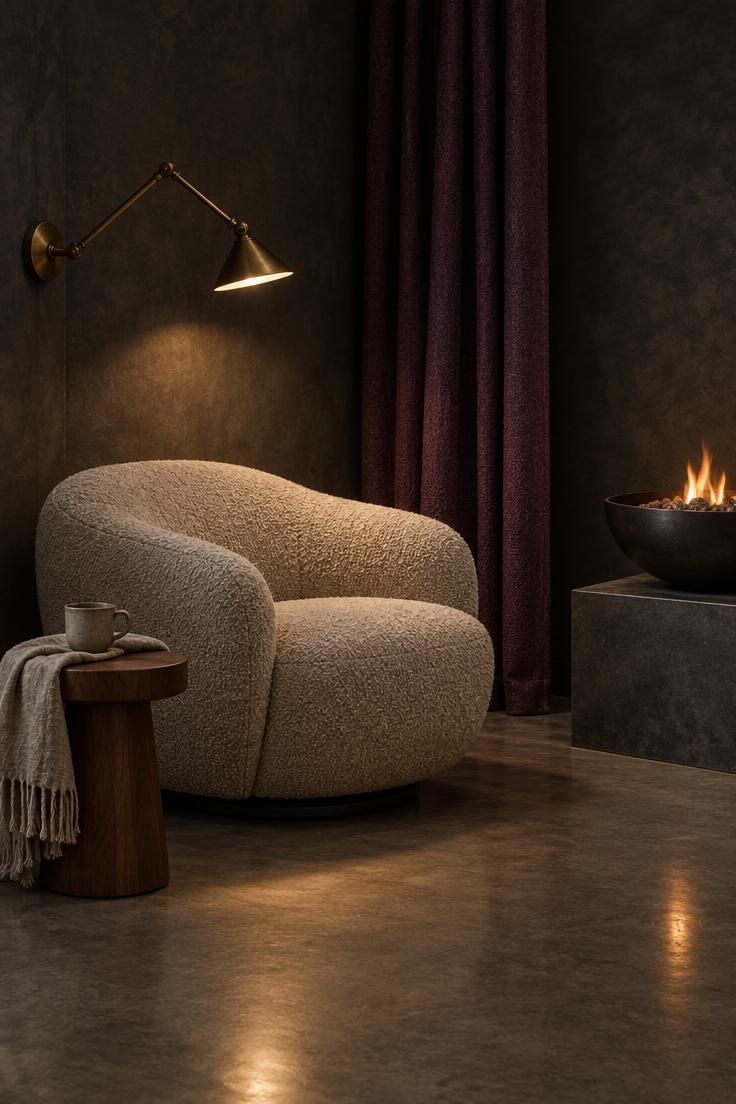
A swivel chair earns its place in a moody room because it lets the person sitting redirect their attention without rearranging heavy furniture, whether toward the fire, the screen, or whoever walks in.
Boucle and other looped textiles absorb light rather than reflect it, so an oversized chair in oat, stone, or greige becomes a quiet soft mass that balances dark walls without shining or competing with the room's few light sources.
Angle it toward the room's main heat or light source, a fire bowl, a media wall, or a window with a view, and give it clearance to rotate fully so the motion feels intentional, not cramped.
The practical tradeoff is that boucle snags easily and collects dust, so a low-pile loop or a tightly woven performance boucle handles a high-use room far better than a loose, fluffy knit.
Where a fire feature is not an option, a sculptural floor lamp with a dimmer creates the same gravitational pull and gives the chair a reason to face its corner.
The corner placement matters more than the chair itself: a single oversized seat pulled slightly away from the walls reads as a deliberate retreat, not leftover furniture.
Style Blueprint:
- One oversized boucle or loop-textured swivel chair in oat, stone, or greige
- A dark limewash or matte plaster corner to contain the silhouette
- A focused brass or blackened-steel light source nearby
- A small walnut, travertine, or dark stone side stool
Dark Built-In Shelving as a Collection Stage
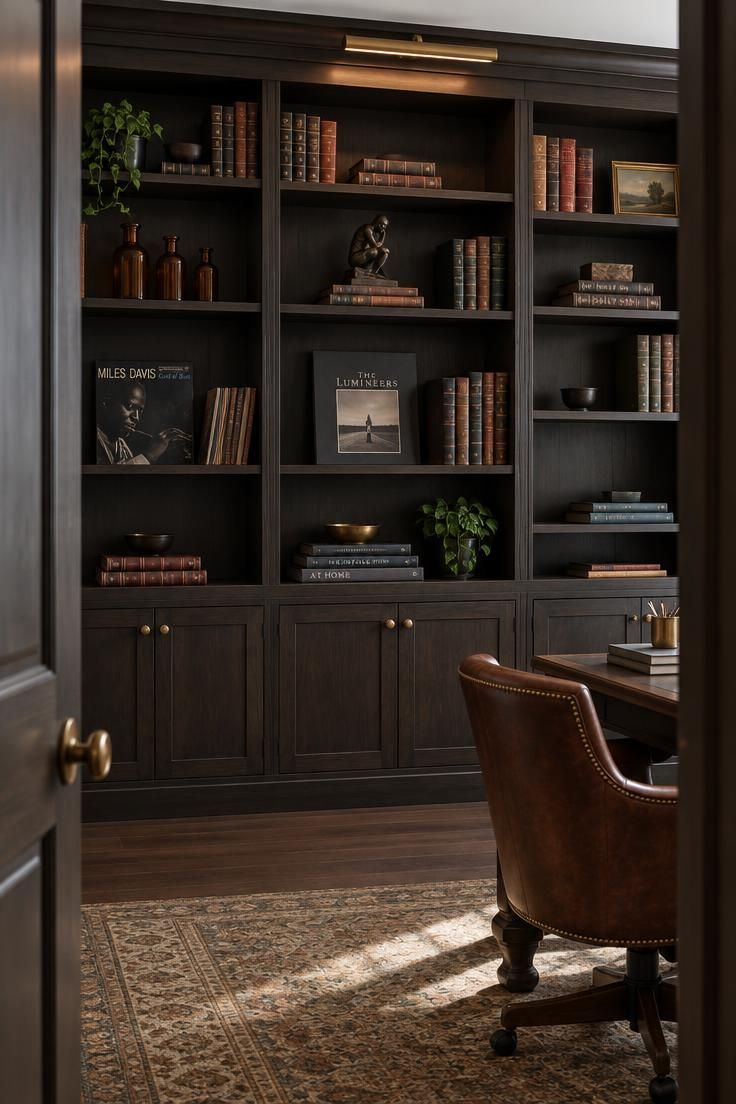
Painting or staining shelving to match the wall turns the case into a quiet frame and lets the objects inside supply the color.
This disappearing-case effect is what separates dark built-in shelving from a freestanding bookcase, because the wall reads as one plane rather than a piece of furniture pushed against it.
Arrangement matters more than volume: mix horizontal stacks with vertical rows, place a few larger objects at eye level, and leave genuine gaps between groupings so the eye has somewhere to rest.
Closed lower doors hide the practical clutter, cables, boxes, and odds and ends, while the open upper section carries the display.
Open shelves collect dust at a steady rate, and the deeper the case, the more surface there is to wipe, so a handheld duster kept nearby makes the upkeep far less of a chore.
Editing is the real discipline here: a shelf that is three-quarters full reads as considered, while one packed edge to edge reads as storage.
Style Blueprint:
- Built-ins stained or painted to match the wall tone
- Closed lower cabinet doors in the same finish
- A mix of horizontal stacks, vertical rows, and open negative space
- Clusters grouped by material, such as amber glass or brass
- A picture light or shelf strip to graze the display
Moody Bar Corner with a Dark Backdrop
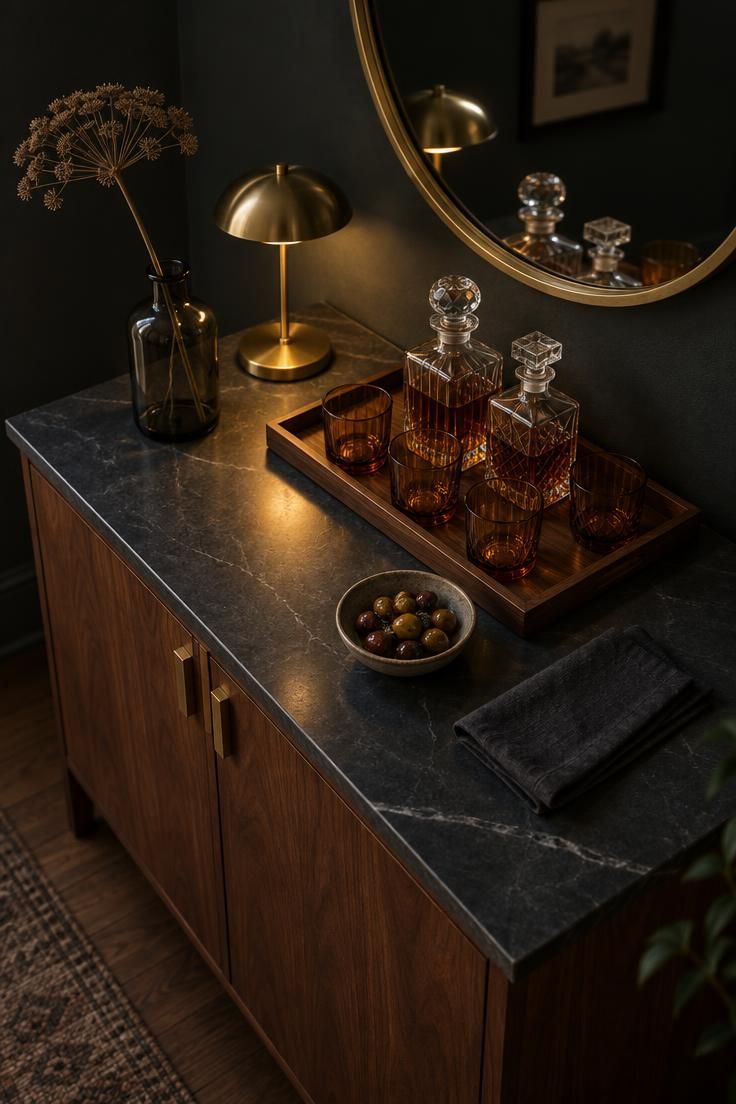
A moody bar corner gathers the room's social energy into one compact zone, and its visual trick is doubling light with a reflective backdrop.
A mirror or a dark glazed tile surface behind the counter bounces a single warm source back into the room, which makes the corner glow twice as far as its footprint suggests.
Dark wood or dark stone on top keeps the surface from glaring, and amber glassware, decanters, and tools read as display rather than clutter when they sit on a tray.
Keep the dedicated light low and warm, positioned so it grazes the bottles rather than flooding the counter.
The scale suits small rooms especially well: a cart, a narrow counter run, or a converted armoire all deliver the same visual effect without claiming much floor area.
Because glass and polished stone both show every smear, a microfibre cloth and a quick wipe after use keeps the surface presentable.
Style Blueprint:
- A compact cart, counter, or armoire in dark wood or stone
- A mirror or dark tile panel behind the bar
- One small warm task light aimed at the bottles
- Amber glassware and decanters grouped on a tray
Design Pro-Tip: Group bar tools and glassware on a single tray so the corner stays styled with one object to move when you need the surface clear.
Recessed Media Wall That Melts into the Dark
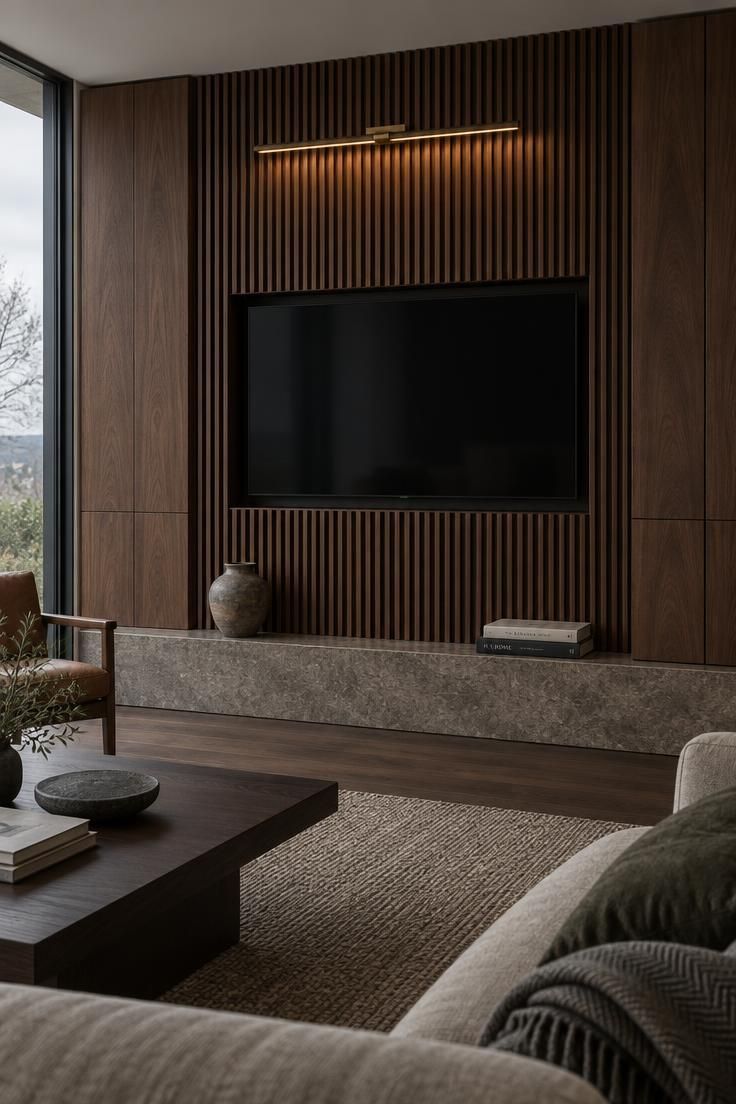
A media wall stops dominating the room when the screen sits inside a dark, textured plane instead of floating on a bright surface.
Vertical slats in stained wood, a stone panel, or matte paint in the same tone as the surrounding walls lets the technology recede until it is switched on.
Flanking cabinetry in a matching finish ties the composition together, so the wall reads as architecture rather than an appliance.
Light the plane from above or to the side with a thin picture light, which keeps the surface from becoming a black void while leaving the screen itself unlit.
Slats and textured panels collect dust more visibly than flat paint, and a vacuum brush attachment makes short work of the gaps.
For rentals, a peel-and-stick slat or panel product can reproduce the texture on a removable basis.
The quieter the wall reads when the screen is off, the more the rest of the room can carry the mood.
Style Blueprint:
- Vertical wood slats, stone, or matte paint in a dark tone
- A shallow recess so the screen sits flush with the plane
- Flanking cabinets in the same finish
- A thin picture light above or beside the wall
Reeded Wall Panel Behind the Seating Zone
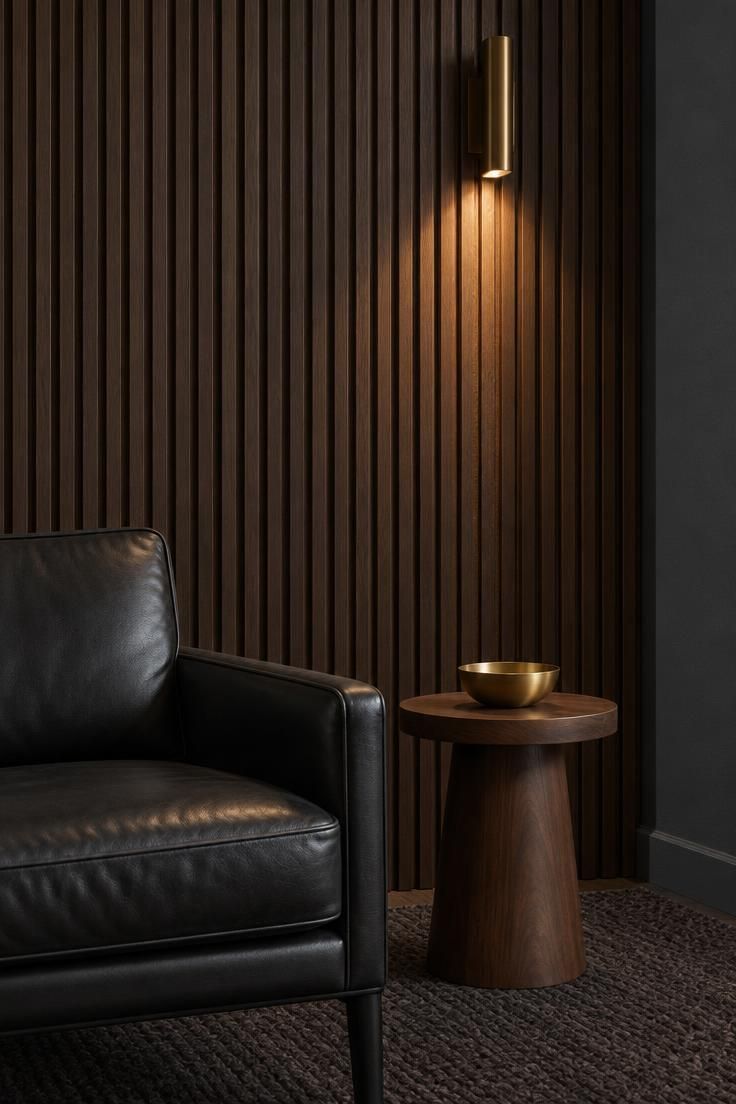
Reeded or fluted paneling gives a dark wall dimension that flat paint cannot, because each ridge throws a fine shadow line that shifts as light moves across it.
The effect is strongest with raking side light from a sconce or picture light, which turns the surface into a series of vertical gradients.
Keep the surrounding walls matte and the nearby decor minimal so the panel remains the single feature plane.
Reeding is a refined profile that suits a more formal room, while board-and-batten or shiplap planks read as more relaxed and rustic.
Texture adds dust-collection surface along every ridge, so a soft brush on a weekly pass maintains the crispness of the shadow lines.
Panel this wall only, since covering every surface in the room would flatten the contrast the feature is meant to create.
Style Blueprint:
- Reeded, fluted, or slatted paneling in a dark stained wood
- A wall sconce positioned to rake light across the profile
- Matte paint on all adjacent walls
Layered Rug Under a Low Coffee Table
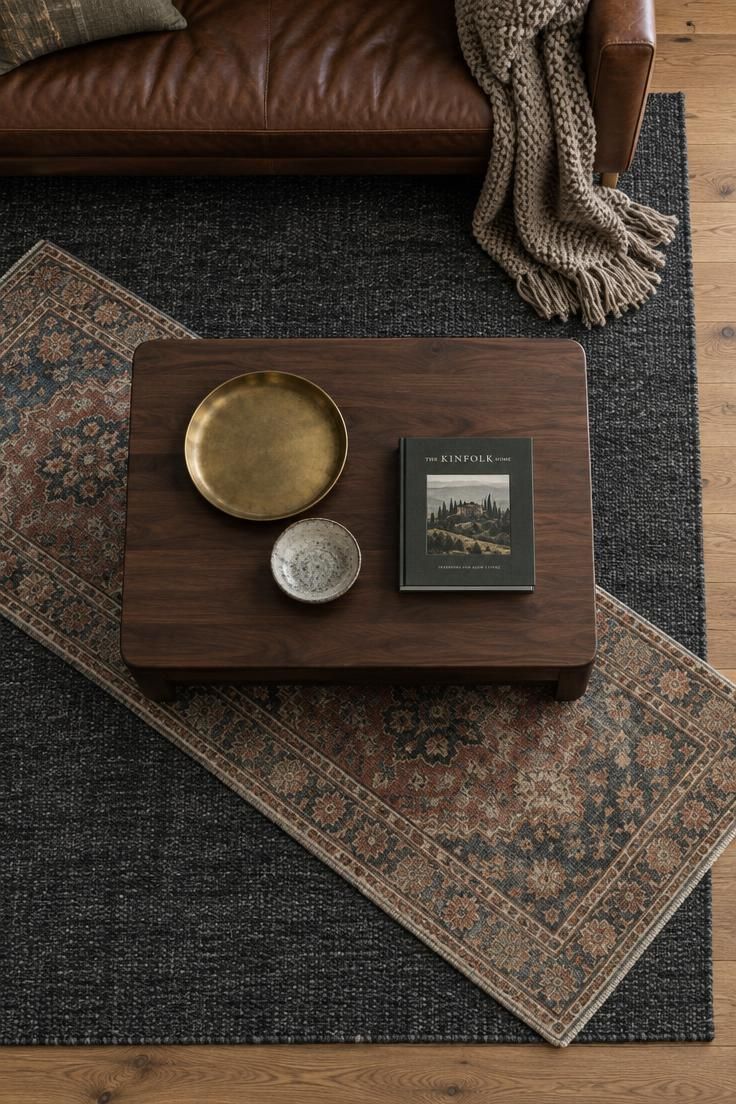
A large rug in wool, hide, or a deep-toned vintage pattern grounds the seating zone and gives hard flooring a softer field.
Layering a smaller patterned runner over a larger neutral base adds the density that moody rooms depend on, and in low light the texture of the pile becomes one of the main things the eye notices.
Sizing is a decision rather than a rule: a rug wide enough to sit under the front legs of the seating usually holds the arrangement together visually.
Dark rugs show dust and pet hair more readily than mid tones, and a faded pattern hides wear better than a solid field.
Natural fibers such as wool and hide also shed and mat over time, so a periodic rotation keeps the pile from compacting in one traffic path.
The rug is the quietest layer in the room and often the one that makes everything above it feel intentional.
Style Blueprint:
- A large wool, hide, or vintage-pattern rug as the base
- A smaller patterned rug layered on top at an angle
- A low table in dark wood or stone as the center object
- A single tray to corral small items
One Saturated Accent in an Oxblood Room
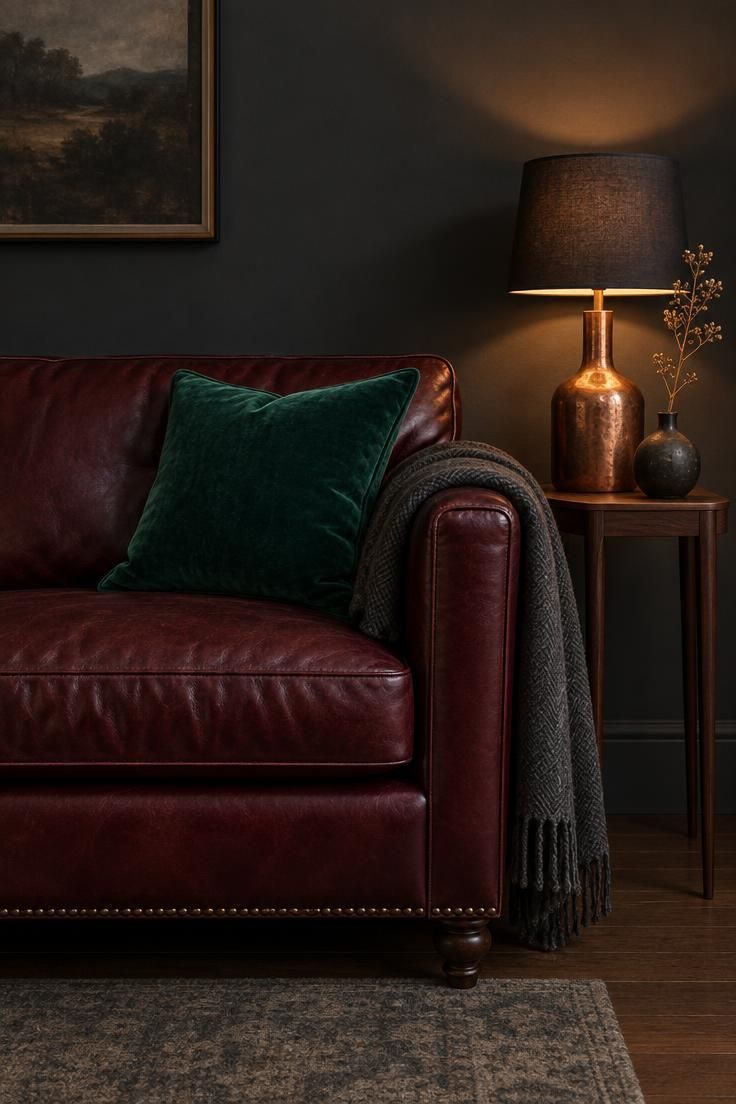
One strong accent carries farther in a dark room than several, because a single saturated note reads across the space while three compete and the mood flattens.
An emerald velvet cushion against oxblood leather, a copper lamp base, a hot-colored artwork, or an amber glass vessel each delivers that pull without disturbing the base palette.
The accent works best when it is the only departure from the room's two or three dominant tones, so choose a color that relates to the base rather than fighting it.
Oxblood and forest green sit close on the wheel and read rich together, while brass and copper accents warm a charcoal or ink scheme.
Swapping the accent is also the cheapest way to refresh the room later, since a cushion, a throw, or a vase carries the change on its own.
In a rental, a throw or a vessel provides the same punch with nothing fixed to the walls.
Style Blueprint:
- A deep base palette of two or three tones
- One saturated accent in velvet, copper, or glass
- A warm lamp to bring out the accent's depth
Design Pro-Tip: Check the accent in grayscale before committing, since a color that reads clearly without hue will read clearly in low light too.
Gallery Grid of Dark-Toned Art
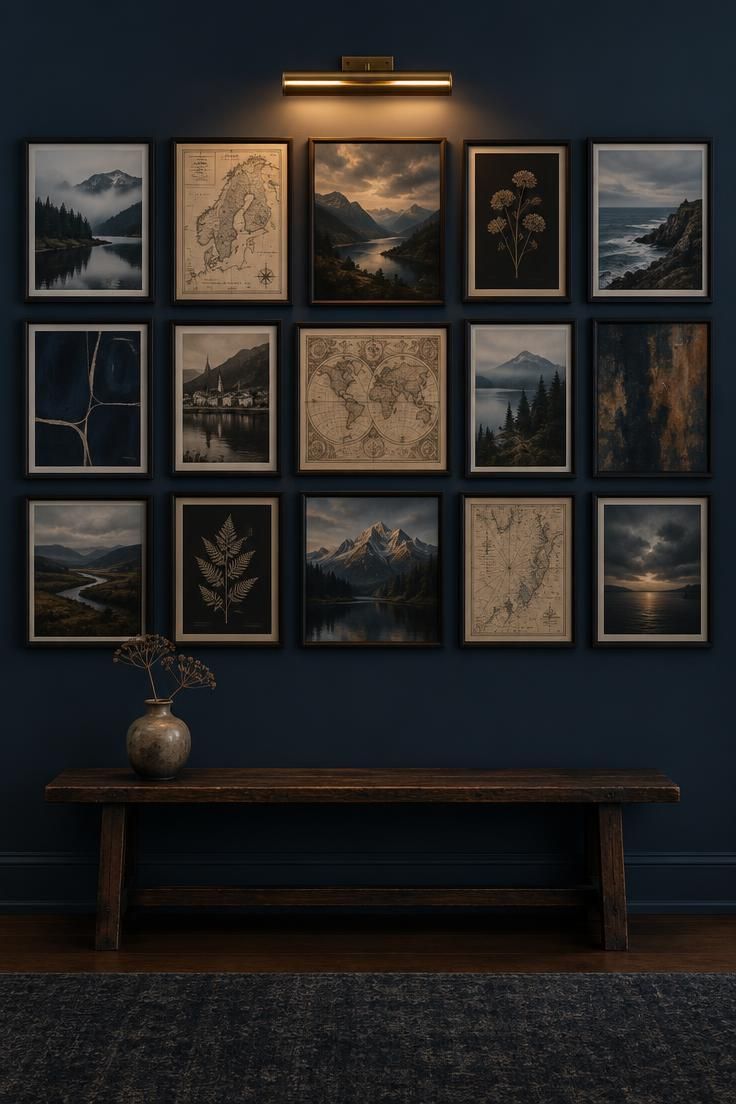
A densely hung grid of dark art turns one wall into a focal plane, and the composition does more for the mood than the individual subjects.
Dark frames disappear into a dark wall so the images themselves carry the shape, while brass or warm-wood frames catch the light and add small points of glow.
Add a picture light above the grid to make the whole arrangement read as a lit plane rather than a shadow.
Consistency is what makes a grid work: matched frames, even spacing, and a deliberate outer boundary keep the composition from drifting.
This takes planning.
Lay the frames out on the floor first to test the arrangement, and measure the gaps between them so the rows stay true.
For rentals, removable adhesive strips can hold lighter frames without fixed hardware.
Style Blueprint:
- A tight grid of dark or moody prints on one wall
- Matched dark frames for a disappearing edge
- One or two warm-wood or brass frames for contrast
- A picture light to wash the plane
Vinyl Collection with Warm Halo Lighting
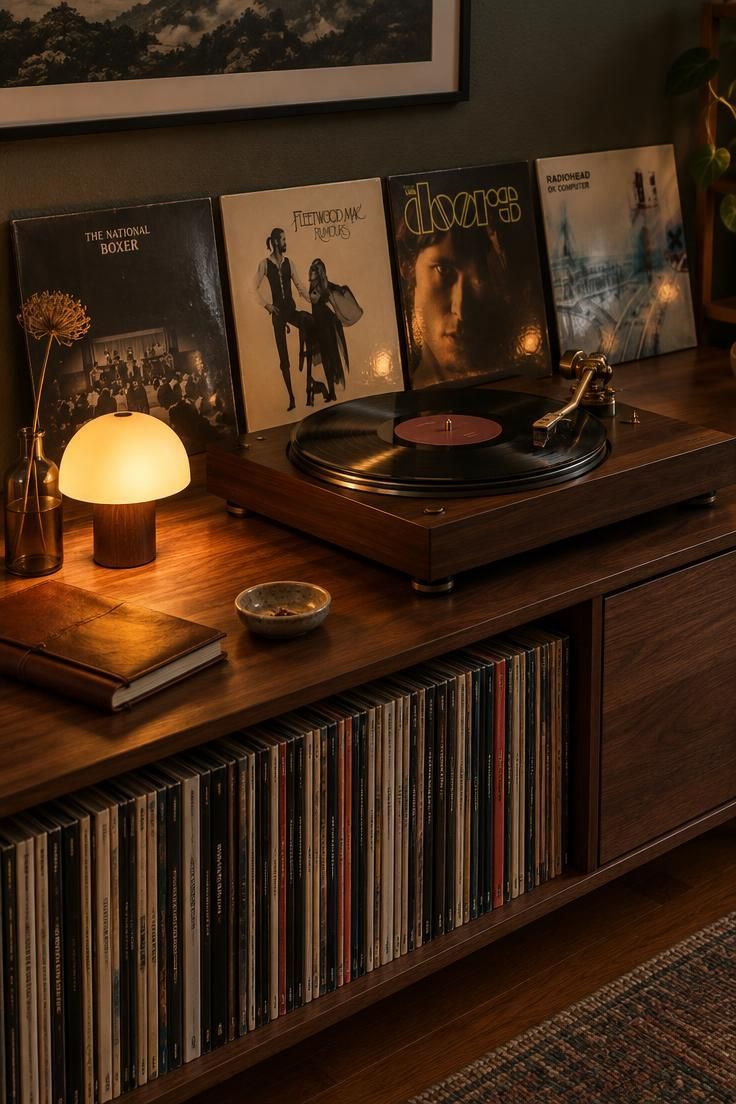
A record collection gives a room its identity faster than almost any other object, and the visual repetition of spines and covers reads as texture from across the space.
Display a few sleeves face-out and store the rest spine-out in a low shelf, so the collection shows without turning into a wall of noise.
A small warm lamp placed beside the turntable creates a halo that centers attention on the console and lets the surrounding wall fall away.
Leave air around the turntable and the face-out covers rather than filling every surface, since the gaps are what make the display legible.
Vinyl prefers a stable, level surface and protection from direct heat, so keep the console away from radiators and out of steady sun.
A felt brush and a simple sleeve habit keep records clean, and a low shelf at seated height makes browsing part of the ritual.
Style Blueprint:
- A console or low shelf in dark walnut or blackened wood
- One small warm lamp beside the turntable
- A few album covers displayed face-out
- Storage below for the rest of the collection
Conclusion
A retreat like this comes together through the relationship between color, light, and texture rather than any single purchase.
Begin with the envelope, walls and ceiling in tones that sit close together, then layer warm light at several heights so the room can shift from one pool of glow to full illumination.
Choose one or two anchors, a leather chair, a wall of shelving, a record console, and let the smaller pieces support them instead of competing.
Leave room for the eye to rest and for light to fall away into shadow, because the falls are what give the room its depth.
From a single chair under a lamp to a full wall of records, each decision earns its place in the final glow.