This post may contain affiliate links. If you make a purchase through these links, we may earn a commission at no additional cost to you.
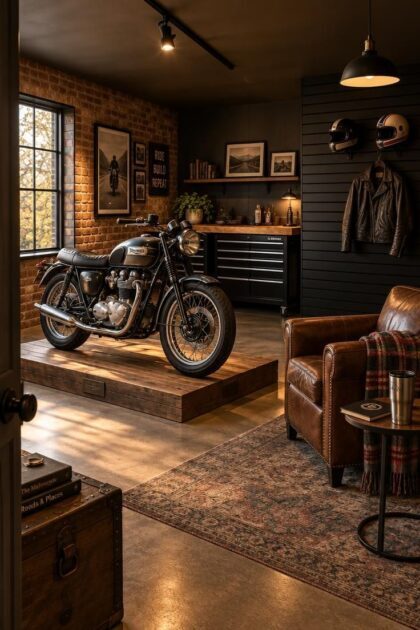
A motorcycle man cave works when the bike becomes the room’s organizing object instead of another parked machine.
Riding gear, memorabilia, seating, and lighting should all orbit that central decision.
The goal is a room that looks interesting on its own terms, not a storage bay with a couch pushed into the corner.
Each concept below treats the motorcycle as a visual anchor and builds everything else in support of it.
Adapt the materials, palette, and layout to the space and light you already have.
Single-Bike Gallery on a Low Platform
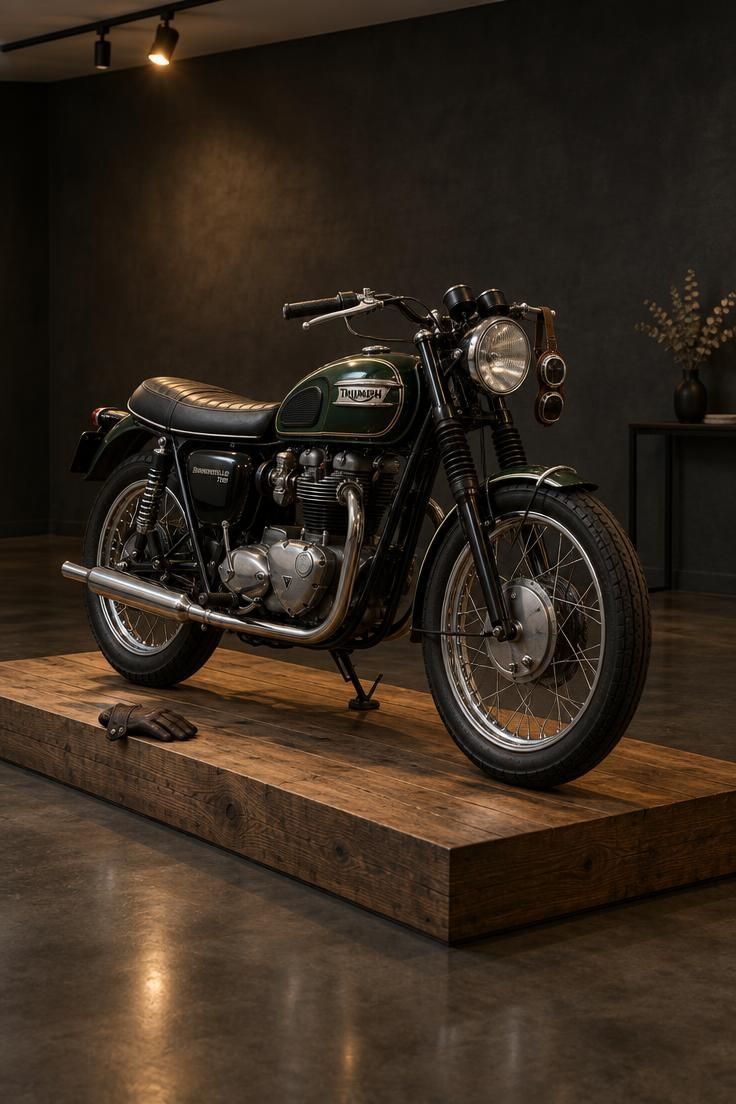
A low platform or a dark rubber mat can anchor one end of a motorcycle man cave, giving the bike a defined footprint without turning the floor into a stage set.
Plain matte walls in greige or charcoal let the machine’s lines carry the visual weight, since busy wall treatments compete with chrome, paint, and exposed engine parts.
One adjustable track head aimed at the bike, with other light sources dimmed, controls what a visitor notices first when the door opens.
Open floor around the platform matters more than most people expect, because walking room on all sides is what separates a gallery from a parking spot.
This arrangement rewards a clean, detailed motorcycle that looks good from multiple angles.
A rough project bike with mismatched panels or an active oil weep may not earn the gallery treatment, and that is a reasonable reason to choose a different concept.
Dust shows quickly on a displayed machine, so a simple cover or a weekly pass with a soft duster keeps the finish presentable.
The palette stays disciplined here: charcoal walls, dark floor, and whatever colors the motorcycle itself brings.
Style Blueprint:
- Low wooden or black rubber display platform sized to the bike’s footprint
- Single adjustable track-light head aimed at the tank and engine
- Matte charcoal or greige wall paint in a flat finish
- One small console or plinth for a helmet, glove, or dried arrangement
Rider’s Lounge with Leather Club Chairs and a Bar Cart
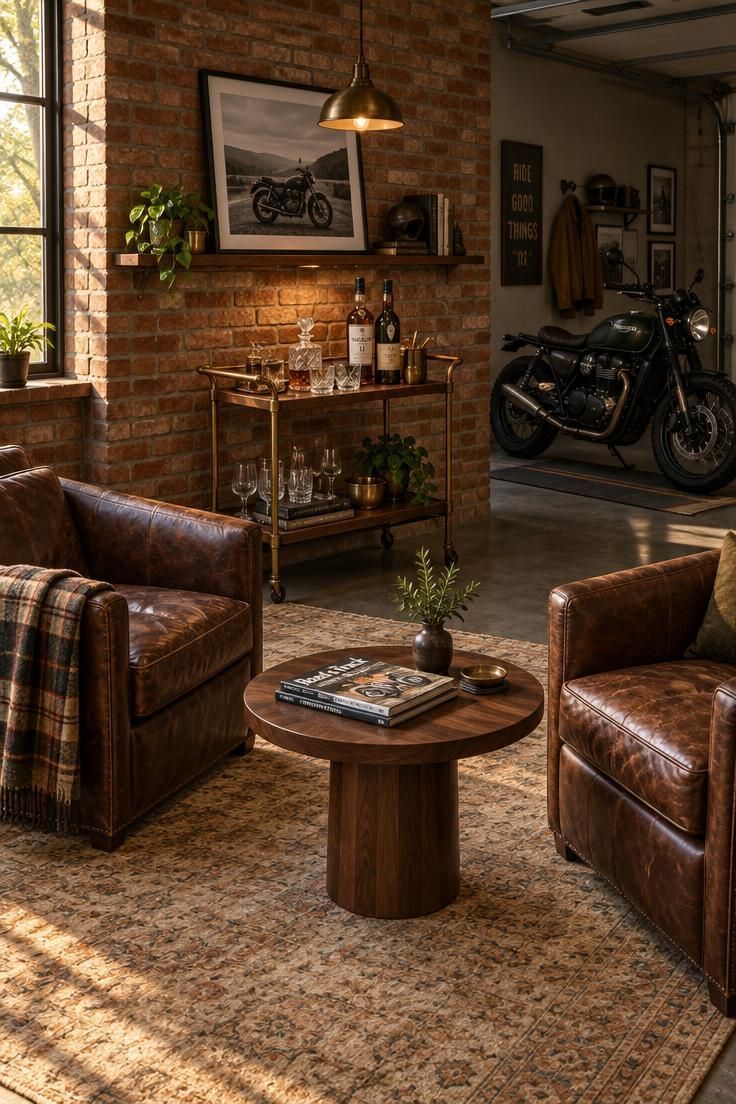
Social function comes first in this layout, which means the seating faces itself rather than the motorcycle.
Two or three deep chairs arranged around a side table create a conversation zone, while the bike sits along a side wall or in a corner where it stays visible without pulling attention away from guests.
A bar cart or narrow sideboard against one wall gives the room a reason to exist beyond display, and it holds glassware, bottles, and a few coasters without demanding much floor space.
The rug does quiet structural work here.
It anchors the seating group and marks a boundary between lounge floor and bike floor, which helps the room read as two zones even in a single open rectangle.
Keeping upholstery and rug tones in the same neutral family as the bike’s paint produces a calm, unified look; a bright patterned rug under brown leather can fight the machine for attention.
Leather requires occasional conditioning and a shaded spot, since direct sun over time dulls the finish and dries the surface.
Style Blueprint:
- Two or three leather club chairs or deep armchairs
- Round side table in walnut or dark oak
- Brass-and-wood bar cart with glassware and a decanter
- Large flat-weave wool rug in a warm neutral
- One framed motorcycle wall art print
Design Pro-Tip: Face the seating toward itself, not the bike, so the room works for conversation and the motorcycle becomes a backdrop rather than a barrier between guests.
Working Garage Lounge with Tool Storage and Seating
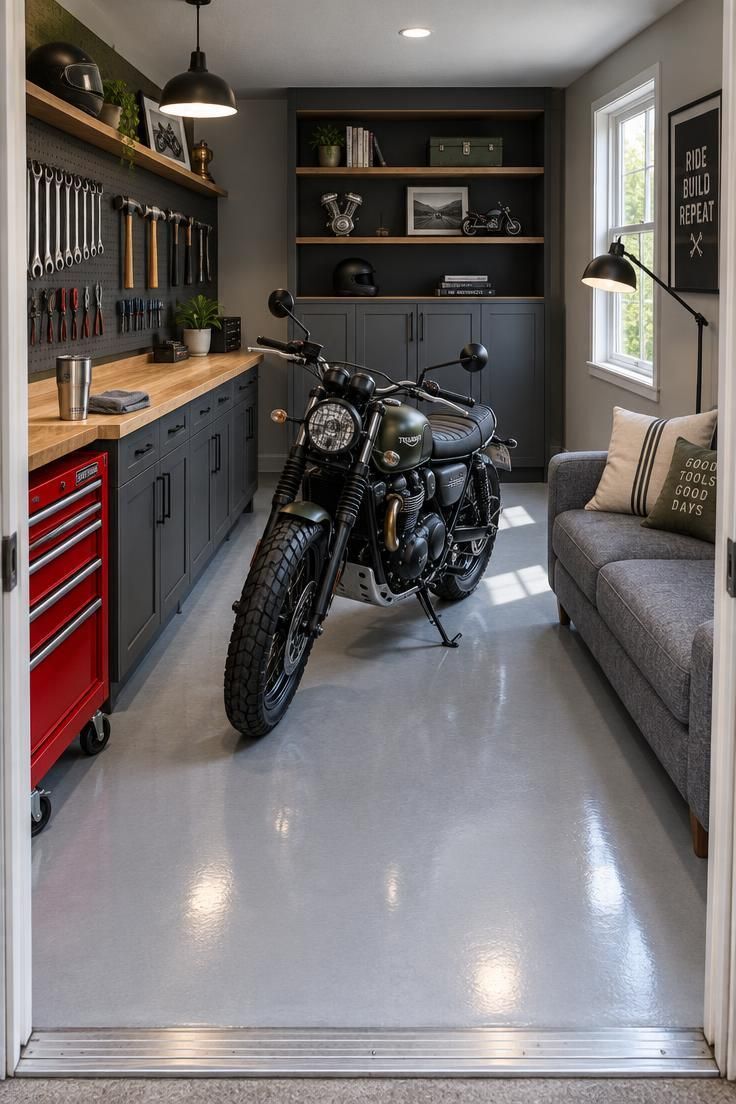
This concept suits someone who actually turns wrenches and wants the room to reflect both uses.
A workbench and rolling tool chest along one wall handle maintenance, while a small sofa or bench opposite handles the hanging out.
Angling the bike between the two zones keeps it reachable from the bench side and still presents well from the seating side, which is the practical compromise that makes a dual-purpose room work.
Flooring choice drives how the space ages.
Interlocking garage tiles or a sealed concrete floor wipe clean after oil drips and road grime, while a plush rug in the work zone would need constant replacement.
A floor lamp or pendant over the garage lounge seating keeps that half from feeling like a workshop after dark, and closed cabinets under the bench hide the unglamorous supplies that otherwise undo the whole look.
Pegboard above the bench should hold only the tools worth showing; the rest belongs behind a door.
The tradeoff is maintenance discipline.
A working garage collects dust, debris, and overspray, and a displayed motorcycle in that environment needs more frequent dusting than one in a dedicated display room.
Positioning the bike away from active cutting or spraying areas limits how much settles on it.
Style Blueprint:
- Butcher-block or steel workbench with closed lower storage
- Rolling tool chest in a color that ties to the room
- Low sofa or bench in durable upholstery for garage lounge seating
- Sealed concrete or interlocking tile flooring
- Pegboard or slat panel above the bench for display tools
Helmet and Jacket Display Wall Above a Slat System
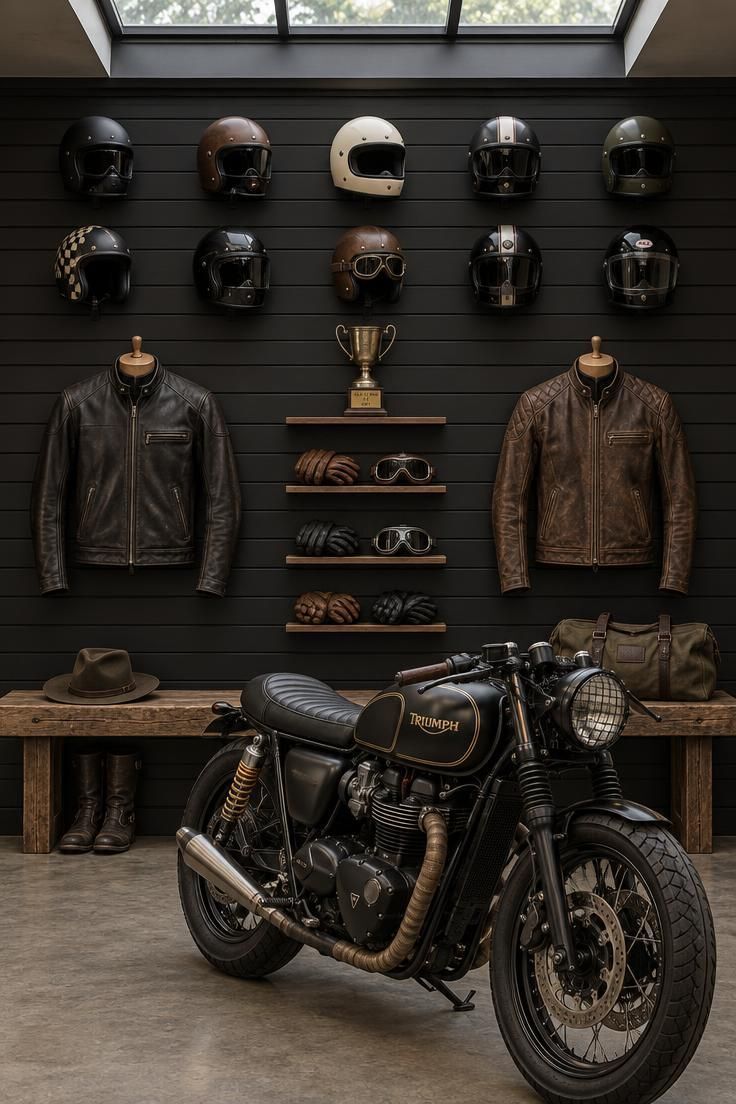
A slat wall or pegboard system turns functional storage into a decorative composition while keeping daily riding gear within reach.
Hanging helmets on hooks and jackets on simple forms creates a repeating grid that reads as intentional rather than incidental.
Alternating hooks with small shelves for gloves, goggles, and a trophy adds rhythm so the wall does not look like a single flat plane of identical items.
Monochrome discipline makes this idea work.
Black and brown gear on a black slat wall looks deliberate, while a wall mixing unrelated knickknacks, souvenir mugs, and loose tools looks like a catchall.
That said, one contrasting piece, such as a cream or white helmet, gives the eye somewhere to land.
The motorcycle parked in front of the wall completes the composition by connecting the displayed gear to the machine it belongs to.
Open display systems require regular tidying, which is the price of visibility.
A closed cabinet would hide the mess but also hide the collection, so most riders end up with some of each: gear on the wall, spare parts and cleaners behind a door.
Style Blueprint:
- Black slat wall or pegboard panels covering one full wall
- Helmet hooks alternated with narrow display shelves
- Low wooden bench for boots and bags
- Two jacket forms in simple wood or steel
Vintage Motorcycle Decor with Fuel and Oil Signage
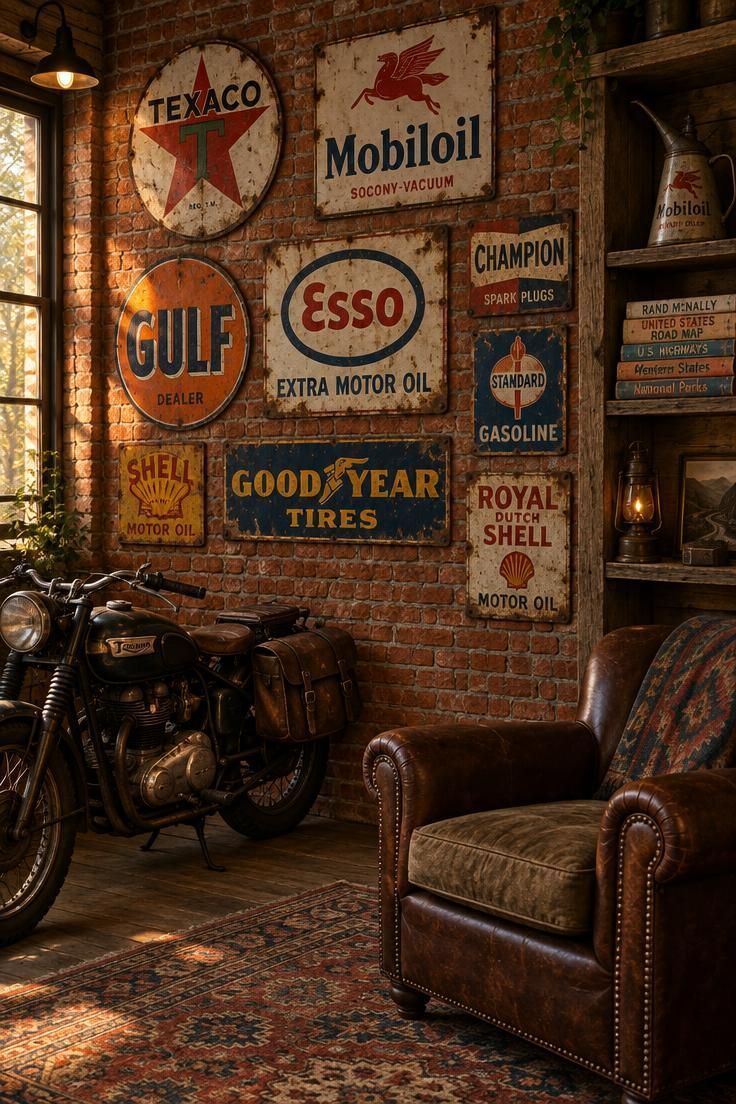
Warm nostalgia drives this corner, and the palette stays limited to rust, amber, cream, and brown.
Layered vintage signage on brick gives the wall depth and history, but the bike should sit beside the wall rather than under the signs so each element gets its own moment.
Reclaimed barnboard shelving and a small side table in old wood carry the same aged character through the rest of the room.
This approach flatters older motorcycles that already show patina.
A modern sportbike with sharp graphics can feel out of place against chipped porcelain signs and worn leather.
Patience helps here too: vintage motorcycle decor is usually assembled over time from flea markets, estate sales, and swap meets rather than purchased in one trip, and a wall of mismatched reproductions tends to look flat next to genuine aged pieces.
Leather and canvas seating suits the theme, and both materials benefit from being kept away from direct sun and temperature swings, which dry and fade them over time.
Style Blueprint:
- Vintage porcelain fuel and oil signs in rust and cream tones
- Reclaimed barnboard shelving
- Worn leather club chair or canvas campaign chair
- Faded oriental or flat-weave rug
- Antique oil can or tool as a shelf accent
Modern Industrial Room with Blackened Steel and Concrete Look
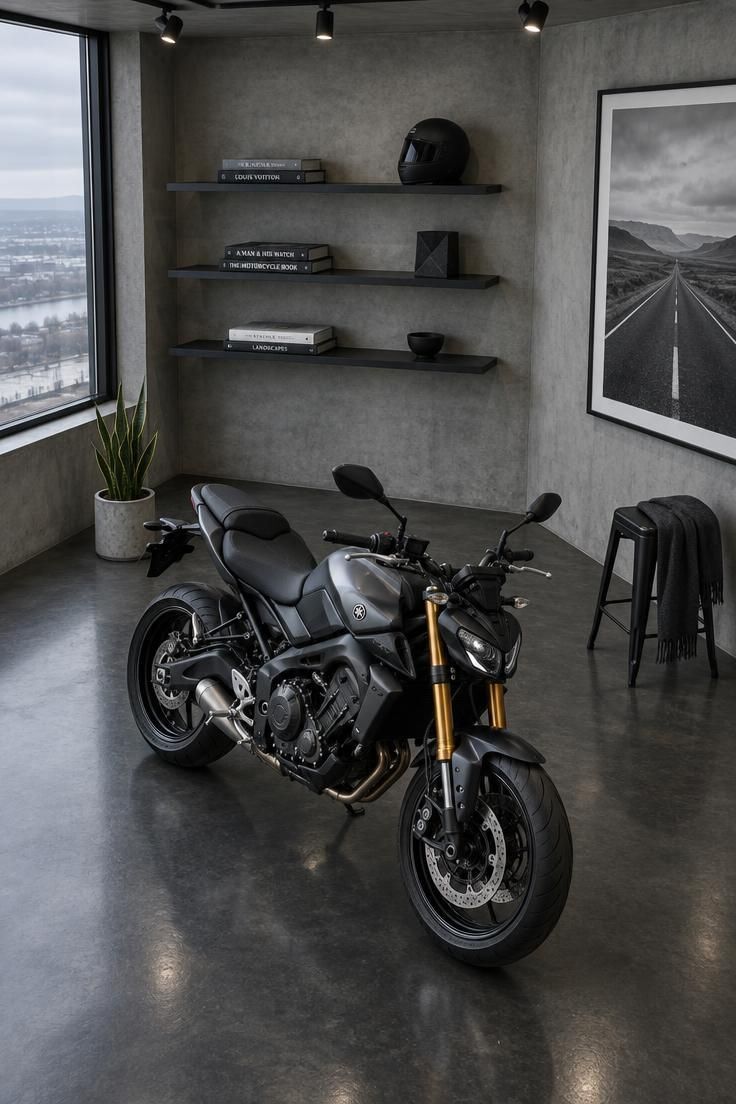
Restraint defines this direction.
Blackened steel shelving, concrete-look surfaces, and minimal decor let a contemporary motorcycle read as a design object rather than a themed prop.
The room stays open and uncluttered, with perhaps one large framed black-and-white photograph as the only wall piece and a single stool completing the scene without softening the mood.
Lighting behaves differently here than in the warmer concepts.
Bright, even illumination from an overhead panel or a row of track lights suits the cool palette better than a warm spotlight, which can make gray concrete look muddy.
This is also the least forgiving concept for clutter, since a single stray box or tangled extension cord breaks the whole composition.
The look suits newer machines with sharp lines and a technical appearance.
An older bike with patina may look out of place against polished concrete and blackened steel, so matching machine character to room character matters more here than in most other ideas.
Style Blueprint:
- Concrete-look wall or floor finish in cool gray
- Blackened steel floating shelves
- One large framed black-and-white road photograph
- Single black metal stool
Race and Track Theme with Checkered Graphics and Numbers
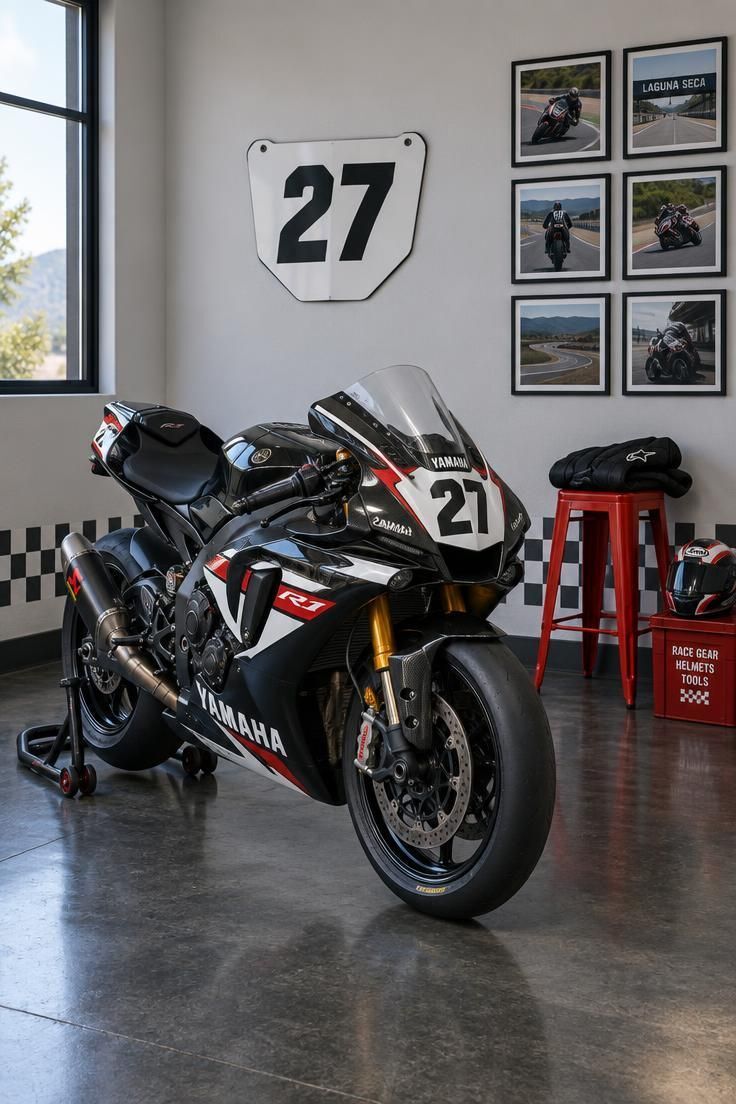
Race graphics bring energy to a room, and the checkered motif works best when confined to a floor border or a single wall stripe rather than covering every surface.
A racing number plate mounted behind the bike ties the machine to the theme directly, and a small grid of track-day photographs in matching black frames extends the story without visual noise.
Background walls should stay simple so the graphics do not compete with the motorcycle’s own livery.
One or two bright accents, in red or yellow, give the eye a focal point when the rest of the palette is black, white, and gray.
A bar stool or storage bin in a single accent color is enough.
This concept fits a sportbike or a track-prepped machine and tends to feel mismatched with a classic cruiser.
It also demands tidiness, since graphic schemes show clutter more readily than warm, layered rooms do.
Style Blueprint:
- Checkered floor border or wall stripe in black and white
- White racing number plate mounted behind the bike
- Black-framed track-day photo grid
- One bright accent piece in red or yellow
Touring Map Wall with Pinned Route Lines and Photos
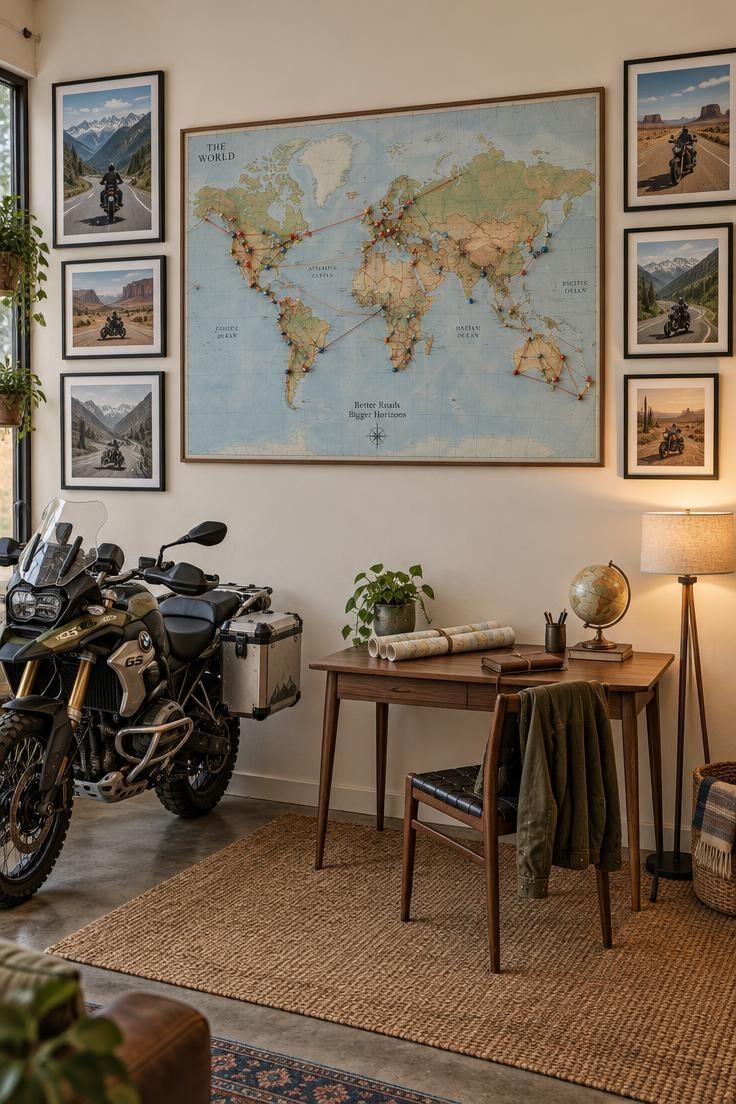
Road-trip storytelling gives this wall its purpose.
Pinning routes with colored string or marking destinations on a large map turns travel history into a display rather than a photo album in a drawer.
Framed ride photographs clustered around the map extend the narrative, and a slim desk or console below holds maps and a journal for planning the next trip.
Leather and linen textures echo the touring theme and keep the palette warm but earthy.
Any motorcycle works here, but a dual-sport or adventure bike with visible luggage and road dust looks most at home.
The layout does require wall space and accepts the fact that the map will keep growing, so leave room around the edges for new pins, string, and photographs as trips accumulate.
Sun exposure is worth considering for anything hung near a window, since printed photographs and paper maps fade over time in direct light.
Style Blueprint:
- Large wall map with pins and string for route marking
- Black-framed ride photographs in a loose gallery cluster
- Slim walnut desk or console for maps and a journal
- Linen-shaded floor lamp
- Woven jute or flat-weave rug
Design Pro-Tip: Angle the motorcycle slightly toward the room’s entrance rather than parking it parallel to the wall, so visitors see the front three-quarter view first and walking room stays open behind it.
Small-Space Single-Wall Vignette with a Motorcycle Lift

Limited square footage does not rule out the concept, it just narrows the composition to one wall.
Raising the bike slightly on a lift or stand creates a subtle platform effect and makes the machine easier to work around, while a narrow shelf above doubles as a helmet display shelf with room for one helmet and one plant without crowding the bike below.
A single large piece of motorcycle wall art on the adjacent perpendicular wall expands the vignette in the viewer’s mind without occupying floor space.
Seating stays minimal here, one stool or a narrow bench that moves out of the way when the bike leaves for a ride.
An exposed brick garage wall adds texture and warmth to what would otherwise be a plain concrete rectangle, and it pairs naturally with wood shelving and black metal accents.
The tradeoff is that everything on display has to earn its spot.
With one wall and a tight footprint, a second helmet or a pile of loose gear tips the composition from deliberate to cramped.
Style Blueprint:
- Small motorcycle lift or stand for a raised display line
- Narrow wood shelf holding one helmet and one plant
- Large framed motorcycle print on the adjacent wall
- Single movable stool or bench
Multi-Bike Collector’s Arrangement with Distinct Floor Zones
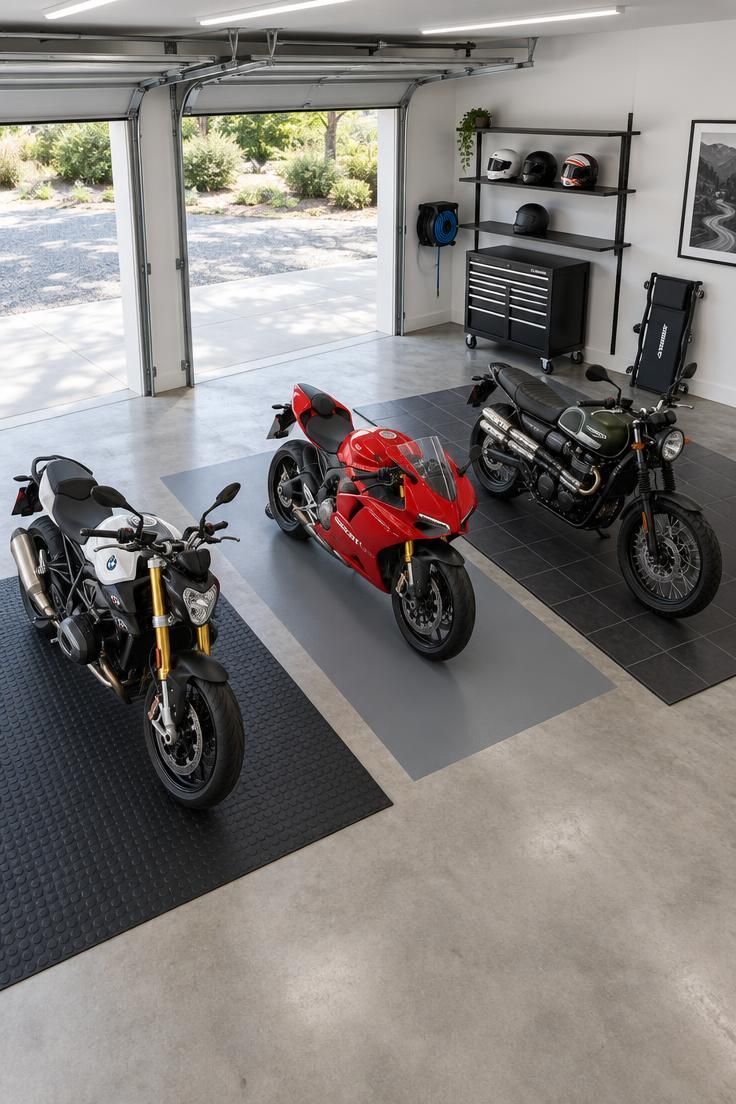
Displaying more than one motorcycle is a spacing problem as much as a design one.
Giving each machine its own floor zone, marked by a different mat, painted rectangle, or tile platform, keeps the arrangement from collapsing into a parking lot.
Angling the bikes slightly and staggering their positions ensures no machine is entirely blocked by the one in front of it.
Walls and storage stay minimal so the machines remain the focus.
Clutter control becomes the main discipline: a single loose oil pan or spare tire in the middle of the floor undoes an otherwise deliberate arrangement.
This is the highest-commitment concept of the set, and the one most likely to grow, so leaving a little extra floor space between zones now makes room for a fourth machine later without rearranging everything.
Style Blueprint:
- Distinct floor treatment for each bike’s zone
- Plain walls with minimal shelving
- Staggered or angled bike placement for sightlines
- Rolling tool chest or helmet shelf on one side
Conclusion
A room built around a motorcycle starts with one decision: what role the machine plays.
Gallery centerpiece, working companion, and social backdrop each lead to different choices in lighting, seating, flooring, and storage.
From there, the walls, displays, and furniture follow logically.
Use these concepts as a visual menu, mixing pieces that fit the light, square footage, and riding habits you already have, and let the room grow as the collection and the memories do.