This post may contain affiliate links. If you make a purchase through these links, we may earn a commission at no additional cost to you.
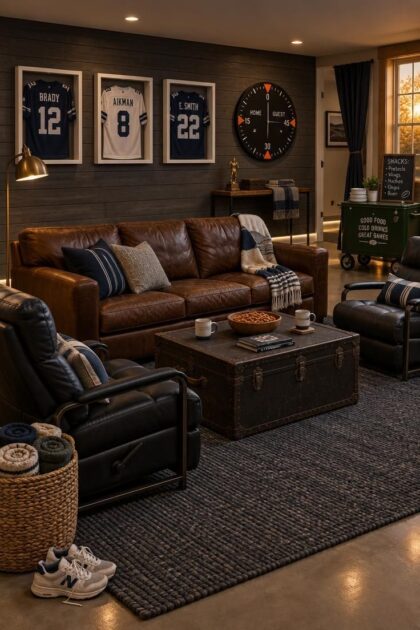
A football man cave can lean two visual ways: American gridiron with helmets, yard lines, and scoreboard cues, or soccer with scarves, matchday stubs, and pub-style wood.
Both read as football because the room is built around one viewing wall, one team palette, and a few strong display pieces rather than a pile of memorabilia.
The ideas ahead are about composition first: what fills the frame, how the seating faces it, and which materials keep the room feeling like a room instead of a retail display.
Use them as starting points and adapt the team reference or sport to what already hangs in the closet.
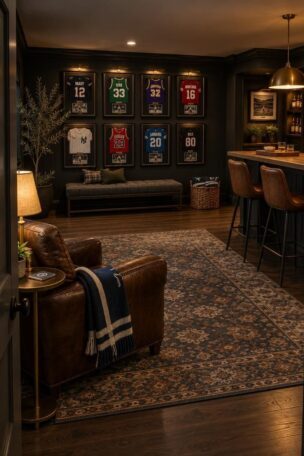
Jersey Shadow Boxes on a Weathered Wood Slat Wall
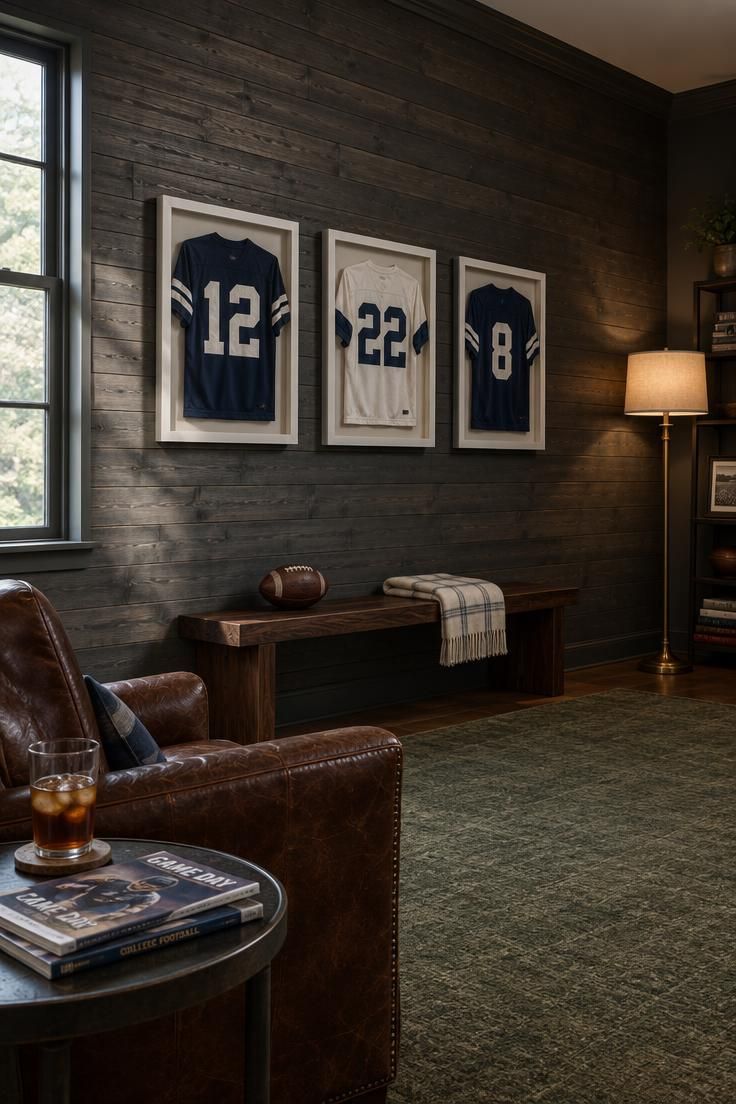
This wall anchors the room with one disciplined display instead of memorabilia scattered across every surface.
Horizontal slats in a gray stain give the frames a quiet textured field, so navy and white fabric becomes the loudest element without a bright paint color competing behind it.
Three to five boxes is the useful range: enough to read as a collection, few enough that each jersey keeps its own presence in the frame.
Matching shadow boxes with an even gap between them create a stepped rhythm, and that regularity does more for the wall than any single frame style.
Below the frames, a low bench or console earns its keep as a landing spot for a vintage leather football, a folded stadium blanket, or a drink during halftime.
This layout suits a narrow room or a stair-side wall where a full seating arrangement will not fit, and it gives the television wall a memorabilia anchor that does not compete with the screen for attention.
A jersey display wall like this one also makes the room legible from the doorway, which matters in a basement where the first three steps of the staircase frame the view.
Style Blueprint:
- Dark gray horizontal wood slat paneling across one full wall
- Three matching white shadow boxes sized to the jerseys, spaced evenly
- A low dark walnut bench beneath the frames
- A vintage leather football and a folded cream wool blanket as bench props
- A brass floor lamp with a linen shade for warm corner fill
Design Pro-Tip: Hang jersey frames so the middle of each box sits near eye level, then center the bench below the middle frame so the whole wall reads as one composition rather than three separate objects.
Double-Wide Recliner Row with Stadium Armrests
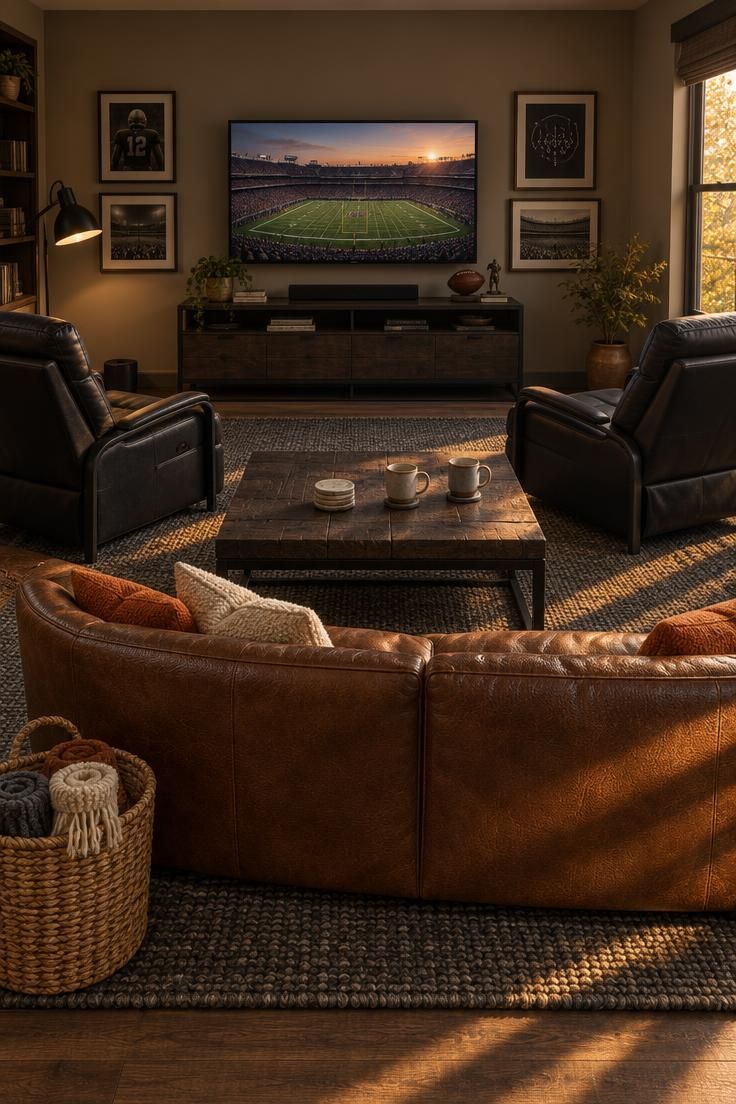
The main viewing row works best when the seating reads as one horizontal band rather than a collection of mismatched chairs.
Two wide recliners flanking a leather sofa, all with dark metal armrests, borrow the visual language of a stadium seat row without recreating a bleacher.
Pebbled leather against black powder-coated metal supplies the material contrast, and throw pillows in the team accent color carry the palette without repainting anything.
Keep the row to five seats or fewer in a small room; beyond that, the sight lines to the screen start to break and the back row loses the room.
A chunky woven rug under the row marks the viewing zone and adds a soft surface that helps with foot traffic noise during a close game.
Set the grouping back from the screen so the proportions feel right: the screen should occupy a comfortable share of the wall, and every seat should have a clear path to the coffee table without leaning forward.
This layout earns its place on long game days because each seat has a sight line and a shared surface for drinks, snacks, and the remote.
Style Blueprint:
- A brown leather sofa with a low, deep seat
- Two wide recliners with dark metal armrests
- A charcoal woven rug sized slightly larger than the seating footprint
- Two sets of throw pillows in the team accent color
Design Pro-Tip: Angle the two outer recliners inward by a few degrees so they face the screen without breaking the horizontal line of the row.
Locker Room Storage with Wire Baskets and a Slatted Bench
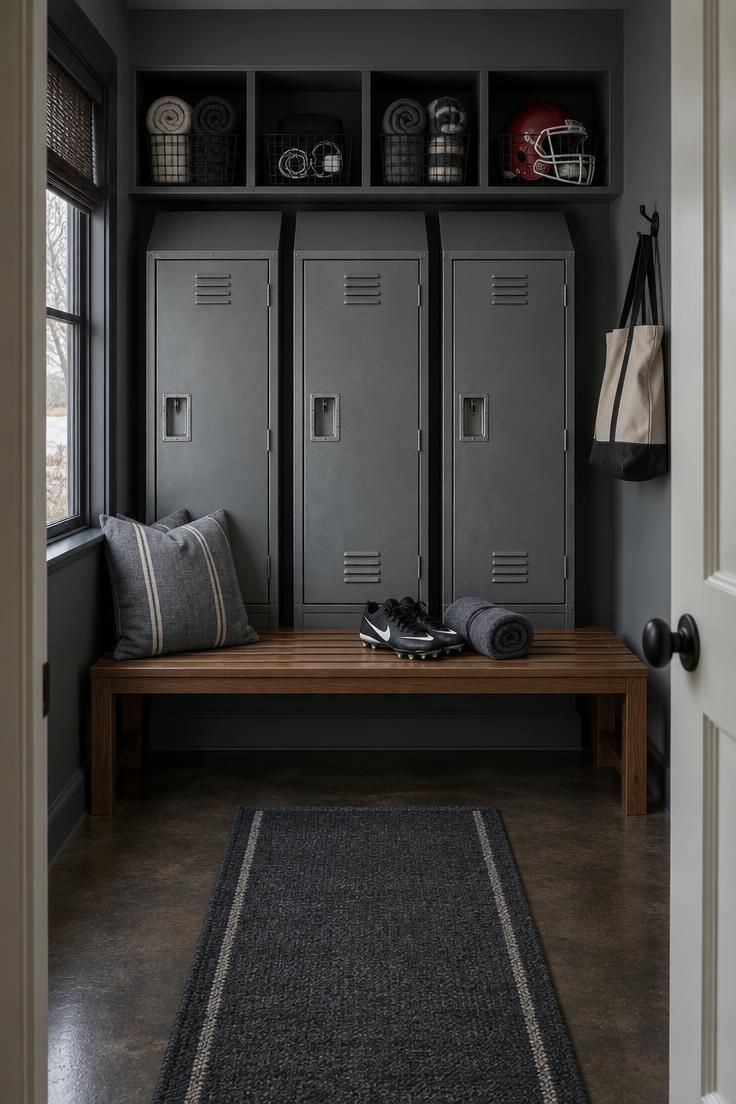
One side wall can handle locker room storage without turning the whole room into a gym.
A row of matte gray lockers or locker-style cabinets with angled tops gives the space its football cue, while open cubbies lined with metal wire baskets hold game-day blankets, charging cords, and the small clutter that otherwise migrates to the coffee table.
Place a slatted teak or pine bench in front and top it with canvas cushions in a team color.
Paint the wall behind the lockers a slightly deeper shade of the same gray so the metal units blend rather than dominate the composition.
This arrangement provides enclosed storage for remotes and cables while leaving one shelf open for a helmet or a pair of cleats, which keeps the display honest without crowding it.
In a small room the bench and lockers can replace a cluttered entry table entirely, and that trade is usually worth making.
Locker room storage like this does collect dust on the open shelves, so plan on a periodic wipe-down; if that becomes a chore, closed cabinet doors read cleaner but hide the collection.
Style Blueprint:
- Three matte gray locker-style cabinets with angled tops
- Four open cubbies lined with black wire baskets
- A wood slatted bench in front with canvas cushions
- A deeper gray paint on the wall behind the lockers
- One open cubby reserved for a helmet or cleats
Design Pro-Tip: Keep the wire baskets in a single metal finish and a single size, then vary only what goes inside them so the row stays visually quiet.
Turf Green Rug with Painted Yard Lines and a Coffee Table
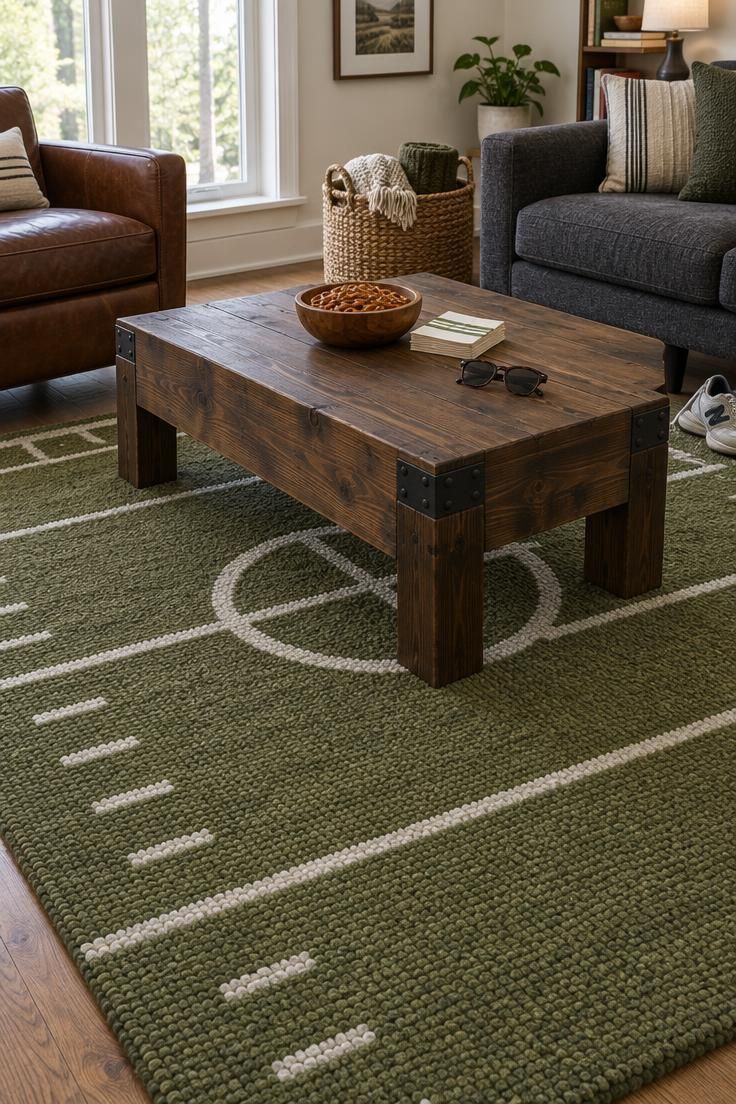
Flooring is the most reversible place to put a football reference, and a turf green rug does the job without committing to green carpet or wall paint.
Choose a low-pile indoor-outdoor rug with a tight loop in a green that leans moss rather than neon; the duller tone reads as a field, while a bright synthetic green reads as a putting mat.
Keep the rug slightly larger than the seating footprint so it registers as a field zone instead of a small mat floating under the table, and run the white yard-line stripes parallel to the main viewing wall so the midfield circle sits under the coffee table.
A dark-stained pine trunk with metal corner brackets works as the table because it is big enough for a game-day spread but low enough not to block the screen from the sofa.
This idea ties the seating row to the floor and rolls up for storage when team loyalties change or the room needs to read as a plain den.
One practical note: painted stripes on a rug do show spills, so a tight loop pile that can be spot cleaned is a better choice than a plush cut pile.
Style Blueprint:
- A low-pile green indoor-outdoor rug with a mossy, dull tone
- White painted yard-line stripes running parallel to the viewing wall
- A partial midfield circle motif centered under the coffee table
- A dark stained pine trunk coffee table with metal corner brackets
Scoreboard Wall Clock with Metal Channel Letters
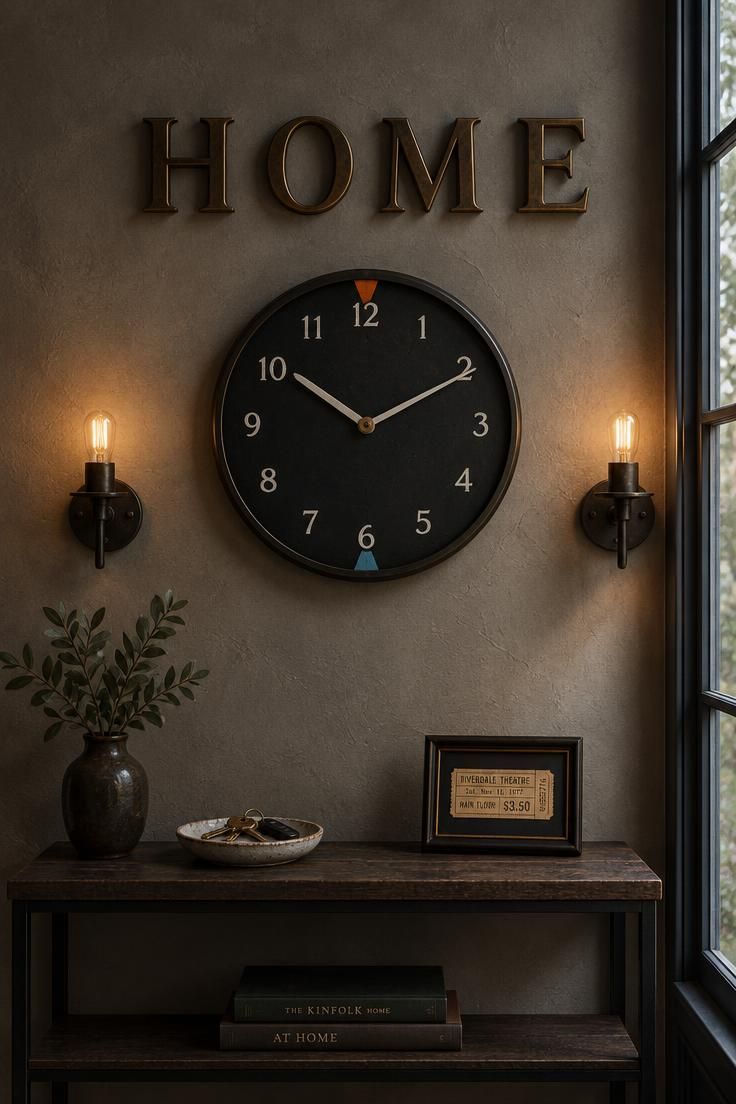
A scoreboard wall clock earns its place by being both a football signifier and the thing that keeps the room on schedule.
Place it on the same wall as the screen or on an adjacent wall where it stays in peripheral view during a game.
The face uses matte black metal with white hand-painted numerals and two small team-color wedges at the top and bottom, which is enough color to tie into the palette without turning the clock into a novelty piece.
Above the clock, three dimensional channel letters spelling a short word like HOME or a team nickname in dark bronze or blackened steel create a strong horizontal band at eye level.
That band gives the wall weight without adding another screen, which matters in a room where the main display already draws every glance.
Channel letters in a metal finish catch light along their edges, so they read well in a low-lit room while staying visually quiet in daylight.
The clock can be flanked by two simple black wall sconces to balance the composition, and a narrow console underneath gives the arrangement a base.
Style Blueprint:
- A black circular wall clock with white numerals and team-color wedges
- Three dimensional channel letters in dark bronze or blackened steel
- Two small black wall sconces flanking the clock
- A narrow console below for keys and a framed ticket stub
Chalkboard Playbook Wall with a Floating Shelf of Play Diagrams
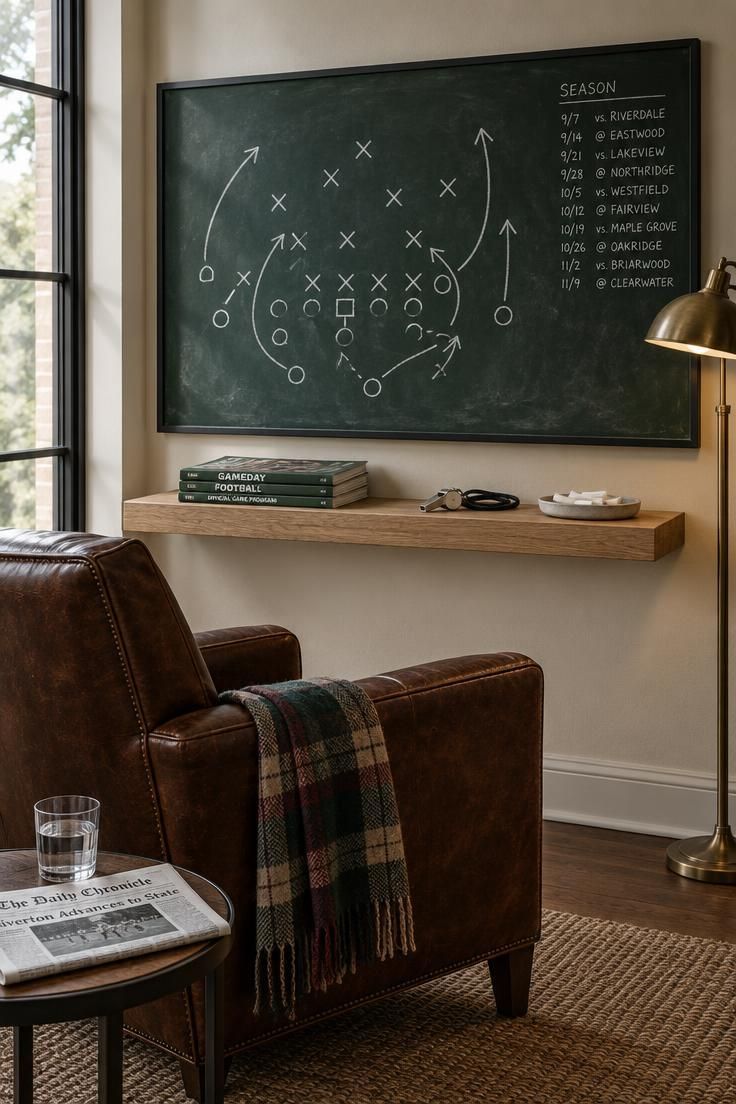
A wall panel finished in dark green chalkboard paint brings a working surface into the football man cave instead of another framed object.
The chalkboard can host a hand-drawn X-and-O play, a season schedule, or a running score from the last game, and it changes with the season.
Dark green recedes behind brighter team accents, which keeps the wall from fighting the seating area for attention.
Mount a floating wood shelf just below the panel to hold stacked game programs, a vintage referee whistle, and a small tray of white chalk; unfinished oak or walnut warms the dark surface and prevents the wall from reading cold.
This idea gives the room a purpose beyond passive viewing, and it gives guests a reason to pause near the wall instead of only facing the television.
Chalk dust is the tradeoff: a felt eraser and a damp cloth keep the shelf and floor tidy, and some people prefer a dry-erase panel for the same reason.
One practical consideration: chalkboard paint shows eraser streaks and hand oils over time, so a panel that can be repainted in an afternoon is easier to live with than a full chalkboard-painted room.
Style Blueprint:
- A dark green chalkboard panel with a thin black frame
- A natural oak or walnut floating shelf below the panel
- A stack of slim game programs and a tray of white chalk
- A leather club chair angled toward the wall with a plaid wool throw
Design Pro-Tip: Keep the chalk tray small and the chalk in one color so the shelf reads as a styled vignette rather than a utility ledge.
Press Box Desk with a Microphone Flag and Three Monitor Stand
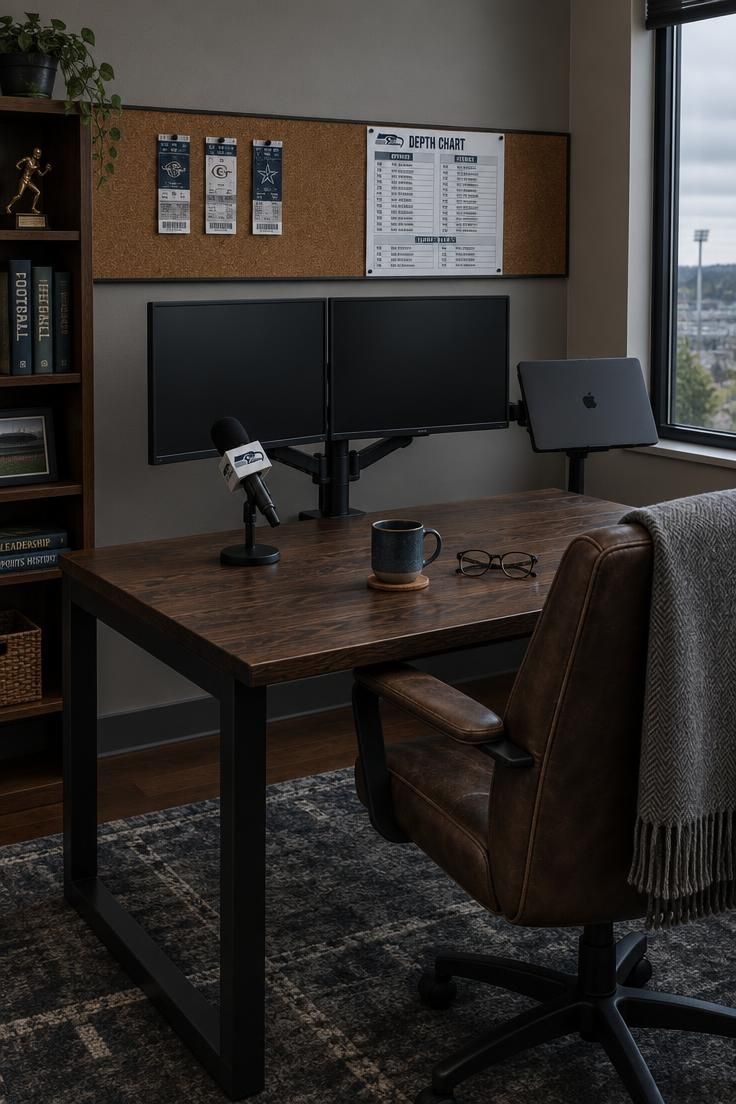
A desk area can borrow from the press box and still keep the room multi-use.
A dark-stained oak desk with a black steel frame placed perpendicular to the main seating lets someone work at the desk while the game stays in view.
On the surface, a short rectangular microphone flag with a small team logo embroidered in white sits on a low stand next to a triple monitor arm holding two screens and a closed laptop.
That arrangement keeps the desk from reading as a home office and gives it a broadcast identity that fits the room.
The wall behind the desk gets a narrow corkboard strip at eye level with a few ticket stubs and a printed depth chart pinned to it.
A setup like this keeps the room useful on non-game days without adding shelves or display cases, and the desk itself becomes a catch-all for remotes, charging cables, and game-day notes.
One limitation worth weighing: a desk and a viewing row compete for the same floor space in a small room, so measure the circulation path between the desk chair and the sofa before committing.
Style Blueprint:
- A dark stained oak desk with a black steel frame
- A desktop microphone with a small embroidered team flag
- A triple monitor arm with two screens and a laptop
- A narrow corkboard strip at eye level with ticket stubs and a depth chart
Tunnel Entry with a Curtained Doorway and Floor Strip Lights
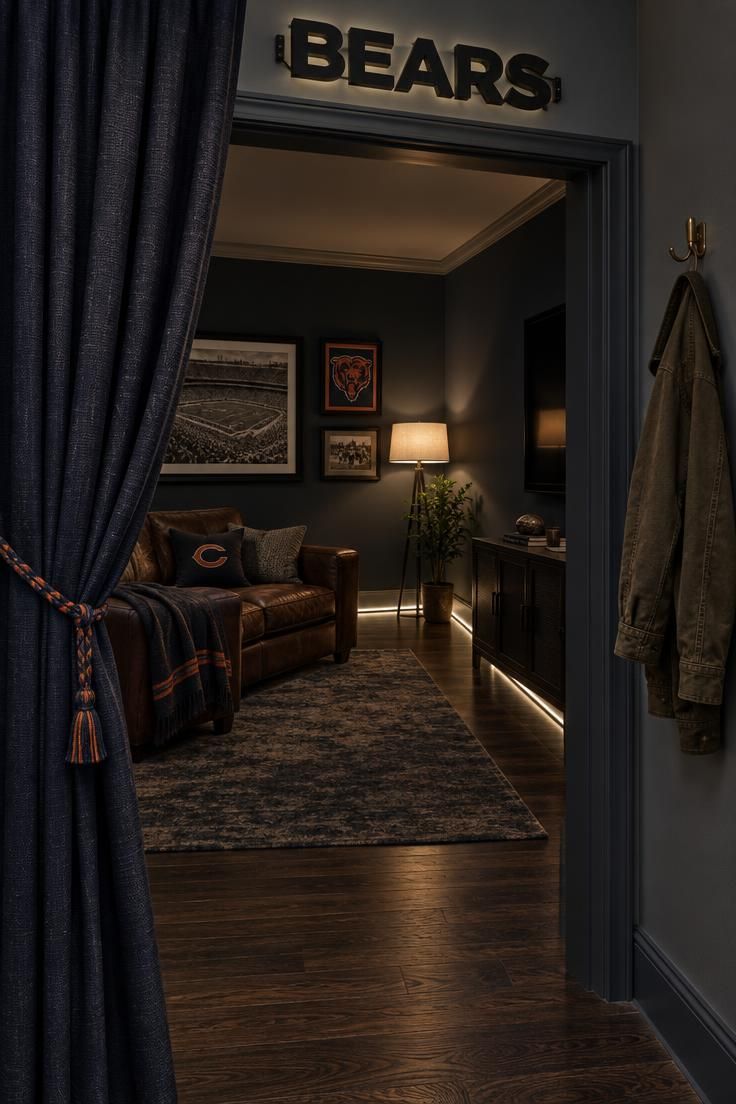
The entry to a man cave can be treated as a one-step tunnel moment without altering the main room.
A wide doorway lined with blackout curtains in a dark team color, tied back with a braided cord, signals that the room is a distinct space with its own mood.
Just inside, a low run of strip lights along the baseboards for a few feet carries the tunnel reference and adds a low glow that stays out of the sight line to the screen.
Keep the color matched to the team or held at a soft white, because a full rainbow effect reads as a party room rather than a den, and a heavy curtain also softens hallway noise when the game is on and the rest of the house is not watching.
Above the doorway on the inside face, a short horizontal metal sign with a team nickname in channel letters completes the tunnel cue and gives guests a threshold to cross.
This idea works best when the room is already a closed-off space, such as a basement door or a converted den, so the curtain has something to frame.
Style Blueprint:
- A dark team-color blackout curtain on a wide doorway
- A braided cord curtain tieback
- A short run of baseboard strip lights just inside the entry
- A horizontal black metal sign with a team nickname above the inside face of the door
Sideline Bench with a Cushion and Helmet Shelf in a Corner
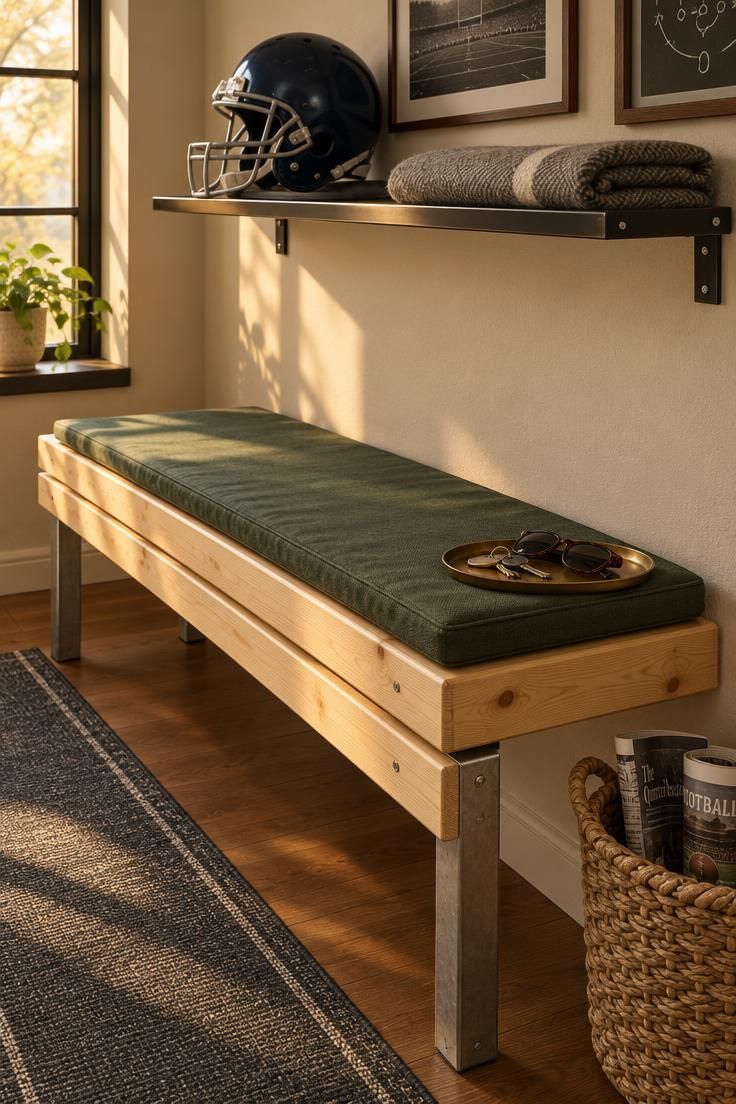
A leftover corner can become a sideline station with a freestanding slatted bench and one narrow shelf.
Use a bench in light pine with double slats and unpainted metal legs, topped with a thin foam cushion covered in heavy canvas dyed a team color.
The light wood keeps the corner from feeling heavy, and the canvas brings a texture that reads as outdoor seating without looking like patio furniture.
Behind the bench, a narrow dark metal shelf at shoulder height holds a single football helmet and a folded game-day blanket.
That one piece of headgear does more for the corner than a crowded wall, and it stays at grab height for guests who want to try it on.
This setup adds one extra seat without the bulk of a chair, and the bench doubles as a drop spot for keys or a backpack when the game is off.
It is also the easiest corner in the room to change if a team palette shifts, since nothing is fixed beyond the shelf.
Style Blueprint:
- A light pine slatted bench with unpainted metal legs
- A thin foam cushion in heavy canvas dyed a team color
- A narrow black metal shelf at shoulder height
- A single helmet and a folded wool blanket as shelf props
Tailgate Corner with a Cooler Cart and Enamelware Food Tray
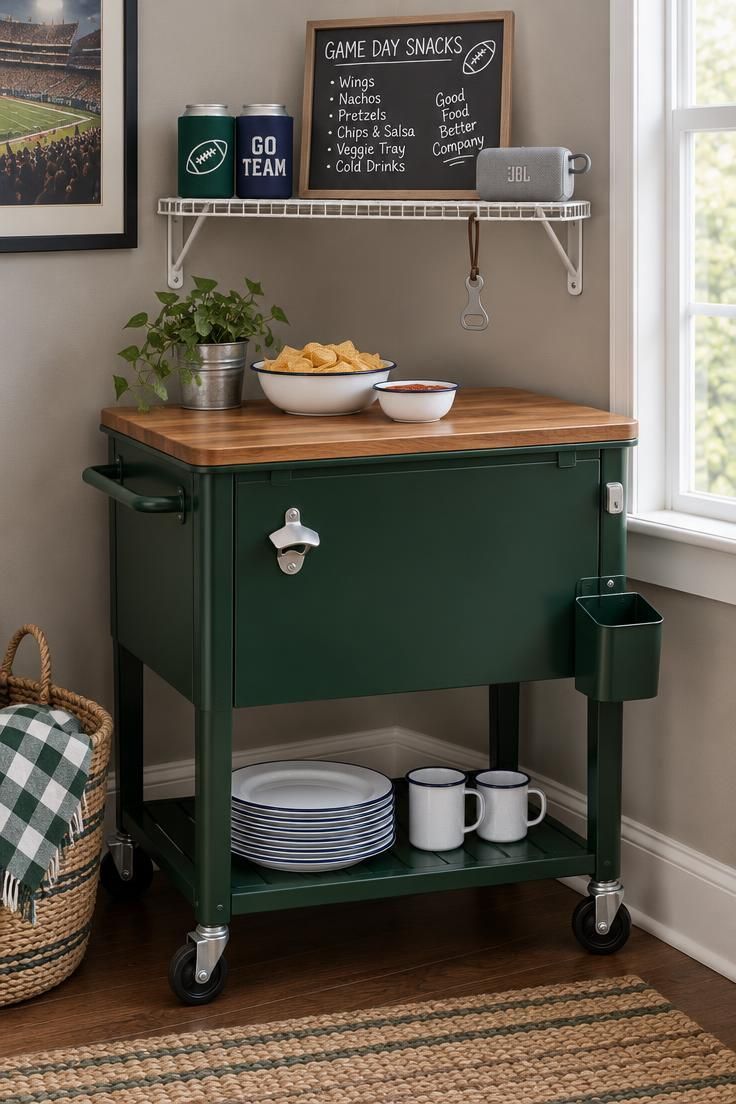
One corner as a tailgate-style snack and drink station keeps food service off the coffee table and out of the seating row.
A dark forest green cooler cart with a wooden top and a lower shelf for a stack of enamel plates sits against the wall, within reach of the sofa but out of the main traffic path.
Above the cart, a single white metal wire shelf holds koozies, a bottle opener on a cord, and a small portable speaker.
The white wire against a warm gray wall adds a clean line that contrasts with the deeper green of the cart.
A miniature chalkboard propped against the back of the shelf can show a hand-lettered game-day snack list, which is easy to rewrite each week.
This corner gives the room a small hospitality moment without a built-in bar or any plumbing, and it keeps drinks and plates on a hard surface instead of the upholstery.
Treat the cart like any kitchen surface: wipe the wood top after spills and keep the enamel stacked on the lower shelf rather than the top, so the cart’s working area stays clear during a game.
Style Blueprint:
- A dark forest green cooler cart with a wooden top
- A lower shelf stacked with white enamel plates and mugs
- A white metal wire shelf above the cart
- Koozies, a bottle opener on a cord, and a small portable speaker
- A miniature chalkboard propped against the shelf with a hand-lettered snack list
Design Pro-Tip: Keep the food cart within arm’s reach of the end of the sofa but off the path between the seating and the doorway, so nobody has to step around it during a close game.
Conclusion
Choose one featured surface or corner first, whether that is the jersey wall, the turf-toned rug, or the scoreboard clock, and let the other details support it.
A single strong football reference usually reads better than a room that tries to include every piece of memorabilia at once.
Reversible choices such as a green rug, a removable chalkboard, or a press-box desk panel keep the room flexible if team loyalties change or a housemate wants a say.
The aim is a space that looks like a dedicated viewing room on game day and still works as a comfortable den the rest of the week.