This post may contain affiliate links. If you make a purchase through these links, we may earn a commission at no additional cost to you.
Moving into a first apartment often begins with a wish list of things to buy.
A minimalist approach flips that instinct and asks a harder question: what actually supports the way you live?
This checklist is built around decisions rather than deprivation.
Fewer items, easy to find and easy to clean, with room left over for ordinary routines.
The goal is an apartment that feels calm on a busy Tuesday and simple to reset after guests leave.
What Minimalism Actually Means in a First Apartment
Minimalism in an apartment is a method of managing space and consumption, not a single visual style.
It concerns quantity, function, and visual organization more than a color story.
A white apartment can still be cluttered.
A beige room with no texture can read as flat rather than calm.
The paint did not decide anything.
Three rules carry through everything that follows.
Function comes before appearance, real routines matter more than idealized ones, and storage holds items rather than hiding an unresolved inventory problem.
That last point deserves emphasis.
A closet stuffed to the ceiling has not solved clutter, it has postponed a decision.
The sections ahead apply these rules room by room, so the minimalist apartment checklist stays a set of choices rather than a shopping list.
The Historical Thread: From Zen Restraint to Warm Minimalism
The restraint behind today’s minimalist homes has several lineages.
Japanese aesthetics contributed ideas of simplicity and meaningful interval, the space between objects rather than the objects themselves.
Low furniture, flexible rooms, and limited possessions shaped interiors long before minimalism had a name in the West.
Early twentieth-century European design movements pushed function over ornament, favoring geometric forms and visual order.
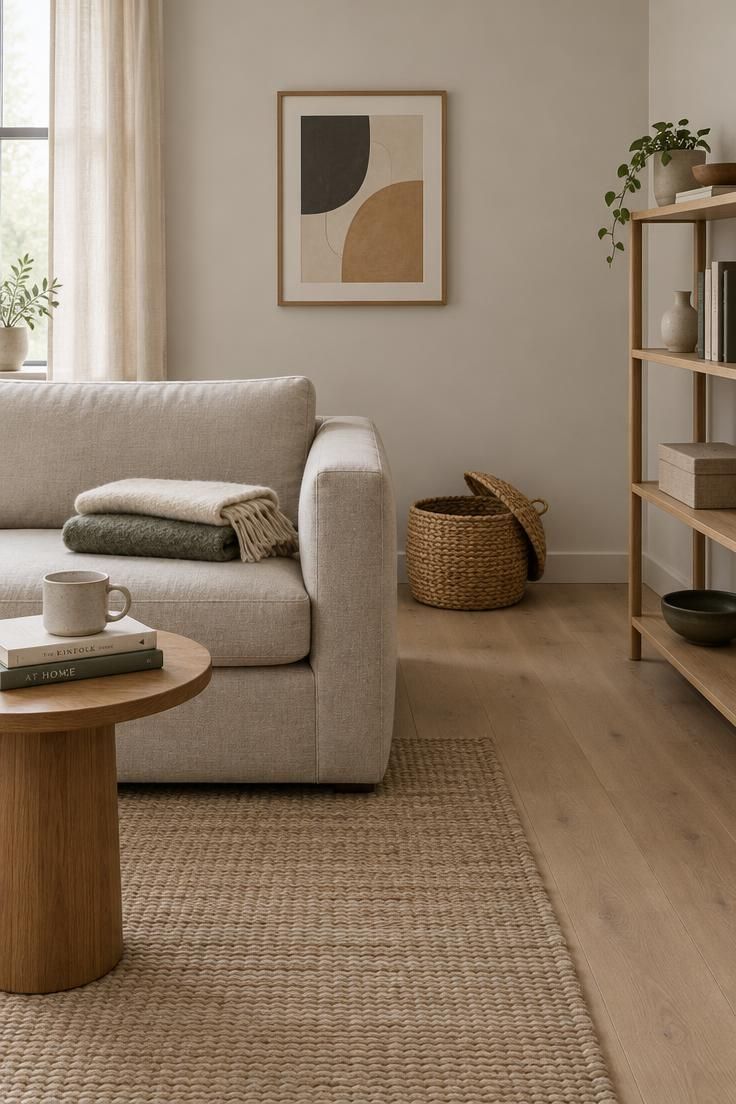
Scandinavian interiors softened that logic with natural wood, pale color, practical furniture, and daylight.
The result was warmth rather than austerity.
Contemporary minimalism grew from ordinary pressures: smaller apartments, urban housing costs, digital noise, and frequent moves.
Warm materials and a few personal objects read as adaptation, not contradiction.
First Apartment Essentials: The Function-First Filter
Before buying or keeping anything, run it through a short filter.
Is it used regularly?
Does it serve a necessary or meaningful purpose?
Is it the best version of what you already own?
Two more questions catch the rest.
Would you buy it again today, and does its value justify the space and cleaning it demands?
These questions work because a first apartment usually lacks room for duplicates and hypothetical items.
A dining table that seats eight makes little sense for someone who hosts twice a year, while a compact desk used daily earns its footprint.
The table may be beautiful; it still loses.
Measurement belongs here, before purchases rather than after.
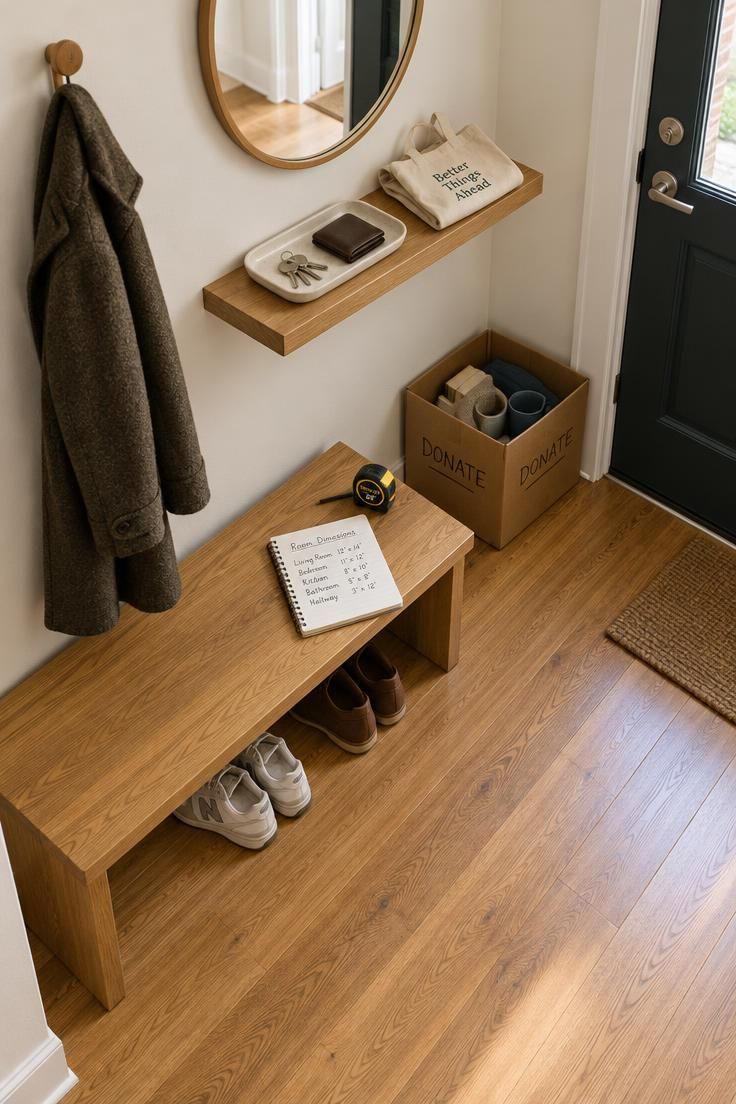
Note the dimensions of each room, the width of doorways, and the length of walls where you plan to place furniture.
A piece that cannot travel through the door or turn a hallway corner will not work, and returns are far easier than regrets.
Real routines should shape the inventory.
Hobbies you practice weekly belong in the plan; hobbies you admire from a distance can wait.
First apartment essentials are the items your actual days require, backed by a few things you genuinely enjoy.
Room-by-Room Checklist for a First Apartment
Each space in a small home has a version of the same job: hold what you use, stay easy to reset, and leave a clear path.
The filter from the previous section applies before any organizing begins.
Entryway. Keep coat hooks or a compact rack, a shoe limit, a key and wallet tray, a mirror, and one designated spot for mail.
A basket can corral reusable bags.
Store visually messy items behind closed doors rather than on display.
The entryway should not become a temporary storage room.
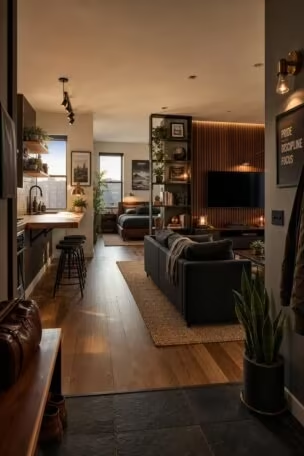
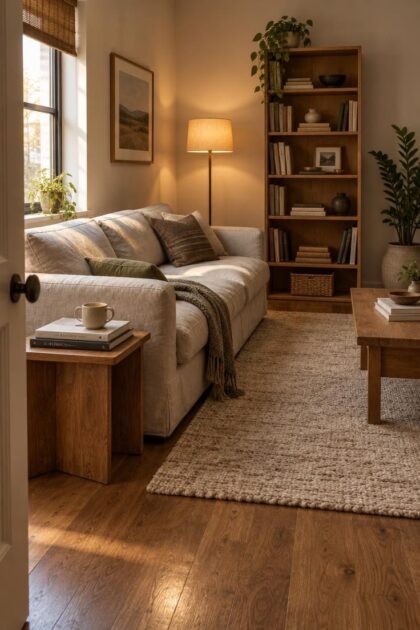
Living room. Seating sized to the room, one coffee table or side table rather than both, adequate lighting, a rug if it helps define the area, and concealed cable management.
Open shelving works best in small doses.
Consolidate media equipment in one location and leave clear paths around the furniture.
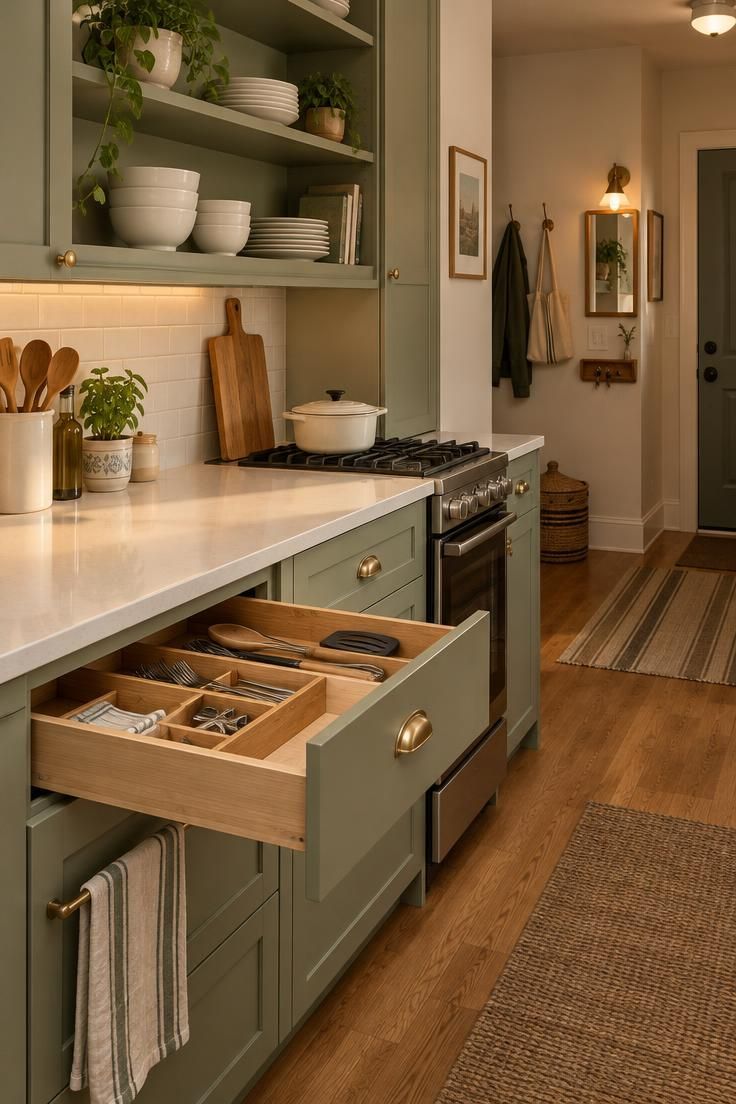
Kitchen. Everyday dishes, one or two reliable pans, frequently used tools, and appliances you use often.
Store or reconsider duplicate utensils, single-purpose gadgets, excess mugs and glasses, expired food, and containers without matching lids.
Keep counters mostly clear, store items near where they are used, and apply a one-in, one-out rule to categories that multiply on their own.
Bedroom. One comfortable bed, bedding suited to your climate, two or fewer bedside surfaces, warm adjustable lighting, a laundry hamper, and limited visible clothing.
The bedroom does not need to double as an office, gym, dressing room, and storage unit at once.
Bathroom. Daily toiletries, one backup of frequently used products, towels that match household needs, a small cleaning kit, and medications stored sensibly.
Review expiration dates before buying any organizer.
A coordinated set of dispensers helps only if it genuinely improves daily use.
Home office. A desk sized for actual work, a comfortable chair, task lighting, cable management, one document-storage method, and only the stationery you use.
Give incoming paper a defined place and give work a way to disappear when the day ends.
Decoration. One or two large artworks often hold a room better than a dozen small pieces.
Repeat a few materials or tones, include plants only if you will maintain them, and prefer objects with personal meaning.
Some wall and surface area can stay empty.
Before buying décor to fill a gap, ask whether the object improves the room’s atmosphere, function, or meaning.
Design Pro-Tip: Pick one category this week, such as mugs or tote bags, and set a fixed limit you can store comfortably. Limits do more work than organizers.
Small Apartment Storage Ideas: Contain, Don’t Conceal
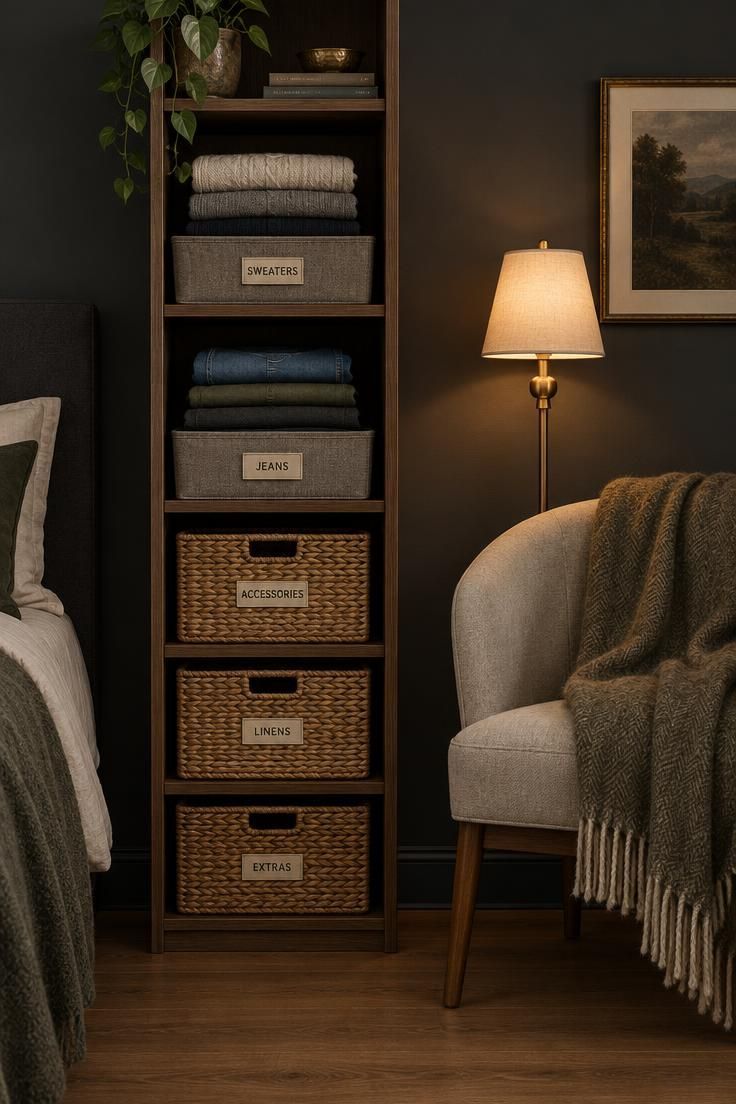
Storage in a small apartment should be accessible, limited, and suited to the object it holds.
Labels help for anything ambiguous.
Visually busy categories usually belong behind closed doors.
The distinction that matters most is between containing items and concealing a problem.
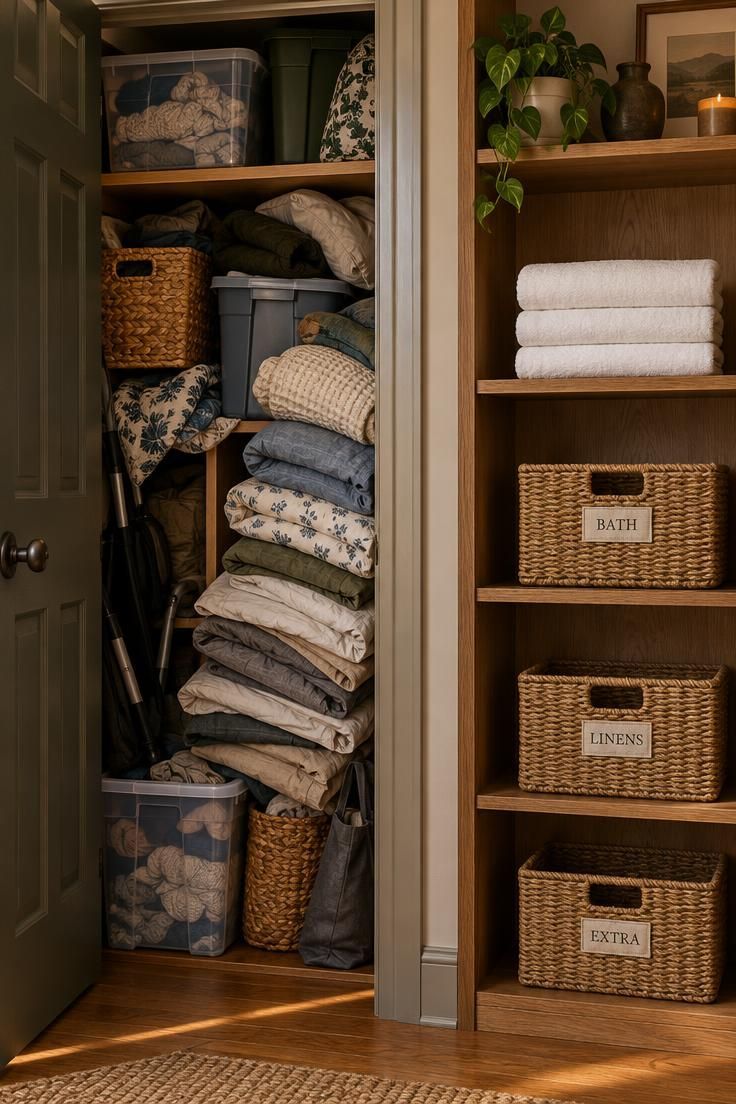
More containers will not fix an inventory that was never reduced.
If a cabinet only closes because of pressure, the next step is subtraction, not another bin.
Sorting works best by category: daily items, occasional items, seasonal items, sentimental pieces, maintenance supplies, documents, and things leaving the home.
Decisions follow decluttering.
Assigning a home to every object before the first pass just relocates the pile.
Small apartment storage ideas lean on a few repeatable tactics.
Zones defined by rugs or lighting do the work that partitions would in a larger home.
Vertical storage comes before more floor furniture, furniture with legs preserves visual openness, and mirrors placed with intention add light without adding objects.
Measurements protect all of this.
Check doorways, elevators, and stairwells before buying, and note wall lengths where a tall or wide piece might go.
A purchase that cannot reach the room has no storage value at all.
Room by Room Decluttering: A Sequence That Prevents Overwhelm
Decluttering fails when it becomes a tour of the apartment with a trash bag.
A sequence works better, and it has four phases.
Phase one removes obvious excess: trash, expired products, broken items, duplicates, things you dislike, and items that belong somewhere else entirely.
This phase is fast and needs no difficult judgment.
Phase two works by category rather than by room.
Clothing, books, kitchenware, bathroom products, papers, electronics, décor, and sentimental objects each get a pass.
Category work prevents the strange shuffle where a pile migrates from closet to hallway to spare chair and back.
Room by room decluttering sounds tidier, but moving between rooms with the same category in hand produces better decisions.
Phase three organizes what remains.
Assign each category a home, use existing storage first, keep frequently used objects easiest to reach, and group similar items together.
Anything that does not fit its designated space becomes a candidate for removal rather than a reason to buy another bin.
Phase four establishes maintenance habits.
Daily resets return surfaces and items to their places, and mail and dishes get handled rather than stacked.
Weekly reviews catch clutter hotspots, empty temporary baskets, and process paperwork.
Monthly or seasonal checks cover clothing, pantry and bathroom supplies, and accumulated packaging.
Digital clutter deserves the same sequence.
Organize files, remove unused apps, clear desktop icons, unsubscribe from unneeded email, and settle on one calendar and one task system.
The desk stays clearer when the screen does too.
Warm Minimalist Decor: Texture, Wood, and Personal Objects
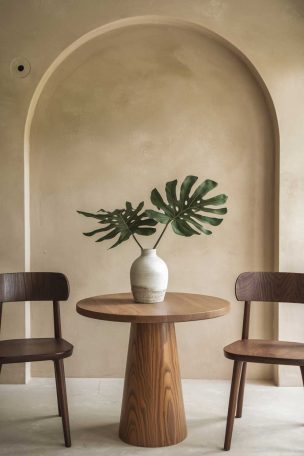
Stark emptiness reads as unfinished to many people, and warm minimalist decor answers that with materials rather than more objects.
A useful framing, borrowed from current design discussion, splits a room into roughly seventy percent functional basics, twenty percent texture and natural materials, and ten percent personal or vintage accents.
It is inspiration, not arithmetic.
Soft lighting, natural wood, woven textiles, a plant, and a few meaningful pieces can carry a room without clutter.
Rently’s 2025 renter survey found that 72 percent of respondents favored minimalism while 79 percent preferred soft, layered lighting, and Apartment Therapy’s 2025 designer survey identified warm minimalism as a continuing direction alongside darker woods, vintage pieces, earth tones, and brunette woods.
Those figures describe related preferences, not one shared standard for a minimalist home.
Texture is the practical lever.
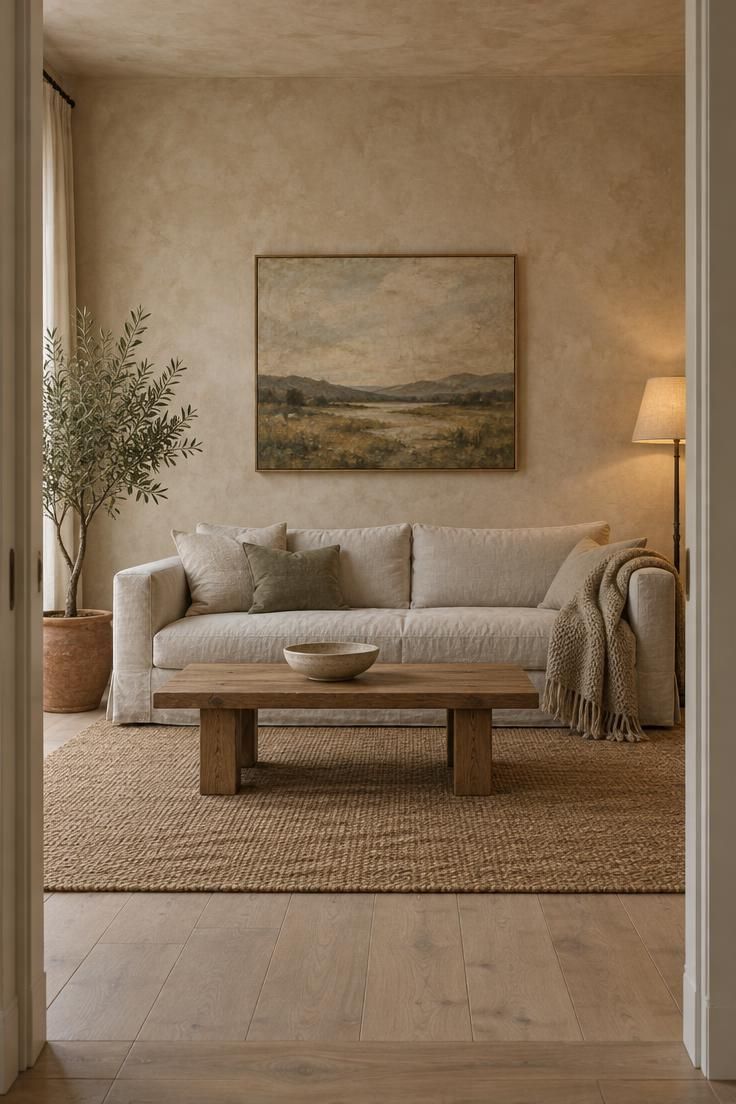
A linen sofa, a wool throw, and a wooden table read as warm even when the palette stays quiet.
Repeating two or three materials or tones across a room ties it together without adding visual noise.
Art follows the same logic.
One large piece often gives a room more presence than a gallery wall of small frames, and a single strong object can hold a wall on its own.
Leaving space empty is a choice, not an oversight.
Empty surface area is what lets the few objects you love register at all.
Renter Friendly Furniture: Choices That Move With You
Every piece bought for a first apartment has a second question attached: will it work in the next one?
Renter friendly furniture answers that before the lease ends.
Standard proportions travel well.
A sofa that fits a typical wall, a table that seats four without dominating a room, and a bookshelf with modest depth will adapt to more floor plans than oversized or unusually shaped pieces.
Lightweight materials help on move day, and modular or stackable options adapt as rooms change.
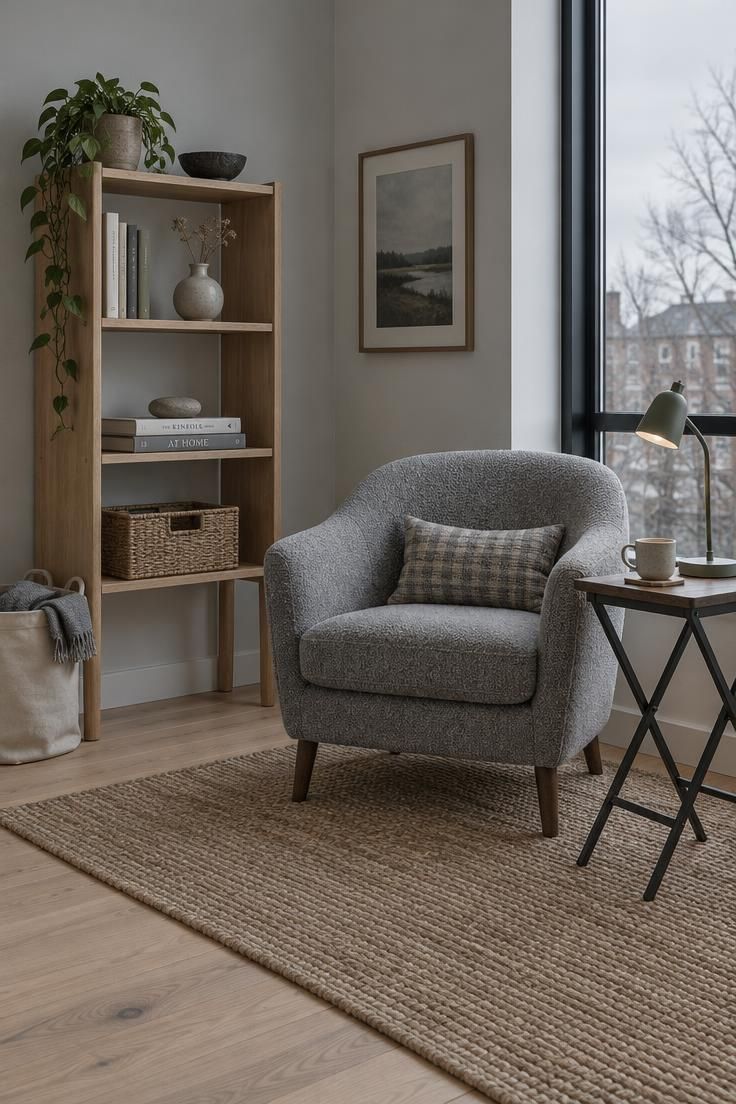
A folding side table and a compact armchair can shift from living room to bedroom without a redesign.
Renter-friendly floating shelves work as a visual idea for storage and display, and the concept is worth considering where a wall needs function without furniture below it.
Legs, mirrors, and vertical storage all preserve openness in a small room.
Furniture raised on legs lets light and sightlines continue underneath, and a well-placed mirror adds depth without occupying floor area.
Measurements decide more than style here.
Apartments.com’s 2026 survey of nearly 27,000 U.S. renters found that 99 percent considered unit-specific information important when apartment hunting, which tracks with a simpler habit: keep your own notes on room dimensions and doorway widths before you shop, and favor pieces that fit more than one future layout.
Design Pro-Tip: Before buying any large piece, walk the route from building entrance to its intended spot and note every tight turn. Furniture that fits the room but not the path is still the wrong purchase.
Common Mistakes That Undermine a Minimalist Apartment
The most common mistake is treating minimalism as a color scheme.
Painting a cluttered room white leaves it cluttered in white.
Paint is not a decision.
Buying a full set of “minimalist” furniture comes second.
Replacing usable pieces to match an aesthetic spends money and adds waste without improving how the apartment functions.
Hiding clutter in closed cabinets is the third trap.
Concealment works as temporary relief, not as a system.
If every cabinet is at capacity, the inventory still needs a pass.
Removing all personality is its own failure.
A home that feels anonymous has confused emptiness with calm.
One or two objects with real meaning keep a spare room from feeling borrowed.
Keeping possessions for a fantasy lifestyle is quieter and more persistent.
The bread machine, the formalwear, the hosting platters: each belongs to a version of life that has not arrived.
The correction is not harsh, just honest.
If it has gone unused through a full year, it can go.
The final mistake is chasing perfection.
Ordinary life disrupts clear surfaces, and that is not failure.
A home that returns to order quickly is doing its job, and minimalism is a practice rather than a finished state.
Conclusion
A minimalist apartment is working when every item has a reasonably clear home.
Surfaces can be cleaned quickly, furniture does not block movement, storage is not overfilled, and you can find what you need without a search.
Set against that standard, the checklist is a decision tool rather than a one-time task.
Moves, new jobs, and changing habits will shift what belongs in your space, and the filter can be run again each time.
The practical way to start is narrow.
Choose a single category this week, run the function-first questions on it, and stop there.
One resolved drawer teaches the process better than a weekend spent attempting the whole apartment.