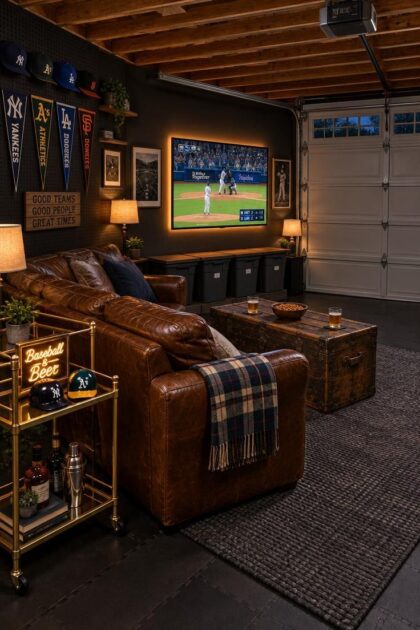
This post may contain affiliate links. If you make a purchase through these links, we may earn a commission at no additional cost to you.
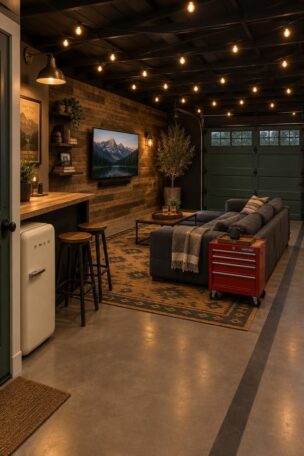
A garage already has the bones of a great gathering space: a wide floor, a long wall for a screen, and a door that opens the whole room to the driveway.
What it usually lacks is warmth, softness, and a clear place to sit.
The ideas below work with those raw materials instead of fighting them, using paint, rugs, secondhand seating, and simple lighting to carve out a corner that still lets the garage do its day job.
Every project here leans on reversible moves.
Seating and floor coverings can be rolled, carried, or pulled back when a car or a project needs the room.
Layered Rugs and Foam Tiles for a Warm, Quiet Floor
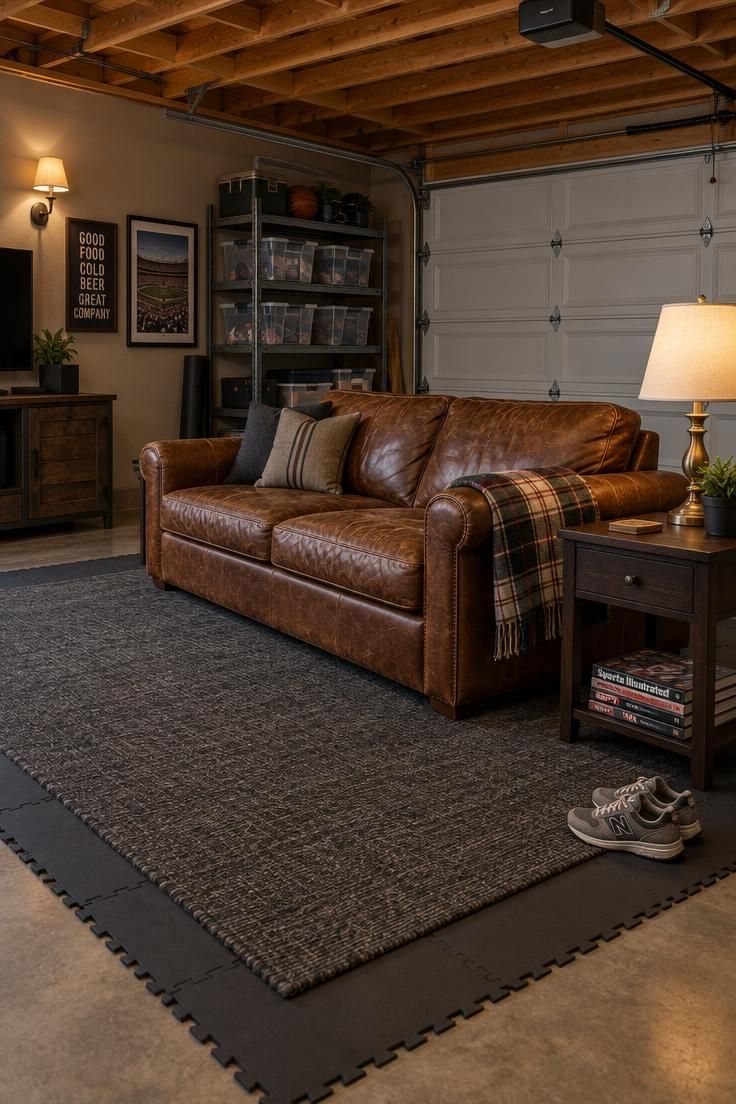
Concrete is the first thing that meets a foot in most garages, and it stays cold, dusty, and loud under a dropped remote.
Interlocking foam tiles take the edge off that surface in an afternoon, and a low-pile indoor-outdoor rug on top does the visible work of marking where the room actually begins.
Choose cheap garage flooring that can handle a hose, a broom, and a winter's worth of grit.
A synthetic weave in a flat gray or navy holds up better than a plush living-room rug, and it can be rolled up and stood against a wall when a car needs the bay.
Foam tiles add a cushion underfoot, so keep them clear of the path where tires roll.
The layering itself matters more than either piece alone.
A large rug over a slightly larger tile field creates a border that reads as intentional, and the two surfaces together cut the slap of footsteps and the hollow ring of a bare slab.
Budget matters here in a practical way.
Paint or a sealed concrete finish costs more in materials and downtime than a rug and a box of tiles, and neither is easy to undo if the finish disappoints.
Rugs and tiles can move to another part of the garage or another house entirely.
Style Blueprint:
- Interlocking foam tiles in a dark neutral, sized to cover the seating footprint with a small border showing
- A low-pile indoor-outdoor rug in charcoal or navy that overlaps the tile field
- A runner or small mat at the door edge to catch grit before it reaches the main rug
- A lightweight vacuum or stiff broom kept nearby for quick cleanups
Design Pro-Tip: Measure the seating zone before buying, then size the rug so the front legs of every seat rest on it. A rug that stops short of the furniture looks like a doormat.
Black Accent Wall Behind a Secondhand Recliner
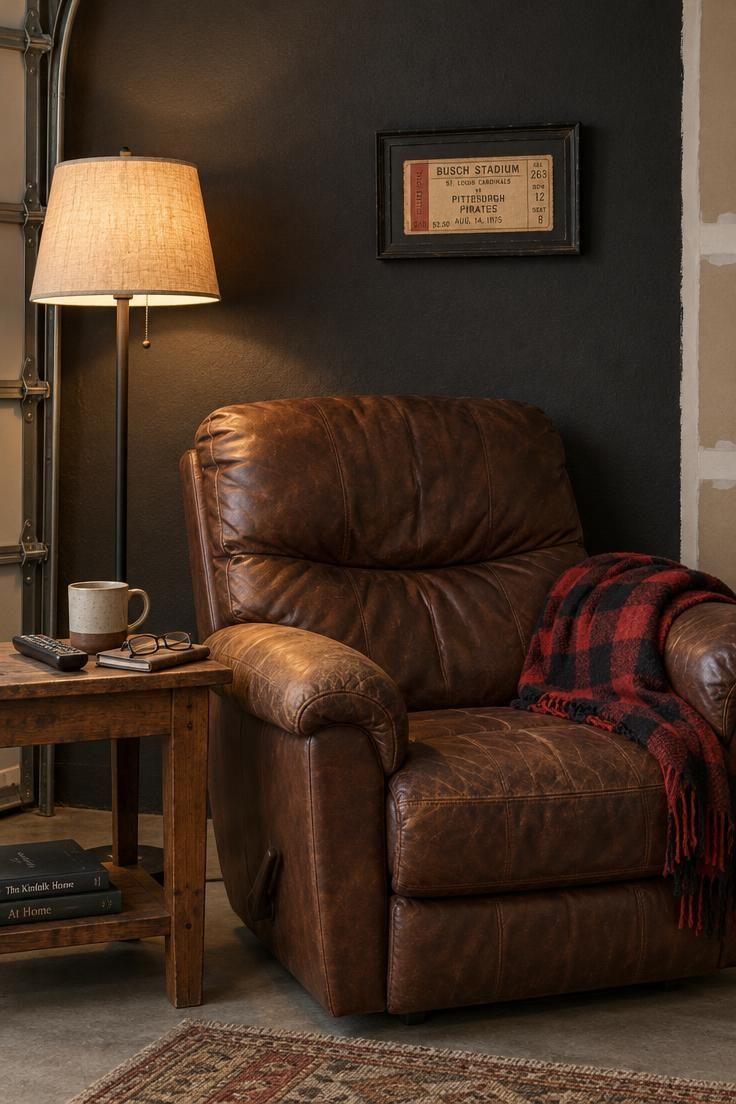
One wall of paint can carry a whole room, and the wall opposite the overhead door is the one worth spending it on.
A deep charcoal or navy in a matte finish sits behind the main seat and turns a bare stretch of drywall into a backdrop, which is the kind of budget man cave decor move that costs a gallon and a weekend afternoon.
A thrifted recliner or club chair in brown leather or a muted woven fabric pairs naturally with a dark wall.
The contrast does the decorating: the chair reads as a shape against the paint rather than blending into the gray of an unfinished garage.
Choose the wall carefully.
The overhead door wall stays bright and reflective by design, so painting it dark fights the one surface that already has visual weight.
A side wall or the wall facing the seating area gives the same effect with less competition.
Drywall condition decides the approach.
Smooth finished drywall takes paint well, while exposed studs and rough patches are better covered with a large secondhand fabric wall hanging or a heavy curtain panel hung across the framing.
Both are reversible, and both shift the room's tone in the same direction.
Test the color on a scrap of drywall or a piece of cardboard taped to the wall for a day.
Deep colors shift with the garage's light through the afternoon, and a shade that looks right at noon can read nearly black by evening.
Style Blueprint:
- One gallon of matte paint in charcoal, navy, or forest green, plus rollers and a tray
- Painter's tape for clean edges where the accent wall meets the ceiling and adjacent walls
- A secondhand recliner, club chair, or wingback in leather or a textured neutral
- A small side table with a lower shelf for remotes and coasters
- One thrifted frame for a ticket, program, or team photo to break the flat wall
Clamp Lights and a Warm Bulb Swap Without Rewiring
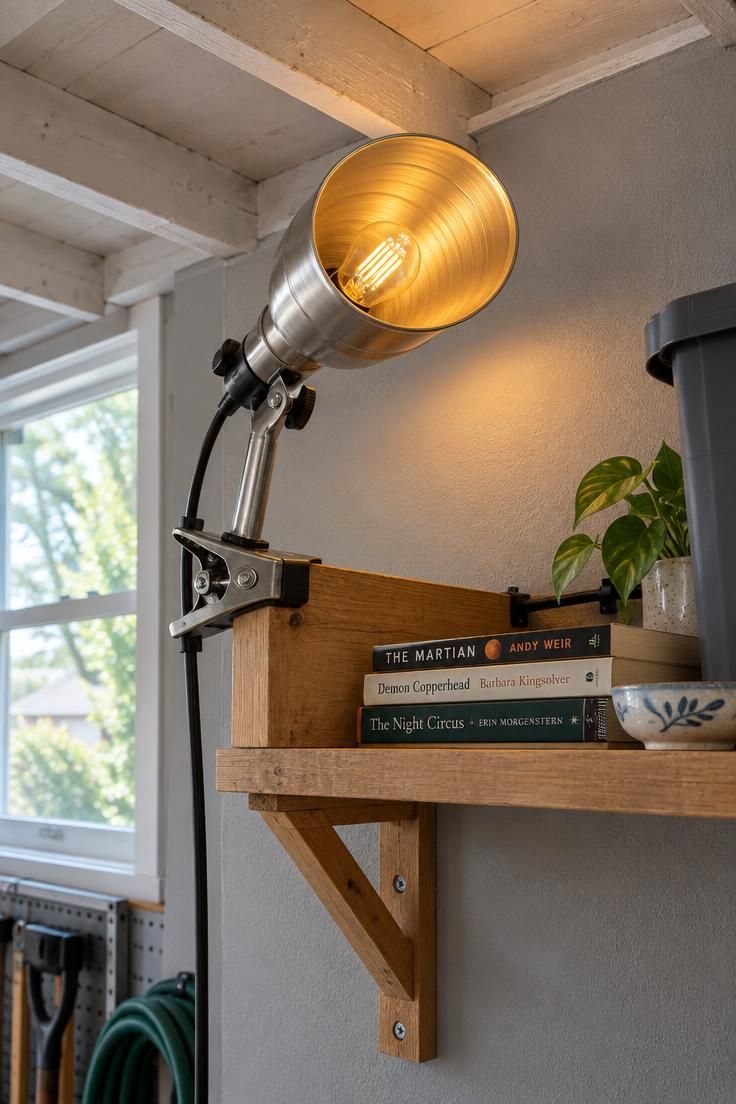
Overhead garage lighting is usually one bare fixture at the center of the ceiling, cool in tone and harsh on the eyes.
Swapping that bulb for a warmer temperature LED is the first move, and it happens in the time it takes to unscrew one fixture.
The change shifts the whole room's cast without touching a wire.
Clamp lights add the second layer.
Two or three of them, clipped to shelf brackets or the edge of a workbench and aimed at the walls or ceiling, bounce light back into the room instead of throwing it straight down.
One above the seating area creates a soft wash, and another near a game table gives the surface enough light to read cards or sort snacks.
This is a common affordable garage conversion approach because it uses what already exists: the outlet, the fixture, and the shelf.
Nothing gets added to the walls, and nothing needs a professional.
The tradeoff is that a line of extension cords becomes part of the room's furniture whether or not it's styled well, so route cords along baseboards and behind storage where they disappear.
Keep one brighter light available for tasks.
Sorting tools, cleaning up after a game, or finding a dropped bottle cap all go faster under a stronger beam, and a clamp light on a separate switch or its own cord gives that without brightening the whole room.
Extension cords and power strips are a temporary arrangement, not a permanent wiring plan, and adding outlets or circuits belongs to a qualified tradesperson rather than a decor project.
Style Blueprint:
- Warm-temperature LED bulbs in the existing ceiling fixture
- Two or three metal clamp lights with adjustable shades
- Shelf brackets or a sturdy ledge to clip lights onto at different heights
- Cord clips or a small cable tray to route cords along the baseboard
Design Pro-Tip: Aim clamp lights at the wall rather than across the room. Bounced light softens shadows and makes a small space feel larger than a direct beam does.
Rolling Tool Cart Turned Snack and Drink Station
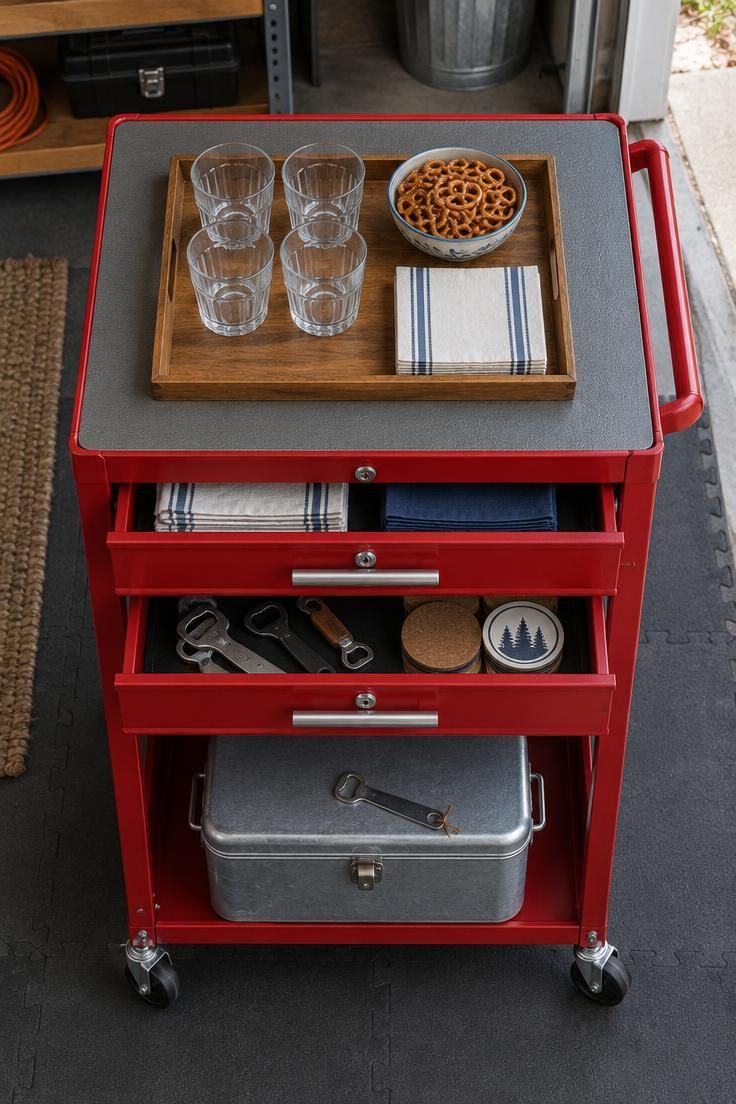
A rolling tool cart already has the qualities a serving station needs: a flat top, drawers that close, wheels, and a handle.
Cleaning it out and giving it a new job costs nothing beyond a wipe-down and a cut piece of washable vinyl for the top.
This is the kind of diy garage bar setup that suits a household that wants serving space without committing to a fixed counter.
The drawers do the organizing.
Napkins, coasters, bottle openers, and small bags of chips each get a shallow drawer, and the dividers built into most carts keep loose items from sliding around.
Line the drawers with shelf paper or a scrap of vinyl to make crumbs easy to shake out.
Positioning is the whole point of the wheels.
Roll the cart beside the seating area during a game, then push it against a side wall when the garage needs to hold a car or a project.
Keep the top clear except for a tray of cups so it stays easy to wipe down.
A cart with a locking drawer or a lid gives a place to store items you would rather not leave in the open.
A lower shelf sized for a small cooler keeps drinks within reach without taking counter space.
Tool carts vary in height, and a cart that sits too low turns pouring a drink into a stooped exercise.
Check the top height against the seating before buying, and favor a cart whose handle does not catch on the arm of a chair as it rolls past.
Style Blueprint:
- A used rolling tool cart with two or three shallow drawers and a lower shelf
- Washable vinyl or shelf liner cut to fit the top and drawer bottoms
- A shallow wooden or metal tray to corral glasses and snacks
- A compact cooler sized to the bottom shelf
- A wall-mounted or handheld bottle opener kept in a drawer
Stadium-Seat Bench Built from Planks and Brackets
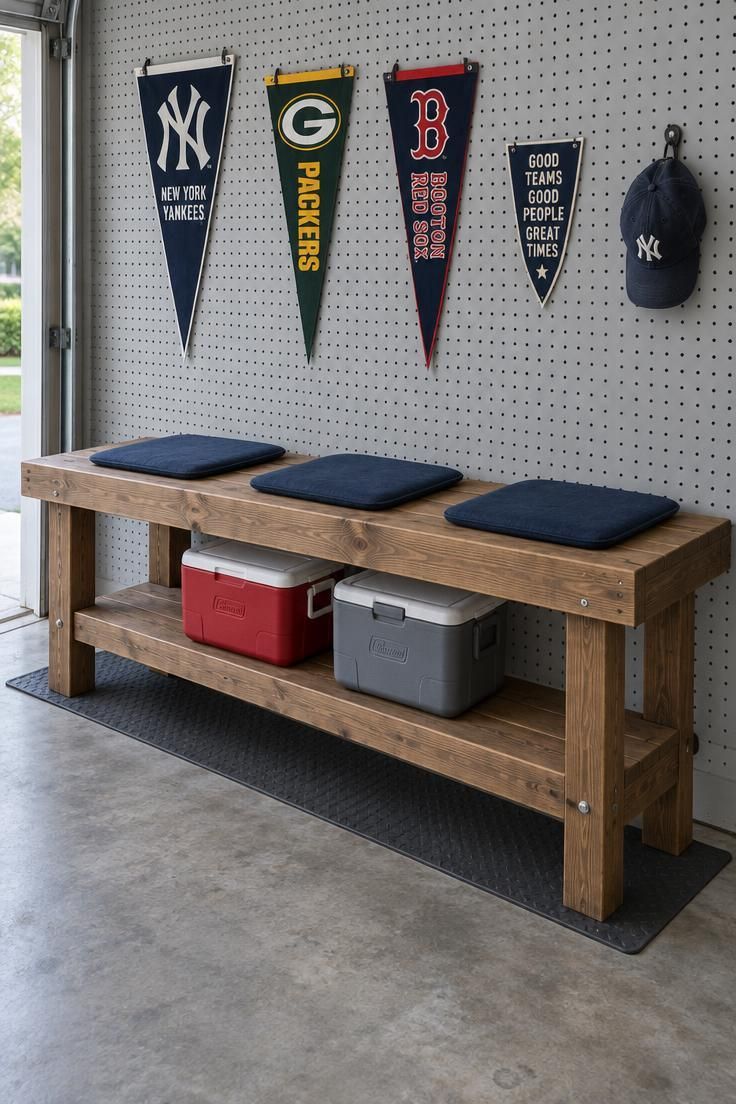
Two wide planks set at different heights create the look of stadium seating along a garage wall without the cost of a row of chairs.
The upper plank is the seat, and the lower one becomes a footrest or a shelf for shoes, small coolers, and a stack of programs.
Sand the boards lightly and leave the finish simple.
A clear coat or one muted stain keeps the grain visible and avoids a plastic look, which suits a space with exposed joists and a concrete floor.
Flat chair pads in a team color sit lighter than bulky cushions and are easier to stack when the bench is not in use.
The bench seats several people for a game at a fraction of the cost of separate chairs, and it hugs the wall instead of jutting into the middle of the floor.
That matters in a garage where a car still needs to turn and park.
Placement decides how well the bench works.
A side wall that does not intersect the overhead door's track or the car's turning path gives the bench a permanent home, while a spot in front of the door turns it into something to move every time the garage opens.
Width is a judgment call rather than a fixed number.
A bench long enough for three people side by side feels generous; one that stretches past the seating area starts to read as unfinished carpentry rather than furniture.
Match the length to the wall it occupies and leave a gap at each end.
Style Blueprint:
- Two wide planks in a matching width, sanded and finished with a clear coat or muted stain
- Sturdy shelf brackets sized to the plank depth, in black or oiled bronze
- Three flat chair pads in a team color or a neutral that matches the floor
- One or two small coolers that fit beneath the lower plank
- A repainted pegboard panel above the bench for pennants and hats
Design Pro-Tip: Keep a small basket under the bench for stray remotes, chargers, and koozies. A single catch-all keeps the seat clear between game days.
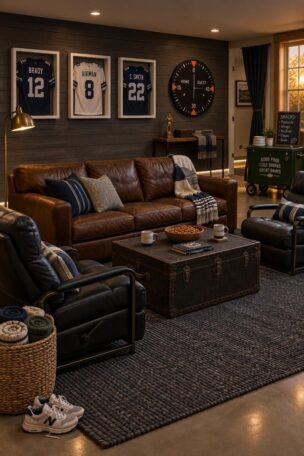
Secondhand Chesterfield Sofa with a Game-Day Throw
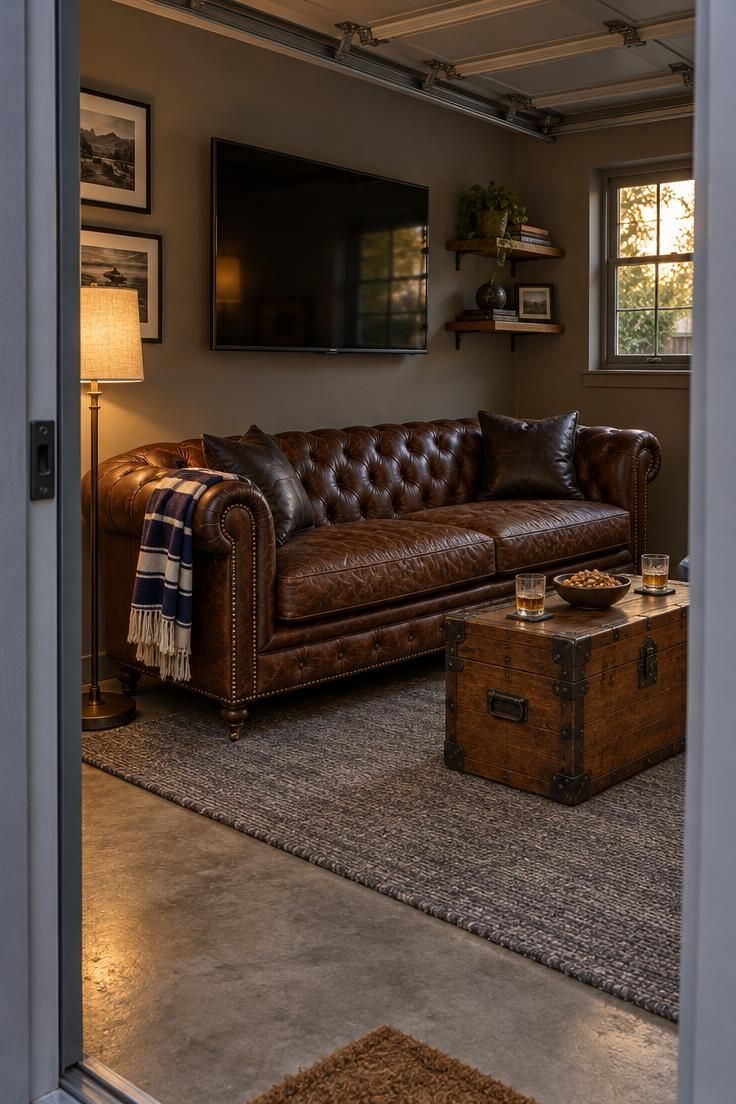
A single well-built sofa can anchor a garage seating area in a way that a pair of folding chairs cannot.
Secondhand furniture for garage use shows up regularly at estate sales and online listings, and a roll-arm or Chesterfield couch in brown or cognac leather brings a warmth that synthetic fabrics rarely match.
Leather has practical advantages on a concrete floor.
It wipes clean, does not hold the dust that settles in a garage, and develops a patina that suits a room with exposed joists.
Check a used piece for musty odors and wobbling legs before bringing it home, but a solid hardwood frame is worth refinishing.
Position the sofa facing the screen wall with its back to the overhead door area.
That arrangement creates a visual barrier between the seating zone and the storage behind it, and it keeps glare from the door panels out of the viewing line during afternoon games.
A throw blanket in a team color and two lumbar pillows finish the piece without much expense.
The arms and back give more support than a futon for a long game, and the upholstery softens the garage's hard surfaces enough to take the edge off the echo.
Sofa size deserves a second look before purchase.
A long couch that fits the wall still has to leave room for a walkway to the door and for whatever the garage stores along the same stretch.
Measure the wall first, then shop.
Style Blueprint:
- A secondhand leather sofa in brown, cognac, or oxblood with a solid frame
- A washable throw blanket in a team color
- Two leather or woven lumbar pillows
- A low trunk or sturdy crate as a coffee table
- A leather conditioner kept on hand for seasonal wipe-downs
LED Strip Behind the Screen for a Low-Cost Game Night Glow
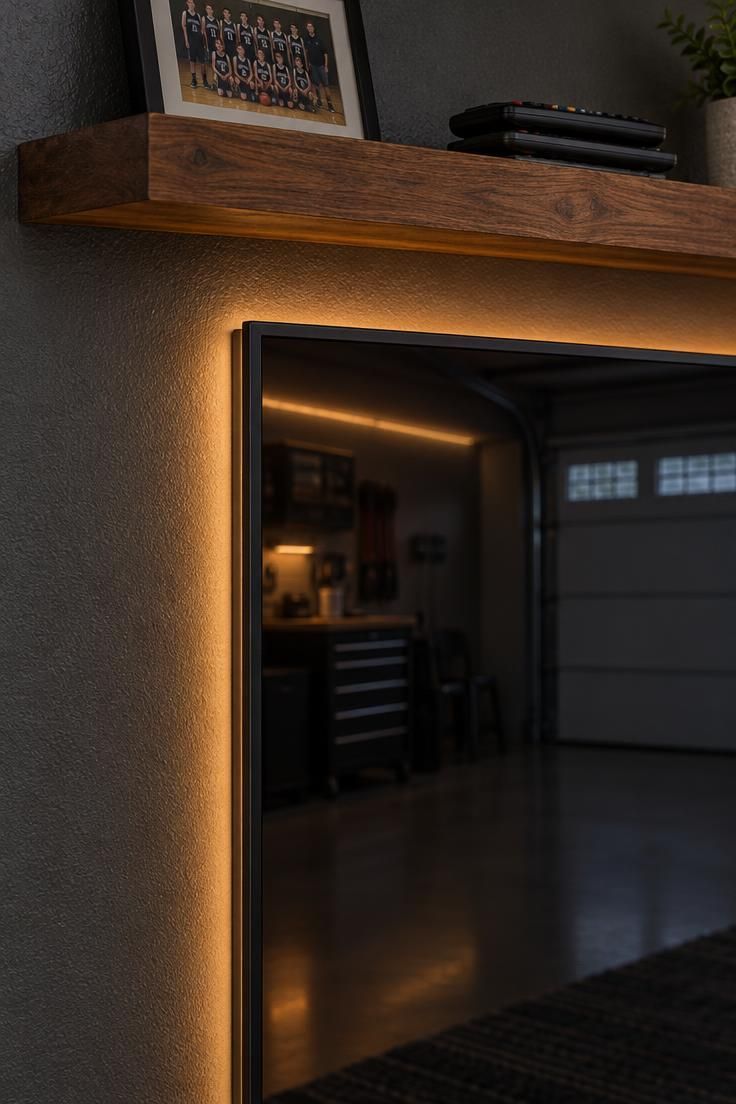
A strip of LED tape tucked behind a television or along the back edge of a shelf gives a room a soft wash of light without adding a fixture.
This is one of the most affordable garage man cave ideas on a budget because the strip itself costs little and plugs into an outlet that already exists.
Stick with one color.
A warm white or a single amber or blue tone that matches the room's palette reads as intentional, while a color-cycling effect can leave the space looking busier than the rest of the design.
The point is a low, even glow that softens the contrast between a bright screen and a dark wall.
Mounting options depend on how the television sits.
A screen on a stand can carry the strip along its back edge, while a wall-mounted screen can take a run of tape along the shelf or ledge above it.
Keep extra length away from the overhead door track and from any moving hardware.
The effect shows best in a darker corner or in the evening, when the strip becomes the room's main light source instead of competing with daylight from the open door.
During the day it disappears into the wall.
LED tape is available in different brightness levels, and a very bright strip in a small corner can wash out the wall instead of outlining the screen.
If the light feels harsh, a dimmer switch or a lower-output strip solves it without changing the layout.
Style Blueprint:
- LED strip tape in warm white, amber, or one accent color
- Adhesive clips or a channel sized to the strip for a straight run
- A dimmer or remote control if the strip supports one
- A nearby outlet or short extension to reach the strip's plug
Design Pro-Tip: Run the strip along a shelf edge instead of only behind the screen. The longer line of light spreads the glow across more of the wall and reads as a design choice rather than an add-on.
Pegboard Team-Merch Wall with a Rotating Display
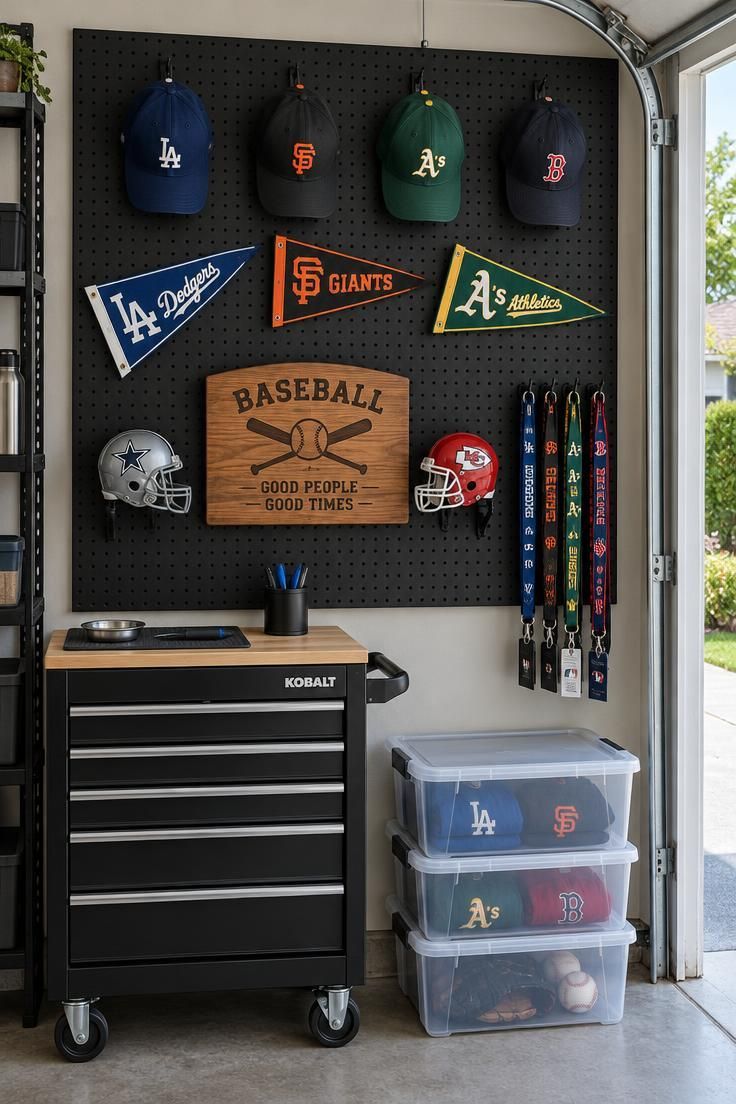
Garages frequently come with a sheet of pegboard already on the wall, and that sheet can hold more than hammers.
Painted a solid dark color and fitted with short peg hooks, it becomes a display surface for hats, pennants, koozies, mini helmets, and small signs at almost no cost.
A dark paint color makes the merchandise read as a collection rather than a scattering of objects.
Black, charcoal, or a deep team color all work, and a single coat often covers the brown pegboard tone well enough for a garage.
Rotate the display so it does not become a static snapshot.
Swapping a few caps or pennants each season keeps the wall interesting and spreads the wear on individual pieces, which matters in a space that sees dust and temperature swings.
Hang the board on a side wall rather than above a workbench or heating source, and keep it clear of the overhead door's weatherstrip where moisture can reach the paper and fabric items.
Mounting height is a judgment call based on reach rather than a fixed number.
This approach also absorbs some sound.
Pegboard, paint, and fabric items on a wall break up a flat reflective surface, which helps in a garage with an open ceiling.
Style Blueprint:
- A pegboard panel painted in a dark matte color
- A set of short peg hooks in a single finish
- A mix of caps, pennants, small signs, and mini helmets for variety
- A shallow basket or bin on a lower hook for loose lanyards and pins
Small-Space Adaptation: Fold-Down Table and Wall-Ledge Seating
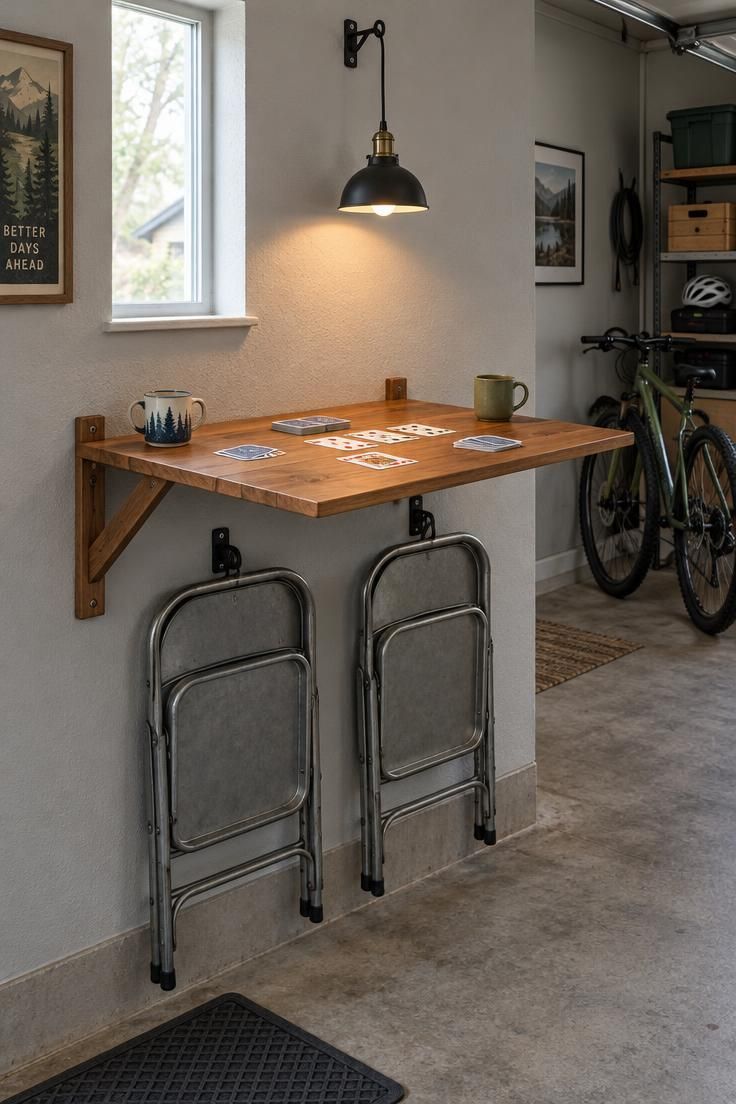
In a single-car garage, a table that folds down from the wall keeps the floor clear until it is needed.
A secondhand table leaf or a simple plywood rectangle with a hinged support turns a stretch of side wall into a card or snack zone, and the whole thing disappears when the car comes back.
Padded folding chairs complete the setup.
They hang from pegs when the table is folded away, and two of them fit around a small table for an evening of cards or a snack tray during a game.
The approach suits a garage that has no spare bay and no room for a permanent seating group.
It gives one household member a dedicated spot for a hobby or a two-person game without claiming floor area that has another job.
Keep the surface simple.
A narrow table sized for two people stays manageable, while a wide one becomes an obstacle that has to be folded the moment anyone needs to walk past.
Height should match the folding chairs rather than bar stools, which take up more floor space and block a car door.
A plug-in pendant hung from a hook above the table adds light exactly where the activity happens without touching the ceiling wiring.
When the table folds away, the lamp stays on its hook and out of the way.
Style Blueprint:
- A secondhand table leaf or plywood top sized for two people
- Wall-mounted folding brackets or a hinged support frame
- Two padded folding chairs with matching wall hooks
- A plug-in pendant lamp hung from a separate hook
- A shallow basket for cards, dice, or coasters
Gallery of Framed Game-Day Photos and Ticket Stubs with a Stainless-Steel Bench
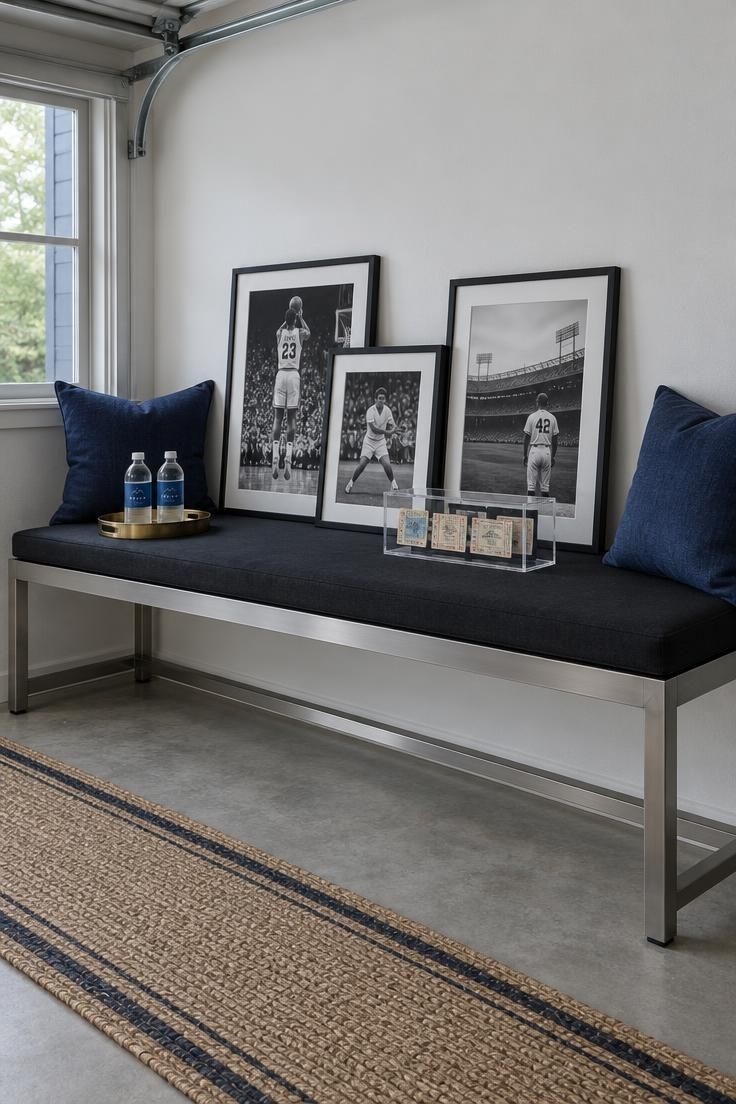
A metal bench from a secondhand shop does two jobs in a garage: it seats overflow guests, and its flat seat becomes a base for a display.
Lined along the wall behind it, a row of framed photos, ticket stubs, and game programs turns a plain surface into a small gallery.
Uniform frames make the collection look composed.
Black or silver finishes in a few matching sizes keep the arrangement from feeling random, and mixing in a single clear display box for loose stubs adds a layer without much cost.
This is a low-cost way to add seating and storage in one footprint, which suits a garage where every object has to earn its space.
The bench slides against a wall rather than sitting in the middle of the floor, and the display lives above the seat instead of on a separate shelf.
Keep the frames away from a workbench or a project zone so paper and glass do not collect sawdust or overspray.
A spot under a window or along a low wall gives the collection good light and a natural resting place.
Dust the bench and the frames on a regular schedule if the garage sees traffic.
A microfiber cloth and a quick pass keep the metal and glass clear without much effort, and it is easier to maintain than it is to clean a neglected collection.
Style Blueprint:
- A secondhand stainless-steel or metal bench with a solid frame
- A thin cushion pad and two pillows in team colors
- A set of matching black or silver frames in assorted sizes
- A clear acrylic box for loose ticket stubs and programs
- A small tray at one end for water bottles or a scorecard
Design Pro-Tip: Group frames by theme, not by size. A row of stadium shots next to a row of player portraits reads as a collection, while mixed subjects at mixed scales look like clutter.
Overhead Storage Racks and a Deep-Hued Curtain Divide
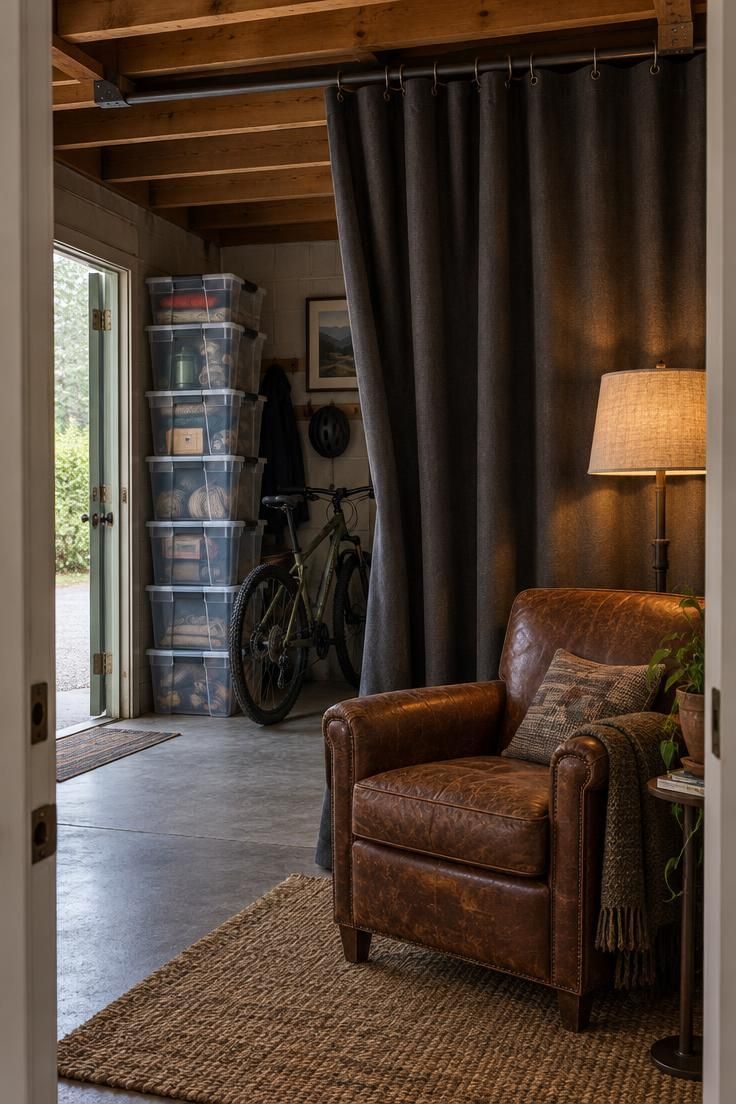
A garage that still stores bikes, tools, and bins needs a way to keep that clutter from competing with the seating area.
A long curtain hung from the ceiling joists with a simple rod creates a visual separation without building a single wall, and heavy fabric blocks the view while absorbing some of the room's echo.
Canvas or a blackout-weight material works better than a lightweight cotton here.
The density holds its shape, hangs in deliberate folds, and reads as a design element rather than a sheet draped over a rod.
A dark tone ties the curtain to the rest of the room's palette.
Pairing the curtain with overhead storage above the seating area frees the floor below.
Bins that used to sit on the ground move up onto a rack, which makes room for a chair, a rug, and a walkway that does not require sidestepping.
Clearance matters with both elements.
The curtain should slide freely past the overhead door's track and avoid blocking any window light the garage receives, and an overhead rack should not interfere with the door's travel or the space above the seating.
The curtain is also easy to change.
Pull it closed for a game, open it when the garage needs to function as storage, and swap the panel for a different color or weight if the room's look shifts.
Style Blueprint:
- A heavy canvas or blackout-weight curtain panel in charcoal, navy, or forest green
- A rod or track mounted between ceiling joists with rings that slide easily
- An overhead storage rack sized for lidded bins
- Matching lidded bins in one size so the stack reads as a unit
- A small hook or tie-back to hold the curtain open during the day
Compact Sports Shrine with a Small Bar Cart and Neon-Style Sign
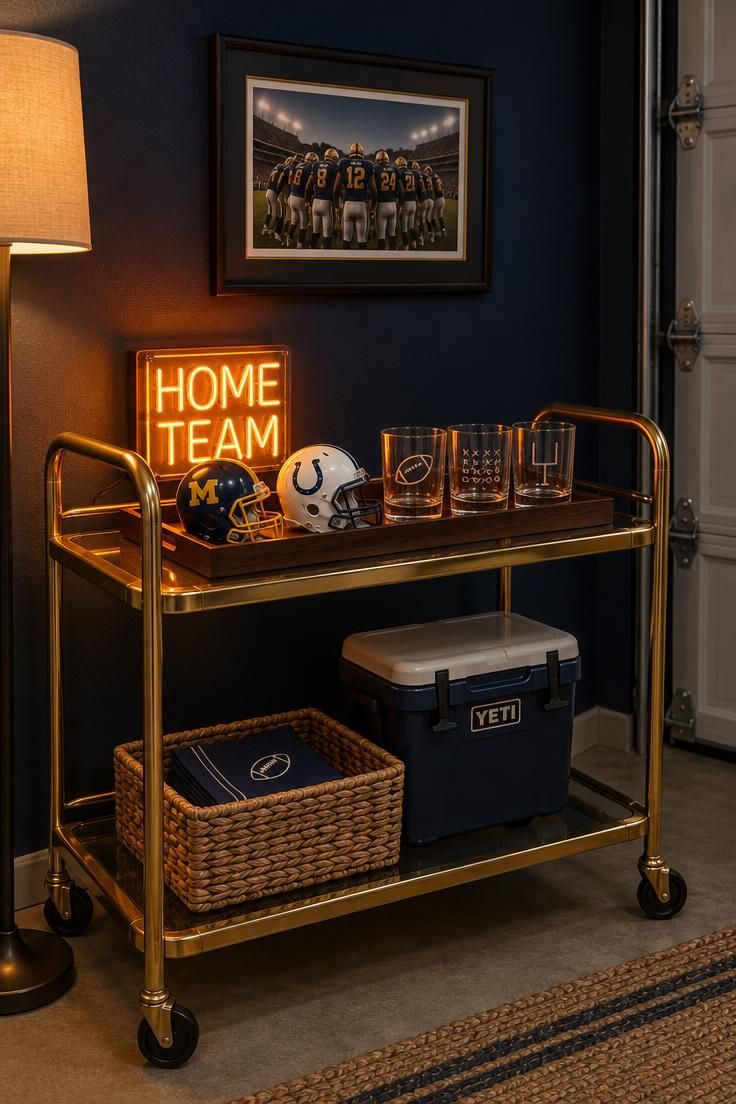
A rolling bar cart from a thrift store can hold a small collection without claiming a permanent counter.
Styled with a couple of mini helmets, a stack of game programs, and a battery-powered neon-style sign, it becomes the room's focal point and moves out of the way when the garage returns to full utility.
The cart's two or three tiers each get a job.
The top holds the display and glasses, and the lower shelf takes a small cooler or a bin of snacks.
That keeps the cart working as a serving piece as well as a display, which is more useful than a shelf that only holds objects.
Keep the sign small.
A compact neon-style piece that mimics an arena glow reads as a deliberate accent, while an oversized novelty light competes with the television and makes the corner feel crowded.
A single row of mini helmets or a short stack of programs beside it is enough styling.
Position the cart beside the seating area rather than in the path to the overhead door.
Wheels make it easy to reposition for a game and easy to tuck against a wall afterward, and the cart itself becomes the visual anchor for the corner.
Brass and glass show dust and fingerprints in a garage, so a quick wipe-down with a soft cloth before guests arrive keeps the display looking sharp.
The task takes a minute and matters more here than it would in a sealed room.
Style Blueprint:
- A secondhand two-tier bar cart in brass, black, or chrome
- A small battery-powered or plug-in neon-style sign in one warm color
- A dark wood or metal tray to corral glasses and helmets
- A woven basket for napkins and coasters on the lower shelf
- A compact cooler sized to the bottom tier
Conclusion
A garage man cave built on a small budget gets its character from a handful of reversible decisions.
A rug and foam tiles warm the floor, a warm bulb and a couple of clamp lights change the feel of the room, and one painted wall or a heavy curtain gives the seating area a boundary.
Secondhand seating, a rolling cart, and a pegboard display carry the sports theme without a custom build.
Pick two or three moves that address the room's weakest points first, then add the rest over a few weekends.
The space does not have to become a finished living room.
It only has to feel like a comfortable zone inside a working garage, ready for the next game day.