This post may contain affiliate links. If you make a purchase through these links, we may earn a commission at no additional cost to you.
Farmhouse Christmas decor draws its warmth from simple materials and a restrained hand: whitewashed wood, aged stoneware, soft linen, and fresh greenery worked into familiar household spots.
That rusticity feels approachable because it treats imperfection and ordinary storage pieces as part of the display.
The ideas below move from the dining table through main rooms, small bedrooms, and entry spaces, treating greenery, textiles, and collected containers as the foundation.
Each idea offers one clear visual direction while noting practical tradeoffs such as needle drop, styling scale, or upkeep.
Long Dough Bowl Filled With Mixed Greenery and Pillar Candles
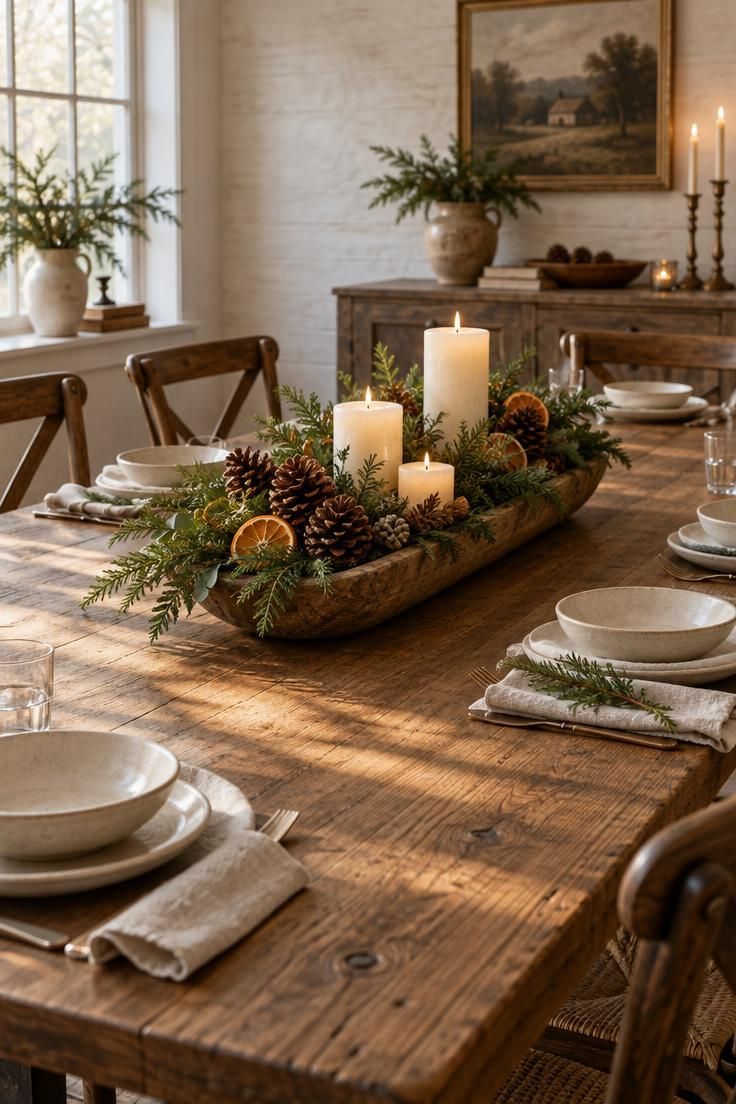
Center a low, shallow wooden dough bowl down the dining table or along a long sideboard.
Build the arrangement in a low mound of assorted greenery, then tuck in pinecones, dried orange slices, and three or four pillar candles of varied heights.
The bowl’s shape keeps the display below sightlines, so family and guests can still see one another across the table.
Real cedar or fir brings scent and texture but drops needles after a week or so.
A mix of dried seeded eucalyptus and small faux sprigs holds its shape much longer, which suits a table that stays styled through several meals.
Whichever direction you choose, keep the arrangement loose rather than packed, since a tight mound reads more formal than farmhouse.
A dark finished wooden bowl reads more traditional, while a washed gray or cream ceramic version feels lighter against pale linens.
Think of this dough bowl centerpiece as a base layer: the candles can be swapped for berry clusters in late December, and the whole bowl can move to a sideboard when the table is needed for serving.
Plan candle placement so flames sit well clear of fine dried stems and loose ribbon.
Unscented pillars keep the focus on the greenery when real branches are in the bowl, and they avoid competing with the smell of a fresh tree elsewhere in the house.
Practical function matters here as much as looks.
A low profile means platters and salad bowls can pass over the centerpiece without a stretch, and the bowl itself lifts away in one motion when the table needs to be cleared.
Style Blueprint:
- A long shallow dough bowl in dark wood, washed gray, or cream ceramic
- Mixed evergreen sprigs with dried seeded eucalyptus for staying power
- Pinecones and dried orange slices tucked low into the greenery
- Three or four unscented pillar candles in cream and ivory
- Neutral linen napkins and simple stoneware to keep the table calm
Design Pro-Tip: Position the greenery so its highest point stays below the rims of your tallest serving dishes, then test the arrangement by sitting at each seat and checking that faces across the table stay visible.
Mantel Garland With Ironstone and Crock Display
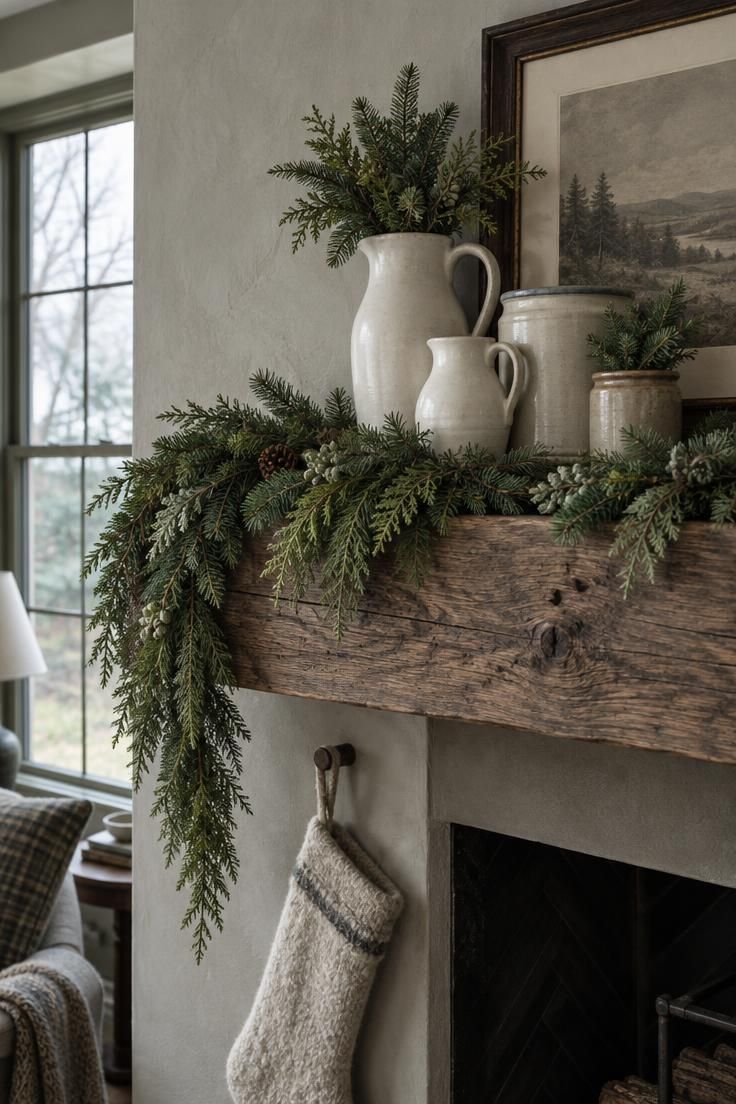
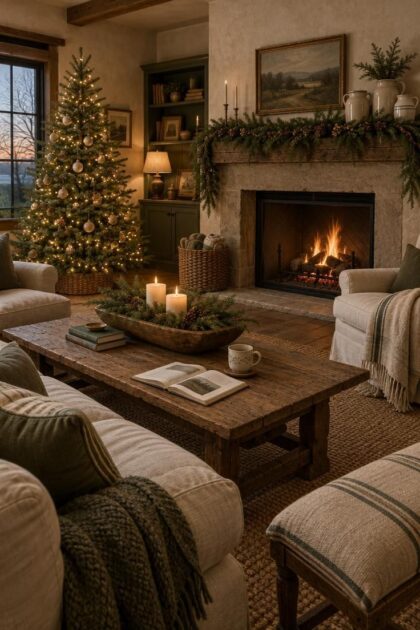
Drape a thick mixed evergreen garland along the mantel and let it hang unevenly over the front edge.
Cluster ironstone pitchers, small crocks, and a few stubby candle holders at one end of the mantel; at the other end, leave the garland plain and let the wood show.
Place three ironstone and stoneware crocks of graduated heights in the cluster and tuck short sprigs of fir or cedar into their openings.
The contrast between rough greenery, matte cream ironstone, and weathered wood carries the farmhouse look without any bright color.
Keep the garland full enough to hold its shape, but not so dense that it hides the mantel’s grain.
An ironstone and crock display works because the ceramics repeat a single pale note against all that green and brown.
Vary the heights noticeably, and let one crock sit slightly forward of the others so the group has depth.
A lean dark frame behind the cluster gives the grouping height without interrupting the garland line.
If the mantel is shallow, a narrower garland or a single crock cluster reads better than a full draping.
For a home with an active fireplace, keep the garland and crocks clear of the firebox opening and avoid hanging stockings low enough to reach the hearth zone.
This mantel idea is a styling direction for the surface above, not guidance on fireplace use or on attaching anything to the wall.
Stockings hung on simple pegs at the plain end balance the visual weight of the crock cluster.
The asymmetry is what keeps the arrangement from reading as a flat, uniform line.
Style Blueprint:
- A thick mixed evergreen garland with an uneven front drape
- Three matte cream ironstone or stoneware crocks in stepped heights
- Short fir or cedar sprigs tucked into the vessel openings
- A dark wood frame leaning behind the cluster for height
- Simple pegs with wool stockings at the plain end
Design Pro-Tip: Stagger the crock heights by a clear step rather than a slight one, and angle the tallest vessel slightly toward the room so the cluster reads as a collected group instead of a row.
Neutral Tree With Wooden Beads and Dried Citrus Slices
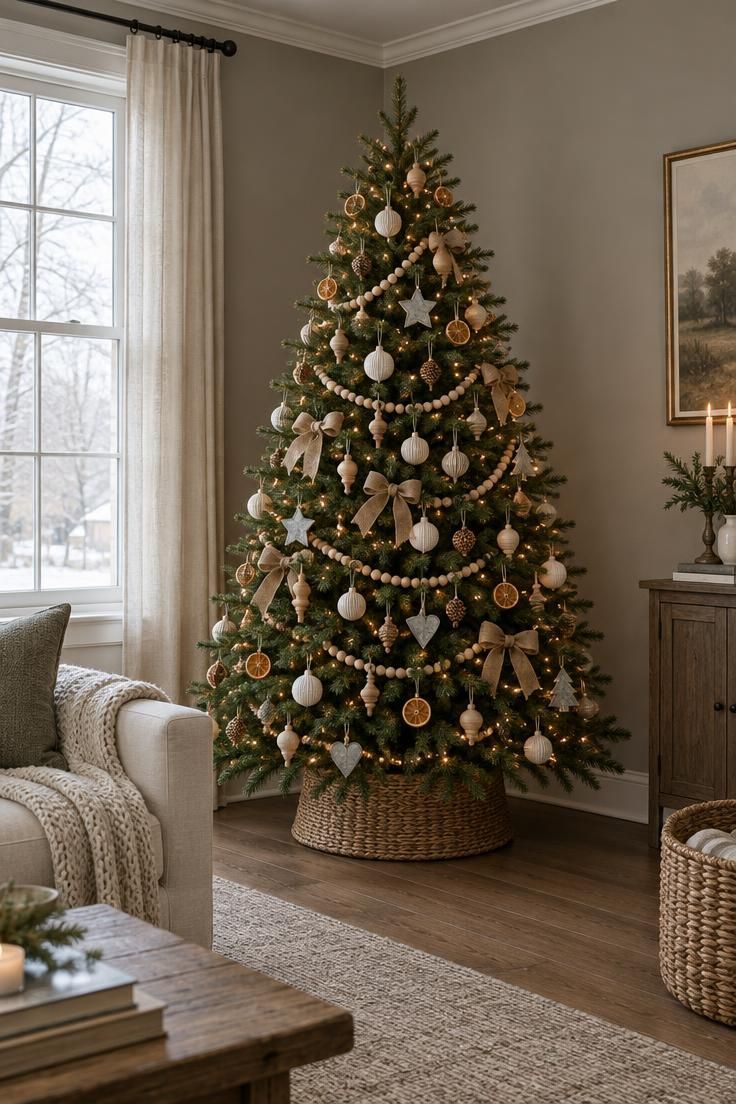
Dress a tree in a limited farmhouse palette: cream and off-white, natural wood, muted brass, and occasional dried orange slices.
Start with warm white lights, then add wooden bead garlands, simple turned-wood ornaments, small jute or linen bows, and a few galvanized-metal shapes.
Avoid large shiny ornaments and keep red to a minimum, if it appears at all.
The calmer palette lets the tree feel part of the room instead of a separate bright object, and the muted tones hold together in natural daylight.
Add texture by mixing smooth and rough wood beads, small metal bells, and soft ribbon bows.
Ornament density matters as much as color: leaving some branch tips bare keeps the tree from feeling crowded and lets the lights show through.
For a small room, a tabletop tree in the same palette creates the same effect without taking over the floor plan.
In either size, store dried citrus flat and away from moisture between seasons, since real slices darken over time.
Mixing finishes keeps a neutral tree from looking flat.
A matte wood bead next to a softly tarnished bell next to a linen bow gives the eye several small textures to travel across.
Style Blueprint:
- Warm white string lights on a full tree
- Wooden bead garlands in mixed smooth and rough finishes
- Turned-wood ornaments and a few galvanized metal shapes
- Jute or linen bows in place of shiny ribbon
- Dried orange slices stored flat between seasons
Design Pro-Tip: Seat the largest ornaments deepest in the branches and let smaller ones sit toward the tips, which builds depth and keeps the pale palette from reading as one solid mass.
Fireplace Firewood Nook With Plaid Wool Accents
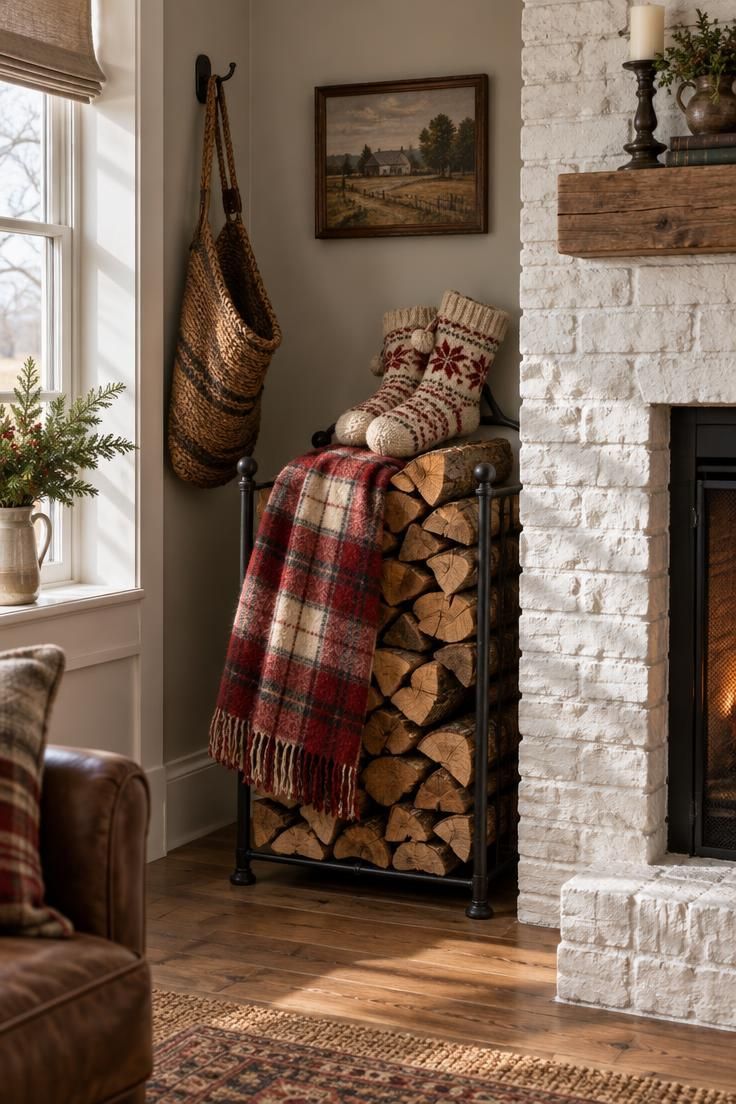
Turn an unused alcove beside the fireplace into a working firewood nook with a warm textile layer.
A slim iron log rack keeps split wood from sitting directly on the floor, while a folded plaid wool blanket across one end softens the hard edges.
Hang a woven carrying sling from a wall hook above or beside the rack so the corner can double as storage for the next trip to the woodpile.
The wool layer does practical work in a cold house.
The blanket can be grabbed for a lap on chilly evenings, and chunky knit stockings resting on the wood stack make the nook feel tied to December without requiring a mantel or shelf.
Choose a plaid in muted red, cream, and a hint of charcoal so the corner reads warm rather than bright.
Wood stacks can look messy when bundles are uneven, so trim longer pieces or turn their split faces toward the room for a cleaner front.
Mixing log sizes keeps the stack stable without needing a fussy arrangement.
Leave a small gap between the rack and the wall so air can move behind the wood.
A dry rack that sits slightly off the floor keeps the bottom logs from absorbing moisture from the slab, which is helpful in older homes where hearth-level dampness lingers after rain.
Rotate the stack every few weeks so older pieces get used first, and keep the wool blanket folded loosely rather than packed tight so it airs out.
Style Blueprint:
- Slim iron log rack in matte black or dark bronze
- Folded red-and-cream plaid wool blanket across one end
- Woven carrying sling hanging from a wall hook nearby
- Chunky knit stockings resting on the top logs
- Wood stack arranged with split faces turned outward
Stair Rail Greenery Swag With Natural Ribbon Ties
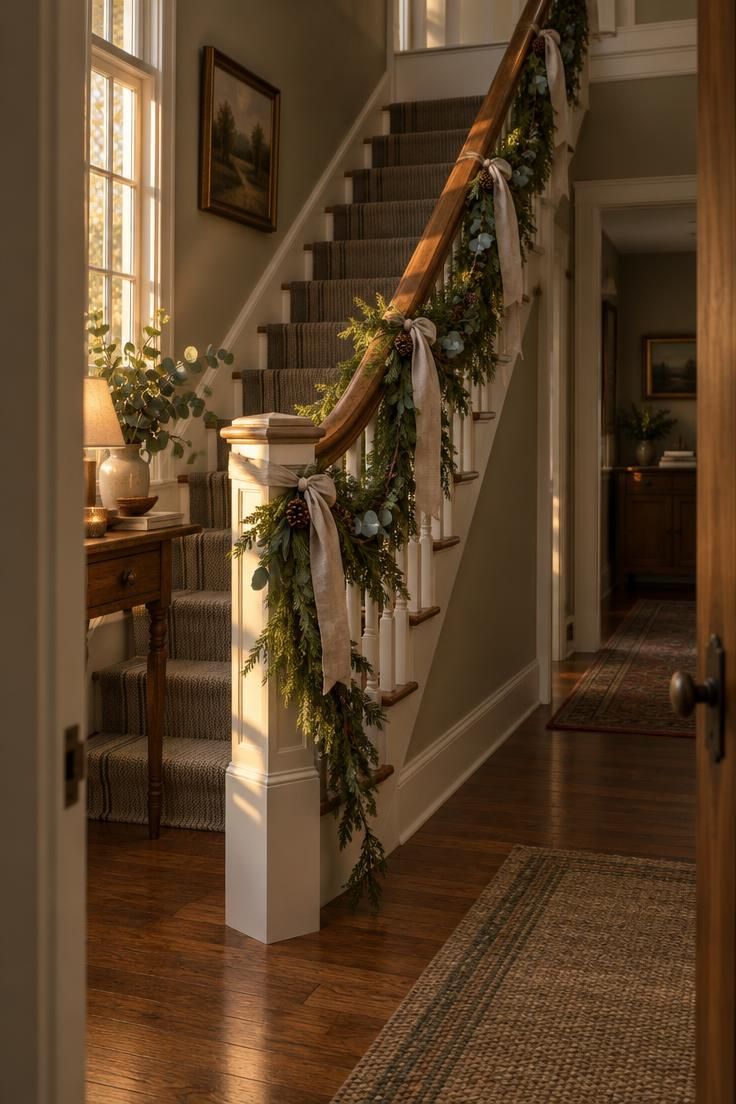
Run a long mixed greenery garland along the handrail of a staircase and anchor it at the newel post and at intervals with wide natural linen or burlap ribbon.
Let the garland dip gently between each tie instead of pulling it tight.
Tuck small pinecones, sprigs of seeded eucalyptus, or a few wooden stars into the garland after tying it in place.
The treatment works with interior wood stair rails and simple painted newel posts, and it adds a strong holiday cue in a narrow space where a tree may not fit.
Loose knots read more understated than full bows.
Use faux greenery if the stair gets daily use, because fresh needles and thin stems can break off with brushing traffic.
Keeping the garland out of the hand-swipe zone on the railing prevents constant dislodging, and it leaves the rail usable on busy mornings.
Ribbon placement does most of the visual work here.
Even spacing between ties keeps the swags consistent, while slightly uneven dips give the arrangement a handmade quality that suits farmhouse interiors.
Style Blueprint:
- A long mixed greenery garland with a loose swag
- Wide natural linen or burlap ribbon tied in simple knots
- Small pinecones and seeded eucalyptus tucked into the garland
- A painted newel post left visible at the anchor point
Design Pro-Tip: Drape the garland loosely along the rail before trimming any stems, then cut only after the main swags sit where you want them so the dips fall evenly.
Mudroom Boot Shelf With Mini Wreaths and a Wire Egg Basket
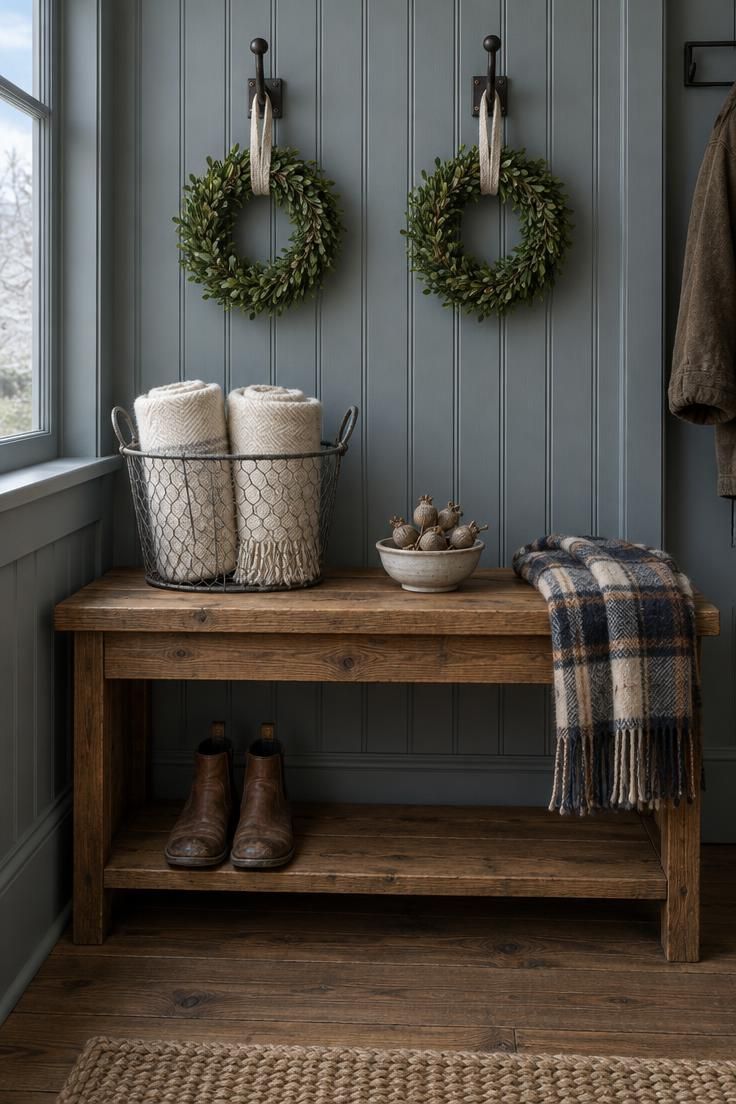
Give a narrow mudroom wall a working decorating layer by treating the boot shelf as a small display surface.
For a muted greenery wreath, the shelf remains useful for setting down gloves, a hat, or a basket, while the wreaths bring greenery up to the wall where floor space is tight.
Pick two small wreaths instead of one large piece so the arrangement follows the length of the shelf without blocking reach.
Twill or linen loops keep the wreaths easy to move when the hooks are needed for a coat or bag.
A wire egg basket corrals rolled blankets, winter socks, or a spare scarf without looking like a stack of overflow.
The open metal grid lets the shelf breathe and keeps the setup from reading as a heavy storage unit.
Mini boxwood wreaths repeat the farmhouse greenery motif without adding another tabletop tree or garland.
The crisp round shapes contrast with the straight shelf and the soft folds of the blankets.
Choose a leather boot, a scuffed work boot, or a child’s boot as the floor anchor if the shelf sits low.
One worn pair reads as part of the room, while a neat row of separate pairs may feel too arranged.
This layer works in a side entry, back hall, or combined laundry-and-mudroom passage.
The shelf depth matters less than the clearance above it, because the wreaths need room to hang without brushing the baskets or scarves beneath them.
Style Blueprint:
- Two small boxwood wreaths on twill or linen loops
- A low wooden shelf with visible grain and a narrow footprint
- A galvanized wire egg basket holding rolled cream or oat-toned blankets
- One folded plaid or grain-sack scarf draped over an end
- A single pair of worn leather boots tucked under the shelf
Kitchen Shelf Styling With Ironstone and Bottle Brush Trees
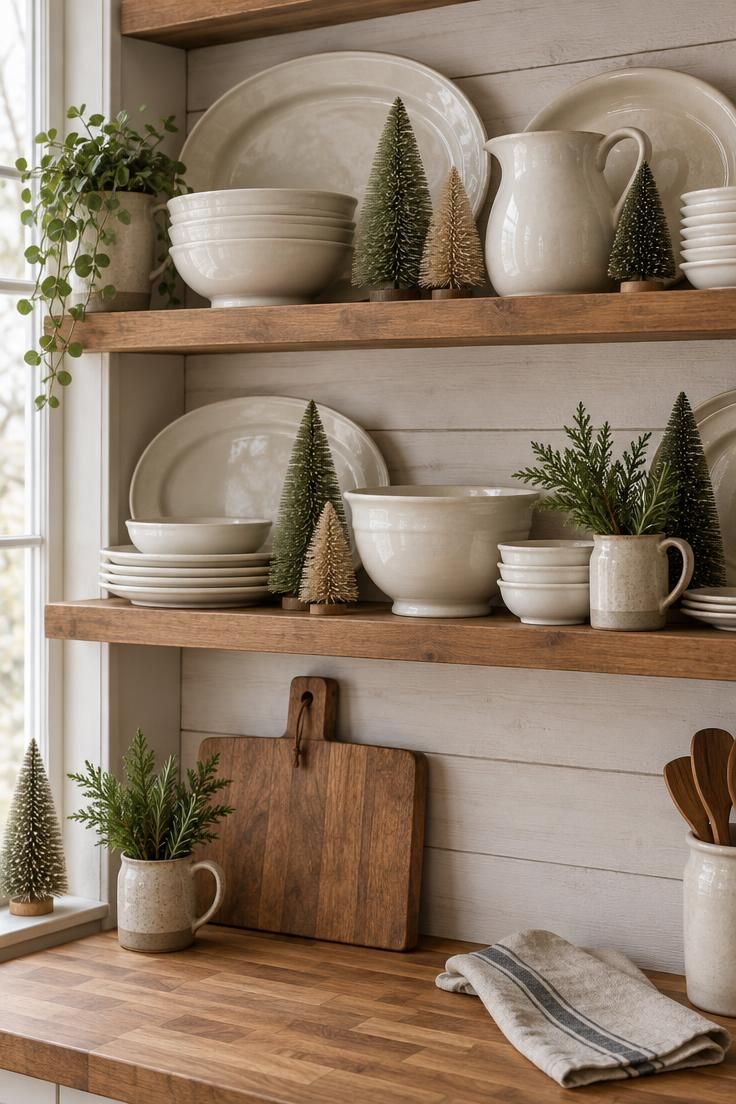
Use open kitchen shelves or a hutch to build farmhouse christmas decor around ironstone plates and small bottle-brush trees.
Start with a foundation of cream ironstone platters and bowls, then place sage or natural bottle-brush trees between them.
Tuck short sprigs of cedar or rosemary into small stoneware mugs and set them at the front edge.
The repetition of white ceramics against wooden shelves creates quiet rhythm, and the small green sprigs add a seasonal note without taking up shelf space.
Keep useable items like a cutting board or a stack of bowls in the arrangement so the shelf still works for daily kitchen tasks.
A shelf that only displays holiday pieces loses the easy, working-kitchen feel that makes this style convincing.
If open shelves are within reach of young children or pets, keep small trees toward the back of the shelf or choose larger, heavier pieces that resist an accidental nudge.
Swap fresh rosemary or cedar for faux sprigs if the kitchen runs warm, since heat dries fresh sprigs quickly.
Grouping the trees in odd numbers with stepped heights keeps the shelf from looking like a matched set.
Leave gaps between the groups so the wood shelf itself stays part of the composition.
Style Blueprint:
- Cream ironstone platters and bowls as the base layer
- Sage and natural bottle-brush trees in odd-numbered groups
- Stoneware mugs holding short cedar or rosemary sprigs
- A cutting board and stacked bowls left in place for daily use
Design Pro-Tip: Vary the tree heights by a noticeable step within each group, and let one ironstone platter lean at the back of each cluster to give the arrangement a vertical anchor.
Grain Sack and Linen Textiles on a Dining Bench
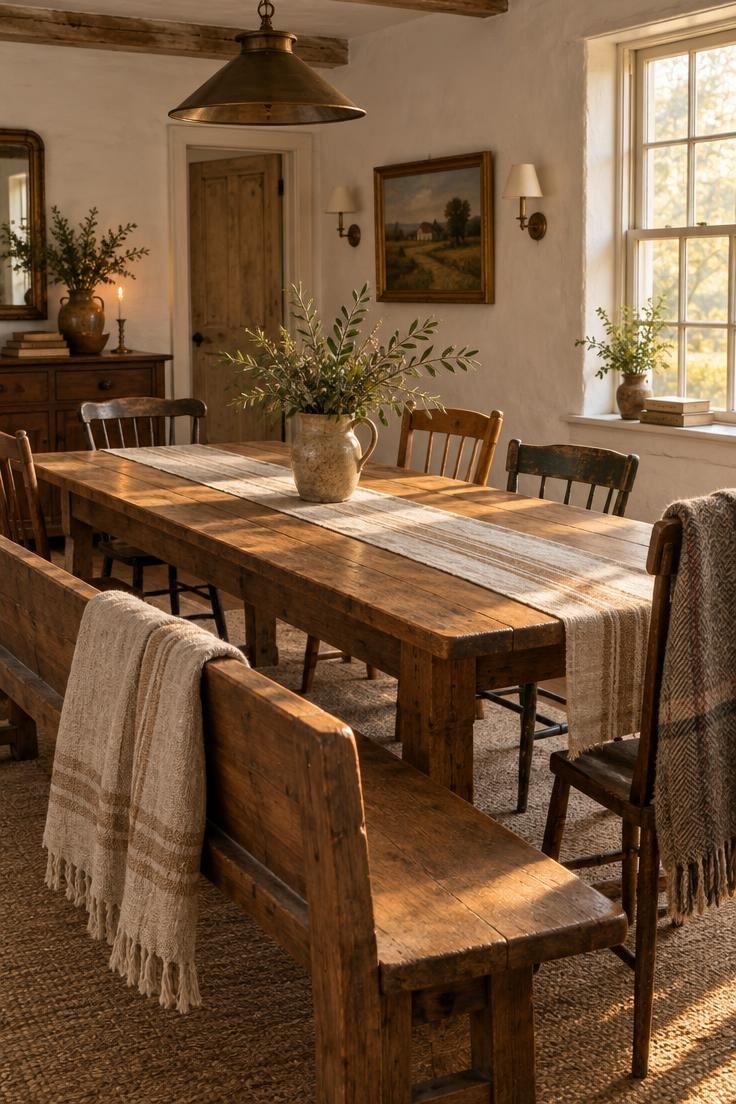
Use grain-sack stripe and natural linen textiles to add farmhouse softness to the dining room.
Drape a runner in alternating cream and tan stripes across the table, or place a single folded quilted throw over the back of a dining bench.
For tree skirts and stockings, use natural linen with simple red or black woven stripes and no extra lettering.
Grain sack and linen textiles work best when the rest of the room is predominantly wood and greenery, because too many competing fabrics make the space feel busy.
Layer a soft wool or textured cotton throw over the end chair to create visual weight at the edge of the table area.
That single heavy textile balances the lighter runner and keeps the table grouping from floating.
Washable cotton and linen are practical for dining areas where spills happen.
For a table that sees daily use, keep the runner narrow enough to leave plate space at each seat, and choose a bench throw that can be shaken out and refolded after meals.
The stripes themselves do useful work.
Running the stripe lengthwise along the table draws the eye down the room, while a crosswise stripe broadens a narrow dining space.
Style Blueprint:
- A grain-sack striped runner in cream and tan
- A folded quilted or linen throw over a bench back
- Natural linen with simple stripes for skirts and stockings
- One wool throw over the end chair for weight
- A stoneware pitcher of greenery as the center note
Bedroom Wall Hook With Dried Yarrow Bundles and a Linen Pocket
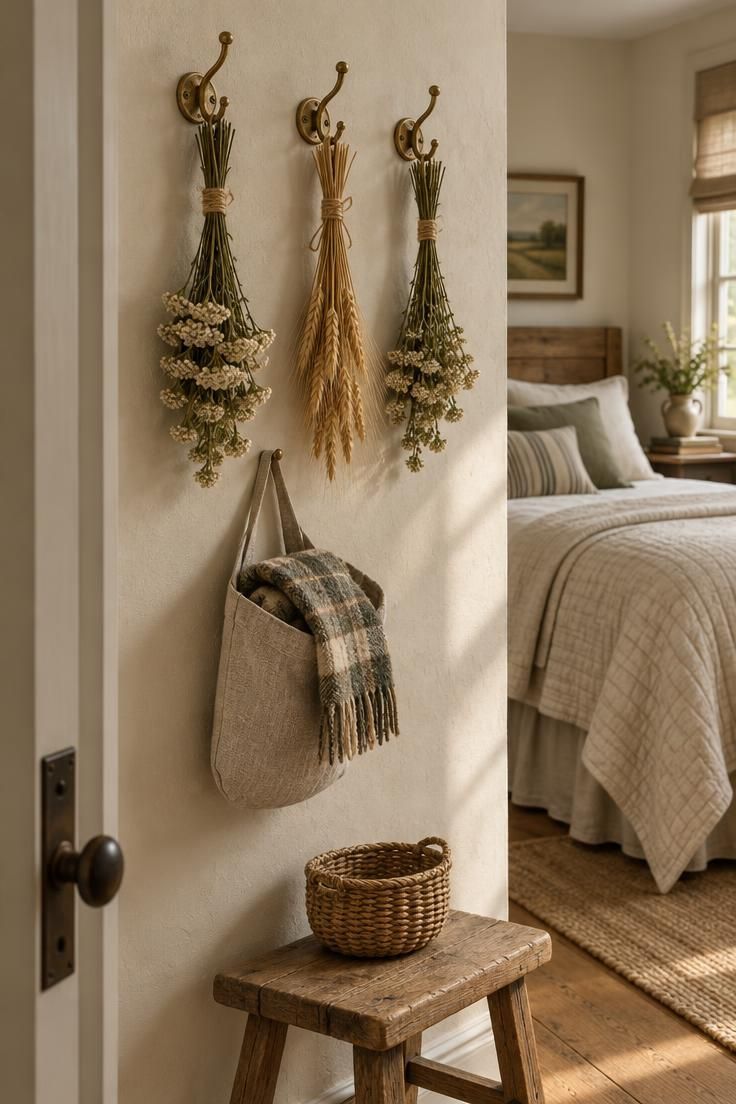
A narrow bedroom wall can hold quiet holiday texture without taking up any walking space or tabletop room.
Hang a small cluster of aged brass hooks near the doorway or beside a dresser, then tie slim bundles of dried yarrow, wheat, or oat stems with twine and loop them over the hooks.
Below the stems, place a shallow natural linen pocket with a folded plaid or grain sack throw tucked inside.
The pocket keeps the fabric off the floor while giving the bed a layer that swaps in quickly on cold evenings.
A wooden stool or low woven basket underneath catches slippers, a book, or a spare pillow, which makes the arrangement useful in a room that already has full nightstands.
Dried stems suit bedrooms because they don’t need water or trimming, though they should be kept away from direct heat vents that can make them shed.
A light dusting with a dry cloth every few weeks is enough to keep them looking tidy.
The palette stays close to the room’s existing neutrals, with the dull green and tan stems adding seasonal depth rather than a loud holiday label.
Style Blueprint:
- Three aged brass wall hooks in a slight arc
- Slim twine-tied bundles of dried yarrow, wheat, or oat stems
- One natural linen wall pocket holding a folded plaid throw
- A low wooden stool or woven basket beneath the hooks
Winter Window Box With Frosted Pine and Galvanized Metal
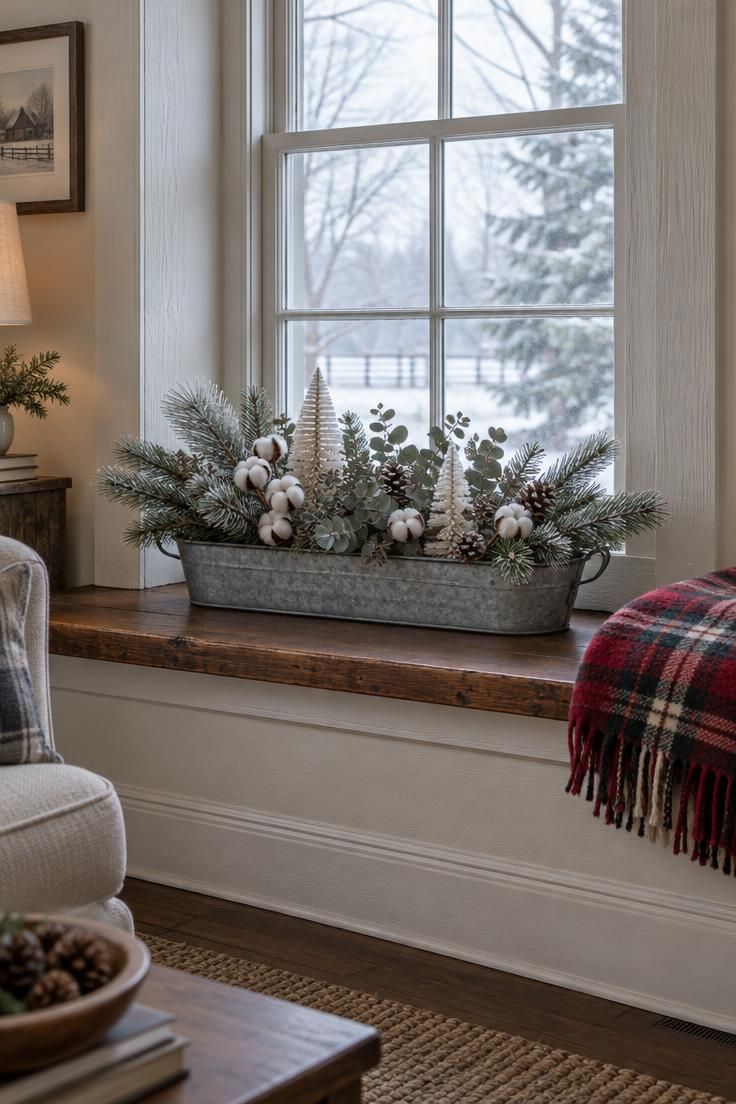
Replace a wreath hung on an interior door with a long, low arrangement set on a wooden window seat or deep sill.
The container can be a galvanized metal tray, a narrow wooden dough box, or a shallow vintage toolbox already kept near the windows.
Fill it loosely with frosted pine stems, seeded eucalyptus, dried cotton bolls, and one or two whitewashed bottle brush trees for height.
The arrangement reads best when it stays below the window’s lower sash, so the daylight still passes through the stems instead of being blocked by them.
A folded wool throw in red or gray plaid at the end of the seat anchors the display and gives the window a practical winter feel.
Keep the throw within reach, since the same seat may be used for reading or sitting through the season.
Dried stems and preserved eucalyptus hold their color without misting and can be returned to storage after the holidays.
If the window seat receives strong afternoon sun, rotate the arrangement occasionally so one side does not fade before the other.
This idea works in a living room, dining nook, or upstairs hallway where a horizontal surface already exists.
Avoid a windowsill that is too narrow for the tray to sit fully without extending past the edge.
A few small white bottle brush trees add texture without turning the display into a full tabletop village.
The galvanized metal picks up cool light from the glass and keeps the arrangement from feeling overly styled.
Style Blueprint:
- A long galvanized tray, dough box, or shallow metal toolbox
- Frosted pine, seeded eucalyptus, and dried cotton bolls
- Whitewashed bottle brush trees for low contrast
- A folded red or gray plaid wool throw anchoring one end
- A low profile that leaves the window light visible
Woven Basket With Rolled Throws and a Small Lantern
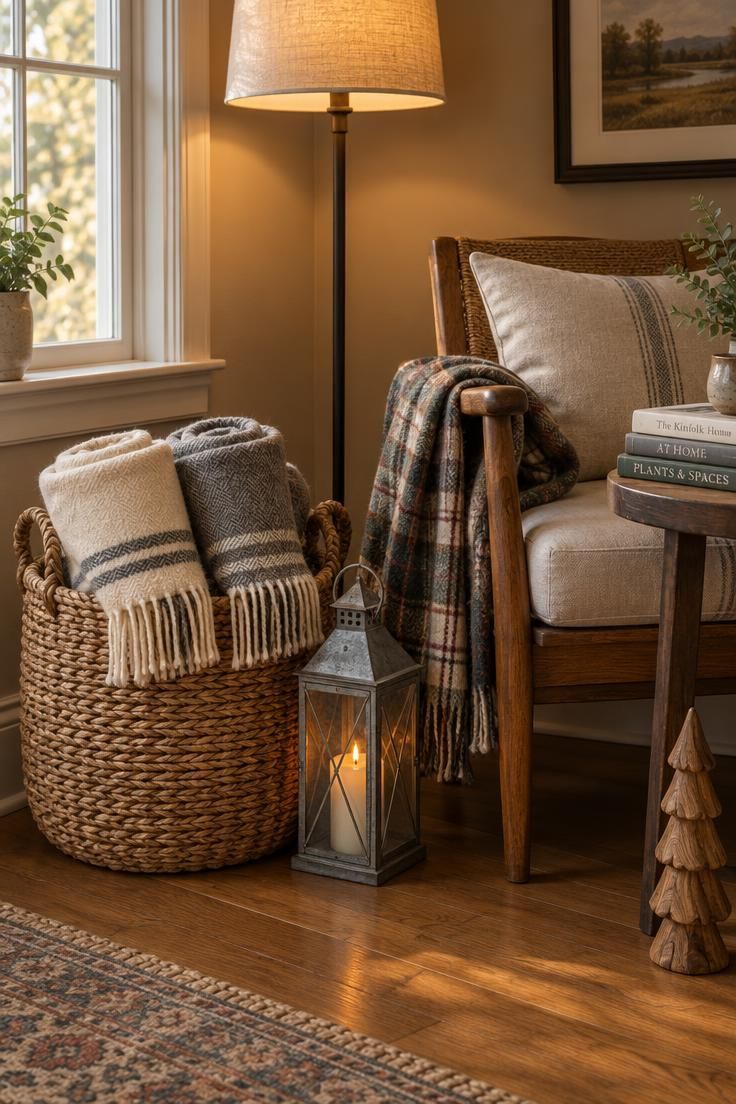
Turn a corner chair or reading nook into a farmhouse holiday spot with a woven basket holding two or three rolled throws in cream, gray, or muted plaid.
Set the basket beside the chair and add a galvanized lantern or small wooden tree on the floor next to it.
Keep the throws loosely rolled with the striped ends facing out so the basket itself becomes part of the decor.
This idea is practical storage: the throws sit exactly where someone sitting or reading would reach for them.
Use a low basket with handles so it can move to another room when needed.
For a small space, choose a narrower basket that still holds two throws without bulging, which keeps the corner from feeling blocked.
Little maintenance is required beyond refolding the throws after use, which keeps the basket neat through the season.
A piece of brown kraft paper or a folded cotton sheet at the bottom of the basket lifts the throws above the basket’s natural splintery edges and protects the fabric.
Balance matters in a corner like this.
A tall lantern beside a low basket gives the eye a vertical note, while the rolled throws keep the basket’s top edge soft.
Style Blueprint:
- A low woven seagrass basket with handles
- Two or three throws in cream, gray, or muted plaid
- A galvanized lantern or small wooden tree beside the chair
- Kraft paper or a cotton sheet lining the basket bottom
- A neutral cushion on the reading chair
Design Pro-Tip: Roll each throw with its striped or plaid edge facing out and stand the rolls upright rather than stacking them flat, which keeps the pattern visible and the basket easy to restock.
Tabletop Forest of Bottle Brush Trees on a Wooden Tray
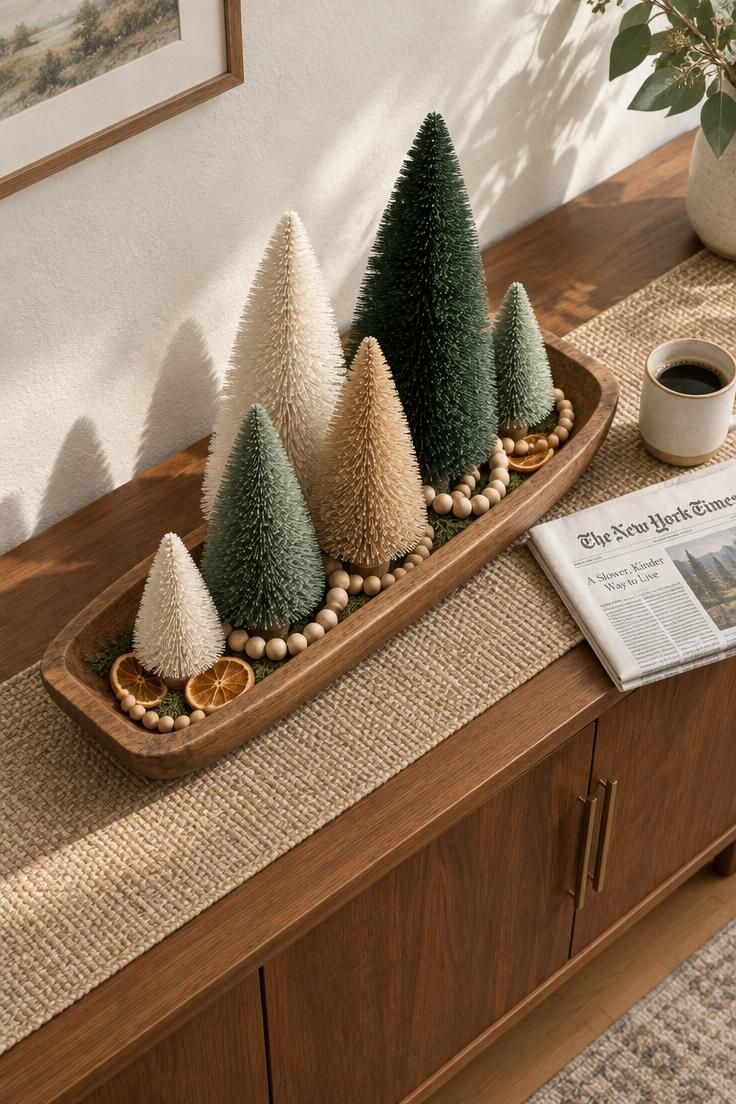
For a bottle brush tree arrangement, cluster five to seven bottle-brush trees in mixed heights and finishes on a long wooden tray or a narrow runner on a sideboard, entry table, or deep windowsill.
Use cream, sage, natural wood, and one dark forest green tree; vary the heights from about four inches up to twelve inches.
Add one small wooden bead garland draped through the group and a few dried orange slices tucked at the base.
The tray keeps the whole group together and makes it easy to move for cleaning or when the surface is needed.
This is a budget-friendly idea that can build over time with inexpensive trees and change yearly by adding another finish.
On a wide surface, a tray of trees works better than scattering them singly because the group reads as one large object.
Avoid mixing in too many red or bright trees, which can push the group away from farmhouse restraint and toward a toy-like look.
Set the tallest tree off center and let the shorter trees cascade away from it toward the tray’s edge so the arrangement avoids symmetry.
A dark green tree among the pale ones gives the group a visual anchor.
Without it, a tray of cream and sage trees can wash out against a pale wall.
Style Blueprint:
- A long wooden tray or narrow runner
- Five to seven bottle-brush trees in cream, sage, natural wood, and dark green
- A small wooden bead garland draped through the group
- Dried orange slices tucked at the base
Conclusion
Farmhouse Christmas decor is a quiet, layered style built from the materials and objects a home already tends to collect: worn wood, white or cream stoneware, simple linens, and fresh greenery.
The strongest rooms in this style pair one large gesture, such as a mantel garland or a dough-bowl centerpiece, with a few smaller vignettes in baskets, shelves, and nightstands.
Restraint and material repetition keep a house from feeling like a holiday shop display, while a few natural accents bring the season into daily routines.
Choose the ideas that fit the surfaces and storage already available, and let the rusticity of the materials do the talking.