This post may contain affiliate links. If you make a purchase through these links, we may earn a commission at no additional cost to you.
A wreath gives a home a clear seasonal marker without asking for much space.
On a front door, a hallway wall, or above a sideboard, one ring of foliage, grain, or fruit can carry the mood of late autumn.
Thanksgiving wreaths work well because their palette has no fixed rules: wheat gold, muted sage, deep plum, and warm amber all read as the season.
The designs below split into distinct visual directions, from airy dried grasses to dense magnolia leaves, so the door color, house style, and preferred effort level can guide the pick.
A few basic tradeoffs, such as fresh versus dried materials and simple versus heavily accented arrangements, help narrow the choices before any assembling begins.
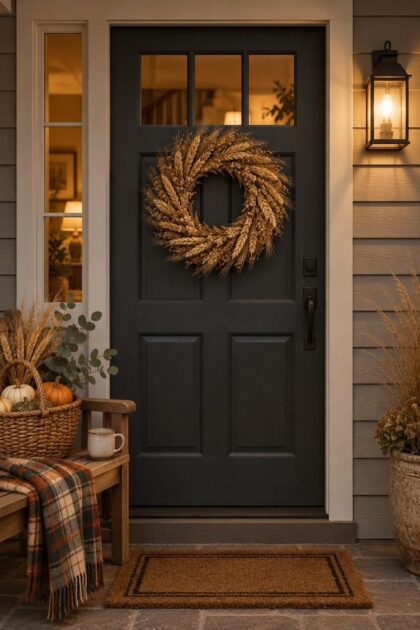
Golden Dried Wheat Wreath with Airy Grass Texture
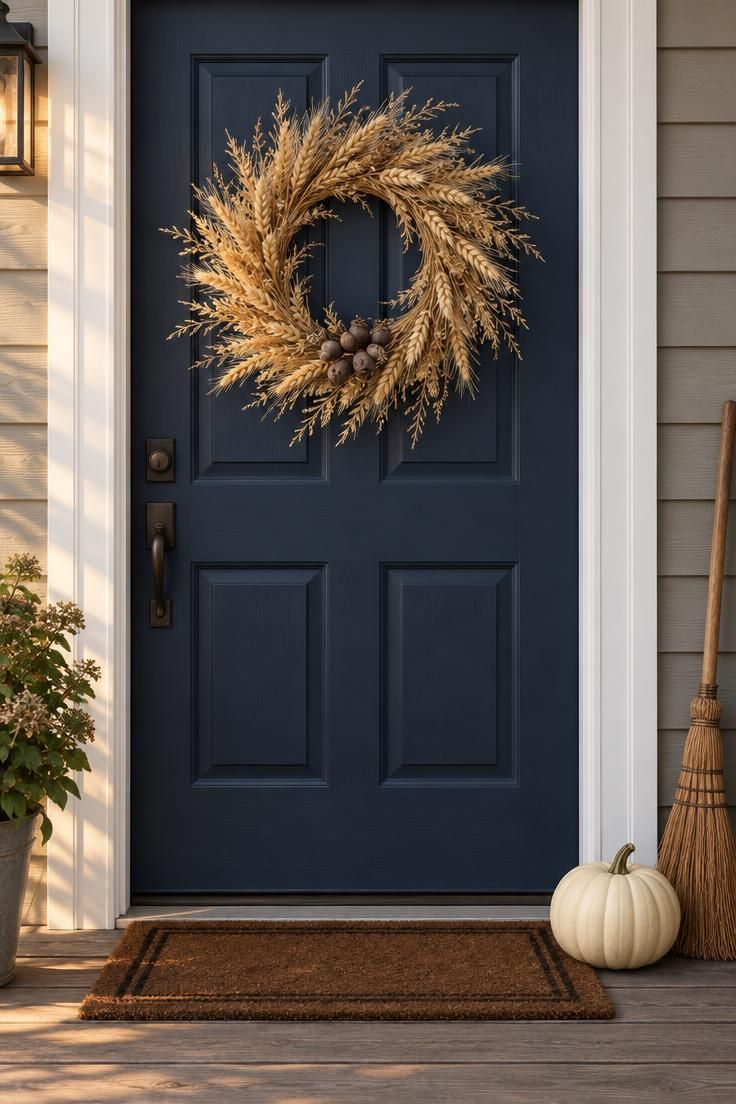
A dried wheat wreath leans on texture rather than color contrast.
Wheat stalks carry a narrow, linear shape that repeats around the ring, and fine grasses soften the edge so the silhouette feels loose and sun-bleached.
Leaving gaps between bundles matters: a dark door showing through becomes part of the design, and the ring reads lighter than its actual size.
Setting the focal point low sidesteps the expected center bow and lets the eye travel around the circle at its own pace.
Deep navy, charcoal, or forest green makes the strongest backdrop for pale gold.
On those doors the wheat appears almost luminous without any added accent color, and a black doormat underneath repeats the dark note.
Warm wood or tan siding pulls the arrangement toward a softer, more blended look, which suits a porch that already leans rustic.
Sizing reads best in relative terms.
A wreath somewhere between a large dinner plate and an oversize serving platter looks generous on a standard door; anything noticeably smaller tends to disappear on a wide panel.
The airy structure keeps the visual weight low even when the ring itself is broad.
Dried stems shed a little over the season, and dust settles into the fine grass.
A gentle shake before hanging and an occasional light pass with a soft brush keeps the bundle looking fresh.
Flattened or bent stalks can be nudged back into place by hand.
Style Blueprint:
- Bundles of dried wheat stalks with wispy tan grasses as the main material
- A small cluster of dark seed pods placed low on the ring
- A navy, charcoal, or deep green door as the backdrop
- A dark brown coir mat and one pale pumpkin at the threshold
Design Pro-Tip: Hang this wreath on a covered porch or in an entry hall rather than a fully exposed south-facing door, since direct sun fades dried grass color over time.
Asymmetric Eucalyptus and Berry Wreath in Muted Green
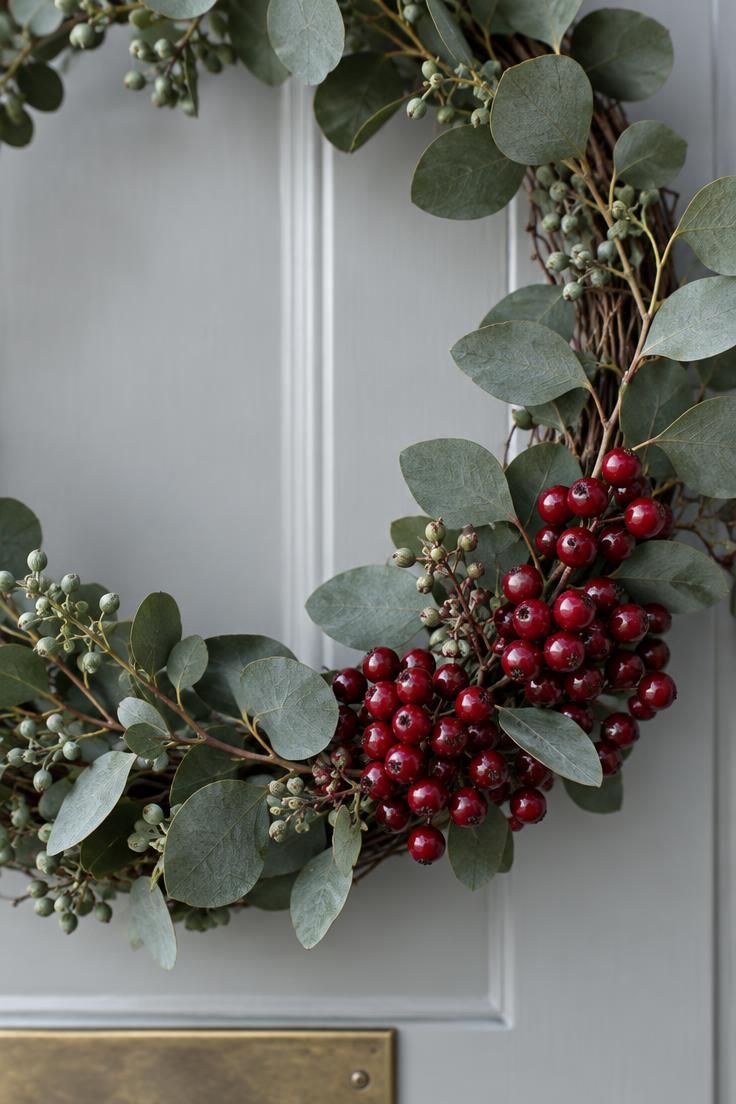
This eucalyptus and berry wreath depends on deliberate imbalance.
Stems climb from one corner and stop short, leaving the opposite side open, and the berry cluster anchors the bottom right like a punctuation mark.
That off-center weight makes the composition feel composed rather than accidental.
The open silhouette reads contemporary next to a full round wreath, and the matte-against-gloss finish contrast gives the eye something to do up close.
Preserved eucalyptus is a dried material, so the wreath keeps its shape across the season and can be stored flat between years.
The tradeoff is that asymmetry demands more conscious placement.
Every sprig has a job because the visual weight is not evenly distributed, so arranging takes a few extra passes and a step back to check balance from a distance.
A light gray or white door lets the sage and burgundy stay understated.
On a darker door the same colors turn richer, though the open structure keeps the overall effect from feeling heavy.
Style Blueprint:
- A slim grapevine base kept deliberately open
- Preserved eucalyptus in muted sage, arced from one corner
- A tight cluster of deep red faux berries as the off-center anchor
- A pale gray or white door to keep the palette quiet
- A thin brass door plate or hardware detail nearby
Design Pro-Tip: Keep this wreath indoors or on a sheltered entry, because long sun exposure can make the eucalyptus shift from sage to brittle tan.
Mini Pumpkin Cluster on a Rustic Twig Base
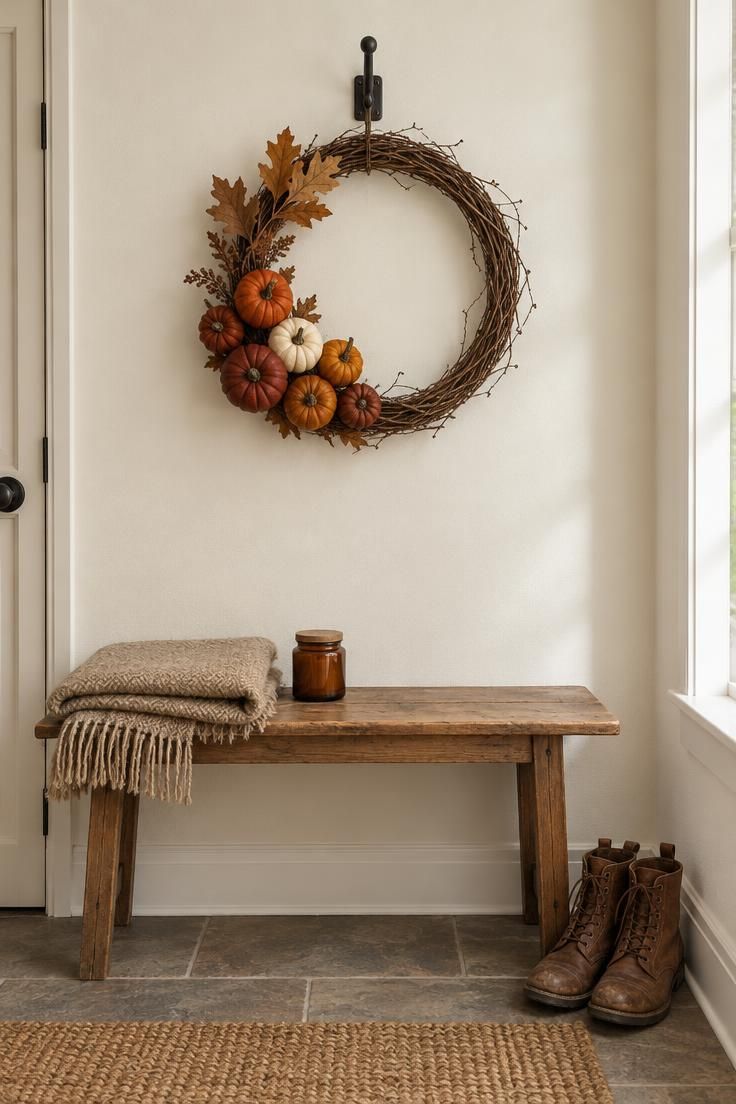
A mini pumpkin wreath reads as casual and slightly playful because the gourds gather in one quadrant instead of ringing the whole hoop.
Six or seven small pumpkins in rust, burnt orange, deep amber, and a lone cream make a warm, varied color story.
Leaving the opposite side mostly open keeps the arrangement from feeling like a full harvest display, and a few dried oak leaves near the top soften the transition between filled and empty space.
The pumpkin cluster is the visual anchor.
With that weight clearly placed, the empty stretch of twig opposite reads as intentional breathing room rather than a gap.
The bare twig base contributes its own irregular curl and shadow, so the wreath looks finished even before any greenery goes on.
This style settles easily into a back door, mudroom wall, or pantry door.
Those are working spots where a relaxed arrangement feels at home, and the gourds can echo amber jars or rust textiles already nearby.
Faux or dried pumpkins store longer than fresh gourds, which is worth weighing if the wreath will return next year.
A twig base can shed small pieces when handled often, so a gentle shake before hanging and a light hand during storage help.
An additional bow risks crowding a cluster that already works hard as the focal point.
Threading pumpkin colors toward the porch or mudroom palette, say rust with tan, keeps the whole corner coherent.
Design Pro-Tip: Lean the pumpkin colors into the existing porch or entry palette instead of adding a bow, since another accent can make the cluster feel busy.
Style Blueprint:
- A bare grapevine hoop with visible irregular twig weave
- Six or seven miniature pumpkins in rust, amber, and cream grouped on one quadrant
- A few dried oak leaves tucked near the top
- A cream mudroom wall with a wooden bench and folded blanket below
Dried Orange Slice and Cinnamon Stick Ring
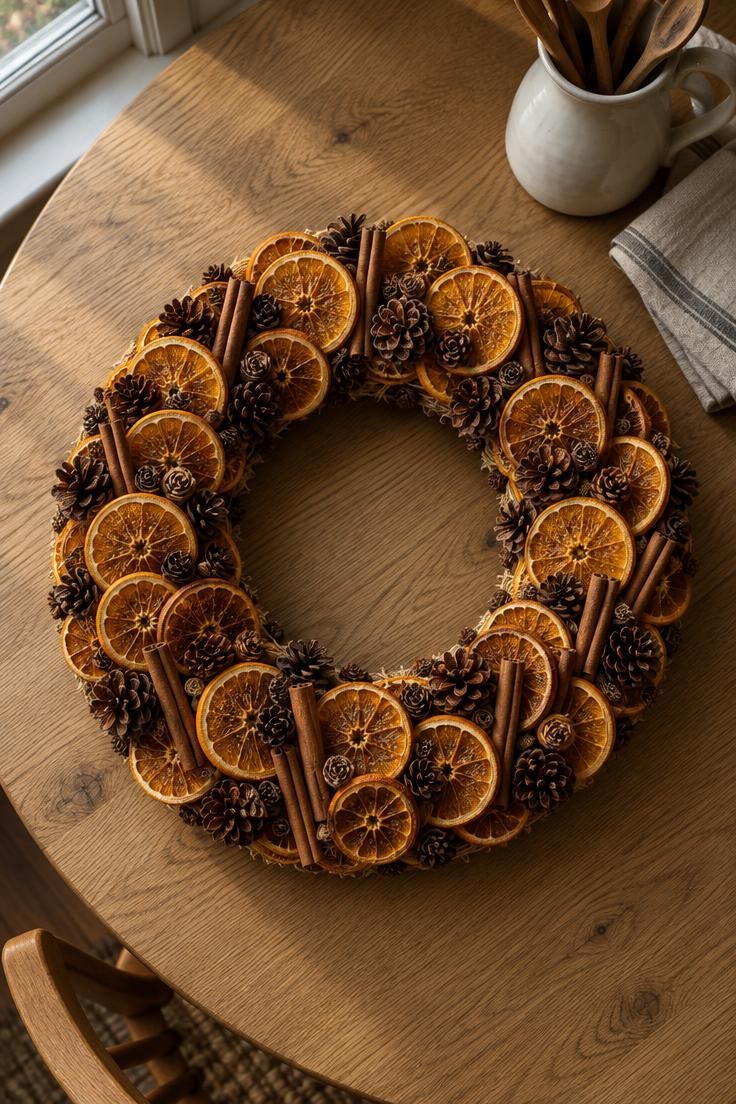
A dried orange slice ring brings fruit into the wreath vocabulary.
Overlapping slices create a repeating round motif around the straw base, and cinnamon sticks interrupt the pattern with short vertical lines, giving the composition rhythm without color variation.
Pinecones fill the small gaps and add a scaled-down echo of the same woody tones.
Density is the defining choice here.
The arrangement is packed fairly full, so the straw base barely shows and the wreath reads lush rather than delicate.
Warm amber and brown keep the effect grounded, and the matte dried peel contrasts quietly with the smoother cinnamon bark.
Because the materials carry noticeable aroma, this design sits naturally on an interior door near the kitchen, pantry, or breakfast nook.
Those spots also shelter brittle slices from weather and bumps.
Over time the orange slices may darken and become more fragile, so keeping the wreath out of reach of daily traffic helps.
Hanging it on a plain wood or woven ribbon loop lets the round fruit slices stay the clear focal point.
A patterned bow would compete with a motif that already repeats around the entire ring.
Style Blueprint:
- A round straw base packed with overlapping dried orange slices
- Cinnamon sticks set in short vertical lines among the fruit
- Small pinecones filling the gaps
- A plain wood or woven ribbon loop instead of a patterned bow
- A kitchen-adjacent door or pantry setting
Neutral Natural-Texture Wreath with Cotton and Wood Beads
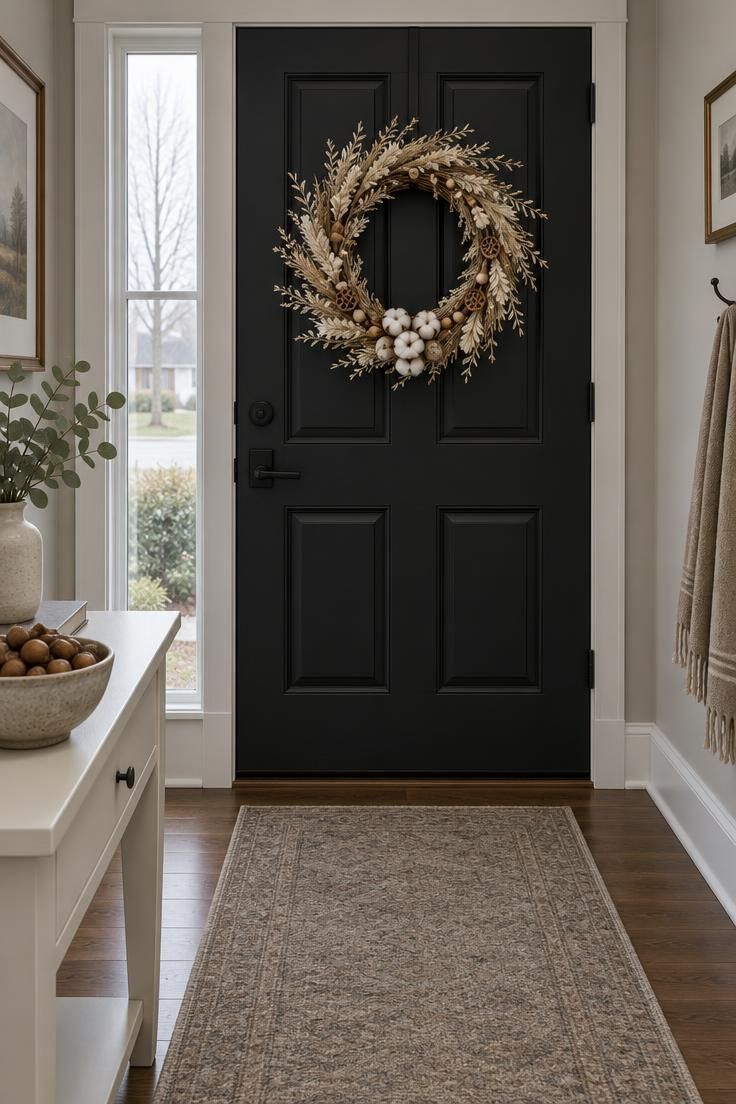
Neutral thanksgiving wreaths build their character from texture rather than color contrast.
Cream and oat grasses wrap a grapevine or wire base, and cotton bolls, wooden beads, and tan seed pods add small sculptural moments.
The silhouette stays open with light density, so the composition feels airy even with several materials in play.
A loose cluster of cotton at the bottom center gives the eye one clear resting point.
The neutral palette earns its place through versatility.
Against a black, charcoal, or deep brown door the cream and tan tones separate cleanly without turning bright, and the piece can drift toward early winter if the cotton and wood lean more seasonal than strictly harvest.
That flexibility extends the display window beyond a single holiday.
Storage is kind to this material mix.
Dried grasses and cotton keep their shape when the wreath is stored flat, so the piece can return season after season with a light dusting and a bit of reshaping.
Restraint keeps the minimalist look intact.
A simple twine loop or a narrow strip of raw linen suits the palette far better than a colored ribbon, which would introduce the one strong hue the design deliberately avoids.
Style Blueprint:
- Cream and oat dried grasses wrapped around a grapevine base
- Cotton bolls clustered loosely at the bottom center
- Small wooden beads and tan seed pods as quiet accents
- A black or deep brown door to make the neutral tones read
Design Pro-Tip: Avoid adding a colored ribbon; a simple twine loop or a narrow strip of raw linen keeps the minimalist look intact.
Deep Burgundy and Plum Foliage Wreath
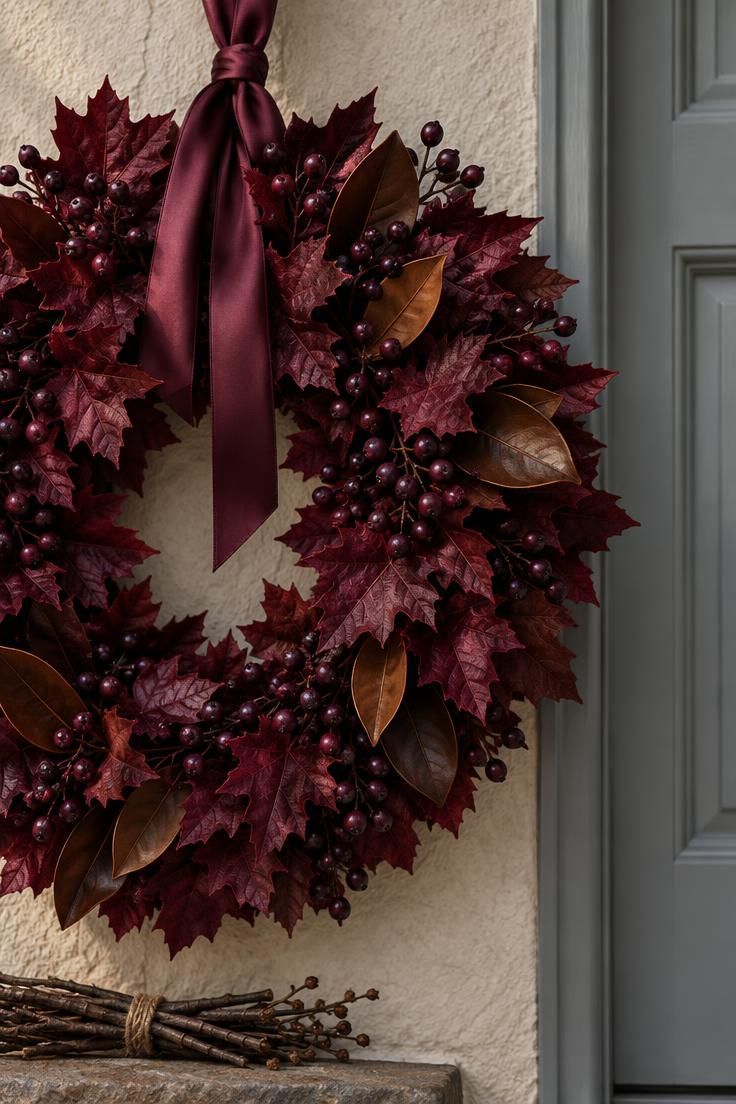
This wreath offers a moodier route through the season.
Deep burgundy maple leaves, plum berries, and dark copper magnolia leaves combine on a dense round base, and the high density gives the ring a formal, almost velvet-like surface.
Dark tones in several values keep the palette from flattening into one note.
Tying a slender satin ribbon in a darker wine tone at the top instead of the bottom changes the whole silhouette.
The knot and short tails extend the form upward, so the wreath reads taller and more elegant than a bottom-bow arrangement.
Cream or warm white siding, pale brick, and soft gray doors all support the saturated palette without competing with it.
In a small entry, though, rich dark colors can feel heavy, so proportion matters.
A slightly smaller wreath suits a narrow door better than an oversized one, and the density should stay high enough to look deliberate at that reduced scale.
Satin ribbon creases with storage and can be pressed back into shape between seasons.
Faux foliage holds its color across the display window, and nearby porch accents kept neutral, such as a single pale gourd, let the wine tones stay dominant.
Style Blueprint:
- Deep burgundy faux maple leaves packed into a dense round base
- Plum-toned berries and a few dark copper magnolia leaves
- A slender wine satin ribbon knotted at the top for height
- Cream siding or a soft gray door as the backdrop
- Neutral porch accents that leave the saturated colors in charge
Bare Grapevine Wreath with One Wide Ribbon
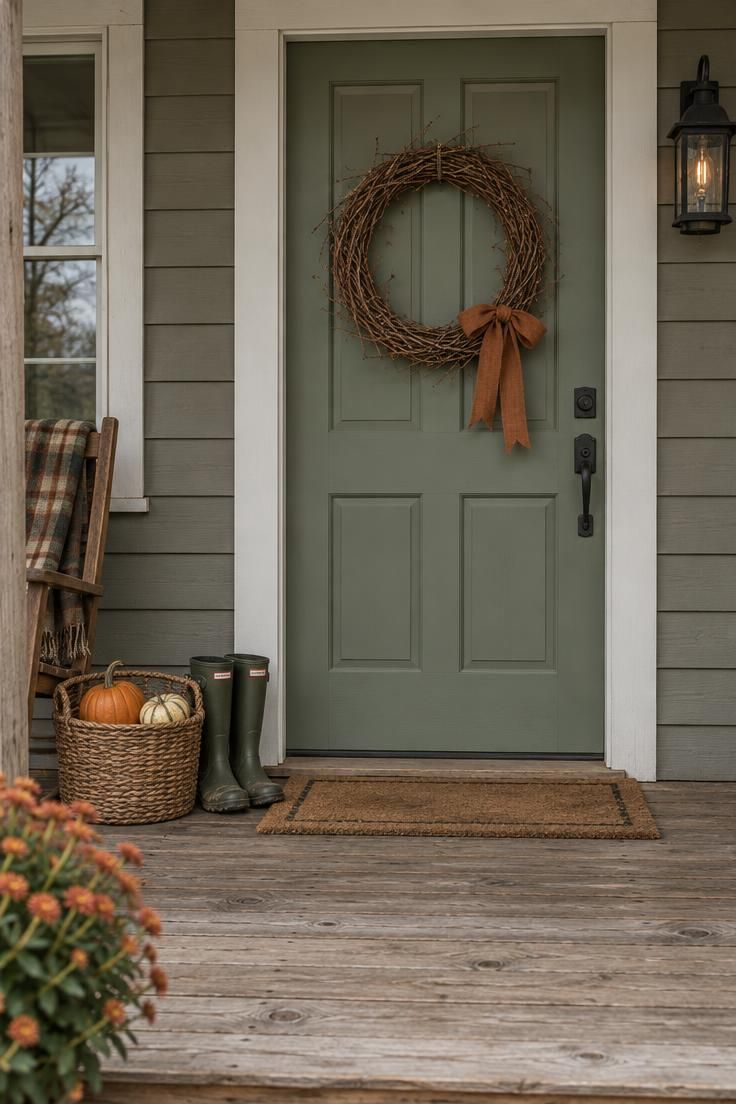
For a grapevine wreath with ribbon, a bare grapevine hoop treats the base itself as the design.
Irregular twigs cross and curl in a way no two hoops repeat exactly, giving the wreath an organic, slightly wild texture that already carries the season without adornment.
A single wide ribbon in rust or cream burlap tied at the bottom right supplies the only color and the only deliberate gesture.
This is the entry-level option, and it earns that role.
Minimal cost, quick assembly, and an openness that lets the door color join the composition make it adaptable.
Sage green, dusty blue, or warm brown doors hold their own alongside the neutral twigs, while white doors let the grapevine stand out like line art.
Grapevine sheds small twigs and flexes over time.
A light shake before hanging removes loose pieces, and reshaped curls can be nudged back into place by hand after storage.
The ribbon should be retied loosely so the bow keeps its soft, unfinished look.
If the bow looks bare against the open hoop, tucking a few dried wheat stems behind the knot adds substance without visual noise.
Multiple ribbons would fight the sparse composition.
Design Pro-Tip: If the bow looks bare, tuck a few dried wheat stems behind the knot rather than adding multiple ribbons, which can clutter the open look.
Style Blueprint:
- A bare grapevine hoop with visible open twig weave
- One wide rust or cream burlap ribbon at the bottom right
- A sage green, dusty blue, or warm brown door
- A woven basket with small pumpkins at the porch edge
Magnolia Leaf Wreath with Bronze Undersides
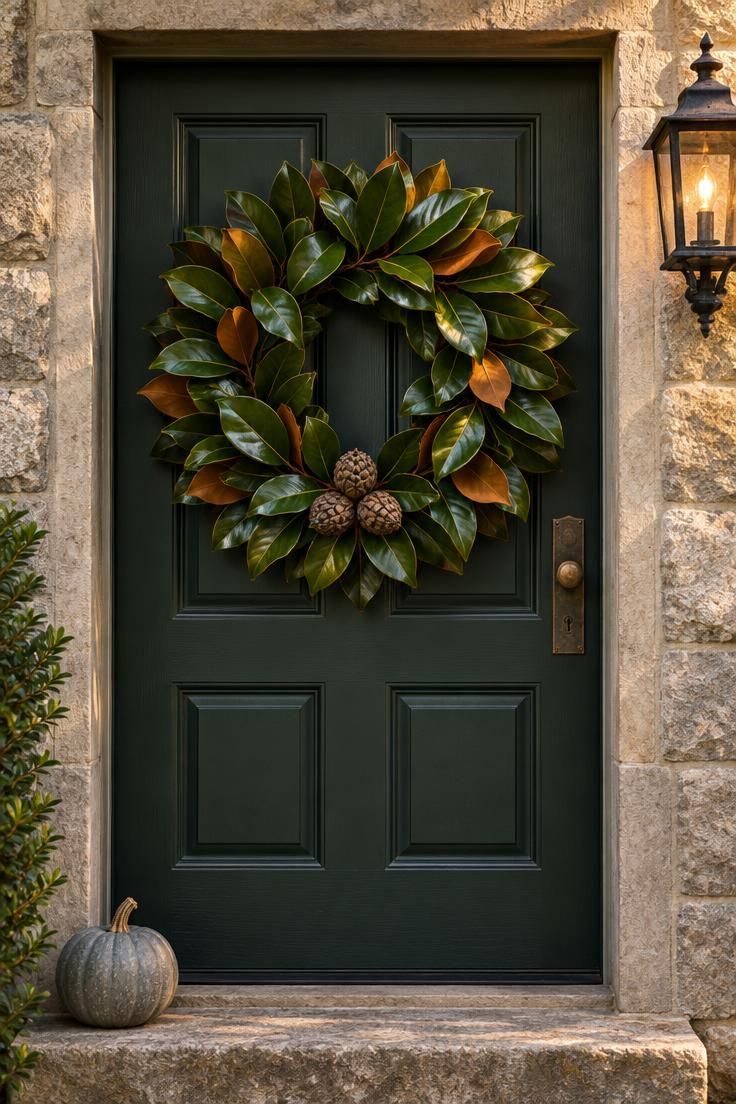
A magnolia leaf wreath works through finish contrast.
Overlapping leaves face outward with their glossy green surfaces, and flipping a few exposes the matte bronze undersides, so light catches in alternating shine and velvet across the ring.
That layered, sculptural surface makes the wreath look built rather than bought, even though its structure is simple.
The full, dense silhouette suits traditional homes, and the green-and-bronze pairing carries an inherited Southern-porch association without leaning on it.
Three small dried magnolia pods gathered at the bottom center give the eye a tidy focal point that matches the wreath’s own materials.
Preserved magnolia leaves hold their shape well and can be stored for reuse between seasons.
Fresh leaves are short-lived and best treated as a single-occasion arrangement, which makes the preserved route the more practical one for a display that spans several weeks.
A covered entry or an interior wall protects the green surfaces.
Prolonged direct sun tends to fade them toward a brittle yellow-brown faster than the bronze undersides lose their depth, so a sheltered spot keeps the two-tone effect balanced.
Flattened leaves can be gently pressed back into shape, and dust lifts with a soft brush.
Arranging should keep some undersides visible throughout the season rather than only near the top.
Design Pro-Tip: Hang this wreath on a covered entry or an interior wall, because prolonged direct sun can fade the green to a brittle yellow-brown faster than the bronze undersides.
Style Blueprint:
- Preserved magnolia leaves layered densely, green tops facing out
- Scattered leaves flipped to show velvety bronze undersides
- Three dried magnolia pods clustered at the bottom center
- A dark green door with stone trim and black iron hardware
Fresh Herb and Greenery Wreath in Soft Sage
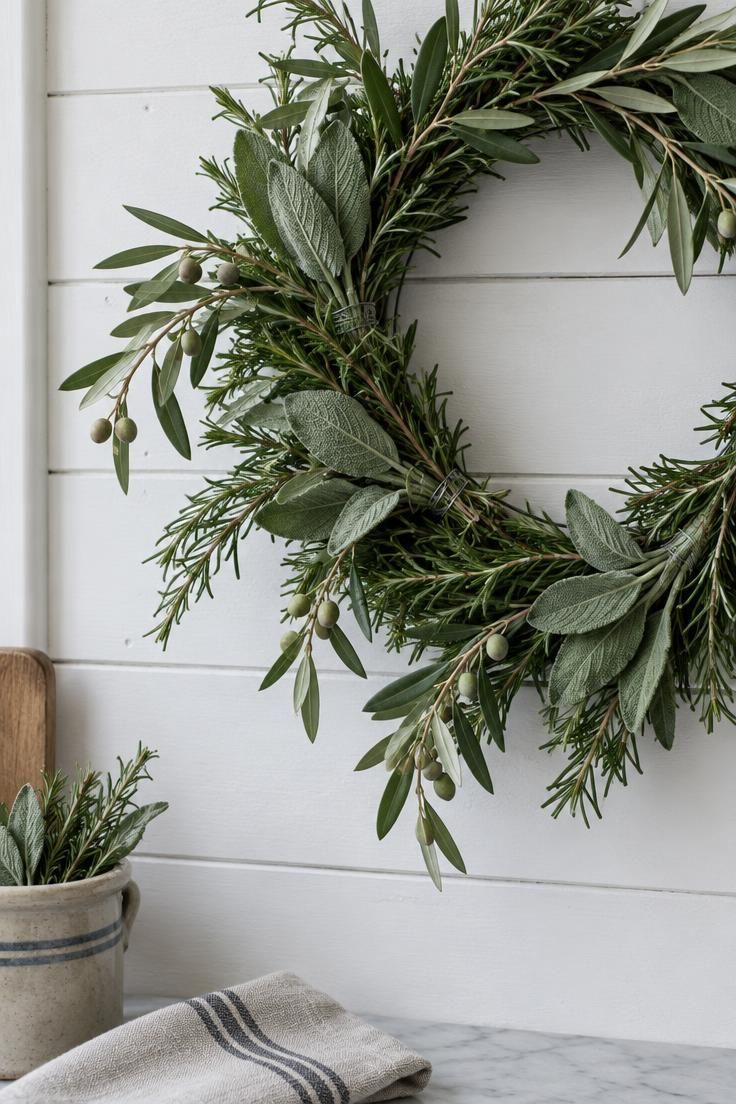
Fresh herbs bring a different character to seasonal decor.
Sage, rosemary, and olive branches wired in small bunches on a simple wire ring produce a wild, slightly loose arrangement, and the color range stays between soft gray-green and deeper olive with no bright accents.
The wreath looks like a garden cutting carried inside, which is exactly what it is.
Fresh materials have the shortest display life of any option here, lasting days to a couple of weeks indoors.
A cool, shaded spot slows the drying, and the look shifts gradually as stems dry and settle.
That changing appearance can be treated as part of the display rather than a flaw.
Interior placements suit the material best: a kitchen wall, above a sideboard, or on a pantry door.
Those spots keep the wreath out of weather and close to the rooms where cooking and gathering happen.
Leaf drop is worth planning around.
Dried stems shed small leaves as they age, so hanging the wreath above a tile floor or wood surface makes tidying simple.
An upholstered bench directly below would collect debris and show it.
Design Pro-Tip: If using fresh herbs, hang the wreath where occasional leaf drop is easy to sweep, such as above a tile floor or wood surface, rather than over an upholstered bench.
Style Blueprint:
- Fresh sage and rosemary sprigs bunched and wired to a simple ring
- A few olive branches trailing loosely for a wild edge
- A white shiplap wall to hold the soft gray-green palette
- A kitchen setting with a stoneware crock and linen towel nearby
Minimal Wood Hoop with One Ribbon and Small Acorn
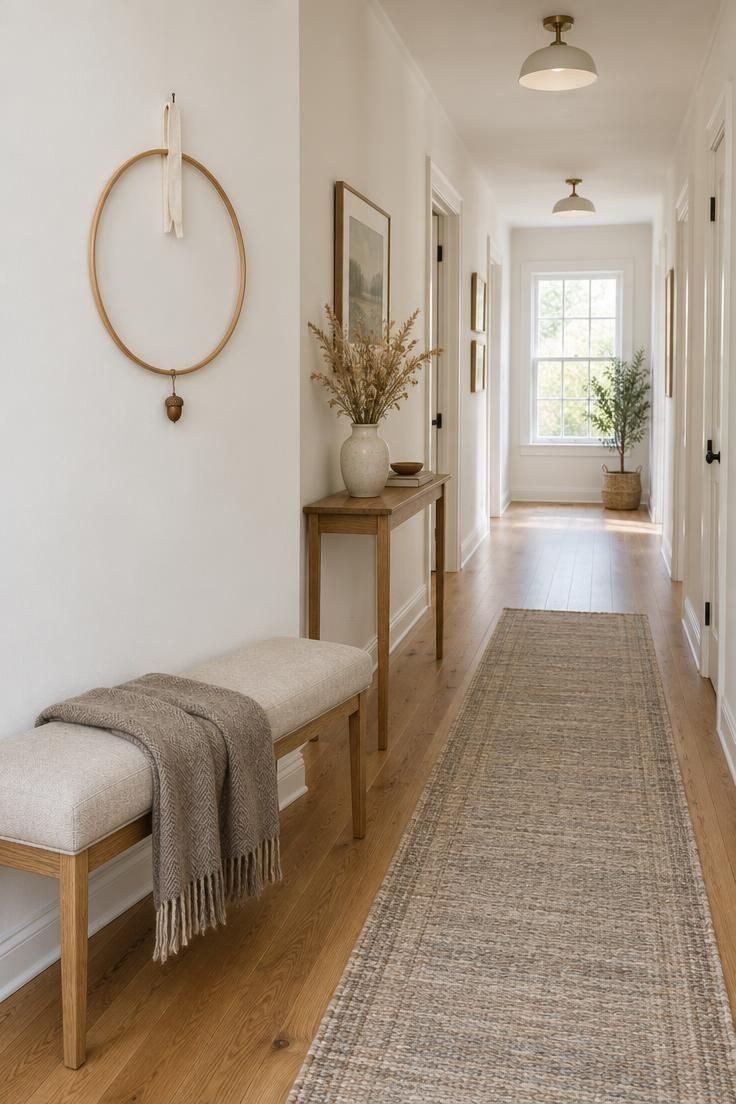
The most pared-back design closes the list.
A thin wooden embroidery hoop or sanded branch ring holds only a narrow cream ribbon at the top and a single small acorn or wooden bead at the bottom center.
The silhouette is open and linear, and the empty space is the point rather than something to fill.
This wreath reads as a subtle nod to the season rather than a statement piece.
It suits modern entries, bedroom doors, and hallway walls where a fuller wreath would feel heavy, and it fits homes that avoid strong seasonal motifs.
Simple materials keep the cost low, and the ring stores flat between seasons.
Ribbon proportion carries the design.
A tail slightly longer than the hoop diameter balances the single acorn’s weight at the bottom, and a matte wood finish keeps the look quiet where a high gloss would call attention to itself.
Style Blueprint:
- A thin sanded wood hoop with an open, linear silhouette
- A narrow cream ribbon tied at the top with a long tail
- One small acorn or wooden bead at the bottom center
- A white wall and warm oak floor with generous space around it
Conclusion
The range here runs from dense magnolia and dried orange rings to sparse grapevine hoops and a single acorn on a wood circle.
Choosing one depends less on the material itself than on where it will hang and how much visual weight the entry can carry.
A dark door benefits from a pale wheat or neutral wreath, while a light door can hold a burgundy or herb-green piece without becoming busy.
Dried and faux materials offer the most reuse and the least upkeep, while fresh greenery and herbs bring a truer seasonal look but require more attention and a shorter display window.
Most of the designs can move between a front door, an interior wall, or a mantel because their scale and color are self-contained.
Picking a wreath that matches the existing door color and the surrounding porch or hallway accents keeps the whole entry feeling intentional rather than cluttered.
A small seasonal object can do a lot of definitional work, provided the palette and density are chosen with the same care as the other pieces in the room.