This post may contain affiliate links. If you make a purchase through these links, we may earn a commission at no additional cost to you.
The entry is the room every household member passes through several times a day, and it carries the coats, bags, mail, and shoes that arrive with them.
A board and batten entryway gives that busy zone a structured backdrop: vertical strips create a rhythm that reads clearly whether the wall is painted soft white, deep navy, sage, or left as stained wood.
The same paneling can support hooks, a bench, a slim console, a mirror, or a single shelf, which is why the treatment suits compact foyers and generous mudrooms alike.
Finish choices change the character more than the structure does, so the palette and hardware should answer to the home’s existing trim and light.
Each idea below pairs one paneling variation with a specific styling and storage scheme for a warm welcome at the door.
The descriptions stay with composition and everyday function, leaving room to adapt proportions to the wall at hand.
Recessed Oak Bench with Cane Storage Doors and Almond Panel Surround
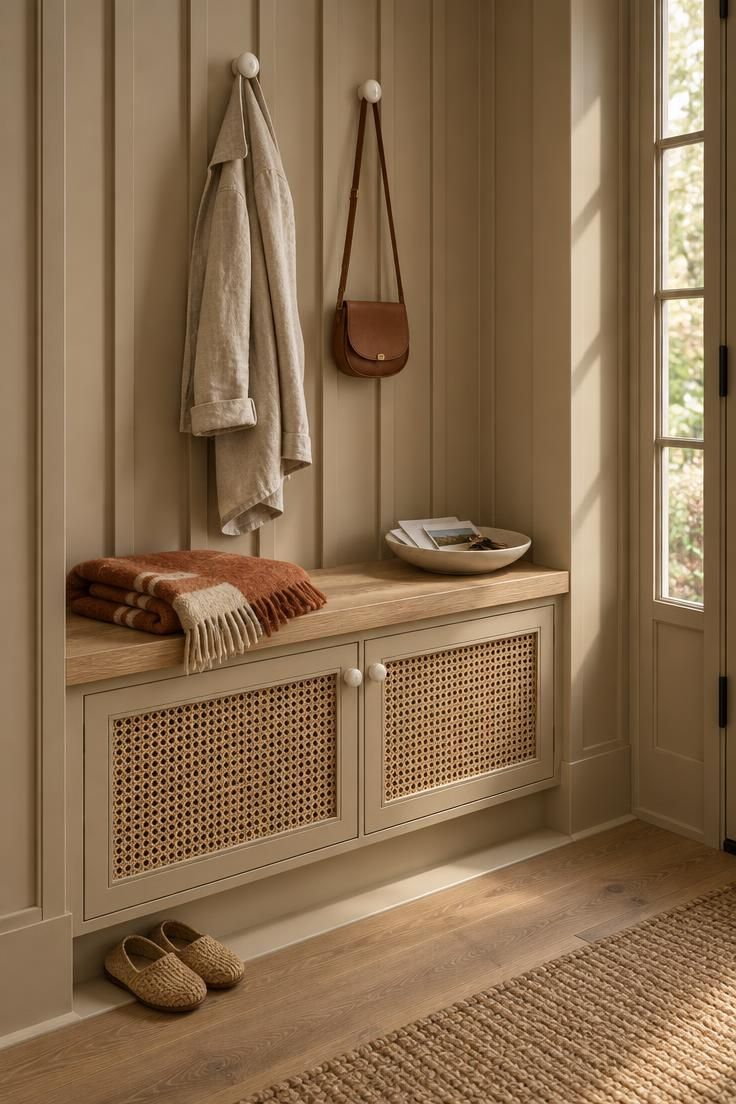
A recessed bench turns the entry wall from a flat decorative surface into a small landing zone for shoes, bags, and mail, while the board and batten surround keeps the whole composition feeling architectural rather than like a piece of furniture pushed against the wall.
The pale oak seat adds natural grain against the painted battens, and the cane doors introduce a woven texture that repeats in the slippers and the folded throw.
Keeping the cabinet flush with the wall face is the detail that makes this arrangement feel deliberate.
The vertical battens continue around the bench opening, so the storage reads as part of the entry architecture instead of a separate console dropped into the space.
Cane panels let cabinet contents stay hidden while adding breathability and a softer visual break than solid painted doors.
The low ledge at floor level gives everyday shoes a landing spot without sprawling across the entry path, while a shallow bowl on the seat corrals the objects that tend to scatter near a front door.
Style Blueprint:
- Warm almond paint on floor-to-ceiling boards and battens
- A recessed bench seat in pale oak with visible grain
- Two cane-front storage doors set flush below the bench
- Porcelain knobs and a low cream ledge for slippers and small items
Stained Wood Board and Batten Wainscot with Shelf Rail
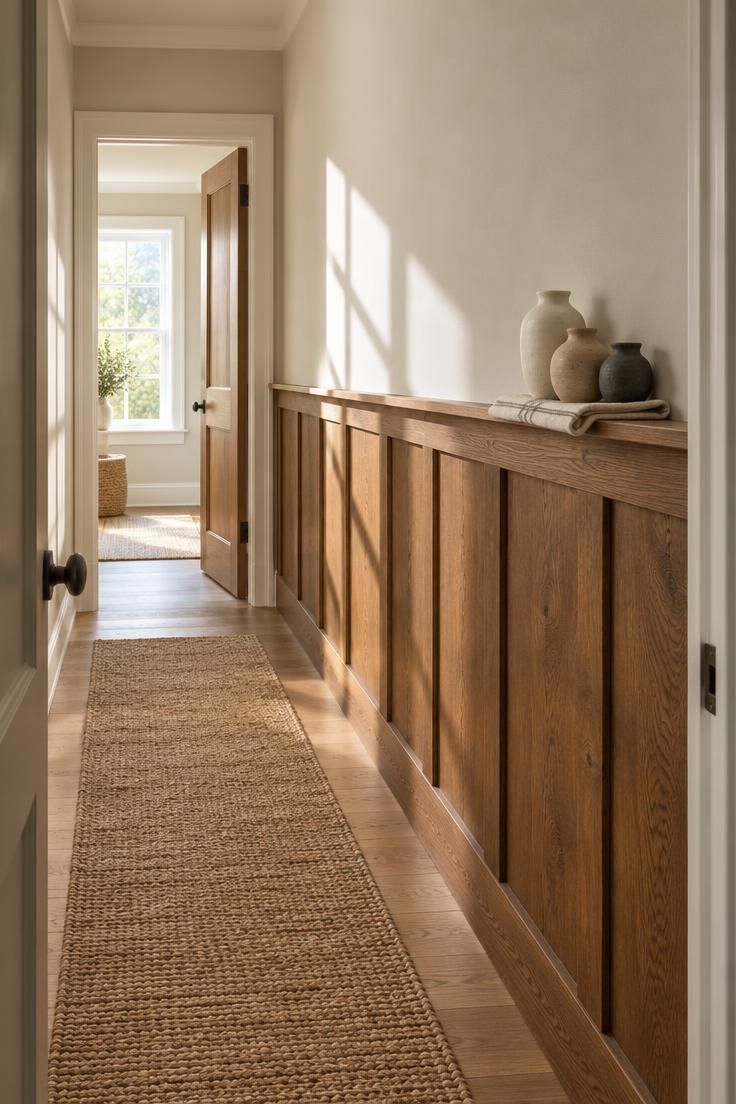
For a board and batten wainscot with shelf rail, stained wood board and batten brings grain and warmth to an entry in a way paint cannot, and a wainscot that stops below the ceiling leaves the upper wall open for art or a softer finish.
The shelf rail turns the top edge of the paneling into a picture ledge, so small framed prints or a trio of pottery pieces can rotate with the seasons without adding another hanging surface.
A medium brown stain reads natural next to pale plaster and works with both warm and cool accents in the adjoining rooms.
Compared with painted paneling, stain shows variation from board to board, which some households find characterful and others find busy on a small wall.
The flat cap of a wainscot gathers dust, and every object on the rail adds to the wiping.
Keeping the display to a small cluster makes routine cleaning quick and preserves the clean line of the wood below.
Style Blueprint:
- A medium brown stain carried across boards, battens, and the shelf rail
- A pale neutral wall above the wainscot
- Three small ceramic vases in graduated earth tones
- A folded linen cloth for soft texture
- A natural fiber runner to warm the floor
Design Pro-Tip: Limit the shelf rail to a cluster of three objects so the wood grain and the batten rhythm share the attention.
White Board and Batten Accent Wall Behind a Natural Bench
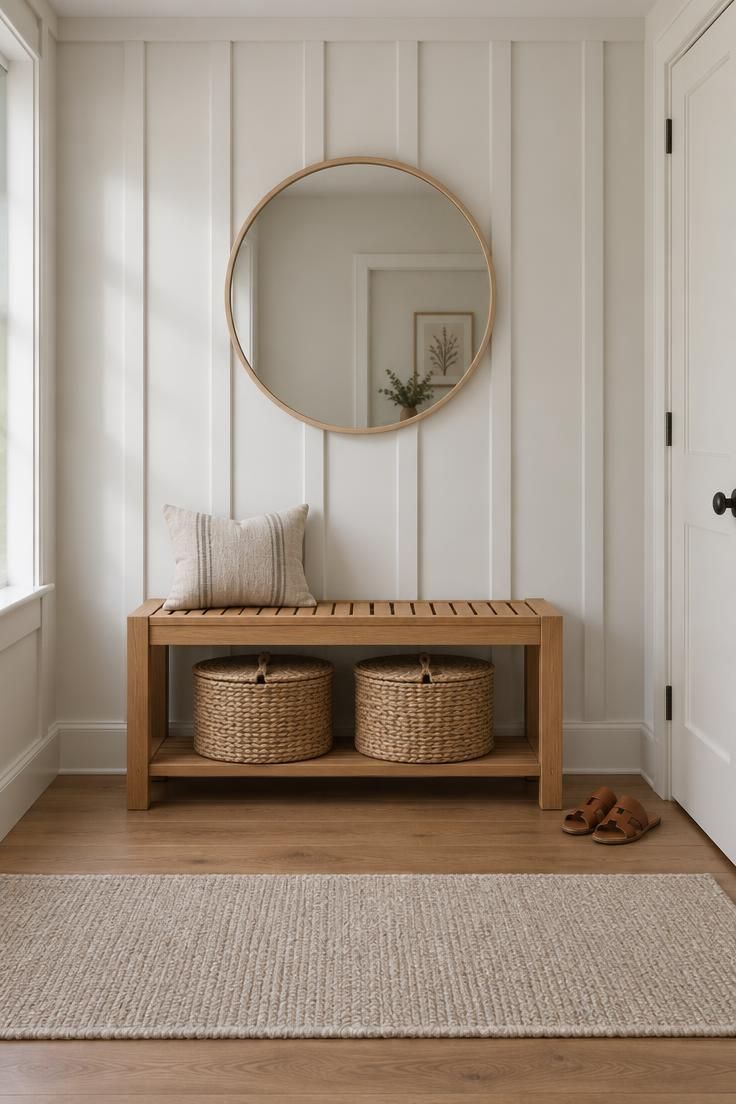
A board and batten accent wall behind a bench concentrates the vertical pattern where it does the most work and leaves the other walls plain, which keeps a small foyer from feeling narrow.
Soft white paneling contrasts with a natural oak seat, and the wood tone supplies warmth that an all-white scheme would lack.
The open space beneath the bench holds two lidded baskets, giving shoes and gloves a home without adding upper cabinets or crowded hooks.
A round mirror centered on the paneling softens the rectilinear rhythm and reflects the light coming from the door.
This partial application also makes practical sense: one paneled wall is easier to clean and repaint than a wrapped room.
The window of visible paneling above the bench should stay generous enough that the vertical lines read as a backdrop rather than a stripe behind furniture.
Style Blueprint:
- Soft white paint on a single accent wall
- A natural oak bench with a slatted seat
- Two lidded woven baskets sized to slide under the bench
- A round mirror with a slim pale wood frame
- An oatmeal wool runner to anchor the floor
Design Pro-Tip: Choose a bench whose backrest sits low enough to leave a clear band of paneling visible beneath the mirror.
Deep Blue Floor-to-Ceiling Panels with Arched Mirror
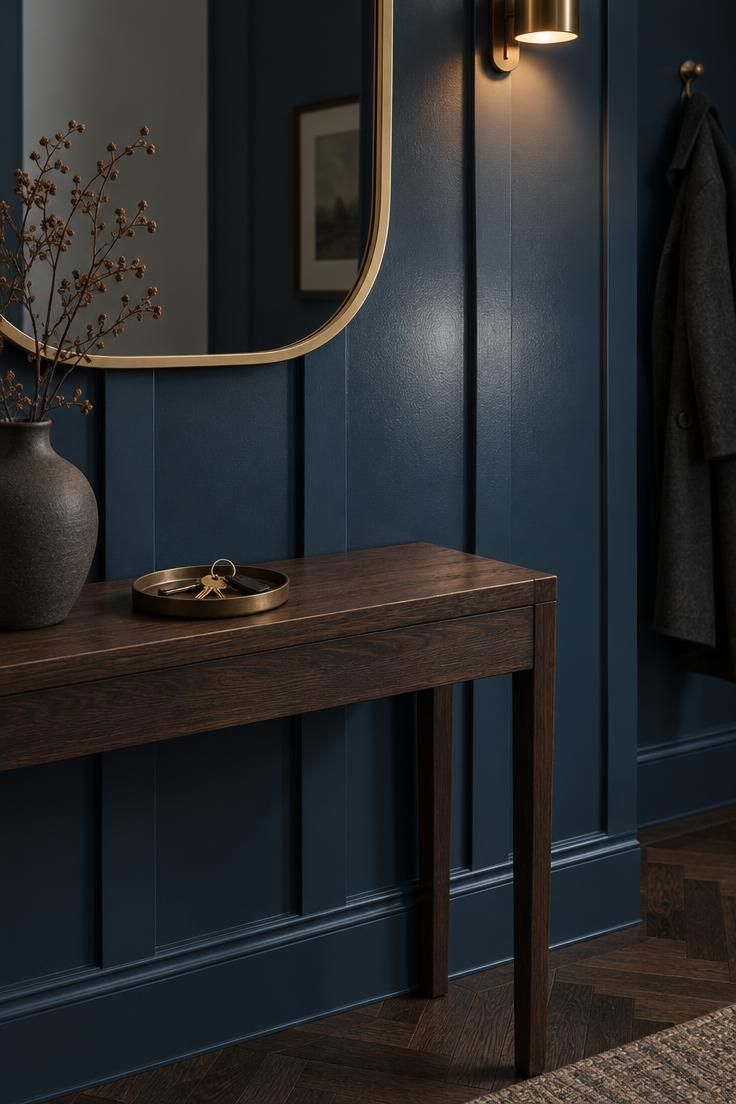
For a floor-to-ceiling board and batten, painting full-height paneling in a deep blue gives an entry a formal, enveloping character, and the color makes the batten shadows read as architecture rather than trim.
An arched mirror centered above a narrow console softens the grid and bounces daylight deeper into the hall, while keeping the console surface nearly bare lets the deep color stay the main event.
Dark paneling shows dust more readily than light paint, so a satin finish that wipes clean easily is a sensible choice for a surface that gets close inspection, and the mood depends on restraint: every additional object competes with the blue.
A single arched shape against the vertical field is enough to carry the composition, with a tray for keys and one ceramic vase as the only quiet accents the surface needs.
Style Blueprint:
- Deep blue satin paint across boards and battens
- An arched mirror in a thin gold frame
- A slim dark wood console
- A small round tray and one matte ceramic vase
Design Pro-Tip: Let an arched mirror echo the upward pull of the battens while breaking the grid with one curved line.
Plaster-Toned Board and Batten Half-Wall with a Slim Storage Ledge
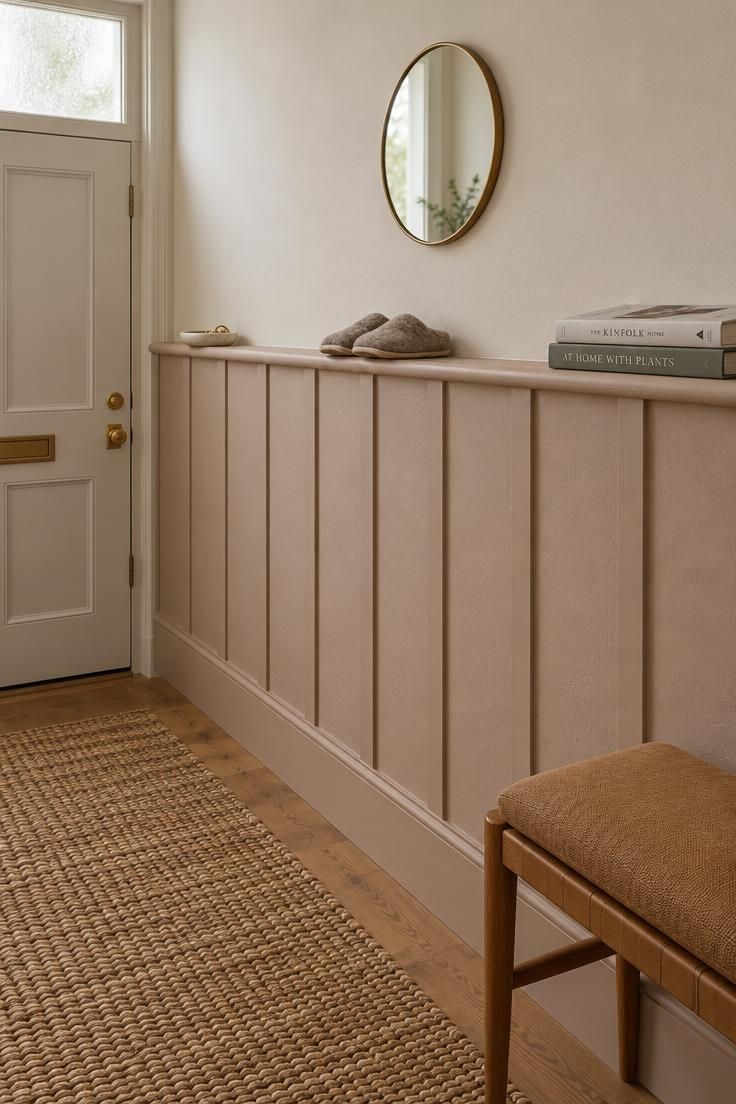
A board and batten half-wall finished in a plaster-toned pink-sand color gives the entry a softer boundary than typical gray or beige paneling.
The warm neutral reads as an extension of the wall itself rather than a contrasting accent, which helps a small entry hall feel less divided.
Replacing the peg rail with a slim storage ledge shifts the practical purpose from hanging to surface space for quick-drop items.
Because the ledge is shallow, it encourages a short, intentional grouping instead of a crowded landing strip.
The change in texture is strongest where the vertical battens catch side light from the front door.
Keeping the upper wall smooth and slightly lighter than the paneling makes the half-wall feel like a built-in architectural layer rather than a painted band.
Dust moves quickly across the ledge and the batten edges, so a dry cloth every few days keeps the plaster-toned finish looking even.
A mirror hung slightly off-center above the ledge draws the eye upward and gives the wall a less rigid arrangement.
Style Blueprint:
- Plaster-toned pink-sand paint on boards and battens
- A slim rounded ledge at paneling height
- A small ceramic ring dish near the door
- Folded wool house slippers as a soft drop item
- A single off-center round mirror on the smooth upper wall
Design Pro-Tip: Keep the ledge objects to one small group of two or three items and leave the remaining wall clear so the half-wall reads as a surface, not a display shelf.
Black Board and Batten Hooks-and-Bench Drop Zone
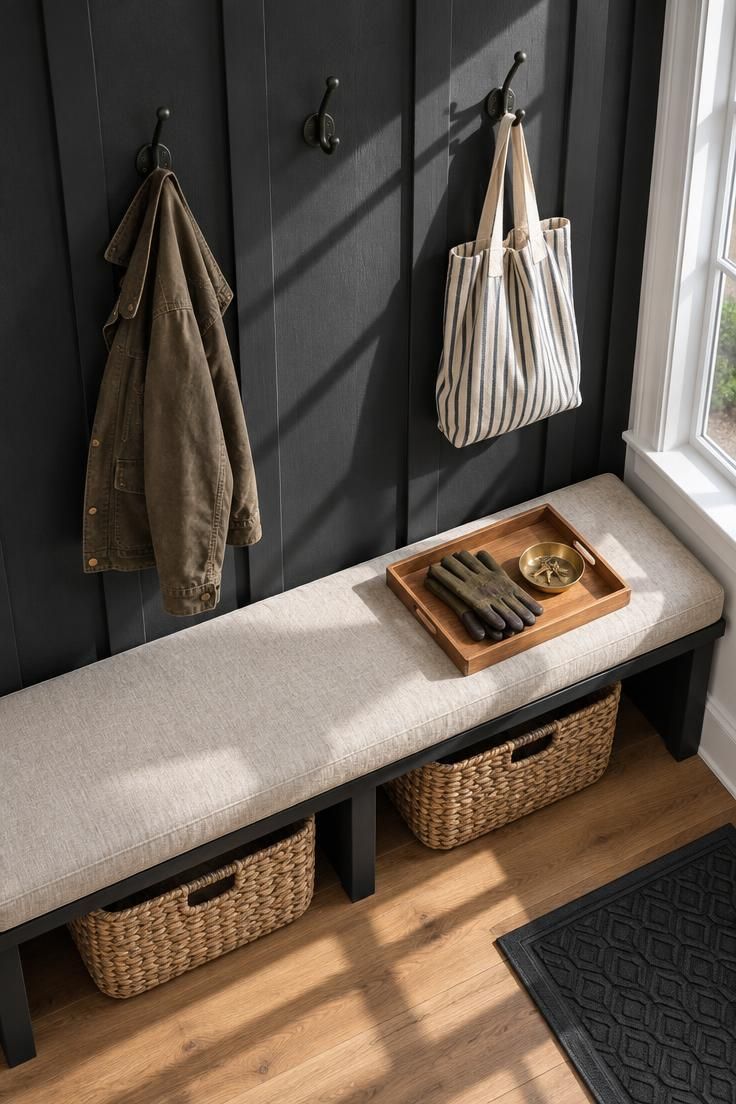
A board and batten with hooks and bench in black makes the drop zone feel deliberate, since the dark field sets off the light cushion and the woven storage beneath.
The bench protects the lower paneling from shoe scuffs, and the hooks above keep bags and coats off the seat.
Black paint near the hooks hides the small marks that daily use leaves behind, which suits a household with children or heavy coat traffic.
Dust does show on black more than on pale colors, so the wall benefits from a quick wipe every week or so.
One warm element keeps the dark scheme from turning heavy: a honey-toned wooden tray on the bench seat adds a mid-tone that bridges the black wall and the natural linen.
Two baskets below the bench hold the overflow without crowding the view of the hooks.
Style Blueprint:
- Matte black paint on the boards and battens
- A built-in bench with a natural linen cushion
- Four black metal hooks above the bench
- Two woven baskets for storage beneath the seat
- A honey-toned wooden tray to warm the dark palette
Design Pro-Tip: Set one warm wood or honey-toned accessory on the bench to bridge the black wall and the natural fiber storage.
Sage Green Half-Wall with White Battens and a Floating Shelf
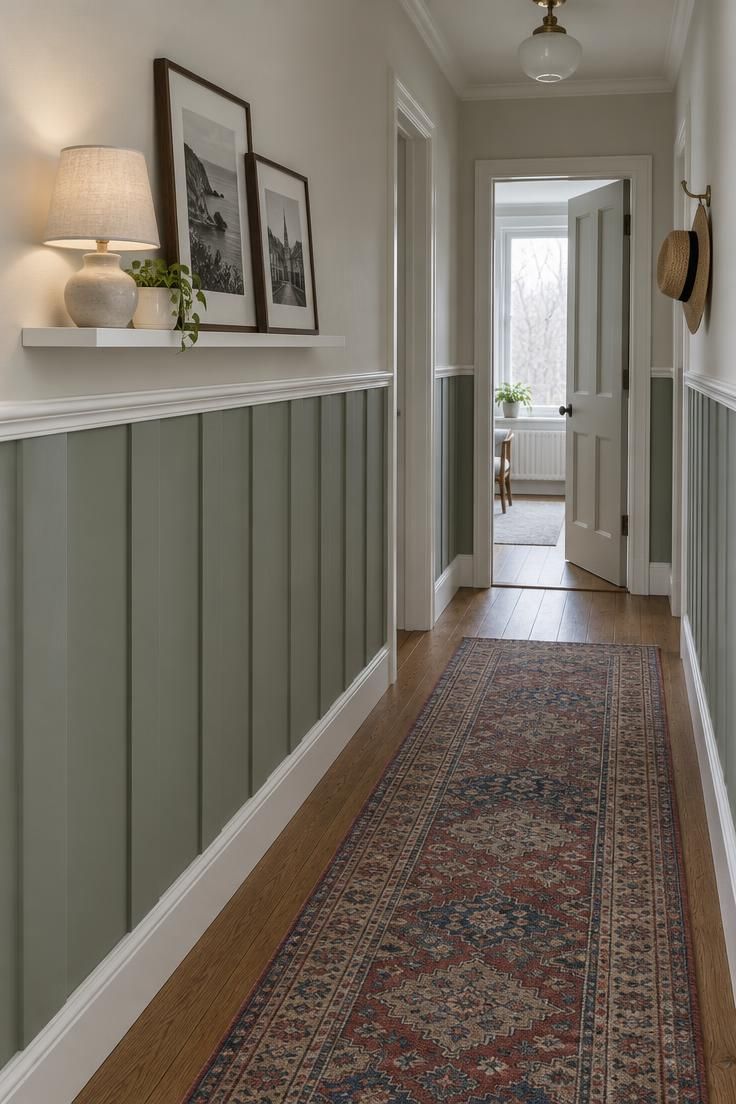
A sage green half-wall with white battens keeps a modest hallway feeling open while still giving the eye vertical structure to follow.
The two-tone effect stops the paneling at a comfortable height, leaving the upper wall to carry light and a slim floating shelf.
A small lamp and two framed photographs on the shelf are enough styling for a narrow passage, since wider arrangements risk blocking the walkway.
Warm green pairs naturally with wood floors and brass accents, so the finish can stay consistent with trim elsewhere in the home.
Shelf depth matters in a corridor: a ledge that projects no farther than the rail keeps the edge out of the walking path.
The shelf itself also gathers dust, so a shallow profile and a light object count keep maintenance simple.
Style Blueprint:
- Sage green paint on the lower wall behind the battens
- White vertical battens stopping at chair-rail height
- A slim white floating shelf at the rail line
- A small ceramic table lamp with a linen shade
- Two framed photographs leaning against the wall
Design Pro-Tip: Keep the shelf depth close to the rail projection so the ledge stays flush with the paneling line in a narrow hall.
All-Stained Wood Board and Batten Entryway with Heavy Bench
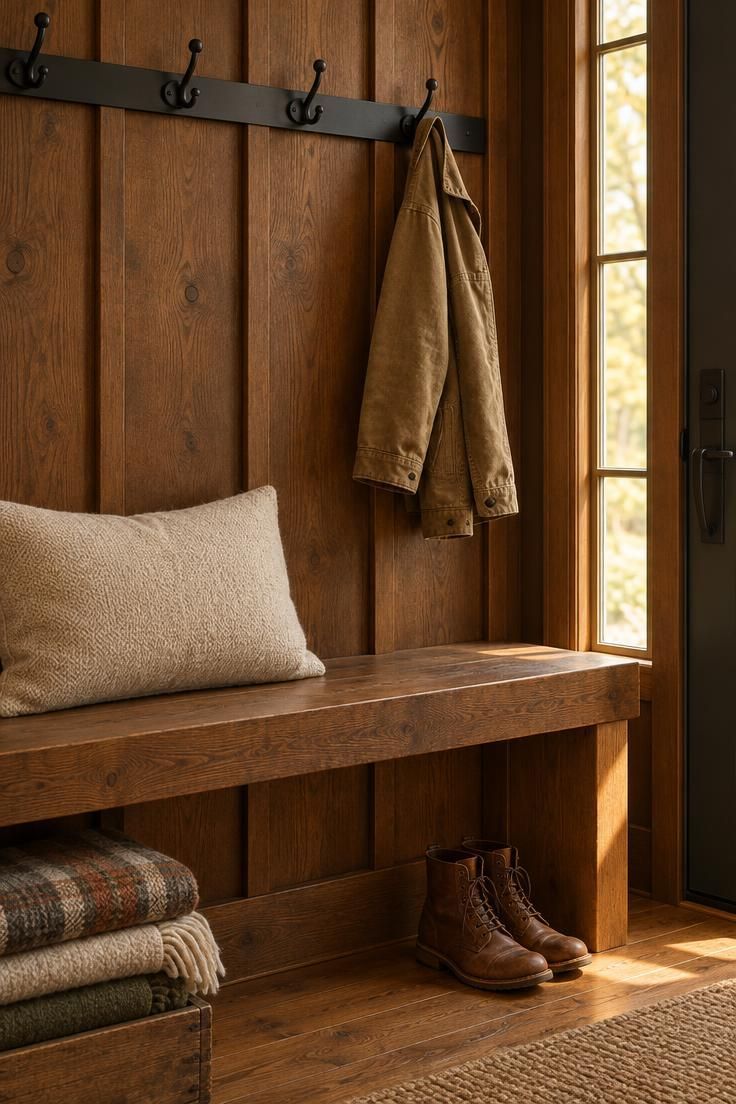
Leaving both boards and battens in a warm brown stain gives the entry a unified, rustic character, and a heavy bench in a similar wood tone reinforces that cohesion.
The matching hues make the paneling read as a single piece of furniture rather than a wall treatment with trim.
All-stained paneling does darken a space, so a light floor and a pale rug are worth planning into the scheme from the start.
Neutral wool cushions and a black metal hook rail add contrast without introducing a second wood tone that would compete with the stain.
Mixing woods in one entry works best with restraint: keeping the bench and paneling within a couple of shades keeps the grain from looking mismatched.
The bench seat also takes the brunt of daily use, so a durable finish there is a practical priority.
Style Blueprint:
- Warm brown stain on boards and battens, both left natural
- A thick wooden bench seat in a near-matching tone
- A pale oat wool cushion on the bench
- A black metal hook rail for contrast
- A simple leather boot pair on the floor
Design Pro-Tip: Keep the bench and the paneling within two shades of each other so the grain reads as one warm family rather than a patchwork.
Horizontal Wire Brushed Boards with Vertical Battens and a Picture Ledge
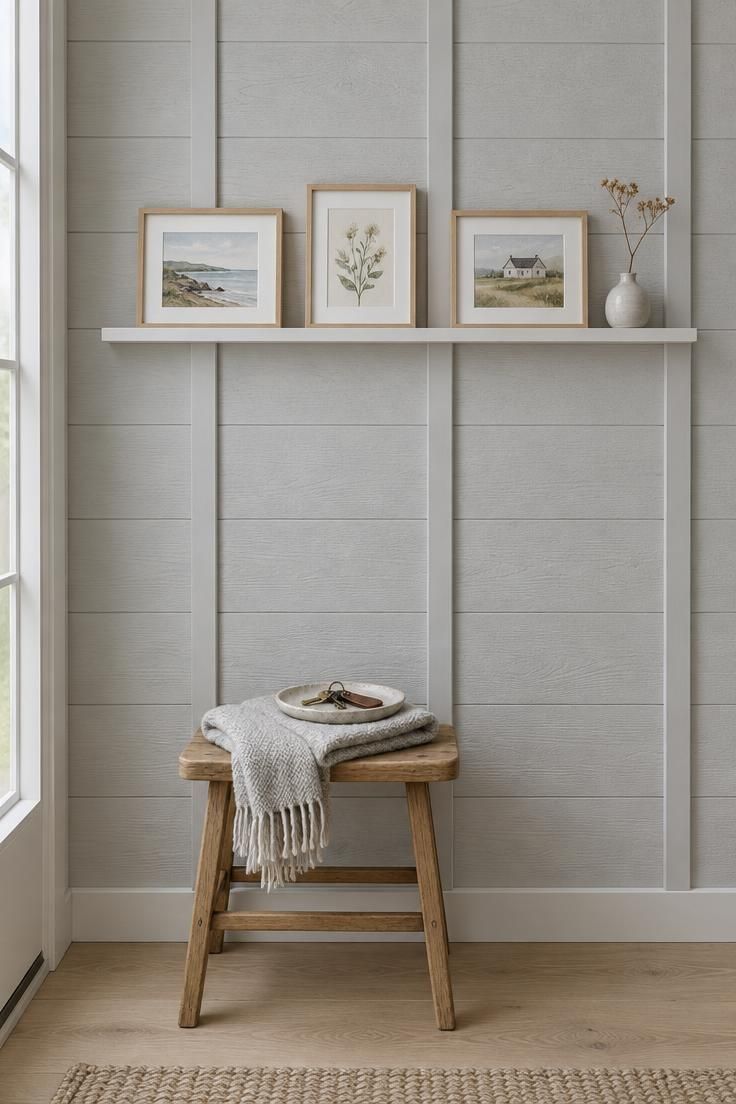
Wide horizontal wire-brushed boards under narrow vertical battens give the wall a layered texture that reads as soft detail rather than heavy line, especially when boards and battens share one light gray paint.
The picture ledge replaces a shelf rail and turns the eye-level band into a rotating gallery for small watercolors, with art that can change without new hardware or patched holes.
Painting the horizontal and vertical elements the same color keeps attention on the brushed grain and the shadow play instead of on a color contrast.
Because wire-brushed wood can hold dust in its texture, a dry microfiber cloth works better than a damp sponge for routine cleaning.
A single leaning frame paired with a small cup and dried stem is a simple way to compose the ledge for the rest of the month.
Style Blueprint:
- Very light gray paint across boards and battens
- Width: wide horizontal boards beneath narrow vertical battens
- A slim white picture ledge at eye level
- Three small watercolors in pale wood frames
- A low stool with a folded knit throw
Design Pro-Tip: Lean one framed piece against a small ceramic cup with a dried stem to build a vignette that takes two minutes to reset.
Terracotta Board and Batten Nook with a Built-in Corner Bench
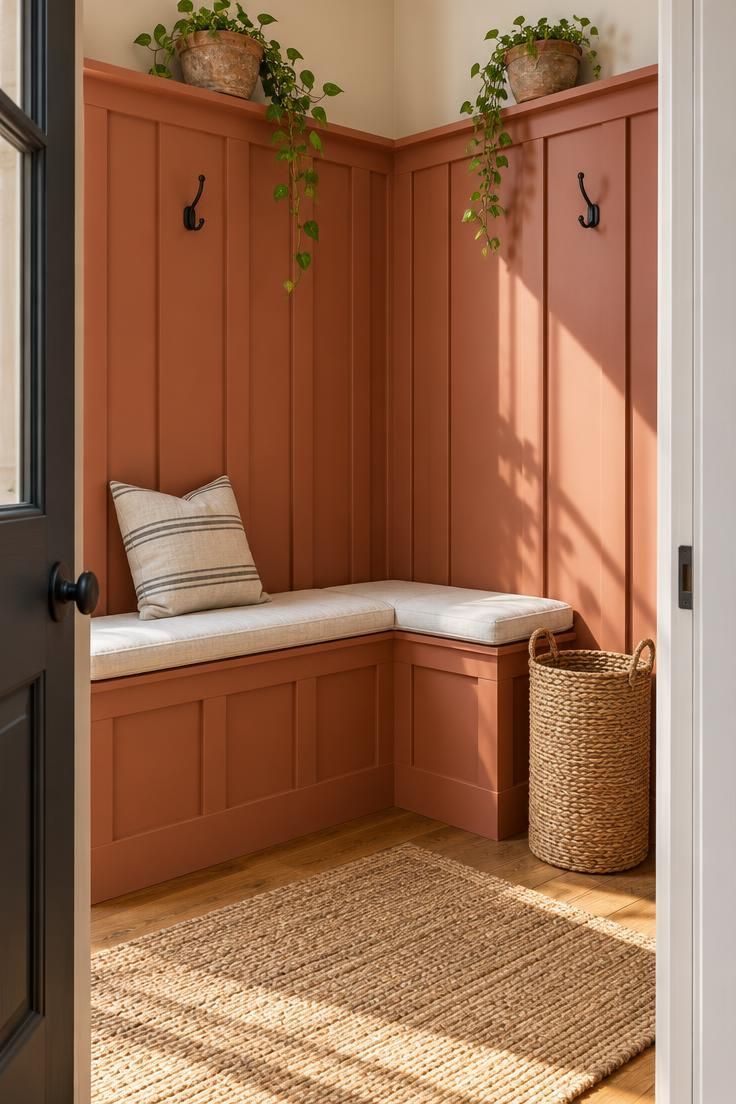
Wrapping a narrow entry corner in floor-to-ceiling paneling gives the nook a deliberate, pulled-together shape, and a muted terracotta makes the small space feel warm without shouting.
A low corner bench fits the angle, and one black hook on each wall keeps the hanging zone simple.
Limited wall area means one strong color carries the whole composition, so coordinating the cushion, rug, and baskets in natural tones keeps the terra cotta from competing with itself.
A cream cotton cushion softens the earthy color and makes the bench a comfortable place to pause.
A tall, slender floor basket beside the bench holds shoes without projecting into the walkway or hiding the vertical lines.
Clay pots with trailing greenery at the top edge of the paneling add organic texture and a touch of height.
Style Blueprint:
- Muted terracotta paint on boards and battens
- A low corner bench with a cream cotton cushion
- One black hook on each wall
- A tall seagrass shoe basket and a jute rug
- Two rustic clay pots with trailing greenery
Design Pro-Tip: Use one tall, narrow floor basket beside a corner bench so shoe storage stays vertical instead of spreading across the walkway.
Dual-Finish Panels in Navy Above and Oak Below with a Slim Console
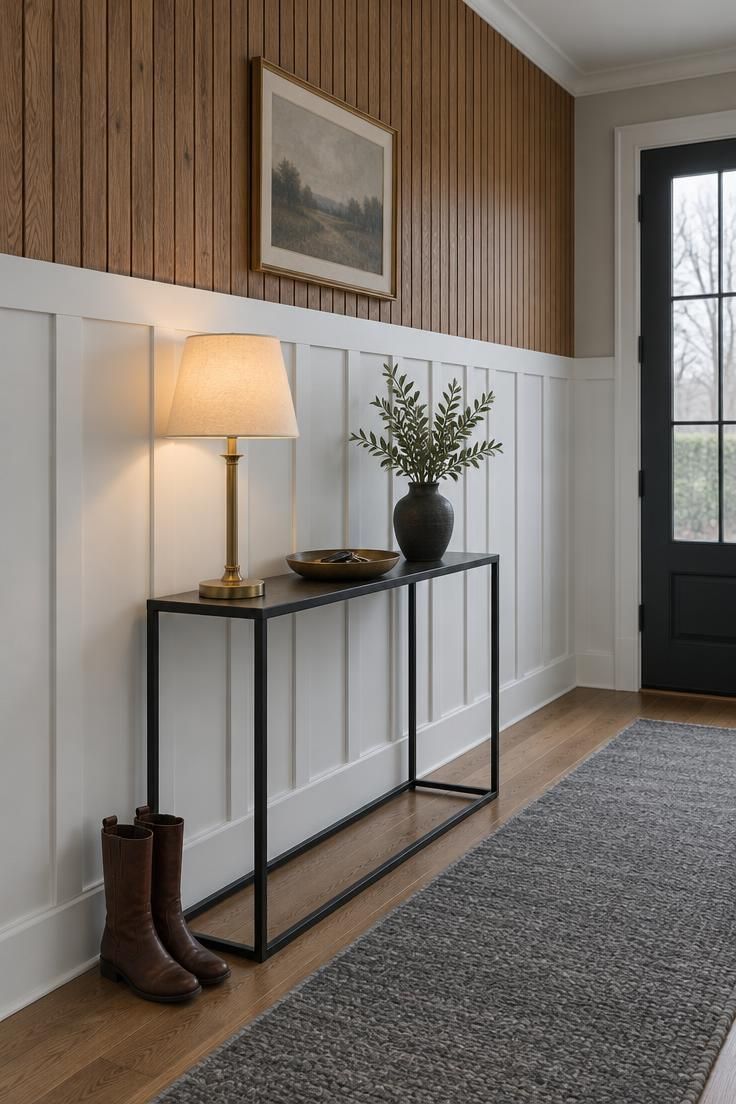
A dual-finish wall, white below and stained oak above with a horizontal seam between them, gives a tall entry a furniture-like composition and visually lowers the upper wall.
The two-tone approach makes the battens read as intentional trim rather than applied decoration, since the change in material announces the design intent.
A slim black console fits against the lower paneling and holds a brass lamp and a shallow bowl for keys, which keeps the daily drop zone contained.
Cool overcast light keeps the white and oak contrast crisp and shows the grain of the upper battens.
On a busy wall, console weight matters: hairpin legs or a floating-style frame keep the piece light so the eye still reads the paneling behind it.
The oak section benefits from occasional dusting along the top edges where battens meet the boards.
Style Blueprint:
- White paint on the lower two-thirds of the paneling
- Stained oak battens above, with a clean horizontal seam
- A slim black metal console with an open, light profile
- A brass table lamp and a shallow catch-all bowl
- A gray wool runner on the floor
Design Pro-Tip: Choose a console with hairpin legs or an open floating profile so the two finishes stay visible beneath and around it.
Conclusion
Any of these entries shows how much range a single wall treatment can carry, from warm off-white panels with brass hooks to deep blue floors-to-ceiling batten walls and terracotta corners.
The finish sets the character, the height of the paneling controls how much upper wall stays open, and the hardware and furniture decide how the space functions from morning to evening.
Choosing well starts with two questions: how much daily storage the household actually needs, and how much visible paneling the composition can spare.
Keeping part of the wall uncluttered lets the vertical rhythm read as structure rather than noise.
Warm wood, soft paint, and saturated tones each change the same paneling in different ways, so the examples above are best used as starting points.
Adjust the bench, hooks, mirror, and baskets to fit the routine that passes through the door every day.