This post may contain affiliate links. If you make a purchase through these links, we may earn a commission at no additional cost to you.
Grey winter mornings can leave a kitchen feeling flat, with cool light pooling on counters that looked lively in summer.
The fix is not a full seasonal overhaul but a handful of deliberate changes that work with that light instead of fighting it.
Warm metals, evergreen branches, textured textiles, and simple tabletop displays add depth without crowding the room.
The ideas below center on specific compositions, with practical notes on upkeep, surface use, and how long each look can reasonably stay in place.
Some take a single branch and a pitcher; others refresh a whole shelf, so there is a starting point for nearly any kitchen size.
Copper and Brass Cluster on a Windowsill
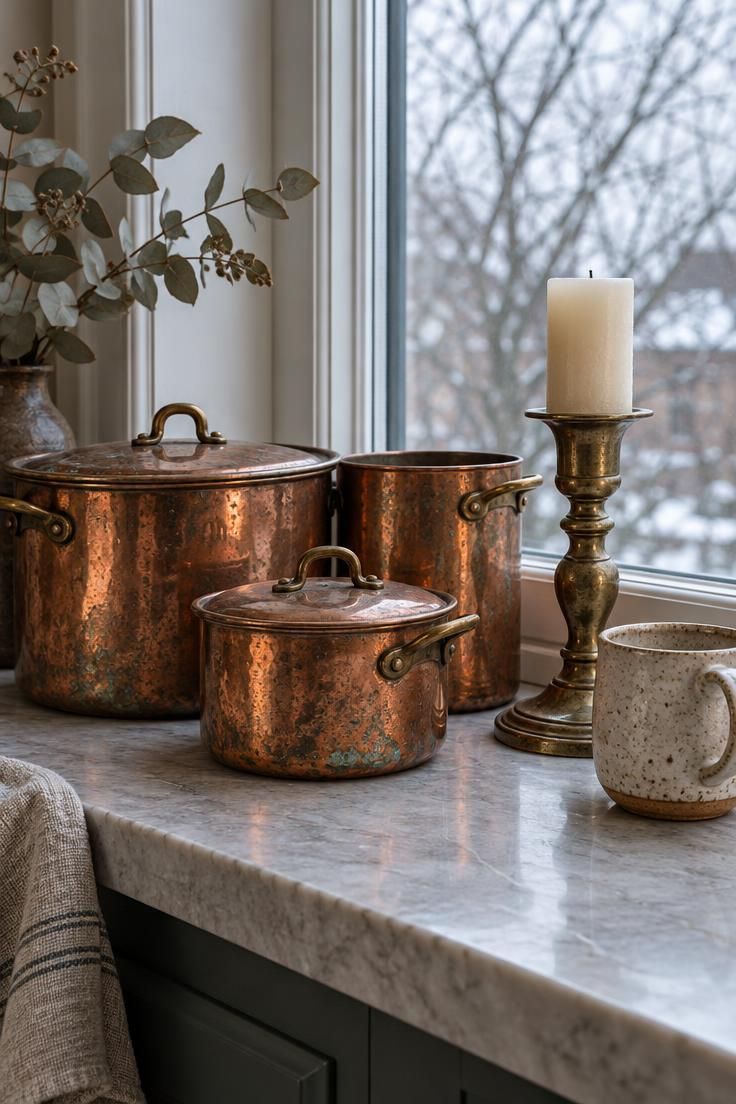
A narrow windowsill makes a good stage for a small group of warm metals.
Cluster copper pots of two or three sizes beside an aged brass candleholder and a speckled clay mug, letting the cool daylight behind them do the contrasting work.
The patina on older copper reads better here than a high polish, which can look brittle against a grey sky.
Keep the group slightly uneven, with the tallest pot set off center and the mug pulled a little forward.
This arrangement gives the eye a clear focal point while leaving the sill looking collected rather than staged.
A windowsill display also frees counter space, which matters in a compact kitchen where every working inch counts.
Position the cluster away from the sink splash zone so water spots do not dull the metal, and lift each piece now and then to wipe the sill beneath it.
Rotating the candleholder to the back of the group every few weeks keeps dust from settling in one visible band.
For winter kitchen decor that holds up through the season, a tight group of four or five pieces is easier to maintain than a long row.
Style Blueprint:
- Two or three copper pots with visible patina, varied in height
- One aged brass candleholder with a cream pillar candle
- A speckled clay mug in a neutral tone
- Dried eucalyptus or a single pine sprig to soften one edge
Design Pro-Tip: Set the tallest piece slightly off center and pull one small object forward so the cluster reads as collected rather than lined up.
Cedar Garland Draped Along Upper Cabinets
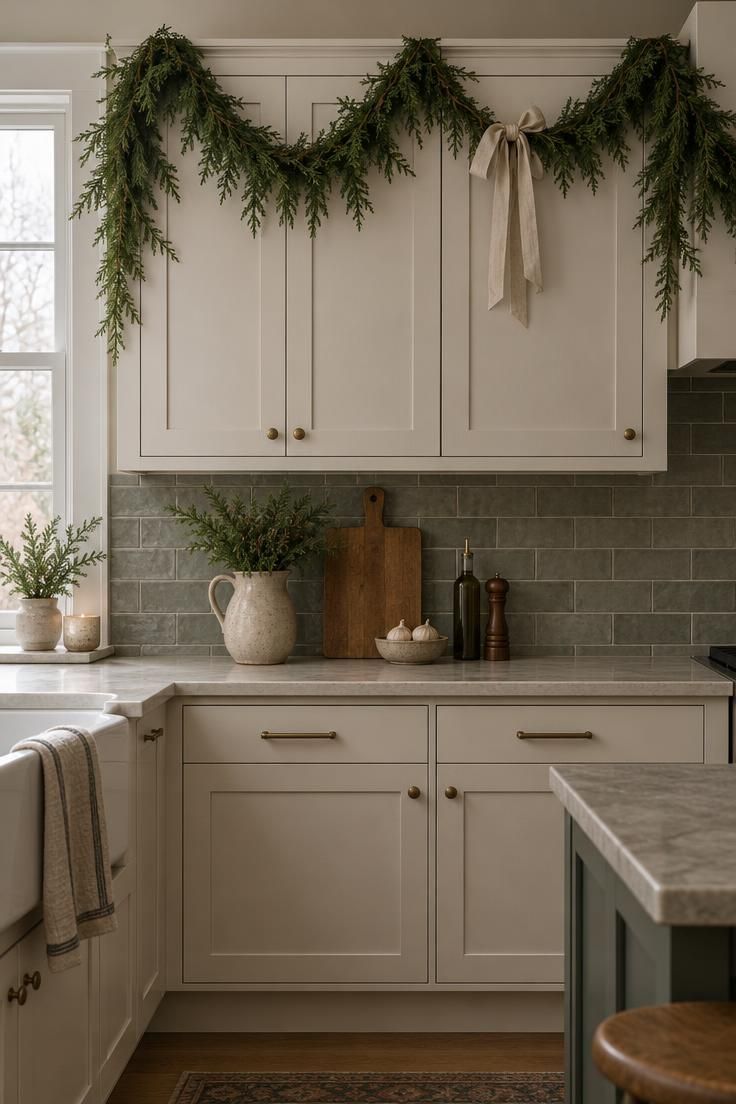
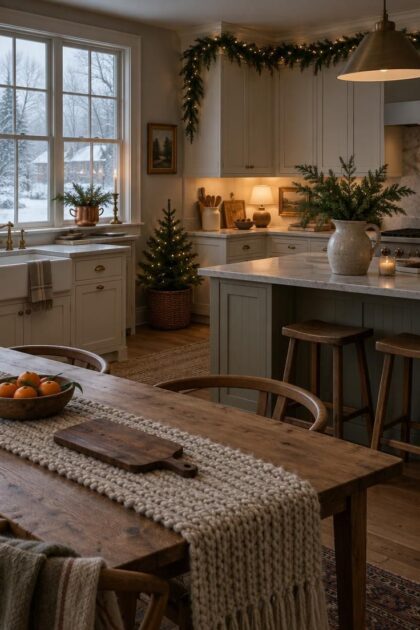
The top of upper cabinets is often dead space, and a cedar or fir garland gives it a purpose.
Drape the greenery in loose, irregular swags rather than a tight, even run, and leave one deliberate gap where a linen ribbon is tied.
The break keeps the line relaxed and prevents the garland from reading as a solid border.
Cabinet fronts in warm white give the deep green something calm to sit against.
Where the cabinetry ends near a doorway, let the garland stop a hand’s width before the edge so the trim stays visible and the drop does not crowd the opening.
A single ribbon in oatmeal or charcoal ties the greenery to the room’s textiles.
Real cedar near a range collects kitchen residue and drops needles as it dries, so faux greenery is the easier choice for cabinets above a cooking zone.
Store the garland in a long, shallow bin after the season so the swags keep their shape.
Evergreen garland styling rewards restraint: one continuous run with a single break looks more considered than several short pieces.
Style Blueprint:
- A cedar or fir garland long enough to run the cabinet tops with slack
- One linen ribbon in oatmeal or charcoal for the gap
- Warm white cabinet fronts as the backdrop
- A shallow storage bin sized to the garland’s length
- A stoneware pitcher on the counter to carry the green downward
Oversized Evergreen Branch in a Stoneware Pitcher
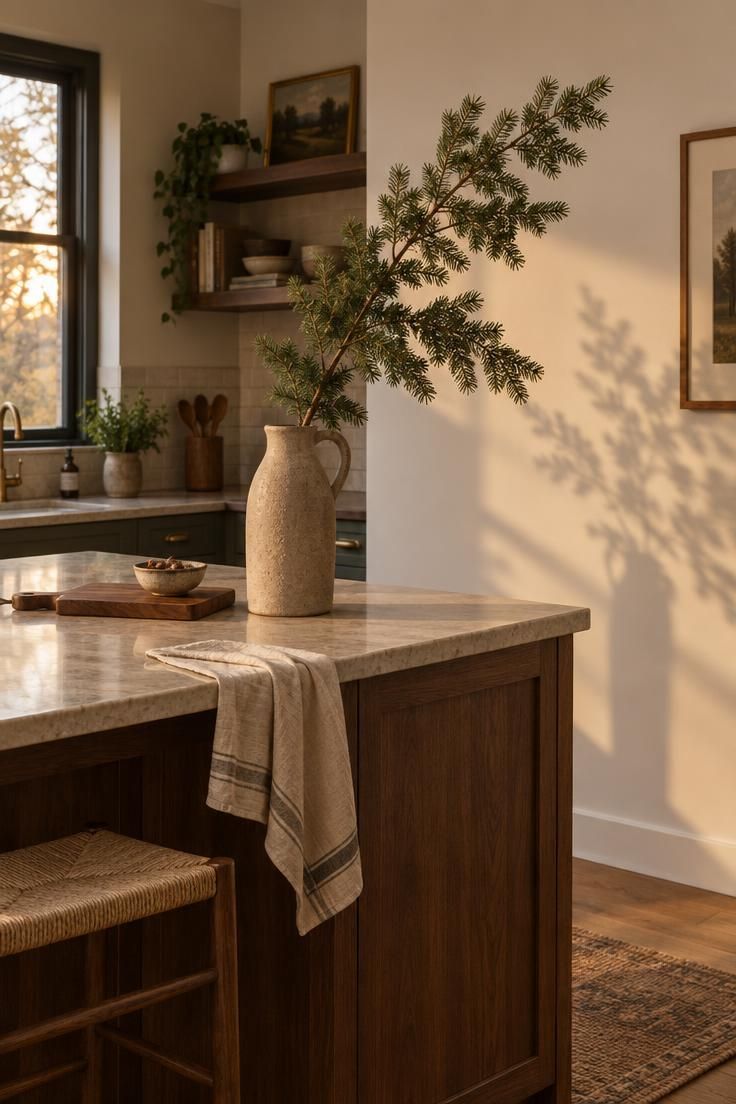
One tall cedar or fir branch in a large matte stoneware pitcher can carry a whole counter corner.
Set the pitcher on an island or side counter where a plain wall sits behind it, and let the branch lean slightly so its shadow falls across the surface.
That shadow is part of the composition, so a wall with some texture and a light source to the side matter as much as the branch itself.
Choose a branch with a strong central line and a few side shoots rather than a dense, bushy cut.
The sparse shape keeps the arrangement reading as winter structure.
A live branch dries within a week or two and begins to drop needles, so plan to replace it on a regular cadence or choose a good faux version if the spot is hard to reach.
Keep the pitcher away from the main prep area so the branch is not in the way when the counter is in full use.
A heavy stoneware base also keeps the arrangement steady on a surface that gets bumped.
The scale tradeoff is real: a large pitcher takes up a meaningful footprint, so measure the corner before committing to the widest option.
Style Blueprint:
- A tall matte stoneware pitcher with a heavy base
- One oversized cedar or fir branch with a clear central line
- A plain wall behind to catch the shadow
- A warm wood board nearby for contrast
Cream and White Ceramic Collection on Open Shelves
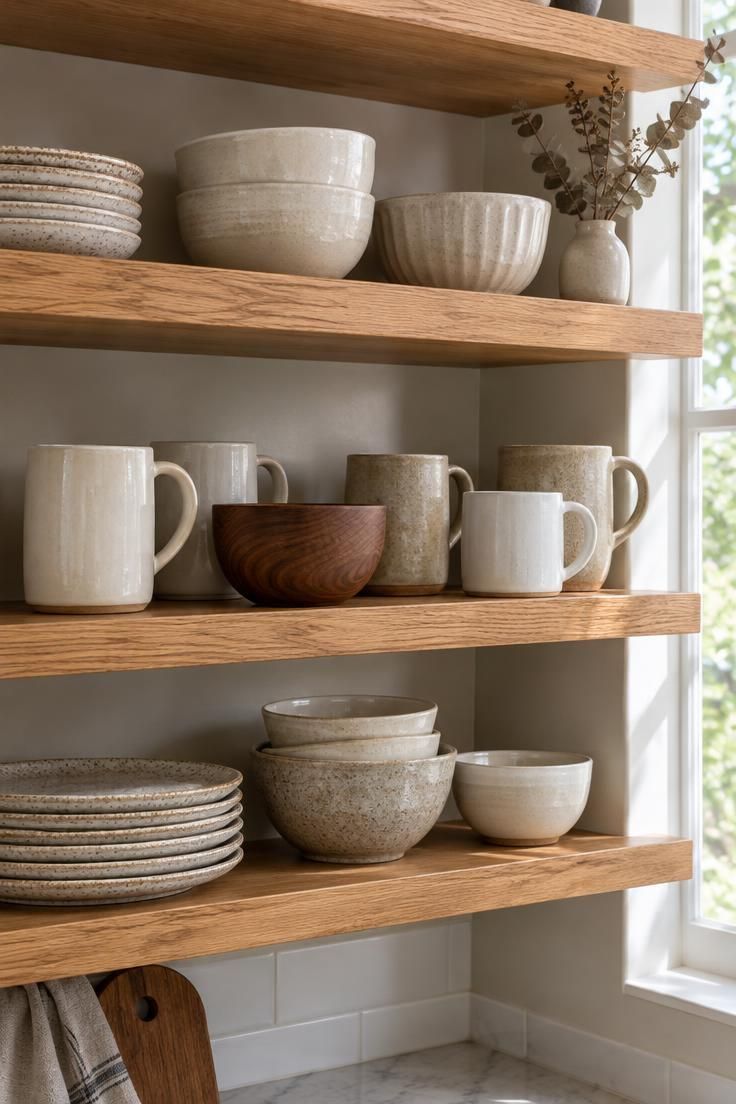
Open shelves give a mug and bowl collection somewhere to live, and an odd-numbered grouping of matte white, ivory, and oatmeal pieces keeps it from looking like a matched set.
Add one warm walnut bowl to break the tonal line, and vary the heights so the eye moves across the shelf rather than stopping at one spot.
Place the pieces within easy reach and leave some breathing room between groups.
A shelf that holds everything at once looks heavier than one with a few gaps, and the gaps make the everyday mugs easier to grab.
Frequently used mugs can sit at the front of the display, so the shelf stays practical as well as composed.
Matte ceramics show dust and fingerprints more than glossy glazes, so a quick pass with a soft cloth every week or so keeps the finish even.
Rotate the mugs you reach for most into the front row and move the less-used bowls to the back.
On a short shelf, keep the grouping to five or seven pieces and let the wood bowl sit slightly apart.
Style Blueprint:
- Matte white, ivory, and oatmeal mugs and bowls
- One warm walnut bowl for contrast
- An odd-numbered grouping with visible gaps
- A soft cloth kept nearby for dusting
- A small dried sprig in a low vase to finish one shelf
Chunky Knit Table Runner with a Wood Board
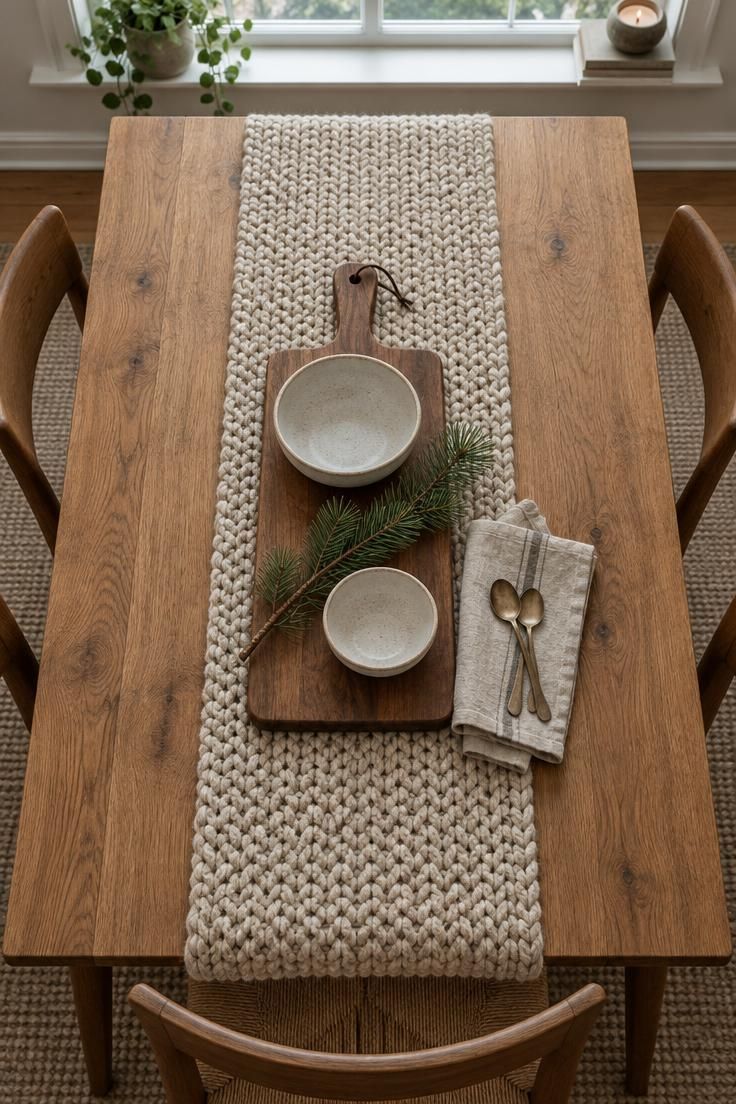
A chunky knit table runner in oatmeal brings softness to a hard dining surface, and a smooth walnut cutting board set on top gives the soft texture something firm to play against.
Two cream stoneware bowls finish the arrangement.
The contrast between the loose knit and the flat wood is the whole idea, so keep the accessories simple.
Let the runner extend past the board at both ends so the knit edge drapes visibly.
Running the full length of the table defines a serving zone, which helps when the table doubles as a landing spot for groceries and mail.
On a bench, a shorter runner proportioned to the seat works better than a long one that pools at the ends.
Shake crumbs out after meals and wash the runner gently according to its fiber, since wool and cotton blends behave differently in water.
A knit this thick takes time to dry, so a spare runner for the busiest weeks is worth storing.
The texture also catches crumbs, which is a small tradeoff for the warmth it adds.
Style Blueprint:
- A chunky knit runner in oatmeal, long enough to drape at both ends
- A smooth walnut cutting board as the firm counterpoint
- Two cream stoneware bowls
- A spare runner for busy weeks
Countertop Lamp or Warm-White String Lights
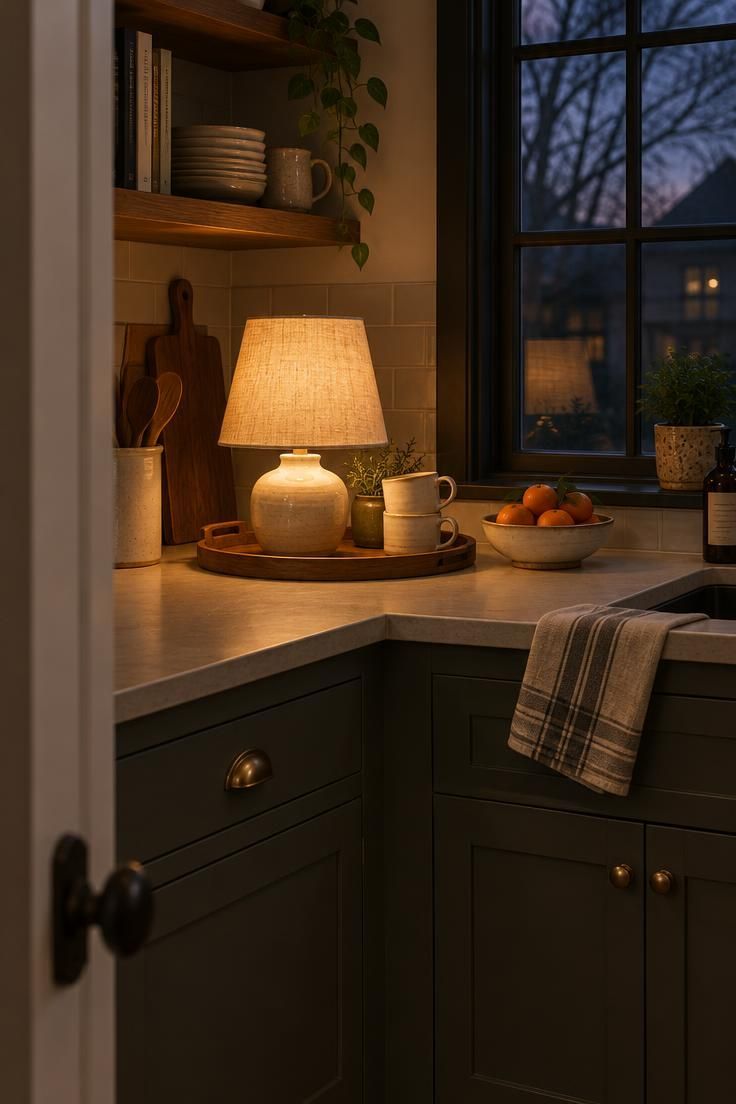
A small ceramic table lamp on a counter corner gives grey winter evenings a soft pool of light to gather around.
Set it on a wooden tray beside stacked mugs so the light has a defined home, and let the rest of the kitchen fall into gentle shadow.
The effect depends on contrast, so keep the lamp modest rather than bright.
Warm-white string lights work in the same spirit when draped loosely along a shelf or gathered in a bowl, though they suit a more casual corner.
Choose a cool-touch bulb and run cords neatly along the backsplash so the light reads as part of the styling rather than an afterthought.
Keep any light source well away from the sink area, where splashes are routine.
The tradeoff is counter space: a lamp and tray claim a footprint that could hold a prep board.
A corner or the end of a run minimizes the loss.
This is atmosphere styling, not a lighting plan, so choose a lamp for the quality of its glow and the shape of its shade rather than for any technical output.
A small shade in linen or ceramic keeps the look soft.
Style Blueprint:
- A small ceramic or linen-shade table lamp with a warm glow
- A wooden tray to corral the lamp and mugs
- Stacked cream mugs within reach
- A corner spot that keeps the footprint out of the prep zone
Winter Fruit Bowl with Pears, Clementines, and Rosemary
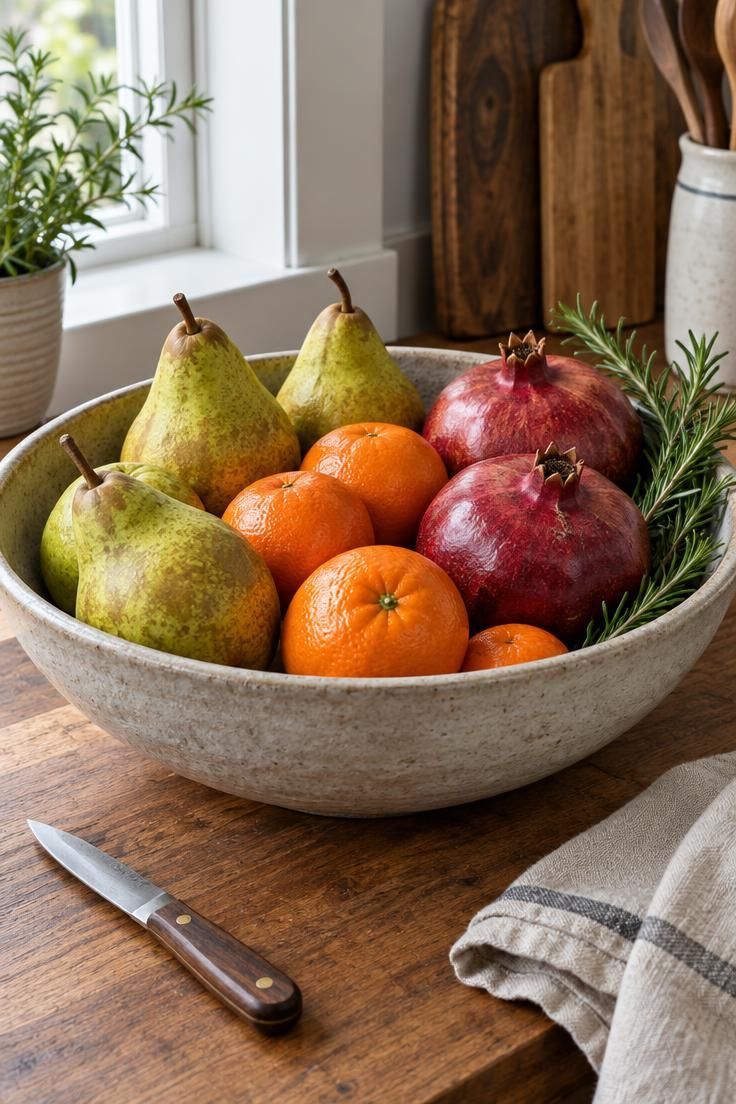
A low, wide stoneware bowl filled with pears, clementines, and pomegranates turns a counter staple into a color composition.
Tuck a few rosemary or pine sprigs at the edge, and let the deep reds, oranges, and greens sit against a neutral bowl.
The fruit does the visual work, so the bowl should stay quiet.
Choose a bowl wide enough that the fruit sits in a single layer and stays visible from above.
Place it near where household members actually eat fruit, whether that is beside the toaster or at the end of the island, so the display stays useful.
A winter fruit bowl display earns its space when the contents get eaten and refilled rather than left to soften.
Rotate fruit as it ripens and remove any piece that starts to spoil.
If the bowl sits in a hot or sunny spot, faux fruit holds the look without the upkeep.
Pomegranates last well, while pears ripen quickly, so check the bowl every couple of days.
Style Blueprint:
- A low, wide stoneware bowl in a neutral tone
- Pears, clementines, and pomegranates in a single layer
- Rosemary or pine sprigs at the edge
- A nearby cloth and knife for serving
Design Pro-Tip: Keep a small cloth beside the fruit bowl and clear out any softening pieces during the same pass, so the display stays presentable without a separate chore.
Bare Branch Arrangement in a Clear Glass Vase
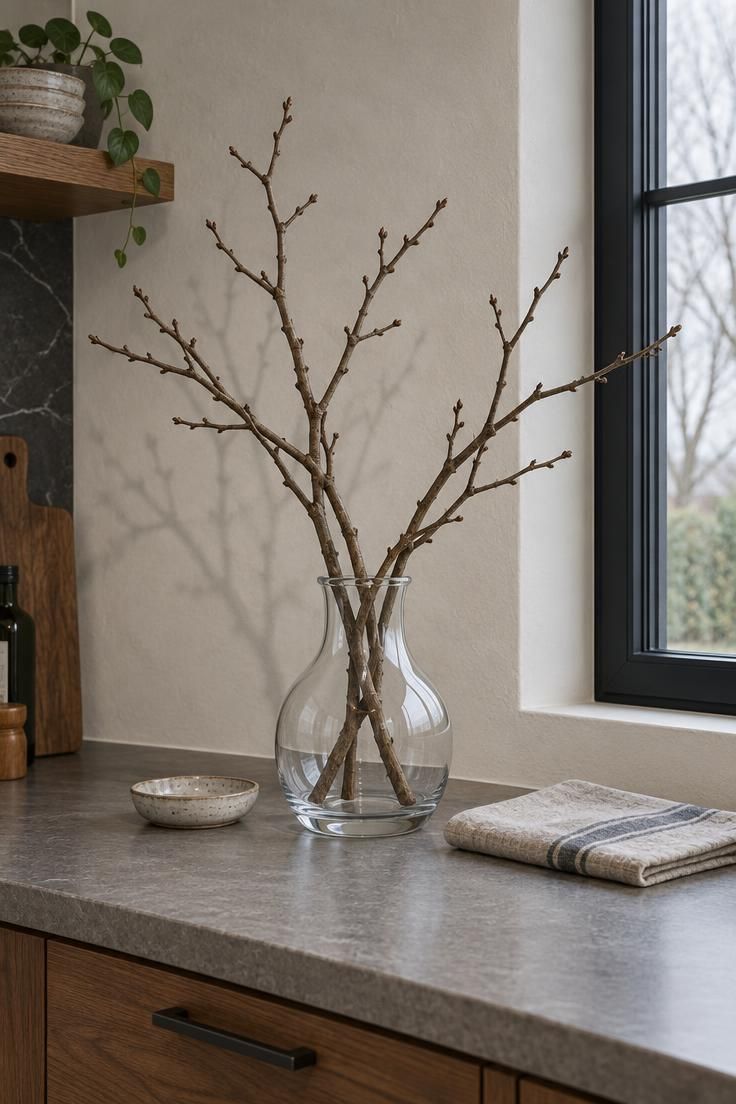
Forked bare branches in a clear glass vase make a spare, sculptural statement against a plain wall.
Choose branches with interesting angles and a few clear forks, and arrange them so the branch line shows against the surface behind.
The sparse silhouette reads as winter structure rather than clutter.
A side counter or a spot beside a doorway gives the arrangement room to be seen from a distance, which suits its scale.
Clear glass keeps attention on the branches themselves, and a vase with a broad, stable base stands up to a top-heavy arrangement.
Dust the branches lightly with a soft brush, since their texture catches it.
The decision here is between found branches and purchased dried ones.
Found branches are free but need checking for insects before they come indoors, and dried stems from a craft supplier arrive ready to use.
Either way, keep the arrangement out of high-traffic spots where a sleeve could catch a fork.
Style Blueprint:
- Bare forked branches with strong angles
- A clear glass vase with a broad, stable base
- A plain wall behind for the silhouettes
- A soft brush for light dusting
Frosted Glass Canisters with Wooden Lids
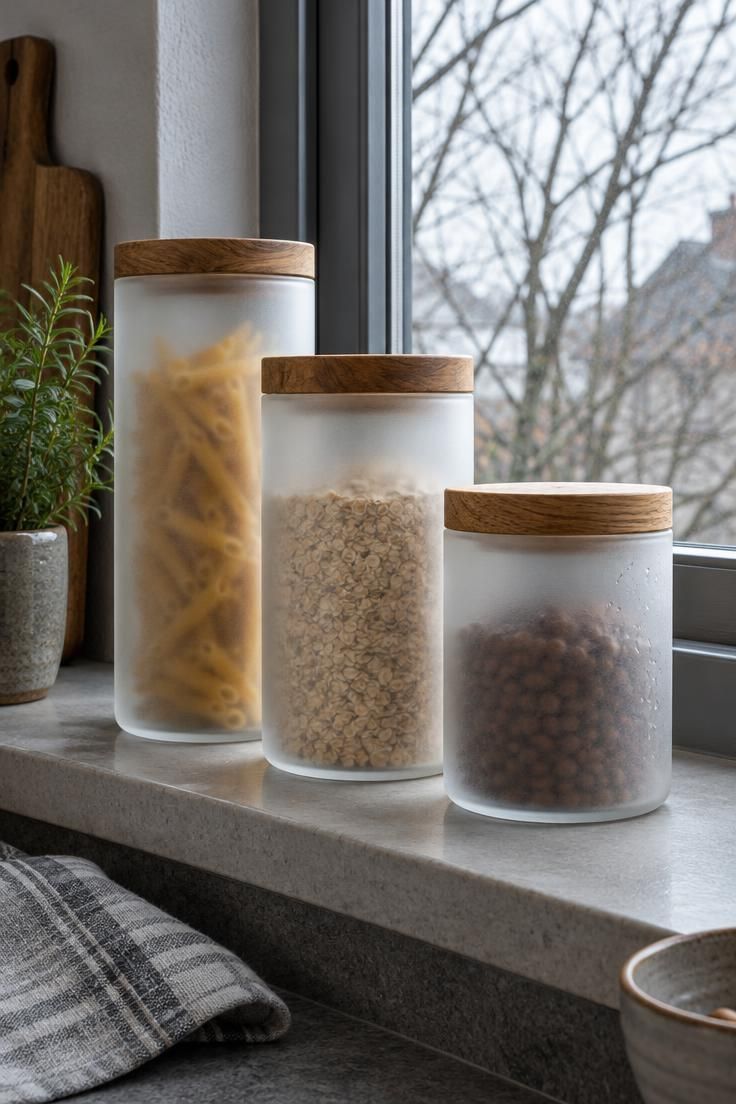
A row of frosted glass canisters with wooden lids lined up on a windowsill borrows the look of ice and winter light.
Backlit by a grey window, the frosted surface glows softly while the lids add warmth.
Fill them with everyday dry goods so the display stays useful.
Varying heights across three canisters gives the row a gentle rhythm; keeping them uniform looks more formal.
Wipe water spots from the frosted glass with a soft cloth, since the matte surface shows them more than clear glass.
A narrow shelf in a small kitchen can hold the same grouping when windowsill space is limited.
Choose canisters with lids that suit how often the contents get used.
Loose-fitting lids are easy for daily access, while tighter ones protect goods that sit longer.
The frosted finish hides the uneven fill lines that clear glass would reveal, which helps the row look calm between grocery runs.
Style Blueprint:
- Three frosted glass canisters with wooden lids
- Varying heights for a gentle rhythm
- Everyday dry goods inside to keep them useful
- A soft cloth for water spots
Tray Styled as a Winter Still Life
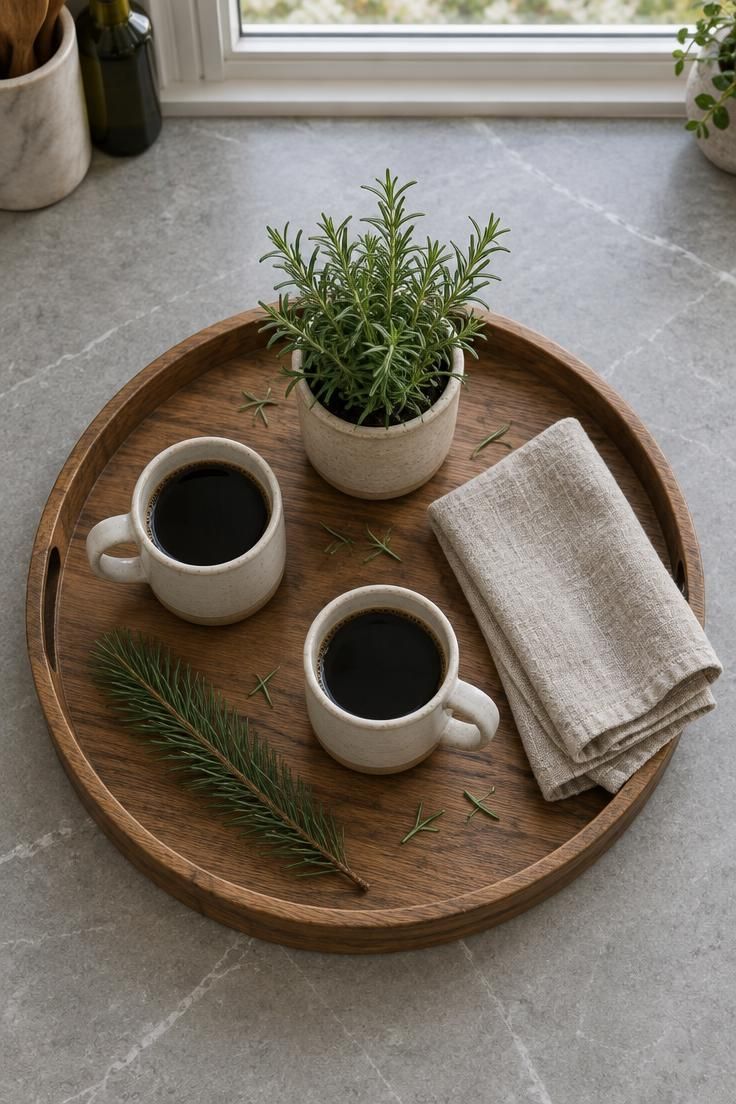
A round wooden tray holding two cream mugs, a small potted rosemary, a folded linen napkin, and a single pine sprig works as a moveable centerpiece.
The tray corrals the pieces so they can shift from counter to table without rearranging, and it defines a small composition on an otherwise open island.
Keep the arrangement edited rather than full, because a tray that grows crowded loses the still-life quality that makes it work.
Selecting between a live herb and a dried sprig comes down to upkeep: the live plant needs light and water, while a dried sprig lasts the season with no attention.
Lift the tray now and then to wipe the surface beneath it, since crumbs collect in the hidden space.
The tray itself needs only a damp cloth.
Overhead, the arrangement should read as a loose triangle of objects rather than a neat grid.
Swapping one object at a time lets the display feel current without turning into a collection of clutter.
Style Blueprint:
- A round wooden tray with a slight rim
- Two cream mugs and a folded linen napkin
- A small potted rosemary or a dried sprig
- One pine sprig to finish the composition
- A regular wipe-down of the surface beneath
Layered Textiles at the Window or Bench
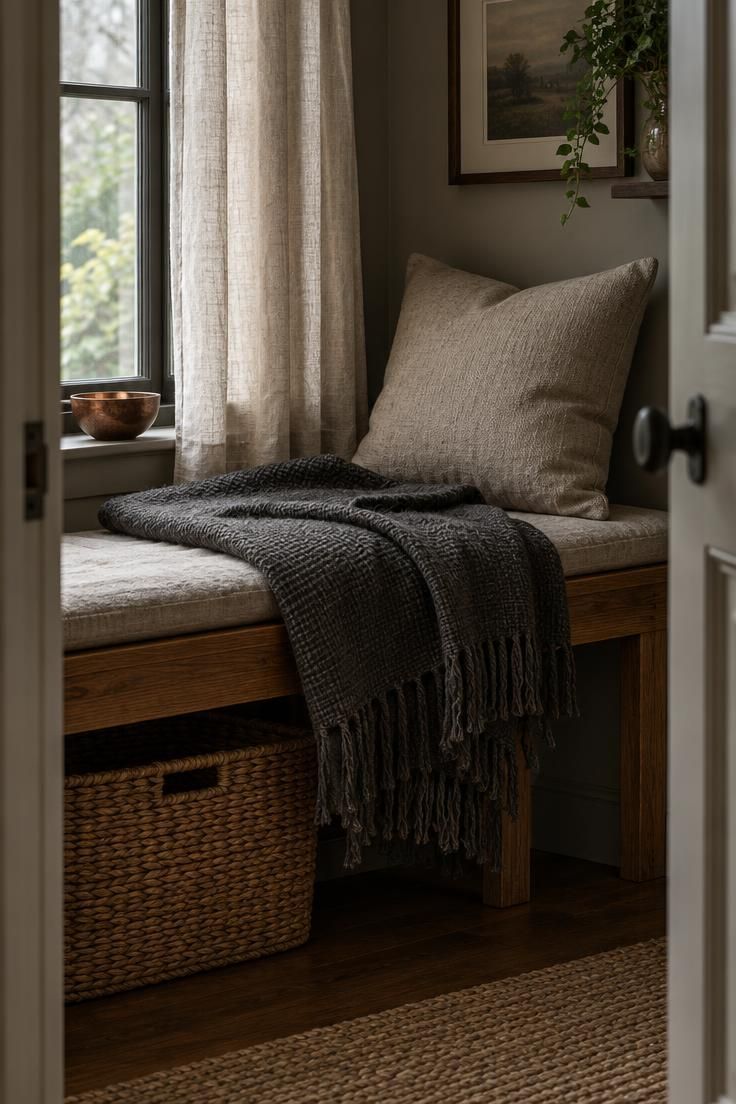
A window bench or a chair beside a kitchen window gives textiles somewhere to gather.
Layer a linen curtain, a charcoal woven throw folded over the seat, and an oatmeal cushion leaning against the wall.
The look comes from texture and tone rather than from precise styling, so keep the layers loose.
Oatmeal and charcoal sit well together and bridge cool window light and warm wood trim.
Copper kitchen accents can tie the textile palette to the rest of the room, whether that means a copper rail nearby or a small copper bowl on the sill.
The idea is texture layering, not window-treatment advice, so judge the curtain by how it hangs and how it feels.
Kitchen-adjacent fabrics collect cooking smells and splashes, so choose washable covers and store off-season textiles in a basket out of the way.
Loose layers are easier to shake out and wash than tightly tucked arrangements.
A bench that doubles as storage hides the extra throws between seasons.
Style Blueprint:
- A linen curtain with a relaxed hang
- A charcoal woven throw with visible texture
- An oatmeal cushion in a washable cover
- A woven basket for off-season textiles
- A small copper accent to link the palette
Cool Palette Wall Styling with a Warm Accent
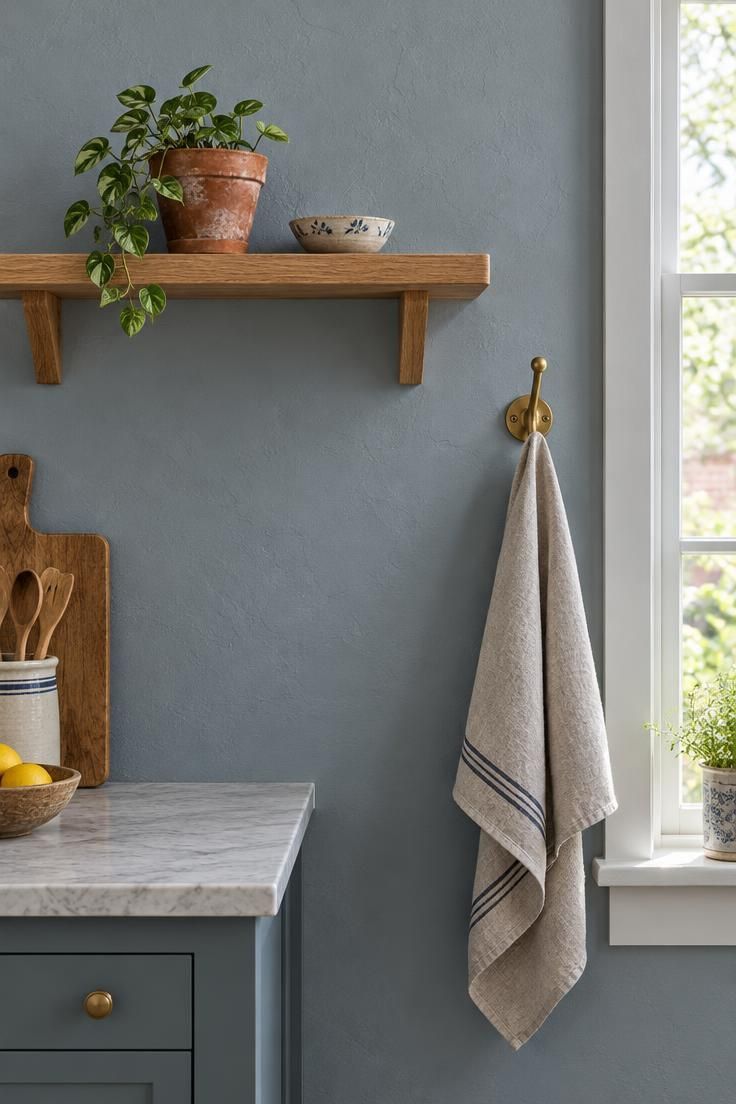
A soft blue-grey or slate wall gives winter styling a cool base, and a single warm accent keeps the room from reading cold.
A warm oak wall shelf holding a small terracotta pot, with a brass hook and a linen towel beside it, shows how one accent can carry the contrast.
The cool surface makes the warm piece stand out without extra decoration.
Test a small accent before committing to a larger one.
A single shelf, hook, or pot reveals how the tone reads in the room’s light, and the accent can move through the season as the light shifts.
Keep the rest of the wall quiet so the warm piece has room to register.
In a very small kitchen, one accent is often enough on its own.
Choose the piece you will notice from the doorway and let the wall do the rest.
Practical items, like a hook that holds an apron or towel, work well as the warm accent because they earn their place.
Style Blueprint:
- A soft blue-grey or slate wall as the cool base
- One warm oak shelf or a single brass hook
- A terracotta pot for a small warm note
- A linen towel that earns its place
Design Pro-Tip: Try the warm accent on a small piece first and live with it for a week, so you see how it reads in both morning and evening light before adding another.
Small Evergreen in a Woven Basket
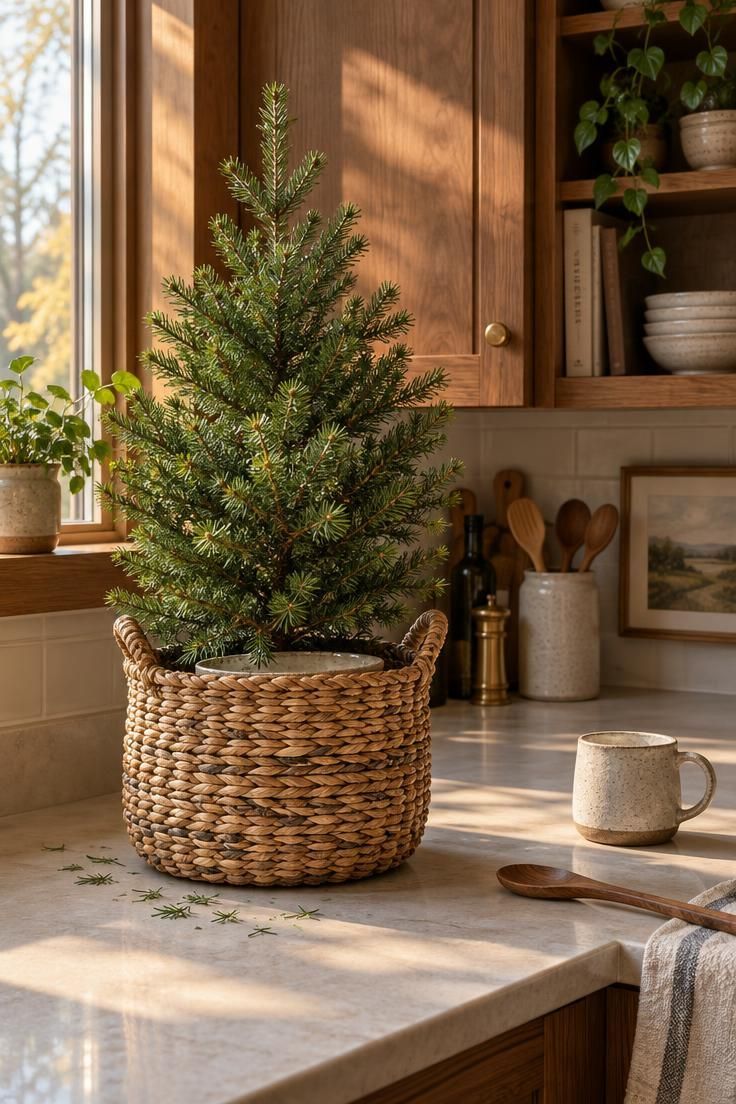
A potted rosemary, small fir, or topiary in a chunky woven basket softens a counter corner.
The basket texture covers the nursery pot and adds warmth that a bare plastic rim cannot.
Set the basket slightly back from the counter edge so it stays out of the way of prep work.
Water only when the soil feels dry, and turn the plant every few days so growth stays even.
On dark winter days, move the basket to a brighter spot near a window and bring it back when the light returns.
A few stray needles on the counter are normal and easy to sweep up.
Choose a basket with a firm base that will not tip when the pot shifts.
A saucer inside the basket catches drainage and protects the weave.
The counter corner should be wide enough that the basket does not crowd the toaster or the kettle.
Style Blueprint:
- A small rosemary, fir, or topiary in a nursery pot
- A chunky woven basket with a firm base
- A saucer inside the basket to catch drainage
- A brighter spot near a window for dark days
Conclusion
Winter styling in a kitchen works best when it builds on the room’s existing light and surfaces rather than asking for a full seasonal overhaul.
Start with one warm-metal vignette, a single evergreen branch, or a textured runner, then add pieces only as they suit daily use.
Rotate live greenery and fruit before they look tired, store off-season textiles and trays out of the way, and let the cool grey light outside shape the palette inside.
A kitchen arranged this way can carry the look through the long winter weeks without demanding constant attention.