This post may contain affiliate links. If you make a purchase through these links, we may earn a commission at no additional cost to you.
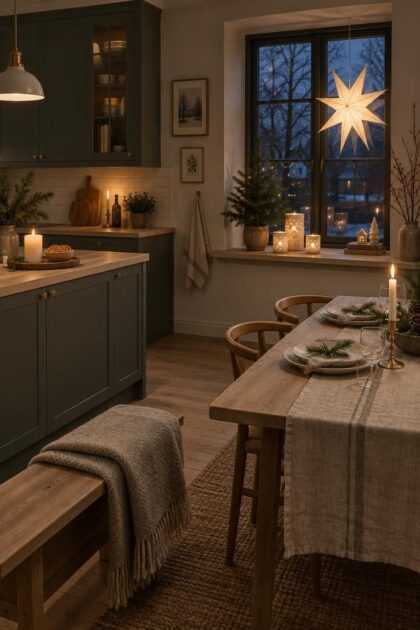
A Scandinavian Christmas kitchen begins with the room you already have: pale cabinets, a length of natural wood, and the quiet contrast of a dark winter window.
Decorating works best when it stays useful, so most of what follows lives on a tray, a shelf, or a sill that can be cleared in one motion before dinner prep starts.
The palette stays narrow, the materials stay natural, and the light comes in small warm layers rather than one bright source.
That restraint is the point.
A single vignette can carry the whole room when it is placed with care and given a little breathing space from the everyday clutter.
Each section below centers on one visual moment, which means a compact kitchen can borrow two or three and still feel fully seasonal.
Windowsill with a Mini Tree and Ridged Ceramic Holders
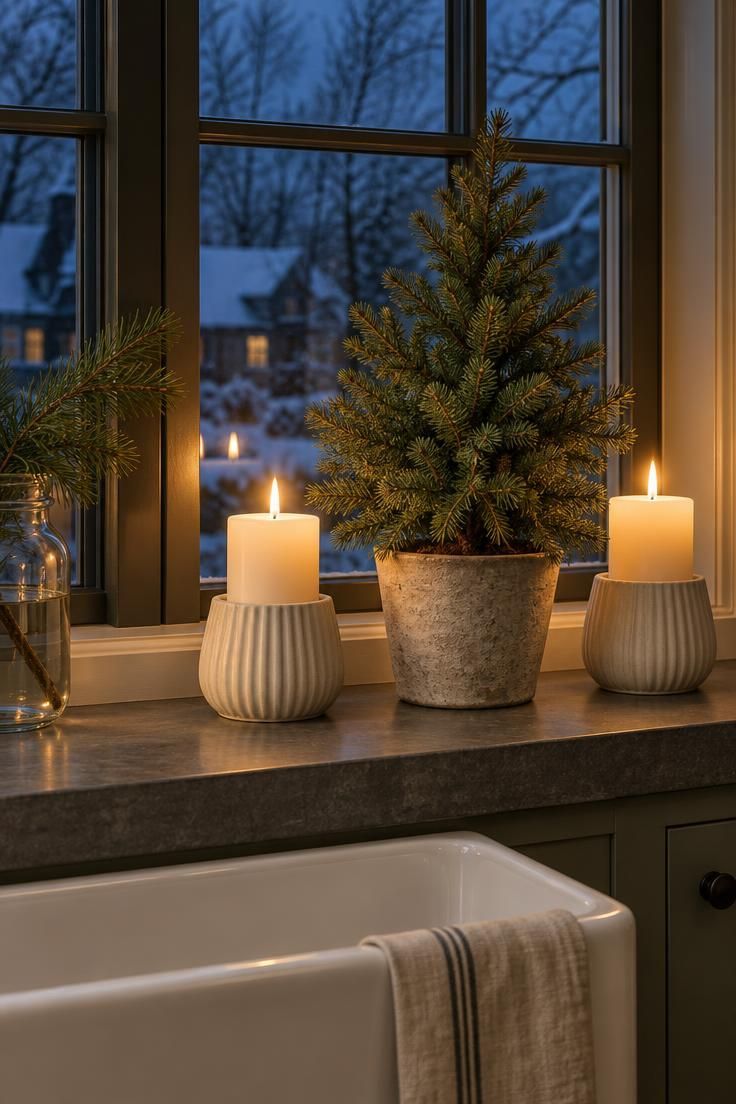
A deep windowsill gives a small tree a stage of its own, and the glass behind supplies a backdrop that shifts from pale gray daylight to deep blue dusk.
Setting the pot slightly off-center keeps the arrangement from reading as a matched pair of objects, which is where windowsill displays often go wrong.
Alternate the heights of the ceramic holders rather than mirroring them.
A taller holder placed behind the tree and a shorter one in front creates a gentle step that leads the eye across the sill.
Unglazed or lightly ridged cream ceramics pick up the rough texture of spruce needles, so the two materials feel related instead of competing.
For Nordic Christmas decor, for anyone building a scandinavian christmas kitchen on a modest scale, this is close to the least effort required for the most atmosphere, since nothing needs to move when the counter fills up.
Keep the rest of the sill clear.
A single jar with one pine sprig is enough to balance the far end, and an empty stretch of painted wood lets the vignette read as one quiet sculpture.
If the window faces a bright street, the dark evening outside does half the work after sunset.
Candle flames near a curtain, a paper shade, or a dried arrangement need ordinary household care: keep the flame clear of anything that can catch and extinguish candles before leaving the room.
Battery-operated pillars give the same low glow if the windowsill is somewhere the household passes quickly.
Style Blueprint:
- A small potted spruce or fir, roughly knee-height to a stool, in a plain terracotta or woven pot
- Two cream ceramic candle holders, one taller and one shorter, with a matte or ridged finish
- Warm-white candles or battery pillars in the same ivory tone
- One clear glass jar with a single pine or spruce sprig to weight the opposite end of the sill
Open Shelf Display with Tomte Figures and Straw Ornaments
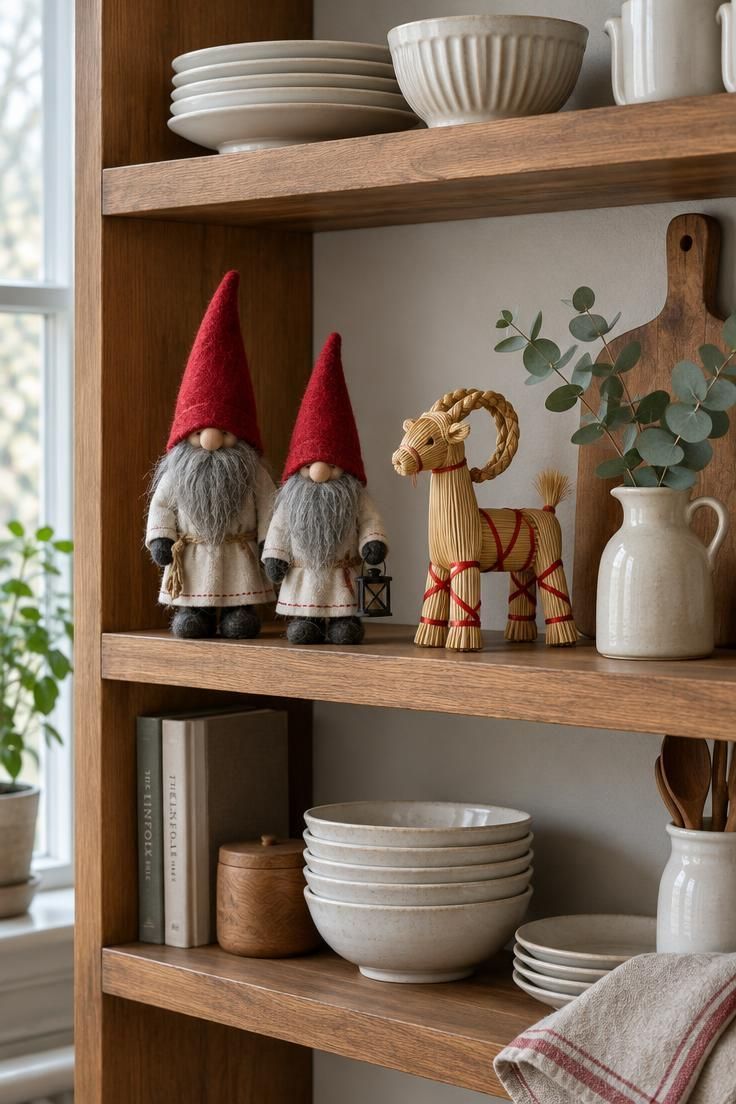
One open shelf can hold a small folk-art grouping without turning the kitchen into a display case.
Two tomte figures at one end and a straw goat at the other, with a cream jug of eucalyptus between them, create a loose line that the eye travels along.
The shelf's everyday contents, whether white dishes or a wooden board, stay in place and become part of the composition.
Red hats and perhaps one red paper heart supply the only strong color note.
Against neutral ceramics and pale wood, that small repetition reads as intentional.
Tomte and straw ornaments carry a handmade quality that suits a room where real cooking happens, and they are light enough to rearrange when the shelf needs to hold more jars.
A shelf at eye level above a counter or beside a window works better than a high one, since the figures stay visible and easy to dust.
Straw and paper collect kitchen grease over a season, so a soft brush every few weeks keeps them looking crisp.
Kitchens with little counter space often have unused vertical storage, which makes this a practical place to start.
Style Blueprint:
- Two or three small tomte figures with red hats and neutral wool bodies
- One straw goat or straw star ornament as a contrasting shape
- A cream stoneware jug with two or three eucalyptus stems
- A wooden cutting board leaned at the back of the shelf for height
- White dishes kept in place so the display sits inside a working shelf
A Single Glowing Paper Star Hung in the Window
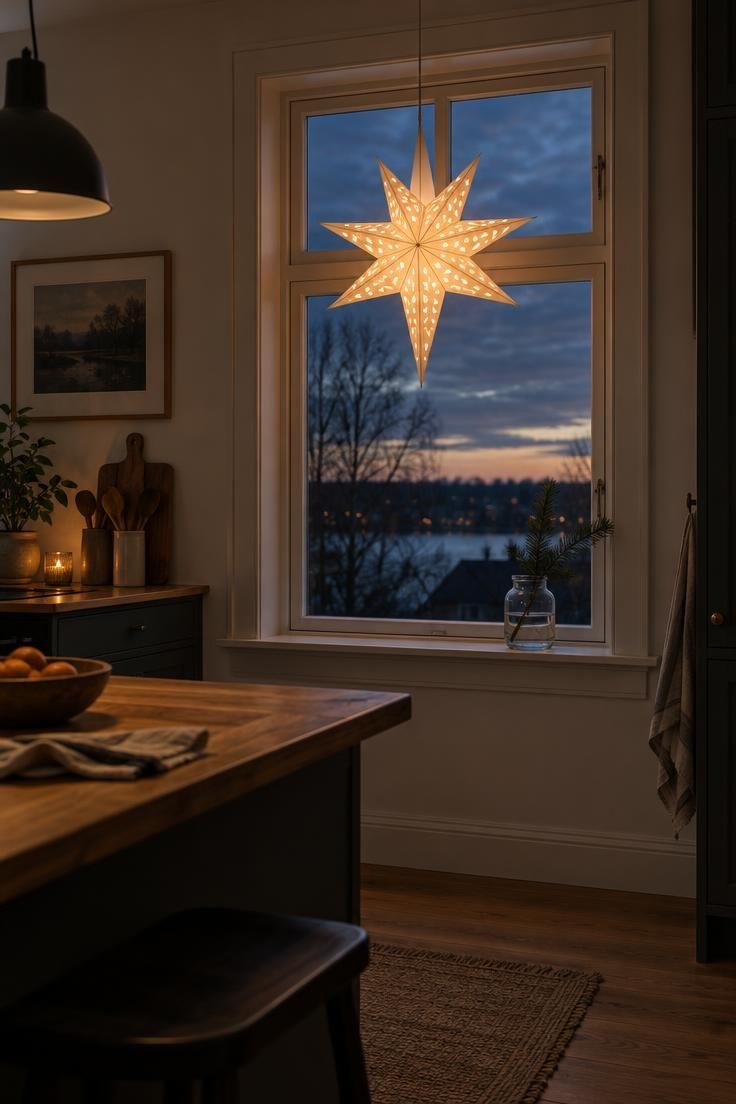
Hanging one folded or perforated paper star in the window and leaving it as the only added light keeps the composition spare.
The glow against dark glass does the atmospheric work that a row of candles would otherwise handle, and it frees the counter entirely.
A subtle cutout pattern reads as a traditional object rather than a flat shape.
Placement matters more than size here.
A star whose bottom point lands roughly a third of the way down the glass looks balanced from inside the room and from the street.
Below it, almost nothing: one small green sprig in a clear jar is enough to anchor the sill without crowding the star's reflection.
Anyone searching for a paper star window decoration will find the effect depends on the surrounding emptiness as much as the star itself.
This suits a window that faces a street, a garden, or a neighboring wall, where the star becomes a quiet signal at dusk.
A slim indoor-safe light on a timer keeps the glow consistent on evenings when nobody remembers to switch it on.
Fold-flat paper stars store easily between seasons, which makes them a low-commitment choice for renters.
Style Blueprint:
- One white or cream paper star with a cutout or folded pattern
- A slim warm-white light or battery option suited to indoor paper decor
- A clear glass jar with a single pine sprig for the sill below
Linen Runner and Pine Sprig Table Setting with One Red Accent
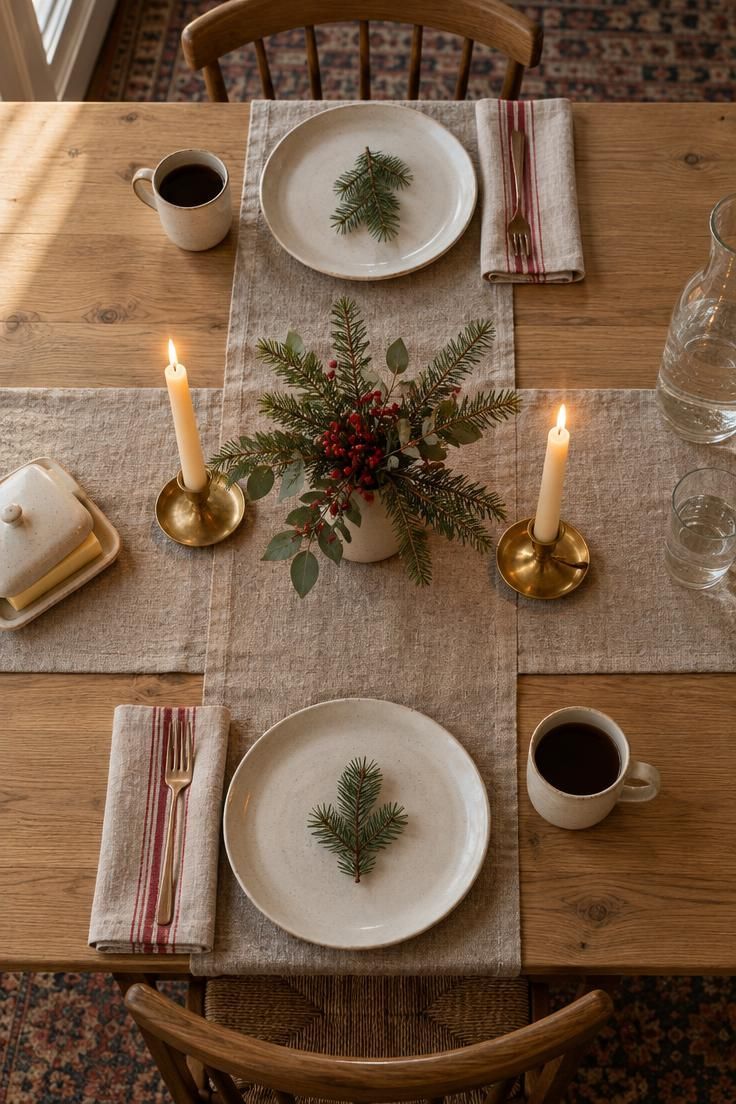
A natural linen runner in oatmeal or cream softens the table's hard surface before anything else is added.
White plates with a single pine sprig on each carry the green note without building a centerpiece that has to be moved for serving.
Two or three low candle holders in brass or matte black sit down the middle, kept short enough that people can see across the table.
The red accent is the part that needs discipline.
A striped napkin, a berry sprig, or a thin ribbon around the flatware should repeat in at least two places so it reads as a decision rather than an accident.
A Scandinavian holiday table setting works on this narrow ratio: mostly neutral, a little green, one warm note.
This arrangement clears in minutes when the table is needed for baking or homework, which matters in a kitchen where the dining surface doubles as workspace.
The linen can be shaken out and reused for several meals before washing.
Households that want holiday meals to feel considered without a full centerpiece will find the runner does most of the visual work.
Style Blueprint:
- An oatmeal or cream linen runner, left slightly rumpled rather than pressed flat
- Simple white plates with one small pine sprig on each
- Two low brass or matte black candle holders with warm-white candles
- Red-striped linen napkins, or a thin red ribbon repeated at each place
Countertop Tray with a Candle, Branches, and Dried Citrus
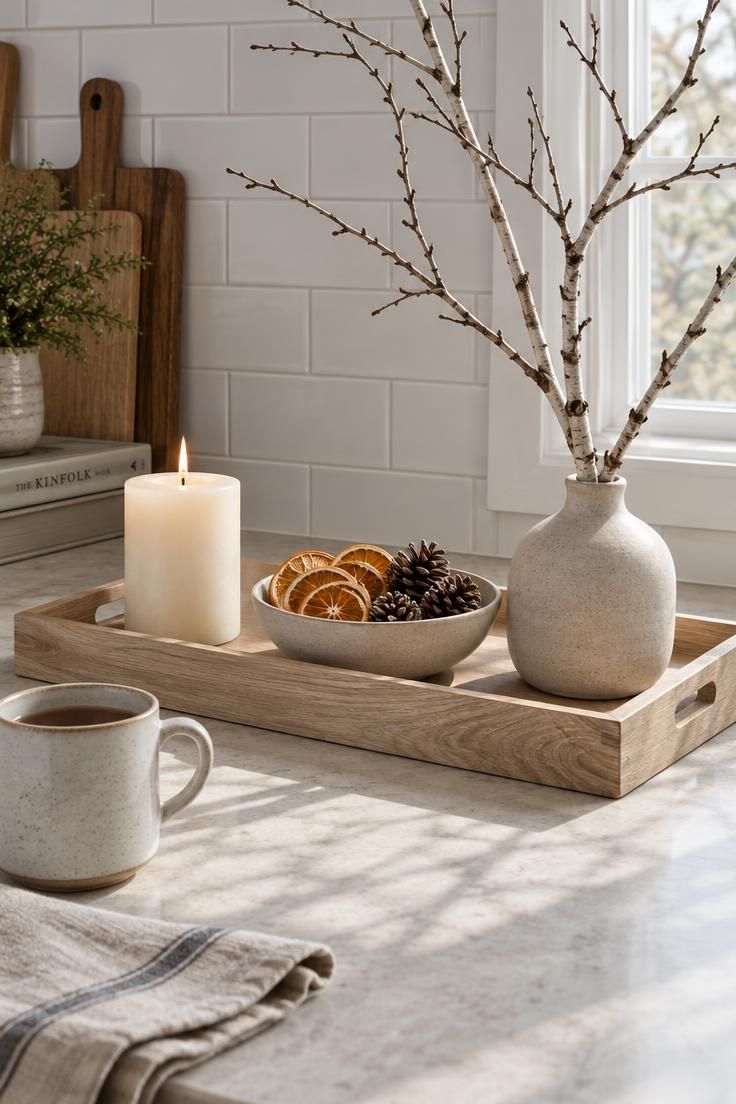
A pale wooden tray corrals the seasonal pieces so they can be lifted off the counter in one motion when the chopping board comes out.
A chunky ivory pillar at one end, a small ceramic vase of bare birch or pine branches at the other, and a shallow bowl of dried orange slices and pinecones between them make a low horizontal cluster.
Wooden countertop tray styling depends on keeping the branches shorter than the candle and the bowl shallow, so the whole composition stays under eye level and does not block the backsplash.
The tray's low sides contain the arrangement visually, which makes a handful of objects look deliberate.
Dried citrus brings a warm amber tone that holds up for weeks, unlike fresh flowers that demand replacing.
Place the tray at the end of a cabinet run or against a backsplash rather than in the middle of the main prep zone.
Tray, candle, and bowl all wipe clean, and the branches can be swapped for fresh sprigs when they start to look tired.
This is a good option for a kitchen that wants a single seasonal moment without spreading decor across every surface.
Style Blueprint:
- A pale wood tray with low sides, long enough to hold three elements in a line
- One ivory pillar candle, unscented, in a simple holder
- A small matte ceramic vase with bare birch or pine branches
- A shallow bowl of dried orange slices and small pinecones
Twig Wreath on a Pantry or Cabinet Door
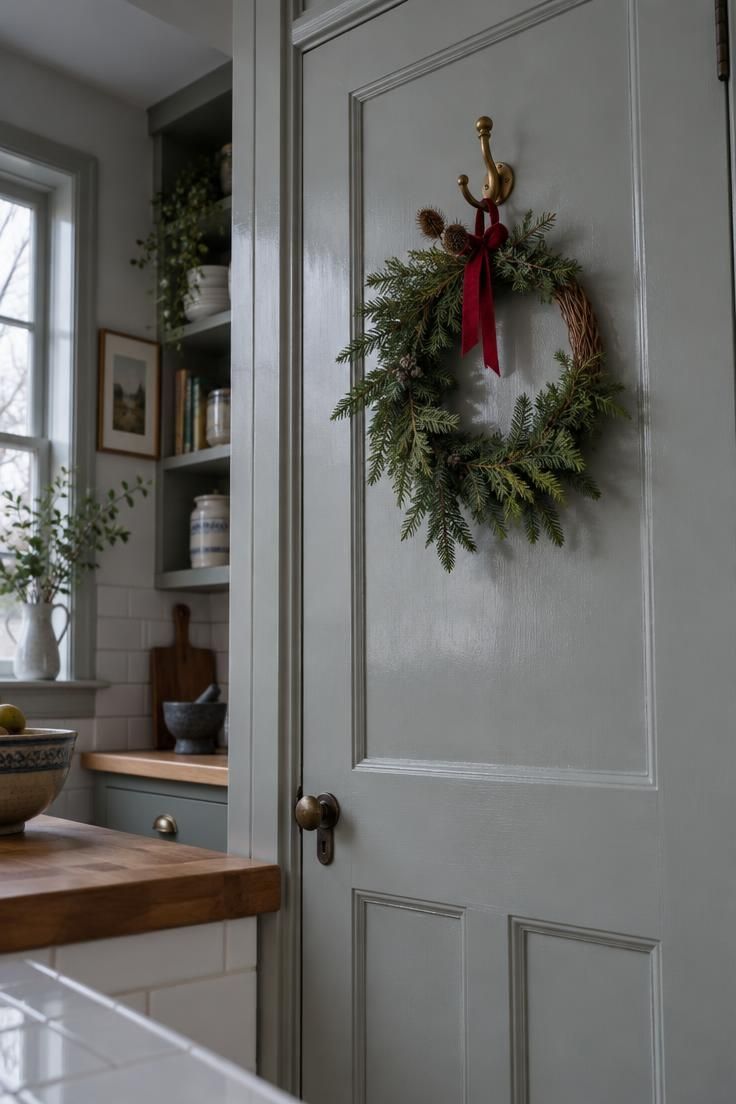
A simple twig or evergreen wreath on one cabinet door adds seasonal texture to a flat surface that otherwise stays blank all year.
Built on a natural willow or straw base, it carries a few dried seed heads, one red berry sprig, or a thin linen ribbon and nothing more.
The restraint keeps it from reading as a door decoration borrowed from the front porch.
Keep the wreath's diameter modest so the door still opens freely and the look stays understated.
Hanging it on the pantry or a tall cupboard puts it at eye level, where the twig structure is visible, and pairs well with a small jar of the same greenery on the nearby counter to repeat the green note.
Kitchens short on horizontal surfaces but long on cabinet fronts tend to get the most from this move.
Fresh evergreen sheds as it dries, especially near warmth, so a faux or dried twig version is the lower-maintenance tradeoff.
Either way, the wreath stores flat and returns each December without much fuss.
Style Blueprint:
- A small wreath on a willow or straw base, sized to clear the door swing
- Mixed evergreen twigs or dried branches for texture
- A short linen ribbon or a single red berry sprig
- A small brass or leather hook that suits the door's look
Dried Orange Garland Draped Along a Kitchen Hutch
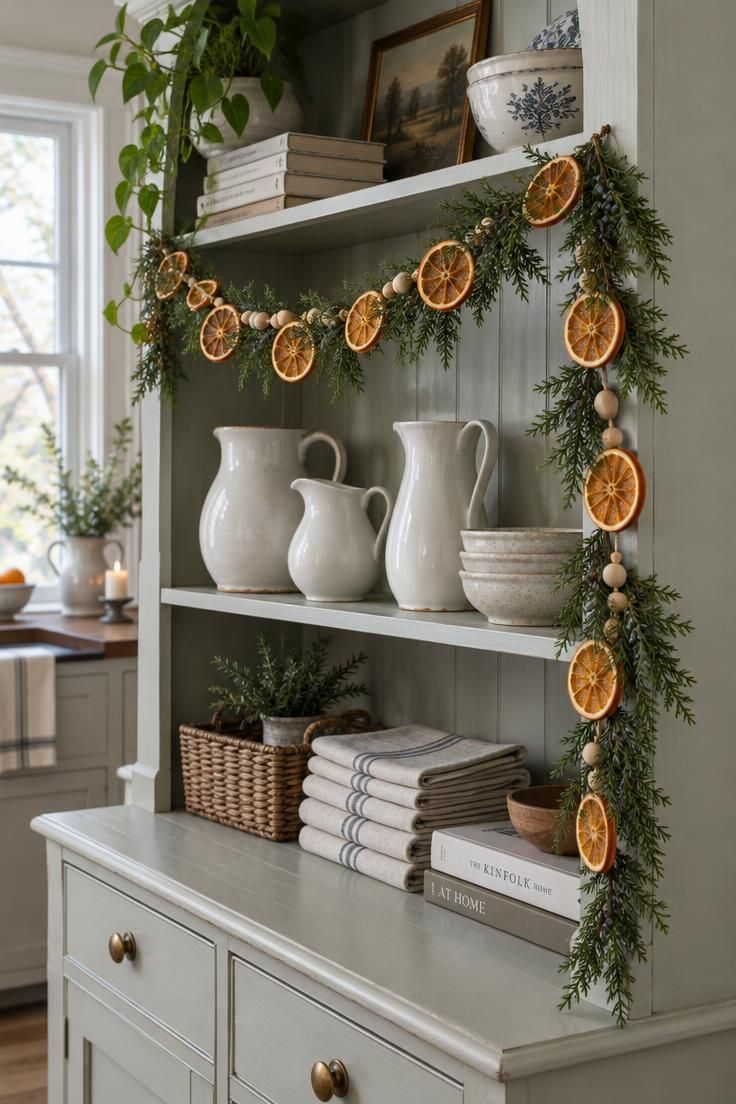
A hutch or freestanding cabinet offers a longer display line than a sideboard, and a garland uses that span without filling every shelf.
Dried orange rounds, pale wooden beads, and short juniper cuttings carry the same warm citrus and soft green as the rest of the room.
The garland can drape across the top edge and fall a few inches down one side so the arrangement feels casual.
The lower shelves stay practical with white ceramic pitchers, folded linen napkins, and a small stack of everyday plates.
Drying orange slices at home takes a standard oven on low heat, and the rounds keep for the season if stored dry.
A few extra slices sliced thin and spaced evenly give the garland a more even rhythm.
This treatment works in a kitchen with limited counter space because it borrows vertical display room that is usually left empty.
After the holidays, the juniper can be composted and the dried orange rounds kept in a paper bag for another winter.
Style Blueprint:
- A garland of home-dried orange slices strung on jute thread
- Small pale wooden beads spaced between the fruit rounds
- Short juniper or cedar sprigs tucked into the garland every few inches
- A pale painted hutch with a mostly empty upper shelf
- White pitchers and folded linen napkins arranged on lower shelves
Candle Cluster on a Tray as an Island Centerpiece
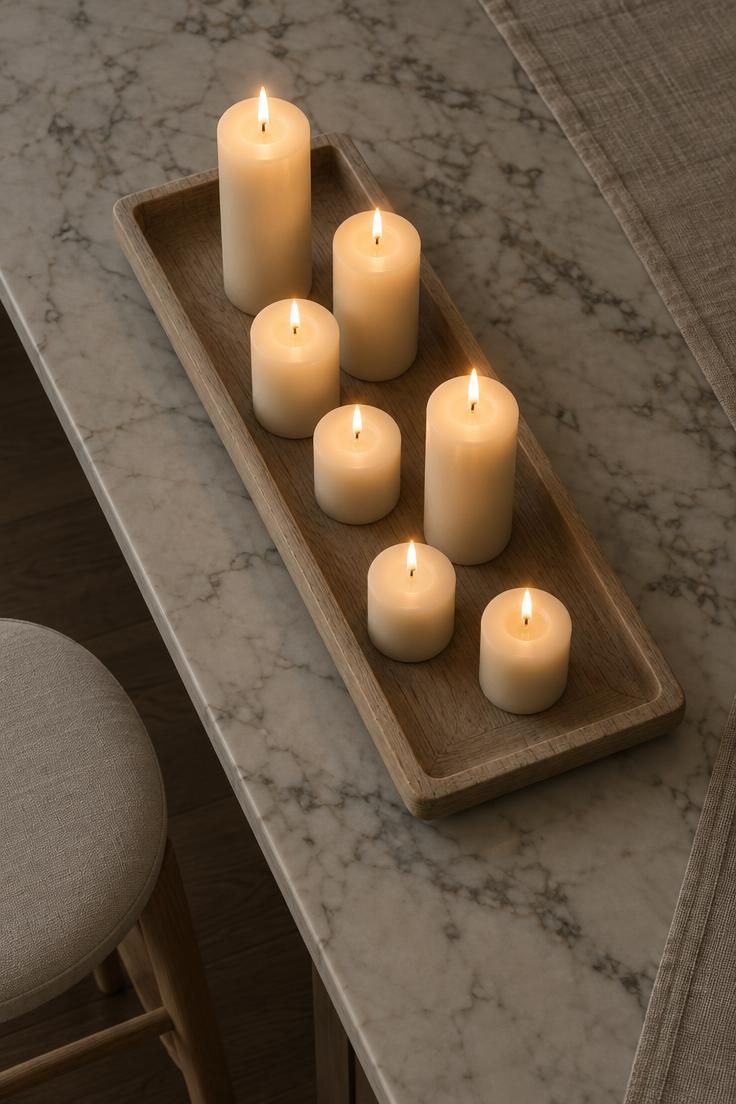
A long wooden or travertine tray down the center of an island gathers a group of ivory pillar candles into one contained moment.
Varying the heights, with some candles raised on small wooden blocks or inverted bowls, gives the cluster a stepped silhouette instead of a flat row.
Keeping every candle in the same warm ivory tone lets the flame heights and wax texture carry the visual interest.
Add nothing else to the tray.
The Nordic preference for several small low sources over one bright overhead shows clearly here, and a single material story reads calmer than a mix of candle colors and holders.
Keep the surrounding island clear so the cluster has room to register.
Battery-operated pillars in warm white suit a kitchen that often sits unattended.
Tray and candles wipe down easily, and the wax tone stays consistent year to year if the set is stored together.
Trim wicks before each lighting so the flames stay even and the wax burns cleanly.
Style Blueprint:
- A long pale wood or travertine tray sized to the island's center
- Seven ivory pillar candles in three heights, all the same warm white
- Two or three small wooden blocks to raise selected candles
Small Straw and Wood Kitchen Tree on a Low Stool
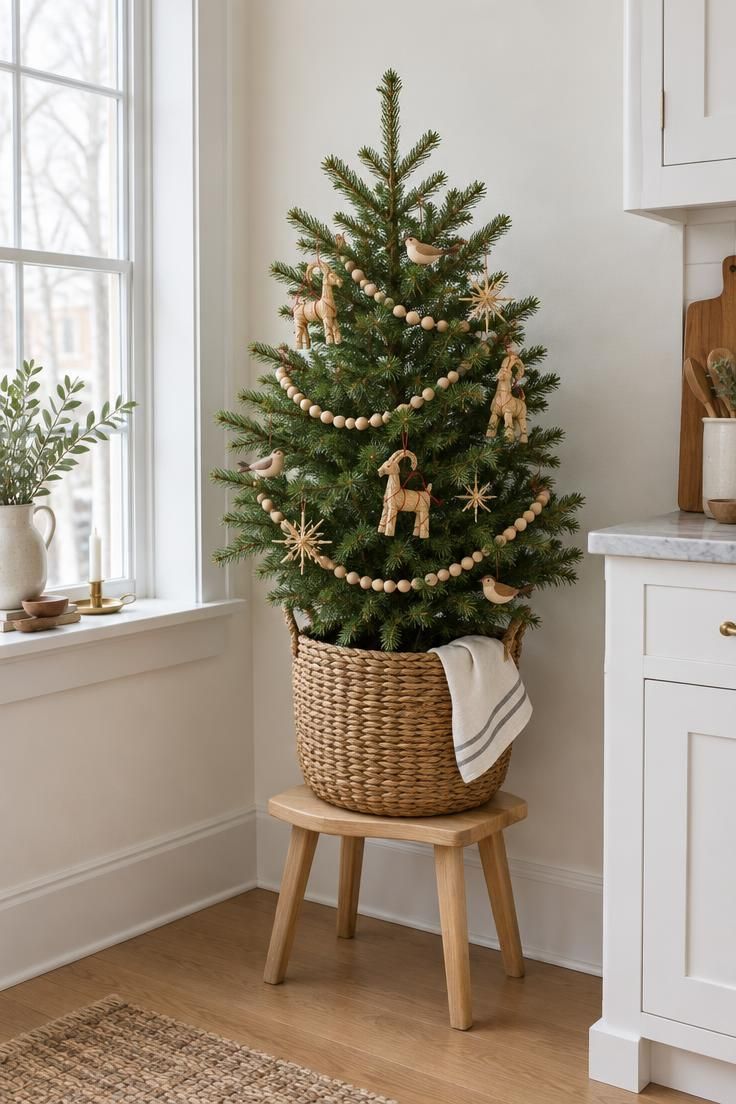
A small tabletop tree, no taller than about two feet, on a low wooden stool gives the kitchen a seasonal anchor without touching a work surface.
Decorated only with wooden and straw pieces, such as mini straw goats, carved wooden birds, and a simple bead garland, it keeps to the natural-material rule that defines the look.
Stand the tree in a woven basket or plain ceramic pot rather than a shiny stand, and tuck a folded linen napkin around the base to soften the transition.
Setting the stool against a blank wall lets the tree's shape stand out without competing with cabinetry.
Because it occupies a corner rather than the counter, the tree can stay out through the whole cooking season, and a narrow profile keeps walkways clear.
Wood and straw ornaments are a practical pick low to the floor, where children and pets pass close.
The basket lifts for sweeping, and the ornaments box up together at the end of the season.
Style Blueprint:
- A small spruce or fir, about two feet tall, in a woven basket or plain ceramic pot
- A low wooden stool to lift the tree off the floor
- Straw goat ornaments and small carved wooden birds
- A simple wooden bead garland in place of tinsel
Dresser Top with Ceramic Jugs and Bare Branches
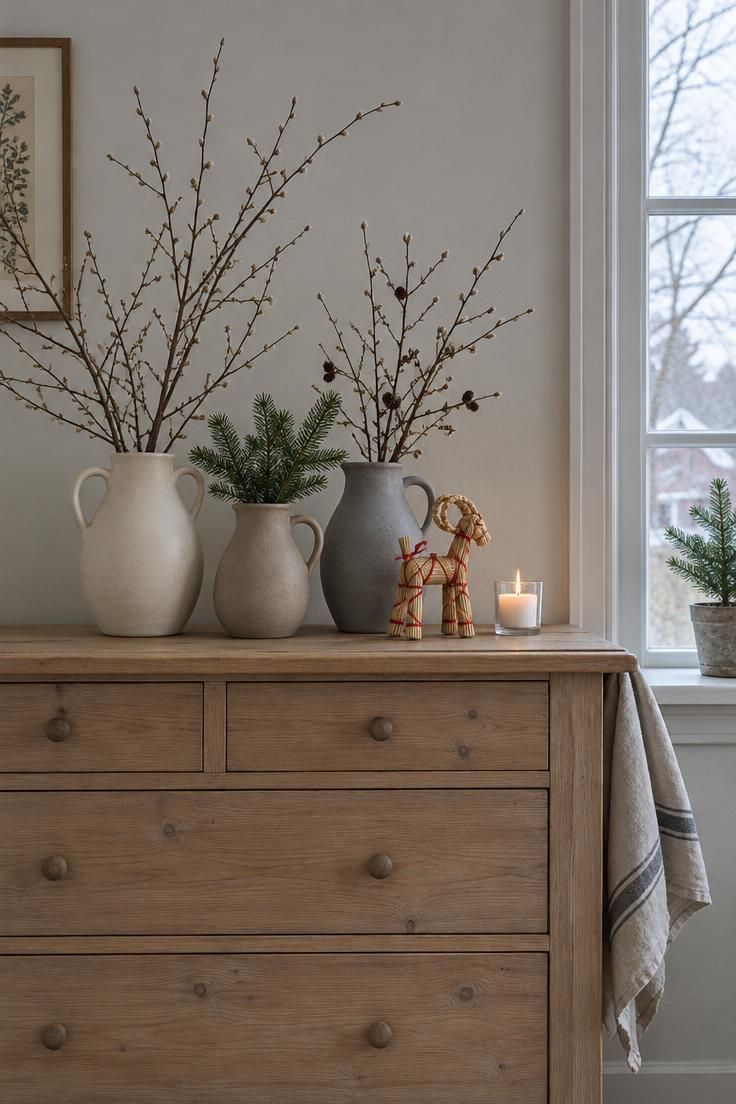
The top of a freestanding dresser or tall hutch offers a display ledge above counter level, where the holiday mood can sit without crowding prep space.
Three matte ceramic jugs in graduated heights, each holding a bare branch or a short evergreen stem, form a loose triangle when the tallest sits back and center and the smaller two step forward and to the sides.
Bare branches add height and a graphic wintry silhouette against a pale wall, while cream, sand, and soft gray ceramics keep the palette quiet.
One straw ornament or a small wooden bird beside the jugs echoes the folk motif without turning the dresser into a collection.
Clear the rest of the top except for one candle in a glass holder, so the grouping keeps its air.
This works best in a kitchen with a tall piece of furniture that already acts as a focal point.
Branches can be refreshed from the yard, and the jugs return to ordinary use once the season ends.
Dust collects on bare twigs, so a quick pass with a soft cloth keeps the arrangement sharp.
Style Blueprint:
- Three matte ceramic jugs in cream, sand, and soft gray, in graduated heights
- Bare branches and a few short evergreen stems
- One straw goat or small wooden bird ornament
- A single candle in a clear glass holder at the edge
Skillet-Top Cooling Rack with Clove-Studded Oranges
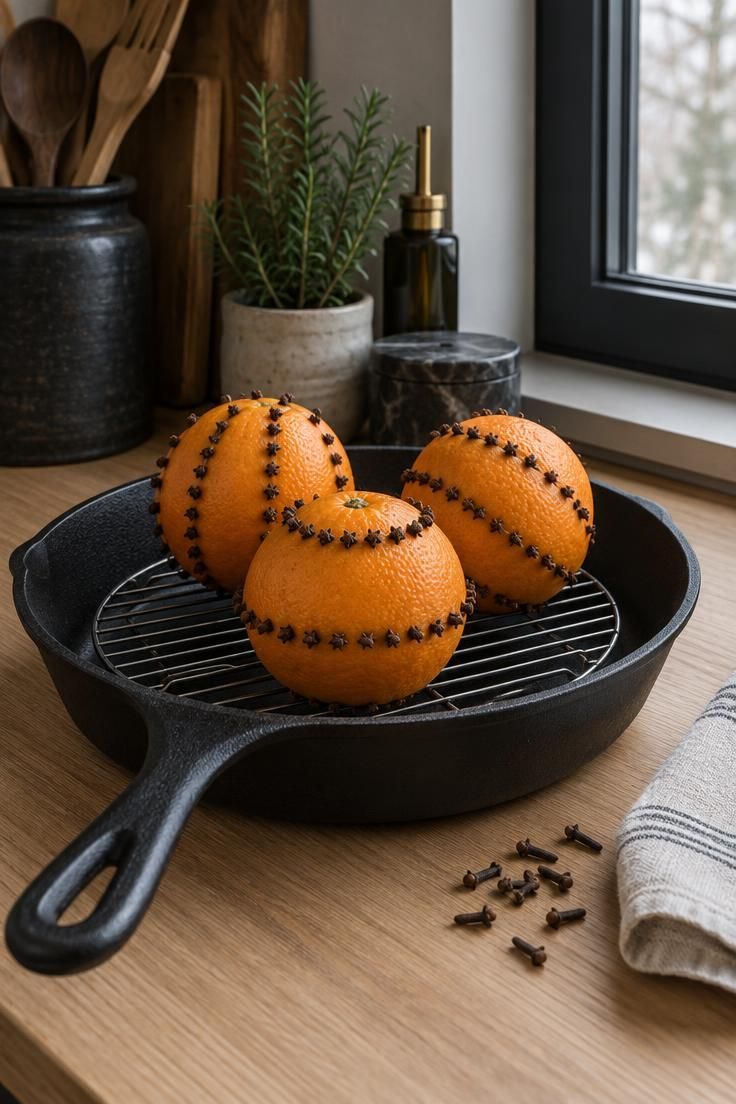
A cast-iron skillet can act as a low tray for a traditional Scandinavian clove orange without pulling the kitchen into full baking decor.
The dark pan grounds the arrangement on a pale oak counter, while a wire cooling rack set across its rim lifts the fruit above the cooking surface.
Three oranges studded with whole cloves in simple vertical bands bring a warm brown pattern against the bright peel.
Keep the arrangement compact by using only two or three oranges and a few loose cloves scattered near the pan's base.
A folded muslin cloth at the side softens the metal edges and catches any stray clove bits.
The rack can be removed in seconds when the skillet needs to return to the stove, and the oranges can dry on the same rack elsewhere after the display.
This works for a kitchen that wants a practical piece of cookware doing seasonal duty without a dedicated tray or centerpiece.
The clove smell stays close to the arrangement rather than spreading through the whole room, which suits a household that prefers subtle fragrance.
Replace the oranges when their skin begins to wrinkle too much, and wipe any clove dust from the skillett.
Style Blueprint:
- A matte black cast-iron skillet centered on a pale oak counter
- A wire cooling rack set across the skillet rim
- Three whole oranges studded with whole cloves in vertical bands
- A small folded muslin cloth and a few loose cloves beside the pan
Design Pro-Tip: Let the clove-studded oranges keep a natural shape and spacing rather than covering the whole peel, so they look like a decorative kitchen object instead of a craft project.
Conclusion
A holiday kitchen does not need every surface dressed.
One or two well-chosen vignettes, placed where the light falls and the work zones stay clear, can carry the whole room through the season.
The strongest versions pair a pale neutral base with natural wood, paper, straw, and a small set of warm lights kept low and layered.
Repetition holds the look together: one green note, one warm accent, one candle shape carried from the windowsill to the table.
Trays, shelves, sills, and quiet corners make the best stages because they lift away when cooking begins.
What remains is a kitchen ready for holiday meals and long winter evenings, and still easy to use on an ordinary Tuesday.