This post may contain affiliate links. If you make a purchase through these links, we may earn a commission at no additional cost to you.
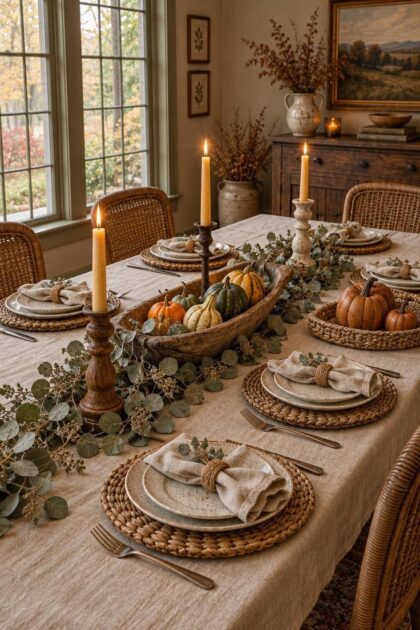
Thanksgiving dinner at home brings a table full of serving dishes, family, and the small pleasures of gathered materials.
A rustic approach suits that scene because it favors texture over polish and accepts the slightly imperfect.
Wood, linen, stoneware, and dried botanicals carry the look without requiring a cupboard of new purchases.
The palette stays in the warm earth range: oat, terracotta, sage, honey, and weathered brown.
Set out a few strong layers, then let the food and the company take over.
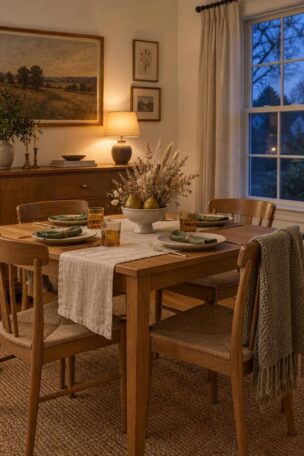
Washed Linen Tablecloth as a Soft Neutral Base
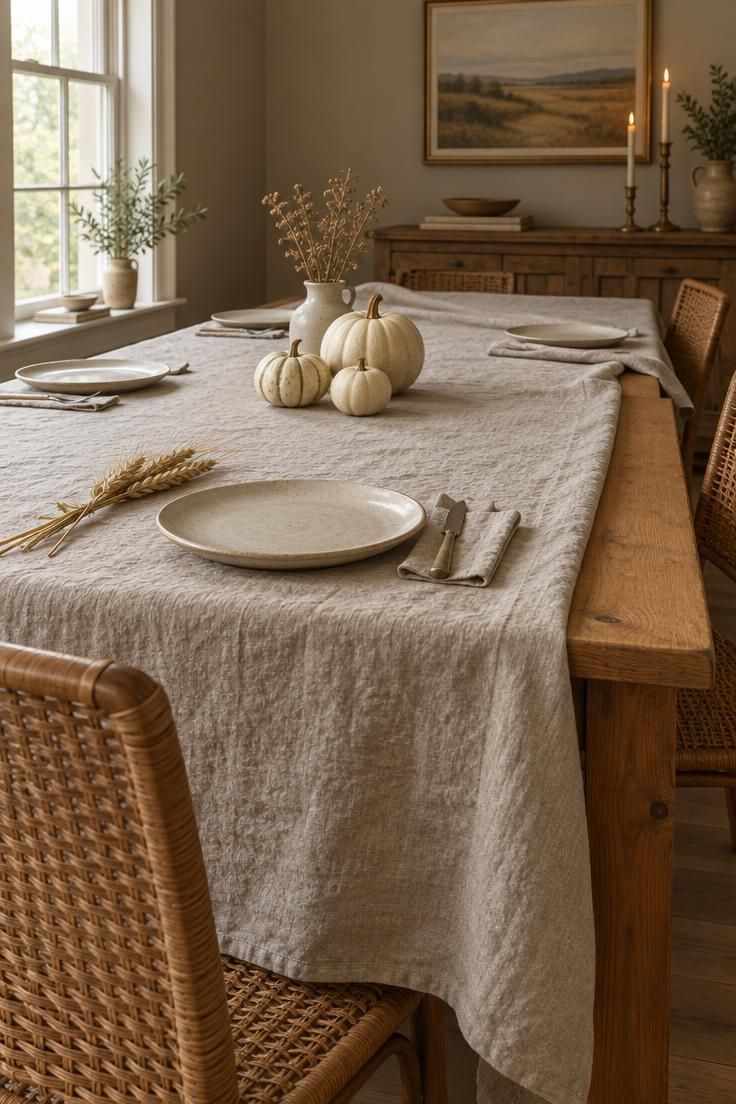
Washed linen changes the whole mood of a dining room before a single plate is set.
Oat, flax, or stone tones read as a matte, rumpled foundation that lets heavier materials above them carry the detail.
The cloth softens the silhouette of a hard wooden table and gives speckled pottery, dark flatware, and worn wood serving boards a quieter surface to rest against.
Folding one end back keeps some wood grain visible, which matters when the table itself has character worth seeing.
Think about how the cloth relates to the chairs and the room around it.
A washed linen tablecloth in a mid-neutral shade sits comfortably between a dark walnut table and pale walls, and it holds up visually next to sage or rust napkins that might otherwise look loud against the floor.
The uneven texture also hides small creases and water marks better than a pressed cotton cloth, which suits a home meal where guests keep passing dishes.
Practical limits come with the appeal.
Loose cloth edges can catch on chair arms or on the corner of a passing serving tray, so a shorter drop may be more practical for a busy meal, especially at the ends where people walk.
A runner-like drape over the middle of a long table is another option that keeps fabric away from traffic while preserving the soft foundation.
A cloth this plain needs contrast to avoid looking flat.
Woven placemats, a wood charger, or a dark napkin at each seat adds enough variation without fighting the neutrality of the base.
Style Blueprint:
- Oat, flax, or stone washed linen cloth with a relaxed, wrinkled finish
- Fold back one end so the wood grain shows
- Choose a drop that clears chair arms and passing trays
- Pair with woven placemats or wood chargers for contrast
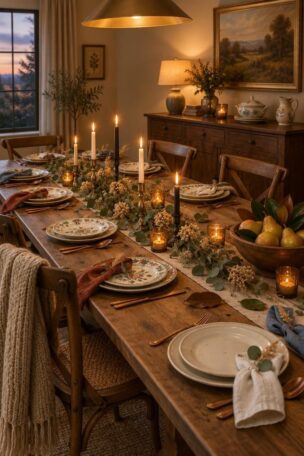
Dried Eucalyptus Table Runner with Amber Glass Votives
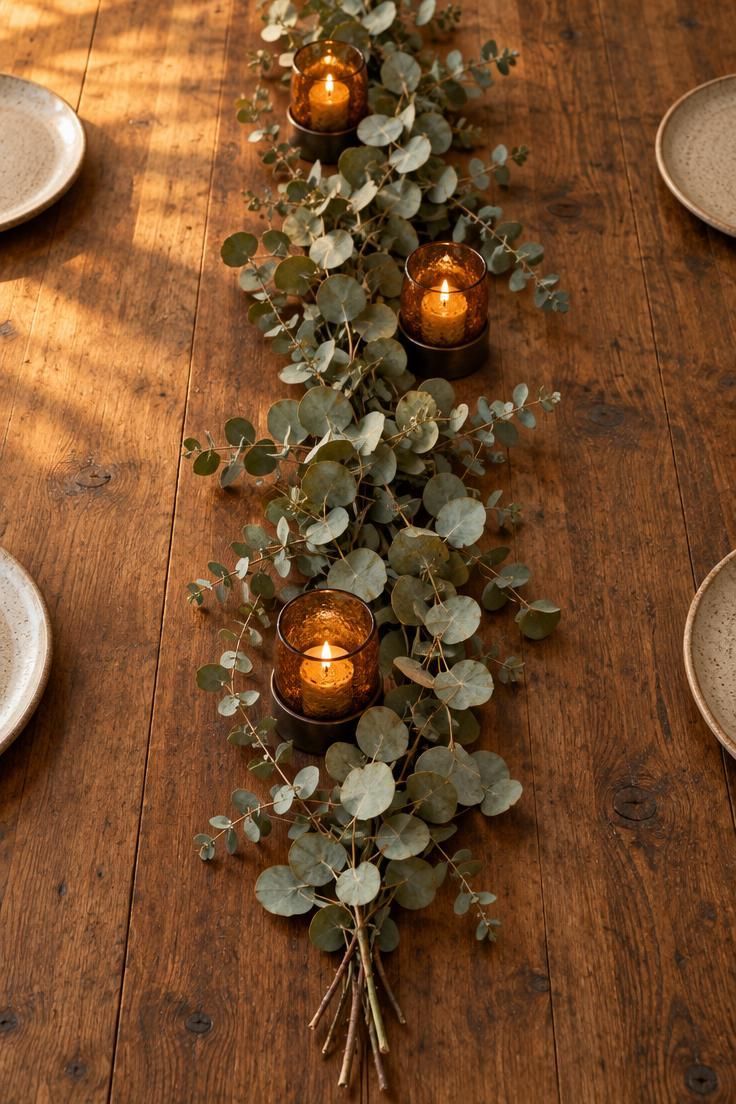
A dried eucalyptus table runner needs no vessel and no arranging skill, which is part of why it works down the middle of a long holiday table.
Pale silver-green leaves echo the gray tones in weathered wood and set off the honey color of amber glass.
The runner reads as gathered rather than built, and it can be nudged to one side when a platter needs room.
Dried stems also last through several dinners, pushing the same material back into service each November.
Treat the dried eucalyptus table runner as a pliable line rather than a fixed arrangement.
Lay the stems in overlapping clusters so the trail widens and narrows, leaving a few gaps near the ends for serving dishes.
Tuck amber glass votives into those gaps at uneven spacing, and set each on a small trivet or metal base so warm wax never touches the wood.
Amber glass carries the palette without introducing a new hue.
Against rust napkins or olive stoneware it stays warm, and the glow from a low flame reads richer than clear glass would.
It can look heavy, though, so keep the candles small and few rather than lining the table with them.
Dried eucalyptus sheds small leaves, and a quick sweep under the runner before guests sit can keep the place settings clean.
Once the meal ends, gather the stems into a paper bag and store them flat so the leaves keep their shape for another gathering.
Dried material and an open flame belong apart.
Keep loose leaves and stems clear of the candle glass, and set votives where a passing arm will not knock them.
Style Blueprint:
- 3 or 4 long dried eucalyptus stems, silver-green and slightly varied
- Small amber glass votives on dark metal or stone bases
- Lay stems in overlapping clusters with gaps at the ends
- Keep dried leaves and bare stems clear of candle glass
Dough Bowl Centerpiece with Gourds and Dried Seed Pods
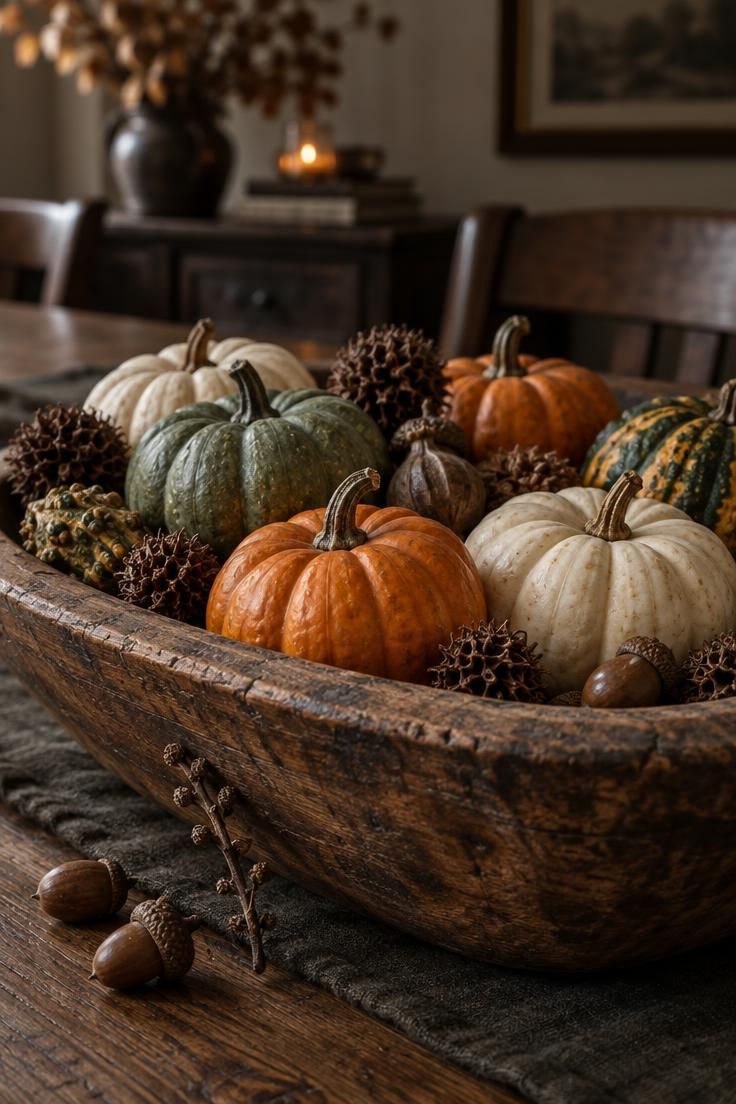
A dough bowl centerpiece with gourds turns the table's focal point into something low and generous.
Shallow wooden bowls, especially worn ones with dark rims and visible grain, add age in a way new ceramics cannot.
Filling one with miniature pumpkins, bumpy gourds, and dried seed pods keeps the arrangement compact and keeps sightlines open across the table.
Build the fill in layers rather than a tidy ring.
Start with the larger gourds around the outside, then work smaller pods and acorns into the gaps, leaving a few pieces perched slightly higher than the rest.
A little unevenness suits the look.
The mix of matte skins and slightly shinier ones catches the light in separate ways, so the bowl holds attention even when the room grows dim.
Because the entire arrangement stays low, a dough bowl centerpiece with gourds can stay on the table throughout dinner without blocking conversation or crowding the serving bowls.
That practicality matters when a whole bird, a platter of rolls, and a stack of plates all need room.
Move the bowl a few inches toward one end and it clears space for serving without losing its role in the scheme.
Real pumpkins and gourds last longer than cut squash and can be reused after the holiday.
Wipe the bowl with a dry cloth, keep dried pods in a small bag, and the whole centerpiece comes back together next year with fresh gourds.
Style Blueprint:
- Shallow weathered wood dough bowl with a visible rim
- Miniature pumpkins and bumpy gourds in orange, sage, and cream
- Dried seed pods and loose acorns tucked into the gaps
- A dark linen runner beneath the bowl
Speckled Stoneware Place Settings with Twine-Wrapped Napkins
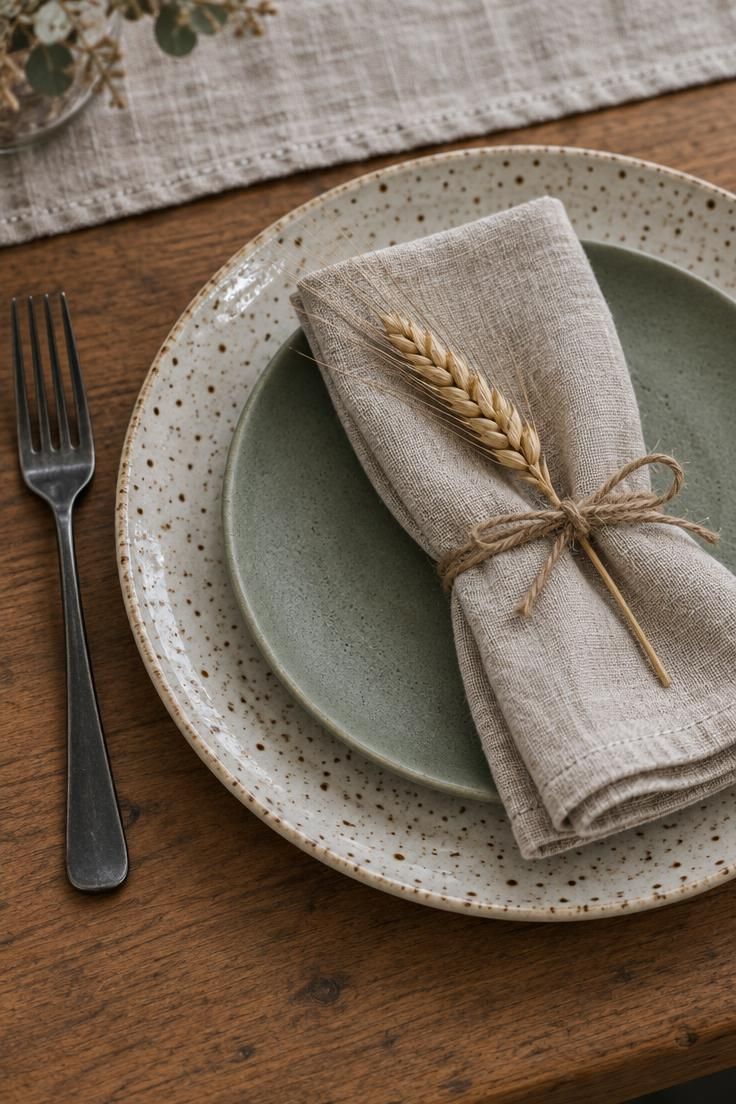
Speckled stoneware place settings carry the handmade look better than most tableware because the irregular flecks keep each plate from matching perfectly.
That tolerance for variation lets an ivory dinner plate sit next to a light gray or sage salad plate without the pairing looking accidental.
Layer the two, fold a linen napkin on top, and wrap it with a single loop of twine.
Keep the wrapping simple.
A short length of twine tied once and knotted holds the fold without crushing it, and a sprig of dried wheat or a single bay leaf tucked under the knot adds a small seasonal mark.
The texture of the twine picks up the rough surface of the stoneware, and the plain napkin underneath keeps the composition from becoming busy.
A speckled stoneware place setting in a warm ivory tint reflects soft light in a way brighter porcelain does not, so the table reads gentler under low lamps.
The weight of stoneware is noticeable, though.
Pull each setting back a few inches from the table edge so guests can lift a plate without the rim catching the wood when they reach for it.
Once the meal ends, twine and wheat come off in seconds and the plates stack without special care.
Keep the wheat sprigs in a small jar between dinners so they can be reused.
Style Blueprint:
- Speckled cream stoneware dinner plates with visible glaze variation
- Smaller sage green plates in a matte finish
- Oat linen napkins folded once with a twine knot
- A dried wheat sprig or bay leaf tucked under the twine
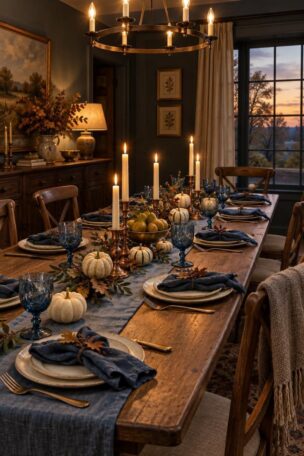
Beeswax Taper Candles in Mixed Wood and Iron Holders
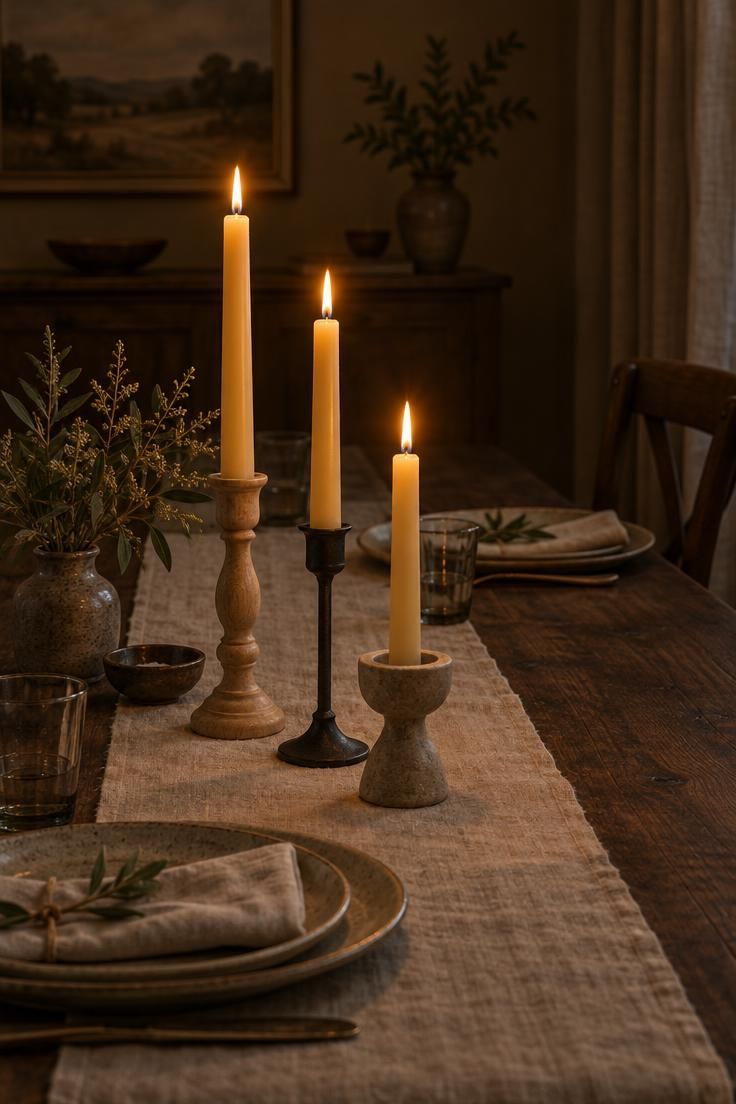
Beeswax taper candles bring a pale honey tone that reads warmer than white wax against dark wood.
Their color picks up the same golden notes as toasted bread and polished oak, which makes them feel part of the table rather than added to it.
Varying the holders is where the arrangement gains its character: a turned wood base, a black iron spike, and a small stone pedestal can sit within the same scheme because all three share a matte, unpolished finish.
Height variation keeps the group from looking like a matched set.
Trim one candle a quarter inch shorter, or set one holder on a low wooden riser.
The uneven line draws the eye along the table and helps the candlelight spread across the linen rather than staying in one spot.
A beeswax taper candles arrangement at both ends of a long table works well when the middle stays low.
If the tapers will burn through the meal, group them on a heat-safe tray at the table ends so hot wax drips land on metal rather than cloth.
That small step keeps the flickering light without risk to the textiles beneath.
Beeswax tapers hold their color well and burn with a soft honey scent, and any unused sticks store easily for next year.
Style Blueprint:
- Three or five beeswax tapers in pale honey
- One turned wood holder, one black iron holder, one stone pedestal
- Vary the candle heights slightly for an uneven line
- A heat-safe tray under any burning tapers at the table ends
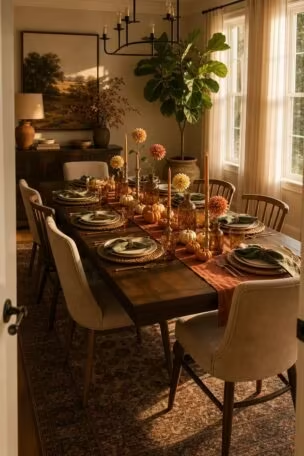
Woven Seagrass Chargers Under Matte Stoneware
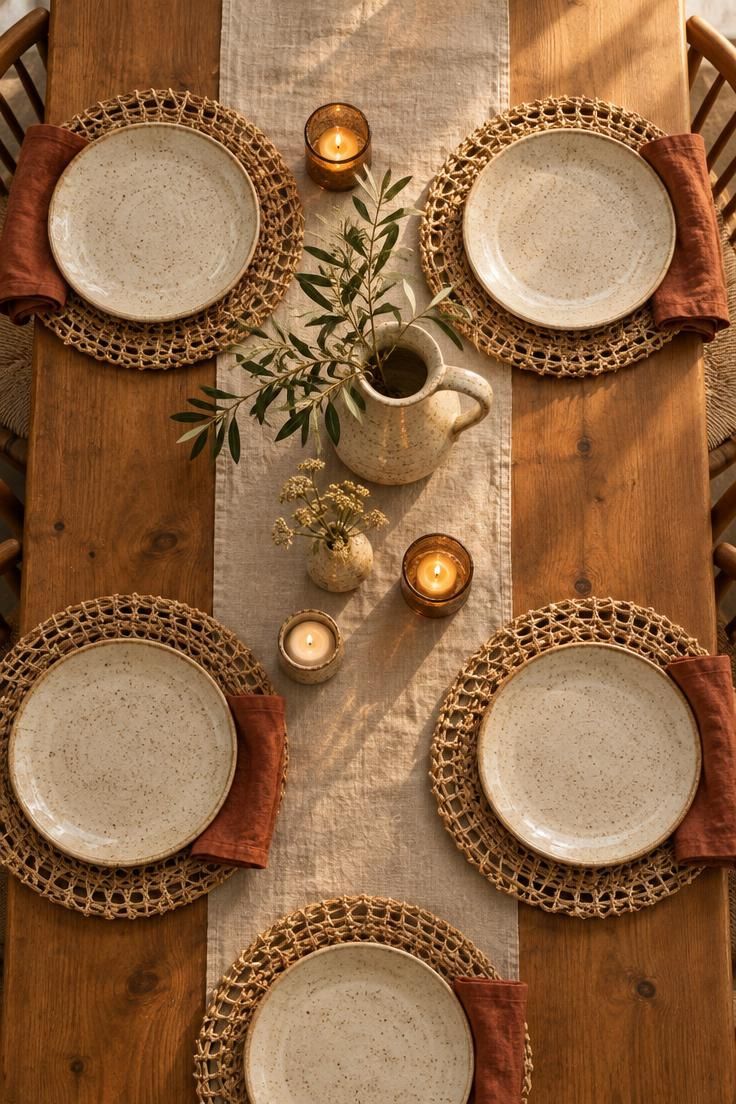
Woven seagrass chargers add a rough natural ring that frames the stoneware and extends the rustic palette outward toward each seat.
The dry straw tone of the grass sits between the warm brown of the wood and the lighter speckled plate, giving the eye a step rather than a jump.
Look for chargers with an uneven edge or a slightly open weave so the ring does not read as machine cut.
The composition works because each place setting becomes a small island of texture against a plain surface.
An overhead view shows how the circular chargers repeat down the table and create rhythm along both sides.
Keep a linen runner and a few small objects down the middle so the pattern of round chargers has a contrasting stripe to play against.
Practical spacing favors narrower chargers.
Narrow seagrass chargers leave more room for serving bowls between place settings than heavier wooden chargers would, which helps on a crowded rectangular table.
They also stack for storage between holidays and take up almost no cabinet depth.
The material has limits.
Seagrass can fray at the edge over time, and a dry cloth wiped across the surface keeps crumbs from settling into the weave.
Avoid setting wet glassware directly on the open weave for long periods.
Style Blueprint:
- Round seagrass chargers with a slightly uneven rim
- Speckled cream stoneware plates on top
- A rust or terracotta napkin at each seat
- A narrow linen runner down the center
Design Pro-Tip: Place one charger at each end facing the seat and check the spacing with a real serving platter between two settings, then adjust before the meal so guests are not fighting for room.
Braided Jute Napkin Rings with Dried Chrysanthemum Stems
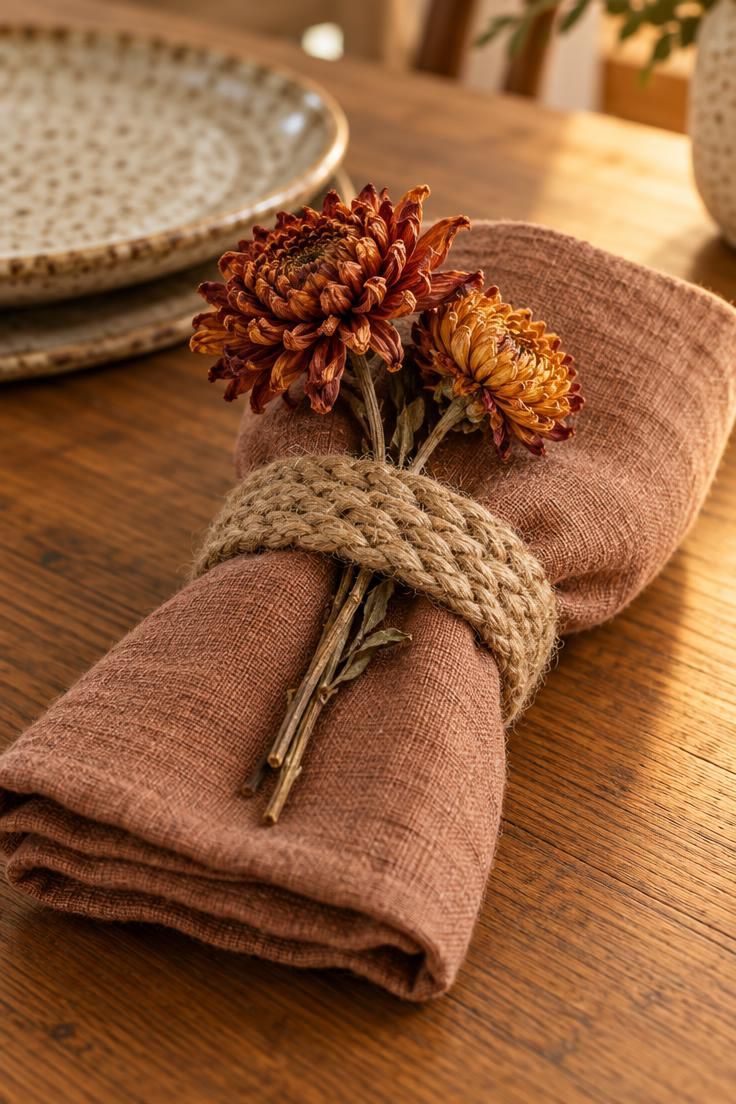
Braided jute napkin rings give each seat a rougher accent than a polished metal ring would, and the rope texture picks up the same dry quality as seagrass chargers and dried stems.
Form the ring from a short length of braided jute, thread one or two dried chrysanthemum stems through the loop, and set the ring on a folded clay-colored napkin beside the dinner plate rather than on top of it.
Placing it to the side keeps the setting open and lets the flower heads show against the wood.
Dried chrysanthemums in deep rust or amber add a muted fall accent without competing with the centerpiece.
Their petals sit in the same earthy range as gourds and eucalyptus, so the ring reads as part of the whole table rather than a separate decoration.
One flower stem is usually enough; two give a little more volume at a large seat.
Handling matters with anything dry.
Sturdier dried flowers hold their shape better than delicate ones when guests unfold the napkins, so the rings can be collected and reused at future meals.
Store them in a shallow box so the petals stay flat.
The jute ring also works after Thanksgiving with a different stem, which makes it a modest investment that earns its cabinet space.
Style Blueprint:
- Braided jute twine formed into small rings
- One or two dried chrysanthemum stems in rust or amber
- Clay-colored linen napkins folded in a loose square
- Place each ring beside the plate, not on top
Carved Wooden Pumpkin Trio on a Tray with Hazel Branches
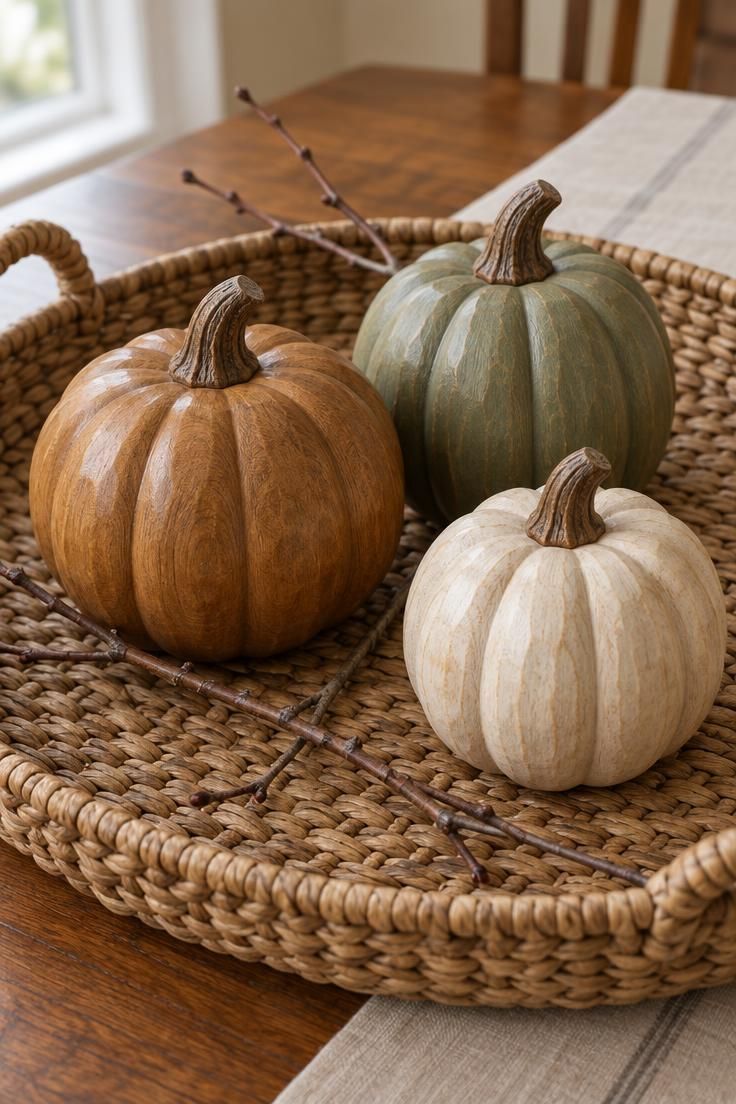
Carved wooden pumpkins bring the shape of fall in a warmer, softer way than bright synthetic decor.
Their painted or oiled surfaces pick up the same honey and sage tones used elsewhere on the table, and the carved stems give them a crafted look.
Grouping three in different sizes on a shallow tray lets them read as a small collection rather than a single object.
The bare hazel branches are the quiet counterpoint.
Their thin dark lines balance the roundness of the pumpkins and add a delicate line that keeps the arrangement from feeling chunky.
Lay the branches between the pumpkins so they cross the tray at angles rather than running parallel.
Place the tray at one side of the table near the center bowl so it reads as a secondary accent rather than a competing focal point.
This rustic thanksgiving table decor works best when one element leads and the others support it, and a small tray is naturally a supporting player.
A tray with a short lip keeps loose twigs and small pumpkins from rolling against serving ware during the meal.
A woven tray also lifts the group slightly off the table and adds another texture layer.
Style Blueprint:
- Three carved wooden pumpkins in caramel, sage, and cream
- A shallow woven or wood tray with a short lip
- Two thin bare hazel branches
- Place the tray to one side as a secondary accent
Mushroom and Lichen Basket Arrangement with a Raw Wood Bowl
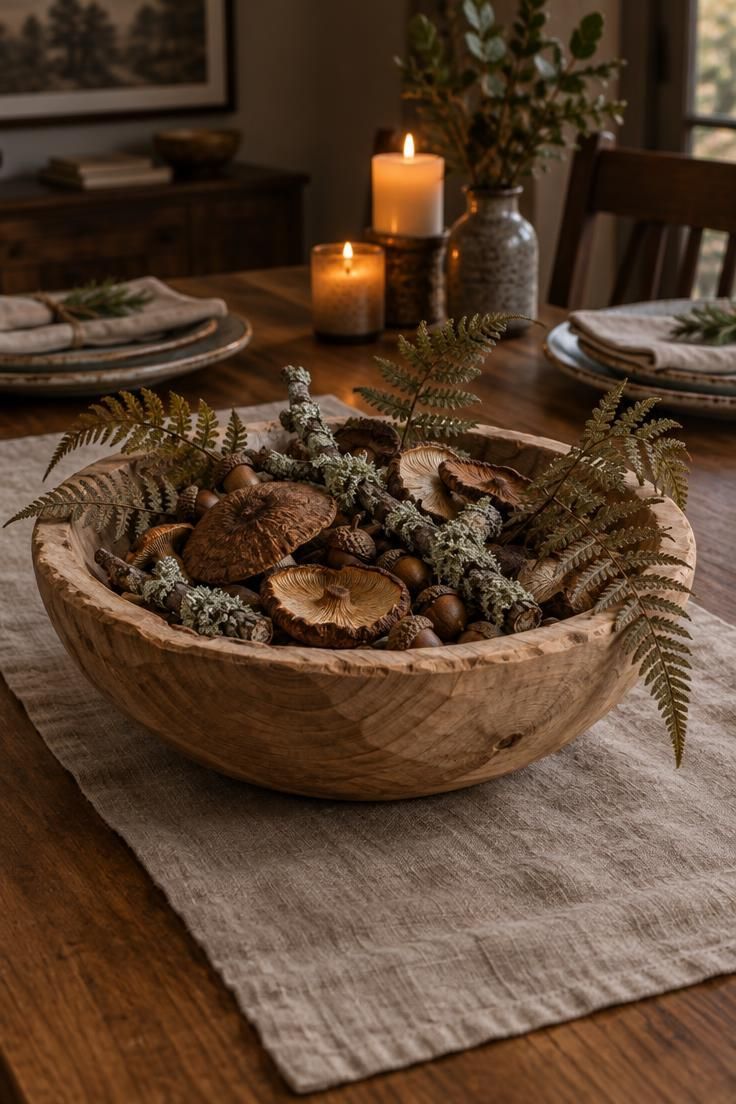
A mushroom and lichen arrangement adds a late-autumn woodland layer that sits apart from the pumpkins and foliage elsewhere on the table.
Flat dried mushroom caps bring a soft brown tone, while lichen-dusted twigs add gray-green texture that echoes eucalyptus without repeating it.
Filling a shallow raw wood bowl with these pieces keeps the look quiet rather than curated.
The unfinished bowl is central to the effect.
Raw wood absorbs light rather than reflecting it, so the arrangement recedes against warmer linens and lets other elements lead.
Set the bowl off-center, or rest it on a folded runner to lift it from the table and give it a small border of cloth.
Because the tones are muted, this arrangement can look lost on a busy table.
Give it a little breathing room and keep bright colors like orange gourds away from it so the woodland notes stay readable.
Dried lichen pieces are brittle and may drop small fragments, so a linen mat under the bowl makes cleanup after the meal easier.
Lift the bowl gently when clearing, and tip the fragments onto the mat rather than shaking the bowl over the table.
Style Blueprint:
- A shallow raw, unfinished wood bowl
- Dried mushroom slices with flat brown caps
- Lichen-covered twigs and a few small acorns
- Two or three dry fern fronds arching over the rim
- A folded linen mat beneath the bowl
Bronze Acorn Place Card Holders at Each Seat
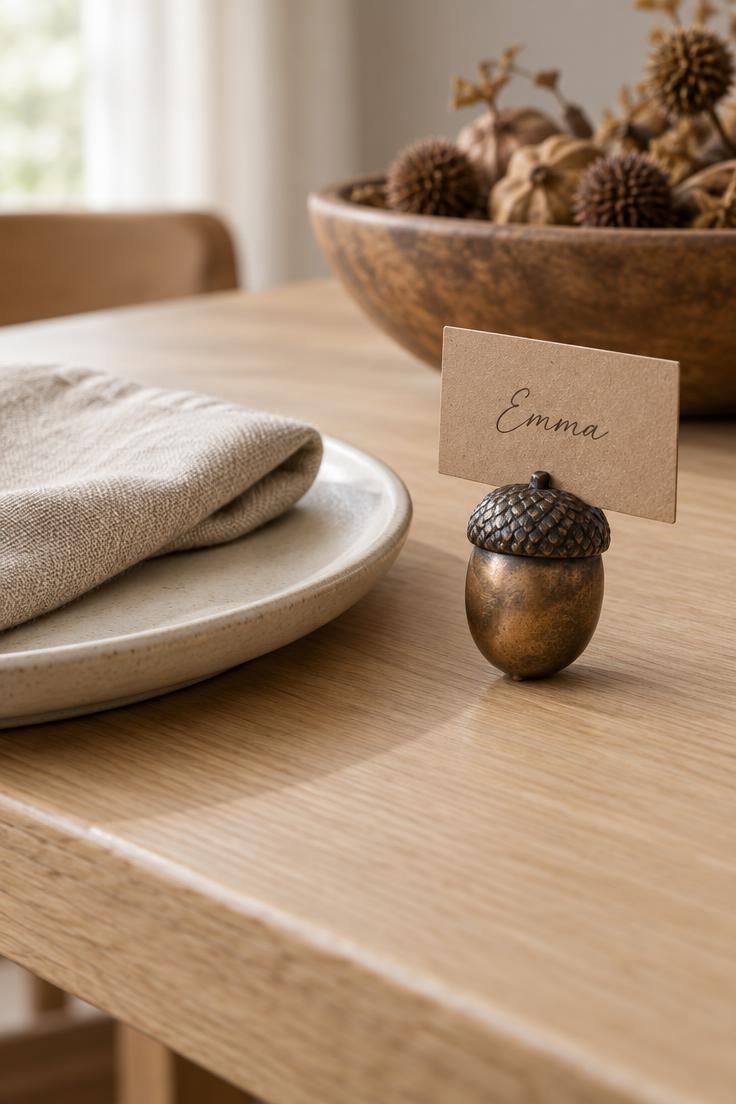
Acorn place card holders give each seat a small sculptural anchor while also helping guests find their spot.
A bronze-tone acorn with a darkened cap reads as a harvest object without becoming cartoonish, and the narrow slot at its top holds a simple slip of kraft paper.
A handwritten name on each card keeps the table orderly without the formality of a printed seating chart.
The acorn's soft metallic finish catches light differently than the matte plates and woven textures nearby.
That small glint pulls the eye away from the bowl in the center and gives the place setting its own quiet detail.
Position the holder just above the napkin or beside the water glass so it remains visible before people sit and easy to move once the meal begins.
Guests can keep the acorn by their plate during dinner, or tuck it into a pocket as a tiny favor.
The paper cards can be written the day before, and a few blank extras make last-minute seating changes simple.
Kraft paper cards match the table's rustic palette more easily than white cardstock and do not need a matching envelope.
Bronze-tone acorns may vary slightly in finish depending on where they are purchased.
Wipe them with a dry cloth rather than water, and store them in a small cloth bag after the meal so the finish stays intact.
Style Blueprint:
- Bronze-tone acorn place card holders, one per seat
- Kraft paper name cards cut to fit the holder slot
- Handwritten names in dark brown or black ink
- Position beside the plate or above the folded napkin
- Blank spare cards for day-of seating changes
Conclusion
A warm Thanksgiving table comes together from a few repeatable layers: a soft neutral cloth or runner, a low gathered centerpiece, candlelight in mixed holders, and a handmade accent at each seat.
Choose two or three of these layers and let the rest of the table stay simple, since the meal and the people around it carry the evening.
Much of the material, from the wood bowl to the jute rings to the kraft paper bundles, can return next year with a quick refresh of gourds or stems.
Start with what is already in the cupboard and build outward from there.