This post may contain affiliate links. If you make a booking or purchase through these links, we may earn a commission at no additional cost to you.
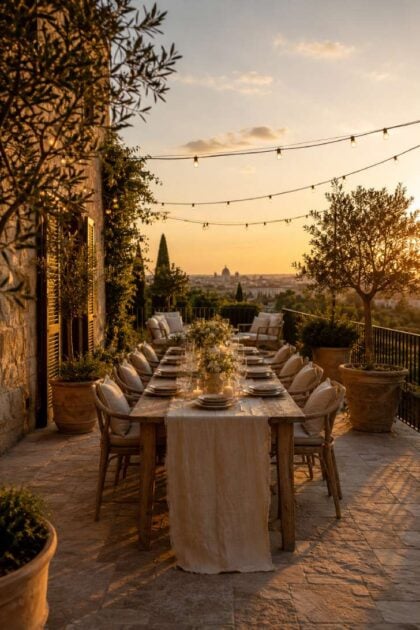
A good open terrace makes you forget where indoors ends and outdoors begins.
It’s that stretch of floor — tile, wood, warm stone — where morning coffee tastes better and weeknight dinners turn into long conversations under a darkening sky.
Whether you have a sprawling rooftop in the city or a modest patio off the kitchen, the right setup changes how you use your home.
Here are 15 open terrace ideas that cover every style, from Mediterranean warmth to Scandinavian calm, with image prompts you can pin and practical blueprints you can actually shop.
The Mediterranean Lounge Terrace
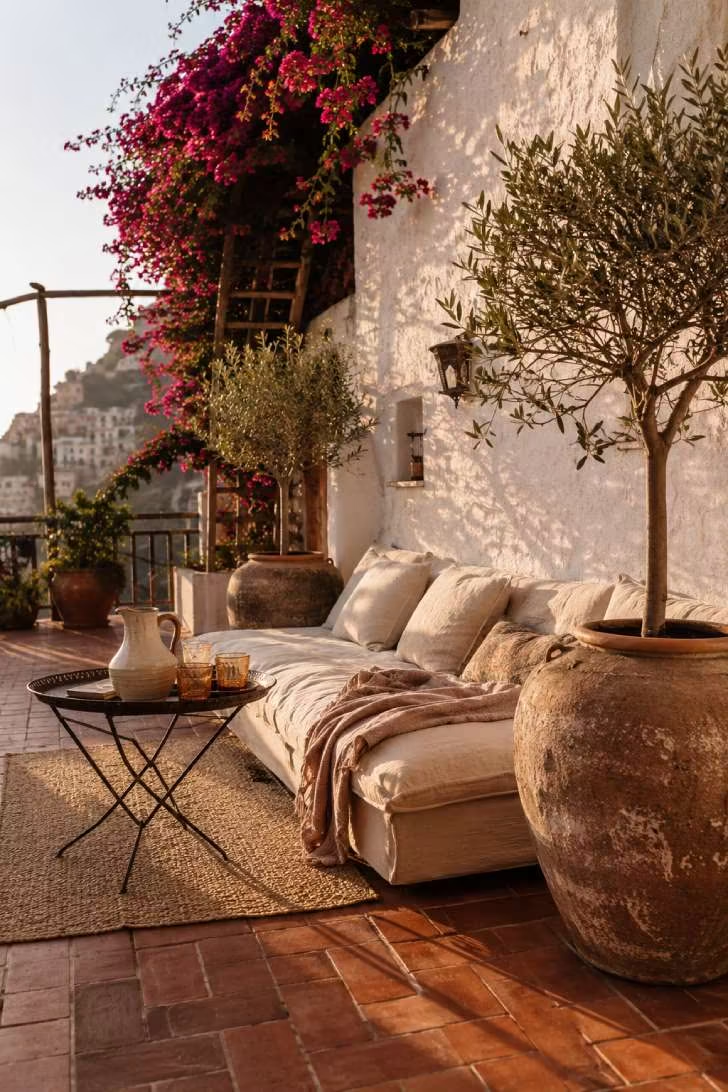
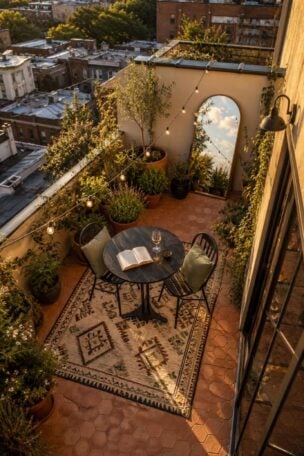
Something about terracotta underfoot and whitewashed walls behind you makes every hour feel like a Saturday.
This look borrows from the southern European tradition of living outdoors as a default, not a special occasion.
The warm floor tiles absorb sunlight during the day and release that heat slowly through the evening, which means bare feet stay comfortable well past sunset.
Olive trees in oversized clay pots do more than look the part — their silvery-green leaves catch the breeze and add gentle movement to what might otherwise be a static scene.
Linen upholstery wrinkles, and that’s the point. It signals relaxation rather than perfection.
The color story here — terracotta, cream, sage green, and touches of magenta from the bougainvillea — creates a palette that feels collected over time rather than ordered from a catalog.
Style Blueprint:
- Terracotta or tumbled-stone floor tiles with matte finish
- Low-profile outdoor sofa with removable linen slipcovers
- At least one large clay pot with a Mediterranean plant (olive, lemon, or fig)
- Wrought-iron side table or drinks trolley
- Woven jute or sisal outdoor rug
The Minimalist Concrete Terrace
Not every terrace needs cushions stacked three deep and a dozen potted plants.
Sometimes the most striking outdoor space is the one with the least in it.
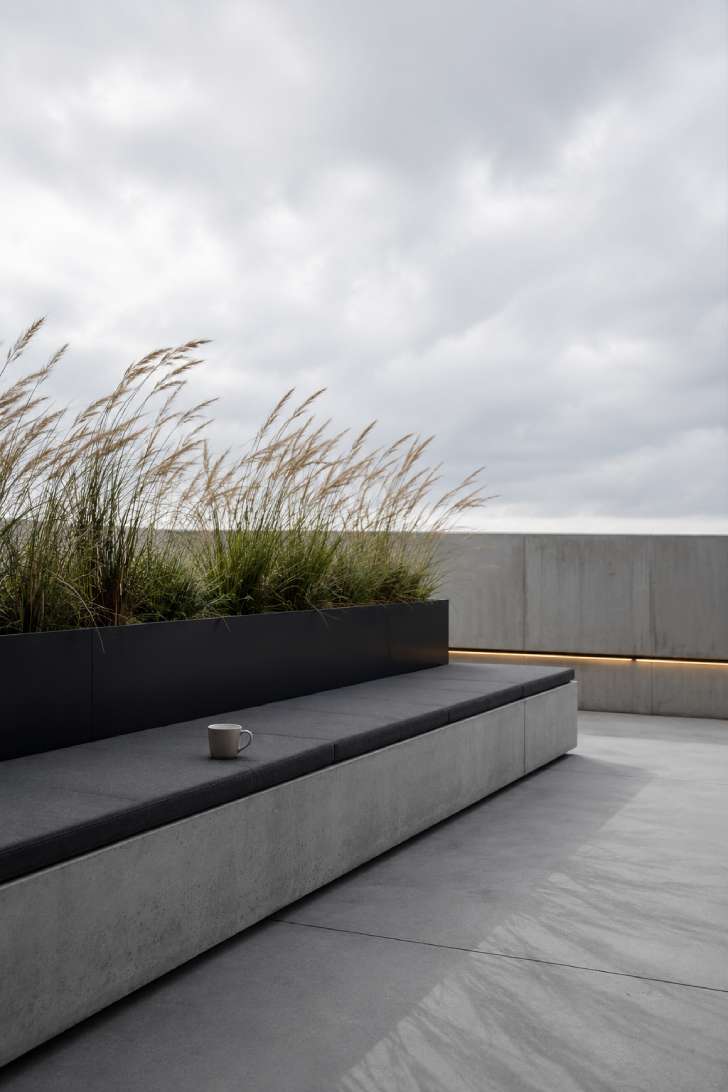
A polished concrete floor — smooth, cool, uninterrupted — sets a tone that says “I chose every single thing here on purpose.”
The trick with a minimalist terrace is picking fewer pieces but making each one count: a bench with real weight to it, a planter box with architectural lines, grasses that move and catch light.
Ornamental grasses like miscanthus or Karl Foerster reed grass add life without clutter, and their vertical shape plays off the horizontal floor and bench.
Recessed LED strips at floor level provide subtle nighttime lighting without competing with the sky — a small detail that affects how the whole terrace feels after dark.
Style Blueprint:
- Polished or brushed concrete flooring
- Built-in or freestanding concrete bench with slim outdoor cushion
- Matte black or corten steel planter with ornamental grasses
- Recessed LED strip lighting (warm white, 2700K)
- One intentional accessory — a single pot, sculpture, or lantern
The Bohemian Rooftop Retreat
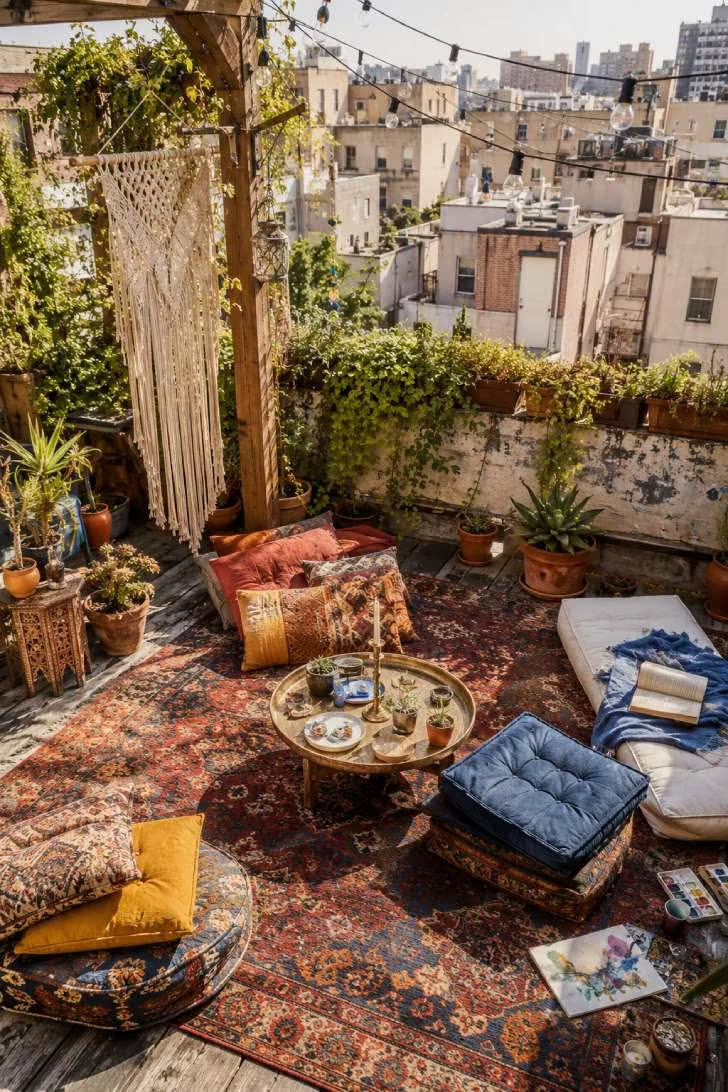
A bohemian rooftop doesn’t follow a plan — it accumulates.
One rug leads to another. A cushion bought at a flea market joins a set picked up on vacation. The brass tray table showed up because it was too good to leave behind.
That’s the whole philosophy: collect pieces that speak to you and let them figure out how to get along.
Floor-level seating works well here because it keeps sightlines low and makes the sky the tallest thing in the room.
Pattern mixing is encouraged — stripes next to florals next to geometric prints — as long as there’s a shared warmth in the color temperature.
The one planning move that separates a good bohemian terrace from a chaotic one is the rug. Choose one large enough to anchor the seating area, and layer a smaller one on top if you want more depth.
Macramé, woven wall hangings, and trailing plants add vertical texture without blocking views.
Style Blueprint:
- Large outdoor rug in a warm, faded pattern
- Floor cushions in at least three complementary colors
- Brass or copper tray table (collapsible for storage)
- Macramé or woven textile wall hanging
- Trailing plants in hanging pots along the edges
The Japanese-Inspired Zen Terrace
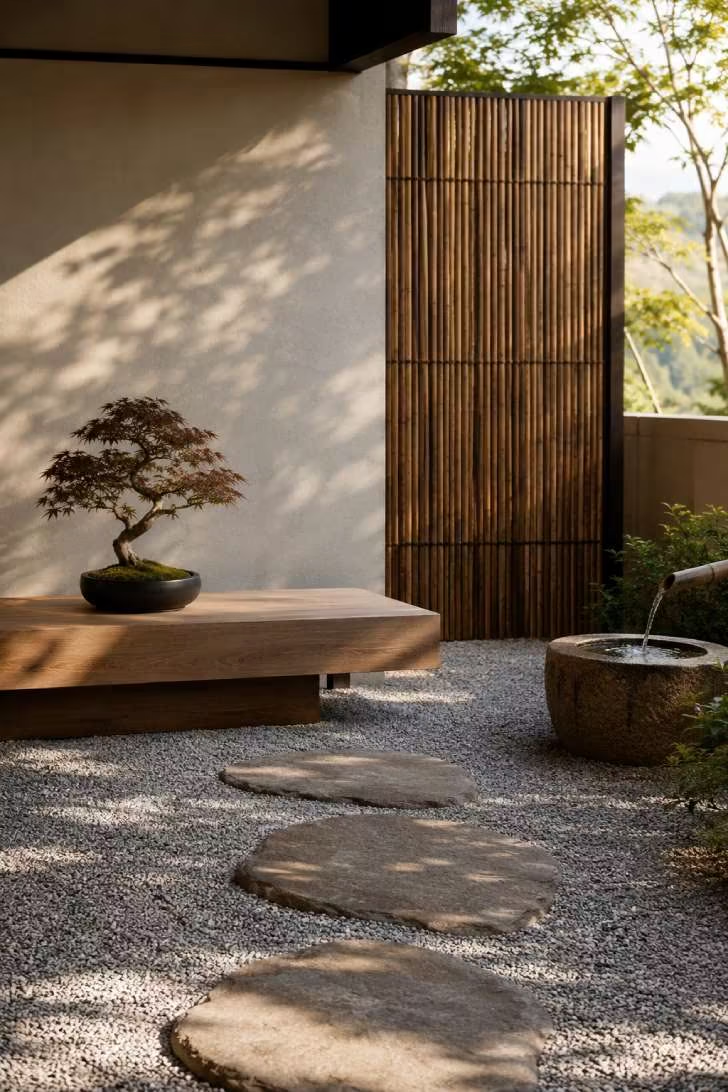
Raked gravel is one of those materials that changes the way you move.
You slow down. You step carefully. You stop checking your phone.
That shift in pace is the whole point of a zen-inspired terrace — it’s designed to interrupt the rhythm of a busy day.
The gravel itself is low maintenance (a quick rake resets the pattern), and it drains rainwater instantly, which makes it practical for open terraces without drainage systems.
A low timber bench replaces conventional seating, keeping you closer to the ground and encouraging a posture that’s more restful than sitting upright in a dining chair.
The stone water basin adds the sound of running water, which masks city noise and creates an acoustic boundary around the terrace.
Bamboo screens provide terrace privacy without feeling like a wall — light passes through the gaps and the material sways slightly in wind, adding subtle sound and motion.
Style Blueprint:
- Pale gray or white decorative gravel with a wooden rake
- Natural stepping stones (irregular shapes, not cut)
- Low timber platform bench or zabuton floor cushions
- One focal-point plant in a dark ceramic vessel
- Stone or ceramic water basin with recirculating pump
Design Pro-Tip: When placing furniture on an open terrace, leave at least 30 percent of the floor visible. Negative space isn’t wasted space — it gives the eye a place to rest and makes the terrace feel larger than its square footage suggests. The pieces you leave out matter as much as the ones you put in.
The Pergola Dining Terrace
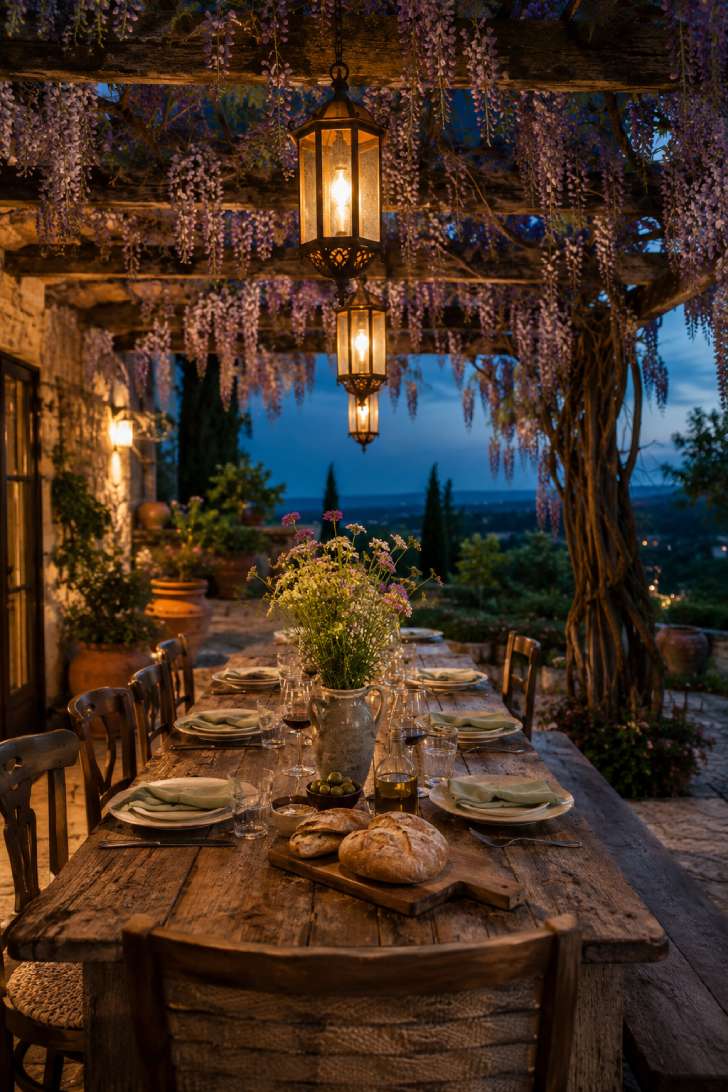
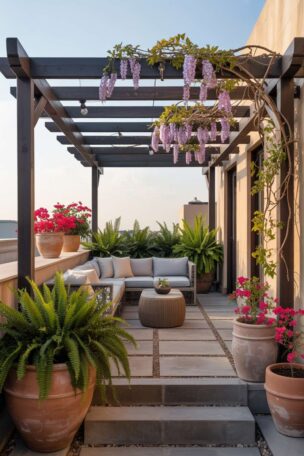
A pergola does something no umbrella or awning can replicate — it creates a ceiling without closing off the sky.
That overhead structure tells your brain you’re in a room, while the open sides and the vine-filtered light remind you you’re outdoors.
Wisteria is the classic pergola vine (lavender blooms, intoxicating scent in spring), but jasmine, climbing roses, or even grapevines work depending on your climate.
Mismatched chairs around a long table look intentional when they share a material — all wood, for example, in different shapes and finishes.
A bench on one side of the table is a smart move for narrow terraces because it pushes tight against the table and frees up walking space behind it.
Hanging lanterns at staggered heights create layered light that feels more natural than a single overhead fixture — and they draw the eye upward into the pergola’s canopy.
Style Blueprint:
- Weathered wood or steel pergola (minimum 2.5m height clearance)
- Climbing vine suited to your hardiness zone
- Reclaimed-wood dining table, at least 2m long
- Mixed seating: chairs plus a bench
- Wrought-iron or rattan pendant lanterns (battery or solar)
The Tropical Paradise Terrace
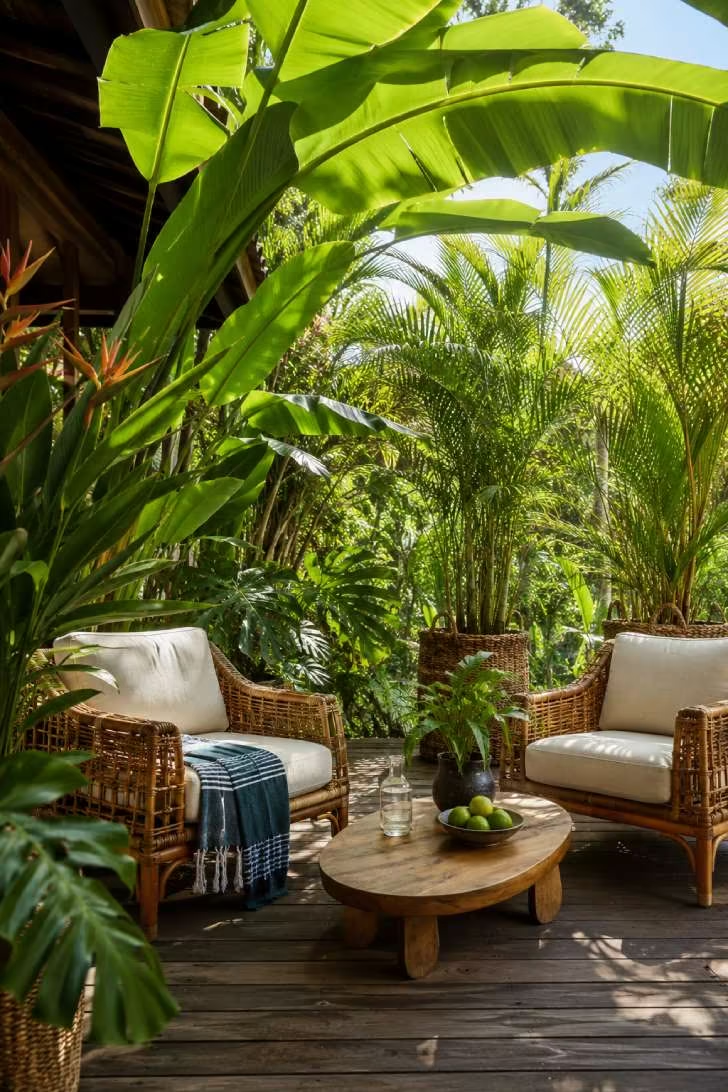
Big leaves change everything on a terrace.
A single monstera or bird of paradise in a generous pot shifts the entire space from “patio with some plants” to “place where you need a cold drink.”
Tropical terrace styling leans on scale — oversized planters, wide-leaf plants, and furniture with enough heft to hold its ground visually against all that greenery.
Rattan lounge chairs are the workhorse of this look, and real rattan (not resin wicker) has a texture and warmth that photographs can’t fully capture.
Teak decking darkens with age into a rich honey-brown tone that pairs with the greens and creams of the furniture and foliage.
If your climate doesn’t support true tropicals year-round, fatsia japonica, canna lilies, and hardy banana plants mimic the look and survive cooler winters with some mulching.
Style Blueprint:
- Dark-stained or natural teak decking
- At least three oversized tropical plants in woven baskets or textured pots
- Pair of rattan lounge chairs with thick weatherproof cushions
- Low teak or concrete coffee table
- Turkish towels or lightweight throws in one accent color
The Scandinavian-Style Terrace
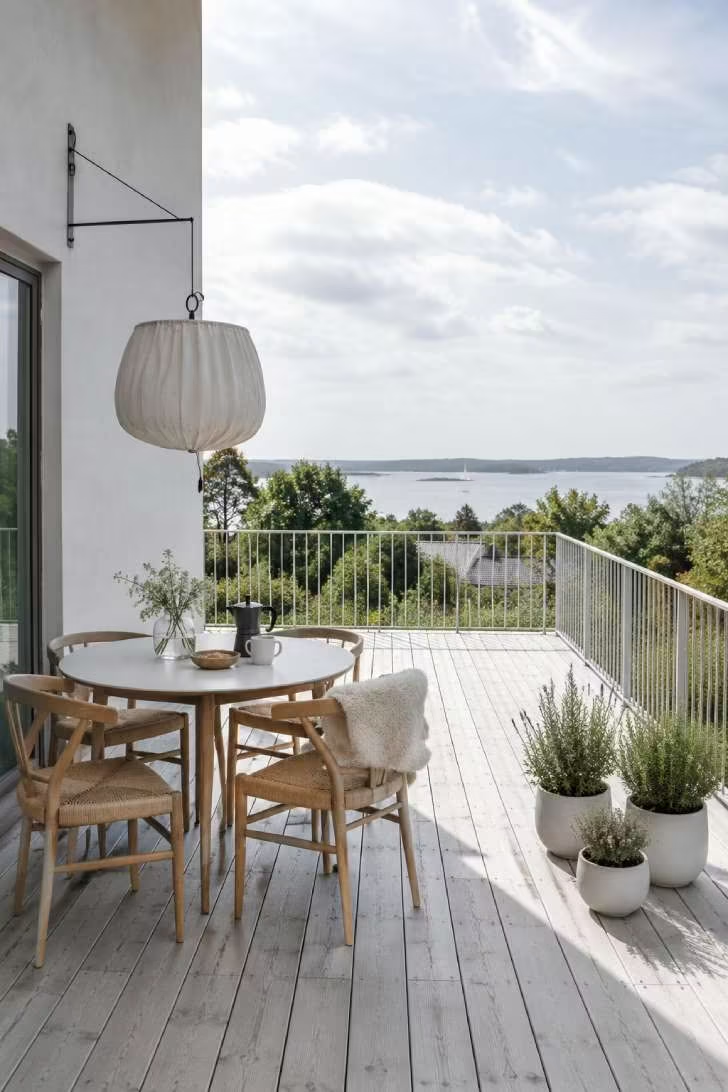
Scandinavian outdoor spaces prove that “simple” and “boring” are not the same word.
Every piece here earns its spot. Nothing decorates for the sake of decorating.
The pale wood deck creates a light, airy base that reflects rather than absorbs sunlight — a practical choice in northern climates where you want to capture every ray.
Paper-cord seats on the chairs are a nod to the Hans Wegner tradition, and they’re surprisingly comfortable for long sits.
Herbs along the terrace edge serve triple duty: they look good, they smell good, and they end up in dinner.
A single sheepskin thrown over a chair back is the Scandinavian equivalent of saying “stay a while.” It’s a small detail, but it transforms a dining set into an invitation.
Style Blueprint:
- Light-toned wood decking (ash, birch, or whitewashed pine)
- Compact round table with tapered legs (seats 2–4)
- Chairs with woven paper-cord or canvas seats
- Herb garden in matching ceramic pots
- One sheepskin or wool throw per seat
The Rustic Farmhouse Terrace
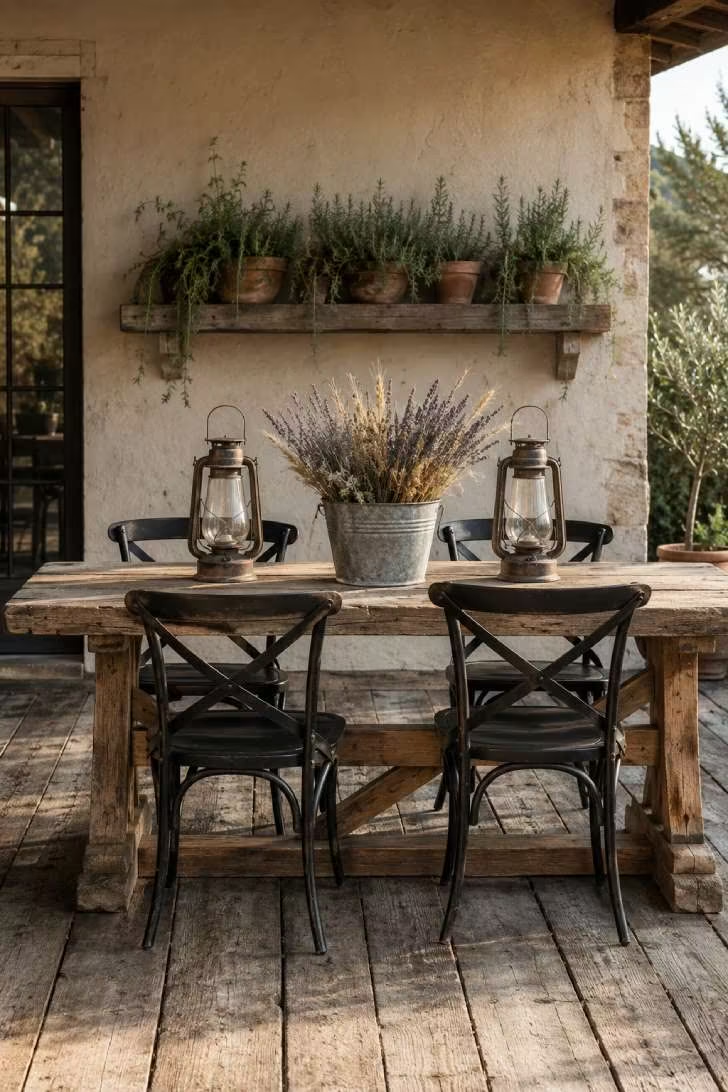
Reclaimed wood tells a story that new lumber can’t fake.
Every nail hole, every gray streak left by decades of weather, every slight warp in the plank — it all says this material had a life before it became your floor.
Barn-wood planks work well on terraces because their imperfections hide wear. A scratch on polished concrete screams; a scratch on reclaimed oak disappears into the grain.
Matte black metal chairs provide the visual contrast that keeps this look from feeling too “country antique store.” The industrial edge grounds the softer textures of the wood and dried flowers.
Galvanized steel — buckets, planters, small trays — fits the farmhouse palette without adding fussiness.
Hurricane lanterns with real flame (or convincing LED versions) give this terrace its nighttime character. The thick glass flickers and glows in a way that string lights simply can’t replicate.
Style Blueprint:
- Reclaimed wood plank flooring or deck tiles
- Solid wood trestle or plank dining table
- Metal cross-back or industrial-style chairs
- Galvanized steel accessories (planters, buckets, trays)
- Hurricane lanterns (glass and metal, at least two)
Design Pro-Tip: Mix your metals on purpose. Matte black chairs, galvanized steel planters, and a wrought-iron lantern — using three different metal finishes on one terrace prevents the space from looking like everything was ordered from the same page. Let each piece look like it arrived at a different time, because that’s how the best outdoor spaces are actually built.
The Urban Compact Terrace
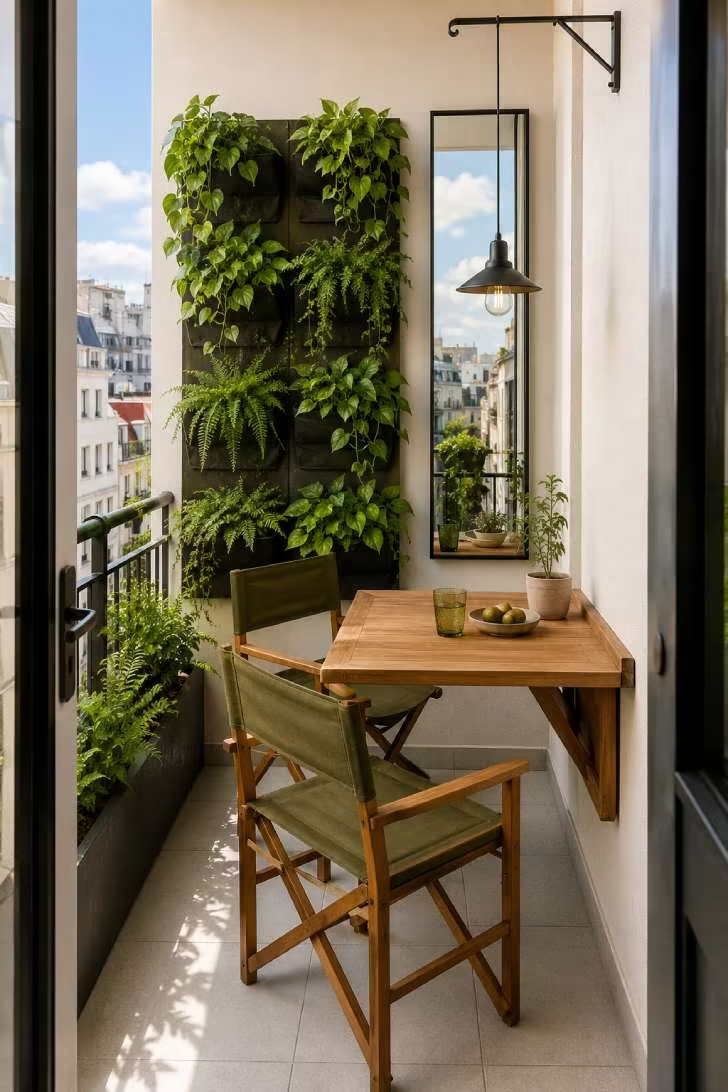
Three square meters. That’s what most city apartments offer by way of outdoor space.
And yet some of the best-designed terraces in the world sit inside that footprint.
The secret is vertical thinking. When the floor is limited, walls become your real estate — fold-down tables mount flush, vertical gardens climb upward, mirrors double perceived depth.
A folding teak table that latches flat against the wall is the single most useful piece of furniture for a compact terrace. It gives you a full dining surface for two and disappears when you need the floor for yoga or just standing with a glass of wine.
Director’s chairs fold to about 10 centimeters thick and store behind a door or inside a closet.
The mirror trick is old but effective — positioned across from the railing, it reflects sky and light back into the terrace, visually pushing the wall outward.
Vertical garden panels with pockets for trailing plants add greenery without consuming a single centimeter of floor.
Style Blueprint:
- Wall-mounted folding table (teak or powder-coated steel)
- Two folding director’s chairs in weather-resistant canvas
- Vertical garden panel with trailing plants (pothos, ferns, ivy)
- Outdoor mirror in metal frame to reflect light and sky
- Wall-mounted pendant or clip-on task light
The Coastal Breeze Terrace
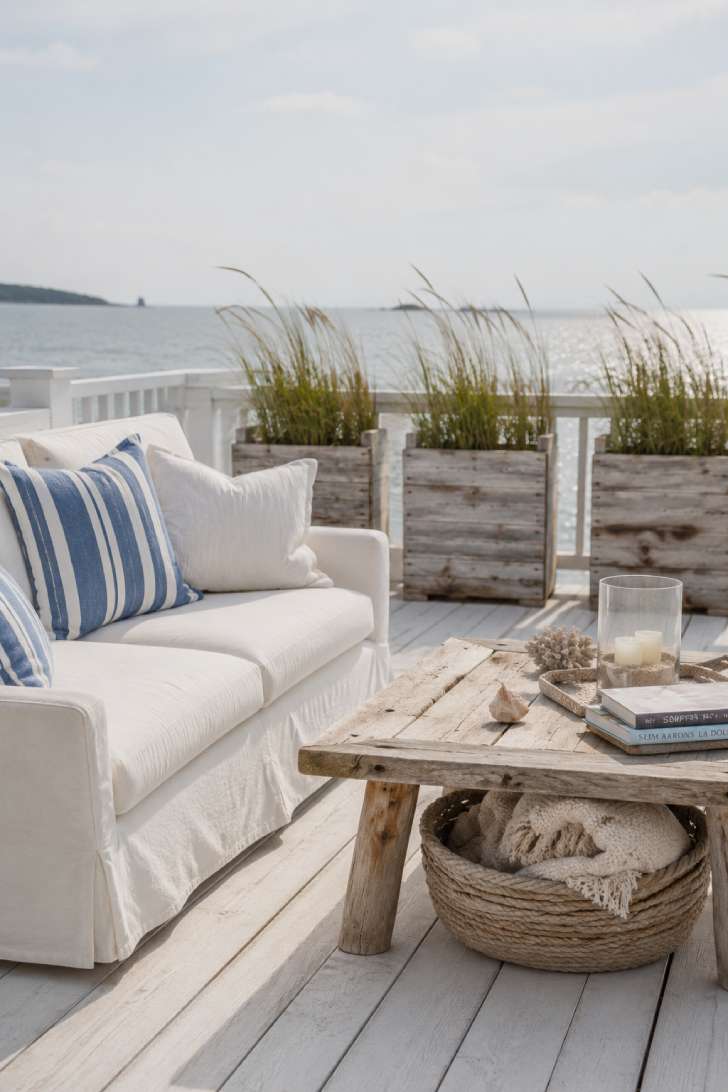
A coastal terrace doesn’t need to be near the ocean — it just needs to borrow the ocean’s color palette and attitude.
White, sand, navy, and weathered gray do the heavy lifting. These four colors, used with restraint, create an immediate sense of shore even on a landlocked balcony.
Slipcovered furniture is worth the investment for this look. The covers can be pulled off and washed when they inevitably collect pollen, dust, or spilled rosé, and that casual rumpled appearance is actually the goal.
Driftwood — whether a coffee table, a decorative bowl, or a piece leaned against the wall — introduces an organic shape that breaks up the straight lines of furniture and railings.
Beach grass (ammophila) tolerates wind, drought, and salt, which makes it one of the hardiest plants for an outdoor terrace decor. Its tall, swaying blades add constant motion.
Nautical rope as a material — in baskets, wrapped around planters, or hung as curtain tiebacks — connects the whole scene without resorting to anchors and ship wheels.
Style Blueprint:
- Whitewashed or bleached wood deck
- Slipcovered outdoor sofa or loveseat in white or natural canvas
- Driftwood coffee table or accent piece
- Beach grass in weathered planter boxes
- Nautical rope details (baskets, wrapped pots, curtain ties)
The Garden Terrace with Living Walls
[Image 11]
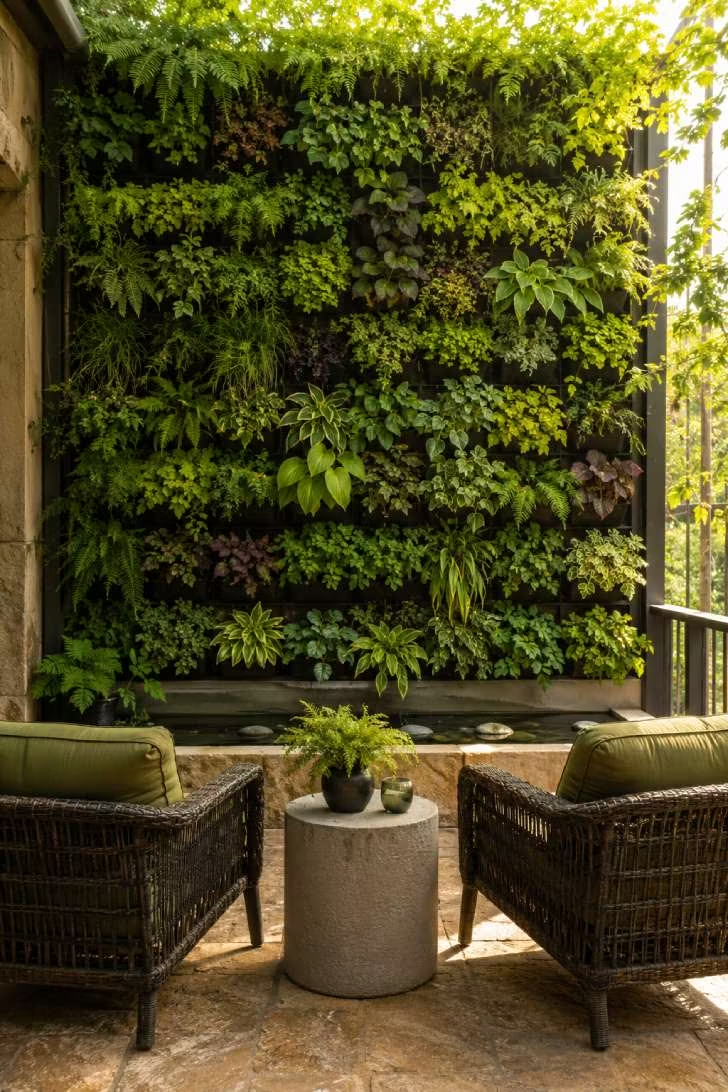
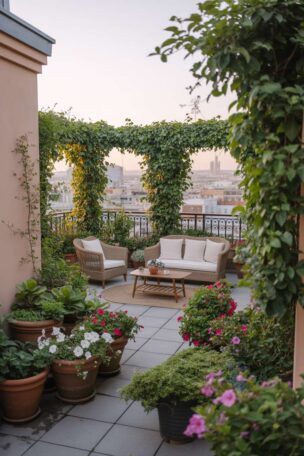
Living walls turn a blank wall into the most interesting thing on the terrace.
The color green has a measurable effect on heart rate and perceived stress — a claim backed by environmental psychology research from the University of Exeter. Surrounding yourself with a wall of foliage changes how the space feels on a physiological level, not just an aesthetic one.
Modular pocket systems make living walls accessible for renters and homeowners alike. They mount with screws (or sometimes suction, for temporary setups) and include built-in irrigation channels that drip water from top to bottom.
The best plants for vertical walls in partial shade are ferns, heuchera (coral bells), creeping jenny, and small hostas. In sun, try succulents, sedum, or ornamental strawberries.
Limestone pavers in honey or sand tones create a warm floor that complements the green wall without competing with it.
A shallow water trough at the base adds humidity, reflects the green wall in its surface, and gives the terrace a grounding horizontal element.
Style Blueprint:
- Modular living wall system (felt-pocket or tray-based)
- Mix of shade-tolerant foliage plants in varying textures
- Natural limestone or sandstone pavers
- Low-slung wicker or rattan armchairs with cushions
- Stone or concrete water trough or shallow basin
The Firepit Gathering Terrace
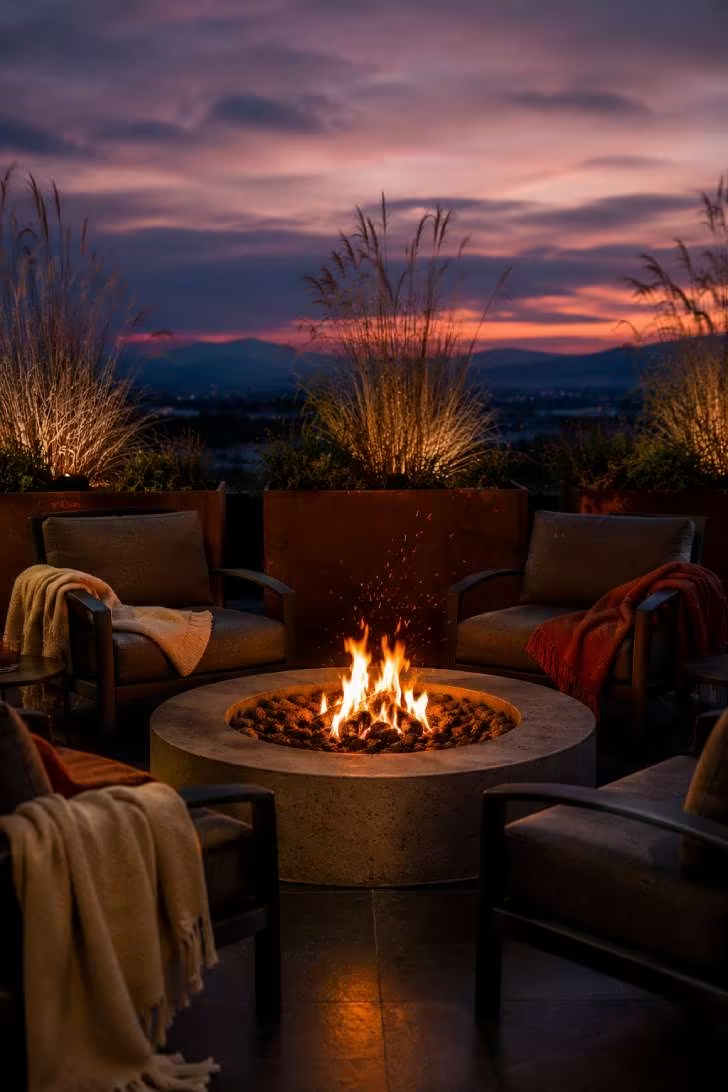
Fire changes the social geometry of a terrace.
Without it, people sit in rows or across from each other. Put a flame in the center and everyone faces inward, shoulders relaxing, voices dropping to a lower register.
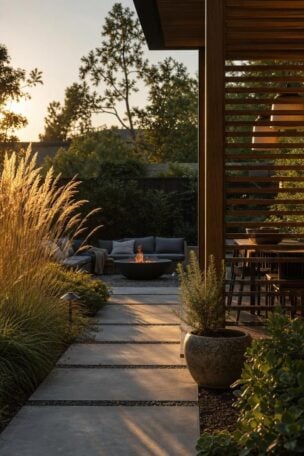
A built-in concrete firepit (gas or wood-burning, depending on local codes) becomes the permanent anchor of an outdoor living space. It defines the seating arrangement, provides warmth that extends the terrace season by two or three months, and creates a focal point visible from inside the house.
Low-back chairs work better around a firepit than tall-back ones because they don’t block the view of the flames for the person behind them.
Throw blankets aren’t just decorative here — on a cool evening, they’re the difference between going inside at 9 PM and staying out until midnight.
Corten steel planters develop a rich rust patina over time that echoes the orange tones of the fire. The material is weatherproof and gains character as it ages.
Style Blueprint:
- Concrete or stone firepit (built-in or portable, gas-fed for ease)
- Four low-back lounge chairs in weather-resistant fabric
- Thick wool-blend throws (at least one per seat)
- Large-format dark slate or basalt floor tiles
- Corten steel planters with tall grasses
Design Pro-Tip: Position your firepit at least 3 meters from any wall, railing, or overhead structure. Beyond the safety requirement, that distance creates a sense of openness around the flames — you want to see the sky when you look up from the fire, not the underside of a pergola or an awning.
The Daybed Lounge Terrace
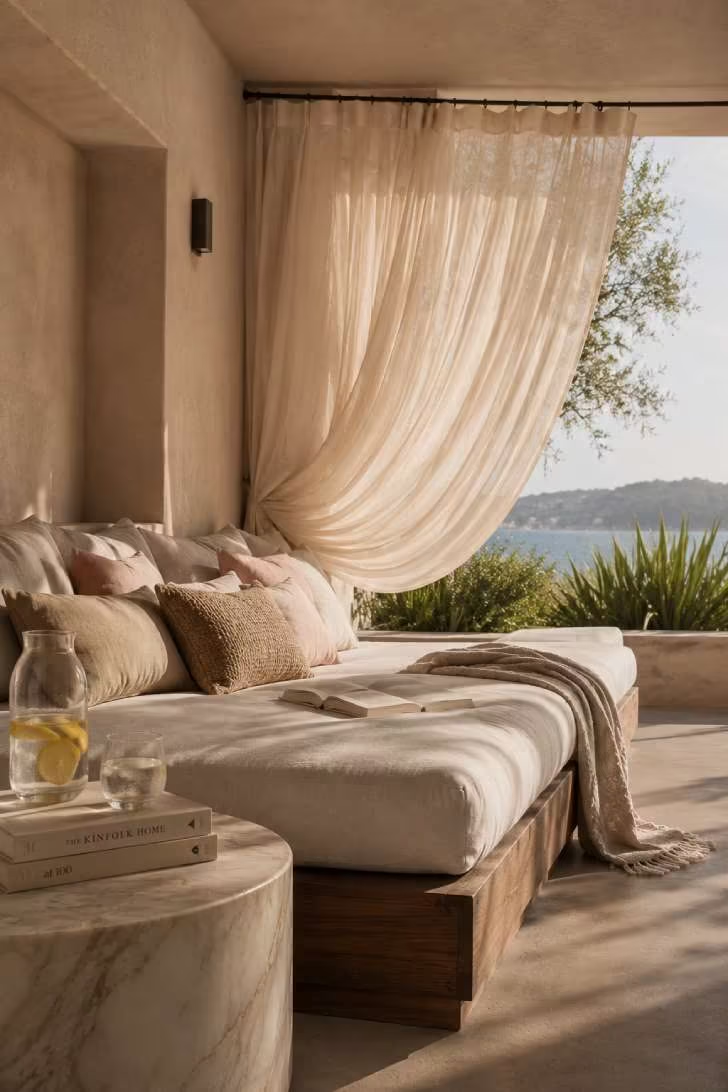
A daybed on the terrace is an honest declaration of intent: this space is for rest.
Not dining, not entertaining, not exercising. Rest.
The platform base should be wide enough for two people to lie side by side comfortably — around 150 centimeters is a good starting point. Built-in versions with storage underneath earn extra credit.
Outdoor mattresses have come a long way from the thin, scratchy pads of ten years ago. Today’s versions use quick-dry foam cores wrapped in solution-dyed acrylic fabric that resists mildew, fading, and the general abuse of outdoor life.
Sheer curtains accomplish two things at once: they filter harsh afternoon sun into a soft diffused glow, and they create a sense of enclosure that makes the daybed feel private even on an open terrace.
Keeping the color palette quiet — blush, sand, pale gray, warm white — prevents the daybed from looking like a furniture showroom and keeps the mood sleepy.
A marble side table next to the daybed is a small luxury that earns its place every time you reach for your water glass without getting up.
Style Blueprint:
- Wide platform daybed base (teak, cedar, or marine plywood)
- Thick outdoor mattress (quick-dry foam, Sunbrella or equivalent cover)
- Cushion set in a soft neutral palette (blush, sand, gray)
- Sheer outdoor curtains on a wall-mounted rod
- Marble or stone side table
The Eclectic Art-Filled Terrace
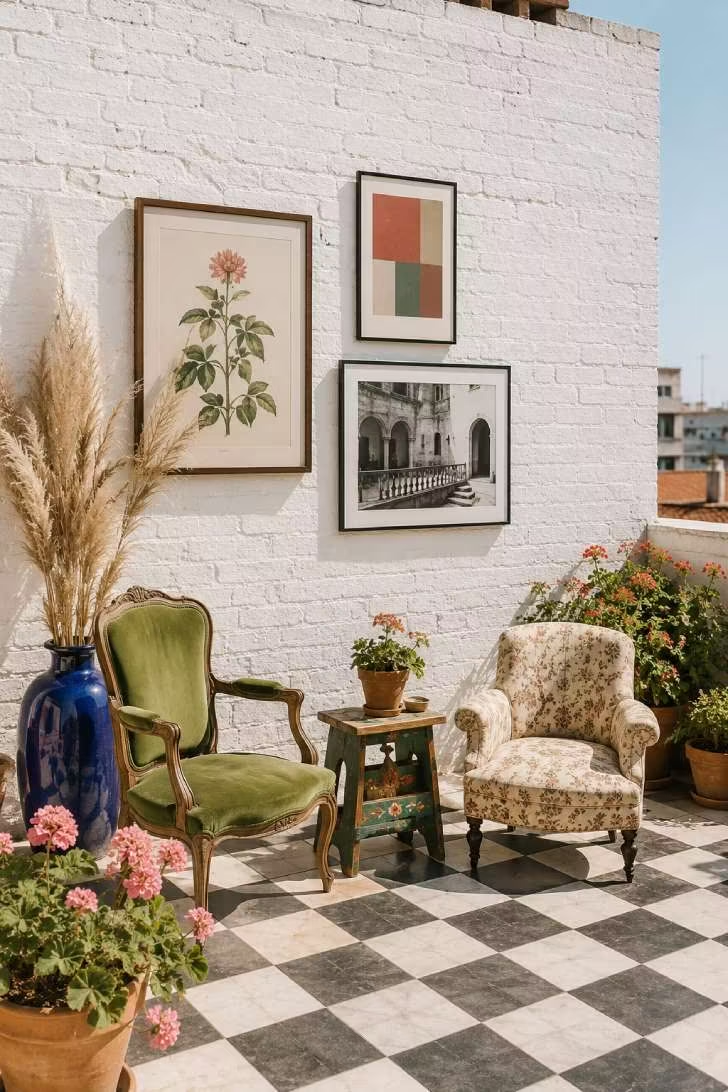
An eclectic terrace is the hardest style to pull off and the most rewarding when it works.
The secret isn’t randomness — it’s having a strong opinion about every piece that earns a spot.
Outdoor-safe art prints (sealed in UV-resistant frames or printed on weatherproof aluminum) turn a bare wall into a conversation starter. Choose pieces that don’t match but share at least one color, and hang them at varying heights rather than in a perfect grid.
Mismatched chairs only look “mismatched” if they’re clearly from different eras or styles — two slightly different dining chairs just look like you couldn’t find a set. Go bold. A velvet armchair next to a wicker peacock chair, or a mid-century side chair beside a painted wooden folding chair.
Checkered cement tiles (encaustic tiles) are a strong terrace flooring option that creates a visual base energetic enough to support all the variety above it.
One oversized ceramic piece — a tall vase, a planter, a sculptural bowl — anchors the eclectic mix and gives the eye a resting point.
Style Blueprint:
- Weatherproof framed art or aluminum prints (3+ pieces, different sizes)
- Two mismatched vintage or statement chairs
- Painted or repurposed wooden stool as side table
- Checkered or patterned cement floor tiles
- One large ceramic statement piece (vase or planter)
The Bioclimatic Smart Terrace
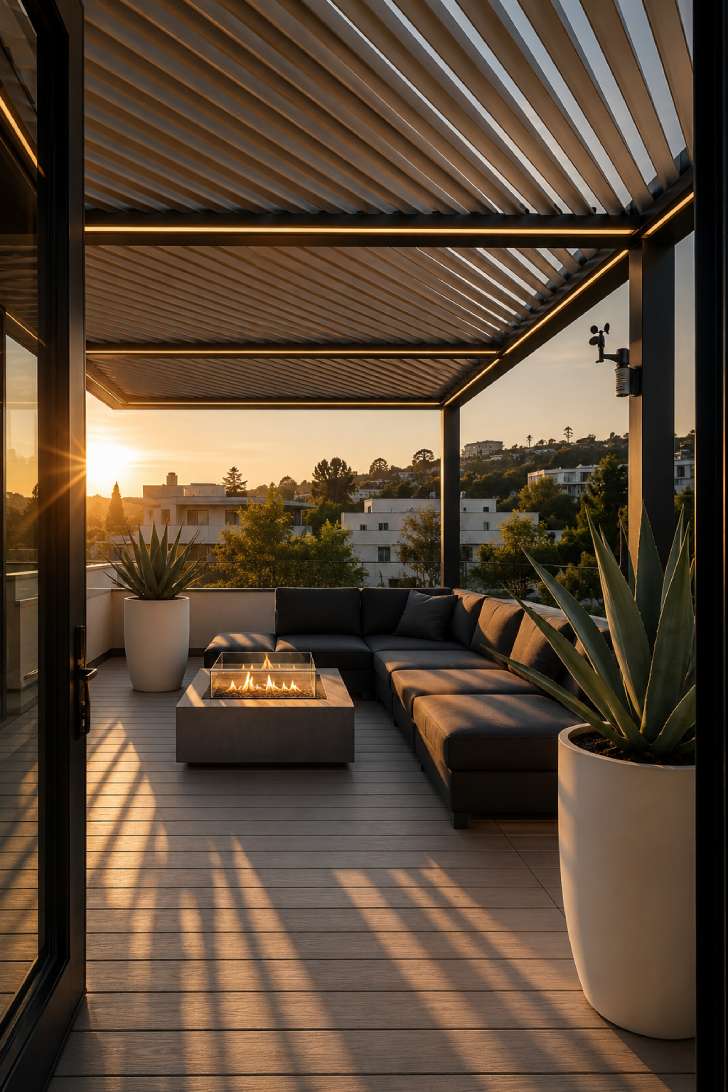
A bioclimatic pergola is the most significant upgrade you can make to an open terrace — and the least visible.
From a distance, it looks like any other aluminum pergola with horizontal slats. Up close, the louvers rotate on motorized hinges. Open them flat for full sun. Tilt them for dappled shade. Close them completely to shed rain while you stay dry underneath.
Many models integrate rain sensors that auto-close the louvers when water hits, LED strip lighting for evening use, side screens that drop for wind protection, and heating elements for cooler months.
The composite deck beneath pairs well with the pergola's modern lines. Composite boards (wood-fiber and polymer blend) resist rot, fading, and splinters, and they come in tones that mimic natural wood without the annual sealing routine.
A concrete fire table — essentially a gas-fed firepit built into a coffee table — gives this terrace year-round functionality. The glass wind guard keeps the flame steady on breezy evenings.
Sculptural plants like agave, yucca, or phormium match the architectural personality of this terrace better than soft, billowy greenery would.
Style Blueprint:
- Motorized bioclimatic louver pergola (aluminum, with rain sensor)
- Composite decking in a warm gray or wood-look tone
- Modular outdoor sectional sofa (weather-resistant cushions)
- Concrete or steel fire table with glass wind guard
- Sculptural drought-tolerant plants in geometric pots
Design Pro-Tip: Run all your terrace lighting on a single dimmer circuit or smart plug. Being able to take the light level from bright task-lighting down to a low amber glow with one switch changes how you use the terrace after dark. Bright for cooking and cleaning up, dim for drinks and conversation — the same space, two completely different moods.
Conclusion
Fifteen open terrace ideas, fifteen different ways to claim the outdoors as part of your home.
The right one for you depends less on square footage or budget and more on how you actually want to spend your time outside. If you cook, build around a dining table. If you read, invest in that daybed. If you host, center the layout on a firepit or a long communal table.
Mix ideas freely. Borrow the vertical garden from one concept and the bioclimatic pergola from another. Pair a farmhouse table with minimalist concrete flooring. No one style has to dominate.
Start with the floor and one good seating piece. Everything else — the plants, the textiles, the lighting, the art — can arrive over weeks and months. The best terraces aren’t finished in a weekend. They’re built one Saturday at a time.