This post may contain affiliate links. If you make a purchase through these links, we may earn a commission at no additional cost to you.
A patio is the room most people already own but rarely finish decorating.
It sits there — concrete, maybe a couple of chairs, a planter that stopped being green sometime last August.
The good news?
Turning that slab into a space you actually want to spend time in doesn’t require a contractor or a second mortgage.
These 19 patio decorating ideas cover everything from quick textile swaps to bigger structural moves, and most of them work whether you’ve got a sprawling backyard or a narrow balcony off a second-floor apartment.
Pick one or two that match your weekend energy and go from there.
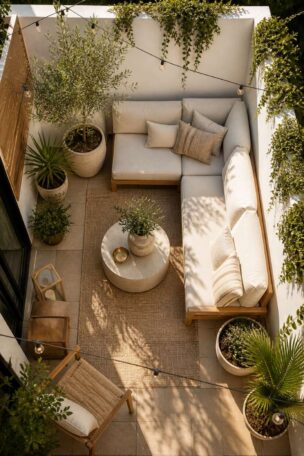
Layer an Outdoor Rug Under Your Seating Area
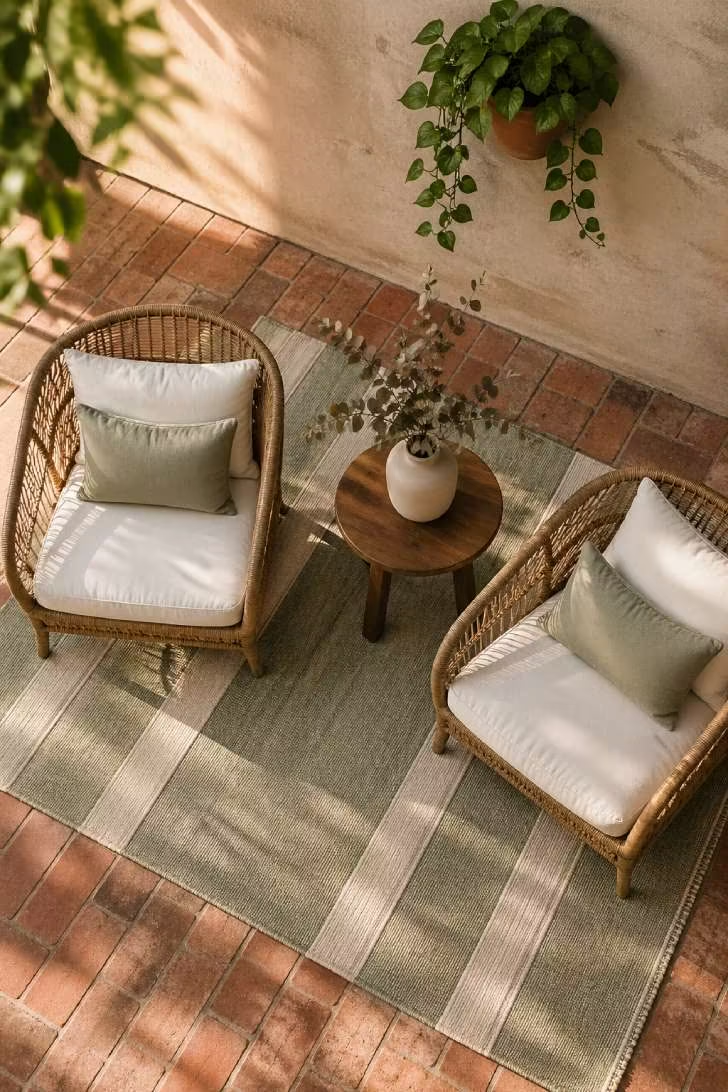
Nothing grounds an outdoor seating area faster than a rug.
On bare concrete or pavers, furniture tends to float — chairs drift apart, the space reads as leftover rather than planned.
A flat-woven rug changes the geometry of the whole area.
It tells your eye where the “room” starts and stops.
The texture underfoot shifts too, from cold hard surface to something that absorbs sound and softens every step.
Pick a rug rated for outdoor use (polypropylene or recycled plastic weaves hold up through rain and UV exposure) and size it so all your seating legs land on the fabric.
That single move makes the patio feel furnished rather than furnished-adjacent.
Style Blueprint:
- Flat-woven outdoor rug in a neutral or muted pattern (at least 5×7 feet)
- Two low-profile armchairs in rattan or woven resin
- Round wooden or metal side table
- Ceramic vase with dried or fresh greenery
- Wall-mounted planter for vertical interest
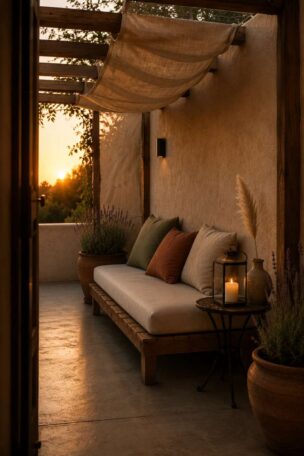
Build a Banquette Along One Wall
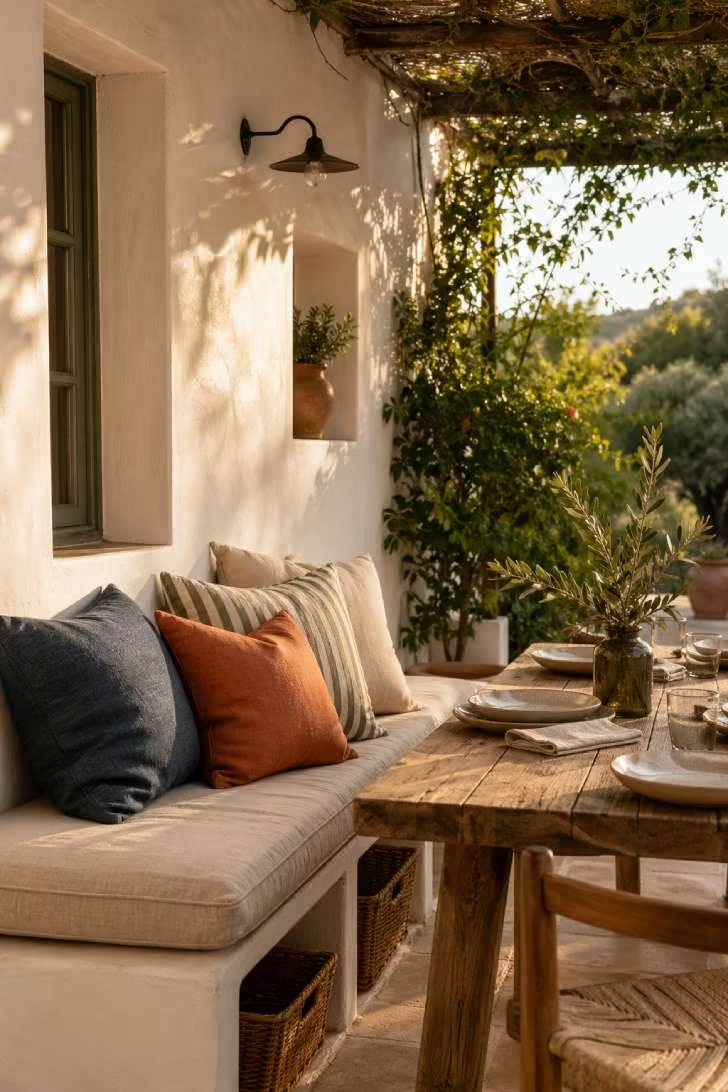
A built-in bench transforms dead wall space into the best seat on the patio.
Banquettes tuck against the house or a perimeter wall, leaving the center open for a table or foot traffic.
The space underneath becomes storage — cushions, gardening gloves, that bag of charcoal you never know where to put.
What makes this work psychologically is the sense of enclosure.
A banquette wraps around you slightly, the way a booth does at a restaurant, and that partial boundary makes the outdoor space feel more intimate without shrinking it.
Pair it with a table that’s just narrow enough so you can still slide in and out without bumping knees.
Style Blueprint:
- Built-in bench with weather-treated wood (cedar or composite decking)
- Thick outdoor cushion in a neutral linen or canvas
- Three to four throw pillows in mixed textures and tones
- Woven baskets for under-seat storage
- Narrow dining table in weathered wood or metal
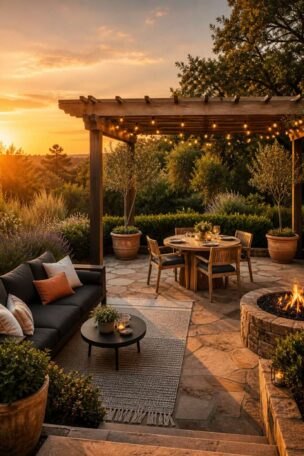
Hang String Lights at Varied Heights
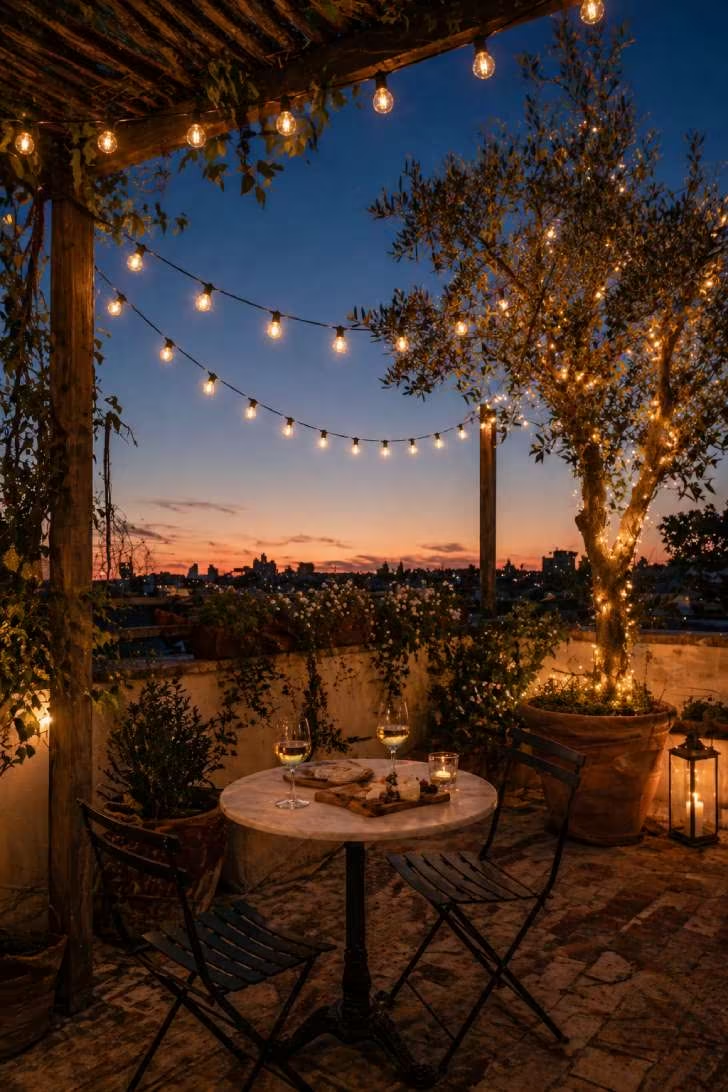
One straight line of string lights is fine.
Three lines at different heights turns a patio into an event.
The variation in height creates a canopy effect — your eye reads the space as enclosed and sheltered even though there are no walls.
Warm white bulbs in the 2700K range give off the same glow as a living room lamp, which is the whole point: making outside feel as comfortable as inside.
Avoid the temptation to light every inch evenly; pools of light and shadow give a patio depth, the same way dimmed sconces and a table lamp work better than an overhead fluorescent.
Wrap a strand around a tree trunk or tall planter to bring the glow down to eye level where it matters most.
Style Blueprint:
- Edison-bulb string lights in warm white (minimum two strands at different heights)
- Sturdy hooks or posts rated for outdoor mounting
- Bistro or café-style seating below the lights
- A tall potted plant or tree to wrap a strand around
- Timer or smart plug for automatic on/off at dusk
Create a Vertical Garden on a Blank Wall
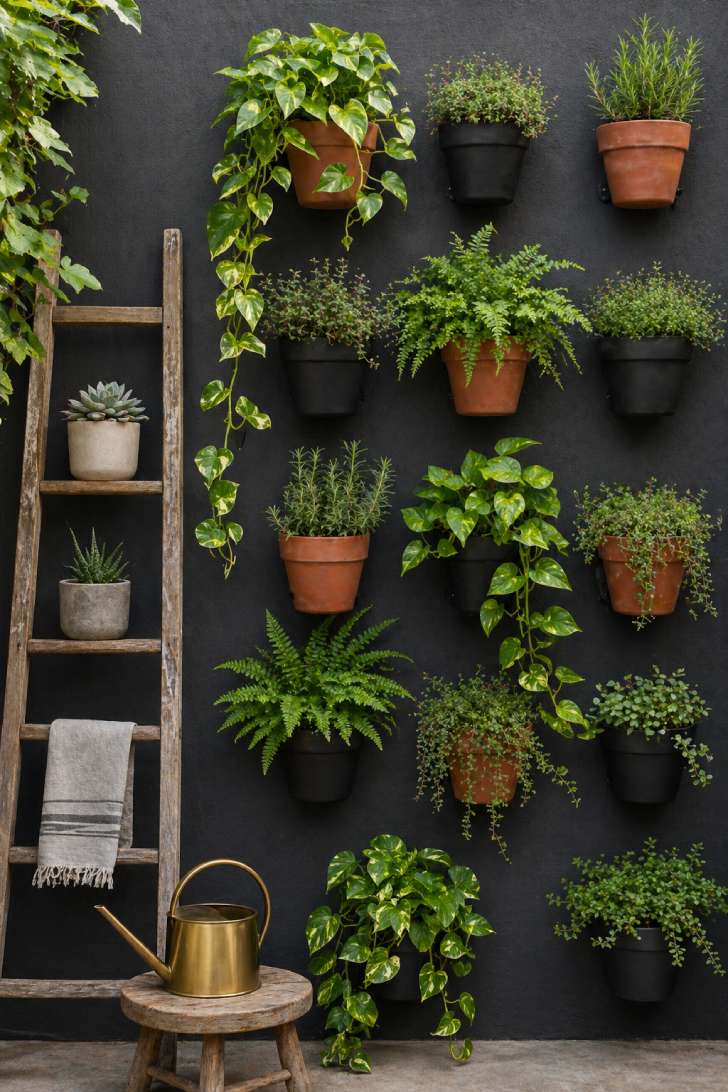
Blank walls on a patio are wasted real estate.
A vertical garden fills that surface with life and color without taking a single inch of floor space — and that trade-off matters when your outdoor area is measured in feet rather than yards.
Trailing plants like pothos and ivy cascade downward, softening hard architectural edges.
Herbs like rosemary and thyme add fragrance every time you brush past.
The visual effect borrows from gallery walls: staggered planters at different heights keep the arrangement from looking like a grid and create the kind of organic asymmetry that reads as grown rather than installed.
Style Blueprint:
- Wall-mounted planters in terracotta or matte ceramic (6-10 units, staggered)
- Trailing plants (pothos, ivy, string of pearls)
- Herbs for fragrance (rosemary, thyme, lavender)
- Slim ladder shelf or peg rail for accessories
- Watering can in a finish that complements the planters
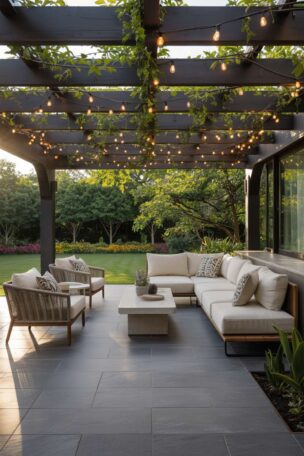
Mix Furniture Styles Instead of a Matching Set
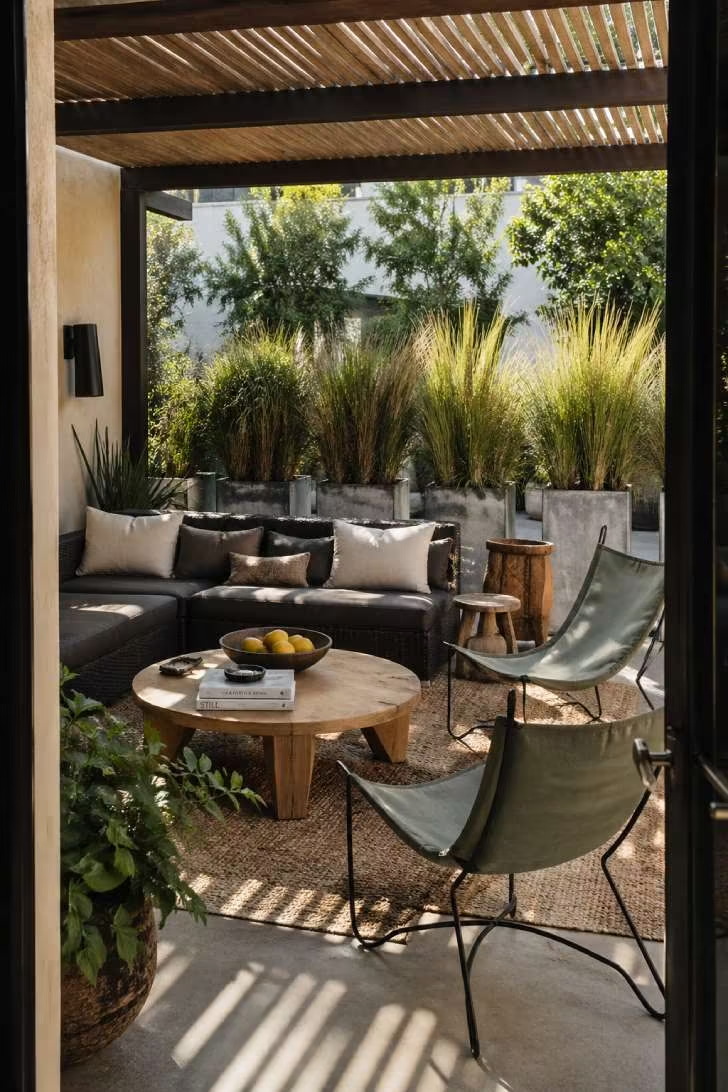
Matching patio sets from a single collection look safe.
They also look like a catalog photo that nobody lives in.
Mixing a low modular sofa with a couple of sculptural accent chairs in a completely different material — say wicker with powder-coated steel — gives the space personality.
Your eye moves from one piece to the next because each one offers something different: a curve here, an angular frame there, a woven texture beside a smooth one.
The trick is holding it together with a shared color temperature.
Keep everything within the same warm or cool family and the variety reads as curated rather than chaotic.
Style Blueprint:
- Modular outdoor sofa in a neutral woven material
- Two accent chairs in a contrasting material (metal, teak or molded resin)
- Round coffee table in natural wood or stone
- Large jute or sisal-look outdoor rug
- Tall planters with ornamental grasses as a backdrop
Design Pro-Tip: If mixing furniture styles feels risky, start with a single unifying element — one color that appears on every piece. A charcoal cushion on the sofa, a charcoal frame on the accent chair and a charcoal pot behind them. That thread ties the whole scene together without matching anything exactly.
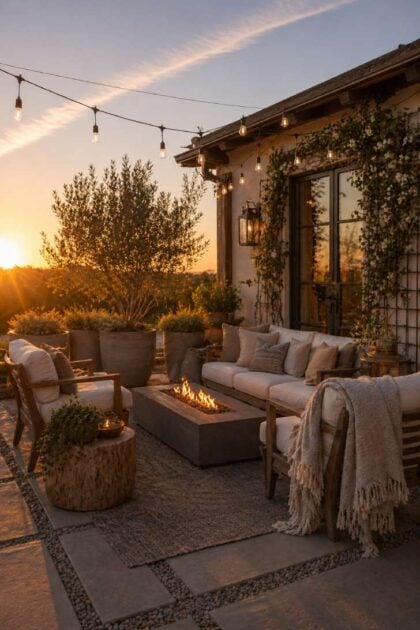
Add a Fire Table as the Centerpiece
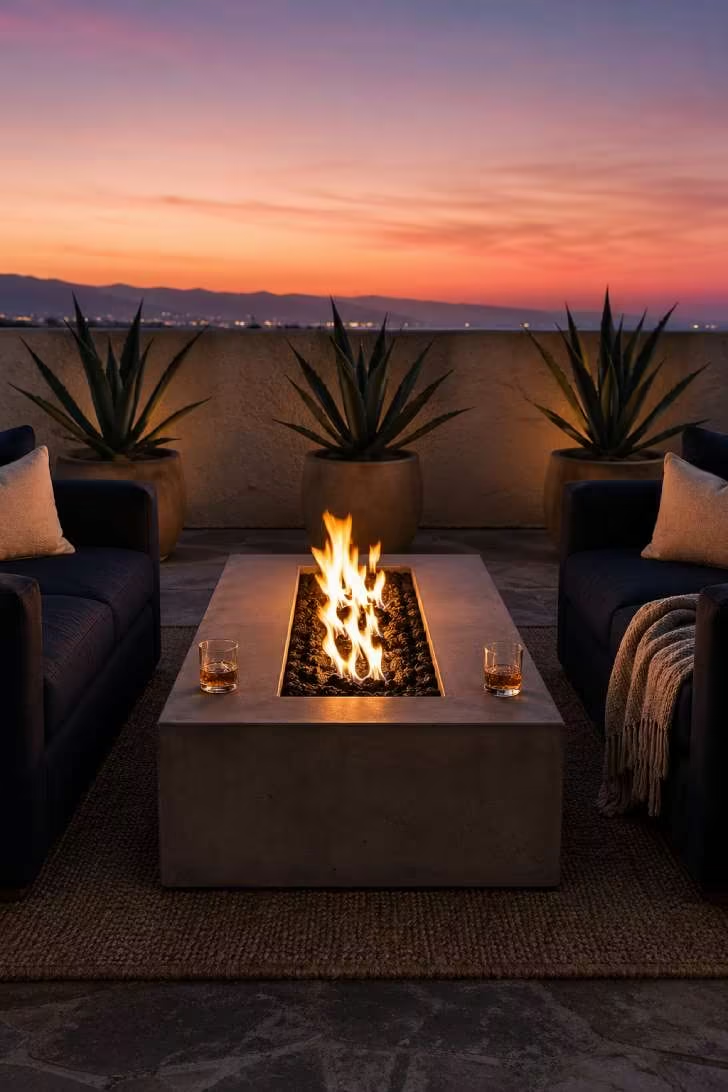
A fire table does what no other piece of patio furniture can — it gives people a reason to sit down and stay.
The flame draws every eye toward the center, which naturally pulls chairs closer and conversations longer.
Linear gas models with a recessed trough of lava rocks or fire glass look clean and modern; they run on propane or natural gas and light with a switch, which removes the whole debate about kindling and lighter fluid.
The warmth isn’t just atmospheric either.
A fire table can extend your patio season by weeks on either end, making April evenings and late October comfortable without a jacket.
Position it low enough that flames sit below sight lines so people can talk across the table without a wall of fire in between.
Style Blueprint:
- Rectangular gas fire table in concrete, steel or stone composite
- Dark lava rocks or tempered fire glass
- Deep-seated lounge chairs angled toward the fire
- Woven or knit throw blanket for one armrest
- Low planters with drought-tolerant sculptural plants behind the seating
Use Oversized Planters with Architectural Plants
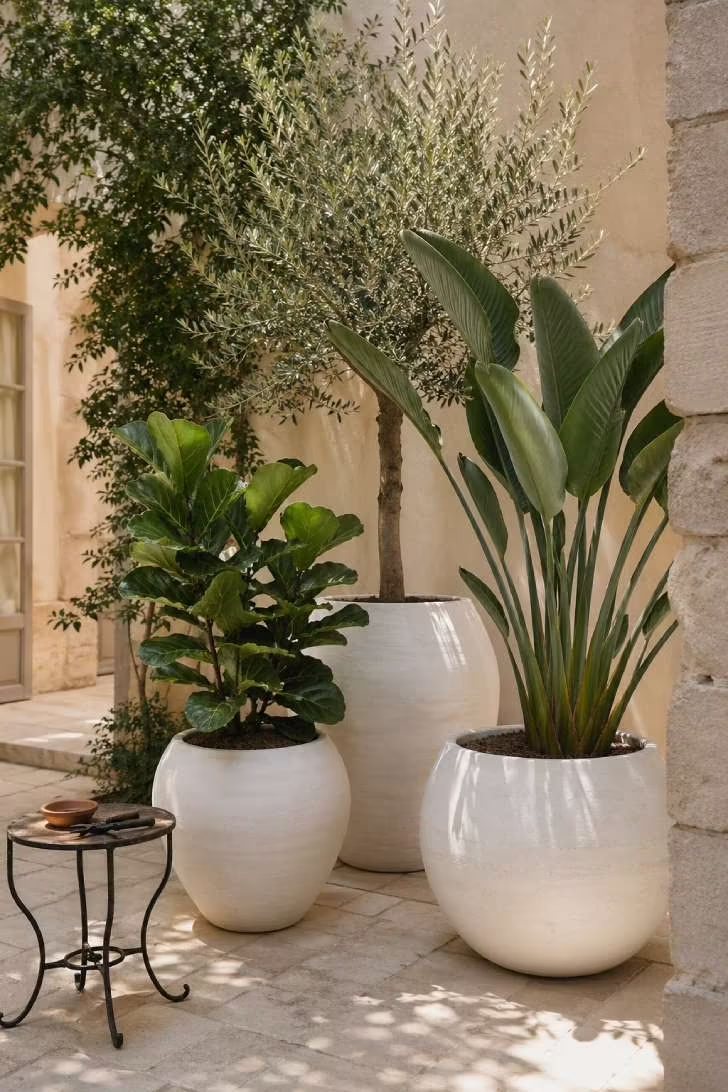
Big plants in big pots command attention the way that a cluster of small succulents never will.
A single olive tree in a matte ceramic planter becomes a focal point — guests notice it, walk toward it, even touch the leaves.
That pull is about scale.
When a plant occupies enough visual weight in the composition, it anchors the space the way a sofa anchors a living room.
Group them in odd numbers.
Three planters of different heights arranged in a loose triangle looks far more natural than four in a straight row, because asymmetry mirrors how plants actually grow in the wild.
Bird of paradise brings drama with its wide, upright leaves; fiddle-leaf fig adds glossy depth; an olive tree contributes that silvered, Mediterranean calm.
Style Blueprint:
- Three oversized planters in matte white, black or terracotta (varying heights)
- One tall specimen tree (olive, citrus or palm)
- One broad-leaf tropical (bird of paradise or banana leaf)
- One compact glossy plant (fiddle-leaf fig or rubber plant)
- Decorative garden stool or low side table for tools and accessories
Install a Pergola or Shade Structure
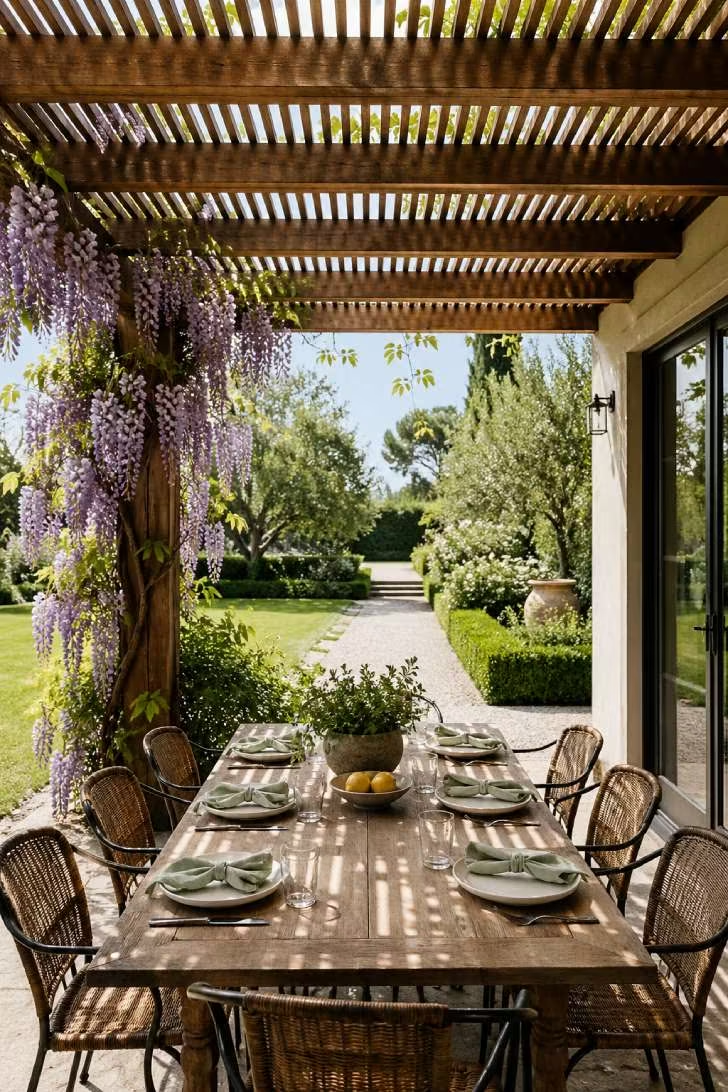
Shade changes everything about how long you stay outside.
Without it, a patio bakes by midmorning and stays abandoned until the sun drops behind the house.
A pergola — even a simple slatted one — filters light into stripes, creating that greenhouse warmth without the squint.
Bioclimatic models with motorized louvers let you adjust coverage throughout the day, opening fully on overcast mornings and closing tight when the sun peaks.
If that’s beyond the budget, a triangular sail shade bolted between the house and two posts costs a fraction and still carves out a usable pocket of cool air.
What shade does psychologically is lower the perceived temperature of a space by several degrees.
Dappled light reads as cooler and calmer than full sun, even when the thermometer says otherwise.
Style Blueprint:
- Slatted wood or aluminum pergola sized to cover the primary seating area
- Climbing plant (wisteria, bougainvillea or jasmine) on one post
- Outdoor dining set positioned underneath
- Linen or canvas napkins and stoneware for table styling
- Gravel or stepping stones leading away from the shaded zone
Set Up a Dedicated Dining Zone
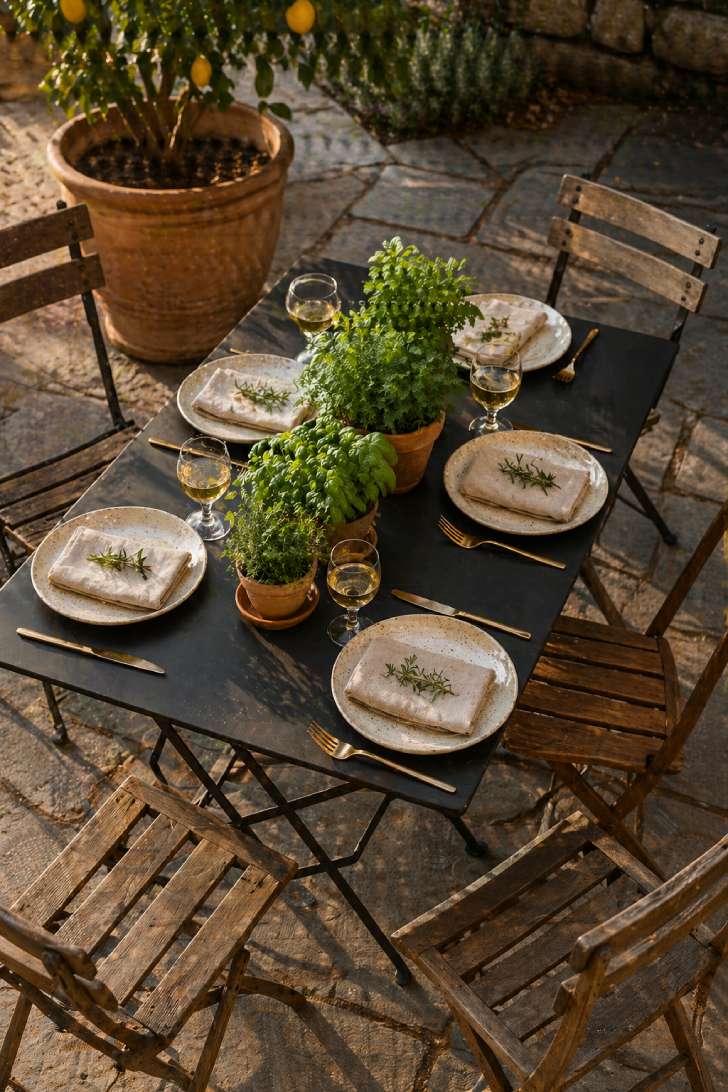
Eating outside hits different when the table feels set up for it rather than borrowed from the lounging area.
A dedicated dining zone — even a folding table with four chairs — signals that meals happen here on purpose.
That separation between where you eat and where you slouch with a book matters.
It gives each area a clear job, which makes the whole patio feel bigger because you’re using it in two distinct ways.
Style the table like you would indoors.
Real plates, cloth napkins, a low centerpiece that doesn’t block eye contact across the table.
Fresh herbs in small pots down the center pull double duty: they look good and you can tear off a basil leaf mid-meal.
Style Blueprint:
- Folding or stackable dining table in metal or weathered wood
- Four chairs (mismatched finishes add character)
- Handmade or artisan ceramic dinnerware
- Low herb garden centerpiece in small terracotta pots
- Cloth napkins in linen or cotton
Design Pro-Tip: Keep your dining centerpiece below 12 inches tall. Anything higher blocks sight lines across the table and kills conversation. Fresh herbs, a single low bowl of fruit or a cluster of three votive holders — all of these keep the visual path open between diners.
Drape Weatherproof Throw Blankets Over Seating
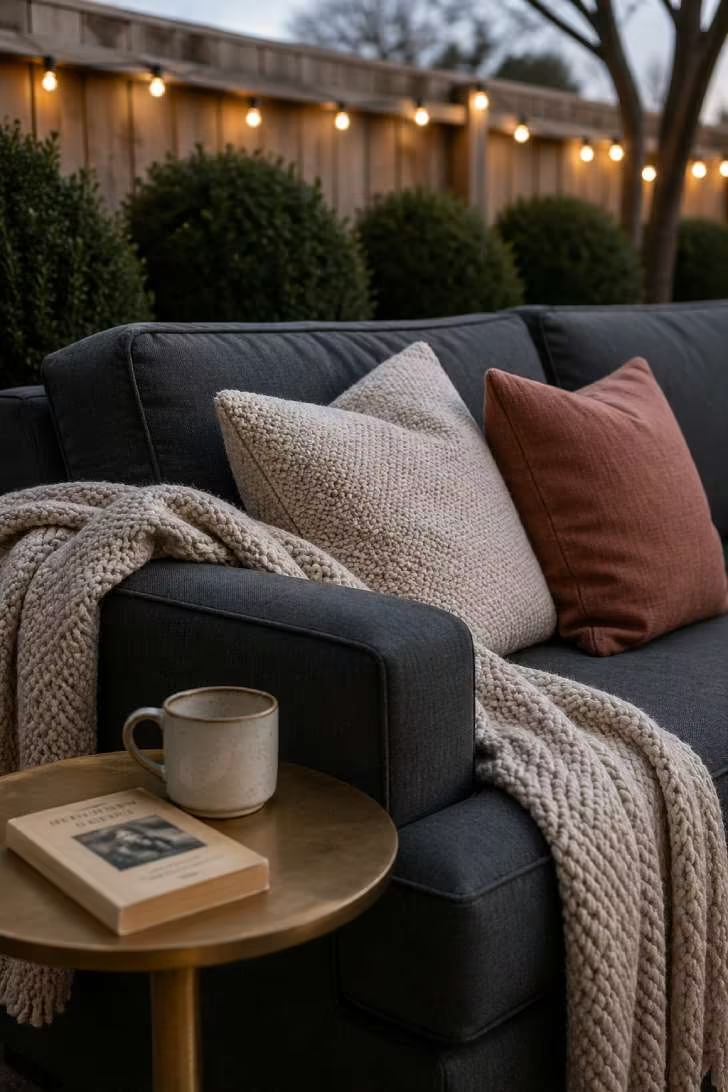
A throw blanket on an outdoor sofa tells your brain that comfort lives here.
It’s a small thing — a few square feet of fabric — but it shifts the patio from functional to cozy in seconds.
The weight of the blanket on your lap on a cool evening, the texture under your fingers when you reach for your glass, those sensory cues are what separate a patio you walk past from one you sink into.
Choose weatherproof fabrics (acrylic knits or polyester blends rated for outdoor use) so you’re not hauling blankets inside every time clouds roll in.
Drape them casually rather than folding them neatly — the undone look reads as lived-in, like someone just got up and will be right back.
Style Blueprint:
- Chunky knit or woven throw blanket in weatherproof fabric
- Deep outdoor sofa or oversized lounge chair
- Two to three textured throw pillows in earth tones
- Small brass or wood side table within arm’s reach
- Ceramic mug or tumbler for styling
Add a Privacy Screen with Climbing Plants
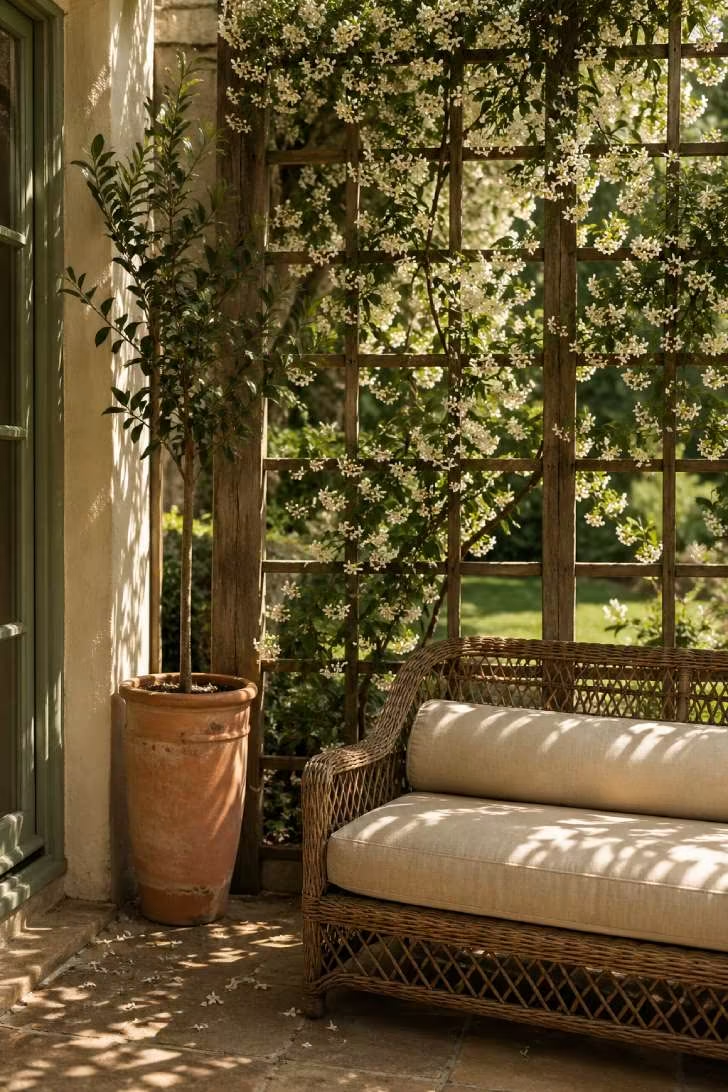
Privacy on a patio isn’t about building a fortress.
It’s about creating just enough visual separation that you stop thinking about the neighbor’s yard and start thinking about your own space.
A trellis panel with climbing jasmine does this beautifully — the vines fill in over a season or two, producing small white flowers that smell like summer evenings and blocking sight lines without blocking airflow.
Reed fencing and bamboo screens work faster if you need instant coverage.
Layer them: a low hedge at ground level, a mid-height planter and a tall trellis behind it.
That graduated approach builds depth into the boundary rather than slamming up a flat wall.
The fragrance from jasmine or honeysuckle adds another dimension entirely — a patio privacy screen that smells good is one you’ll notice every time you step outside.
Style Blueprint:
- Wooden trellis panel (4-6 feet tall)
- Star jasmine, honeysuckle or climbing rose
- Low wicker loveseat or bench in front of the screen
- Tall narrow planter with a bay laurel or boxwood topiary
- Bolster cushion in natural linen or canvas
Paint an Accent Wall in a Rich Color
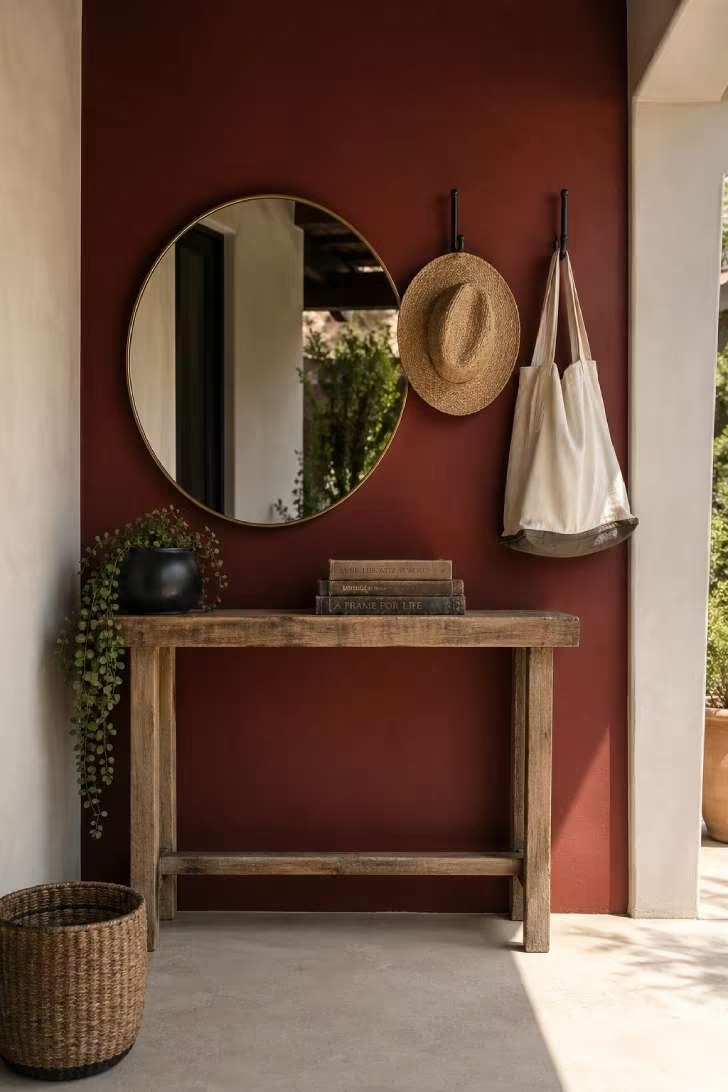
One painted wall changes the entire personality of a patio.
Deep oxblood, forest green, burnt clay — these saturated colors create a backdrop that makes every piece of furniture in front of it look more intentional.
The color absorbs light instead of bouncing it, which lowers the visual temperature of the space and adds a sense of enclosure that open-air patios often lack.
You don’t need to paint every surface.
A single wall — preferably the one your seating faces — is enough.
It becomes the anchor, the way a headboard wall works in a bedroom.
Choose a matte or eggshell finish for exteriors; high gloss shows every imperfection and reads as commercial rather than residential.
Style Blueprint:
- Exterior-grade paint in a saturated matte finish (oxblood, deep olive or navy)
- Slim console table or floating shelf in reclaimed wood
- Round mirror in a thin brass or black frame
- One trailing plant in a matte pot
- Wall hooks for hats, bags or lanterns
Set Up a Compact Bar Cart
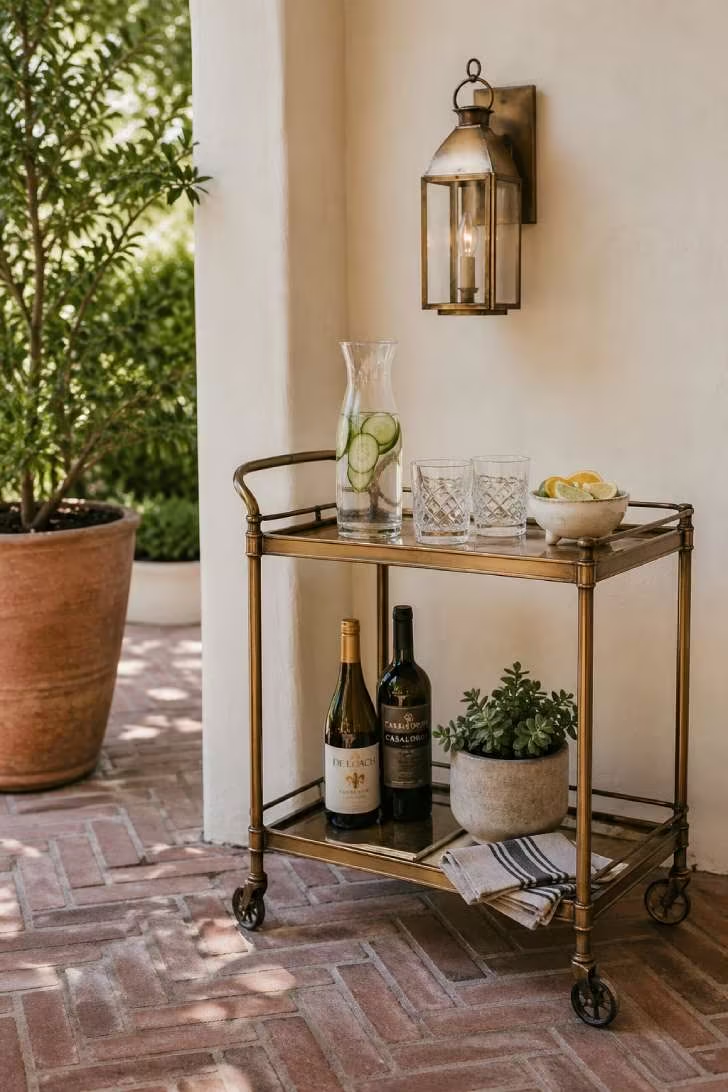
A bar cart on the patio is less about cocktails and more about having a station.
It’s where glasses live, where the water carafe sits, where you drop your phone and sunglasses when you come outside.
The wheels mean it rolls to wherever the gathering happens — next to the fire table, beside the dining setup, into the shade when the sun shifts.
Style it the same way you’d style a bookshelf: functional items (glasses, a bottle opener, napkins) mixed with one or two decorative ones (a small plant, a pretty bottle, a ceramic dish of olives).
The cart works hardest when it’s half full rather than packed.
Negative space on the shelves keeps it looking curated.
Style Blueprint:
- Bar cart in brass, black metal or rattan with wheels
- Glass carafe or pitcher for water or lemonade
- Two to four quality glassware pieces
- Small potted plant or succulent on the lower shelf
- Linen napkins and a small bowl for garnishes
Design Pro-Tip: Roll your bar cart into the shade. Ice melts slower, wine stays cooler and guests naturally migrate toward the drinks — which means you’re steering foot traffic away from the grill or dining table during the awkward “everyone’s standing in the kitchen” phase of outdoor entertaining.
Place a Statement Lantern at Table Height

One good lantern does more for evening atmosphere than a dozen tea lights scattered across a table.
The scale matters — a lantern that stands 18 to 24 inches tall at table height puts warm light exactly where faces are, which is the zone that counts.
Moroccan-style metal lanterns with geometric cutouts throw shadow patterns onto nearby walls, turning a blank surface into something that moves and breathes after dark.
LED pillar candles inside solve the wind problem without sacrificing the look; the glow through the cutouts is the same whether the flame is real or not.
Position the lantern on a side table rather than the center of a dining table, where it would block sight lines.
Off to the side, it lights the conversation without interrupting it.
Style Blueprint:
- Oversized metal lantern (18-24 inches tall) in brass, black or aged copper
- LED pillar candle with a warm amber glow
- Low wooden or stone side table
- Deep-seated lounge chair nearby
- Cream or neutral throw pillow for contrast
Introduce a Patterned Tile Accent
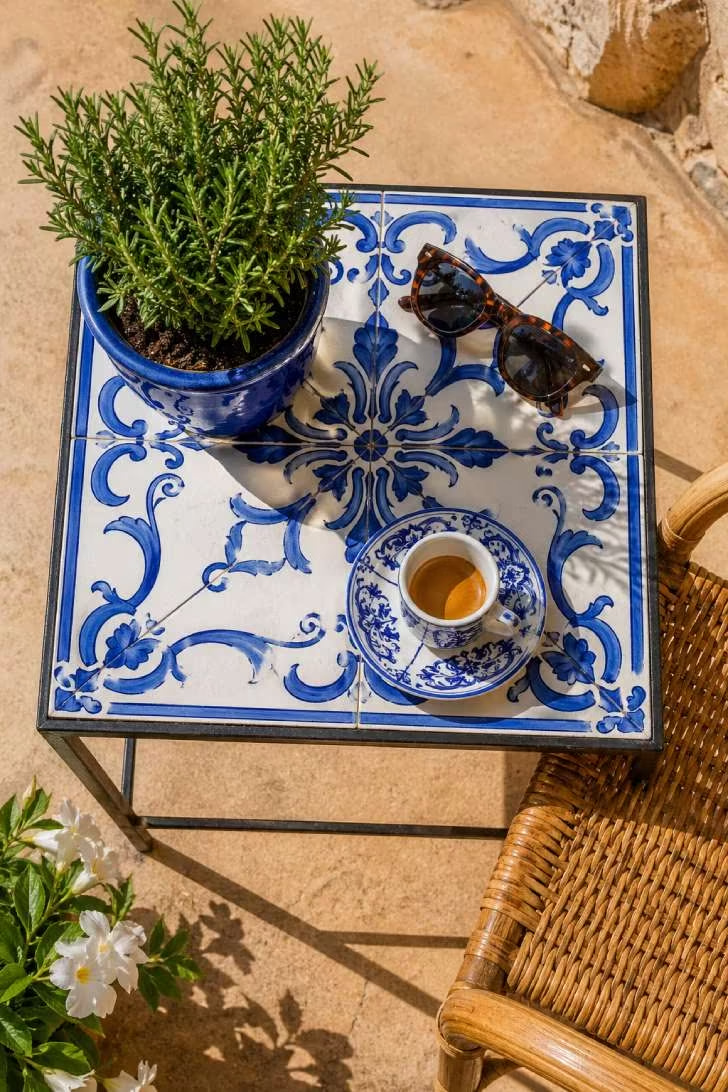
Patterned tile brings the energy of a Lisbon courtyard or a Marrakech riad to your patio without a full renovation.
You don’t have to re-tile the floor — a single accent on a side table top, a tray or a planter surround is enough to introduce the pattern.
Peel-and-stick tile decals work on smooth surfaces and come off cleanly, which makes this renter-friendly too.
Blue-and-white is the classic pairing, but terracotta-and-cream or black-and-sage give the same geometric interest with a warmer, quieter feel.
The pattern adds visual texture at close range, the kind of detail people notice when they set down their glass and really look at where they’re sitting.
Style Blueprint:
- Small side table with a tile inlay or peel-and-stick tile accent
- Glazed ceramic planter in a color that picks up the tile pattern
- Espresso cup or small beverage glass for styling
- Woven rattan or teak chair nearby
- Bright, sun-tolerant herb plant (rosemary or thyme)
Swap Textiles by Season
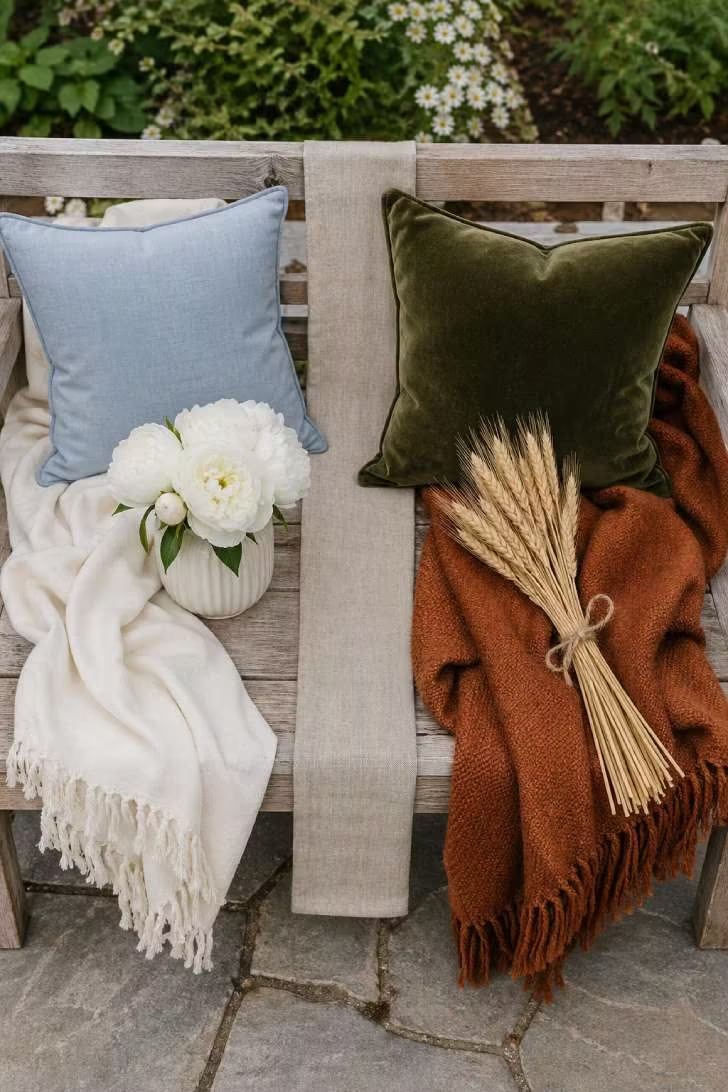
Changing your patio textiles is the outdoor equivalent of rotating your wardrobe.
Lighter linens, pale blues and whites for summer; heavier knits, burnt sienna and olive for fall.
The swap takes fifteen minutes and costs nothing if you already own the pieces — and it keeps the patio from looking the same in September as it did in June.
Your brain registers seasonal cues through color temperature and texture weight.
Cool, lightweight fabrics signal warm weather relaxation; heavier, richer textures signal nesting and warmth.
Matching those cues to the actual season outside makes the space feel responsive rather than static.
Store off-season textiles in a weatherproof deck box or the storage compartment under a banquette seat.
Style Blueprint:
- Summer set: lightweight cotton throw, pale linen pillows, fresh flowers
- Fall set: woven wool-blend throw, velvet or corduroy pillows, dried botanicals
- Weatherproof storage box or under-bench compartment
- Linen table runner as a transitional base
- Two to three pillow covers per season (removable covers save space)
Carve Out a Reading Nook
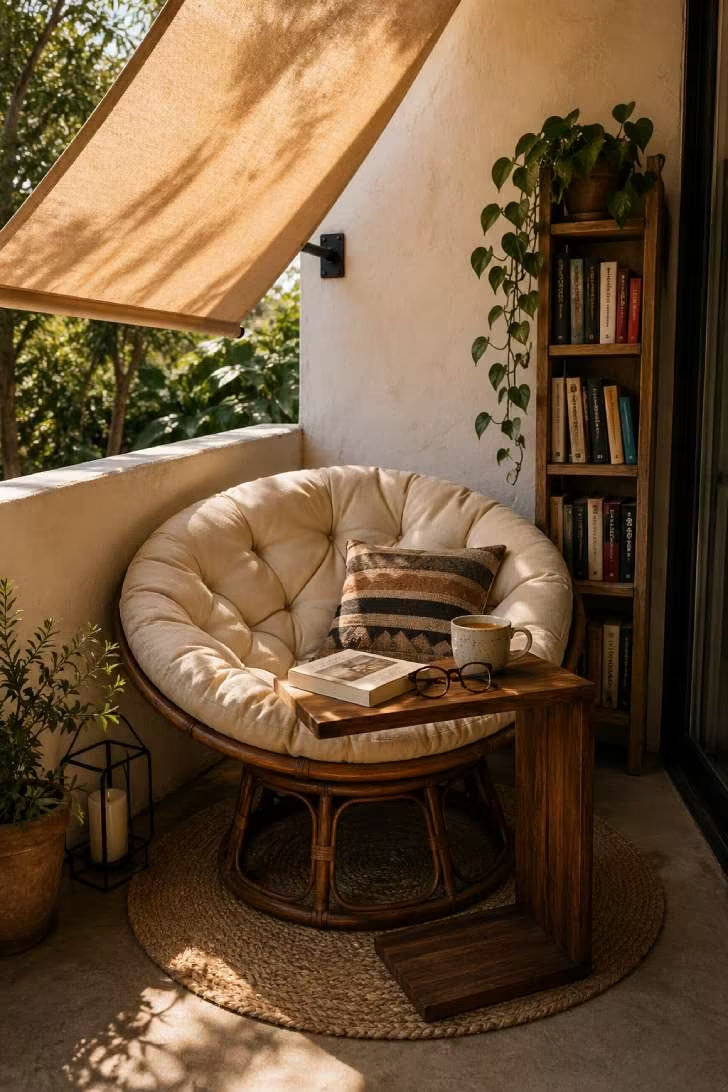
Not every spot on the patio needs to face the group.
A single deep chair in a shaded corner, a slim side table and something to read — that’s a reading nook, and it works even better outside than it does indoors.
The ambient noise of wind, birdsong and distant neighborhood sounds creates a kind of white noise that helps concentration.
The chair should be deep enough to curl into.
Papasan chairs, hanging egg chairs or a wide Adirondack all qualify.
Shade is the non-negotiable — a wall-mounted shade cloth, an overhanging tree or a position under a pergola keeps the sun off the page and the reader’s neck.
A C-table that slides over the chair arm puts a drink within reach without requiring you to unfold.
Style Blueprint:
- Deep papasan, hanging egg or wide Adirondack chair
- Thick cushion in a neutral, washable canvas
- Slim C-table or swing-arm side table
- Small bookshelf or magazine basket
- Wall-mounted shade cloth or positioning under existing shade
Design Pro-Tip: Face your reading nook away from the main seating area. The physical separation — even just angling the chair toward a garden wall instead of toward the table — creates a psychological break that makes the nook feel like its own room. You’re still on the patio, but you’ve left the gathering.
Build a Custom Shelf or Bench from Reclaimed Wood
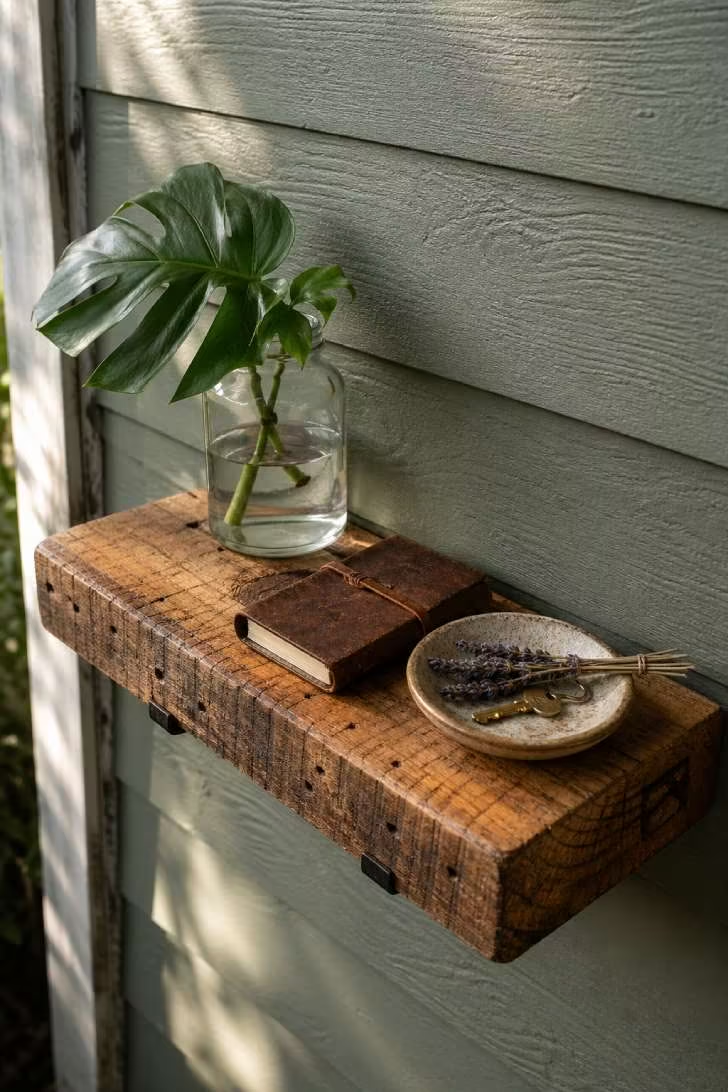
Reclaimed wood carries a history that new lumber never will.
The saw marks, nail holes and weathered grain of salvaged barn wood or old-growth cedar give a shelf or bench a texture that would cost a fortune to manufacture from scratch — and it’s free if you know where to look.
Architectural salvage yards, demolition sites and online marketplaces regularly sell planks thick enough for a floating shelf or sturdy enough for a simple bench.
Sand it lightly to remove splinters but leave the patina intact.
That aged surface catches light differently than smooth, milled wood — it absorbs some, reflects some and creates micro-shadows in the grain that add visual depth at close range.
A single plank shelf on a painted wall becomes a display for objects that matter: a plant cutting, a worn book, a ceramic dish.
Style Blueprint:
- Thick reclaimed wood plank (minimum 2 inches for visual weight)
- Heavy-duty floating shelf brackets rated for exterior use
- Propagation vase or small plant in a simple container
- Two to three personal objects with varied heights
- Light sanding only — preserve the original patina and imperfections
Group Lanterns and Vessels on a Tray
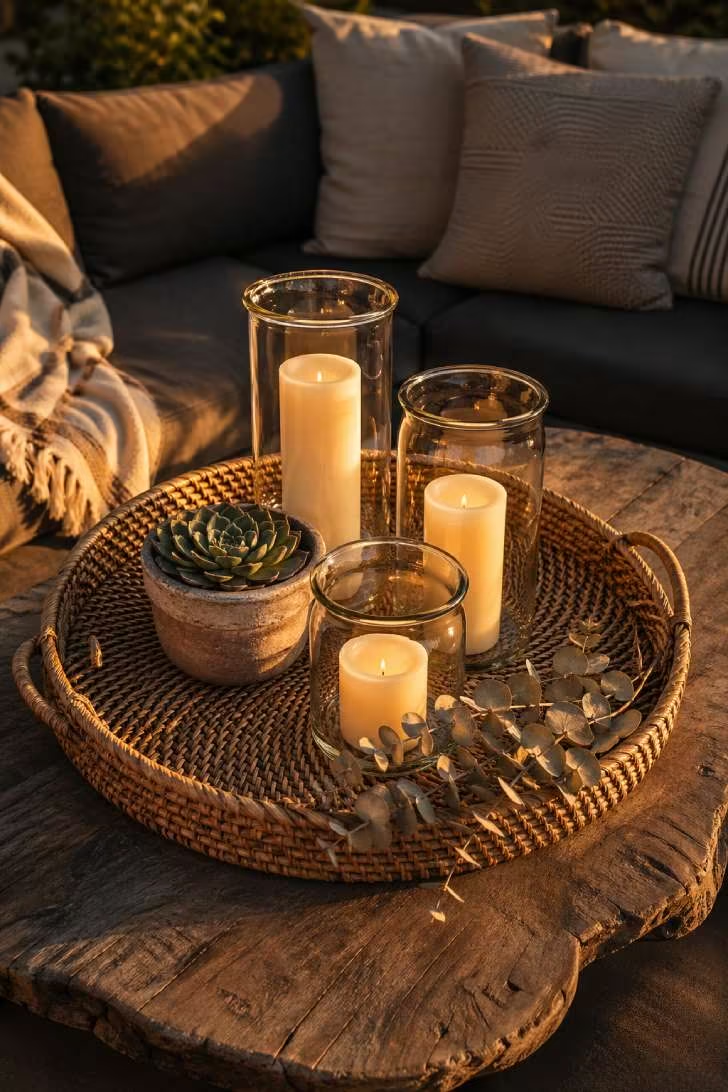
A scattered collection of objects across a table reads as clutter.
The same objects grouped on a tray read as a vignette.
The tray is the frame — it contains the arrangement and tells your eye that everything inside belongs together.
Three hurricane lanterns at different heights create a staggered skyline of warm light after dark.
A small potted succulent and a sprig of dried greenery fill the gaps without overcrowding.
The whole thing can be lifted off the table in two seconds when you need the surface for plates or drinks.
Round trays on rectangular tables (or vice versa) create a pleasing contrast of shapes.
Woven rattan, hammered metal or reclaimed wood trays all work — pick a material that echoes something else on the patio so the tray feels connected to the larger scene.
Style Blueprint:
- Large round or oval tray in rattan, metal or wood
- Three glass hurricane lanterns in graduated heights
- Cream LED pillar candles
- One small potted succulent or air plant
- Dried eucalyptus, lavender or olive branch as a finishing touch
Design Pro-Tip: Build your tray arrangement in odd numbers. Three lanterns, one plant, one botanical sprig — that’s five elements total. Odd groupings look more relaxed and organic than even ones because they resist symmetry. Your eye keeps moving around the arrangement instead of splitting it down the middle and stopping.
Final Thoughts
Starting with even one of these ideas — a rug, a throw blanket, a single oversized planter — shifts how you feel when you step outside.
The patio is already there.
It’s just waiting for you to treat it like the room it’s been all